




Abstract
A study was conducted with the objective of determining the effect of deficit irrigation on maize (Zea mays L.) under conventional, fixed, and alternate furrow irrigation. The experiment was conducted at Jimma Agricultural Research Center (JARC) in 2014/2015 and 2015/2016 dry periods. Nine treatments of different deficit irrigation levels were factorial combined and randomized in plots, and all cultural practices were done. The crop water requirement was calculated using the CROPWAT8.0 program. Yield and growth parameter data were recorded, and analyzed using SAS software. The two-year over-all statistical analysis result showed that, different deficit irrigation levels had a significant effect (p<0.05) on grain yield, ear height, fresh biomass, 100 seed weight, girth, and water productivity. However, there was no significant effect (p > 0.05) on plant height and internode length. The result revealed that 100% ETc conventional furrow gave the highest grain yield (106.1 Qun/ha), followed by 75% ETc conventional furrow (101.23 Qun/ha) and 50% ETc conventional furrow (81.86 Qun/ha). The minimum yield of 55.64 Qun/ha was obtained at a fixed 50% furrow irrigation, and there was a 52.44% yield improvement. The maximum fresh biomass of 196.5 Qun/ha was obtained from 100% conventional furrow, and the minimum 103.40 Qun/ha was at 50% fixed furrow irrigation. The maximum and minimum water productivity of 8.007 and 2.8 kg/m3 were obtained at 75% conventional and 100% fixed furrow irrigation, respectively. Considering the water productivity, net economic benefit and sustainable production of the crop in the agroecology of the study area, combination of 55% up to 85% of deficit irrigation level with conventional furrow irrigation system could be recommended for the production of maize in a deficit furrow irrigation method. Based on the observations made and the statistical analysis done, fixed furrow irrigation was not recommended for the study area.
Introduction
Sustainable agricultural production, the world’s largest user of freshwater and source of water scarcity, faces a major challenge in addressing the reduction of freshwater availability brought on by massive population growth, industrialization, climate variability, climate change, and unproductive water loss (Chareesri et al., 2020). Besides the well-known water-scarce regions of arid and semi-arid regions, water scarcity can also occur in areas with ample rainfall, both in quantity and quality (Capra et al., 2008). Since crop production in agriculture is the first sector to be immediately impacted by climate change, there is a significant correlation between food safety and water scarcity. The availability, spatial and temporal variability of rainfall in many countries, as well as water stress and limited irrigation water accessibility, have all been linked to climate change (Yan et al., 2015). Water scarcity, according to Panda et al. (2021), leads plants to downregulate a number of physico-chemical processes, severely damaging cellular functions through oxidative stress and resulting in a large loss of yield. Water scarcity may be caused by both a physical lack of water and inadequate institutional organization. Consequently, the agriculture sector needed to develop new technology to address the water scarcity sustainably through water-saving practices, primarily in irrigated agriculture such as improved irrigation application methods, on-farm irrigation scheduling, and drainage, in order to increase production, enhance yields, reduce crop failure risks, and enable year-round farming (Hussain & Hanjra, 2004; Kulkarni, 2011).
Diverse approaches have been implemented globally to optimize the utilization of accessible water resources for efficient water management and to augment crop productivity in irrigated farming. Enhancing crop productivity and water use efficiency could be possible with the use of deficit irrigation, or water savings irrigation. Deficit irrigation is a water saving irrigation strategy, which is becoming popular in arid and semi-arid areas. According to the migration law of production attributes during crop growth, it uses limited water resources to achieve the estimated crop yield (Li et al., 2022). Through the use of deficit irrigation, crops are subjected to varying degrees of water stress for a portion of the growing season or all of it, with the expectation that the benefits of using the conserved water on other crops will outweigh any yield reduction (Kirda, 2002). Only when water is easily accessible and irrigation expenses are modest can full irrigation be justified economically (James, 1993). The strategy of deficit irrigation aims to allow maximum profit per water unit or per land unit through optimum water depth, depending on whether land or water is the limiting constraint and if the major strategic goal is the maximization of food production or profit (Capra et al., 2008). Utilizing scarce water resources more wisely may be possible if one is aware of when irrigation is crucial for crops in humid and sub humid environments (Sweeney et al., 2003).
Maize (Zea mays L.), is a major cereal crop that is extensively cultivated throughout Africa and is the primary ingredient in food aid programs (Jama et al., 2017; Leonardo et al., 2015). In terms of total production, it is in second place globally behind wheat and ranks third among the cereals (Food and Agriculture Organization Corporate Statistical Database, 2017). Despite teff being the most widely grown cereal crop in Ethiopia, with an estimated 2.1 million acres under cultivation, maize is the most productive crop with an annual production of 8.4 million tons (Central Statistical Authority [CSA], 2021). The crop kernel, which has a starch content of 77%, is utilized for both animal feed and industrial purposes (Onasanya et al., 2009; Asim et al., 2017). According to OECD, FAO (2018), maize is predicted to account for 58% of the total cereal crops in developing countries by 2027. It is extensively utilized by the fuel industry and brewers to produce ethylic alcohol (Dabija et al., 2021). Ethiopia covers a vast area of maize, but the average yield per person is just 3.9 t/ha (CSA, 2021), less than the 4.9 t/ha experimental yield (Faostat & Production, 2016) and the 13.9 t/ha water-limited yield potential (GYGA, 2021).
In addition to climate change, poor crop management practices, water availability, and soil quality severely restrict maize production. Climate change is expected to reduce maize grain yield by 8.34%, 9.14%, and 4.69% by 2030, 2050, and 2070, respectively (Chinasho et al., 2023). Conversely, it was predicted that by 2050, the demand for food, especially maize, would rise by 70% (Du Plessis, 2017). Due to these conflicting issues, there may be a shortage of food. Irrigation and water management are key to addressing these significant production-limiting issues and can ensure sustainable crop production. Sustainable water resource usage and mitigating the negative effects of climate change may be aided by effective irrigation management techniques (El-Nashar & Elyamany, 2023). Through climate smart maize production, it is possible to increase output while reducing environmental pollution in the face of climate change (Borowski, 2020). Applying too much or too little irrigation water might restrict maize growth and development, which lowers output (Bailly, 2019; Rudnick & Irmak, 2013). Similarly, Admasu et al. (2019a, b), found that irrigation only based on crop water requirements is not an option, especially in areas where water resources are limited. Hence, determining the irrigation technology that enhances yield and economic benefit through water saving considering the topography of the command area is imperative for maize production.
The terrain of the command area is taken into account when choosing the optimal irrigation technique since it may not be possible to get irrigation water close to the irrigation field, which could cause a delay in water delivery and have an impact on the overall performance of crop production. One of the most common surface irrigation techniques utilized in Ethiopia on agricultural and commercial fields is furrow irrigation, which can be applied in the form of an alternating, fixed, or conventional furrow (Faures et al., 2001). Deficit irrigation of maize spread over the whole growing season may not necessarily result in an increase in crop water productivity because different growth stages vary in their susceptibility to reduced water application (Narayanan & Seid, 2015). It is essential to know the response of deficit irrigation in a water scarce area due to the location of the water in gorges to use the cost of water used for pumping to deliver to the field (economical water use) and for sustainable irrigation water management. Hence, it is important to know the crop response to water deficit and irrigation methods of a given area. Therefore, the objective of this study was to assess the impact of deficit irrigation on maize (Zea Mays L.) crop under different furrow irrigation methods.
Materials and Methods
Description of the study site
The experiment was conducted at the Jimma Agricultural Research Center (JARC) for two consecutive years in 2014/2015 and 2015/2016 dry periods (Figures 1 and 2). The site is located at 7°46′N latitude, 36°02′E longitude, and at an altitude of 1,753 m above sea level (Figure 1). The area receives an average annual rainfall of up to about 1,710 mm distributed non-uniformly, with monthly mean maximum and minimum temperatures of 25.90°C and 11.30°C, respectively. The soil texture had been classified as sandy loam soil, and the available water holding capacity per unit meter of the soil profile in the root zone was 121 mm/m (Figure 3).
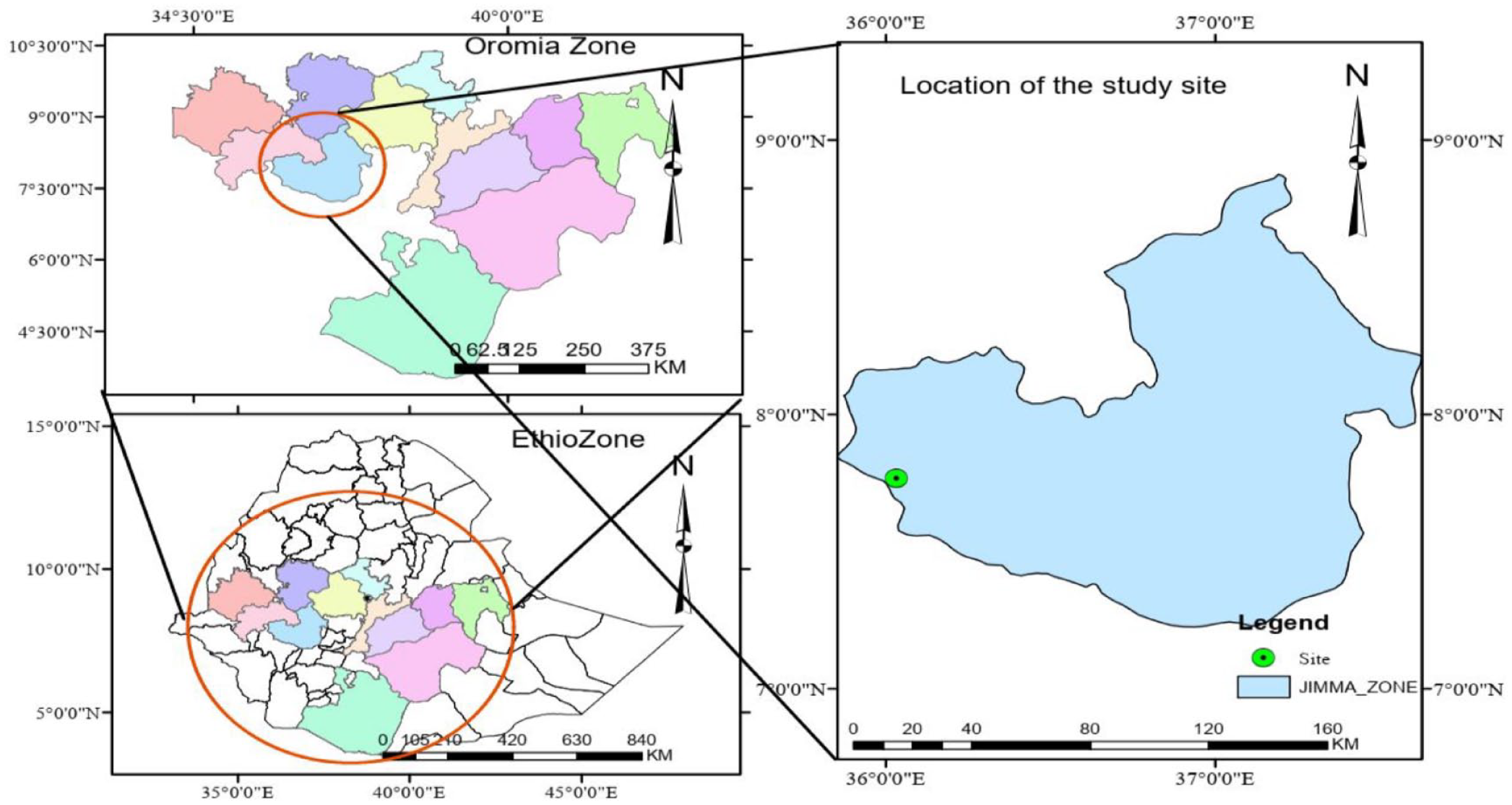
Location map of the study site.

Climatic condition of the site during 2014/2015 cropping season.

Climatic condition of the site during 2015/2016 cropping season.
Many irrigation research activities were conducted at Jimma Agricultural research center under irrigation and water harvesting research program. Among promising results were, deficit irrigation on soybean (Robel et al., 2019a, b); effect of moisture stress at different growth stages on common bean (Admasu et al., 2019a, b); response of supplementary irrigation on maize (Tilahun et al., 2023); and irrigation scheduling (Robel et al., 2019; Tilahun et al., 2021) are the major one. Even though these were the research outputs generated, still there is a gap on determining the effect of deficit irrigation and different furrow irrigation systems on maize, which is one of the major crops in the agro ecology and cultivated highly on the farmer’s field.
Experimental design and management conditions
A field experiment was carried out in the off-seasons of 2014/2015 and 2015/2016 cropping seasons on BH 661 maize variety. Since there is equal size of replications, that contains the nine treatments and because of its simplicity and flexibility of application, Randomized Complete Block Design (RCBD) with three replications was used following the procedure of Gomez and Gomez (1984). Nine treatments of different deficit irrigation levels were factorial combined and randomized in plots, as shown in Table 1. The experiment included three furrow irrigation systems and three irrigation levels. The irrigation systems were used following an observation made from the farmers practice and the irrigation levels used were to give a scientific evidence based on the optimal irrigation scheduling that can supply the determined amount of water and its schedule. The three-furrow irrigation systems were Alternate furrow irrigation (AFI), fixed furrow (FFI), and Conventional furrow irrigation (CFI) and the three irrigation levels were 100% ETc, 75% ETc, and 50% ETc of the crop water requirement. The experiment had 9 treatment combinations and 27 plots. Each individual plot had an area of 3.0 m × 3.0 m = 9.0 m2, which consists of five (5) rows. The recommended spacing of 75 and 30 cm between rows and plants was adopted. Each experimental treatment was fertilized with the recommended fertilizer application rate, which was 175 and 100 kg/ha of DAP and urea, respectively. All cultural practices were applied to all treatments in accordance with the recommendations made for the area.
Treatment Arrangement.

Crop water requirement and irrigation scheduling
Crop water requirement was calculated using the CROPWAT8.0 model based on the FAO Penman Monteith method (Smith, 1992; Valiantzas, 2013). The CROPWAT8.0 model has the capability of calculating reference evapotranspiration of crops, water supply for an irrigation scheme of more than one crop, and determination of effective rainfall. Even though CROPWAT 8.0 was not used to predict yield it has been used for calculating crop water requirement and irrigation scheduling (Alhassan et al., 2015; M. El-Marsafawy et al., 2018; Muroyiwa et al., 2022; Ndayitegeye et al., 2020). In this study, a long year climate data for a period of 24 years (1990–2014) mainly maximum and minimum temperature, relative humidity, wind speed, and sunshine hours on monthly basis were collected from JARC meteorological station and used as an input data for the CROPWAT 8.0 model to estimate the potential evapotranspiration [ETo; equation (1)]. The crop water requirement of the maize was calculated by multiplying the ETo with crop coefficient [Kc; equation (2)] and irrigation requirement was calculated using equation (3). However, the crop coefficients at different growth stages were provided and adjusted according to Allen et al. (1998). Irrigation scheduling was calculated using the CROPWAT8.0 program and adopted using the depletion to determine the irrigation interval [equation (4)]. The total amount of rainfall data for the cropping period was recorded, and from that, the effective rainfall was used. Since the level of groundwater is below 2 m, the groundwater contribution was null.

Where: ET0 = is the reference crop evapotranspiration (mm/day);
Δ = is the slope of the saturation vapor pressure curve (kPa/°C);
Rn = is net radiation at the crop surface (MJ/m2 day);
G = is the soil heat flux density (MJ/m2 day);
T = is the mean daily air temperature at 2 m height (m/s);
U2 = is the wind speed at 2 m height (m/s);
es − ea = is saturation vapor pressure deficit (kPa);
es = is the saturation vapor pressure at a given period (kPa);
ea = is actual vapor pressure (kPa);
γ = is the psychrometric constant (kPa/°C).

Where, ETc = actual evapotranspiration by the crop (mm day),
ETo = reference evapotranspiration (mm/day), and
Kc = crop coefficient at a specific growth stage.
The net irrigation (IRn) at each stage was computed from the following expression:

Where Peff = effective rainfall (mm).
The irrigation interval was calculated by using the following formula:

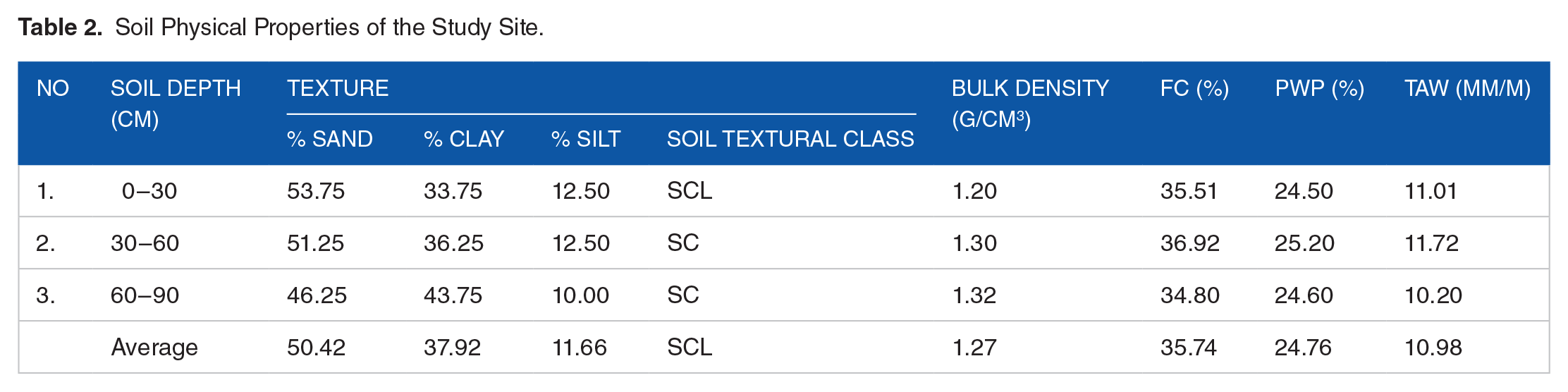
The water was applied by a surface irrigation system using a 3′ parshal flume, and the amount of water applied at each treatment was calculated from the full irrigation using the maize crop water requirement (CWR) at the crop rooting depth. A soil sample was collected at a 30 cm depth interval up to 90 cm depth from each plot using a soil auger, and the sample was weighed before oven drying at 105°C for 24 hours to a constant weight and both the physical and chemical properties were determined in the soil laboratory (Tables 2 and 3). The soil bulk density (BD) is also determined from the collected soil using core sampler using equation (5). Additionally, a soil sample was collected before and after irrigation for monitoring the soil moisture before applying the determined amount of water for the crop.

Soil Physical Properties of the Study Site.
Soil Chemical Properties of the Study Site.

To determine the optimum level of deficit irrigation, a quadratic equation was developed between the deficit irrigation level and obtained yield (English & Raja, 1996), using equation (6) as shown in Figure 4.

Where: Y = grain yield; I = Irrigation amount; a and b are constants

Graphical representation of yield and irrigation requirement of the treatments for net benefit.
Data collection
Yield and growth parameter data were recorded, and the quality of the data such as its relevance, accuracy, reliability, consistency, and its normality was checked using Microsoft excel. The treatments were compared based on grain yield and growth parameters, which include plant height, ear height, fresh biomass, 100 seed weight, internode length, and girth. Grain yield was calculated by harvesting the total number of plants in the experimental plot, and grain yield per plot was measured using an electronic balance and adjusted to 12.50% moisture and then converted to hectares. Fresh biomass was determined by harvesting all the plants from the net plot area at physiological maturity, weighing them, and converting to hectares. The water productivity was calculated by the ratio of harvested yield per total water used [equation (7)].

To determine the economic analysis, the partial budget analysis was carried out using the methodology described in CIMMYT (1998), by using grain yield data for analysis. The price of 1 kg of maize grain at the local market near the experimental site, the total price of 1 kg of fertilizer, and the average labor cost incurred for incorporating hectares of farmland from sowing to harvesting were taken as 12, 15, and 1,640 Ethiopian Birr (ETB), respectively, during the cropping year. Accordingly, the total variable cost (TVC) was calculated as the sum of all costs that are variable for a treatment compared to the control irrigation treatment. The gross benefit (GB) was calculated as the average adjusted grain yield (kgha-1) × grain price. Adjusted Yield (AY) refers to 90% of the total grain yield that was adjusted by a certain percentage to show the difference between the experimental yield and the yield farmers could expect from the same treatment. The net benefit was calculated by subtracting TVC from the GB. Similarly, a graph was developed between the net benefit and the level of deficit irrigation used to determine the most economical level or range of deficit irrigation level (Figure 5). The sensitivity analysis was also evaluated by considering the gross cost of production and the net benefit to be gained from the production. It was evaluated by assuming 10% increase in the total cost of return and by assuming a 10% decrease on the net benefit due to transportation, post-harvest problem, or storage problem (Figure 6).

Graphical representation of net benefit gained from each treatment.

Net benefit gained from each treatment with sensitivity analysis.
Data analysis
The data were statistically analyzed and combined for all years by Statistical Analysis Software (SAS) software. SAS is a software that enables to perform extensive data analysis. The main advantages of using SAS software is that it is easy to use, provides accurate results, and is widely used in a variety of industries. However, it requires complex syntax and this makes it difficult to operate simply. In this study, SAS software version 9.2 for Windows was used for analysis (SAS Institute, 1996). Whenever the treatment effects were found to be significant, a GLM test at 1% and 5% was performed to assess the significant difference among the treatment means.
Result and Discussion
Soil physical and chemical properties
As shown in Table 2, the average soil physical composition of sand, silt, and clay percentages was 50.42%, 37.92%, and 11.66%, respectively. Thus, according to the USDA soil textural classification, the percent particle size determination for the experimental site revealed that the soil texture is classified as sandy clay loam (SCL). The experimental soil of the trial site is classified as sandy clay loam, and the study soil has an average bulk density of 1.27 g/cm3. The bulk density shows a slight decrease with a 30 cm soil depth. This could be due to a slight decrease in organic matter with depth and compaction due to the weight of the overlying soil layer (Brady et al., 2008). The average total available water depth per meter depth in the soil was 10.98 mm (Table 2).
The average PH of the soil was 4.93 (Table 3). According to Liu and Hanlon (2012), a pH range from 5.5 to 7.0 is suitable for most crops since, from a solubility point of view, this pH range can assure high bioavailability of most nutrients essential for growth and development. Even though the preferred PH for maize growth is between 6.0 and 7.2, it has poor tolerance to low (<5.0) pH soils when aluminum toxicity reduces root development and manganese toxicity reduces plant development. Maize grows well on a range of soils but does best on deep, well-drained, fertile soils that are slightly acidic to neutral, pH 5.5 to 7.0 (White et al., 1997). From here, the soil needs amendment, mainly through lime application or adding enough irrigation water. According to Cox (1995), irrigation water with high alkalinity can gradually increase the pH of the soil or growing medium over time if enough is applied.
As shown in Table 3, the average soil organic matter is 3.79, and at a depth range of 0 to 30 cm, it is high, which shows that there was a high concentration in the top soil. This could be due to the application of irrigation water, which causes the accumulation of more organic matter in the soil, which enhances the growth of the crop. The average soil organic carbon is 2.20%, and it is at its maximum at the top (Table 3). A high organic carbon value shows that there was a high retention of water and could prolong the irrigation schedule.
The average cation exchange capacity (CEC) of the soil at the study site was 20.04 meq/100 g (Table 3). It is dependent on the parent materials from which the soil developed and the conditions under which it was formed. As shown in Table 3, the average phosphorus, magnesium, calcium, chloride, and available potassium were 1.62, 0.53, 2.63, 0.43, and 1.43, respectively, in the soil, which were safe for cereal crops.
Climatic condition and crop water requirement of maize
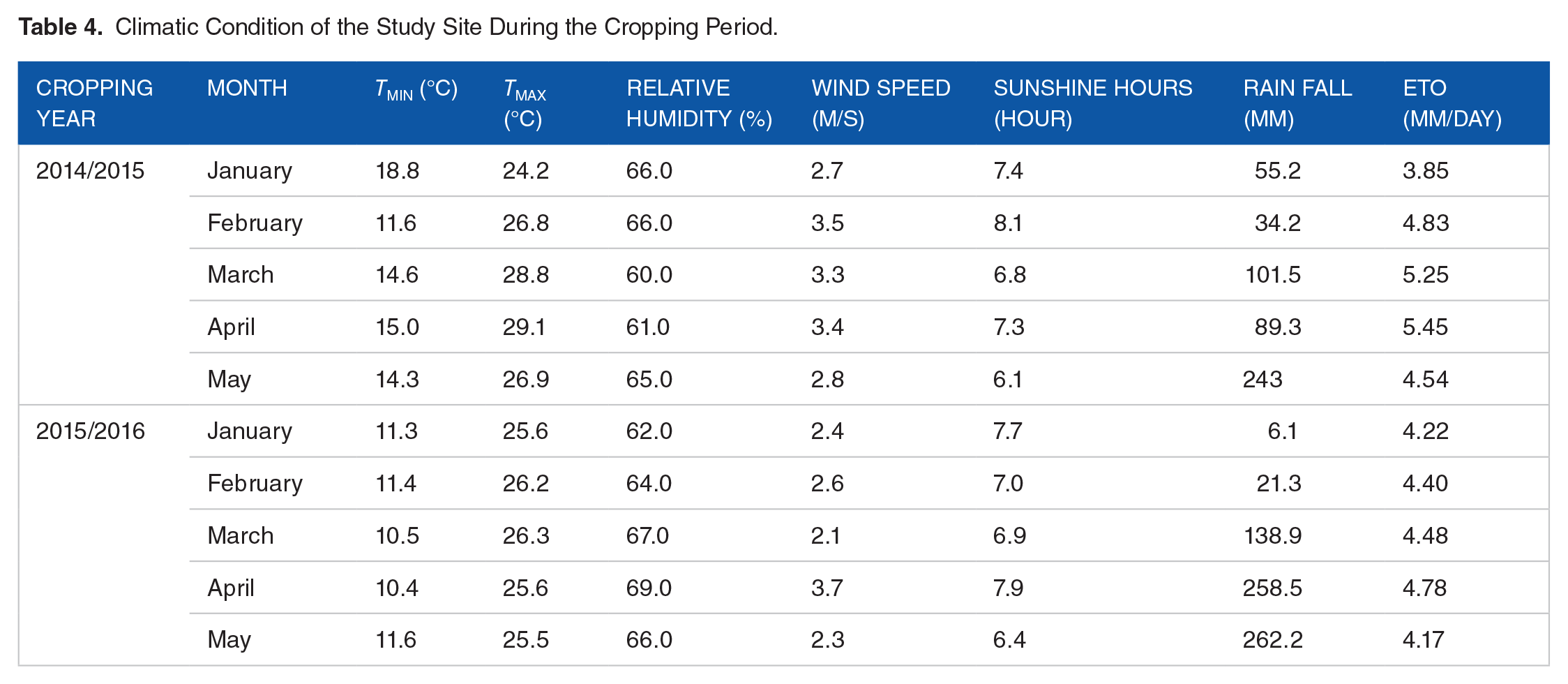
Knowledge of the agro ecology where crops are produced is among the suitability criteria for crop production. Climatic factors, mainly rainfall and temperature, affect the sustainable production of the crop, alter the planting date, and could cause a yield reduction (Bryan et al., 2009). According to Khaeim et al. (2022), temperature affects maize production from seed germination to grain filling, and it needs an optimal temperature range of 20°C to 22°C for the whole growing season (Neild & Newman, 1987). Climate change can reduce maize yield by 46% in semi-arid areas and may increase it by up to 59% in sub humid/ humid areas of Ethiopia in 2080 (Muluneh et al., 2015). As shown in Table 4, the climatic conditions are suitable for maize production in the off-season, and the rainfall during the cropping period were shown. From this, it is justified that there is a need of irrigation water for the full production of maize at the study site.
Climatic Condition of the Study Site During the Cropping Period.
The seasonal crop water requirement of maize was 542.50 and 599.20 mm depth in the cropping seasons of 2014/2015 and 2015/2016, respectively (Tables 5–8). It requires a net irrigation of 394.20 and 376.10 mm for the full development, which is 72.66% and 60.59% of the crop water requirement that has to be supplied through irrigation in the cropping season of 2014/2015 and 2015/2016, respectively. The variation was mainly because of the variability of the rainfall during the season and climatic condition. More than 50% of its total water requirement was needed after tasseling, and inadequate soil moisture at grain filling results in a poor yield of shriveled grains. Generally, the water requirement of maize in the agro ecology of Jimma could range from 500 to 640 mm of water per season. A study undertaken at Arba Minch by Mekonen also reported that a maize variety with a total growing period of 135 days from sowing to maturity requires 535.8 mm depth of water (Ayana, 2011), which is in a similar range to the current finding. Similarly, Tilahun et al. (2023) also obtained a crop water requirement of maize to be 532 mm depth of water on the study conducted to evaluate the amount of supplementary irrigation on the production of maize in a rain fed agriculture at JARC.
Crop Water Requirement and Irrigation Requirement of the Crop in Each Cropping Season.

Note. Where: ETc = reference evapotranspiration; CWR = crop water requirement Eff RF-Effective rainfall; NIR = net irrigation requirement.
Crop Water Requirement to be supplied in Each Treatment in a furrow (mm).

Irrigation Requirement supplied in Each Treatment in a furrow (mm).
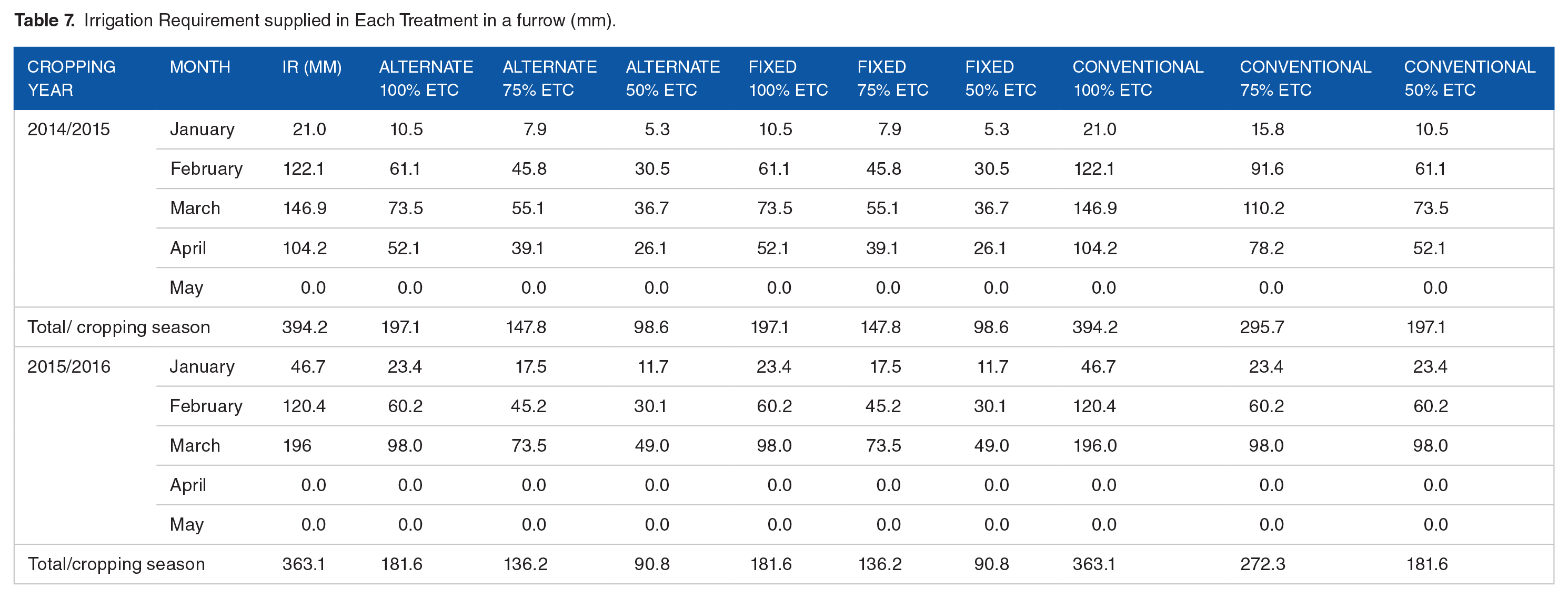
Overall Mean of Irrigation Requirement supplied in Each Treatment in a furrow (mm).

Effects of deficit irrigation on the yield and growth parameter of maize
Grain yield
The 2-year over-all statistical analysis showed that different deficit irrigation levels had a significant effect (p < .05) on grain yield (Table 9). The result revealed that conventional furrow 100% ETc gave the highest grain yield (106.1 Qun/ha), followed by conventional furrow 75% ETc (101.23 Qun/ha) and conventional furrow 50% ETc (81.86 Qun/ha; Table 9). The minimum yield of 55.64 Qun/ha was obtained at a fixed 50% ETc furrow irrigation, and there was a 52.44% difference between the maximum and minimum yields (Table 9). The uniform application of water to the root of the soil could be the cause of obtaining the maximum yield. Since, the soil root obtained enough amount of water, all the micronutrients were soluble, and the soil got the intended amount of water required for growth. Similarly, Shirazi et al. (2014) obtained a maximum maize crop yield of 7.99 tons/ha at conventional furrow irrigation at 100% ETc. Conventional furrow irrigation could be tedious and labor-intensive; however, the yield obtained was high. In the same manner, a study conducted at JARC on soybean obtained the maximum grain yield (1,901.8 kg/ha) at conventional furrow 100% ETc (Admasu et al., 2019a, b).
Effect of the Different Furrow Irrigation Treatment on Yield and Yield Components. .

Note. Numbers with the same letter are not statically significant @5% level of significance.
, **, and *** mean that the words written in short are written in full letter.
Where: Qun/ha = quintal per hectare; FBM = fresh biomass; HSW = 100 seed weight.
Plant height and ear height
Water is an important component of plant cells and a raw material for photosynthesis. Carbohydrates are manufactured from water combined with carbon dioxide (CO2) in the presence of sunlight. Water keeps the plant turgid; moisture deficiencies in plants result in cell flaccidity, and the plant drops and wilts. Tari (2016) and Jia et al. (2017) found that maize plants grown under sufficient moisture content produce high plant heights, while water-stressed conditions produce dwarf maize plants. According to a study conducted on tomatoes, plant height was a good index of plant vigor, which may contribute toward greater productivity because it has a significant positive correlation with leaf parameters such as number of leaves, leaf area, and leaf area index, as well as with the number of branches (Wali & Kabura, 2014).
The statistical analysis showed that, the rate of deficit irrigation has no effect on the plant height (p > .05), but the ear height was affected by the rate of deficit irrigation (p < .05; Table 9). The maximum ear height of 137.55 cm was obtained at 50% conventional irrigation, and the minimum ear height of 109.50 cm was obtained at 100% fixed irrigation. Even though there was no statistical difference in plant height, a maximum plant height of 247.00 cm was obtained at 75% conventional furrow irrigation. From this, it was observed that a water deficit has no effect on plant height except physiological stress. Since the water provided for the crop was affecting the root system and the productive part is mainly up to the ear height, there was a difference in both the growth and yield of maize. In addition to this, tall maize crops were susceptible to lodging and vulnerable to wind, rain, and will fall, which leads to low yield production. Similar to the current study, due to the application of irrigation water, ears per plant significantly increased and followed a similar pattern as the number of tillers per plant in a study conducted on wheat (Shirazi et al., 2014).
Fresh biomass (FBM) and 100 seed weight (HSW)
The statistical analysis reveals that both the fresh biomass and 100 seed weight were significantly (p < .05) affected by the rate of deficit irrigation. The maximum fresh biomass of 196.5 Qun/ha was obtained from 100% conventional irrigation, and the minimum was 103.40 Qun/ha at 50% fixed furrow irrigation (Table 9). Similarly, the maximum 100 seed weight of 79.80 g/plot and a minimum of 51.73 g/plot were obtained from 100% conventional and 50% fixed furrow deficit irrigation, respectively (Table 9). There was a 47.38% and 35.72% yield difference between the maximum and minimum fresh biomass weight and 100 seed weight, respectively. The irrigation quantity and method of application to the root of the crop could be the cause of the variation in fresh biomass and 100 seed weight. Similarly, Perez Mendoza et al. (2006) and Salas-Perez et al. (2010) observed that the quantity of irrigation water affects maize forage production. According to Alcaraz-Romero and Canton-Castillo (2021), irrigation water volume was observed to have a significant effect on the different evaluated variables, and the highest weight of fresh biomass was obtained from the highest irrigation water volume.
Internode length and girth
The statistical analysis showed that there was no significant difference (p > .05) in the internode length of maize, but the girth of the plant was affected (p<0.05) by the rate of deficit irrigation level. The data reveals that the highest girth of 29.4 mm was recorded at 50% alternate furrow irrigation, and the minimum of 23.6 mm girth diameter was recorded at 100% fixed furrow irrigation method (Table 9). The maximum and minimum internode lengths of 14.78 and 13.44 cm were recorded at 100% conventional and 50% alternate methods of furrow irrigation, respectively (Table 9).
Water productivity
In agriculture, water productivity is the amount of value in terms of benefits and services created per unit volume of water consumed. This value depends on the amount of output as well as the nutritional and socio-economic value of the output derived per unit of water consumed. The water productivity was significantly (p < .05) affected by the rate of deficit irrigation. The date reveals that the maximum water productivity of 8.007 kg/m3 was obtained at a 75% alternate method of furrow irrigation, and the minimum water productivity of 2.8 kg/m3 was obtained at a 100% fixed furrow irrigation (Table 9).
Economic analysis
The partial budget analysis result shows that there was a maximum and a minimum net benefit of 76, 399.20, and 40,060.80 Ethiopian Birr (ETB) from 50% conventional furrow irrigation and 100% alternate furrow irrigation, respectively (Figure 5). The economic benefit could be due to the efficient management of irrigation water in the field and the effective management and reduction on the number of the labor force. The determined quantity of water for the crop was applied to the crop based on their irrigation schedule, and other weeding and agronomic management was effectively managed up to the post-harvest process. There was a 52.43% net gain between the maximum and minimum net benefit. Even though the maximum was obtained from the 50% conventional furrow irrigation, there was a relatively low yield and water productivity, and there was a possibility of soil moisture drying from the other side of the furrow. Additionally, there was partial root zone drying, and this could lead to yield reduction and sustainability production being at risk. Therefore, considering this problem, it is advantageous to use 75% ETc conventional furrow irrigation for sustainable production, high yield, net benefit, and water productivity.
In case where the cost of production may increase and antagonistically the production may be affected due to the post-harvest and low market cost, the producer (farmer) may be affected relatively. In this case, the sensitivity of the economic benefit was estimated. It reveals that, the maximum and minimum net benefit of 64,443.8 and 31,638.57 ETB could be obtained from the 100% conventional and 50% fixed deficit irrigation (Figure 6). Since the marginal rate of return is greater than 50%, the farmer will not lose the total production and not at risk in both cases, except the net benefit to be gained.
Conclusion
In addition to the spatiotemporal variability of rainfall distribution, the major limitation of water resources in the Jimma Zone is its location on the shore and gorges near agricultural land. Hence, it needs a pump or irrigation structure to deliver the water from its source, and this requires an additional cost. Therefore, studying deficit irrigation was essential for economic benefit in addition to yield improvement through effective irrigation water management. According to the study conducted on deficit irrigation, it is possible to produce a maximum of 106.11 quintals of maize per hectare by using 3,786.75 mm depth of irrigation water. It is also to get a net economic benefit of 58,809.60 ETB from 1 h of maize cultivation through deficit irrigation. However, in this study considering the water productivity, net economic benefit, and sustainable production of the crop in the agroecology of the study area, a combined use of 55% up to 85% level of deficit irrigation with conventional furrow irrigation system could be recommended for the production of maize in a deficit furrow irrigation method. In this irrigation level, the quantity of irrigation water to be supplied is 2,088 up to 3,224 mm depth of water per hectare. Based on the observations made and the statistical analysis done, fixed furrow irrigation is not recommended for the study area.
Footnotes
Acknowledgements
The authors are thankful to Ethiopian Institute of Agricultural Research for providing financial support for conducting the experiment. They also express appreciation for Jimma Agricultural Research Center and staff members of Irrigation and Water Harvesting Research program specially Adisu Asefa and Hewan Tadesse for their comment in writing this manuscript. We would also thank the Agro metrology department staff of JARC.
Funding
The author(s) received no financial support for the research, authorship, and/or publication of this article.
Declaration of Conflicting Interests
The author declared the following potential conflicts of interest with respect to the research, authorship, and/or publication of this article: The manuscript entitled “Effect of Deficit Irrigation on Maize (Zea Mays L.) Crop under Conventional, Fixed and Alternate Furrow Irrigation for Effective Irrigation Water Management,” is a research conducted at Jimma Agricultural Research Center in 2014/2015 and 2015/1016 for two consecutive years by the responsible researchers namely Minda Tadesse, and Robel Admassu. The necessary collected data were analyzed and written by Etefa Tilahun, Minda Tadesse, Mohammed Kedir, and Robel Admassu as a manuscript for publication. We hereby declare that this research is our original work and all information in this document has been worked responsibly and with ethical conducts. We also declare that, as required by these rules and conducts, all sources of materials that are not original to this work have been cited and duly acknowledged.
Availability of Data and Materials
The necessary data are available up on request from the corresponding author.
