



Abstract
Irrigation enhances resilience to the negative impacts of climate change through sustainable food production and environmental health. However, water is a scarce resource that needs efficient utilization. This study explored (1) farmers’ perceptions about the roles of irrigation in climate change adaptation and (2) determinants of the choices to selected WUE-improving soil and water management practices in southern Ethiopia. A multistage sampling technique was used to survey 373 households. The results indicated that the majority of surveyed households were male-headed: 90.6%, above 40 years old: 56.8%, and uneducated: 73.5%. They perceived that irrigation improved their net income (INCOM): 88%, acted as insurance against decreased rainfall (IADR): 44.8%, and insurance against increased temperature (IAIT): 70%; though the water was not available in all dry seasons: 55%. The choice to tightly close water-diversion points after use is significantly positively (p < .05) affected by education level (EDUC) and perceptions about irrigation water as IADR and IAIT. However, the farmers’ perceptions about INCOM significantly negatively affected their choice to not irrigate at peak sunshine hours. The choice of mulching is significantly positively affected by the perception of INCOM and IAIT. Similarly, the choice of using compost is significantly positively affected by EDUC and their perceptions of IADR and IAIT, and significantly negatively affected by INCOM. The choice of not practicing conventional tillage is strongly negatively affected by the farmers’ perceptions about equitable water distribution (EWD) and INCOM. Therefore, it can be concluded that the farmers’ understanding of the roles of irrigation in climate change adaptation is good but their understanding of WUE-improving practices is poor due to poor water distribution systems and low education levels. So, improving water distribution systems and farmers’ awareness about WUE-improving practices are suggested to the study area and other countries under related conditions.
Introduction
Agricultural production systems, mainly under rain-fed conditions, old technologies, and smallholder farmers, are more vulnerable to the negative impacts of climate change (FAO, 2015; World Bank, 2017). On the other hand, irrigation improves the resilience of farmers to the impacts of climate change through increasing agricultural productivity and household asset accumulation (Tesfay, 2021; Todkari, 2012), improving nutrition and health (Hanjra et al., 2009; Negash et al., 2020), reducing migration in response to drought, and sustaining environmental health and biodiversity (Aspe et al., 2016; Morsy et al., 2021). About 70% of global freshwater (surface and ground) withdrawals are for agriculture; thrice more than 50 years ago and would increase by 19% by 2050 (Global Agriculture, 2021). Thus, improved agricultural water-use efficiency (WUE) of a scarce resource would have gigantic contributions to the achievement of sustainable development goals like no poverty, zero hunger, good health, and well-being, and climate action, among others (Borowski, 2021; United Nations, 2015).
Agricultural soil management practices such as mulching (Mak-Mensah et al., 2021; Tunio et al., 2020), compost (Rady et al., 2016; Ramos, 2017), and minimum tillage (Belay et al., 2020; Zhang et al., 2015) improve farm-level WUE through increased crop yields and decreased water loss. Mulches reduce the depth and frequency of irrigations by maintaining soil moisture and increasing average yield and WUE (Balwinder-Singh et al., 2016; Tesfu & Tesfaye, 2009). The absence of mulches exposes the soils to direct sunlight which increases water loss via evaporation and reduces soil moisture, increases infestation of weeds, and reduces water infiltration, nutrient availability to crops, and crop yields (Kwambe et al., 2015; Stelli et al., 2018). The application of compost improves the water holding capacity of soils and acts as a source of nutrients for crops (D’Hose et al., 2012; Ramos, 2017). Soils under minimum tillage experience lower soil and nutrient loss by runoff, and better soil moisture, soil organic carbon, nitrogen contents, phosphorus, crop yield, and WUE than conventional tillage (Mathew et al., 2012; Mtyobile et al., 2020).
Similarly, water management practices at the farm level such as method, depth, frequency, and time of water application affect WUE (Abera et al., 2017; Chebil et al., 2012). Water application methods like deficit irrigation (Gebremedhin, 2017), prioritizing crops and reducing farm size under irrigation (Evans & Sadler, 2008; Schmitter et al., 2017), and adequate land leveling (Government Accountability Office of United states, 2019), improve farm-level WUE by reducing the volume of water consumed. On the other hand, continuous discharge of water to the farms limits the movement of soil oxygen to plant roots, increases the toxicity of nutrients, and decreases crop yields and WUE (Csajbók et al., 2014; SMIS, 2016). In addition, irrigating the farms at peak sunshine hours decreases the ratio of transpiration to evaporation which causes reduced yield and WUE of crops (FAO, 2003).
The choices of farmers to any of soil and water management practices at the farm level are determined by several factors including demographic profile, access to information, agricultural inputs, technical supports, labor, and economic feasibility (Alemayehu & Bewket, 2017; Kolleh & Jones, 2018). Farmers with larger farming experience year (age), better education level, male-headed households, and better understanding of causes of climate change and soil fertility status have more positive perceptions of irrigation and use irrigation as an adaptation measure to climate change (Mihiretu et al., 2020; Shi-yan et al., 2018). The economic benefit obtained from irrigation is also the determining factor of farmers’ perceptions about irrigation and its adoption (Nonvide et al., 2018). In addition, access to drought-resistant plant varieties, better and revised seeds, fertilizers, and pesticides, also improves crop productivity, WUE, and enhances farmers’ resilience to climate change impacts (Borowski & Patuk, 2021; Shita et al., 2020).
Like in other parts of the world, Ethiopia has been experiencing the negative impacts of climate change like low maize productivity which is below 5.66 t/ha-the world’s average (Borowski, 2020; CSA, 2019). Similarly, a 2.1% to 4.1% reduction observed in rain-fed crop yield as a result of the El Nino effect that caused a 2.4% to 9.7% deduction of the national gross domestic product (GDP) of Ethiopia (Sennoga & Zerihun, 2018; Yared et al., 2016). Consequently, more than 8.7 million population in the country needed external food support in 2016 (FAO, 2017). The government of Ethiopia, to enhance the resilience of the country to climate change impacts, has been investing huge efforts in irrigation development. About 54% increase was observed in small-scale irrigation development in Ethiopia between 2009/2010 and 2012/2013 (Yohannes et al., 2017). However, all of the small-scale irrigation schemes did not have satisfactory performance (Awulachew et al., 2007, 2010).
In addition, many of the studies conducted on irrigation scheme performance in Ethiopia focused on the engineering (technological) aspects (Gebul, 2021), and ones covered social aspects focused solely on the economic benefits of irrigation and the challenges of its adoption (Leza et al., 2020; Woldemariam & Gecho, 2017). On the other hand, farmers’ perceptions about irrigation roles in climate change adaptation (economic, environmental: rainfall and temperature and human well-being: health) and their demographic profiles matter their choices to WUE-improving practices. Therefore, this study was initiated with two specific objectives: (1) to examine the farmers’ perceptions about irrigation roles in climate change adaptation and (2) to explore factors determining the farmers’ choices of WUE-improving practices in southern Ethiopia.
This paper was organized into four sections. The first section consisted of the materials and methods part with seven sub-sections; the second section consisted of the results part with six sub-sections; the third and fourth sections consisted of discussion and conclusion parts, respectively.
Materials and Methods
Description of the study area
Boloso Sore district is located 330 km from Addis Ababa, and 30 km north of Sodo town. It is bordered by Sodo Zuria and Damot Sore (south), Boloso Bombe (west), Kembata Tembaro and Hadiya Zones (northeast), and Damota Pulasa (east). The absolute location of Boloso Sore district ranges from 6°55′ to 7°14′N (latitude), 37°36′ to 37°50′E (longitude), and at an altitudinal range of 750 to 1820 m above sea level (source: field survey). Administratively, it is under the Wolaita Zone of Southern Nations Nationalities and Peoples Regional State (SNNPRS) of Ethiopia (Figure 1). The district has a total population of 197,973 (166,565 rural inhabitants), of whom 96,392 are male and 101,581 are female, and it is one of the densely populated areas in the country-653 persons per square kilometer (CSA, 2007). Using the country’s average annual population growth rate of 2.9% (CSA, 2007), the district population is projected to be 266,868 by the end of 2019.

Map of the Kebeles (the lowest level of administration) using irrigation in Boloso Sore district, southern Ethiopia.
The soil of the district is clay having an average bulk density of 1.2 g cm−3 and a pH of 5.0 (Shanka et al., 2018). The geologic formations of the district belong to the Precambrian rock formation underlain by sedimentary rocks (Geological Survey of Ethiopia, 2018). The mean annual precipitation of the area is 1,328.29 mm, and maximum and minimum temperatures of 25.07°C and 13.79°C, respectively (NMA, 2019). The main source of income for farmers is mixed agriculture (crop production, livestock, and poultry production). Very few are engaged in trading (retailers). Maize is the first preferred annual crop by the farmers and the next one is a common bean. Besides, they produce taro (Colocasia esculenta (L.)), enset (Ensete ventricosum(Welw.) Cheesman), sweet potato (Ipomoea batatas (L.)Lam), coffee (Coffee arabica L.), ginger (Zingiber officinale Roscoe), teff (Eragrostis tef (Zucc.)), banana (Musa acuminate Colla and M. balbisiana Colla), avocado (Persea americana Mill.), and mango (Mangifera indica L.).
Smallholder farmers of Matala Hembecho, Tiyo Hembecho, and Tadisa Kebeles use irrigation for agricultural production. Kebele refers to the lowest administration level in Ethiopia. Farmers of Matala Hembecho Kebele use modern irrigation, Tiyo Hemebecho Kebele uses both modern and traditional irrigation, and Tadisa Kebele uses traditional irrigation only (Agriculture Office, 2018). The farmers’ access to irrigation is limited due to myriad factors including distance from the water source, land size, access to pair of oxen (used for land preparation), and the education level of the farmers (Abera et al., 2017; Leza et al., 2020). This study covered Soke and Woybo irrigation schemes of Boloso Sore district in Wolaita Zone, south Ethiopia. The points of sampling indicated in Figure 1 refer to locations of sampling rather than individual households.
Sampling technique and sample size determination
A multi-stage sampling technique was used to conduct a cross-sectional survey in Boloso Sore district in 2019. First, Boloso Sore district was purposively selected since irrigation is practiced at a larger scale than other districts of Wolaita Zone (Agriculture Office, 2018). The same report showed that there are 5,431 households using irrigation water, among which 10% (543) inhabited at the first start of irrigation line, 60% (3,259) at the mid-line, and 30% (1,629) at the end-line. Then, a total sample size of 373 households was selected using the formula of Yamane (1967) and probability proportional to sample size. Accordingly, 37 households at the first start of irrigation line, 224 households at the mid-line, and 112 households at the end-line, of irrigation schemes were sampled. Then, households in each stratum were randomly selected. Besides, focus group discussions were held with 32 individuals grouped into four teams each containing eight individuals, and a semi-structured interview was conducted with 12 experts.

Where “N” is the total number of households using irrigation, n is sample households, and e is the level of precision (5%).
Data collection methods
Data were collected using a dichotomous (Yes/No), five-level Likert scale (strongly agree, agree, somewhat agree, disagree, and strongly disagree), and open-ended questions. Moreover, data on climate trends were generated using the observed rainfall and temperature dataset of 31 years (1987-2017) that was obtained from the National Meteorological Agency of Ethiopia (NMA, 2019).
A conceptual framework for determinants of the choices of WUE-improving practices
The explanatory (independent) variables with their expected effects (sign) on farmers’ farm-level practices improving WUE were adapted from literature (Derbe, 2020; Maher Salman et al., 2019; Figure 2, Appendices 1 and 2). The independent variables included in this study were gender, age, education level, and farmers’ perception about water availability in all dry seasons, equitable water distribution, timely water distribution, irrigation water increased net income, irrigation water is insurance against increased temperature, irrigation water is insurance against decreased rainfall, and irrigation water caused diseases. The dependent variables considered in this study were irrigation water use efficiency-improving practices such as tightly closing water diversion points after use, not irrigating at peak sunshine hours, using compost, using mulches, and not practicing conventional tillage. Conventional tillage in this paper refers to tilling the farm more than twice whereas a peak sunshine hour refers to 10:00 AM to 4:00 PM (high evaporation at peak sunshine hours).

A conceptual framework for determinants of farmers’ choices to WUE-improving soil and water management practices.
Econometrics model
Before the selection of a specific econometric model for multivariate analysis, Pearson correlation was used to check the relations between variables (Benesty et al., 2009). Pearson correlation is the most widely used correlation statistic to evaluate the level of linear relationships between variables (Cohen et al., 2003). The coefficients of Pearson correlation range between −1 (strongly negative) to +1 (strongly positive) linear relationship between variables. The coefficient values closer to zero indicates that there is a very weak or no relationship between the two variables.
Thus, the correlation coefficients of the farmers’ choice to use or not to use WUE-improving practices in the study area were analyzed using R-software. A similar procedure was followed by Bedeke et al. (2019). Accordingly, the practice of using compost has a significant positive correlation with the practice of mulching, tightly closing water diversion points, not irrigating at peak sunshine hours, and not practicing conventional tillage (Appendix 3). Since a multivariate probit model (a nonlinear model) fits in random-effects models with moderate size data sets or strong correlations between at least two variables (Chib & Greenberg, 1998; Güneri & Durmuş, 2019), it is used in this study. The multivariate probit model considers that:
(1) Yij a binary (0/1 response) on the ith observation unit and jth variable, and
(2) Yi = (Yi1,. . ., YiJ)’ (1 ⩽i ⩽ n) as the collection of responses on all J variables.
(3) Then, the probability that Y = yi, conditioned on parameters β, Σ, and a set of covariates xij, is given b:

Where

Then, the log-likelihood is calculated as:

Trend analysis of observed changes in rainfall and temperature
The trend (change) of annual rainfall and temperature (minimum and maximum) in Boloso Sore district were analyzed using a Mann-Kendall’s trend and Sen’s slope (Kendall, 1975; Mann, 1945; Tosunoglu & Kisi, 2017) as indicated in equations (5)–(10).


The mean of S is E[S] = 0, and Variance of S (

Where tj is the number of data points in the jth tied group, and p is the number of the tied groups in the data set. And S is approximately normally distributed provided that the following Z-transformation is employed:


Where Xj and Xi are climate datasets at time j and i, respectively for (1 ⩽ i < j ⩽ n), and SS is the magnitude of Sen’s slope

Where Xt = climate data at time t, b = median slope, and At = intercept, t = time (year).
Data analysis
Before data analysis, the five-level Likert scale survey results were summarized to dichotomous (agree = Yes = 1 and disagree = No = 0) for better interpretation of the results. The categories strongly agree, agree, and somewhat agree were added together and considered as agreed, and the categories disagree and strongly disagree were added together and considered as disagree. Stata 12 software was used for descriptive analysis (frequency and percentages) and multivariate probit model for examining the determinants of the choices of irrigation use efficiency-improving practices at a 5% significance level. Besides, R-software 4.2 was used to analyze the trends (change) of rainfall and temperature.
Results
Trends of changes observed in rainfall and temperature of Boloso Sore district
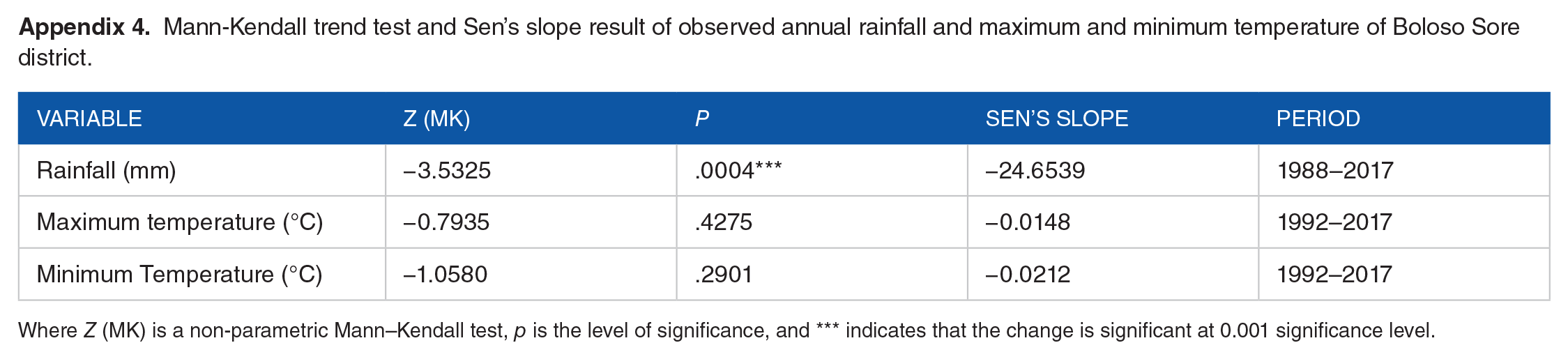
The Mann–Kendall trend test result indicates that the annual rainfall of Boloso Sore district (Areka station) showed a significantly decreasing trend (Figure 3, Appendix 4). However, the maximum and minimum temperatures showed a non-significant decreasing trend at a 5% significance level (Figure 3, Appendix 4).
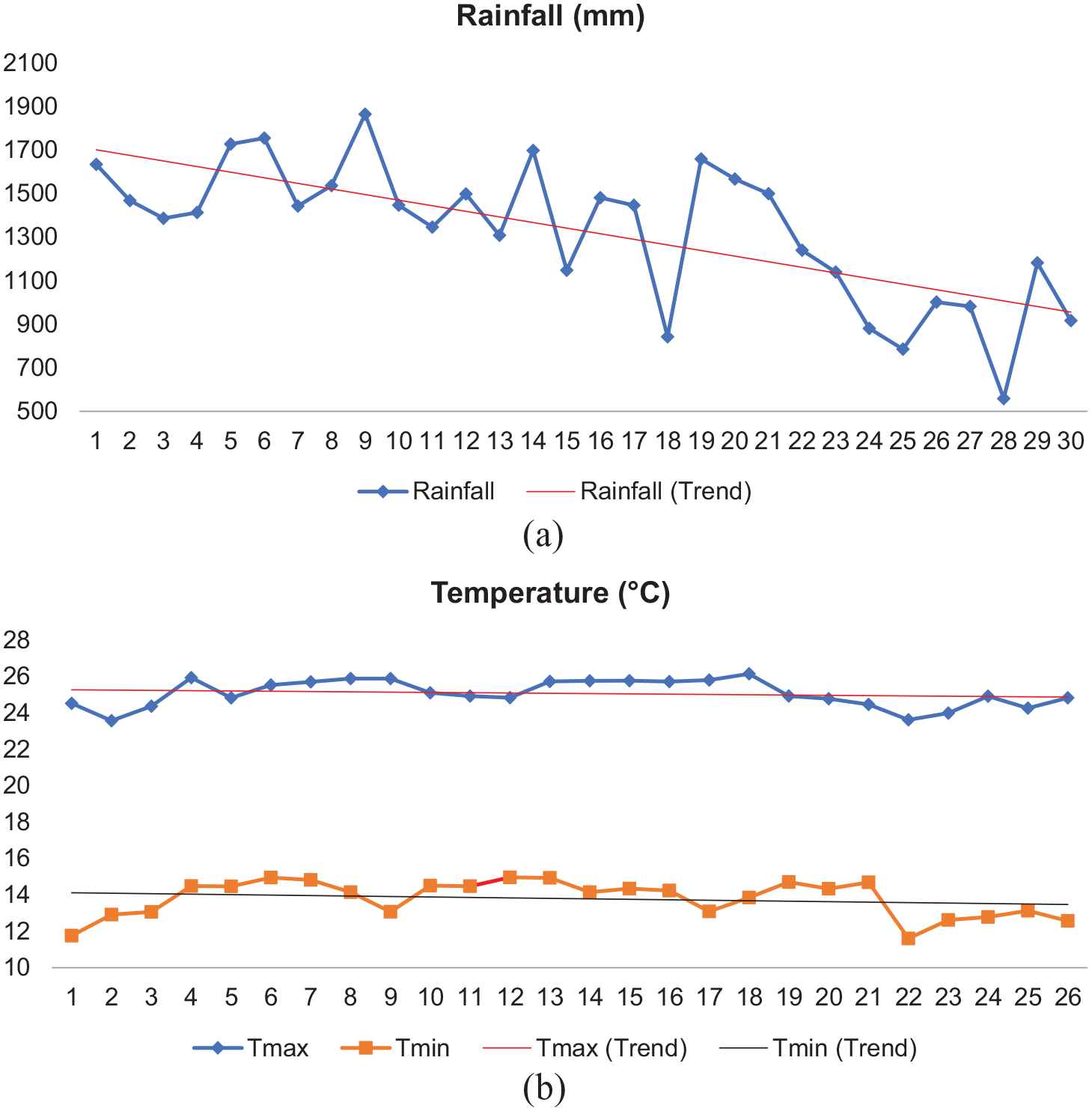
Trends of changes observed in annual rainfall and maximum and minimum temperature of Boloso Sore district: (a) rainfall trend and (b) temperature trend.
Demographic profile of smallholder farmers in southern Ethiopia
Among the farmers involved in crop production under irrigation, 90.6% were male-headed households, 56.8% were aged above 40 years, and 73.5% did not attend formal education (Table 1). During the focus group discussions, farmers also indicated that the male-headed households have better maize production and productivity than female-headed households.
Demographic profile of smallholder farmers in southern Ethiopia.

Farmers’ perceptions about the role of irrigation water in climate change adaptation
As indicated in Table 2, the majority of farmers (87.9%) perceived that their net income increased due to improved crop production under irrigation. Likewise, 44.8% of the farmers perceived decreasing rainfall and believed that irrigation water was used as insurance against the impacts of decreasing rainfall. But, a large proportion of farmers (70%) perceived an increasing trend of temperature and irrigation used as insurance against the negative impacts of elevated temperature. About 45% of farmers perceived that there were occurrences of water-borne diseases due to irrigation water in their communities.
Descriptive results of farmers’ perceptions about the roles of irrigation water in climate change adaptation in southern Ethiopia.
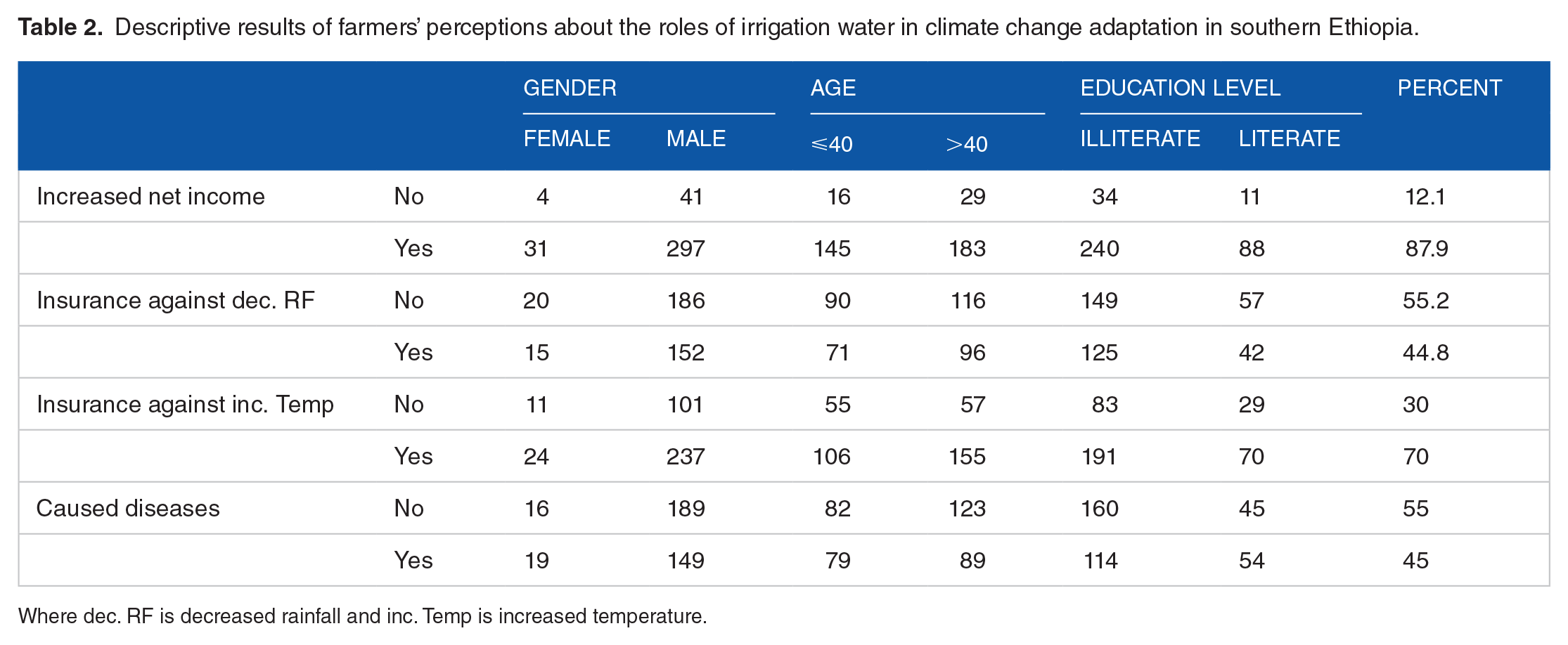
Where dec. RF is decreased rainfall and inc. Temp is increased temperature.
Farmers’ perceptions about irrigation water availability and distribution
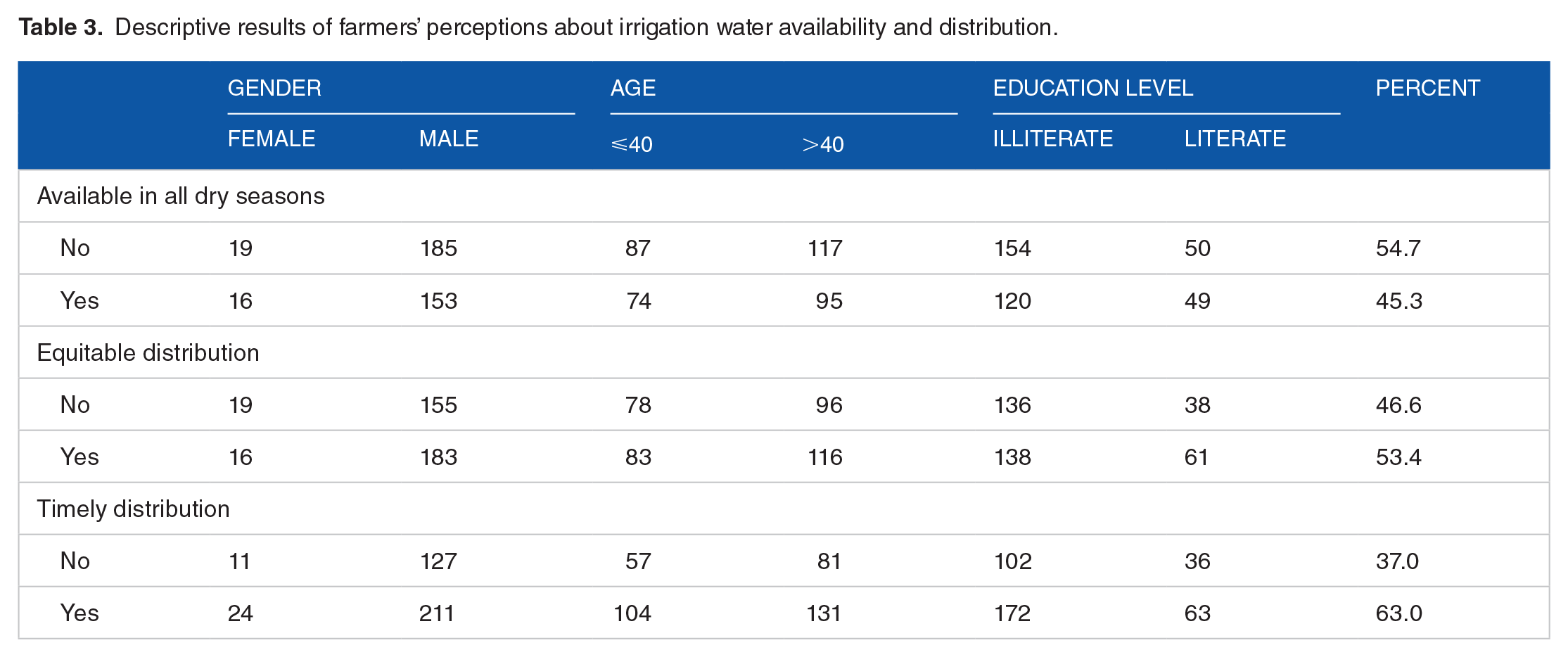
The results indicated that 54.7% of the respondents perceived that the irrigation water was not available in all dry seasons (Table 3). About 46.6% of the farmers perceived that there was no equitable water distribution, and 37% perceived that there was also no timely distribution of water in Boloso Sore district.
Descriptive results of farmers’ perceptions about irrigation water availability and distribution.
Farmers’ choices to WUE-improving soil and water management practices
As indicated in Table 4, 46.4% of farmers did not tightly (properly) close water diversion points after use, 53% did irrigate their farms during peak sunshine hours, 63.5% did not use compost, 66.5% did not use mulches, and 67.6% did practice conventional tillage. The information obtained from focus group discussions indicates that they use soils, leaves/twigs of Eucalyptus trees, and pseudo leaves and stems of banana and inset species to divert water from the schemes to their farms with hand-dug furrows. Besides, they sell their maize in fresh (both grain and straw), harvested from ground surface level so that no biomass is left on the farm. In response to this, very few farmers cover their soils (mulch) with leaves/twigs of plants, pseudo leaves, and stems of bananas for a short period. During the field visits, the authors also noticed that irrigation canals were covered with grasses and silts, and damaged structures.
Descriptive results of farmers’ choices to WUE-improving soil and water management practices at Boloso Sore district.

Where CWDPs is closing water diversion points, IR is irrigation, PSSHs if peak sunshine hours and conv_tillage is conventional tillage.
Determinants of farmers’ choices to WUE-improving soil and water management practices
McFadden’s pseudo R squared (r2 = 0.2) of multivariate probit model indicates that the model good fitted for determining explanatory variables significantly affecting the dependent variables. Farmers’ choice of tightly closing water-diversion points after use is significantly and positively affected by education level, perceptions about irrigation water as insurance against decreased rainfall, and increased temperature (Table 5). However, their choice of not irrigating at peak sunshine hours is significantly and negatively affected by their feeling of irrigation water has increased the net income. The farmers’ choice of using mulching is significantly and positively affected by the perception that irrigation increased the net income and served as insurance against increased temperature. Similarly, their choice of using compost is significantly and positively affected by the educational level of farmers and their positive feeling on irrigation as insurance against decreased rainfall and increased temperature. Unexpectedly, it is significantly and negatively affected by the farmers’ positive feeling about irrigation water increased the net income. Finally, the choice of not practicing conventional tillage is strongly and negatively affected by the farmers’ positive perceptions about equitable water distribution and irrigation increased the net income.
Multivariate Probit model results show the effects of independent variables on dependent variables.

Where **, *** refers to the significance level of 5 and 1%, respectively. Wald chi2 (50) = 55.47, Log-likelihood = −883.57302, Prob > chi2 = 0.2762, and McFadden’s pseudo R2 = 0.2. Coef is coefficient, Std. Err is the standard error, and CI is a confidence interval.
Discussion
A large proportion of male-headed households’ engagement in crop production under irrigation in Boloso Sore district is due to their better access to water and agricultural inputs than female-headed households. Besides, the majority of female-headed households’ maize production was led by the male-headed households for benefit-sharing. Similar findings were reported for central Tigray (Aseyehegu et al., 2012) and the Upper Blue Nile basin of Ethiopia (Amare & Simane, 2017). Lack of water availability during dry seasons and absence of fair and timely water distribution observed in two schemes (Soke and Woybo) of Boloso Sore district go in line with the findings reported by Haileslassie et al. (2016).
A better understanding of decreasing trend of annual rainfall was discerned in male-headed, older aged, and educated farmers. Deressa et al. (2011) found similar results indicating that the farmers of older ages, better wealth, and social capital have a better understanding of climate change. However, farmers’ understandings of changes in maximum and minimum temperature of Boloso Sore district were in disagreement with meteorological analysis. This is in agreement with studies (Ayal & Leal Filho, 2017; Niles & Mueller, 2016) indicated that the farmers’ perceptions of local climate change do not consistently go with the historical climate changes over time.
Farmers perceiving irrigation improved their net income and acted as insurance against decreased rainfall and increased temperature put a high value on irrigation and a piece of land nearby irrigation is expensive. It was also similar for farmers of Benin (Nonvide et al., 2018) and Colombo (Mahoo et al., 2007). On the other hand, there were occurrences of irrigation water-related diseases such as malaria and diarrhea in Boloso Sore district. The occurrence of malaria was during the closing times of irrigation schemes through which the anopheles mosquito gets the opportunity to reproduce itself in the water left in the schemes (Kibret et al., 2019). Whereas the occurrences of diarrhea may be related to drinking contaminated water (World Health Organizations [WHO], 2017) since scheme waters are diverted to springs and rivers during rainy seasons; that could damage the drinking water pipes (lines) and get mixed with the drinking water.
The majority of farmers of Boloso Sore district did not tightly close water diversion points after use, did irrigate at peak sunshine hours, and did not apply compost, mulching, and minimum (zero) tillage. Similar problems were reported from the Oromia (Awulachew et al., 2010) and Tigrai (Yohannes et al., 2017) regions of Ethiopia. Farmers with better education levels and perceiving water as insurance against decreased rainfall and increased temperature tightly close water diversion points after use. This indicates that educated farmers better understand the value of water and WUE than uneducated ones (Abid et al., 2015). The choice of farmers to not irrigate at peak sunshine hours depends on their positive perceptions about water as insurance against decreased rainfall and increased temperature. Due to low education level and poor understanding of irrigation WUE, farmers of Boloso Sore district fail to select irrigating at the appropriate time. Besides, farmers inhabited downstream are forced to irrigate at peak sunshine hours due to poor access to water.
Farmers perceiving that irrigation increased their net income and served as insurance against increased temperature apply more mulch. Luo et al. (2018) found that farmers who obtained larger agricultural income from irrigation showed better willingness to participate in irrigation water management. Whereas educated farmers perceive irrigation as insurance against decreased rainfall and increased temperature apply more compost. However, those perceiving irrigation increased their net income prefer inorganic fertilizer over compost because of better access to inorganic fertilizer. Similarly, the farmers with better access to water (EWD) and perceiving that irrigation increased their net income misunderstood the values of minimum tillage. This indicates that farmers having better access to water and no financial constraint to buy inorganic fertilizer misunderstood the values of water, compost, and minimum tillage and focused on extensive production. This result goes in line with Tang et al. (2016) that showed the awareness of water scarcity (feeling scarce) enhances the adoption of more farm-based irrigation water-saving techniques whereas access to better irrigation infrastructure discourages it. In addition, Ntshangase et al. (2018) found that farmers with larger land size less adopt minimum (zero) tillage than farmers with small land sizes due to their misunderstandings of zero-tillage. On the other hand, farmers who were facing water scarcity in Boloso Sore district applied compost, mulches, and minimum tillage to keep their soils moist until they get water after a long period due to poor irrigation water distribution.
Conclusion
Exploring farmers’ perceptions about irrigation roles in climate change adaptation (socio-economic and environmental benefit) and determinants of choices to WUE-improving practices has a profound importance for devising measures to improve farm-level WUE. This in turn could enhance resilience to the negative impacts of climate change. The majority of households surveyed at Boloso Sore district were male-headed, above 40 years of age, and uneducated. The farmers’ perceived that irrigation improved their net income (INCOM) and acted as insurance against decreased rainfall (IADR) and increased temperature (IAIT). Despite this, water was not available in all dry seasons. The farmers’ choices to any of the selected WUE-improving practices in the study area varied with considered independent variables. Education level (EDUC) and farmers’ perceptions about irrigation water as IADR and IAIT positively determined their choice to tightly close water-diversion points after use. Likewise, farmers’ perceptions about the roles of irrigation on INCOM positively affected their choice to not irrigate at peak sunshine hours.
Similarly, farmers’ choice to apply mulches on their soils is positively affected by their perceptions about irrigation improved INCOM and acted as IAIT. The choice of using compost was also positively affected by EDUC and their perceptions of IADR and IAIT. However, it is negatively affected by INCOM due to misunderstandings of farmers about compost over inorganic fertilizer. Similarly, farmers misunderstood the benefits of minimum tillage and support conventional tillage. Therefore, the choice of not practicing conventional tillage is strongly negatively affected by the farmers’ perceptions about EWD and INCOM. Based on the results of this study, it can be concluded that the farmers’ understandings about the roles of irrigation in climate change adaptation are appreciable but their understanding of WUE-improving practices is poor due to poor water distribution systems and low education levels. So, improving water distribution systems and farmers’ awareness about WUE-improving practices are suggested to the study area and other countries under related conditions.
Footnotes
Appendix
Mann-Kendall trend test and Sen’s slope result of observed annual rainfall and maximum and minimum temperature of Boloso Sore district.
| Variable | Z (MK) | p | Sen’s slope | Period |
|---|---|---|---|---|
| Rainfall (mm) | −3.5325 | .0004*** | −24.6539 | 1988–2017 |
| Maximum temperature (°C) | −0.7935 | .4275 | −0.0148 | 1992–2017 |
| Minimum Temperature (°C) | −1.0580 | .2901 | −0.0212 | 1992–2017 |
Where Z (MK) is a non-parametric Mann–Kendall test, p is the level of significance, and *** indicates that the change is significant at 0.001 significance level.
Acknowledgements
The authors of this article would like to acknowledge Boloso Sore district agricultural office for providing secondary data. Besides, administrators of Achura Kebele, Tiyo Hembecho Kebele, and Matala Hembecho Kebele are thankful for facilitating the investigation in the study area.
Declaration of Conflicting Interests
The author(s) declared no potential conflicts of interest with respect to the research, authorship, and/or publication of this article.
Funding
The author(s) disclosed receipt of the following financial support for the research, authorship, and/or publication of this article: This manuscript is part of a Ph.D. dissertation work of a corresponding author supervised by the co-authors and financially supported by Africa Center of Excellence for Climate Smart Agriculture and Biodiversity Conservation, Haramaya University (World Bank), and Wolaita Sodo University, Ethiopia.

Data Availability
The important datasets used for this study are included in the paper.