



Abstract
Background:
Breast cancer is the most prominent cancer type to affect women. Surgical treatment of invasive breast cancers involves mastectomy. Due to mastectomy, women are subjected to social, emotional, and cultural problems which need to be addressed.
Objective:
The objective of the study is to understand how women cope with body image–related issues, trauma, anxiety, and depression post-mastectomy.
Design:
A systematic literature review was conducted for understanding the coping in post-mastectomy patients. The methods for identifying the studies were based on Preferred Reporting Items for Systematic reviews and Meta-analysis (PRISMA) guidelines.
Databases:
Medline/PubMed, PsycInfo, and Cochrane databases were used for searching relevant articles. A final of 19 studies were analyzed for the work.
Methods:
Search strings such as “coping strategies and post mastectomy,” “body image coping and post mastectomy” and “anxiety coping and post mastectomy” were used for identification of references from databases. Eligibility criteria were used for finalizing the references.
Results:
Analysis of the 19 studies has clearly shown that women who undergo mastectomy suffer from anxiety, stress, and trauma. This study has observed that women have problems with their body image post-mastectomy along with bouts of depression. Self-coping has been observed in relatively few studies. Psychological interventions before surgery have been observed to be a better coping strategy. In most of the studies, women opted for breast reconstruction to overcome the trauma associated with mastectomy.
Conclusion:
Mastectomy has a severe impact on women’s appearance and psychology. Breast reconstruction and acceptance have played an important role in coping among these women. However, breast reconstruction is not accepted by many women due to a multitude of factors. Thus, it is essential to have proper intervention programs in place to ensure women can cope with this situation and can lead healthy lives.
Registration:
Systematic literature review (SLR) is submitted to PROSPERO. The application confirmation number is 449135.
Registration awaited from the database.
Introduction/Background
Breast cancer is one of the most common cancers affecting women worldwide. Apart from causing death, breast cancer affects the health-related quality of life (HRQoL) in these patients. Worldwide, approximately 19.3 million cases of cancer were reported in 2020. Of the total number of cases, 11.7% of total cases were caused by breast cancer. Breast cancer surpassed lung cancer in 2020 as the main cause of cancer-related mortality. Globally, 6.9% of the deaths were seen due to breast cancer in 2020. A maximum number of the cancer types, including breast cancer and cancer-related deaths, are seen in Asia, followed by Europe, America, and Africa. 1 The overexpression of genes such as human epidermal growth factor receptor (HER) and epidermal growth factor (Erb) genes in breast cancer cells has been useful as a molecular tool for the identification and classification of breast cancers. The subtypes are identified based on relative expression levels of HER and Erb genes. 2
Of late, breast cancer has been reported to occur at a very high rate in young women. The phenotype is more aggressive with the presence of distinctive biomarkers that has become an important area of concern. The onset of breast cancer in young women affects their fertility and the risk of inheritance by their progeny. Tumor heterogeneity and expression of various proliferation markers have been seen in young women with breast cancer. The genomic profile of young women suffering from breast cancer has been different from elderly women suffering from the same disease.3-5 Health-related quality of life is a complex concept that in turn includes patients’ physical, psychological, and social aspects of everyday life. Health-related quality of life is considered an essential feature to be considered while performing therapies for any of the disease conditions. In patients with breast cancer, HRQoL is considered as one of the end points of successful therapy. Many of the breast cancer patients do not adhere to the treatment that is associated with physical and psychological problems. Adherence to treatment is a key indicator of overall success in breast cancer treatment. Health-related quality of life is one of the major factors that influences the adherence to treatment. Studies have been done to understand the HRQoL in breast cancer patients undergoing therapy.6-8 Over the last decade, many methods have been developed to improve the quality of life. However, improvements are associated with treatment modalities. Pain, anxiety, and sexual performance in young women who have undergone surgery have not shown much improvement.9,10
There are 2 main types of surgical options for breast cancer which include breast-conserving approaches and non-breast-conserving approaches. Breast-conserving approaches involved radiation and chemotherapy-based methods. However, in cases where cancer has become aggressive and metastasizing, breast removal or mastectomy becomes an obligation. Many women who elect for mastectomy opt for breast reconstruction. 6
However, there is limited research associated with HRQoL in post-mastectomy patients. Understanding the HRQoL and the wide range of issues associated with it, post-mastectomy could help in suggesting strategies that could help in coping strategies in these women with their condition.
Methods
Inclusion criteria
Studies related to mastectomy and coping strategies were considered for this study. Studies that discussed trauma, anxiety, depression, and overall quality of health post-mastectomy were considered. Studies related to body image and coping strategies were considered for the study. Studies between 1997 and 2023 were considered in the review.
Exclusion criteria
Studies not conducted in English were excluded. Studies that were only abstract or had no full texts available were excluded. General studies on mastectomy and those which did not involve coping strategies were excluded. Book chapters and conference papers were excluded from study.
Search strategy
Specific search strings were developed by combining the various keywords. The search strings used for the study included “coping strategies and post mastectomy,” “body image coping and post mastectomy” and “anxiety coping and post mastectomy.” Search strings such as “Trauma coping and post mastectomy” and “depression coping and post mastectomy” identified the same reference articles as “anxiety coping and post mastectomy.” Medline/PubMed and PsycInfo were the databases that were used for retrieving the research articles. The Cochrane database was also checked for any relevant studies.
Study selection
Relevant studies were selected by adopting a search strategy in 2 distinct steps. First, articles with appropriate topics were screened using keywords related to the study. Important information regarding the topic was extracted in the first step. The available titles and abstracts were identified and examined to reveal the justification of the included studies present in the article. The second step involved the investigation of the full-text articles appropriately by independently reviewing them. PubMed was used for retrieving the full texts of the papers. The articles were independently screened by 3 reviewers (A.M., J.N., and A.M.S). After study selection, a consensus was reached before the inclusion of the studies in this review. Any conflicts were resolved through discussion and consensus among reviewers.
Quality assessment
The selected articles were independently reviewed by 2 reviewers who assessed whether the included articles matched the criteria listed for their inclusion (A.M. and J.N.). Each of the selected articles was analyzed in detail for the quality of the work and the database from where they were collected. Based on this assessment, a final list of articles for the study was obtained. The final articles obtained for the study were indexed in PubMed. The Mixed Methods Assessment Tool (MMAT) was used for the quality assessment of the papers identified for the systematic literature review. The MMAT methods were proposed for qualitative and quantitative studies. However, this method is not applicable for the assessment of the review papers and theoretical papers. 11 The MMAT summarizing the various studies included is shown in Table 1.
Mixed Methods Assessment Tool analysis of the studies included in the systematic review.

Critical appraisal of the studies
The critical appraisal was performed using the Critical Appraisal Skills Programme (CASP) tool. A set of 10 questions were used to appraise the studies. CASP qualitative studies checklist was used for the evaluation of the studies. 29 A summary of the CASP-based appraisal is shown in Table 2.
CASP analysis of the relevant studies included in the systematic review.

Data extraction
Data were extracted separately for each study. A common consensus was reached by the 2 reviewers (A.M. and J.N.) who evaluated the entire process. The various aspects extracted from the data included the nature of breast cancer treatment, coping strategy, and study outcomes. The outcomes obtained based on the observations from each study were used to generate the conclusions from this systematic literature review. The data extraction was done from the identified primary references. References cited in each of the selected studies were checked and it was found that summary of those is already presented in the selected study.
Finalization of References and Study Characteristics
PRISMA sheet and the summary of final studies that have been used for the review
Using the various search strings, a total of 2175 references were identified from both Medline and PsycInfo. Cochrane did not yield any different results for the same as observed in these 2 databases. Of the 2175 references identified, 100 references were duplicates and 600 references were not related to the study. Excluding these resulted in 1475 references that were screened further. Of the 1475 reference book chapters, conference abstracts and only abstracts accounted for 500 references which were excluded, resulting in identification of 975 articles for further evaluation. Of the 975 articles selected, 40 of them were excluded as the reports could not be retrieved. The final 935 references were screened based on eligibility criteria. Of the 935 references, a total of 916 references were excluded as the abstracts or full texts did not fit the eligibility criteria resulting in the final of 19 studies that were considered for the systematic review. The PRISMA sheet summarizing the same is presented in Figure 1.
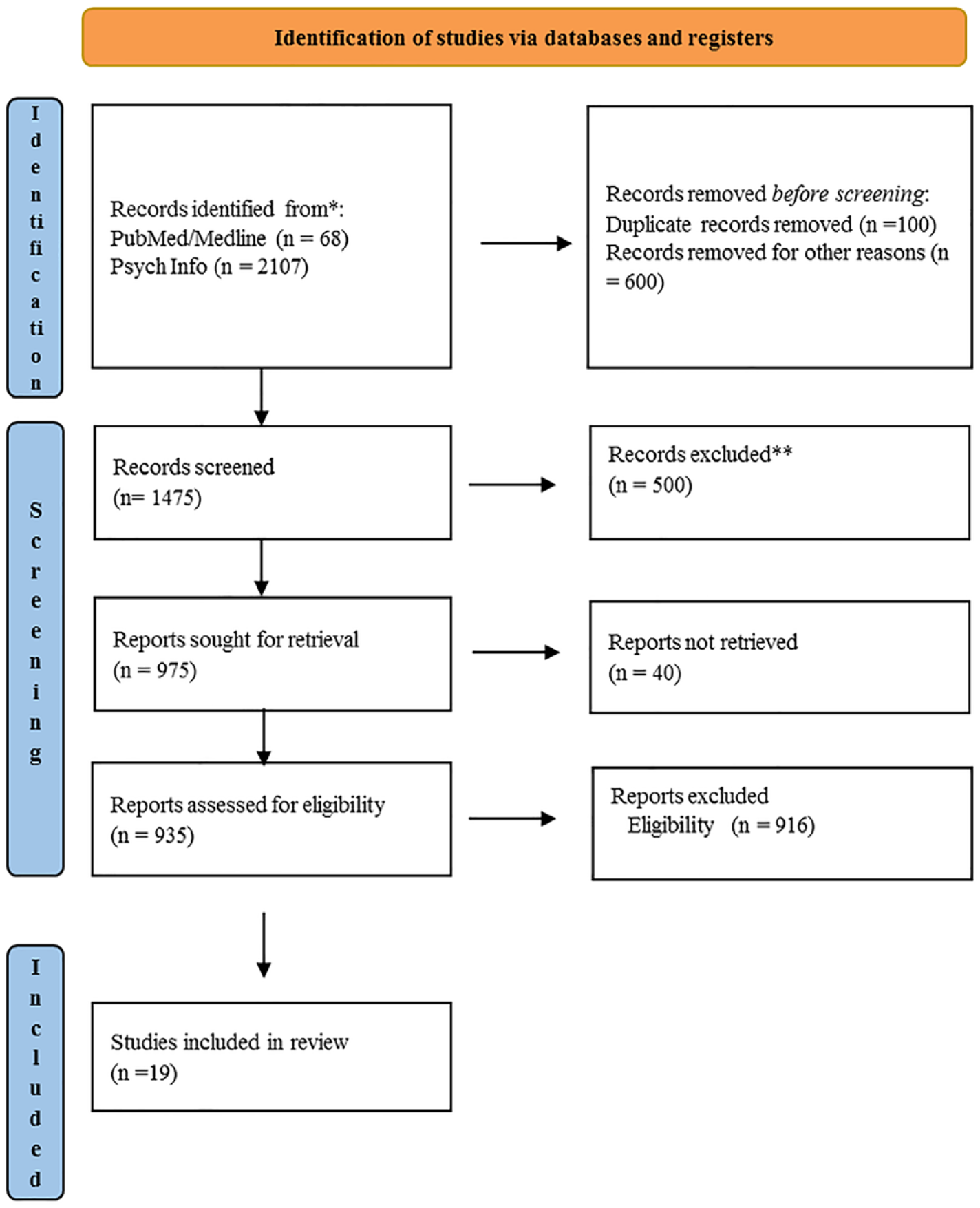
Preferred reporting items for systematic reviews and meta-analysis summarizing the identification of final references.
Study characteristic table
The table summarizing characteristics of included references present in Table 3.
Characteristics of various studies included in SLR.
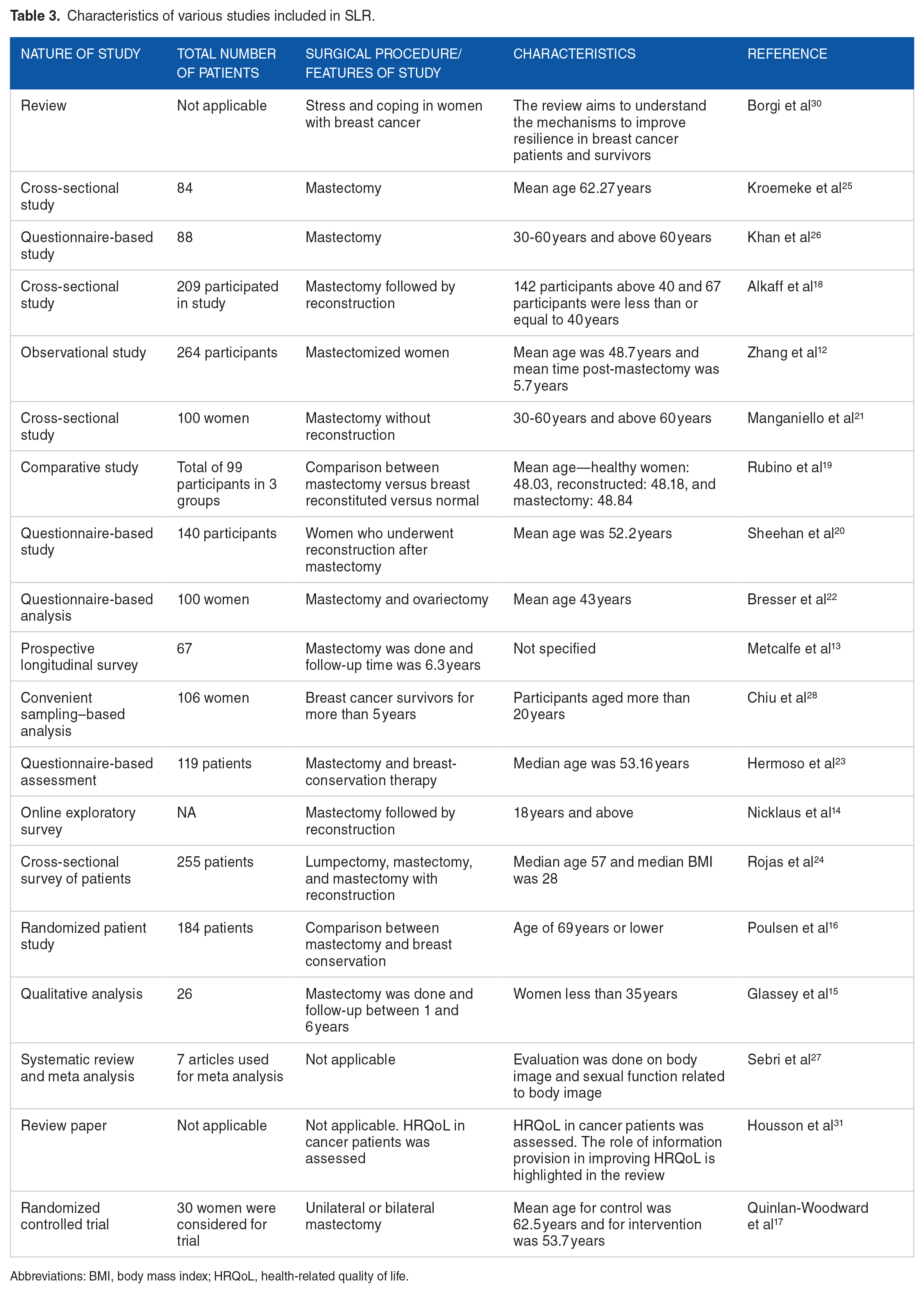
Abbreviations: BMI, body mass index; HRQoL, health-related quality of life.
Results
Detection of breast cancer in women and subsequent therapy, surgery, and associated treatments result in stress in these women. There is a gradual deterioration in HRQoL observed in these women. Anxiety and depressive symptoms are major problems faced by these patients. 30
Need for coping strategies
Coping post-mastectomy is one of the major challenges for breast cancer patients. In a study in Poland, the coping strategies and extent of coping were measured in post-mastectomy patients. Patients post-mastectomy either had growth and improvement in quality of life or they had negative feelings and further deteriorated their quality of life. Patients who had adapted with the situation had significant post-growth and improvement as seen in the assessment studies. Patients who had negative thoughts, on the contrary, had shown a deterioration in the quality of life and were found to be scoring low on the coping scale. 25 The level of anxiety and depression associated with post-mastectomy is very high. In one such study in Pakistan, the various methods by which post-mastectomy women cope with depression and anxiousness were studied. The study identified that women who underwent mastectomy could not cope with it as they felt very anxious and highly depressed due to the loss of their body identity. Appropriate coping strategies are needed to overcome this problem in women undergoing mastectomy. 26
Breast reconstruction as a modified coping strategy to overcome trauma
Trauma refers to conditions or events that result in intense physical and psychological stress reactions. Trauma results from adverse events that ultimately have a long-term effect on the individuals functioning and well-being. 32
Mastectomy has a huge influence on the appearance of women and impacts them mentally and physically. The identified review papers were from different geographical regions that offered a distinct perspective on breast reconstruction as an alternative coping strategy. Breast reconstruction and its acceptance are relatively less understood in the Middle East. A cross-sectional study was performed on women who underwent a mastectomy at King Khalid University Hospital, Saudi Arabia. The main purpose of the study was to understand the impact of breast reconstruction and whether it helps in coping with post-mastectomy. The questionnaire-based study was to understand the feeling of women post breast reconstruction. Eighty-four percent of women in study were of the opinion that breast reconstruction was mainly associated with improving their psychological status. The other factors in consideration for opting for breast reconstruction were associated with femininity, sexual relationships, and appropriate dressing. 18 Similar such study was done in China to understand the benefits of post-mastectomy reconstruction. The various parameters associated with HRQoL such as depression, pain, self-esteem, and body image showed a statistically significant improvement in women who underwent breast reconstruction. 12 Thus, the observation of this study correlates with the observations reported in the Middle East that breast reconstruction is one of the effective ways of coping in post-mastectomy patients. However, a multitude of factors could be responsible for lack of coping in women who undergo mastectomy and do not opt for breast reconstruction. In a cross-sectional study done in Brazil, it was observed that women who did not opt for breast reconstruction had issues with their sexuality. Women who have lower education and those with older partners were found to have coping issues when they have not opted for breast reconstruction. 21
On the contrary, studies done in Italy and Australia had different perspectives. In Italy, a comparison was done between women who underwent breast reconstruction and those who did not opt for breast reconstruction with healthy women. Evaluation of various parameters such as quality of life, anxiety, depression, and social adaptation was done between various groups. Surprisingly, the study observed no difference in anxiety, quality of life, and social adaptation between reconstructed and mastectomy groups. The reconstructed groups exhibited lower depression than mastectomy groups. Breast reconstruction did not improve any of aspects related to quality of life or aforementioned parameters when compared with healthy women. 19 Thus, the study observed that breast reconstruction did not improve the quality of life which is different from observations obtained from Middle East study. Regret associated with breast reconstruction was examined in post-mastectomy patients in Australia. The study observed that 27.6% of participants had moderate regret for the reconstruction and 19.5% had strong regret. Lack of coping in these women was mainly associated with anxiety, low levels of satisfaction, and depression. Proper interventions are required to handle such situations and help these women to overcome the situation Thus, breast reconstruction was not very favorable in these patients as per the study. 20
Adapting to mastectomy as a coping strategy
Post-mastectomy, there is a lot of stress faced by women. This often leads to anxiety and depression. Coping with stress and depression is very difficult post-surgery. Studies identified in the present review observed that adapting to the situation acts as an effective coping strategy. In a study done in the Netherlands, questionnaire-based analysis was done post-mastectomy. The study observed that the patients had a high level of distress before surgery which continued to show an upward trend 6 months and 1 year post-surgery. Positive thoughts and reassurance regarding better quality of life decreased the stress substantially. 22 A similar such observation was seen in a prospective longitudinal survey conducted in Toronto, Canada.
Women who underwent mastectomy were monitored for 6.5 years post-mastectomy and they were compared with women who underwent breast reconstruction post-mastectomy. The study found that after a long period of mastectomy, women start coping with it and they have near normal psychological functioning irrespective of reconstruction. Thus, both the studies emphasized the fact that post-mastectomy as the time proceeds women learn to cope with situations, thus improving their overall quality of life. 13 In a similar such study, resilience as a coping strategy was examined in women who survived breast cancer. The study had similar observations as abovementioned studies. The perception of illness and adapting to it were major features which helped them to overcome body image–related issues. 28
Body image issues and coping post-mastectomy
Health-related quality of life is affected in women who undergo mastectomy. One of the primary reasons associated is with the body image and psychological adjustment associated with it. Studies have identified body image issues as a major contributor for lack of coping. In one such study in Spain, women’s body image and psychological assessment were done between women who underwent mastectomy and those who had breast-conservation therapy. Women who had radical mastectomy showed higher levels of hopelessness, body image issues, and had psychological distress when compared with other groups. Thus, coping in these women was directly associated with their body image and subsequent psychological adaptation for the same. 23 Body image issues are further augmented by the fact that women post-mastectomy have issues in finding right undergarments for use. This is one of the factors that makes it difficult for women post-mastectomy to socially adapt in society. There is no support offered to these women and these patients need more guidance and more resources for choosing the right garments such that they can feel comfortable. 14 A cross-sectional survey done in the United States to understand the body image–related issues in women who had undergone mastectomy. The study had similar observations as previous 2 studies that have been analyzed here. The survey observed that body mass index (BMI) and body image satisfaction were inversely related in women who did not undergo reconstruction after mastectomy. Women with higher BMI had more issues with the appearance of their chest. Thus, the study suggested that weight management before surgery could be a better strategy to cope with this situation. 24 Similar observations are reported in Danish women. A comparative analysis of quality of life between post-mastectomy and breast-conserving therapies observed that mastectomy had a huge impact on making social contact, quality of life, psychological balance, and overall mood in these women but had no difference in performance of day-to-day activity. 16
Nonpharmacological intervention in coping post-mastectomy
Psychological intervention before surgery as a coping strategy
Women undergoing mastectomy have body image–related issues, well-being, and intimacy with partners. Bilateral prophylactic mastectomy (BPM) reduces the risk of breast cancer; however, women suffer from psychological, emotional, and physical consequences. A retrospective qualitative study was performed in the University of Western Australia on BPM patients. Telephonic interviews were conducted for participants and data from the interviews were analyzed for themes. One common problem observed in all these women was pre-surgery anxiousness and related psychological trauma. Consultation with a psychologist before surgery helped them to overcome the trauma post-surgery and served as a good coping strategy. Women who did not consult psychologists before surgery had troubles post-surgery and felt that they should have opted for psychological consultation. Women who underwent psychological consultation before surgery felt better intimacy with partners, were more confident, and had body image issues sorted out. Thus, this study highlighted psychological consultation before surgery as a good coping strategy for women undergoing mastectomy. 15 The observations from above study have been reconfirmed by a systematic review and meta-analysis done on psychological intervention in breast cancer patients and survivors. The analysis observed that psychological intervention reduces body image–related issues; however, it has not been successful in reducing sexual issues. 27 Similarly, providing sufficient information to breast cancer patients helps them to understand the various aspects related to trauma and anxiety, and they are more prepared for better HRQoL when compared with women who do not have information. Thus, information provision helps in better understanding of various treatments associated with breast cancer. 31
Acupuncture–based intervention in coping post-mastectomy
The use of nonpharmacological interventions would further help to cope in women who had undergone a mastectomy. The use of acupuncture has been shown to help women who have undergone mastectomy to relieve them from pain, nausea, and anxiety on day 1 and day 2 post-mastectomy. They can cope better with mastectomy post acupuncture treatment. 17
Discussion
Women who undergo a mastectomy have difficulty in accepting the situation and coping with it. The various coping strategies that are to be considered need to involve both physical and emotional aspects. In the present review, it was observed that women post-mastectomy have altered levels of anxiety and depression. It was observed that patients had negative thoughts with deteriorated quality of life. Coping strategies thus are highly helpful in such patients.25,26 It is observed that post-mastectomy women go through a lot of emotional disturbance which affects them psychologically, resulting in trauma, anxiety, and depression which need to be addressed properly. Also, it is essential to change the stressful environment such that women do not feel uncomfortable and start reacting to the stressor. Considering these aspects could help mastectomy patients to overcome the trauma associated with the condition and learn to survive. 33 In the present review, breast reconstruction post-mastectomy was observed as a significant coping strategy to improve the overall quality of life post-mastectomy.12,18-21 Although there is no consensus reached on this, it is still widely considered a safer option. A systematic review conducted on the same observed the reconstruction rates are highly variable in women. There are multiple barriers associated with breast reconstruction with prominent factors being age, ethnicity, income, educational status, and patients choice. 34 Psychological intervention before surgery has been highlighted as a useful method in this review.15,27,31 This has been shown to have positive outcomes in cancer patients. Providing psychological support before surgery helps the patients to cope with the surgery and has positive outcomes. 35 Psychoeducational programs that educate women before surgery associated with breast cancer have shown positive outcomes in terms of reducing the overall stress and worry in such patients. 36 Nonpharmacological interventions such as acupuncture have been helpful to reduce pain in mastectomy patients which has been helpful for them to cope with the condition. 17 There are several of the nonpharmacological-based methods that have been suggested and used for breast cancer patients to overcome the trauma and disease burden. These include exercise, cognitive behavioral therapy, and several such methods which are known to help patients in recovery. 37 Body image–related issues are the most prominent issues in breast cancer patients post-surgery. It is one of the major factors that contributes to coping and subsequent psychological adaptation to the same. The present review observed that women face several issues, including choosing the right undergarment and appearance of chest.14,16,23,24 Qualitative research done in this aspect on women who have undergone mastectomy has shown that the surgery adversely affects women. The research clearly showed that women miss their self-image and hence their body appearance due to mastectomy. Mastectomy had adverse effects on attire and intimacy with their partners. 38 Such studies which have been done in different countries have shown a similar observation of loss of self-esteem and negative perception of body image post-surgery.39,40 Psychological interventions have been sought after in such cases to reduce the trauma associated with body image–related issues in breast cancer patients.27,41
Conclusion
There is a large amount of literature that is available to explain the coping aspects along with the interventions that could be used successfully in patients undergoing therapy for breast cancer or those undergoing nonsurgical methods for breast cancer treatment. However, there is relatively less literature available on coping post-mastectomy in women and the way it needs to be addressed. In the present systematic review, an attempt has been made to address the same. The review has observed that post-mastectomy, there are severe issues faced by women and, in many cases, they opt for breast reconstruction to mitigate these issues. Of course, coping with reconstruction therapy is different but women find it more acceptable as it adds to their self-esteem and increases their chance of having a proper sexual life with their partners. In some of the studies identified in this review, women over time have accepted the lack of breasts as a natural aspect and have learned to cope with it. Thus, the review has observed a mixture of methods, including intervention, self-coping, and alternative therapies as methods by which women try to cope post-mastectomy. The presence of proper strategies and support programs which could help women post-mastectomy is required to address this situation. The development of appropriate intervention programs and their implementation are not aggressively being developed to address this issue.
Limitations of the study
The studies identified and discussed in this SLR were collected from PubMed, Cochrane, and PsycInfo databases. No other databases were searched and thus any further articles related to the area of research might have been missed out. This review considered articles that have been already published and hence any of the relevant articles that were at preprint stage might have been missed out. Studies published in English were only considered, resulting in missing out of any relevant articles in the area of research.
Footnotes
Acknowledgements
The authors would like to acknowledge the support of Dr Anjali Midha Sharan in the preparation of the review article.