



Abstract
Neospora caninum is a protozoan parasite, the etiologic agent of Neosporosis—a common cause of abortion in cattle worldwide. Herd level prevalence of Neosporosis could be as high as 90%. However, there is no approved treatment and vaccines available for Neosporosis. MicroRNA (miRNA) based prophylaxis and therapeutics could be options for Neosporosis in cattle and other animals. The current study aimed to investigate the genome of Neospora caninum to identify and characterize the conserved miRNAs through Expressed Sequence Tags (ESTs) dependent homology search. A total of 1,041 mature miRNAs of reference organisms were employed against 336 non-redundant ESTs available in the genome of Neospora caninum. The study predicted one putative miRNA “nca-miR-9388-5p” of 19 nucleotides with MFEI value -1.51 kcal/mol and (A + U) content% 72.94% corresponding with its pre-miRNA. A comprehensive search for specific gene targets was performed and discovered 16 potential genes associated with different protozoal physiological functions. Significantly, the gene “Protein phosphatase” was found responsible for the virulence of Neospora caninum. The other genes were accounted for gene expression, vesicular transport, cell signaling, cell proliferation, DNA repair mechanism, and different developmental stages of the protozoon. Therefore, this study finding will provide pivotal information to future aspirants upon Bovine Neosporosis. It will also serve as the baseline information for further studies of the bioinformatics approach to identify other protozoal miRNAs.
Keywords
Introduction
Bovine neosporosis is an important protozoan disease—having worldwide distribution and causing severe financial damages in the cattle industry.1,2 The etiologic agent of Neosporosis is Neospora caninum – a microscopic protozoon. The pathogen is abortifacient and is considered to be an economically significant pathogen for cattle. 3 Globally, 42% of bovine abortion is attributed to Neosporosis. 4 Herd level prevalence of Neosporosis could be as high as 90% in cattle. 5 The estimated cost per annum for Neospora infection is the US$ 1.1 million in the New Zealand beef industry and US$ 546.3 million in the US dairy business. 1 Despite the substantial impact of Neospora caninum in the cattle industry, there is no approved treatment and vaccines available for neosporosis. 6 A variety of drug compounds and a combination of drugs have been suggested to control the Neosporosis for subsiding clinical signs and humoral immune response to infants or diminishing the rate of abortion to the pregnant cows. But the therapeutic is not well accepted to date due to lack of experimental validity and failure to present drug efficacy against the bradyzoite stage of the organism. 7 With the limitations of comprehensive research regarding Neospora caninum, there is an ardent need to figure out the pragmatic and effective therapeutic strategy or other usefultools to combat Neosporosis in the cattle industry.
MicroRNAs (miRNAs) are non-protein-coding short sequences RNA of around 22 nucleotides (nt) in length. miRNAs are commonly transcribed from DNA sequences. They are found in a wide range of organisms, from protozoans to mammals.8,9 miRNAs cover 1-3% of the total length of the genome. 10 They play essential biological and physiological regulatory functions in animals 11 and plants. 12 They are essential for the development of animals and have a critical role in different biological processes. miRNAs are pleiotropic and could target hundreds to thousands of genes. 13 miRNAs having a role in post-transcriptional gene regulation and targets specific mRNAs for degradation or translation repression. 14 The pleiotropic nature and role in gene regulation make miRNAs a potential choice for a novel class of therapeutic targets. In recent days, thus, miRNA research has been focusing on RNA-based therapies. Further, studies are examining the potential of miRNAs for the development of new generation drugs.
The high throughput sequencing, computational biology, and bioinformatics analysis methods accelerated miRNAs research. With enhanced research, thousands of miRNAs have been identified and made available in miRbase (http://www.mirbase.org/) – either recognized through cloning technology or predicted by the computational method. Moreover, in recent days, an Expressed Sequenced Tag (EST) analysis rather than former traditional computational methods has evolved to make conserved miRNA identification convenient.
Neospora caninum is characterizing by different antigenic strains divulging notable genotypic and phenotypic differences. 15 However, very little is known about the genetic diversity of Neospora caninum – except few as exemplified genome sequence, 16 phylogenetic analysis, 17 biological and genetic variation between 6 isolates. 18 Moreover, there is no information available about specific microRNAs (miRNAs) of Neospora caninum in the database. 19 However, investigating Neospora caninum genome for identifying miRNAs with their regulatory target and functions could aid in devising new prophylaxis and therapeutics for nesporiosis. Thus, it is a worthy effort to predict the miRNAs of Neospora caninum, including their functions.
The current study aimed to identify plausible miRNAs of Neospora caninum through ESTs-based homology search from the NCBI GenBank database. Further utilize in silico methods to perform the function analysis of Neospora caninum involved with molecular, cellular, and biological functions.
Materials and Methods
Retrieval of ESTs in the genome of Neospora caninum
Initially, the genome of Neospora caninum (GenBank Assembly Accession: GCA_000208865.2; Assembly ID: ASM20886v2) was employed to search for ESTs from GenBank database of NCBI (http://www.ncbi.nlm.nih.gov/). The genome based BLAST search suggested available ESTs of Neospora caninum which were further retrieved from the EST database of NCBI. This database is open access - annotated nucleotide sequences are publicly available.
Acquisition of a reference set of miRNAs
In the absence of insufficient information about protozoal miRNA in the database, we decided to pick up the reference organisms considering the taxonomy of Neospora caninum from miRBase 22.1 (January 2020) 20 database. In order to look for potential miRNAs of Neospora caninum, a total of 1,041 formerly known mature miRNAs from miRBase database were utilized. These mature sequences were designated as query sequences employed against the retrieved ESTs of Neospora caninum.
Search for potential miRNAs of Neospora caninum
The query miRNAs were subjected to nucleotide BLAST (BLASTn) (https://blast.ncbi.nlm.nih.gov/Blast.cgi) of NCBI against Neospora caninum sequences. Python language-based command line for Linux platform was established for BLASTn and addressing by “tblastn -subject -query -out -evalue -word_size 10 -qcov_hsp_perc.” The search considered 80% query cover and 90% identity match and no set E-value. Considering all these criteria with the BLASTn, a set of EST sequences had been primarily identified that was stated to be the possible miRNA candidates for Neospora caninum.
Removal of protein-coding sequences
As miRNAs characteristically must not code for any protein, 21 the next step was to extract non-protein-coding sequences through BLASTx. 21 This set of sequences were further screened to isolate pre-miRNA through assessing the previously reported properties. 22
Identification of novel miRNAs with stated parameters
Following the procedure described by previous authors,23,24 the putative miRNA precursors were identified. The same procedures were used in different other studies.25,26 The putative miRNA precursors must fulfill subsequent criteria: (i) the predicted mature miRNA must not allow above three nucleotide substitutions in comparison with reference sequences (ii) the pre-miRNA sequence must form a stem-loop hairpin structure (iii) the mature miRNA must be placed at the single arm of secondary structure (iv) above three mismatches were not acceptable between predicted and reference sequences (v) higher the A + U percentage better the quality of precursor miRNA (present study considered above 70%) (vi) the anticipated secondary hairpin structure should have high negative MFE (Minimal Folding Free Energy, ΔG in kcal/mol) and MFEI (Minimal Folding Free Energy Index) values.26,27
Prediction of pre-miRNA and secondary structure of mature miRNA
An algorithm sorted out the potential pre-miRNAs aspirants with miREval 2.0. 26 To predict appropriate hairpin-like secondary structures that must contain the minimum length of 85 nucleotides, the potential pre-miRNAs were subjected to the Mfold web server.27,28 Typically the putative secondary structure should possess high negative MFE and MFEI values, which confirmed the best-fitted pre-miRNAs to pick up. MFEI was calculated using the equations given below 29 :


Finally, the potential miRNA of Neospora caninum was extracted from all the non-coding mature ESTs qualifying earlier mentioned preconditioned criteria.
Nomenclature and family annotation of predicted microRNAs
By using miRBase database, the final retrieved miRNA family was again subjected to local blast to validate the family annotation of predicted miRNA. This final miRNA was addressed according to miRNA nomenclature. 30 For verification, the sequence alignment of homologous sequences of putative miRNA families was done by miRBase search output and used Clustal Omega. 31 A comparative analysis of base nucleotide between putative mature miRNAs and its homolog miRNA was also conducted.
Functional annotation of gene targets by putative miRNAs
The function annotation of the newly identified miRNA family was accomplished by TargetScanFly database version 7.2. 32 The miRNA category of the database provided the available target genes of the respective family. The molecular, biological, and cellular functions involved with each particular gene were also analyzed and documented. Moreover, the single specific gene holding NCBI gene Identification number, Ensembl ID (https://asia.ensembl.org/index.html), UniProtKB (https://www.uniprot.org/), and Alliance of Genomic Resources ID (https://www.alliancegenome.org/) were tabulated for convenience.
Results
Retrieval of ESTs in the genome of Neospora caninum
All available ESTs of Neospora caninum were downloaded from NCBI GenBank database. There were a total of 25,095 ESTs of Neospora caninum available in the GenBank database (Table 1). The schematic outline of the entire methodology of identifying miRNA of Neospora caninum is shown in Figure 1.
Steps involved in the characterization of putative miRNA from ESTs of Neospora caninum genome.

Abbreviations: EST, expressed sequence tag; miRNA, microRNA; NC, Neospora caninum.

The schematic outline of entire methodology of identifying miRNA of Neospora caninum.
Acquisition of a reference set of miRNAs
Neospora caninum is classified under the kingdom of Chromista or superfamily Chromalveolata of eukaryotes along with superphylum Alveolata and phylum Apicomplexa.33,34 We sorted out six organisms in miRBase, namely Phaeodactylum tricornutum, Phytophthora sojae, Phytophthora ramorum, Phytophthora infestans, Ectocarpus siliculosus and Symbiodinium microadriaticum that were also categorized into the superphylum Alveolata or superfamily Chromalveolata. Hence, those organisms got prioritized during the retrieval of mature miRNAs in this study. Besides, only mycetozoa Dictyostelium discoideum in miRbase was considered to retrieve mature miRNA as mycetozoa exhibited the characteristics of both protozoans like organism such as Neospora caninum and fungi. 35 Moreover, mature miRNAs of two model organisms such as Caenorhabditis elegans 33 and Drosophila melanogaster 34 were also considered in the study. However, in order to look for potential miRNAs of Neospora caninum, a total of 1,041 mature miRNAs of miRBase 22.1 (as of January 15, 2020) 20 database were retrieved and considered for further study (S1 File).
Search for potential miRNAs of Neospora caninum
There were 339 ESTs obtained through BLASTn (S2 File), which was counted 336 after the redundancy check (S3 File). These sequences were enforced to allow not exceeding four mismatches and the lowest preset E-value.
Removal of protein-coding sequences
All the non-redundant sequences were employed through BLASTx search to search for non-protein-coding ESTs. Hypothetical proteins were discarded for the final data set. Finally, 93 non-protein-coding ESTs had been attained (S4 File), having the probability of being a potential miRNA candidate for Neospora caninum.
Prediction of pre-miRNA with secondary structure
At the next step, sequences were rendered through miREval to predict potential pre-miRNA structures. The sequences were further attempted to Mfold Web Server for extrapolation of hairpin-like secondary structure. Furthermore, sequences were tabulated with the length of pre-miRNA, length of mature miRNA, the number of mismatches between query and subject sequences, % of A + U, minimal folding free energy, minimal folding free energy index, and the location of mature miRNA in the secondary structure (S3 Table).
Among all the non-protein-coding ESTs, 92 sequences were not the best-fitted candidates to be the potential miRNA for Neospora caninum (S5 File). Eventually, one potential EST candidate (CF938952.1) was explored as the precursor of the putative miRNA of Neospora caninum (S1 Table) against the reference miRNA dme-miR-9388-5p from miRBase. The secondary structure of pre miRNA achieved from Mfold web server formed a hairpin looped configuration (Figure 2). In the 85 nucleotides long pre-miRNA, the mature miRNA was sited in one arm of pre miRNA (gray box in Figure 2). The investigation also displayed the length of 19 nucleotides with no record of substitutions. The amount of A + U percentage in total length was 72.94% indicates a better precursor. The minimal folding free energy (MFE) and minimal folding free energy index (MFEI) depicted -29.60 and -1.51, respectively (Table 2).

Secondary structures of final putative miRNA by using Mfold software.
Properties of putative miRNA of Neospora caninum with suggested criteria.
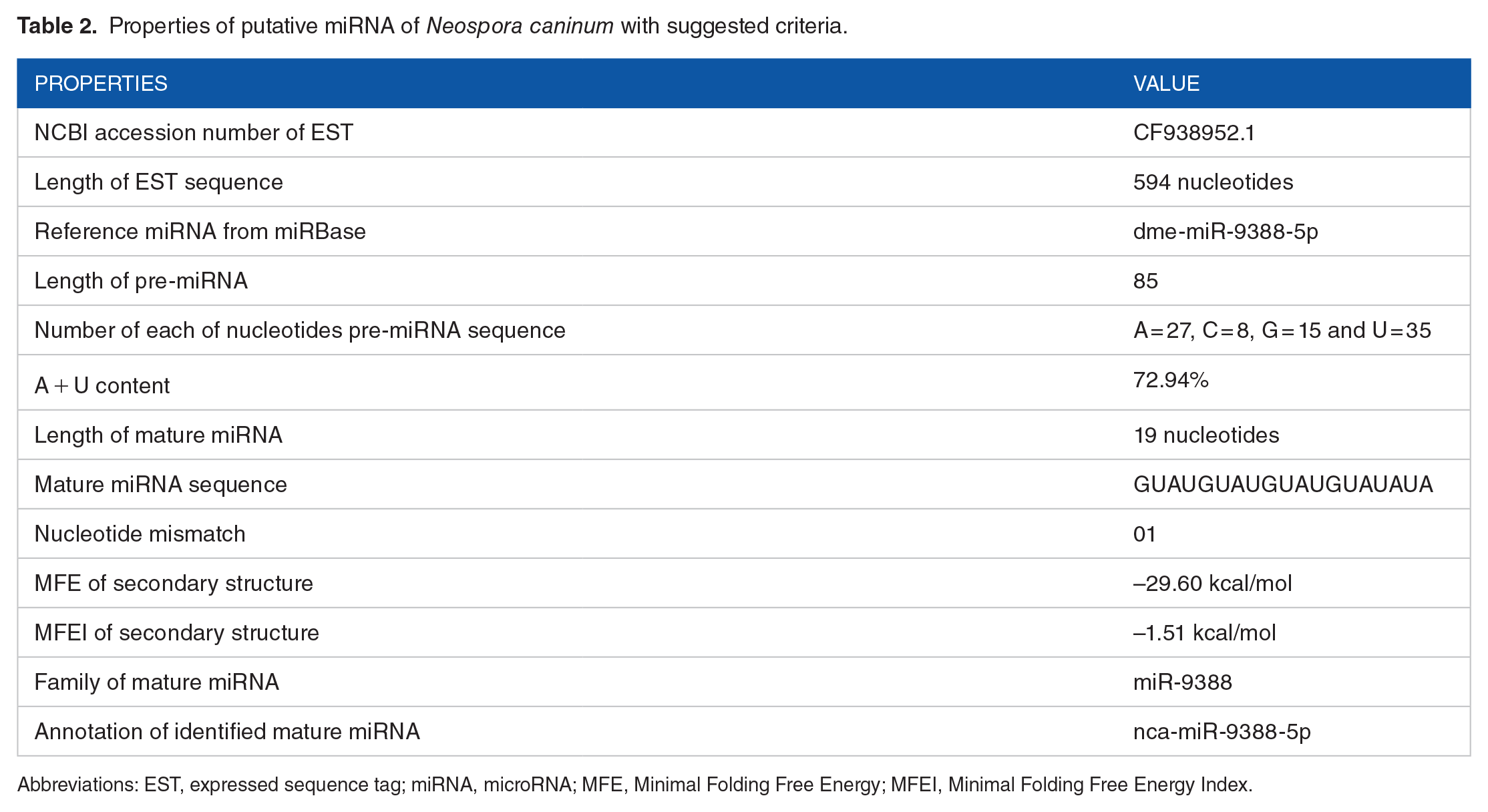
Abbreviations: EST, expressed sequence tag; miRNA, microRNA; MFE, Minimal Folding Free Energy; MFEI, Minimal Folding Free Energy Index.
Nomenclature and family annotation of predicted microRNA
The local blast result of miRBase revealed that miRNA of Neospora caninum genome belongs to “miR-9388-5p” family of mature miRNA. Therefore, the predicted miRNA was named as “nca-miR-9388-5p” (Figure 3). Result of comparative nucleotide base composition between putative miRNA, and homologous families obtained from miRBase is presented in Figure 4. The overall nucleotide percentage was documented as 31.58% Adenine, 47.37% Uracil, and 21.05% Guanine (Figure 4). The final miRNA candidate of the Neospora caninum genome did not contain cytosine. However, the uracil percentage of the reference miRNA family was displayed slightly lower than the resulting miRNA.

Alignments of the putative miRNA of Neospora caninum genome and its homologues from respective microRNA family.

Overall nucleotide compositions (%) of putative miRNA from Neospora caninum compared with the homologues mRNA of miRBase.
Prediction and functional analysis of putative Neospora caninum miRNA
From the TargetScanFly 7.2 web server, a total of 424 genes were found, making the best hit for target specification for by the putative miRNA of Neospora caninum. The functions involved with these genes were tabulated as molecular function, biological process, and cellular component (S2 Table), and the number of total genes involved with all three functions was 77.12%. Besides 84.67%, 85.61% and 81.13% genes played a role in molecular and biological; biological and cellular, and molecular and cellular functions, respectively. Moreover, in the KEGG database (https://www.genome.jp/kegg/pathway.html) for pathway analysis found no information about Neospora caninum. Therefore, to establish a probable relationship between obtained and expected genes functions, earlier literature was thoroughly reviewed describing the functions linked with any of the genes of either Neospora or other equipotential protozoans. After a comprehensive review of the literature, the study found 16 responsible genes (Table 3) that were linked with molecular, cellular, and biological functions. In particular, different sub-functions under the biological process were revealed as development, cell organization/biogenesis, response to the stimulus, cell cycle/ proliferation, transport/localization, reproduction, immune system, nervous system process, behavior, signaling, gene expression, protein metabolism, DNA metabolism, small molecule metabolism (Figure 5). The most significant part of the gene pull (213 genes) was found to be engaged in the developmental function of the reference family. They contributed to different organ parts and body system development. Being the second highest, a total of 200 genes played a role in cell organization or biogenesis. Commonly they performed at mitotic sister chromatid segregation, myosin II filament organization, histone modification, and mitochondrial translational termination. There were 192 genes responded to various biological stimuli like detection of chemical stimulus concerning sensory perception, phototransduction, different signaling pathways, transmembrane transport, response to the odorant, cellular response to DNA damage stimulus, and DNA repair. The genes are involved with molecular function as enzyme, regulator, receptor, receptor binding, transporter, structural molecule, cytoskeletal binding, DNA binding, RNA binding, transcription factor, small molecule binding, metal ion binding, lipid binding and carbohydrate-binding (Figure 6). The highest pull of genes are engaged with different enzymatic activities (129) under molecular function. GTPase activity, serine-type endopeptidase activity, acyl-CoA dehydrogenase activity, butyryl-CoA dehydrogenase activity, glutathione transferase activity and endo-peptidase activity. Also, 87 were found to be involved with DNA/RNA binding activities. However, 64 genes are involved in the olfactory receptor, transmembrane signaling receptor, photoreceptor activity, hormone activity, ligand activity, insulin receptor binding, and G-protein coupled receptor activity. The cellular function includes extracellular region, cytosol, cytoskeleton, mitochondrion, nucleus, chromosome, membrane, cell periphery, cell junction, cell projection, endomembrane system, synapse, macromolecular complex (Figure 7). In total, 178 genes act for the dendrite membrane, plasma membrane, mitochondrial inner membrane, SNARE complex, an integral component of membrane, basolateral plasma membrane, and postsynaptic density membrane. Another pool with 136 genes play a role in developing nuclear envelope, nucleoplasm, cdc73 or ESC complex, histone methyltransferase complex, nuclear euchromatin of the entire nucleus. Also, 118 genes took part in the function associated with the different macromolecular complexes like alpha DNA polymerase complex, ubiquitin ligase complex, hetero-trimeric G-protein complex, gamma subunit complex, large mitochondrial subunit, and polysome, Smc5-Smc6 complex.
Putative miRNA targets in the crucial cellular process of Neospora caninum.

Abbreviation: miRNA, microRNA; ADP, Adenosine diphosphate.

Biological Function of predicted target.

Molecular function of predicted target.

Cellular functions of predicted target.
Discussion
The present study conducted an in silico ESTs based homology search to find out novel miRNA of Neospora caninum from a large volume of primary EST sequences available in the public domain. Approaching miRNA identification and characterization of Neospora caninum predicted one putative miRNA “nca-miR-9388-5p” of 19 nucleotides with MFEI value -1.51 kcal/mol and 72.94% of (A + U) content corresponding with its pre-miRNA. A comprehensive search for specific gene targets was performed resulting 16 potential genes associated with different protozoal physiological function. Significantly, the gene “Protein phosphatase” was found responsible for the virulence of Neospora caninum. The other genes are accounted for gene expression, vesicular transport, cell signaling, cell proliferation, DNA repair mechanism, and the developmental stage of different protozoa.
Though in the early days, miRNAs identification was only restricted to the cloning method, miRNAs identification is now a much simpler approach due to the advancement of computational biology and bioinformatics. 53 The present work was initiated with the acquisition of EST sequences and template miRNAs of Neospora caninum. We collected available ESTs of Neospora caninum from the NCBI Genebank database and reference miRNA sequences from miRBase to perform BLASTn following earlier studies.25,36,54,55 We did not set up a cut-off point for E- value during the BLAST search due to retrieving the best matching region between subject EST and reference sequences. Thus, the sequences that displayed 100% similarity with very minimum mismatches were allowed to be the expected output sequences. The nucleotide length of pre-miRNA of Neospora caninum was counted as 85, which supports the results of the previous studies that ranged from 60-265.21,26,56 The predicted miRNA carried 19 nucleotides within the range of 16-22 nucleotides suggested by the previous studies. 23 ,56-58 Earlier studies have shown that different plants and vertebrates pre-miRNAs containing higher (A + U)% than (G + C)% could have a better function in biochemical signals in miRNA biogenesis.23,59 The current study considered above 70% as cut off of (A + U) % to find out the best-predicted miRNA. The way of predicting secondary structure from the information of primary sequences depends on reducing the free energy of a molecule by exploiting the quantity of satisfactory base-pairing interactions.38,39 MFE is calculated by assessing the minimum energy values acquired by complementary base pairs diminished by the stacking energy of consecutive base pairs or amplified by the destabilizing energy accompanying with non-complementary bases.38,39 According to Bonnet and co-workers, 40 maximum miRNAs demonstrate an affinity to show minimal folding free energy (MFE) compared to tRNAs and rRNAs. This characteristic is suitable to form a stable secondary structure by the pre-miRNAs. However, above 90% of miRNAs contain an MFEI value 0.85 that makes a clear demarcation from other RNAs like tRNAs, mRNA or rRNAs. 29 The final annotated miRNA of the current study having the MFE and MFEI values -29.60 and -1.51, which is in line with the findings of. 29 As a prerequisite of being miRNA, it must be located at the one arm of the secondary hairpin structure of pre-miRNA. 29 The maximum nucleotide involvement in the stem is the best structure for being a miRNA. The predicted miRNA of this study constituted with 19 nucleotides, is entirely located at the stem of the secondary hairpin structure of pre-miRNA without forming any internal loop or bulges.
Since the discovery of the non-protein-coding micro RNAs, the most pressing question is how these small molecules run their activities in body regulatory mechanisms? To understand the function of micro RNAs, identifying the responsible target genes under the micro RNA family is immensely important.41,42 Formerly, several approaches based on the abnormal appearance of targeted miRNAs were popularly used for identifying the target genes of worm development.43,44 First, the miRNA of Caenorhabditis elegans was found responsible for transferring one larval developmental stage to another. 10 Later with the progression of science, thousands of miRNA targets have been placed in the database performing through different computational approaches.45-47 However, the KEGG pathway database lacked information about Neospora caninum, which forced us to search for the functions from previous literature. Likewise, some common genes were popped up having relation to molecular, biological and cellular functions of reference fly family “dme-miR-9388-5p” which also had the significance of different protozoal physiology. The present study only searched for protozoal gene function because Neospora caninum is a protozoan parasite that might share common genes with similar gene functions with other protozoa. One out of sixteen genes found in the present study is linked directly with Neospora caninum responsible for the virulence of the organism. The rest of the gene connected with other protozoans such as Toxoplasma, Entamoeba, Trichomonas, Trypanosoma, and Leishmania. “Formin 3” was identified in Toxoplasma gondii playing role in tachyzoite growth and gliding motility for invasion into the host cell. 48 As the Apicomplexan parasite Toxoplasma and Neospora share high similarities between the morphology, genomes and transcriptomes, - they must have some standard regulatory functions in infecting the host cell. 49 The gene recognized for host cell invasiveness in Toxoplasma might act in the same way in Neospora. “TBP-associated factor 1 (Taf1)” gene, a constituent of Transcription factor IID (TFIID), was found to be associated with cell proliferation, cell growth, cell cycle, cell cycle checkpoint, and various other processes in Entamoeba histolytica. 50 The function of the “Syntaxin” gene had to be related to vesicular transport of eukaryotic cells in various protozoan parasites like Entamoeba, Giardia, Trichomonas and Trypanosoma. 51 The other functions of this gene were neurotransmission, vesicular transport, membrane fusion, and even internal membrane compartment reconstruction connected with Giardia, Trypanosoma, and different kinds of algae. 52 This experiment of function analysis also documented the same evidence as cell cycle proliferation, cell organization/biogenesis, transport/localization, development and signaling. Another gene “AKT1” identified in this study was found responsible for cell signaling and promoting cell survival in Leismania spp. 60 Besides, two RNA binding proteins “RBP4” and “RBP6” play a significant role in the developmental stage of Trypanosoma, especially in epimastigotes. 57 The present study identified both the proteins. In Trypanosoma cruzi “Poly-(ADP-ribose) polymerase” enzyme has a vital role in DNA repair mechanisms and controlling power in different phases of cell growth 61 which is found to play a similar function in the case of “dme-miR-9388-5p” family. The “Pumilio,” a RNA-binding protein, modulates gene expression mainly in post-transcriptional stage in Trypanosomes. 56 Besides in Plasmodium, a significant contribution of this protein has been reported. Plasmodium Puf2 is one of the key associates of the Pumilio family that is responsible for playing a vital role in the organism’s developmental progression, especially during the sporozoite transmission from mosquito saliva to human. 58 The current study found “Protein Phosphatase” in Neospora caninum that has a significant effect on the virulence of the organism. The protein is proved to exist at profuse volume in a highly virulent strain of the organism. 59 Virulence in Neospora caninum is defined as the capability of prompting pathogenicity in laboratory organism mice and the trans-placental transmission from mother to offspring. 15 Some other previous studies also demonstrated the “Protein Phosphatase” as an invasion protein of other Apicomplexan parasites as example Toxoplasma and Plasmodium facilitating the entry of parasite into targeted host cell.62-65
Since the discovery of the first miRNA, from gene cloning-based primitive identification method to modern computational approach, thousands of miRNAs of plants and animal kingdom have been discovered. However, the microRNA database is still missing different important organisms and parasites. The current study endeavors to enrich the microRNA database by identifying the potential miRNA of Neospora caninum via EST-based homology search. In this study, we identified one putative mature miRNA of Neospora caninum and sixteen possible target genes. Although the only gene “Protein Phosphatase” was explored directly associated with Neospora caninum. It is known that the different organisms from common family origin can have homologous genes and exhibit similar functions in different protozoa. Thus, identified genes in this study associated with other protozoa might function similarly for Neospora caninum. However, further wet-lab validation will be necessary to clarify the definite functions and relationship between genes. Nevertheless, the present experiment has been able to fill the research gaps on the protozoan parasite Neospora caninum. Further, the findings of this study may serve as the baseline in elucidating many unsolved questions related to the miRNAs biology of Neospora caninum.
Supplemental Material
sj-pdf-1-BBI-10.1177_11779322211046729 – Supplemental material for In Silico Investigation of Conserved miRNAs and Their Targets From the Expressed Sequence Tags in Neospora Caninum Genome
Supplemental material, sj-pdf-1-BBI-10.1177_11779322211046729 for In Silico Investigation of Conserved miRNAs and Their Targets From the Expressed Sequence Tags in Neospora Caninum Genome by Moumita Das, Mahmudul Hasan, Sharmin Akter, Sawrab Roy, Binayok Sharma, Md. Shahidur Rahman Chowdhury, Md. Irtija Ahsan, Rubaiat Nazneen Akhand, Md Bashir Uddin and Syed Sayeem Uddin Ahmed in Bioinformatics and Biology Insights
Supplemental Material
sj-pdf-2-BBI-10.1177_11779322211046729 – Supplemental material for In Silico Investigation of Conserved miRNAs and Their Targets From the Expressed Sequence Tags in Neospora Caninum Genome
Supplemental material, sj-pdf-2-BBI-10.1177_11779322211046729 for In Silico Investigation of Conserved miRNAs and Their Targets From the Expressed Sequence Tags in Neospora Caninum Genome by Moumita Das, Mahmudul Hasan, Sharmin Akter, Sawrab Roy, Binayok Sharma, Md. Shahidur Rahman Chowdhury, Md. Irtija Ahsan, Rubaiat Nazneen Akhand, Md Bashir Uddin and Syed Sayeem Uddin Ahmed in Bioinformatics and Biology Insights
Supplemental Material
sj-pdf-3-BBI-10.1177_11779322211046729 – Supplemental material for In Silico Investigation of Conserved miRNAs and Their Targets From the Expressed Sequence Tags in Neospora Caninum Genome
Supplemental material, sj-pdf-3-BBI-10.1177_11779322211046729 for In Silico Investigation of Conserved miRNAs and Their Targets From the Expressed Sequence Tags in Neospora Caninum Genome by Moumita Das, Mahmudul Hasan, Sharmin Akter, Sawrab Roy, Binayok Sharma, Md. Shahidur Rahman Chowdhury, Md. Irtija Ahsan, Rubaiat Nazneen Akhand, Md Bashir Uddin and Syed Sayeem Uddin Ahmed in Bioinformatics and Biology Insights
Supplemental Material
sj-pdf-4-BBI-10.1177_11779322211046729 – Supplemental material for In Silico Investigation of Conserved miRNAs and Their Targets From the Expressed Sequence Tags in Neospora Caninum Genome
Supplemental material, sj-pdf-4-BBI-10.1177_11779322211046729 for In Silico Investigation of Conserved miRNAs and Their Targets From the Expressed Sequence Tags in Neospora Caninum Genome by Moumita Das, Mahmudul Hasan, Sharmin Akter, Sawrab Roy, Binayok Sharma, Md. Shahidur Rahman Chowdhury, Md. Irtija Ahsan, Rubaiat Nazneen Akhand, Md Bashir Uddin and Syed Sayeem Uddin Ahmed in Bioinformatics and Biology Insights
Supplemental Material
sj-pdf-5-BBI-10.1177_11779322211046729 – Supplemental material for In Silico Investigation of Conserved miRNAs and Their Targets From the Expressed Sequence Tags in Neospora Caninum Genome
Supplemental material, sj-pdf-5-BBI-10.1177_11779322211046729 for In Silico Investigation of Conserved miRNAs and Their Targets From the Expressed Sequence Tags in Neospora Caninum Genome by Moumita Das, Mahmudul Hasan, Sharmin Akter, Sawrab Roy, Binayok Sharma, Md. Shahidur Rahman Chowdhury, Md. Irtija Ahsan, Rubaiat Nazneen Akhand, Md Bashir Uddin and Syed Sayeem Uddin Ahmed in Bioinformatics and Biology Insights
Supplemental Material
sj-pdf-6-BBI-10.1177_11779322211046729 – Supplemental material for In Silico Investigation of Conserved miRNAs and Their Targets From the Expressed Sequence Tags in Neospora Caninum Genome
Supplemental material, sj-pdf-6-BBI-10.1177_11779322211046729 for In Silico Investigation of Conserved miRNAs and Their Targets From the Expressed Sequence Tags in Neospora Caninum Genome by Moumita Das, Mahmudul Hasan, Sharmin Akter, Sawrab Roy, Binayok Sharma, Md. Shahidur Rahman Chowdhury, Md. Irtija Ahsan, Rubaiat Nazneen Akhand, Md Bashir Uddin and Syed Sayeem Uddin Ahmed in Bioinformatics and Biology Insights
Supplemental Material
sj-pdf-7-BBI-10.1177_11779322211046729 – Supplemental material for In Silico Investigation of Conserved miRNAs and Their Targets From the Expressed Sequence Tags in Neospora Caninum Genome
Supplemental material, sj-pdf-7-BBI-10.1177_11779322211046729 for In Silico Investigation of Conserved miRNAs and Their Targets From the Expressed Sequence Tags in Neospora Caninum Genome by Moumita Das, Mahmudul Hasan, Sharmin Akter, Sawrab Roy, Binayok Sharma, Md. Shahidur Rahman Chowdhury, Md. Irtija Ahsan, Rubaiat Nazneen Akhand, Md Bashir Uddin and Syed Sayeem Uddin Ahmed in Bioinformatics and Biology Insights
Supplemental Material
sj-pdf-8-BBI-10.1177_11779322211046729 – Supplemental material for In Silico Investigation of Conserved miRNAs and Their Targets From the Expressed Sequence Tags in Neospora Caninum Genome
Supplemental material, sj-pdf-8-BBI-10.1177_11779322211046729 for In Silico Investigation of Conserved miRNAs and Their Targets From the Expressed Sequence Tags in Neospora Caninum Genome by Moumita Das, Mahmudul Hasan, Sharmin Akter, Sawrab Roy, Binayok Sharma, Md. Shahidur Rahman Chowdhury, Md. Irtija Ahsan, Rubaiat Nazneen Akhand, Md Bashir Uddin and Syed Sayeem Uddin Ahmed in Bioinformatics and Biology Insights
Footnotes
Funding:
The author(s) received no financial support for the research, authorship, and/or publication of this article.
Declaration of conflicting interests:
The author(s) declared no potential conflicts of interest with respect to the research, authorship, and/or publication of this article.
Author Contributions
S.S.U.A., M.B.U., and M.H. were involved in conception of the study, designed the study methodology, facilitated the analytical tools, wrote the manuscript, and critically reviewed the article and supervised. R.N.A. was involved in retrieval of data, data curation, contributed to the analysis, and critically reviewed the article. S.R., B.S., M.I.A, S.A., and M.S.R.C. assisted in the retrieval of data and analysis. M.D. assisted in the retrieval of data and analysis, wrote the paper, and critically revised the article.

Supplemental Material
Supplemental material for this article is available online.
References
Supplementary Material
Please find the following supplemental material available below.
For Open Access articles published under a Creative Commons License, all supplemental material carries the same license as the article it is associated with.
For non-Open Access articles published, all supplemental material carries a non-exclusive license, and permission requests for re-use of supplemental material or any part of supplemental material shall be sent directly to the copyright owner as specified in the copyright notice associated with the article.
