




Abstract
The commercial determinants of health are an emerging area of inquiry; however, a comprehensive understanding of commercial activities impacting Indigenous peoples remains elusive. In 2021, an Australian parliamentary inquiry was initiated to examine how the corporate sector can better engage with Indigenous consumers. This study examined the commercial determinants of Indigenous health and social wellbeing by analysing submissions to the Inquiry. Twenty-five submissions were analysed: seven from Indigenous actors, five supplementary submissions, and the Inquiry’s interim report. Findings revealed exclusion of Indigenous leadership from the commercial sector, supply of harmful products, misleading branding, and predatory lending. This meant increased stress and reduced access to essential services for Indigenous consumers, despite affirmative corporate social responsibility strategies towards Indigenous peoples. Government policy should prioritise ongoing collaboration with Indigenous peoples in the development of regulatory mechanisms to mitigate the negative impact of commercial practices on health and social wellbeing.
Keywords
Introduction
Colonisation has severely disrupted Indigenous societies worldwide, undermining cultural practices and fuelling persistent health and social inequities (Wispelwey et al., 2023). Australian governments have committed to a set of targets to close the gaps in health and socioeconomic outcomes between Aboriginal and Torres Strait Islander and non-Indigenous Australians. At the international level, the Australian government has also committed to the United Nations (UN) Sustainable Development Goals, which align with the Closing the Gap agenda, and the UN Declaration on the Rights of Indigenous peoples (UNDRIP) (Schultz, 2020; United Nations, 2007, 2015). The UNDRIP asserts that Indigenous peoples have the right to be actively involved in all decisions that affect them (United Nations, 2007).
Australian government efforts towards improving health equity for Aboriginal and Torres Strait Islander peoples, hereafter, respectfully referred to as Indigenous peoples, centre on the social determinants of health; however, this may overlook other factors influencing health outcomes (Finlay et al., 2021), such as the commercial determinants of health (CDoH). This is an emerging field in public health research and policy (Lacy-Nichols & Marten, 2021), with CDoH defined as “the systems, practices and pathways through which commercial actors drive health and equity” (Gilmore et al., 2023, p. 1195). Commercial practices impact health through product design, supply chains, marketing, financial practices, labour conditions, reputational management, involvement in research and political lobbying to weaken public health regulation (Gilmore et al., 2023; World Health Organization [WHO], 2021).
Extant CDoH research has focussed on big business, including the tobacco, alcohol and ultra-processed food industries (Lacy-Nichols et al., 2023). However, the commercial sector also provides products and services essential to wellbeing, such as health care, education, housing, food and water, to which access is considered as a human right. Therefore, commercial actors have the power to either promote or harm health (Lacy-Nichols et al., 2023). This occurs through products and services driving health harm, including smoking, air pollution, alcohol use, obesity, communicable diseases, noncommunicable disease, traffic injuries, violence and mental health conditions (WHO, 2021). When these commercial interests are prioritised over health, social and environmental considerations, pre-existing inequities are exacerbated (Gilmore et al., 2023).
There have been some high-profile examples of large corporations causing harm to Indigenous communities in Australia. In 2020, the mining company Rio Tinto destroyed sacred rock caves at Juukan Gorge in Western Australia (Oliveri et al., 2022). In 2021, the Australian Federal Court ordered Telstra to pay AUD $50 million in penalties when it breached Australian Consumer Law by selling unsuitable contracts to over 100 Indigenous people (Australian Competition & Consumer Commission, 2021). Also in 2021, Woolworths abandoned its plan to open a Dan Murphy’s alcohol superstore close to three alcohol-free communities in Darwin following a 5-year battle with liquor licencing regulators and Indigenous organisations (Crocetti et al., 2023). In 2022, funeral insurance company Youpla, collapsed leaving thousands of Aboriginal people out of pocket (Bainbridge et al., 2022). Youpla had been investigated for misleading and deceptive conduct since 1999, but continued to operate and market itself as an Aboriginal organisation (Bainbridge et al., 2022). All the aforementioned companies had corporate social responsibility (CSR) statements of commitment to reconciliation with Indigenous Australians.
CSR is the concept that companies have a responsibility to society beyond their economic and legal responsibilities to shareholders (Lee & Carroll, 2011). An existing CSR mechanism in Australia, designed to improve engagement with Indigenous peoples, is the development of Reconciliation Action Plans (RAPs). The RAP framework, overseen by Reconciliation Australia, has four levels to reflect the various stages of an organisation’s progress towards reconciliation: Reflect, Innovate, Stretch and Elevate. After 15 years of the RAP programme, Reconciliation Australia reported that close to 4 million people were working or studying in RAP organisations (Reconciliation Australia, 2022). Although 88% of employees in organisations with Stretch and Elevate level RAPs believed their organisation had a clear public stance against racism, less than half (47%) of Indigenous staff in organisations with these plans believed their workplace was welcoming and respectful of new Indigenous employees (Reconciliation Australia, 2022). The aforementioned companies Woolworths, Rio Tinto and Telstra had RAPs, and Rio Tinto and Telstra at the highest Elevate levels, while undertaking deleterious activities in Indigenous communities.
In October 2021, following a series of high-profile media stories reporting unscrupulous corporate activities affecting Indigenous peoples, described above, the Australian Government Minister for Indigenous Australians requested a parliamentary inquiry, hereafter, the Inquiry, titled How the corporate sector establishes models of best practice to foster better engagement with Aboriginal and Torres Strait Islander consumers (Committee on Indigenous Affairs, 2022). The Australian Parliament’s House of Representatives Committee on Indigenous Affairs oversaw the Inquiry which aimed to “consider, report and where appropriate make recommendations on” the way the corporate sector engages with Indigenous consumers and how it develops and demonstrates cultural understanding, the impact of RAPs on corporate sector engagement and actions and other matters as required (Committee on Indigenous Affairs, 2021, para. 1).
The Inquiry had a narrow timeline (Figure 1) of 3 months, which included the Christmas period, before the final hearing was held in February 2022. An interim report was published in March 2022, which confirmed there would be no final report. The Inquiry ceased at the dissolution of the Australian parliament in May 2022 prior to a federal election.
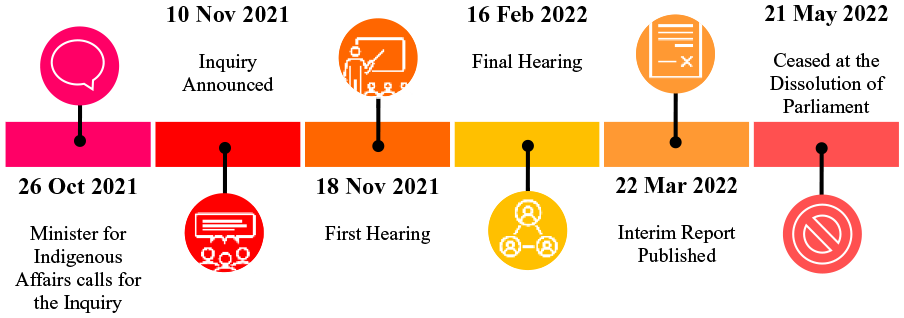
Inquiry timeline.
With the Inquiry as a case study, this research aimed to investigate, with Indigenous peoples, the commercial determinants of Indigenous health (CDoH) through the following research questions:
Which commercial sectors are causing harm in Indigenous communities?
What activities and practices are commercial entities undertaking that may be harming Indigenous peoples?
How do these harmful practices impact Indigenous health and wellbeing?
Method
There have been numerous calls for greater transparency with regard to Indigenous engagement, involvement and leadership in research concerning Indigenous peoples (Lock et al., 2022; Maddox et al., 2023). This study was undertaken by a non-Indigenous social worker and public health research student (P.L.) with supervision support from an experienced Indigenous researcher (M.L.) and a non-Indigenous public health researcher (J.B.). Two additional researchers, one Indigenous (T.W.) and one non-Indigenous (A.C.) contributed to the analysis and preparation of this article. As an author team, we acknowledge the roles social work and research have played in Indigenous oppression, colonisation and disempowerment. We acknowledge Aboriginal and Torres Strait Islander peoples as the custodians of the lands now known as Australia and commit to upholding the principles of cultural safety, equity, justice and strengths-based practice in our research.
A qualitative constructivist approach was applied, operationalised through focussed thematic analysis. Thematic analysis is useful for synthesising large volumes of text and focuses on making meaning from qualitative data under the assumption that researchers are only ever partially knowledgeable (Braun & Clarke, 2022). The study followed the thematic analysis process outlined by Braun and Clarke (2022), which includes familiarisation with the dataset, coding, generating initial themes, developing, and reviewing themes, refining themes and the final write-up.
Data collection
The dataset was all organisation submissions made to the Inquiry that were publicly available. Submissions were downloaded directly from the Inquiry webpage for analysis. The Inquiry’s terms of reference, media releases, hearing transcripts and interim report were downloaded to provide context for the analysis.
Data analysis
To determine the level of engagement with and from Indigenous organisations in the Inquiry process, submissions were grouped by organisation type. However, not all Indigenous-owned organisations identified themselves as such in their submissions. Indigenous status in the submissions aligned with their Indigenous Corporation Number (ICN) as registered with the Office of the Registrar of Indigenous Corporations, if the submission was a joint submission with an organisation with an ICN, and if the organisation or programme was aimed at meeting needs of Indigenous peoples (Supplementary Material 1).
After multiple readings of the dataset, the submissions were uploaded into NVivo qualitative analysis software (QSR International) for coding. Coding was first undertaken inductively by one investigator (P.L.). After initial codes were generated, P.L., T.W. and A.C. then coded the dataset inductively, theoretically and reflexively, whereby decisions were made through team discussions about what was important, what should be included and what not to include based on what the data were telling us about the research questions (Braun & Clarke, 2022). The second stage of analysis grouped similar codes to generate themes. The themes that incorporated a large number of codes were organised into subthemes. In the third stage, the themes and subthemes were revisited multiple times and refined through discussion with senior team members (M.L. and J.B.).
Results
Participation in the inquiry
A total of 25 submissions, plus 5 supplementary submissions, were made to the Inquiry by 32 organisations (9 for-profit and 23 non-profit) from the finance, social, retail, telecommunications, education, government, media, legal and health sectors (Supplementary Material 1). The financial sector provided 13 (41%) submissions that covered the banking, superannuation, investment and financial counselling areas. There were submissions from 7 (22%) Indigenous organisations, according to those with an ICN, and all of which were non-profit organisations. The majority of submissions were made by non-Indigenous organisations (78%). Indigenous voices were not identifiable in most (60%) of the submissions (Supplementary Material 1).
Analysis of the submissions produced three overarching themes of (a) numerous commercial entities are causing harm in Indigenous communities, (b) unscrupulous commercial practices are harming wellbeing and (c) looking for solutions. Themes and subthemes are summarised in Table 1 and described in the following sections.
Summary of key themes and sub themes.
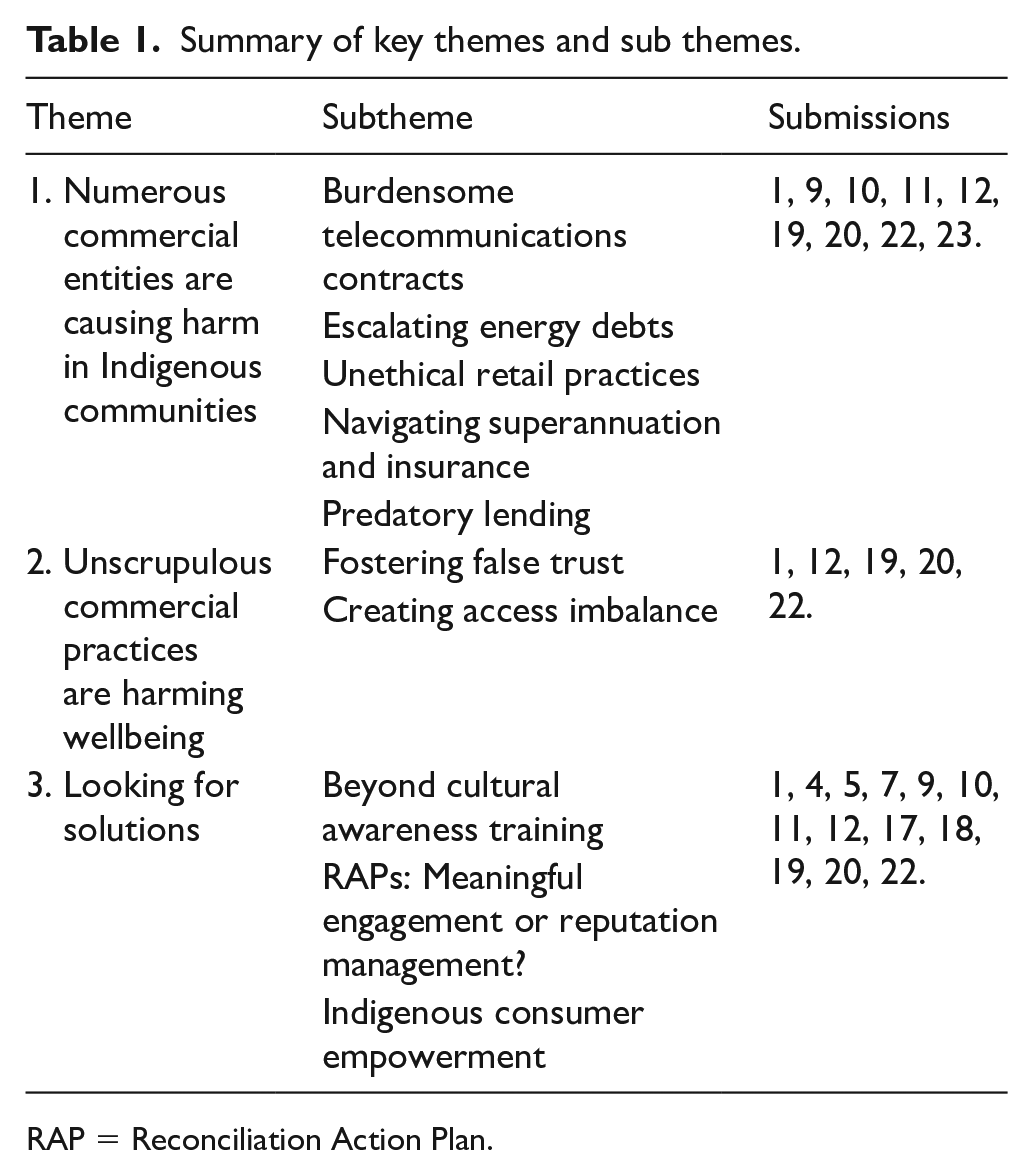
RAP = Reconciliation Action Plan.
Theme 1: numerous commercial entities are causing harm in Indigenous communities
Highlighted were the numerous operations of commercial organisations, such as telecommunications, energy, retail, alcohol, superannuation, insurance and finance sectors, within Indigenous communities. These operations were largely described in a negative light, with several reported to be causing harm to Indigenous peoples (Table 1). Submissions from advocacy organisations, most of which were Indigenous organisations, emphasised their ongoing efforts to challenge these commercial organisations to minimise their impact on local communities. The activities of the sectors are described below.
Burdensome telecommunications contracts
Misconduct by the telecommunications sector was highlighted in four submissions. Misconduct included engaging in the sale of phone plans, and additional products and services, which were unnecessary or unsuitable for consumers’ specific needs (submission 12; submission 22, attachment 1). Some of Telstra’s Indigenous customers faced pressure to assume responsibility for family members’ contracts when they did not have access to formal identification (submission 22). As a result, bills were bundled together, and some individuals were burdened with unpaid bills of up to AUD $500 per month, and with no suitable hardship payment options available. An Indigenous person with a Disability Support Pension was sold “a bundle” by a telecommunications corporation, which was “clearly unaffordable and [the individual] quickly ended up with a large debt” (submission 22, p. 33). Submissions emphasised the impact of language and cultural barriers used by telecommunications employees to mislead Indigenous peoples (submissions 9 & 10).
Escalating energy debts
Multiple submissions noted concerns about the conduct of the energy industry; specifically, issues related to the inappropriate increases of already large consumer debts (submissions 12 & 22). Large debts to energy retailers were common among Indigenous clients of one advocacy group, stating that “energy is an essential service and consumers have a right to access it on fair and reasonable terms” (submission 12, p. 17). Energy debts ranging from AUD $3,000 to AUD $10,500 were reported. Moreover, driven by fear of disconnection, Indigenous people had resorted to using buy now pay later products which “result in a loss of Energy Ombudsman protections” including access to complaint and resolution procedures (submission 12, p. 17).
Unethical retail practices
Unethical retail practices occurred across various sectors, including car sales, photography, home appliances and alcohol retail (submissions 1, 12, 19, 20 & 23). Details were provided of specific instances of unethical and dishonest behaviour, such as car dealers selling faulty vehicles at inflated prices and resulting repair costs of up to AUD $20,000 (submissions 1, 12, 19 & 23). A large home appliance retailer approved an Indigenous person a loan of AUD $12,500 for products that could not be used in their home (submission 12). In addition, photography companies were reported to have issued debts to Indigenous peoples for photo packages costing between AUD $4,000–AUD $6,000 (submissions 19 & 23).
Significant concerns were raised regarding practices of the alcohol retail industry, and these concerns served as one of the catalysts for initiating the Inquiry. A submission described the 5-year battle between an alcohol retailer, owned by the Woolworths Group, and local community members, including multiple Indigenous health organisations (submission 23). This was described not as a one-off event, but part of a long-term strategy used by the alcohol industry to build new stores near alcohol-free Aboriginal communities of the Northern Territory (submission 20).
Navigating superannuation and insurance
One submission reported that Indigenous peoples had been denied access to their superannuation and or the superannuation of their next of kin when they were not able to provide sufficient identification (submission 11). The Royal Commission into Misconduct in the Banking, Superannuation and Financial Services Industry (2019) was cited in the submission to reinforce the persistent difficulties experienced by Indigenous peoples in accessing superannuation, particularly concerning identification requirements and binding death nominations (submission 11).
Similar to the challenges with superannuation, Indigenous peoples have faced barriers in accessing insurance coverage that they have paid for, often due to insufficient identification or the requirement to provide a written response in English (submission 12). In one case, a funeral insurance company pressured an Indigenous person to purchase an unnecessary second policy, resulting in over AUD $6,000 in premiums paid over multiple years (submission 12). It was emphasised that many economically vulnerable people, already struggling with financial stress, were targeted to sign up for poor value insurance products that were promoted as culturally safe (submission 12).
Predatory lending
Various finance industry organisations were named throughout submissions, including banks, vehicle finance companies and small loan companies. Car dealers were implicated in supplying substandard vehicles and engaging in unscrupulous lending practices. For example, one car loan was approved for AUD $39,000 but ended up costing AUD $85,000 to repay (submission 23). Finance companies including Cigno and BHF Solutions reportedly used strategic lending structures to provide short-term credit at high costs, which can accumulate interest of up to 990% of the original loan amount (submission 12). Moreover, various payday loan companies were highlighted in submissions for approving multiple loans to Indigenous people, with repayments often amounting to 20% more than the client’s gross income (submission 12). When borrowers were unable to meet their repayment obligations, then debt collectors pressured Indigenous peoples to use funds that should have been safeguarded, including redress funds from Native Title and the Royal Commission into Institutional Responses to Child Abuse (submissions 12 & 23).
Theme 2: unscrupulous commercial practices are harming social wellbeing
Various commercial activities were described in the submissions. These were encapsulated by the two sub themes of fostering false trust and creating access imbalance, as described below.
Fostering false trust
Multiple examples of companies using misleading representation to foster false trust with Indigenous communities were presented. The community consultation processes by Woolworths regarding its plan to build a Dan Murphy’s alcohol store close to three alcohol-free communities was described as inadequate because it was limited to telephone surveys about harm minimisation strategies (submission 20). It was reported that there was no discussion about whether these communities wanted the store in the first place (submission 20). From the telecommunications sector, Telstra was officially charged for misleading Indigenous consumers, for actions which included abuse of language and cultural barriers to mislead Indigenous customers into signing contracts they could not afford (submission 19).
Commercial organisations engaged in misleading representation through deceptive branding that disproportionately affected Indigenous people. An extreme example was that of a funeral insurance company operating under the name Youpla, an Indigenous Creole word which translates approximately “you fellows” in English (Shnukal, 1988, p. 229). It was argued that, by using an Indigenous name, the company misled consumers to believe it was an Indigenous organisation when it is not registered with ORIC to hold an ICN (submission 12).
There were also multiple examples provided of the finance sector fostering false trust while engaging in unsafe lending practices. In some cases, lending practices were described as predatory especially when loans were approved when they could not realistically be repaid (submission 12). Submissions were especially scathing of lenders who misled Indigenous peoples with “low literacy and low financial literacy” into “trusting that if they are approved for credit that must mean the creditor knows they can afford it” (submission 1, p. 5). Submissions by financial counselling organisations reported that many Indigenous clients frequently sought help for utility loans, payday loans, credit card debt and housing arrears (submissions 12 & 22). It was reported that “First Nations customers are at the mercy of the energy provider’s hardship arrangement” (submission 12, p. 17).
Creating access imbalance
The negative health and social wellbeing impacts of commercial practices appear to be driven—in part—by an access imbalance, where access to essentials is reduced and access to harmful products is increased. The results of this imbalance included financial stress, poor mental health and being cut off, or fear of being cut off, from essential services (submissions 12 & 22). In one case, an Indigenous person contacted a legal service for assistance with credit debt, noting his father passed away due to suicide because of financial stress, and he did not want the same for himself (submission 22, attachment 1).
Many of the wellbeing impacts were associated with reduced access to basic services, in some cases products or services that were paid for, resulting in feelings of frustration and shame (submissions 1, 5, 10, 12, 19 & 22). This financial stress rippled into other areas of health and social wellbeing. For example, a study found one in two Indigenous people lived under financial stress and, as a result, made repayments towards debts ahead of paying for food (submission 12). An advocacy and financial counselling service reported that despite achieving positive financial outcomes for Indigenous people, the process in which this occurs is still “very stressful for all” (submission 1, p. 2).
The health and social wellbeing impacts signal that commercial entities pursue their business interests in spite of the potential public health implications. A well-reported example is the Woolworth Group’s attempts to build Dan Murphy’s alcohol outlet in the Northern Territory (submissions 1 & 20). Although this project was eventually abandoned, one submission was particularly critical of corporations supplying harmful products to communities that already experience high levels of alcohol-related harm (submission 20). Woolworths’ conduct was just one example of a larger pattern of historical and ongoing conflict between corporate profit-seeking (submission 20). Another example of poor corporate practice is the high rates of destruction of cultural heritage sites which “continues to cause deep distress within [Indigenous] communities” (submission 9, p. 3).
Theme 3: looking for solutions
This third theme encompasses potential solutions to poor corporate behaviour. Submissions (Table 1) provided comments about current approaches, including cultural awareness training programmes and RAPs, and recommended additional strategies for Indigenous consumer empowerment.
Beyond cultural awareness training
Cultural awareness programmes, also referred to in the submissions as cultural awareness training, cultural competency training and cultural safety training, are a common strategy among corporations aiming to increase understanding of Indigenous issues and improve service delivery. It was noted that these programmes are often vague, lacking local contextualisation and diversity, and do not focus on cultural inclusion (submissions 1, 4, 9, 10, 11, 12 & 19). An Indigenous legal agency reported inadequate cultural awareness training increases the risk of “unconscious bias, causing arguably more harm than explicit prejudice” (submission 19, p. 2). Corporations’ lack of cultural sensitivity had, according to submissions, resulted in exploitive practices that adversely affected Indigenous peoples. An Indigenous organisation advocated that corporations implement cultural considerations across their everyday practice to such a degree that it becomes “embedded in the fabric of corporations, rather than being perceived as a burden” (submission 10, p. 5). It was urged that “corporations must go beyond cultural ‘competency’ and consider anti-racism actions within their work practices” (submission 10, p. 5). While cultural awareness programmes were acknowledged as a step in the right direction, it was argued that they need to be reviewed and should not be seen as the ultimate solution.
Inadequate employment of Indigenous peoples was another factor contributing to the negative impact of commercial practices. Several submissions advocated for quotas to support the employment of Indigenous peoples and improve governance arrangements (submissions 4, 9, 12, 19 & 21). They argued for employment quotas at the highest levels of corporations, such as the inclusion of at least one Indigenous board member. Moreover, they emphasised the importance of employing the local community, where possible, to create jobs on Country (submissions 4, 9, 12, 19 & 20). It was also suggested that incorporating employment quotas with built-in cultural supervision and mentoring could further strengthen the effectiveness of cultural awareness programmes (submission 10). Furthermore, it was advocated that Indigenous people providing cultural awareness programmes or cultural mentoring must be “appropriately renumerated for their service” (submission 19, p. 2).
RAPs: meaningful engagement or reputation management?
It was emphasised that RAPs, as a stand-alone CSR mechanism, were often ineffective in ensuring meaningful engagement with Indigenous peoples (submissions 7, 9, 10 & 20). RAPs were criticised for being viewed as a one-off activity, treated as the solution rather than a plan, being difficult to revoke, not a priority for all corporate departments or managers, and for being developed to bolster the company’s reputation rather than to improve relations with Indigenous people (submissions 9, 10, 17 & 18). One submission suggested there was “little evidence of RAPs being understood and implemented through mid-level management . . . across the corporate sector” (submission 10, p. 5). Recommendations included more rigorous RAP processes through the active involvement of heads of departments, human resources and communication staff, continuous monitoring, and provisions for them to be revoked when corporations fail to meet their obligations (submissions 4, 9, 10, 12, 19 & 20).
All submissions noted genuine commitments to RAPs and their contribution towards reconciliation. It was suggested that learning from other organisations could help commercial organisations, for example, an Indigenous corporation provided positive feedback on an Elevate RAP by the Australian Broadcasting Corporation [ABC] which “has been instrumental as a platform for positive changes in the way ABC works with First Nations media sector” (submission 10, p. 5).
Indigenous consumer empowerment
Submissions highlighted multiple barriers to positive engagement between commercial entities and Indigenous peoples, including cultural, communication, language and location differences. Although some organisations had established helplines or services specifically for Indigenous peoples, it was reported that these channels were often inaccessible, with non-functioning phone numbers and broken email links being common issues (submission 12). In response to these challenges, Indigenous organisations put forward recommendations for improving community engagement: the provision of documents in Indigenous languages, use of interpreters to facilitate effective communication and the implementation of user-friendly mechanisms for reporting unscrupulous corporate practices. One submission recommended that: corporations establish an Aboriginal consumer advocacy group, which is funded to support Aboriginal cultural brokers and people to canvas the views and experiences of Aboriginal communities and advocate for these in the formation of consumer policies and frameworks for corporations. (submission 19, p. 3)
Health organisations highlighted that while Indigenous communities have been subject to negative health consequences of poor commercial behaviour, these communities and their leaders repeatedly resist poor commercial behaviour and have done so for many decades (submission 20).
Discussion
Commercial entities and their activities negatively impact Indigenous peoples’ health and social wellbeing, potentially contributing to health disparities, as evidenced by the submissions to an Australian government Inquiry into corporate sector engagement with Indigenous peoples. These findings suggest lack of engagement with Indigenous leaders within the commercial sector, supply of harmful products, misleading branding, exploitive consent processes and limited oversight of CSR plans may be harming Indigenous peoples through financial stress, poor mental health and being cut off from essential services. The analysis also highlights that corporations engaging with Indigenous communities should strengthen and be accountable to their CSR strategies related to Indigenous peoples, including Indigenous employment strategies and RAPs, to minimise the harm to Indigenous peoples caused through their commercial practices.
The public health literature provides many examples of commercial organisations engaged in explicitly harmful activities. Previous CDoH research has predominantly focussed on the negative health effects caused by the alcohol, ultra-processed food, gambling, tobacco and pharmaceutical industries with a limited focus on Indigenous peoples (Wood et al., 2021). Through the lens of CDoH, present findings provide new insight into a broader range of commercial organisations contributing to the health and social inequities experienced by Indigenous peoples. The study identified novel industries that may be harming Indigenous peoples’ wellbeing, including the telecommunications, energy, retail superannuation, insurance and financial services sectors. Policy to address the CDoH has predominately focussed on regulating unhealthy commodities, rather than the practices of private organisations providing essential services (Kickbusch et al., 2016; Lacy-Nichols et al., 2023). For example, alcohol and tobacco are tightly regulated in Australia but there are fewer restrictions on harmful financial products, as exposed by this inquiry.
Anti-oppressive and strengths-based frameworks are an essential consideration for understanding CDoH for Indigenous peoples. Instead of problematising Indigenous individuals and communities, such frameworks interrogate the systems of oppression including capitalism, colonialism and racism, which manifest as health and social inequities (Havig & Byers, 2019). The present findings suggest that colonial cultural expectations, including English literacy, financial literacy, communication style, access to technology and physical location may be additional pathways through which the CDoH operate for Indigenous peoples, particularly in remote Australia. Furthermore, research from Canada suggests commercially driven inequities extend beyond the recipients of products and services, adversely affecting the social and emotional wellbeing of Indigenous people working within corporations (Durand-Moreau et al., 2022). While supporting Indigenous-led advocacy is an avenue for change, the onus of responsibility for action on the CDoH should ultimately be shifted onto governments and commercial entities who wield power and perpetuate harm within these oppressive systems (Crocetti et al., 2023).
Financial stress was the predominant health consequence of unscrupulous commercial activities identified in this study. This is a novel finding, given that most literature describes CDoH related to chronic disease risks, such as smoking, alcohol consumption and unhealthy diets (de Lacy-Vawdon & Livingstone, 2020). Previous research has identified that financial stress is prevalent in Indigenous communities and is often associated with using high-cost, unregulated forms of credit (Weier et al., 2019). The challenges to social and economic wellbeing identified in this analysis can have significant consequences for both mental and physical health (Best, 2022; O’Connor et al., 2023). A recent review found that the commercial determinants of Indigenous health must incorporate broader factors such as exploitation of land and cultural appropriation alongside well-documented commercial practices such as marketing and political lobbying (Crocetti et al., 2022). While further research is required to conceptualise an Indigenous-specific model of the CDoH, the present analysis extends previous work in this emerging field, adding financial manipulation and unsafe lending practices to the commercial playbook in Indigenous communities.
Recent conceptualisations of CDoH consider both health-promoting and health-harming commercial practices (Gilmore et al., 2023). The submissions to this Inquiry focussed on the negative impacts of poor corporate engagement with Indigenous peoples. Although understanding the nature and extent of health-harming commercial practices is essential to progressing knowledge about the CDoH for Indigenous peoples, the present analysis yielded few examples of commercial practices associated with positive health outcomes which could inform future strengths-based business approaches. Previous research indicates Indigenous approaches to land and water management, ranger programmes, protecting sacred areas, Indigenous foods and cultural tourism as examples of commercial practices that potentially create positive health and social wellbeing impacts (Crocetti et al., 2022). Furthermore, scholars from New Zealand suggest supporting Indigenous entrepreneurship “challenges the standard business ethic of profit maximisation” and instead prioritises community wellbeing and social justice (Awatere et al., 2017, p. 81). This is a key area for further research.
Cultural awareness programmes were criticised throughout the submissions. While cultural awareness programmes may be intended to improve cultural safety, evidence on the capacity of cultural training to address the underlying symptoms of colonisation and racism is limited (Atkinson et al., 2023). Cultural safety requires critical self-reflection on power, privilege and implicit biases (Curtis et al., 2019; Russell, 2020); the findings of this study suggest this is currently missing from RAPs, indicating a deficiency in corporate understanding of cultural safety. Definitions of cultural safety and how it is to be achieved are inconsistent and poorly regulated within Australia (Atkinson et al., 2023; Curtis et al., 2019; Lock et al., 2021). A focus on cultural training alone risks framing cultural safety as a skill to be learned in the workplace rather than changing the systems, structures and policies that produce power imbalance and institutional racism (Curtis et al., 2019). Furthermore, a one-size-fits-all approach to cultural training risks promoting homogenised representations of Indigenous cultures and reinforcing negative stereotypes (Kerrigan et al., 2020).
The Inquiry terms of reference requested consideration on the impact of RAPs in developing targeted approaches to engaging with Indigenous peoples (Committee on Indigenous Affairs, 2021). This narrowed the focus of the Inquiry with RAPs framed as the mechanism for better engagement with Indigenous peoples. The fact that all corporations that made submissions had a current RAP, including those named as causing harm, demonstrates that RAPs alone are insufficient at protecting Indigenous peoples from harmful commercial practices. The present findings suggest that, in the absence of rigorous accountability mechanisms, RAPs may be exploited as a form of reputation management and pseudo-moralism, providing the illusion that corporate practices align with the goals of Reconciliation Australia and giving companies a social licence to operate. Reputation management is a key strategy within the corporate playbook as a means of distracting attention from the harmful practices of commercial entities (Friel et al., 2023).
Several factors may have limited Indigenous peoples’ ability to participate in this Inquiry. The Inquiry website stipulated submissions had to be made via Microsoft Word, PDF or plain text document (Committee on Indigenous Affairs, 2021). Thus, Community members with limited English language literacy or access to technology may have been excluded from participation. Furthermore, submissions that made allegations or negative comments about a specific organisation would take longer to be considered as the submission would potentially be provided to the named organisation, allowing them an opportunity to respond (Committee on Indigenous Affairs, 2021). Therefore, submissions naming organisations negatively impacting Indigenous peoples’ health may have potentially been excluded from the final list of publicly available submissions.
The short 3-month time limit may have privileged powerful non-Indigenous corporations who have the staff and resources to develop submissions at short notice. Corporate power is also reflected in the fact that submissions were only provided by organisations, no individual submissions were received from Indigenous people. Previous research has identified the limited participation of Indigenous actors in policy processes (Browne et al., 2021). Although parliamentary inquiries shed light on critical issues, barriers to participation may perpetuate inequity for Indigenous people through institutional failure, and unequal distribution of power (Browne et al., 2021). Therefore, it is unsurprising that non-Indigenous organisations made up over two-thirds of participants. The discontinuation of the Inquiry process without a final report or recommendations (Committee on Indigenous Affairs, 2022) further illustrates the inadequate oversight and accountability for the concerns raised by participants. As the interim report did not offer formal recommendations, the Inquiry did not require a response from the Australian Government, placing the burden of addressing commercially driven harms on Indigenous health and social care organisations.
A limitation of this study is that the available data focussed primarily on Indigenous peoples in remote Australia. As a result, the present findings are likely not representative of the CDoH experienced by all Indigenous peoples in Australia or, indeed, internationally. In order to further conceptualise this topic, future research is needed to identify the commercial practices impacting the health of Indigenous peoples in urban and regional communities. The over-representation of non-Indigenous commercial entities in the sample is a further limitation. These corporations may have used this platform to reframe their actions in a way that protected and promoted corporate interests, which may have impacted the quality of data, as demonstrated in alcohol policy submissions (Miller et al., 2023). Despite these limitations, this study adds to the emerging body of knowledge on the commercial determinants of Indigenous health and may support Indigenous communities internationally in strengthening their advocacy efforts against powerful commercial entities. The findings of this study underscore the importance of amplifying Indigenous voices in decision-making processes concerning commercial practices on their lands and for greater regulation of the commercial sector to protect the rights of Indigenous peoples.
Conclusion
The exploitation of Indigenous peoples by the commercial sector is unethical and has significant implications for social wellbeing. Despite its limitations, this parliamentary inquiry exposed numerous instances of harmful corporate behaviour targeting Indigenous peoples in Australia. Several recommendations for policy, practice and research can be drawn from this analysis. First, there is a need for greater regulation of harmful commercial practices and products in Indigenous communities. These harmful practices include exclusion of Indigenous leadership from the commercial sector, supply of harmful products, misleading branding and predatory lending from companies operating in retail, telecommunications, finance and insurance sectors. Second, CSR strategies related to Indigenous Peoples, including cultural awareness training and RAPs, require stronger oversight and accountability. Third, government and parliamentary inquiries related to Indigenous people need to be designed in a way that enables Indigenous participation, including consideration of barriers related to language, literacy and access to information technology. Fourth, in order to further conceptualise Indigenous-specific CDoH future research, both in Australia and internationally, should consider the specific systems and pathways through which commercial organisations impact health and social wellbeing of Indigenous peoples. In order for Australia to realise its commitments to Closing the Gap and the Sustainable Development Goals, the exploitation of Indigenous peoples for commercial gain must end. This will require stronger government regulation and corporate accountability mechanisms built on genuine realisation of Indigenous peoples’ rights for active engagement in decisions that affect them.
Footnotes
Acknowledgements
The authors acknowledge the Traditional Custodians of the lands on which this research took place: the Wurundjeri, Yorta Yorta, Awabakal, and Gimuy Walubara Yidinji people. The authors pay their respects to these lands, communities, and Elders past, present, and emerging and extend that respect to all Aboriginal and Torres Strait Islander peoples.
Authors’ note
Declaration of conflicting interests
The authors declared no potential conflicts of interest with respect to the research, authorship, and publication of this article.
Funding
The authors disclosed receipt of the following financial support for the research, authorship and publication of this article: J.B. received financial support from the Heart Foundation Post Doctoral Fellowship (105168).

Supplemental material
Supplemental material for this article is available online.
References
Supplementary Material
Please find the following supplemental material available below.
For Open Access articles published under a Creative Commons License, all supplemental material carries the same license as the article it is associated with.
For non-Open Access articles published, all supplemental material carries a non-exclusive license, and permission requests for re-use of supplemental material or any part of supplemental material shall be sent directly to the copyright owner as specified in the copyright notice associated with the article.
