



Abstract
Since the release of the Truth and Reconciliation Commission (TRC) of Canada’s Calls to Action in 2015, many post-secondary institutions have hired educational developers (EDs) to support instructors in the Indigenization of curricula and pedagogy. Drawing from a Canada-wide study, and best practices identified in the literature, this article explores the experiences of educational developers EDs in these roles, and proposes strategies for how institutions of higher education can better foster transformative change and practices inclusive of First Peoples in Canada.
We are strong voices who believe in an inclusive society that values all who live and share this land with us.
We are the children of this land, sky, and water that has nurtured, taught, and given meaning to our lives. Our ancestors were Algonquin, Anishinaabe, Cree, Metis, Saulteaux, Mohawk, and Umpqua, and they taught us our values and beliefs. We honour and reciprocate their gifts so that our children and grandchildren will know these worldviews too.
We are settler educational developers (EDs) of East and Southeast Asian, Middle Eastern, Pakistani, and Northern and Western European ancestry. We grew up with ways of knowing grounded in colonial frameworks that until recently, definitionally excluded Indigenous people. Based on our relationships with spaces, each other, and our own learning, we are working to undo the practical and conceptual harms in our field and our higher education systems.
We braided our voices together to give life and meaning to this article. We invite you to add your own voice to help make the message stronger.
Introduction
biindigen, tawâw, wiliháwtʱekʱ, miyoonakishkatoohk, watkwanonweraton welcome, come in and let us learn together
In 2015, the Truth and Reconciliation Commission (TRC) of Canada published its Calls to Action as a means towards transforming Canadian society and kickstarting a reconciliation process between Indigenous and non-Indigenous peoples. The report specifically called on post-secondary institutions to “educate teachers on how to integrate Indigenous knowledge and teaching methods into classrooms” (Truth and Reconciliation Commission of Canada [TRC], 2015, p. 7). Although the TRC itself has faced widespread criticism (Garneau, 2016; Tait & Ladner, 2017), the impact and importance of this document, and the momentum it has sparked, cannot be overestimated: reconciliation has emerged nationally as a “moral and political imperative” (Lightfoot, 2017, p. 297), with post-secondary institutions at the forefront of this change process (Bopp et al., 2017).
It is critical to note that “this surge of discussion around reconciling, decolonizing, and Indigenizing the academy . . . is more like a resurgence” (Lavallee, 2020, p. 117). Elder Jean Becker (personal communication, November 15, 2020) points out that the use of the educational system to mobilize Indigenization is by no means novel. Statements and reports including those from the National Indian Brotherhood (Knockwood et al., 1973) and the Royal Commission on Aboriginal Peoples (1996), as well as social movements, such as Idle No More, laid the groundwork for the TRC. Elder Maria Campbell (personal communication, November 3, 2020) reminds us that we stand on the broad shoulders of previous generations of Indigenous people and their allies, whose vision, will power, and spiritual beliefs gift us with hope for a better future for Canadians, including the Indigenous Peoples of Canada.
We recognize, honour, and acknowledge the Indigenous Elders, Knowledge Keepers, and leaders who have advocated for the changes we are seeing today: maarsii, miigwech, kinana’skomitina’wa’w, naqumik, anushik, niá:wen, huy tseep q’u—thank you, in various Indigenous languages.
This article examines the steps that Canadian post-secondary institutions have taken in response to the TRC’s Calls to Action with a specific focus on the experiences of EDs who are tasked with supporting instructors in the Indigenization of curricula and pedagogy. Drawing on a national study examining the roles, responsibilities, and challenges faced by EDs in these positions, as well as best practices identified in the literature, we critique steps taken to date. We then propose strategies for how post-secondary institutions can foster the transformative change many have long advocated for, creating supportive educational practices that are inclusive of First Peoples in Canada, and their histories, worldviews, and ways of knowing and being.
Indigenization and educational development
To understand how Indigenization might be operationalized in Canadian universities, we draw on Gaudry and Lorenz’s (2018) analysis of Canadian post-secondary institutional approaches to Indigenization as falling into one of three categories: Indigenous inclusion, reconciliation Indigeni-zation, and decolonial Indigenization. The first can be understood as the inclusion of Indigenous people, and their ways of knowing, in post-secondary education as faculty, staff, and students; the second, reconciliation Indigenization, involves building relationships with Indigenous communities and finding “common ground between” Indigenous and settler worldviews (p. 219); and the final approach, decolonial Indigenization, is the most transformative as it involves rebuilding the academy—and all of its procedures and policies—with approaches informed by Indigenous ideologies and where Indigenous and settler epistemologies are equal.
As post-secondary institutions enact Indigenization plans, the incommensurabilites of engaging Indigenous knowledge systems within “a university culture that is still, for the most part, invested in Indigenous erasure and marginalization” (Gaudry & Lorenz, 2018, p. 218) become apparent. While many settler faculty members wish to decolonize their curriculum and pedagogy, they lack the knowledge and guidance to do so (Yeo et al., 2019). Furthermore, the current underrepresentation of Indigenous faculty, staff, and student voices in higher education has had devastating implications: Indigenizing the academy without Indigenous leadership results in new forms of cultural appropriation and epistemic violence. One initiative to address these tensions in the teaching and learning context has been the hiring of EDs in Indigenous-specific roles.
Educational development is the “systematic and scholarly support for improving both educational processes and the practice of educators” (Stefani, 2003, p. 8). To many, the teaching and learning centres in which ED positions reside seem to be a natural home for those supporting faculty, teaching assistants, and organizational change related to teaching and learning. Like their counterparts around the world, known variously as academic developers, faculty developers, or instructional developers, EDs in Canadian colleges and universities play several roles on their campuses: they run workshops for and consult with individual instructors about course design, assessment, and classroom practices; support curricular transformation at the programme level; and oversee scholarly investigations of changed teaching practice. Educational developer Susan Wilcox (1997) identified the tensions in these roles between pragmatic and academic self-conceptualizations, and recognized—drawing on Ron Barnett’s work—educational development’s ongoing quest for legitimacy within higher learning organizations. Now more clearly, part of almost every university’s administrative structures, such roles may still have local struggles around legitimacy or expertise, but when functioning well, are a site for participant-driven change.
Educational developers, however, have been characterized as a marginalized group in academia (Little & Green, 2012; Manathunga, 2007; Schroeder, 2011) who do not fit into neat binary categorizations of faculty and staff or academic and administrator. Little and Green (2012) evoke metaphors of migration and marginality to capture the in-between positionality of EDs, situated as they are at the interstices of disciplines, competing stakeholders, and institutional priorities. This liminality extends to the tensions EDs experience when the institutionally mandated agendas they are expected to implement conflict with “critical, personal understandings of the roles and purposes of educational development” (Manathunga, 2007, p. 29). Current administrative demands to Indigenize, decolonize, or reconcile illustrate these tensions anew, as EDs hired into Indigenous-focussed roles navigate these demands.
Snapshots from across the Canadian post-secondary landscape
Environmental scan
In the last 5 years, post-secondary institutions across Canada have turned their focus towards Indigenization. In a 2020 scan of 68 Canadian universities, more than 85% have published strategic plans that articulate a commitment to Indigenization; and 63% have produced and posted Indigenization plans. This is a jump from a review undertaken by Pidgeon (2016), who found that a considerably lower number of public colleges and universities in Canada had specific institution-wide Indigenous plans. A large majority of the strategic plans we recovered include a promise to incorporate Indigenous content into curricula across programmes, and 70% of the institution-wide Indigenous plans recommend that institutions hire Indigenous staff to support faculty in the inclusion of this content, a finding supported by Minthorn and Chávez (2015).
Despite a rise in institutional rhetoric focussed on Indigenization across the country, there appears to be a lack of coherence between a stated commitment to support curricular Indigenization and willingness to adequately resource this initiative: in a review of Canadian university websites, we found 31 Indigenous-focussed ED positions across 26 institutions. We define Indigenous-focussed as a position with a formal focus on Indigenizing curriculum, as noted in a job title or job description. The majority of universities (77%) have only hired one ED to support an entire campus, seemingly requiring that a single individual have an impossible breadth of disciplinary and pedagogical knowledge, as well as time and ability to affect thousands of programmes, courses, and instructors. Burdening an individual with educating a community runs counter to many Indigenous cultures’ emphasis on relationality and community as drivers of collective decision-making and adds to racist attitudes in tasking the colonized with educating the colonizers.
It is important to note that these data do not take into account the faculty and staff who undertake this work in addition to other responsibilities, and others who are in dedicated roles relating to decolonization or Indigenization of education, but not in ED positions. This blurriness or fuzziness to the data speaks to the possibility of underlying structural issues in colonial post-secondary institutions. First, many officially designated positions responsible for Indigenization are housed between or across units—for example, teaching and learning centres, Indigenous support centres—which could be a consequence of colonial organizational structures, a positive attempt to disrupt and dismantle such structures, or an attempt to maximize support for Indigenization using dispersed, minimal economic commitment and a limited concern for system-wide impact or change. Furthermore, teaching and learning centres, and Indigenous student support units are both faced with their own sometimes competing priorities which can overwhelm staff’s ability to fully commit to and undertake curricular Indigenization efforts. Finally, many individuals without an official title undertake Indigenization work, which speaks to their dedication to change and the grassroots nature of much of this work, and also to a possible lack of institutional support to formalize more of these positions.
National survey
To gain a better understanding of the experiences and challenges faced by EDs who support the Indigenization of curricula, we undertook a Canada-wide research study using an anonymous online survey. The research was granted approval according to the recommended principles of Canadian ethics guidelines and the University of Windsor’s Research Ethics Board. The survey had both demographic yet non-identifying questions, as well as open-ended questions focussed on work responsibilities, accomplishments, barriers, and recommendations. We relied on convenience sampling to obtain participants via listservs hosted by the Educational Developers Caucus and Society for Teaching and Learning in Higher Education.
With respect to the open-ended questions, we used a qualitative analysis approach informed by Braun and Clarke (2006), to conduct thematic and content analyses, and systematically identify and summarize insights and patterns.
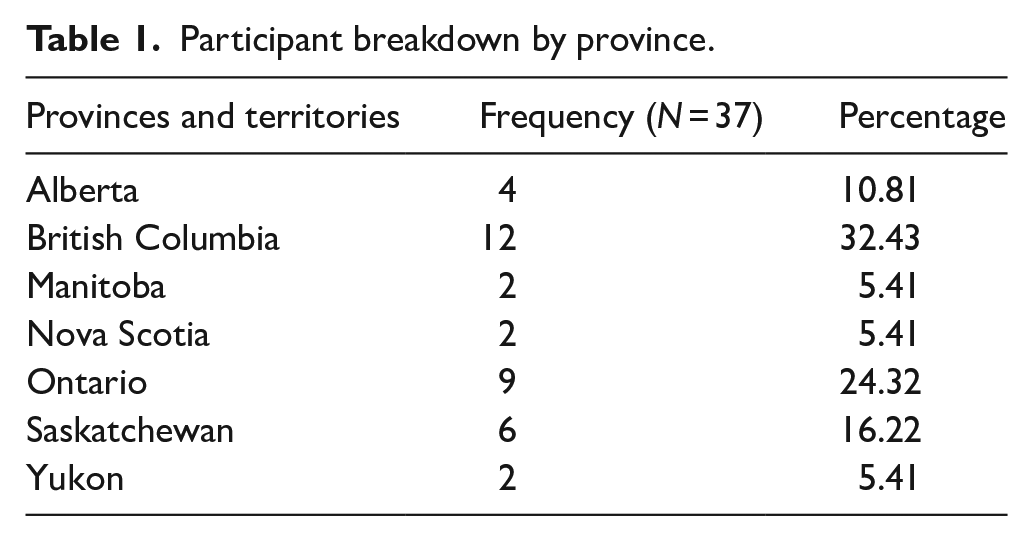
Thirty-seven participants from universities (78.4%) and colleges (21.6%) across seven provinces responded to the survey, with 65% representing institutions in Western Canada (Table 1). More than half of the respondents (59.5%) self-identified as EDs, and the remaining as directors (8.1%), faculty members (24.3%), senior administrators (2.7%), or staff (5.4%). This variation in roles is not surprising as educational development work can be a formal part of the work responsibilities for directors, staff, and administrators; and in some universities, people in educational development roles are considered faculty.
Participant breakdown by province.
The majority of participants reported that they are considered permanent full-time (78.4%) and permanent part-time (5.4%), and others noted that they are on temporary (13.5%) or renewable (2.7%) contracts. When many of these positions were first advertised via public listservs, they were posted as contractually limited or part-time roles; survey results mark a welcomed trend towards greater permanency. Much of the literature on best practices in Indigenization calls for staff who can provide ongoing institutional support (Bopp et al., 2017; Pete, 2016). Reporting structures mirrored the results of our environmental scan, with 81% of participants noting that their position sits within a teaching and learning centre, and 19% in Indigenous centres and affiliated units.
Campus-wide support for the Indigenization of curriculum is a massive undertaking, yet most of the survey respondents indicated that this work is part of a larger profile of responsibilities related to teaching and learning. Only eight respondents indicated that campus support for Indigenization was the sole purpose of their role with responsibilities including consultations, workshops, and department-wide professional development programming focussed on Indigenization and decolonization of education. The majority of participants (67.5%) indicated that their responsibilities evolved over time with respect to their role in supporting Indigenization, marking three notable shifts: (a) the role evolved with greater emphasis on the Indigenization of curriculum (48.1%); (b) the role evolved with greater emphasis on general educational development responsibilities (33.3%); and (c) the role evolved with less emphasis on Indigenization support (11.1%).
Those who reported their positions evolved with a greater focus on Indigenization attributed this shift to an increasing involvement in large scale projects, campus-wide prioritization, additional staff hired to support Indigenization efforts, and increased opportunities to engage with faculty and students to discuss topics related to reconciliation, decolonization, and Indigenization. One participant identified that: As time has gone on, and my relationships with Indigenous colleagues have deepened, and the work we have collaborated on has grown in momentum and demonstrated its impacts, my portfolio has grown to formally recognize Indigenous initiatives, and our Centre’s programming has evolved to focus more intentionally on decolonizing pedagogy. (P22)
Respondents who saw their work responsibilities evolve to include more general educational development duties credited the shift to a campus need for faculty teaching support, and more recently, for online teaching support in response to the shift online during the COVID-19 pandemic. Finally, those who expressed that their responsibilities around Indigenization support had devolved since their position’s inception associated this shift with a loss of resources and job overload. One participant reported this common frustration: “I am doing what has been asked of me but there aren’t enough hours in a day” (P20).
When asked to explore what they have accomplished in their role, more than half of the participants indicated that they were able to build campus-wide awareness about Indigenization, foster rich relationships between Indigenous and non-Indigenous university stakeholders and community members, contribute to strategic documents, and disseminate resources on the integration of Indigenous knowledge and pedagogies. One participant reported: Shifting the university climate to no longer question why we need Indigenous perspectives [is] . . . a necessary way forward. I am happy that I was part of creating the first Indigenous Strategic Plan and that I am here long enough to see our university move into the second one with more depth and more resources to continue the important work we are doing. Faculty are now asking questions such as “how can I attend to the knowledge gaps in my own practice, my disciplinary culture and what resources are available to help me do so?” (P6)
Participants were asked to identify barriers they personally experienced in trying to support the Indigenization of curricula, and general challenges to advancing Indigenization on campus. The most commonly identified barrier participants faced was faculty and administrator resistance marked by a lack of interest and inability to see the value in Indigenizing curriculum. Participants noted that many faculty members are too entrenched in their own teaching epistemology; have a lack of motivation to learn and integrate Indigenous elements in their teaching and curriculum; have a lack of knowledge and awareness surrounding decolonization and Indigenization; are uncomfortable with reconciliation; perceive Indigenous knowledge and methodologies as “less valid, or at least foreign” (P15); or do not have the time to commit to the process. These findings are echoed in the literature. As Kuokkanen (2007) notes, the academy seems inhospitable, if not openly hostile, to many indigenous people for three main reasons: lack of relevance, lack of respect, and lack of knowledge about indigenous issues . . . . Put simply, the values and perceptions of indigenous cultures are generally not recognized or respected. (p. 52)
Participants also highlighted problems at the institutional—or systemic—level, commenting on a lack of support, commitment, and prioritization. One participant specifically encountered barriers to navigating what they perceived to be deliberate attempts at colonialism: The rules about hiring don’t account for colonialism. An Indigenous contract lecturer was driving six hours every week to teach her class, but the school was hesitant to reimburse her for travel. “We don’t do that for other contract workers,” I was told. Well, the government didn’t force other workers to live hours away from the nearest settler city. (P7)
Respondents found universities and colleges prioritized well-intentioned, but ill-conceived efforts rather than meaningful systemic changes: “People are too caught up in the band-aid responses to indigenization (e.g., land acknowledgments at the beginning of every meeting) rather than robust, academic treatment of Indigenous perspectives integrated into programs in a thoughtful, holistic way” (P21). This theme is well-cited in the literature which emphasizes that hiring additional staff to support Indigenization efforts is not a last objective, but a first step towards systemic Indigenization (Gaudry & Lorenz, 2018). And yet, in their consideration of Indigenization at Canadian post-secondary institutions, Gaudry and Lorenz (2018) conclude that universities have been committed to solely increasing the number of Indigenous people rather than broader changes.
Finally, survey participants found they were faced with a heavy workload—juggling support for Indigenization and other general ED responsibilities—and lack of human and financial resources. Three participants reported issues of tokenism, noting they are the source for “everything Indigenous” (P7, P19, and P33). Others found the process of Indigenization complex and all respondents agreed that the responsibilities and goals related to Indigenizing curriculum cannot be placed on a single staff member. It is important to note that Indigenous EDs in these positions face unique questions about and challenges within their role that are different from those faced by non-Indigenous EDs who contribute to the work of Indigenization. Lavallee (2020) writes that “the surge of attempting to Indigenize the academy is exponentially falling on the shoulders of Indigenous academics and non-academic staff” (p. 122). In some ways, this can be perceived as a revictimization of those who were oppressed to burden them with the challenge of changing the system without effective resources.
The following participant provided a strong overview of the themes we identified: The University was developed within a 1000-year-old Western tradition and, thus, the mechanisms of the institution are designed primarily for research and teaching. To have an institution with a dominant worldview and operational structure transform to a new version of itself that is inclusive of Indigenous worldviews means that it needs to commit to exceptional levels of near-immediate change—navigate increasing tensions while persevering against resistance and status quo to initiate and sustain a legitimate transformation. Unfortunately, academic freedom, collective bargaining agreements, Western views of disciplinary procedures, fears of public relations, funding limitations (or stipulations), and a lack of vision of a future that benefits from reconciliation make it difficult for anyone working in this field to last let alone succeed. However, like all the Indigenous Elders, leaders and community members that have come before us, the impossibility of this task doesn’t mean it isn’t worth the effort. We just need more people to commit with their hearts and minds and to provide the appropriate support and resources to those on the frontline. (P5)
Moving forward: calling all post-secondary institutions to action
miyo-pimâtisiwin living the good life
Indigenization must be understood and implemented as working toward the transformation of the academy
—Shauneen Pete (2016, pp. 1–2)
In line with the TRC’s Calls to Action, we ask post-secondary administrators and faculty to make space for more meaningful integrations of Indigenous worldviews in curricula and pedagogies. We encourage all EDs—Indigenous and settler—to think boldly in taking action with their Indigenization efforts rather than complying with institutional measures that do not lead to sustainable reconciliatory actions. Based on our data analysis and our individual and collective understandings of specific Indigenous methodologies and worldviews, we call upon post-secondary institutions to take up the following recommendations:
1. Hire additional Indigenous EDs and increase educational development resources and support
The field of educational development has begun to respond to the TRC’s Calls to Action through the hiring of Indigenous-specific EDs. Though the experiences of EDs who are Indigenous are markedly different from their non-Indigenous counterparts, both are important to the success of this work. That said, hiring one Indigenous ED per institution will not lead to sustainable, widespread change across an entire college or university. A single ED lacks the power to meaningfully advocate for or change policies or procedures within their post-secondary institution, and the risks become twofold: (a) loss of an ED, which can devastate campus efforts and (b) maintenance of the status quo, which can lead to continued oppression of Indigenous peoples. Complicating this further, Indigenous EDs are asked to be the all-knowing source of Indigenous epistemologies, ontologies, axiologies, and pedagogies, even though this is impossible, tenuous, racist, and not generally asked of other professionals (Kuokkanen, 2007). As one participant noted: A dedicated, and substantial budget is essential. Advancing Indigenous knowledges also means developing relationships with Indigenous communities, elders and knowledge keepers beyond the campus, and it requires a budget for supporting the projects and needs of Indigenous faculty on campus, including teaching grants devoted specifically to decolonizing. (P22)
Hiring additional Indigenous EDs can minimize burnout, increase Indigenization support, diversify Indigenous worldviews, disrupt colonial attempts at checkbox measures, decrease siloed approaches to Indigenization of the academy, and signify to the academy and surrounding Indigenous communities the post-secondary institution’s level of commitment to an inclusive educational environment. Educational development with an Indigenous focus is not a stop-gap measure. It is nuanced work that continuously evolves. In order for the Indigenization of the academy to survive and thrive, it must be supported by long-term investments of ongoing operational funds, material resources, and human commitment.
2. Minimize the amount of other duties as needed that pull Indigenous and non-Indigenous EDs away from Indigenization work.
Other duties as needed have become a catch-all phrase in job calls, but in practice, its ambiguity can negatively impact EDs undertaking Indigenization work in the post-secondary environment. Many find themselves supporting other institutional mandates, thus leaving no time to complete Indigenous-specific tasks. For example, survey respondents noted that their job duties were overwritten by centre and campus-wide initiatives, leaving no time to take on Indigenous-related work. And yet, Indigenous-identifying or settler EDs have extensive duties which may include:
participating in university-wide Indigenous initiatives, such as strategic planning, action groups, or communities of practice
consulting with instructors across disciplines to incorporate Indigenous scholarship into curriculum and undertaking Indigenous curriculum development
facilitating Indigenous pedagogical workshops
creating resources and locating and translating Indigenous-specific resources for a myriad of uses across many disciplines
collaborating with Indigenous peoples across post-secondary institutions, and Indigenous Elders and Knowledge Keepers
reviewing and providing feedback on Indigenous projects or resources
participating on hiring committees
Indigenous EDs are also asked to act as cultural teachers, community liaisons, counsellors, and substitute instructors—often by well-meaning settlers who are uncomfortable teaching about Indigenous histories and contemporary realities.
We call upon senior leaders to undertake their own self-education and personal work on Indigenization and other topics that are not the cultural practices of Indigenous peoples specifically. There appears to be unprecedented pressure placed on EDs to be a model of change through certain types of crises; however, crises come and go, but racism, colonialism, and anti-Indigenous mind-sets persist inside and outside the academy. Indigenization efforts are as important today as they were when the TRC’s 94 Calls to Action were created. The agility of the academy response to the COVID-19 pandemic to implement dramatic changes to the ways in which we teach and learn, is evidence that the transformational change required to Indigenize and decolonize is possible.
3. Develop a framework that supports collaboration and community building between post-secondary institutions and Indigenous communities
The lack of forethought or follow-through with creating and maintaining Indigenized strategic plans highlights the academy’s low investment to these efforts, which may be perceived as a superficial approach to Indigenization, especially by communities battling the effects of oppression. One survey respondent noted: For some reason it never seems urgent or important to folks. We get very caught up in the day to day and don’t always get to think long term, except at key moments during the term where we write things in strategic plans and don’t always come back to them. (P2)
As Mihesuah and Waziyatawin (2004) posit, to Indigenize the academy, we must “compel institutional responsiveness to Indigenous issues, concerns and communities” (p. 2). In order for Indigenous students to see themselves in the academy, and for non-Indigenous students to become familiar with Indigenous ways of knowing, we must create and act on creating learning environments that support a holistic view of Canadian society. At this point in our development as a nation, we can no longer attribute ongoing oppression to past actions. We have all been called to acknowledge our responsibilities over the last six years as a result of the TRC Report, so that, failing to live up to the TRC Calls to Action is now our own failure.
We call on post-secondary institutions to create living frameworks and strategic plans that explicitly support collaborative engagement with Indigenous communities on and off campus, and continually assess the impact of these efforts. The source of Indigenous knowledges is in the communities, not in books or articles written about our communities. Universities and colleges must allocate monetary resources for hiring Indigenous Elders and Knowledge Keepers as collaborators, advisors, and subject experts. Earmarking funding and creating honorarium policies helps to establish and maintain healthy, long-term community relationships and ensures community members are respected and compensated for their time and contributions. We must take up and honour Indigenous approaches to knowledge with the same academic integrity that we follow in producing Western knowledge. It is time to explore practice-based evidence rather than focussing only on evidence-based practice.
4. Stop conflating Indigenization with internation-alization, equity, diversity, and inclusion
We ask post-secondary institutions to stop conflating Indigenization with internationalization and equality, diversity, and inclusivity (EDI) as it erases the colonial context in which Indigenous peoples live every day. This conflation negates Indigenous legal differences in Canadian society, which are upheld in the treaties, land agreements, Canadian Constitution, and Canadian Charter of Rights and Freedoms. Western society dominates locally, nationally, and even internationally: post-secondary institutions are bastions of Western culture and, therefore, are biased against other cultures.
Survey respondents—and authors of this article alike—report that Indigenization has been conflated with internationalization or added to EDI portfolios. This gesture, often done through the convenience of othering, dismisses the enormous responsibility of Canadian society to atone for hundreds of years of colonial oppression and harm of Indigenous peoples specifically. Indigenization may include elements of EDI, but its efforts involve more than trying to treat people respectfully and with value. This conflation also highlights a failure to confront Canada’s colonial reality, thus making reconciliation and allyship nothing more than a performative act. This approach to Indigenization allows universities to cling to systems of power and dominance over those that are equity denied. Instead, we contend that EDI initiatives should be grounded in decolonial praxes. Decolonization, which seeks to dismantle systems of oppression and unsettle dominant Eurocentric epistemologies, radically transforms universities in ways that enable Indigenous resurgence and remake the institution for all equity denied communities. Indigenization helps us to decolonize higher education and its many and multiple systems. Indigenous and non-Indigenous EDs are not merely actors; they also do the hard work of holding their universities accountable for maintaining an oppressive narrative that causes extreme harm to Indigenous peoples. Actioning the Indigenization of course design, curriculum, and pedagogy is the tool for rewriting the colonial narrative with one that is inclusive of Indigenous ways of knowing and living.
5. Invest in campus-wide personal and professional development focussed on local Indigenous epistemologies
While survey respondents described that they support instructors through workshops and consultations focussed on Indigenous issues, much of this work is sporadic and surface-level, covering basic concepts of local and national Indigenous identities, diversity, and differences. This can be attributed to limitations of personal understanding and engagement by post-secondary stakeholders as much as it is due to the lack of coordination and in-depth attempts at the institutional level. Professionalism and institutional autonomy often isolate personal expectations from the process, thus leading to insufficient engagement. It is fundamentally important to provide personal and professional development about local Indigenous issues, worldviews, knowledge, histories, and cultural practices. It is also critical to ensure that, in addition to depth, Indigenous-focussed professional development aligns with the practices and worldviews of the local communities and individuals in and around each post-secondary institution, so there is no pan-Indigenization or appropriation of Indigenous perspectives.
Inspiration to fully engage with Indigenous epistemologies can come from many sources; for the author group, one approach is kiyokiwin (the art of visiting), which goes well beyond professionally distant courtesies. This investment demands time and effort: sitting in a circle with local community members, Elders, and Knowledge Keepers, and absorbing core intellectual, physical, emotional, and spiritual lessons, and Indigenous worldviews, self-determination ideology, lived experiences, cultural practices, and the hopes we have for the next generation. Too many people do not value or respect holistic Indigenous development processes that engage the whole person, preferring to parachute in and out of Indigenizing and decolonizing work without any personal investment. For most Indigenous people, trust is a personal quality that is about an individual’s capacity to be reliable, to speak with honesty and humility, and their ability to know themselves in relation to community. Trust cannot be placed in a professional attitude or credentials, but with a person who can show their trustworthiness. Pete (2016) also speaks to the need to learn and unlearn colonial histories and systems through the undertaking of professional development such as reading Indigenous authored scholarship and working with Indigenous peoples and communities. Post-secondary institutions must invest in Indigenous-focussed personal and professional development opportunities which include, but are not limited to, Indigenous ceremonies, community engagement, cultural events, teach-ins, and guest lecturers by Indigenous scholars and community leaders. It is time to openly accept holistic development of staff and faculty to include time spent with Indigenous communities or attending events or ceremonies. Similar to conferences and workshops, these are learning places for Indigenous knowledge and guidance for direction or next steps. We urge universities to provide time to participate in these Indigenous personal and professional development experiences, the funding for expenses, and recognition for taking the initiative to support the academy in this way.
We would like to emphasize the importance and necessity of prioritizing local engagement in personal and professional learning opportunities. Too often, Western society looks for or brings in nationally acclaimed teachers whose prestige matches institutional egoism. While we do not wish to denigrate the teachings that these honoured and respected Indigenous leaders bring, what is critically important is to lift up local Indigenous communities. They are the people of the land where our campuses sit, and their teachings, knowledge, histories, and cultural practices are paramount in the Indigenous learning journey of our post-secondary institutions. We must all remember our sacred connection and relationship to place, know where our knowledge comes from, and cherish it as much as we do our own unique and special gifts.
6. Through collective action, change faculty and leadership mind-sets—from their understanding and value of Indigenization to their approach to teaching and learning
Post-secondary institutions are vast and complicated systems of interrelated components. There is no easy way to Indigenize an academy without encountering many different and sometimes competing components. This resonates with survey respondents who indicated that they struggle to navigate the components that are outside of their areas of influence. And yet, EDs are forced to spend time negotiating with leaders or faculty members, who are gatekeepers, to validate their work, and validate Indigenous knowledges. These gatekeepers are, as Aileen Moreton-Robinson (2015) argues, those “who [have] the power to constitute what knowledge is valid” (p. 13). There is a high level of prejudice for evidence-based practice versus practice-based evidence with Indigenous knowledges falling into the latter. Often settler faculty and senior administrators assess the value of Indigenous knowledges by applying Western academic standards and thus over-look or dismiss important Indigenous knowledge contributions simply because they are not presented in refereed journals, for instance. The inability to perceive the value in Indigenous ways of knowing, being, and doing ensures that Indigenous worldviews are not a part of curricular processes or policies. Moreover, there is a deficit in academic leaders and faculty members educating themselves about Indigenous histories and contemporary realities. Consequently, many survey respondents disclosed that faculty members are often too entrenched in their own epistemologies which are rooted in colonial mind-sets. To disentangle one’s belief system from the colonial mind-set takes much unlearning, relearning, and learning. One participant noted: Indigenous knowledge and methodologies are still considered less valid, or at least foreign. Ways of assessing and teaching that are more Indigenized are not often included, even in our professional learning on the subject. The focus remains on teaching Indigenous content in a western way, which often ends up compromising the content and misrepresenting the worldview. (P15)
It is imperative that educational leaders pivot towards a decolonial mind-set and dismantle the governance systems that uphold colonialism (Chung, 2019; Easton et al., 2019; Mooney, 2021; Yeo et al., 2019). It is time for educational leaders to be more than allies; it is time for them to be accomplices, drawing on their own power, and privilege to challenge dominant systems. Dismantling colonial educational systems must happen at all levels in the academy. We contend that decolonizing the academy includes using Indigenous governance and teaching and learning practices when developing curriculum and resources, enacting governance structures, creating course and programme-level outcomes, conducting meetings, collegial interactions within the workplace, and in pedagogical strategies.
Anti-Indigenous racism and epistemological violence will prevail if Indigenous worldviews are not represented in every facet of post-secondary education. Recently, Wilton Littlechild, TRC Commissioner, in reviewing how far we have come since the TRC’s Calls to Action were released, said that he would add a 95th call and it would be for Indigenous and non-Indigenous people to work together (Monkman, 2020).
7. Increase Indigenous hires across all faculties, departments, and staffing units within the academy
It is not just the EDs who carry the burden of Indigenizing post-secondary institutional curricula, but also leadership, faculty, staff, and the students that interact with the many different facets of academic portfolios. To truly Indigenize means that the academy’s halls, walls, staff, faculty, students, and resources reflect Indigenous peoples lived experiences. Indigenous students, staff, and faculty must be able to see themselves in the academy. However, there are few Indigenous academics represented in universities in Canada. Currently, only 1.4% of professors in Canadian universities identify as Indigenous (Academic Women’s Association [AWA], 2018). Moreover, 1% of the total PhD student population in Canadian universities are Indigenous (AWA, 2018). Data from 2016 show that 48% of Indigenous students who enter post-secondary educational institutions complete their studies (AWA, 2018). Furthermore, only 5% of post-secondary students are Indigenous (AWA, 2018). Why are the data so low? Colonialism, imperialism, and racism are to blame. But, these are not empty signifiers without actors that perpetuate systems of violence and oppression against Indigenous peoples. There are people within these systems that uphold approaches to power and dominance over Indigenous students, scholars, and staff. It is common to hear throughout educational development that faculty members and staff share that they do not have the time or the space in the curriculum to incorporate Indigenous perspectives.
Education has a role to play in reconciliation and in changing future outcomes for all people in Canada. If we take the TRC’s Calls to Action seriously, it is apparent that more Indigenous peoples are needed within the academy to Indigenize and decolonize a highly colonial space. Creating new positions such as Indigenous faculty, vice-provosts, vice-presidents, and directors, or hiring Indigenous peoples into existing faculty and upper administrative positions—as well acting on the above recommendations—can support the transition towards shared voices from every facet of the university, better and more authentically facilitating the inclusion of Indigenous knowledges and approaches, and help Indigenous students to truly see themselves in the academy. Indigenous peoples working collectively to Indigenize and decolonize post-secondary teaching and learning environments, policies, procedures, and governance structures, can limit epistemic violence. The survey respondents uphold this call to action: Hire more Indigenous people. We really need to reform our hiring process. (P8) Shifting the university climate to no longer question why we need Indigenous perspectives and why the attending to the gaps in Indigenous knowledge and understanding are a necessary way forward. (P6) In order to advance Indigenous knowledges and ways of knowing in curricula and teaching practices at my campus, we need to hire a new [job title] asap so that I can return to the work I was initially hired for. But deeper than this, I think that whoever comes into the position needs to be more thoroughly supported by senior leadership, much better resourced in terms of human resources and also budget, and trusted more deeply to help guide the [university] overall. (P33)
In closing
These recommendations were developed through the lens of educational development in the Canadian higher education system, though their applicability—we believe—is relevant worldwide. Canadian post-secondary institutions have committed, on paper, to aligning with the TRC’s Calls to Action, but have not yet become accomplices in reconciliation. Our proposed strategies aim to foster the transformative change long advocated for, and to create supportive educational practices that are inclusive of Indigenous Peoples. As the Elders have shared with us, this work began decades ago.
As post-secondary institutions are complex systems rooted in deep traditions, and the harm to Indigenous Peoples is integrated into institutional structures, it will take time—and trust—to achieve deep transformation. Nonetheless, transformation is essential to remedy our past, to contextualize our present, and to protect as well as ensure the safety and stability of our future generations. Working together to create this transformation is the responsibility of every member of the academic community.
To the EDs who noted that they feel isolated, tired, alone, defeated: We hear you. We support you. We send you our love.
Footnotes
Acknowledgements
The authors thank Chrissy Bowden and Suzie Sawicki (University of Windsor) for supporting this research. We are grateful for their time, generosity, and efforts.
Declaration of conflicting interests
The author(s) declared no potential conflicts of interest with respect to the research, authorship, and publication of this article.
Funding
The author(s) disclosed receipt of the following financial support for the research, authorship, and publication of this article: This work was supported by the Educational Developers Caucus. The authors gratefully acknowledge their financial support of this project.

Glossary
miigwech thank you
huy tseep q’u thank you
naqumik thank you
niá:wen thank you
watkwanonweraton welcome
anushik thank you
maarsii thank you
miyoonakishkatoohk welcome
kinana’skomitina’wa’w thank you
kiyokiwin the art of visiting
miyo pimatisiwin living the good life; living the good life means that we are living in right relations with our human and more than human kin; we are adhering to natural law and the sacred teachings of the Creator
tawâw welcome
biindigen come indoors, come inside
miigwech thank you
wiliháwtʱekʱ welcome from ancestors to your ancestors; we welcome everyone to this space