



Abstract
Flavonoids contain pharmacological effects that help to protect cells from damage. However, the anticancer activity of flavonoids is related to their modulation of signal transduction pathways within cancer cells. Natural substances such as flavonoids have immune-stimulating anti-tumor effect that could lower breast cancer risk. However, various diseases included Alzheimer’s and cancer disease are associated with flavonoids intake due to their ability as antioxidant agent to alter essential cellular enzyme’s function. Therefore, through interaction between flavonoids and Cytochrome P450 (CYP) family enzymes led to make them chemopreventive agents for breast cancer. In this analysis, the chemo-informatics properties of 5 selective flavonoid derivatives and their efficiency as anti-breast cancer drugs were evaluated. Flavonoid ligands were docked with the predicted protein, which is human placental aromatase complexes with exemestane, a breast cancer drug (3S7S). Based on various docking energies, the molecular characteristics and bioactivity score of the following components, C15H12O6 2-(3,4-dihydroxyphenyl)-5,7-dihydroxy-2,3-dihydro-4H-chromen-4-one and C15H12O5 5,8-dihydroxy-2-(4-hydroxyphenyl)-2,3-dihydro-4H-chromen-4-one showed greatest molecular properties and bioactivity docking scores of −8.633117 and −8.633117 kcal/mol respectively. Therefore, both compounds could be considered antitumor agent.
Introduction
Flavonoids have typical structures of 2 benzene rings with a 15-carbon skeleton showing effective polypharmacological behaviors when interacted with enzyme systems. 1 Highest amounts of flavonoids found in the human diet and some legumes contain around 4.5 to 610 mg/kg. However, it mainly existed in various common fruits and in aromatic herbs. 2
Flavonoids’ pharmacological properties of the secondary metabolites are could be used to generate powerful anti-cancer medicines in future studies. The biological and pharmacological activities of flavonoids showed wide range of in-vitro studies such as anti-allergic, anti-inflammatory and antifungal, antioxidant, anti-microbial, anti-cancer, antiviral, and anti-diarrheal activities.3,4
The chemical mechanism of flavonoids suppresses the activation of various carcinogenic substances by blocking critical cell cycle regulators such as cyclin-dependent kinases and vascular endothelial growth factor inhibition which led to produced their anticancer and prevention effect include the induction of apoptosis. 5 However, flavonoids are responsible for inducing leukemia gene in the mixed-lineage and also proved to prevent topoisomerase enzymes.6,7
Flavonoids have poor antioxidant effect without hydroxyl groups in compared to flavonoids contain hydroxyl groups. Besides, the presence of hydroxyl groups in flavonoids contributed to greater antioxidant activity and interaction with binding sites better than the other flavonoids. 8 Also, the antioxidant activity of flavonoid-rich grapeseed protected the gastrointestinal mucosa from reactive oxygen species generated by acute and chronic stress. 9 However, by reversibly combining with various proteins, enzymes, and receptors in the body, amazing impacts on protein regulation functions were discovered. There is an inverse association between breast cancer risk and higher intake of flavonoids according to epidemiological studies. However, the relation between flavonoids and breast anticancer activity is related to flavonoids modulation of signal transduction pathways within cancer cells leading to inhibiting cell proliferation, metastasis, and angiogenesis. 10
The breast tissue is the spot that cancer initiates, whereas breast cancer is divided into 2 categories relying on the place that cancer originates. The first one is called ductal carcinomas, and the second one is lobular carcinomas. 11 Most breast cancer cases have been in women, while men have been taken by a very tiny percentage, whereas the type and characteristics of breast cancer is the key to treat the disease, whether by chemotherapy, hormonal medications, or surgery. 12 In breast cancer prevention and treatment, flavonoids are potentially contributed either by antioxidant or apoptotic activity. Breast cancers typically exhibit intra-tumoral heterogeneity, with ER-positive and ER-negative cells, and it is recommended to treat women with ER-positive tumors with anti-estrogens or aromatase inhibitors. 13 The association between flavonoid intake and breast cancer may greatly affect risk menopausal and estrogen-receptor (ER) status. However, the link between soy isoflavone consumption and a lower risk of breast cancer incidence was greater in postmenopausal women than in premenopausal women. 14
Chemoinformatics is a tool that is used as a source of information by transforming data into information, which leads eventually to create knowledge of a subject. It is accompanied with results that are acquired by chemical experiments to predict some mysterious chemical phenomena 15 . Docking or Molecular docking is a type of bioinformatics modeling that is based on bonding 2 or more molecules to end up with a stable structure. Docking could predict 3-dimensional properties of molecules relying on binding properties. It is also a good method to estimate the strength and type of obtained signals. 16 Software products that are used to calculate ADMET properties and various pharmaceuticals such as CLOGP, C2-ADME, Drug Matrix, TOPKAT, Bioprint, AbSolv, and Gastro Plus.
In this study, 5 flavonoids were logically chosen for this investigation based on differences in hydroxyl groups on their structural framework in order to examine their reactivity and bio-efficiency as drug agent. A comparative molecular docking analysis was performed to elucidate the binding modes of experimentally reported and unknown inhibitors based on the knowledge of geometry, binding affinity, and drug score.
Biological functions of flavonoids
The potential cytotoxicity of flavonoids and their interaction ability with enzymes is the main vital aspect of biological activity. Also, flavonoids used in maize to resist aluminum toxicity due to their ability to chelate metals in vivo mechanism to ameliorate aluminum toxicity. 17
However, some flavonoids benefit on cardio-protection include increasing coronary vasodilation, reducing the capacity of platelets in the blood to coagulate, and preventing LDLs from oxidizing, and its essential part in the influence on capillary blood vessels. Therefore, cardiovascular diseases can be reduced 2.4 times by natural flavonoids intake in compared to individuals less consume of these products. 18 Flavonoids can modulate signal transduction pathways within cancer cells; flavonoids can promote apoptosis and prevent cell proliferation, angiogenesis, and metastasis. 19 Flavonoids are bioactive polyphenols that have antioxidant and immunomodulatory properties. Flavonoids are classified into several sub-groups based on the chemical configurations of hydroxy groups and the degree of oxidation (Figure 1). 20

General chemical structures of different types of flavonoids.
Molecular Docking Method
Molecular docking is essential in the rational design of medicines. A typical computational biology approach for predicting the binding orientation of small molecule with their protein targets to estimate the small molecule’s affinity and activity. Bioinformatics laboratory aiming to indicate flavonoid compounds by utilizing chemoinformatic. Molecular docking includes 3 steps in development of drugs, as shown schematically in Figure 2.

Molecular docking steps.
Likewise, the study aimed to observe the binding action of these compounds on molecular objectives. Various flavonoid compounds were drawn with 2-dimensional as well as 3-dimensional structures by the PUBCHEM project, which was further used in docking. The software and online servers that were utilized in the study are described below:
National Center for Biotechnology Information: This facility possesses a collection of databases that are related to biomedicine and biotechnology work.
PUBCHEM: This software was used to sketch the 2-dimensional and tri-dimensional properties of the selected flavonoid compounds as ligands. It was also employed in docking.
Protein Data Bank (PDB): This software is a database considered to be the one of the informational depositories of huge biological molecules as 3D structures of proteins and nucleic acids.
Open Babel: This software was free, and it was used very smoothly. It is utilized to convert the format of chemical files. The flavonoids were selected individually and the SDF files were converted into PDB.
Swiss-Model: It is a bioinformatics web server that shows similar sequences between the target and the enzyme to provide homo-modeling of proteins as 3D structures. 15
Molinspiration: This software was used to provide a rapid estimation of biological activities. This engine selects only the molecules that supply a virtual screening of biological activity of a huge collection of molecules. v2013.02.
Hex Docking Server: Hex is a program for molecular superposition and interactive protein docking. It is mainly used in molecular modeling to predict the preferred direction of 2 molecules with each other to end up with a stable molecule. Therefore, it is used to estimate the association and strength between a protein and a ligand.
Selection of Molecular Target: The molecular target was chosen based on RCSB Protein Data Bank (www.rcsb.org). It was prepared by gathering some information via research papers and a book (Flavonoid Chemistry). Crystal structure of human placental aromatase complexed with breast cancer drug exemestane (3S7S) was template of the protein as shown in Figure 3.
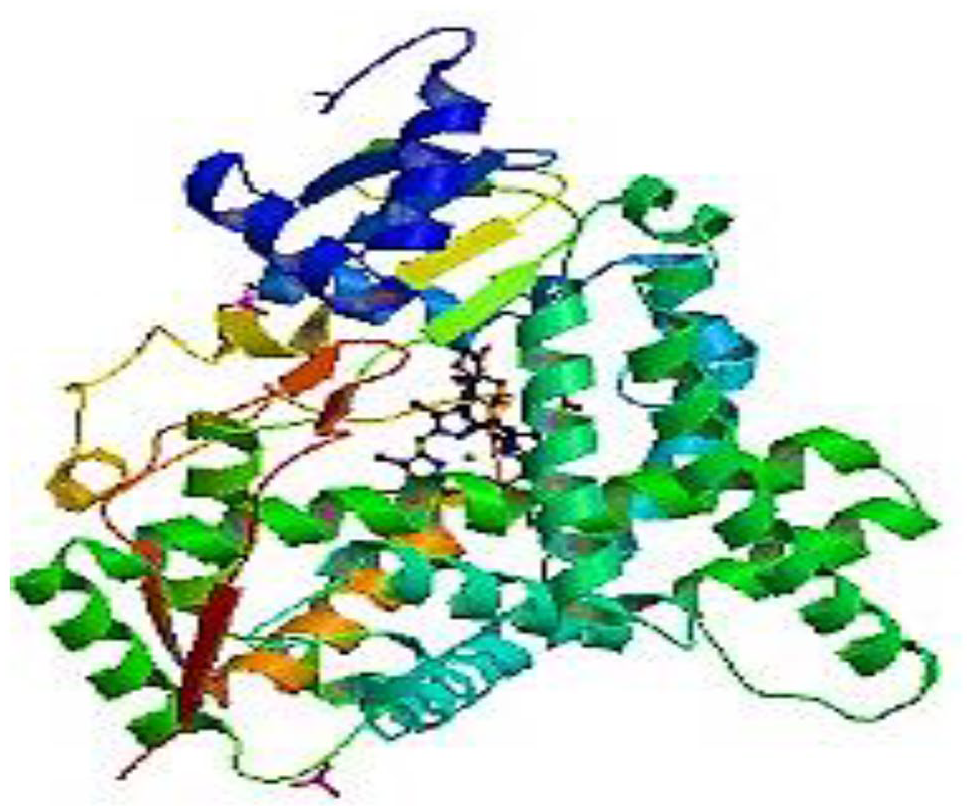
Crystal structure of aromatase complexes with breast cancer drug (3S7S).
Results and Discussion
A comparative molecular docking analysis was completed successively to reveal the binding mechanisms of experimentally reported and unknown inhibitors of 5 chosen flavonoid based on binding affinity, and drug score.
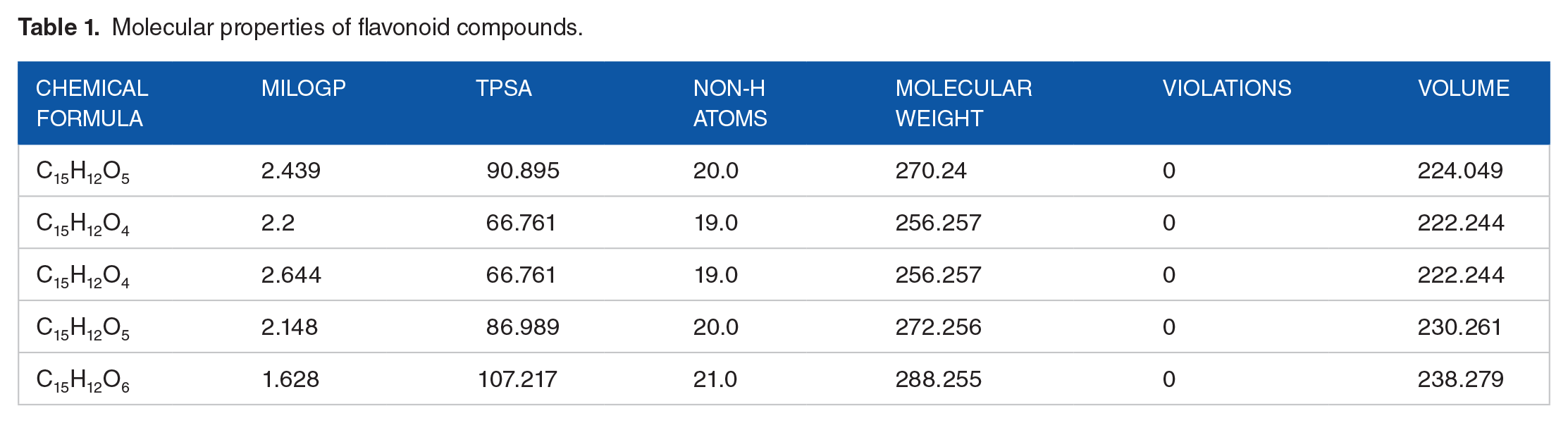
Pharmacological similarity is a compression between the properties and features of molecules and medications, as well as, to determine the likeness between them. Tables 1 and 2 contains pharmacological similarity of compounds (1-5). These characteristics mostly include bioavailability, metabolic stability, and configuration.
Molecular properties of flavonoid compounds.
Calculation of bioactivity scores.
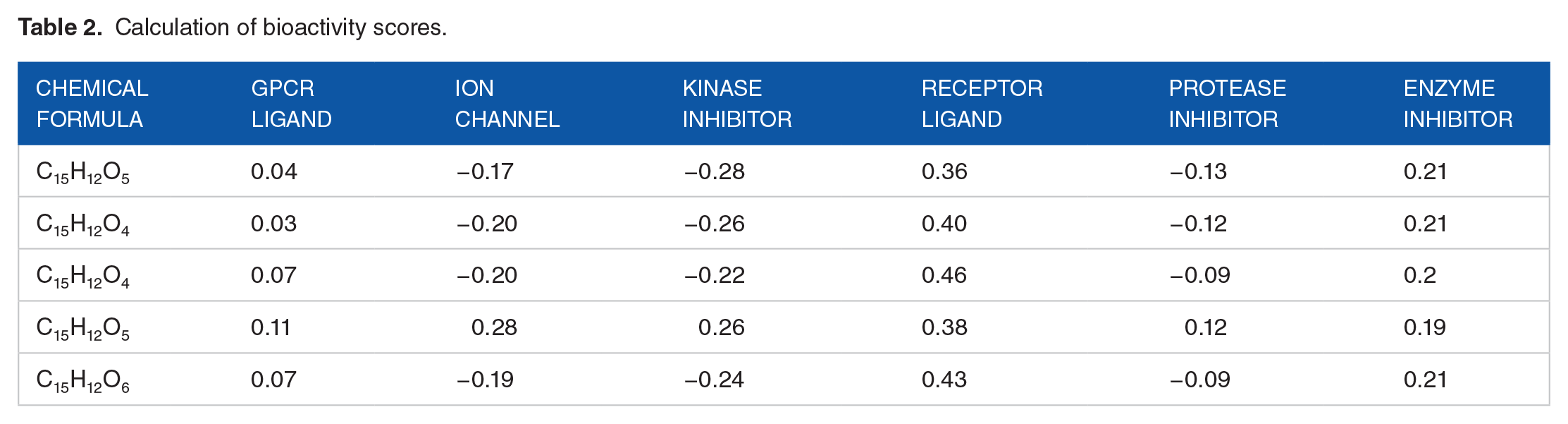
The 5 compounds and standard medicines were evaluated based on 4 pharmacological activities in the field of nuclear receptor ligand activity, GPCR ligand activity, kinase inhibition activity, and ion channel modulation. All the results are listed in the Tables 1 and 2 by numerical designation. The compounds were shown negative values in all denominations that are reliable to do a compression with the selected standard medications. Thus, it is obviously seen that these molecules are predicted to have similar activities to the medications according to the above 4 mentioned criteria. The properties of the selected molecules are shown in Table 1 MiLogP (octanol/water partition coefficient). An approach by Molinspiration was relied on to determine those properties. The chosen method is very powerful in terms of its ability to deal with vast number of flavonoid molecules and organic compounds (TPSA).
PSA was proved to be an excellent rubric that characterizes drug absorption, as in the blood-brain barrier penetration, bioavailability, and intestinal absorption. Two essential properties, which are the values of Lipophilicity (logP value) and (PSA), are very good factors for estimation of per-oral bioavailability of drug molecules. The (PSA) was calculated using surface areas that are filled by oxygen and hydrogen atoms. Therefore, the PSA is the tool that links the hydrogen bonding of a molecule. The intestinal absorption is poor when the value of PSA is 160 Å or above. Therefore, there are no certain criteria for anticipating oral absorption of a medication.
Generation of library of flavonoid compounds
The NCBI Computational Biology Branch (CBB) was very helpful in creating a ligand library. The 5 selected flavonoid compounds are listed in Figure 4.

Selected flavonoid compounds (2-d structure and 3-d structure).
Calculation of molecular properties and bioactivity scores
Flavonoids biological functions are linked to their interesting interaction with enzymes through protein complexation and their potential cytotoxicity. The following data represent the calculation of the Bioactivity and Molecular properties of 5 flavonoid compounds (Table 1).
Based on what was mentioned in Tables 1 and 2, the flavonoid compounds possess excellent molecular properties. Also, they do not exhibit any violation of Lipinski’s Rule of 5. The violation is because of molecular weight, such as example-Actinomycin D (Molecular weight-1255). 21
The strength of a non-covalent interaction between 2 molecules after they have been docked could be predicted by computational chemistry and molecular modeling, which considers a fast mathematical method used to score functions. 21 In Table 3, the calculated docking energy was observed; the docking energy of the below compounds had the following least docking energy. However, a better association between the ligand and the target protein produced a higher binding affinity, which meant less docking energy. Flavonoids have pharmacological effects can be justified by the 2 important pharmacophores hydroxyl group and oxygen; anticancer activity falls sharply due to the drastic poor H2O solubility of the resultant compound. 22
Docking energy of ligands.

The mechanism of the aforesaid reaction suggests that the pharmacological properties of the flavonoids act either chemo-preventive for adverse endocrine disruption or hormone-dependent cancer through the interference of exogenous chemicals with the aromatase enzyme. 22 Aromatase, an enzyme that can convert androgens to estrogens which is a major enzyme in steroid biosynthesis. 23
Docking energy
Docking analyses of flavonoids 1-5 with COX-1 showed the association between the ligand and the selected protein, which led us to examine how these compounds docked in the active site of the enzyme, as well as determine which residues are involved in the interaction with the compounds.
However, low docking energy values produced the best association between the ligand and the selected protein in compared with the high value. Besides, the pharmacological properties of compounds with (H and O) would decrease the anticancer activity due to the water poor solubility in the formed compound. 24
The result showed that the flavonoid compounds have zero violation to Lipinski’s Rule while there are many drugs known to have same violation, such as Actinomycin D (Molecular weight-1255. However, this violation is due to molecular weight. Hex Dock online server was utilized to find out the Docking energy of the ligand (Table 3).
The non-covalent interaction between the ligand and the protein was investigated by computational chemistry and molecular modeling, which are considered as the best mathematical methods. In contrast, proteins and flavonoids interaction impacts the antioxidant efficacy which may result in a reduction in flavonoids’ antioxidant capacity both in vitro and in vivo. Furthermore, interactions with proteins may increase antiproliferative effect in some tumor cell lines.
Conclusion
Human dietary elements and health are directly linked to flavonoids. As a result, it is necessary to assess the link between structure and function. Many flavonoids have been proven to have antioxidative, anti-inflammatory, prevention of coronary heart disease, and anticancer effects while others may have antiviral properties. Breast cancer like other types of cancer, has been placed under investigation to find a cure that could eliminate it. Many anti-cancer agents have been developed, especially the non-toxic ones, aiming to use them as a treatment. Flavonoids compounds have been selected due to the advantages they possess. Therefore, women who consume a lot of flavonoids have a lower risk of getting breast cancer. These molecules have played a role as antitumor agents. However, breast cancer prevention and treatment, either by antioxidant or apoptotic activity, can be contributed effectively by flavonoids. Based on the results above, it was shown that some of the selected molecules were shown the best bioactive score, molecular properties, and docking energy toward anti-tumor medication due to that they do not violate Lipinski’s rule. The following 2 compounds 2-(3,4-dihydroxyphenyl)-5,7-dihydroxy-2,3-dihydro-4H-chromen-4-one and 5,8-dihydroxy-2-(4-hydroxyphenyl)-2,3-dihydro-4H-chromen-4-one were shown a prove that these flavonoids could be the initiation of developing antitumor medications.
Footnotes
Acknowledgements
The author Dr. Mohammed Hadi Ali Al-Jumaili would like to express his special appreciation to Dijlah University College.
Funding:
The author(s) received no financial support for the research, authorship, and/or publication of this article.
Declaration of conflicting interests:
The author(s) declared no potential conflicts of interest with respect to the research, authorship, and/or publication of this article.
Author Contributions
MHA and MKY contributed to the conceptualization, writing original draft preparation. MHA writing—review and editing. The authors have read and agreed to the published version of the manuscript.
