




Abstract
Transposable elements (TEs) are known to play a role in genome evolution, gene regulation, and epigenetics, representing potential tools for genetics research in and breeding of conifers. Recently, thanks to the development of high-throughput sequencing, more conifer genomes have been reported. Using bioinformatics tools, the TEs of 3 important conifers (Picea abies, Picea glauce, and Pinus taeda) were identified in our previous study, which provided a foundation for accelerating the use of TEs in conifer breeding and genetic study. Here, we review recent studies on the functional biology of TEs and discuss the potential applications for TEs in conifers.
Transposable Element Insertions Influence Plant Traits
Transposons are DNA sequences that are autonomously duplicated and can “jump” out from one location on the genome and be reinserted at another place. Transposons randomly shift to different loci in the genome, which can alter the original gene structure and lead to gene silencing or inactivation, consequently changing the traits under the regulation of the functional genes. 1 For example, Zhang et al 2 found a 27.2 kb transposable element insertion in the promoter of the stiff1 gene of maize that represses the transcription of stiff1 and, consequently, enhances stalk strength by increasing the cellulose and lignin contents in the cell wall. Sometimes, when a transposon is inserted into the coding region of a gene, it modifies an important functional domain or splice site, consequently changing the transcript. Although the gene could still be translated into a protein, the original function may become weakened or lost. Moreover, some transposable elements (TEs) directly regulate a functional gene as a promoter. 3
Recent studies have also suggested that plant transposons have important biological functions in gene expression regulation through the generation of noncoding RNAs.4,5 Most long non-coding RNA (lncRNAs) originated from intergenic regions where transposons were abundantly distributed, and some microRNA (miRNAs) and short interfering RNAs (siRNAs) were directly or indirectly derived from transposons. These noncoding RNAs are known to regulate genes in plants. Because TE insertions could influence gene expression and function and eventually cause phenotypic variances between individuals, they have received attention for their potential value in the study of genetics.
Transposable Elements Participate in Genome Evolution
In addition to genetic association studies, TEs have also been used the study of evolutionary processes. For example, miniature inverted-repeat elements (MITEs) were considered the driving force of genomic evolution, and the number of MITEs was significantly and positively correlated with genome size. Because of their abundant variety of copy numbers and insert sites and highly species-specific characteristics, transposons have great potential in the study of gene function and genome evolution. 6 Tang et al identified an active MITE “mJing” that is associated with the high-tillering dwarf mutant in rice; moreover, they also found that the copy number of mJing dramatically varies among Oryza sativa (Asian cultivated rice), Oryza rufipogon (wild ancestor of Asian cultivated rice), and Oryza glaberrima (African cultivated rice), suggesting that the amplification or contraction of mJing elements may play an important role in genome evolution and species diversification in rice. 7
Interestingly, when plants experience biotic and abiotic stresses, many TEs in the plant genome are specifically activated and probably transposed under the regulation of methylation or transposons themselves, which has been found in tobacco, tomato, and other plants. 8 Some researchers have suggested that the activation of TEs under stress may accelerate genome recombination, which may also reflect the environmental adaptation process of plants during the particular lengthy evolutionary history of species.
Potential Application of TEs in Conifer Breeding
Conifers (Coniferales) are the largest and most important group of gymnosperms, as well as the most archaic branch. They have a total of 6 families, 69 genera, and 605 species. Although the number of species is limited, most of the important tree species belonging to terrestrial ecosystems evolved from conifers, placing conifers in an important taxonomic status and were usually used for the study of plant evolution history. 9 Moreover, conifers have been regarded as dominant species in the forest for more than 200 million years, not only for supporting large industries by providing wood, fiber, and energy but also for making great contributions to the global ecosystem. Due to their high ecological significance and economic importance, the genetic breeding of conifers has become an important research subject worldwide. With the rapid development of genome sequencing technology, an increasing number of high-quality plant genomes have been reported, from which researchers could get genetic data that could be used for the study of genetic mechanisms and for identifying key genes associated with important economic traits. These genomic resources could be a great resource when making breeding plans and, in addition, accelerate the process of genetic breeding in plants. Although several plant whole-genome sequences have been reported, the sequences available from conifers are limited due to their extremely large genomes and assembly difficulty. Examples of such conifers include Pinus lambertiana (~31 Gb), Pinus taeda (~22 Gb), and Picea abies (~20 Gb).10-12 Their genomes contain considerable amounts of repetitive DNA, which contributes to the large size of conifers’ genomes and, especially, a high number of TEs, which provide vast potential genetic resources for further study.
In a previous study, we reported our work on the identification and classification of TEs in 3 important conifers, P abies, Picea glauce, and P taeda, at the whole-genome level. 13 In total, 413 423 TEs were identified from the 3 conifers, and further classification suggested a great variety among the 3 species (Table 1). Further identification of the genetic functions or association with the economic characteristics will facilitate breeding. Identifying functional genes associated with interesting traits through the construction of transposon-based mutation libraries and the development of TEs as molecular markers that could be used for assisted breeding are 2 main methods by which TEs could be used in plant breeding. Related research has been carried out in other economic plants.14,15
Summary of identified TEs in the Picea abies, Picea glauce, and Pinus taeda genomes. 13
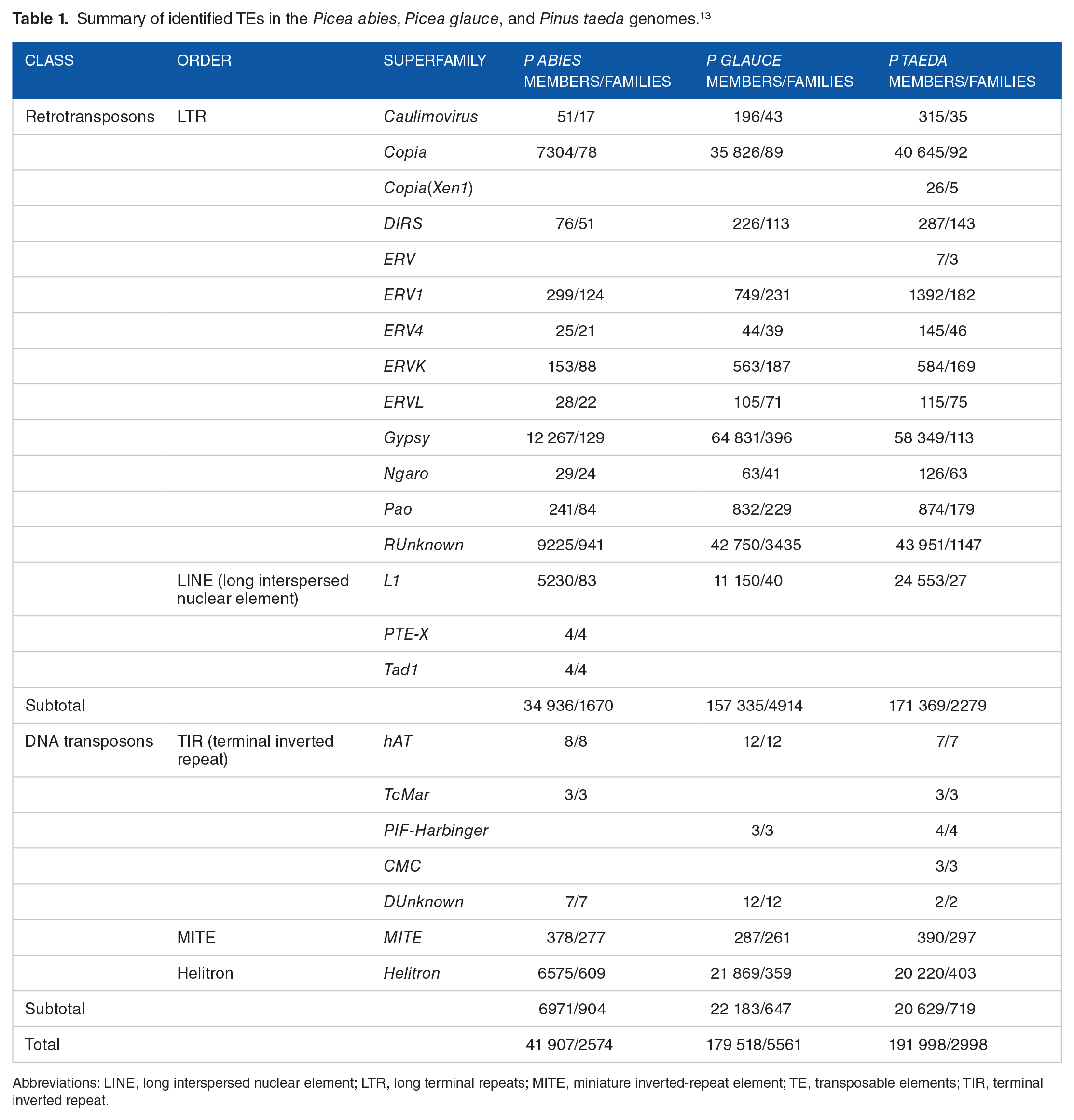
Abbreviations: LINE, long interspersed nuclear element; LTR, long terminal repeats; MITE, miniature inverted-repeat element; TE, transposable elements; TIR, terminal inverted repeat.
Transposon-based mutation libraries are important tools for the study of functional genomics in economic crops, including Oryza sativa 16 and Zea maize. 17 Currently, studies have been conducted in which exogenous TEs have been inserted into the plant genome to create mutants using genome walking. 18 Tnt1, Activator/Dissociation (Ac/Ds), and other TEs are traditional transposon systems used in the construction of mutation libraries. For example, Tnt1 was originally found in Nicotiana tabacum and is usually not active in common plant tissues; however, it can be activated in other plant species via tissue culture. Moreover, it can be stably inherited and re-transpose during tissue culture. 19 In a recent study, Sun et al 20 found that Tnt1 insertions are basically randomly distributed throughout the genome and can be identified on both arms of chromosomes in a Tnt1-based Medicago truncatula mutation library. Moreover, they found that the Tnt1 insertion is positively correlated with gene methylation and negatively correlated with CG content in M truncatula, suggesting a special tendency of Tnt1 insertions. Zhou et al 21 identified 2 mariner-like elements (MLEs), Ppmar1 and Ppmar2, from moso bamboo that contain terminal inverted repeats. Furthermore, heterologous transfer of the 2 MLEs to Arabidopsis thaliana suggested that they could also transpose in other plants. However, Tnt1 must be activated under in vitro tissue culture 22 ; therefore, a stable and effective tissue culture system in conifers must be constructed first. Another Activator/Dissociation (Ac/Ds) element comes from maize and is a classic maize transposon method that is used for constructing mutation libraries. Both elements can duplicate and transpose throughout the plant genome. Previous studies have suggested that Ac/Ds can insert into gene-rich regions and alter the expression of genes or the genome through the formation of unstable insertion alleles, stable derivatives, or excision alleles.23–25 Until now, Ac/Ds transposons have been shown to be effective in approximately 20 plant species and have become the most widely used TEs for gene tagging and functional genomics studies in plants. For example, Carter et al 25 produced activation-tagged and knockout mutants in the processing of tomato cultivar M82 using the Ac/Ds system and agrobacterium-mediated method. Finally, a population of 509 independent transposed lines with only Ds insertions throughout all 12 chromosomes was developed. Wang et al 26 established an Ac-based transposon system with the donor Ac tightly linked with sugary1 (su1) on maize chromosome 4S, and a total of 208 independent long-distance-transposed Ac lines were identified. This Ac-based system combined with 2 other Ac-based regional mutagenesis systems in maize could be integrated into a new maize mutation library with a more even and high-density distribution of Ac elements throughout the genome for functional genomics studies.
Molecular markers are an important tool for genetic studies and breeding, the construction of linkage maps, and population genetics analysis. Transposable elements constitute most of the repetitive sequences and are distributed throughout the genome in plants; thus, TE could have great potential to be explored as molecular markers. Liang et al 27 identified 336 long terminal repeats (LTR) effective primer pairs that could amplify DNA from P virginiana, 117 of which could produce amplification in other Prunus species; in addition, 59 of the LTR markers were used to construct a linkage map after qualification. Sequence-characterized amplified region (SCAR) markers derived from transposons are another TE-based molecular markers that are notorious for being low time consuming and highly efficient. Roy et al 28 developed 108 CACTA transposable element-derived SCAR markers in maize, 32 of which could be integrated into the genetic map of a Recombinant Inbred Lines (RIL) population; in addition, 76 markers could be used for diversity analysis of different corn lines. Inter-retrotransposon amplified polymorphisms (IRAP) are another important type of molecular marker that were developed from polymorphisms in the conserved region of retrotransposon sequences from the same or allied species. Cui et al 29 developed 29 stable and polymorphic amplifications in Pinus massoniana, according to the conservation region of the reverse transcriptase sequences of Ty1-copia and Ty-gypsy-type retrotransposons. These IRAP markers were effectively used in the identification of germplasm and genetic relationships, as well as further genetic breeding in P massoniana. Moreover, because LTRs are usually conserved and widely distributed in the plant genomes, they can be used for developing TE junction-based markers. The study of LTRs has provided a great example of molecular marker development in conifers.
Conclusions
TEs have great potential to be used in conifer breeding; however, a limited number of related studies have been reported. In future studies, mutant libraries of conifers could be constructed to identify essential genes associated with target traits, according to the genotype and phenotype variations in the library. Moreover, TE-based molecular markers could be developed for use in molecular breeding in conifers. It is important to mention that the massive genome sizes and relatively long life cycles of conifers make the use of TEs in conifer breeding more challenging than in annual crop breeding and much foundational work is needed.
Footnotes
Acknowledgements
The authors would like to thank Thirteenth Five-Year Plan for Key & Research Project of China (2017YFD0600606-09) for the financial support.
Funding:
The author(s) disclosed receipt of the following financial support for the research, authorship, and/or publication of this article: This work was supported by the Fundamental Research Funds of Chinese Academy of Forestry (CAFYBB2019ZX001); Thirteenth Five-Year Plan for Key & Research Project of China (2017YFD0600606-09).
Declaration of conflicting interests:
The author(s) declared no potential conflicts of interest with respect to the research, authorship, and/or publication of this article.
Author Contributions
JW, NL, FY, and YX composed, reviewed, and approved the final article.