



Abstract
Entering the labour market and conforming to the authority relations that characterize wage labour are central parts of becoming an adult. The aim of this qualitative study is to analyse desirable leadership from the perspective of young adult employees in the retail sector. Informants were asked to define what they view as leadership and describe what they desire leadership to be like. Interviews with 13 young adults (aged 18–28) in the Swedish retail sector, analysed with qualitative content analysis, revealed that desirable leadership meant participation and equal influence. This included the formal exercise of authority, provided that the authority considered the integrity and views of all subordinates. At the same time, leadership based on formal authority was desired. Two themes were identified as desired: leadership through cooperation, democracy and respect; and leadership through competence, command and objective feedback, summarized under the overarching theme of leadership based on professional competence and respect for individuals’ integrity.
Introduction
Young adults may feel uncertain about what is expected of them as employees (Arnett, 2000; Grosemans et al., 2020; Jablin, 2001, p. 70; Wall, Svensson, et al., 2021). Managers, practicing leadership, can fulfil an important role in the development of competencies and skills, thereby providing crucial support for inexperienced young adults entering the labour market (Hogg, 2001; Wall, Svensson et al., 2021; Zhao et al., 2016). It can also be important for young adults to have a well-functioning authority figure in the workplace during a period of life characterized by uncertainty.
Young adults who are currently entering the labour market are often assumed to differ from older colleagues in terms of work motivation, work values and leadership preferences (Anderson et al., 2017; Chou et al., 2021; Krahn & Galambos, 2014; Mahmoud et al., 2020), and it has been argued that they require a different style of leadership than previous generations (Anderson et al., 2017; Arsenault Paul, 2004; Balda & Mora, 2011; Chou, 2012). The specific nature of the leadership deemed suitable for young adults varies considerably. For instance, current young adults are assumed to attach less importance to authority and formal organizational hierarchy (Balda & Mora, 2011; Loughlin & Barling, 2001). At the same time, they have been said to be more sensitive to position power (Anderson et al., 2017). Research on age-related differences in leadership and/or leadership preferences is a field of research suffering from both theoretical and methodological shortcomings (Galdames & Guihen, 2022; Lyons & Kuron, 2014; Parry & Urwin, 2017; Rudolph et al., 2018). Therefore, we argue that the ideas about what specific leadership young adults require are unclear.
The literature on age-related differences in leadership preferences generally treats all young adults as a homogenous group with similar needs and desires across all labour market sectors. However, leadership is context-dependent (Kellerman, 2016; Offord et al., 2016; Porter & McLaughlin, 2006). Therefore, we argue that studies of young adults’ views on leadership should target a specific business sector. Given that the retail sector is one of the industries where young adults frequently start their working lives (Grotti et al., 2019); retail is an appropriate context to apply such an approach. The aim of this study is to analyse desirable leadership from the perspective of young adult employees in the retail sector and to answer the question, ‘What sort of leadership do young retail employees desire?’
The perhaps dominant perspective on age and young adults in youth research in Western countries (Côté, 2014) rests on Arnett’s (2000) theory of emerging adulthood, according to which emerging adulthood is a developmental stage in between adolescence and adulthood characterized by identity and role exploration, which involves, among other things, different work and educational experiences. Since most of Arnett’s examples of primality concern middle-class youth with, or involved in, higher education, it has been criticized for being a theory of middle-class youth, not necessarily applicable to working-class individuals (Côté, 2014; Hendry & Kloep, 2010). Nevertheless, we argue that Arnett’s (2000) theory is relevant in discussing young adults and leadership. To work and become established in the labour market are central aspects of young adults’ process of becoming adults (Kalalahti & Varjo, 2022). In the process of leaving school and adolescence and starting to work, young individuals’ positions vis-à-vis authorities are being transformed. During childhood and adolescence, individuals need to submit to authorities such as parents or school teachers. In adulthood, relations with authorities are different. For instance, an individual’s subordination to a manager in a workplace is not mandatory to the same extent as the adolescent’s subordination to his/her teacher. In a similar manner, Arnett (2000) describes how individuals in emerging adulthood have a diffuse relationship with authorities, in which the young adult takes on some of the responsibilities of adulthood, while others are left to, for instance, parents.
Arnett (2000) has described emerging adults’ identity and role exploration and ambiguous attitudes towards authorities in terms of balancing between autonomy and relatedness, or autonomy and community (Arnett et al., 2001). This means a balance between individual freedom and rights, on the one hand, and responsibilities, commitments and obligations towards groups to which the individual belongs, on the other (Arnett et al., 2001). This attitude towards the self’s integration into social groupings is seemingly contradictory. A study of young adults’ views on leadership in the workplace will provide further insight into how emerging adults perceive authority. On this basis, we argue that even if ideas about young adults’ need for a new type of leadership are unclear and partly contradictory, it is still relevant to study how young adults describe their preferred relationship with formal authority in the workplace.
Theoretical Perspectives
A characteristic of current leadership research is that the theories mainly focus on the assumed effects of leadership (Alvesson, 2020; Knippenberg & Sitkin, 2013). Alvesson refers to this functionalist leadership literature as mainstream leadership theories (Alvesson & Spicer, 2014). Leadership is commonly defined as distinct from management or supervisory tasks. A manager plans, maintains, oversees processes, identifies problems and follows up on results, whereas a leader motivates and inspires subordinates to achieve goals (Kotter, 1990; Kotterman, 2006; Zaleznik, 1977). Leadership is thus considered a social influence process. Others emphasize that leadership’s primary goal is to facilitate behaviour that realizes organizational goals. Yukl defines leadership as the ‘process of influencing others to understand and agree about what needs to be done and how to do it, and the process of facilitating individual and collective efforts to accomplish shared objectives’ (Yukl, 2010, p. 8). A successful leader thus evokes desirable attitudes and emotions in subordinates, leading to behaviour that fulfils organizational goals. It follows that leadership resides in asymmetric authority relations (Perrow, 2014). Alvesson and Blom (2019, p. 28) capture this power asymmetry: ‘Leadership is about influencing meanings, values, and beliefs in a hierarchical (unequal) relation’ (italics in original).
A key distinction in leadership research is between task-oriented and relations-oriented behaviours (Hemphill & Coons, 1957; Likert, 1961; Yukl et al., 2002). This is reflected in Bass’s (1985) transformational leadership theory, perhaps the most influential leadership theory since the end of the 1980s and a cornerstone in current research (Alvesson & Kärreman, 2016; Siangchokyoo et al., 2020). Transformational leadership involves that leaders transforming subordinates to prioritize organizational goals over self-interest, using charisma and an understanding of ‘the needs, values, and hopes’ (Bass, 1985, p. 46) of followers, along with the skill to express these insights through ‘dramatic and persuasive words and actions’ (Bass, 1985, p. 46). In this way, subordinates will develop a strong emotional attachment to the charismatic leader and be inspired, which will make them gain self-esteem and enthusiasm so that they ultimately do more in the job than they originally intended to do (Antonakis & House, 2013; Bass, 1985).
Barbuto (1997) remarks that the emphasis on a leader’s charisma presupposes weak, dependent and obedient followers and that transformational leadership borders on manipulation (Barbuto, 1997). We agree with this criticism. For all intents and purposes, it seems that Bass’s original idea (Bass, 1985) is based on benevolence. The idea of the transformation process is that leaders should have individual concern for their subordinate employees. As an expression of this concern, the leader evaluates the potential of each employee and assigns tasks that will make the most out of each individual (Bass, 1985). Nevertheless, we argue that this idea, in addition to manipulation, closely resembles paternalism. Moreover, it is an idea of leadership that rests on a heroic and romanticized (Collinson et al., 2018), leader-centric image of leaders.
Mainstream leadership research often treats leaders and organizations as reference points, with followers seen as passive objects of research (Collinson, 2005; Ford & Harding, 2018). In contrast, Carsten et al. (2010) argue that leadership is a process equally dependent on leaders and followers. According to this perspective, institutionalized societal ideas shape individuals’ cognitive schemas, which interact with organizational attributes, influencing perceptions and responses to leadership. Thus, leadership and followership are part of the same context-specific, socially constructed process where subordinates ‘socially construct a definition of followership and, by extension, how they enact the follower role’ (Carsten et al., 2010, p. 545).
This perspective on leadership highlights the need to consider the retail context. Work in the Swedish retail sector features a non-bureaucratic, operationally close leadership style, with managers and employees collaborating closely, free from hierarchical distance (Andersson et al., 2011; Wickelgren et al., 2012). Despite this image of a close-knit community, it has also been described how work in Swedish retail is characterized by clear and explicit role expectations, commonly communicated by the manager in a direct and straightforward manner, in what could be described as an authoritarian leadership style (Wickelgren et al., 2012). Although retail work is often seen as unskilled, it has been emphasized that retail work often demands a sense of responsibility and a well-developed judgement, especially in managing complex interactions with customers (Reegård, 2015).
Studies that unconditionally analyse subordinates’ views on how they wish leadership to be are scarce (Gottfredson et al., 2020). A recent review, mapping the nature of the leadership literature focusing on young adults (Galdames & Guihen, 2022), found 35 empirical studies, of which eight were qualitative. This review does not clarify young adults’ leadership preferences. Quantitative cross-sectional studies show younger generations value loyalty, honesty, caring and being forward-looking less, but prioritize ambition, imagination and determination (Arsenault Paul, 2004). Sessa et al. (2007) found that young employees prefer dedicated leaders over credible ones. Boatwright and Forrest (2000) noted that young adults favour relations-oriented leadership. Zehetner et al. (2020) conclude that young adults expect leaders to provide a good team spirit, work-life balance and financial security. Interview studies (Graybill, 2014; Omilion-Hodges et al., 2019) align in showing that young workers value high-quality social relations and collaborative leadership. Overall, young adults prefer relationship- and team-oriented leadership. However, empirical research on age and leadership preferences is limited. In fact, this holds true for leadership among workers at large, without consideration given to age. Leadership has, since the early days of leadership research, generally been studied as a predefined phenomenon, operationalized into a fixed set of items (see, e.g., Hemphill & Coons, 1957; House, 2004; Likert, 1961). Less is known about what sort of leadership is preferred. This is an empirical question that we turn to next.
Materials and Methods
The trade sector in Sweden consists of 15 different sub-sectors and employed a total of N = 512,000 people in the year of data collection, 2020 (Svensk Handel, 2021). This corresponds to about 1 in 10 employed persons in Sweden. Approximately one-fifth of these workers are young people aged 16 to 24, and it is the industry in which most young people in Sweden, approximately 18% of all people aged 15 to 24 (Statistics Sweden, 2021), work. About 17% of the staff in retail are temporary workers (Statistics Sweden, 2020). The sector includes both retail and wholesale workers in e-commerce warehouses. This study is limited to work in the types of stores that can be visited directly by customers, that is, retail. The retail sector can be broadly divided into grocery trade (103, 422 employees in 2020) and durable goods trade (194,578 employees in 2020) (Svensk Handel, 2021).
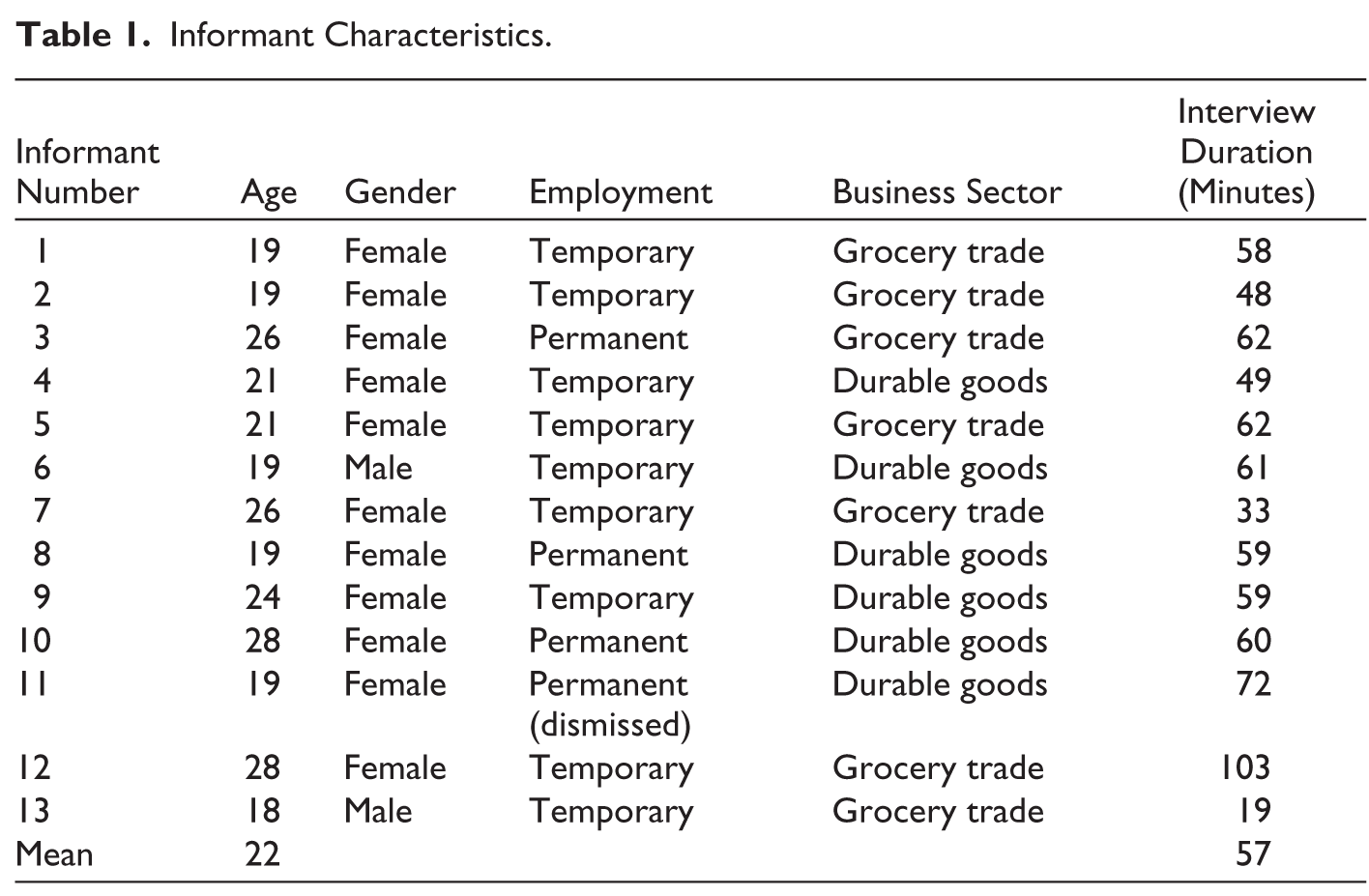
Individual interviews with 13 informants were conducted via telephone or video conference. In both cases, the verbal communication was recorded and transcribed verbatim. Data collection lasted from January to June 2020. Informants between 18 and 28 years old were recruited via an advertisement on the university’s website and social media. Informants lived and worked in cities with between 60,000 and 150,000 inhabitants. In addition to the information on the informant’s characteristics given in Table 1, two of the informants worked full time or close to full time.
Informant Characteristics.
The interviews were part of a research project focused on uncertainty, learning and leadership among young adults in the retail sector. The interview questions were intended to capture information relevant to each of the project’s three themes. Nevertheless, there was a certain degree of overlap in the informants’ answers.
Ford and Harding (2018) argue that a specific language or terminology positions informants in an identity category that restricts what informants can say or think about themselves. Restricting informants to the category of followers would therefore risk that they could only express a preference for a certain type of leadership. To avoid such a limitation in the results, we first asked the informants to describe situations that they themselves defined as leadership and give practical examples of what they describe as leadership. The informants were thereafter asked to provide a description of leadership they found desirable. The analysis is based on the following question: ‘If you think about the future, and do not think about how things are now or your past experiences, how would you like leadership to be in your future working life if you could describe the best-case scenario?’. The interviews covered other aspects of work as well. In some instances, informants spontaneously discussed their preferences for leadership in connection with other questions in the interview. These spontaneous statements have also been included in the analysis. For further information on the data collection and full interview guide, see the study protocol (Wall, Jansson, et al., 2021).
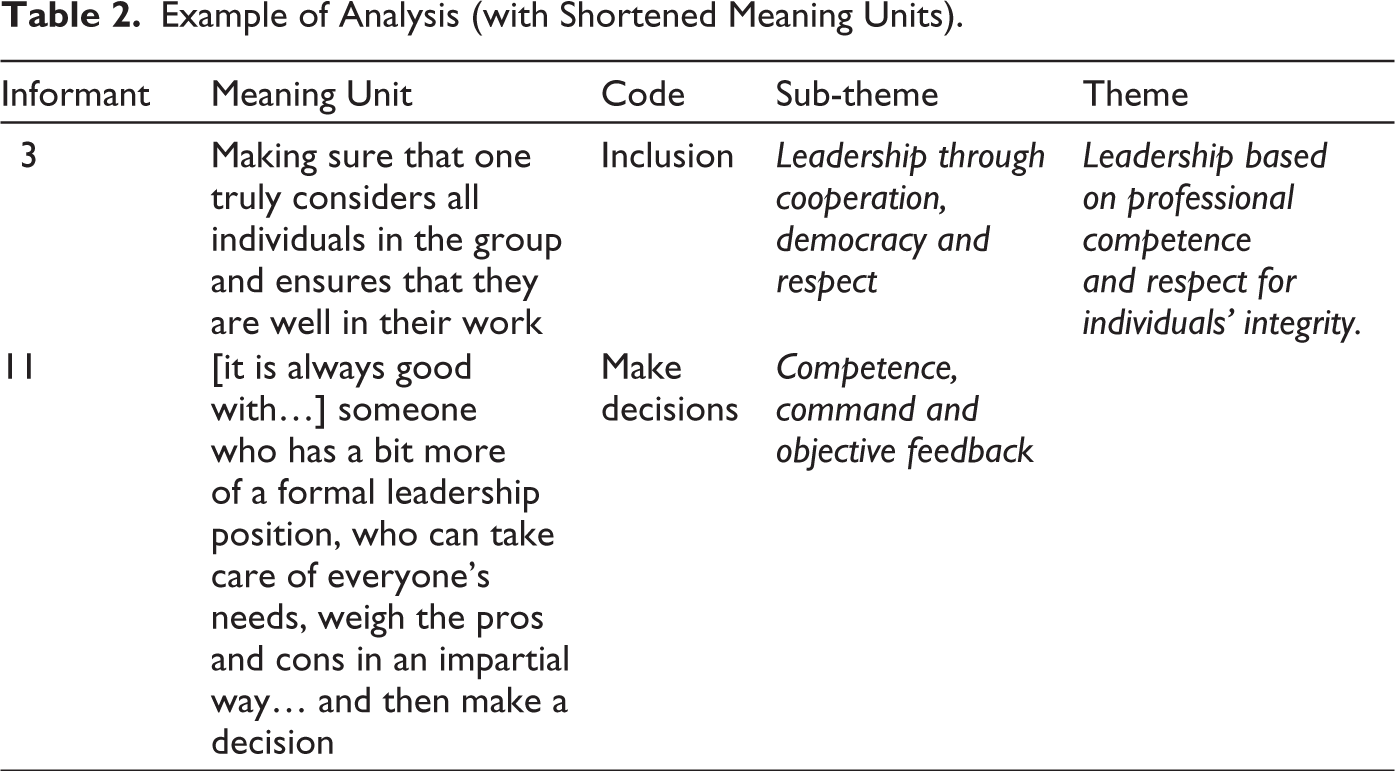
The analytical process followed Graneheim and Lundman’s (2004) description of latent qualitative content analysis. The analysis process was conducted in order to meet Lincoln and Guba’s (1985) criteria for trustworthiness (see the study protocol for full details, Wall, Jansson, et al., 2021). In addition to illustrating the analysis process (see online supplemental file A), this means, in practice, that all the researchers in the project were involved in the data analysis. As a first step, all the researchers read the transcribed interviews, and initial interpretations from these individual readings were discussed during a three-day seminar (peer debriefing to reach credibility, Lincoln and Guba, 1985). As a next step, the corresponding author re-read the data and identified meaning units, which were condensed and subsequently assigned codes. The coding phase was an iterative process in which the transcribed interviews were being read and re-read. Examples of codes assigned are ‘democracy’, ‘inclusion’, ‘respect for individual integrity’, ‘taking charge’, ‘professional competence’ and ‘leadership competence’. The interpretative search for latent content was a central part of the analysis, even in the coding phase. The underlying meanings of these codes were then synthesized into sub-themes (also defined as categories by Graneheim and Lundman, 2004) at a higher level of abstraction. The interpretive work continued in the next step, in which the corresponding author created themes that refined the understanding of the data at yet a higher level of abstraction. The result of the analysis was examined against the raw data in relation to the overall context of each interview. The themes were then discussed in the entire group (analyst triangulation to reach credibility, Denzin, 1978; Lincoln & Guba, 1985). These discussions involved a careful consideration of whether the themes had enough support in the data and did meaningfully relate to the aim of the study. Following this discussion, the result remained essentially the same, although slight revisions in the words describing the main two themes were being made. Thereafter, the analysis was verified by re-reading the raw data. Similarities and differences within and between themes were reflected upon in discussions within the research group. As a final step, the research group made a joint decision on the result of the analysis. See Table 2 for examples of the coding process and the online supplementary appendix A for a full version of the table. Data collection and data handling in the project are congruent with the Swedish Research Council’s guidelines on research ethics (Swedish Research Council, 2017). See the study protocol for full details (Wall, Jansson, et al., 2021).
Example of Analysis (with Shortened Meaning Units).
Results and Analysis
The analysis resulted in two sub-themes and one overarching theme describing how young adults in the retail sector of Sweden describe the desired leadership. In contrast to studies where subordinates dismiss leadership (Alvesson & Blom, 2019; Blom & Alvesson, 2014), none of the respondents expressed a reluctance to be exposed to leadership. The overarching theme was leadership based on professional competence and respect for individuals’ integrity, founded on the two sub-themes leadership through cooperation, democracy and respect and leadership through competence, command and objective feedback. In the analysis, it was evident that the informants viewed leadership as something practiced by a formal manager or someone else in the work team who took the place of the manager when the manager did not take full responsibility.
Leadership Through Cooperation, Democracy and Respect
In the first sub-theme, desirable leadership is depicted as a style of leadership where the manager leads by promoting cooperation and community through equality, influence, democracy and respect for the subordinates’ competence.
The theme was developed from statements based on the informants’ views that desirable leadership is exercised when a manager listens to all the members of a workgroup and takes the views and opinions of each individual into account. These statements were labelled with codes such as knowing who I am, respect for personal integrity, influence, non-authoritarian, joint effort, equality or respect for subordinates’ competence. Part of such leadership concerned recognition, as expressed by interviewee 9:
I would also like someone who knows who I am and who, in the best-case scenario, has a little insight into how I feel, in which situations I function best, etc.
This quote reflects the emphasis on individualized consideration in the transformational leadership theory (Bass, 1985). However, the leadership depicted as desirable is not about submitting to a superior leader who uses individualized consideration to achieve more effort, as the idea seems to be in the theory of transformational leadership (Antonakis & House, 2013; Bass, 1985). Instead, the emphasis is on equality and democratic cooperation. One of the informants highlights this in the following way, in a statement coded as dialogue and responds to opinions:
leadership where you are heard, where leaders show they care and where there is a dialogue. Maybe avoid the iron fist approach; instead, bring suggestions and be responsive to opinions. (interviewee 4)
This emphasis on equality and democratic cooperation is also prominent in the following quote:
instead of shouting out orders, she said ‘what are your ideas?’ This is my idea, but what do you think? What are the problems you are encountering? Is it worth putting the energy into this? She engaged everyone and showed that everyone’s opinions are important, not simply ‘now I have decided’. (interviewee 10)
Both quotes illustrate the desire for democratic influence as well as cooperation. The latter quote also indicates that in desirable leadership, the manager considers the work carried out as a joint effort, which is also interpreted as a desire for influence over the work carried out. Taken together, both quotes echo the ideas advocated in the literature on shared leadership, in which leadership is seen as a relational process where prospects for influence are distributed across hierarchical levels, that is, between managers and subordinates (Pearce & Conger, 2003). This desire for influence also revealed an inherent wish for the manager to respect the respondents’ competence and professional knowledge. Informants reported a desire for democracy and equal influence in the workplace based on a leadership style that takes them seriously as professionals:
So, let’s break this down together, me and them, or us and them. It’s a little… Because people always say ‘no, the manager is the one who decides’. But we can decide together, with our manager. Because the manager does not interact with the customers the same way. We are the ones who do the work. And that’s why it is important that a manager always listens to the employees and their suggestions. (interviewee 7)
A final component was the expression of a desire to be taken seriously as an individual and sincere respect for individual integrity. One of the informants explained this desire by describing non-desirable leadership:
they don’t model a kind of leadership that creates development, I think; it’s more like you’re only expected to fulfill a given function, and they are the ones who know the most, because they have been there the longest. (interviewee 12)
This quote illustrates a recurrent emphasis expressed by informants. While team-oriented and emphasizing cooperation and community, they wanted to be respected for their professional knowledge and status as individuals. They did not wish to be reduced to ‘mere cogs in the machinery’ or dependent on the leader, as Barbuto (1997) argues transformational leadership presupposes. At the core of the Leadership through cooperation, democracy and respect, sub-theme is a desire for leadership that allows subordinates to influence decisions democratically. Such influence is not limited to autonomy in specific tasks. A manager exercises desirable leadership by taking subordinates’ opinions and perspectives seriously and involving them in decision-making without reference to formal authority structures. This echoes Arnett’s (2000) description of emerging adults seeking autonomy, with ‘the individual as the primary moral authority’ (Arnett et al., 2001, p. 70), as well as community.
So far, the desirable leadership described by the informants does not align much with formal leadership definitions. Although they accept being in an unequal hierarchical relationship with a formal leader, the interviews did not indicate a preference for being enthused, inspired or emotionally attached to that leader. The closest they come to a formal leadership theory is shared leadership, which emphasizes shared and distributed influence. However, the results suggest that informants preferred a leader who could take a stand and make decisions, contrary to the idea of shared leadership across hierarchical levels. This preference is reflected in the theme of leadership through competence, command and objective feedback.
Leadership Through Competence, Command and Objective Feedback
In the second sub-theme, desirable leadership is described as having professional and managerial competence to take command, make decisions and provide objective feedback. The statements reflect how informants value managers with a reflective view of their leadership abilities. They also emphasized the need for clear authority, which involves keeping professional and private spheres separate. Informants described how authority remains clear and distinct when managers do not mix private matters into the professional context. The statements forming the sub-theme were labelled with codes such as taking charge, constructive feedback and being an expert.
It was evident from the analysis that leadership would be considered desirable when practiced by a leader who had competence in the relevant professional area:
[it is important for a leader who practices desirable leadership] to know what they are talking about, that they are an expert, really. (interviewee 2)
It was also clear that the type of leadership that respondents preferred was based on competence in the leadership role. Such competence concerned, for example, feedback:
[desirable leadership is practiced by someone] who can maybe give different types of feedback, then, with both constructive criticism and positive feedback. (interviewee 9)
One of the informants defined desirable leadership in terms of non-desirable leadership:
yes, but someone who identifies, for example, with being a leader and has an image of being a leader, which may not be rooted in the latest research of which leadership qualities are beneficial for a workplace. And I think that the risk is when people without the right skills, or without… well, who may not have received any… who don’t… who get positions, but don’t receive support through training and similar for how to best carry out their role, that then, I think, there is a risk both in the workplace, but also for companies in general. (interviewee 12)
That a desirable leader is someone who has received leadership training and has competence in the leadership role signals that the respondents prefer to be led by someone who knows the craft of leadership. As was the case with the first sub-theme, we interpret this to signify that the informants accept the power asymmetry inherent in the relationship between a leader and subordinate employees. At the same time, there was also a distinct desire for a manager who could balance the views of the entire work group and make his or her own position clear. One of the informants described this as follows:
Everyone gets to say what they think, and then we still clearly have our store manager who leads the meeting as well. And then he has taken… He is the one who takes the leadership role. And so, if we sit down to talk about something, and everyone might say something different in different situations where the same thing has occurred, he is still the one who takes a step back, analyses the situations and says, yes, but what you are bringing up now, it is actually the same…it stems from the same thing. And then he considers it further. (interviewee 11)
The leadership through competence, command and objective feedback theme centres on a desire for firm and clear leadership by a manager who is competent and secure in his/her professional role, balancing subordinates’ views while taking command and making decisions for the group.
The simultaneous emphasis on cooperation, democracy, respect, competence, command and objective feedback might seem contradictory and difficult to merge into one overarching theme. On the one hand, the young adult employees want to be included in cooperation on equal terms with the manager and respected for their competence and individuality. This aligns with Carsten et al.’s (2010) description of followers as active co-constructors of leadership. On the other hand, they desire a manager who, with professional managerial proficiency, can take command and provide objective feedback on their performance. This might seem to contradict active co-creation of leadership. However, there is no contrast here between relationship-oriented versus transactional (bureaucratic) leadership as in the transformational leadership theory (Bass, 1985) or task orientation (Yukl et al., 2002). As we see it, the ideals that emerged in the data correspond to values and behaviours found in the literature on the professions (Wilkinson et al., 2009), suggesting young adults see themselves as self-actualizing employees and their supervisors as team-oriented, self-critical and good listeners, according to the ‘new’ professional ideal (Fournier, 1999). At a higher level of abstraction, we summarize the result as leadership based on professional competence and respect for individuals’ integrity.
Discussion
In this interview study with young adults in the Swedish retail sector, the sort of leadership that young retail employees desire could be summarized as a leadership based on professional competence and respect for individuals’ integrity. This leadership preference rests on the two sub-themes of leadership through cooperation, democracy and respect and leadership through competence, command and objective feedback. The two sub-themes identified in the study may at first appear to be contradictory. The theme of leadership through cooperation, democracy and respect emphasizes how desirable leadership is exercised by a manager who can lead without using the formal authority that comes with the hierarchically superior position of ‘manager’. At the same time, it is emphasized in the theme of leadership through competence, command and objective feedback that desirable leadership is exercised when a manager has the ability to take command and make decisions, thus exercising authority (Spillane & Joullie, 2015).
The apparent contradiction between democracy and command can be partly resolved by contrasting mainstream leadership theories with Sennett’s (1980) work on authority. Mainstream leadership theory views the leader-manager as a shepherd-like, superior individual who knows what is best for their people, can take care of them (Alvesson & Kärreman, 2016) and can cultivate their subordinates’ personalities better than they themselves can (Bass, 1985). This aligns with Sennett’s (1980) description of authority, where subordinates depend on it for self-concept confirmation, restricting their autonomy and potential. To overcome this, authority must be transparent and inclusive (Sennett, 1980). The results here show that desirable leadership is inclusive, non-authoritarian and acknowledges all employees’ views while taking command and providing objective feedback. Thus, the contradiction can be reconciled as managers who take command are preferred if they do so transparently and democratically. However, it may not be necessary to resolve this contradiction. If it is accepted that the young adults interviewed here are defined as emerging adults, the very idea of reconciling seemingly contradictory leadership ideals becomes somewhat redundant. Emerging adulthood is a period characterized by instability, change and exploration; a complex relation to authorities (Arnett, 2000); and a balance between ideological views of autonomy and community (Arnett et al., 2001).
The results of the study clearly show how young adults accept submitting to authority at work. This implies that they acknowledge the need to live up to the role expectations associated with the social position of being an employee. Jensen (2011, p. 153) describe this in terms of ‘moral concepts pertaining to persons’ duties to others… and the welfare of groups’. This aspect of leadership preference is expressed in the sub-theme leadership through competence, command and objective feedback, which revolves around a manager who can take charge of the group and lead the workplace forward. The informants prefer a manager who values every employee’s opinion and suggestion as much as their own, seeing work as a collective effort rather than a process divided between a leader and subordinates. At the same time, it is very clear that they expect the authority figure, the manager, to respect their individual integrity, as reflected in the theme of leadership through cooperation, democracy and respect.
The emphasis on non-authoritarian manager–subordinate relationships and teamwork is in line with several studies of generational differences in work values. In this literature, young adults are often defined as ‘millenials’. Chou (2012), for instance, argues that millennials will be exemplary followers since they prefer to express ideas, are willing to question leadership and constantly engage in critical and independent thinking. Boatwright and Forrest (2000) found that millennials idealize relationship-oriented leadership. Sessa et al. (2007) found that millennials prefer a leader who shows personal consideration. We do not wish to use the term millennial. The evidence concerning its analytical validity is weak (Galdames & Guihen, 2022; Rudolph et al., 2018). In addition, it is difficult to distinguish generational effects from the effect of age-related experience (Parry & Urwin, 2017) or societal trends, such as the individualization process (Lyons & Kuron, 2014). However, based on the findings of the present study, we could add cooperative, democratic and respectful to the list of leadership characteristics that young adults’ desire. However, this addition must be made with the caveat that it simultaneously coexists with a desired leadership that takes charge and moves the group forward.
Further Research
It has been argued that young adults in today’s labour market tend to be self-centred, on the verge of being narcissistic (Foster et al., 2003) and that they put their self-interests first (Winter & Jackson, 2014). No such tendency to egocentrism appears in this study. Rather, the results show how young adults are distinctly team-oriented with a preference for a leader who considers everyone’s needs and opinions. On the other hand, the results show that respondents attached great importance to their own roles as individuals. This simultaneous emphasis on teamwork and individuality needs further study, especially as leadership in Sweden is often portrayed as being particularly egalitarian and consensus-oriented (see literature review in Holmberg & Åkerblom, 2006). Against this background, it is relevant to investigate expected leadership among young people in other industries and countries to determine to what extent the preferences for non-authoritarian manager–subordinate relationships and teamwork found here are an expression of leadership preferences stemming from age or national context.
Although the results from this study align with predictions in the literature on generational differences in work values and leadership preferences (Lyons & Kuron, 2014), the desired leadership identified here is not necessarily unique to young adults. Little research has unconditionally studied desired leadership among non-managerial employees. Cooperation, democracy and respect are likely universally embraced qualities of a desired leader. However, it is possible that the simultaneously strong emphasis on democracy and competence, command and objective feedback are characteristic of young adults. Arnett (2000) argues that ages 18 to 25 are characterized by a constant state of flux. In such a situation, young adults may prefer clear and firm leadership, as expressed in the competence, command and objective feedback sub-theme. This has not been examined in the literature. More studies on the leadership style preferred by young adults, contrasted with senior employees, are needed. It is also likely that preferred leadership changes as young adults enter adulthood. Whether this means less or more desire for community or autonomy requires longitudinal studies in future research.
Limitations
The result from this study provides additional insights into the type of leadership young adults prefer, which go beyond the leader-centric perspectives commonly found in the leadership literature. However, if ideals of professionalism have spread in society, and in retail specifically (Wilkinson et al., 2009), it is not very surprising that such a view of leadership characterizes the result here. It is in line with Carsten et al.’s (2010) view of leadership as dependent on society’s norms and values. The ideal of a leader that is inclusive and democratic might also be explained by applying the theory of Carsten et al. (2010), as retail work is often characterized by managers and subordinates working together at the shop floor (Andersson et al., 2011). Also, the result reflects the views of 13 young adults, out of whom 11 were women, and is not to be seen as representative for the entire collective of young adults or young adults in the retail sector.
We do not know the socio-economic background of the informants. Given the critique of the middle-classness of previous studies of young adults, this is a limitation of the present study. Of the 13 informants, 9 were temporarily employed, a proportion higher than the Swedish average (Statistics Sweden, 2020). Insecure employment may create a need for inclusion and clear leadership, potentially affecting the study’s results. Future studies should consider this.
Conclusion
This interview study with young adults in the Swedish retail sector shows that a desirable leadership is one where managers promote cooperation and community through equality, influence, democracy and respect for their subordinates’ competence. Managers should be competent in their professional field and managerial role, enabling them to take command, make decisions and provide objective feedback and, in fact, manage. This exercise of management relies on genuine respect for subordinates, both as individuals and for their abilities. There was nothing in the data to indicate a desire to be transformed by a manager; instead, subordinates want managers to respect their personal integrity and take them seriously. In summary, the preferred leadership is a leadership based on professional competence and respect for individuals integrity.
Supplement Material
Supplement material for this article is available online.
Footnotes
Declaration of Conflicting Interests
The authors declared no potential conflicts of interest with respect to the research, authorship and/or publication of this article.
Ethical Approval
The study has received ethical approval from Swedish Ethical Review Authority (ref. no. 2019-03.885).
Funding
The authors disclosed receipt of the following financial support for the research, authorship and/or publication of this article: This work was supported by AFA Försäkring under Grant 180265.
References
Supplementary Material
Please find the following supplemental material available below.
For Open Access articles published under a Creative Commons License, all supplemental material carries the same license as the article it is associated with.
For non-Open Access articles published, all supplemental material carries a non-exclusive license, and permission requests for re-use of supplemental material or any part of supplemental material shall be sent directly to the copyright owner as specified in the copyright notice associated with the article.
