



Abstract
To gain an in-depth understanding of the position of being a young adult and new at work simultaneously, this study examines the doing of age in relation to others in the lives of young adults, rather than focusing on age as a category and/or developmental phase. The study focuses on being a young adult from a critical and relational perspective of age. Based on focus group interviews with young adults, mostly women, working in retail, the aim is to analyse the position of being a young adult while new at work through age-marked relationships. The results reveal how this position can be understood both in terms of security and insecurity. Security arises in the sense of opportunities for learning and leaving responsibilities to older and more experienced colleagues. Insecurity arises in the sense of being exposed to insecure employment, the risk of being allocated less challenging tasks and being judged for failures.
Introduction
Work is a critical aspect of the transition to adulthood, offering economic security and social respectability for young adults (Cohen-Scali et al., 2020; Ranta et al., 2013). However, it is simultaneously a process marked by insecurity because it is difficult for young adults to get stable employment (Tomic, 2018). For example, in Sweden, young people are overrepresented among temporary employees and have a higher risk of unemployment (Statistics Sweden, 2022). The youngest and oldest individuals in the labour market tend to face disadvantages, missing out on opportunities associated with working life (Gee et al., 2007). Young adults, as organizational newcomers, encounter various challenges and risks when starting work that is related to inexperience and uncertainty regarding what is expected of them as employees (Miller & Jablin, 1991). Adult role models, including parents, friends and teachers, play a crucial role in shaping young adults’ perceptions of work (Aley & Levine, 2020; Jablin, 2001; Levine & Hoffner, 2006). Additionally, a sense of belonging and inclusion in the workplace is essential for forming a coherent self-concept (Waller, 2020), making social relations with colleagues and supervisors vital for young adults as they begin their careers.
In this article, we explore young adults’ perspectives on entering the workforce within the retail sector. Using material from a focus group interview study, we examine the interwoven meaning-making of being a young adult while simultaneously new at work. The analysis is informed by a relational perspective wherein the position as young and new at work is understood from an analysis of how young adults position themselves specifically through age-marked relationships. This analysis expands the understanding of how age-related subordination/superiority is part of the experiences of young adults entering the workforce. Such knowledge can be used as a basis for the creation of health-promoting onboarding processes and thereby promote a sustainable working life.
The aim of this article is to analyse the position of being a young adult and new at work simultaneously, through the doing of age-marked relationships.
Theoretical Framework and Previous Research
In this article, we focus on one of the many power dynamics that characterize work and the workplace, namely, how age is constructed in relationships and how this impacts the position of being both young and new at the workplace. This means that other power dynamics based on hierarchies or on social determinants, such as gender and ethnicity, do not form the basis for the present analysis even though such aspects obviously play a significant role in shaping the work environment and the conditions for young adults entering the labour market. In previous research on young adults entering the workforce, we have found that age is often used as a category based on the number of years lived, with different generations defined in relation to each other, or understood on the basis of various stages of life. For example, in previous studies of young working adults, individuals are often arbitrarily divided into different generational categories (Rudolph et al., 2018). The underlying assumption for this generational perspective of age is that being born in the same year is associated with common experiences which, in turn, shape work-related attitudes. This perspective has been criticised for its theoretical and methodological weaknesses (Galdames & Guihen, 2022; Parry & Urwin, 2017; Rudolph et al., 2018). For instance, it is hard to distinguish between generational differences and lived experiences varying with age (Parry & Urwin, 2017). As a response to the criticism of age as a category, one of the currently dominating perspectives of age and the understanding of young adults in social sciences is based on Arnett’s (2000) theory of emerging adulthood (Côté, 2014). From this perspective, the process of emerging adulthood is understood as a universal developmental stage between adolescence and adulthood. Arnett (2000) describes emerging adulthood as being characterised by identity and role exploration, which involves different work and educational experiences. In accordance with Arnett’s (2000) theory, previous research has primarily focused on work conducted alongside education, where employment is utilized by young adults as a means of self-exploration and establishing a firm foundation for future career development (Grosemans et al., 2020), with the aim of creating a meaningful life (Mayseless & Keren, 2013). However, it is common for the perspective on emerging adulthood to be conceptualised in terms of phases (Grosemans et al., 2020) where young adults are viewed as immature and ‘turned into adults’ through the care of superior adults (Rauscher et al., 2012). Further, the perspective on emerging adulthood has been criticised for being a theory of middle-class youth, which is not necessarily applicable to working-class individuals (Côté, 2014; Hendry & Kloep, 2010) and it has been argued that young, working-class adults are underexplored (Cohen-Scali et al., 2020). Hence, both perspectives, the generational as well as the emerging adulthood approach, to the study of young adults involve groups based on categories or transitional age phases being compared to each other. While this may yield valuable information regarding general differences, we miss the detailed nuances of the importance of age per se for how young adults experience work and relations at work based on the position of being a young adult and new at work.
In this analysis, age is understood as being more than simply the number of years lived and/or as a specific phase in life. Instead, categorising people by perceived age is understood as an organising principle using a relational perspective of age (Gullette, 2008; Krekula & Johansson, 2017). Rather than comparing categories based on age, or studying young people in a certain phase of life, it is possible to gain more in-depth knowledge on how social relations contribute to the understanding of being a young adult and new at work if age is understood as an organising principle analysed from a critical perspective. This means that age is understood and defined as performative in that age is assumed as a continual doing within relations. Categorisation based on age is related to power structures, like categorisation by gender and ethnicity (Krekula & Johansson, 2017). Using critical perspectives of age means that the interest in young adults is transferred from the delimiting categorisation of age to a relational and performative perspective that focuses on how the understanding of various ages is constructed in relation to each other (Krekula, 2009). From this, the understanding of positions related to various ages is assumed as being a continual doing within relations, and categorisation based on age is related to power structures, in the same manner as gender and ethnicity (Krekula & Johansson, 2017). To make the relational aspects of age visible, this study uses the concepts of marked and unmarked age. These concepts are related to ideas of power in the hands of those who have the right to define the situation. The unmarked position, that is the privileged position, becomes visible in relation to the marked position, the others (Pease, 2010) and the unmarked age might vary depending on the circumstances. However, the common pattern is that the person found to be in the unmarked position is understood as the norm (Pease, 2010). Furthermore, the unmarked group is often given interpretive precedence (Johnson, 2006). In terms of privilege and age, it is common that adults are seen as unmarked in relation to others, that is children, young people and the elderly.
By using critical perspectives of age, the interest in young adults is transferred from the delimiting categorisation to a relational perspective of age focusing on how the understanding of various ages is constructed in relation to others (Krekula, 2009). In this way, this perspective questions the objectivity of categorisation by age. Instead, it is argued that all reasonings based on age within society simply bring about the doing of age. Further, understanding differences between people based on age contains elements of power and discipline (see ideas on discipline by Foucault, 1977) in contrast to the idea of age as a neutral category describing each person gradually and naturally shifting along the scale of age. Defining age as relational illuminates that age is used for dividing tasks and responsibilities. One consequence of this is that different age groups have access to different powers and agencies (cf. Calasanti, 2007; Laws, 1995) which results in positioning different age groups in relation to dependency and/or privileges. When age is understood as relational, it therefore becomes possible to analyse how hierarchies based on age are created and maintained (Krekula & Johansson, 2017, p. 26).
In summary, this study uses a critical and relational perspective of age to theoretically explore the experiences of young adults (Krekula & Johansson, 2017, p. 12). It emphasizes age as an organizing principle, underscores the values inherent in age categorization within relationships, and deepens the theoretical understanding of how age shapes power dynamics in society and workplace settings. This approach allows for a more nuanced analysis of the experiences of young adults starting new jobs rather than a focus on age categories or developmental phases.
Method
Study Design
This article is based on a focus group interview study.
The study was planned and carried out in accordance with the process for thematic analysis as presented by Nowell et al. (2017), in order to meet the quality criteria relevant to qualitative research; authenticity and trustworthiness (Guba & Lincoln, 1994; Lincoln & Guba, 1985). To enable those directly impacted to express their views, the study was designed in conformance with the Ottawa Charter for Health Promotion (WHO, 1986). Focus group interviews are considered to be particularly relevant when researching the views and experiences of young people (see Adler et al., 2019; Bagnoli & Clark, 2010) as well as for minimising the power differences between the researcher and participants. This means that participation takes place under conditions convenient to the participants (rather than being in the control of the researcher) and enables greater opportunities to bring out the participants’ opinions and experiences related to the phenomenon studied (Wilkinson, 1999).
All data collection and processing in the project was performed in accordance with the Swedish Research Council’s guidelines on research ethics covering information, consent, confidentiality and data usage (Swedish Research Council, 2017).
Data Collection, Participants and Material
During the period of February to March 2020 three focus group interview sessions were conducted with 21 participants. All participants were students in the final year of Business and Administration programmes at the Swedish high school level. All interviewees had experience of working in the retail sector in connection with their studies and additional experience of substitute and/or summer jobs in this sector, that is of part-time and/or temporary employment. Some interviewees had also worked as substitutes in the restaurant and entertainment industry.
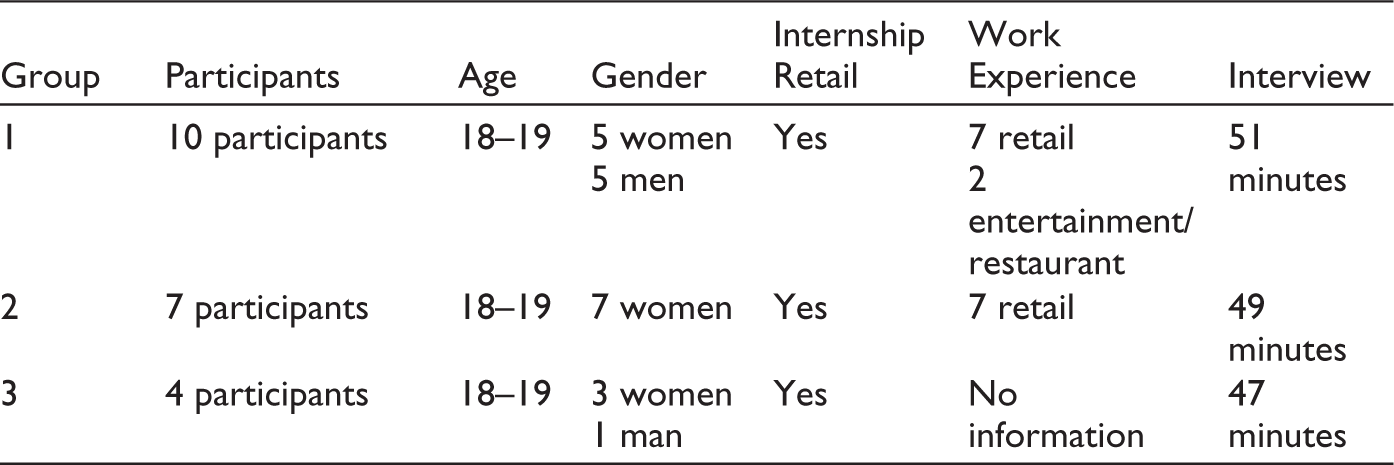
To recruit participants, teachers at schools with Business and Administration programmes in various Swedish cities were contacted and informed about the study. The teachers informed students and invited them to participate in the study. Written information about the study and conditions for participation were then forwarded to the teachers (schools) who noted and forwarded the interest in participation. Before each interview began, information about the study and conditions for participation (informed consent) was presented orally and the interviewees were given the opportunity to ask any questions. Before starting the interview, the researcher also ensured that all participants had received, read and understood the information given. In connection with this, it was also emphasised that participation was voluntary and that the interviewees could end participation at any time without giving any particular reason and without further consequences. Informed consent was formally obtained by each interviewee signing an informed-consent form.
An interview guide was used for conducting the interviews along with a set of stimulus cards focused on the three themes: leadership, learning and insecurity/security. These themes were selected in advance as each of them, in theory and previous research, has been identified as of overall importance for the experience of work. This procedure involved thematic questions designed to create conversation regarding the research themes based on the participants’ experiences and/or thoughts about these themes, rather than on their assessment of their current work situation and working conditions. Each interview started with the researcher asking the participants questions about their expectations of working life and about the people/roles that have particular significance in their working life. This was followed by the main part of the interview in which each research theme was discussed with the help of the different stimulus cards. Hence, in focus group interviews, stimuli most often are used to stimulate the group interaction by seeing, touching, and moving about, for example, by sorting and rating items (Adler et al., 2019). Here, the stimulus card ‘Leadership’ was presented followed by the question, ‘What do you think leadership means in the workplace?’. Then, 19 stimuli cards were placed on the table, each illustrating different roles or positions that might be relevant to a retail workplace, and the participants were asked to sort the cards to reflect which positions or roles the participants deemed important for leadership in the workplace (the most important position/s were to be placed at the top, position/s of equal importance were placed side-by-side, and any position/s that they deemed irrelevant were set aside). This procedure was then repeated for the two other themes. When all themes had been addressed, concluding questions were asked about the participants’ own perceptions and experiences of security in their working lives, and whether they had any further reflections in relation to any of the above-mentioned themes. The material used for the analysis was the transcribed conversations.
Data Analysis
The material was analysed using an inductive thematic analysis in accordance with Braun and Clarke (2006). The process started with a close reading of the transcribed interviews to create an understanding of each interview and the material in its entirety. From this, all material was sorted out that to some extent was related to any perspectives on the position of being a young adult and new at work whereas age or age-marked relationships could be found. In the next stage, significant excerpts related to the aim of this article were identified. Statements reflecting various aspects of age were thus focused upon, and these formed the basis for the interpretation of the empirical material. In other words, excerpts where age was in some way prominent in the discussions were identified and analysed more thoroughly, whereas sections that related to other aspects were excluded from the material. Thus, the analysis was guided by the aim of this article, and all elements of the interviews that illustrated age as being relational and illustrated how hierarchies based on age are created and maintained were coded and interpreted. Age is not always explicitly mentioned by the interviewees, instead, sometimes, age is tied to years at work, that is, to experience. However, as the analysis shows that the interviewees connect, for example, ‘more experience’ with ‘older’ we also interpret the discussion of experience as an expression of a general understanding of age. This analysis process resulted in the creation of three themes.
Results
In this section, the position of being a young adult and simultaneously new at work has been analysed through age-marked relationships. The analysis contributes knowledge on how the position as a young adult and simultaneously new at work is made sense of. Hence, the interpretation provides information on how the interviewees position themselves in relation to various understandings of age and, thus, illuminates how hierarchies based on age are created and maintained in the workplace (cf. Krekula & Johansson, 2017).
These three themes were created as a result of the thematic analysis: (a) Positioning as related to learning and responsibilities, (b) positioning as related to vulnerability and uncertainty and (c) positioning as related to unclear boundaries between private life and work life. Collectively, these themes describe the interwoven experience of being a young adult and new at work from a relational perspective on age.
Positioning as Related to Learning and Responsibilities
From the analysis, the positioning as young related to learning and responsibilities emerges. The material shows that the interviewees position themselves in relation to more experienced (older) people at work and outside of work. These people are described as being superior and more privileged, in other words, they are in a position of power. As an example, one of the interviewees describes that when the store was being renovated, it was the people who had worked there longer who decided ‘… how things should be, and told them what to do’. Others agree with this statement and the following is added:
R: Yes, really. It’s the people who have worked there longer who decide, yes, go ahead and do it. R2: It’s not necessarily only the manager, it can be people who have R: Yes exactly. R9: Uhuh, exactly. (p. 8)
Our interpretation is that this is an expression of age being linked to power, as the allocation of the right to lead and decide is explained by the doing of age. Older, more experienced colleagues are ascribed the power to decide while younger less experienced people (i.e., the interviewees themselves) are positioned in contrasting roles, as those with less power. One consequence of younger people being positioned as subordinate to older, more experienced people is that the position of being young, new and inexperienced entails an opportunity to leave decisions and responsibilities to more experienced (older) people. A similar expression for this, as well as a clear positioning based on age, is illustrated in a discussion on whether experience matters to the workplace environment:
R: Well of course it can be good when you come to work, R7: R: Exactly. R2: And then if anything were to happen, nothing major, but if… well, yes, if we were robbed or something else, people who have more experience know, well, ‘this is what you can do’ or ‘here are a few tips’, or if you simply have an unpleasant customer, they can give you tips. [general agreement]. (p. 51).
In the excerpt above, the interviewees position themselves as young people who are to gain experience. The extract thus illustrates the idea that ‘older and more experienced’ people teach ‘younger and more inexperienced’ people, in other words, experienced, older colleagues are given a superior role in relation to learning. We interpret the above as an expression of the position of being young entailing space for development through the opportunity to be instructed by and to learn from those more experienced. During the interviews, the importance of being able to learn and receive feedback from more experienced people to be able to understand how things are done is constantly emphasised. In this regard too, a clear positioning in relation to age emerges via the idea of children (young people) as not-yet-grown-up adults. In other words, the participants position themselves as ‘in development’ in contrast to older people as ‘more fully developed’. The material also demonstrates a wide range of things that a new person at work has to learn. There is a lively discussion about different roles and functions at the workplace (who does what?) and there are many explicit expressions of uncertainty and lack of knowledge about certain roles.
Furthermore, managers are positioned as people with more experience and through the analysis an underlying expectation emerges that managers should take care of those who are new, in other words, those positioned as young.
R: And, even if you’re new at work you get to learn, for example, ‘well this is how we do this particular thing’, learn to use the tills and all that stuff.
R: That you get to learn everything.
R2: And how to close [the store], for example.
R: Yes, so you have….
R: So you have a manager, or, you know… What’s it called, when you start a job, new, a person takes care of you, helps bring you into the group?
R: So you know what you’re meant to do.
R: Yes, someone who has
This is also an example of age being tied to years at work, in other words, to experience. We also see the above extract from the material as an expression of how the participants position themselves as young, and thereby as somewhat dependent on being able to rely on people with more experience (who are older). Only on a few occasions is age is done in a reverse way when the position of being young is related to opportunities to learn and lead others. Furthermore, in the few cases when the material illustrates how the participants position themselves as possible leaders, experience emerges as being important. In a discussion about what the interviewees link to ‘leadership at work’ managers at various levels are mentioned and then the following is said:
R: It’s not necessarily only managers. R1: Yes… [laughter] […] R5: You know, you can become a leader yourself by … well, new people start, maybe and you yourself become a leader teaching them things you’ve learnt yourself over the years, or something like that. [general agreement] R6: Yes, you share your R5: Yes, exactly. (p. 67)
Similarly, the below quote stands out compared to the dominant idea in the material of older people as ‘those who are capable’ and younger people as ‘those who are to be trained’. In this example, age is instead done based on the idea that younger and older people are different, able to do different things and can therefore learn from each other:
R: And it’s probably good to have mixed ages because then the older people learn from the younger people and the younger people learn from the older people. So that’s also really good. R: And those who are older often have a lot more experience too. Then you can learn… you learn from each other. (p. 50)
As a whole, though, these quotes also illustrate that the dominant idea emerging from the material is that older and more experienced people teach younger and more inexperienced people and that the former are mainly those who make decisions in everyday work.
Positioning as Related to Vulnerability and Uncertainty
In the results of the thematic analysis, the position as young also transpires as related to a risk of being allocated less challenging tasks. An expression of this is illustrated in the extract below in which, when asked which type of leader they would like, they express a desire for a fair and clear leader and say the following:
R2: Somebody that doesn’t use R: You mean fair, then. R: Uhum. Honest. Open to discussion. [general agreement]. (p. 19)
In this example the interviewees position themselves (young people) as a vulnerable group at risk of getting the ‘crap stuff’ and we interpret this as expressing how the doing of age makes power relations in the workplace visible. Young people are positioned here as a vulnerable group while the opposite, in other words, older people with more experience, appear as a group with more power that can ‘use’ young people to do less desirable tasks. During the interviews, the position as young is also related to a more vulnerable and uncertain situation marked by insecure employment, while the position as older and more experienced is instead related to secure jobs with permanent employment. This is illustrated when the interviewees discuss whether there are positions in the workplace that are more or less secure:
R4: Yes. It’s like… Those with permanent employment should feel more secure than those who were just hired yesterday, as they have a fixed job. R5: Extra workers. R4: Yes, extras. [talk at the same time] R5: … times you get or how much you get to work in a month, so you don’t know what pay you’ll get. R2: Or simply employed by the hour. R5: Yes. By the hour and… yes. R4: It’s kind of like this if you work at a workplace and then…. If it’s like… If they need to fire some people, it’s always those with the most knowledge and everything… that’s who gets to remain at the workplace. So it’s like… R3: It’s like last in first out. [general agreement]. (p. 114)
In the above quote, young people are positioned as temporary employees with insecure jobs, in contrast to ‘those with the most knowledge’. Based on the entirety of the material, this is understood as an expression of people who are perceived to be older as those who also possess the ‘most knowledge’. As a whole, we interpret this as expressing that the position as young in relation to older colleagues is linked to vulnerability and uncertainty.
In terms of positioning based on age in relation to vulnerability and uncertainty, the analysis also shows that colleagues and friends of the same age are positioned as more ‘alike’ the participants themselves. In this way, they are described explicitly as adding to perceived security at work. This is illustrated for instance when the interviewees are asked to describe a dream scenario of how the perfect, secure workplace looks. One interviewee expresses that friends, ‘I mean real friends that you hang out with outside of work’, should be valued higher and others agree somewhat. In response to the follow-up question asking whether this is because people who are also considered as friends outside of work enhance their feeling of security, they say:
R7: Yes, actually. I’d have felt… You could just have gone and asked, ‘can you help me with this, because I…’ ‘Can we do this together, because I don’t dare to do it by myself’, or… R: Then you dare to ask too, and say what’s wrong. R7: Yes, you don’t… Then you don’t feel under pressure that you might be… What’s it called? R3: Be judged. R7: Yes precisely. They don’t judge you. I: What do you others think? Would your dream scenario be any different? R: No, but that’s kind of what it’s like where I work. We are all kind of the same age, about 18–20. Everyone knows each other, outside of school too. So it’s like… It’s as if we are friends at work too, everybody talks to each other. Everyone enjoys it. We even do things outside of work. I: And do you feel that strengthens your security at work? R: Yes, you form a stronger tie to each other. R9: It’s more fun to work too. R: Exactly. And then our manager, my manager that’s usually there, he’s the same. He’s also fairly
Our interpretation of this excerpt is that, in terms of positioning based on age, the risk of being judged is described as greater related to older people compared to those of the same age. In the excerpt, ‘fun with those of the same age’ is contrasted against ‘being judged by older people’. The material thus shows that older colleagues and/or managers sometimes judge young adults who make mistakes. This can be considered to express how positioning based on age makes power relationships visible, in other words, not only ‘who’ has power at work, but also who ‘uses’ their power to express things that young adults who are new at work perceive to be judgemental. As a whole, we understand this as an illustration of how young adults position themselves as being in a vulnerable position in relation to older people at work and simultaneously feel there is less risk of being judged by colleagues of a similar age who they position as equal. The above excerpt also illustrates that managers who are positioned as younger get closer to the participants in terms of power, and are thereby associated with increased security.
Through the analysis, more direct expressions appear showing that due to their experience, older people are positioned as having more secure jobs and therefore being less vulnerable, which demonstrates that the interviewees, based on their positioning as young, feel insecure in situations that they believe others do not feel (as) insecure in. Below, ‘security’ is described as essential for people positioned as young, while older people are instead positioned as ‘not new’ (more experienced) and that they can therefore no longer be completely ‘new’. When asked whether security in working life is the same thing for young people as for those who have worked for a longer time, the interviewees respond as follows:
R3: People with more R5: No, well… Everybody needs security, I believe, but it’s maybe different… R2: They [older, more experienced] have more knowledge, of course. R5: But levels… Or how shall we put it… People who have worked maybe at a company for longer than I have as a new employee, of course, they know how things work anyway and they’ve maybe got more colleagues or somebody they can talk to, or the manager, as they maybe know him, or her, better. R4: Yes, but us as such young people now, when we… We’re about to enter the workforce now. This is the first time we’ll properly start working. And for me more secure is really important. R5: Precisely. R4: But for my parents, it’s probably not as important. R3: If they maybe come to a new… R2: They know how it works. R: Precisely. R3: …. workplace, they know anyway. R: Yes. R: I think that… R: Experience. (p. 101)
In summary, this theme shows that the position as young and inexperienced is linked to different forms of vulnerability and uncertainty through the risk of being given less challenging tasks, of having an uncertain job and of being judged by more experienced (older) people for failures.
Positioning as Related to Unclear Boundaries Between Private Life and Work Life
This theme illustrates differences found in the material in how the participants position themselves in relation to experiences of being a child to their parents and based on private relationships. Throughout the material, there are repeated discussions about whether private relationships with parents, siblings, relatives, friends and boy/girlfriends are significant to work. In other words, this theme provides knowledge on the dissimilarities in how the interviewees, in their position as young adults and simultaneously new at work, focus on and emphasise private relationships in relation to starting their working life and their own development. The following excerpt is taken from a discussion on learning:
R: You can learn from very many people. RYes, everybody around you, in your circle. R: Yes, many people are important. R1: Salary administrator. R7: Relatives are also maybe fairly… If you’ve spent a lot of time with relatives and so on when you were little.
In the above excerpt, there are two clear positionings in relation to older people. The first positioning is done in terms of ‘I was a little child but now I’m bigger’ and the second is that one learns from people who know more and who ‘are older’. The interviewees thus position themselves as a person who is young and who still has a lot to learn from older people. We therefore interpret this as expressing how learning and the doing of age are intertwined throughout the material.
Another example from the material of discussions regarding whether private relationships are significant to their own position at work is a discussion on learning when half of the group consider colleagues to be most important, while the other half see their parents as most important. The following reasoning emerges in one of the focus group interview sessions:
R: What do parents do at work? R: Well. They don’t know… R1: It’s them that have…. You know, created who I am and how I behave. It’s them… They’ve laid the foundation for me. R: You also need to think about what you’re going to learn… you have to learn actually at work. R: They [parents] can’t learn your work tasks. R: What’s most important then? Well then, it’s my colleagues. They know, they have
Thus some of the interviewees also position themselves as children to their parents and thereby include private life in their understanding of being a young adult and new at work. The extract shows that the relationship between children and parents is perceived as being central to one’s own development earlier in life and that parents are therefore also important today, and they are also given a central role outside of private relationships. In the above extract, some ambivalence is expressed in this reasoning regarding the participants’ own positioning in relation to age. On the one hand, they position themselves as children in relation to their parents, on the other they position themselves as adults and working, with boundaries between that and the parent-child relationship. There is another split in how positioning is done in this example: Different positionings emerge depending on whether reference is made to ‘me as a person’ or ‘me at work’. The extract can be understood as ‘me at work’ being positioned in relation to colleagues, with people ‘with experience’ (more years at work, and thus implicitly older) being seen as more experienced and able to support in learning. ‘Me as a person’ is positioned as a child in relation to the parents. This analysis shows that learning is spontaneously understood as stemming from family relationships and secondarily as related to work. For these participants, despite the fact that the interview is focused on working life, their first thought is not that they are ‘me at work’ but that they are ‘me as a person’. The same type of ambivalence is illustrated in the extract below when the interviewees are discussing the role of their colleagues and parents in their learning.
R9: I’d say that both [colleagues and parents] are equally important, but if I had to choose one, I’d say colleagues.
R: To prepare myself for a job I can’t ask a colleague before I have started at the job if I get the job.
R: No, but once you start the job you can’t then ask your [parents]….
R: Yes, but I mean beforehand.
R: That’s why I think that both are as important. But once you’ve started a job, then I think it’s your colleagues.
R2: You might have bad colleagues and then it’s good to have your parents.
R1: Uhum. (p. 30)
We interpret this as indicating that the private ‘me’ constitutes the strongest identity (for this individual) and is placed ahead of the work ‘me’. This can, in turn, be understood as positioning related to age in some cases (for quite a few) being more spontaneously made in relation to (older) family members, and that the positioning of oneself in relation to parents helps create a feeling of perceived security. The below extract also illustrates that some of the interviewees associate with their private relationships when describing security. The analysis shows that relationships with parents, relatives and friends outside of the workplace help them feel secure at work. When reasoning about security in working life/at work the following is said:
R3: But your parents can also provide security in your working life. If you have a hard time at work, you can go to them for security and support. R: You can have [put] your friends there too, then. R2: They can help to.… R5: Then we should have [place] that one there again. R1: Well may as well put them all at the same level, then. [laughter] I: Parents, siblings, relatives together? R: Yes. R: Friends… Shall we put friends there too? R5: And friends too.
In summary, this theme demonstrates that the position as young per se is related by the interviewees to a blurred boundary between private life and working life and that for some of the interviewees, private relationships are linked to an opportunity for support and learning, even in relation to the context of work. By looking closer at the doing of age in the descriptions of private and work-related relationships, the theme contributes deeper understanding of the position of being young and simultaneously new at work.
Discussion
In this study, the position of being a young adult and new at work has been analysed through age-marked relationships. From the thematical analysis, we have seen that the position is made sense of in relation to learning and responsibilities, vulnerability and uncertainty, and to unclear boundaries between private and work-related issues.
The very definition of young adults new at work, as ‘young adults’ highlights that we, theoretically, understand this group in relation to the unmarked workforce, that is the adults. Our focus on the way age is marked/unmarked (cf. Johnson, 2006; Pease, 2010), leads us to the conclusion that the position as a young adult and new at work is clearly age-marked. Already the need of the defining the group as ‘young’, marks the distinguishing from the unmarked category, in this case, who are not defined by specifications, that is adults. In the relation between adults and young adults, such categorisation implies that adults are normal and young adults are those that are not yet fully mature. The unmarked category of adults emerged as the natural category, while the younger people are seen as representing the process of growing up accompanied by a dependency on adults (Sundhall, 2012). Based on this, adulthood, seen as the unmarked category, is interwoven with the idea of youngsters as not being ‘fully developed’ (Sundhall, 2012).
However, despite the theoretical understanding of young adults as a marked position in contrast to adults, the empirical results provide a more complex view of this position. Through a relational perspective of age, the result shows that the position as a young adult and new at work is made sense of as interwoven with various relationships with the position as the young and new individual not always being the only one marked. The interviewees do not solely position themselves as vulnerable, instead, they are also capable of taking care of their own development, for example, in terms of learning the work tasks needed and how to handle work-life itself. From the different views represented in the results, it emerges that the position as young and new at work can be understood both in terms of security and insecurity. Security arises in the sense of opportunities for learning and development and leaving responsibilities to older and more experienced colleagues. Insecurity arises since these opportunities for security come with power asymmetries. To gain security, young adults position themselves in a hierarchical position below adult colleagues, which can be understood as a form of vulnerability (Misztal, 2011).
The relational perspective of age (Gullette, 2008; Krekula & Johansson, 2017) illustrates that age and power are closely intertwined. This may have an impact on young adults’ introduction to the labour market, for example, via different expectations and performance criteria for young and inexperienced workers, compared to older workers. It may also be the case that the workplace itself is defined by and for adults (the unmarked position), which means that those who are clearly younger than the others are put at a disadvantage per se. Power relations based on dependence/independence can thus be translated into superiority of power among older employees who are established in the workplace and who are given superiority over younger individuals who are new to the job. Real participation, in terms of being included and given responsibility, etc., cannot be generated in this type of context if such power asymmetries are maintained. There is a risk of age discrimination if young people who are new at work are only understood as young and new when they see themselves as potential contributors. Young people are inexperienced, but not incapable, and want to learn (from others who are more experienced). They perceive themselves fairly quickly as ‘experienced’, knowing how things are done and ready to be included in workplace processes. If managers/more experienced people assume that young people are ‘only’ inexperienced there is a risk of missing out on the potential they have. Given this, establishing a sustainable working life for young people might face challenges as early as during their introduction to work.
However, young adults who are new at work are not only young adults, nor just new at work. The material analysed included women and men, and the ethnicity, place of residence, experiences, etc. of the interviewees varied. We are aware that the relational doing of age does not take place within a vacuum. Rather, the meaning of age must be seen in relation to other social positions. We therefore argue that intersectional analyses (cf. Crenshaw, 1989) including age should be carried out for a further, deeper understanding of how the position of being a young adult and new at work is made sense of. The intersectional perspective is, not least, relevant when it comes to the demarcations between relations in the workplace and outside of work analysed here. Using intersectional analysis, it is possible to clarify how age is related to other positions defining power relations within the workplace.
Strengths and Limitations
This analysis draws strength from its foundation in a focus group interview study, which has made it possible to unveil the joint sense-making of the position of being a young adult and simultaneously new at work. However, the analysis also uncovered a range of contrasting perspectives within the focus groups. As an example, the role that parents have when it comes to the experience of the interviewees at work was discussed, providing a deeper understanding of how age-marked positions vary among young adults, which sometimes gives rise to unclear boundaries between their private life and work.
Nonetheless, as with all qualitative analyses, these results should be interpreted in the context of the specific data and interviewees involved. Here, it is important to highlight that all interviewees had experience from temporary work within a specific sector, that is within retail. Thus, important implications of the type of job focused (that is, retail work as an example of a more low-qualified job) and the context of ‘working temporary while studying’ are surely reflected in the results as relations to colleagues and supervisors and power asymmetries at the workplace are surely affected by these aspects. For example, being temporary probably makes the interviewees more dependent on others for certain information, etc., that is these factors can be assumed to intersect. Additionally, the influence of age as a source of power may be less significant in higher-qualified job contexts where formal competence carries greater weight (as a ground for employment, etc.). However, our intention is not to generalize the findings but rather to identify crucial aspects regarding when and how age assumes significance and meaning in relationships. To deepen the knowledge about how age-marked relationships are ‘done’ and experienced by the interviewees. Besides this, as our sample consists of mostly females and of both foreign-born and native young adults a more thorough analysis based on both gender and ethnicity would have deepened and strengthened the analysis. The choice to not perform such analysis thus illustrates an important delimitation (weakness) with this study. Furthermore, it’s reasonable to assume that the experiences of those who chose to participate in the interviews may differ from those who declined to participate. Consequently, the results should be understood within the context of the specific group of participants included in this study.
Footnotes
Declaration of Conflicting Interests
The authors declared no potential conflicts of interest with respect to the research, authorship and/or publication of this article.
Ethical Approval
The submitted manuscript is based on a study which has been approved by the Swedish Ethical Review Authority (2019-03885).
Funding
This research was supported by a Grant from AFA Försäkring, Sweden, through the project named ‘Ett hållbart arbetsliv för unga vuxna’ [A sustainable working life for young adults], Grant number 180265.