




Abstract
This study investigates how members of party youth wings perceive their respective youth wings and identifies areas they believe require improvement. Empirically, the study surveys the youth wings of eight Swedish political parties, exploring members’ experiences using open-ended questions. The findings confirm that political and social aspects hold greater importance for youth wing members compared to material benefits. Additionally, the analysis reveals how members view the youth wing as a transformative community fostering personal growth, self-exploration and the development of values. Notably, the youth wing is seen as a community unified by shared values, with a collective vision for the world and a focus on collaborative efforts to realize that vision. Challenges include expectations set by the mother party, such as campaigning and career aspirations, and negative perceptions of the competitive political landscape, citing conflicts and factionalism.
Introduction
While there are numerous studies on membership decline in political parties (van Biezen et al., 2012; van Haute et al., 2018; Whiteley, 2011) and on why people join parties (Bale et al., 2020), the role of party youth wings is only rarely discussed. This is surprising because party youth wings are widely regarded as the main avenue for recruiting individuals into party politics (de Roon, 2020; Hooghe et al., 2004). In addition to overlooking the youth wings, earlier research tends to underestimate the significance of members’ perceptions of their engagement in politics. Most research instead suggests that the decline in membership is a consequence of members no longer being as necessary as they once were. For instance, Whiteley (2011) finds that members become less important as parties become more closely connected to the state and its funding, whereas, for example, Kölln (2016) suggests that once parties become more established and consolidated, they require fewer members to disseminate the party message. As a result, only a few studies have delved into the internal factors within party youth wings to enhance our understanding of how these factors can influence the appeal of party membership.
In this article, we aim to bridge this research gap by examining the perspective of party youth wing members and investigating how young people perceive their membership. Our study is based on a survey that was distributed to members of the youth wings of the eight political parties represented in the Swedish parliament. Unlike previous research, which relied on quantitative methods and predefined close-ended survey questions to understand members’ reasons for joining, we adopt a qualitative approach. By using open-ended questions, we are able to identify nuanced arguments that are not revealed with traditional close-ended questions. Moreover, in contrast to previous research that has focused on the motives behind why young individuals become members, this study explores what they appreciate about their membership and what they believe could enhance their membership experience.
The analysis confirms previous findings from survey research (Bolin et al., 2023; Bruter & Harrison, 2009b; Weber, 2020) that suggest that political and social aspects are more important than material benefits for youth wing members. However, our conclusions go beyond these general categories of benefits. Crucially, we have also recognized the youth wing’s role as a transformative community for personal growth, self-exploration and the cultivation of values and political aspirations. Notably, the youth wing is perceived as a community bound by shared values, characterized by a unified vision for the world and collective efforts towards its realization, as well as the establishment of lifelong friendships with individuals who share similar ideals. Meanwhile, there are aspects of membership that pose challenges. The criticisms or areas for improvement raised by members often stem from the expectations placed on youth wings by the mother party, including campaigning, recruitment drives and career aspirations. Furthermore, some members view the competitive nature of politics negatively, perceiving conflicts and factionalism as drawbacks.
This study makes a valuable contribution to the literature on party membership as well as the still limited literature on youth wings. Specifically, we enhance our understanding of why certain young individuals find it worthwhile to participate in formal politics, particularly during a time when youth engagement predominantly occurs through informal forms of political involvement, despite their sustained political interest (Sloam, 2014). Additionally, we pinpoint specific aspects of membership that could be improved upon. This knowledge holds significance as it not only fills a gap in the literature regarding young people’s encounters with party politics but also provides guidance to party leaders in their efforts to enhance the overall member experience.
After the introduction, we present a literature review that examines the existing research on party membership and youth political engagement. Subsequently, we delve into the data and methodology employed in this study. Following that, we present our empirical findings. Finally, we conclude our paper by summarizing the results and discussing their broader implications in the field.
The Role and Appeal of Youth Wing Memberships
In spite of the large body of research on party membership, there is limited research on the role of youth wings and the extent to which they provide a meaningful environment for young people. This is remarkable, given the widespread assumption that the youth wing serves as the primary recruitment channel for political parties. Previous studies indicate that a substantial number of elected politicians initiated their political careers within these youth wings (Hooghe et al., 2004), and others describe these organizations as the ‘much needed lifeblood for political parties’ (Mycock & Tonge, 2012, p. 139). Success in this regard seems to vary. Some studies indicate that youth wings are losing members (Hooghe et al., 2004). Others suggest that there are variations across organizations (Bolin & Backlund, 2021; de Roon, 2020; Kosiara-Pedersen & Harre, 2015; Ødegård, 2014).
The success of youth wings in recruiting and retaining members depends on their ability to provide what young individuals demand. Among the relatively few studies examining the internal dynamics of party youth wings, there are indications that they could improve their recruitment efforts and better meet the expectations of their current members. The majority of young individuals join, for example, British and Swedish youth wings through their own initiative rather than being actively recruited by the respective youth wings (Bolin & Backlund, 2021; Rainsford, 2018). Additionally, a comparative study examining young people’s attitudes towards democratic participation in six European countries reveals that many young individuals possess a political interest but are not drawn to the existing alternatives available to them. The study also presents compelling evidence indicating that numerous party organizations ‘could do more to orient themselves toward young people’s needs’ (Cammaerts et al., 2014, p. 661).
In a related body of literature, the motivations of youth wing members enrolment have been examined. For instance, in Bruter and Harrison’s (2009b) trichotomous typology, members are categorized based on their motives for political engagement as moral-minded, professional-minded, or social-minded members. The main motivation for moral-minded members is political in nature: ‘to express and assert their newly crystallized moral beliefs’ (Bruter & Harrison, 2009b, p. 1264) and to influence their party and change society (Weber, 2020). Rather than being loyal to the party, they see their youth wing as a pressure group for exerting political influence. Social-minded members see their membership as a way to engage in discussions and to meet new friends or likeminded people and, finally, professional-minded members are primarily motivated by career-related aspirations, aiming to become elected politicians or paid party workers (Bruter & Harrison, 2009b; Weber, 2020). Later research has found that members are motivated by various factors. Specifically, it is emphasized that a majority of young people have both political and social motivations for their engagement, while career-related motivations are less common (Bolin et al., 2023; Weber, 2020). The importance of political and social reasons aligns with the substantial body of previous research on why people join parties (Bale et al., 2020; Gauja & van Haute, 2015; Heidar & Kosiara-Pedersen, 2019).
Bruter and Harrison’s typology provides insight into where to direct our attention when assessing the appeal of youth wing membership but offers a limited understanding of the extent to which these motivations are fulfilled by the youth wing. Furthermore, previous research often identifies members’ motivations through predefined survey questions, leaving little room for more nuanced discussions about what the youth wing offers to individual members and what areas need improvement. To address these limitations, our approach is twofold. Analytically, we employ a broader framework that encompasses a more detailed array of motivations. Methodologically, instead of relying on close-ended standard survey questions, we use open-ended questions and qualitative analysis. In the following section, we will present the analytical framework, and in the subsequent section, we will outline the methodological approach.
The Analytical Framework—What Does Membership Offer?
Since the literature on young people’s involvement in youth wings is limited and has thus far been based on a restricted repertoire of motives for enrolling, our analysis draws inspiration from the much more extensive literature on party membership. This literature assumes that political participation entails costs for the individual (Seyd & Whiteley, 1992). Party activities require investing time, dedicating resources and engaging with the party. These activities could potentially be replaced by other activities that are more rewarding and enjoyable. Scarrow (1994) refers to this as the ‘paradox of enrolment’, questioning why individuals invest their scarce resources, such as time, energy and commitment, in a political party where the benefits are collective, such as the ability to influence political decision-making or engage in social activities. As a result, individuals are expected to evaluate the costs and benefits associated with their political engagement. They are not only expected to consider what they can do for the party but also what the party can offer them. To understand the declining membership of political parties in general, and youth wings in particular, it is crucial to comprehend what members of political youth wings appreciate and find concerning within their respective organizations.
The literature on party membership distinguishes between selective and collective benefits, as well as outcome and process incentives. Selective benefits include inclusive benefits for all members and exclusive benefits for a select few (Wilson, 1973), such as job opportunities, party mandates, or professional networking. Process incentives involve experiential aspects like socializing and networking (Seyd & Whiteley, 1992). Scarrow (2015) expanded on these distinctions by developing a typology categorizing party benefits into political, social, psychological, or material nature and whether they are collective or selective (see Table 1). This comprehensive typology, compared to the Bruter and Harrison framework, accommodates a broader array of factors from previous research, making it more suitable for analysing diverse qualitative data. In addition, it is more general and clarifies various types of benefits that inspire partisan participation, rather than Bruter and Harrison’s framework, which specifically focuses on the motives for becoming a member. We use this framework to assess the perceived value of membership among Swedish youth wing members and identify areas for improvement.
Examples of Benefits Accruing from Party Membership.
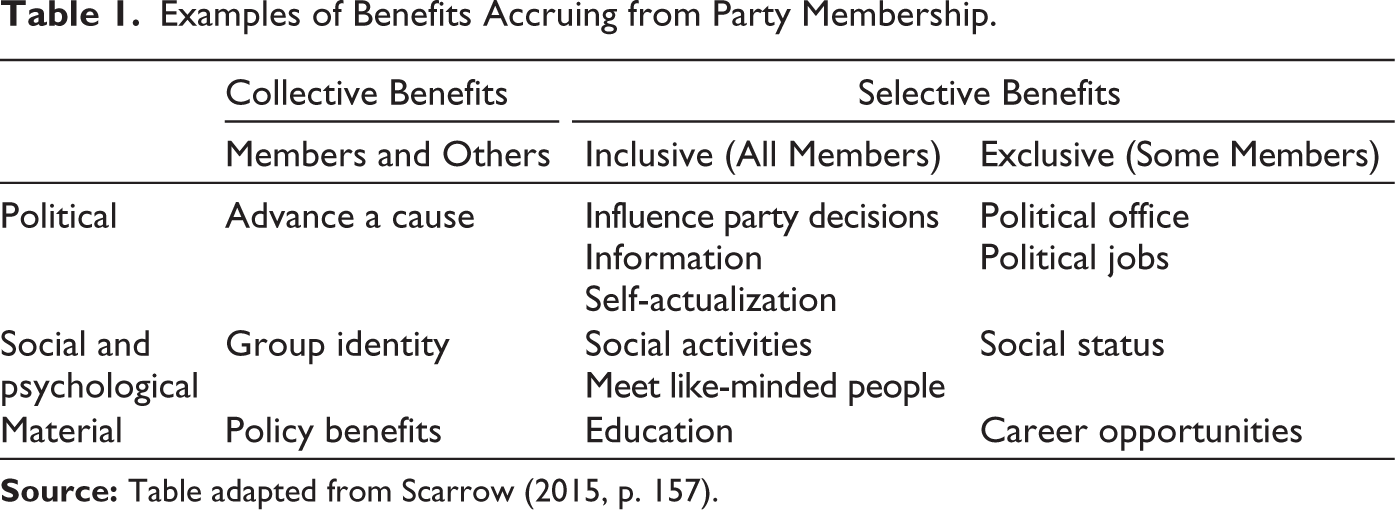
The primary reason for party engagement is the political benefit of advancing a cause and supporting a party (Bale et al., 2020). The promise of policy rewards, which is the core benefit offered by political parties, is collective in nature and applies to both members and non-members. Members often mention ideological reasons for political engagement, such as a desire to change the world, ‘make it a better place to live in’ or ‘making one’s voice heard’ (Sveningsson, 2016, p. 153). However, the engagement ‘on behalf of a collective benefit may be reinforced’ by selective personal expressive rewards, such as ‘feelings of self-esteem’ as well as self-actualization that may come from working for a cause (Scarrow, 2015, p. 176). Political parties also provide selective benefits to their members, such as access to political information and the opportunity to influence party politics. The access to information and participation in events to become more informed about politics and societal issues is available to all members, making it inclusive in nature. However, the possibility of attaining political positions, whether within the party or through elections, is exclusive, as only a select few individuals can stand as candidates for the party.
Membership may also offer various social benefits, including social activities, the opportunity to meet like-minded individuals and the ability to cultivate and express a political identity. However, the social collective benefit of asserting a group identity based on class and interests has become less appealing due to the weakening of traditional political cleavages and the evolution of mass parties. In contrast, newer political parties, such as radical right parties, are more likely to foster the cultivation of new group identities (Miller-Idriss, 2018).
While some political parties target specific groups based on ethnicity or language (Scarrow, 2015, p. 162), other types of group identities, such as a sense of community, can also be valued by party members. This sense of community may range from a general feeling of belonging to a movement that advances a particular cause to being part of a community where one feels recognized and valued. Additionally, political parties serve as platforms for meeting like-minded individuals and forming friendships. They can offer members a certain social status, which may include exclusive benefits such as opportunities to meet high-ranking politicians and participate in exclusive events (Scarrow, 2015, p. 161).
Given that youth wings have a specific mission to socialize young people into political parties, they are likely to put more effort into creating a sense of community among their young members. Considering their age and life stages, young members are likely to be more interested in finding spaces to meet like-minded individuals, cultivate a sense of belonging, explore their own identities and express a group identity. Political parties organize various events, including party meetings and social activities, which are open to all members. Although the appeal of these party activities may decrease among party members in general, younger members are more likely to appreciate social events compared to older members (Bruter & Harrison, 2009a, p. 35). Furthermore, social benefits and personal connections can have a substantial impact on motivating current members to renew their membership and increase their level of active involvement. Although these activities are available to all members, those who are actively engaged are more likely to take full advantage of them. Attaining social status within the party is regarded as a form of selective social exclusive benefit. This may encompass opportunities to interact with high-ranking politicians and receive invitations to exclusive party events (Scarrow, 2015, p. 164).
Finally, Scarrow (2015, p. 169) distinguishes between collective and selective material benefits. Economic promises and material improvements are cited as examples of collective material benefits. However, such benefits may not be sufficient to motivate membership. Political parties provide various forms of education and training for their members, including courses on meeting techniques, economic management and the development of rhetorical skills. These may be both exclusive and inclusive material benefits. Acquiring these skills can serve as future assets for members in their professional careers, in addition to personal development. The opportunity to pursue a political career, which is a selective and exclusive benefit, has been identified as a significant motivator for party membership, particularly for party activism. However, in this context, the possibility to stand as a candidate in the youth wing and/or a young representative for the party is more relevant; however, attaining positions within the youth wing has often served as a springboard for a political career in the mother party.
Table 1, adapted from Scarrow (2015, p. 157), provides a summary of various benefits that serve as the foundation for analysing the perspectives of party youth wing members on their membership. In the next section, we outline how we empirically examine the presence of these different benefits and what members believe can enhance their experience of membership in the youth wing.
Methods and Materials
To examine membership perceptions, we utilized data from a web survey that was conducted among members of the youth wings of all eight Swedish parliamentary parties. 1 Sweden offers a relevant case to examine member perceptions since all parties have a long tradition of having close ties to well-organized youth wings that are generally seen both as important supporting organizations for the mother party and as platforms for young people to develop and voice their opinions. Like their mother parties, most Swedish youth wings have lost members over time. However, membership figures have stabilized during the last decade. When the web survey was fielded in late 2020, there were approximately 25,000 members in the youth wings of Sweden’s political parties. With only one exception, the parties’ youth wings are independent from their mother parties insofar as they are free to elect their own leaders and develop their own political platforms. Despite this independence, there is a strong link between the youth wing and its mother party. Some of the youth wings even have formal representation in their mother parties, although the small number of seats on party boards and congress delegates is primarily symbolic rather than of real significance (Bolin, 2019). The Young Swedes is the only youth wing that is not independent. Instead, it is formally an intra-party section of its mother party, the radical-right Sweden Democrats.
The survey targeted members who were at least 15 years old and had provided their email addresses to their respective youth wings. The responsibility of forwarding the survey link to the members while ensuring respondent anonymity rested with the youth wing leaders. Out of the 17,104 members invited to participate, a total of 2,906 responses were received, resulting in a response rate of 17%, which aligns with response rates observed in similar studies (Kölln & Polk, 2017). The survey respondents were largely representative in terms of gender and age for the six youth wings where population distribution information was available. However, information was not available for two youth wings.
We utilized two open-ended questions from the survey to capture members’ perceptions of their youth wing membership. It is important to note that open-ended questions typically have lower response rates as they require more effort from respondents (Zhou et al., 2017). Additionally, the positioning of these questions at the end of the survey may have affected the response rate. However, despite these factors, we deemed the number of responses received to be relatively high and sufficient for conducting a meaningful analysis. However, caution must be exercised when generalizing the findings from the analysis.
The first question aimed to understand the perceived benefits of youth wing membership and asked respondents, ‘What do you like most about the youth wing?’ Approximately 24% of the respondents provided answers to this question, resulting in 690 responses. The second question focused on the drawbacks of membership and was phrased as follows: ‘What do you think is the main thing that could be done to improve the experience of being in the youth wing?’ Around 21% of the respondents answered this question, providing 606 responses. While research has demonstrated that there are group differences in the likelihood of responding to open-ended survey questions (Miller & Dumford, 2014), there are no such indications in our sample. There are negligible gender differences in the response rate for the open-ended questions when compared to the overall sample. The variations at the organizational level range from 20% to 33% and 15% to 27% for our two different questions. Since we are not concerned with measuring discrepancies based on gender and/or youth wings, we firmly believe that these relatively minor differences do not present an issue.
The responses to the open-ended survey questions were analysed using NVivo software. The coding of the responses to these questions is based on the categorizations of benefits highlighted in previous research. As explained in the theoretical section and illustrated in Table 1, the point of departure consisted of identifying the collective and selective (inclusive and exclusive) political, social and psychological and material benefits, which were adapted from the work of Scarrow (2015).
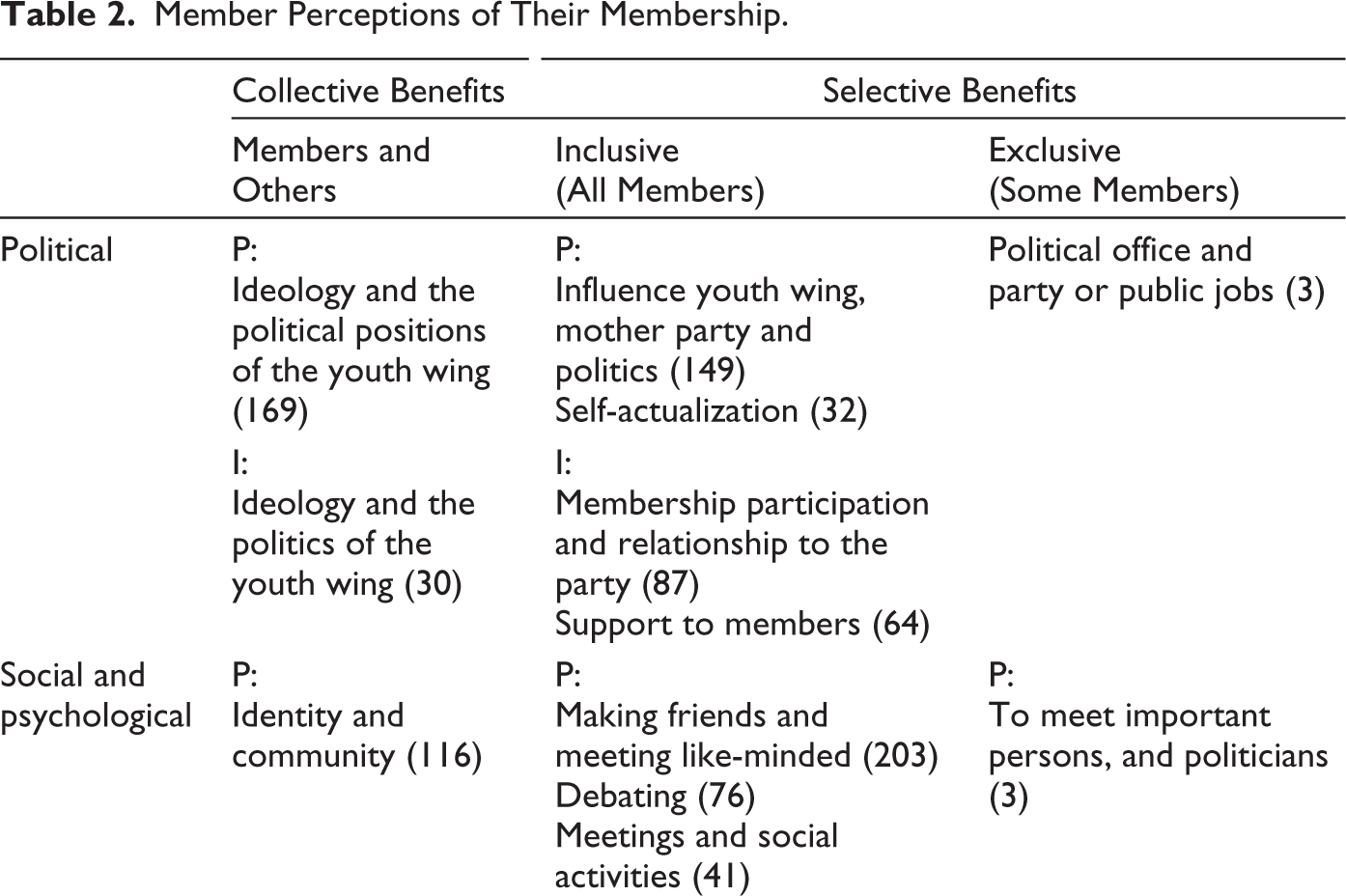
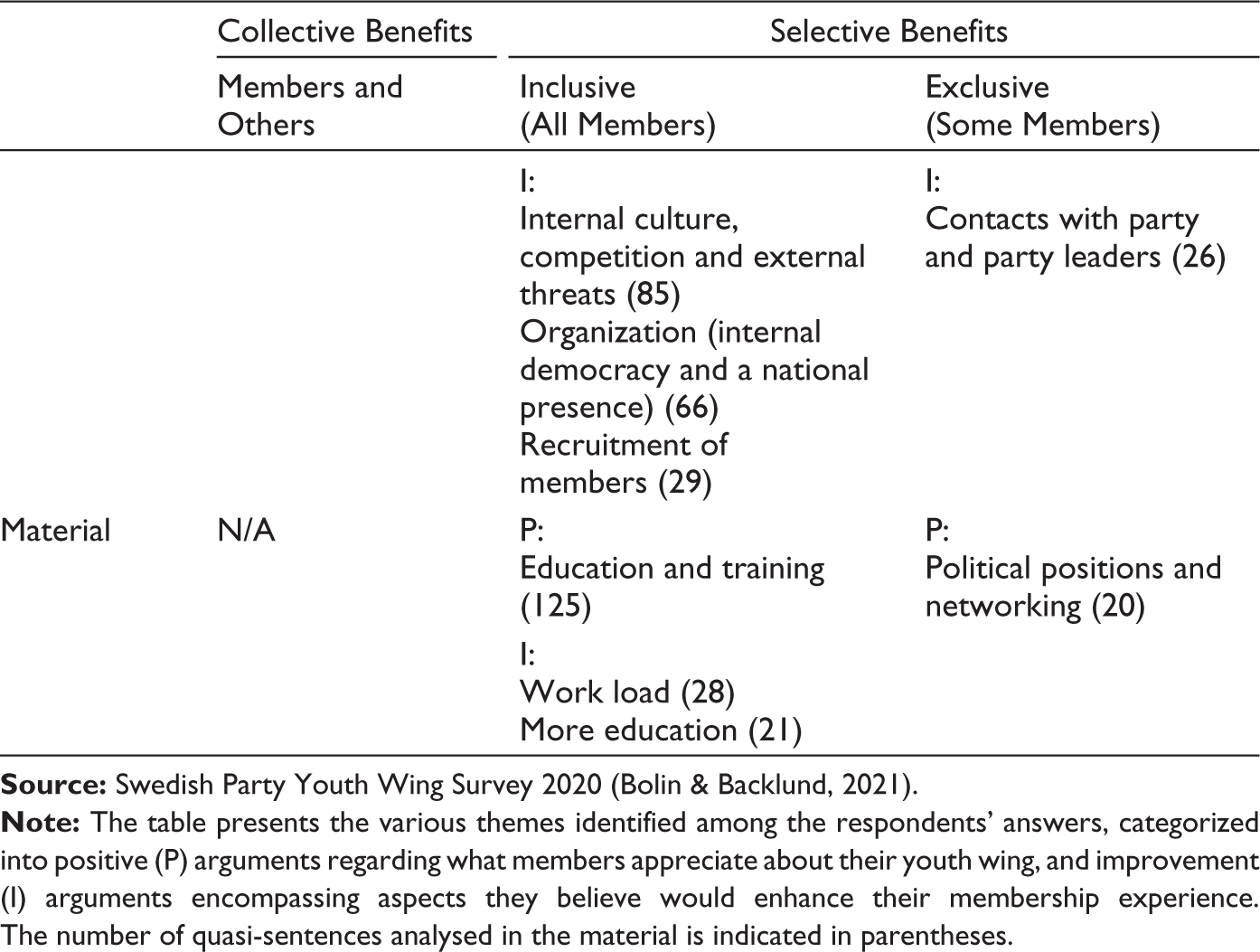
The responses to the two broad questions were categorized into quasi-sentences, which are individual statements that relate to the above-mentioned analytical categories. These quasi-sentences capture the things that members like or the benefits they experience from being a member, as well as the potential improvements that could enhance their membership experience. A quasi-sentence represents a single statement about a specific item, while ‘natural’ sentences can include multiple statements (Merz et al., 2016). For example, if a respondent’s answer states that ‘I have made many good friends and learned a lot about politics’, it would be coded into two quasi-sentences corresponding to the analytical categories of ‘making friends and meeting like-minded’ and ‘education and training’. In total, 1,393 quasi-sentences have been identified in the coding. Out of these, we have excluded 20 due to reasons such as their reference to personal remarks on individual leaders and a few other statements that cannot clearly be related to any of the categories in the analytical framework. The distribution of quasi-sentences is presented in Table 2. The analysis allows us to quantify the 1,373 quasi-sentences falling under the respective analytical categories, as well as determine whether it is something that is appreciated or could be improved. Although we are cautious not to place too much emphasis on the frequency of occurrences of different categories, this is used as a certain indication of the extent to which various arguments can be considered common among the members. All else being equal, it is reasonable to give more weight to the recurrently mentioned arguments.
Member Perceptions of Their Membership.
Analysis
In Table 2, we provide a summary of the findings from the analysis. The ‘Positive’ (P) statements represent what the members like about their youth wings, while the ‘Improve’ (I) statements highlight the aspects they would like to change or improve. Additionally, we report the number of quasi-sentences for each theme.
The predominant themes underscore the collective and inclusive political and social benefits of membership in youth wings, with fewer references to exclusive benefits, reflecting their limited accessibility. Members cherish youth wings for their unwavering commitment to principled ideologies and policies, which often stand less compromised than those of the mother party. Moreover, the sense of community fosters a shared identity among like-minded individuals, bolstering the desire to enact meaningful political change. Active involvement in youth wings is viewed as an avenue for influencing political discourse and fostering personal and political growth. Social engagements, particularly opportunities for networking and engaging in political debates, are highly prized among members.
However, challenges exist within the internal dynamics of youth wings, with some members perceiving factional struggles and competition for positions as detracting from the open and welcoming atmosphere. The demanding workload, especially for those in leadership roles, coupled with the pressures associated with pursuing a political career, can be overwhelming. To address these challenges, members emphasize the importance of recruiting new members and expanding local and regional activities. While material benefits hold less significance compared to the political and social rewards, members value the educational and training opportunities provided by youth wings.
The following discussion will delve into the more frequent themes that emerged from the analysis, providing further details. The presentation is structured based on the division between political, social and psychological, and material benefits.
Political Benefits
The political benefits are the most prevalent statements in the data. Members take pride in the ideology and political positions that their youth wings represent. This collective benefit accessible to all is valued by the members in different ways. First and foremost, there is a broad and somewhat idealistic sense that members associate themselves with the ideology and political positions advocated by their respective youth wings. ‘I like that the values that are the most important for forming the society are the core of the youth wing’. The youth wings are highly valued as they are seen as champions of a noble cause, working towards making the world a better place. In this regard, the youth wings provide their members with opportunities to actively engage in societal transformation, fostering a sense of purpose and instilling hope for the future. As formulated by one youth wing member: ‘That we [in the youth wing] are fighting for a common goal and that we make a difference. It reduces the gloominess about what the society looks like today’.
The members hold a favourable view of their youth wing due to its perceived superiority, bravery and courage compared to both the mother party and other youth wings. The youth wing is seen as being more ideologically principled and, at times, more radical, refusing to compromise on core values. As a result, members take pride in their youth wing when it acts as a watchdog, keeping a close eye on the actions of the mother party. The youth wing ‘takes positions in a more fundamental way than the shortsightedness of the mother party’ and is ‘never afraid of saying what it believes in’. The youth wing takes positions that the mother party does not dare to take, ‘stand for our own views and we go against the mother party’ and are ‘never afraid of saying what we believe in’. The youth wing is also recognized for its unique policy offerings, which are often absent in other political parties. The nature of these policies may vary among different youth wings. Some members appreciate their youth wing’s stance on specific issues, for example, climate change, social justice and crime. However, some would like their youth wing to be more courageous and independent vis-à-vis the mother party and not act as a support group.
The youth wings empower their members with a sense of influence over their own youth wings and the mother party, as well as politics and society at large. This political selective benefit of having an influence is formulated in statements such as ‘we change’ and ‘make a difference’, which frequently emerge, reflecting members’ belief in the impact of their actions. Being part of the youth wing allows them to ‘make their voice heard’ and makes them feel a sense of agency in shaping political outcomes. It is recognized that the youth wings can foster a sense of political efficacy among members by exerting pressure on their political parties. Members perceive that their youth wings ‘truly impact the development of Swedish politics’.
The fact that young people without voting rights through the youth wings are given the possibility to influence politics is also mentioned: ‘I like to participate in politics and influence it. Generally, young people are ignored in political discussions’. Some members see their youth wing as ‘a platform where I am listened to, which is not especially common outside the walls of the youth wing’. They appreciate the opportunity to participate in politics and influence it, particularly since they feel that young people are often disregarded in political discussions.
Not only do members appreciate that their opinions are taken into consideration, but the youth wings stimulate the members to express their opinions: ‘young people are encouraged to make their voices heard’. For instance, one respondent explains that the youth wing ‘gives a feeling that one can influence the society through campaigning and opinion pieces’. The youth wings are perceived to be arenas for making a real change, not just complaining and doing nothing.
The possibilities to influence not only the youth wing but also the mother party are expressed as well. ‘What I like the most is to concretely see the fruits of our work, the feeling of ownership, and that one produces something’. It gives a sense of meaning as well as pride to be able to make a difference as a young member concludes:
To see a bill that I or someone else in the youth wing has put together as a loosely formulated Google document being debated at the youth wing annual congress, and thereafter a decision is taken at the party congress that it is the official position of the party. It is like seeing a baby learning to walk. It is a cool feeling.
However, there are also multiple responses indicating that the mother party should be more open to the views of youth wing members, thereby enhancing membership participation and improving relations between the mother party and the youth wing. Some respondents suggest that the mother party could better utilize the youth wings and their members to gain insights into societal dynamics, while others emphasize the independence of the youth wing in relation to the mother party and the role of the youth wing in challenging the mother party. Nonetheless, members express a desire for their mother parties to be more receptive to the views of young people, stating that ‘young persons are not taken seriously’ and highlighting the need for the mother party to respect and listen to the youth wing to a greater extent. There is also a call for improved communication between the youth wing, the mother party, and the parliamentary representatives in general.
The activity within the youth wing has contributed to the personal development and self-actualization of their members. Youth wing members state that they have learned to express themselves and have developed their own perspectives: ‘The discussions in the youth wing help me to develop politically from my point of view and debate my ideas’. Another member explains, ‘my youth wing has given me the most important thing one can give a young person, the tools to channel anger and frustration into a concrete fight and a context in which I have been able to develop my own political thoughts’. The youth wing has also played a role in boosting self-esteem and confidence, as expressed by one respondent: ‘The youth wing has through its education given me immense confidence in myself and my viewpoints’. For young individuals, being an active member in a youth wing can be formative in terms of personal development, offering opportunities to learn and explore political ideas and providing a sense of importance.
However, there are also concerns raised by some members regarding the support provided to members. These concerns can be categorized into two types. On the one hand, there is a call for youth wings to encourage members to become more active and bridge the gap between passive and active membership. Special efforts should be made to include and engage individuals who do not have a local association nearby. In this case, youth wings should strive to create a welcoming environment and promote activism. Some members express a desire for increased involvement. On the other hand, some members believe that youth wings should be flexible in accommodating different degrees and types of participation preferred by individuals. They feel that at times, youth wings exert excessive pressure on members to engage and be active. As one respondent puts it, ‘Do not pressure people to be as active as I have felt. Recognize that members can make a difference without attending every meeting’. However, it is recognized that members still need to feel a sense of being ‘needed’ in some way in order to remain in the party. ‘Those who are active should have responsibilities. Feeling needed—on one’s own terms—would make members stay in the organization. It can start with small tasks like making coffee and later progress to chairing specific program committees’.
Social Benefits
One of the most frequently mentioned themes when discussing what members appreciate about their party can be referred to as identity and community. This theme highlights the collective social benefit of belonging to a community that shares a common purpose and represents something beyond simply sharing similar world views and political ideas. It provides members with a sense of identity and a feeling of being part of a group that is dedicated to a shared goal. ‘The feeling that we want the society to go in the same direction is incredible—almost euphoric’. The youth wing is described as a ‘second family’ where the members support one another and learn from one another. The community is described as ‘a place of people who are like you’ and as a unique place to meet and interact with people who are interested in politics: ‘Either you like politics a lot or not. It feels like being part of a context that maybe cannot be found in school or in other places’. Another respondent framed the experience of the youth wing as a way of finding people interested in politics, something that s/he has not experienced elsewhere: ‘I am from a little place where no one talked about politics in school. I am so happy to meet people who are like me and want to change society’.
But it is not only about a community united around shared ideas and policies but also an environment where diversity is allowed and even appreciated: the youth wing is a place ‘to meet people that share and do not share my opinions’. The youth wing is described as a place where one is welcome and accepted, a place ‘where I can be myself and it is ok to hold different opinions; it is among the most fun things I have experienced’. The diversity is part of the experience of the youth wing community: ‘we have different backgrounds and different thoughts about this and that. In spite of this, we have common goals about greater equality and support one another. It is some sort of community’. Or, the youth wing is described as ‘a great mix of people who basically hold the same views but where different opinions have a lot of space’.
The youth wing is obviously providing the possibility ‘to meet people with similar ideas’. But, in addition to meeting like-minded people, the youth wing is a way to make and meet friends. ‘The absolutely best with my youth wing is the social aspect’. This statement is indicative of how the social aspects are appreciated. The members have made friends for life and created networks for the future. To meet like-minded people with the same views and who see the world in a similar way is appreciated by the youth wing members, but also the diversity of members: ‘to meet people who share and do not share my opinions’ as one member formulates it. In addition to the ideological diversity, the opportunity to meet young persons of different age, from different parts of Sweden and different social backgrounds is mentioned. The members express that they have got an entirely new circle of social contacts through the youth wing: ‘I have got a new social network through my membership. Most of my closest friends are from politics, and from my youth wing’. Only a handful mention social status and the possibility of meeting high-ranking people from the party as reasons for why they like their youth wing.
Debating and discussing are social activities that are comparatively often mentioned. As one member formulates it: ‘My favourite activity is the talking and debating of politics!’ Members like their youth wings because it is a place where they can meet people who are interested in talking about what is going on in society and about current political affairs. Some members also mention the meetings and social activities—internal meetings and the national gatherings where one can interact with youth wing members from different parts of Sweden.
Parallel to the positive views on the youth wing community, there are those who express concerns about the internal culture, competition and external threats. There is room for improvement in general and especially in relation to factionalism and the levels of competitiveness within the youth wing, and to external threats. The members state the party culture should be improved in order to make members thrive and ultimately remain in the organization by making the organization more open, inclusive and less judgmental of different views. The members should feel safe and secure, even when the internal debates are polarized and conflictual. The youth wing should formulate guidelines for acceptable social behaviour and correct and expel members who behave in inappropriate ways. Moreover, personal and factional conflicts should be avoided and, when occurring, dealt with rapidly: ‘Get rid of those fucking factional conflicts’. The competitive aspect of the youth wings in terms of personal competition about youth wing positions should be downplayed.
The personal conflicts can be consuming on a personal level. Particularly when one has lost an election: It can feel like a stab in the back to receive fewer votes [than the other candidate(s)]. And this can be scary since many see the youth wing as a ladder to a career. The stakes are higher then. To counter that culture would be important.
Others mention that there is too little focus on the mental stress of political engagement. It would be important ‘to try to make a sense of the community and reduce the competitive aspect. It is quite easy to focus on the competition [for positions], and that is necessarily not the best for politics and personal well-being’. The external threats of being politically active are also mentioned: ‘the security needs to be improved as many encounter hate and threats’.
In addition, the members think that the youth wings should improve the recruitment of members and engage in transforming the negative perception of party politics and political engagement: The youth wings ‘should work against the contempt against politicians and normalize being a member and a party-associate’. The youth wing members should be presented with more possibilities to meet with the party leaders and representatives from the mother party. The members also raise concerns about organizational issues and express a desire to see more youth-wing leadership presence and activities at both the regional and local levels. Moreover, the leadership should pay attention to the all too heavy workload on those who engage in the youth wings, something that is a disincentive for some to become more active. They believe that the leadership should listen to and support the local youth wings to a greater extent and ensure that people from different parts of the country are represented in the national organization, in order to avoid a leadership structure centred solely around Stockholm. Some members also express their concerns about a lack of interest in supporting and organizing activities in smaller localities, which makes it more difficult to recruit and retain members.
Material Benefits
The youth wing offers its members political information, education and training through a range of activities. These include updates on current political affairs, ideological and political education, and skill-building in debating, writing and meeting techniques. The most valued aspect among members is the opportunity to learn. They describe how they have gained extensive knowledge about politics, both in theory and practice, and, above all, how the youth wing has allowed them to improve their thoughts and perspectives. Members appreciate the practical understanding of politics and power, as well as the chance to develop their own political thinking and skills.
However, relatively few respondents mention political positions and networking or the possibility of pursuing a political career as something they particularly value in their organization. While they acknowledge the acquisition of knowledge and skills that are not easily obtained elsewhere and describe the youth wings as ‘schools for life’, few envision a future solely focused on politics. Moreover, even though members are trained for political careers and to navigate the ‘corridors of power’, only a couple express a genuine desire to pursue a future in politics. At the same time, there are some statements highlighting the burdens and responsibilities associated with political positions. The workload is considered too heavy and, at times, quite stressful, especially concerning the demands placed on youth wing leadership for extensive engagement in recruiting new members. Few individuals express an interest in assuming positions of responsibility at the regional and local levels. As one member puts it, ‘as a member of the youth wing board at the local level, there is a heavy burden on your shoulders. And this must be balanced with a job, school, friends, and leisure activities’.
According to the members, the workload within the youth wing should be shared, and the central organization should provide greater support for those who are actively involved. Others propose alternative ways of engagement within the youth wings, in addition to serving on national or regional boards and participating in campaigns or member recruitment.
Discussion
The scholarly literature characterizes youth wings as support teams and recruitment pools for political parties (Bolin et al., 2023; Hooghe et al., 2004). The role of youth wings is to provide the party with young individuals who can work for the party and assume leadership roles in the future. From the perspective of the mother party, the role of youth wings is primarily instrumental in both the short and long term. However, a different perspective emerges when examining youth wings through the eyes of their members and their expectations of the youth wing experience. While members are expected to work for the party’s interests and advancement, they also anticipate receiving something in return for their membership.
Instead of asking what the members do for the party, this analysis focused on the question of what the party offers to the members. Specifically, it explored what members appreciate and what factors could improve their experience of membership in the youth wing. Previous survey-based research has identified various political, social, and material benefits as reasons for youth wing membership. Our analysis confirms previous findings (Bolin et al., 2023; Bruter & Harrison, 2009b; Weber, 2020) that suggest that political and social aspects tend to be more significant than material benefits. While members seem to value material benefits in terms of building competence in specific skills that are considered useful for future political or non-political careers, these are less important than some other aspects.
Our analysis, however, goes beyond identifying these overarching categories of benefits. One aspect that has been given too little attention in previous research is how members view their youth wing as a formative community for personal development, self-discovery and the cultivation of values and political visions. It serves as an arena where members can engage in discussions and debates about society and political affairs, which they may not feel comfortable doing in many other settings. Furthermore, a sense of belonging to a community of shared values is a sentiment shared by the respondents. This community is characterized by a common vision for the world and collective efforts towards that goal, as well as the formation of lifelong friendships with like-minded individuals. Above all, the feeling of being part of a community is highly valued by the members.
Importantly, however, our analysis has also identified several areas where many members have had negative experiences. Areas for improvement mentioned by members are often related to the expectations placed on youth wings by the mother party, such as campaigning, membership recruitment and careerism. Some members also perceive the competitive nature of politics negatively, with conflicts and factionalism being seen as drawbacks. Given that previous research (van Haute et al., 2018) indicates that internal conflict and dissatisfaction lead members to leave political parties, these warning signs should be important for today’s leaders in both parties and youth wings.
This analysis of responses to open-ended survey questions from members provides several tentative contributions. First, it indicates that the expectations set by the mother party sometimes clash with what members truly value. While ideology and the opportunity to influence politics are important to members, they also prioritize the individual effects of membership, such as self-actualization, political identification and competence building. Additionally, the sense of belonging to a group with shared values and interests in politics and society is crucial for young people engaging in political parties. Some describe the youth wing as a family-like environment where they can pursue their political interests and engagement in an atmosphere that often views party politics with disdain and suspicion.
Second, these findings offer methodological insights for designing surveys that aim to understand not only why young people join youth wings but also why they engage and remain involved. Speculatively, the rising individualism observed in society is not only reflected in careerism but may also influence young members’ expectations of rewarding experiences beyond politics, such as personal development and self-fulfilment. While previous survey-based research on party and youth wing members considers a range of political, social and material motivations (e.g., Bolin et al., 2023; Weber, 2020), these aspects have not been given much prominence at all.
Finally, in an era where both political parties and youth wings face challenges in recruiting and retaining members (van Biezen et al., 2012; van Haute et al., 2018; Whiteley, 2011), these findings hold considerable importance for youth wings and political parties. They aim to understand not only how to attract young individuals but also how to sustain their involvement within the parties and youth wings. If members are expected to dedicate their time and energy to work for the party, they also anticipate the party to invest in them by offering information, education, training and opportunities for social interaction. Furthermore, youth wings should exhibit adaptability in accommodating various types and forms of activism. In addition to this, youth wings also need to address the fact that many members perceive politics as competitive and conflict-oriented. The challenge seems to be to simultaneously be a community where members share values and political visions and an environment that allows for different forms and intensities of engagement.
Footnotes
Declaration of Conflicting Interests
The authors declared no potential conflicts of interest with respect to the research, authorship and/or publication of this article.
Funding
The authors declared the following financial support for the research, authorship and/or publication of this article: This research was funded by the Swedish Agency for Youth and Civil Society (MUCF) under grant number dnr: 0671/19.