



Abstract
Youth unemployment and precarity have been expanding in the aftermath of the recent global recession. This article offers a theoretically informed empirical examination of the spatio-temporally uneven expansion of young people ‘Not in Employment, Education or Training’ (NEETs) between 2008 and 2018 in the European Union (EU) South, namely in Italy, Spain, Greece and Cyprus. This article contributes to the growing literature on youth inactivity and marginalization, by focusing on the spatial, rather than just the temporal dimension of youth which marks most relevant studies. The analysis engages with the concept of ‘youthspaces’ to critically analyse the economic, social and political spatialities that determine the dynamic relationship between youth and the labour market, and discuss the persistently high NEET rate in the EU South. Employing a mixed-methods approach, we highlight that gender, class, education and economic growth are key socio-spatial factors that determine the geographically uneven expansion of NEETs across the study regions.
Introduction
Young people Not in Employment, Education or Training (NEETs) compose a potentially large segment of the labour market, highly vulnerable to economic shocks and recessions. The 2008–2009 global economic recession has sparked off an intense academic and political discussion on the increasing youth unemployment and inactivity (Avis, 2014; Mascherini & Ledermaier, 2016). Although it is commonly acknowledged that limited participation in education and labour precariousness negatively affect young people’s lives, the deeper forces of youth disengagement are often not well understood. Moreover, NEETs are frequently examined without considering space and the regional socio-economic framework (Mascherini, 2019). Thus, most studies fail to satisfactorily explain the higher and more persistent NEET rates in the least-developed areas of the European Union (EU), as in the case of the EU South (Kotroyannos et al, 2015; Zuccotti & O’Reilly, 2019).
Indeed, economies of the EU South have historically been vulnerable to crises with repercussions on employment. Recent labour reforms have further increased precarity. Labour fragmentation, flexibility without security and informality have been key characteristics of the EU southern labour markets throughout the 20th century, determining the structures and cultures found therein (De Luca et al., 2020; Leontidou, 2012). Therefore, the ramifications of the recent Great Recession signify only a small piece of the bigger ‘uneven development puzzle’; a piece that is itself determined by the historically specific and regionally bound development dialectics that characterize the study area (Pastore, 2015). The fragility of the Mediterranean EU economies is manifested through high and persistent unemployment rates, weak industrial relations, dismantled collective agreements and the recent shift to long-lasting stagnation or anaemic recovery (Gialis & Leontidou, 2014).
This article offers an empirically grounded critical examination of the geographically and temporally uneven distribution of young NEETs across the regions of Cyprus, Italy, Greece and Spain. Drawing jointly on key geographical political–economy concepts and on the concept of ‘spaces of youth’ (see Farrugia, 2018), or ‘youthspaces’ hereafter, we study the expansion of NEET figures focusing on the socio-spatial dialectics at play. Specifically, we seek to answer the following research questions. First, which are the key factors that determine the disparities in NEET rates across regions of the EU South in the post-2008 period? Second, how does spatiality affect the prospects of young people, especially of young women, in the EU South? To explore these issues, we employ a mixed-methods approach, scrutinizing both quantitative (descriptive statistics and ANOVA statistical tests) and qualitative (semi-structured interviews) data. Throughout the analysis, we understand the relationship between youth and the labour market as an integral part of the wider network of socio-spatially determined opportunities and uneven power geometries. Though in our secondary data analysis we focus on both sexes, in the qualitative part we pay particular attention to young females, a highly vulnerable subgroup of NEETs who usually face higher barriers when seeking to enter the labour market (Zuccotti & O’Reilly, 2019). In that way, we ensure a joint focus on the youthspaces created and inhabited by the more disadvantaged young people within the less-privileged regions. The research is particularly timely, coming at a moment of social and economic turmoil fuelled by the COVID-19 pandemic (Herod et al., 2021; Kapitsinis, 2021).
Below we, first, build a conceptual framework that links NEETs with youthspaces, while we also provide a brief background of youth unemployment and inactivity in the EU South that contextualizes contemporary spatial unevenness. We then outline our methodology, before proceeding with the analysis of data. Finally, we use the concept of ‘youthspaces’ to critically discuss the economic, work and political spatialities that determine the accessibility of youth to the labour market, and interpret NEETs persistence in the EU South.
NEETs and Youthspaces: A Tentative Conceptual Framework
Explaining youth’s absence from labour markets and education is not a new inquiry. The acronym ‘NEET’ was first introduced in the United Kingdom in the late-1980s, when the operational regime of social services changed to reduce the benefits offered to those under 25 (Furlong, 2006). This reform led thousands of jobless young people having no access to any kind of public support. As a response, scholars and policy makers explored new ways of assessing young people’s vulnerability and decided to focus on both the unemployed and not-in-education youth, thus introducing the NEET statistical category (Furlong, 2006). Following the post-2000s trends, a broader definition (and measurement) was adopted, in order to include those between 25 and 29 years that face a prolonged transition from adolescence to early adulthood (Simões, 2018).
The share of young NEETs over the total young population (or NEET rate) comprises young people who jointly face the two following conditions. First, they are unemployed or inactive, according to the standard definitions of Eurostat. Second, they are not receiving any formal or non-formal education or training. The NEET indicator integrates different labour force survey variables, thus, does not represent a homogeneous social group, as being unemployed is often a quite different situation than being inactive (Furlong, 2006). Despite of this heterogeneity the NEET rate has acquired the status of a commonly accepted indicator of youth vulnerability used to jointly compare trends in youth unemployment and inactivity across different territories (Mascherini & Ledermaier, 2016).
Youth is usually described as the stage in a person’s lifetime that begins at one time (e.g. in adolescence) and ends at another time (e.g. by the start of adulthood), (Worth, 2009). Several nodal temporal turning points, such as biological ageing, and other biographical milestones, such as work acquisition and family formation, are used to assess that phase of social and individual development (Lesko, 2001; Morrow, 2013). The latter nodal moments/milestones –also perceived as ‘temporalities’ of youth transition—are losing their relative importance due to the increasing—and geographically uneven—labour precariousness during the recent decades. This is so, as a gradually declining number of individuals engages in a permanent job or creates a family while being young (Farrugia, 2018). Despite of this change, the majority of academic and political discourses still evaluate young peoples’ lives based on horizontal, labour market-oriented and spatially insensitive turning points.
Yet, it is not only ‘about time, but also about space’, as space is a crucial lens through which we should analyse youth and other social phenomena (Massey, 2005). The interaction between space and society—or the spatiality of the phenomena in hand—(Ettlinger & Bosco, 2004) determines the dynamic relationship between young people and the socio-spatial features of their environment. Youth emerges within social and cultural frameworks, educational systems, labour markets and transnational dynamics that are spatially grounded and geographically differentiated; and is, thus, affected by both local factors and global trends (Farrugia, 2018; Katz, 2004; Merriman et al., 2012). The notion of youthspaces, as utilized below, allow us to better understand the ways certain – global-to-local, material or digital—spaces affect the development of young people. These youthspaces shape and are, in turn, being shaped by young individuals’ praxis and everyday life stories.
Even though people’s lives have historically been articulated within the nexus of local social structures and community-based ties, contemporary young people come to age ‘beyond the limits’ of their localities. In this respect, youthspaces are the product of fluid assemblages of social processes developed in different geographical scales that are active in the construction of youth as such (Farrugia, 2018). On these grounds, understanding youth through their complex spatialities is a crucial conceptual shift with epistemological and ontological implications.
For example, most studies focus on the experiences of young people that reside in metropolitan vantage points of the global North—where globalization may have had more beneficial implications compared to the (EU) South (Cuervo & Wyn, 2012). Yet, young people living in the big cities of the Global North are not in any case representative of global youth as a whole. Young people living in less prosperous regions face limited opportunities of getting a meaningful stable employment or do not have access to good education (Simões, 2018). By focusingon youth across different regions of the EU South, our approach below transcends the metrocentric nature of contemporary youth studies.
In this framework, understanding the diverse spatial structures and local labour markets dynamics that determine the geographical unevenness of NEETs expansion is crucial. There are several key processes at play within contemporary youthspaces that have an impact on NEET volumes. For instance, young individuals are affected by the shifting position of their localities within the global production networks and have to address certain socio-economic barriers in order to become employed (Quintano et al., 2018). Less-affluent labour markets reproduce fragmenting mechanisms and foster youth unemployment and inactivity (Avis, 2014). Youth navigates itself through precarity in order to make a living within these labour realities. The types of labour precariousness that young people face are spatially dependent and, at the same time, geographically divergent and include a spectrum of practices such as unpaid internships, low-paid contracts, unpaid family work and atypical or even informal employment (Gialis et al., 2020). These practices are shaped on the basis of dismantled collective social ties and non-inclusive labour market structures that, in turn, determine how young labourers are reproduced. To briefly touch upon, EU southern countries are often characterized as fragmented socio-economic formations of the semi-peripheral —yet advanced—capitalism (Gambarotto et al., 2019). Their economies are service-oriented, while their labour markets have been traditionally offering few well-paid permanent jobs to young people (Leontidou, 2012). Labour precarity, informal practices and flexibility without security have been historically widespread among the younger cohorts of the population in these societies (Gialis & Leontidou, 2014).
Apart from a few regions hosting large and export-oriented corporations that offer more employment opportunities to young people (e.g. the Italian North), the EU southern labour markets have been suffering from high youth exclusion. Tayloristic production processes and the pertinent labour relations have been scarce, leaving many young people unemployed or inactive. Highly exploitative labouring practices as well as inadequate and insufficient welfare systems have gone hand in hand since the early 20th century (Perrons, 1995). Due to the poor industrial relations and weak planning and housing policies (Peck, 1996) the basic safety net for young people living in the area is historically provided by the family (Petmetsidou, 1996). This informal safety net offers some protection against market deficits but also has obvious negative effects as it makes young people highly dependent on family financial support (Leontidou, 2012). Extensive informal work and repression of workers’ agency have also played an important role in restricting the agency of young people (Herod, 2017; Herod et al., 2021).
The recent global recession has aggravated this disadvantageous situation. Certain EU countries, such as Greece and Spain, were strongly affected by the economic collapse and experienced, among other negative effects, a significant increase of NEET rates (Papadakis et al., 2015). Due to the limited number of well-paid job vacancies, many young people, even the highly educated ones, currently face higher difficulties in achieving a smooth transition from education to work (Simões, 2018). The countries under study have not been able to produce stable working conditions for youth, heretofore, (Avagianou et al., 2022; Kotroyannos et al., 2015).
Overall, our comprehensive approach below seeks to understand the reproduction of NEETs within contemporary youthspaces of the EU South. That way we avoid the conceptual barriers of depoliticized abstract perceptions of space, namely the ones offered by the neoclassical school of thought. Space is socio-economically constructed, thus entailing uneven geographical opportunities and socio-spatial mobility for young people (Peck, 1996). In our politicized youthspaces approach we critically analyse and empirically substantiate how and in what terms NEETs are reproduced in less-developed socio-spatial entities of the semi-peripheral capitalism (Avis, 2014).
Methodology, Data and Research Design
Below we employ a mixed-methods approach that links quantitative analysis with qualitative material. The quantitative results reveal trends of youth inactivity between 2008 and 2018, while also help us estimate statistical associations between regional socio-economic factors and youth inactivity. Narratives from semi-structured interviews with female NEETs add a more nuanced understanding of the ways spatiality, gender and class affect young people’s integration into local labour markets.
Description of the Data Used
The secondary data 1 employed for the analysis include socio-economic variables at a regional (NUTS2) level, such as NEET rates, tertiary education attainment, early school leavers (ESL), gross domestic product (GDP) and household income, as well as geo-demographic characteristics, such as insularity and regional population. All data are from Eurostat. Eurostat is the coordinator of all national statistical agencies 2 of the EU member states. The variables along with brief relevant information and links to the sources in the original database are described in Table 1.
Variables Retrieved from EUROSTAT and Used in the Quantitative Analysis, NUTS2 Regions of Greece, Spain, Italy and Cyprus, 2008–2018.
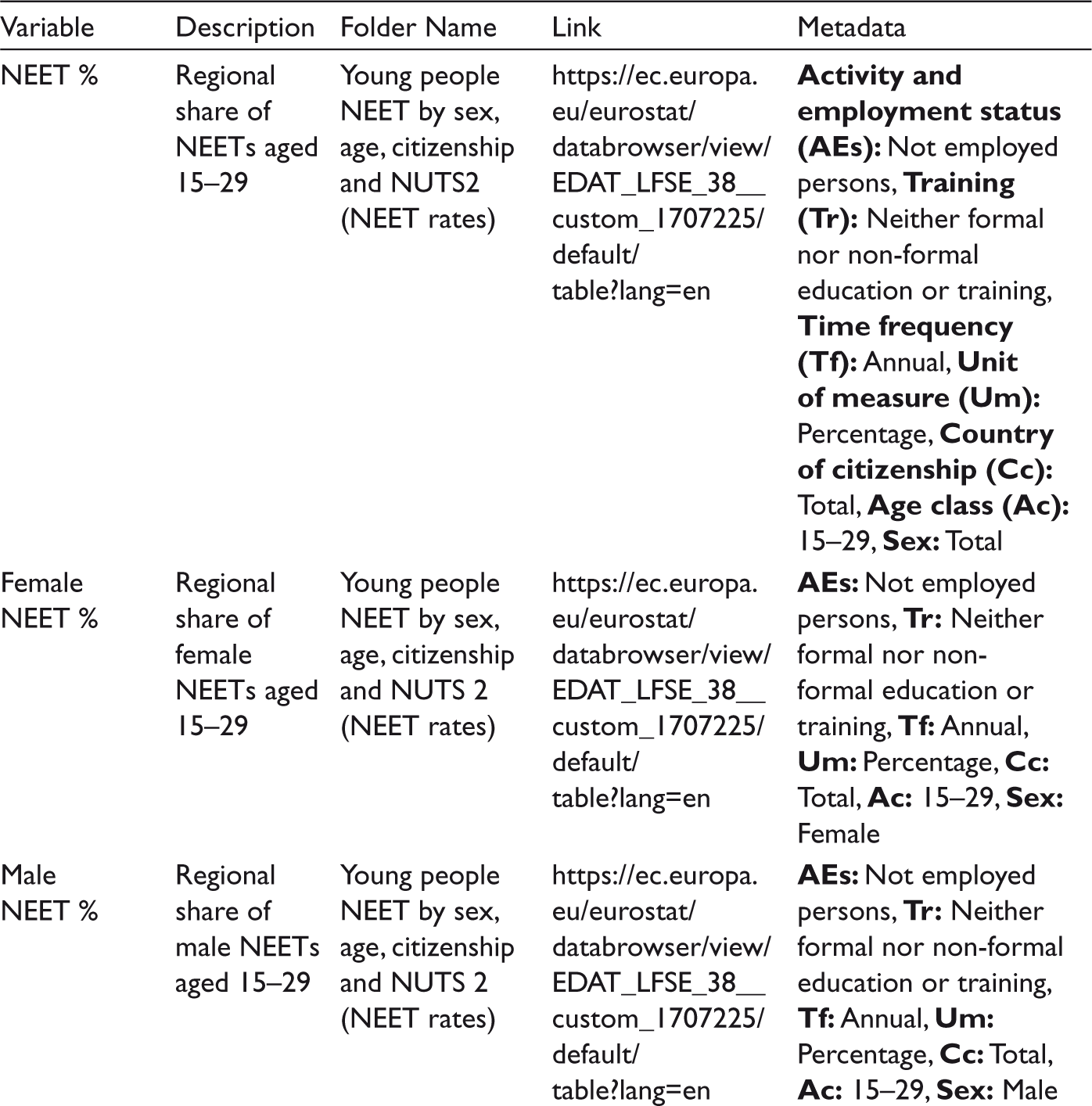
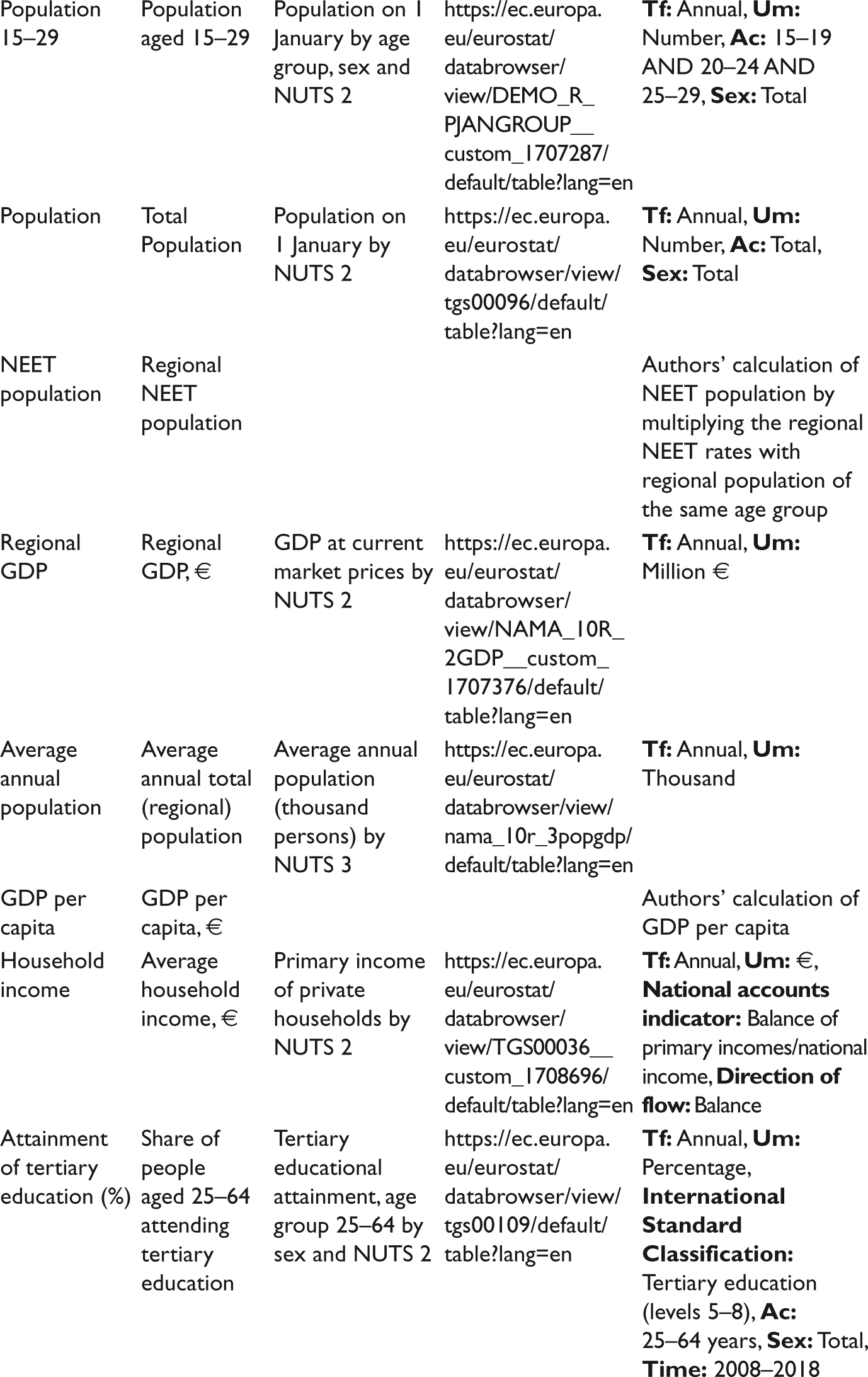
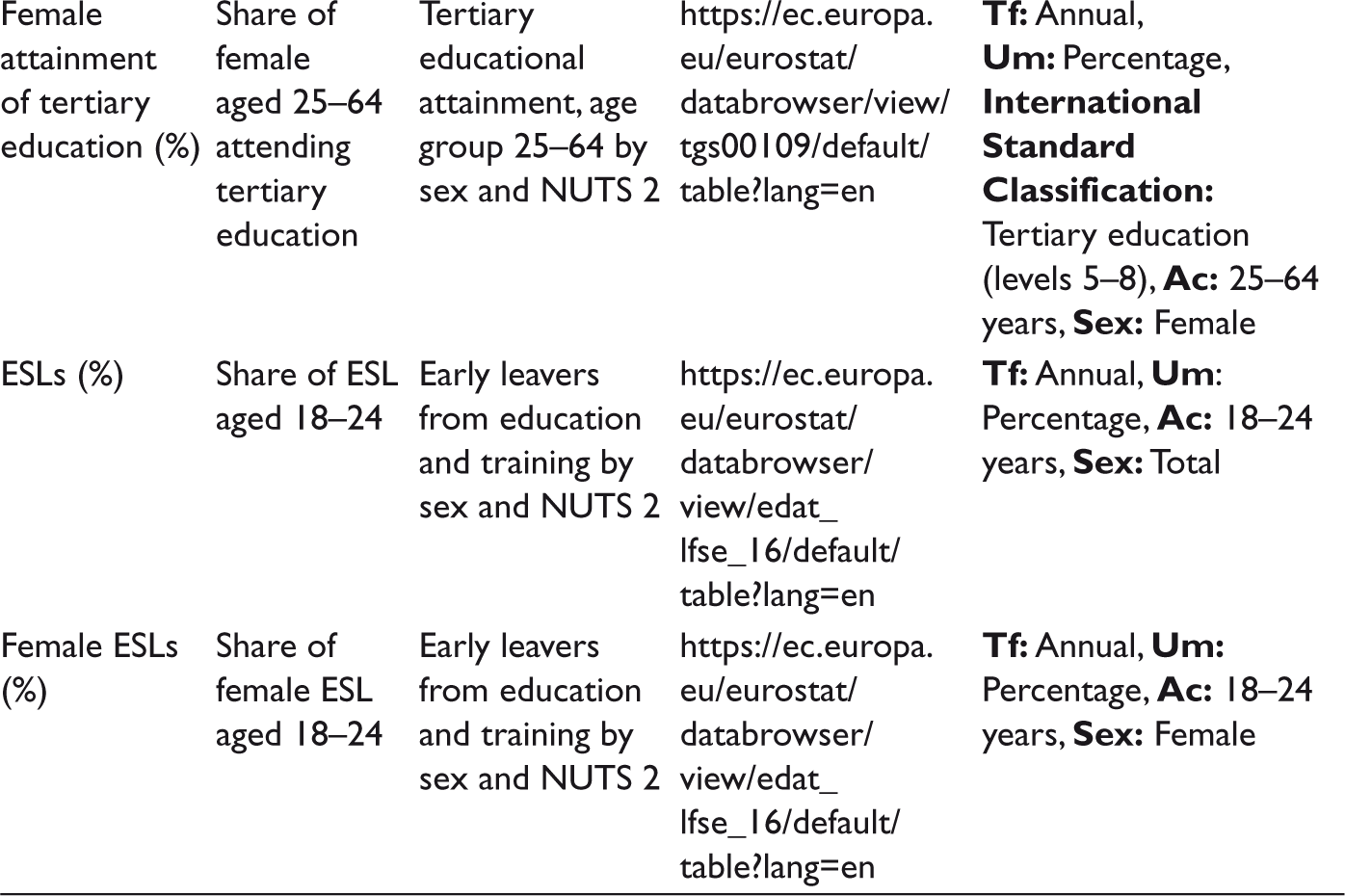
Regional data on employment and education attendance (NEETs, tertiary education attainment and ESL) are based on the EU Labour Force Survey (EU-LFS), following the definitions and recommendations of the International Labour Organization. 3 The ‘educational attainment level’ of an individual is the highest International Standard Classification of Education level successfully completed, as validated and officially recognized by the relevant national educational authorities. Specifically, the tertiary education attainment covers short-cycle tertiary education, bachelor’s, master’s and doctoral levels. ‘Early leave from education and training’ measures the share of individuals that have attained up to lower secondary education and are currently not being involved in further education or training.
Furthermore, ‘regional GDP’ is estimated through the total value of commodities and services produced in a region. The ‘regional household income’ is retrieved from the ‘Income and living conditions’ domain which covers four topics, 4 and is calculated by aggregating the personal income received by all household members.
The primary data collected for the qualitative analysis are interviews conducted with 30 female NEETs aged 25–29 residing in the study regions, between October 2019 and February 2020. Table A2 (in the Appendix) provides key profile information regarding the interviewees educational background, family annual income, how active they are in terms of job search or participation in education and other data related to their region of current residence. 5 The interviewees are almost evenly distributed across the study countries (i.e. seven in Greece, seven in Spain, nine in Italy and seven in Cyprus), and most of them live in peripheral or less-affluent regions, including insular areas (26 participants live in peripheral regions and 10 among them in islands). The educational level of the participants ranges between ‘Lower secondary school certificate’ and ‘Vocational post- secondary’, 6 while in most cases, it is higher than the educational level of their parents. The family income of most participants 7 falls into the ‘Bottom’ or ‘Low/Median’ 25% of the respective income range classes.
Methodological Steps
The quantitative analysis is structured in four steps:
First, we examined the uneven expansion of young people NEET aged 15–29 in the study regions between 2008 and 2018. Second, we searched for important regional over-/under-concentrations of NEETs in 2018 through the Location Quotient (LQ) Indicator.
8
Third, we implemented one-way analysis of variance (ANOVA) in order to examine the statistical differences between the NEET rate and the means of the selected socio-economic variables. For this, we statistically tested the pre- and post-crisis growth of average regional NEET rates for each class of the variables across two study periods; the ‘recession period’ (2009–2013), and the ‘weak recovery period’ (2014–2018). We classified the variables as follows:
Regional insularity, divided into two classes: island regions, which correspond to nine spatial entities
9
comprised exclusively from islands, and continental regions (45 regions). Regional population, divided into two classes: metropolitan regions (19 regions with a population of more than 2,000,000 people and at least one city of over 300,000 people) and peripheral regions (35 regions that do not satisfy the above condition). Regional GDP per capita,
10
divided into four classes: less than 18,000€ (18 regions), from 18,001€ to 21,000€ (11 regions), from 21,001€ to 28,000€ (11 regions) and more than 28,001€ per capita (14 regions). Regional household income, divided into four classes: less than 15,000€ (18 regions), from 15,001€ to 20,000€ (11 regions), from 20,001€ to 25,000€ (11 regions) and more than 25,001€ (14 regions). Regional tertiary education attainment, aged 25–64 (%), as a share of the total population of this age group, divided into four classes: less than 20% (30 regions), from 20.1% to 30% (15 regions), 30.1% to 40% (8 regions) and more than 40.1% (1 region). Regional female ESLs, aged 18–24 (%), as a share of total female population of that age group, divided into four classes: less than 10% (14 regions), from 10.1% to 20% (23 regions), 20.1% to 30% (12 regions) and more than 30.1% (5 regions). Fourth, we estimated the bivariate correlation between the NEET rate and regional GDP per capita, household income (%), tertiary education attainment and female ESLs (%) throughout the study period, using panel data and considering the time effects. Hence, we tested the statistical association between each variable in year t with the NEET rate in year t + 1 across the study regions.
For the qualitative analysis, and due to the fact that NEETs are among the most hard to reach groups, since they are frequently absent from organized social activities or training programmes (Russell, 2013), we employed the snowball method. The method allowed us to obtain meaningful responses from the female NEETs that were interviewed (Eisenhardt, 1989). Specifically, we utilized local contacts with individuals that work with NEETs and other young people in the selected regions, and, through them, we successfully identified female NEETs. These women were then approached for interview. At the end of each interview, we asked the respondents to suggest other female NEETs, potentially interested in participating. We sought to conduct the highest possible number of interviews with female NEETs that live in peripheral or insular regions, given the limited time and financial resources available.
To ensure the collection of comparable background information from all participants, we included a structured interview section with pre-defined answers, pertaining to their demographic data. These were designed to match the definitions of the variables applied in the quantitative part above, making the qualitative and quantitative parts as comparable as possible. Additionally, we used a pre-defined interview schedule, and asked interviewees to reflect on their educational and work experiences. This open-ended part focused on the opportunities and restrains the women under inquiry may have faced, when trying to integrate into the regional labour market; and how these experiences have affected their future education and work aspirations.
Regarding ethical considerations, all interviewees were assured anonymity and confidentiality. Prior to the interviews, the participants were asked whether they agreed to a digital recording of the interview or not. Most interviews were carried out face to face, while others were conducted online. The interviews were carried out in the respondents’ native language (Greek, Italian or Spanish) and lasted 40 minutes on average. All interviews were digitally transcribed and then translated into English, before findings were analysed. The transcripts were read several times and coded adopting to content analysis, examining the ways through which spatiality, gender, class, and other factors, affected interviewees’ educational and work realities. After analysing the interviews, particular patterns emerged, shaped by commonalities among the responses. These patterns mainly refer to the significance of spatiality in the ways female NEETs view their work prospects. The data collected offer useful insights into the experiences of ‘being NEET’ and illustrate several dimensions of the contemporary youthspaces created and occupied by female NEETs in the EU South, addressing efficiently the research objectives of the article.
NEETs in the Youthspaces of the EU South: A Mixed-methods Empirical Analysis
Quantitative Cross-regional Analysis
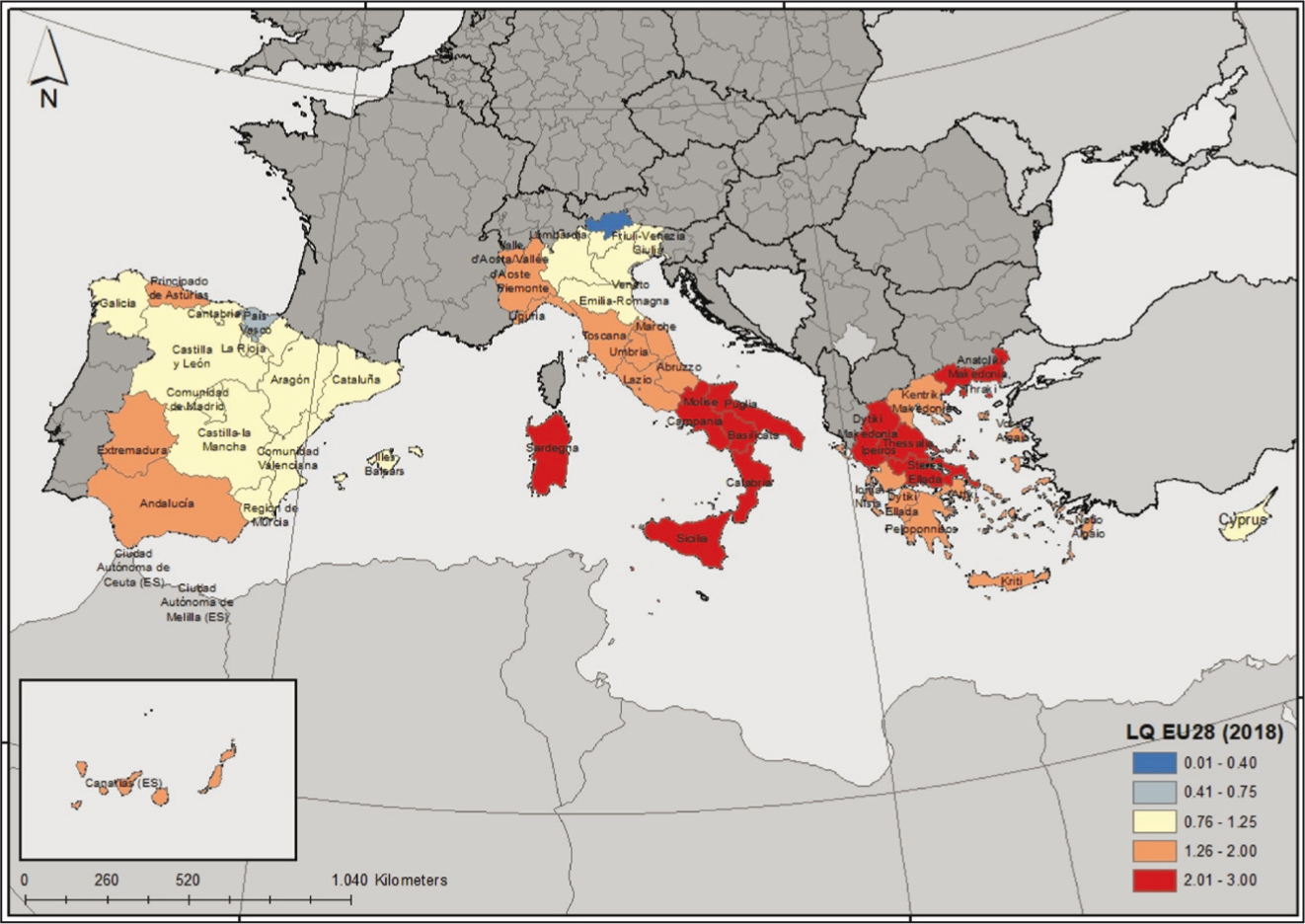
Our analysis reveals that national NEET rates increased post-2008, due to the dire effects of the crisis on the EU southern economies. Nevertheless, 2013 becomes the turning point to a weak recovery period and to lower NEET rates. Apart from Spain, the NEET rates are still higher in 2018, compared to 2008, in all study countries (14.9% in Cyprus, 23.4% in Italy, 15.3% in Spain and 19.5% in Greece; see in Appendix, Table A1). These NEET rates are well above the EU-28 average. Things are less uniform on the regional scale: the mapping of the LQ index brings to the fore the regionally uneven concentration of NEETs when compared to the EU-28 average NEET rate in 2018 (Map 1). There is a clear North–South divide in Italy as an over-concentration of NEETs is recorded in the economically weak southern regions (e.g. Campania, Puglia, Calabria and Sicilia). NEET rates in the Italian South often exceed 30%. By contrast, areas of the prosperous North, such as Trento, Veneto and Friuli-Venezia Giulia, record NEET rates below 15%. Similarly, a higher than the EU-28 average NEET rate is found in several Greek regions (Western Macedonia, North Aegean and Central Greece), where rates range between 25% and 29%. In Spain, most regions display an under-concentration of NEETs. The same applies for the one and only NUTS-2 region of Cyprus.
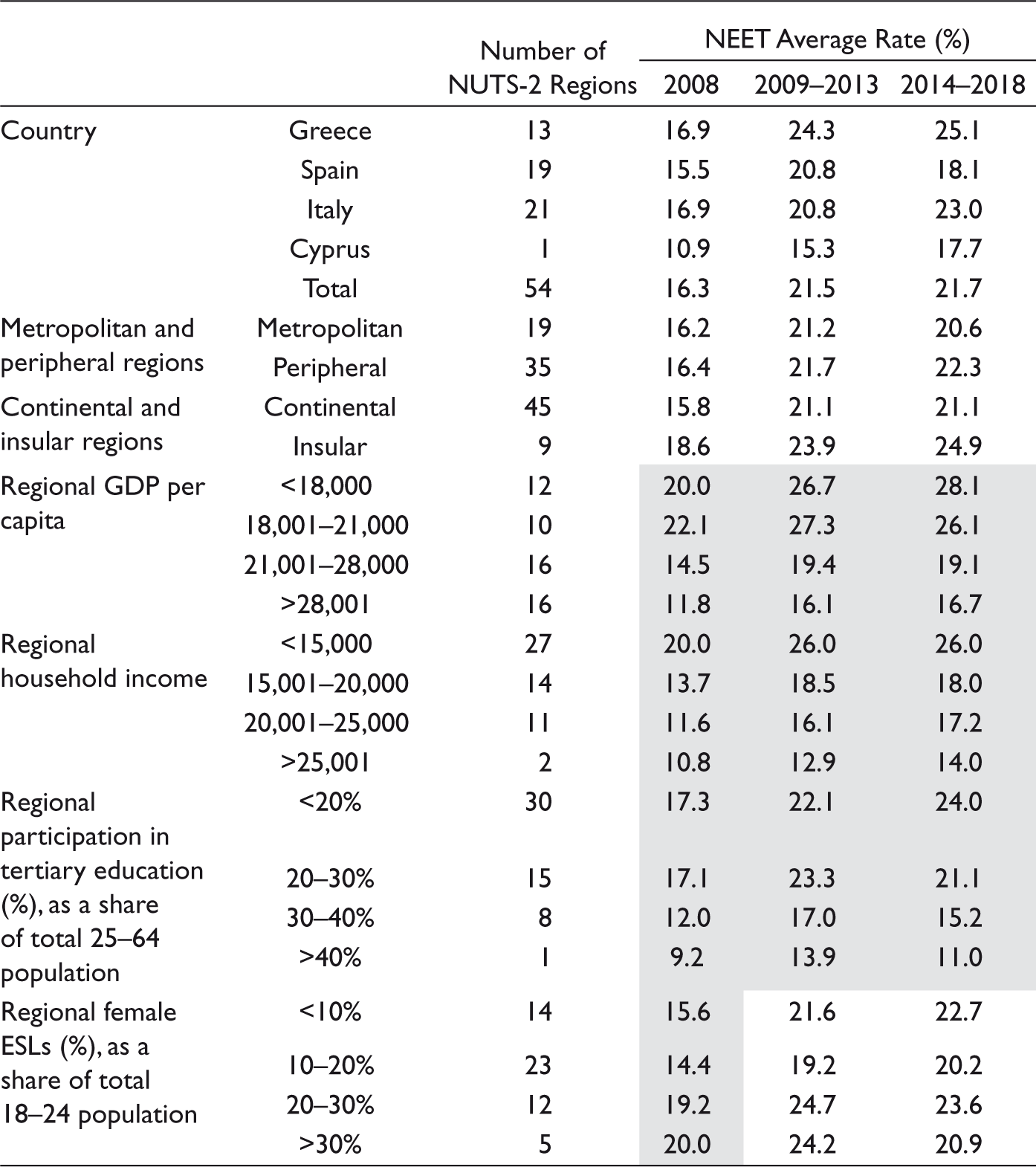
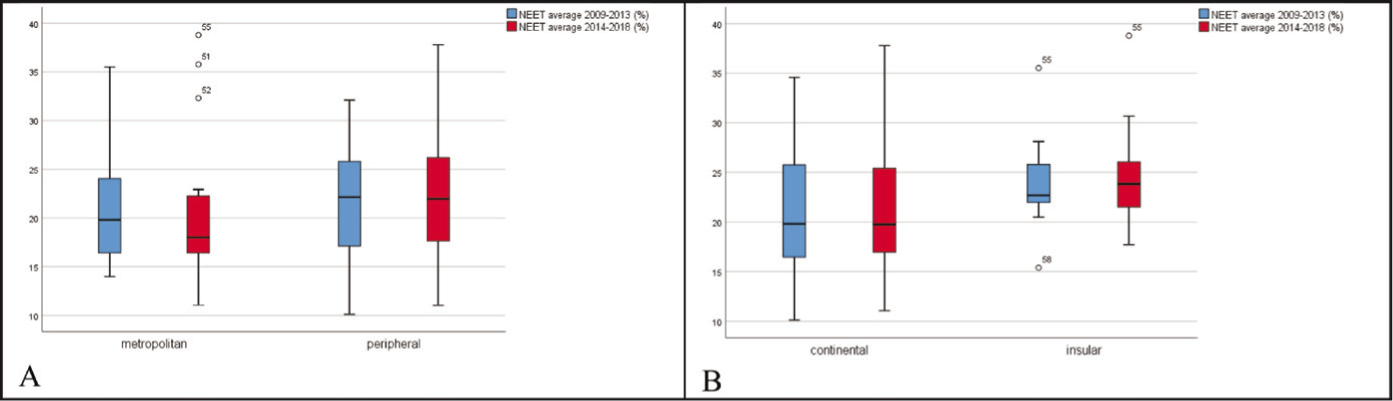
The results of the ANOVA testing highlight important regional dynamics that affect the expansion and persistence of youth unemployment and inactivity (Table 2). Total population size and insularity are among the regional characteristics that do not yield statistically significant results (Figure 1A, 1B). However, regions classified as peripheral (N = 35) or insular (N = 9) record increasing—and higher than average—NEET rates for both study periods, while the metropolitan (N = 19) and continental (N = 45) regions hold NEET rates that tend to decrease between the two study periods. Furthermore, average NEET rates have a high variability in the peripheral regions during both periods. The same applies for the metropolitan regions during the first period.
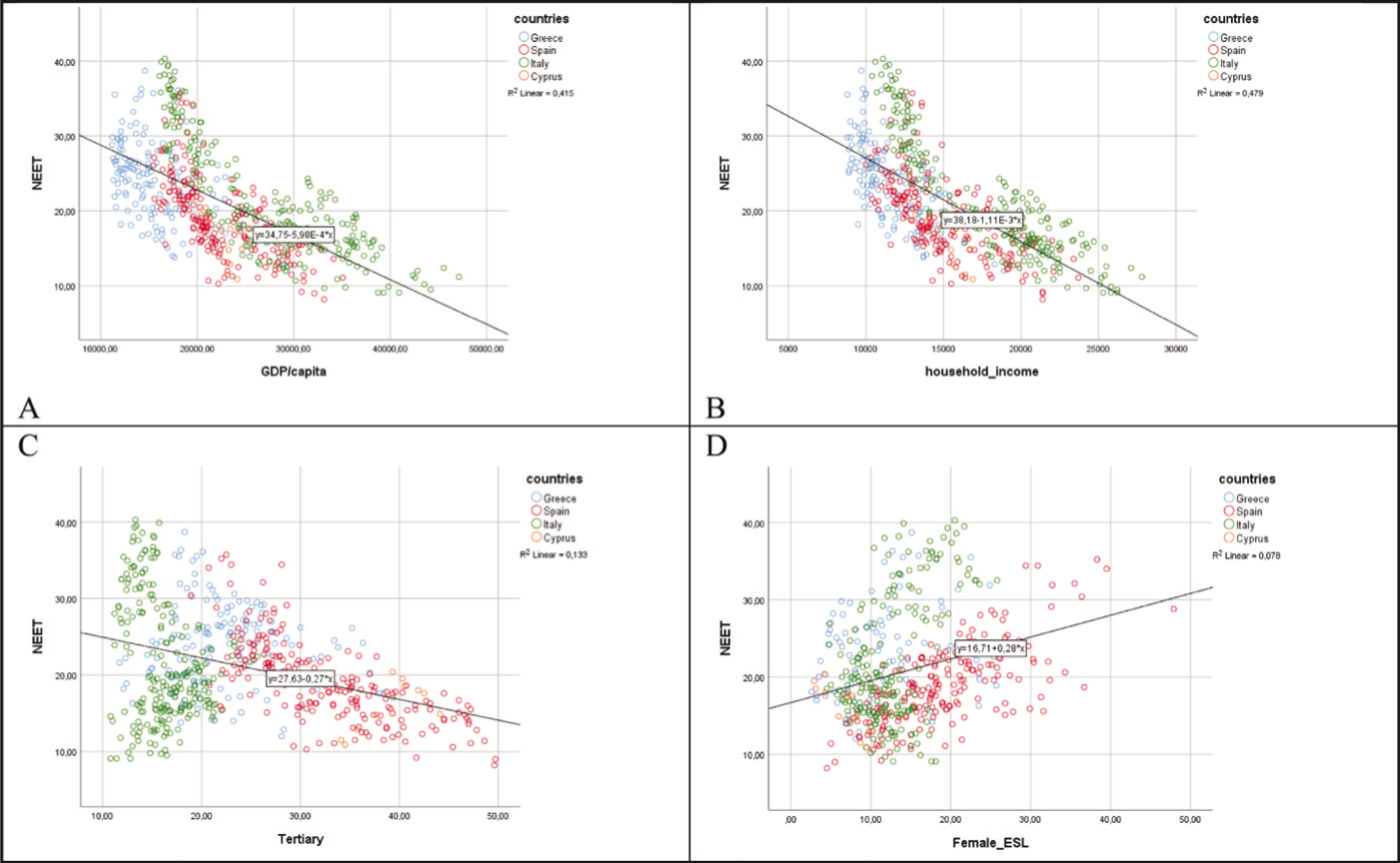
Economic growth (GDP per capita and household income) and education variables (participation in tertiary education and ESL) are all statistically significant. The correlation between GDP per capita and the NEET rate for 2018 is inversely proportional, recording the highest R2 (0.41) among the tested variables (Figure 2A). This indicates that, despite high variability, affluent regions tend to have low NEET rates and vice versa. Typical cases of such regions can be found in the Italian North (e.g. Bolzano) and in the Spanish metropolitan centres (Comunidad de Madrid, País Vasco). At the other end of the spectrum, poor regions, such as areas in the Italian South and many Greek regions, hold relatively high, and in many cases increasing, NEET rates. This signifies that being young, while living in a poor region, increases the likelihood of being NEET. Household income designates a statistically significant and negative correlation to NEET rates (R2 = 0.47) (Figure 2B). This is an indirect reflection of the social class barriers that young NEETs face (Carcillo & Königs, 2015). Indeed, Greek and Italian regions with the lowest household income demonstrate the highest NEET rates.
ANOVA Results for NEET Rate (%) and Selected Geo-demographic, Educational and Economic Indicators for 2018, Regions of Greece, Spain, Italy and Cyprus.
Since the NEET rate reflects the absence of young people from both the labour market and education, it makes no surprise that the relationship between NEET rates and educational level is statistically significant and inversely proportional (Figure 2C). However, the statistical association among NEET rates, tertiary education attainment and female ESL is less robust, with lower R2 values compared to the economic indicators. Italian territories with the highest NEET rates across the study regions also record the lowest participation rate in tertiary education. This pattern is reversed in Spain—possibly explaining the lowest NEET rates among the four countries. It is, however, interesting that the Spanish regions also demonstrate the highest shares of ESL, particularly among females, highlighting that the relationship between educational level and youth inactivity is not always reciprocal (Appendix, Table A1). Nevertheless, it should be noted that there is a relatively greater dispersion across Spain in both tertiary educational attainment and female ESL compared to the other countries (Figure 2C and D). Gender divisions are evident in most regions, where female NEET rates exceed the respective shares within male population (Appendix, Table A1). Regions with the highest female NEET rates (such as Sicilia and Calabria in Italy and Central Greece) are also among the regions with the highest early school leaving rates (Appendix, Table A2). Although the relationship between NEET rates and female ESL is statistically insignificant, regions with high level of young female ESLs tend to record higher NEET rates (Figure 2D).
Qualitative Results
Insights from the life stories of the interviewed female NEETs reveal some of the key factors behind youth inactivity in the study regions. The interviewees stressed the lack of good employment opportunities in their localities that hinders youth’s integration in the labour market. The mismatch between job vacancies and skills, in addition to the difficult transition of young graduates from education to the labour market, is a common reason behind youth unemployment (Brunello & Wruuck, 2019). A woman seeking a job in Komotini, Greece (GR_1), said: ‘There are not many opportunities for a sociologist, since existing vacancies regard other sectors, mainly accommodation.’ Moreover, though relatively high skills and previous working experience are prerequisites for young employees, access to starting level jobs is limited in certain regions. As mentioned by a woman who has a vocational upper secondary certificate in Aljucer, Spain (SP_1), ‘I have no opportunity to get work experience, since nobody would hire me.’
Apart from few job opportunities offered, youth inactivity is interrelated to limited access to certain forms of education. Indicatively, an interviewee from Cyprus (CY_1), who has completed upper secondary school, stated ‘I have not received further education after school, since access to tertiary education in Cyprus is expensive, and salaries are low.’ High costs of education particularly when considering the low potential wage gain, result in low participation rates in tertiary education and high NEET rates. This lack of qualifications contributes, in turn, to the reproduction of the marginalized position of working-class youth (Kotroyannos et al., 2015). This vicious circle is particularly evident in the regions of the Italian South. Even though ESL have been decreasing in the EU since 2007 (De Luca et al., 2020), early school leaving remains a significant driver of high NEET rates in less-privileged areas of Italy as well as in many other study regions.
Spatiality is an important factor that affects youth inactivity, as implied by the interviewees. Most of the interviewees identified significant discrepancies between metropolitan and peripheral regions. Specifically, peripheral labour markets provide limited employment opportunities and lack job vacancies in specific sectors. Particularly in Greece many small enterprises, which are still the ‘backbone’ of peripheral economies, went bankrupt in the aftermath of the 2008 economic crisis (Kapitsinis, 2018). Indicatively, a woman living in Kalimnos (GR_3), an insular, peripheral area of Greece, said: ‘The opportunities for a Geography graduate here are limited. The local labour market is dependent on tourism and based on seasonal employment.’ Seasonal, occasional or even informal—precarious—employment, is indeed common in the food and accommodation sector of many peripheral regions. The primary sector offers some employment opportunities, as pointed out by a woman living in Mytilene (GR_4), an island of Greece, ‘In the countryside, you can find a job more easily than in the city since young people can work in agriculture.’ Yet, young farmers in rural areas are not supported by policy makers and often deal with precariousness in employment or underemployment (Culliney, 2017). Overall, agriculture does not attract the majority of youth (Simões, 2018), whose professional orientation is formed both by local-to-global socio-economic conditions as well as by subjective factors. The latter include youth’s personal aspirations for professional accomplishment.
As already mentioned, metropolitan regions offer a greater variety of employment opportunities stemming from their agglomeration economies and business clusters (Farrugia, 2018). This is also reflected on the NEET rates, which are higher in the non-metropolitan regions, as documented above. An unemployed woman in Madrid (SP_4) claimed: ‘I moved from my hometown to the capital, where I found more jobs available. It is a matter of size of the economy and economic development.’ However, precarity dominates labour also in metropolitan areas, since young people face temporary and insecure employment with low salaries and unpaid working hours (Ferreri et al., 2017). A woman living in Attiki (GR_5), the main metropolitan region of Greece, pointed out: ‘Youth face low salaries for a long working day, while regardless of the amount of the vacancies, finding a well-paid or permanent job here is often more difficult than in non-metropolitan areas.’
Gender discrimination in education, employment and job seeking was highlighted by most of the interviewees. With regard to education, an interviewee from Madrid (SP_4) said: ‘There is a clear gender bias in vocational education. Women do not receive support equivalent to that offered to men, in upper secondary education.’ In terms of employment, women are often perceived as having limited work competencies, regardless of their educational level and working experience. A woman in Basilicata, Italy (IT_1) asserted: ‘Unfortunately, being a woman is implicitly related to accepting a lower salary.’ Moreover, motherhood generates additional restrains on employment opportunities. Indicatively, CY_1 stated: ‘Many employers refuse to hire women because of marital status, considering the prospects of reduced working time due to family duties.’ Traditional patterns in respect of gendered family responsibilities, particularly in peripheral regions of Greece and Italy, are possibly linked to high shares of female NEETs (see in Appendix, Table A2). In Italy, female work participation rates are still the lowest in Europe (De Luca et al., 2020).
Class structure is another critical factor that has an impact on female youth unemployment and inactivity (Avis, 2014). The socio-economic background of young people significantly affects their education and employment prospects. Unsurprisingly, most of the interviewees with a secondary educational background grew up in low-income families of similar educational level. Indicatively, a woman from Mytilene, Greece (GR_4) mentioned: ‘When I was 13 years old, I left school to work and help financially my family. I returned to school later but quit again. I finally graduated, attending adult evening classes. I did not receive help from anybody, while I also experienced discrimination at school.’ A combination of class-oriented factors affect the opportunities and obstacles that young people confront in pursue of individual development. One of these factors is household income. As identified in the quantitative analysis, regions with low household income are likely to record high NEET rates.
Poor education and few good job offers discourage young people from actively improving their employment or educational status. The interviewees were asked to describe their aspirations and how these might have changed over the years, in order to capture their transition to inactivity. Many participants envisioned a better future during adolescence and were looking forward for a stable, secure job or becoming self-employed. For instance, a woman from Basilicata, holding a bachelor (IT_2), said: ‘Although I did not follow the profession I dreamt of when I was younger, I still have the aspiration to express myself and use my skills through an adequately paid job.’ Some interviewees managed to follow advanced studies during the transition from adolescence to adulthood, while others switched to more secure options, adapting to the changing personal and external circumstances. An interviewee from Attiki, Greece (GR_5), with a secondary school certificate, who is not actively seeking job, revealed: ‘Since I failed in attending the Law School when younger, my career aspirations cannot come true, currently I have a lot of family obligations.’ The latter verifies that family commitments are still considered a female responsibility, making it more difficult for mothers to realize their career dreams.
NEETs Persistence in Regions the EU South: Exploring the Key Underlying Factors Through the Notion of Youthspaces
Youthspaces reflect the dynamic processes, through which youth unfolds, interacts and develops in a context of spatially dependent socio-economic structures. On these grounds, the empirical analysis identified several underlying factors that determine the uneven NEET rates across the regions of EU South, while also pointing to the ways different spatialities impact on youth unemployment and inactivity (Cuervo & Wyn, 2012). The weak integration of youth—particularly female—into many of the regional labour markets examined is related to spatially dependent structural barriers and institutional insufficiencies. It is also related to various cultural norms that affect the agency of young people. Our key findings lead us to following three arguments of wider significance.
First, the opportunities offered to young people trying to access the labour market are driven by their local economies’ structural constraints. The significant correlation between NEET rates and economic growth brings to the fore context-specific and path-dependent dynamics that affect youth inactivity across different spatialities. This is evident in the striking contrast between the examined metropolitan and peripheral regions in terms of youth disengagement; peripheral regions, often linked to economic vulnerability, concentrate high and long-term NEET rates. In this context, the recent global economic recession has reinforced the downturn of particular regions that had been already experiencing economic decline. By contrast, metropolitan regions record the lowest NEET rates. Indicatively, this is the case of Attiki, the capital and most populated region of Greece that, in 2018, concentrated 47% of the national GDP, while recording the lowest NEET rate in the country. Additionally, according to most interviewees, peripheral labour markets provide limited employment opportunities and lack job vacancies in specific technologically advanced sectors. These regional discrepancies pinpoint the fragility of youthspaces in many regions of the EU South. Structural youth unemployment and inactivity in the least-developed regions extend beyond economic cycles as they are determined by a long-term path-dependent process. In this sense, theories of uneven spatial development are highly relevant to explain the geographically uneven distribution of NEETs. Alongside economic growth trajectories, the industrial specialization of certain local labour markets leads to a mismatch between young people’s skills and actual job vacancies. The economic vulnerability of young people increases in regions where the agricultural sector is dominant, and the tertiary sector is less diversified or weakly developed (Gialis & Leontidou, 2014). This is also the case in geographically distant territories, such as the islands, where seasonal work based on tourism is widespread. The high magnitude of the informal sector plays a significant role as it may restricts employment opportunities for young people, while fostering insecurity.
The market dynamics developed within regions are, nevertheless, parts of an increasingly interconnected, flexible global economy. This ‘flexible turn’ is related to a set of factors that dictate market demands, such as low labour costs and specific workers’ qualifications (Vachon & Wallace, 2013). Thus, seeing NEETs through the lens of contemporary youthspaces contributes to a more profound understanding of youth inactivity. Youthspaces exceed the geographical boundaries of countries and regions, and young people are called upon need to enter and compete into a global labour market, regardless of the restrains of their localities. The interaction between the global labour devaluation tendencies and local labour regimes results in spatially uneven outcomes. Flexibilization entails growing labour precariousness, particularly in the least-developed regions, where employment is neither ‘rigid’ nor ‘flexicure’ (Leontidou, 2012). Fragmented, weak regional economies of the EU South demonstrate high rates of involuntary part-time and temporary work, combined with low wages for young workers (Gialis & Leontidou, 2014). These regional economies, lacking true activation policies and employment protection legislation, fail to integrate a large proportion of young people into employment and education, resulting in skyrocketing NEET rates and high levels of youth discouragement (Assmann & Broschinski, 2021).
Second, formal institutions play a crucial role in the prospects of young people across different spatialities. Employment policies either planned by extra-regional players, such as the EU and the central governments, or implemented by regional actors, affect the labour market dynamics in a detrimental way (Russell et al., 2020). The skills-mix market demands, on the one hand, and the access and quality of the educational system, on the other hand, are crucial factors that determine youth inactivity in each region. The increasingly commercialized higher education diminishes the level of youth educational attainment and, in turn, leads to fewer employment prospects (Kotroyannos et al., 2015). The high fees asked in countries such as Cyprus, makes education inaccessible for many young people, while the educational path in Italy and Spain consists of a rigid and fragmented programme, postponing the acquisition of skills and work-related competences necessary to enter the labour market (De Luca et al., 2020). Job support schemes that could break the vicious cycle between precarity, unemployment and education by supporting permanent and stable employment, based on the true needs of youth (Farrugia, 2018), are insufficient; the existent schemes mainly offer short-term and low-waged jobs. In this context, the development of youth faces several important obstacles. Although structural unemployment and increasingly high labour market demands drive young people towards attaining high-level education and training, they are often not able to capitalize the skills they acquire.
Third, besides labour market structures and formal institutions, the individual and social development of young people is determined by family and social relations within different localities (Caroleo et al., 2020; Preotesi & Tomescu, 2020). Being a product of social processes, youthspaces reflect the nexus of social ties and the multi-scale agency of various actors,. That being said, socio-economic inequalities are reflected upon, and in turn reflect, the processes developed within different youthspaces. As Farrugia and Wood (2017) stress, space is socially constructed and is a mere container of perceptions of distinction and value. Indeed, our empirical analysis brought to the front issues of gender and class as structural discriminating factors in youth employability and social cohesion. These factors are associated with discourses of underclass and gender inequality, across different spatialities. The fact that young women are exposed to gender divisions in the labour market is related to the reproduction of prevailing social norms, career models and family roles (Zuccotti & O’Reilly, 2019). As a result, women experience important difficulties and barriers when trying to enter the labour market (De Luca et al., 2020). The higher share of female NEETs and ESL found in many peripheral, less-developed regions reflects that spatiality affects the prospects and life chances of young women. By contrast, strong family ties in the economically weak EU southern regions offer a safety net to its young members, often through informal networks or practices.
Our analysis has pinpointed the significance, as well as the vulnerability, of contemporary youthspaces, paying particular attention to the increased barriers faced by female youth in economically weak regions of the EU South. Gender, class, regional economic growth and access to high-quality education are, among others, spatially grounded key socio-economic factors that determine the geographically uneven distribution of NEETs across different spatialities. It is, therefore, necessary to study youth vis-a’-vis space in order to understand the socio-spatial mechanisms that foster youth inactivity and reproduce precarity (Caroleo et al., 2020).
Data Availability Statement
The secondary data that support the findings of this study have been retrieved from Eurostat and are openly available at:
Footnotes
Acknowledgements
This article has been prepared in the framework of the project ‘A Place for Youth in Mediterranean EEA: Resilient and Sharing Economies for NEETs (YOUTHShare)’, which is funded by Iceland, Liechtenstein and Norway through the EEA and Norway grants fund for Youth Employment (
Declaration of Conflicting Interests
The authors declared no potential conflicts of interest with respect to the research, authorship and/or publication of this article.
Funding
The authors disclosed receipt of the following financial support for the research, authorship, and/or publication of this article: The authors received financial support for the research, authorship and/or publication of this articlefrom the project ‘A Place for Youth in Mediterranean EEA: Resilient and Sharing Economies for NEETs (YOUTHShare)’, which is funded by Iceland, Liechtenstein and Norway through the EEA and Norway grants fund for Youth Employment.