




Abstract
While Australia has experienced low COVID-19 case numbers relative to other countries, it has witnessed severe economic consequences in the wake of the pandemic. The hospitality industry, in which young adults are overrepresented, has been among the most affected industries. In this article, we present findings from an interview and a digital methods-based study of young hospitality workers in the Australian cities of Melbourne and Newcastle who lost shifts or employment due to the pandemic. We argue that the participants’ ability to cope with the loss of work was mediated by the degree of family support that they could access, with some experiencing the pandemic as an inconvenience, while others suffered extreme financial hardship. Findings from this study show that the most severe impacts of the pandemic play out along pre-existing lines of inequality and marginality, causing the most severe consequences for those who were already most vulnerable to them.
Introduction
This article explores the experiences of young hospitality workers during the COVID-19 pandemic in the context of discussions about work, precarity and biography in the sociology of youth. Young people are disproportionately vulnerable to the economic impacts of the pandemic due to both their already higher unemployment rates prior to the beginning of the pandemic (see Borland & Coelli, 2020) and their over-representation in interactive service occupations (such as the hospitality industry) which have in different ways been restricted as part of measures aiming to curb the spread of COVID-19. In this article, we examine how young workers experienced and negotiated the impact of the pandemic in relation to the broader terrain of inequality and insecurity that characterizes the youth period. In particular, the article shows how the pandemic may be approached in terms of a crisis of precarious work that is negotiated in ways that reflect the relationship between inequality and uncertainty in this part of the economy. The way that young people negotiate this crisis makes visible a new relationship between contemporary youth inequalities and young people’s biographical practices and orientations towards the future. The pandemic is, therefore, approached as a sociological phenomenon constituted by the social dynamics of insecure work with implications for how the sociology of youth approaches precarity and biographical uncertainty.
The article begins with a discussion of the emerging literature on COVID-19, highlighting a lack of understanding about the impact of the virus on young people and on young workers. We suggest that hospitality workers offer a unique insight into the sociological dynamics of the virus, due in particular to the nature of hospitality labour and the hospitality labour force, which is made up of a diverse group of youth with different relationships to the labour market and with access to different levels of family support. The article then suggests that the social dynamics of the pandemic can inform existing discussions about the nature of inequality in precarious labour markets, including in relation to biographical temporalities and in understandings of how young people negotiate precarious work. Empirically, the article draws on a study that we conducted with young hospitality workers in Australia between May and June 2020. Participants were living in Melbourne (capital of the state of Victoria) and Newcastle (a regional city in New South Wales). The study consisted of 2 weeks of digital data collection during which the participants posted about their day-to-day experiences via an app and an in-depth interview at the conclusion of this period. While presenting these data, we focus on the participants’ experiences of negotiating work, their access to financial and family support and the impact of the pandemic on their biographies and future plans or goals.
The Pandemic and the Sociology of Youth
Young hospitality workers are employed in an industry that is highly precarious and uniquely vulnerable to COVID-19 sector shutdowns due to the interactive nature of hospitality labour. The hospitality industry was seen as a key site for the transmission of the virus, and in Australia where this study took place, the hospitality industry was effectively shut down for 3 months in order to prevent the spread of the pandemic, with the ‘lockdown’ in the state of Victoria extending to almost 8 months. However, young hospitality workers are absent from the emerging sociological literature on COVID-19. Studies addressing the experience of working during the pandemic thus far have focused predominantly on the challenges that parents face trying to manage paid work and care during lockdowns (Collins et al., 2020; Craig & Churchill, 2020), and the conditions facing workers in specific industries such as healthcare (Yarrow & Pagan, 2020), higher education (Nash & Churchill, 2020) and the cultural sector (Banks, 2020). These studies have highlighted the anxieties of ‘high touch’ workers (Yarrow & Pagan, 2020) in healthcare, and while the risks experienced by hospitality workers are not necessarily comparable to those faced by healthcare workers, hospitality workers nevertheless inhabit high-touch and high contact positions which expose them to increased risk of coming into contact with the virus. Hospitality labour also requires face-to-face interaction, meaning that as Dobusch and Kreissl (2020) observe, hospitality workers are part of the group of relatively disadvantaged workers who face unemployment whilst those in professional occupations work at home during lockdowns. This observation echoes other publications addressing the relationship between quarantine and privilege (Salamanca & Vargas, 2020; Saraiva & Rampazo, 2020) which shows that quarantine restrictions are experienced and negotiated by workers along existing axes of structural inequality. While this literature—particularly the work of Dobusch and Kreissl (2020)—provides a framing for our research, this review also shows that the experiences of workers such as those in hospitality are largely absent from the literature on the social dynamics of COVID-19. It is in this context that our article explores the experiences of losing work, looking for work and of returning to work amid an ongoing pandemic, as well as the biographical practices that emerge from this context.
As well as making a contribution to the literature on COVID-19, the experiences of hospitality workers during the pandemic also raise recent discussions and debates in the sociology of youth about labour market insecurity, structural inequality and the biographical practices that young people deploy in order to manage uncertainty. As is widely recognized, youth unemployment and underemployment are now structural features of labour markets across the world. Young people are central figures in what Standing (2011) has famously described as the ‘precariat’ or a transnational population of workers defined by their lack of formal entitlements, protections or representation. Beyond notions of precarity, uncertainty has also been a key theme in the sociology of youth through many years, driven in part by engagements with the ‘risk society’ thesis (Beck, 1992) that describes labour market insecurity as part of the structural fragmentation of late modern societies. Labour market insecurity has been part of the increasingly uncertain nature of youth experience in general, as well as the increasing heterogeneity of young people’s biographical pathways (Furlong & Cartmel, 2007). More recent arguments concerning generational shifts in the social organisation of youth biographies and in the articulation of classed and gendered inequalities also foreground the role of labour market insecurity, suggesting that an increased necessity for biographical life planning has become a characteristic of the contemporary youth period (Woodman & Wyn, 2015). The pandemic emerged as a crisis within this context of widespread precarity experienced by youth in general.
However, as we will show below, the pandemic also demonstrated new ways that inequalities among young people emerged and were negotiated in the context of precarious work. This has been a topic of concern in the sociology of youth in recent years, including debates about the relationship between individualisation and social class (Roberts, 2012; Woodman, 2010) as well as the role of inequality in shaping young people’s reflexive relationship to their own biographies in local labour market contexts (Farrugia, 2013). Notably, previous research has addressed the relationship between precarious work and the hospitality industry, with Kelly et al. (2015) interpreting employment programmes in this segment of the labour market as neoliberal technologies of the self. Moreover, a key area in which inequality and insecurity interact is in the area of young people’s orientations towards the future, which have become a topic of inquiry in the context of the discipline’s increasing focus on notions of uncertainty. Research in this area has shifted from developing typologies to understanding how young people operate under conditions of greater or lesser certainty (by, e.g., developing plans, hopes or dreams, see Brannen & Nilsen, 2002 and Davadason, 2008), to broad characterizations that position youth itself as a time of uncertainty through conceptualizations of youth as moratorium or ‘waithood’ depending on the resources one can access (Cuzzocrea, 2018), or of young adults as homo promptus (Walsh & Black, 2020). This shift in the literature appears to map onto a broader decline in biographical certainty (Zinn, 2004), as the ability to plan one’s biography as a coherent long-term project has been eroded. As a result, specific orientations towards the future appear to have given way to types of selves who are more or less able to marshal resources and manage the need for adaptability in the face of pervasive uncertainty and a rapid pace of social change (Rosa, 2013).
In this context, our focus on young hospitality workers and COVID-19 offers a new perspective on the sociological dimensions of the pandemic and on the way that inequalities are manifested in conditions of uncertainty. Studies of inequality and insecurity have tended to focus on the social organization of young people’s biographies in general (e.g., Furlong et al., 2018) and have focused less on the experiences of specific fractions of the labour market. In contrast, this article focuses on hospitality workers, especially those who perform face-to-face interactive service work and are, therefore, uniquely vulnerable both to the economic impacts of the precarity and to contracting and transmitting the virus through their labour. A focus on hospitality workers allows us to explore how inequality and insecurity are negotiated within an enormously heterogeneous youth labour force—one that is both poorly remunerated and precarious, but that also includes a large range of workers including students, full-time and part-time workers and migrants on a range of different visas with different rights to work and different relationships to the labour market. These workers all experienced unemployment and insecurity, but also had different levels of support available to them, and the negotiation of this support demonstrates how inequalities emerge in conditions of precarity and how family support is relationally negotiated when workers are in crisis. The heterogeneity of this labour force also demonstrates new biographical practices and orientations towards the future that reflect class inequalities but that are given a unique character by the specific conditions of the pandemic, which created new temporalities in the lives of precarious young workers. By situating COVID-19 within the existing concerns with precarity and inequality in the sociology of youth, the pandemic may be approached here not merely as a health crisis that impacts on precarious workers, but rather as a crisis of precarious work itself, experienced and negotiated in terms of the relationship between inequality and uncertainty that has emerged in the context of labour market precarity among youth.
Methods
This project used a mix of qualitative interview and digital methods to gain a point-in-time snapshot of the COVID-19 pandemic for youth (previously) employed in the hospitality industry. The choice of these methods was informed by the project’s phenomenological underpinnings; we sought to gain some understanding of the lifeworlds of our participants at a time of great change and upheaval. The participants were asked to make short text, image or video-based posts using an app that allowed them to communicate privately with the researchers (see Cook & Woodman, 2019). They were asked to use the app to explore how they were experiencing the COVID-19 pandemic—its impacts on their work, living and financial situations—and broader impacts on their day-to-day lives. The use of this digital method allowed for an experience of intimacy or closeness (see Mainsah & Prøitz, 2019) that was otherwise difficult to achieve at this time due to lockdown restrictions and aided in building rapport with the participants prior to the interviews. Participants were recruited via advertisements on social media and through an existing qualitative sample exploring the experience of affective labour of hospitality workers in the target sites for this study, Newcastle and Melbourne, Australia. Participants were asked to create four posts using the app over a 2-week period and to then take part in an interview (conducted by authors) via Zoom. The interviews lasted between 35–90 min and included questions about the participants’ sources of support (financial, emotional and practical), employment and living situations, and the general impact of the pandemic on both their everyday lives and their plans for the future. Interviews also explored the posts participants had made during the digital phase of the research. Posts typically featured textual descriptions of events in their lives, similar to short journal entries. Some participants also posted photographs that they had taken—these commonly featured food and meals, their locales (such as the spaces they were able to exercise in outside their houses), pets, housemates and house interiors. Participants were reimbursed with $100 Coles giftcards in recognition of their contribution to the project and to public knowledge in this important time of social transformation. The study received approval from the (institution) Human Research Ethics Committee prior to its commencement.
A total of 32 participants took part in the study, with 16 in Newcastle and 16 in Melbourne. Participants were aged 18–31 and included a relatively even gender split (15 identified as women, 17 as men). The majority of participants were currently studying in tertiary education alongside working in hospitality. Participants worked in a range of different hospitality venues, including cafes, pubs and hotels, restaurants, bars, events companies and fast-food chains. Only a small number were employed in management or supervisory roles, with the vast majority holding casual front-of-house or server positions. The data were analysed using a method adapted from ‘Deterding and Waters’ (2018) ‘flexible coding’, and the data presented in this article represent the primary themes that emerged during analysis.
Context: May–June 2020
Data were collected over an intensive 4-week period in May–June 2020. At this point in time, venues in both cities were in the process of reopening for in-house dining with a maximum capacity of 50 people in any venue. The study captures some participants’ experiences of the transition between full lockdowns where all but one or two lost all hours of work and gradual reopening of some venues where many were beginning to return to face-to-face service. Methods were designed to explore a range of experiences in this context: the disappointment and resignation to the initial lockdown measures, which for the majority meant the loss of all working hours and in some cases loss of employment; the boredom and seemingly endless period of lockdown and being isolated from friends and co-workers; and a gradual return to customer-facing service as lockdown measures began to ease. In Melbourne, the easing of restrictions was short-lived, with the cessation of all but takeaway service resuming due to the ‘second wave’ just weeks later in July. In Newcastle, lockdowns have not yet been reintroduced, meaning most restaurants, cafes and hotels are still able to serve limited numbers of patrons in venues.
Many of the participants were either receiving or had applied for income support from the federal government at the time of data collection. Some of those who were students received Youth Allowance or Austudy—the federal government’s income support payments for full-time students who meet eligibility conditions (such as means testing against parents’ income for those who were aged under 22 and had not been deemed independent). Notably, recipients of these payments received an additional Coronavirus Supplement from April of 2020. The federal government also introduced a ‘JobKeeper’ programme, through which employers who had experienced significant income losses could receive payments to cover some of their staff’s wages and, thus, retain their staff. Eligibility for this programme was restricted to staff who were either employed on permanent or fixed term contracts, or who had been employed on a casual contract with their current employer for at least 12 months. Due to the high rates of casualization in the hospitality industry, and the short-term and episodic nature of much hospitality work, many workers in this industry were not eligible for this support. These workers were eligible for the less generous ‘JobSeeker’ payment, a rebranding of the federal government’s unemployment income support payment (previously Newstart). Importantly, these payments were only available to Australian citizens and permanent residents, meaning that international students were not eligible for any income support from the federal government, despite many of them losing their jobs in the wake of the pandemic and lockdown.
Findings and Discussion
Work
The impact of the COVID-19 pandemic on young hospitality workers is shaped by the precarity of the industry in which casualization is the norm and in which informal working arrangements proliferate. In this project, international student workers were particularly affected by informal working arrangements and were disproportionately working ‘off the books’ without rights or entitlements of any kind. When the industry went into shutdown, young hospitality workers were either let go or placed in a series of contingent employment relationships that varied according to each individuals’ length of tenure, citizenship status and the resources that they were able to marshal in order to respond to the lack of work. Workers were often told that they would not be working with very little notice, or when they had already attended work to start their shifts:
I actually worked every day up until the shutdown…I got there, and he was like, we’re closing at 12 and that’s it. Then we had to communicate that. So me and the other staff members had to communicate that to all the other staff that weren’t there via our Facebook group chat. So there was no communication whatsoever. (Steph, 25, Newcastle)
For university students with family support available, work was one of a series of commitments including study, and a reduction in shifts was not necessarily an immediate problem. For others, the absence of work precipitated an immediate personal and financial crisis. Robertson (2019) has described the ‘indentured temporality’ that migrants to Australia can experience as a result of limitations placed on their education or working lives by visa restrictions. In this context, international students in this project were accorded no entitlements from their employers or government support schemes during the COVID-19 shutdown and were frequently treated poorly by their employers:
[I was working in] hospitality, [as a] support worker, babysitting, in a bar, in a hotel, everywhere. Now, nothing…they start to cancel all the shifts and then nothing. I don’t even receive any information from my…manager and I receive the email from the general manager. (Rosie, 29, Melbourne)
As the sector shut down, all workers were forced to negotiate the terms of their employment informally on the basis of criteria established by employers and on the basis of the informal relationships they had (or had not) established with their employers. One participant described being interviewed by his employer about his own finances so that his employer could offer work to employees on the basis of which employees had the most financial obligations. As a young worker, he stood little chance of maintaining his employment through this process:
We all got interviewed essentially on our financial positions, what we had to pay for. I moved home at the beginning of the pandemic, just because I was not sure what was going to happen going forward…I had the least amount of financial commitments, so I put myself up to be made redundant essentially. (Josh, 20, Newcastle)
The consequences of the loss of work varied according to students’ citizenship status and access to family support. More privileged university students focused on their studies; for instance, Violet described beginning university-organized work placement as a ‘convenient’ way of filling time during the lockdown:
that’s when the pub essentially shut down. So I lost my job there. Then when I came back…on the Tuesday, I think the café said they didn’t have any work for me. So then it was kind of convenient because I was like what am I going to do with all my time? Although I was still busy with uni. It was just, yeah, placement going ahead was good. (Violet, 26, Newcastle)
Others such as Rosie, an international student, were placed in a desperate situation, with no access to government support and no resources to fall back on. In order to survive, Rosie took informal and dangerous cleaning work in situations she would not have risked entering if she had access to other financial support:
One time I found a cleaning job, but it was so weird the man… and they were, ugh. I found it [online]…all my jobs disappeared - you know, how many hours I spent in SEEK sending emails and not even one people call me. No one. This guy called me. He was real weirdo, though, but I didn’t have nothing else at the moment. No superannuation, no nothing. It was at the start of all this, you know? April…He called me and said, oh, can you come right now? I pay you an Uber?…I was talking with a friend and saying, oh, this is the address. If I don’t tell you anything in 15 minutes, you call the police…Yeah. It was there, you know -, I don’t have nothing in my life. I don’t have a job. I have to work - you know when you have to do anything. (Rosie, 29, Melbourne)
In other words, while some participants responded to the lack of work by falling back on family support and focusing on study, others struggled to meet their immediate financial needs and were forced into even more perilous and unpredictable working situations. In this way, the COVID-19 pandemic exacerbated inequalities connected with class and visa status that structure the hospitality labour force and the overall landscape of precarity that young workers experience.
As the sector started to reopen, workers were uncertain as to their working futures and were again forced to negotiate their entitlements informally with employers. Workers were aware that their industry was in crisis and that their jobs were likely to change substantially in ways that would deepen their precarity:
It looks like I could be getting made redundant and put back on casually…they’ve kept us on JobKeeper as a sign of good faith, and then I think—I honestly think I’ll be getting put back on casually and working my hours essentially casually. But I was full time, but I think the structure of the business is going to change entirely from here on out essentially. (Josh, 20, Newcastle)
The following participant worked for a large company that operated in multiple venues, and as the industry slowly reopened, he was moved from one venue to another. His new manager expected him to work substantially more hours than other, more established staff, which he attributed to the pre-existing relationship that existed between his new management and existing staff:
Before I came along and the other two staff, they had the venue manager, three other managers and one floor member and that was their whole team that was front of house. One of their managers is studying to be a paramedic, so she’s got exams and the venue manager’s looking out for her staff first…But it means that me, who is also studying for exams, has to make up for that… We just have to deal with it for the next four months and move on with our lives. But it does end up screwing over the new people—but I mean unfortunately, I mean that’s the industry…The industry is broken. It’s munted. You deal with what you’re given and you beg and grovel for anything more than that. (Jack, 19, Melbourne)
In other parts of the interview, Jack described working particularly hard in his new venue to establish a relationship with his new employer in order to eventually negotiate a position that would allow him access to the shifts he needed to focus on his own university study. However, as emphasized at the end of this quote, young workers felt largely disempowered in their negotiations with employers as their venues reopened, and the exploitative conditions prevalent throughout the industry became increasingly visible. As well as being structurally disempowered, workers were also anxious that the face-to-face contact required of hospitality workers in the routine conduct of their work would expose them to the virus and place their own family members at risk:
Being in a position where I have to see so many people, it’s just got me a little bit anxious over how is it going to impact me and my health, because of—there’s the 50 million degrees of separation…Just the amount of different pathways that I can see if I infect one member of my family, how far I can see it going is just getting me really anxious, because I don’t want to be responsible for anybody getting a disease like COVID-19…I know where my friends have been. But when I’m standing in a bar and somebody walks in and asks for a table, I’ve got no idea where they’ve come from. People aren’t sanitising their hands on entry. (Jack, 19, Melbourne)
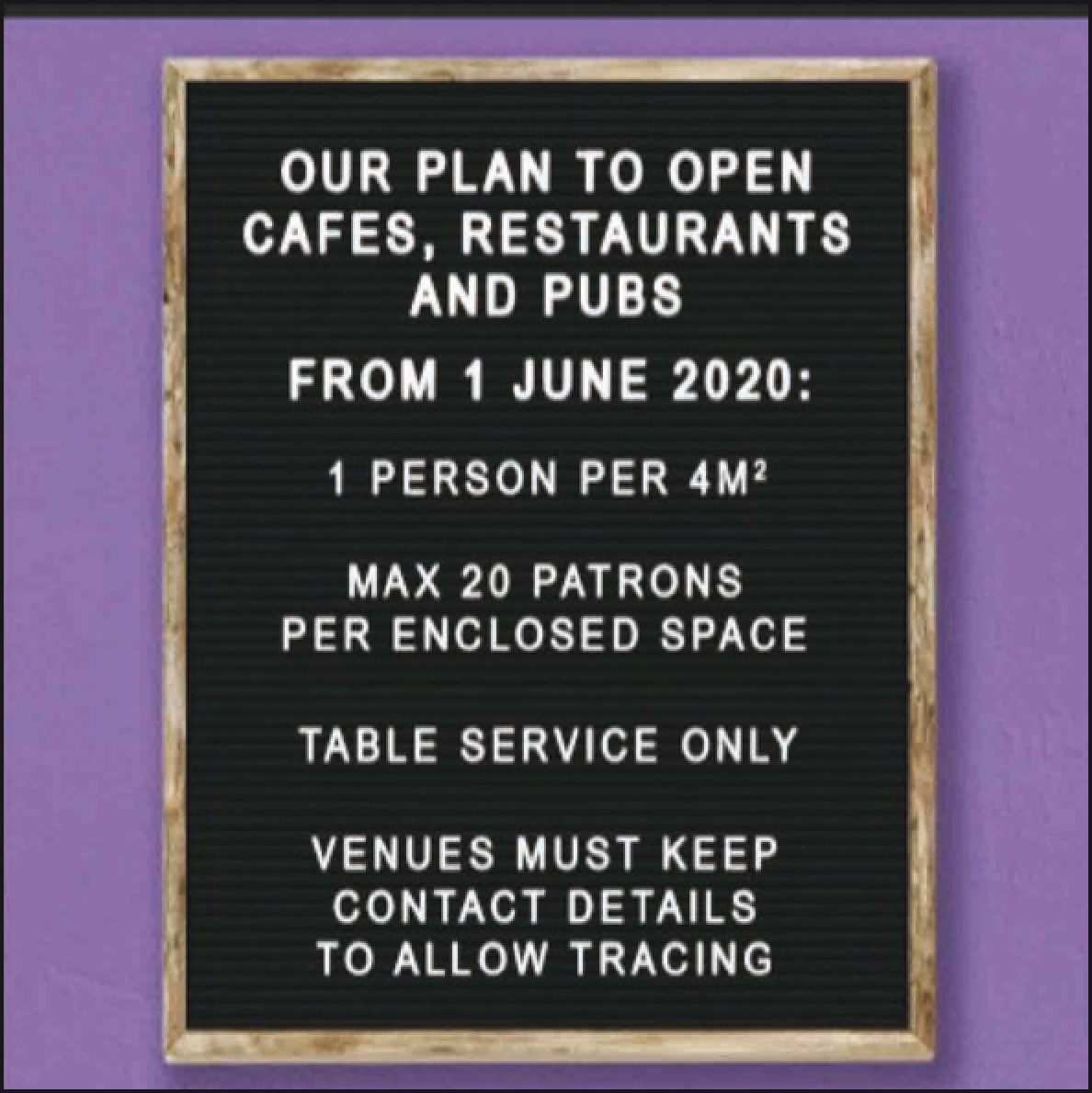
Noah (18, Melbourne) posted this photo (Figure 1) prior to his interview and was feeling apprehensive about how the venue he worked at, a large pub, would be able to manage workers’ safety as restrictions began to ease. Many participants expressed concern about how hygiene and safety was to be managed, and the additional labour and stress this would cause. Willow, for example, described routinely being verbally abused by patrons who were asked to sign in to the pub as a condition of entry as restrictions eased to allow pubs to reopen:
Sometimes they try to sneak past the sign-in and hand sanitiser table while you’re serving someone else. You just have to be really stern with them but then they’ll get aggressive and curse at you. Sometimes have to use curse words back, only to get them out, because they just won’t listen to you, and the managers do it, as well. We see some crazy stuff at our pub…I had a guy shouting at me saying, oh my train’s here in a few minutes, I don’t have time to sign in. I’m like, yes, you do. My manager was there and had to kick him out because he was getting more and more aggressive. (Willow, 20, Newcastle)
In summary, the COVID-19 pandemic exacerbated the precarity faced by young hospitality workers precisely as it imposed unique risks of infection and community transmission via hospitality venues. Workers were at risk of immediate poverty as well as threats to their physical health and that of their families. They were also required to informally negotiate the entitlements of their work in ways that reflected their employers’ own unpredictable response to the pandemic, including re-establishing relationships with employers to access particular shifts and hours and dealing with employer decisions about which workers would remain employed from a position of relative disempowerment. These processes also exacerbated inequalities within the young hospitality labour force, and workers’ experiences reflected their visa status and access to family support.
Support from Family
The level of family support that participants were able to access was central to how they experienced the pandemic. Those in relatively secure economic circumstances and who were either already living with family or were able to return to the family home generally experienced challenges that were relational rather than financial. Alex, for instance, lived in the family home during the shutdown, meaning that despite losing employment, he nevertheless had a relatively relaxed attitude to the COVID shutdown:
I was living at home with this before COVID and wasn’t paying rent because I’m studying full-time, so they don’t make me pay rent or anything. That’s remained unaffected. (Alex, 22, Melbourne)
In addition to in-kind support provided through cohabitation, several of the participants’ families also offered more direct financial support. In some cases, the knowledge that this support was available provided participants with a sense of security, whether or not it was accepted:
They’ve offered but we pretty much just said don’t. We’re breaking even. We’re not going to take your money [laughs] to get ahead. That’s not fair but they would if we needed it. (Arlo, 28, Newcastle)
Arlo was relatively relaxed about his situation as he knew that support was there if needed. However, having access to family support is not as straightforward as asking and receiving. There are negotiations needed and knowledge that it could be ‘used against you later on’ (Felicity, 30, Newcastle); for instance, Felicity talked about knowing that support is available from her family and her in-laws but was wary of accepting this support due previous negative experiences:
Look, absolutely, if push came to shove and we had to. My in-laws are very generous, but I always feel that there are strings attached. They actually went guarantor on our home loan for us and putting boundaries in place has been very difficult with them because of it … But yeah, look, if push came to shove and it was a choice between starving to death or asking my mum for money, of course, yeah. Luckily we both do have that support around us. (Felicity, 30, Newcastle)
Other participants who returned to live with parents faced changes that felt infantilizing and controlling. A common response to this is typified by Remy’s statement that I think we all just got on each other’s nerves (Remy, 20, Newcastle). Some participants found that their everyday practices were curtailed by the move home. Jack, a music student, found it difficult to practise because it disturbed his parents. He found that returning to the family home after living independently had a negative impact on his relationship with his parents:
It’s just been a little bit negative, just because there’s been a strain on it… I’ve probably cried more in these last two and a half months than I have in the last five years … I’ve been an emotional wreck. (Jack, 19, Melbourne)
These phenomena can have negative consequences for participant’s relationships with partners and friends, putting different kinds of pressure on them, while also magnifying or bringing back pre-existing tensions within a family.
However, for some participants, moving back home was a relatively positive experience. Several found that the combination of governmental financial support and moving home with parents has led to a temporarily improved financial situation, allowing them to save more money than they were before the pandemic:
I was saving, pretty slowly but I was saving. Living out of home I had like quite a few expenses, and then I’d spend money a little bit willy-nilly sometimes, but you do that. But no, I was doing all right; like full-time work and having a predictable income really helps. But now at home on JobKeeper, like I’m pretty much banking most of what I’m getting. (Josh, 20, Newcastle)
Several of the participants who were in a similar position found that they could consider saving money, something that is rare for young people in the hospitality sector, especially when combining study and living independently.
Coping Without Family Financial Support
The experiences of participants who could access financial support from families (whether through cohabitation or direct assistance) contrasted markedly with the experiences of participants who were unable to do so in the wake of losing income and employment. Many of the participants in this situation applied for income support from the federal government, either on the basis of their unemployment or their status as students (as outlined in the methods section). However, the process of applying for this assistance was a significant source of stress and anxiety for several of the participants; for instance, Felicity recounted her experience of trying to access federal income support after losing her job at the beginning of the lockdown:
I think I probably had a small nervous breakdown in the middle of it there somewhere, just with Centrelink alone… I’ve never had to or been able to claim Centrelink before… I totally understand that they were completely swamped, completely overwhelmed, but holy shit. They could not have made that any more difficult if they had deliberately engineered it to be that difficult. The complete inability to be able to contact a human being and actually talk to a person and just the goal posts constantly moving. Then basically being told, oh yeah, you might get it next week or in two months, we don’t know. (Felicity, 30, Newcastle)
Wait times of over 2 months for income support payments and experiences of anxiety and distress were reflected across the portion of the sample who were unable to rely on financial support from family.
A further portion of the sample in Australia on student visas and excluded from federal income support programmes found themselves without access to either government or family support, or with access to very little family support. Samesh, an international student living in Melbourne, received a small amount of monetary support from his parents in India. However, as the pandemic worsened in India, his parents could no longer afford to provide him with financial support. At the time of the interview, he had no income and was living off his meagre savings:
When I stopped doing my job, I was like, what should I do? … So, I thought ‘maybe I’ll try to do Uber’. But then this pandemic grew so fast that I thought, ‘no, I’ll have to face many people, I’ll have to be in a group of many people, I’ll have to go with different deliveries, going to different restaurants and delivering’. [I thought] I’ll not do that. Then nothing was open, at that time, so, I had to stay at home. I asked my parents for money, but then, in India, also, the situation got worse … They did send me money, but that wasn’t enough for two or three months to continue. So, I asked my university for the grant that they are giving. Yeah, that helped a bit, but I’m still sort of struggling a bit. (Samesh, 23, Melbourne)
Nisha, an international student in Melbourne, had no access to parental support and no access to Australian welfare or support schemes and was in a similar situation:
Basically, even my dad has lost his job now, and even he’s home. So, even the company doesn’t pay for two, three months without any job, as in you are just staying home. The company won’t pay. So, it becomes a bit difficult also for parents to send something (Nisha, 22, Melbourne)
In response to the inability to access support from family or government, several of the international students turned to support from community groups; for instance, upon finding himself with no immediate means of meeting his living expenses, Krish found a group on Facebook who provided him with groceries:
I remember there was a post which had come on Facebook regarding grocery help on a group. I’m in a group called Indians in Melbourne so there are people who help other people who are suffering or having hardship. I’d bring up a message saying that I’m having issues with my groceries and rent, anyone could help me out? There is a group which is dedicated for that. A family had helped me out and they’d given me groceries for a month roughly. That was really helpful, so I’ve saved it up. I’m using it very cautiously. (Krish, 24, Melbourne)
For several of the international students in the sample, these groups were formed by migrant communities from their country of origin. However, some of the donations of food were provided specifically to hospitality workers. Rosie, who lost all three of her jobs at the beginning of the lockdown, recounted:
The first thing that they offered us, the people that lost their job on hospitality, they gave us a voucher for Deliveroo. They gave us a couple of restaurants that we can use it… Then [restaurant] were giving us soup every Thursday. Super good soup, every week different. Then they start to give us to some market food. (Rosie, 29, Melbourne
The participants’ experiences of losing work differed markedly on the basis of the types of support that they were able to access. While some participants, due both to family financial support and cohabitation, remained largely unaffected, others faced the stress of navigating an overstretched income support system, or faced the extreme precarity of losing all income and support. The latter experience was, in some cases, alleviated in a small way by informal networks of support that stepped into the gap left by both the labour market and the government. While these forms of support reflect the networks of care that have been highlighted by several authors in the context of the pandemic (Springer, 2020), they nevertheless provided temporary and small-scale forms of relief to groups of young people who remained extremely financially vulnerable due to the loss of work and lack of other forms of support.
Sense of the Future
Due to many of the experiences that we have already discussed, the pandemic affected our participants’ views of both the present and short-term future in a variety of ways. Studying was rendered more difficult due to an almost instantaneous move online, work placements and internships were postponed, mortgages were paused, overseas travel plans scuppered and cultural and artistic endeavours such as recording an album were halted. The participants were, in many cases, cast into a period of ‘waithood’ (Cuzzocrea, 2018). International students in particular faced severe short-term uncertainties around staying in the country or being unable to go home to visit family. If they were to go home, they faced uncertainty about whether they would be allowed back into Australia. As a result, in addition to the ‘indentured temporality’ (Robertson, 2019) that they faced due to their working conditions, these participants also faced challenges making plans for the future—an experience that has been documented among young people in conditions of severe uncertainty (Raffaelli & Koller, 2005).
Beyond the temporally immediate, our participants also had to rethink their medium-to-long-term career plans. Firstly, not many of our participants saw hospitality work as a long-term career (see Farrugia et al., 2018). As Phoenix stated, ‘I don’t think it is for a lot of people. I think it’s really often just something transient to earn a living’ (Phoenix, 24, Newcastle). Some participants who were not seriously financially affected and/or had relatively stable living arrangements took the lockdown time to reassess, to ‘weigh up’ or make plans for the future. Felicity spoke about the pandemic lockdown giving her ‘the space’ to think what she wants to be doing in 10 years:
Realistically I’m 30, my partner’s 33, if we’re going to breed, we want to be doing it probably in the next 4 years. I don’t want to be pulling beers and having to go home to a toddler after pouring beers. I don’t think that is something that I could sustain, so it has made me think about that. I have actually applied for a psychology degree online. I’m waiting to hear back about that. But I will be probably getting out in the next five years, I think. (Felicity, 30, Newcastle)
Felicity had considered this move for ‘quite a while’, especially during nights on shift where she was: ‘scrubbing vomit out of the carpet [or] I’ve been verbally abused by someone for 25 minutes’ (see Coffey et al., 2018). However, by pausing her hospitality work, the pandemic accelerated her thinking and planning. As Luna put it, ’Yeah look, this has given me a lot of time to think about what’s important and what I need to do to get where I want to go’ (Luna, 20, Melbourne). This experience is echoed in the distinction that Øian (2004) has drawn between ‘dropping out’ and ‘taking time out’ for young people leaving education. Specifically, those who are in more privileged positions are able to treat time away from institutional structures (such as employment and education) as a strategic break during which they can regroup and plan. In contrast, those with less resources to draw on are more likely to experience time away from work or study as a disruption to their intended life course trajectory.
The acceleration of plans was disproportionately felt by those who were most exposed to the precarity inherent in the hospitality industry, as the heightened uncertainty that they experienced appeared to produce extra motivation for them to pursue more secure work:
Well before the whole Coronavirus thing happened, I was studying business because I don’t really like the insecurity of hospitality, like not really knowing that you’re going to get sick pay or holiday pay … It doesn’t sit well with me now that I’m like over 25, I guess. So yeah, I’m just really looking forward to the future and then having a stable job where if something bad happens that I could be supported by my workplace. (Tessa, 26, Melbourne)
For others who were working towards a career goal while supporting themselves in hospitality work, the pandemic put the brakes on their plans. Joel had been working with a business partner to open up a bike shop. He was working in hospitality to save money, as was his partner. Both lost their jobs in the wake of the lockdown, and this experience of biographical disruption left them hesitant about their plans:
As a result of losing a large chunk of income, those plans have now been kicked and also just everything else is up in the air. Yeah, those plans have very much been kicked down the road a little bit further, just because we hadn’t hit our savings targets. I mean, my business partner, he has completely lost his job. He is on JobSeeker, but he was a manager at a bar, so there’s no chance of them reopening any time soon. We just haven’t bothered planning anything, there’s no point. Reassess in six months’ time, I guess. (Joel, 31, Melbourne)
While some of our participants were looking to get out of hospitality, others had readjusted their attitude towards the industry. After the lockdown was lifted, some of our participants, especially those who moved home with parents and experienced the lockdown as a break, were returning to their hospitality jobs and commented on how the pandemic was affecting their orientation towards work and their colleagues:
I’m definitely just a lot more Zen at work. Not so stressed out. I think that the pandemic, the isolation, has been definitely a positive. Had a positive impact on me. (Celeste, 24, Newcastle)
Josh had spent some of his lockdown time working on his motorbike, but also practising cocktail making. He has decided to move from working behind the bar at a café to pursue ʻa more dedicated bar’:
So I think, as far as like the natural progression of what I’m going to do, like it still works out well for me because I’m not regressing or anything, I’m moving forward still, in my mind. It’s sort of like the dream is just like having your own bar but obviously it’s going to take a lot of time before I get there… It’s not like a retirement plan, like just ‘oh yeah, I’ll just open up a bar’… So it’s the dream, but not right now. (Josh, 20, Newcastle)
Overall, most of our participants did not envision the pandemic as completely changing their future trajectories, with most noting delays to their plans or concern about ‘falling behind’ rather than feeling the need to completely reinvent themselves or re-evaluate their future plans. For the more privileged participants, the COVID-enforced lockdown and either loss of job or having their hospitality job put on hold meant that they could reassess their plans for the future or start to do concrete things to put those plans into place. For those struggling without financial or family support, the future seemed a long way off, manifesting primarily as an ever-present affective threat that added to the stresses of general uncertainty associated with the pandemic.
Conclusion
Recent literature addressing the pandemic has argued that it is best understood with reference to the wealth of research on previous pandemics across the 20th century (Lupton, 2020). However, as our study addresses the impact of the pandemic on the employment and working lives of our participants, literature addressing previous recessions is arguably most useful for our purposes. In particular, the recessions of the 1970s, 1990s and late 2010s demonstrate the disproportionately negative impact of such events on young workers. We know from this literature that compared to older (especially middle age) workers, young workers are likely to have more difficulty in finding work, to lose work more quickly and to have more difficulty in finding a new job (Bell & Blanchflower, 2011; Borland, 2009). However, while this principle broadly holds true, the current pandemic-related recession is also unique in its disproportionate impact on the industries that young adults are concentrated in and the speed at which loss of hours and employment have occurred. Indeed, the service sector expanded throughout the recession of the 1990s (Watson, 2002). Media coverage and emerging studies of the pandemic have already identified the significant impact that it is having on the youth labour market in Australia. While it is not possible to predict the mid- or long-term effects that the pandemic and resulting suppression measures may have on the youth labour market, the impact that it has had on industries in which young people are concentrated suggests that the pandemic is likely to have a large impact on young workers, and that this impact may result in the ‘scarring effects’ that have been associated with unemployment (Chauvel, 2010). Thus, we contend that the pandemic is not merely a health crisis that impacts on precarious workers, but rather as a crisis of precarious work itself, experienced and negotiated in terms of the relationship between inequality and uncertainty that has emerged in the context of labour market precarity among youth, and will likely have long-range effects on young workers.
Footnotes
Declaration of Conflicting Interests
The authors declared no potential conflicts of interest with respect to the research, authorship and/or publication of this article.
Funding
The authors received no financial support for the research, authorship and/or publication of this article.