



Abstract
Objectives
The aim of the study was to evaluate if diffusing the F3 facial-marking pheromone using a novel passive diffusion system can help cats to exhibit behaviour suggesting ‘confidence’ in a novel environment.
Methods
A crossover trial was performed: cats were placed into two identical, separate experimental rooms for 10 mins and exposed to either the treatment or the control solution. The rooms were arranged similarly to a normal living space and the passive diffuser was placed on a shelf. The behaviour of 14 cats was evaluated during the standardised test. Different behavioural parameters were measured via video analysis and submitted to statistical analysis to evaluate the emotional state of the cats. Data were analysed using general and generalised linear mixed models, as well as a proportion test.
Results
Cats did not destroy or play with the diffuser. The statistical analysis showed that the F3-treated cats spent more time in the proximity of the diffuser (P = 0.0180). Moreover, F3-treated cats also spent more time lying down (P = 0.0191) and playing (P = 0.0016) and exhibited more rubbing behaviour (P = 0.0102) than controls, while they spent less time sitting (P = 0.0180) than controls. Finally, F3-treated cats needed more time to approach the diffuser (P = 0.0517). No differences were observed in the other studied behaviours.
Conclusions and relevance
These findings show for the first time that adapting this novel passive diffusion system to diffuse the F3 pheromone impacts the behaviour of treated cats, increasing behaviours associated with positive emotions (playing) and acclimation to and suggesting confidence in the environment (rubbing, resting). Moreover, this new system can be adapted for use at home since it is already used there and does not need electricity or heat to function, making it a promising tool to improve the wellbeing of pet cats in different situations.
Introduction
Cats are very popular pets in many countries, and their number continues to increase. In the USA, more than 45 million households own at least one companion cat, and in the EU, the population of pet cats is estimated to be 113 million, outnumbering the dog population, which is estimated to be 92 million. 1 The living style of cats can differ depending on the country and the local culture, 2 with some owners allowing their cats to live only indoors and others allowing free access to external spaces. The indoor-only lifestyle has been more linked to behaviours that are problematic for owners (eg, spraying, scratching the furniture, aggression towards people) than the indoor–outdoor lifestyle; 3 generally, access to the outdoor environment has positive outcomes on cats’ wellbeing. 4 Despite these advantages, many owners limit outdoor access for fear of losing their cat; to protect cats from traffic accidents, ingesting poisoned food and wild animals; or because, in some countries, outdoor cats are killed by law to protect wildlife.4,5
To be acclimated to and cope in an indoor environment, it is crucial for the cat to be in a positive state of welfare, meaning physically and mentally well (emotionally balanced). Unfortunately, some cats are unable to be acclimated to indoor environments as effectively as others. 6 For this reason, it is crucial to identify the environmental features of a home that may provide a positive experience for a cat in order to improve its welfare. 6 Food and water bowls, litter trays and scratching areas should be provided to meet the cat’s basic needs. 6 Additional recommended enrichment often includes hiding areas, vertical vantage spots and toys with which the cat can simulate hunting.7,8 To prevent and avoid behavioural problems, it is important to promote a positive emotional state in indoor cats. 9 A safe environment will allow the cat to exhibit all its behavioural patterns and to cope with the surroundings and other individuals.
Chemical communication is a form of communication that plays a pivotal role in the life of cats; different kinds of chemical messages (emitted in urine or by scratching or rubbing) are used by cats in order to communicate in their environment. 10 The use of synthetic pheromones has been described in pet and farm species largely to facilitate the acclimation process in novel situations (both social and spatial).11,12 An association with a reduction in stress marker levels and anxiety, as well as improvements in animal welfare, has also been proven.13 –16 In a natural context, feline facial pheromones are released by the sebaceous glands in the cat’s cheek. Fraction 3 (F3) of the feline facial pheromone is released by rubbing the muzzle to mark preferred pathways in cats’ territories, or in challenging social environments to facilitate social bonds between conspecifics. 10 Its synthetic form has been described as being able to reduce different behavioural problems, reduce stress in various situations and help cats better acclimatise in a novel environment. 17 Therefore, in households and other controlled environments, the synthetic F3 pheromone can be sprayed in specific locations to define comfort sub-areas for the cat or diffused through the air to define larger safety areas. 10 This approach has additional advantages, including the safety of the synthetic pheromone, the absence of adverse effects and undesired drug interactions, and ease of administration. 18 Different formulations of synthetic pheromones are available for administration to pets and farm animals; for indoor cats, the most commonly used route of administration is via an electrical diffuser. However, these devices can sometimes create issues because of the need to heat substances via electricity.
For this reason, the aim of this study was to evaluate the efficacy of the F3 pheromone diffused via an innovative passive capillary diffusion system (PCDS; SIGNS Lab, patent pending) 19 for the acclimation of solitary cats in a novel environment in order to validate this novel diffusion method. This system does not require electricity and could be adapted for use with housed pets. To evaluate this, a standardised test in which cats were introduced to a novel environment was conceived, and different behaviours were measured. Our hypothesis was that the presence of the F3 pheromone could help the cat cope with the novel environment.
Materials and methods
This study was performed at the experimental facility of the Research Institute in Semiochemistry and Applied Ethology (IRSEA, France). This study was conceived in strict accordance with French (2013-118) and European laws (2010/63/EU) on the protection of animals used for scientific purposes. The protocol was approved by the ethics committee (National French Ethics Committee C2EA125) under approval number CE_2022_03_F3b01.
Animals
A total of 14 European Shorthair cats aged 4–15 years (seven entire females, five neutered males and two entire males) participated in the study. These cats were sourced from the cat housing facility at the IRSEA. They were housed in four identical catteries with indoor and outdoor areas and all the necessary resources and enrichment to ensure their welfare. Only cats able to express all behavioural patterns of the species, with no indication of physical and/or behavioural disorders, were included in this trial. Cats enrolled in the study had to be in good health; any signs of impaired physical condition led to exclusion from the study. Cats currently receiving medical treatment were also excluded.
Experimental design and procedure
A randomised blinded trial was conducted in a single group of cats following a crossover design: two separate, independent and identical experimental rooms were used, one per treatment (the control and F3 treatment). The rooms were arranged to replicate a living room and the diffuser was placed on a shelf (Figure 1). The rooms were divided into three zones using Scotch tape on the floor. Randomisation was performed by the Statistical Service. Cats were randomised to one of the two treatment sequences (A/B or B/A), stratified by sex to ensure balanced allocation. For example, if a female cat was randomised to sequence A/B, she received treatment A in period 1 and treatment B in period 2. Conversely, a male cat was randomised to sequence B/A, meaning he received treatment B first, followed by treatment A.
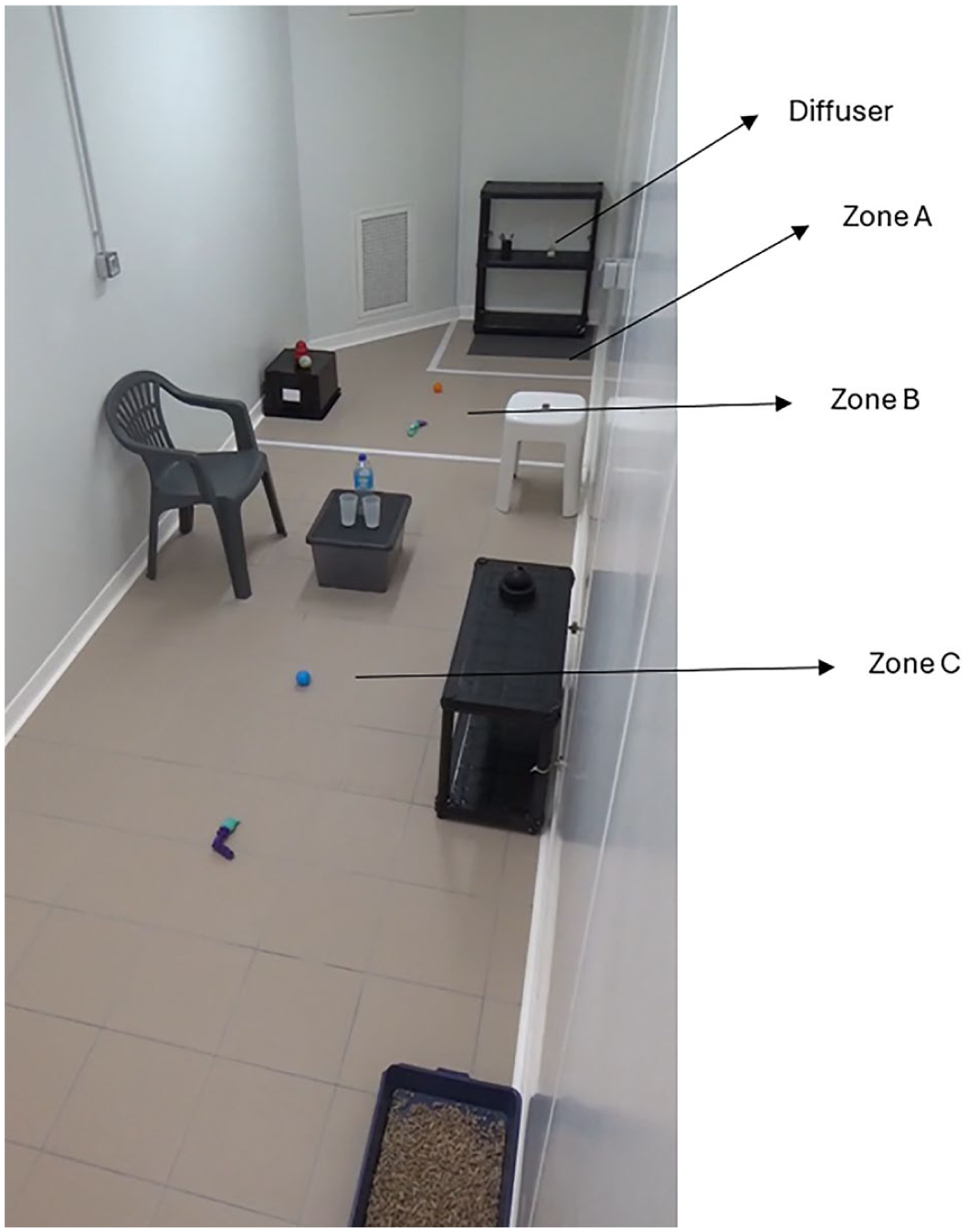
The experimental room was equipped with one chair, one stool, two shelves, two coffee tables, one diffuser (with treatment or control solution), one litter tray, one water bowl, seven toys and one video camera. Three zones were delimited by Scotch tape on the floor
F3 treatment (SecureCat Home; SignsLab) was provided via a glass container filled with 40 ml of a solution of 2% F3 diluted in a mixture of complex alcohol and antioxidant; six 24 cm long natural rattan sticks were placed in the container (Figure 2). The placebo was visually identical to the treatment, but without the active ingredient. Neither the placebo nor F3 treatments could be distinguished by their visual or olfactive features. The blind procedure was maintained by assigning a code to all tests included in the trial. Diffusers were placed 48 h before the beginning of the trial, at T0, to allow diffusion into the air. The study was a 2 × 2 crossover with two treatments and two periods for all 14 cats. Each cat was its own control; thus, each cat was exposed to the two different treatments over two successive periods. During each period, eight cats were tested 2 days after T0 and six cats were tested 3 days after T0; all tests were conducted in the morning.

The device used to diffuse the treatment and the excipient in the experimental rooms
The test consisted of a simulation of a common environment in a home: a cat was placed in a room containing different objects to be explored and discovered. Every cat spent 10 mins in the room, and the entire test was video-recorded using a GoPro Hero 9 camera; these videos were then analysed. BORIS software (University of Turin) was used to code the videos. 20 When the test was finished, the cat was gently transported back to the cattery using a cat carrier. Between each experiment, the test area was thoroughly cleaned by two operators following a cleaning protocol with a detergent disinfectant product that destroys liposoluble compounds (DNA02 LeVrai Professionel, https://www.bernard.fr/). The cat room was cleaned before the first cat that was involved in the test, using the same product and protocol. For the second period, the same procedure was performed 1 week later with new diffusers, according to the blinded and randomised protocol.
Behaviours
The behaviours analysed in this study are reported in Table 1. Depending on the behaviour, videos were coded as frequency, duration or both.

PE = point event; SE = state event
In addition to these behaviours, the maximum level of contact with the diffuser was noted, with a score for each passage: 0 = ignoring the diffuser; 1 = looking at the diffuser; 2 = smelling the diffuser; 3 = touching the diffuser; 4 = knocking over the diffuser; 5 = destroying the diffuser (eg, eating the sticks).
Data and statistical analysis
The data were collected by a blinded observer who watched the videos during continuous sampling.
The videos were coded by the same trained observer (PhD and MSc in ethology) who followed a predefined ethogram that had been used in previous studies and standardised recording procedures. This observer was trained under the supervision of the directors of the project (DVM, MSc, PhD, Diplomates of European College Animal Welfare and Behavioural Medicine) until consistency in scoring was ensured.
A priori sample size calculation was performed based on behavioural data from previously published trials in cats. Using the observed means and SDs from these studies, an estimation of the number of animals required to detect differences was calculated, with 80% power and a two-sided alpha of 0.05. Calculations were performed using R (version 4.1.2; R Foundation).
The data were transferred to an Excel (Microsoft) file for statistical analysis.
The study was a 2 × 2 crossover with two treatments performed on a sample of 14 cats over two periods. In a crossover study, each subject is its own control, and each cat was exposed to the two different treatments over two successive periods, in different orders: half of the cats were randomised to sequence A/B, and the other half to sequence B/A. The carry-over effect was systematically included as a fixed effect in the initial models. If this effect was not significant, it was removed for parsimony, as is standard practice in model simplification and both periods were analysed. If it was significant, only data from the first period were analysed. Data were analysed using R (version 4.1.2). The significance threshold was classically fixed at 0.05.
The categorical variable ‘Contact level’ (originally scored 0–5) was collapsed into a dichotomous variable: 0 = does not touch the device; and 1 = touches the device. Categories 0, 1 and 2 were classified in the new category 0, and categories 3, 4 and 5 in category 1 (4 and 5 were not obtained in this data set). This simplification avoided sparse categories and allowed us to focus on the meaningful contrast between ‘touch’ vs ‘no touch’. A proportion test was performed to compare the proportions of the two modalities (0 and 1), all treatments combined. The effects of treatment (control/F3), sex (F/M) and treatment–sex interactions were tested, in addition to the carry-over effect. The cat and the cattery were considered as random effects. Data were analysed using different statistical models depending on the nature of variables and the values assigned to them. For the behaviours expressed as durations, general linear mixed models (GLMMs) were used for raw data when residual normality was verified (graphically and using the Shapiro test). If normality was not verified, Box–Cox transformation was applied to the data to obtain normality. For the behaviours expressed as frequencies, generalised linear mixed models (GsLMMs) with the Poisson distribution were used as the first choice. The Pearson χ2 statistic/degrees of freedom (DF) indicator was determined to evaluate the dispersion of the data. If this statistic was less than 2, there was no overdispersion and the Poisson model was adopted; if it was more than 2, data were overdispersed and the model was not adequate. In that case, a negative binomial GsLMM was preferred. For all the parameters, multiple comparisons were performed using the Tukey test for effects with more than two modalities. Complete models were simplified if Akaike information criterion and Bayesian information criterion decreased when an effect was removed from the model (and if they were not significant).
Results
The proportion test to compare the proportions of the two modalities (0 and 1: 0 = does not touch the device and 1 = touches the device), all treatments combined, showed a significant difference between the two modalities with most of the cats not having any contact with the device (P <0.0001) (Table 2).
Descriptive results for the level of contact with the device

Scores are as follows: 0 = ignoring the diffuser; 1 = looking at the diffuser; 2 = smelling the diffuser; 3 = touching the diffuser; 4 = knocking over the diffuser; 5 = destroying the diffuser (eg, eating the sticks)
The statistical analysis showed significant effects for proximity duration (Figure 3). Cats spent more time in zone B with the treatment than with the control solution (GLMM; DF = 1; F = 7.9828; P = 0.0180). Although not statistically significant, a trend was also observed for zone C, with treated cats tending to spend less time in zone C than those in the control group (GLMM; DF = 1; F = 4.8680; P = 0.0519).

Comparison of time (in seconds) spent in zone B and C between control and F3 groups (*P <0.05; t = P <0.1)
Regarding behaviour (Figure 4), cats spent more time lying down (GLMM; DF = 1; F = 7.1466; P = 0.0191) and playing (GLMM; DF = 1; F = 18.3661; P = 0.0016), exhibited more rubbing (Poisson Mixed Model; DF = 1; X2 = 6.6035; P = 0.0102) and spent less time sitting (GLMM; DF = 1; F = .9727; P = 0.0180) with the treatment compared with the control diffuser.

Comparison of time (in seconds) spent lying down, playing and sitting and of frequency of rubbing between control and F3 groups (*P <0.05; **P <0.01)
Finally, a statistical trend was observed for the latency to approach (GLMM; DF = 1; F = 4.5880; P = 0.0517). Cats tended to take more time to approach the diffuser containing the treatment solution than the control (Figure 5). No significant difference was observed for the other parameters (Table 3).

Comparison of time (in seconds) spent before approaching the device between control and F3 groups (t = P <0.1)
Results for parameters with no significant difference

Data are mean ± SD
A significant effect of the sequence was observed. Only the data from period 1 can be used in the analysis (n = 14)
GLMM = general linear mixed model
Discussion
The results of our study showed that administration of the feline F3 pheromone via a new PCDS positively influenced the expression of certain behaviours during acclimatisation to a novel environment. In the presence of treatment, cats displayed more behaviours associated with comfort within their surroundings, suggesting an increase in behavioural indicators consistent with a positive emotional state. In mammals, the association between pheromone use and behavioural responses during acclimation has been previously described in different contexts.11,12,17 The present study evaluated an innovative passive diffusion system and showed that the behavioural effects of pheromones are maintained with this new diffusion method. Moreover, during the trial, only two cats made physical contact with the device, touching it without playing with or damaging it. This finding suggests that the system may be suitable for use in household environments, particularly considering that cats commonly explore novel objects through physical interaction, 23 which could increase the risk of damage to the device.
Regarding proximity to the device zone, the F3-treated cats spent significantly more time in the area close to the diffuser compared with the control group. Moreover, the F3-treated cats showed a longer latency to approach than controls. These findings may suggest that the presence of the F3 pheromone conveyed an interesting signal for the cat, requiring a longer period to ‘analyse’ the chemical message, its source and the surrounding space. This hypothesis warrants further investigation, particularly as the roles of space and time are well known in chemical ecology, where their interaction is critical in the detection of chemical cues and the expression of associated behaviours. 24
Concerning other behaviours, cats spent significantly more time lying down and playing, and exhibited increased rubbing behaviour with the F3 treatment compared with the control. These findings suggest that F3-treated cats displayed behaviours indicative of confidence in the novel environment, probably because the acclimation process was facilitated by the presence of the pheromone. The behaviours mentioned above are associated with cats that feel confident enough to engage in resting and play behaviour. Indeed, the lying position is often associated with resting behaviour. 21 Regarding playing behaviour, to our knowledge, this is the first study demonstrating that the F3 pheromone increases object play behaviour.
Play is a commonly observed and characteristic behaviour of young mammals. 25 In the domestic cat, play can be classified as social, locomotor, predatory or object. 26 Previous studies on feral, pet and laboratory cats have showed that each type of play has different developmental features that can be unique to each type or shared among them. 26 Object play is highly associated with predatory behaviour in cats, 27 and stress can suppress the presentation of this behaviour. 25 Moreover, in domestic species, play behaviour is associated with positive emotions, 28 and previous authors have proposed it as an indicator of animal welfare.29 –34 Interestingly, our findings showed for the first time that the use of the F3 pheromone can help cats exhibit this important and positive behaviour.
Promoting the wellbeing of an individual in a novel environment means not only helping it to cope with a new situation (social and/or environmental), but also promoting a better acclimation process and the ‘happiness’ of the animal in a specific situation. Animal happiness can be defined as how well an animal feels most of the time. 35 This definition of animal happiness is based on the balance of positive and negative effects, according to this specific vision of animal welfare as an affective state. 35 Similar to previous studies mentioned above, we chose a crossover experimental design in a controlled setting to measure the selected indicators in the same individuals and evaluate the potential changes in the balance of their affective states with different treatments.
The possible positive effects of pheromones during the acclimation process have previously been investigated in pets, farm animals and wildlife in different contexts. In domestic cats and European wildcats, the facial fraction F3 pheromone and cat-appeasing pheromone have been used to try to facilitate acclimation in different situations through managing environmental and agonistic behaviour.17,36 –38 Further research needs to better describe the efficacy of pheromones in these specific contexts. In dogs, previous studies have described the efficacy of the dog-appeasing pheromone in problems associated with transport, separation, sound sensitivity and novel environments and in improving conditions in dog shelters.39,40 In farm animals, the use of appeasing pheromones has been shown to reduce stress marker levels and aggression and to increase zootechnical performances and welfare.11,14 –16,41 –43 These findings emphasise the efficacy of different families of pheromones in helping animals cope with different challenging contexts by acting on both a behavioural and a physiological level and thus facilitating acclimation to these conditions.
The studies mentioned here evaluated different methods of pheromone administration, with different technologies (ie, skin application, diffuser bloc, collars, sprays) and durations of treatment (single or continuous administration). In this study, we tested a novel method of passive diffusion of the F3 pheromone into the environment in cats for the first time. This device does not require electricity or heat and ensures a homogeneous and continuous release of semiochemicals. 19 Moreover, this diffusion system is already commonly used in home environments, which may facilitate transfer to real-life household conditions. This passive diffusion device was also recently validated for rabbit-appeasing pheromone use in pet rabbits. 44 Previous studies investigating the continuous diffusion of pheromones in various species (via topical application, electrical devices or block diffusers) demonstrated that animals benefit from constant exposure to pheromones, which can influence their mental state and facilitate acclimation to challenging situations.
Our study showed that this new method of pheromone diffusion can be adapted for delivery of the F3 pheromone and has beneficial effects on treated cats, as shown by the increased behaviours that are commonly associated with positive affect, such as playing, rubbing and resting. However, our study presents some limitations that should be addressed in future clinical trials. First, although the experimental room was arranged to represent a typical living room, a real household is a complex environment that can be only partially reproduced in experimental conditions. Furthermore, the number of cats included in the study was limited; therefore, future studies should evaluate this treatment in real households and include a larger number of subjects. Despite these limitations, this new diffusion method seems to be a promising tool for safely and effectively communicating with cats and helping them cope with challenging everyday situations.
Conclusions
For the first time, our findings show that administering the F3 pheromone via a new formulation approach increases behaviours associated with positive emotions in cats. Treated cats exhibited behaviours suggestive of increased confidence within the environment and spent more time in proximity to the treatment device, highlighting increased interest. Moreover, this new method can be adapted for household use, as these systems are already used in homes and do not need electricity or heat. Further clinical studies are needed to confirm the efficacy of this new method of passive pheromone diffusion.
Footnotes
Acknowledgements
We would like to thank all members of the Vertebrate Animal Study Service for all their work and their help in taking care of the cats. We would also like to thank SIGNS Labs for providing the treatment and the excipient. In addition, we thank the MDPI English editing service for helping us improve our manuscript.
Conflict of interest
The authors declared no potential conflicts of interest with respect to the research, authorship, and/or publication of this article.
Funding
The authors received no financial support for the research, authorship, and/or publication of this article.
Ethical approval
The work described in this manuscript involved the use of experimental animals and the study therefore had prior ethical approval from an established (or ad hoc) committee as stated in the manuscript.
Informed consent
Informed consent (verbal or written) was obtained from the owner or legal custodian of all animal(s) described in this work (experimental or non-experimental animals, including cadavers, tissues and samples) for all procedure(s) undertaken (prospective or retrospective studies). No animals or people are identifiable within this publication, and therefore additional informed consent for publication was not required.
