




Abstract
Objectives
High-rise syndrome (HRS) is one of the most common causes of trauma in cats; however, significant inconsistencies remain in the literature regarding the relationship between fall height and injury severity, as well as epidemiological patterns, including seasonal variations and architectural risk factors. Given these discrepancies, the aim of the present two-part study was to analyse a substantial population of cats to clarify these unresolved questions, providing a comprehensive assessment of injury patterns, survival rates and risk factors associated with feline high-rise falls.
Methods
This retrospective analysis included 1125 cases of cats treated for HRS at the Freie Universität Berlin’s small animal clinic between 2004 and 2013. Eligible cases involved cats falling from at least the second floor of new buildings or the first floor of older buildings. Collected data encompassed breed, sex, age, weight, timing of accident, prior treatment, fall height, impact surface and environmental factors. The first part of this study focuses on epidemiological patterns and risk factors, while the second will analyse injury severity correlations.
Results
European Shorthair cats accounted for 82% of cases, with an average age of 2.3 years and an average weight of 4.1 kg. Falls were evenly distributed between sexes. Seasonal peaks occurred in summer (77%) and most incidents took place at night (62.1%). The average fall height was in the range of 8–15 m, with the majority of cats landing on hard surfaces (74.2%). Repeat incidents (two separate falls) were documented in 1.4% of cases.
Conclusions and relevance
This study, with the largest sample of feline HRS cases, highlights the influence of seasonal, temporal and environmental factors on fall risks. The findings offer a critical basis for preventive strategies, including owner education, use of window barriers and prompt veterinary care, to mitigate the incidence and severity of HRS.
Plain language summary
High-rise syndrome (HRS) refers to injuries in cats that fall from significant heights, usually from the windows or balconies of apartment buildings. Although this is a common cause of trauma in cats, there is disagreement in previous studies about whether falling from a greater height leads to more severe injuries. There is also limited research on how seasonal changes, building design and other factors influence these accidents. This two-part study aims to answer these questions by analysing a large group of cats that experienced high-rise falls.
Researchers reviewed medical records of 1125 cases of cats treated for HRS at a veterinary hospital in Berlin between 2004 and 2013. The study included cats that fell from at least the second floor (or the first floor in older buildings). Information was collected on the cat’s age, breed, sex, weight, fall height, landing surface and time of the accident. The first part of the study focuses on general patterns and risk factors, while the second part will examine the severity of injuries.
Most affected cats were young, with an average age of 2.3 years. Most cats were European Shorthairs (82%). Falls occurred more often in summer (77%) and mainly at night (62.1%). Most cats landed on hard surfaces (74.2%). A small number (1.4%) experienced two falls. Falls were equally common in male and female cats.
This study confirms that certain times of the year, especially summer, pose a higher risk for falls. Window and balcony barriers can help prevent these accidents. Educating cat owners about these risks and ensuring prompt veterinary care for injured cats can reduce the severity of injuries and improve survival rates.
Introduction
High-rise syndrome (HRS) refers to the collection of traumatic injuries occurring in cats that fall from at least the second floor of a building, typically from balconies or windows.1 –3 First described in 1976, 1 the term has since been widely used in veterinary literature. HRS is most common in urban areas with high-rise buildings, where cats are at a higher risk of falling compared with those in suburban or rural settings with low-rise structures.4,5 Falls from height are among the most frequent accidents affecting cats, accounting for 13.9% of such incidents. 6 Cats often engage in playful or hunting behaviours, such as chasing birds or insects, before falling.2,7 Indoor cats, frequently perched on window sills or balconies, may fall as a result of curiosity or missteps, although these events are often poorly described by owners.
Robinson 1 initially described this syndrome with clinical signs such as pneumothorax and epistaxis, but notably excluded common injuries such as limb fractures. The relationship between fall height and injury severity in HRS remains unclear, with contradictory findings in the literature. Although some studies report a linear increase in injury severity with height, 7 others suggest a curvilinear pattern, where severity peaks at intermediate heights and decreases at extreme heights.2,3,5 In contrast, Vnuk et al 8 found no definitive pattern, further complicating the understanding of injury mechanisms in feline falls. These inconsistencies highlight the need for further investigation to clarify whether fall height directly influences injury severity. The aim of the present study was to address this gap by analysing a large data set using a standardised methodology, providing new insights into trauma patterns in HRS.
Seasonal and environmental factors also influence HRS. Although most studies link higher fall incidences to warmer months, especially in Europe and North America,4,5,7,8 studies from warmer climates suggest a lower incidence during the hottest and most humid periods, potentially due to the use of air conditioning and closed windows. 9 In addition, in tropical climates, where temperatures remain relatively constant throughout the year, seasonal variations in fall incidence have not been observed. 10 Differences in study design further limit comparability and the development of universal conclusions, underscoring the need for a comprehensive, standardised approach. This study hypothesises that epidemiological factors, such as age, sex, seasonal variations, time of day, impact surface and fall height, influence the risk and severity of injuries in feline HRS. We analysed a large data set from Berlin with the aim of identifying key epidemiological patterns and risk factors, considering the city’s architectural landscape.
The primary aim of this study is to determine which epidemiological factors – including fall height, season, time of day, impact surface, age and sex – impact injury severity and survival rates in feline HRS cases. In addition to these core analyses, we also examine secondary outcomes, including factors that may further influence prognosis, such as time elapsed before presentation to the clinic in different seasons (summer vs winter), time of day (day vs night) and whether the cat received prior treatment elsewhere before arriving at our clinic. These insights provide a comprehensive understanding of how multiple factors interact to influence clinical outcomes in feline HRS cases. Although previous studies in other cities have reported mixed results, this study – based on one of the largest HRS case samples – provides valuable insights into the epidemiology of feline falls. The second part will further explore the relationship between these factors and injury patterns. Understanding these factors can help veterinary professionals improve diagnostic, prognostic and treatment protocols. Furthermore, the findings can guide pet owners in implementing preventive measures to reduce the incidence and severity of HRS.
Materials and methods
This retrospective observational study analysed medical records and radiographs of 1125 falls in cats admitted to the small animal clinic at Freie Universität Berlin (Berlin, Germany) between 2004 and 2013. The study focused on cases of HRS, defined as falls from significant heights. The sample size of 1125 cases was determined by including all eligible cases of HRS, providing sufficient statistical power to identify significant patterns and relationships across variables.
The inclusion criteria consisted of documented falls from a minimum height of 4 m: from the second floor or higher in new buildings or the first floor or higher in older buildings. Cases were excluded if records were incomplete or did not meet the inclusion criteria. All cases were identified using the Vetera practice software system, the clinic’s electronic medical record database. A keyword search was performed by a single author (AN) using terms such as ‘high-rise syndrome (HRS)’, ‘fall’ and the German term ‘Fenstersturz’, commonly used in this clinic to describe such accidents.
The following variables were collected for each case: breed, sex, age, body weight, time of the accident, prior treatment received before presentation, height of the fall, surface of impact and accompanying circumstances. For descriptive statistical purposes, cats’ weights were categorised into four groups (<2 kg, 2–4 kg, 4–6 kg, >6 kg). For statistical analysis, cats were classified as light (<4 kg) or heavy (>4 kg) to assess the influence of body weight on injury severity. These categories were chosen to reflect clinical thresholds relevant to body condition scoring and size variation commonly observed in feline patients.
All data were extracted by the same author (AN) using a standardised data extraction form to ensure consistency. Cases with ambiguous or incomplete data were flagged and re-reviewed for clarification. A second team member (LB) conducted periodic cross-checks to validate the accuracy and completeness of the data set. Range checks were performed for continuous variables, such as body weight, to identify and correct anomalous values. Follow-up data were not collected, as the study focused on the initial clinical presentation, type of injuries and outcome. The exclusion criteria for this study included cases with incomplete records or missing critical data (eg, fall height, injury type or more than three epidemiological details like age, sex or weight), cases where the fall height was not documented or did not meet the inclusion criteria of a minimum 4 m, cases involving injuries unrelated to falls (eg, vehicular trauma or animal attacks) and patients outside the study’s scope, such as non-feline patients or cases recorded outside the 2004–2013 timeframe.
Timing of the accident
For the assessment, the timing of the accident – including the season, time of day and the time elapsed between the accident and the cat’s presentation to the clinic – was analysed. Seasonal division was based on Berlin’s climate and its influence on fall risk, and time-of-day segmentation considered light, human activity and behavioural factors.
Regarding the seasons, the months were categorised as follows: Winter = October to March; and Summer = April to September.
The time of day when the accident occurred was categorised into day and night, as well as segmented into the following periods: morning = 06:00 to 10:00; midday = 10:00 to 14:00; afternoon = 14:00 to 18:00; evening = 18:00 to 22:00; and night = 22:00 to 06:00. For analysis, morning, midday and afternoon were classified as day, while evening and night were classified as night.
The time elapsed between the occurrence of HRS and the cat’s presentation to the clinic was divided into the following groups: less than 4 h and more than 4 h. This structured approach allows for a comprehensive analysis of how timing factors may influence outcomes in cases of HRS.
Fall height
Only cats with a documented fall height were included in the study. Fall height was provided by the owners in terms of floors or metres. To further distinguish the fall height, the type of building was considered. Given Berlin’s diverse architectural landscape, there are significant differences between old and new buildings, particularly regarding their floor heights. Categories were based on Berlin’s architectural characteristics and documented height variations. Groupings provide stratification for meaningful analysis of fall biomechanics.
When the building type was not explicitly specified by the owner, it was determined based on the owner’s address and the Berlin rent index, categorising buildings as follows: old buildings = constructed between 1918 and 1949; and new buildings = constructed from 1950 onwards. New buildings in Berlin typically feature floor heights in the range of 2.2–2.8 m, with an additional base height of up to 1 m from the ground floor in new constructions. In contrast, old buildings generally have taller floor heights, typically in the range of 3.2–4 m. The windows and balconies in both types of buildings are typically situated 0.8–1 m above the respective floor height.
To facilitate statistical analysis and ensure a practical and standardised classification of fall heights, we established seven height groups based on estimated floor heights in both old and new buildings. This grouping approach was chosen to simplify comparisons while accounting for architectural differences. By structuring the groups in this way, we aimed to avoid excessive fragmentation while still capturing meaningful differences in fall heights:
Group 1: at least 4 m, <5 m → first floor of an old building or second floor of a new building
Group 2: 5–7 m → second floor of an old building or second to third floors of a new building
Group 3: 8–11 m → second to third floors of an old building or third to fourth floors of a new building
Group 4: 12–15 m → third to fourth floors of an old building or fourth to fifth floors of a new building
Group 5: 16–21 m → fourth to sixth floors of an old building or sixth to eighth floors of a new building
Group 6: 22–24 m → sixth floor of an old building or ninth floor of a new building
Group 7: >24 m → seventh floor or higher in an old building or 10th floor and above in a new building
Impact surface
Impact surface data were extracted from patient files, which documented the type of surface the cat landed on after the fall. Surfaces were classified into two categories based on previous literature:4,11 hard surfaces, including concrete, asphalt, stone floors, bicycles, cars, canopies, grilles, railings, fences, garbage cans, grating and stairs; and soft surfaces, including awnings, gravel, leaves, sand, bushes, lawns, chairs, sofas and beds. This classification was based on the assumption that softer surfaces may dissipate impact energy more effectively, potentially reducing the severity of injuries compared with harder surfaces.
Statistical analysis
Data were analysed using SPSS Statistics for Windows version 23.0 (IBM Corp).
Continuous variables (age and body weight) were summarised as median or mean ± SD. Categorical and ordinal variables were summarised as frequencies and percentages.
The χ2 test was used to analyse the interdependency between two categorical variables. In the case of a four-field matrix, Fisher’s exact test was used.
All tests were two-tailed, and P <0.05 was considered statistically significant.
Results
Patients
The initial data set included 1125 recorded falls identified from the Vetera practice software system. After excluding cases with incomplete information, eight patients were identified as having experienced multiple falls (two incidents each). Consequently, the total number of individual patients was 1117. It is important to note that the unit of observation in this study is the fall, not the individual cat, as cats with multiple falls were recorded separately for each incident. Missing data patterns and their potential impact on the analysis are addressed below.
Table 1 summarises the breed distribution for 1122 recorded falls. European Shorthairs were the most represented breed, accounting for 911/1122 (81.2%) cases. Crossbreeds and other specific breeds were less common.
Breed distribution among cases of high-rise syndrome

Date of birth was recorded for 1085 falls (96.4% of cases). The age at the time of the fall was in the range of 0.1–20.3 years (mean age 3.68 ± 3.70; median age 2.3). Age distribution showed that 296/1085 (27.3%) cats were aged under 1 year, 645/1085 (59.4%) were aged 1–8 years and 144/1085 (13.3%) were aged over 8 years.
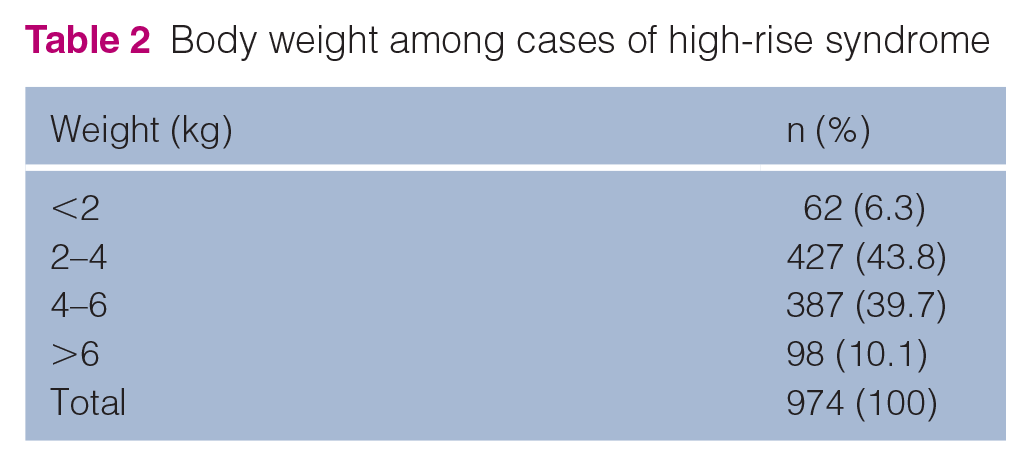
Weight data were available for 974 falls (86.6% of cases). Weights were in the range of 1–10 kg (mean weight 4.28 ± 1.43; median weight 4.1). To facilitate the analysis of the influence of body weight on injury patterns, cats were categorised into four weight groups: <2 kg, 2–4 kg, 4–6 kg and >6 kg (Table 2). The distribution was nearly even, with 489/974 (50.2%) classified as light (⩽4 kg) and 485/974 (49.8%) as heavy (>4 kg).
Body weight among cases of high-rise syndrome
Information on sex was available for 1112 cats that experienced falls (98.8% of cases). Of these, 150 (13.5%) were intact males, 451 (40.6%) were neutered males, 267 (24.0%) were intact females and 244 (21.9%) were spayed females.
Monthly frequency of HRS
Out of 1125 recorded cases of HRS, 867 (77%) occurred during the summer months (April to September). The highest incidence was observed in July (17.9%, 201/1125), followed by August (14.7%, 165/1125), June (13.5%, 152/1125), May (12%, 135/1125), September (9.9%, 111/1125) and April (9.1%, 103/1125). The lowest incidence was recorded during the winter months (October to March), comprising 23% (258/1125) of cases. The monthly incidence ranged from 1.9% (22/1125) in January to 6.8% (76/1125) in October (Figure 1).

Frequency and number of patients with high-rise syndrome in the different months of the year (n = 1125). Light grey = winter period; dark grey = summer period
Spring accounted for 9.1% (102/1125) of cases, with all falls occurring in April. In contrast, fall months showed a gradual decline, with September contributing 9.9% (111/1125) and October 6.8% (76/1125) of cases. The lowest incidence was recorded during the winter months (October to March), comprising 23% (258/1125) of cases. The monthly incidence ranged from 1.9% (21/1125) in January to 3.5% (39/1125) in November (Figure 1).
Daytime vs nighttime frequency of HRS
The timing of HRS accidents was documented in 1034/1125 (91.9%) cases, with 91/1125 (8.1%) missing because of incomplete records. The majority of incidents occurred during the evening and nighttime hours (18:00 to 06:00), comprising 642/1034 (62.1%) cases. Specifically, 371/1034 (35.9%) falls happened at night, while 271/1034 (26.2%) occurred in the evening.
Fewer incidents were recorded during daylight hours, with 144/1034 (13.9%) at midday, 125/1034 (12.1%) in the morning and 123/1034 (11.9%) in the afternoon. These findings indicate a peak in HRS incidents during periods of reduced natural light, suggesting that time of day may influence fall risk (Figure 2).

Frequency and number of 1034 cases of high-rise syndrome by time of day
Fall height
Analysis indicates that the majority of falls occurred from heights in the range of 8–15 m, while falls from lower (<5 m) and higher (>16 m) heights were less frequent.
Among the cases, the most frequent falls, in descending order, occurred from heights in the range of 8–11 m (348/1125, 30.9%), followed by 12–15 m (288/1125, 25.6%) and 5–7 m (245/1125, 21.8%). Falls from less than 5 m accounted for 137/1125 (12.2%) cases, while 16–21 m represented 85/1125 (7.6%) falls. Falls from greater heights were notably rare, with 14/1125 (1.2%) falls occurring from 22–24 m and only 8/1125 (0.7%) from heights exceeding 24 m (Figure 3).

Fall height in metres with respective number and percentage in 1125 cases
Of the 1125 recorded falls, 530 (47.1%) occurred from old buildings, while 595 (52.9%) were from new buildings.
Impact surface
Details regarding the impact surface were documented in the patient files of 227/1125 (20.2%) cases. Among these, 165/227 (72.7%) cats fell onto hard surfaces or objects, while 62/227 (27.3%) encountered soft surfaces (Figure 4).

Impact surface distribution with respective number and percentage in 227 cases
Seasonality and time of day of HRS
Seasonal analysis revealed that 101/239 (42.3%) falls in winter occurred during the daytime, compared with 291/795 (36.6%) in summer. Conversely, nighttime falls were more frequent in summer (504/795, 63.4%) than in winter (138/239, 57.7%).
A χ2 test of independence was conducted to evaluate the relationship between time of day (daytime vs nighttime) and seasonality (winter vs summer). The test revealed no statistically significant association (P = 0.128) (Table 3).
Time of the day at which high-rise syndrome occurred in winter and in summer

Data are n (%). χ2 test, P = 0.128
Time elapsed between HRS accident and presentation to the clinic
Of the 1125 cases in the study, 856 (76.1%) had available data regarding the elapsed time between the accident and presentation to the clinic. A total of 269/1125 (23.9%) cases were excluded from this analysis because of incomplete or missing records. A review of missing data patterns revealed no systematic biases.
Among the 856 cases analysed, 512 (59.8%) cats were brought to the clinic within 4 h of the accident, while 344 (40.2%) were presented more than 4 h later. The majority of nighttime falls (326/461, 70.7%) resulted in presentation within 4 h, compared with 185/305 (60.7%) daytime falls. In other words, cats that fell during the day (120/305, 39.3%) were significantly more likely to present after more than 4 h, compared with those that fell at night (135/461, 29.3%).
The time of day was classified as either daytime (06:00 to 18:00) or nighttime (18:00 to 06:00), while presentation times were grouped into <4 h or >4 h after the accident. A χ2 test revealed a statistically significant association between time of day (daytime vs nighttime) and the time to presentation to the clinic (P = 0.005) (Table 4).
Influence of time of day on presentation time to the clinic

Data are n (%). χ2 test, P = 0.005
Time of presentation was recorded for 856 falls, whereas data for time of day were available for only 761 cases. When describing the overall study population, the analysis is based on 856 falls
Prior treatment
Of the 1125 cases examined, 340 (30.2%) cats had received veterinary treatment elsewhere before being brought to the clinic for further diagnostics and therapy. Consistent with previous analyses, a χ2 test was used to determine any influence of the time of day the HRS incident occurred – categorising the time of day into day (06:00 to 18:00) and night (18:00 to 06:00) – on the number of cats that had received prior treatment for HRS.
The analysis revealed that cats that fell during the day (137/392, 34.9%) were significantly more likely to have received prior veterinary treatment compared with those that fell at night (1339/642, 21.7%) (P = 0.001) (Table 5).
Influence of time of day on prior veterinary treatment

Data are n (%). χ2 test, P = 0.001
Time of day was recorded for 1034 falls, whereas prior treatment information was available for all 1125 cases. When describing the overall study population, the analysis is based on 1125 falls
In addition, 196/294 (66.7%) cats that had received prior treatment for HRS presented to the clinic more than 4 h after the accident, compared with 148/562 (26.3%) cats that had not been pretreated, indicating a notable delay in clinical presentation among previously treated cases.
Discussion
In a city like Berlin, with its distinctive architectural features and pronounced seasonal climatic variations, this study – one of the largest on HRS in cats – provides critical insights into epidemiological trends, risk factors and associated behaviours. Our findings highlight the role of environmental factors, such as time of year and time of day, in influencing the likelihood of falls, while architectural characteristics primarily affect the calculation of fall height rather than the risk of falling itself.
We observed a higher incidence of falls during the summer months, with a peak in HRS incidents occurring during periods of reduced natural light, suggesting that both seasonal and environmental factors contribute to the risk of feline falls. Most falls occurred on hard impact surfaces, which could influence injury severity. The average fall height was 12 m, corresponding to approximately the fourth floor of a building. In addition, cats that fell during the day were more likely to have received treatment elsewhere before arriving at the clinic, whereas cats that fell at night were more likely to be presented within 4 h of the accident.
These results align with those of previous studies while addressing inconsistencies in the literature, particularly regarding seasonality in different climatic regions and age distribution among affected cats. Given the large data set amassed in this study, the analysis was divided into two parts: the first part focuses on epidemiological patterns, while the second part will correlate these findings with other risk factors, injury types, severity and survival rates. In addition, this study emphasises the importance of impact surface, which will be explored further in subsequent analyses.
According to Kolata, 6 unidentified causes account for traumatic lesions in cats up to 40% of the time, surpassing traffic accidents (16%) and falls (14%). Despite falls being a significant cause of injury in this species, only a few epidemiological studies have been reported in the literature. The term ‘high-rise syndrome’ (HRS), referring to falls from heights and the resulting injury patterns, has been consistently used since 1976. 1 Major epidemiological studies, conducted in different cities around the world, have involved between 119 and 423 patients.2,3,5,7 –9 Notably, these studies differed in design and were influenced by variations in architectural features and climatic conditions. Our study, including 1125 HRS incidents presented to the small animal clinic of Freie Universität Berlin between 2004 and 2013, comprises one of the largest sample sets for HRS to date.
In the current study, the majority of cats, almost 82% (911/1125), were identified as European Shorthairs, with other breeds comprising smaller proportions. Comparisons with existing literature are limited as a result of the scarcity of breed-specific data in previous studies, making it challenging to assess potential breed predispositions to HRS. However, it is likely that the breed distribution observed in this study reflects the feline population and ownership preferences in Berlin. This aligns with findings of Nakladal et al, 12 which highlighted the predominance of European Shorthairs among cats with traumatic injuries treated in Berlin’s small animal clinics. These findings underscore the importance of considering regional variations in breed distribution when interpreting epidemiological data on HRS, as urban areas with differing demographic and cultural profiles may present contrasting trends.
The cats in our study had a median age of 2.3 years, which aligns with findings from several studies reporting average ages in the range of 2.5–2.7 years.2,7,13 In contrast, other studies have reported significantly younger patient populations, with ages ranging from younger than 1 year to 1.8 years.5,8,9,14 Previous research suggests that younger cats are at higher risk of falls because of their playful and curious nature, coupled with a lack of experience and underdeveloped balance skills.5,11,15 These findings, however, contrast with those of our study, where only 27.3% of patients were aged under 1 year, while 72.7% were older, including 13% aged over 8 years.
This discrepancy may reflect differences in environmental factors and owner behaviours, such as the increased supervision of younger cats in urban settings like Berlin. Furthermore, variations in geographical location, urban vs rural environments, and regional pet ownership practices could also contribute to these differences. For instance, cities with greater outdoor access for cats might experience a higher frequency of falls among younger populations. These findings highlight the importance of considering environmental and behavioural influences when evaluating age-related fall risks in feline populations.
Regardless of neuter status, male (54.1%) and female (45.9%) cats in our study experienced falls at nearly equal rates, consistent with findings from previous studies.3,5,8,9,16 However, this result contrasts with research by Collard et al, 13 who reported a higher incidence of falls among male cats. Among neutered cats in our study (62.5%), 40.6% were male and 21.9% were female, closely aligning with studies from North America. For example, Bonner et al 11 and Whitney and Mehlhaff 2 reported neutering rates of 75% and 50%, respectively. By contrast, studies from Croatia and Greece5,8 found significantly lower neutering rates of 4.2% and 2%, respectively. These differences may reflect cultural practices and regional attitudes toward routine neutering, which is more prevalent in Central Europe and North America compared with some other regions. Kolata 6 suggested that males are generally more affected than females in cases of trauma; one possible explanation for this difference is that female cats may have a lower tendency to roam and spend more time indoors, which could reduce their exposure to external hazards. However, our study does not specifically support or refute this hypothesis, as no significant difference between male and female cats was observed in our results. This finding highlights the need for further investigation into behavioural or environmental factors that may disproportionately increase the risk of falls among female cats in certain contexts.
The average weight of the cats in our study was 4.1 kg, consistent with findings from recent studies. 14 Over 80% of our patients fell within the weight ranges of 2–4 kg (43.8%) and 4–6 kg (40.3%). Similarly, Bonner et al 11 reported an average weight of 4.8 kg and categorised cats into weight groups ranging from very light (<2 kg) to very heavy (6–10 kg). Although body weight is considered an important factor in determining the severity of lesions in HRS, data on this relationship remain limited. Beyond early research by Meyer zu Erpen 17 and Warner and Demling, 18 few studies have systematically examined the correlation between body weight and injury severity. This relationship will be explored in the second part of our study, focusing on its role as a potential risk factor for specific injury patterns and outcomes.
Of the 1125 cases, 867 (77%) occurred during the summer months (April to September), while 258 (23%) occurred during the winter months (October to March). Including the transitional months of March (57/1125, 5.1%) and October (76/1125, 6.8%), a total of 1000 (89%) falls occurred during the warmer seasons. In contrast, the incidence of falls during specific winter months remained notably low, ranging from 24/1125 (2.1%) in November to 39/1125 (3.5%) in December. Peak frequencies within the summer period were observed in July (201/1125, 17.9%), August (165/1125, 14.7%) and June (152/1125, 13.5%). These findings align with data from previous investigations.1 –3,5,8,12,16,19 However, studies conducted in warmer geographical regions have reported a lower incidence of falls during the hottest and most humid months, likely due to the widespread use of air conditioning, which leads to closed windows and balconies during these periods. 9 In contrast, in tropical climates, where temperatures remain relatively constant throughout the year, seasonal variations in fall incidence have not been observed. 10 In Denmark, Flagstad et al 3 demonstrated a clear correlation between warmer months (May to August) and an increased frequency of HRS. Similarly, in Berlin, where residential buildings typically lack air conditioning, ventilation during the warmer seasons relies on open windows and balcony doors. This increased exposure to outdoor environments, where cats often bask in the sun or observe birds and butterflies, may contribute to the higher incidence of falls during these months, as previously suggested.3,5,12
Of the 1034 cases (92% of the total 1125 cases) where the timing of the accidents was determinable, 642 (62.1%) occurred at night, while 392 (37.9%) occurred during the day. This pattern contrasts with observations by Papazoglou et al 5 in Thessaloniki, Greece, where most accidents occurred during the day, likely due to cats having unrestricted access to balconies for exercise and relaxation in daylight hours.
In Berlin, the higher frequency of HRS accidents during the evening and nighttime may reflect the working hours of cat owners, who often leave their cats unsupervised during the day. During this time, windows and doors are typically kept closed for security and safety reasons. In contrast, windows and balcony doors are more frequently opened in the evening and nighttime for ventilation when owners return home, increasing the risk of falls. In addition, accidents are more likely to be promptly observed and reported during these hours, facilitating veterinary intervention. Supporting this, nearly 71% of HRS patients in our study were brought to the veterinarian in the evening and nighttime hours (between 18:00 and 06:00) within 4 h of the incident, compared with 60% during the day. This finding aligns with the observations of Whitney and Mehlhaff, 2 who also noted a higher proportion of cases during the evening and nighttime hours.
The height from which a cat falls is critical in determining the severity of injuries associated with HRS, as it directly correlates with the amount of impact energy absorbed by the body, potentially causing bone fractures and internal organ ruptures.18,20 This relationship is supported by significant statistical differences between injury severity and fall height, making fall height an essential factor for studies on HRS. In our study, the most frequent fall height was in the range of 8–15 m (equivalent to the third or fourth floors), closely aligning with findings of Barth 4 (11.5 m), Vnuk et al 8 (12.4 m) and Papazoglou et al 5 (11.3 m).
Lower average fall heights reported by Bonner et al 11 (8.8 m) and Flagstad et al 3 (9.7 m) may be attributed to their inclusion of cats falling from lower floors. Similarly, Merbl et al 9 indicated that most falls occurred from the third or fourth floors, consistent with our findings. In contrast, Whitney and Mehlhaff 2 reported a notably higher average fall height of 20.1 m. This discrepancy likely reflects the influence of study design and the architectural differences across cities. For example, cities like New York are characterised by tall skyscrapers, whereas cities like Copenhagen or Zagreb have fewer buildings exceeding six floors.
Our findings, along with those of Dupre et al, 7 suggest that cats most commonly fall from the second, third and fourth floors, consistent with the architectural trends observed in cities like Paris and Berlin. These results underscore the importance of considering urban design and building structure when evaluating the risk and outcomes of falls in feline populations.
Among our 1125 patients, 165/227 (74.2%) experienced falls onto hard surfaces or objects, while 62/227 (25.8%) landed on soft surfaces. However, impact surface data were documented for only 227/1125 (20.2%) cases, a trend consistent with the limitations observed in previous studies.2,8,11 The type of impact surface is a critical factor influencing injury severity in high-velocity falls. Biomechanical studies suggest that soft surfaces dissipate impact forces more effectively, reducing the likelihood and severity of fractures and internal injuries. In contrast, hard surfaces result in higher impact forces because of their limited capacity for energy dissipation, leading to more severe trauma. These principles have been demonstrated in both human and veterinary studies on fall-related injuries.2,19
Accurate observation of the accident itself was rare, with most instances described broadly as ‘falling out of the window’. Veterinarians seldom inquire about the specifics of the fall during anamnesis, limiting the detailed understanding of fall dynamics. While a significant portion of the impact energy is absorbed by the muscles, tendons and ligaments of the limbs, the residual force often affects critical areas such as the head, thorax and abdomen. The severity of injuries is closely correlated with the hardness of the impact surface, as demonstrated in prior studies.2,4,5,8,11,18,20,21 This relationship will be further explored in the second part of this study, focusing on its influence on specific injury patterns.
In our study, 16/1125 (1.4%) recorded falls involved repeat incidents, with eight cats experiencing two separate falls each. These findings align closely with previous studies, which reported repeat falls in 1.4–3% of cases.2,5,11 The recurrence of falls may reflect a lack of preventive measures, such as window or balcony barriers, implemented by the owners. In addition, changes in living environments or heightened curiosity in certain cats may contribute to repeat falls. These findings emphasise the importance of educating cat owners on implementing effective precautions to reduce the risk of recurrence of incidents.
This study has several strengths, including its large sample size, comprehensive data set and detailed analysis of epidemiological variables. However, certain limitations should be considered. As a retrospective study, the accuracy of some data (eg, fall height, timing of the incident) relied on owner-reported information, introducing potential recall bias. In addition, missing data for variables like impact surface (80% of cases) and time to presentation (23.9%) may have influenced some results. Finally, the study population was limited to a single urban area, potentially reducing the generalisability of the findings to other geographic regions or rural settings.
These findings emphasise the importance of targeted prevention strategies. Veterinary professionals should educate owners about the risks of falls, particularly during the summer months and nighttime hours when such incidents are most common. Previous studies 10 have proposed preventive measures like installing window and balcony barriers, especially in urban environments with high-rise buildings, as an effective means to significantly reduce the incidence of HRS. In addition, public awareness campaigns highlighting the importance of prompt veterinary care after falls could further improve outcomes for affected cats.
Conclusions
This study provides critical insights into the epidemiology of HRS in cats, analysing one of the largest data sets to date, comprising 1125 cases. Key findings highlight the significant influence of environmental factors such as seasonality, time of day and fall height on the occurrence of HRS, helping to clarify inconsistencies in the literature. These findings establish a foundation for further investigation into injury patterns, risk factors and clinical outcomes, which will be addressed in the second part of this study.
This study underscores the importance of preventive strategies, such as installing window screens or barriers, which are well supported in the literature as effective interventions to reduce falls. In addition, early veterinary intervention after a fall is critical to improving survival and reducing complications. However, these recommendations must be considered in the light of this study’s limitations, including its retrospective design, variability in medical record completeness and potential reporting biases. To mitigate these limitations, we conducted rigorous data validation and statistical analyses to ensure robust findings.
Future research should focus on expanding biomechanical analyses of feline falls to better understand impact forces and injury mechanisms. In addition, behavioural and environmental factors – such as feline risk-taking behaviours and owner awareness of fall prevention – warrant further investigation. Multicentric prospective studies across diverse urban environments could provide a more comprehensive understanding of HRS and help refine clinical management and preventive strategies to enhance feline safety and wellbeing.
Footnotes
Conflict of interest
The authors declared no potential conflicts of interest with respect to the research, authorship, and/or publication of this article.
Funding
The authors disclosed receipt of the following financial support for the research, authorship, and/or publication of this article: This research received external funding from the Health and Medical University, Potsdam, to cover publication costs. No specific grant number was assigned.
Ethical approval
The work described in this manuscript involved the use of non-experimental (owned or unowned) animals. Established internationally recognised high standards (‘best practice’) of veterinary clinical care for the individual patient were always followed and/or this work involved the use of cadavers. Ethical approval from a committee was therefore not specifically required for publication in JFMS. Although not required, where ethical approval was still obtained, it is stated in the manuscript.
Informed consent
Informed consent (verbal or written) was obtained from the owner or legal custodian of all animal(s) described in this work (experimental or non-experimental animals, including cadavers, tissues and samples) for all procedure(s) undertaken (prospective or retrospective studies). No animals or people are identifiable within this publication, and therefore additional informed consent for publication was not required.
