



Abstract
Objectives
The aim of this study was two-fold: first, to investigate the attitudes and application of cat-friendly practices among German, French and Swiss veterinarians during consultations; and second, to gain a better understanding of the relationship between the demographics of the veterinarians and variations in the application of cat-friendly practices and attitudes.
Methods
A bilingual questionnaire structured around the capability, opportunity, motivation and behaviour (COM-B) model of human behaviour was distributed to veterinarians in Germany, France and Switzerland. Using Likert scales, participants were asked to report on their application of cat-friendly practices during consultations and their attitudes towards cat-friendly methods. The proportion of cat-friendly practices and attitudes were identified by grouping results across Likert scales. Multiple binary logistic regression models were performed to compare the differences in cat-friendly practices and attitudes across the three countries. Cumulative scores were calculated for practices and attitudes, and analysed for associations with veterinarian demographics using a general linear model.
Results
Of the 516 respondents, 36.2% used scruffing to restrain cats, 51.9% prescribed anxiolytics for future visits and 17.1% used medication to mitigate stress during consultations. Only 37.6% thought that caregivers expected to be educated on how to prevent or reduce stress in their cats during transport. Having an employee position rather than being clinic director or partner was associated with a lower score of cat-friendly practices (P <0.01) and motivation (P = 0.02). Whereas, awareness of cat-friendly guidelines, working in a Cat Friendly or Fear Free accredited clinic and being trained in animal behaviour contributed to higher scores in both cat-friendly practices and overall attitudes (P <0.001).
Conclusions and relevance
Education and promotion of guidelines on cat-friendly practices will facilitate improvements in handling cats and mitigating fear-anxiety with medication.
Plain language summary
Methods to prevent forceful restraint or an aversive environment have been developed to reduce cats’ stress during veterinary visits. Information on the application of these cat-friendly methods is lacking in European countries such as Germany, France and Switzerland. Filling this information gap on cat-friendly practices is crucial to provide veterinarians with the necessary information to prioritise the application of feline stress reduction methods. A questionnaire was distributed to veterinarians working with companion animals in Germany, France, and Switzerland. Participants were asked to report on their practices during consultations and their opinions towards cat-friendly methods. Of the 516 respondents, 89.9% waited for the cat to leave its carrier itself during the consultation. When the cat required restraining, 36.2% of the respondents still used methods that may cause the cat stress. For cats exhibiting fear or anxiety, only 51.9% of the respondents prescribed anxiolytics for future visits. Furthermore, only 37.6% of the respondents thought that owners expected to be educated on how to prevent or reduce stress in their cats during transport. Having an employee position rather than being clinic director or partner was associated with a decrease in the application of cat-friendly methods and in being motivated to apply these methods. However, being aware of cat-friendly methods, working in a Cat Friendly or Fear Free accredited clinic and being trained in animal behaviour contributed to an increase in cat-friendly practices and in motivation to prevent cat stress. The results of the study highlight the importance of promoting cat-friendly methods, by developing educational programmes. The results also stress the need to empower veterinarians in an employee position to ensure commitment to cat-friendly practices.
Introduction
‘Cat-friendly’ guidelines have been developed to improve cats’ comfort through reducing the emotions of fear, anxiety (fear–anxiety) and frustration during veterinary visits, thus enhancing cat welfare.1 –3 However, cat-friendly guidelines are not consistently applied; research suggests that 75% of caregivers, surveyed mostly from the UK, have never received advice from veterinarians on how to transport their cat, 4 despite evidence that training cats to be transported leads to easier examinations and shorter consultation lengths. 5 In addition, 60% of veterinarians surveyed in North America still use full-body restraint or scruffing to immobilise fearful cats, 5 even though cats restrained by these methods struggle more often than passively handled cats. 6
Research has shown that successful application of evidence-based practice depends on context and various human behavioural variables, which is the result of interacting components 7 as conceptualised by the capability, opportunity, motivation and behaviour (COM-B) model (Figure 1).8,9 While veterinarians believe it is important to perform low stress practices in the veterinary environment, 10 the implementation of all recommendations is not always considered feasible mainly due to space or time constraints, as well as resistance to changing habits. 10 Research has also shown variable application of cat-friendly recommendations dependent on the country, which is attributable to differences in veterinarians’ education on animal behaviour. 5 While the application of cat-friendly practices has been evaluated via veterinarians’ self-reporting in several English-speaking countries,5,11,12 similar information is lacking in European countries where French and German are spoken, such as Germany, France and Switzerland.

Furthermore, published data directly examining cat-friendly attitudes and practices of veterinarians using a framework such as the COM-B model are lacking. Filling this information gap on cat-friendly practices and attitudinal factors is crucial to understanding the barriers to improving cat welfare in veterinary practices and for prioritising the creation of feline stress reduction programmes. 7
This study aimed to investigate the extent to which German, French and Swiss veterinarians apply cat-friendly practices during consultations and their attitudes towards these methods. This study also examined the differences in practices and attitudes according to veterinarian demographics.
Materials and methods
Population and sample
The sample population consisted of veterinarians working with companion animals in Germany, France or Switzerland at the time of data collection.
Survey design
Based on the COM-B model, an online questionnaire comprising of 51 questions (see File 1 in the supplementary material) was created using the JISC online platform (https://www.jisc.ac.uk/online-surveys). Using a five-point Likert scale, participants were anonymously asked to evaluate whether they apply cat-friendly practices (ie, always, often, sometimes, rarely or never) during consultations, as well as their level of agreement (ie, strongly agree, agree, neither agree nor disagree, disagree, or strongly disagree) towards statements on cat-friendly methods.
In addition, the questionnaire included demographic data such as gender, years of experience as a veterinarian, position in the clinic, proportion of cats as patients, training in veterinary behavioural medicine, country and location of practice, number of veterinarians in the clinic, and whether the clinic was Cat Friendly or Fear Free (CF/FF) accredited.
The original English version was pre-tested and subsequently translated into French and German by two trilingual scientists, according to the translation, review, adjudication, pre-testing and documentation methodology. 13 A trilingual veterinarian ensured that the translations were consistent. Completion time was approximately 15 mins.
Recruitment of respondents
Small animal veterinary associations in Germany, France and Switzerland were invited to share the link to the questionnaire with their members via relevant newsletters, websites or Facebook groups. Approximately 5000 veterinarians were exposed to the questionnaire from December 2022 to mid-February 2023.
Data handling and statistical analysis
Data were downloaded from the JISC online platform into Excel, version 16.82 (Microsoft). Data were checked and levels within some variables were grouped if the numbers were considered too low. Some questions on practices (14.7 and 15.1) and attitudes (20.4, 21.1, 21.2 and 21.4) were asked in a reversed format to minimise acquiescence bias 14 and were recoded prior to analysis to ensure consistency of scale directionality.
Differences in demographic data between countries were calculated using a χ2 test. Further analysis on practices and attitudes was approached in two different ways. First, to evaluate the extent to which cat-friendly practices were applied, a variable representing cat-friendly practices (yes/no) was created by combining always and often (yes); and sometimes, rarely and never (no). For the attitudes, a variable representing cat-friendly attitudes (yes/no) was created by combining strongly agree and agree (yes); and neither agree nor disagree, disagree and strongly disagree (no). To evaluate the differences in cat-friendly practices and attitudes across the three countries, separate binary logistic regressions (logit link function) were performed in R, version 2023.03.0+386 (R Foundation) using the glm package. 15 Country was included as the only explanatory variable in each model. The results are presented as odds ratios (ORs) and 95% confidence intervals (CIs).
Second, to measure the relationship between the demographics and variations in the application of cat-friendly practices and the attitudes, cumulative scores were created by summing across Likert raw ordinal data of practices (ie, never = 1, rarely = 2, sometimes = 3, often = 4, always = 5) and attitudes (ie, strongly disagree = 1, disagree = 2, neither agree nor disagree = 0, agree = 3, strongly agree = 4), after having computed a Cronbach’s alpha. For practices, 17/18 questions were retained to calculate the cat-friendly practices cumulative score (PCS). For attitudes, 16/16 questions were retained to calculate the attitude cumulative score (ACS). Subscores were calculated: capability (Capability-ACS), opportunity (Opportunity-ACS) and motivation (Motivation-ACS), by summing the responses to the questions corresponding to the COM-B components. To measure the differences in the dependent variables of interest (ie, PCS, ACS, Capability-ACS, Opportunity-ACS and Motivation-ACS) according to demographics, stepwise linear regressions were performed in R, version 2023.03.0 +386, using the glm package. At each step, variables were added based on P values, and Akaike information criteria were used to set a limit on the total number of variables included in the final model. 16
All models were checked to ensure a good model fit. P ⩽0.05 was considered statistically significant. Where appropriate, post-hoc Tukey’s tests were performed and the P values adjusted for multiple comparisons.
Ethical approval
The study was approved by the Human Ethical Review Committee of the University of Edinburgh (HERC 2022-124). For the information letter sent to veterinarians responding to the survey and the consent statement, please see Files 2 and 3 in the supplementary material, respectively.
Results
Participants characteristics
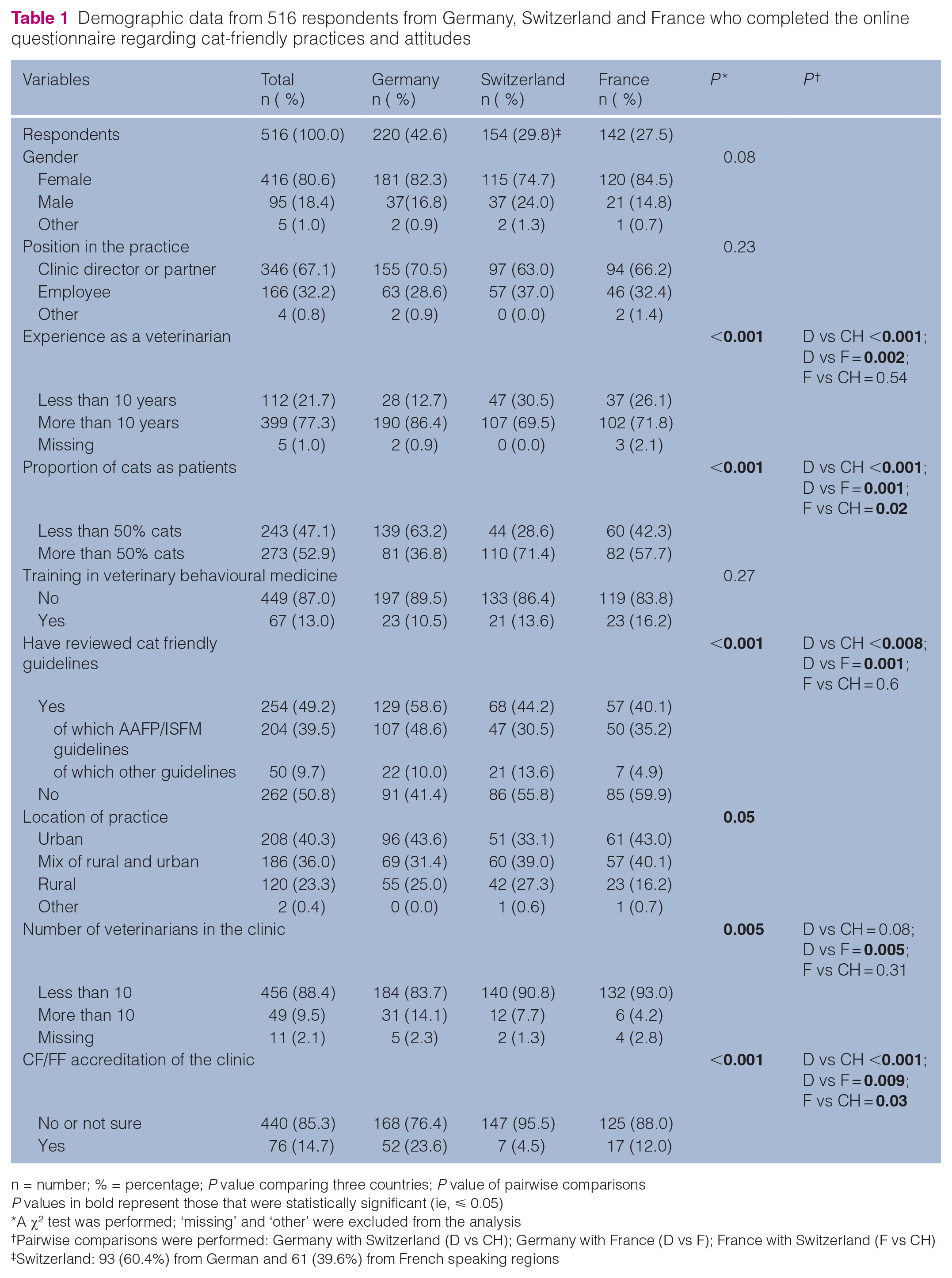
As outlined in Table 1, 516 veterinarians responded to the questionnaire, corresponding to an approximate response rate of 10% (n = 516/5000); 42.6% (n = 220/516) were from Germany, 29.8% (n = 154/516) were from Switzerland and 27.5% (n = 142/516) were from France. Participants were predominantly female (n = 416/516; 80.6%). Over two-thirds (n = 346/516; 67.1%) of participants were clinic directors or partners. Slightly less than 15% worked in a CF/FF accredited practice (n = 76/516; 14.7%), with German veterinarians overrepresented in this area (n = 52/220; 23.6%) compared with Swiss (n = 7/154; 4.5%; P <0.001) and French veterinarians (n = 17/142; 12%; P = 0.009) (Table 1).
Demographic data from 516 respondents from Germany, Switzerland and France who completed the online questionnaire regarding cat-friendly practices and attitudes
n = number; % = percentage; P value comparing three countries; P value of pairwise comparisons
P values in bold represent those that were statistically significant (ie, ⩽ 0.05)
A χ2 test was performed; ‘missing’ and ‘other’ were excluded from the analysis
Pairwise comparisons were performed: Germany with Switzerland (D vs CH); Germany with France (D vs F); France with Switzerland (F vs CH)
Switzerland: 93 (60.4%) from German and 61 (39.6%) from French speaking regions
Almost half (n = 254/516; 49.2%) of respondents reported having read cat-friendly guidelines, with differences between the three countries; German respondents were overrepresented (n = 129/220; 58.6%) in the group compared with Swiss (n = 68/154; 44.2%; P = 0.008) and French veterinarians (n = 57/142; 40.1%; P = 0.001) (Table 1).
Application of cat-friendly practices
As outlined in Table 2, during the consultation, 89.9% of respondents (n = 464/516) waited for the cat to leave the carrier voluntarily, and 82.8% (n = 427/516) examined the cat while allowing it to maintain its chosen position.
Summary of results from 516 respondents from Germany, Switzerland and France who answered ‘always’ or ‘often’ (for inverted questions ‘never’ or ‘sometimes’) to the 18/18 questions on cat-friendly practices

Data are number of respondents (n)/total and percentage (%)
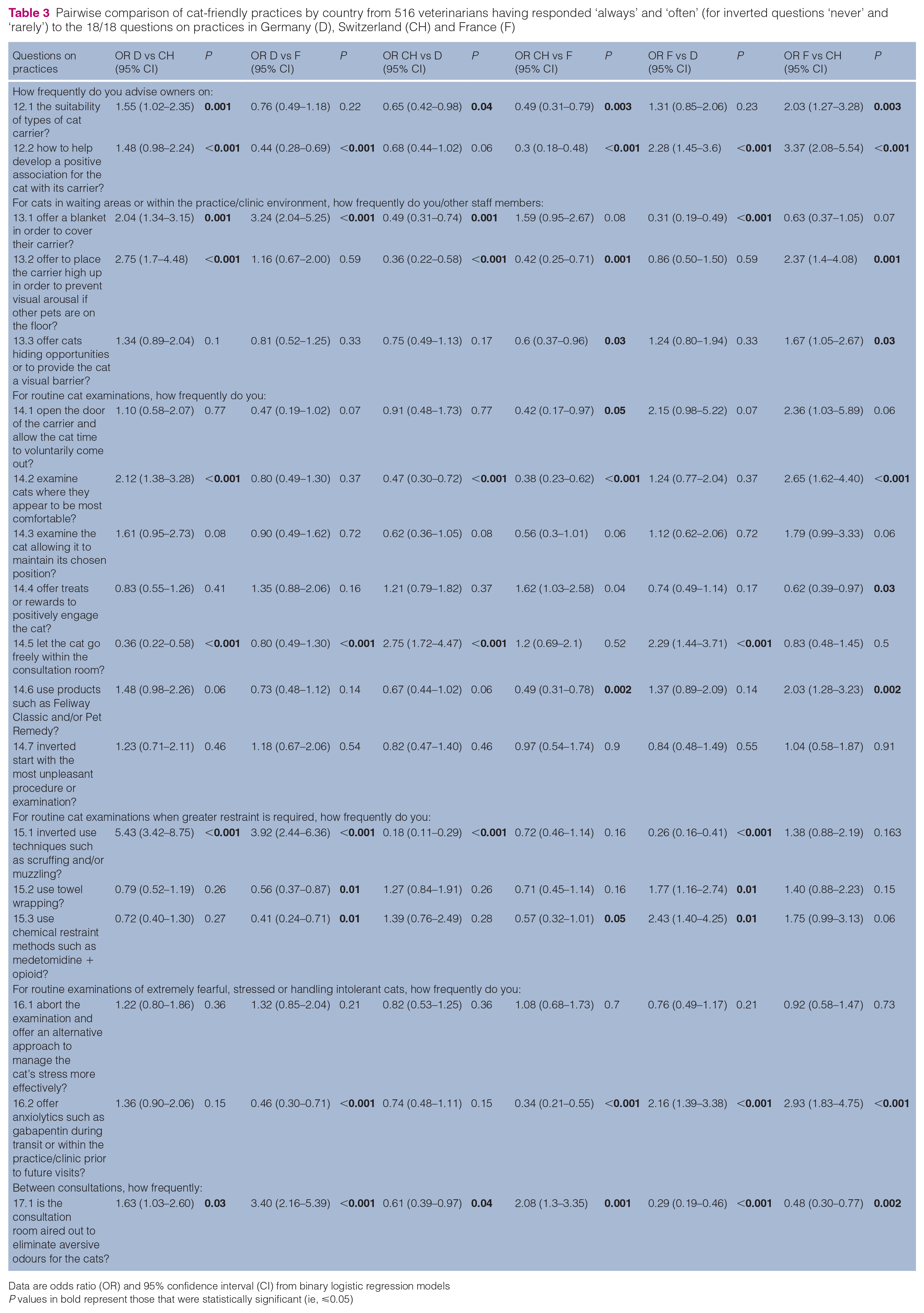
When restraint of the cat was required, 54.3% (n = 280/516) used a towel and 36.2% (n = 187/516) used scruffing or muzzling, with differences between the three countries; German respondents were more likely to avoid scruffing compared with French (OR = 3.92; 95% CI = 2.44–6.36; P <0.001) or Swiss (OR = 5.43; 95% CI = 3.42–8.75; P <0.001) respondents (Table 3).
Pairwise comparison of cat-friendly practices by country from 516 veterinarians having responded ‘always’ and ‘often’ (for inverted questions ‘never’ and ‘rarely’) to the 18/18 questions on practices in Germany (D), Switzerland (CH) and France (F)
Data are odds ratio (OR) and 95% confidence interval (CI) from binary logistic regression models
P values in bold represent those that were statistically significant (ie, ⩽0.05)
For cats exhibiting extreme fear–anxiety, 51.9% (n = 268/516) were prescribed anxiolytics for future visits, with differences between the three countries; French respondents were more likely to prescribe gabapentin as a pre-visit anxiolytic than their German (OR = 2.16; 95% CI = 1.39–3.38; P <0.001) and Swiss (2.93; 95% CI = 1.83–4.75; P <0.001) counterparts.
Cat-friendly attitudes
Veterinarians (n = 492/516; 95.3%) agree or strongly agree in being confident when examining cats and using as little restraint as possible (Table 4). Respondents (n = 486/516; 94.2%) also felt confident in recognising the early signs of cat stress and reducing the escalation of fear. Most respondents (n = 493/516; 95.5%) were motivated to have positive interactions with cats (Table 4).
Summary of results from 516 respondents from Germany, Switzerland and France who answered ‘strongly agree’ or ‘agree’ (for inverted questions ‘strongly disagree’ or ‘disagree’) to the 16/16 questions on attitudes

Data are number of respondents (n)/total and percentage (%)
Most respondents (n = 417/516; 80.8%) agreed or strongly agreed that caregivers expected them to prevent cat fear–anxiety during consultations (Table 4). However, only 37.6% (n = 194/516) agreed or strongly agreed that caregivers expected to be educated on reducing stress in their cats during transport. There were some differences between the three countries: French veterinarians were more likely to strongly agree or agree that taking sufficient time to treat the cat was an investment in longer-term financial benefits for the practice compared with Swiss (OR = 2.93; 95% CI = 1.73–5.05; P <0.001) and German (OR = 1.75; 95% CI = 1.05–2.97; P = 0.03) veterinarians (Table 5).
Pairwise comparison of cat-friendly attitudes by country from 516 veterinarians having responded ‘strongly agree’ and ‘agree’ (for inverted questions ‘strongly disagree’ and ‘disagree’) to the 16/16 questions on attitudes in Germany (D), Switzerland (CH) and France (F)

Data are odds ratio (OR) and 95% confidence interval (CI) from binary logistic regression models
P values in bold represent those that were statistically significant (ie, ⩽0.05)
Effect of demographics on practices and attitudes
Being aware of cat-friendly guidelines and working in a CF/FF accredited clinic were associated with greater scores for PCS as well as ACS (Table 6) and its three components: Capability-ACS, Opportunity-ACS and Motivation-ACS (Table 7).
Results from the stepwise linear regression model investigating the effect of respondents’ demographics on the practice cumulative score (PCS) and the attitude cumulative score (ACS)

PCS was measured by the addition of scores to the 17/18 questions on practices (ie, never = 1, rarely = 2, sometimes = 3, often = 4 and always = 5)
ACS was measured by the addition of scores to the 16/16 questions on attitudes (ie, strongly disagree = 1, disagree = 2, neither agree nor disagree = 0, agree = 3 and strongly agree = 4)
Data are regression coefficient, standard error, 95% confidence interval (CI)
P values in bold represent those that were statistically significant (ie, ⩽0.05)
Empty cells indicate demographic variables that were not retained in the final model
Results from the stepwise linear regression models investigating the effect of respondents’ demographics on the three subscores of the attitude cumulative score (ACS): Capability-ACS, Opportunity-ACS and Motivation-ACS

Capability-ACS is the sum of the scores of 4/16 questions (19.1;19.2;19.3;19.4); Opportunity-ACS the sum of the scores of 5/16 questions (20.1, 20.2, 21.4, 22.1, 22.2); and Motivation-ACS the sum of the scores of 7/16 questions (20.3, 20.4, 21.1, 21.2, 21.3, 22.3, 22.4)
Data are regression coefficient, standard error, 95% confidence interval (CI)
P values in bold represent those that were statistically significant (ie, ⩽0.05)
Empty cells indicate demographic variables that were not retained in the final model
Similarly, respondents with prior training in animal behaviour were associated with a higher PCS, ACS, Capability-ACS and Motivation-ACS (Figure 2). Participants with over 10 years of experience were associated with a higher ACS and Capability-ACS. By contrast, veterinarians in the position of employee were shown to have a lower PCS, as well as a lower Motivation-ACS. Veterinarians that reported working in a clinic with over 10 veterinarians had lower ACS, Capability-ACS and Opportunity-ACS than those working in smaller clinics. Respondents’ country of work did not significantly contribute to the multiple regression models (Table 6).

Schematic figure summarising the results of the stepwise linear regression models for the effect of respondents’ demographics on the practice cumulative score (PCS), the attitude cumulative score (ACS) and the subscores, that is, Capability-ACS, Opportunity-ACS and Motivation-ACS. Green = significant positive association of demographics with PCS, ACS or subscores; orange = significant negative association of demographics with PCS, ACS or subscores; grey = no significant association of demographics with PCS, ACS or subscores. PCS was measured by the addition of scores to the 17/18 questions on practices (ie, never = 1; rarely = 2; sometimes = 3; often = 4; and always = 5). ACS was measured by the addition of scores to the 16/16 questions on attitudes (strongly disagree = 1; disagree = 2; neither agree nor disagree = 0; agree = 3; and strongly agree = 4). Capability-ACS is the sum of scores of 4/16 questions (19.1, 19.2, 19.3, 19.4), Opportunity-ACS is the sum of scores of 5/16 questions (20.1, 20.2, 21.4, 22.1, 22.2) and Motivation-ACS the sum of scores of 7/16 questions (20.3, 20.4, 21.1, 21.2, 21.3, 22.3, 22.4)
Discussion
The present study aimed to fill a knowledge gap regarding cat-friendly practices and attitudes towards cat-friendly methods among veterinarians from Germany, France and Switzerland. The study also aimed to better understand factors associated with the application of cat-friendly guidelines.
There are four key findings from this study. First, of the practices explored in the questionnaire, 3/18 were applied often or very often by more than 80% of respondents, 12/18 by 50–80% of respondents, 2/18 by 20–50% of respondents and 1/18 by less than 20% of respondents, thus highlighting a various application of cat-friendly recommendations. Second, over 65% of participants agreed or strongly agreed that they felt capable, motivated and had the opportunity to apply cat-friendly methods. There was one exception to these results, with only 37.6% of respondents agreeing they had the opportunity to advise caregivers on how to reduce their cat’s stress during transport. Third, having reviewed cat-friendly guidelines or working in a CF/FF accredited clinic were positively associated with PCS as well as with the three components of ACS: Capability-ACS, Opportunity-ACS and Motivation-ACS. By contrast, having an employee position was associated with a lower PCS and Motivation-ACS, and working in a clinic with over 10 veterinarians was associated with a lower overall ACS. Finally, respondents’ countries were not associated with PCS.
Application of cat-friendly practices
With over 80% of participants having reported to always or often allowing the cat to maintain control over its environment in the veterinary context, the results of the current study were similar to previous research among veterinary professionals working primarily in the UK. 11
There were significant differences in the prescription of anxiolytic prior to consultation; 67.7% of respondents working in France prescribed pre-visit gabapentin to alleviate cat fear–anxiety compared with less than 50% of both Swiss and German respondents. This variation may depend on national regulation for prescribing non-veterinary medications, professional experience and habits, and the training curriculum between the countries. 5 These differences may also depend on misconceptions such as fear of side effects regarding particular medications, as has been reported for the prescription of analgesics in veterinary practices.17,18 Caregiver’s awareness regarding the deleterious impact of stress on their cat, as well as their personal experience with psychoactive medication, may also play a role in the administration of anxiolytic drugs in cats prior to a veterinary visit. 19 Further research on both veterinarians and caregivers is needed to better understand the differences between the three countries in given pre-appointment medication (ie, gabapentin) despite its well established effectiveness in safely alleviating cat stress.20 –23
Furthermore, there were some differences between countries regarding the use of semiochemicals (pheromones or valerian-based products) to prevent or decrease stress, with Swiss respondents using semiochemicals the least (40.3%) and French respondents the most (57.7%). The French results were closer to the results of previous studies conducted in the UK, with 72–88% of respondents using pheromones.11,24 As evidence is still scarce on the effectiveness of semiochemicals in reducing cat stress in the veterinary environment,25,26 these differences may be attributed to the promotion by the product manufacturer depending on the country.
Attitudes towards cat-friendly methods
The current study suggests that respondents felt responsible for limiting their feline patients’ stress; they generally agreed to being confident in their skills to identify, prevent and mitigate fear–anxiety in cats. These findings are consistent with the previous literature.11,27,28
While most respondents (87.4%) agreed to being confident in advising caregivers on appropriate transportation of their cat, only a minority (37.6%) agreed that caregivers expect to be advised on how to prevent stress during the transportation process. Research reported that caregivers from the UK expected to be informed of preventive healthcare, but veterinarians felt that caregivers lacked interest in receiving such information, with time pressure being an additional cause for not informing caregivers during preventive healthcare consultation.29,30 Time pressure did not appear to be an issue in the current study, as most respondents (78.1%) agreed that it was possible to take time to offer recommendations to caregivers on appropriate transportation of their cat. Further exploration of the mutual expectations of veterinarians and caregivers is crucial for removing mismatched expectations, improving communication and ensuring cat stress prevention in the veterinary context.
Associated factors to cat-friendly practices and attitudes
In line with previous literature,5,11 the current results highlight that working in a CF/FF accredited clinic is associated with an increase in PCS and ACS. In addition, having reviewed cat-friendly guidelines or having been trained in animal behaviour was positively associated with PCS and with Capability-ACS, Opportunity-ACS and Motivation-ACS. In the current study, only 49.2% of respondents had read cat-friendly guidelines, suggesting a lack of knowledge on cat-friendly methods. Furthermore, as only 13% of respondents had attended courses on animal behaviour and there is some evidence that teaching of ethology-centred handling methods in the veterinary curriculum is limited, 28 respondents may have lacked knowledge on the underlying causes of cat stress, 12 and various means to reduce it. 31 Finally, since the cat-friendly guidelines are available in English, the language barrier could explain why only half of the respondents had read them. 32
The current study highlights that being an employee rather than a clinic director or partner was associated with a lower motivation score (Motivation-ACS) and cat-friendly practices (PCS). Even though no similar study exists with which to compare these results, potential explanations to limited motivation in applying cat-friendly methods may include a lack of capability acquired through experience and training, as employees of a veterinary clinic are more frequently in the early stages of their professional career 33 and may not have received adequate training on the importance of cat-friendly practices. 34 Furthermore, environmental factors can lead to employees having little autonomy in their work, since many employers do not have the clinic team working collaboratively 35 and this may decrease motivation in preventing cat fear–anxiety. 36
The present study found that working in a larger clinic was associated with a lower ACS. This finding refutes previous work emphasising that, compared with smaller veterinary clinics, larger clinics apply protocols more rigorously 37 and adopt new protocols more quickly. 38 In the current study, clinic size (ie, > 10 veterinarians) may be a confounding factor, given that positions held by the veterinary staff are generally at the employee level. However, working in a larger clinic may cause employees to feel unsupported by their superiors in applying cat-friendly recommendations or experience additional workload during busy working days,36,37 thus leading to a decrease in opportunity or commitment to apply cat-friendly methods.
In the context of the growing number of larger veterinary clinics across Europe, 33 the findings of the current study stress the importance of creating strategies to support teams in implementing cat-friendly interventions. These strategies include multimodal interventions such as the prevention of infections in veterinary clinics (ie, provision of training, display of posters or technique guidelines, evaluation of adherence rates and reinforcement by leadership and role modelling). 37
Study limitations
The current study has several limitations. First, there is an overrepresentation of female respondents (80.6%) compared with the population of veterinarians, which is about 60% female, 33 causing a limitation in the generalisability of the results. Indeed, more female veterinarians responded to the questionnaire because they may be more sensitive to animal welfare than male veterinarians.39,40 There is also some evidence suggesting that the online survey response rate is higher among female than male participants. 41
Second, the approximative response rate of 10% limits the generalisation of the findings. Indeed, overrepresentation of respondents concerned with cat welfare cannot be excluded as a source of bias.
Third, the self-reporting method may have led respondents to overrate their responses 42 compared with the practices that may be observed as demonstrated in previous research on Fear Free clinics after having first interviewed veterinarians and then observed their consultations. 27 Respondents of the current study may also have overestimated their capacities, with previous research indicating 77% of veterinarians felt confident to identify fear–anxiety or frustration; 27 however, when observed in practice, the veterinarians did not identify dog fear–anxiety or frustration in 50% of cases. 43
Conclusions
The results of the current study emphasised veterinarians’ agreement with being capable, motivated and having the opportunity to apply cat-friendly methods; however, some cat-friendly practices were partially implemented and there were significant differences between Germany and Switzerland, as well as France. This variation in the application of cat-friendly practices stresses the importance of veterinary associations and schools placing greater emphasis on the standardisation of application of cat-friendly practices through professional development and curricula.
Holding an employee position and working in larger clinics were associated with a decrease in cat-friendly practices and in agreement with being capable, motivated and having the opportunity to apply cat-friendly methods. Given the increase both in the number of staff with employee status and the number of larger practices in European countries, these findings stress the importance of developing management styles that actively support programmes to sustainably strengthen the implementation of cat-friendly recommendations.
Supplemental Material
File 1
Questionnaire on cat-friendly practices and attitudes.
Supplemental Material
File 2
Information letter.
Supplemental Material
File 3
Consent statement.
Footnotes
Acknowledgements
We are thankful to Dr Anneli Muser Leyvraz and Dr Petra Busch for their help in translating the questionnaire from English into French and German. We also thank Caroline Johnston for providing the authors with some questions on cat-friendly practices. We also thank all the veterinarians and veterinary organisations from Germany, Switzerland and France who promoted this survey.
Author note
The results of this study were presented in part at the Swiss Veterinary Annual Congress 2024.
Supplementary material
The following files are available as supplementary material:
File 1: Questionnaire on cat-friendly practices and attitudes.
File 2: Information letter.
File 3: Consent statement.
Conflict of interest
ND is employed by International Cat Care as head of the International Society of Feline Medicine. The remaining authors declare that the research was conducted in the absence of conflict of interest.
Funding
The authors received no financial support for the research, authorship, and/or publication of this article.
Ethical approval
This work did not involve the use of animals and therefore ethical approval was not specifically required for publication in JFMS.
Informed consent
This work did not involve the use of animals (including cadavers) and therefore informed consent was not required. No animals or people are identifiable within this publication, and therefore additional informed consent for publication was not required.

References
Supplementary Material
Please find the following supplemental material available below.
For Open Access articles published under a Creative Commons License, all supplemental material carries the same license as the article it is associated with.
For non-Open Access articles published, all supplemental material carries a non-exclusive license, and permission requests for re-use of supplemental material or any part of supplemental material shall be sent directly to the copyright owner as specified in the copyright notice associated with the article.
