






Abstract
An increasing number of rodents are housed in individually ventilated cage (IVC) systems, as these seem to be very effective for the protection of animals against infections, as well as protecting the staff against allergens. For the IVC systems to be properly ventilated, a huge amount of air has to be blown into the cage, which may cause a draught at animal level inside the cage. The aim of the present study was to evaluate the preferences of mice for differing levels of air speeds and air changes inside the cage. It has been concluded that mice do react to draughts, whereas they do not seem to be affected by a high number of air changes delivered without draught, which underlines the importance of applying draught-free IVC systems for mice.
An increasing number of mice are housed in individually ventilated cage (IVC) systems either to protect them against infections 1–3 or to protect the staff against allergens. 4–6 However, only a limited number of studies have been conducted to evaluate how mice are affected by these systems. The number of air changes in various types of IVC systems ranges from 50 to 120 times/h. To achieve such a high number of air changes, the air must be blown into the cage at a relatively high speed, and depending on the cage design, air speed at animal level can be from 0.2 m/s to more than 1.0 m/s. At a certain level, air speed and air changes may affect the animals' welfare and wellbeing. Previous studies have shown an impact on the physiology and preferences of rats exposed to a high number of air changes. 7 Another study also showed that mice are affected when housed in IVC systems, 8 although it was unclear as to what extent the effects came from the air speed or the air changes. Different methods may be applied to evaluate the effects of various housing conditions. Previously telemetric monitoring of heart rate and systolic blood pressure, and preference tests have been applied for evaluating how various conditions affect the animal's welfare and wellbeing. 9,10 Rats were shown to be affected by the number of air changes, both with regard to heart rate and blood pressure, and also with regard to preference, whereas air speed did not affect the rats. 7 The aim of the present study was to evaluate how mice were affected by different air speeds and air changes in the cage. Two studies were designed: one analysing whether low air speed (0.5 m/s) and high air speed (1.0 m/s) affected the mice, and another study analysing whether different air changes (40, 80 and 120 times/h) affected the mice. Both studies were evaluated by the use of the preference test.
Ten Sca:NMRI female mice (Scanbur A/S, Sollentuna, Sweden) aged four months at the onset of the study were, prior to testing, randomly marked and housed in groups of five in two type III cages with bedding (Tapvei, Kortteinen, Finland), wood sticks (Lillico, Surrey, UK), paper house ‘Des.Res.TM’ (Lillico) and nesting material ‘Enviro-Dri®’ (Lillico). The cages were changed twice a week and food (Altromin 1324, Brogården, Gentofte, Denmark) and water were provided ad libitum. The preference test was set up as previously described using two type II cages (Tecniplast, Gazzada, Italy), interconnected with a PVC tube, placed on a computer-logged digital weight. 10 Two set-ups were placed simultaneously in a ventilated cabinet (Scantainer, Scanbur A/S, Karslunde, Denmark) in a separate room with no other animals present, and with automatic day/light shift (06:00–18:00 h), room temperature at 23 ± 1°C and relative humidity at 50 ± 10%. The room and the ventilated cabinet were ventilated 10–15 and 70 times/h, respectively. Two night time (18:00–06:00 h) and two day time (06:00–18:00 h) periods were analysed for each mouse in each study. To avoid bias, the preference for the different ventilation parameters in the set-up was validated before testing (control period) by placing the mice one by one in the set-up to choose between two identical type II cages without any air changes or air speed, noting that they actually chose the left and the right cage equally. For the monitoring of air change frequency, the mice were placed individually in the preference set-up in type II cages, and with one of the cages in each set-up equipped with the specially designed filter top (Figure 1a) to provide the required number of air changes without causing draught in the cage. The preferences for 40, 80 and 120 number of air changes were registered. When the mice were not in the preference set-up, they were socially housed for at least two weeks in an ordinary type III cage. For the monitoring of the impact of air speed, the mice were placed individually in the preference set-up, given the choice between a type II cage and a specially designed cage (Figure 1b), with air being blown into the cage through 12 small holes along the sides 1 cm above the bedding (same as above) with an air change of 40 times/h. First, the animals were tested for preferences at low air speed (0.5 m/s, 12 holes on each side) and then at high air speed (1.0 m/s, 6 holes on each side) with no enrichment in the cages, and then again for both speeds with enrichment (as described above) in the cage. The air speed was measured using a Testo400 equipment (Testo GmbH, Lenzkirch, Germany). When the mice were not in the preference set-up, they were housed for at least two weeks in a normal type III cage with social companionship. The results were analysed by the use of one-sample t-test (Minitab version 14, Minitab Inc, State College, PA, USA) testing whether the distribution between the two cages was 50/50, as the data were found to be normally distributed by the Anderson–Darling test. The null hypothesis was set as being no effect of housing on the preference (50/50 distribution between the two cages) versus the alternative hypothesis, that an effect would be observable.
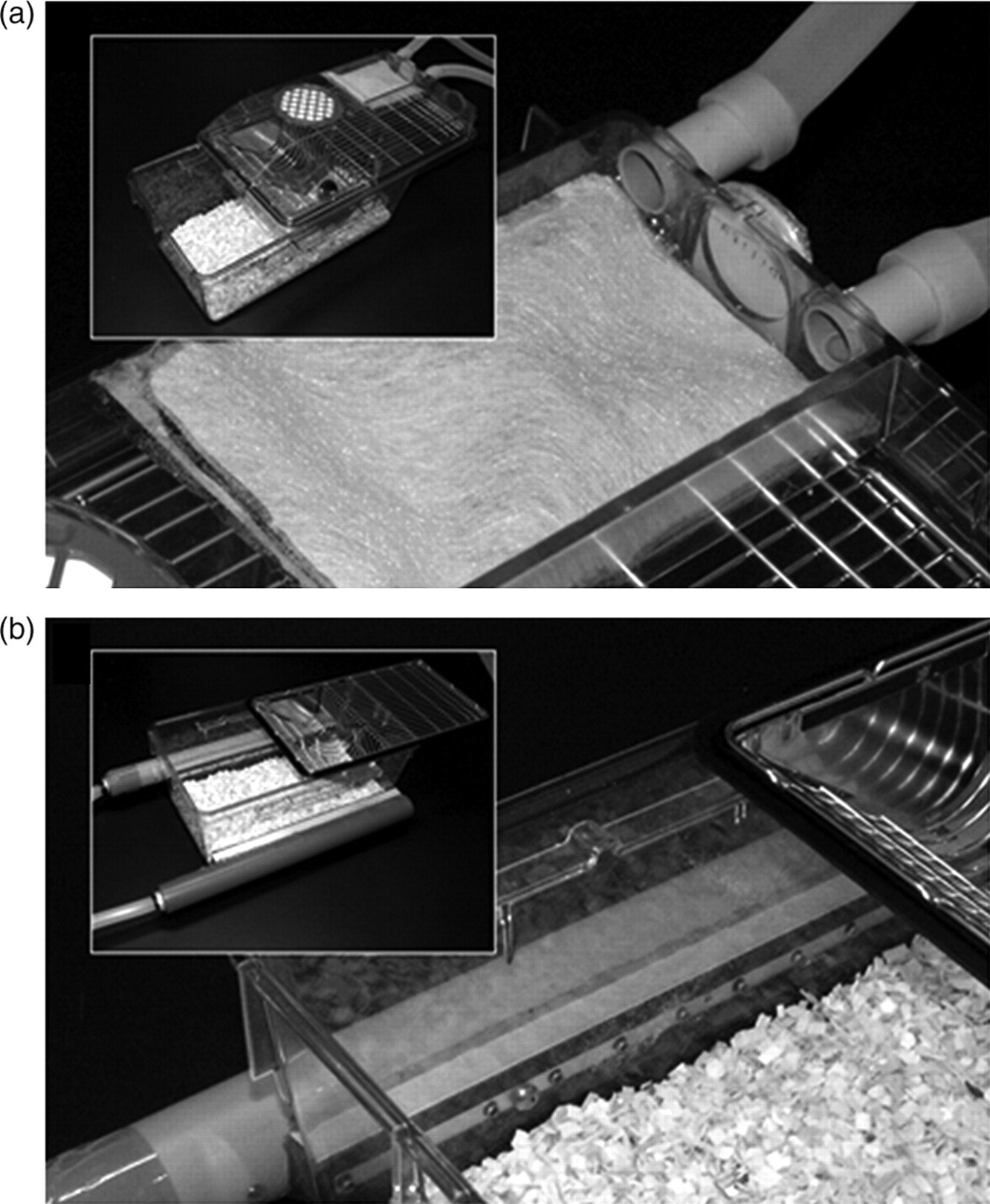
The cages used for the air change and air speed studies in 10 Sca:NMRI female mice. (a) The cage used for the air change study. The rebuilt filter top with a specially designed chamber is equipped with filter paper for diffusion of the air to prevent draught inside the cage, and the back of the chamber equipped with two silicone tubes connected to a ventilator distribute 40, 80 or 120 air changes/h. (b) The cage used for the air speed study. Inflowing air passed through an outside PVC tube connected to 12 small holes placed 1 cm above the bedding. One end of the tube was closed, whereas the other end was through a silicone tube connected to a ventilator giving 40 air changes/h. With all holes open, air speed at animal level was 0.5 m/s, and with every second hole open, air speed at animal level was 1.0 m/s
During the control period, the mice chose the left and the right cage equally (Figure 2a). The number of air changes did not seem to affect the animals' choice for either side of the cages, as only one significant preference, i.e. 40 air changes during night time, was observed (P < 0.05). Mice deselected cages with air speed, with no regards to whether these were enriched or not, and to whether the air speed was low or high (Figure 2b).
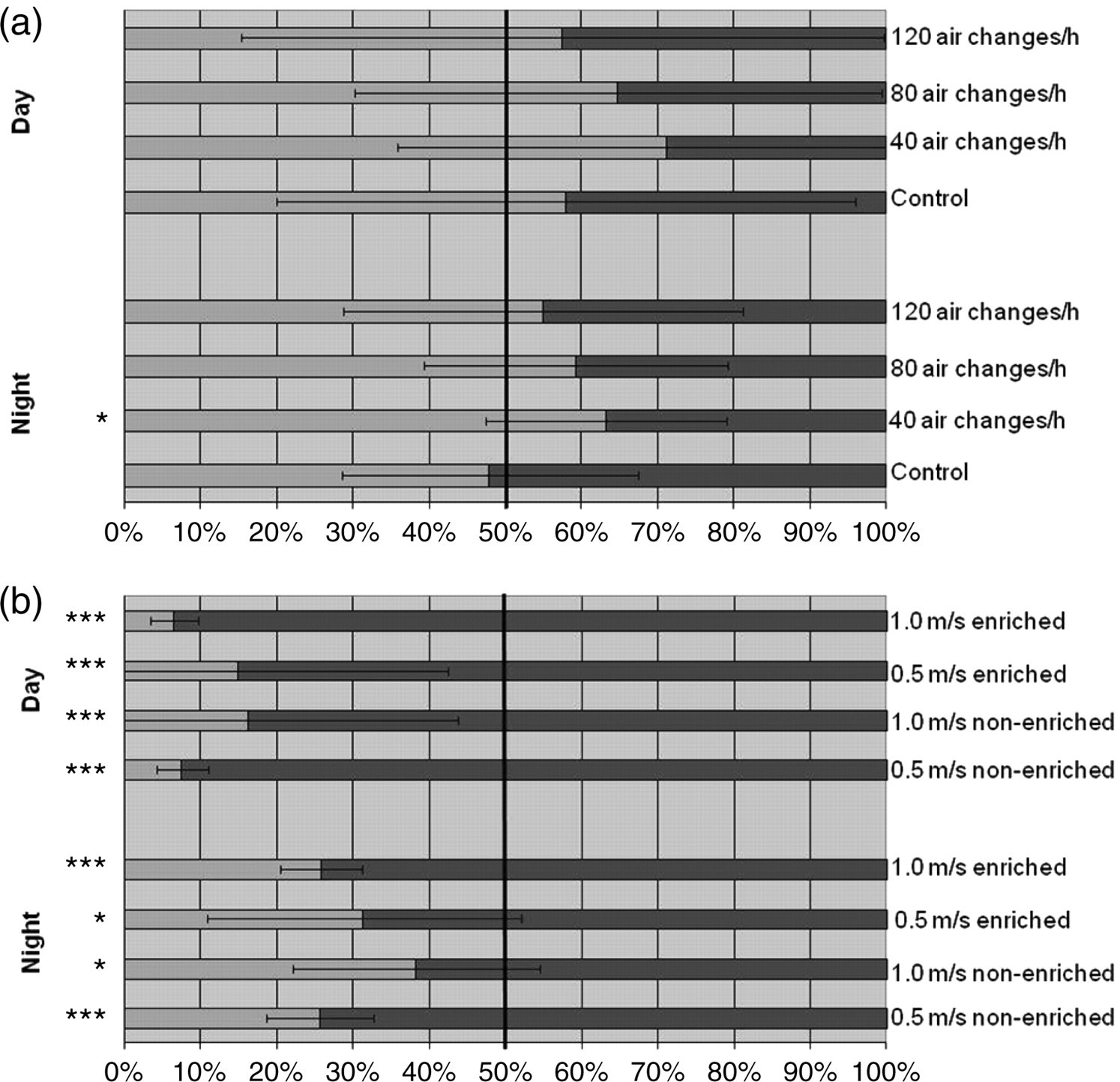
The dwelling time for the air change and air speed studies in 10 Sca:NMRI female mice. The distribution of dwelling time between the left and the right cage for the day and night is shown. The left side (light grey) shows the percentage dwelling time in the cage with the ventilation parameter, either air change or air speed, whereas the right side (dark grey) shows the percentage dwelling time in the cage without ventilation or air changes. (a) Data for the control with two identical cages without ventilation or air changes and for the three different air changes. (b) Air speed data with as well as without enrichment. The 50% distribution is marked with a bold line, and for each result the standard deviation is marked. *P < 0.05; ***P < 0.001
Draught seems to be an important factor when housing mice in IVC systems, as the mice clearly rejected the cages with a notable air speed (Figure 2b), whereas the number of air changes seems to be of minor importance. This is in clear contrast to a previous study on rats, in which the rats rejected cages with a high number of air changes, but did not seem to react on draught.
7
The commercially available IVC systems deliver an air change rate from 30 to 100 air changes/h according to their own information (