



Abstract
Practical relevance:
Acid-related disorders including esophagitis and gastroduodenal ulceration are uncommon in the cat. However, when they occur, they can have devastating consequences and require targeted intervention, including the use of gastroprotectants. Careful consideration of the causes of esophagitis and gastroduodenal ulceration can help the clinician to determine which gastroprotectant to use, and when to begin and end gastroprotective therapy.
Clinical challenges:
Gastroprotectants remain one of the most misused classes of drugs in veterinary and human medicine. There are very few studies evaluating the efficacy of gastroprotective agents in cats. Furthermore, goals for the degree of gastric acid suppression are extrapolated from studies performed in dogs and humans.
Aims:
This review provides a foundation for the logical approach to the choice of gastroprotectant as indicated by the disease process, and is aimed at all veterinarians who prescribe gastroprotectants for use in cats.
Evidence base:
The guidance provided in this review is supported by current literature, including consensus opinion from the American College of Veterinary Internal Medicine. Gaps in evidence for use of gastroprotectants in cats are filled by extrapolations from studies performed in dogs and humans.
Gastric acid and the mucosal barrier
Gastric acid plays several important roles in health. The low luminal pH created by gastric acid secretion renders the stomach an inhospitable environment for the colonization of unwanted, and potentially pathogenic, ingested bacteria. Gastric acid also facilitates the breakdown of food by catalyzing the conversion of pepsinogen into pepsin, the enzyme tasked with the initial breakdown of dietary protein prior to intestinal digestion and absorption. Furthermore, pepsin is required to cleave vitamin B12 from dietary protein, allowing for its subsequent absorption via intrinsic factor. 1 Additionally, the low pH environment of the stomach increases the solubility of minerals such as iron2,3 and calcium, 4 enhancing their absorption.
The major mediators involved in gastric acid secretion are acetylcholine, gastrin and histamine (Figure 1). These ligands bind to their respective receptors on the gastric parietal cell, and their different intracellular signaling mechanisms converge onto a final common pathway to activate the The gastric mucosal barrier comprises defense mechanisms that protect the gastric mucosa against autodigestion by gastric acid or other noxious substances present in the stomach. These defense mechanisms include: a bicarbonate-rich double mucus layer; a single layer of epithelial cells, which express negative charge on their surface to help repel acids and are capable of rapid cellular restitution (a process involving cellular migration, independent of cell division) to help cover denuded areas; cytoprotective prostaglandins; and a rich blood supply that aids in rapid repair following injury.

The three acid secretagogs (acetylcholine, gastrin and histamine) stimulating the gastric parietal cells to release hydrogen ions into the gastric lumen. ACh = acetylcholine; CCK2 = cholecystokinin 2; ECL = enterochromaffin-like; ENS = enteric nervous system. Reproduced, with permission, from Medical Physiology, 3rd ed, by WF Boron and EL Boulpaep, 2016. © Elsevier
While the gastric diffusion barrier provides excellent local protection against acid, the more distal segments of the bowel have less protection against a low pH solution. Entry of the acidic gastric contents through the pylorus stimulates the pancreas and proximal duo denum to secrete bicarbonate and mucus, sparing the small intestine from erosion and ulceration.
Importance of gastroprotection
The importance of gastric acid in normal physiology is unequivocal. However, erosion and ulceration often develop when there is an imbalance between the protective mechanisms provided by the mucosal barrier and caustic agents such as gastric and bile acids. Not only will the epithelial cells that line the gastro intestinal tract be destroyed by the low pH and digested by pepsin, but protons will traverse the damaged epithelium and stimulate inflammation. At first, the vasodilation secondary to inflammation can be beneficial in increasing mucus and bicarbonate secretion. However, if severe, the inflammatory response leads to a decrease in blood flow and perpetuates further cellular injury.
Delaying measures to support ulcer healing could lead to hemorrhage and gastrointestinal perforation. 5 Thus, it is necessary to remove the underlying cause of injury, when possible, and initiate treatment with gastroprotective agents, which serve to protect the damaged epithelium from the caustic gastric contents by either increasing gastric pH or bolstering the gastric mucosal barrier. Commonly used options for gastroprotection include gastric acid suppressants, cytoprotectants and antacids.
Options for gastroprotection
Readers should be aware that some of the drugs discussed in this article may not be available or legal to prescribe in their own country. it is the responsibility of the clinician to follow local rules.
Gastric acid suppressants
Gastric acid suppressants are recommended as the first-line medical treatment for esophagitis and gastroduodenal ulceration in cats and are thought to be superior to the other gastroprotectants reviewed in this article. Gastric acid suppressants include histamine-2 receptor antagonists (H2RAs; eg, famotidine, ranitidine and cimetidine) and proton pump inhibitors (PPIs; eg, pantoprazole, esomeprazole, omeprazole and lansoprazole).
Histamine-2 receptor antagonists
The H2RAs decrease gastric acid secretion by competitively inhibiting the histamine-2 receptor on the parietal cell rather than by directly targeting the proton pump. 6 Ranitidine is an ineffective gastric acid suppressant in cats. 7 Cimetidine is thought to be less potent than famotidine and may have a higher risk of adverse effects. Therefore, only famotidine is recommended for use in cats when gastric acid suppression is desired.
Like ranitidine, famotidine has a weak effect on promoting gastric emptying but much larger dosages are required to achieve this prokinetic effect. 8 Famotidine can be given orally, subcutaneously or intravenously. When administered orally at standard dosages (Table 1), the drug is not only a relatively weak gastric acid suppressant in cats, it also has a diminished effect with repeated oral administration over time.9,10 This occurs within 2–3 days of instigating oral administration. Thus, orally administered famotidine is an acceptable choice only when weak acid suppression is required or for one-time situational use (eg, preanesthetic administration) and is not recommended when a severe acid-related disorder is suspected.
Feline gastroprotectant dosages

*See text for discussion of preferred route of administration for specific indications CRI = constant rate infusion; IV = intravenously; PO = orally; SC = subcutaneously
Despite its widespread use, there are only a handful of preclinical studies evaluating the effect of parenterally administered famotidine in cats. These studies served as preliminary investigations toward the use of famotidine for humans. in one such study, cats were fitted with a fistula cannula in their stomach to measure gastric pH. 11 When administered as a bolus injection, famotidine had a potent acid-suppressant effect with a very rapid time to maximum efficacy, but this effect had a relatively short half-life. 11 There fore, as with oral administration, twice-daily parenteral famotidine administration is unlikely to be sufficient for the treatment of severe esophagitis or gastroduodenal ulceration.
In the aforementioned preclinical study with cats, 11 and two studies in healthy dogs,12,13 famotidine administered as a constant rate infusion (CRi) has been demonstrated to be highly effective. Therefore, a famotidine CRi is used commonly by the authors for cats with severe acid-related disorders and no complications have been documented with this practice. Famotidine has a relatively wide therapeutic margin, and very few adverse effects have been described with its use. The concern for hemolysis related to intravenous famotidine administration in cats was disproven. 14
Proton pump inhibitors
The PPIs are administered as prodrugs that require the acid environment of the activated parietal cell canaliculi for conversion into their active form. once activated, the drug becomes trapped in the canaliculi where it irreversibly binds to the proton pump, rendering the acid pump permanently inert. 15
The PPIs are available in oral and injectable formulations. There is one preclinical study (again a gastric fistula cannulated feline model) evaluating the acid-suppressing effect of a bolus intravenous injection of omeprazole compared with famotidine. While famotidine had the same quick inhibitory effect, omeprazole had a longer lasting effect over a 24 h period. 16 Therefore, either omeprazole or esomeprazole is preferred over famotidine when prolonged acid suppression is needed, such as with the treatment of gastroduodenal ulceration. Based on studies evaluating orally administered PPIs in cats and parenterally administered PPIs in dogs, twice-daily administration is recommended when standard dosages of PPIs are administered (Table 1).7,10,17 Although iV pantoprazole is thought to be effective in cats, it is important to note that the evidence for its effect on feline gastric pH is limited to a single case report. 18 To the authors’ knowledge, there are no published studies evaluating the efficacy of oral pantoprazole for raising gastric pH in cats.
Newer PPIs, such as dexlansoprazole and lansoprazole, are used for the treatment of acid-related disorders in humans. At the time of publication of the American College of Veterinary internal Medicine (ACViM) consensus statement on gastroprotectants in dogs and cats, it was unknown if these newer formulations offered any advantage, 19 but it has subsequently been determined that dexlansoprazole and lansoprazole are ineffective acid suppressants compared with esomeprazole 20 or omeprazole, and should not be used for gastric acid suppression in cats.
Although PPIs can take up to 4 days to reach maximum effect, they have a longer duration of action than H2RAs, as previously mentioned; they have the same or better ability to raise gastric pH over the 24 h period as H2RAs on day 1 16 and are clearly superior by day 4.7,10 Moreover, since the PPIs require the acid environment of the parietal cell canaliculi for conversion into their active form, and H2RAs decrease the acidity of the parietal cell, concurrent H2RA and PPi administration is not recommended when aggressive acid suppression is the goal, such as with the treatment of esophagitis or gastroduodenal ulceration.
occasionally, in cases where severe gastro esophageal reflux is suspected, an H2RA may be used at nighttime alongside twice-daily PPI use. The enteric-coated omeprazole tablets can be split to help provide optimal dosing for feline patients. 10 Although the split tablet likely underperforms in the first few days of administration, continued use helps to raise gastric pH and essentially provides the ‘enteric coating’ in the stomach required for resistance of premature tablet degradation.
Several adverse effects have been described with omeprazole use in cats, including a mild alteration of resident intestinal microbiota (dysbiosis) while the drug is administered. 21 Unlike with antibiotics, the dysbiosis will resolve within days following discontinuation of the drug. Cats who receive long-term PPi therapy (⩾60 days) may also experience rebound gastric acid hypersecretion if the drug is abruptly discontinued; 22 therefore, a more gradual taper is recommended following long-term use. Based on studies in non-feline species, there is concern that PPi administration in cats might also decrease the absorption of other concurrently administered drugs that require an acid environment, such as cephalo sporins,23,24 azole antifungals 25 and myco phenolate. 26 Additionally, PPi administration may alter the efficacy of concurrently administered drugs through inhibition of cytochrome P450 enzymes. Most notably, PPIs were thought to decrease the efficacy of clopidogrel through this mechanism. However, a study in dogs showed that, while the inactive metabolite of clopidogrel was increased, the efficacy was not significantly altered. 27
Cytoprotectants
Another important class of gastroprotectants are those that restore the gastric mucosal barrier via cytoprotection – namely, sucralfate and barium. in the acidity of the stomach, sucralfate dissociates into sucrose octasulfate and aluminum hydroxide. Sucrose octasulfate forms stable bonds with the protein-rich exudate at ulcer sites, serving to prevent the diffusion of acid across the gastroesophageal epithelium, as well as protecting the ulcer site against the proteolytic effects of pepsin. 28 Aluminum hydroxide confers mild acid-buffering capacity. 28 Sucralfate was shown to perform better than placebo in accelerating healing of gastroduodenal ulceration; 29 however, at the time of writing, there is no study comparing PPi monotherapy with sucralfate or combination therapy.
Sucralfate should be administered as a slurry rather than an intact tablet, 30 with the timing organized so as to separate sucralfate administration from other medications that are dependent on gastric acidity (eg, PPIs, tetracyclines, etc).30–32 Sucralfate should only be given once the animal is well hydrated and caution should be used in cats with chronic
kidney disease (CKd) due to concern for constipation, hypovolemia and, as a result, exacerbation of azotemia. 33 Compliance is a concern as many cats do not accept the chalky taste of sucralfate or the need for frequent administration. Therefore, if owner compliance is expected to falter, or administration 2 h before or after other medications would not be possible, the authors would recommend PPi therapy over sucralfate for the treatment of gastroduodenal ulceration.
While experimental studies have shown that sucralfate exhibits a cytoprotective effect on healthy esophageal mucosa prior to acid-induced esophagitis, 34 there are no studies indicating that sucralfate exhibits the same protective mechanisms when applied after the esophageal injury has already occurred. This is likely due to the fact that sucralfate requires an acid environment to exert its protective mechanism. 28 However, in contrast to gastroduodenal ulceration, the authors would more strongly recommend the administration of sucralfate in patients with esophagitis. Extrapolations from human medicine indicate that while sucralfate does not significantly impact the healing rate in patients with esophagitis, it appears to exert a soothing effect on the irritated mucosa, increasing the patient’s comfort level earlier than placebo. 35 Regardless, the most impactful medication for treating esophagitis is a PPi.
Barium, like sucralfate, is believed to exert mucosal-protecting effects and have hemostatic properties. However, to the authors’ knowledge, there are no studies evaluating barium for gastrointestinal bleeding in cats. in humans, barium is effective at treating lower gastrointestinal bleeding, although the risks of administration to a vomiting patient (ie, fatal aspiration pneumonia) must be weighed against the potential benefits. 36
Prostaglandin analogs/misoprostol
Endogenous prostaglandins help to maintain a healthy gastrointestinal tract by stimulating secretion of bicarbonate-rich mucus, enhancing mucosal blood flow and promoting epi thelial turnover. Misoprostol is a synthetic prostaglandin E1 analog that is purported to confer similar benefits. However, this drug has been demonstrated to protect dogs solely in the context of non-steroidal anti-inflammatory drug (NSAid)-induced gastric injury, and only when given prior to the injury occurring. Studies evaluating the use of misoprostol in cats are lacking, and NSAid-induced gastro intestinal injury appears to be uncommon in cats compared with dogs.
Caution is recommended when handling misoprostol as it can induce abortion in both pregnant women and queens.
Antacids
Antacids, such as calcium carbonate, aluminum hydroxide and magnesium hydroxide, neutralize gastric acid. However, because there is no inherent acid-suppressing mechanism, this effect is transient. A potential solution would be to increase the frequency of administration, but this may be problematic in feline patients. 36
The benefits of antacid administration would be to promote prostaglandin production and provide local analgesia for painful ulcerative or erosive lesions. The authors suggest that if an antacid is prescribed, it is used as an adjunctive rather than a mainstay therapy. Because antacids neutralize gastric acid, they may interfere with the efficacy of other gastroprotectants such as gastric acid suppressants and cytoprotectants. Therefore, it is recommended to separate oral administration of these drugs by 1–2 h, whenever possible.
Nutrition
Modification of total dietary fiber (TdF), including the fiber source, has been briefly explored as a possible treatment strategy to address ulceration of the lower gastrointestinal tract secondary to NSAid administration. Such studies have compared the impact of varying amounts of TdF. When cats were fed diets lower in TdF before adminis tration of an NSAid, fewer small intestinal ulcerations were observed compared with those offered food higher in dietary fiber. 37 in the same study, cats who were fed diets low in TdF but supplemented with insoluble fiber (cellulose) formed small intestinal lesions, while those supplemented with a rapidly fermentable soluble fiber (pectin) did not. This demonstrates that the type of dietary fiber supplemented in food plays a significant role in ulcerogenesis after NSAid administration. in another study, concurrent pectin and cellulose supplementation decreased lesion formation after administration of an NSAid. 38 Additionally, other soluble fibers, such as polydextrose and guar gum, were shown to convey a protective benefit. 38
In summary, soluble fiber supplementation might be a safe way to protect the small intestine against NSAid-induced ulcerations.
Indications for gastroprotectant use
Gastroprotectants are one of the most overused classes of drugs in veterinary medicine. 39 Readers are referred to the ACViM consensus statement on the rational use of gastroprotectants for a review of the indications and non-indications for gastro protectant therapy in cats. 19
Documented or suspected gastroduodenal ulceration
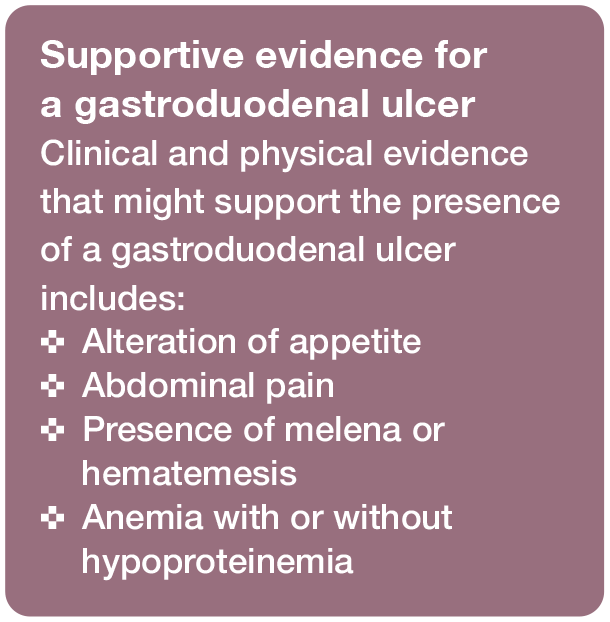
often, gastrointestinal ulceration is not documented, but is suspected based on the presence of a predisposing factor (see box, ‘Causes of gastroduodenal ulceration and esophagitis in cats’), and physical and/or clinicopatho logic evidence of gastro intestinal bleeding (Figure 2; see also ‘Supportive evidence for a gastroduodenal ulcer’). in a recent retrospective study evaluating the presence of gastroduodenal ulceration in cats, malignant causes accounted for roughly half of the 61 cases. 41 This is in stark contrast to dogs, where gastro intestinal neoplasia was documented in only 7.7% of cases of gastroduo denal ulceration in a large retrospective study. 43 An elevated blood

(a) Gastric ulceration and (b) ulcerative gastric lymphoma at the cardia in two cats
urea nitrogen (BUN)/creatinine ratio can also be present, although its absence does not rule out gastro intestinal ulceration; based on a study performed with dogs, BUN:creatinine is presumed to be an insensitive indicator for the detection of intestinal bleeding in cats. 44
Treatment of gastroduodenal ulceration should be focused on identification and removal of the underlying cause, in addition to administration of gastroprotectants as described above. The recommended duration of gastroprotec
tion should be based on the suspected etiology. Cats with non-infiltrative causes of gastro intestinal ulceration (eg, NSAids, tyrosine kinase inhibitors) tend to have a quicker recovery period (eg, 3–4 weeks), whereas those with infiltrative causes (eg, neoplasia, inflamma tory bowel disease, feline gastrointestinal eosinophilic sclerosing fibroplasia) usually require a longer course of treatment (eg, months to years), with the duration of treatment for the latter being highly dependent on whether the disease can be treated directly. 40
When ulceration is suspected based on clinicopathologic data alone, resolution of the abnormality used to make the diagnosis
(eg, microcytosis, increased BUN:creatinine, etc) should be used to guide when to discontinue medical therapy.


Prophylaxis for gastroduodenal ulceration
Generally, prophylaxis for gastroduodenal ulceration, including for patients receiving glucocorticoids or NSAids, is not recommended and could have unwanted consequences, based on studies in cats 21 and dogs.45,46 The exception to this is when there are multiple risk factors for gastrointestinal bleeding (see box, ‘Causes of gastroduodenal ulceration and esophagitis in cats’). Note that pancreatitis, hepatic disease and CKd should not be included as risk factors for gastro intestinal bleeding. Neither gastroduodenal ulceration nor gastric hyperacidity are common findings in cats with CKd.47,48 Similarly, although underexplored, the occurrence of gastrointestinal bleeding in cats with acute kidney injury (AKi) is suspected to be rare. As cats with AKi or CKd already suffer an enormous pill burden, gastroprotectant treatment is not recommended unless there is strong suspicion for, or documentation of, gastroduodenal ulceration.
Also, gastroprotectants should not be used as antiemetics. in a study of cats with CKd, omeprazole administration was not effective in reducing vomiting events, 49 in contrast to the findings of a separate study using antiemetics (maropitant). 50 Chronically vomiting cats,
especially those also having weight loss and/or diarrhea, should undergo further evaluation for an underlying cause, as these are common signs in cats with chronic small bowel disease. 51
Documented or suspected esophagitis
Either documented evidence of esophagitis (ie, endoscopy; Figure 3) or a clinical suspicion (difficulty swallowing, regurgitation, odyno phagia, dysorexia, weight loss, etc) is an indication for gastroprotection, based on ACViM consensus guidance. 19

Esophagitis secondary to an esophageal foreign body (a) and a hiatal hernia (b) in two cats
As with gastric ulceration, the etiology of esophagitis (see box, ‘Causes of gastroduo denal ulceration and esophagitis in cats’) will determine the duration of treatment. Severe, acute esophagitis in cats diminishes normal peristalsis, lowers esophageal sphincter pressure and shortens the length of the esophagus.52,53 Therefore, prokinetic therapy should be considered in addition to gastro protection in these cases. These sequelae often resolve with treatment within 4 weeks post-injury. 52 As with gastroduodenal ulceration, measures to identify an inciting cause of esophagitis should be taken to prevent protracted use of acid suppressants.
Prophylaxis for esophagitis
As for gastroduodenal ulceration, prophylactic use of gastroprotectants for esophagitis is generally not recommended, including as a preventive against gastro esophageal reflux under anesthesia. Gastro esophageal reflux during anesthetic events is common in cats. in one study, 9/27 cats (33%) undergoing anesthesia for routine dental procedures experienced at least one reflux episode, based on esophageal impedance and pH monitoring. 54 Although pathology associated with gastroesophageal reflux appears to be quite rare, these reflux events can occasionally result in severe consequences such as benign esopha geal strictures.42,55 While preoperative gastric acid suppression will reduce gastric acidity, 54 the benefit of this practice in terms of stricture incidence is unknown as gastric acid suppressants do not prevent the reflux event itself.
Until guidelines are established, the authors do not recommend routine preoperative acid suppressants in the absence of additional risk factors for reflux (eg, brachycephalia, hiatal hernia, etc), but do recommend monitoring for reflux events through the use of esophageal suction catheters. if a large reflux event is suspected or observed during general anesthesia, local (ie, dilute barium or sucralfate administered into the esophagus) and systemic (ie, intravenous acid suppressant) therapies should be implemented.
Key Points
✜ Use of gastroprotectants in cats demands a thoughtful and evidence-based approach, with consideration of the challenges and gaps in feline-specific research on the topic.
✜ While these gaps have been filled by extrapolating from canine and human medicine, the importance of a feline-specific approach cannot be overstated. For instance, malignant etiologies that induce gastroduodenal ulceration are much more common in cats compared with dogs.
✜ The duration of gastroprotection must be based on the suspected or diagnosed etiology; and, when possible, the underlying trigger must be addressed.
✜ To avoid the misuse of gastroprotectants, clinicians should always ensure that appropriate indications guide their prescription and deprescription. Prophylactic administration is only warranted when there are multiple ulcerogenic comorbidities present.
Footnotes
Conflict of interest
Katie Tolbert is a scientific advisor for TriviumVet, the manufacturer of omepraVet (although this product has only been studied in dogs). Eric Stubbs declared no potential conflicts of interest with respect to the research, authorship, and/or publication of this article.
Funding
The authors received no financial support for the research, authorship, and/or publication of this article.
Ethical approval
This work did not involve the use of animals and therefore ethical approval was not specifically required for publication in JFMS.
Informed consent
This work did not involve the use of animals (including cadavers) and therefore informed consent was not required. No animals or people are identifiable within this publication, and therefore additional informed consent for publication was not required.