



Abstract
Objectives
The aim of this work was to create a video-based compilation of acute pain behaviours in cats as an open-access online resource for training of veterinary health professionals.
Methods
A database comprising 60 h of video recordings of cats was used. Videos were previously recorded after ethical approval and written client consent forms, and involved cats with different types (eg, medical, surgical, trauma, orofacial) and degrees (eg, from no pain to severe pain) of acute pain, before and after surgery or the administration of analgesia. The database included videos of cats of different coat colours, ages, sex and breeds. Video selection was based on a published ethogram of acute pain behaviours in cats. Videos were selected by one observer (SM) according to their definition and quality, followed by a second round of screening by two observers (SM and PVS). Video editing included a standardised template (ie, watermark and titles).
Results
A total of 24 videos (mean length 33 ± 17 s) with each acute pain-related behaviour described in the ethogram were uploaded to an open-access online video-sharing platform (http://www.youtube.com/@Steagalllaboratory) with an individual hyperlink. Videos were provided with a short description of the behaviour for the public.
Conclusions and relevance
This video-based compilation may promote better training of veterinary health professionals on acute pain assessment while improving feline health and welfare and the understanding of cat behaviours.
Introduction
Acute pain is usually caused by tissue damage and inflammation leading to changes in behaviour, which may be unique to each individual cat.1,2 Recognising feline pain behaviours requires an understanding of their intrinsic nature and ability of masking signs of pain as an adaptive strategy.1,2 Indeed, successful pain management relies on accurate pain recognition. Feline pain assessment has received increased attention with the publication of specific guidelines,1,3 multidimensional composite pain scales4–7 and the Feline Grimace Scale (FGS). 8 However, subjectivity is an intrinsic limitation of behavioural-based pain scoring tools. For example, inter-observer reliability is often a concern in studies involving pain assessment with individuals with different levels of training. 9 Demeanour may bias pain assessment as shy or fearful cats may present high pain scores that are not necessarily related to pain. 10 Recently, a validated ethogram of acute pain behaviours in cats was published using content validity index and expert consensus. 11 This ethogram consists of a repertoire of 24 pain-related behaviours with standardised terminology and descriptors to mitigate inter-observer subjectivity and interpretation of clinical manifestations of pain. Identifying pain behaviours can be challenging for individuals who are not familiar with cats and/or those who are undergoing training. 11 In the authors’ experience, non-anglophone individuals may find it difficult to differentiate some descriptors as, for example, ‘hunched-up’ vs ‘crouched’. Furthermore, it is not always clear how individuals perceive ‘eye squinting’, ‘eyes partially closed’, ‘blinking’ or ‘feigned sleep’. Pain might be neglected and/or underdiagnosed when there is subjective understanding or interpretation of pain behaviours leading to patient suffering. In addition, the lack of training on pain assessment and continuing education and implementation of pain scales in the clinical setting may contribute significantly to this issue. 12 Further training and open-access knowledge on pain assessment and behaviours could decrease oligoanalgesia (ie, failure to recognise and provide analgesia in patients with acute pain) 12 and contribute to improved feline health and welfare.
The use of educational videos is widespread and important for continuing education.13–15 A systematic review and meta-analysis reported that video-based learning increases the technical performance of medical students and surgery residents. 14 In veterinary medicine, an evidence-based teaching tool with a total of 13 videos on local anaesthetic techniques in small animals has received more than 92,000 views on YouTube. 15 This tool has been used to teach undergraduate veterinary students at the Université de Montréal and City University of Hong Kong, in addition to several practical laboratories, workshops and lectures worldwide. Video-based education is paramount for behavioural recognition, as signs can be subtle and often under-recognised.
The aim of this work was to create a video-based compilation of acute pain behaviours in cats as an open-access online resource for the training of veterinary health professionals and the general public on feline acute pain assessment. The ultimate goal was to improve feline health and welfare through means of better pain recognition.
Material and methods
Database
A database comprising approximately 60 h of video recordings of cats was reviewed. These videos were collected from cats with different types (eg, medical, surgical, trauma) and degrees (eg, from no pain to severe pain) of naturally occurring pain, before and after surgery or the administration of analgesia, which have been mostly reported in cats.8,16–25 The database included videos of cats of different coat colours, ages, sex and breeds. Studies were performed after approval by the institutional animal care and use committee of the Faculty of Veterinary Medicine, Université de Montréal (17-Rech-1863, 18-Rech-1825, 17-Rech-1890, 20-Rech-2068, 20-Rech-2075, 21-Rech-2132, 21-Rech-2153 and 23-Rech-2250, respectively). An additional study was approved by the animal research ethics committee of the School of Veterinary Medicine and Animal Science, São Paulo State University. 26
Video screening, selection and editing
A veterinarian and PhD candidate (SM) performed 3 h/day of video screening until the full database was reviewed. An Excel spreadsheet (Microsoft) was created to track the observed behaviours. Each study was allocated to a dedicated data sheet that included each behaviour of the aforementioned validated ethogram and video number (eg, video 1, 2, 3, 4, etc). 11 The ethogram included 24 normal and pain-related behaviours, divided into 10 categories (ie, position in the cage, activity, posture and body position, affective-emotional states, vocalisation, playing [with an object], feeding, post-feeding and facial expressions or features). 11 The criteria for video selection included high-definition video recordings of 10–30 s demonstrating a cat displaying any of the specific ethogram-based behaviours. Annotations were made in the spreadsheet for each behaviour identified in the video and when meeting the inclusion criteria (eg, ‘back of the cage’, ‘no attention to the surroundings’, ‘restlessness’, ‘crouched/hunched-up positions’, ‘lying dorsoventrally with pelvic limbic extended/contracted’, etc). 11 The selected videos were then reviewed by a second observer, a board-certified veterinary anaesthesiologist (PVS). Each selected video underwent another round of reviews by the two observers together who discussed the best representation of the targeted behaviour in alignment with the ethogram’s descriptions.
Videos were edited using Movavi Video Editor 2024 (https://www.movavi.com/). The editing process aimed to standardise video length (eg, 30–60 s) and layout (eg, watermarks and title).
Results
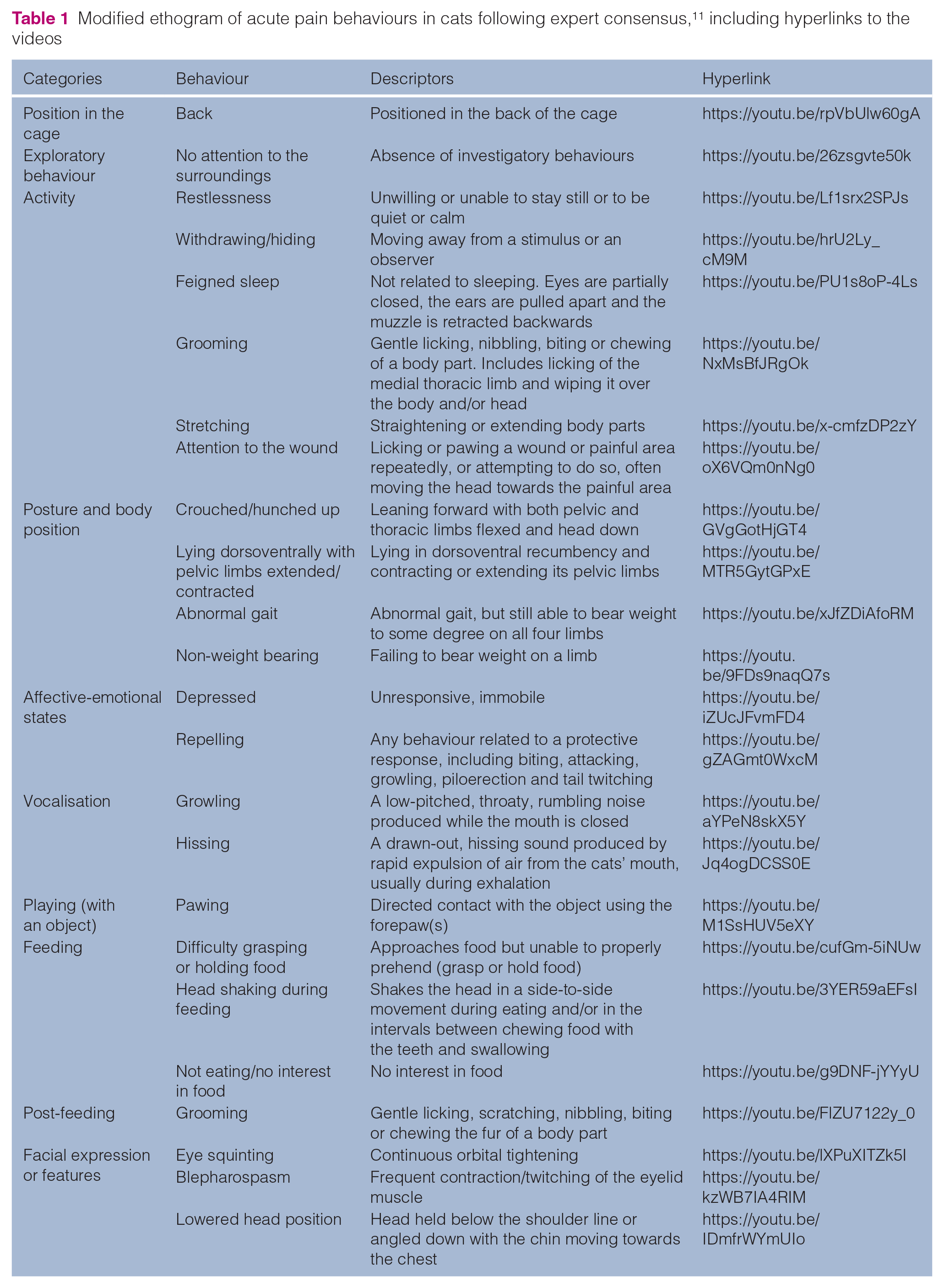
A total of 24 videos (mean length 33 ± 17 s) were uploaded individually to an open-access online video-sharing platform (http://www.youtube.com/@Steagalllaboratory; YouTube). Each behaviour of the ethogram is represented by a corresponding YouTube hyperlink that includes captions and descriptions. Each video comprises 1–3 different cats displaying the respective behaviour. Cats included in the video-based compilation presented different types of naturally occurring pain (eg, surgical and medical pain) 8 and those undergoing elective ovariohysterectomy, 16 including studies evaluating the analgesic efficacy of intraperitoneal bupivacaine. 17 In addition, videos of cats with oral pain after multiple dental extractions were reviewed, including feeding and post-feeding behaviours.19,24,25 For ocular pain-related behaviours (ie, blepharospasm), the authors used data from an ongoing study including videos of cats with medical and ophthalmologic surgical pain. A modified ethogram of acute pain behaviours in cats with their respective hyperlinks is described in Table 1.
Modified ethogram of acute pain behaviours in cats following expert consensus, 11 including hyperlinks to the videos
Discussion
This work provides a video-based compilation of acute pain behaviours in cats as an open-access online resource for veterinary health professionals that may support educational training on feline pain assessment. Pain directly impacts animal health and welfare, and can range widely in terms of its type, degree/magnitude, duration and evoked behavioural responses. 27 Behavioural signs of pain in cats can be subtle and often overlooked, and unique to the individual patient.1,28 Cats with equivalent pain conditions or that undergo similar surgical procedures may experience variable levels of pain, potentially influenced by genetics, response to analgesics (ie, pharmacokinetic and pharmacodynamic differences) 28 and stressors experienced earlier in life. 29 In addition, the severity of pain may be underestimated in cats, resulting in oligoanalgesia, as veterinarians might consider similar surgical procedures to cause more pain in dogs than in cats.1,12 It is clear that there is a need for better education on feline pain assessment and video-based training has been shown to be an important source of improving medical skills.13,14
Insufficient training is a common reason for the lack of pain assessment in clinical practice. 30 Epidemiological surveys have identified factors limiting the application of novel analgesic techniques31–33 and the implementation of pain scoring systems in clinical practice.30,33,34 These factors include time constraints, lack of familiarity with pain scoring, insufficient personnel and inadequate training.30,33 Pain assessment should be performed using validated tools, while reducing subjectivity (ie, guessing) of whether a patient requires interventional analgesia. 35 The foundation of these tools is based on the observation of normal and abnormal specific behaviours, as with the UNESP-Botucatu Feline Multidimensional Pain Assessment Scale 5 and its shortened version (UFEPS-SF), 4 the Glasgow Composite Measure Pain Scale (CMPS-Feline) 6 and changes in facial expressions (FGS) during acute pain assessment.8,22,36 However, pain scales have not been implemented worldwide. In the USA, a survey revealed that approximately 50% of veterinarians incorporate pain scales in their daily practice, while 6.3% indicated intermittent usage or 36.1% not using at all. 30 On the other hand, 93% of Spanish small animal veterinarians reported using the FGS for pain assessment in cats. 34 Independently of the pain scoring system, veterinarians who enrolled in continuing education on pain management (eg, conferences, seminars) expressed greater confidence in pain assessment, with an odds ratio of 2.84 for adequate pain evaluation. 37 In addition, their likelihood of using pain scales was 4.28 times higher than those who did not enrol in continuing education. 37 This suggests that education plays a crucial role in enhancing skills on pain assessment and our video compilation aims to contribute to the training of veterinary health professionals through the understanding of pain-induced behavioural changes.
Cats have a large repertoire of behaviours and evoked pain-related responses are highly individualised.1,29 These could be subtle or intermittent and require close observation as they can be easily overlooked. Our published ethogram 11 reported some behaviours that had been described in multi-composite validated tools.4–6 Nevertheless, these behaviours have never been systematically reported and may not always be familiar to veterinary health professionals. This could potentially result in under-recognition or misinterpretation of pain behaviours, highlighting the need for the creation of a peer-reviewed video-based compilation. For example, ‘lying dorsoventrally with pelvic limbs extended/contracted’ is observed in cats experiencing abdominal pain. This behaviour was reported in the UNESP-Botucatu, 5 UFEPS-SF 4 and the International Society of Feline Medicine (ISFM) guidelines of acute pain management in cats. 1 However, this body position, associated with intermittent extension or contraction of pelvic limbs, could be mistakenly interpreted as pelvic limb ‘stretching’, which is typically observed in pain-free cats. Thus, careful observation of the frequency, duration and intensity of these body postures is required. Similarly, ‘feigned sleep’ has been described in previous literature1,38 and can be easily misinterpreted as ‘cat is asleep’ or ‘under residual sedation post-surgery’,11,38 or as previously mentioned, with ‘eye squinting’ or ‘eyes partially closed’. This reinforces the need for appropriate training linked to video-based examples to perform adequate pain assessment and the rationale for developing this video-based compilation as an easy-to-use auxiliary tool. In addition, pain scoring and behavioural observation should occur at least 30 mins after sedation or general anaesthesia 21 to mitigate bias related to residual drug effects.
Individual experience, age, sex and culture are pivotal to feline pain assessment.35,39 Training and education may aid to circumvent biases related to these aforementioned factors. Indeed, in addition to cat-oriented guidelines designed for the veterinary community, ISFM and the American Association of Feline Practitioners provide educational resources, such as cat brochures for caregivers, promoting awareness in several areas of feline care (ie, how to recognise pain, inappetence and feeding tube management, cat friendly practice, palliative care, among others). The availability of open-access resources promotes dissemination and learning, which might be beneficial to feline welfare. Thus, providing caregivers with a supportive video-based tool of acute pain behaviours in cats might promote early pain recognition, encouraging caregivers to seek early veterinary care.
This work has some limitations. This video-based compilation of acute pain behaviours may now undergo further studies to investigate its impact on feline pain assessment education. Videos were selected by one observer and reviewed by two observers; therefore, the final videos are the result of the authors’ interpretation, which could have been biased to the authors’ experience and training. Finally, videos were mostly collected during controlled clinical trials in a specific veterinary teaching hospital. Videos may not be representative of clinical cases observed in general practice, in which the repertoire of behaviours could have been different. Feline-friendly interactive techniques and cat-oriented environmental needs are pivotal for adequate pain assessment. 2 , 29
Conclusions
This open-access video-based compilation provides an additional educational resource for teaching veterinary health professionals and caregivers to recognise acute pain behaviours in cats. This approach could enhance comprehensibility and mitigate bias and subjectivity during pain assessment. This work may improve feline health and welfare through better understanding of their behaviours and improved pain assessment skills.
Footnotes
Acknowledgements
The authors are grateful to Dr Ryota Watanabe for his contribution of videos to be considered for inclusion in the video-based compilation.
Author note
This manuscript represents a portion of a PhD degree thesis by the first author to the Université de Montréal.
Conflict of interest
The authors declared no potential conflicts of interest with respect to the research, authorship, and/or publication of this article.
Funding
The authors received no financial support for the research, authorship, and/or publication of this article.
Ethical approval
The work described in this manuscript involved the use of non-experimental (owned or unowned) animals and procedures that differed from established internationally recognised high standards (‘best practice’) of veterinary clinical care for the individual patient. The study therefore had prior ethical approval from an established (or ad hoc) committee as stated in the manuscript.
Informed consent
Informed consent (verbal or written) was obtained from the owner or legal custodian of all animal(s) described in this work (experimental or non-experimental animals, including cadavers) for all procedure(s) undertaken (prospective or retrospective studies). For any animals or people individually identifiable within this publication, informed consent (verbal or written) for their use in the publication was obtained from the people involved.
