



Abstract
Objectives
Unowned ‘stray’ domestic cats threaten wildlife, as well as create a community nuisance and contribute to high rates of euthanasia in animal shelters. These cats can experience poor welfare, contribute to the pet cat population and compromise attempts to control feral cats. However, many unowned domestic cats are cared for by semi-owners who do not consider they own these cats; therefore, semi-owners are a potentially important target population for human behaviour change interventions. The present study aimed to describe the characteristics of cat semi-owners and compare these with the general population of cat owners and non-cat owners to inform future cat management interventions.
Methods
An online questionnaire open to all residents of New South Wales, Australia was developed and advertised. Respondents were asked ‘do you care for other free-roaming or stray cats (not including the cats you own)?’, whether they owned cats, about characteristics of their home and their agreement with 15 capability, social opportunity and motivation (COM) items relating to cat containment.
Results
Questionnaire responses were received from 8708 people, including 588 semi-owners (7%). Semi-owners were significantly more likely to be female, live in urban areas, live in lower socioeconomic areas and rent their home. Most semi-owners also owned their own cats and owned more cats than non-semi-owners.
Conclusions and relevance
Semi-owners of unowned ‘stray’ cats are a valuable potential target audience for human behaviour change interventions. Understanding that these semi-owners often have their own cats, might already be overwhelmed with cat-caring responsibilities and are disproportionately from lower socioeconomic backgrounds should guide intervention design. A nuanced approach is needed that prioritises the wellbeing of cats and semi-owners for semi-owners to ‘buy in’. Any intervention should also recognise that semi-owners often face multiple, complex barriers to neutering or claiming ownership of the cats they care for, especially cost, and trust in the authorities.
Keywords
Introduction
Every year, thousands more cats arrive at animal shelters in Australia than they have the capacity to rehome, resulting in many cats being euthanased.1–3 The pressure to reduce the euthanasia of healthy and treatable animals in animal shelters is increasing the need for humane interventions that reduce animal shelter cat intake, thus reducing the need for euthanasia. Most cats entering both municipal pounds and animal welfare organisation shelters originate as ‘strays’ – a term used to describe cats who are free-roaming and generally unowned. 4 However, research from Australia and overseas suggests many cats surrendered as ‘strays’ are in fact fed or provided with other care by one or more persons who do not consider that they own these cats.2,4–6 This population of cats is increasingly referred to as being ‘semi-owned’.7–9 ‘Stray’ cats and the people who care for them have been identified as important targets for human behaviour change interventions; 10 however, to date, this human population remains poorly described.
All cats in Australia belong to a single species, Felis catus; however, distinct but inter-related populations exist with different relationships to humans, including domestic (owned, semi-owned and unowned) and feral populations (Figure 1). This has important implications for management. As defined by RSPCA Australia, feral cats are those that are unowned, unsocialised, have no relationship with or dependence on humans, and reproduce in the wild. 7 In Australia, feral cats are managed as an invasive pest species under separate regulatory frameworks from domestic cats. The commonly used term ‘stray’ is problematic as it describes the cat’s free-roaming behaviour but not their ownership status. Free-roaming domestic cats are associated with a variety of problems in addition to their contribution to animal shelter intakes. Cats reproduce rapidly and, while kitten mortality is often high, their high reproductive rate means that sexually intact free-roaming cats quickly result in overpopulation, especially when provided with supplementary food and shelter. 11 Free-roaming cats can transmit diseases of importance to human health, agriculture and wildlife such as toxoplasmosis, 12 and can create a nuisance in the community through noise, soiling with faeces and urine, property damage and disturbing other companion animals. Free-roaming domestic cats have also been associated with biodiversity loss via predation, especially in areas already subject to external stressors such as urban environments.13–16 In addition, unowned and semi-owned free-roaming cats may have poor welfare.9,17–19
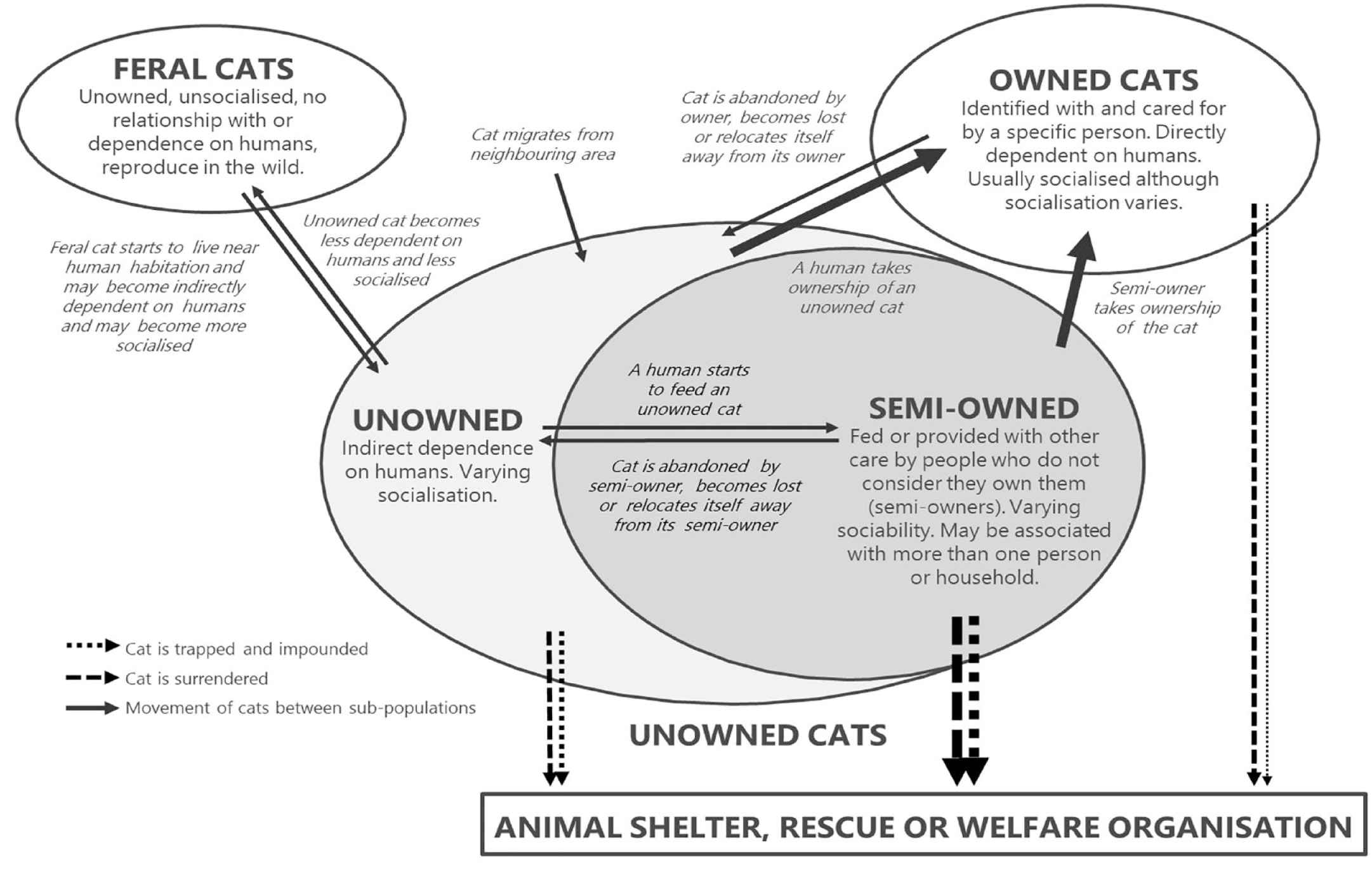
Cat subpopulations and their interactions with humans 7
The semi-owned and unowned domestic cat population in Australia has been estimated at 0.7–2 million, or 60–100 cats per 1000 human residents, depending on location.1–2,20–22 Many, even most, unowned domestic cats are provided with some care (food, shelter, veterinary treatment) by people who do not consider they own them.2,7,9 This semi-owned population are generally sexually intact with a high reproductive rate owing to supplementary feeding and hence their offspring contribute to animal shelter intakes and swell the feral and owned pet cat populations (Figure 1). Semi-owned cats may or may not be socialised with people; 9 lack of socialisation to people makes many semi-owned cats unsuitable to be rehomed 23 and may be a barrier to semi-owners assuming full ownership. 6 Nonetheless, cat semi-owners can have high levels of attachment to the cats they care for,24,25 and care provided to semi-owned cats, while variable, can be indistinguishable from care provided to owned cats.4,9
Cat semi-ownership is relatively common in many countries, including Australia,9,6,25 Ireland, 26 Thailand 27 and the USA. 21 However, obtaining valid data directly from cat semi-owners can be difficult, especially where the practice of caring for unowned cats is discouraged or penalised by local authorities.6,9,27 One Australian study has described the characteristics of semi-owners compared with owners surrendering cats to an animal shelter and found that most semi-owners also had cats of their own. 6 Another Australian study of a similar semi-owner population described barriers such as already having companion animals, not wanting a cat and restrictions of their accommodation as preventing semi-owners from adopting their semi-owned cats. 18 However, how these findings relate to the wider semi-owner population is unknown.
Semi-owned cats have a human caregiver who can serve as the target for behaviour change interventions that aim to reduce cat overpopulation, improve free-roaming cat welfare, reduce animal shelter cat intake and euthanasia, and reduce cat impacts on wildlife. 7 Effective behaviour change interventions require a thorough understanding of the characteristics of the target population and the barriers to, and drivers for, undertaking the target behaviours. 28 McLeod et al 29 demonstrated the use of an integrative framework based on the community-based social marketing and the behaviour change wheel and associated capability, opportunity, motivation (COM)–behaviour model to design better, equitable and ethically acceptable interventions for free-roaming cat management. Gaining a better understanding of the target audience’s current behaviour and the likelihood of adopting new behaviours, along with their capabilities (physical and psychological capacity to engage in a behaviour), opportunities (external factors that prompt or enable a behaviour) and motivations (factors internal to an individual that energise or direct behaviour), equips planners and policymakers with a multilevel approach for designing more feasible, targeted interventions. Using this framework, the present study aims to describe the characteristics of cat semi-owners and compare these with the general population of cat owners and non-cat owners to inform future cat management interventions.
Materials and methods
Questionnaire
An online questionnaire was developed and advertised throughout New South Wales (NSW), with links available through the RSPCA NSW website and social media and it was shared by other external stakeholders such as veterinary practices and councils throughout NSW. The questionnaire was open to all residents of NSW, both cat owners and those who did not own a cat.
Respondents were asked ‘do you own any cats?’, ‘how many cats do you own?’ and ‘do you care for other free-roaming or stray cats (not including the cats you own)?’. Demographic information (age and gender) was collected from all respondents. Cat owners were asked about their current cat containment behaviours and asked to estimate the time their owned cat currently spent roaming freely outside. 30 They were asked about the characteristics of their property (location, the type of dwelling, access to an outside space and home ownership) that had the potential to influence containment behaviour (physical opportunity). In addition, cat owners were asked to rate their agreement (on a five-point Likert scale) to 15 COM items relating to cat containment (Table 1). These COM items addressed four important themes that had been identified from previous research.6,31,32 Respondents that did not own a cat were also asked to rate their agreement to 10 COM items within three of these themes (Table 1).
Reliability of capability, social opportunity and motivation (COM) themes and individual items relating to cat containment that were rated by respondents in an online survey

COM items rated by respondents that did not own cats
Statistical analysis
As COM items were worded as either drivers or barriers in the survey, all barrier items were reverse scored for analysis. All data were tested for compliance to the assumptions for parametric statistical analyses: normality, outliers, multicollinearity, non-linearity, homoscedasticity and non-independence assumptions. COM agreement data from Likert scales were treated as interval data, following the common practice used in medical and psychological research. 33 Internal consistency of the COM variables containing multiple items was tested using the Cronbach’s α test. 34
ANOVA and Pearson χ2 were used to compare the differences in demographic and situational variables between respondents. ANOVAs were used to compare the differences between the COM ratings of semi-owners and other respondents. All analysis was conducted using SPSS, version 29 (IBM).
Ethical approval
The study was approved by the Human Research Ethics Committee of the University of Sydney (protocol code 2021/473; 27 July 2021).
Results
All respondents
Responses to the online questionnaire were received from 8708 people; 404 responses were excluded due to insufficient data or respondents indicating they were not from within NSW, leaving a total of 8304 responses for analysis. Responses were received from 105 of the 128 local government areas within NSW. Two-thirds of respondents (5581; 67%) lived in major urban centres (Sydney, Newcastle, Lake Macquarie, Central Coast, Wollongong and Shoalhaven), with the remaining third coming from regional areas (2723; 33%). 35 The overall mean ± SD age of respondents was 49.2 ± 14.6 years, ranging from 18 to 90 years. Three quarters of the respondents were female (6243; 75%), with 1721 males (21%) and 320 (4%) identifying as non-binary and 20 respondents (2%) not offering a response.
Semi-owners
When asked ‘do you care for other free-roaming or stray cats (not including the cats you own)?’ 588 of 8304 (7%) respondents answered ‘yes’. These respondents are hereafter referred to as ‘semi-owners’. Semi-owners were younger on average than respondents who were not semi-owners (45.5 ± 14.7 years vs 49.5 ± 14.6 years; F = 39.37, df = 1, P <0.001, η2 = 0.01). The semi-owners were mostly female (487; 83%), with 84 (14%) males and 17 (3%) non-binary. This proportion of females was significantly higher compared with the overall survey response (Pearson χ2 = 19.05, df = 2, P <0.001, r = 0.05).
Three-quarters of the semi-owners (447, 76%) lived in major urban centres (Sydney, Newcastle, Lake Macquarie, Central Coast, Wollongong and Shoalhaven), with the remaining quarter coming from regional areas (141; 24%). Semi-owners were more likely to live in urban areas than people who were not semi-owners (Pearson χ2 = 22.30, df = 1, P <0.001, r = 0.05). They were also more likely to live in areas with lower average scores on the index of socioeconomic disadvantage (1006.1 ± 75.48) than respondents who were not semi-owners (1029.3 ± 63.94; F = 69.91, df = 1, P <0.001, η2 = 0.01). 36
Cat ownership
Just over half of the respondents to the questionnaire were cat owners (4461; 54%), while the remaining 3843 (46%) were people who did not own cats (hereafter referred to as ‘non-owners’). Cat owners were younger (46.0 ± 13.7 years) than non-owners (52.8 ± 14.8 years) (F = 455.04, df = 1, P <0.001, η2 = 0.0) and more likely to be female than non-owners (82.2% vs 67.0%; Pearson χ2 = 306.44, df = 3, P <.001, r = 0.19). Cat owners were more likely to live in major urban areas (3162; 70.9% cat owners and 2419; 62.9% non-owners) and non-owners in regional areas (1299; 29.1% cat owners and 1424; 37.1% non-owners; Pearson χ2 = 58.99, df = 1, P <.001, r = 0.08).
Semi-ownership and cat ownership
Most semi-owners also owned their own cats, such that they were both semi-owners and cat owners (416 of 588; 71%). Semi-owners who were also cat owners were:
significantly younger (44.3 years) than all other groups (F = 160.9, df = 1, P <0.001, η2 = 0.06) (Table 2);
more likely to be female than semi-owners who were not cat owners (88% vs 77%; Pearson χ2 = 7.41, df = 2, P = 0.03, r = 0.11), but no more likely to be female than cat owners who were not semi-owners (88% vs 82%); Pearson χ2 = 2.44, df = 2, P = 0.30, r = 0.02); and
more likely to live in major urban areas than all other groups (79% vs 70%; Pearson χ2 =5.21, df = 1, P = 0.02, r = 0.09).
Comparison of age, gender and location variables between semi-owners and those that were not semi-owners further segmented by cat ownership

Compared with cat owners who were not semi-owners, cat owners who were also semi-owners were (Table 3):
less likely to own their home and more likely to be renting;
more likely to own three cats or more;
less likely to contain their own cats; and
more likely to own cats that were always outdoors.
No statistical differences were found between the type of dwelling or access to outside space.
Comparison of cat-owner situational and cat ownership variables between semi-owners and those who were not semi-owners

ZResid = adjusted standardised residual, where ZResid > |2| is significant at P <0.05. r = Pearson’s correlation coefficient; r ⩾0.5 indicates strong effect size, r = 0.3 indicates medium effect size, r = 0.1 indicates weak effect size
Semi-owners and COM agreement ratings
All respondents that owned cats were asked to rate their agreement with COM statements pertaining to their capability, social opportunity and motivation for containing their cats. Cronbach’s α for the multi-itemed COM items are shown in Table 1. All items reflected an adequate internal consistency. 34 Scale scores for each of these themes were computed by averaging the items, which were then used for this analysis.
All cat owners who fully contained their cats had significantly stronger agreement ratings to all four COM themes than those cat owners who did not contain their cats, regardless of their semi-ownership status; capability (F = 1468.74, df = 3, P <0.001, η2 = 0.50), social opportunity (F = 591.25, df = 3, P <0.001, η2 = 0.00), cat welfare motivation (F = 822.50, df = 3, P <0.001, η2 = 0.36) and community motivation (F = 641.99, df = 3, P <0.001, η2 = 0.30) (Figure 2). Cat owners who were also semi-owners agreed less strongly than cat owners who were not semi-owners to the community motivation theme (Table 4). Therefore, cat owners who were also semi-owners agreed less strongly than cat owners who were not semi-owners that:
cats should be prevented from roaming to protect wildlife;
cats should be prevented from roaming to prevent them causing a nuisance to neighbours;
they would prevent their cat from roaming if required by law; and
cats should not be allowed to roam freely.

Average agreement ratings to capability, social opportunity and motivation (COM) themes for cat owners who are also semi-owners compared with those who are not semi-owners
Comparison of capability, social opportunity and motivation (COM) themes across semi-ownership, cat owner and cat containment groups
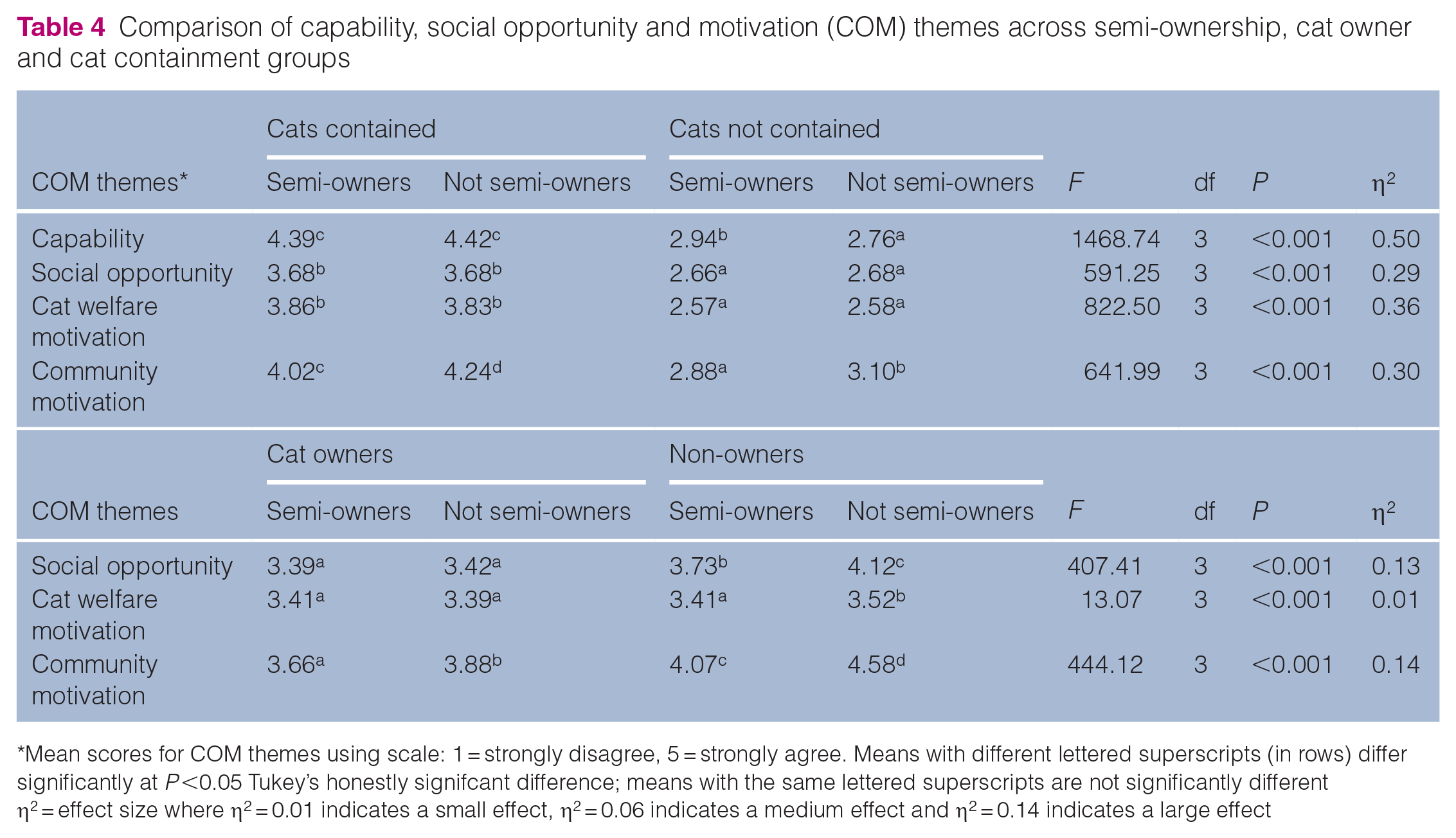
*Mean scores for COM themes using scale: 1 = strongly disagree, 5 = strongly agree. Means with different lettered superscripts (in rows) differ significantly at P <0.05 Tukey’s honestly signifcant difference; means with the same lettered superscripts are not significantly different η2 = effect size where η2 = 0.01 indicates a small effect, η2 = 0.06 indicates a medium effect and η2 = 0.14 indicates a large effect
Respondents who did not own cats were also asked to rate their agreement with relevant COM statements pertaining to their perceived social opportunity and motivation for cat containment. All respondents who did not own cats significantly rated their agreement higher than cat owners for two of the three COM themes, with respondents who were not semi-owners agreeing more strongly than semi-owners; social opportunity (F = 407.41, df = 3, P <0.001, η2 = 0.13) and community motivation (F = 444.12, df = 3, P <0.001, η2 = 0.02) (Figure 3). Non-owners who were also not semi-owners had a significantly stronger agreement rating than all cat owners and semi-owners for the cat welfare motivation theme (F = 13.07, df = 3, P <0.001, η2 = 0.01) (Table 4).

Average agreement ratings to capability, social opportunity and motivation (COM) themes for cat owners and non-owners who are also semi-owners compared with those who are not semi-owners
Non-owners who were also semi-owners agreed less strongly than non-owners who were not semi-owners that (Figure 3):
councils should have a law requiring cats to be contained;
containment was a practice their family and friends agreed with;
containment was a practice that veterinarians agreed with;
cats should be prevented from roaming to keep them safe;
cats should be prevented from roaming as it is good for their health and wellbeing;
cats like being contained;
cats should be prevented from roaming to protect wildlife;
cats should be prevented from roaming to prevent them from causing a nuisance to neighbours; and
cats should not be allowed to roam freely.
Discussion
The present study demonstrates that cat semi-ownership is common in Australia and is the first to describe characteristics of semi-owners from a large survey. Overall, more than one in 15 respondents, both cat owners and those who do not have pet cats, provide care for cats they do not consider they own. Most semi-owners also own their own cats. Cat-owning semi-owners were more likely to allow their own cats to roam and were less concerned about wildlife and nuisance issues associated with free-roaming cats. Importantly, and consistent with the findings of previous research, semi-ownership was more common among those who rented than those who owned their homes and was associated with living in a lower socioeconomic area.10,37,38
The presence of populations of unowned domestic cats is associated with socioeconomic disadvantage.10,37,38 Hence, it is unsurprising that semi-owners, who care for these unowned cats, disproportionately live in lower socioeconomic areas. These are areas where cost can be an important barrier to accessing neutering for pet cats, contributing to unplanned breeding, overpopulation, and abandonment of cats and kittens. 39 Access to reliable means of transport and access to veterinary services can also be important barriers. 40 Other factors might also contribute to lower uptake of neutering in lower socioeconomic areas, such as lower levels of educational attainment, a lack of knowledge around ‘responsible’ pet ownership practices and different social norms around pet guardianship.
People living in lower socioeconomic areas might also be more likely to passively acquire pet cats (ie, become cat owners without deliberately sourcing a cat; for example, by finding an unowned cat or kitten, or being given a cat or kitten as a gift). Living in lower socioeconomic areas has been associated with having unowned cats on your property, feeding unowned cats and surrendering cats to animal shelters multiple times, 38 which are all scenarios that might also lead to cats, and especially kittens, being passively acquired. This might explain, at least in part, the high proportion of cat semi-owners who are also cat owners; many of these owned cats might have previously been unowned or semi-owned. Indeed, it has been estimated that around half of all pet cats in Australia were passively acquired. 41 The relationship between socioeconomics, semi-ownership and passively acquiring pet cats is an important area for future research and in-depth, qualitative research in this area could be particularly valuable.
Our findings that most semi-owners (more than 80%) also own cats of their own, own more cats on average than non-semi-owning cat owners and are more likely to own more than four cats, suggests that many semi-owners are already overwhelmed with cat caring responsibilities. This has been found to be an important reason for semi-owners not claiming ownership of the unowned cats they care for. 18 Semi-owners can be valuable potential adopters of unowned free-roaming cats. However, if already overwhelmed, semi-owners might experience moral distress when unable to take on more responsibility for the cats they care for, despite being concerned for their welfare. The negative emotional and psychological consequences for semi-owners when cats they care for have poor outcomes are starting to be described. 24 In addition, there could be potential cat and human wellbeing issues associated with semi-owners taking on responsibility for multiple cats or more cats than they can effectively provide for. For example, if the semi-owner already has their own cats, adding an additional cat or cats can result in conflict between the cats, which is one of the major sources of stress in owned cats, especially when contained.42,43
A growing body of research suggests that there are very few genuinely unowned cats and that unowned cats quickly become semi-owned as they are noticed by compassionate community members.4,24,44 Because of this, semi-owners are a crucial target audience for human behaviour change approaches that aim to reduce unowned cat populations. However, a nuanced approach to intervention design is needed that prioritises the wellbeing of cats and semi-owners for semi-owners to ‘buy in’. Unowned free-roaming cat management is resource-intensive because unsocialised cats are difficult to trap, especially when they are provided with supplementary food and are less motivated to enter traps. 45 In our experience, trapping programmes can also be sabotaged by members of the public (potentially semi-owners), deliberately releasing cats from traps. Semi-owners know where to find unowned free-roaming cats and, if positively engaged in the programme, can often catch them or assist with trapping programmes and can gradually socialise the cats over weeks and months, making them easier to trap and neuter or rehome. 23 Semi-owners can also be invaluable for ongoing surveillance for new-arrival unowned cats and for monitoring the health, welfare and size of the population. Hence, it is often in the interests of local government and animal welfare organisations to work collaboratively with semi-owners on the management of unowned free-roaming cats.
An understanding of the importance of semi-owners in the management of unowned free-roaming cats highlights problems with demonising and criminalising semi-ownership. Penalising semi-owners for feeding free-roaming cats, restricting the number of cats per household, mandating registration of pet cats and mandating cat containment all make effective management of unowned free-roaming cats more difficult by creating barriers to semi-owners formally adopting unowned cats, or coming forward to report the cats they care for. Imposing these restrictions on cat ownership, as is common and increasing among local and state governments in Australia, does not prevent or stop the compassionate behaviour of semi-owners24,46,47 and does not address the underlying reasons for the presence of unowned free-roaming cat populations, such as affordability of veterinary services, lack of surrender options, abandonment of unwanted cats and kittens, and immigration of feral cats to populated areas. 7 Instead, they erode the trust of semi-owners in the authorities and encourage negative community sentiment against semi-owners, which can shift the behaviour of caring for unowned cats underground. 24 Obstructive legislation also limits the management options for unowned cats that are available to local governments and animal welfare organisations, especially for cats that are poorly socialised, leading to higher rates of euthanasia.1,2 For example, trap–neuter–release interventions are difficult to implement in Australia, where legislation prohibits the release of ‘feral’ cats and the ‘abandonment’ of unowned domestic cats. 48
Cat semi-owners are unlikely to be one homogeneous group and it might be important to differentiate between those, for example, who are feeding only one or two unowned cats, those who care for multiple cats at their place of work, those caring for multiple unowned cats at their home and those who travel to feed groups of cats at other locations. Understanding different semi-owner audience segments is another important area for future research and might impact how behaviour change interventions are targeted. 10 Some semi-owner segments will be overwhelmed with more cats than they can effectively care for, and management programmes should only return cats if they can reasonably expect that they would have acceptable welfare and will receive ongoing care. 7 Hence, interventions need to incorporate long-term planning for each cat and ideally provide options for cats to be surrendered for rehoming where they are locally overpopulated. 49 Programmes also need to consider and address health, disease and safety concerns, which are commonly encountered among free-roaming unowned cats.7,17,19 Euthanasia of unowned free-roaming cats can be an appropriate outcome for some cats where their quality of life is poor (eg, owing to untreatable medical conditions), where overpopulation is significant or where rehoming options are overwhelmed.
Clearly defining target behaviours is an important first step in designing interventions to influence human behaviour around unowned free-roaming cats. 28 Consistent with McDonald and Clements, 10 we suggest that a key target behaviour is reporting cats to management programmes. This is a behaviour that is relatively simple to perform and does not cost anything, and considers the fact that semi-owners are often overwhelmed, have limited resources and are acting compassionately towards animals who are ultimately not their responsibility. However, semi-owners will likely only report cats when they are confident the outcome will be humane.24,46,47 As such, in our experience, an effective intervention for semi-owned cat management needs to:
1) Engage all stakeholders, including multiple potential semi-owners with varying relationships with the cats in question, landowners and non-semi-owning neighbours.
2) Establish a long-term plan both for individual cats and the area, including confirmation of who will be designated as the guardian of the cat(s). The guardian is responsible for the ongoing care and monitoring of the cat(s) and can be an individual or organisation. Note that the requirements on guardians differ between jurisdictions. Some may be required to permanently identify, register and/or contain cats they ‘own’.
3) Trap, neuter and permanently identify cats that will remain at the site with the consent of their guardian. Note that ensuring true informed consent has been obtained for neutering is an important component of gaining the trust and confidence of semi-owners who are often wary and sceptical. 24
4) Trap and rehome or euthanase other cats after careful consultation and with the consent of all stakeholders, noting there are often multiple semi-owners caring for individual cats who will be invested in their outcome.
Other target behaviours that might be incorporated into semi-owner behaviour change interventions include presenting cats for neutering and claiming ownership of cats. However, semi-owners face multiple and complex barriers to engaging in these behaviours.10,18 Many of these barriers can be overcome with careful intervention design. In our experience, semi-owners can be secretive and defensive and can also be socially isolated. As a result, trust is often the most important barrier, which can be overcome by proactive community engagement, removing penalties and demonisation of semi-ownership, as well as ensuring humane, non-lethal outcomes for the unowned cats. 24
The cost of neutering is another important barrier for many semi-owners and relates to these cats predominantly being present in lower socioeconomic areas.10,18,37 In addition to the financial limitations often experienced by semi-owners, the willingness to pay for interventions for cats they do not consider they own can be especially low. In our experience, neutering must be free in order to get good engagement from semi-owners. The ability to transport cats to and from veterinary appointments, the ability to catch or trap cats, and access to appropriate carriers in which to transport cats can also be significant barriers. 40 Knowledge, language and cultural barriers can also be important in some communities and might explain some of the differences observed in community motivation scores between semi-owners and non-semi-owners in the present study. 50 These barriers necessitate careful consultation and engagement with local stakeholders, such as community organisations, schools, human social services and businesses. Lack of availability of pet-friendly housing, especially for renters, is another important barrier to semi-owners taking on ownership responsibility of the cats they care for. 40 This was reflected in our findings that semi-owners were more likely to be renting.
Semi-owners are unlikely to seek out services for the unowned free-roaming cats they care for, mainly because they do not consider these cats their responsibility. This can be overcome by engaging with semi-owners directly through door-knocking and letterbox drops. Social marketing that encourages the community to notice and report unowned cats might also be especially valuable, noting the need to reassure semi-owners that outcomes for cats will be humane and non-lethal, both to effectively engage semi-owners and avoid stoking anti-cat sentiment.
Conclusions
Unowned ‘stray’ domestic cats threaten wildlife, as well as create a community nuisance and contribute to high rates of euthanasia in animal shelters. This population of cats can have poor welfare, contribute to the pet cat population and compromise attempts to control feral cats. Semi-owners of unowned cats are a valuable potential target audience for human behaviour change interventions to manage this important cat subpopulation. Understanding that these semi-owners often have cats of their own, might already be overwhelmed with cat-caring responsibilities and are disproportionately from lower socioeconomic backgrounds should guide the design of these interventions.
Footnotes
Conflict of interest
The authors declared no potential conflicts of interest with respect to the research, authorship, and/or publication of this article.
Funding
This project was assisted by the NSW Government through its Environmental Trust [grant number 2020/PROS/0001].
Ethical approval
This work did not involve the use of animals and therefore ethical approval was not specifically required for publication in JFMS.
Informed consent
This work did not involve the use of animals (including cadavers) and therefore informed consent was not required. No animals or people are identifiable within this publication, and therefore additional informed consent for publication was not required.
