



Abstract
Objectives
The interaction between free-roaming cats and humans can lead to cohabitation issues. One such issue is the nuisance caused when cats scavenge and scatter garbage, particularly in cities. This study aimed to investigate the impact of a semiochemical on cat avoidance behaviour.
Methods
Five cats were included in the study, in a crossover design. A 10 min choice test involving two garbage cans, one sprayed with the semiochemical and the other sprayed with a control solution, was performed in a controlled setting. The parameters observed were exploration, proximity, latency to approach and first choice.
Results
Cats spent less time exploring (general linear mixed model [GLMM]; degrees of freedom [DF] = 1; F = 14.23; P <0.0001) and in proximity to the treated garbage can (GLMM; DF = 1; F = 13.25; P <0.0001). Additionally, although there was no significant difference in the first choice (P = 0.5300), the latency to approach tended to be longer for the treated garbage can (frailty model; DF = 1; χ2 = 3.49; P = 0.0610).
Conclusions and relevance
The present study demonstrated that this semiochemical can deter cats from trash cans in a controlled setting. Further studies are needed to explore the efficiency of the semiochemical deterrent in a real-world setting to improve human–cat cohabitation.
Introduction
The presence of many free-roaming cats in urban environments causes cohabitation issues with humans, with nuisance complaints including odour problems, noise, faeces and scattered garbage.1–3
Free-roaming cats are domestic cats living in public areas and not confined to an owner’s home. 4 Scavenging can be one of the main sources of food for free-roaming cats, and the scattering of garbage induces visual and olfactory nuisances, especially in urban environments. 5 A deeper understanding of cats’ behaviour could allow for the management of these cohabitation issues while also considering their welfare.
Chemical signals are essential in the social interactions of cats. 6 The domestic cat is a territorial species that defends its territory through various methods, including agonistic interactions and chemical communication (ie, marking). Nevertheless, chemical communication is not currently used by cities or neighbourhoods to control cats in a particular space or area. Replicating chemical communication could be useful in improving cat–human cohabitation in a non-lethal and non-coercive way, which is more ethical. Indeed, as it has already been shown to induce avoidance behaviour around a litter tray, our hypothesis is that chemical communication could be used to repel cats from garbage cans. In fact, a study has shown that cats eliminated significantly less in a litter tray sprayed with a semiochemical developed from the anal glands of male cats, 7 which could have a role in territorial marking. 8 This result prompted the idea that the same semiochemical could be used to manage other problems, such as garbage scattering. The aim of this study was to test the effect of a semiochemical on cats’ avoidance behaviour in a controlled trial using a trash can model.
Materials and methods
The study protocol was approved by the Research Institute in Semiochemistry and Applied Ethology (IRSEA) ethics committee (approval number CE_2021_01_CEMS05).
Animals/experimental design
Five European Shorthair cats (one neutered male, one intact male and three intact females aged between 4 and 15 years old) were included in the study. The procedure was conducted in a test room in which three toys, a water bowl, a rug and a camera were placed. Two garbage cans (ALLIBERT 25 l; 50 × 27 × 20 cm) with garbage bags placed inside (20 l), simulating household garbage cans, were also placed in the experimental room in two delimited zones (Figure 1). Both garbage cans contained newspaper, one plastic bottle and a quarter of a can of cat food (Purina ProPlan; 85 g) to attract the cat. The size of the garbage cans allowed the cats to pull them over so they could reach in. In addition, some cat food was placed at the top of the garbage bag so the cats could eat a small amount without pulling the garbage can over.
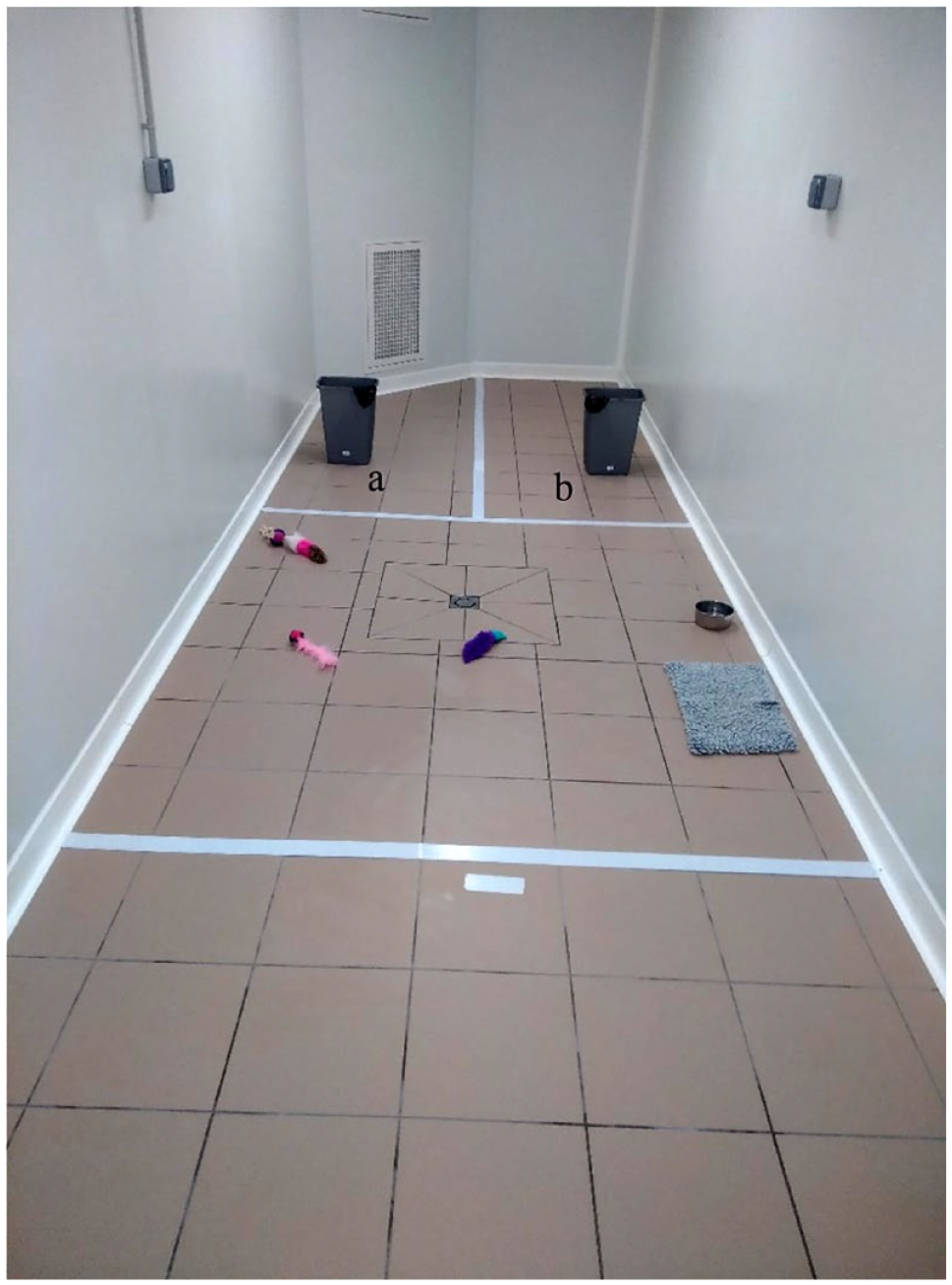
The experimental room was equipped with two garbage cans (ALLIBERT 25 l; 50 × 27 × 20 cm) (a can that had been sprayed with treatment and a control), one water bowl, three toys, one rug and one video camera. Zones (a) and (b) were delimited by Scotch tape placed on the floor
For the trial, a choice test was performed. The experimental room was familiar to the cats. In fact, they were regularly exposed to a habituation procedure to ensure that they were comfortable staying alone in the experimental room, as described in Kasbaoui et al. 7 The procedure was blinded and randomised. The treatment or placebo was sprayed six times on one garbage can each (four times on the trash bag, once on the outer side [wall side, to avoid contamination with the other can] and once on the front of the can), according to the randomisation list (A or B), 5 mins before the introduction of the cat in the experimental room. The volume of spray applied was 1.2 ml for each spray. The treatment used was a reconstituted partial volatile fraction (CEMS – ‘Cat Elimination Modulation Semiochemical’) of the secretion of a male cat’s anal gland, as described by Kasbaoui et al. 7 The control treatment was a mixture of ethanol and water (60% ethanol). Each test was performed for 10 mins in the morning, during the same hour on each day of testing. Each individual cat was tested four times: on Tuesday and Thursday for the first week and on Monday and Wednesday for the following week. All tests were filmed and analysed with Behavioural Observation Research Interactive Software (BORIS). 9
The parameters of the study included exploration (defined as the total duration of smelling and touching the garbage and eating the food, in seconds), proximity (time spent in each zone, in seconds), latency to approach (time taken by the cat to interact with each garbage can – if the cat never approached the garbage can, the maximum test duration was noted, ie, 600 s) and first choice (the garbage can the cat interacted with first).
Statistical analysis
Data analysis was performed in R version 4.0.3 and RStudio version 1.4.1103 (R Foundation for Statistical Computing). The significance threshold was classically fixed at 5%. As four repetitions were performed per cat, the effect of the treatment was studied using mixed models to consider the cat as a random effect. Exploration and proximity were analysed using general linear mixed models (GLMMs). For the first choice, which was a binary variable, mixed logistic regression was performed. For latency to approach, a shared frailty model allowing the introduction of the cat as a random factor was used. If the cat did not approach the garbage during the 600 s of the trial, the data were censored.
Results
Exploration and proximity
Cats spent significantly less time exploring (GLMM; degrees of freedom [DF] = 1; F = 14.23; P <0.0001) and in proximity (GLMM; DF = 1; F = 13.25; P <0.0001) to the treatment garbage can than to the control garbage can (Table 1).
Descriptive data of the effect of the treatment on exploration, proximity and latency to approach

GLMM = general linear mixed model; DF = degrees of freedom
Latency to approach
The latency to approach tended to be higher for the treatment can than for the control garbage can (frailty model; DF = 1; χ2 = 3.49; P = 0.0610) (Table 1).
First choice
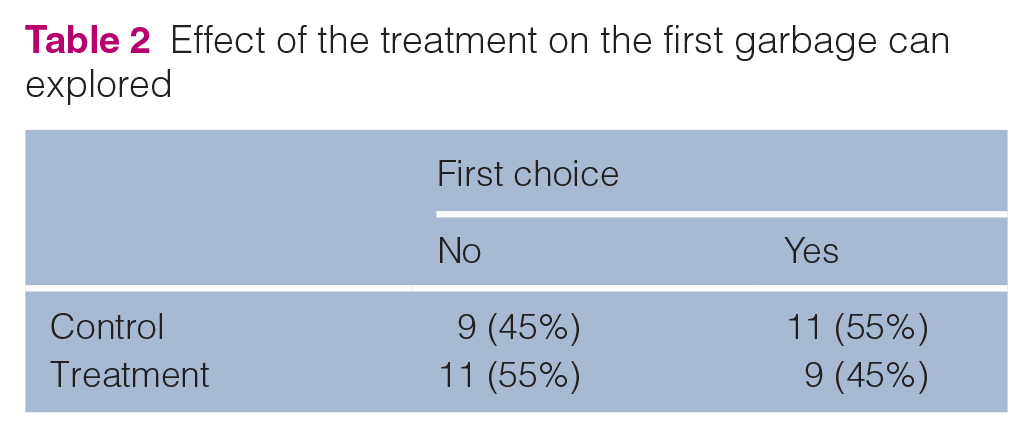
No significant difference in the first choice between garbage cans was found (mixed logistic regression; DF = 1; Z = −0.63; P = 0.5278) (Table 2).
Effect of the treatment on the first garbage can explored
Discussion
The aim of this work was to investigate the response of a cat population to a garbage can treated with a semiochemical reconstituted from a volatile fraction of anal gland secretions from male cats. The results highlighted the treatment effect. The cats spent more time exploring and in proximity to the garbage can sprayed with the control solution. A trend was detected for latency to approach, which was less for the control garbage can. However, no significant difference was found for first choice. These results suggest that the treatment could have an impact on the behaviour of cats and stimulate avoidance behaviour. A preference for the control garbage can was demonstrated in this study. The first choice was non-significant, indicating that the cats had to approach the garbage can to detect the semiochemical and choose to stay or not. This result is interesting from an ethical point of view because it does not ‘punish’ the cat when making a choice. The results demonstrated that when the first choice was the CEMS-treated garbage can, the cats subsequently explored the control-treated garbage can. In contrast, when the first choice was the control garbage can, they stayed to explore and eat the food present in that garbage can. This provides an avenue of exploration for the management of cat populations in an ethical way using a biomimetics approach. Vincent et al 10 defined biomimetics as mimicking nature using technical systems in fields such as engineering, chemistry, electronics and so on. In this context, chemical signalling is part of the natural behaviour of cats, 6 and we used one of these chemical signatures to redirect cat behaviour. This approach is beneficial because it prevents the need for coercive solutions.
Even with a small number of subjects, the results are promising, which is why a real-world field trial would be the next step to thoroughly validate these results. A trial under real-world conditions should be performed, and the semiochemical should be tested in collaboration with local government officials in a city where non-controlled variables are present. However, it is possible that under conditions in which cats do not have a better choice, the treatment will have a different impact on cat behaviour.
Conclusions
This controlled trial showed that a trash can treated with a semiochemical induces avoidance behaviour in cats. However, further studies with a larger number of subjects and under different contexts are needed to confirm these results. Furthermore, it would be interesting to evaluate whether stress-related behaviours could be induced by the presence of this semiochemical, even if no distress was observed during the present study.
Footnotes
Acknowledgements
The authors would like to thank Dr Pietro Asproni for his review of the manuscript and the cats for their great collaboration during this study.
Conflict of interest
The authors declared no potential conflicts of interest with respect to the research, authorship, and/or publication of this article.
Funding
The authors received no financial support for the research, authorship, and/or publication of this article.
Ethical approval
The work described in this manuscript involved the use of experimental animals and the study therefore had prior ethical approval from an established (or ad hoc) committee as stated in the manuscript.
Informed consent
Informed consent (verbal or written) was obtained from the owner or legal custodian of all animal(s) described in this work (experimental or non-experimental animals, including cadavers) for all procedure(s) undertaken (prospective or retrospective studies). For any animals or people individually identifiable within this publication, informed consent (verbal or written) for their use in the publication was obtained from the people involved.
