



Abstract
Objectives
The present study aimed to investigate pegylated-
Methods
A retrospective, descriptive case series of cats treated initially with pegylated-
Results
Eighty-two cats with lymphoma of five different anatomic types were included: alimentary, abdominal extra-alimentary, peripheral nodal, nasal/nasopharyngeal and other (mediastinal, renal [solitary] and miscellaneous combined in one group for analytical purposes). The response rate was 74.1% (95% confidence interval = 63.4–83.5) with 38.3% (95% confidence interval = 27.8–48.8) in complete remission. The median disease-free period and calculated overall survival time were 70 days (12–1702+) and 79 days (1–1715+), respectively. The response rate was significantly correlated with the origin of the lymphoma and the combined group had a significantly lower response rate (P = 0.035). Twenty-four cats were also treated with corticosteroids. There was no significant difference in outcomes between the group treated with or without corticosteroids. Adverse events were present in a small number of cats (14/82). The majority of these adverse events were mild to moderate in 5/14 cats; however, the adverse events were severe enough to cause discontinuation of therapy.
Conclusions and relevance
Based on the response rate and median disease-free period, treatment with pegylated-
Introduction
Feline lymphoma can be classified by anatomic location (mediastinal, alimentary, multicentric and others, such as renal, nasal and ocular),1,2 by cell size (small, intermediate or large) 3 and most recently by immunohistochemical characteristics. 4 The median age of presentation is 11 years but with a wide range.5,6
The mainstay treatment option for lymphoma remains multiagent cytotoxic chemotherapy,7 –15 with glucocorticoids being used when cytotoxic chemotherapy is declined. Reported overall response rates (ORRs) for feline lymphoma of various origins treated with different chemotherapy protocols range widely from 40% to 95%, and median overall survival times (OSTs) range from 50 days to 388 days.7–16 Median OST for feline lymphoma treated with corticosteroids alone is not published, contrary to dogs where the median OST (range) is reported to be 31–53 days. 17
Cat owners can be reluctant to use cytotoxic chemotherapy for different reasons, including concerns about contamination of the home environment, especially with small children, during pregnancy or when trying to conceive, or concerns about the potential adverse events (AEs), with reported rate of AEs of up to 87%. 18 The environmental hazard for owners while caring for pets being treated with chemotherapy is poorly documented, although contamination of the home environment has been reported.19 –21
The objective of this study was to investigate the efficacy of PEGasp monotherapy for feline intermediate and large cell lymphoma of different anatomic locations as a potential alternative to palliative corticosteroids treatment in animals whose owners declined cytotoxic chemotherapy.
Materials and methods
Study population
This retrospective study included 82 client-owned cats with lymphoma that were presented to one referral hospital (2017–2020). Ethical and general approval for the performance of this retrospective study was awarded by the institutional ethical committee (approval no. MCD-2001). The cats were examined by supervised residents, European board-certified and/or national specialists.
Data collection
The EasyVet (K Care Healthcare Solutions) database was searched using the terms ‘feline lymphoma’, ‘Oncaspar’ and ‘peg-asparaginase’. Cats with intermediate or large cell lymphoma diagnosis, peg-asparaginase therapy, palpable lesions on physical examination and/or clear lymphoma-related clinical signs were included in the study.
Exclusion from the study was based on unconfirmed diagnosis, concurrent or previous cytotoxic chemotherapy, previous
Diagnosis and staging
Signalment, cytological or histological diagnosis, anatomical location(s) of lymphoma, staging, response to therapy and occurrence of AEs were recorded, along with feline immunodeficiency virus/feline leukaemia virus (FIV/FeLV) status and immunophenotype only when available.
Staging of the lymphoma patients was performed based on one or more of the following: physical examination, abdominal ultrasound, thoracic radiographs, serum biochemistry, complete blood count and PCR assessment of antigen receptor gene rearrangement test, if performed. Cats with abdominal disease underwent abdominal ultrasonography. Cytology of the liver and spleen was not routinely performed. Thoracic radiographs were performed in cats with mediastinal lymphoma.
Treatment protocol
The PEGasp monotherapy was offered as an alternative to corticosteroid therapy alone when owners declined chemotherapy treatment. If cats were unresponsive to PEGasp monotherapy, cytotoxic treatment was offered again. The treatment protocol consisted of intramuscular injections with PEGasp (Oncaspar; Les Laboratoires Servier) (powder for injection, after reconstitution 750 IU/ml, conserved at 4°C for a maximum of 14 days) at a dose of 500 IU/m2 (30–40 IU/kg) according to a 12-injection protocol administered in weeks 0, 2, 4, 6, 9, 12 15, 18, 22, 26, 30 and 34.
Initial treatment was continued if cats showed complete remission or partial remission associated with a good quality of life and the owner’s refusal to transfer to chemotherapy. Owners were offered to continue treatment indefinitely after the 12th injection.
Follow-up
Follow-up consisted of recheck consultations at the time of the next treatment. The maximum response to PEGasp was defined as complete remission (CR; 100% regression of measurable lesion[s] and clinical signs, excluding imaging and cytology), partial remission (PR; less than 100% but more than 50% regression of disease and partial improvement of clinical signs) and no response (less than 50% regression or growth in size of the original lesion or development of new lesions or clinical signs). Restaging through imaging and/or cytology was not routinely performed during or after the treatment. For evaluation purposes, only patients with palpable disease or clear clinical signs were included in the study.
AEs were classified using standardised terminology into grades 1–5 according to the Veterinary Co-operative Oncology Group – Common Terminology Criteria for AEs (VCOG-CTCAE; see Table S2 in the supplementary material). 30 Response rates (RRs), OST and disease-free period (DFP) were determined. To assess the response to PEGasp, clinically measurable tumour lesions and the absence of clinical signs were measured. Because imaging and endoscopy were not always used for this re-evaluation, remissions were expressed as clinical remissions.
Statistical analysis
Differences in the RR between groups were evaluated by χ2 tests. Survival curves were drawn with the Kaplan–Meier method and comparisons of groups of survival data were made using the log-rank test. Survival time was calculated as the interval from start of treatment to death or to the date on which the cat was last known to be alive, including all cats and counting only deaths due to lymphoma as events. For cats in which there was a CR, the DFP was calculated as the interval from the start of treatment to relapse or to the date on which the cat was last known to be free of disease, counting only relapses as events. Cats were censored from overall survival analysis if they were still alive at the time of analysis, or if they were lost to follow-up. Cats were censored from DFP analysis if a recurrence had not occurred. For improving comparisons, the anatomic types with small numbers were grouped together to assess response (ie, miscellaneous, renal and mediastinal). Statistical significance was set at P ⩽0.05, or a corrected P value when applying sequential testing. All calculations were performed using SPSS, version 27.0 (IBM).
Results
The initial search included 270 cats. After applying the inclusion and exclusion criteria, 82 cats were included in the study. Two cats were lost to long-term follow-up but completed the treatment protocol.
Patient characteristics
All patient characteristics are presented in Table 1. No stage 5 disease was identified, although haematology was not routinely performed.
Summary of patient characteristics and clinical data of the 82 cats

PEGasp = pegylated-
Response
The maximum response during the entire therapy was recorded for all cats but one. This cat (alimentary lymphoma) died 1 day after treatment initiation and was included in the overall survival but excluded from the RR analyses. The number of treatments varied from 1 to 30, with a median of three injections.
ORR was 74.1% (95% confidence interval = 63.4–83.5%), with CR in 38.3% (95% confidence interval = 27.8–48.8%) of cats. RR per anatomical location are reported in Table 2.
Response rates associated with different anatomical locations of lymphoma

Data are n (%)
ORR = overall response rate; CR = complete remission; PR = partial remission
RR was significantly lower for the subgroup ‘other’ (P = 0.035) compared with the standard types. No additional statistically significant differences were observed. Sex (P = 0.284) and stage (P = 0.215) did not have a significant influence on response.
Median DFP was 70 days (13–1702+) with a 1-year disease-free percentage of 21.5% (Figure 1). Median calculated OST was 79 days (–1715+) with a 1-year survival rate of 20.8%.

Disease-free survival in 31 cats with lymphoma treated with pegylated-
There was no significant difference between the median OST or DFP with the different anatomic locations of lymphoma (Table 3).
Median disease-free period and overall survival time split by the different anatomical locations of lymphoma
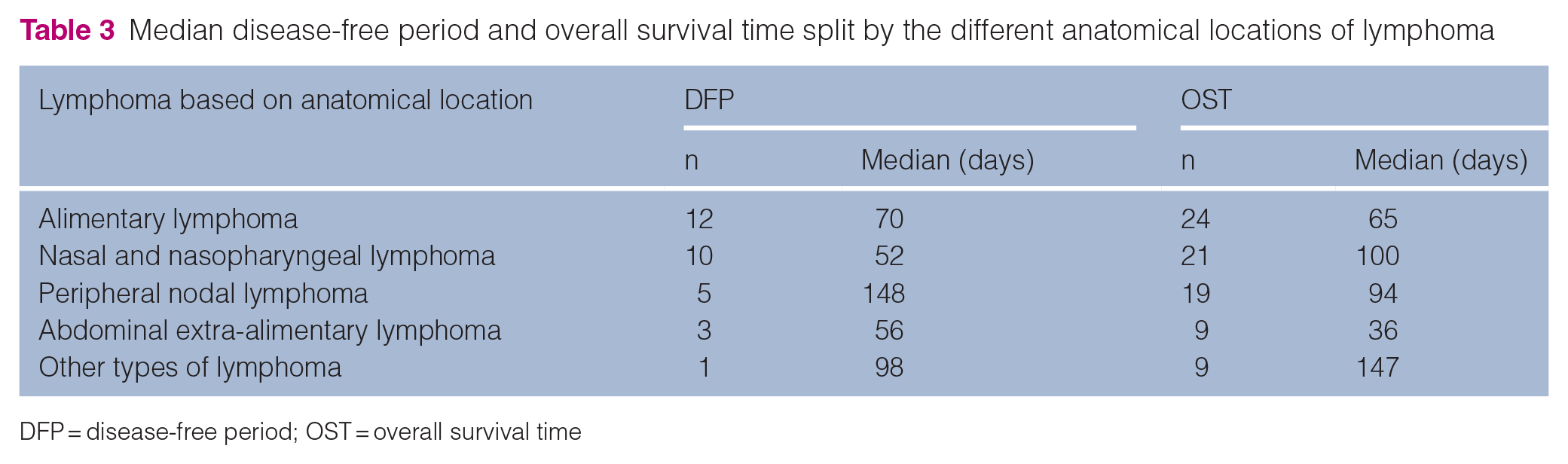
DFP = disease-free period; OST = overall survival time
Seven cats completed the entire treatment protocol (8.5%). Five cats had alimentary lymphoma, two with nasal lymphoma. All but one of these cats showed CR, and the remaining cat was in PR. Two cats were lost to follow-up after treatment was completed, both in CR at their last visit. Three cats were still alive at the time of writing.
Additional corticosteroids were used in 29% (n = 24) of cases, in varying doses. The rationale for corticosteroid use is listed in Table 4. There was no significant difference in RR between outcomes of cats treated with or without steroids (P = 0.468). In addition, there were no significant differences in remission times (P = 0.901) and OST (P = 0.822).
Rationale for corticosteroid use during pegylated-
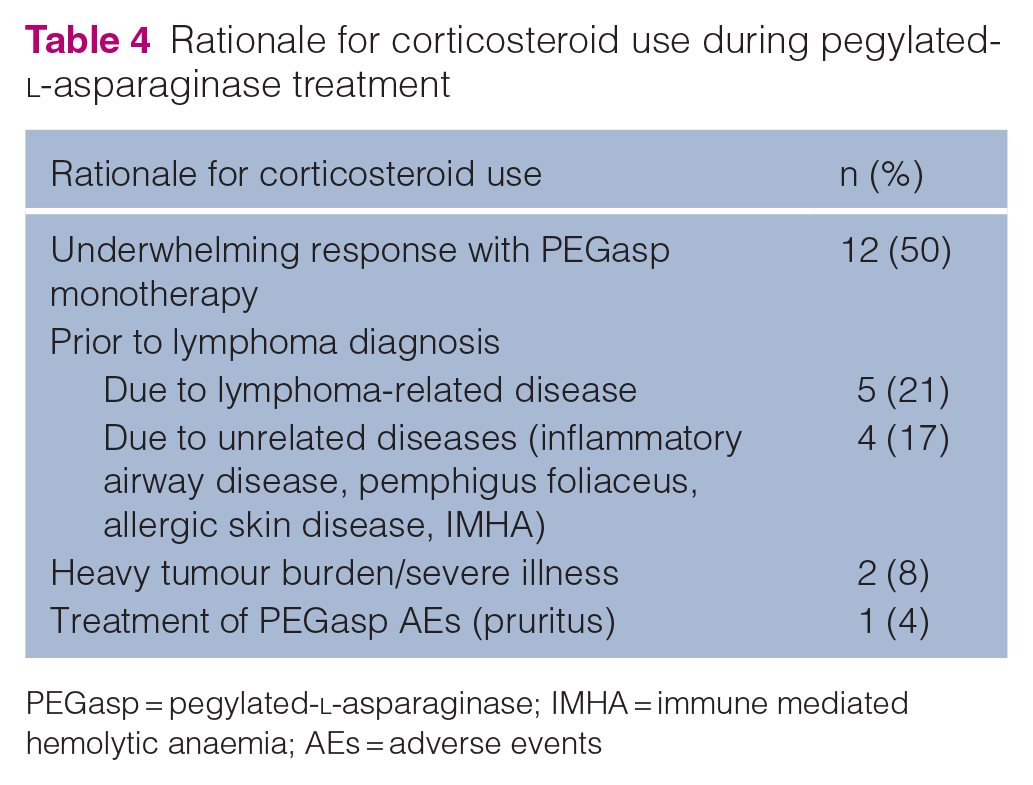
PEGasp = pegylated-
At the time of data collection, 74 cats had died, six cats were alive and two cats were lost to follow-up. In 71 cases, the death of the cat was lymphoma-related. Three cats died of unrelated or unknown causes, all showing CR at the time (21 days, 106 days and 1260 days after diagnosis). Nineteen cats (23%) with an underwhelming response were switched to other treatment options, either chemotherapy or radiation.
AEs
AEs were reported in 14/82 cats (17%) and are shown in Table 5. The number of injections varied from 1 to 12 with a median of 2.5 treatments per cat. Although AEs were more often noted in castrated males (11/14) than spayed females (3/14), this difference was not significant (P = 0.270). AEs were reported in alimentary (n = 6), nasal (n = 3), peripheral nodal (n = 2), abdominal extra-alimentary (n = 2) and renal lymphoma (n = 1). Stage was uniformly represented. The severity of AEs were the sole reason for discontinuation of therapy in 36% (5/14). One cat was euthanased 1 day after the first PEGasp treatment due to acute collapse, bradycardia and dyspnoea. It was censored from the response cohort but included in the group of patients experiencing AEs and OST. In one case, escalation of the AE was seen on repeated dosing: hyporexia leading to anorexia. Pruritus was mild and associated with repeated administrations of PEGasp.
Overview of the different types of adverse events, frequency and grade, according to VCOG-CTCAE

VCOG-CTCAE= Veterinary Comparative Oncology Group–Common Terminology Criteria for Adverse Events
The median (range) AE duration was 5 (1–14) days, the longest were hyporexia and lethargy. The time to development AEs was reported inconsistently. In seven cases (50%), treatment was started to mitigate the AEs; antiemetics (n = 3), appetite stimulants (n = 2), corticosteroids (n = 3), laxatives (n = 1), analgesics (n = 2) or intravenous fluids (n = 2).
In four cases, the AEs possibly led to death. Three patients developed severe anorexia requiring hospitalisation and supportive treatment with oesophageal feeding tube (n = 1), or euthanasia (n = 2) when owners were unwilling or unable to hospitalise their cat. In two cats, the anorexia was mild after the first injection, requiring oral supportive medication. In both cases, the second injection was given because of good tumour response, resulting in worsening anorexia. One cat with a feeding tube was discharged, only to return in a soporous condition with bradycardia and hypothermia 2 days after the second PEGasp injection; euthanasia was therefore elected. One cat with suspected tumour lysis syndrome resulting in cardiovascular collapse was euthanased following the first injection; the owners declined diagnostics at that stage. Necropsy was declined in all cats.
Discussion
The PEGasp monotherapy was used to treat cats with medium and large cell lymphoma of a variety of anatomic locations, as an alternative to corticosteroids when owners declined cytotoxic therapy. The results of the present study indicate that PEGasp monotherapy results in complete or partial clinical response in 74.1% of cases, although it appears to result in a short median DFP (70 days) and median overall survival (79 days). It is worth mentioning the exceptional responses that were present (⩾1715 days) in three of the 31 cats with a CR. Significant AEs were noted in the study (14/82; 17%) with several patients requiring discontinuation of the treatment protocol (6/82; 7%) and four of these dying as a potential result of the AEs. The treatment protocol was completed by only 8.5% of the study population (7/82).
The CR rate does not correspond with cytotoxic chemotherapy studies, with reported CRs between 60% and 76.9%.7,10,12,16 The short duration of responses could be related to the development of anti-asparaginase antibodies, neutralising the asparaginase and resulting in rebounding of amino acids in serum, as seen in people, and recently confirmed in dogs.28,31 To date, this has not been confirmed in cats.
Inherent to the study design, direct comparison with other treatments cannot be made; however, the present results (median OST = 79 days, median DFP 70 = days) are less favourable than reports of cytotoxic treatments.7,8,10–12,14–16
DFP times are hard to compare between the different anatomic locations because of the small sizes of the subpopulations, and although there appears to be an absolute difference between the groups, it is not significant.
Median OST of corticosteroid treatment alone has not been described in a large population of cats with lymphoma. However, a study by Williams et al 32 reported a median OST of 42 days using corticosteroid treatment in nine cats with renal lymphoma and Taylor et al 33 described a median OST of 60 days in 10 cats. There are a few studies describing survival times in dogs treated with corticosteroids alone; these show MSTs ranging from 31 to 53 days with a maximum individual survival of 240 days.17,34,35 It would be interesting to explore the life expectancy in cats treated with steroids, for comparison with PEGasp monotherapy. Although specific studies in cats with lymphoma are lacking, most AEs associated with corticosteroids are known to be mild in severity, such as polyphagia and weight gain, although more severe AEs can be seen with longer duration of treatment, mainly secondary infections and development of diabetes mellitus. 36
In 29% (n = 24) of the cases, there was concurrent use of corticosteroids for different reasons. No significant difference in DFP between both groups was found. The corticosteroids were used for different reasons. Because corticosteroids have also been used in cases with an underwhelming success for PEGasp, a comparison of observations based on PEGasp alone and PEGasp with corticosteroids was difficult. A recent study regarding the additional effect of PEGasp in a modified COP regimen by Krupa et al 29 noted that pre-treatment with corticosteroids was a positive prognostic factor for response to PEgasp, although the group treated with steroids was small. In humans, corticosteroids decrease the immune response to PEGasp and therefore decrease the development of neutralising antibodies.24,25 Overall, we concluded that the concurrent use of corticosteroids did not influence the outcome of the PEGasp treatment in the present study.
AEs with cytotoxic chemotherapy are reported in 47–65% of cases; commonly gastrointestinal or haematological in origin, although rarely grade 4 or 5.7,37,38 AEs can also be present in cats treated with corticosteroids, although most are mild in severity. 36 The frequency of AEs observed in the present study (17%) was low compared with cytotoxic treatment; however, the AEs seen were markedly higher in grade. Because all cats with severe AEs were already severely ill from the lymphoma in the present study, it was difficult to truly differentiate between the AE and the disease itself. In most of these cases, however, the clinical signs were clearly present after treatment, and repeated or worsened with additional treatments. Some AEs were considered unlikely to be related to lymphoma (pruritus, alopecia) and were assumed to be true treatment-related AEs. All cats with AEs showed clear response to treatment, apart from the cat that died 1 day post-injection, reducing the chance of those clinical signs being related to lymphoma.
Pancreatitis, as reported in people treated with PEGasp,
39
was not reported in the present study as an AE; however, because none of the cats with gastrointestinal AEs underwent further diagnostics, this cannot be excluded. To our knowledge, there are no studies available that look specifically at the rate of AEs of
Since this is a retrospective study, the performed staging was not standardised for every cat. In some cases, staging was minimal, often due to financial constraints. In most cases, no restaging was performed, impeding further observations. Although an attempt was made to minimise the impact of this by only including cats with palpable disease and/or significant clinical signs, more objective follow-up data would have been desirable.
There is a potential selection bias. Because only cats from owners declining cytotoxic chemotherapy were included, it could be hypothesised that these owners were less likely to put their cat through a protracted treatment course. Additionally, because they did not want to pursue other treatment options, the current treatment might have been given for longer when success proved underwhelming, compared with owners who wanted to switch to regular treatment. Nevertheless, it is still worth investigating the effect of this therapeutic option in the search for different options to offer to treat different cat–owner combinations.
Retroviral testing was infrequently performed; thus, it might influence the observations that were made. Previously, FeLV infection was considered a major risk factor for developing lymphoma and leukaemia, but even with decreasing incidence over recent decades, the incidence of lymphoma is rising.5,41 The Netherlands is among the lowest tested countries for FeLV infection, hence prevalence, 42 and FeLV positivity is present in less than 5% of the Dutch feline lymphoma cases.12,16 Therefore, it is unlikely that FeLV was a significant comorbidity.
PEGasp has a high financial impact compared with corticosteroids; however, for average-sized cats, the costs are similar to the costs of cytotoxic chemotherapy over the long term in our clinic. Important advantages of PEGasp treatment compared with chemotherapy include that there is no need for additional tests such as haematology, it is a well-tolerated treatment, even in fractious cats, and there is an absence of environmental hazards.
Starting with PEGasp is an interesting way to introduce antineoplastic therapy to chemotherapy-hesitant owners: 19 owners (23%) decided to switch to cytotoxic treatment after underwhelming results with PEGasp. These owners would most likely have treated their cats with corticosteroids otherwise, possibly reducing life expectancy. It is not known how these cats respond to chemotherapy compared with PEGasp-negative cats. PEGasp could also be an alternative for owners of difficult-to-medicate pets because it does not involve tablets and the injections are well tolerated.
Conclusions
The ORR to therapy was, as expected, somewhat lower than existing multi-drug cytotoxic treatment protocols, although there was evidence of a good response in a proportion of cats, and there was a small subset of cats that showed exceptional long disease-free intervals and overall survival. The quality of life was generally good and the rate of AEs was lower than with cytotoxic drug protocols. For owners declining cytotoxic treatment, PEGasp monotherapy could be an alternative to palliative corticosteroid treatment and it may encourage some owners to decide to move over to chemotherapy, when they would have initially refused. Given the impact of cytotoxic chemotherapy on the wellbeing of the cats and their families, future studies are warranted to continue to explore the impact of alternative options to treat this common disease in cats, including the comparison between response to single agent PEGasp and corticosteroids, also with regard to AEs.
Supplemental Material
sj-docx-2-jfm-10.1177_1098612X231193536 – Supplemental material for Pegylated-l-asparaginase therapy for feline large cell lymphoma: 82 cases (2017–2020)
Supplemental material, sj-docx-2-jfm-10.1177_1098612X231193536 for Pegylated-l-asparaginase therapy for feline large cell lymphoma: 82 cases (2017–2020) by Céline A Bik, Bart R Ruijter, Lindsay Van den Bossche, Erik Teske, Stijn JM Niessen and Yaiza Forcada in Journal of Feline Medicine and Surgery
Supplemental Material
sj-xlsx-1-jfm-10.1177_1098612X231193536 – Supplemental material for Pegylated-l-asparaginase therapy for feline large cell lymphoma: 82 cases (2017–2020)
Supplemental material, sj-xlsx-1-jfm-10.1177_1098612X231193536 for Pegylated-l-asparaginase therapy for feline large cell lymphoma: 82 cases (2017–2020) by Céline A Bik, Bart R Ruijter, Lindsay Van den Bossche, Erik Teske, Stijn JM Niessen and Yaiza Forcada in Journal of Feline Medicine and Surgery
Footnotes
Supplementary material
The following files are available as supplementary material:
Table S1: Patient data sheet
Table S2: Veterinary Comparative Oncology Group-Common Terminology Criteria for Adverse Events (VCOG-CTCAE) following chemotherapy or biological antineoplastic therapy in dogs and cats.
Author note
The abstract of this study was presented at BSAVA Congress, Manchester 2023.
Conflict of interest
The authors declared no potential conflicts of interest with respect to the research, authorship, and/or publication of this article.
Funding
The authors received no financial support for the research, authorship, and/or publication of this article.
Ethical approval
The work described in this manuscript involved the use of non-experimental (owned or unowned) animals. Established internationally recognised high standards (‘best practice’) of veterinary clinical care for the individual patient were always followed and/or this work involved the use of cadavers. Ethical approval from a committee was therefore not specifically required for publication in JFMS. Although not required, where ethical approval was still obtained, it is stated in the manuscript.
Informed consent
Informed consent (verbal or written) was obtained from the owner or legal custodian of all animal(s) described in this work (experimental or non-experimental animals, including cadavers) for all procedure(s) undertaken (prospective or retrospective studies). No animals or people are identifiable within this publication, and therefore additional informed consent for publication was not required.

References
Supplementary Material
Please find the following supplemental material available below.
For Open Access articles published under a Creative Commons License, all supplemental material carries the same license as the article it is associated with.
For non-Open Access articles published, all supplemental material carries a non-exclusive license, and permission requests for re-use of supplemental material or any part of supplemental material shall be sent directly to the copyright owner as specified in the copyright notice associated with the article.
