



Abstract
Practical relevance:
Cats are one of the most common companion animals in the world. However, relatively little scientific research has been conducted on cat behavior. With problem behaviors a leading reason for relinquishment of cats to shelters, or abandonment outdoors, solutions to address feline behavioral problems can have important welfare benefits. Because naturally occurring pheromones produce measurable species-specific responses in cats, the use of synthetic pheromone products consisting of the same compounds may activate a specific behavioral response in the receiving individual, allowing humans to better communicate with cats and manage feline problem behavior.
Aims:
In this article the scientific background for naturally occurring feline pheromones and semiochemicals and their impact on cat behavior is reviewed. This is used as a foundation to explore the three feline synthetic pheromones currently available and the empirical evidence that exists for their effectiveness. From this information, several recommendations for veterinarians and behavior professionals on the application of feline pheromone therapy in the home and veterinary clinic setting are presented.
Evidence base:
The efficacy of synthetic pheromones as a tool for the management of problem behaviors is a relatively new area of research and only fairly recently has the need to implement more rigorous research methodology been recognized.
Pheromones: species-specific signals
Animal species have developed a range of mechanisms to facilitate social communication. These mechanisms can be visual, vocal, physical or chemical and may function both within and between species. Semiochemicals include any chemical signal given off by one individual that provides a message, altering the behavior of another individual. 1 In mammals, chemical signals are excreted via faeces, urine and glandular secretions, and are detected by other individuals via the main olfactory and vomeronasal systems. 1 Pheromones are a type of semiochemical evolved for communication within a species. 2 Pheromones are individual molecules or a set of chemical compounds that are excreted on the outside of an individual’s body, are received by a member of the same species and activate a specific behavioral response in that receiving conspecific. 3

The use of pheromones as a tool to redirect problem behaviors has important implications for cat welfare. Because pheromones produce species-specific behavioral responses, it may be possible to utilize solutions comprised of the same chemical compounds found in feline pheromones and semiochemicals to activate a specific behavioral response in the receiving individual. Before exploring the role of synthetic pheromones in managing cat behavioral issues, it is important first to examine how cats use chemical signals to communicate and how naturally occurring feline pheromones impact cat behavior.
Feline olfactory communication
In the domestic cat, chemical stimuli play a central role in communication and social behavior. 4 Chemical cues can provide information on the familiarity5-7 and sexual status of the individual, 8 and cats have developed several behaviors related to depositing and detecting olfactory cues. Scent-marking behaviors include object rubbing, allorubbing (rubbing the head/flank of the body on another individual; Figure 1a), social rolling (Figure 1b) and scratching, while odor-detecting behaviors include sniffing (Figure 1c) and the flehmen response (Figure 1d). The last involves the cat opening its mouth into a grimace that causes the ducts to open; this flehmen behavior lets scent molecules pass into the vomeronasal receptors, and allows the cat to ‘taste’ chemical stimuli.4,8 Additionally, behaviors related to urination and defecation play a role in chemical signaling.

Scent-related behaviors including: (a) allorubbing between free-roaming colony cats; (b) social rolling; (c) sniffing; and (d) flehmen behavior in response to a novel conspecific scent
Cats deposit chemical stimuli (glandular secretions, saliva, urine and feces) in their environment, particularly within areas commonly used by the individual. 9 In places where scent-marking events take place frequently, the scent of the individual, or individuals in the group, may accumulate and serve as an olfactory reference point.4,9,10
A cat’s use of scent as a reference point within its environment relates back to early interactions in the mother–kitten relationship. Because only tactile and olfactory systems are operational from birth, kittens rely heavily on tactile and chemical cues to navigate their early environment. 11 For example, the nest area where kittens are reared accumulates scent as hair, urine and saliva are deposited and queens mark the area with glandular secretions.4,11,12
The olfactory cues deposited in the nest area provide a signal to the kittens, allowing them to orient themselves spatially in their environment. 13 This has been demonstrated by research which found that, when displaced from the nest area, kittens that were able to detect odor had a higher success of returning to the nest location than anosmic kittens that could not detect olfactory cues.11,14
The nest odor also serves to reduce distress behaviors in kittens. This was demonstrated by researchers who washed the nest area, thereby removing all olfactory cues. Despite being in the same spatial location, with the lack of olfactory cues kittens backed away from the nest area and emitted distress vocalizations (Figure 2). 15

Kitten emitting a distress vocalization. This is common when separated from the family nest scent
This combination of research indicates that olfactory cues allow kittens to orient themselves within their environment and that the olfactory stimuli may exert a calming effect, thereby reducing distress by signaling the kitten is in a familiar location. 4
Pheromones and semiochemicals
Of particular interest in cat communication is the use of pheromones and semiochemicals, including the facial pheromones, feline appeasing pheromone (FAP) and feline inter-digital semiochemical (FIS) (Table 1).


Both (a) free-roaming colony cats and (b) pet cats engage in allorubbing behavior. The F4 facial pheromone is thought to be deposited in these social situations and may be related to security behavior
Much remains to be learned about the production and detection of these pheromones and exactly how they influence cat behavior. Researchers have begun to explore the production of synthetic cat pheromones and how they may be applied to impact cat behavior and welfare. To date, synthetic analogues of F3, FAP and FIS have been developed and marketed.
F3 feline facial pheromone
Depositing behavior and natural function
The F3 facial pheromone is deposited during object rubbing. Similar to cats in the outdoor environment, pet cats rub on objects around areas of the home where they spend the most time.4,9 The F3 pheromone may play a similar role to that of the nest scent, whereby proximity to chemical stimuli that have been deposited in an area acts to reduce distress and increase security.
Synthetic analogue
Products available
The F3 pheromone was the first feline synthetic analogue to be produced and marketed. The most common synthetic brand is Feliway Classic (Ceva), although other companies have also produced F3 products. Various different means of dispensing the synthetic F3 pheromone have been marketed including collars, sprays, wipes and diffusers. The synthetic pheromone is proposed to decrease behaviors related to stress such as inappropriate urination, inappropriate scratching and overgrooming.
Empirical evidence
Most scientific research examining the influence of synthetic pheromones on cat behavior has focused on F3, the most long-standing feline synthetic analogue.
A recent study examined stress via measurement of cortisol levels in cats. Researchers assessed salivary cortisol levels before and after implementation of the Feliway Classic F3 diffuser for 35 days. 21 Although researchers did not see a significant difference in salivary cortisol levels when comparing day 0 with day 35, they did find great individual variability in response to the F3 analogue. Cortisol levels did decrease for the majority of cats (75%; 21/28 cats) following implementation of the treatment. Interestingly, a significant difference was found between responses of males and females; and all seven subjects that did not respond to the treatment were female. This may indicate that male cats respond better to the F3 analogue, or it may be a reflection of the great variability that exists in responses to these compounds. It is important to note that no control group was included. Implementing any treatment may potentially influence cat behavior, especially if caretakers are aware of the treatment and may unwittingly alter their behavior toward the cat in response.
More recently the need to implement more rigorous research methodology has been recognized – including group randomization, blindness to treatments, and the inclusion of a placebo or control group. For example, a randomized, double-blind, placebo-controlled clinical trial showed a reduction in stress (as measured by lack of sneezing in the treatment group) and an increase in resting behaviors following treatment. 22 Another study found that, compared with a placebo spray, the Feliway F3 spray caused a reduction in stress during cats’ visits to a veterinary clinic, with stress behaviors ranked by observers blinded to the treatment. 23
It is important to note that results on the success of the F3 analogue in decreasing cat stress levels have been mixed,24,25 and some authors have stated that there is insufficient evidence for the effectiveness of feline facial pheromones for reducing stress and enhancing calmness. 26 For example, one randomized, controlled study evaluated the effects of a placebo and F3 diffuser and found the F3 diffuser had no significant influence on stress scores of cats living in multi-cat shelter rooms. 24 Additionally, several studies have been funded and conducted by the companies producing the feline synthetic pheromones. Overall, however, the research that does exist, especially that which employs more rigorous methodology, indicates that this is a valid study area for management of feline behavioral problems.
Feline appeasing pheromone
Depositing behavior and natural function
Chemical signals released by the mammary glands during lactation play several different roles during early mother–kitten interactions. 4 FAP is released from the sebaceous mammary glands of the queen during nursing from 3–4 days after giving birth. The pheromone persists until around 2–3 months; ie, slightly after kittens are weaned. 16 It is believed that the production of this pheromone reassures kittens, promotes security and may facilitate bonding between kitten and mother. 16
Synthetic analogue
Product available
A synthetic analogue has been developed commercially by Ceva and is known as Feliway MultiCat in the United States and Feliway Friends in Europe. This analogue is currently available in diffuser form. Feliway MultiCat/Friends proposes to decrease conflict and aggression and increase social bonding in multi-cat homes, as well as alleviate stress during changes in the environment by promoting security, similar to the natural function of FAP.
Empirical evidence
To date, only one pilot study has been conducted, exploring the efficacy of the FAP analogue in the management of feline aggression. 20 Researchers recruited 45 multi-cat households (2–5 cats) that had been experiencing issues with inter-cat aggression for at least 2 weeks prior to the study. Households were randomly assigned to either a treatment (20 households) or placebo group (25 households). A 2% solution of the FAP analogue (Feliway MultiCat) was used as the treatment and placed in two 50 ml diffusers within the home. Both the treatment and placebo diffusers contained equivalent amounts of solution (48 ml) and were sited in cat resting locations picked by the investigator, who was blinded to the household treatment. All participants attended an educational training meeting on day 7 after placing diffusers and were instructed to monitor aggressive behaviors listed on the Oakland Feline Social Interaction Scale including staring, fleeing, hissing, chasing, stalking, biting and tail twitching, among others. Although aggressive behaviors decreased in both the treatment and placebo groups over time, aggressive behavior decreased significantly more in the synthetic analogue treatment group.
While results indicate that treatment with the synthetic FAP provides significant benefit in addressing inter-cat aggression, 16 with only one preliminary study published on the efficacy of this analogue much remains to be learned about how this tool can be utilized and how effective it can be in a variety of settings. For example, because experience with chemical stimuli is often key to developing a behavioral response to the stimuli,4,27,28 orphaned kittens that are bottle-fed and reared by humans, and which may have little to no exposure to FAP due to lack of nursing on their mother, may show little or no response to the synthetic analogue. Further studies are required to determine whether FAP elicits a behavioral response automatically, or if experience plays a role.
Feline interdigital semiochemical
Depositing behavior and natural function
Research has found that outdoor colony cats often scratch tree bark, effectively using certain trees as ‘scratching posts’. 9 Most of the trees in the study area remained unmarked, with the cats scratching certain trees in locations where they often frequented. These preferred trees displayed severe visual damage on the bark and most likely also provided olfactory cues from the paw secretions of the cats engaging in the scratching behavior. 9
Synthetic analogue
In pet cats, scratching is a normal behavior directly related to cat wellbeing.4,9 Thus promotion of healthy and appropriate scratching behavior is an important component of human–cat interactions. However, many owners report cats displaying inappropriate scratching behavior, leading to potential conflict in the human–cat relationship. 29 Therefore, the use of synthetic FIS as a means of redirecting scratching behavior has important welfare potential.
Product available
The FIS analogue is known as FeliScratch (Ceva) and is currently available in liquid form. It is proposed that this synthetic analogue addresses inappropriate scratching behavior by redirecting scratching to a desired location. The liquid is squeezed out of a pipette onto the desired scratching surface, with one dose applied daily during the first week and then once a week for two further weeks.
Empirical evidence
The product is relatively new and so, to date, only two studies have examined the impact of synthetic FIS on cat scratching behavior. In one study, owners of cats with existing problematic scratching behavior were instructed to place the FeliScratch solution (comprised of 0.05% FIS Fraction 1, 0.1% catnip and blue colorant) on a desired scratching surface. 30 The researchers found that 74% of the 29 cats stopped scratching the undesired surfaces following application of the FeliScratch solution to an appropriate scratching surface. However, no placebo group was included and, although owners were instructed not to direct the cat’s attention to the scratching post, it is possible that application of the solution itself, or some other characteristic of the solution, may provide the incentive for scratching the surface rather than the FIS analogue specifically.
In the second study, which did include a placebo group, 19 cats received the FIS analogue and a placebo liquid in a crossover repetition design. 31 Behavioral responses to the FIS treatment and placebo were coded by independent observers who were blinded to the treatments. The results indicated that the presence of FIS on the scratching post significantly influenced cat behavior, with both the median duration of scratching and median frequency of scratching events increasing with presentation of the FIS treatment. These results suggest that use of the FIS analogue may be a way for the owner to communicate appropriate scratching surfaces to the cat, thereby strengthening the human–cat bond.
Pheromone therapy
Practical application
There are several considerations for animal care professionals when utilizing pheromone therapy – and key among them is where to recommend placing synthetic pheromones in the home (see box on pages 1030–1031). It is important also to remember that there may be individual variability in response to synthetic or even naturally occurring pheromones that may depend on the individual’s sex 21 or environmental experiences. 28 The individuality of cats has been well described by researchers 36 and animal care professionals will want to employ pheromone therapy on a case-by-case basis.
Pairing of synthetic analogues with catnip
In order to entice more cats to explore the F3 synthetic analogue, some have proposed pairing the analogue with another extract known to elicit a response in cats, catnip (Nepeta cataria). 37
Catnip is a preferred olfactory stimulus for cats and, in a recent study examining individual preferences, significantly more cats preferred a cloth impregnated with catnip compared with cloths with conspecific or gerbil scent. 38 As shown in Figure 4, several investigatory and other behaviors are associated with the catnip response, including sniffing, licking/chewing, chin/cheek rubbing, allorubbing and social rolling, and research indicates that about two-thirds of cats display this active response. 39 However, the presentation of this active behavior alone is insufficient to assess catnip responsiveness, as the majority of, if not all, cats also respond to this stimulus with passive behavior, such as time sitting still in a sphinx-like position. 39
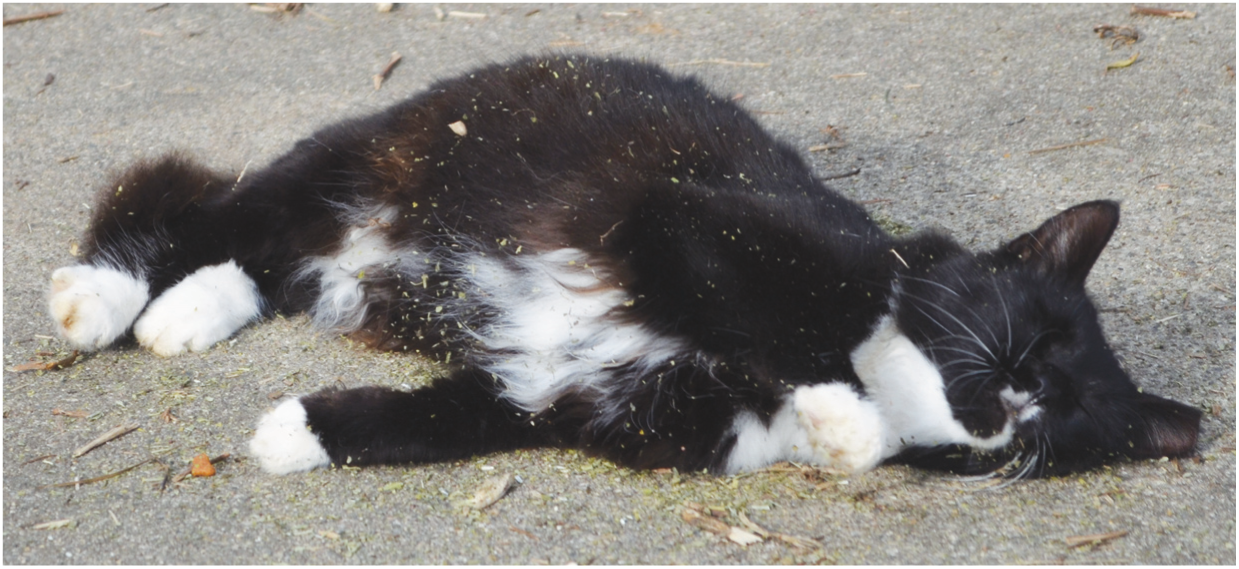
Catnip response in a free-roaming cat. The catnip stimulus elicits several behaviors related to scent marking including chin/cheek rubbing and social rolling, as seen here
Given that the majority of cats respond to catnip in some way, and that it may increase investigatory behaviors, pairing the F3 analogue with catnip extract (Figure 6) may elicit a more powerful response, producing a greater impact on cat behavior. Additionally, because catnip increases behaviors related to depositing olfactory cues (such as object sniffing, chin/cheek rubbing and allorubbing), 8 it may allow cats to deposit their scent in the environment more readily, encouraging them to feel more secure.
Researchers examining the efficacy of pairing catnip with the F3 analogue compared a positive control of Feliway Classic with Zenifel (Virbac), an F3 analogue containing catnip extract. 37 The study was double-blind and each of the 24 study cats received both treatments; half of the cats received the Feliway Classic treatment first and the other half received the Zenifel treatment first. All cats were then switched to the other treatment. A stress index was obtained from behavioral assessments taken before, during and after a potentially stressful event (blood pressure measurement); the assessment encompassed various stress and wellbeing behaviors. Researchers found significant differences between the two treatments, in terms of a reduction in the stress index, at some time points but not others. For example, during blood pressure measurement, the solution with catnip provided a significant reduction in the stress index as compared with the positive control. However, at 4–5 h after blood pressure measurement, there was no significant difference between groups. This indicates that catnip may be combined with the F3 analogue (Figure 6) to reduce stress; however, the effect may not be long-lasting. Additionally, because the catnip response can be displayed with both active and passive behavior, 39 further research is warranted to examine the role of catnip in stress reduction and how it may best supplement pheromone therapy.
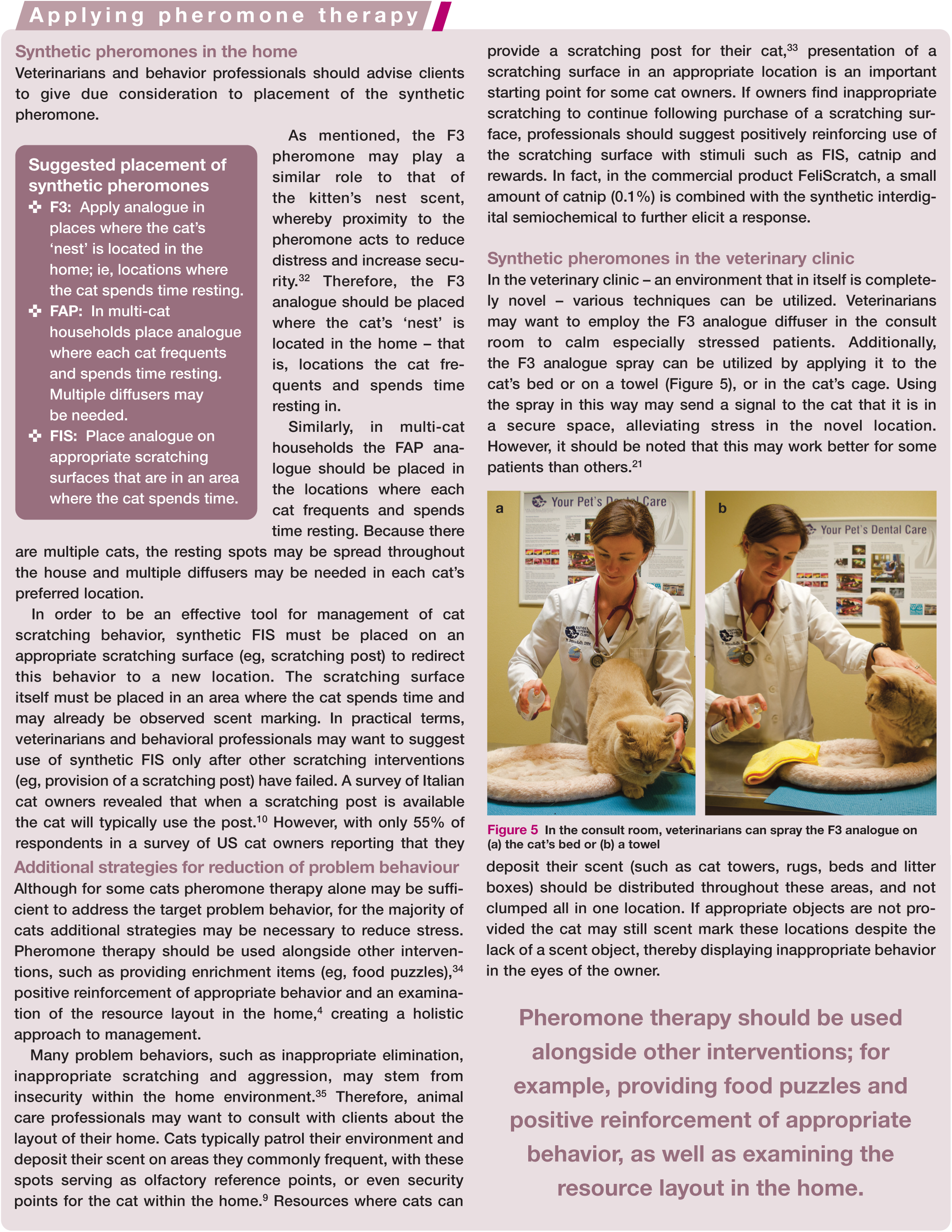

In the consult room, veterinarians can spray the F3 analogue on (a) the cat’s bed or (b) a towel

Cat investigating a cloth sprayed with F3 pheromone and paired with catnip
Conclusions
In all, much remains to be learned about how best to implement feline pheromone therapy. However, key recommendations can be made based on the current information (see box below). The present body of research provides a good foundation for future directions in implementation of synthetic pheromones to address feline problem behaviors.
Key Points
Consider cat individuality and employ pheromone therapy on a case-by-case basis.
Advise owners to give careful consideration to where synthetic pheromone is placed in the home.
Present synthetic pheromone paired with catnip, or an appetitive stimulus such as food or toys, to promote initial exploration of the pheromone.
Use pheromone therapy alongside other interventions, such as providing enrichment items, positive reinforcement of appropriate behavior, and an examination of the resource layout in the home.
Employ an F3 analogue diffuser in the consult room for use with patients that are especially stressed in the veterinary clinic environment.
Apply F3 spray to items within the consult room, including the cat’s cage.
Supplemental Material
Supplementary Material
Special issues on feline behaviour and problem behaviours
Footnotes
Acknowledgements
Thank you to Eastgate Veterinary Clinic in Corvallis, OR, USA and their cat Latte for assisting with hospital photos. Thank you also to Alexandra Behnke of the Human–Animal Interaction Lab at Oregon State University for comments on an early version of this article.
Conflict of interest
The author declared no potential conflicts of interest with respect to the research, authorship, and/or publication of this article.
Funding
The author received no financial support for the research, authorship, and/or publication of this article.
References
Supplementary Material
Please find the following supplemental material available below.
For Open Access articles published under a Creative Commons License, all supplemental material carries the same license as the article it is associated with.
For non-Open Access articles published, all supplemental material carries a non-exclusive license, and permission requests for re-use of supplemental material or any part of supplemental material shall be sent directly to the copyright owner as specified in the copyright notice associated with the article.
