



Abstract
Objectives
Transport can be a stressful experience for domestic cats. The objective of this study was to evaluate the effect of a new synthetic feline facial pheromone product on relieving stress in domestic cats during short-distance transport.
Methods
A randomised, blinded, placebo-controlled pilot study was conducted. Prior to baseline screening, cat owners were trained via online meetings in the assessment of stress-related behaviours and overall stress visual analogue scoring. All assessments were completed 30 mins after the start of transport. A total of 150 domestic cats exhibiting stress-related behaviours during baseline screening were recruited and randomly assigned to either the treatment group (n = 75) or the placebo group (n = 75). For the placebo-controlled intervention, the product and placebo, which were identical in appearance, were provided to the treatment and placebo groups, respectively. Fifteen minutes after spraying the carriers with the product or placebo, cat owners were required to take their cat out and complete the same assessments (baseline screening).
Results
After the intervention, the performance of the stress-related behaviours curling, lack of motion and meowing during transport outside the home was significantly reduced in the treatment group compared with the placebo group (P <0.05). When the baseline stress visual analogue scale (VAS) score was >2.94 cm, cats in the treatment group had significantly lower post-intervention stress VAS scores compared with those in the placebo group (P <0.05).
Conclusions and relevance
A synthetic feline facial pheromone product can alleviate short-distance transport-related stress in domestic cats with higher stress scores. This finding will benefit domestic cats during transport outside of the home.
Introduction
Domestic cats (Felis catus) are sensitive to environmental changes, preferring to stay in a familiar environment, which can bring them a sense of security. 1 However, it is necessary to take cats to unfamiliar places (eg, veterinary hospitals, boarding facilities and travelling). Transport is a stress-prone experience that can trigger various negative stress responses.1–3 Notably, stress triggered during transport to the veterinary hospital can make subsequent care or examinations difficult, affecting the outcome of medical diagnoses. 2 Besides, the severity of transport-related stress may be exacerbated by additional stressors that cats encounter in the hospital, 4 which will not only affect the normal diagnosis and treatment, but can also lead to about one-third of cat owners becoming unwilling to send ill cats to the veterinarian, threatening the health and welfare of cats. 5
Generally, instructing cat owners on how to deal with aggressive events (discouraging them from punishing cats negatively with squirt guns or other startle methods), preconditioning cats to stressful situations through positive reinforcement (familiarising new events, and giving food, petting and verbal praise), and listening to cat-specific music have been previously proposed to alleviate feline stress.2,6,7 Carrier training is proven to be an effective approach to reducing feline stress during transport to veterinary practices. 2 However, the need for long-term training may limit its further application in practice. In recent years, feline facial pheromone products have gained popularity owing to their low cost, ease of implementation and high rate of instant results for controlling various feline stresses. 8 Nevertheless, the pheromone product has been shown to have different effects on different types of feline stress in different settings (eg, veterinary hospitals, homes and shelters).4,8 Frank et al 9 systematically reviewed the literature on the use of pheromone products in the treatment of undesirable behaviours in cats, and they found insufficient evidence for the effectiveness of feline facial pheromone products in either calming feline idiopathic cystitis during catheterisation or reducing stress-related behaviours in hospitalised cats. A 2021 study showed that the low-stress transport protocol, that is, preparing a cat carrier basket containing a F3 pheromone product and keeping the basket covered and stable during the journey from home to the clinic, can result in less time to sedation with a lower dose of propofol. 10 A previous study has demonstrated the effect of a synthetic feline facial pheromone product on long-distance transport-related stress in domestic cats. 11 However, whether the synthetic feline facial pheromone product could also help reduce stress in cats during short-distance transport remains unknown.
To get a better insight into stress in domestic cats during short-distance transport, the authors worked with cat owners to qualify and quantify stress-related behaviours during short-distance transport, and to evaluate the efficacy of a new synthetic feline facial pheromone product on alleviating stress in domestic cats during the short-distance transport. To our knowledge, this is the first randomised, placebo-controlled study to evaluate the effect of a synthetic feline facial pheromone product in alleviating the stress of short-distance transport in domestic cats.
Materials and methods
Study design and ethical approval
This was a randomised, placebo-controlled, blinded pilot study. All the trial protocols and animal care procedures were approved by the Experimental Animal Care and Ethical Committee of the Institute of Animal Science, Chinese Academy of Agricultural Sciences (approval no: IAS2020-89), with informed consent from cat owners whose cats were volunteered for the study. During the entire trial, no drugs or products were used other than the test product and placebo.
Screening, training, recruitment and baseline characteristics
All domestic cats were recruited from WeChat, one of the largest social networking applications on smartphones in China. First, a recruitment advertisement was posted in the discussion group. Within a month, >1000 interested cat owners responded. Healthy cats over 1 year of age that were stressed during transport in the carrier and were the only pet at home were included in the baseline screening. ‘Healthy’ was defined as being in normal mental health, free from eating or defaecation disorders, free from vomiting, sneezing, coughing and diarrhoea, free from skin diseases, dewormed, and not pregnant, breastfeeding or in oestrus. Consequently, 188 cat owners agreed to join the baseline screening with informed consent.
A new carrier was mailed to every involved cat owner (Figure 1), which was the same as conventional cat carriers on the market. The new carriers were placed next to the cats so that the cats could smell, explore and become familiar with the carriers at least 1 week before taking them out in them. Via WeChat, one-to-one online training was given to cat owners for assessing stress-related behaviours after receiving the carriers. The overall severity of stress was assessed with a 100 mm visual analogue scale (VAS) based on the Cat Stress Score developed by Kessler and Turner, 1 which has long been used to assess feline stress with good validity.2,7,12 A VAS was used for its advantages of continuity, responsiveness and precision over discrete scales, especially for well-trained participants in the study. 13 Moreover, 10 investigated stress-related behaviours were also determined accordingly (Table 1). 1 Hiding was judged by observing whether the cats avoided the owner’s hand reaching into the carrier from above. Other behaviours were observed directly through the mesh windows of the cat carrier (Figure 1). During the training, the cat’s stress response and VAS scoring tools were shown by videos and pictures, respectively. After a detailed explanation of how to evaluate the occurrence of 10 investigated stress-related behaviours and overall severity of stress, three new videos of cats during transport were shown to each cat owner so that they could judge the 10 types of stress behaviours and the levels of overall stress. If one owner’s measurement accuracy (30 judgements and three VAS scores) was at least 95% or more, as required by the trainer, the owner’s training was ended. If cat owners did not reach the standard initially, their training was continued until they reached it.
Stress-related behaviours investigated in this study


Cat carrier used in the investigation: (a) front and (b) side
To determine the time point for assessment during transport, the time the cat owners spent when transporting their cats was investigated. It was found that about 80% of responding cat owners spent <2 h on transport each time. Therefore, transport can be thought of as acute stress triggered by the superposition of various stressors, such as handling, restriction in cat carriers, unfamiliar environments and bumpy roads. In addition, cats will adapt and stress-related behaviours will decrease over time. To avoid unstable states at the beginning of transport and to observe apparent responses during transport, the assessment time was determined to be 30 mins after the start of transport.
For baseline screening, the owners were asked to put their cats in the new carriers and go outside. Thirty minutes later, the owners were required to assess the stress-related behaviours of their cats. Dichotomous results of ‘yes/no’ for every investigated stress-related behaviour, in addition to the overall stress VAS score, were recorded on a designated WeChat app and submitted immediately. The cats exhibited at least one stress-related behaviour with a VAS score >20 mm during baseline screening were finally recruited and randomly allocated to either treatment or placebo groups. The baseline demographical characteristics, including age, sex and neuter status, were confirmed and recorded. Randomisation was undertaken by computer-generated random numbers and the cat owners were blind to the results of randomisation. Eventually, a total of 150 cats were randomly assigned to either treatment or placebo groups (treatment, n = 75; placebo, n = 75).
Investigational product and placebo
The investigational product (Cature) is an anti-stress feline facial pheromone product developed and produced by Fiber Biotech (Shanghai) Limited-liability Company, Cature mainly contains a synthetic feline facial pheromone F3 analogue, a mixture of 10–18 carbon chain fatty acids or their derivatives, dissolved in 75% medical alcohol solution with the mass ratio of 10:90, a pungent smell of alcohol and good volatility. The product can be used in two ways. The first is to spray once before a stressful event or several times during a stressful event. The second way is to release diffusely in fixed places (eg, boarding catteries and new homes). The first technique was used in this study. At the same time as spraying the product, 75% medical alcohol was used as the placebo. Both the investigational product and the placebo were poured into spray bottles with an identical appearance and label.
Intervention and post-intervention assessment
After recruitment and randomisation, the spray bottles containing the investigational product (Cature) or placebo were mailed to both groups. The intervention was conducted approximately 10–15 days after baseline screening. First, the owners were asked to spray about 2–3 ml (either investigational product or placebo) into the carriers. Fifteen minutes later, the owners were asked to put their cats in the carriers and go outside, in the same way as they did for baseline screening. Identical to the baseline screening, the owners were required to assess stress-related behaviours and overall VAS score of their cats 30 mins after the start of transport.
For each investigated cat, the same owner was required to complete all the trial procedures, including training, information filling, intervention and stress assessments. Upon completion of the study, a gift of RMB 50 was offered to every cat owner participating in this study.
Statistical analysis
All data were processed and analysed with R software (version 3.6.0; https://www.r-project.org/). Continuous variables were summarised as mean, SD, minimum, maximum and median, and were examined for normality with the Shapiro–Wilk test. Categorical variables were summarised as frequency (percentage). Differences in baseline continuous variables between groups were compared with Mann–Whitney U-tests given that the assumptions of normality were not met. Differences in categorical variables within and between groups were compared with McNemar's test and a χ 2 test, respectively.As a pilot study, the objective was to lay the foundation for subsequent large-scale experiments and therefore different analytical methods were applied to explore the treatment effects more robustly. First, post-intervention VAS scores and changes from baseline in VAS score between groups were compared with Mann–Whitney U-tests as these variables were not normally distributed. Second, post-intervention stress VAS scores were analysed with parametric methods as evidence showed that parametric methods remained robust in coarser data from Likert scales. 14 It has been argued that even if the baseline covariates with prognostic influence (covariate–outcome correlation ⩾0.3) are not significantly different between groups, they may still obscure the treatment effects.15,16 Regression methods with pretreatment outcome variables treated as covariates (simplest as analysis of covariance [ANCOVA]) have been reported as the optimal statistical method for treatment effects in randomised controlled trials, especially when the pretest–post-test correlation was >0.3.17,18 In this study, the Pearson correlation coefficient between pre- and post-intervention stress VAS score was 0.343. Thus, the baseline stress VAS score, as an identifiable prognostic covariate, was included in the regression model to eliminate completely the influence of baseline stress VAS score on treatment effects. The parallel regression lines hypothesis for ANCOVA was not met and therefore multiple linear regression with interaction was performed to test the effects of different baseline stress severity on the reduction of stress VAS score in group (treatment vs placebo). The model can be written as follow:

where, Y is the post-intervention stress VAS score, X1 is the group (treatment vs placebo), X2 is the pre-intervention stress VAS score, X1×X2 is the interaction between the group and pre-intervention stress VAS score, and β is the regression coefficient. Regions of significance of covariates were calculated and shown in a Johnson–Neyman (J–N) plot. 19 A two-sided P value ⩽0.05 was considered to be statistically significant for all tests.
Results
Baseline characteristics
All the cats (n = 150) completed the study. At baseline, no significant differences were found between groups with regard to age (P = 0.594), sex (P = 0.869), neuter status (P = 0.384) or baseline stress VAS score (P = 0.116) (Table 2).
Summary of demographic characteristics and baseline stress visual analogue scale (VAS) score

Of the 10 stress-related behaviours investigated during transport outside home, meowing accounted for the highest proportion (63.3%), followed by curling (40.0%), hiding (38.7%), becoming motionless (32.7%) and dilation of the eyes/pupils (30.0%). The proportion of swallowing decreased to 4.7% and only one owner (0.7%) reported drooling (Figure 2).

Proportions of stress-related behaviours during baseline screening
Stress-related behaviours after the intervention
Within the same group, six stress-related behaviours (curling [P = 0.0004], becoming motionless [P = 0.0002], meowing [P = 0.0004], hiding [P <0.0001], shortness of breath [P <0.0001] and trembling [P = 0.0009]) decreased significantly in the treatment group after intervention, while only three (hiding [P = 0.0002], shortness of breath [P = 0.0339], flattened ears [P = 0.0348]) decreased significantly in the placebo group. Between groups, the treatment group had more hiding behaviours at the baseline than the control group (P = 0.0442). At the endpoint, the proportions of curling (P = 0.0265), being motionless (P = 0.0008) and meowing (P = 0.0217) were significantly lower in the treatment group compared with the placebo group (Table 3).
Proportions of stress-related behaviours during transport, before and after the intervention

Data are n (%) unless otherwise stated
P value obtained by Fisher’s exact test because at least one expected frequency was <5
W/I = within group; B/W = between groups; NA = not applicable
Stress VAS scores after intervention
Both the post-intervention and changes from baseline stress VAS scores were significantly lower in the treatment group compared with the control group (P = 0.0001 and P <0.0001, respectively; Mann-Whitney U-test) (Figure 3), indicating that the treatment had a significant effect on reducing stress during transport. According to the multiple regression analysis, the adjusted mean ± SEM post-intervention stress VAS score was lower in the treatment group than in the control group (2.26 ± 0.266 vs 4.15 ± 0.267 cm) (Table 4). As shown in Table 5, the main effect of the group was not statistically significant (P = 0.755). However, the interpretation of main effects can be misleading owing to the significant interaction between the covariate (baseline VAS scores) and the factor (group) (P = 0.004) (Table 5). It could be inferred that the effect of group on the reduction of stress VAS score was not the same under different conditions of baseline stress severity. Therefore, conditional effects of group (treatment vs placebo) on post-intervention VAS scores were calculated and shown in a J–N plot (Figure 4).
Adjusted and unadjusted intervention means and variability (cm) for post-intervention stress visual analogue scale (VAS) score with pre-intervention stress VAS score as a covariate

LS = least square
Summary of multiple linear regression analysis (n = 150)
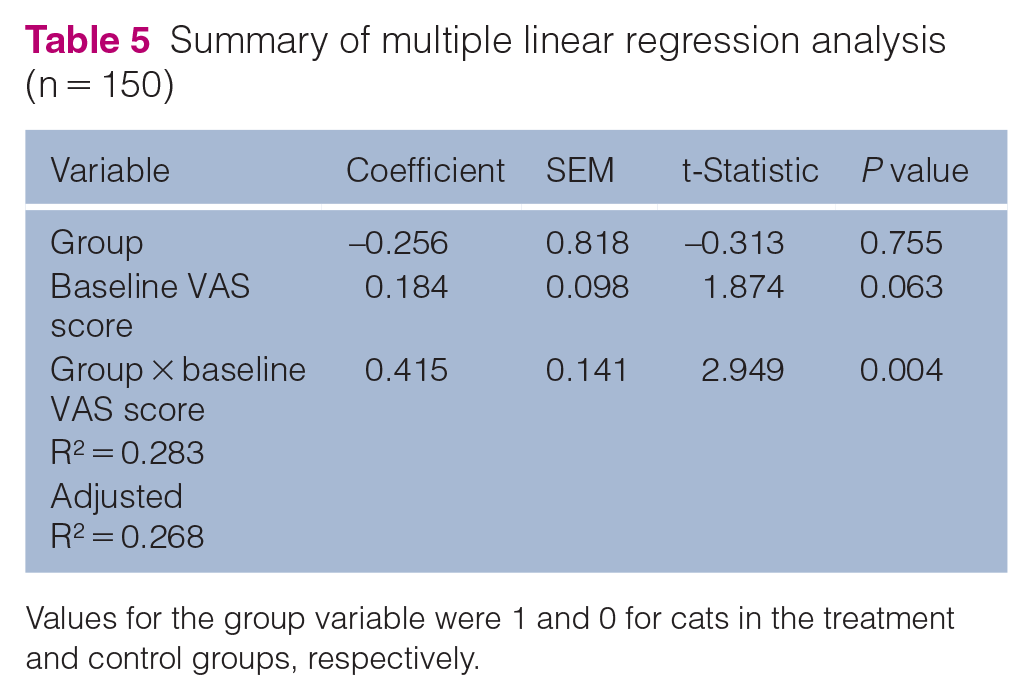
Values for the group variable were 1 and 0 for cats in the treatment and control groups, respectively.
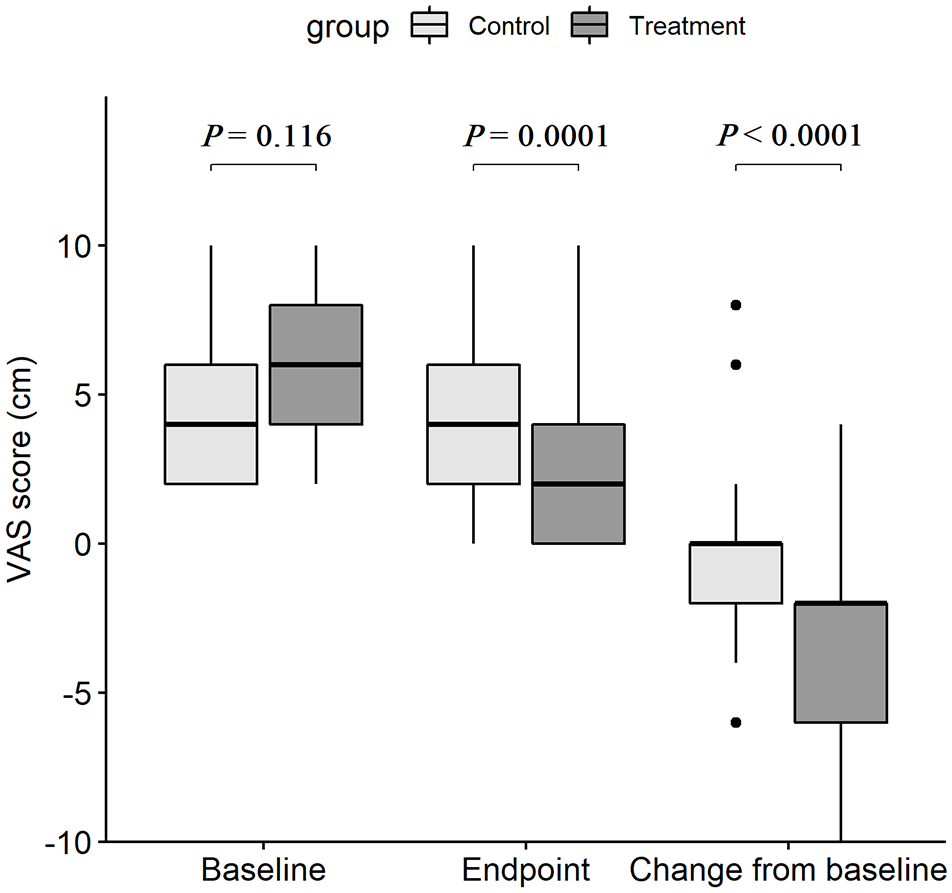
Box plots of stress visual analogue scale (VAS) scores of groups during the experimental period

Conditional effects of group (treatment vs placebo) on the post-intervention visual analogue scale (VAS) scores with 95% confidence intervals
As shown in Figure 4, the differences between the treatment and control groups increased as the value of baseline stress VAS score increased. The difference was significant statistically (P <0.05) when the baseline stress VAS score increased to >2.94 cm.
Discussion
Stress-related behaviours of domestic cats during transport outside of the home
Domestic cats are exposed to many stressors, such as environmental changes, poor human–cat relationships and lack of predictability, 20 which may exist at the same time during transport from their homes to veterinary hospitals, catteries or new homes, with a cumulative effect on cats. 21 According to the length of time that the stressor exists, stress can be divided into acute and chronic stress. 21 The stress caused by carrying the cat into the carrier and during short-distance transport in this study can be considered to be acute stress, which is a normal, protective reaction and often arises during short travel to hospital, and even at home when, for example, a visitor comes for dinner and stays for a while. Thereafter, the animal is able to return to a normal baseline state. 22
Cats express diverse stress-related behaviours. Kessler and Turner 1 evaluated the posture and behaviour of cats in boarding catteries from ‘fully relaxed’ (score 1) to ‘terrorised’ (score 7) with the improved 7-point cat stress-scoring method. The assessment items included the state of the body, abdomen, legs, tail, head, eyes, pupils, ears and whiskers, as well as changes in vocalisation and activity. When cats were ‘terrorised’, they were motionless but alert, with their eyes fully opened, pupils fully dilated, ears fully flattened back on the head, whiskers pointed backwards and plaintive meowing. As solitary hunters, cats usually escape or hide in the face of challenges. 23 Once domestic cats feel unsafe, the frequency and intensity of their attempts to hide increase.24,25 Under stressful conditions, vocalisation, vigilance, urine spraying and aggressive behaviours have also been reported to increase.26–29 Recently, vocalisations have been found to be more reliable than motor activity between individuals, which may be a better measure of stress responses in cats. 3 Of the 10 stress-related behaviours of domestic cats observed in this study, hiding and being motionless were associated with fear and alertness, respectively. Curling, meowing, eyes/pupils dilated, trembling and the other behaviours were associated with nervousness. The results showed that the proportions of five behaviours were >30% and meowing was dominant (63.3%) at baseline. Thus, it can be concluded that the transport of domestic cats is a stressful experience.
Effects of the test product
When comfortable with the environment, cats rub their facial glands to release pheromones. Synthetic feline facial pheromone products have been developed to mimic the chemical composition secreted by the cat’s facial glands, which can appease cats under stress when moving to a new home, travelling outside or at an animal hospital.9,12 Exposure to feline facial pheromone product increased food intake in both healthy and clinically diseased cats, and reduced non-sexual urine spraying.4,30 It has been reported that a salivary cortisol level of 75% in test cats decreased after receiving a synthetic feline facial pheromone product, indicating an effect on the alleviation of feline stress. 31 However, the effects of this synthetic product on individual cats were not consistent. Some studies also found that the synthetic feline facial pheromone product did not have the effect of reducing the physiological and behavioural stress,8,32 which may be affected by many factors, such as temperament, baseline level, social status, human–cat relationship and early experiences.1,3,30,33–36
The new synthetic feline face pheromone product measured in this study mainly contains a functional fraction F3 of feline facial pheromone, which can establish a familiar smell in the environment, relieving the cat’s emotion and stress, preventing and helping treat territory-related stress behaviours. 12 Our results showed that curling, becoming motionless and meowing significantly reduced after treatment with the product vs the placebo. Curling and being motionless may be categorised as passive or shy coping styles,37,38 and meowing may be a type of proactive coping.33,39 The proportions of these three stress behaviours at baseline were >30%, indicating that the cats were in a very tense or alert state, according to the 7-level cat stress score proposed by Kessler and Turner. 1 Furthermore, the test product significantly reduced stress responses in cats during transport outside when the baseline stress VAS score was >2.94 cm, implying that this product has a better effect on alleviating transport-related stress behaviours for cats with a higher stress score.
Stress-related behavioural assessments and stress VAS scores were all performed by cat owners with the same standardised tools. As all cat owners were blind to the results of randomisation and allocation, bias was prevented owing to a lack of knowledge of the test product. To maintain a consistently high quality of data assessed, the same observer was required for every test cat and all cat owners were trained in the protocol and assessments. Potential confounding factors (eg, cat–owner relationship and the cat’s temperament) were not collected. However, these factors should be comparable between groups owing to randomisation and were less likely to affect the results. To completely avoid the interference of these factors, the next step would be to concentrate the recruited cats in a fixed site where they can be measured by a professional observer. In the present study, the effect of the test product was based entirely on subjective observations. Future confirmatory studies should also include physiological indicators (eg, salivary cortisol, body temperature and respiration rate).
Conclusions
Of the stress-related behaviours exhibited during short-distance transport outside of the home, meowing was seen in the highest proportion of test cats. The synthetic feline facial pheromone product (Cature) alleviated stress in domestic cats during short-distance transport, with better effects in cats with higher baseline stress VAS scores.
Footnotes
Acknowledgements

Conflict of interest
The authors declared no potential conflicts of interest with respect to the research, authorship, and/or publication of this article.
Funding
This work was supported by the Fiber Biotech (Shanghai) Limited-liability Company (grant number: 2020-ZX-06).
Ethical approval
This work involved the use of non-experimental animals only (including owned or unowned animals and data from prospective or retrospective studies). Established internationally recognised high standards (‘best practice’) of individual veterinary clinical patient care were followed. Ethical approval from a committee, while not necessarily required, was nonetheless obtained, as stated in the manuscript.
Informed consent
Informed consent (either verbal or written) was obtained from the owner or legal custodian of all animal(s) described in this work (either experimental or nonexperimental animals) for the procedure(s) undertaken (either prospective or retrospective studies). No animals or humans are identifiable within this publication, and therefore additional informed consent for publication was not required.