




Abstract
Practical relevance:
Problem feline behaviour can be managed successfully by early diagnosis and intervention, good first-aid advice in veterinary practice and then, if necessary, a referral to a suitably qualified behaviourist for those cases that are complex. There are a number of tools available to assist in the resolution of problem feline behaviour and this article will cover environmental modification and behavioural modification.
Clinical challenges:
Problem feline behaviours are not uncommon and the veterinary team often have to rely on their own knowledge to assist clients if a specialist behaviourist is not available.
Evidence base:
There is a lack of evidence-based information regarding how best to work-up and treat cases of problem feline behaviour in practice; therefore, some recommendations within this article are based on the author’s experience of treating cases in a cat-specific behaviour referral practice over the past 20 years. However, there is evidence available regarding how best to enrich a cat’s environment and how to ensure a cat’s environmental needs are met.
Audience:
Any veterinarians, veterinary nurses or technicians who are involved in the diagnosis or treatment of problem feline behaviour in practice would benefit from understanding the principles of environmental and behavioural modification.
Behavioural advice and available tools
Articles in Part 1 of this series have described how behavioural awareness and a better understanding of feline emotions, behaviour and body language can improve the welfare of the feline patient. This awareness and understanding enables the veterinary team to provide good behavioural advice in-house and, where necessary, effective ‘first-aid’; the former to prevent future problems, and the latter to help resolve behavioural issues prior to the case being referred. Good behavioural advice can be achieved by careful analysis of the presenting problem and understanding the options that are available for resolution.

The author’s work as a clinical animal behaviourist is conducted to a large extent out of the referring veterinarian’s sight, using knowledge and skills that are not always part of the traditional veterinary training. Therefore, resolution of problem feline behaviour may be dependent on finding a suitably qualified behaviourist, such as a veterinarian/nurse/technician with specialist behaviour training or a clinical animal behaviourist, who is able to receive referrals and consistently provide outcomes to the satisfaction of the owner and ones that represent improved welfare for the cats. It is important, first, for the referring veterinarian to rule out any underlying medical issue that may have caused the probem behaviour.
There are a number of tools available to assist in the resolution of problem feline behaviour (see box on page 1006). Which of these tools are used, and to what extent, is based on thorough assessment, using questionnaires, medical histories and a comprehensive consultation in a clinical setting or the home. For the latter, videos, photos, floor plans and observational diaries may be utilised in the absence of a physical visit to the home. It is important to understand the underlying principles of these tools before applying them in practice. Even without a definitive ‘diagnosis’ of causal factors, principles of environmental modification can be applied, via good first-aid advice, for problem behaviour that may reduce it by providing the cat(s) with a more appropriate environment.
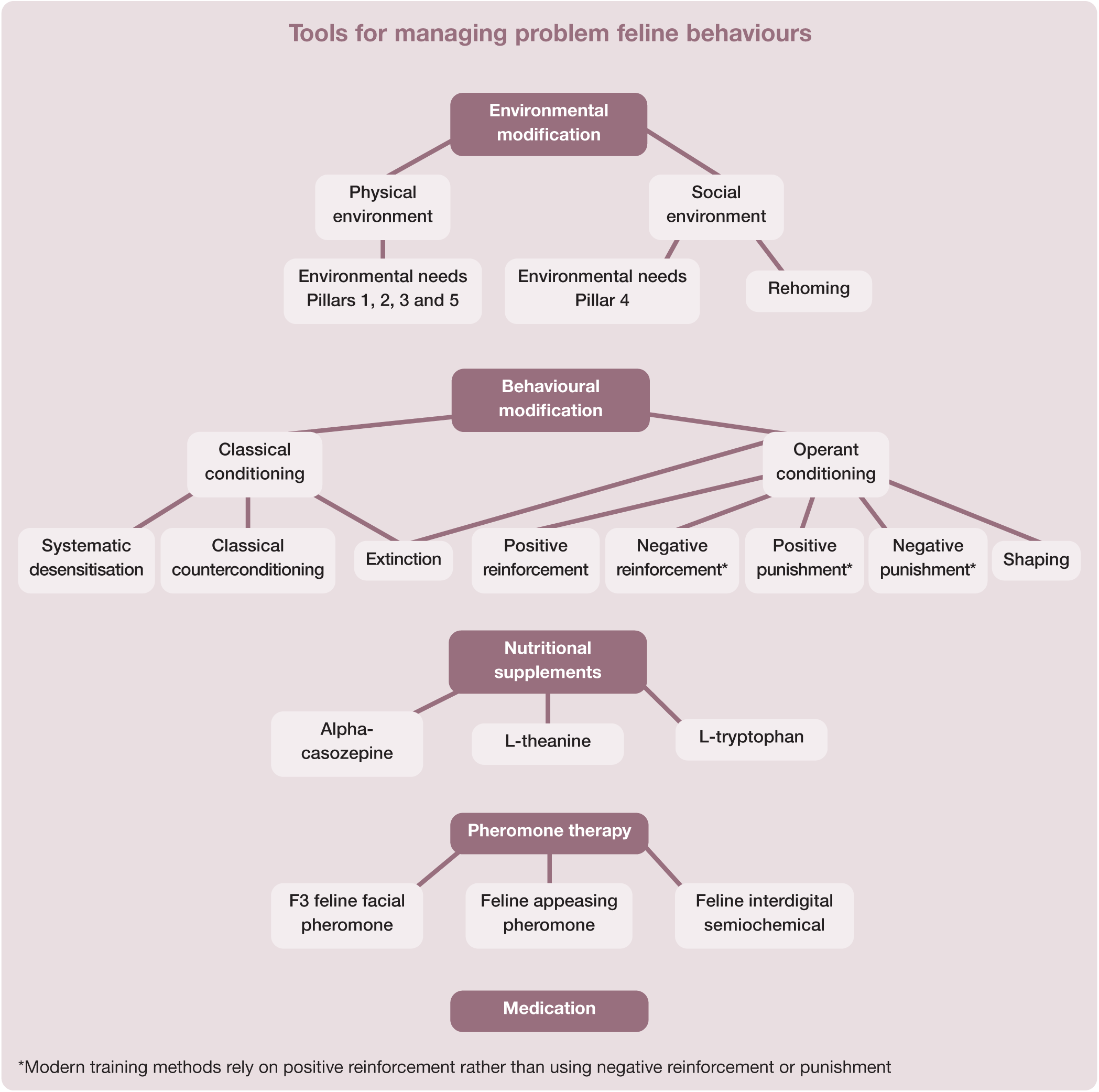
Environmental modification
The term ‘environmental modification’, in the context of problem feline behaviour, refers to internal and external physical adaptations to the home that are necessary to ensure the health and welfare of resident cats, with the intention of reducing or removing the incidence of a problem behaviour. Studies looking at treatment for the common problem of stress-related cystitis, for example, show that multimodal environmental modification (MEMO) is an important adjunctive therapy for indoor cats.1,2
Environmental modification should work from a basis of what all cats need in their environment. 3 This ensures that all aspects of the environment are considered, including the social setting and contact with other animals and humans, as the social environment can be as equally distressing as the physical environment for some cats. While environmental modification may address this via increased resources (thereby reducing conflict with other cats), it is helpful to have this framework to work within to establish an optimum environment in all circumstances. Once the cat’s environmental needs have been met, other changes can also be made, based on the identification of specific stressors.
Five ‘pillars’ framework
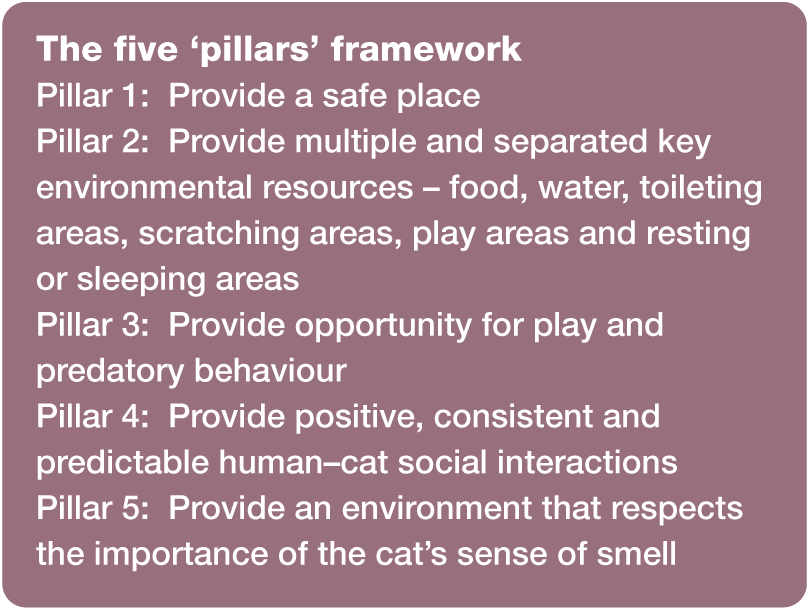
A five ‘pillars’ framework has been devised to help create an optimum feline environment. 3
Provide a safe place (pillar 1)
The risk of injury for cats as solitary hunters represents a serious threat to survival, so cats tend to use avoidance or escape as their strategy when faced with danger. This perceived threat can be signalled by any strange smells, objects, people or other animals.
A safe place is a private and secure area where a cat can retreat to in threatening situations. This place can be at ground level or in a raised location. If the cat cannot see a potential threat, it feels safer, even if its whole body is not fully concealed; for example, when a cat hides with its head and shoulders under a full length curtain, remaining only partially hidden. When a cat is relaxed, a safe place can also function as a resting or sleeping area. Each cat should be provided with at least one place for hiding and owners should respect their intentions while in a safe place and not disturb them. Some cats within the same household will rest together, whereas most use common resting and hiding locations at different times of the day to each other. 4 Therefore, it is important to provide multiple safe places in different locations to avoid competition for these resources.
If high level perches and shelves are provided they should be non-slip and of a sufficient length and width to enable the cat to stretch out fully. The cat may also benefit from a modification to the shelf or perch that allows it to hide behind something rather than remain in view. Even without this modification the recommendation that owners should ignore and not disturb cats applies to high perches also, whether the area does or does not provide camouflage.
Age-specific considerations may be relevant, with mobility issues in the elderly cat dictating the suitability of some areas over others regarding accessibility. Young kittens may also need low level places to be provided. In multi-cat households, a safe place should have more than one entry or exit so that access cannot be easily blocked by another cat.
The formula for the optimum number of litter boxes of ‘one per cat plus one extra located out of sight of each other’5-7 is frequently used by the author for all resources, including safe places, as, anecdotally, this achieves a consistently good outcome.
The decision to keep a cat permanently indoors or provide free access outside (or any combination in between) lies with the owner, but, if the external environment and cultural norms allow, cats should also have access to safe places outdoors. An outdoor enclosure (Figure 1) may be a potential compromise where safe places can be provided.
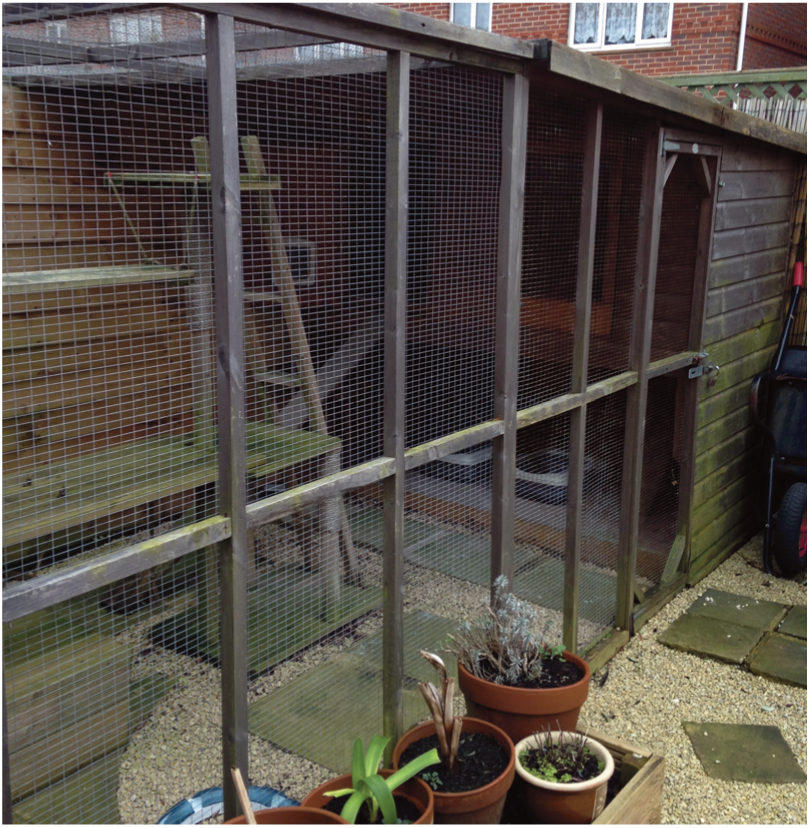
An outdoor enclosure is one method of providing outdoor access in a safe environment
Provide multiple and separated key environmental resources (pillar 2)
A cat should have a choice for each resource (see box, left); for example, a minimum of two resting areas, feeding areas and litter boxes/trays. Each of the key resources should be positioned in a dedicated location, away from other resources.1,8 Food and water should be separated from each other. As cats evolved as solitary hunters, those in multi-cat households prefer to feed from separate bowls placed out of sight of each other. 9
As cats reach social maturity between the ages of 2 and 4 years 10 they can either continue to be part of or form a social group, or behave as a solitary cat, within the multi-cat setting. It is not unusual for several distinct social groups to coexist in one household so it is essential that the available resources can support all cats or social groups (see ‘Case notes’ on page 1008).

Where multiple cats are kept exclusively indoors, it is important for each cat to be able to maintain a distance of between 1 and 3 m (3–10 feet) from another, so placement of resources should take this into consideration. 13 A variety of resting areas should be offered, some secluded and others in elevated positions where the cat has views of the internal environment and/or outdoors. 14 Indoor cats in particular need unrestricted access to resting areas where they can escape from environmental stressors such as loud noises, other cats or small children. 15

Litter boxes are significant, particularly for cats without access outdoors, and failure to provide adequate facilities to meet the needs of the resident cats can be a source of distress for some individuals. Optimal litter box management is considered one of the most important environmental modifications, with the potential to significantly decrease clinical signs and increase the disease-free interval in cats with chronic feline idiopathic cystitis. 1 Therefore, as well as providing sufficient numbers in appropriate locations, it may also be beneficial to optimise litter facilities (see box below). 7

Provide opportunity for play and predatory behaviour (pillar 3)
Cats should be able to engage in play and feeding that mimic elements of predatory behaviour (ie, locating, stalking, chasing, pouncing, killing, preparing and consuming prey). Failure to provide opportunities to do so may deprive cats of mental stimulation and physical activity, thereby contributing to the development of obesity and other health problems. 16
The opportunity to engage in these behaviours can be facilitated by the provision of toys and feeding devices, as well as social play interaction with owners and other cats. The box below lists various types of nonfood-related play. 17

Cats are more likely to indulge in social play with each other if the environment enables them to do so safely without the play escalating into fighting. Cats appear to enjoy playing in environments where there are obstacles and varying levels to give camouflage, hiding opportunities and the chance to access high places for ‘time out’. It seems that the opportunity to break the stare in interactive play fighting diffuses tension and avoids the arousal from escalating to agonistic levels that are inappropriate for play. For maximum benefit, areas indoors that are designated for play should contain some or all of the following objects:
Cardboard boxes with entry/exit holes
Furniture at various heights
Tables
Cat activity centres
All objects should be positioned in such a way that each cat can move around them and approach from any angle.
Food-related play can be facilitated using commercial ‘interactive feeders’ or ‘treat games’ (Figure 2a); homemade devices can also be used (Figure 2b,c). 18 Options for the latter include:
Placing some dry food at the bottom of a paper bag (with the top folded over or the bottom torn a little).
Attaching cardboard toilet roll tubes to each other to form a large triangle of connected tubes (Figure 2b). Securing this to a base, for example by sticking it to a plastic mat with double-sided adhesive tape, will help to prevent the cat from knocking it over.
Squashing the end of a single toilet roll tube and placing some dry food inside.
Wrapping dry food in tissue paper or greaseproof/waxed paper and placing it in a cardboard box.
Making paw-sized holes in a sealed cardboard box and putting dry food inside.
Placing some dry food in toilet roll tubes stuck together and backed with cardboard, which is then attached to a wall or door (Figure 2c).

Food-related play can be facilitated using (a) commercial interactive feeders or (b,c) homemade devices, such as cardboard toilet roll tubes stuck together
Provide positive, consistent and predictable human–cat social interactions (pillar 4)
Cats can benefit from friendly and predictable social interaction with people if they have had positive associations with humans from a young age. Kittens should be handled by a variety of people during their sensitive period for socialisation between the ages of 2 and 9 weeks. 19 Sociability is very variable in cats, dependent on factors such as genetics as well as early experiences as a kitten. Many would rather initiate contact and prefer low intensity but high frequency interaction.
Provide an environment that respects the importance of the cat’s sense of smell (pillar 5)
Cats use olfactory and pheromonal signals for communication with other cats, so smells give them information about the safety of their surroundings. Owners should be mindful of this and take care not to interfere with the established scent profile of the home. This can be achieved by:
Avoiding strong-smelling products; for example, air fresheners and perfumes.
Removing outdoor footwear before entering the home.
Introducing new items into the household with care (eg, covering a new sofa with a familiar-smelling blanket at first).
Providing scratching areas where a cat can mark its territory.
Using synthetic pheromones when necessary (see accompanying article on
Physical environment
With regard to any further modifications to the physical environment that may be required on a case-by-case basis, there are three distinct categories to consider:
Internal environment (all the available space indoors including any current or potential opportunities for three-dimensional use, high perches, etc).
External environment (even for indoor cats, as there are potential visual and olfactory stimuli associated with threat from other animals outside through windows and doors).
Husbandry and management (including feeding regimen, lifestyle restrictions, litter box cleaning regimen, etc).
In addressing the cat’s environmental needs, specific stressors may have been identified; for example, an unfamiliar cat outside that is regularly approaching glass patio doors, causing the resident cat to become distressed. This cat may need to feel more ‘camouflaged’ and secure in the internal environment by having the uninterrupted view of the outdoors through the glass removed. This might be achieved by attaching static/adhesive opaque window film to the lower portion of the glass.
Social environment
When considering modifications to the social environment, there are two distinct categories to look at:
Contact with/presence of humans, dogs, etc.
Contact with/presence of other cats.
In multi-cat households, safe core areas may, for example, need to be installed, utilising microchip-operated cat flaps on internal doors, if one cat is persistently threatened by the presence of another and requires key environmental resources that cannot be accessed by other cats in the home.

Once each cat’s environmental needs have been met and the environment adapted accordingly, any problem behaviour that persists, such as inter-cat conflict, may be addressed by using behaviour modification (see below) such as counterconditioning or gradual desensitisation. These can also be useful tools if aggressive behaviour is directed towards humans or dogs, or a cat is anxious or fearful in specific situations.
Behavioural modification
Learning theories
Correct application of behaviour modification tools requires some understanding of learning theories, which are conceptual frameworks describing how knowledge is absorbed, processed and retained during learning. Behaviourism emphasises the role of environmental factors in influencing behaviour (to the near exclusion of innate factors), with new behaviour being learnt through classical or operant conditioning.
Classical conditioning
The example that is most familiar is Ivan Pavlov’s experiment with dogs’ involuntary responses in the early 20th century, when the sound of a metronome elicited salivation because it had previously been heard at mealtimes.
Using this example: the unconditioned stimulus (US) is food, the unconditioned response (UR) is salivation, and the conditioned stimulus (CS) is the metronome. If the CS is paired with the US repeatedly and simultaneously, eventually the CS will elicit the involuntary response of salivation (now referred to as a conditioned response [CR]) in the absence of food.
An example of learning through classical conditioning in a cat is the development of fear in response to the cat carrier, as this has become associated with negative experiences.
Operant (instrumental) conditioning
When a particular response to a specific stimulus is reinforced (rewarded), the individual is conditioned to respond. The reward (rein-forcer) is anything that strengthens the desired response. This theory of operant (instrumental) conditioning (also referred to as trial and error learning; see box on page 1012) covers negative reinforcers as well – that is, any stimulus that results in the increased frequency of a response when it is withdrawn. Key concepts are:

An example of operant conditioning, via positive reinforcement, is a cat that has learned to open a door by jumping up and pulling a door handle. The stimulus is the closed door, the response is the jumping and touching the handle, and the reinforcement is access to the closed-off area as the door opens.
Behaviour modification techniques
With appropriate understanding of the theory behind classical and operant conditioning, specific training to address problem behaviour and enhance welfare can be delivered. Modern training methods rely on positive reinforcement rather than using negative reinforcement or punishment.
Operant conditioning
An example of operant conditioning where an owner plays an active role would be training a cat to come to call by giving a high value treat when it returns from outdoors. The stimulus is the sound of the call, the response is coming to the owner’s side and the reinforcement is the high value food treat.
Extinction
Extinction is the reduction or elimination of an operant or classically conditioned response by removing the reinforcement that previously maintained the behaviour. For example, if an owner, who has previously got out of bed in response to the cat vocalising at night, stops getting out of bed and remains still in response to the vocalisation, the reinforcement for the behaviour will have ceased and the calling will reduce or stop completely. A phenomenon referred to as ‘extinction burst’ may occur initially, with the cat increasing the behaviour in the short term when the reinforcement is removed (the theory being that the cat is attempting to reinstate the original reinforcement by intensifying the behaviour).
Shaping
Shaping is a technique that modifies behaviour by reinforcing actions that are progressively closer approximations of the desired behaviour. These incremental steps are referred to as successive approximations.
Systematic desensitisation
Systematic densensitisation is a technique used to treat fears and phobias that involves gradually exposing an animal to increasingly intense forms of the relevant stimulus while the animal is relaxed. An example would be training a cat to go into a cat carrier with ease, when previously the cat has been reluctant due to fear associations with the carrier and the subsequent events once confined inside. This might be achieved by leaving the cat carrier with the door open and positioning a food bowl at a distance from the carrier where the cat will eat comfortably and without fear. The bowl is then gradually moved closer, a short distance on each occasion, until the cat is eating comfortably from the bowl inside the cat carrier.

Classical counterconditioning
Classical counterconditioning involves altering an undesirable response to a conditioned stimulus by engaging the animal in another response to the same stimulus that is incompatible with the first (see ‘Case notes’ above).
Key Points
If the veterinary team understands the principles of environmental and behavioural modification they can provide good first-aid advice to their clients to help address feline problem behaviour.
Environmental modification may include alterations to the internal or external physical environment, as well as the social environment.
Cats all need: a safe place; multiple, separate key environmental resources; opportunities for play and predatory behaviour; positive human–cat social interaction; and an environment that respects the importance of the cat’s sense of smell.
Rehoming of a cat, under specific circumstances, may be an appropriate environmental modification strategy.
Specific training to address problem behaviour and enhance welfare can be delivered if there is appropriate understanding of the theory behind classical and operant conditioning.
Supplemental Material
Supplementary Material
Special issues on feline behaviour and problem behaviours
Footnotes
Conflict of interest
The author declared no potential conflicts of interest with respect to the research, authorship, and/or publication of this article.
Funding
The author received no financial support for the research, authorship, and/or publication of this article.
References
Supplementary Material
Please find the following supplemental material available below.
For Open Access articles published under a Creative Commons License, all supplemental material carries the same license as the article it is associated with.
For non-Open Access articles published, all supplemental material carries a non-exclusive license, and permission requests for re-use of supplemental material or any part of supplemental material shall be sent directly to the copyright owner as specified in the copyright notice associated with the article.
