




Abstract
Objectives
The aim of this study was to perform a case-control medical evaluation of cats from multi-cat households presenting with inappropriate latrining and spraying behavior.
Methods
Owners of 18 ‘spraying’ and 23 ‘latrining’ cats with normal control subjects available from the same households were recruited for a case-control study. Otherwise overtly healthy dyads (each dyad consisting of a case cat and a control cat) were brought together to the veterinary hospital of the University of São Paulo for a medical work-up (ie, physical examination, complete blood count, biochemical profile, urinalysis and urine culture, abdominal ultrasound of the urinary system and in females, where possible, cystoscopy).
Results
Medical problems were identified with similar frequency in the ‘sprayers’ (38.9%), ‘latriners’ (39.1%) and controls of the latrining group (26.1%), but not the controls of the spraying group (5.5%). The difference between ‘cases’ and ‘controls’ from spraying households was significant. Common potential health-related changes include renal insufficiency, cystitis and bladder lithiasis. Renal calculi, higher creatinine levels (within normal reference interval) and ‘glomerulations’ (detected during cystoscopy) were also found in the remaining sprayers and latriners that were considered clinically healthy. Post-cystoscopy, a new form of periuria occurred in two cats (one sprayer and one latriner).
Conclusions and relevance
These results indicate that spraying or latrining behavior in the home, as well as living with a cat that is not using the litter box as a latrine, are all associated with a higher level of urinary tract abnormalities; living with a cat that is spraying, however, does not have this association. The findings also suggest that both forms of periuria might be associated with interstitial cystitis. We therefore conclude that all cats with periuria need to be carefully evaluated medically and that treatment of latrine-related problems should consider all cats in the house, whereas spraying may be more focused on the individual displaying the problem.
Introduction
In the clinical context, spraying for marking purposes by domestic cats has long been distinguished from inappropriate urinary latrine-related behavior (latrining).1–8 Spraying commonly involves urine deposited on vertical surfaces (or on significant horizontal spots) with the cat typically in a standing posture.2,4,5 ‘Sprayer’ cats generally keep use of the appropriate latrine for both urination and defecation.2,4,5 By contrast, inappropriate latrining is mostly characterized by large amounts of urine, usually on horizontal surfaces with the cat in a squatting posture.2,4,5 ‘Latriner’ cats may give up using the latrine and so both urine and faeces may be found in inappropriate locations.2,4,5
Successful management of either condition depends on the identification of medical factors that might be contributing to the problem.1–8 The evidence for the significance of medical problems in these cases is inconsistent,9,10 and largely based on simple case reports and comparisons, with inadequate controls for things like differences in management that might exist. 11 Nonetheless, the overall recommendation of adequate medical screening in order to eliminate potential medical factors contributing to the problem remains sound advice.1–8 Some suggest that the urination behavior of cats with a urinary problem does not resemble urine marking, and urinalysis does not provide relevant diagnostic information, at least in cases of urine spraying, 12 but urinalysis may be of value in cases of latrine-related problems. 12 It is also worth noting that in many cases of periuria (problematic deposition of urine in the home regardless of cause), the medical assessment is often quite superficial, frequently based on only a brief physical examination and possibly urinalysis. 12 A more complete evaluation of the urinary system (eg, via ultrasound or cystoscopy) may reveal further abnormalities. 13 Indeed, the frequency and extent to which medical evaluations are performed in these cases is not known. Thus, it is not possible to say with any confidence what problems are present in these cases or what their relevance might be. Current practice focuses on the behavioral history, with the precise role of urinary system abnormalities evaluated to a variable extent for their relevance on a case-by-case basis.
Veterinary behavioral guidelines not only propose diagnostic procedures, but also treatment protocols, for both inappropriate latrining behavior and spraying. Although these are generally clear and reasonably easy to apply, complete eradication of the problem using only management and environmental change is often unsuccessful. 14 There is clearly a proportion of refractory cases in which typical management regimes do not work. This may include those with untreated medical complications, and so it is important to improve our understanding of the potential relationship between and role of urinary tract abnormalities in these cases.
Therefore, this study aimed to address some of the shortcomings identified in previous reports of the association between urinary tract disease and periuria by performing an in-depth medical evaluation of a series of cats from multi-cat households presenting with inappropriate latrining and spraying behavior alongside control subjects drawn from the same household in order to control for management confounds between subjects. 15
Material and methods
Recruitment and selection
Publicity aimed at selecting house-soiling cats and matched controls (without periuria) from the same multi-cat households (n = 3–9 cats per house) was promoted in several ways: via a poster at the veterinary college at the University of São Paulo (FMVZ/USP) and several veterinary clinics in Sao Paulo and neighboring cities, emails to a list of students of the veterinary college, and postings on cat breeder websites and internet communities related to pet cats.
Cats reported by their owners to manifest periuria were classified into spraying or latrining groups (together with their respective controls without periuria) on the basis of a careful behavior analysis made by a veterinary behaviorist considering cat posture and behavioral repertoire when depositing urine outside the litterbox, location, target and amount of urine deposited outside the litterbox, litterbox use, and so on. Households where different cats exhibited urine spraying and latrine-related behavior in the home were not eligible for inclusion. This means that in selected spraying households there was no latrining behavior in the home by any of the cats; similarly, in the selected latrining households a spraying problem was absent.
Problem behavior (ie, spraying or latrining) had been manifested by participant cats from months to years, with unsuccessful treatment attempts made by most of the owners before the current study. During the study, with the exception of the cases further described in the paper, cats did not receive any treatment for their problem behavior.
Spraying group
Twenty-one urine-spraying case-control dyads were initially recruited, but in the case of three dyads examinations could not be concluded for various reasons (eg, the cat became sick) and therefore they were excluded from further involvement in the research. The remaining 18 case-control dyads were then subjected to medical examinations involving a complete blood count, biochemical profile, urine examination and urine culture, and ultrasonic evaluation of the urinary system at the university veterinary hospital (HOVET-USP).
Among the 18 case cats, there were three females and 15 males: 17 mixed breeds and one Persian, with an average age of 6.27 years (SD = 2.44). Control cats were six females and 12 males, 17 mixed breeds and one Siamese, with an average age of 6.43 years (SD = 4.48). On average, there were 6.09 cats per household (range: 3–8). Four of the 18 case-control dyads came from two households; there were therefore 16 different households in this group. Spraying households were all houses (as opposed to flats) and half of them offered free outside access to the cats.
Latrining group
Twenty-nine inappropriate latrining case-control dyads were initially recruited, but for six dyads the examinations could not be concluded (eg, the owner did not fast the cat or did not prevent litter box use and so the cat did not have sufficient urine for the examinations). The remaining 23 case-control dyads were then submitted to similar clinical examinations at the university veterinary hospital (HOVET-USP).
Of the selected 23 case-control dyads, 18 case cats were female and five were male; 13 were mixed breed, four were Persian, four were Maine Coon and two were Ragdoll. Their average age was 4.46 years (SD = 2.19). Among the control cats, there were 13 females and 10 males; 16 were mixed breed, four were Maine Coon and three were Persian. Their average age was 5.21 years (SD = 3.35). Households in this group had, on average, 4.6 cats (range: 3–8 cats). Four of the 23 case-control dyads came from two households, and so there were 21 different households in the group. Toileting households were evenly split between houses and flats, and none of the toileting households offered free outside access to the cats.
Medical examinations
All procedures involved in the medical examination were conducted on both case and control cats from the household on the same morning, with cats having fasted for between 8 and 12 h. The collected materials were processed according to standards and techniques established by the Laboratory of Clinical Pathology (HOVET-USP). Ultrasounds were performed in the same room by a specialist in veterinary ultrasonography; a second veterinary feline specialist carried out all other clinical examinations.
In the 2 h immediately preceding the examinations, owners were instructed to encourage water intake, and to prevent the use of the litter box in an attempt to promote bladder filling, necessary for the collection of urine, which was performed by cystocentesis guided by ultrasound. Blood samples had to be sufficient for at least a complete blood count and biochemistry profile, otherwise the dyad was excluded.
Any abnormality of the lower urinary tract (eg, bladder urolithiasis, cystitis) or alterations indicative of either systemic disease or organ dysfunction was considered a medical abnormality; following the establishment of a medical problem of concern, the dyad did not then progress further in order to avoid undue stress. However, alterations of the upper urinary tract that did not appear to interfere with functioning of the urinary system (eg, renal urolithiasis accompanied by normal urinalysis and renal profile), although considered potentially problematic, did not result in exclusion of the dyad from further analysis.
Cystoscopy
Second visits to the veterinary hospital were planned for cystoscopies of suitable female cats, subject to owner informed consent, including explanation of the need for a general anaesthetic. Cystoscopies were carried out on selected female case cats only (ie, those exhibiting periuria without medical abnormality of concern in the preliminary examinations). This cystoscopy allowed us to investigate abnormalities that may have passed unnoticed in the previous examinations (eg, interstitial cystitis). 13
Out of the 23 potential case-control dyads reaching this stage, 12 (two from the spraying group and 10 from the latrining group) included female case cats suitable for cystoscopic examination, and eight owners chose cystoscopy .
Cystoscopies were performed by the same specialist who undertook the clinical examinations following fasting for at least 8 h (a maximum of 12 h) and withdrawal of water 2 h before the examination. Cats were pretreated with acepromazine and meperidine (0.05 mg/kg and 4 mg/kg, respectively, IM). Anesthesia was then induced with propofol (5–6 mg/kg IV) and maintained with isoflurane diluted in 100% oxygen at concentrations necessary to maintain the third level of the third stage of Guedel’s classification of depth of anesthesia. 16 In the case of three females that appeared to be aggressive, ketamine (2 mg/kg IV) was added to the premedication, which allowed us to safely handle them while promoting induction with propofol. In the last four procedures, in order to achieve a better penetration of the endoscope via a deeper urethral relaxation, butorphanol (0.4 mg/kg IV) was added to the protocol.
Statistical analysis
A Shapiro–Wilk normality test was first performed for each of the medical variables in both groups (cases and controls were first tested separately). In the event of a normal distribution for both cases and controls, Student’s paired t-tests were used for pairwise comparisons, with Wilcoxon signed-rank tests used in the case of non-normally distributed data.
The prevalence of medical alterations in case vs control cats in both spraying and inappropriate latrining dyads was compared by either Fisher’s exact test or Pearson’s χ2 test. Similarly, comparisons of case subjects between groups were also assessed using Pearson’s χ2 test. Statistical analysis was performed using SAS software (version 9.2) with a probability level of 0.05 used to assess significance.
Results
Spraying dyads
Medical examinations revealed that out of 18 apparently healthy cats exhibiting urine spraying, seven (38.9%) demonstrated medical alterations; however, this was found in only one control cat (5.5%). Significantly more case than control cats (Fisher’s exact test, P = 0.041) therefore had at least one of the following medical conditions: renal insufficiency (2 cats), idiopathic cystitis (2), diabetes insipidus (1), diabetes mellitus (1) and ectopic testes (1). The only control cat with a medical alteration presented with bladder lithiasis.
The remaining 11 dyads were considered clinically healthy on the basis of the initial health screening, although some medical complications that did not obviously impair either urinary or other system functioning were identified. In four case and one control cat, renal lithiasis was identified (these measured about 0.3 cm in diameter and in all cases were located in the renal pelvis); a renal cyst was found in a fifth case cat. One case and one control cat showed renal diverticulum calcification. This meant that 12 out of the initial 18 recruited sprayers (ie, 66.7%) and 3/18 (ie, 16.7%) controls had identifiable deviations from a perfect state of the urinary tract. One of the remaining case cats had glycosuria, but blood levels of glucose, as well as fructosamine, were within the normal reference interval. The leukocyte count was high (ie, 19,900 cells/mm3) and further urinalysis did not reveal glycosuria, suggesting the condition was not due to diabetes mellitus.
Blood leukocyte counts of cases and controls (n = 11) did not differ significantly (median ± interquartile range [IQR]: case cats = 13,700 ± 3800 cells/mm3; controls = 10,700 ± 13,200 cells/mm3, P = 0.6377). However, serum creatinine levels were significantly higher for sprayers in comparison with their controls (mean ± SD: case cats = 1.53 ± 0.31 mg/dl; controls = 1.19 ± 0.23 mg/dl, P = 0.005). With regard to blood urea, the difference between cases and controls approached significance (mean ± SD: case cats = 62.68 ± 6.13 mg/dl; controls = 56.35 ± 6.41 mg/dl, P = 0.0597).
Cystoscopy performed on one of the two spraying female cats revealed several scattered submucosal petechiae (‘glomerulations’) (Figure 1), edema and mild bladder hemorrhage, indicative of interstitial cystitis.
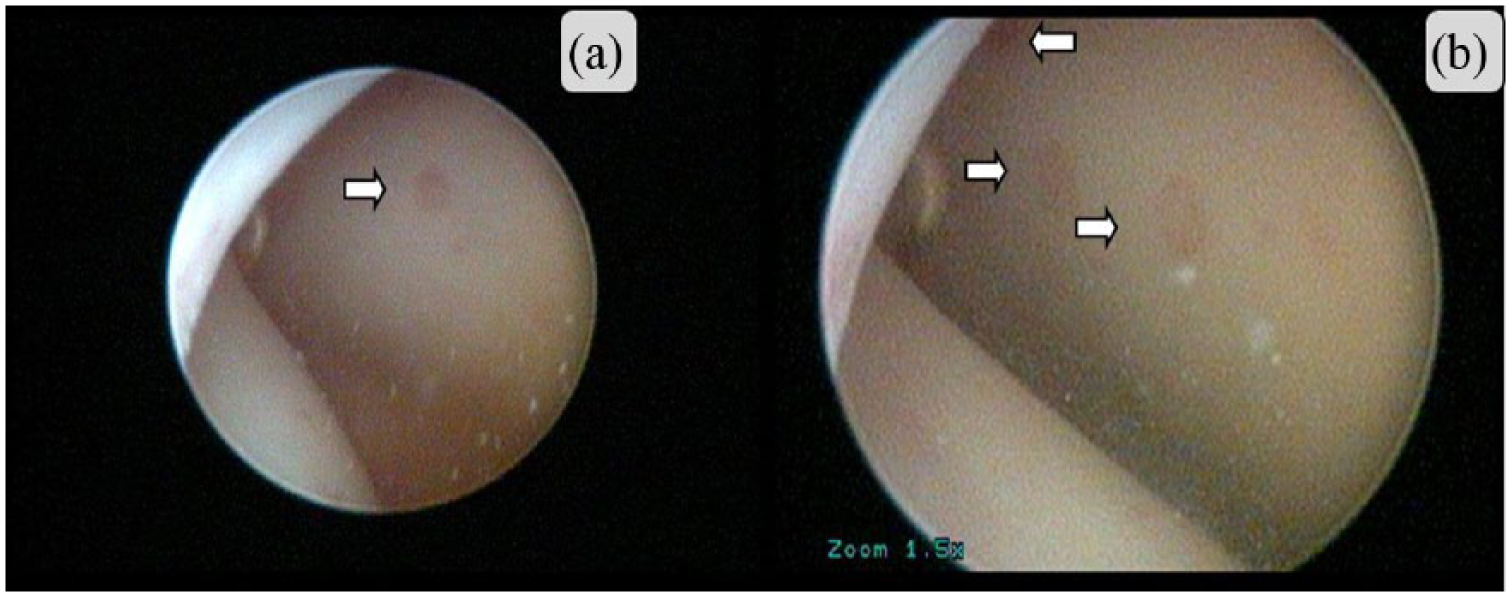
Cystoscopic examination of a female sprayer cat. White arrows indicate petechiae ([a] normal size; [b] 1.5 × zoom)
Follow-up: over the days following cystoscopy, the cat with petechiae showed hematuria, polakiuria and apparently painful urination. A latrine-related problem arose, with the cat depositing urine containing blood in the bathroom sink (such a behavior had never been observed before). This lasted a couple of weeks and the owner felt that the problem had been exacerbated by the cystoscopic examination. The cat was successfully treated with amitriptyline (1 mg/kg q12h) from the first day after cystoscopy for 60 days; the cat returned to using the litter box for latrine-related urination with the owner reporting only rare occasions of urine spraying. Such improvement was sustained for at least 6 months, when the last contact with the owner occurred.
Latrining dyads
Medical examinations revealed that out of 23 apparently healthy cats exhibiting inappropriate latrine-related behavior, nine (39.1%) demonstrated an overt medical concern; this was found in six control cats (26.1%). The difference was not significant between case and control cats (Pearson’s χ2 test, P = 0.365). Medical problems found among cases were: renal insufficiency (3 cats), leukocytosis (2), leukocytosis plus bladder plug (1), bladder lithiasis (1), bladder plug (1) and hepatic disease (1). Control cats had leukemia (1 cat), bladder diverticulum (1), renal insufficiency (1), bladder lithiasis (1), abdominal liquid (1) and hepatic disease plus urinary infection (1).
Of the 12 remaining dyads considered healthy on the basis of the initial health screening, there were a range of other conditions identified that were not considered to obviously impair either urinary or other organic system functioning. Four case and four control cats had one of the following alterations in the ultrasound image of their kidneys: diverticulum calcification, heterogenous texture, decreased corticomedullary definition, retraction and/or thinning of cortical area leading to loss of kidney definition. This meant that, in total, 13 out of the initial 23 recruited latriners (56.5%) and 10/23 controls (43.5%) had abnormalities.
One control cat had glycosuria, but blood levels of glucose and fructosamine were within normal reference intervals and the leukocyte count was high (ie, 30,100 cells/mm3). Later, further urinalysis did not reveal glycosuria, suggesting that the cat did not have diabetes mellitus.
Blood leukocyte counts for cases and controls (n = 12) did not significantly differ (mean ± SD: case cats = 10,641.67 ± 2191.91 cells/mm3; controls = 13,308.33 ± 7206.87 cells/mm3; P = 0.229). Serum creatinine as well as urea levels were also not significantly different when latriners were compared with their controls ([mean ± SD] creatinine: case cats = 1.38 ± 0.15 mg/dl, controls = 1.40 ± 0.26 mg/dl, P = 0.848; urea: case cats = 60.28 ± 15.58 mg/dl, controls = 60.13 ± 12.66 mg/dl, P = 0.968).
Cystoscopy was attempted for 6/10 potentially qualifying female cats, but complete bladder visualization was possible in only three of them; in the other three cats, the urethra passage was very difficult and, given the risk of injury, the procedure was abandoned. The bladder was healthy in two cats, but in the third there were submucosal petechiae (‘glomerulations’), ulcerations and hemorrhage (Figure 2) indicative of interstitial cystitis.

Cystoscopic examination of a female latriner cat. The red arrow indicates petechiae and ulceration; the white arrow indicates hemorrhage
Follow-up: on the days following cystoscopy the cat diagnosed with interstitial cystitis showed hematuria, pollakiuria and painful urination (including high-pitch vocalization before entering the litter box). Urine spraying, which had never been observed in this cat before, as well as a digging behavior at the front door of the house (followed by urination just there), arose during this time. This cat was treated with amitriptyline (1 mg/kg q12h) from the first day after cystoscopy and for 90 days. Within a couple of weeks, the cat returned to its previous pattern of eliminating large amounts of urine on horizontal surfaces in the home without signs of pain. The owner reported, however, a decrease in frequency of inappropriate urination. The problem was still present after 6 months despite inclusion of behavior therapy to augment treatment.
Comparison between sprayers and latriners
Medical conditions were detected with similar frequency in both apparently healthy sprayers and latriners (Pearson’s χ2 test, P = 0.639).
Discussion
Medical conditions were common in both overtly healthy sprayers and latriners; thus, despite recommendations to focus on ruling out medical problems in cases of inappropriate latrining only, 12 our findings from the case-control study emphasize that a medical work-up should be undertaken in any case of periuria, as previously suggested. 10 This finding is supported by two cases that went on to develop periuria – one in the form of spraying, the other in the form of latrining – following cystoscopy.
The prevalence of medical conditions among our selected sprayers is more in agreement with the findings of Frank et al, 10 Barcelos et al 11 and Tynes et al 12 than the report of Landsberg and Wilson. 17 The differences could be due to which medical conditions are considered as possibly interfering with the act of urine expulsion. In the study reported here, any alteration of the upper urinary system potentially compromising urinary function, any abnormality of the lower urinary tract or altered functioning of the organism in general that was considered as possibly linked to periuria led to a medical concern for the cat; by contrast, other studies have only considered lower urinary tract disorders or the result of a single urinalysis as exclusionary criteria.12,17 In the case of latriners, the percentage of cats presenting a medical condition (ie, 32.1%) is consistent with previous research that has indicated a similar lifetime prevalence of urinary tract disease.9,11,18
Physical alterations in periuric cats are typically described in relation to lower urinary tract disorders or other conditions known to be painful,4,5,8,9,12,18 but alterations in the upper urinary tract were seen in both sprayers and latriners subject to more intense medical evaluation. The significance of this remains unclear. Investigations into the link between renal alterations such as early renal disease and different types of urinary act, particularly when urinary function does not seem to be diminished, are lacking. Likewise, the potential for renal formations (eg, calculi within the kidney) to cause pain, and as a consequence change urination behavior, has been completely overlooked in the scientific literature. Thus, if such conditions act either as causes or contributors to inappropriate urination (particularly in the spraying cases) and have not been detected due to medical examinations being focused on the lower urinary tract this might explain, at least in part, the refractoriness of some cases since part of the problem has not been recognized and managed.
Since the veterinary goal is to provide complete care for the feline patient with a urinary behavior problem,4,5,8 a detailed medical examination including imaging evaluation of the upper urinary tract should be encouraged, especially in refractory cases. Therapeutic intervention for some conditions (eg, evidence of chronic kidney disease-stage 1, renal calculi, renal cyst) may not involve much more than monitoring the condition, since the significance of these features to wider kidney disease progression is still unclear; 19 a relapse in periuria correlated with medical progression, or an improvement in association with medical treatment, may help to establish a link between these conditions, and help to explain why a refractory case has not achieved success despite the appropriate behavior management.
In spraying households, medical conditions were more common in sprayers than in controls, whereas in latrining households, latriners and controls were equally affected by medical problems. A 21.4% prevalence of medical problems among control cats in the latrining group was unexpected; a previous report of 100 apparently clinically healthy cats has indicated that only 6% had medical problems (eg, hyperthyroidism, urinary infection). * The current report is the first time medical problems have been identified with such high frequency in cats sharing the same environment as those with a latrining problem. Nonetheless, the relatively high prevalence of abnormalities in control cats from households with a latrining cat, is similar to the general prevalence reported by Tynes et al 12 and lifetime owner-reported history prevalence or urinary disease reported recently by Barcelos et al. 11 One possible explanation for such a result lies in environmental physical and/or social characteristics (or even ownership style) that may predispose all household cats to diseases in latrining households. For example, Barcelos et al 11 recently reported that cats with a latrining problem were less likely to be described as having a heavy dependence on their owner compared with either spraying cats or non-periuric controls.
Spraying households had a higher average number of resident cats than latrining houses. Although this had not reached significance, we can hypothesize that cats from spraying houses were more likely to be involved in conflict behaviors, and therefore more prone to manifest spraying but not necessarily to develop more diseases. It should also be noted that cats in latrining houses did not have outside access, whereas half of spraying households offered free outside access to the cats, and this has been identified as a risk factor for the condition. 11 We hypothesize that a lack of access to diverse external latrines might reduce urinary frequency and thus encourage overdistension of the bladder, predisposing subjects to cystitis.
Depending upon combinations of external factors (eg, decrease in water availability, provision of a low-quality diet) and individual predispositions, medical problems interfering with the urinary system may also arise, potentially leading to periuria in some subjects. In other cases, non-urinary illness may develop and likely result in other medical signs that may not be perceived by the owner of multiple cats, at least in its early stages. Thus, we suggest that there may be several ways in which the care needed for optimal bladder health may not be provided by the owners of participant cats in the latrining group. Whether this is a problem of the households in this study only, or if it represents a wider characteristic in cases of latrining cats, remains to be explored, although the recent results of Barcelos et al 11 suggest it may be a much wider problem.
In the interests of caution, to safeguard cat health and welfare, we therefore suggest that clinicians make a broader enquiry into the overall environmental management and general feline urinary health care of households affected by a latrining problem. This should emphasize the importance of multiple litter box sites in all homes with indoor-only cats (regardless of the number of cats in the household), but perhaps for a slightly different reason than is commonly described in behavior texts;1,2,4,5,6,8 that is, to maintain bladder health rather than meet the desire of cats not to share a latrine with others. Although issues such as unacceptable cleanliness of the litter box, inappropriate distribution of the litter boxes and so on may play a role,1,2,4,5,6,8 it is worth noting that litter box features were not a risk factor in the recent study of Barcelos et al, 11 although lack of access to outdoor latrines was. Perhaps too much emphasis has been put on hygiene- and odor-related issues, when it may be more appropriate to focus on choice and opportunity for cats.
Cystoscopy provides an accurate way to diagnose cystitis, and its use in this study reflects the value of a more multimodal veterinary medical approach to behavior cases.20–25 However, as professionals, it is important for veterinarians to offer expert advice that balances the risks with the benefits of any proposed procedure. We do not recommend cystoscopy for all female cases of inappropriate urination. There are risks from anesthesia, possible complications (including those illustrated here) and cost factors to consider, alongside a recognition that full inspection of the bladder is not possible in all cases. 25 It should also be recognized as a highly specialized procedure.26,27 However, we do suggest that cystoscopy may be valuable in refractory, atypical and more obscure cases. Before cystoscopy, owners must be made aware of the procedure itself as well as the risk of temporary worsening of the problem or a new form of periuria, as appeared to occur in two cases in this study.
Conclusions
Our findings emphasize the importance of considering not just bladder health but general urinary tract functioning in all cats with periuria. For those showing a latrining problem in the home, we suggest that attention needs to be paid to the provision of sufficient latrine opportunities as a first line of enquiry. Further work is required to establish the nature of the causal link between urinary tract problems and periuria, and this will likely be accelerated by greater cooperation between internal medicine and behavior specialists.
Footnotes
Acknowledgements
We would like to thank Carine Savalli Redigolo for the statistical analysis. We are also thankful for FAPESP Research Foundation for funding the project and giving a doctorate scholarship to D Ramos.
Author note
*Garcia JL, Bruyette DS. American College of Veterinary Internal Medicine Forum poster session, 1998.
Conflict of interest
The authors declared no potential conflicts of interest with respect to the research, authorship, and/or publication of this article.
Funding
The authors received financial support by FAPESP Research Foundation for the research, but not the publication of this article.
