



Abstract
Objective:
This research was aimed at assessing latrine utilization and associated factors in East Gojjam Zone, North West Ethiopia.
Methods:
A community-based cross-sectional study was conducted on households of East Gojjam Zone, from 1 February to 30 May 2021. Multistage cluster sampling technique was used to select 806 study participants into the study. Data were collected through pretested structured interview questionnaires and direct observation. Collected data were entered and cleaned using EPI info version 7.2 and analysed using SPSS version 23 software package. Bivariable and multivariable logistic regression was employed to assess association of the variables and controlling the effect of confounders, respectively. P value less than 0.05 was taken as statistically significant.
Results:
The overall latrine utilization in East Gojjam Zone was found to be 45.4% (95% confidence interval = 42.2–49.1). Occupation (adjusted odds ratio = 2.248, 95% confidence interval = 1.037–4.876), participating in model family training (adjusted odds ratio = 2.481, 95% confidence interval = 1.802–3.415), water availability (adjusted odds ratio = 2.456, 95% confidence interval = 1.514–3.983), and type of latrine (adjusted odds ratio = 2.013, 95% confidence interval 1.648–2.972) had statistically significant association with latrine utilization.
Conclusion:
Latrine utilization in East Gojjam Zone was found to be low relative to other studies and the country’s plan. It is very far apart from the Ethiopian latrine coverage and utilization plan (100%). Occupational status, participated in the model family training, water availability, and type of toilet were significantly associated with toilet utilization. Encouraging private latrine construction with accessibility of water and all households participating in model family training may increase latrine utilization in East Gojjam Zone. Further observational study triangulated with qualitative research should be conducted to provide more strong evidence for further improvement of household latrine utilization status in East Gojjam Zone.
Introduction
Latrine utilization is the use of latrine by all the family members in the households throughout their life by keeping it clean, with hand washing facility near the latrine. 1 A lack of sanitation facilities including latrine, water, and safe waste disposal system leads people to practise open defecation and throwing dirt anywhere, resulting in environmental pollution. 2 More than 15% of the world’s population still practised open defecation, leading to diarrhoeal disease and many other health problems. 3
Globally, 2.2–5 million people died from diarrhoeal disease as a result of unsanitary excreta disposal, poor personal hygiene, and unsafe drinking water. 4 Of the 494 million people practising open defecation in the world, 196 million are from sub-Saharan Africa, who are suffering from the burden of diarrhoeal diseases. 5 The World Health Organization and UNICEF Joint Monitoring Programme (JMP) Indicators for water supply, sanitation, and hygiene in East Africa showed that open defecation had a direct relationship with diarrhoeal diseases and stunting. 6
The study done in Ethiopia during 2015 to assess sanitation progress indicated that the country’s open defecation proportion was 35.6%. 7 In another systematic review done in Ethiopia, the pooled prevalence of open defecation was found to be 15.9%. 8 This indicated that a large segment of the population in Ethiopia still defecates openly anywhere, who are at a great burden of faeces-borne diseases.
Although the latrine coverage in Ethiopia has improved significantly across the country, latrine utilization is still very low; improved toilet use (not shared) is only 6%, unimproved toilet use (commonly used) is 50%, and 32% of households have no toilet at all. 9
The study conducted in India showed that the latrine utilization was 51.9%. 10 Another study done in Nepal to assess the latrine utilization and associated factors of the population indicated that its utilization was 94.3%. 11 The study done in North Shewa, Ethiopia, showed that the latrine utilization in Mehal Meda Town was 91.2%. 12 Another study done in South Wollo on latrine utilization indicated that the latrine utilization among households was 71.8%. 13 There are many factors that potentiate poor utilization of the latrine like poor hand washing practice after toilet use, unavailability of water near the toilet for hand washing, family size, and others were among the common factors that were directly associated with the level of education of people in the households. 14 This in turn negatively affects the latrine utilization (Figure 1).
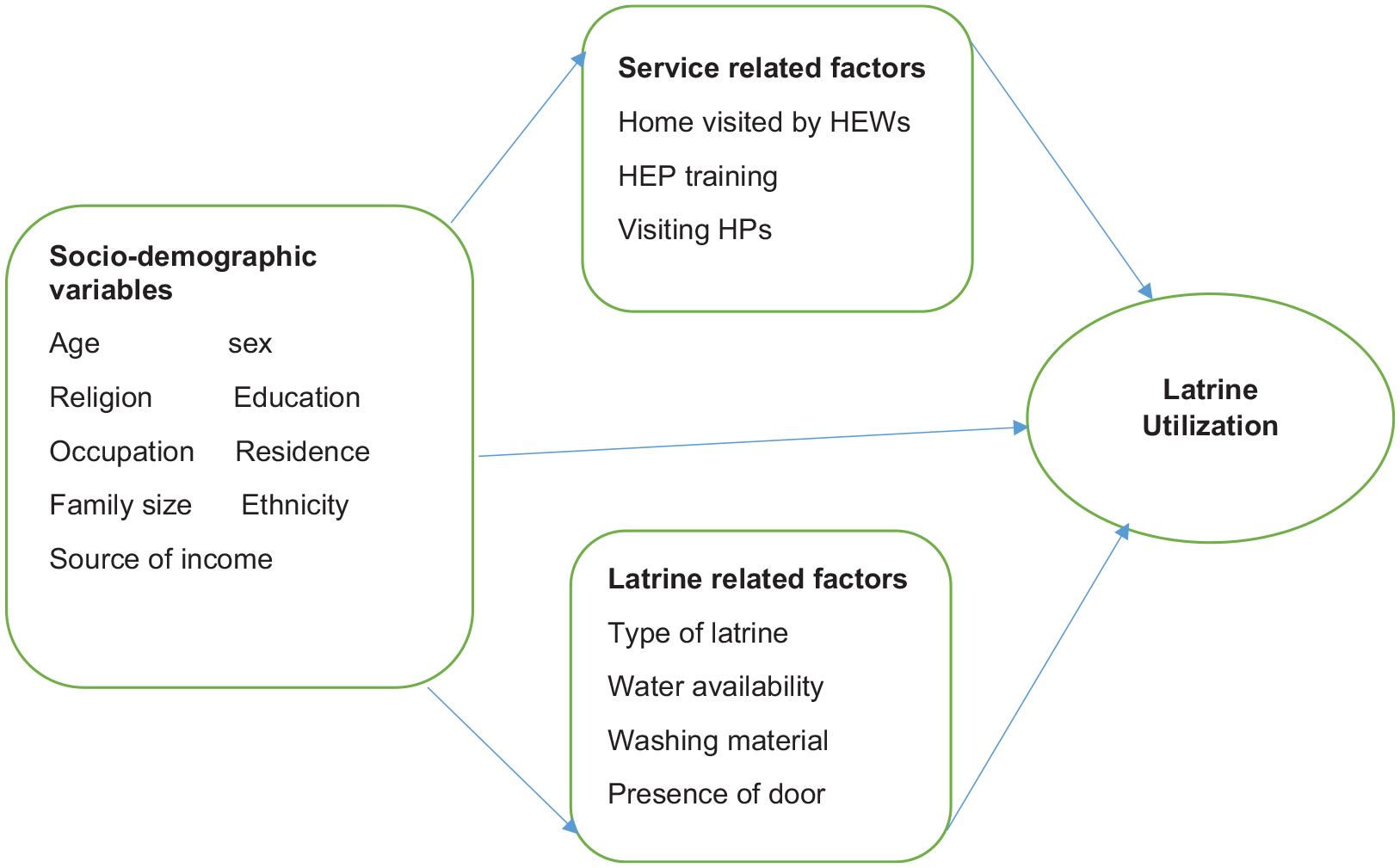
Conceptual framework showing the relationship between independent and outcome variables to assess latrine utilization in East Gojjam Zone, North West Ethiopia, 2021.
The presence of latrine in every household in the community has a great advantage to prevent communicable diseases like diarrhoea and non-communicable diseases if the member of the household uses the latrine properly and in a continuous manner.15,16 If latrine is used improperly and open defecation is being practised in the community, it will contaminate the water sources and the environment, which exposes people to the disease, so proper toilet utilization is the key to keep the water sources and the environment clean and protect the health of the people.16,17
The Ethiopian government designed a plan to achieve universal access to primary health care by preparing a Health Sector Development Program (HSDP). This plan was aimed to address the service coverage problem of the health system through an accelerated expansion and strengthening of primary health care services.18,19
Many studies in Ethiopia showed that coverage of toilets does not show the proper utilization of latrine, which may not measure the success of HSDP. Therefore, we conducted this study to assess the proper utilization of toilets and associated factors in East Gojjam Zone, North West Ethiopia.
Methodology
Study design
A community-based cross-sectional study design was used.
Study area and period
This study was conducted in East Gojjam Zone from 1 February to 30 May 2021.
East Gojjam Zone is a zone in Amhara Region of Ethiopia with a capital city of Debre Markos Town (located 300 km from Addis Ababa, the capital city of Ethiopia and 265 km from Bihar Dar, the capital city of Amhara.). It is bordered on the south by the Oromia Region, on the west by West Gojjam, on the north by South Gondar, and on the east by South Wollo. According to the 2007 Ethiopian population census projection and East Gojjam Zone health department report, it has a total population of 2,153,937 and 506,520 households who are distributed in 22 Woredas and 480 Kebeles. There are 10 hospitals, 102 health centres, and 423 health posts (HP) in this zone.20,21
Study population
All households who are living at least 6 months in East Gojjam Zone during the study period in the selected Kebeles.
Eligibility criteria
Inclusion criteria
Those aged 18 and above were included in the study.
Exclusion criteria
Individuals in the household who are mentally ill during the data collection period were excluded.
Sample size determination and sampling procedure
Sample size determination
The sample size was calculated using a single population proportion formula with the assumptions of 95% confidence interval (CI) (α = 0.05) and 4% margin of error. The population proportion of latrine utilization was considered as 71.8% which was taken from a study conducted in Alansha, South Wollo Zone, on utilization of latrine among community. 13
Thus, the sample size for this study could be

where n is the sample size; Z(a/2) is the 95% CI equal to 1.96; p is the estimation of latrine utilization from the previous study which was 71.8%; and w is margin of error which is 1 − confidence level = 1 – 0.95 = 0.05, but we took 0.04 to make the sample size representative.
Since it has two stages, we used 1.5 design effect due to budget constraints, and the sample size is 488 × 1.5 = 732. By considering 10% non-response rate, the estimated number of non-response participants is 732 × 0.10 = 74. Then, the minimum sample size for this study was 732 + 74 = 806.
Sampling procedure
A multistage sampling technique was employed. The first five rural Woredas were selected using lottery method. Again, cluster sampling technique was employed after proportionally allocating the sample size (806) to selected rural Woredas (Figure 2).

Schematic presentation of sampling procedure to assess latrine utilization and associated factors in East Gojjam Zone, North West Ethiopia, 2021.
Study variables
Dependent variable
Latrine utilization.
Independent variables
Socio-demographic variables: age, marital status, religion, educational status, occupation, and family size.
Latrine-related characteristics: type of toilet, water availability, toilet having a wall, door, and roof, and presence of hand washing material near toilet.
Service-related characteristics: Participation in health extension package (HEP) training, visiting HP, and home visits by health extension workers (HEWs).
Operational definitions
Latrine utilization
Latrine utilization is the actual behaviour of regularly using existing latrines for safe disposal of excreta in a safe manner. 2
Open defecation
Open defecation is disposing of faeces in the fields, forests, bushes, open bodies of water, beaches, and other open spaces. 5
Data quality control
To assure the data quality, the data collection tool was pretested on 5% of the study population at West Gojjam Zone to check its clarity, and training was given to data collectors and supervisors regarding the objectives of the study, data collection method, and the significance of the study. Daily communication was maintained among data collectors, supervisors, and principal investigators for discussion regarding presenting difficulties and to assess the progress of data collection. Collected data were checked for completeness and on the spot corrective measures were taken by data collectors and supervisors.
Statistical analysis
All collected questionnaires were rechecked for completeness and coded. Then, these data were entered and cleaned using Epi Info 7.2 software and exported to SPSS version 23 for analysis. Bivariable logistic regression was employed to identify an association, and a multivariable logistic regression model was used to control the effect of confounders.
Variables having p value less than 0.05 in the bivariable analysis were fitted into the multivariable logistic regression model. Ninety-five percent CI of odds ratio was computed, and a variable having p value less than 0.05 in the multivariable logistic regression analysis was considered to declare statistical significance.
Before the actual logistic regression analysis was done, the necessary assumption of the logistic regression model was checked using the Hosmer–Lemeshow test of goodness of fit which has a chi-square distribution.
For further analysis, descriptive statistics such as frequencies and cross-tabulation were performed. Graphical presentations such as bar charts and pie charts were used to present the findings of the study in addition to texts and tables.
Results and discussion
Socio-demographic characteristics
A total of 806 cases were included in this study with a 100% response rate. All the participants were Amhara in ethnicity. This may be due to the current political issue of the country. More than half of the study participants (52%) were found to be in the age group of 40 and above (⩾40 years). More than two-thirds of the participants (63.6%) were living in the rural area with agriculture as a source of income. More than four-fifths of the participants (81.1%) were females (Table 1).
Socio-demographic characteristics of respondents to assess latrine utilization and associated factors (n = 806) in East Gojjam Zone, North West Ethiopia, 2021.
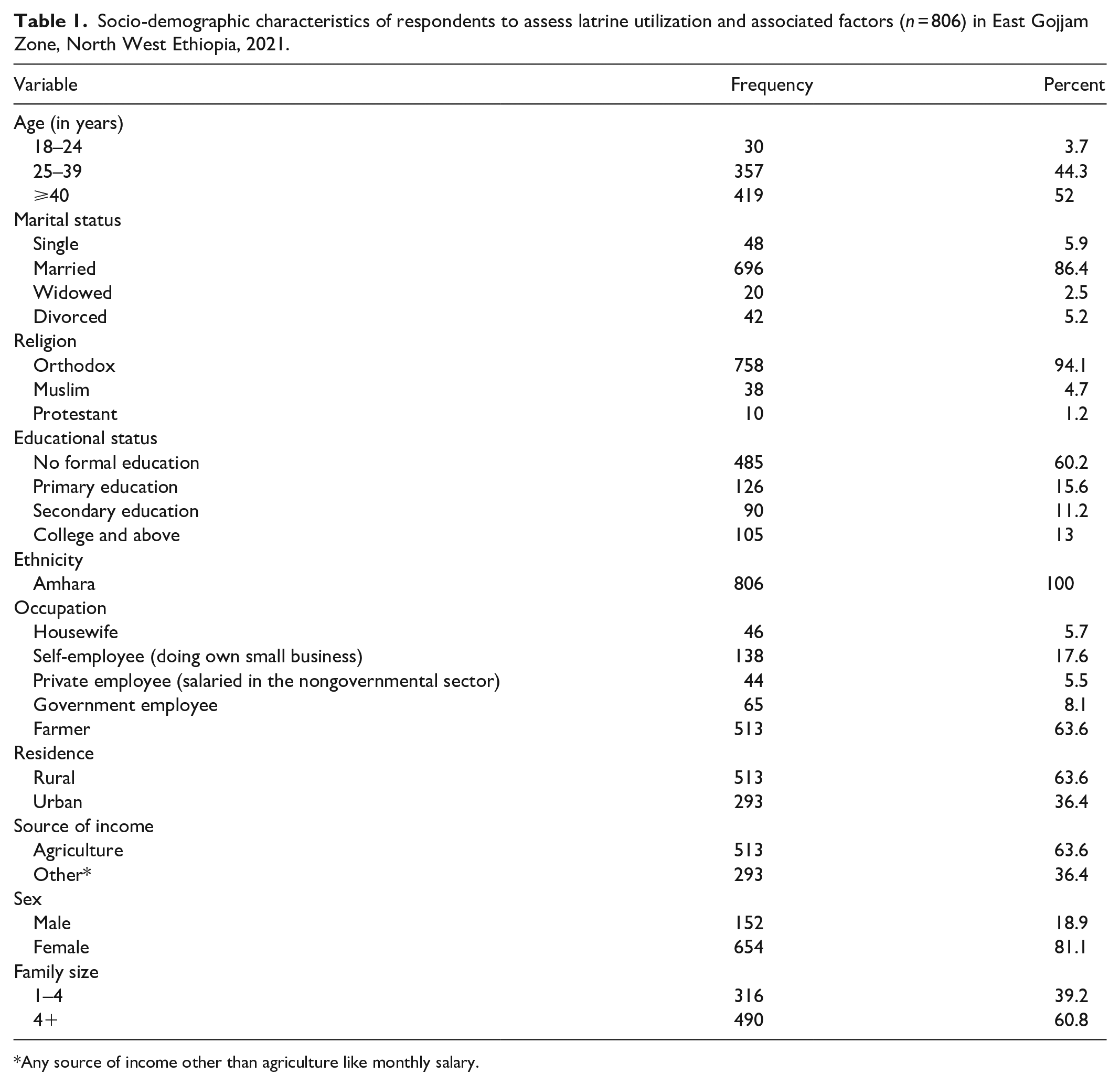
Any source of income other than agriculture like monthly salary.
Service-related characteristics
Nearly three-fourths of the respondents (72.5%) did not visit the HP for different reasons. Among respondents who participated in the model family training, 93.3% graduated as a model household. More than two-thirds of the participants’ (67.5%) home was visited by HEWs (Table 2).
Service-related characteristics on assessing latrine utilization in East Gojjam Zone, North West Ethiopia, 2021.

Toilet-related factors
There are factors that can be directly related to toilet utilization such as toilet type, water availability, and others. More than three-quarters of the participants (75.4%) had a toilet. Almost 95% of the respondents had a private toilet. Only 16.9 % of the participants wash hands after visiting the toilet (Table 3).
Toilet-related characteristics on assessing latrine utilization in East Gojjam Zone, North West Ethiopia, 2021.

Toilet utilization
Having a toilet does not mean utilizing the toilet. Many individuals may construct a toilet, but they never use it for different reasons in the study area. Among 608 participants who have a toilet, only 276 (45.4%) used the toilet consistently (Table 4).
Toilet utilization among households in East Gojjam Zone, North West Ethiopia, 2021.

Factors associated with toilet utilization
There are different factors that preclude latrine utilization by the community in East Gojjam Zone, including socio-demographic factors, service-related factors, and toilet-related characteristics.
In this study, variables such as residence, occupation, source of income, home visited by HEWs, participated in the model family training, water availability, and type of toilet were significantly associated in bivariable regression analysis, but only occupation, participated in the model family training, water availability, and type of toilet were significantly associated in multivariable regression analysis (Table 5).
Factors associated with toilet utilization among households in East Gojjam Zone, North West Ethiopia, 2021.
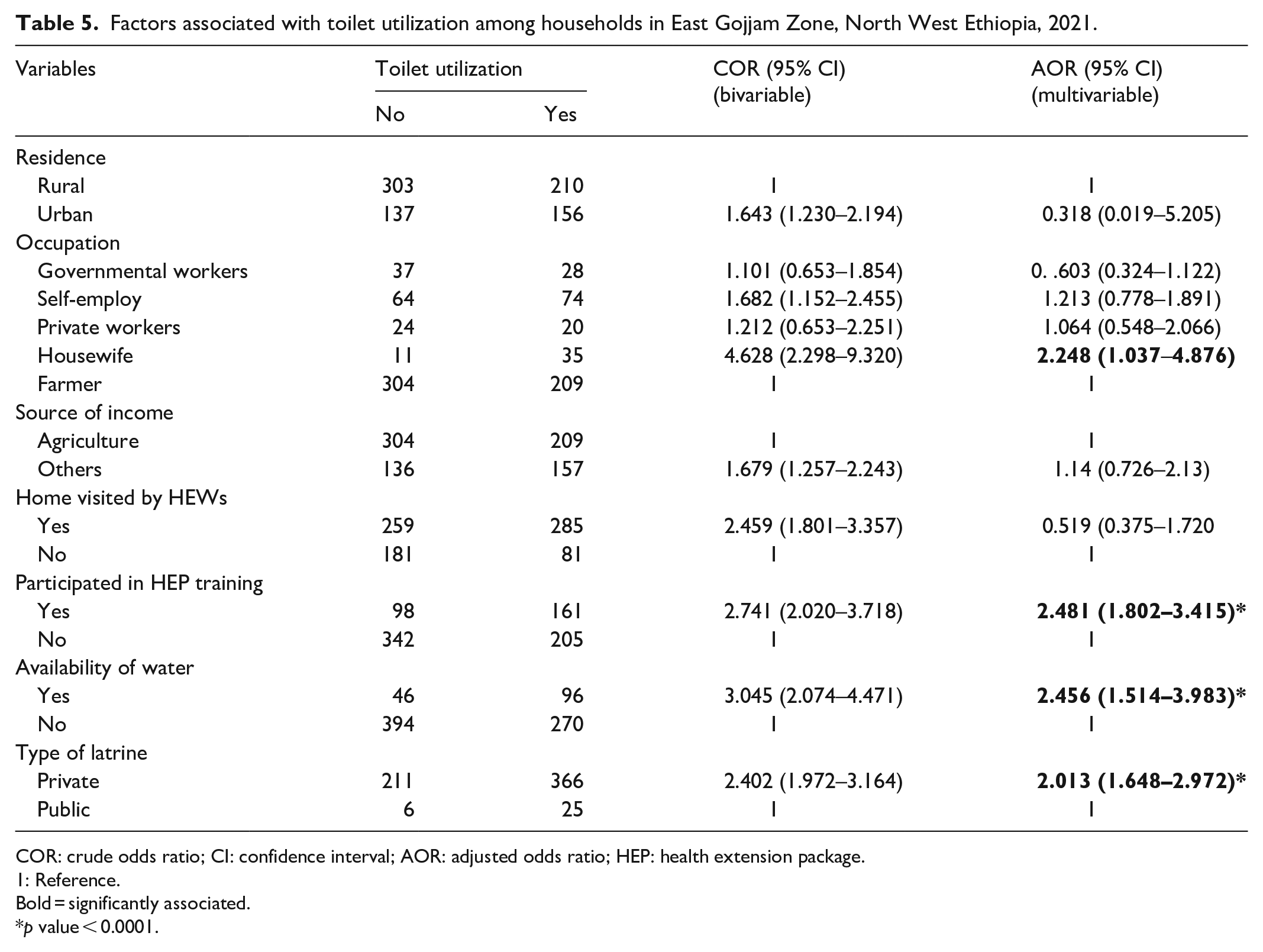
COR: crude odds ratio; CI: confidence interval; AOR: adjusted odds ratio; HEP: health extension package.
1: Reference.
Bold = significantly associated.
p value < 0.0001.
Discussion
This community-based cross-sectional study has attempted to assess latrine utilization and associated factors among households in East Gojjam Zone, Amhara Region, North West Ethiopia, 2021. The study results showed that the overall latrine utilization in East Gojjam Zone is 45.4% with 95% CI of 42.2–49.1. This finding is lower than the studies done in semi-urban area of Alansha in South Wollo Zone, Ethiopia (71.8%), 13 Maicew, Axum, Ethiopia (58.9%), 22 Denbia, North Gondar, Ethiopia (61.2%), 23 and Mehal Meda Town of North Shewa Zone, Ethiopia (91.2%). 12 The possible explanation for this difference may be our study was conducted both in rural and in urban areas, whereas the other ones were done in urban area, and it is clear that the awareness of latrine utilization among urban dwellers is better than the rural residents.
Again our result is much lower than the study conducted in Nepal (94.3%). 11 This difference might be due to a difference in socio-cultural and socio-economic assets, and level of awareness about latrine utilization of the community between the two study settings. The result of our study is also less than the findings of multi-level analysis studies done in Ethiopia as a country level (50.02%) 24 and sub-Saharan Africa (50%). 25 This difference can be explained by these multi-level analysis findings taken from the pooled prevalence of the other studies, and most studies on latrine utilization are done in urban area. In turn, almost all urban residents use the latrine obligatorily because of no space for open defecation. This made the results of this multi-level analysis higher than our findings. However, the finding of this study is higher than the study done in India (30.1%). 10 The difference between these study findings may be due to a difference in socio-cultural assets and the time period.
In our observation of the rural community, we appreciated that there is a toilet, but they use open defecation. Establishing the skeleton of the toilet and its utilization is quite different. Therefore, there should be a need for a repetitive follow-up whether the community utilizes it or not.
Occupation is one of the factors which are significantly associated with latrine utilization. Housewives were 2.248 times more likely to utilize the toilet compared with the farmers (adjusted odds ratio (AOR) = 2.248, 95% CI = 1.037–4.876). This is in agreement with the studies done in Denbia District, Ethiopia, 23 Maichew, Ethiopia, 22 and Mahal Meda Town, Ethiopia. 26 The reason for this difference may be housewives mostly stay in the home and have the opportunity to use the toilet consistently than the farmers, since farmers spend most of the time in the farm area and they may use open defecation where they work.
Participating in the model family training is one of the factors associated with latrine utilization. Participants who had been involved in model family training were 2.481 times more likely to utilize the latrine than those who had not participated (AOR = 2.481, 95% CI 1.802–3.415).
This result is supported by a study conducted in Lafto sub-city, Addis Ababa, Ethiopia. 27 The possible explanation might be involvement in the model family training regarding health extension packages including latrine utilization increases awareness about latrine utilization than those who did not participate. The other reason could be that when participants are involved in the model family training, they might be inspired to use the toilet than those who did not participate since they get the chance to share experiences with others, including the model households and the trainer. Again, the model family training has a demonstration session and a fieldwork, which is the best opportunity to make them familiar with the latrine construction and utilization after the training in their home than those households who were not involved in the training.
The other factor associated with latrine utilization in East Gojjam Zone is availability of water near the toilet. Respondents with water available near to their toilet were 2.456 times more likely to utilize the latrine than their counterparts (AOR = 2.456, 95% CI = 1.514–3.983). This finding concurs with the study conducted in Mehal Meda Town, North Shewa, Ethiopia. 26 This can be possibly explained as that households with no water do not use the latrine due to bad odour than households with water easily accessible to the toilet. Therefore, households with no water prefer open defecation anywhere than using the toilet.
Type of latrine is one of the factors which is positively associated with latrine utilization in the study area. Respondents who have private latrine were 2.013 times more likely to utilize the latrine than those who have public latrine (AOR = 2.013, 95% CI = 1.648–2.972). This finding is supported by the study conducted in Maichew, Axum. 22 This is due to the fact that private latrine has no queue to utilize during need than the public latrine. When there is a queue to use the toilet, individuals prefer open defecation rather than waiting.
Limitation of the study
The study design we used was cross-sectional, which cannot establish a cause and effect relationship between latrine utilization and the independent factors. It is also somewhat difficult to determine consistent use of latrine by simple cross-sectional study without follow-up and was prone to social desirability bias.
Conclusion
Based on our findings, we can conclude that latrine utilization in East Gojjam Zone was low relative to other studies and the country’s plan. It is very far apart from the Ethiopian latrine coverage and utilization plan (100%). Occupational status, participation in the model family training, water availability, and type of toilet were significantly associated with toilet utilization. Encouraging private latrine construction with accessibility of water and all households participating in model family training may increase latrine utilization in East Gojjam Zone. Further observational study triangulated with qualitative research should be conducted to provide more strong evidence for further improvement of household latrine utilization status in East Gojjam Zone.
Supplemental Material
sj-docx-1-smo-10.1177_20503121221074780 – Supplemental material for Latrine utilization and associated factors in East Gojjam Zone, North-West Ethiopia: A community-based cross-sectional study
Supplemental material, sj-docx-1-smo-10.1177_20503121221074780 for Latrine utilization and associated factors in East Gojjam Zone, North-West Ethiopia: A community-based cross-sectional study by Misganaw Fikrie Melesse and Bewket Yeserah Aynalem in SAGE Open Medicine
Footnotes
Acknowledgements
We would like to thank Debremarkos University Research and community service directorate for allowing us to do this research by giving ethical clearance. Our deepest gratitude also goes to the HSC postgraduate and research coordinating office for any support throughout the research work. We wish to express our special thanks to study participants, data collectors, and supervisors for their honesty throughout the data collection.
Author contributions
Misganaw Fikrie and Bewket Yeserah were involved in conceptualization, data cleaning, formal analysis, and supervision. Bewket Yeserah was involved in methodology. Misganaw Fikrie was involved in manuscript writing.
Declaration of conflicting interests
The author(s) declared no potential conflicts of interest with respect to the research, authorship, and/or publication of this article.
Funding
The author(s) received no financial support for the research, authorship, and/or publication of this article.
Ethical approval and consent to participate
Ethical approval for this study was obtained from the research committee of Debre Marcos University with ethical approval number HSC/R/C/Ser/Co/341/06/12.
Informed consent
Written informed consent was obtained from all subjects before the study.

Availability of data and materials
The data sets used and analysed during the current study will be available from the corresponding author on reasonable request.
Supplemental material
Supplemental material for this article is available online.
References
Supplementary Material
Please find the following supplemental material available below.
For Open Access articles published under a Creative Commons License, all supplemental material carries the same license as the article it is associated with.
For non-Open Access articles published, all supplemental material carries a non-exclusive license, and permission requests for re-use of supplemental material or any part of supplemental material shall be sent directly to the copyright owner as specified in the copyright notice associated with the article.
