




Abstract
Objectives
In humans with herpetic disease, early or pre-emptive famciclovir therapy reduces disease duration and severity. This prospective, masked, placebo-controlled study tested therapeutic and prophylactic effects of two famciclovir doses given to cats for 7 days following shelter entry.
Methods
Cats were assigned to prophylactic or therapeutic study arms based on clinical evidence of herpetic disease at study entry. Cats in the therapeutic arm received no treatment (n = 19), placebo (lactose; n = 18) or famciclovir at ~30 (n = 21) or ~90 mg/kg (n = 20) PO q12h for 7 days. Cats in the prophylactic arm received no treatment (n = 25) or famciclovir at ~30 (n = 28) or ~90 mg/kg (n = 27) PO q12h for 7 days. Disease scores, body weight, conjunctival feline herpesvirus 1 (FHV-1) shedding, and adoption rates were recorded on days 1 (admission), 8 (end of therapy) and 15 (1 week after cessation of therapy).
Results
No significant differences in clinical scores were observed among groups in the prophylactic or therapeutic arms at any of the three time points. However, within the therapeutic arm, viral shedding on day 8 was significantly higher in cats receiving no treatment than in those receiving ~30 or ~90 mg/kg famciclovir, and this effect persisted 1 week after famciclovir was stopped (day 15) only in cats receiving ~30 mg/kg, although this approached significance in cats receiving ~90 mg/kg. No significant differences in adoption rates were detected among groups in either arm throughout the study.
Conclusions and relevance
Although we did not demonstrate a statistically or clinically significant effect of famciclovir administration upon clinical signs of infectious upper respiratory disease or adoption, when it was administered at ~30 or ~90 mg/kg q12h for 1 week famciclovir reduced conjunctival FHV-1 shedding. This suggests a potential role in interrupting the infectious cycle within a shelter population; however, cost in time and resources, and stress and pathogen transmission induced by oral administration should be considered.
Keywords
Introduction
Infectious upper respiratory disease (IURD) is a common and important management problem in multi-cat environments, with feline herpesvirus type 1 (FHV-1) believed to be one of the major causes of severe and recurrent disease.1–5 In shelters, physiologic stresses leading to viral reactivation in latently infected cats are common as a result of high turnover, crowding and variable vaccination history and immunocompetency; thus, FHV-1 shedding and herpetic disease are extremely prevalent in shelter-housed cats.2,3 Currently, the lack of effective methods to control IURD within shelters has resulted in clinical IURD being one of the major reasons for euthanasia or difficulty adopting cats from shelters, and remains a notable management and welfare concern in multi-cat environments worldwide.2,3
Although administration of antiviral drugs to humans with herpes simplex virus or in animal models of herpetic disease reduces establishment of latency, 6 reactivation frequency 7 and viral shedding, 8 to our knowledge, antiviral drugs have not been assessed in this way in FHV-1-infected cats. Until recently, systemically administered antiviral medications were considered too toxic or insufficiently effective for use in cats.9,10 However, data regarding the safety and efficacy in cats of famciclovir – an antiviral prodrug of penciclovir – are extremely promising, and its use in shelter-housed cats warrants investigation. We, and others, have shown that penciclovir – the active metabolite of famciclovir – is highly effective against FHV-1 in vitro.11–14 We have also extensively assessed the pharmacokinetics (PK), pharmacodynamics, safety and efficacy of famciclovir in normal, as well as experimentally and naturally infected cats. Although famciclovir PK are complex and non-linear,15–17 the drug is highly effective in cats with experimentally induced or spontaneous herpetic disease,15,18,19 with improved systemic, ophthalmic, clinicopathologic, virologic and histologic outcomes all noted without adverse effects.
Preliminary investigations into the utility of famciclovir as a prophylactic agent in a shelter setting have thus far proven unsuccessful. In a 2015 study, famciclovir, when administered as a single dose of 125 or 500 mg (16–52 or 92–227 mg/kg, respectively) to cats upon shelter entry, did not reduce shedding of FHV-1 DNA or clinical disease scores compared with placebo-treated cats at the 1 week time point assessed. Furthermore, sneezing scores increased and body weight (BW) decreased compared with study entry in cats that received 500 mg famciclovir or placebo. 20 However, this study did not explore the effects of oral famciclovir administered over a prolonged dosing period and cats were not stratified based on clinical scores at the time of study entry. If a fiscally and logistically viable method of administering famciclovir to cats in shelters is as effective at limiting viral shedding and clinical signs of disease as it is in humans, this drug would have extraordinary potential to reduce disease prevalence and severity, and minimize viral shedding, thereby revolutionizing management, improving animal welfare, reducing euthanasia rates and promoting adoption within shelters worldwide.
Therefore, the present study was designed to investigate the clinical and virologic effects of prophylactic and therapeutic administration of two doses of famciclovir administered to cats for 1 week beginning immediately upon shelter admission. We hypothesized that, relative to placebo, q12h oral administration of famciclovir for a period of 1 week at ~90 mg/kg, but not at ~30 mg/kg, would reduce incidence and severity (prophylactic arm) and prevalence, duration and severity (therapeutic arm) of feline IURD, thereby reducing euthanasia rates and increasing adoption rates. Furthermore, we hypothesized that these effects would persist beyond the 1 week administration period and that incidence of adverse events would not differ between famciclovir doses.
Materials and methods
This study was conducted between March and November 2016 in a county animal shelter in Northern California. Cats were considered for enrollment in this study within 48 h of being put up for adoption. Prior to this, cats were held for the legally mandated period of 72 h, during which they were spayed or castrated if not already, and underwent behavioral testing. All participating cats were individually housed and fed in the shelter’s adoption facility and remained eligible for adoption throughout the study. For entry into the study, cats were required to test negative for serum feline leukemia virus (FeLV) antigens and feline immunodeficiency virus (FIV) antibodies (SNAP Combo FeLV Ag-FIV Antibody test; IDEXX), have a body condition score (BCS) ⩾3/9, 21 be ⩾1 kg BW and be ⩾3 months of age (estimated based upon dental examination). For cats meeting these inclusion criteria, clinical signs of IURD were graded by masked observers according to a published semi-quantitative scoring system. 22 The total clinical disease score was defined as the sum of all ocular (conjunctivitis, blepharospasm and ocular discharge) plus all non-ocular (sneezing and nasal discharge) scores. The minimum total clinical disease score possible was 0 and the maximum was 24.
Based upon clinical disease score, cats meeting all eligibility criteria were assigned to one of two study arms – one designed to test the prophylactic effects and the other to test the therapeutic effects of famciclovir given at one of two doses to cats for 1 week beginning at shelter entry (Figure 1). Cats without evidence of IURD (ie, clinical disease score = 0) were assigned to the prophylactic arm of the study, whereas cats with evidence of IURD (ie, clinical disease score ⩾1) were assigned to the therapeutic arm. Within each arm, cats were stratified based upon sex, estimated age group and clinical disease score, and then randomized into treatment groups such that all groups in both arms had approximately equivalent distribution of sex (male or female without consideration of neuter status) and estimated age group (<12 months or ⩾12 months). Group assignment was performed by a single individual who was not involved with clinical assessment of cats.

Study design by which cats were selected for entry and randomly assigned to one of seven treatment groups within the prophylactic or therapeutic study arm of a clinical trial assessing the efficacy of famciclovir administered at one of two doses for 1 week following shelter entry. FeLV = feline leukemia virus; FIV = feline immunodeficiency virus; BCS = body condition score; IURD = infectious upper respiratory disease; CS = clinical score
Within the prophylactic arm cats received either no treatment or ~30 mg/kg or ~90 mg/kg oral famciclovir q12h. Within the therapeutic arm, cats were assigned to the same three treatment groups plus a group that received placebo (lactose PO q12h). In both arms, famciclovir was administered using commercially available tablets (Apotex) that were crushed, weighed and placed into gelatin capsules to provide either ~30 or ~90 mg/kg depending on group assignment and based upon twice-weekly recordings of each cat’s BW. Cat BW was rounded up to the nearest 0.5 kg and dose calculated as described in Table 1.
Based upon twice-weekly assessment of body weight, cats received a famciclovir dose that approximated (but was never less than) 30 or 90 mg/kg q12h for 7 days following shelter entry

For the placebo group, lactose was similarly placed in gelatin capsules at an approximate volume to a 30 mg/ kg dose of famciclovir. Capsules containing lactose or famciclovir were administered using a commercially available pill administration device and followed by 1 ml tap water delivered orally via a dosing syringe. Each cat received twice daily famciclovir or placebo for 1 week but remained in the study for a further 1 week (total of 2 weeks) of observation unless adopted.
Cats in all treatment groups of both study arms were managed according to the shelter’s usual protocols in all respects other than drug/placebo administration. All cats underwent general health assessment by shelter caretakers at least once daily as was routine in this shelter. All changes were noted as potential adverse events. In addition, BW and BCS was recorded twice weekly and cats that lost >15% of their entry BW were removed from the study. Clinical evidence of IURD was graded once daily by trained observers using the same scale used at study entry. Cats that entered with signs of IURD or became affected by IURD during the study were treated according to this shelter’s IURD protocol, which included the systemic administration of doxycycline (or, in one cat only, azithromycin) and/or the topical administration of oxytetracycline–polymyxin ophthalmic ointment. These cats remained in the study and continued to receive famciclovir or placebo according to their group assignment in addition to the medical care dictated by the shelter protocol. Cats known to receive any other antibiotics were excluded from all data analysis.
On days 1, 8 and 15 (ie, at study entry, at cessation of famciclovir/placebo administration, and 7 days following drug cessation), cats in all treatment groups received 1 drop of 0.5% proparacaine (Akorn) in each eye, and a dry polyester swab (Fisher Scientific) was vigorously rolled in the ventral conjunctival fornix of both eyes. Swabs were immediately placed in sterile 1.5 ml Eppendorf tubes and stored on ice for 1–3 h, and then at 4°C until quantification of FHV-1 DNA by means of a qPCR assay (IDEXX Laboratories), according to published protocols. 23
For the duration of the study, personnel were assigned either an evaluator or observer role. Those personnel assigning clinical scores remained masked to treatment group and study arm and entirely separate from those administering treatments. All data collected prior to removal of cats from the study were included in the analyses. The χ2 test of homogeneity was used to detect differences among groups with respect to sex regardless of neuter status, and neuter status regardless of sex. Kruskal–Wallis one-way ANOVA was used to detect differences in age among treatment groups. Time to adoption among treatment groups and between study arms was compared using a log-rank test; unadopted individuals were censored after 16 days. The presence of FHV-1 DNA was compared among treatment groups within particular days and study arms using logistic regression. The effects of treatment group, time and their interaction on clinical disease scores was evaluated using mixed-effects linear regression, with the individual cat treated as a random effect. For all analyses, a P value <0.05 was considered significant. Personnel making decisions regarding euthanasia, adoption and movement of cats within the hospital were all unaware to which treatment group cats were assigned.
The study was approved by the Institutional Animal Care and Use Committee of the University of California–Davis and designed in accordance with the ARVO statement for the ethical use of animals in ophthalmic research.
Results
Demographics
A total of 163 cats met all enrollment criteria; however, data from five cats were removed before analysis. Data were removed from one cat in the ~30 mg/kg group of the prophylactic arm because of a suspected recording error in which pounds were used instead of kilograms for body weight. Data from the remaining four cats were removed because these cats received oral antibiotics other than doxycycline or azithromycin. Of these, two cats were in the untreated group, one was in the ~30 mg/kg group in the prophylactic arm and one was in the ~90 mg/kg group in the therapeutic arm.
Thus, final data were analyzed for 158 cats; 146 domestic and 12 purebred (one Bombay, two Himalayan, one Maine Coon, five Siamese and three Snowshoe) cats divided approximately equally among the seven treatment groups (Table 2). None of the cats were considered markedly brachycephalic. There were 91 females and 67 males with a median age of 25 months (range 3–168 months). Of these, 80 cats were already neutered upon intake to the shelter, 77 were spayed or castrated by shelter veterinary staff prior to study entry and one was an intact female. At admission, no significant differences were detected among groups with respect to sex, regardless of neuter status (P = 0.176), neuter status regardless of sex (P = 0.147), or age (P = 0.860). Owing to the small number of purebred cats, breed distribution was not statistically analyzed; however, the purebred cats were approximately equally distributed across 6/7 treatment groups; the ~90 mg/kg group within the therapeutic arm had no purebred cats (see Table 2).
Baseline demographic and clinical data for 158 cats entered into a clinical trial assessing the efficacy of famciclovir administered at one of two doses for 1 week following shelter entry

Cats were randomly assigned to 1/7 treatment groups within the prophylactic or therapeutic study arms. Age and sex distributions were not significantly different among groups. Breed distribution was not statistically analyzed
D = domestic; F = female; M = male; P = purebred
Clinical signs
Although on day 0 all cats in the prophylactic arm had a clinical disease score of 0 (as defined by entry criteria) and all cats in the therapeutic arm had a clinical disease score >0, these scores had sometimes changed by day 1, which was considered the baseline for the study. Despite this, median (range) clinical disease scores on day 1 did not significantly differ among cats entered into the three treatment groups of the prophylactic arm or the four treatment groups of the therapeutic arm (see Table 2). Furthermore, no significant differences in clinical disease scores were observed among any groups within the prophylactic arm (Figure 2a) or therapeutic arm (Figure 2b) at the end of the period of famciclovir/placebo administration (day 8) or 1 week after cessation of therapy (day 15). No cats in either study arm had a clinical disease score >12 at baseline (day 1) or at study termination (day 15), and, across all seven treatment groups of both arms, only six cats achieved a clinical score >12 at any point during the 2 week study. All six were in the therapeutic arm and, of these, four (two from placebo group, one that received ~30 mg/kg famciclovir and one that received ~90 mg/kg famciclovir) had a clinical score >12 at the conclusion of the 1 week treatment period (day 8); however this had returned to <12 by day 15. Considering the remaining two cats, one was in the ~90 mg/kg famciclovir group and had a clinical score >12 on days 10 and 16, while the last was in the placebo group and had a clinical score >12 on days 3, 5, 7 and 9–13.

Clinical disease scores for 158 cats entered into a clinical trial assessing the efficacy of famciclovir administered at one of two doses for 1 week following shelter entry. (a) Cats without clinical signs of infectious upper respiratory disease (IURD) at study entry were assigned to the prophylactic study arm and stratified to receive famciclovir at ~30 mg/kg (n = 28; yellow) or ~90 mg/kg (n = 27; red) PO q12h or were untreated (n = 25; blue). (b) Cats with signs of IURD at study entry were assigned to the therapeutic study arm and received famciclovir at ~30 mg/kg (n = 21; yellow) or ~90 mg/kg (n = 20; red) PO q12h, placebo PO q12h (n = 18; green) or were untreated (n = 19; blue). No significant differences in clinical disease scores were observed among any groups within the (a) prophylactic or (b) therapeutic arms at the end of the period of famciclovir/placebo administration (day 8) or 1 week after cessation of therapy (day 15)
Herpetic DNA
Within the prophylactic arm of the study, the proportion of cats in which FHV-1 DNA was detected in the conjunctival fornices was generally low (0–13%), and did not significantly differ at any time point statistical analysis was possible (ie, at baseline [day 1] among any of the three treatment groups, or at the conclusion of the 1 week treatment period [day 8] between the no-treatment and ~90 mg/kg famciclovir groups; Figure 3a). Comparisons among other groups in the prophylactic arm on day 8 and among any treatment groups on day 15 were not possible owing to the paucity of cats shedding FHV-1 in these groups at these times.

Proportions of cats in which feline herpesvirus type 1 (FHV-1) DNA was detected in the conjunctival fornix of either eye on days 1, 8 or 15 of a clinical trial assessing the efficacy of famciclovir administered at one of two doses for 1 week following shelter entry. (a) Cats without clinical signs of infectious upper respiratory disease (IURD) at study entry were assigned to the prophylactic study arm and stratified to receive famciclovir at ~30 mg/kg (n = 28; yellow) or ~90 mg/kg (n = 27; red) PO q12h or were untreated (n = 25; blue). Within the prophylactic arm of the study, the proportion of cats in which FHV-1 DNA was detected in the conjunctival fornices did not significantly differ at any time point statistical analysis was possible. (b) Cats with signs of IURD at study entry were assigned to the therapeutic study arm and received famciclovir at ~30 mg/kg (n = 21; yellow) or ~90 mg/kg (n = 20; red) PO q12h, placebo PO q12h (n = 18; green) or were untreated (n = 19; blue). At baseline (day 1), FHV-1 DNA was detected in the conjunctival fornices of a significantly greater proportion of cats in the untreated group than in the placebo or ~30 mg/kg groups but not the ~90 mg/kg groups. For placebo-treated cats, this difference was no longer evident on day 8 but had returned by day 15. For cats receiving ~30 mg/kg famciclovir, significantly fewer shed virus after 1 week of therapy and this effect persisted until day 15. For cats receiving ~90 mg/kg famciclovir, significantly fewer shed virus after 1 week of therapy and this effect approached significance on day 15
Within the therapeutic arm of the study, herpetic DNA was detected in the conjunctival fornices of a large proportion (45–47%) of cats in the untreated group on all 3 days. This permitted statistical comparison of the presence of conjunctival herpetic DNA data between untreated cats and those in the three treatment groups at all three time points (Figure 3b). At baseline (day 1), FHV-1 DNA was detected in the conjunctival fornices of a significantly greater proportion of cats in the untreated group than in the placebo (P = 0.0214; odds ratio [OR] 0.081, 95% confidence interval [CI] 0.0016–0.77) or ~30 mg/kg (P = 0.0103; OR 0.068, 95% CI 0.0013–0.63) but not the ~90 mg/kg (P = 0.2470; OR 0.36, 95% CI 0.069–1.70) groups. For placebo-treated cats, this difference was no longer evident on day 8 (P = 0.2451; OR 0.30, 95% CI 0.038–1.81) but had returned by day 15 (P = 0.0174; OR 0.078, 95% CI 0–0.67). Relative to the untreated group, significantly fewer cats receiving ~30 mg/kg famciclovir shed virus after 1 week of therapy (P = 0.0176; OR 0.073, 95% CI 0.0014–0.72), and this effect persisted until day 15 (P = 0.0094; OR 0.064, 95% CI 0–0.54). Whereas, significantly fewer cats receiving ~90 mg/kg famciclovir than those that were untreated shed virus after 1 week of therapy (P = 0.0384; OR 0.14, 95% CI 0.011–0.92), and this effect approached significance on day 15 (P = 0.0531; OR 0.089, 95% CI 0.0016–1.03).
Considering data from all cats regardless of study arm and treatment group, FHV-1 DNA was detected on 46 occasions in 32 cats. Of these, there were 25 for which PCR data were available at all three time points. Ten of these were positive at baseline but then ceased shedding at the end of the 1 week treatment period (day 8) and remained negative 1 week after cessation of treatment (day 15). Of these two were untreated, and eight received famciclovir at either ~30 (n = 4) or ~90 (n = 4) mg/kg. By contrast, four cats were positive at all three time points throughout the study; three were in the untreated group, whereas only one received famciclovir (~90 mg/kg). Finally, three cats were negative at baseline but shed on both days 8 and 15; one cat was untreated and the other received ~90 mg/kg famciclovir.
Adoption data
A significant difference in time to adoption was not detected among treatment groups in both arms (P = 0.8802 or among both arms in all treatment groups [P = 0.4022]; Table 3).
Adoption data for the 158 cats entered into a clinical trial assessing the efficacy of famciclovir administered at one of two doses for 1 week following shelter entry
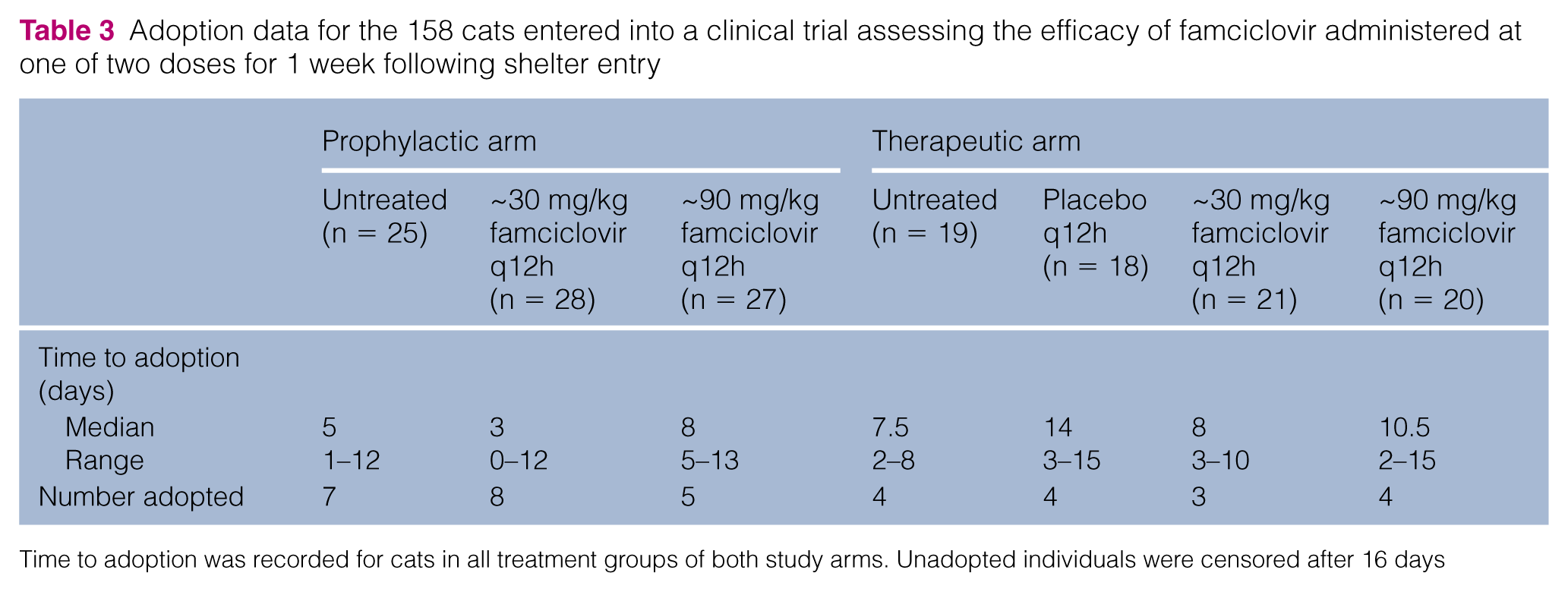
Time to adoption was recorded for cats in all treatment groups of both study arms. Unadopted individuals were censored after 16 days
Discussion
This study revealed that famciclovir did not prevent or reduce clinical signs of IURD when administered orally at ~30 or ~90 mg/kg for 1 week following shelter entry to cats with or without signs of IURD. However, when administered at ~30 or ~90 mg/kg to cats with signs of IURD, famciclovir was associated with reduced viral shedding at the end of the 1 week treatment period. This effect did not persist 1 week after the cessation of therapy for cats receiving the higher dose but did in cats receiving ~30 mg/kg q12h. No significant differences in adoption rates were detected among groups in either arm throughout the study.
Findings in the present study that famciclovir did not prevent or reduce clinical signs of IURD at the two doses tested when administered for 1 week following shelter entry are in accordance with those from a previous study, 20 in which a single oral dose of 125 or 500 mg famciclovir (16–52 or 92–227 mg/kg, respectively) was administered to cats upon shelter entry. In that study, 20 clinical disease scores obtained 1 week after medication administration did not significantly differ between those cats receiving the antiviral drug and those receiving the placebo.
Given famciclovir’s potent antiviral effect in cats experimentally infected with FHV-1, 15 and in client-owned cats with presumed herpetic disease, 18 it is interesting to consider why an effect was not seen in the present or previous study conducted in shelter environments. 20 First, the low incidence of IURD at the shelter where the present study was performed and the mild clinical disease noted may have affected this outcome. Specifically, the mild clinical signs seen are likely to have made subtle changes in clinical course more difficult to detect. No cats in the present study had a clinical disease score >12 at baseline (day 0) or study termination (day 15). Interestingly, 4/6 cats in the therapeutic arm (two from placebo group, one that received ~30 mg/kg, famciclovir and one that received ~90 mg/kg famciclovir) had a clinical score >12 at the conclusion of the 1 week treatment period (day 8), which was no longer >12 at 1 week later (day 15), suggesting that the act of pilling may have transiently worsened clinical disease.
Second, the relatively short course of famciclovir administration may have been insufficient to detect a clinical effect. The study was originally designed to include a 2 week course of treatment followed by a 2 week period of observation. However, during the pilot phase, the time course was shortened owing to difficulty getting cats through to study completion due to factors such as transfer and adoption. Third, it is possible that IURD signs scored in cats of the present study were due to non-infectious causes, or pathogens other than FHV-1 not sensitive to famciclovir. Certainly, the other major respiratory pathogens of cats – Chlamydia felis, Mycoplasma species and feline calicivirus – would not be expected to be sensitive to an acyclic nucleoside, such as penciclovir. Furthermore, coinfection with FHV-1 and other respiratory pathogens may have made clinical improvement due to antiviral treatment more difficult to detect.
Although famciclovir did not prevent or reduce clinical signs of IURD in the shelter population studied here, some significant differences in viral DNA detection at the conjunctival surface were detected among groups. For example, administration of famciclovir at ~30 or ~90 mg/kg to cats with signs of IURD (ie, in the therapeutic arm of the study) was associated with reduced viral shedding at the end of the 1 week treatment period. This effect persisted 1 week after cessation of therapy in the ~30 mg/kg group, and the difference approached significance in the ~90 mg/kg group suggesting that a larger data set may have revealed significance.
Meanwhile, an interesting trend was detected among cats with clinical disease at study entry and entered into the untreated or placebo group. Although FHV-1 DNA was detected more commonly in cats in the untreated group than the placebo group at all time points, it remained relatively constant at each time point tested. By comparison, 7 days of pilling of placebo-treated cats was associated with a notable increase in FHV-1 DNA detection rate, which subsided to about (or slightly less than) baseline 7 days after pilling had ceased. This raises the possibility that stress and/or fomite transmission among cats being pilled twice daily may induce herpetic shedding. This is in accordance with findings of a previous study, 20 in which cats receiving a single dose of famciclovir or placebo at shelter entry had increased rates of FHV-1 shedding vs untreated controls. If true, this suggests that the decision to administer famciclovir (or any other oral medications) in shelters and perhaps elsewhere may not be a benign act. Rather, it may even have negative consequences for the individual receiving the medication or FHV-1-naïve in-contact cats.
Because relatively few cats across all treatment groups were shedding FHV-1, as detected by FHV-1 PCR performed on conjunctival swabs, inferences drawn from these data must be interpreted with caution. This is particularly true for cats for which PCR data were available at all three time points. However, within this group, viral shedding trends suggested that cats receiving no treatment were more likely to shed FHV-1 throughout the study than those receiving famciclovir at ~90 mg/kg. Furthermore, cats shedding FHV-1 at baseline were less likely to continue shedding virus at subsequent time points if they received famciclovir at ~30 or ~90 mg/kg than those that received no treatment.
Philosophically, it is interesting to consider whether many of the differences in this study that were not statistically significant may have become significant had the number of cats assessed in each group been larger. While an a priori power analysis is helpful in such settings, it would have been based upon pure conjecture here given the absolute novelty of the study design. However, to explore the possibility of the effect of sample size, it is interesting to assess the likely clinical significance of such changes had we been able to demonstrate significance. Taking, as an example, the non-significant differences in clinical scores – the greatest difference between averages of any two groups was 3 (and more typically 2) on a scale of 0–24. Such differences would likely be of minimal if any clinical significance. For example, a difference in a clinical score of just 2 could be accounted for by minor serous discharge from one nostril and one eye. Likewise, the proportion of cats shedding DNA varied among groups by 0–13%. Against studies that show shedding rates of up to 50% in normal cats,24,25 this seems likely to be a relatively minor clinical effect.
Conclusions
We were unable to demonstrate a statistically or clinically significant effect upon clinical signs of IURD or adoption rates when famciclovir was administered to cats at ~30 or ~90 mg/kg for 1 week following shelter entry. However, when administered at ~30 or ~90 mg/kg, famciclovir was associated with reduced herpes viral shedding at the conjunctival surface at the end of the 1 week treatment period, and this effect persisted for a further week off treatment in the ~30 mg/kg group. Although this suggests that famciclovir therapy may have the ability to interrupt the infectious cycle within a shelter population via reduction of FHV-1 shedding, this concept warrants further consideration, especially as it relates to the cost in time and resources, as well as the stress and potential spread of FHV-1 and other pathogens associated with frequent oral drug administration in a shelter setting.
Footnotes
Acknowledgements
We thank the Solano County Sheriff’s Office Animal Care Division and Sheriff Thomas A Ferrara for use of their animal adoption facility; IDEXX Laboratories for performance of the qPCR; Monica Motta BS, RVT, RLAT for technical support; Kate Hurley DVM and Michael Bannasch BS, RVT for assistance with project design; and the following undergraduate students for preparation of study medications and data collection: Christina Ball, Marisa Ciccozzi, Connor Chang, Megan Coyne, Allison O’Donnell, Nadya Dooley, Alyssa Hoehn, Anny Huang, Winter Keith, Jayden Li, Kira Lin, Kimberly Ly, Ariana Marangakis, Huong Nguyen, Josefina Nordenstahl and Hannah Morris.
Conflict of interest
The authors declared no potential conflicts of interest with respect to the research, authorship, and/or publication of this article.
Funding
This work was supported by grants from the Morris Animal Foundation and the UC Davis Center for Companion Animal Health and RM Cello Endowment.
