



Abstract
Profanity is common in everyday life, yet law enforcement often treats all swear words alike. Building on Adams (2024), we surveyed a large public sample (n = 2412) who evaluated profanity’s appropriateness, professionalism, impact on trust, and disciplinary deservedness across nine scenarios (n = 9874) varying in intent (positive, neutral, derogatory) and target (self/situation, colleague, public). Results aligned with prior research: any profanity aimed at the public, especially in a derogatory way, drew the strongest condemnation. Meanwhile, positive or neutral profanity toward oneself or colleagues was generally acceptable, though derogatory profanity at colleagues elicited moderate concern. Across the two studies, it appears police executives are generally more condemnatory of police profanity compared to public expectations. These findings underscore the need for nuanced language policies, rather than blanket bans, to address truly harmful speech without penalizing harmless expressions.
Introduction
Profanity appears across social contexts and throughout the life course, including childhood (Jay et al., 2006; Jay & Jay, 2013), academic settings (Generous et al., 2015a, 2015b), and the workplace (Baruch et al., 2017; Johnson, 2012). Efforts to curb its use have had limited success, as profanity functions as a core element of everyday language (Eliasoph & Lichterman, 2003; Generous, Frei, & Houser, 2015). For example, in counseling, adopting a client’s vernacular—including profanity—can improve rapport and treatment outcomes (Giffin, 2016; Wiley & Locke, 1982). More broadly, profanity may help express emotion and alleviate stress (Husain et al., 2023).
However, police agencies have taken an opposing approach towards profanity usage, with departmental policies either sidestepping the issue entirely (Adams, 2024), or relying on unrealistic blanket bans, deeming it “always unprofessional” (Michigan Commission on Law Enforcement Standards, 2022). These bans deviate from other public-facing professions such as nursing and education, which opt for policy concerning inappropriate or disrespectful conduct, avoiding specific mentions of “profanity” across national (American Nurses Enterprise, 2025; National Education Association, 2025) and state-level institutions (New York City Public Schools, 2025; North Carolina Board of Nursing, 2025). This allows for case-by-case interpretations of behavior and language rather than absolute rules disconnected from contextual factors. High quality research shows that officer profanity can worsen public perceptions in use-of-force situations (Doyle et al., 2024; Martaindale et al., 2023; Patton et al., 2017; Sharps et al., 2019). Yet broad bans overlook the varied contexts in which profanity arises in the policing workplace, and risk concentrating policy on statistically rare scenarios, rather than encompassing the broader policing workplace context.
Recent research has begun to untangle these nuances, with this paper’s predecessor investigating law enforcement and human resource executives’ perceptions of police profanity usage. Adams (2024) proposed a framework to evaluate the use of expletives, specifically “fuck”, based on their intent (positive, neutral, derogatory) and target (self/situational, colleague, public). Adams found significant differences in respondent perceptions of profanity use based on differing combinations of intent and target. Generally, “derogatory profanity targeting colleagues, and all forms of profanity targeting the public were considered less appropriate, less professional, more harming to public trust, and more deserving of disciplinary sanction” (Adams, 2024, p. 3).
The current study replicates the methodology of Adams (2024), applying the same pre-registered theoretical framework and experimental methodology in a public sample. Our findings align with the original: the public sees profanity targeting the public as unacceptable, especially when used derogatorily. We find the public is just as capable and even-handed as police and human resources executives at evaluating the harms of profanity use across differing contexts. These findings provide further evidence in support of narrowing the breadth of profanity policy in pursuit of greater policy effectiveness and workplace fairness.
Profanity, Policy, Policing, and Public Perceptions
Rightly or wrongly, profanity is firmly embedded in the culture of policing. Like any workforce, police are not excluded from the overall assertion that people are profane at work (Baruch et al., 2017; Johnson, 2012). While the specific frequency of police profanity use is not empirically established, motivating examples abound. Van Maanen (1978) provides the classic account of police profanity as a cultural phenomenon, providing insight into the unique way police officers use profanity to categorize those they encounter – most notably “The Asshole.” Nearly thirty years later, Moskos (2009) enters the police workforce to produce ethnographic evidence that profanity remains a time-honored verbal skill among patrol officers in Eastern Baltimore: “When I first came on this job, I couldn’t understand 90% of what these motherfuckers were saying…I speak three languages: English, bad English, and profanity!” (p. 62) “Some people consider that a bullshit lockup. But fuck ‘em. I don’t see them locking up Al Capone…” (p. 84)
Profanity can obviously serve as a verbal weapon, but often serves as a casual filler rather than an outright attack. Frankfurt (2005) classifies this type of speech as “bullshit,” contending that bullshit is “one of the most salient features of our culture…Everyone knows this” (p. 1). In policing, these “backstage” (Goffman, 1959) exchanges can at times meet social needs, helping foster connection or establish rapport, or psychological needs, serving as a way to emphasize emotion, blow off steam, or even increase pain tolerance (Hay et al., 2024; Stephens & Robertson, 2020). At other times, officer profanity amounts to “saying stupid shit for the sake of it” (Sausdal, 2020, p. 103). Profanity may also project a sense of composure amid tension and reinforce in-group bonds among officers (Fine & Corte, 2024; Newburn, 1995; Waddington, 1999). However, this seemingly meaningless “bullshit” may have marginalizing effects, as it is used more frequently and intensely by males (Güvendir, 2015), and receives harsher public perceptions when the user is female (Patton et al., 2017; White et al., 1994). This raises the potential of profanity use as a tool that pushes women, an out-group in the overly-masculinized atmosphere in policing (Workman-Stark, 2021), further to the margins of police culture.
Fuck and Other Profanities
The word fuck holds a singular status in the English language, widely regarded as the most profane term, carrying the “deepest stigma of any in language” (Read, 1934, p. 264). Its prominence as the quintessential profanity has made it a focal point in both linguistic and criminological research (Adams, 2016, 2024). Profanity research presents conflicting conclusions, as its usage has been associated with honesty (Feldman et al., 2017) and authenticity (Lie et al., 2024), as well as dishonesty (de Vries et al., 2018) and a lack of education or trustworthiness (Jay, 1999). This may reflect profanity’s highly context-dependent applications, ranging from expressions of frustration or joy to fostering camaraderie or exclusion. In the absence of context, profanity is not inherently harmful (Jay, 2009), and at times is even considered socially appropriate (Jay & Janschewitz, 2008).
Profanity serves distinct social and functional roles. Within occupational subcultures, shared vernacular—including profane language—can strengthen social bonds, fostering a sense of community and cohesion (Eliasoph & Lichterman, 2003; Fine & Corte, 2024). Functionally, profanity enhances recall, making statements containing expletives more memorable (MacWhinney et al., 1982). However, when directed at individuals outside the subculture, such as members of the public, profanity can amplify power imbalances and harm perceptions of police legitimacy (Fine & Corte, 2024), These effects are particularly pronounced when expletives are used insultingly during contentious interactions, as seen in research linking profanity use to negative outcomes in use-of-force incidents (Doyle et al., 2024; Martaindale et al., 2023; Patton et al., 2017; Sharps et al., 2019).
Yet not all uses of profanity in policing are inherently harmful or negative. Officers may employ profane language in ways that foster understanding or empathy. For example, officers using colloquial, profanity-laden language can connect more effectively with individuals who speak similarly in their daily lives (Dolan & Johnson, 2017; Moskos, 2009). The situational context matters: exclaiming “good fucking job” to a colleague, expressing empathy to a member of the public by saying “that’s fucking terrible,” or using a slur like “motherfucker” during an arrest are qualitatively different scenarios. Despite the shared use of profanity, variations in intent and target of profanity raise questions about the uniform application of departmental sanctions across fundamentally different scenarios.
Profanity Policy in Policing
Excessive policy demands increase stress among police officers (Worden et al., 2024). Profanity rules contribute to this burden when they ban all swearing without regard to context (Adams, 2024), potentially forcing officers to monitor the minutiae of their speech in everyday practice. As police are more carefully and publicly monitored than ever before – through the use of body-worn cameras as just one example – this increased workplace surveillance is related to increased emotional tolls on officers (Adams & Mastracci, 2019). Blanket prohibitions often fail to distinguish casual profanity among peers from malicious profanity aimed at the public, or profanity used during a use-of-force incident, which can harm community perceptions (Doyle et al., 2024; Martaindale et al., 2023; Patton et al., 2017; Sharps et al., 2019).
In practice, departments rarely punish casual swearing, and legal challenges that hinge on officer profanity seldom prevail (Adams, 2024). While some field professionals may contend that this policy’s presence is necessary to regulate profanity that is considered undesirable, these haphazardly applied punishments only further complicate the nuanced category of unprofessional conduct policy in policing (Noble & Alpert, 2008). A lack of consistency in punishment application for behavior that is a de facto violation of departmental policy makes the disciplinary system unpredictable, which harms officers’ perception of departmental fairness and leads to negative outcomes for all parties involved (Worden et al., 2024). This reflects a core legal principle: consistency is essential to institutional legitimacy, whether in policing (Sunshine & Tyler, 2003) or as one of the eight desiderata of a moral legal system (Fuller, 1969). Policing organizations can be viewed as a micro-level operationalization of a broader legal system, where internal disciplinary processes hold the same demands for consistency in application. Upholding fairness in policy is not only central to maintaining perceptions of organizational justice (Wolfe & Lawson, 2020), but also increases recognition and acceptance of policy, shown through misconduct reductions and increases in job satisfaction (Rosenbaum & McCarty, 2017; Wolfe & Piquero, 2011).
Existing research that supports profanity bans usually focuses on force incidents involving public-directed profanity (Doyle et al., 2024, 2024, 2024; Patton et al., 2017; Sharps et al., 2019). These scenarios, however, capture only one of many target-intent combinations (Adams, 2024), and are relatively rare (Alpert & Dunham, 2004; McLean et al., 2022). A more balanced policy approach—one aligned with the realities of police practice—can allow for consistent enforcement and more effective regulation of profanity.
Public Perceptions of Police Profanity
One clear lesson has emerged from experimental research: police profanity in use-of-force incidents negatively impacts public perceptions of those interactions (Doyle et al., 2024; Martaindale et al., 2023; Patton et al., 2017; Sharps et al., 2019). Although the public may not be familiar with specific departmental profanity policies, such violations signal a disconnect between policy and officer conduct. When such actions go unpunished, they undermine perceptions of organizational justice, which, in turn, damages the department’s legitimacy (Sunshine & Tyler, 2003; Tyler, 2004).
Public perceptions of police legitimacy are critical for securing compliance and public approval (McLean & Nix, 2021). These perceptions are shaped largely by personal experiences, with even a single interaction significantly influencing attitudes toward a department or policing more broadly (Gau & Brunson, 2010; Nix et al., 2015; Skogan, 2006). Key factors such as officer demeanor, response time, follow-up, and ease of contact are especially influential. Dissatisfaction with even one of these factors dramatically increases the likelihood of an overall negative assessment (Bradford et al., 2009).
Positive public perceptions of police also serve practical interests, such as addressing recruitment challenges and rebuilding public trust following the events of 2020 (del Pozo et al., 2024; McClure et al., 2023). This has inspired a multitude of efforts to enhance police transparency in an effort to improve public perceptions of police (Kochel & Skogan, 2021; Schafer, 2013). To improve transparency and community relations, departments have implemented reforms like body-worn cameras (Stoughton, 2017; White et al., 2018), civilian review boards (Adams, McCrain, et al., 2024; McGregor, 2016), and increased focus on community policing strategies (Koslicki et al., 2021). However, the effectiveness of these efforts varies. For instance, civilian review boards may counter-intuitively result in net-negative public perception outcomes for departments when disagreements between boards and executives arise, overshadowing potential benefits from improved perceptions in cases of alignment (Schiff et al., 2024).
Overview of “Fuck: The Police”
Given the current effort’s extension of the original (Adams, 2024), it is worth quickly revisiting the original design and findings. Adams (2024) conducted a pre-registered, 3 x 3 survey experiment with a mixed design, including within- and between-subject conditions. The survey aimed to identify differences in sentiments toward profanity use in different intent (positive, neutral, or negative) and target (self/situation, colleague, or public) contexts. After exposure to a given vignette, respondents evaluated the acceptability, professionalism, impact on public trust, and appropriateness of disciplinary action, both from the agency’s perspective and their own.
Results confirmed the study’s hypotheses: perceptions of profanity varied systematically by intent and target. Specifically, profanity targeting the self or situation – especially with neutral or positive intent – was evaluated more favorably than profanity targeting a colleague or the public with negative intent. Effects were also moderated by demographics, with males more accepting, and those with more education or longer tenure more critical.
These findings suggest that blanket bans on profanity are overly simplistic. Adams recommends that policies should focus on derogatory profanity aimed at colleagues and any profanity directed at the public, while showing leniency towards self- or situationally targeted profanity, particularly when it carries neutral or positive intent. While findings indicate that such policies may gain traction among policymakers, they do not address whether similar views are held by the general public. The study’s sample of 1492 law enforcement and human resource executives limits the generalizability of its conclusions to the public, thus forming the basis for the present study.
The Current Study
Profanity Framework
Notional Theory Table.
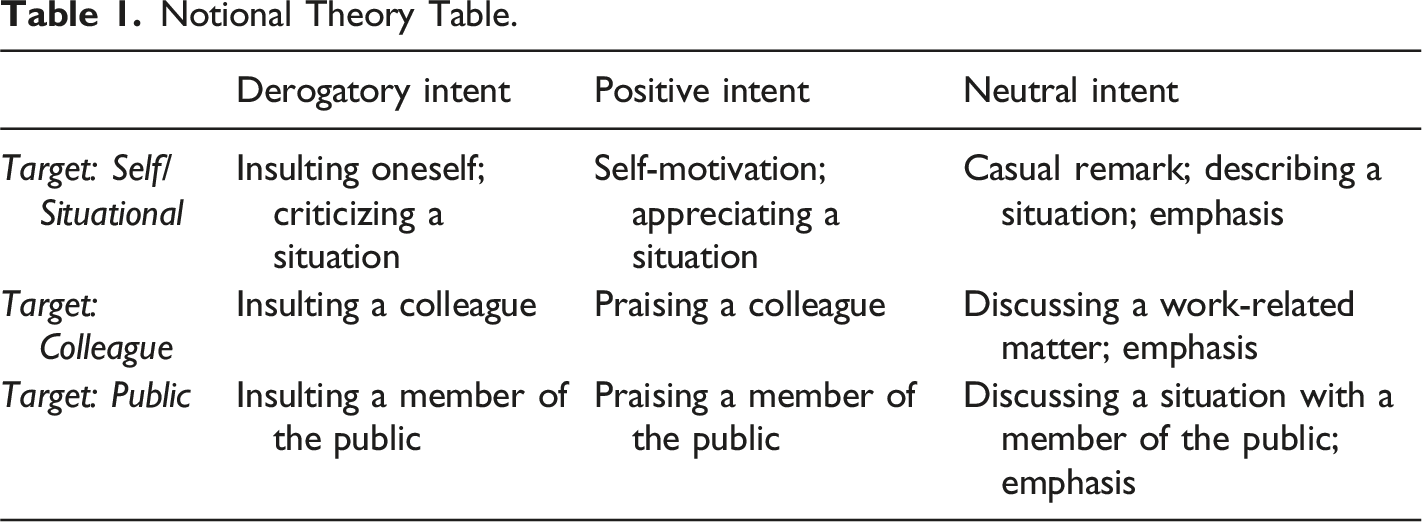
Target Definitions
• • •
Intent Definitions
• • •
Design
The intent and target framework were embedded in a between- and within- subjects survey experiment, systematically varying the target (self/situational, colleague, or public-directed) and intent (derogatory, positive, or negative) of the profanity used in a policing context. Differentiating our approach from recent work (Doyle et al., 2024; Martaindale et al., 2023), we avoid high-profile, risk-laden contexts such as arrests and use of force. Avoidance of these contexts allows us to more confidently attribute effect sizes to our changes in the conditions of interest, rather than the confounding effects of approval/disapproval of arrest or use of force behaviors. Each respondent was randomly exposed to four of the nine conditions available, thus creating both within and between measures. For each condition, respondents were asked to rate the appropriateness, professionalism, impact on public trust, and recommended discipline for the scenario they reviewed using 1-5 Likert-scale ratings. Vignettes followed a prompt that provided consistent background for each scenario presented to respondents: You will be presented with four real situations, although the names have been changed, and asked for your opinion on each situation. Following each scenario, you will be asked your opinion on four brief questions that ask about the appropriateness, professionalism, impact on public trust, and appropriate level of discipline.
Following the above prompt, four (of nine possible) randomly selected vignettes were presented, aligning with factorial survey experiment best practice (Auspurg & Hinz, 2014; Wallander, 2009), and respondents were prompted with questions regarding the outcomes of interest. Random selection also created random ordering of vignettes presented to respondents, making our design robust against question order effects. The vignettes were directly replicated from Adams (2024), where they were developed based on interviews with former and current officers. In this case, the original study functioned as a pilot for these vignettes, and their prior implementation increases confidence that the instrument was clear and free of major issues. General descriptions of each of the nine scenarios are listed in Table 1.
For example, a respondent presented with the combination of Officer Smith had pulled over a speeding car. As he approached the vehicle, he realized they had forgotten his ticket book back at the station. With his words recorded on his body-worn camera, Officer Smith said to himself, “Man, I'm such a fuck-up.” The situation came to the police agency through a random review of body-worn camera footage.
Alternatively, a respondent could be presented with the combination of Officer Smith's partner, Officer Jones, skillfully diffused a potentially volatile situation during a traffic stop. Impressed, Officer Smith, with his words recorded on his body-worn camera, said, “Jones, you handled that fucking brilliantly.” The situation came to the police agency through a random review of body-worn camera footage.
A complete report of all nine vignette combinations is provided in the appendix to this report.
Hypotheses
We test the original hypotheses set out in Adams (2024), as pre-registered 2 and described in detail below, with one exception – we do not use the question “How severe would the disciplinary action be, according to your agency’s policy, for this officer?” as the respondents are members of the public, not law enforcement executives. This question and its related outcomes have no meaning in the context of a public sample.
Profanity simultaneously conveys emotional valence and social positioning. Citizens infer an officer’s motive (intent) and audience (target). Derogatory intent cues dominance and disrespect, activating moral condemnation; positive or neutral intent can signal rapport-building or emotion regulation. Likewise, profanity directed at the public violates politeness and power norms more severely than self- or colleague-directed language, threatening perceived legitimacy. Accordingly, we expect judgments of appropriateness, professionalism, trust impact, and deserved discipline to worsen from self/situation → colleague → public, and from positive/neutral → derogatory intent. All hypotheses replicate those verified in Adams (2024); the current study asks whether the same intent-by-target pattern appears when the evaluators are members of the public rather than police executives.
Perceived Acceptability: “In your opinion, how acceptable was this officer’s use of profanity at work?” Participants responded on a Likert scale from 1 (completely unacceptable) to 5 (completely acceptable). • •
Perceived Professionalism: “In your opinion, how professional was this officer in using profanity at work?” Participants responded on a Likert scale from 1 (completely unprofessional) to 5 (completely professional). • •
Impact on Public Trust: “If made public, how do you think this officer’s use of profanity would affect public trust in the police?” Participants responded on a Likert scale from 1 (greatly reduces public trust) to 5 (greatly enhances public trust). • •
Disciplinary Action: “In your personal opinion, how severe should the disciplinary action be for this officer?” Participants responded on a Likert scale from (1) no sanction, (2) verbal coaching, (3) written warning, (4) significant sanction such as time off, and (5) termination of employment. • •
Sample
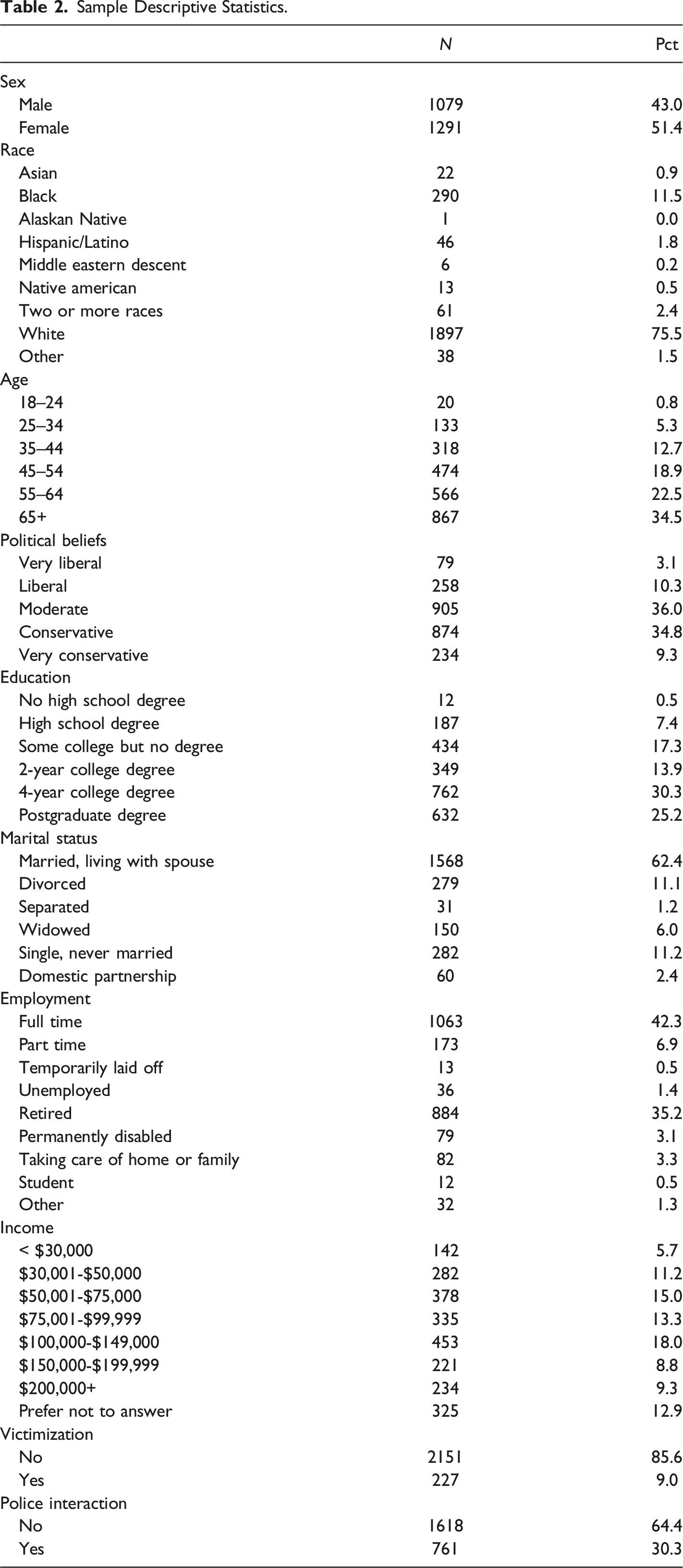
The sample (n = 2412) for this study was drawn from a third-party commercial listserv (Mailers Haven, 2023), comprising 903,570 email addresses of heads of households in South Carolina. Mailers Haven maintains the accuracy of household records through multiple validation checks annually, drawing from the U.S. Postal Service, curated mailing lists, publicly available data, and other sources. Unverified addresses, vacant properties, or addresses on no-contact lists are then removed from the database. From this condensed list, each verified home address list includes a corresponding email address for the head of household, forming the sampling frame.
Prior experimental work has relied on similar distribution lists (Boehme et al., 2024). Surveys were distributed via Qualtrics beginning on August 6, 2024, with periodic email reminders. Data collection concluded on October 17, 2024. This corresponds to a response rate of less than 1% when calculated using AAPOR RR2 standards (AAPOR, 2022). However, beta testing suggested that only approximately 20% of emails reached respondents’ direct inboxes; the remaining 80% were filtered into spam or junk folders. This provides evidence that the effective response rate for delivered emails is likely higher. Despite this adjustment, we cautiously interpret these figures. Among those who accessed the survey, 87% completed it.
The final sample was 51.4% female, 75.5% White, and 11.5% Black. Most respondents identified as politically conservative (44%) or moderate (36%), were 55 years of age or older (57%), held at least a four-year college degree (55%), and were married (62%). Nearly half (49%) were employed, with fewer than 10% reporting a history of victimization by crime and 30% reporting contact with police in the past 12 months.
Balance tests assessing the comparability of groups across experimental conditions, reported in Online Appendix A, indicate no significant differences across covariates, confirming successful randomization via Qualtrics. Chi-square tests and t-tests similarly found no statistically significant imbalances.
While the sample slightly overrepresents White respondents and underrepresents Black respondents compared to state demographics (United States Census Bureau, 2022) it aligns closely with South Carolina’s population in terms of gender and political affiliation. Relative to national demographics, the sample closely mirrors the national proportion of Black respondents and gender distribution. Despite these demographic variations, prior research supports the external validity of online survey techniques (Patten & Perrin, 2015). With a final sample of 2,412, our design is well-powered based on the a priori power analysis. Nonetheless, as detailed in our limitations, we interpret generalizability with caution.
Sample Descriptive Statistics.
Analytic Plan
The independent variables of interest are the experimental conditions: target (self/situation, colleague, public) and intent (neutral, positive, derogatory), creating a 3 x 3 main effects design. Mixed-effects modeling was employed for analysis, due to each respondent’s responses to four randomly selected vignettes. To construct these models, the lmer package (Bates et al., 2015) in R (R Core Team, 2024) was used, and the general form is presented below: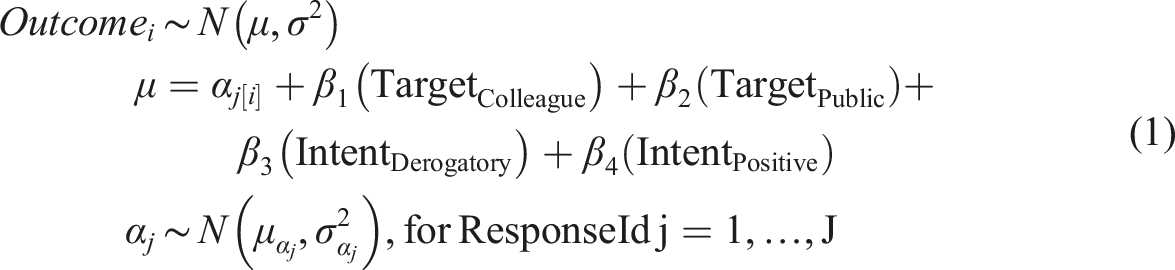
The dependent variable, Outcome{i} for the i th observation, is modeled as following a normal distribution (mean = μ, variance = σ2). The mean is constructed as a combination of predictors, with αj[i] as a random intercept for participant j and observation i, and
The random intercept αj accounts for individual differences among participants and is modeled as following a normal distribution (mean = μ, variance = σ2). Following this main effects-only model, a second model was constructed to include interaction effects between target and intent. This model’s general form is presented below: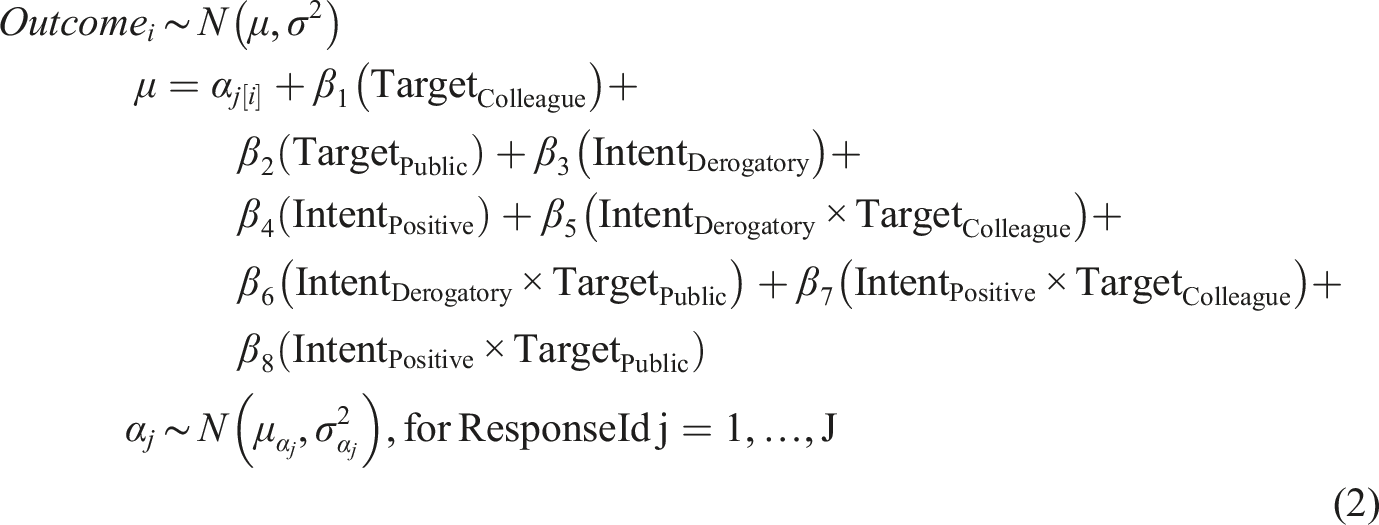
Results
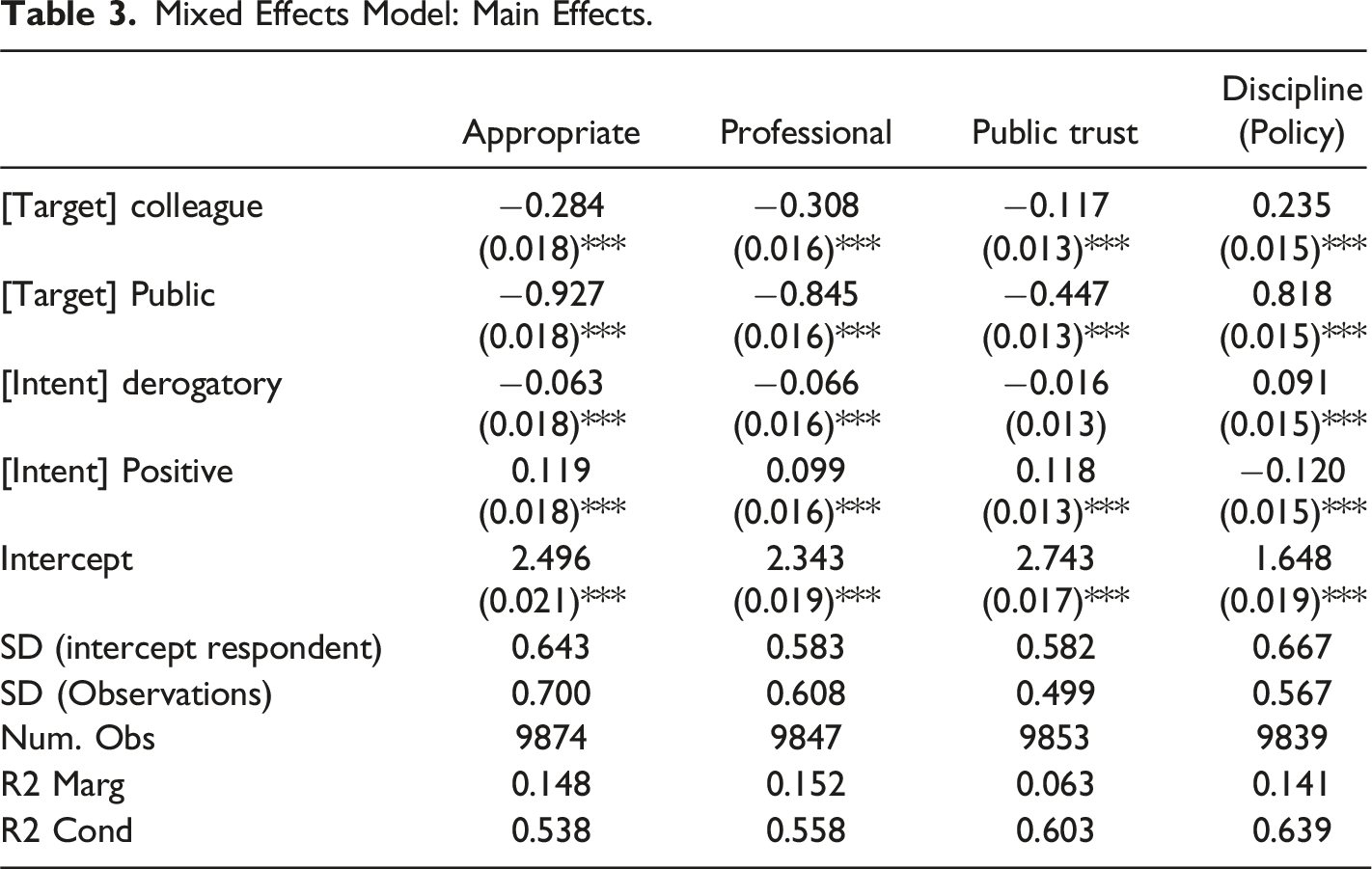
Mixed Effects Model: Main Effects.
Target Effects
The target of profanity significantly influenced all outcomes. When profanity was directed at colleagues, it was perceived as significantly less appropriate (b = −0.284, p < .001), less professional (b = −0.308, p < .001), more harmful to public trust (b = −0.117, p < .001), and deserving of stricter policy-based regulation (b = 0.235, p < .001) compared to profanity directed at the self or situationally. The effects were even more pronounced when profanity was directed at members of the public. In these cases, profanity was perceived as markedly less appropriate (b = −0.927, p < .001), less professional (b = −0.845, p < .001), more harmful to public trust (b = −0.447, p < .001), and deserving of much stricter disciplinary regulation (b = 0.818, p < .001).
Intent Effects
Profanity’s intent also shaped perceptions across most outcomes. When profanity was derogatory, it was viewed as less appropriate (b = −0.063, p < .001), less professional (b = −0.066, p < .001), and deserving of stricter disciplinary action (b = 0.091, p < .001) compared to neutral profanity. Conversely, profanity with positive intent elicited more favorable perceptions. Positive profanity was deemed more appropriate (b = 0.119, p < .001), more professional (b = 0.099, p < .001), beneficial to public trust (b = 0.118, p < .001), and less deserving of disciplinary action (b = −0.120, p < .001) relative to neutral profanity.
Model Performance
The models explain a substantial proportion of variance, with conditional R2 values ranging from 0.538 to 0.639 across outcomes. However, the marginal R2 values, ranging from 0.063 to 0.152, suggest that random effects account for much of the explained variance. This finding aligns with expectations, given the diversity of respondents in a public sample compared to the more homogeneous sample of HR and law enforcement executives analyzed in the original study (Adams, 2024).
Overall, our results highlight the importance of considering both intent and target in the regulation of police profanity. While derogatory or public-directed profanity is perceived as highly inappropriate and deserving of strict sanctions, profanity with positive intent or directed at oneself or a situation garners significantly more favorable evaluations. These findings further validate the nuances of the proposed framework and underscore the necessity of tailoring profanity policies to account for context-specific factors.
Controlled Models
Mixed Effects Model: Main Effects With Controls.
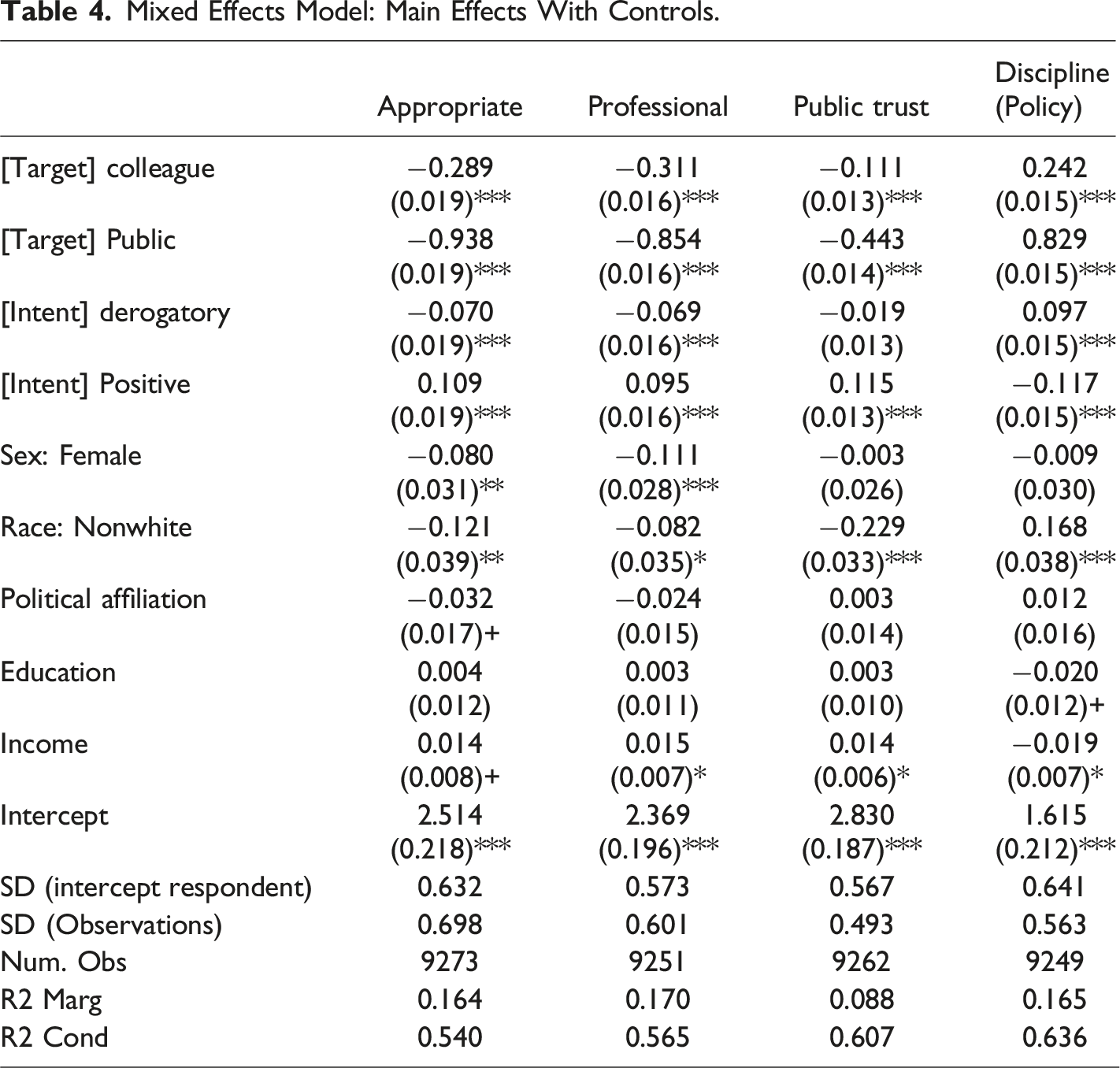
Public perceptions of police legitimacy and levels of support for police are of longstanding scholarly interest (Kochel & Skogan, 2021; Sunshine & Tyler, 2003; Tyler, 2004). We acknowledge this interest through pre-treatment legitimacy measures included in additional controlled models. The inclusion of this additional control did not shift the experimental results (as expected, see Blair et al., 2023), and generally demonstrate that those with high levels of perceived police legitimacy are slightly less damning of police profanity. 4
Interaction Models
Interaction terms allow us to gauge how the effects of profanity’s intent differ across various targets. Main-effects models focus solely on individual predictors, holding all else constant, and thus do not capture how different combinations of intent and target might shape outcomes. To address this gap, we fit a second model that includes an interaction term between these two key variables.
Model fit improved notably with this interaction specification (see Online Appendix C for chi-squared tests). Full results can be found in Online Appendix E, and Figure 1 illustrates the joint effect of target and intent on the four dependent variables. Relative to the main-effects model, these interaction terms help clarify which combinations of profanity intent and target elicit stronger or weaker reactions. Experimental interaction effects of {Target} x {Intent}.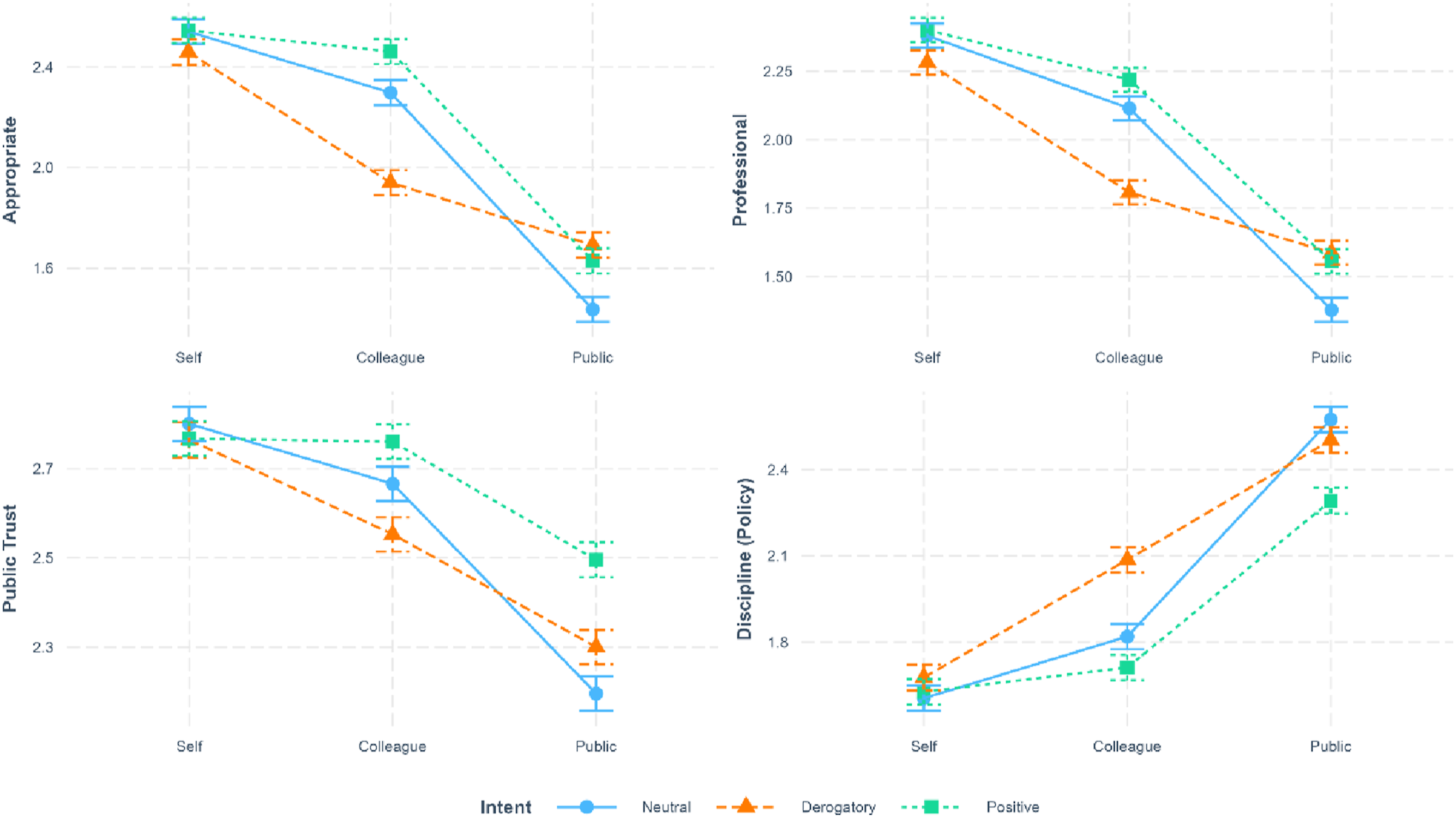
Derogatory intent consistently ranks lower than neutral or positive, and its distance from the others tends to widen when profanity is targeted at colleagues. Self and public targets remained close together at the more acceptable (self-directed) and less acceptable (public-directed) ends of the results. Positive-intended profanity demonstrated a slight mitigating effect on the consistently negative perceptions of public-aimed profanity, as it received more positive perceptions than neutral or derogatory profanity.
These plots indicate that despite the mitigating or aggravating effects that intent may have on target, self/situational-directed profanity holds consistently higher levels of approval across all intents. Further, public-directed profanity does the opposite, as it consistently falls below other targets. Colleague-directed profanity is more nuanced, with derogatory intent drawing farther below positive or neutral intents, countering the clustered results of other targets. These results imply that the public’s sentiments towards public and self-directed profanity are rather straightforward: self-directed profanity is more acceptable, whereas public targeted profanity is unacceptable, and colleague-directed profanity should avoid derogatory intent.
Discussion
The public does not clutch its collective pearls when confronting police profanity, but instead display considered judgment that is sensitive to the target and intent of the profanity in use. Our analysis examined how profanity’s target (self, colleague, or public) and intent (neutral, derogatory, or positive) affect four key outcomes: perceived appropriateness, professionalism, public trust, and the degree of policy-based discipline suggested by respondents.
Adams (2024) is replicated successfully with a new public sample, and we find strong alignment between public and executive judgments on the relative severity of profanity use. Approval varies sharply by intent and target, underscoring the need for context in evaluating police profanity. Clearer distinctions in policy-based discipline across contexts could enhance fairness, reducing perceptions of arbitrary enforcement and strengthening organizational justice (Wolfe & Lawson, 2020; Worden et al., 2024).
While the findings of previous police profanity research argue that profanity use by officers is always wrong and should not be permitted by policy (Doyle et al., 2024; Martaindale et al., 2023), our results show the contextual elements of profanity usage are important, and provide more guidance for assigning punishment than simple usage could. It is vital for policy to recognize contextual nuances to hold officers accountable for more harmful public-directed or derogatorily intended profanity use while also demonstrating leniency in the midst of harmless self-directed or positively intended profanity directed at the self/situation or colleagues. Profanity is not only frequently found across the working world (Baruch et al., 2017; Johnson, 2012), but is considered ordinary and often lacking in meaning (Sausdal, 2020).
Results from this paper’s predecessor indicate that human resource and law enforcement executives are able to recognize the differences in harm between differing profanity use contexts, thus providing evidence of policymakers’ willingness to implement policies that recognize these nuances, as well as their importance for police practice (Adams, 2024). While executives may be more influenced by peer practices than public opinion (Adams, McLean, & Alpert, 2024), they share an interest in maintaining public trust (Sunshine & Tyler, 2003). Our results demonstrate that the public is likewise able to recognize this profanity nuance, showing strikingly similar results in overall approval and discipline desires. This finding suggests that a more nuanced profanity policy may be positively accepted by the public.
The interaction effects revealed in the experiment underscore the pivotal role of context in shaping perceptions of profanity. When directed at the public, respondents largely fail to differentiate between neutral and derogatory intent—both are perceived with similar disapproval. Although profanity with a positive intent receives marginally more lenient reactions, it remains significantly more condemned than profanity aimed at oneself or a colleague. In line with Adams (2024), our replication thus reinforces a broad consensus that officers should avoid using profanity in public-directed contexts. From the perspectives of chiefs, sheriffs, HR executives, and the wider community, such language is considered unprofessional, highlighting the need for policies specifically addressing profanity aimed at the public.
As artificial intelligence becomes increasingly integrated into law enforcement practices, our findings highlight key distinctions that should inform evaluations of officer behavior. For example, Truleo’s body-worn camera analysis software is capable of flagging “impolite language,” characterized as profanity directed at or about a person (Adams, McCrain, et al., 2024; Watts et al., 2024). However, this flag is not treated as definitive; its validity requires verification by a supervisor, highlighting the importance of contextual factors in determining the impact of profanity. As artificial intelligence becomes more prevalent in law enforcement, our results further emphasize that it is not vocabulary alone, but vocabulary and context in tandem, that shape how language is perceived, an element that many large language models still struggle to interpret accurately.
Direct interpretation of our results demonstrates a public indifference towards self-directed profanity, intolerance of public-directed profanity, and a largely intent-dependent opinion on profanity between colleagues. At the least, both Adams (2024) and our results coincide in a clear policy recommendation – derogatory profanity targeting colleagues, and any profanity targeting the public, should be restricted in all but the most exigent circumstances.
While the experimental conditions explain a substantial portion of variance in our models, other elements—such as tone, type of profanity, and the overall circumstances—allow leeway for executive discretion in evaluating police profanity. Adopting a policy that distinguishes among various intents and targets of profanity is a meaningful first step, but its implementation must be handled judiciously. This careful approach ensures room for individualized review of each incident’s broader context. In doing so, agencies can maintain both positive public perceptions and internal trust in the fairness of disciplinary practices.
Limitations and Future Research
Our methodology is vastly similar to that of “Fuck: The Police,” and to a great degree its limitations are ours. While revered one of the six worst words in the English language by some (Mohr, 2013), and the worst of the worst by others (Fairman, 2006; Read, 1934), “fuck” is only one word out of a long list of profanities to choose from. This intuitively narrows the scope of the analysis, but due to the complex nature of language, using the most extreme example allows our findings to represent the worst possible result. However, it is plausible that different profanities or different conjugations of “fuck” may yield differing perceptions in both the public and law enforcement executives. Future research that expands the profanity framework to other expletives will be able to provide a wider picture of profanity perceptions in police practice.
Amongst the profanity framework originally proposed by Adams (2024) lie intensity and form, which refer to the emotions or situations described by the profanity, and the specific conjugation or linguistic structure of the words used. These have not been addressed in either study, not because they are unimportant, but because of the difficulty in operationalizing them experimentally. Defining a profanity’s intensity is difficult to represent in a text-based survey, and there are far too many conjugations of the word “fuck” to causally identify which ones have more adverse effects than others. For example, Adams (2024, Table 1) lists fifty “fucks in use” in his original study, prompting the question (p. 12) “if every ‘motherfucker’ could be good, bad, or indifferent, how can we hope to regulate it?” Future research can continue to operationalize more contextual factors to further explain the variation in perceptions of profanity.
A related key constraint of this study is its reliance on text-only scenarios, giving some pause in considering its ecological validity. Real-world perceptions of profanity often hinge on tone, volume, and inflection. Consider the difference between an officer quietly whispering, “What’s up motherfucker?” to a colleague at a briefing versus forcefully shouting it across the room while showing visible aggression. Although the sentence remains unchanged, the circumstances (and likely policy implications) differ substantially. Future research should follow the example of Doyle et al. (2024), which included audio in its replication of Martaindale et al. (2023). Incorporating auditory and other contextual cues would clarify how these additional factors shape reviewer perceptions, to uncover the unique properties that might be salient to policy review and public reaction.
Although our survey structure included binary measures of police contact and victimization in the past year, consistent with previous police-public survey work (Boehme et al., 2023, 2024), we did not include follow-up questions about perceptions associated with these experiences. Capturing this nuance may have further contextualized our analyses, as prior experiences and perceptions of police can shape perceptions of police behavior (Sunshine & Tyler, 2003). However, our survey did measure constructs such as trust in police, perceived procedural justice, and willingness to obey, which were included in controlled models that yielded substantively similar results. We did not measure participants’ own profanity use, leaving open whether personal swearing norms condition reactions, which reamins an important avenue for future work, though random assignment ensures this omission does not bias the reported treatment effects. Further, the randomization of vignette conditions distributed to respondents in tandem with our sample size increases our confidence that unmeasured variation in prior perceptions of police is randomly distributed across conditions, thus limiting the risk of systematic biases in our results. 5
This study uses a sample from the state of South Carolina. While American English serves as a common linguistic foundation across the United States, regional accents, slang, and cultural norms shape distinct vernaculars that may influence perceptions of language use. While it may be less plausible that a sample of North Dakotans would strongly approve of derogatory police profanity aimed at members of the public, mindfulness of the culture and language norms of the sample location is vital for proper generalization of our results. Consequently, careful attention to the cultural and linguistic context of South Carolina is crucial for interpreting these findings. While representative of South Carolina’s population in aspects such as race and political affiliation, our sample is slightly older and more educated than the greater South Carolina public (United States Census Bureau, 2022). These discrepancies should be considered when generalizing results to younger age groups or individuals with less formal education. Although aspects of our sample, such as sex and the representation of Black respondents, align with broader U.S. demographics, these results are most readily generalizable to South Carolina. Extrapolation to other states, the national population, or international contexts should be approached with caution. Addressing this limitation will require future research using random, representative samples from the populations of interest.
Conclusion
The flip side of transparency is exposure, and policing is often tasked with balancing these priorities. The distribution of risk is never neutral: with a tendency towards increasing transparency in policing, policy must distinguish between language that undermines public trust and language that does not. Overly restrictive policies risk alienating officers and reducing operational effectiveness, while insufficient regulation can further erode public confidence.
Our results extended prior work on police chiefs, sheriffs, and human resources chief executives to the general public. Beat-for-beat, our results map onto Adams (2024). The extreme similarities in magnitude and direction of effects in both studies provide convincing evidence in favor of a generally accepted practice aimed at constraining the worst excesses of profanity, while recognizing the shared human love of an appropriately placed “fuck.” The results shared across Adams (2024) and here demonstrate that both policing and HR executive and the public all agree that profanity cannot be judged in a vacuum.
Neither ignoring profanity, nor blanket bans on its use are realistic or effective, and in the event of their strict enforcement, camaraderie-building profanity and derogatory profanity are subject to the same punishments. Profanity alone does not cause harm (Jay, 2009), rather, the contextual factors surrounding profanity largely dictate its positive or negative interpretation. Through the consensus demonstrated by law enforcement executives and members of the public, these contextual factors can be accounted for, and profanity policy can be tailored effectively, without undue costs to public trust.
Supplemental Material
Supplemental Material - Fuck: Public Opinion
Supplemental Material for Fuck: Public Opinion by Ian T. Adams, Marc Olson, Lois James, Brandon Tregle, Hunter M. Boehme in Police Quarterly.
Footnotes
Author Note
Ian Adams thanks Annette Gibert for her relentless support, tolerance for profanity, and initial encouragement to pursue this line of research.
The first and second authors contributed equally to this work. Both authors have the right to list themselves as the first author on their respective CVs.
Declaration of Conflicting Interests
The author(s) declared no potential conflicts of interest with respect to the research, authorship, and/or publication of this article.
Funding
The author(s) received no financial support for the research, authorship, and/or publication of this article.

Supplemental Material
Supplemental material for this article is available online.
Notes
Author Biographies
References
Supplementary Material
Please find the following supplemental material available below.
For Open Access articles published under a Creative Commons License, all supplemental material carries the same license as the article it is associated with.
For non-Open Access articles published, all supplemental material carries a non-exclusive license, and permission requests for re-use of supplemental material or any part of supplemental material shall be sent directly to the copyright owner as specified in the copyright notice associated with the article.
