




Abstract
This article proposes multilevel modelling to account for individuals’ contexts when predicting police confidence. It uses the case study of Brazil considering 107 cities from 25 states to assess four evidence and literature-based predictors impacting police confidence measures in the country. The article found that being a crime victim, experiencing police corruption and having low interpersonal trust were negatively and significantly associated with confidence in the police. Levels of variance between individuals grouped by cities and states were a considerable explanatory feature of police confidence. The implications of these results are discussed in relation to police governance.
Introduction
Recent policing studies discuss the idea that institutional confidence decreases as individuals experience corruption, become victims of crime, feel insecure in their neighbourhoods and their social cohesion deteriorates (Bradford, 2011; Sindall et al., 2012; Worden and McLean, 2017). What tends to be omitted, however, is the underlying premise that citizens live in different social contexts, and therefore, no measure of police confidence can be considered the same across different groups and levels of human association. Contrasting mono-level theories using single-grouping techniques, the article claims instead that measuring police confidence requires contextualization of the many levels of societal organization possible (i.e. families, schools, neighbourhoods, districts, provinces, states, nations, regions and so on). The article uses multilevel modelling for data grouped in more than one category to explore such an idea. It argues that police confidence is multilevel, and thus, we should use matching theories and techniques for our analysis.
The article lays out the case study of Brazil to predict individual expectations on the police across 107 municipalities (cities) from 25 states. In performing the analysis, the article discusses four literature-based predictors impacting police confidence measures: whether individuals were a victim of crime, whether they had been exposed to police bribery, whether they believed their neighbourhood was unsafe and whether they self-reported poor interpersonal trust. The modelling results were demonstrated using level-1 (individual), level-2 (cities) and level-3 (states) sample sizes. Results suggested a negative and statistically significant relationship among police confidence and being a crime victim, having experienced police corruption through bribery and having low interpersonal trust with neighbours. Feeling insecure in their place of residence did not show to affect the outcome measure. The multilevel modelling outputs indicated that variance between individuals grouped by cities and states was a relevant explanatory feature of police confidence; however, it supported the idea that a greater share of the outcome variance remains at the individual level.
The article is structured as follows. The first section reviews multilevel modelling and the literature on police confidence. The second section presents the case of Brazil and the predictive relationships hypothesized. The third section introduces data taken from the 2019 round of the AmericasBarometer and describes estimation in multilevel modelling. The fourth section offers a summary of the results. The final section concludes by commenting on the broader methodological and practical considerations of this research. Across the article, I refer to my statistical technique as multilevel ‘mixed’ (that is, the presence of fixed and random effects) modelling. Often it is also named random coefficient modelling, empirical Bayes estimation or hierarchical linear modelling.
A multilevel method for a multilevel problem
Multilevel methods have consolidated in crime and policing studies thanks to new data analysis software and the growing understanding of complex social relations through re-establishing plausible lines of reasoning, taking induction from examples or deduction from principles, that link upper-level groups to lower sub-units (Garson, 2019: 1). Multilevel modelling techniques have become, for example, a unique way to circumvent ecological and atomistic fallacies (Robson and Pevalin, 2016). The former assumes that relationships observed in groups can be misleadingly extrapolated for individuals. The latter supposes that deductions about groups can be made from individual-level data. An array of empirical shortcomings in quantitative inquiry have been dealt with multilevel analysis, including mistaken conceptualization and measurements, data collection and issues with generalizability (Kleinnijenhuis, 2016). The simplest argument is that for multilevel measures subdivided into hierarchical clusters, we need to study the effects that vary by contextual groups, that is, by estimating group level averages.
It is found across the literature that multilevel data analysis must follow multilevel theories, an area that seems blurred when grouping characteristics are not defined. We require a clear decision about group membership and theoretical assumptions expected for individuals to project different outcomes influenced by certain aspects of their context (Hox et al., 2018). In the criminological literature, a practical example of multilevel questioning is Sampson and Groves (1989), who sought to explain the link between-community social disorganization and its correlation with high crime and delinquency rates. The authors used two different samples of residents living in hundreds of communities in Great Britain to prove whether between-community variations in social disorganization transmitted much of the effect of community structural characteristics (low economic status, ethnic heterogeneity, residential mobility and family disruption) on rates of victimization and offending.
The multilevel focus of this article adds to these methodological advances focussing on individual and community linkages and attitudes towards the police. For example, Faulkner and Burnett (2018) argued that police’s popularity and levels of confidence with the overall criminal justice reflected on communal feelings frequently seen at the national level to propose crime prevention and reduction strategies. Public authorities often use police confidence as a sole national indicator to prescribe major reforms to law enforcement. Various elements of such an understanding are questionable. Nations worldwide employ different policing levels from federal to municipal forces (i.e. Argentina, Brazil, Canada or the United States), resulting in ad-hoc relationships between police and the social groups they serve. Also, and in countries with a sole, unified police force (i.e. Chile, Scotland or Sweden), or those with a single level of police forces across multiple geographies (i.e. United Kingdom or Australia), community-police relationships remain non-uniform and vary greatly in all levels of social organization, for example, across large and small cities, and between urban and rural locations. As well, with the consolidation of ‘plural’ (Loader, 2000), and the recent reconceptualization of ‘private’ (White, 2020) features of policing across the globe, several interrelated ‘policing’ actors are now influencing the reciprocal relationships between individuals and those that ‘police’ daily life at the various societal level. We are thus in the presence of theoretical and empirical arguments suggesting potential misinterpretations of police confidence (whether for social analysis or policymaking) based on monolovel aggregated data.
Modelling police confidence
The magnitude of quantitative studies using monolovel samples to explain collective confidence in the police has kept expanding. For example, Holland and co-authors (1983) explored the relationship between fear of crime and police confidence in Phoenix, Arizona. This single-level study found that trust in the police reduced fear among the elderly; meanwhile, Whites had significantly more confidence in the police than non-Whites. Although scholars have emphasized on dissecting measures of police confidence (i.e. by including individual-level and contextual variables), these efforts have not resulted in the disaggregation of multilevel data for analysis. Worral (1999), for example, gathered national data from citizens in the United States revealing that support for local police is dependent to perceived ratings of efficacy and image. In another study of people living in Accra, Ghana, (Tankebe, 2010) found that satisfaction with police reform measures explained institutional confidence but that personal experiences of police corruption did not do so. Sindall et al. (2012) used aggregate population data from the British Crime Survey to argue that trust in the police was not related to worries about crime and perceptions of social cohesion, nor informal social control, but crime perceptions and the property crime rate. Ways to enhance public opinion on the police seem much harder to obtain than ways to damage public opinion. Myhill and Bradford (2012), for example, argued that negative pre-existing opinions of the police predicted negatively received contact, while positive views did not predict well-received contact according to monolovel findings from two surveys on contact between the public and the police conducted in England and Wales. On a similar vein, Malone and Dammert (2020) studied measures of trust and police effectiveness in 17 Latin American countries, confirming that community-oriented policing practices tended to garner more public trust across the sample.
Although this literature is conducive to further hypothesis-testing, the potential drawback is that single-level regression analysis typically results in estimates of averaged regression coefficients that hold equally for each city, each nation and so on. With multilevel regression analysis, we can model the variation of regression coefficients between different nations, different cities, different municipalities and different citizens, on top of the estimation of averaged (or fixed) effects (Kleinnijenhuis, 2016), that is, which citizens in which municipalities within which nations are more likely to have confidence in the police.
Examples of multilevel regression modelling of dependent variables that are defined at the lowest level (the individual) include Cao et al. (2012) using hierarchical data (respondents grouped in countries) to test whether regime nature explained variations in public confidence in the police. Authors found that residents in long-term stable authoritarian regimes and long-term stable democracies display elevated confidence levels in the police. In contrast, short-term or unstable authoritarian nations and nations in democratic transition have the lowest level of trust. Confidence in the police was higher among citizens in nations with more government efficiency and was lower among residents of countries with higher homicide rates. Comparably, Choi and Kruis (2021) explained police confidence variation across different countries (84 nations with a total sample size of 122,330 respondents). Using hierarchical generalized linear modelling (HGLM), logistic regression results showed that three proxies of social integration (homicide rates, group grievance and suicide rates) were negatively and significantly associated with confidence in the police. On a similar note, but this time looking at the perception of national crime, Mohan et al. (2011) used multivariate multilevel models with data from the British Crime Survey to conclude that a person’s socio-demographic background and their newspaper readership had the strongest association with perceptions of national trends, while the strongest association with pessimistic views on localized crime was whether the individual had been a recent crime victim. Finally, Wheeler et al. (2020) used multilevel regression models to estimate the effect of local violent crimes on attitudes towards police, controlling for other individual and neighbourhood level characteristics. Their results showed that local counts of violent crime predicted attitudes towards police considering both race and age factors.
The case of Brazil
Figure 1 displays the mean police confidence for individuals living in a sample of Brazilian cities and states. The figure shows considerable variability from city to city on attitudes towards the police. Municipalities like Duque de Caxias and Salvador appear to have lower police confidence, whereas Fortaleza has a greater mean score. Evidence of state variability suggests that police confidence is lower in Rio de Janeiro and considerably higher in Amapa. Police confidence in a sample of Brazilian cities and states.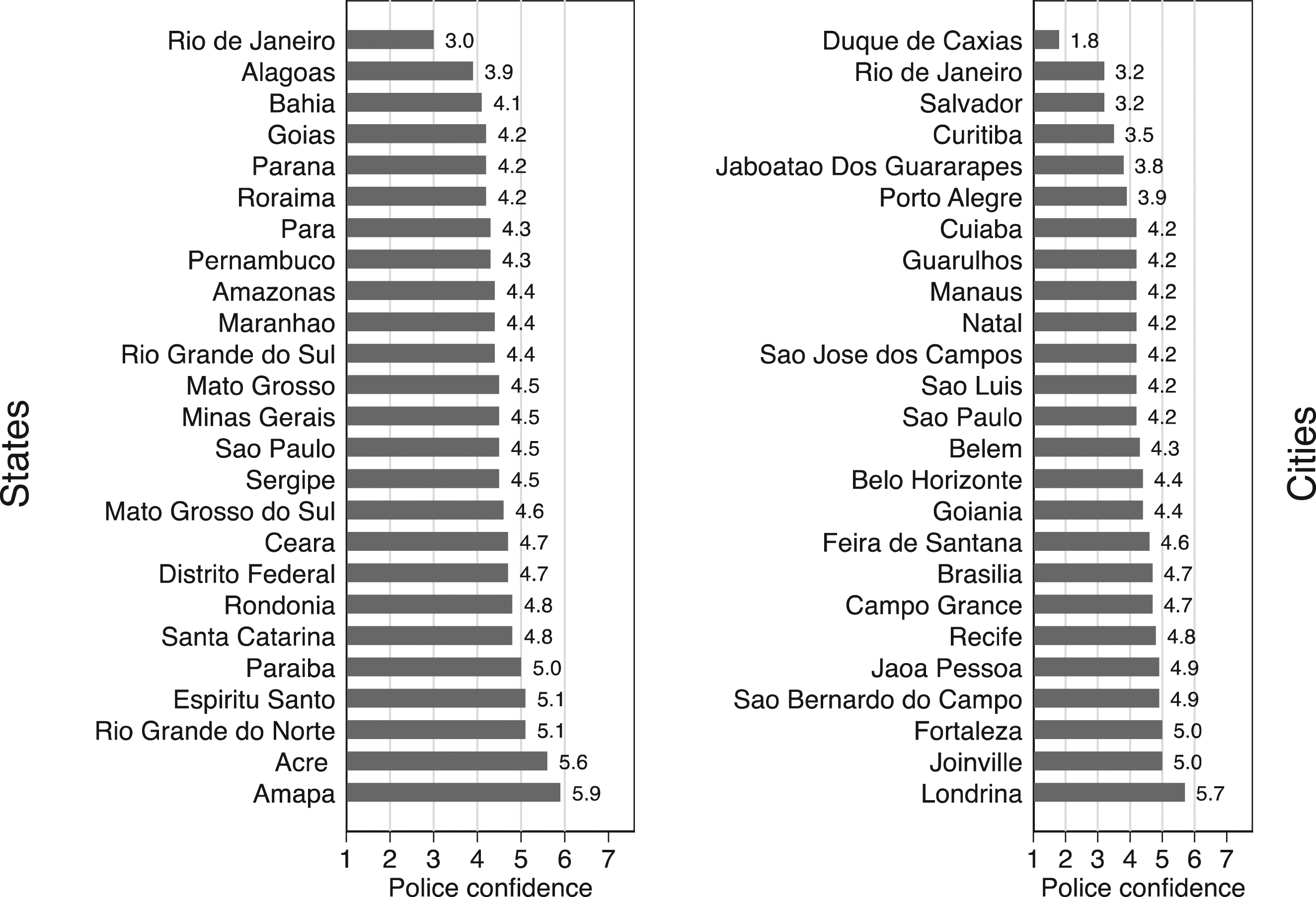
I theorize that the relationship between individuals and their surroundings, in this case, individuals’ confidence in the police, will be influenced by given features of their cities and states. Observations close in space are more similar than observations far apart; thus, individuals from the same city and state will be more similar than respondents from different cities and states due to shared experiences, history and living conditions.
Multilevel modelling proposes an identifier variable, that is, a level variable that categorizes each level of the model except the first. My methodology thus follows the current governance of policing in Brazil, which happens to be disaggregated at the national level by the federal police, at the state level by the military and civil police forces and at the city level by municipal police. The aim is to account for variance in the dependent variable (police confidence) measured at the lowest level (the individual), assessing information from different levels. Since I argue that there are up to three levels in my proposed modelling (individuals, cities and states), it was reasonable to hypothesize four premises for the Brazilian case that should shed light on such an expected variance across levels: H
1
: Crime victimization decreases police confidence. H
2
: Experiences of police corruption decrease police confidence. H
3
: Perceptions of neighbourhood insecurity decrease police confidence. H
4
: Low self-perceived interpersonal trust decreases police confidence.
For H 1 , being a crime victim, I found evidence suggesting that Brazil’s overall failure to protect society and offer justice to crime victims has affected public opinion in the police (Caldeira, 2002; Malone and Dammert, 2020; Muggah and Carvalho, 2018). Brazil is acutely marked by inequalities in living conditions and ineffective public services, including criminal justice and law enforcement at different levels in its 26 states and its federal district. Although for individuals living in some cities, the scenario is changing, for example, deaths related to homicides have dropped considerably since the 1990s, making life radically safer for its inhabitants in Florianopolis and São Paulo; in several others, there is a sustained upward spike of violence and rampant criminality, such as in San Salvador and Rio de Janeiro. Policing has been associated with the presence of gangs, economic informality and weak state institutions. In many cities and states, the police collude with criminals and are responsible for turning a blind eye to many civilian injustices that usually do not investigate.
In the case of H 2 , police corruption, the current crisis of democratic governance in recent years fuelled by the greatest political corruption scandal seen in Brazilian history (the Lava Jato investigation) has rested credibility and public trust in the judiciary, and most notably, in the authorities’ accountability and efficiency to provide public services (Katz, 2018). Brazil’s questionable policing often portrays an iron-fist militarization and marginalization of urban spaces, which underlines systemic racial bias and the use of unrestrained lethal force in impoverished states and across major urban municipalities. The lackluster governance conditions have exposed the lasting effects of post-authoritarian law enforcement: the politicization of the forces, the construction of internal enemies and the absence of strong democratic controls. Overall, policing malpractices, such as a deep-rooted bribery culture, have diminished individuals’ confidence in the police at most levels (Wolff, 2017).
For H 3 , neighbourhood insecurity, I found evidence to argue that individuals living in different communities in Brazil share spaces with heavily armed gang members resisting police’s ongoing incursions; meanwhile, the poorest communities got trapped in shut down densely populated favelas. Studies conducted elsewhere suggested that neighbourhood context influenced police confidence measuring local disorder and social cohesion affected citizens’ confidence in the police (see Kwak and McNeeley, 2019). Similarly, Lee et al. (2020) observed that in several areas of north-western states in the United States, social cohesion portrayed as residential stability (e.g. residents who own homes or have stayed longer in the community) had statistically significant and effects to residents’ assessments of police trustworthiness compared to those who rented or were newcomers.
Recent studies in Brazil have shown that local crime affects people’s trust in the police (Sampaio et al., 2019). Perceptions of risk and safety across the population have had different outcomes across the country (Rodrigues, 2006). In some Brazilian cities, scholars would add that some of the most worrying criminal activity is the violence perpetrated by police officers and their close circle of co-conspirators upon regular citizens (French, 2013). Against this background, police violence has contributed to neighbourhood insecurity perceptions, where people are falsely arrested and abused by police officers, making Brazilians fear both crime and the police (Ceccato and Ceccato, 2017)
Finally, to support H 4 , interpersonal trust, I found evidence suggesting that Brazilian policing is ridden by severe abuses of corporate privileges, disrespect for civil rights and high victimization of the working-class people. Political partisanship in the judicial and policing policy sectors and weak democratic participation have become the norm, making individuals distrust not only the authority but also interpersonal trust has decreased. A succession of national events, including the impeachment of left-wing president Dilma Rousseff, the succeeding interim right-wing government of Michel Temer, and the ascent of far-right Jair Bolsonaro, triggered a climate of deep political and social instability cascading through and across societal organizations which have impacted citizenship, democratic participation and personal relations (Koster, 2014). Scholars argue that citizens in Latin America have a ‘constrained citizenship’ that curtails social interactions and trust-based relationships due to the lack of security necessary to engage in ‘everyday political, economic and social activities that are constitutive of citizenship’ (González, 2017: 495). Particularly for Brazil, the new rightists order has regressed human rights provision, civil liberties and how citizens relate one to another (Goldstein, 2019). There is serious doubt on the public authorities’ willingness to provide, anytime soon, greater respect for human lives in some of the most crime-ridden social spaces (Garmany, 2014).
Data set and model
I analysed a subsample of data from the 2019 AmericasBarometer by the Latin American Opinion Project (LAPOP), which polled 1498 voting-age Brazilian adults on public experiences with democratic governance. The survey used a complex sample design, including stratification and clustering for national-level representation with respondents from 107 municipalities in 25 Brazilian states 1 (AmericasBarometer, 2019).
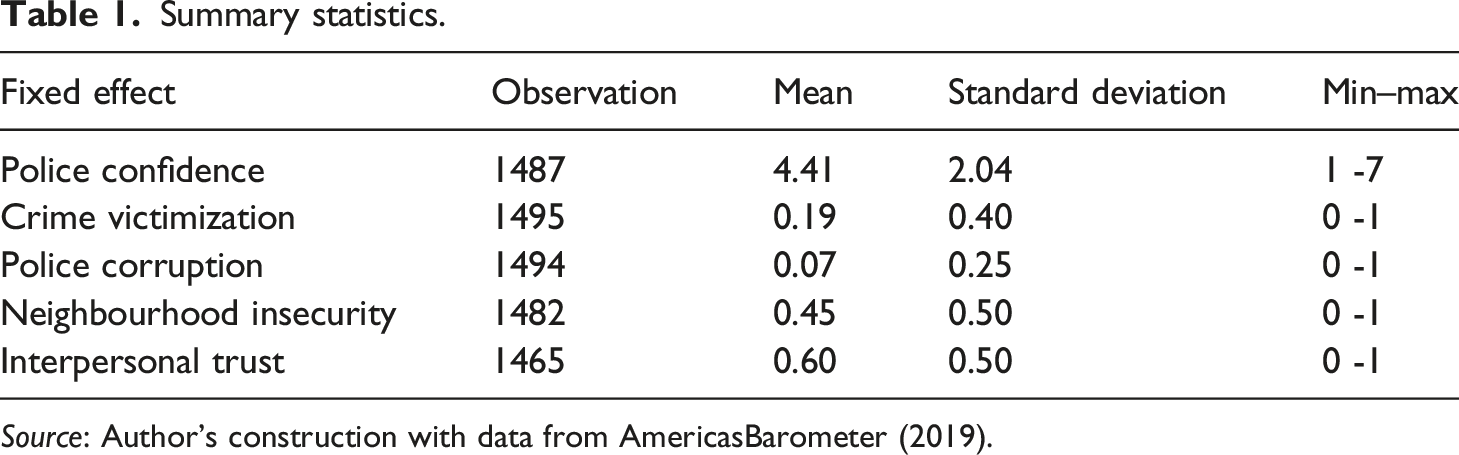
Summary statistics.
Source: Author’s construction with data from AmericasBarometer (2019).
The main difference with classical regression is that multilevel modelling can be used for a variety of improved purposes, most notably, prediction, data reduction and causal inference (Gelman, 2006). This article benefited from the strengths of multilevel modelling through an example of prediction. I present two and three-level random intercept models 3 using individual police confidence scores at level-1 and clustered by city at level-2 grouped by states at level-3. In other words, the model is testing whether the predictors have a linear effect on police confidence, adjusting for the grouping effect at level-2 and level-3. The regression allowed for intercept models to predict mean values of the dependent variable, including both fixed effects and random effects. Rather than centring predictor variables, I used raw values as found in the sample since zero was a value in the data.
Because I used a continuous measure for the outcome variable, I used the Stata 
It is commonly assumed that a one-level model would be just standard OLS regression. However, a standard regression analysis violates the linear model assumption of independence (or lack of correlation) of the residuals. Using multilevel modelling accounts for observations being interdependent; in other words, ‘participants nested in the same cluster are more likely to function in the same way than participants nested in different clusters’ (Sommet and Morselli, 2017: 206). In this article, for example, there might be some municipalities in which the police are trusted and others in which the police are loathed. Multilevel modelling notably aims to disentangle the within-cluster effects (i.e. the extent to which some participant characteristics are associated with confidence in the police) from the between-cluster effects (i.e. the extent to which some municipality characteristics are related to trusting the police).
It was implicit that the models could be expanded in many ways, for example, by adding extra predictor variables at the individual and city levels. In this opportunity, I kept the level-2 and level-3 free of any extra predictor variables. The multilevel models used maximum likelihood estimation (ML).
Results
My results begin with summary information about the model and the data. The model had 1367 respondents (level-1 units) grouped in 107 municipalities (level-2 units) and 25 states (level-3). The size of level-2 varied from 8 to 66 observations per group, and level-3 from 12 to 216 observations, meaning this was an unbalanced design. 4
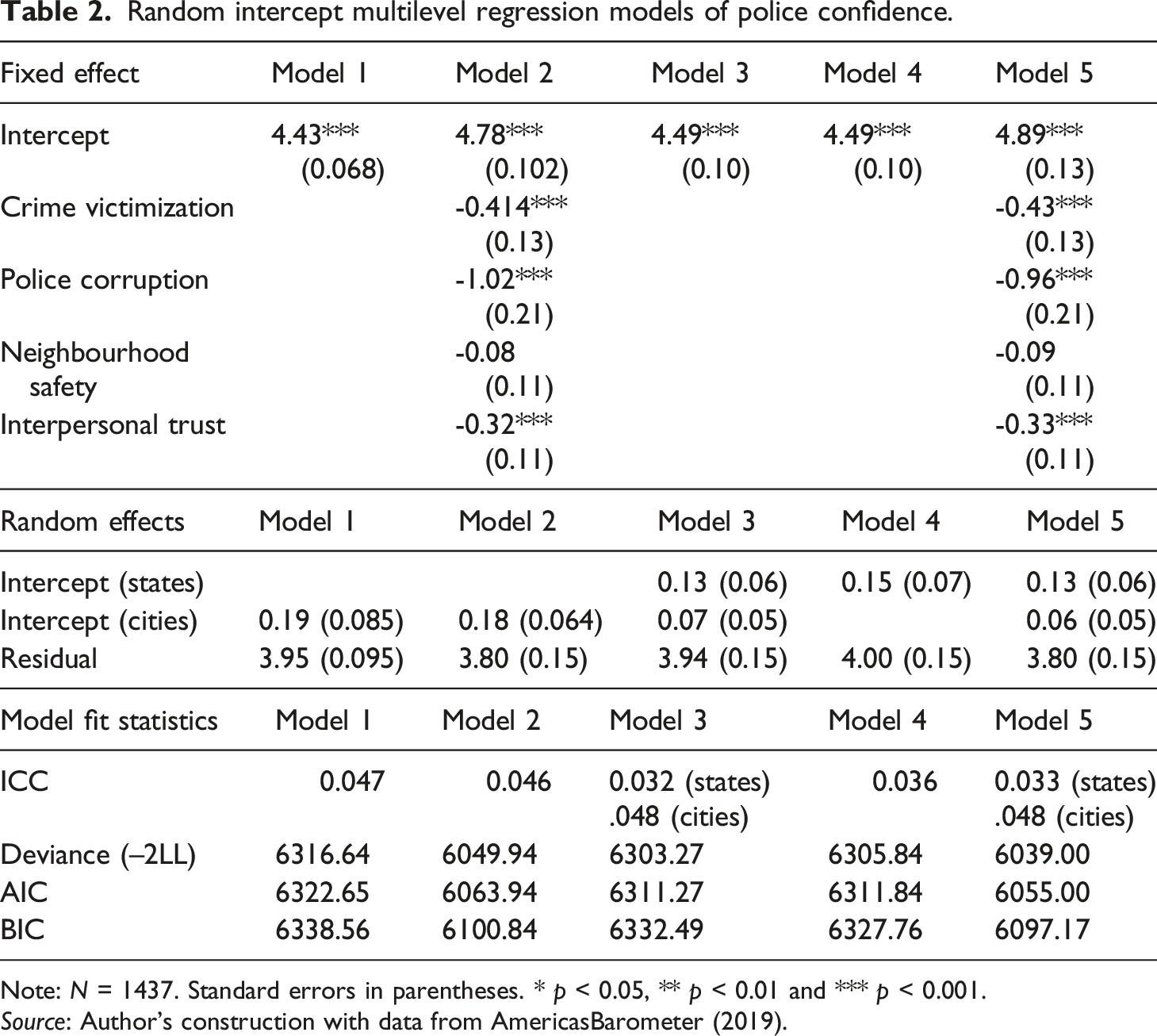
Random intercept multilevel regression models of police confidence.
Note: N = 1437. Standard errors in parentheses. * p < 0.05, ** p < 0.01 and *** p < 0.001.
Source: Author’s construction with data from AmericasBarometer (2019).
Model 2 introduced the four independent variables measured at the individual level: crime victimization, police corruption, neighbourhood security and interpersonal trust. The fixed effects coefficients were the average effects of the entire sample of municipalities. The model revealed that experiencing police corruption, being a crime victim and having poor interpersonal trust were significant predictors of individual-level police confidence. The estimated b coefficients can be read the same as in linear regression. For instance, being a victim of police corruption is associated with a 1.02-point decrease in individual-level police trust. Also, poor interpersonal trust meant less police confidence. All significant fixed effects were better than the 0.05 level. The fixed effects intercept of 4.78 was the expected value of police confidence when the predictors’ values were all 0; that was a 0.35 increase from the null model 1. In the random effects part of the model, adding level-1 independent variables reduced variance and the total variance of the model. Adding the predictors to model 2 resulted in a decrease in the city level variance of just 5% (changing from 0.19 to 0.18). The individual-level variance had a decrease of just 4%. This suggested that the distribution of the predictors varied across cities. Scholars usually use this information to help decide either to add more variables to the model or, conversely, to stop adding variables at a particular level (Luke, 2011). The ICC for model 2 was 0.046, meaning that by adding the predictors, the model reduced the amount of explained variance due to differences between cities. The relatively large variance components for level-1 and level-2 (all greater than zero) suggested we might consider adding more predictors to the model in future research as there might be potentially substantial un-modelled variability.
Because cities were nested within states, in model 3, I fitted a three-level mixed model with random intercepts at both the region and the city-within-state levels. The model computed three variance components (states, cities and plus residual), two being the random effects equations. The first is a random intercept (constant only) at the state level (level-3), and the second is a random intercept at the city level (level-2). The random effects component of the multilevel model reported between-group effects, such as the effect of the identifier defining level-2 and level-3 groups. What is not explained is reflected in the residual variance component, which represents the within-group effect – unexplained variance in the DV not accounted for by other effects in the model (Luke, 2011).
Model 3 revealed how much variance in the dependent variable was explained at each level, first at the state level (level-3) was 3%, second at the municipality-city level (level-2) 5% and, finally, at the individual level (level-1) of 95%. Models 4 and 5 mixed level-2 and level-3 identifiers in different ways. Model 4, for example, was a null model using states as level-2 identifiers. Here the ICC value was reduced slightly to 0.36, meaning the variance in the dependent variable was explained to 4%. Model 5, on the other hand, included both level-2 (cities) and level-3 (states) identifiers with the explanatory variables at level-1 (individual). The multilevel model with cities clustered by states was significantly different from the corresponding (monolovel) OLS regression, with a positive chi-square value (27.43), meaning the multilevel model displayed less error and a better fit than the OLS model. In this case, the ICC values from the model were almost exactly as those reported in model 3. In the three-level models computed (models 2 and 5), both fixed and random effects differed slightly in their b estimates and standard errors.
Finally, I assessed the measures of deviance (i.e. how closely the model fitted the data) by transforming the natural log-likelihood of each model and by reporting at the Akaike information criterion (AIC) and Bayesian information criterion (BIC) values to compare one model to another. As with the deviance, lower AIC or BIC indicated a better fit. Examination of the values confirmed model 5 as the best model.
Conclusion
In line with crime and policing studies in Brazil, the article found that individual experiences and the context of individuals affect police confidence at city and state levels (Light et al., 2015; Rodrigues, 2006). The article reinforced previous studies evidencing the multi-layered geography of social attitudes towards the police (Vargas and Alves, 2010) by methodologically examining how to account for multilevel variance in predicting trust towards the police. While other scholars have shown that police’s interventions vary across Brazilian states (Riccio et al., 2013) and municipalities/cities (Wolff, 2017), this article has captured the variance existing between individuals grouped at city and state levels across the country and their cynicism towards the police. I found that being a crime victim decreased police confidence, experiences of police corruption decreased police confidence and poor interpersonal trust decreased police confidence. The multilevel modelling output supported the idea that a larger share of the variance remains at the individual level compared to city and state groupings.
Methodologically, the use of multilevel modelling showed a range of advantages for policing scholars and practitioners less familiar with this simple yet all-around analytical technique which can be easily put to the test across different disciplines/audiences. While it is not necessary to talk about every output that came after the regression modelling, multilevel models are well-suited to explain the strength of coefficients as well as the direction and significance of added predictor variables and how they add to hypotheses and previous research. For the particularities of the Brazilian case study, it was worth highlighting the model-to-model change in ICC and the statistical evidence suggesting that improvements were made to the model. For example, the null models showed differences between cities and states, suggesting variance in police confidence scores. It was, therefore, appropriate to follow on with multilevel modelling to capture level-2 and level-3 variance. As suggested by previous literature, once I added the predictor variables at the individual level, the negatively associated scores to police confidence were consistent with the ample literature on the topic.
Brazil is going through significant political and social discontent, putting policing and the overall criminal justice system under tremendous strain. For practical purposes, the article showed that police trust, or its lack, is associated with other factors producing restlessness in the emerging and industrialized democracies affecting the relationships between citizens, the state and democracy. Institutional distrust is pulling citizens away from new attitudes of political participation. Although citizen’s police satisfaction and accountability mechanisms have been under constant reform, recent developments under the governments of Fernando Henrique Cardoso, Luiz Inácio Lula da Silva and Dilma Rousseff aimed at addressing crime, poor policing and ineffective penal responses have watered down. Public authorities have relied on revamping police performance by promising the public more federal bureaucracy resources and managing intergovernmental relations with states and municipalities, hoping to improve the image of the police among societal groups (Macaulay, 2017). Nevertheless, countless police violence, corruption schemes and constant abuses on the most vulnerable groups of society clearly show the damaged state-society relations Brazilians experiences on different degrees and across living contexts.
Footnotes
Declaration of conflicting interests
The author(s) declared no potential conflicts of interest with respect to the research, authorship, and/or publication of this article.
Funding
The author(s) received no financial support for the research, authorship, and/or publication of this article.
