




Abstract
This study focuses on police profanity, with a particular interest developing reasonable policy to regulate the use of the word “fuck.” Officers employ “fuck” as a linguistic tool to accomplish a range of goals, such as establishing authority, fostering solidarity, and diffusing tension. However, “fuck” can also be used derogatorily, and negatively impact public assessments of police actions. Policy in this area is either absent, overly broad, or inappropriate to its intended use. Following brief, unstructured interviews with line and executive officers, I propose a novel policy theory of profanity, deriving target and intent. I test the theory with a pre-registered experiment administered to a national sample of police and human resources executives (n = 1492), with each respondent evaluating multiple vignettes (n = 5280 observations). Results support the proposed theory and generate useful recommendations for practitioners interested in strengthening the ability of agencies to constrain professionally inappropriate use of profanity in the police workplace.
Introduction
Police officers use brutal language, which has occasionally been the target of scholarly disapproval. 1 Taking a less critical view, other scholars have portrayed the profanity used by police officers as “analytically ordinary” (Sausdal, 2020) and no more than backstage (Goffman, 1959) bullshit (Frankfurt, 2009), lacking either specific intent or meaning (or both). Profanity, scholars have recently suggested, is not merely something the police use, but also describes a core police function: “they unfuck people’s problems” (Huey & Johnston, 2023, p. 1).
Beyond these theoretical considerations, empirical studies have shown that excessive use of profanity adversely affects public perception of police actions, including the use of force (Martaindale et al., 2023; Patton et al., 2017; Sharps et al., 2019). This concern aligns with research the connects the use of profanity with low self-control and generally deviant behavior (Reisig & Pratt, 2011). Despite these concerns, contemporary police policy has been inadequate in effectively managing the use of profanity by officers. This inadequacy, I contend, is a result of a failure to precisely define the scope of the problem. Profanity serves multiple purposes in the daily lives of officers, thus rendering blanket prohibitions ineffective. The central question, therefore, is: When should policy prohibit and sanction police profanity? And when should it recognize such incivility as situationally normal, healthy, and bond-forming (Baruch et al., 2017; McWhorter, 2023)?
The challenge of regulating officer behavior often rests on the policies instituted by law enforcement agencies. Crafting effective policies is crucial, especially when confronting complex and sensitive issues like profanity (Alpert & Smith, 1994a; Noble & Alpert, 2008). Given the potential negative impact of profanity on public perceptions, and the range of contexts and intentions in which profanity is used, neither blanket bans nor ignoring the issue are effective or realistic. This study seeks to address this policy void by exploring the innumerable uses of the word ‘fuck’ by police officers with the aim of providing insights that can guide the formulation of more nuanced and effective policies on the use of profanity in professional policing contexts.
I address this gap in police profanity policy in three parts. First, by canvassing the concerns of police executives, I demonstrate that there is a great deal of apprehension around using policy to address profanity, even as they generally understand it to be – in extremis – a potential problem for community relations. Here, I found that police executives were often afraid to regulate profanity on the off-chance that some profanity could be useful, normal, healthy, and even necessary to the safety of officers in some scenarios. The lack of policy guidance remains problematic, however, as officers are “highly responsive to managerial directives” (Mummolo, 2018, p. 1) and may exhibit less professionalism in the absence of guidelines, which can, in turn, undermine public trust in the police (Tyler, 2004). Second, I draw on my own experience and that of other front-line police officers (both current and former) to sketch the outward edges of the use of a specific expletive: fuck. In doing so, I find that both critics and supporters of police profanity are, in some regard, correct in their views. “Fuck” can be derogatory, demeaning, and hurtful; however, it can also be the source of much needed humor in challenging situations, as well as an affirmation of camaraderie: rather than targeting the public, the word is largely used as an outlet to “let off steam” or, conversely, as emphasis when praising colleagues and the like.
In considering the executive and line-officer experiences, I propose a theory of profanity policy that focuses on the target (self, colleague, or public) and intent (neutral, positive, or derogatory) of a particular use of profanity. In the final section, I test the proposed theory, systematically varying the target and intent in a pre-registered experiment administered to a large sample of police executives and public sector human resources’ managers. I demonstrate a useful path forward for narrow, but effective, profanity policy: derogatory profanity targeting colleagues, and all forms of profanity targeting the public, are universally rated less appropriate, less professional, more harmful to public trust, and more deserving of disciplinary sanction.
Literature Review
The use of illicit, taboo, and improper words is theorized to have been with humanity for as long as language itself (Jay, 1999). While no single agreed-upon definition exists, a useable version is “the use of taboo language with the purpose of expressing the speaker’s emotional state and communicating that information to listeners.” Profanity across all forms of media has increased, and is paralleled with a rise in public usage.
In this study, I focus on the particularized use of a specific form of profanity: the word “fuck” and its derived uses and meaning. Fuck is a versatile, profane term that can be used as a verb, noun, or interjection; it can be used to express a wide range of emotions, actions, or descriptions. Depending on the context, it can be used to convey anger, annoyance, surprise, or even approval.
Fuck, therefore, is the ur-curse, “the word that has the deepest stigma of any in language” (Read, 1934, p. 264), and, until fairly recently, was considered unfit for publication. For example, it was not even cited in omnibus dictionaries until late into the 20th century. Previous scholarship proposes that, prior to the Reformation, the worst of swear words were those that took liberties with the divine. God, damn, and goddamn were all considered terrible breaches of propriety, while those dealing with intercourse and excretion had little hold on the lurid imagination, and were as common and innocuous then as the word “damn” is today. Fuck comes to us “quietly out of the mists of time” in a 1528 letter that mentions “a fuckin abbott” (McWhorter, 2021a, pp. 47–48). Today, the word extends across national and language barriers, and is commonly used worldwide as an English “loan word” that replaces local language curses (Fjeld et al., 2019).
Fuck as a focal subject is common to the scholarly treatment of profanity, with authors dedicating whole chapters (see, e.g., McWhorter, 2023, Chapter 2), or using it as the main exemplar for a broader discussion of the general topic of profanity (Adams, 2016). Somewhat perversely, people have studied the word, even when using the actual word is so terrible that the author opts to only obliquely infer its existence (Read, 1934). Focusing on fuck here has a useful methodological quality as well, as its primacy of place allows theorizing guided by the most extreme example of a phenomenon. Lesser profanities—asshole, bitch, dick—among others, are prevalent in daily police verbiage (Van Maanen, 1978) and can readily fall under the umbrella of a police policy that addresses the worst of words.
Police and Profanity
If to be human is to curse, then any single study of police cursing will always fall short. There is no part of the human brain labelled “police cursing.” 2 However, the aim here is not to provide a complete description of swearing by the police, or even of the word fuck. Rather, the goal is to provide some reasonable, practitioner-useable approach to regulating police profanity. The language habits of police officers have long been of interest to scholars. Some studies even include police verbal commands: for example, within measures of police use of force (Queirós et al., 2013). However, there is no empirical evidence for understanding profanity as true harm (Jay, 2009), particularly given the ubiquity of profanity in modern life.
Police profanity has been a frequent focus of scholarship (Martaindale et al., 2023; Patton et al., 2017; Sharps et al., 2019). While not about how profanity is used by police, recent commentary suggests that the core police duty is to unfuck situations (Huey & Johnston, 2023). However, the primary literature on police profanity has been focused on the public perceptions of profanity; specifically, it has focused on how profanity shapes public disapproval of police actions, rather than offering a close examination of how police swear. For example, researchers have experimented with videos of police use-of-force, varying only whether the captions of the officers words contained extreme profanity or none at all (Martaindale et al., 2023). This research finds that respondents ranked the profanity-laden incident as more unreasonable than the exact same incident where the officer used no profanity. Further, when viewing two different incidents with varying levels of force and situational factors, wherein neither incident involved profanity, respondents were able to rank reasonableness between the incidents. However, when profanity was introduced, both incidents were ranked at about the same level of unreasonableness. This finding suggests that profanity is capable of undermining the ability of the public to make nuanced determinations about police use of force. This study also demonstrates the ubiquity of profanity, almost to the point of saturation, as can be seen the following transcripts (emphasis mine, Martaindale et al., 2023, app. A): [Domestic Violence Scenario] (0:18) Officer: This stupid [Traffic Stop Scenario] (0:19) Officer: I need you to get out of this
In the domestic violence scenario, the hypothetical officer uses fuck (or a derivative) twelve times in just over one minute, and scatters in a pinch of another six profanities for good measure. During the traffic stop, just one-minute of interaction produces seventeen fucks and another dash of “dumbasses” and “goddamns.” The experimental model generates high internal validity, but to generalize to the external environment, we first should understand how well this level of profanity-in-use matches real world cases. Further, we might imagine that “goddamn car” or “stop fucking moving” are lesser moral violations (and thus less likely to sway sensitive public ears) compared to demeaning and obviously derogatory uses like “stupid motherfucker” and calling a driver “dumbass.” In other words, scholars know quite a bit about how extreme police profanity is interpreted, but gloss over how police use profanity, thereby stalling efforts to smartly constrain its use. Capturing officers’ own words is a valuable effort on its own (Paoline & Terrill, 2011), but also has important implications for scholarly understanding (Mourtgos & Adams, 2019).
Perhaps the most famous scholarly effort was not about profanity per se, but about how police categorize the individuals they contact (Van Maanen, 1978), which opens with [p. 307], “I guess what our job really boils down to is not letting the assholes take over the city.” Van Maanen’s brilliance was in capturing how police talk, and from that deriving three “ideal types” of citizens: suspicious persons, know-nothings, and assholes. While none of the ideal types were complimentary, suffice it to say the assholes were in the worst spot when police came calling. And while profanity was not the scholarly focus in Van Mannen’s writing, readers could not help but attend to the many profane statements that were captured. In addition to the titular assholes, cops were captured talking about “those goddamn kids,” “shitheads” and “little bastards,” any of whom may be subject to a “kick in the ass.”
Policy for the Profane Police
Concern about how the police use profanity has a lengthy history, as do attempts to regulate this form of police behavior. The most basic goal of police policy is to provide control and guidance to officers’ discretion, and whenever policy is too broad, it fails at inception (Alpert & Smith, 1994a; Noble & Alpert, 2008). In agencies where profanity is regulated by policy, it typically falls under the “unprofessional conduct” category of discipline, which is subject to wide variation with regard to the seriousness of applicable consequences (Noble & Alpert, 2008). These unpredictable disciplinary systems are often seen as unfair by officers who fall under their ambit, and can “lead to outcomes that are detrimental for the officers, their agencies, and the communities they serve” (Worden et al., 2023, p. 22). Basic fairness in how policy is created and used is therefore a critical component of maintaining the organizational justice climate in an agency (Wolfe & Lawson, 2020).
A brief review of a geographically diverse set of policy aimed at profanity demonstrates the variety of policy responses in this area. A common policy response to profanity is to ignore it, or leave the policy broad and therefore open to interpretation. For example, the Oklahoma City Police Department (2023) mentions profanity five times: (1) to prohibit it during radio transmissions, (2) to avoid it during interviews of drivers and witnesses during vehicle collision investigations, (3) to remind officers it is a violation of FCC provisions to use profane language, (4) to avoid “harsh, violent, profane, and insolent language” as part of public courtesy, and (5) to proscribe “profane or explicit” language in email and internet content. The Metropolitan Police Department (MPD) of Washington, D.C., emphasizes decorum and respect in its General Order 201.26, mandating that officers maintain courtesy and refrain from ‘harsh, violent, coarse, profane, sarcastic, or insolent language’ in their interactions with the public (Police Complaints Board, 2016, p. 4). Furthermore, the D.C. Code grants the Office of Police Complaints (OPC) authority to handle complaints against MPD members that include the use of language or conduct that is insulting, demeaning, or humiliating. In the Palo Alto Police Department (Palo Alto Police Department, 2022, r. 340.5.5(g)), there is a broad-reaching, yet qualified prohibition: “No member shall use profane language while on-duty or in uniform, except under limited circumstances wherein the profane language is used as a deliberate verbal tactic with the specific intent to gain compliance or avoid a physical confrontation with an individual who is non-compliant, hostile or aggressive. Once such an individual complies and/or no longer poses a threat, officers are expected to refrain from continuing to use profane language.
Blanket bans on profanity are quite common in US policing, and they reflect common scholarly advice on the subject. In Michigan, police recruits are instructed that that the ethical demands of being a police officer require that they (Michigan Commission on Law Enforcement Standards, 2022, p. 3), “use proper language, [and that] profanity is always unprofessional.” Martaindale et al. (2023, p. 204) agree. They contend that profanity can negatively influence public perceptions and make the following recommendation based on the results of their study (above): “Police agencies should prohibit the use of profanity by their officers.” However, this is too much of a leap. The fact that profanity influences perceptions of the police in statistically rare use-of-force incidents (Alpert & Dunham, 2004; McLean et al., 2022) does not justify a blanket prohibition of profanity for all police activity, given how broad those activities are (Lum et al., 2022; Ratcliffe, 2021). Rather it should be an invitation to examine how that profanity is used with the understanding that the texture of language—that is the situational and interpersonal context of its use—matters a great deal, and that a one-size-fits-all response would be viewed as both inequitable and impractical. These diverse policies reflect a broader trend of addressing police profanity by prescribing a standard of conduct that upholds public respect and dignity, yet they vary in specificity and enforcement mechanisms. Such variations provide a starting point for discussion on the efficacy and fairness of profanity policies in policing.
Police Profanity in Use
Is it unlikely that any single written work can capture all forms of profanity in use, or even the varied uses of a single ur-profanity within a single profession. Still, the map is made more legible by restricting our view to a single, but profound, version of profanity. As discussed earlier, “fuck” is the uber English curse word, “the word that has the deepest stigma of any in the language” (Read, 1934, p. 264), and one that “most people would consider a profanity in any situation” (Adams, 2016, p. 25). In some ways, the core assumption of this study is that fuck matters, a lot. If the reader does not bear that assumption, the rest does not follow.
Humans swear at work (Baruch et al., 2017), and cops are humans. Insofar as “swearing is not necessarily impolite, inasmuch as offensive language is often used within the boundaries of what is considered situationally appropriate in discourse” (Jay & Janschewitz, 2008, p. 268), policy that ignores those contextual boundaries is likely to fail. What of, for example, a scenario where an officer simply exclaims, “oh fuck!” upon confronting a sudden existential threat? The Palo Alto policy example described above, taken at its word, would deem such a use as a policy violation because it was not a “deliberate verbal tactic.” This is not mere word play – officers do face such sudden threats, they do respond to them with non-deliberate profanity, and this policy does prohibit such an act. But few would disagree that the context of the situation does not violate the spirit of the policy, which attempts to take situational characteristics into account. The appropriate aim for police policy, it suggests, is situationally inappropriate profanity. The Palo Alto example tacitly agrees with this aim, and attempts to cabin off a specific use-case. However, it still fails to realistically and humanely confront profanity in the police workplace.
The Police Executive’s Position
In a handful of informal conversations with police executives about profanity policy, those who had no policy were unanimous in describing why: “There’s no way to enforce this, my guys swear all the time, and if I jam one up, they’ll beat the write-up because we’re not consistent,” said one assistant chief at a large southeastern municipal police department. This complaint is heartfelt but ultimately unsatisfactory, choosing to avoid regulating any behavior in favor of treating recognizably different behavior as homogenous. Other executives either explicitly or implicitly recognized that there were degrees of profanity, though not all capably described those differences using policy language. To quantify this aspect, when asked specifically about the appropriateness of directing profanity towards the public, approximately half of the twelve executives expressed that it should never be considered acceptable, emphasizing the importance of maintaining a professional demeanor at all times. The other half, while not endorsing the use of profanity as a standard practice, did acknowledge scenarios where they believed its use could be understood, if not fully justified, given the circumstances.
One pushback from a few police executives was they felt that using general policy cutouts for “professional behavior” provided enough of a backstop that they could use it to regulate undesirable profanity. Such a policy cutout is common in policing, but is uncommonly used for profanity violations, idiosyncratic in use, and unsuccessful when defended against in legal and civil service proceedings. When pressed, no police executive could provide an example case where profanity was the singular reason such a policy was used to discipline an officer. In several cases, it was an addendum to other, more serious administrative sanctions, but never on its own. This result is akin to having no position on profanity at all, but instead is merely an enhancement of administrative charges at the whim of the chief executive.
A View from the Line Officers
“Fuck” Uses by Police.
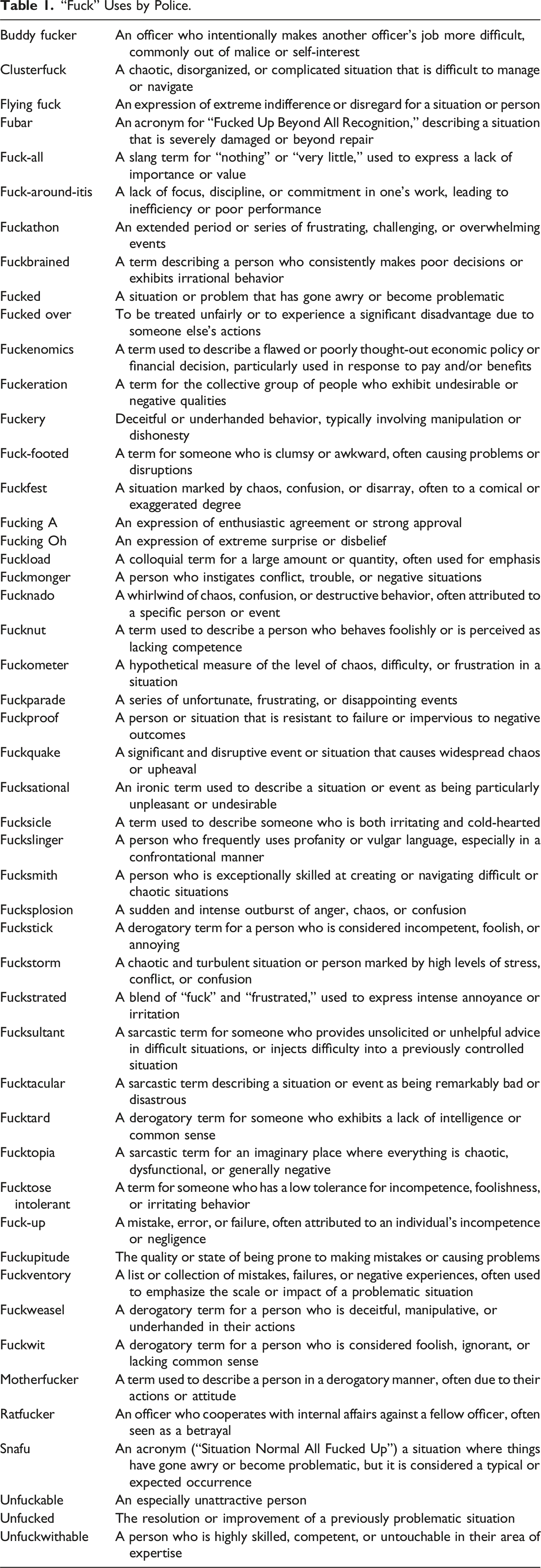
As my convenience sample generated varying uses of the word fuck, I asked the contributor to tell a story where the word had been used. In all cases, the description was sufficient to allow me to generate a general definition of the word. The beginning of these conversations was unstructured and friendly. Eventually, I would shift the focus of the conversation to profanity by asking a variation of: “Can you tell me about different ways you’ve heard the word ‘fuck’ used by you or other officers during your career?” Next, I attempted to prompt them with a use of the word they had not mentioned. For example, when a conversation had stalled on providing provisions of the word fuck, I would tell them about a humorous version I already had listed (“Fucksultant” and “Fuckenomics” proved useful several times). Typically, this ploy was successful in generating several more examples from my interviewees, as they recalled other unique derivations. In no case did I present the entire listing of fuck derivations to any interviewee, as this felt too likely to generate “unique” uses that were more the product of competitive cops trying to out-do their peers.
These were casual communications, and the time they served as officers covered a broad period of time, going as far back as 1969 and up to the present day. The group was primarily male (24 male/4 female), and roughly evenly distributed between US regions (4 West Coast, 5 Mountain West, 5 Southwest, 3 Midwest, 4 Northeast, 7 Southeast). Seventeen of the officers had spent most of their careers in agencies employing 100 or more officers, potentially biasing the sampled language towards the largest agencies in the US. In the end, fifty unique cases of fuck derivatives used by police officers were captured, and these are presented alongside a definition in Table 1.
These discussions with both executives and line officers served as a preliminary exercise to ensure that my personal experiences did not unduly influence the study’s direction. They were designed to be exploratory, to validate the variety of contexts in which profanity is used among police officers, and to establish a foundation for the formal study. In these informal conversations, all of the officers I spoke with acknowledged that they or their colleagues use profanity in a positive or humorous manner towards each other. This included instances where such language was employed to alleviate tension, strengthen team bonds, or inject humor into routine operations. This sentiment was consistent across different regions and departments, suggesting a cultural tolerance for profanity when it serves to build camaraderie or lighten the mood in a high-stress work environment. However, more disagreement emerged around how, and when, profanity could be used when directed at people they interacted with on the job. While the majority of officers felt that certain contexts may warrant the use of strong language—for example, as a tactical choice in dangerous or non-compliant situations—others were firmly against it, citing professional conduct and the potential for negative public perception and agency discipline. The dividing lines often were not clear-cut and appeared to be influenced by a range of factors, including individual officer’s discretion, the perceived severity of the situation, departmental culture, and community standards.
One immediate lesson stood out after my survey of how police use fuck in the workplace. The perspective from both police executives and officers was not that policing cannot be done without profanity, but rather that they did not imagine it possible to eradicate, and thus was a nice idea but ultimately an unlikely one for policy to give nuanced direction on. Very commonly they would comment upon the sheer volume of profanity encountered by officers during their work. Can we really expect them to never swear? Much like the findings of studies of profanity in other workplace settings (Baruch et al., 2017), police use fuck and its variations in a wide variety of ways. Even words with seemingly straightforward negative connotations, like buddyfucker, were readily placed into positive use by my informants. For example, when asked to give an example of its use, one former officer offered, “It was my turn to buy drink at the bar, but my sergeant buddyfucked me and closed the tab before I could grab it.” The language-in-use among police is the key limiting factor to describing what useful policy in this area might look like. After all, if every “motherfucker” could be good, bad, or indifferent, how can we hope to regulate it?
A Profanity Framework
The complications above demonstrate a key tension in the regulation of police profanity. On the one hand, profanity is well understood to be an unreasonable police behavior that can needlessly escalate and inflame situations, and directly causes lower public support for police action (Martaindale et al., 2023). On the other hand, profanity is a natural part of human behavior overall, and other scholarship suggests that profanity also injects humor into consistently difficult scenarios, emphasizing the humanity of an officer, thereby reducing the power differential between officers and those they encounter (Todak & White, 2019). These competing visions of profanity and its effects suggest that policy ought to maximize control over officer behavior where it might negatively impact the core missions of police agencies, but minimize areas where the profanity has limited negative, or even positive impact.
Executives and line officers both agreed there is a line of propriety, though they differed in where that line was, and how to define it. Reasonableness is a consistent framework in policing – impacting decisions as important as when force can be used (Alpert & Smith, 1994b; Mourtgos & Adams, 2020) and when officers can conduct a search (McLean et al., 2023). However, what would constitute “reasonable” profanity in the policing workplace proved difficult to pin down. One consistent demarcation was that it was almost always permissible to swear in the presence of same-rank colleagues, and most interviewees agreed swearing at colleagues was in bounds so long as it was positive or humorous. All interviewees agreed that swearing to oneself, even when recorded, was not worth disciplining. On the other hand, swearing during public interactions, especially in a derogatory way, was generally considered less professional, although with looser boundaries and more disagreement for profanity occurring during use-of-force situations.
This is a particularly delicate area of policy, given experimental findings that the public is less approving of an officer’s use-of-force when profanity is used (Martaindale et al., 2023; Sharps et al., 2019). Manifestly, agencies should be profoundly interested in maintaining public goodwill and trust (Tyler, 2004). However, they should also be interested in protecting officers from unnecessary internal investigation and avoiding any policy that is disconnected from the realities of policing such that officer morale suffers (Nix & Wolfe, 2016; Wolfe & Lawson, 2020). A consistent feature of policing research is that organizational burdens drive stress levels more than features of public-facing police work (Shane, 2010, 2019), and that overly burdensome policy is a recognized driver of police stress (Worden et al., 2023). High levels of perceived organizational justice also protect against negative policing outcomes such as misconduct (Wolfe & Piquero, 2011).
Further, profanity exists in all professional walks of life, and is deemed beneficial to the people in those professions (Baruch et al., 2017). Upwards of 7% of all Twitter posts contain profanity (Laboreiro & Oliveira, 2014). Doctors swear (Perrault et al., 2022), people swear when they text (Mak & Lee, 2015), and men and women both swear (Selnow, 1985). When even the Pope says fuck (Chappell, 2014), it would be very odd to expect police officers to possess the saintliest mouths among us.
In other words, this is an area that requires carefully balanced policy. If the policy is too broad, then we end up perpetuating the current situation, where agencies either have no policy, or an unenforceable one. If the policy is too narrow, then the resulting policy is unlikely to be applied in disciplinary hearings, simply because the policy framers did not anticipate the exact formation of the profanity in question and administrative action is likely to be inconsistently applied (and therefore easily defended by the perpetrator).
Navigating the tightrope of policy creation in this arena is a daunting task, as useful policy must not only reflect societal norms, but also respect the dynamic, demanding nature of law enforcement work. To effectively frame a policy that is both realistic and enforceable, my conversations with line and executive officers lead to an approach that categorizes profanity based on its inherent characteristics. This framework, rather than approaching the issue with a broad brush, considers four pivotal aspects: intensity, form, intent, and target. • • • •
Each category presents unique facets of profanity, providing a nuanced understanding of its use. However, the utility of these categories varies when translating them into practical, enforceable policies. The first two categories – intensity and form – while interesting theoretically, prove challenging to implement on an operational level due to their subjectivity and complexity, while the last two categories – intent and target – offer more pragmatic and effective tools for policy creation.
When we examine intensity and form it quickly becomes clear that they vary a great deal and are subjective and mired in minutiae, such that there can be no consistent way of using them as a means of assessment. For example, intensity relies on the perceived emotional responses of the other as the decision point. Moreover, whether or not a suspect is personally offended, and to what degree, by being called “fuckbrained” is somewhat extraneous to a policy which is designed to regulate professionalism. Form, too, is less than helpful from a policy perspective. I have avoided providing every conjugation of a single fuck derivative (i.e., “buddy fuck” and “buddy fucker” and “buddy fucking” and “buddy fucked”), and any policy that tried to parse these as different would immediately confront the same problem that currently exists in this arena. Specifically, that project would immediately be overwhelming and impractical with the result that there would either be no policy at all, or that the policy would be so ungainly as to be both non-navigable and unenforceable because of its amorphous nature. Nonetheless, attempts to regulate profanity according to how the language is received, or in light of its “intensity,” are commonly found in policy recommendations. Even well-regarded training and policy organizations, such as the California Commission on Police Officers Standards and Training (POST), have struggled to produce effective profanity recommendations. For example, their focus on considering the “volume, location, and proximity to others” of profanity, but not its target or intent, falls short of a clear-eyed solution to this ongoing problem (Commission, 2020, p. 53).
However, intent and target provide a foundation that make policy comprehensible to officers, and useable for their managers. By focusing on these two aspects, agencies can develop guidelines that are easier to enforce and more closely aligned with the goals of maintaining professionalism and public trust. A policy that differentiates between the use of profanity based on its intent, such as derogatory, positive, or neutral language would be both clear, contextually oriented, and enforceable. By offering clear definitions and examples, officers would have a better understanding of what is deemed professional and what is not. Additionally, agencies could take into account the target of the profanity, such as whether it is self-directed, other-directed, or situation-directed.
By concentrating on the intent and the target of profane language, policy-makers (and experimental researchers) could craft guidelines that are not only more enforceable, but also more adaptable to the varied situations officers encounter in their line of work. This approach would enable agencies to provide clearer guidance without becoming overly restrictive or disconnected from the realities of policing.
Categorization
Scholars and practitioners would benefit from a systematic way to categorize the different uses of the word “fuck” in the context of law enforcement. Early scholarship subjected different profane (or adjacent) words to factor analysis, but the resulting structure is only useful in describing that profanities load across various factors, including “euphemistic-colloquial” and “abrasive” and “abrasive-expletive” (Mabry, 1975).
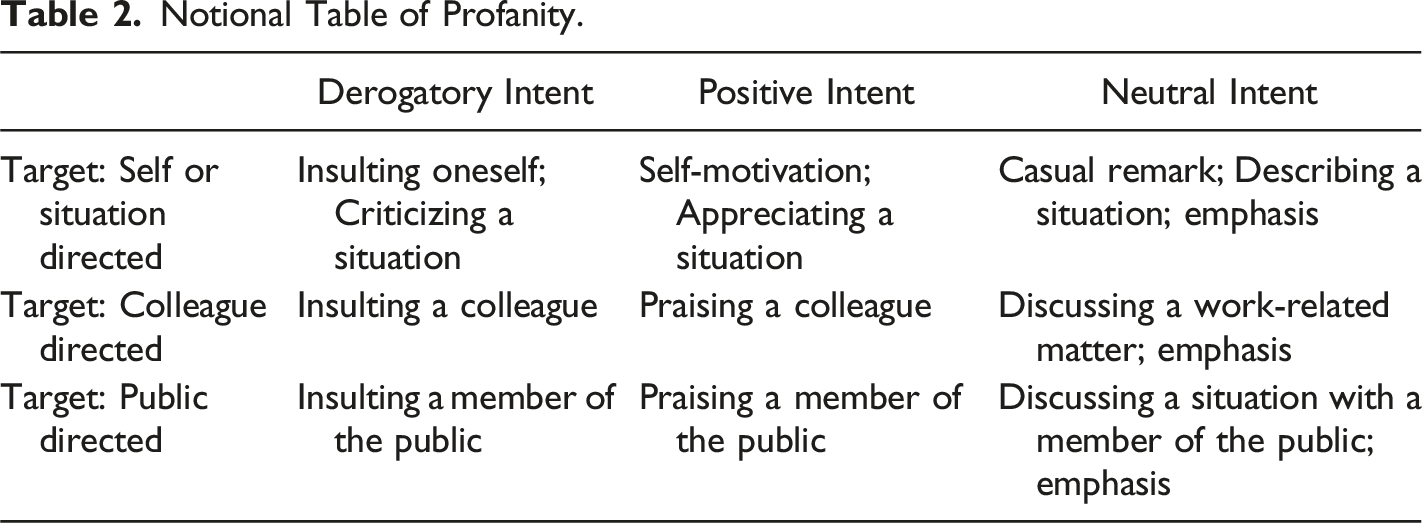
Based on the language-in-use discussion above, I suggest a straightforward categorization. Rather than attempting to regulate certain words, or forms of words, a policy-oriented categorization proceeds according to whether they primarily target self/situation, colleagues, or the public, and according to the function they serve in communication—whether they are used derogatorily, positively, or neutrally.
Target Definitions
• The Self or Situation Directed category is when profanity was primarily referencing the officer themselves, or when describing a particular event, circumstance, or state. • The Colleague-directed category is when profanity was primarily directed at a colleague. • The Public-directed category is when profanity was primarily directed at a member of the public.
Intent Definitions
• The Derogatory category encompasses terms used to belittle, offend, or express disapproval. This category of profanity is characterized by its intent to insult, criticize, or demean an individual or a group. These terms are often employed to assert dominance, express frustration, or convey negative sentiments, reflecting the complex emotional landscape of law enforcement interactions. • The Positive category contains language used to express solidarity, encouragement, or positive affirmation. Such profanity intends to foster rapport, demonstrate approval, or cultivate an atmosphere of mutual understanding. Central to this category is the intent behind the use of these terms: to communicate positive sentiments or support, regardless of the recipient. • The Neutral category includes terms that articulate emotions, attitudes, or feelings, typically utilized to underscore or augment a statement, or to offer a dispassionate or informative depiction of a person, situation, or state. This category is marked by its use of profanity in a manner that is neither overtly positive nor derogatory, often serving as a linguistic tool to enhance communication or express sincerity.
Notional Table of Profanity.
Design
A theory is only as useful as its connection to the world it describes. To test the theory of police profanity proposed above, and its connection to police practice, I constructed a pre-registered experimental test of the theory. 3 The experiment systematically varied the target (self or situation directed, colleague directed, and public directed) and the context (derogatory, positive, neutral) of the profanity-in-use.
This study uses original data, collected from an online survey experiment administered to a large sample of local government (municipal and county) executives, both appointed and elected, across the United States. The underlying data is drawn from a novel panel set of all municipal executives between 2013 and 2018, taken at six-month intervals. This underlying data was developed by the author and a colleague. Every observation in the data is at the city or county role level and tracks ten municipal executive roles. For the purposes of this study, the roles of interest are public executives of human resources and law enforcement. These are two roles in local government with prominent responsibility for developing and enforcing police personnel policy. In addition to role, the panel data includes information about the locality type, budgetary information, employee counts, and population counts for the locality.
Based on these criterion, 24,151 observations (LE = 13,295; HR = 10,856) were initially screened for inclusion, forming the sampling frame for this study. However, upon distribution through Qualtrics, the removal of duplicates as well as email failures resulted in a final distribution sample of 18,100. The study was held open for eleven days, beginning on July 10, 2023. Two reminder emails (four and seven days after) were sent during the open study period. A total of 2053 respondents began, and 1444 finished (70.3% completion rate) the survey, resulting in a response rate of 11.3%. This rate is just slightly lower than the average response for survey experiments on political elites (Kertzer & Renshon, 2022), but substantially higher than most police-based survey research using similar online methodology (Nix et al., 2019). It is on a par with the most recent similar effort, which was a survey experiment on police chiefs and sheriffs (Adams et al., 2022). Heads of law enforcement responded at a higher rate (7.4% of initially screened roles) compared to heads of human resources (3.1%).
Hypotheses
This study used a mixed design with both within-subjects and between-subjects conditions. Participants were randomly exposed to four out of nine possible conditions, with each condition corresponding to a different vignette involving the use of the profanity “fuck” by a police officer. These conditions are designed based on a 3 (target: self or situation-directed, colleague-directed, public-directed) × 3 (intent: derogatory, positive, neutral) matrix, yielding a total of nine conditions.
Respondents were exposed to four randomly selected conditions of the nine available. Following each vignette, respondents rated the appropriateness, professionalism, impact to public trust, policy-dictated discipline, and personal preference for discipline for the scenario they had just seen. The vignettes followed a prompt that provided consistent background information on each scenario presented to respondents: “Imagine the following has occurred in your agency. The situation came to your attention through a supervisor who was randomly reviewing body-worn camera footage. There has been no complaint at this time, but the situation remains under investigation.”
Following that prompt, one of the four randomly selected vignettes appeared. Following each vignette, respondents were asked to respond to five outcome questions. Below, each outcome question is linked to formal hypotheses related to the two experimental conditions of Target and Intent. All hypotheses were pre-registered, and the appendix to this article includes the original preregistration document.
Perceived Acceptability: “In your opinion, how acceptable was this officer’s use of profanity at work?” Participants responded on a Likert scale from 1 (completely unacceptable) to 5 (completely acceptable). • H1A: The use of profanity when self-directed or situation-directed will be perceived as more acceptable than when other-directed (colleague or public). • H2A: Positive or neutral intent in profanity use will be perceived as more acceptable than derogatory intent.
Perceived Professionalism: “In your opinion, how professional was this officer in using profanity at work?” Participants responded on a Likert scale from 1 (completely unprofessional) to 5 (completely professional). • H1B: The use of profanity when self-directed or situation-directed will be perceived as more professional than when other-directed (colleague or public). • H2B: Positive or neutral intent in profanity use will be perceived as more professional than derogatory intent.
Impact on Public Trust: “If made public, how do you think this officer’s use of profanity would affect public trust in the police?” Participants responded on a Likert scale from 1 (greatly reduces public trust) to 5 (greatly enhances public trust). • H1C: The use of profanity when self-directed or situation-directed will be perceived as having less negative impact on public trust than when other-directed (colleague or public). • H2C: Positive or neutral intent in profanity use will be perceived as having less negative impact on public trust than derogatory intent.
Disciplinary Action (Agency Policy): “How severe would the disciplinary action be, • H1D: The use of profanity when self-directed or situation-directed will be perceived as warranting less severe policy-based disciplinary action than when other-directed (colleague or public). • H2D: Positive or neutral intent in profanity use will be perceived as warranting less severe policy-based disciplinary action than derogatory intent.
Disciplinary Action (Personal): “In your • H1E: The use of profanity when self-directed or situation-directed will be perceived as warranting less severe personal opinion-based disciplinary action than when other-directed (colleague or public). • H2E: Positive or neutral intent in profanity use will be perceived as warranting less severe personal opinion-based disciplinary action than derogatory intent.
Sample
The sample for this study consisted of 1492 participants who were predominantly serving in leadership roles within their respective organizations. Responses were measured across multiple assessments per respondent, generating an observations’ set of 5280 responses. Most participants (72.3%) were heads of law enforcement, while 24.7% were heads of human resources. A small proportion (3.0%) did not specify their specific role. Respondents come from all 50 US states. All participants occupied the lead executive role within either the Head of Human Resources or Head of Law Enforcement position in their respective agency or governmental organization. 4
The participants were experienced professionals, with an average of 27.5 years (SD = 10.0) of professional experience and an average of 10.7 years (SD = 10.2) of experience in their current role. The average age of the participants was 53.7 years (SD = 8.8). The sample was predominantly white (82.9%), with small representations of individuals identifying as Black or African American (3.8%), more than one race (3.2%), Hispanic (2.7%), American Indian or Alaska Native (0.5%), Asian (0.2%), and Native Hawaiian or Pacific Islander (0.1%). 6.6% did not specify their race. The participants were highly educated, with 31.5% holding a master’s degree, 29.1% holding a bachelor’s degree, 16.7% holding an associate’s degree, and 13.4% having completed high school or equivalent. A small proportion (3.5%) held doctoral-level qualifications such as PhD, JD, or MD. Most participants were male (76.9%), with females comprising 16.5% of the sample.
The organizations represented in the sample were predominantly municipalities (50.8%), with a smaller proportion of county (11.1%) and township (9.5%) governments. 28.6% did not specify their governmental category. The average city population served by these organizations was 38,212.8 (SD = 138,467.2), and they had an average of 42.3 full-time officers (SD = 121.1). The mean expenditure on police services was $6,749,400 (SD = $24,065,400).
Sample Descriptive Statistics, n = 1492.
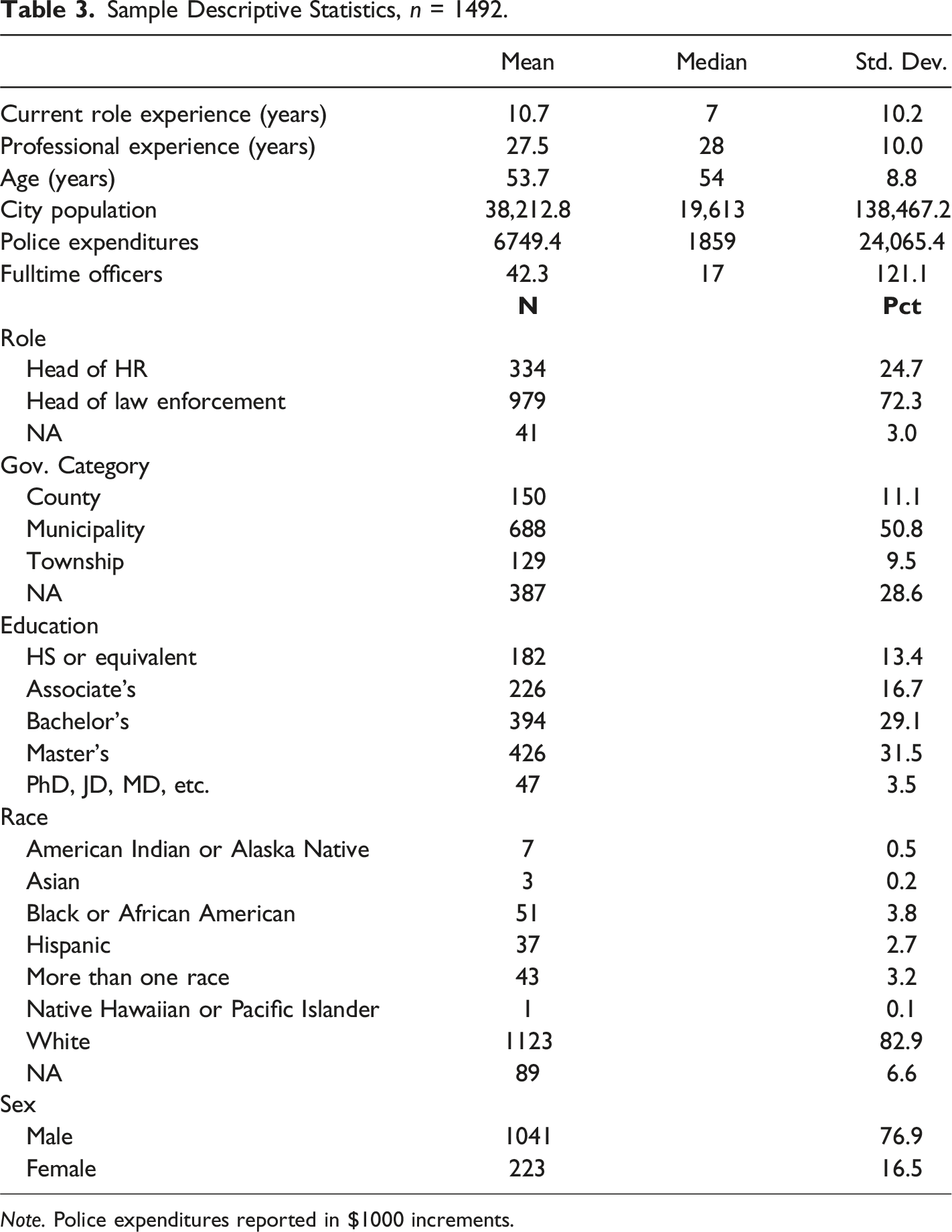
Note. Police expenditures reported in $1000 increments.
Analytic Plan
The primary independent variables are the experimental conditions target (self, colleague, public) and intent (neutral, positive, derogatory), resulting in a 3 × 3 main effects experiment. I employed a mixed effects model to analyze the data, which was the result of each respondent answering a random selection of four vignettes drawn from the nine possible. Analysis proceeded with the `lmer` package (Bates et al., 2015) in R (R Core Team, 2023). The general form of the mixed effects model is represented by the following multilevel equation: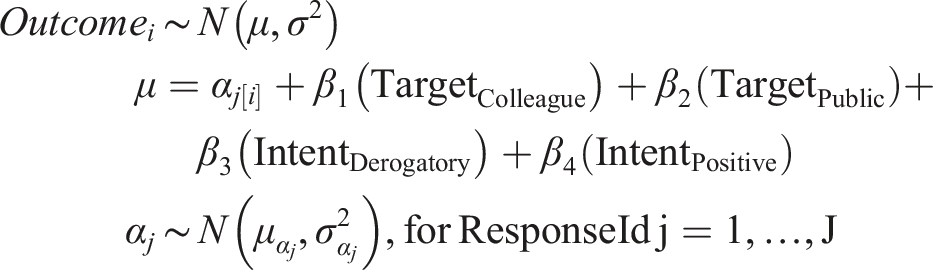
The dependent variable,
The random intercept
The interaction model presented later includes an interaction term between the main experimental variables of Target and Intent, resulting in a mixed effects model represented by a similar multilevel equation with more terms to represent the interaction: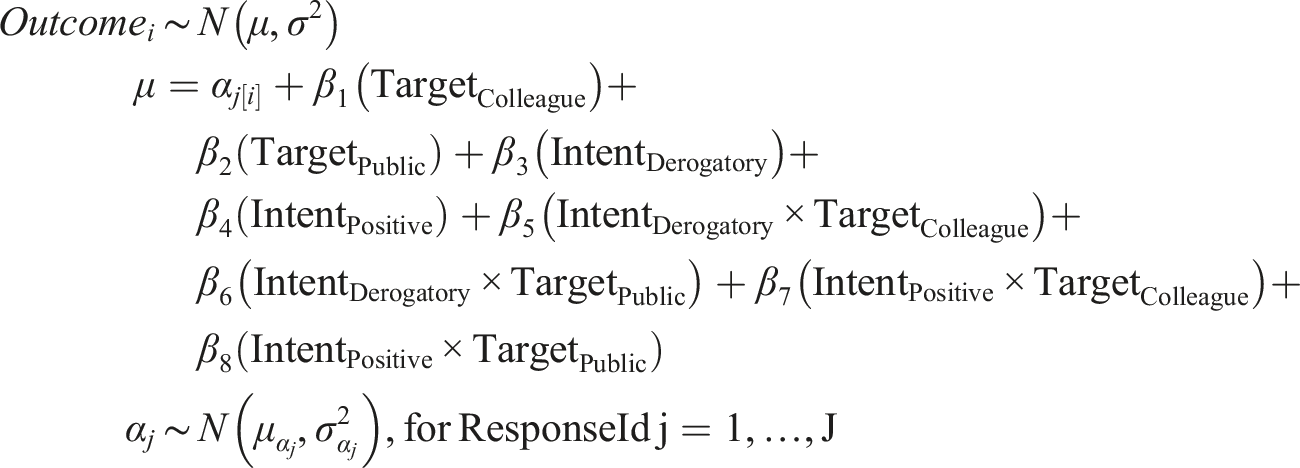
Results
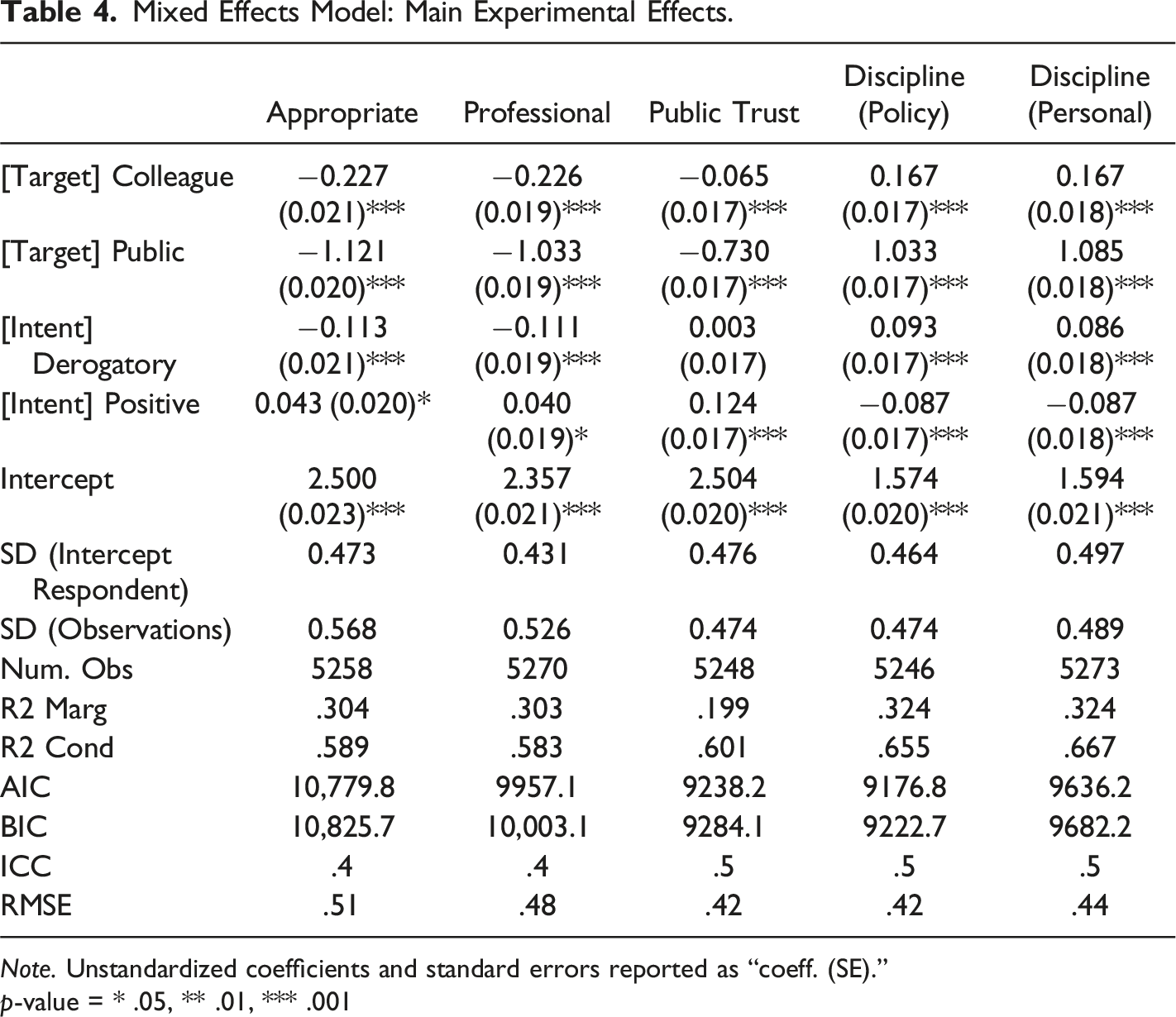
Mixed Effects Model: Main Experimental Effects.
Note. Unstandardized coefficients and standard errors reported as “coeff. (SE).” p-value = * .05, ** .01, *** .001
The target of the profanity had a significant influence on all outcome variables. When the profanity was directed at the public, it was seen as significantly less appropriate (b = −1.121, p < .001), less professional (b = −1.033, p < .001), and was perceived to have a greater negative impact on public trust (b = −0.730, p < .001) compared to when it was self-directed. Furthermore, profanity directed at the public was associated with a perception of needing more severe policy-based (b = 1.033, p < .001) and personal opinion-based (b = 1.085, p < .001) disciplinary action. Similarly, the use of profanity directed towards colleagues was also seen as less appropriate (b = −0.227, p < .001) and less professional (b = −0.226, p < .001), with a smaller but still significant negative impact on public trust (b = −0.065, p < .001). It, too, was associated with a perception of needing more severe policy-based (b = 0.167, p < .001) and personal opinion-based (b = 0.167, p < .001) disciplinary action, compared to profanity that was self-directed or situation-directed.
The intent of the profanity was also found to significantly influence perceptions. Profanity with a derogatory intent was perceived as less appropriate (b = −0.113, p < .001) and less professional (b = −0.111, p < .001) compared to profanity with a neutral intent. Interestingly, compared to a neutral intent, derogatory profanity did not have a significant impact on public trust (b = 0.003, p = n.s.), but it was associated with perceptions of needing more severe policy-based (b = 0.093, p < .001) and personal opinion-based (b = 0.086, p < .01) disciplinary action. On the other hand, profanity with a positive intent was perceived as more appropriate (b = 0.043, p < .05) and more professional (b = 0.040, p < .05), with a larger positive impact on public trust (b = 0.124, p < .001), and was associated with perceptions of needing less severe policy-based (b = −0.087, p < .001) and personal opinion-based (b = −0.087, p < .01) disciplinary action, compared to profanity with a neutral intent.
Indeed, while the fixed effects in the model explained a substantial portion of the variance in the outcomes, there was still a significant proportion of unexplained variance. 7 This unexplained variance, ranging from around 42% to 67% across the different outcomes, could potentially be attributed to factors not directly measured in this study, including the intensity and form suggested in my proposed theory. One such factor is the broader “context” of the situation in which profanity is used, as pointed out by almost every chief and line officer consulted during this study. These contextual elements, such as the severity of the situation including threat dynamics, the relationship between the officer and the target of the profanity, and other situational dynamics, could have significant impacts on evaluations of the appropriateness, professionalism, impact on public trust, and disciplinary action associated with the use of profanity. This gap highlights the potential need for further research to incorporate and examine these contextual elements more explicitly. In the next section, I report on further model results, and consider organizational and respondent characteristics.
Controlled Models
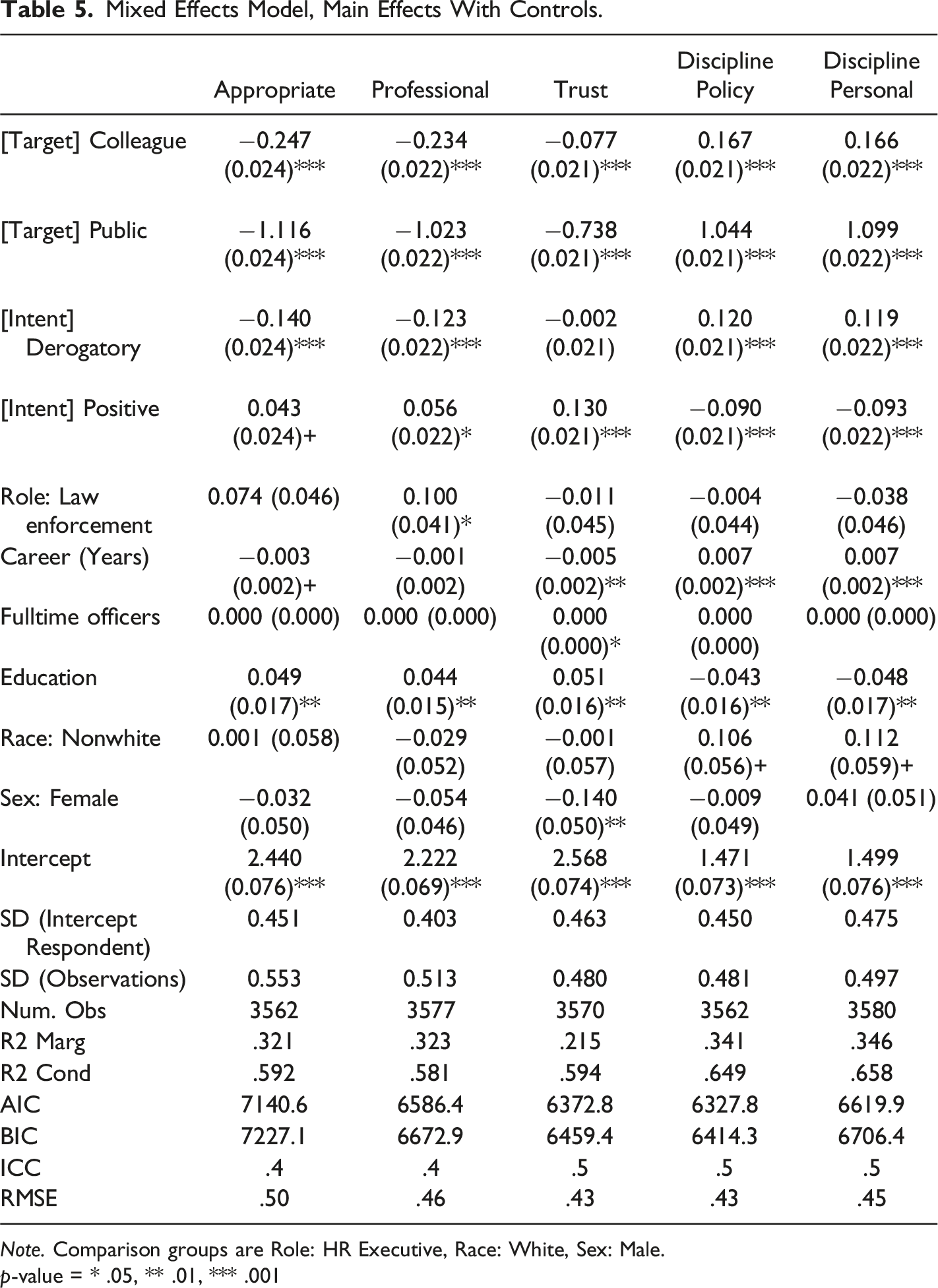
Mixed Effects Model, Main Effects With Controls.
Note. Comparison groups are Role: HR Executive, Race: White, Sex: Male. p-value = * .05, ** .01, *** .001
The effects of race and sex were less consistent. Non-white participants showed a trend towards perceiving a greater need for policy-based (b = 0.106, p < .1) and personal opinion-based (b = 0.112, p < .1) disciplinary action compared to white participants. Female participants perceived a greater negative impact on public trust compared to male participants (b = −0.140, p < .01).
These findings provide further evidence of the influence of both the target and intent of profanity on its perceived implications, while also highlighting the role of various demographic and professional factors in shaping these perceptions. This underscores the complex nature of this issue and the need for a nuanced approach to addressing it in professional settings.
Results for Experimental Interaction
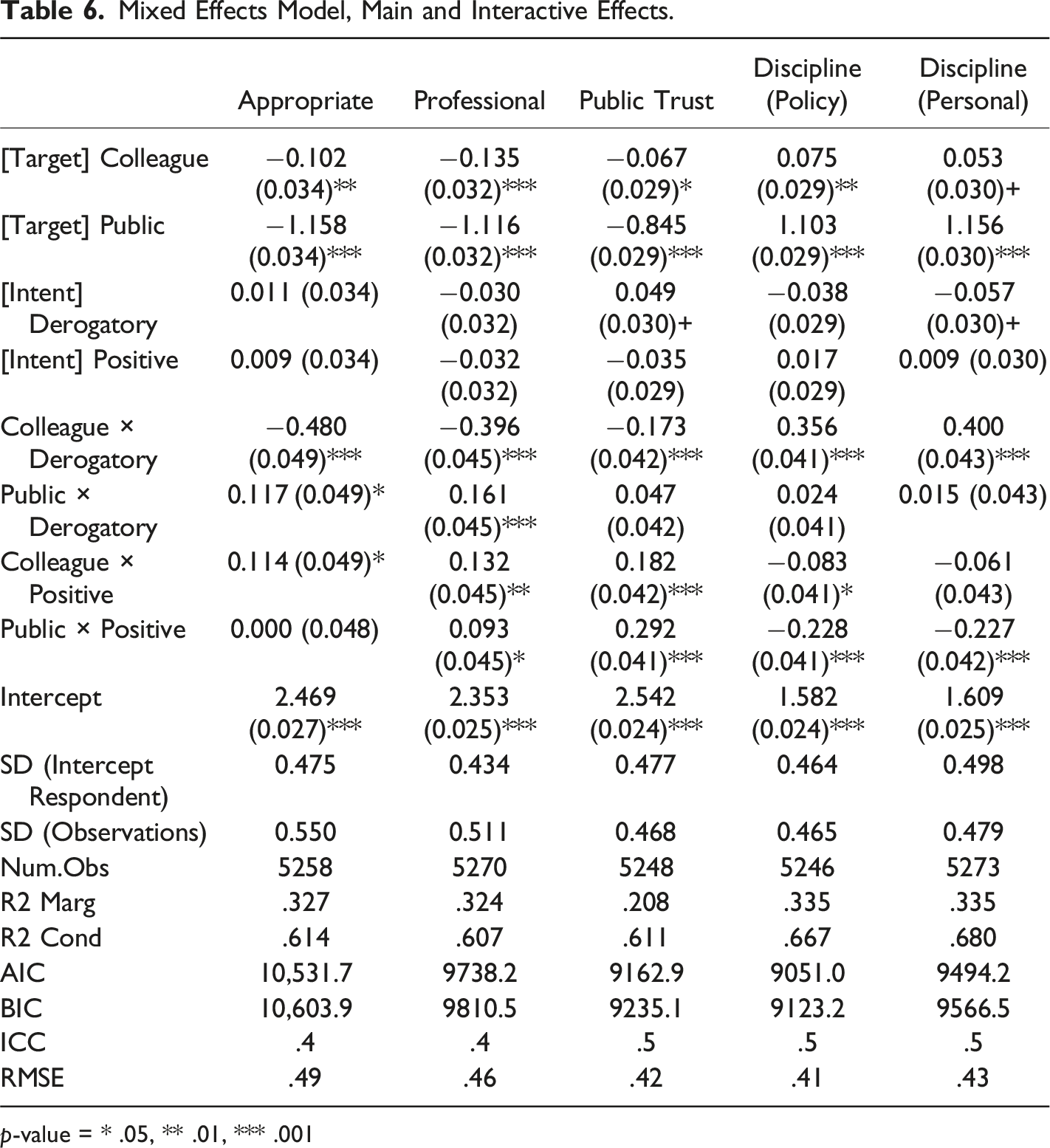
Mixed Effects Model, Main and Interactive Effects.
p-value = * .05, ** .01, *** .001
In all cases, the interaction model provides a significantly better fit to the data than the simple model for each of the outcome variables. The p-values (Pr(>Chisq)) for the Chi-squared tests are all significant (p < 2.2e-16), suggesting that, for each outcome variable, the interaction model provides a significantly better fit to the data than the simple model. In other words, the interaction between “Target” and “Intent” significantly improves the model’s ability to predict each of the outcome variables, over and above the individual effects of “Target” and “Intent”.
The interaction relationships are visualized in Figure 1. First, the effect of target on the outcome variables was significantly moderated by the intent of the profanity. For example, derogatory intent amplified the negative effect of colleague-directed profanity on perceived appropriateness (b = −0.480, p < .001), professionalism (b = −0.396, p < .001), and public trust (b = −0.173, p < .001), and it increased the perceived severity for policy-based (b = 0.356, p < .001) and personal opinion-based (b = 0.400, p < .001) disciplinary action. However, for public-directed profanity, the derogatory intent did not exacerbate its negative impact but, instead, slightly tempered it in terms of perceived appropriateness (b = 0.117, p < .05) and professionalism (b = 0.161, p < .001). Experimental interaction effects of {Target} x {Intent}.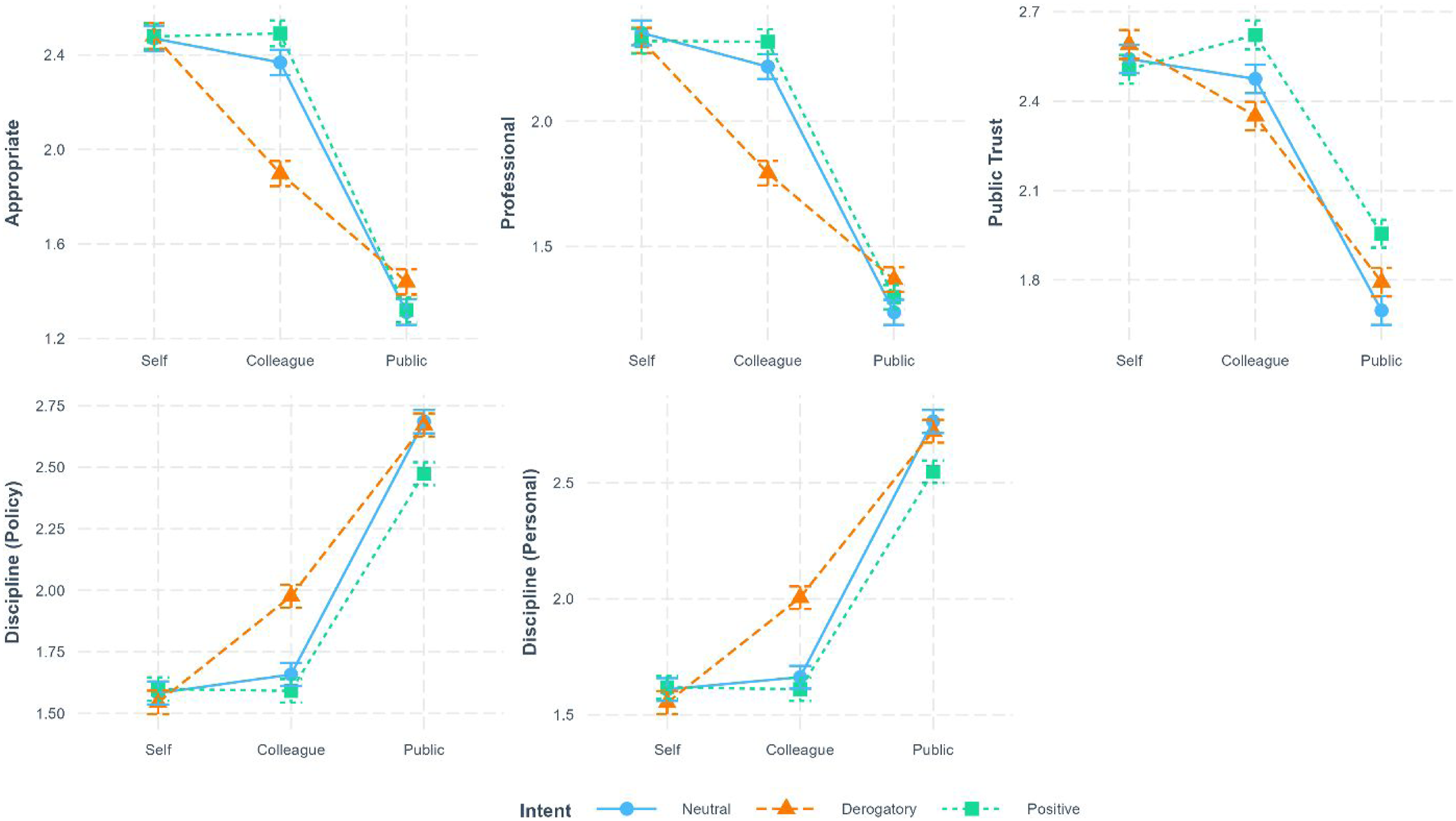
Secondly, positive intent was found to moderate the effect of target on the outcomes. Specifically, it reduced the negative impact of colleague-directed profanity on perceived appropriateness (b = 0.114, p < .05), professionalism (b = 0.132, p < .01), and public trust (b = 0.182, p < .001), and it lessened the perceived need for policy-based disciplinary action (b = −0.083, p < .05). Interestingly, for public-directed profanity, positive intent had no significant effect on perceived appropriateness (b = 0.000, p = n.s.) but improved perceptions of professionalism (b = 0.093, p < .05) and significantly enhanced public trust (b = 0.292, p < .001), while reducing the perceived need for both policy-based (b = −0.228, p < .001) and personal opinion-based (b = −0.227, p < .01) disciplinary action.
The variance explained by the fixed effects in this model, including the interaction terms, increased slightly compared to the previous model. The marginal R-squared values ranged from .208 for public trust to .335 for disciplinary action, indicating that the inclusion of the interaction terms improved the explanatory power of the model. The conditional R-squared values, which include both the fixed and random effects, ranged from .611 for public trust to .680 for disciplinary action, demonstrating that the model fits the data well. Furthermore, the Akaike Information Criterion (AIC) and Bayesian Information Criterion (BIC) values were lower in this model compared to the previous model, providing additional evidence of improved model fit.
These findings underscore the complex interplay between the target and intent of profanity in shaping perceptions of its appropriateness, professionalism, impact on public trust, and the severity of disciplinary action it warrants. As such, these results highlight the importance of considering both the target and intent of profanity, as well as their interaction, in understanding and addressing the implications of profanity use in a professional setting.
Discussion
McWhorter (2023) anticipates the core tension examined in this study, articulating that it is essential to avoid the simplistic notion that police officers should never use profanity, such as the word “fuck,” under any circumstances. He argues that such a view neglects the complex nature of language, where even seemingly offensive words can have multiple meanings and contexts. Such an approach “would operate upon an almost willfully uninformed sense of how language actually works” (McWhorter, 2023, para. 8). I agree, and the findings here also concur with McWhorter’s perspective, revealing a national consensus among police and local government human resource professionals. Specifically, there is agreement that agency policies should target the use of individually directed derogatory profanity towards colleagues and any profanity aimed at members of the public. Such language, which belittles, disrespects, and dehumanizes both civilians and fellow officers, underscores the importance of revisiting and refining current policies on profanity in law enforcement. The research highlights the significance of distinguishing between the target and intent behind profanity usage. This distinction is crucial for shaping perceptions of professionalism and public trust, as well as for guiding decisions regarding the necessity and extent of disciplinary actions.
Accordingly, policy recommendations should emphasize a greater focus on the context of profanity use. For instance, agencies should consider developing guidelines that distinguish between profanity directed at the public and profanity that is self-directed. These findings suggest that the former is seen as significantly less appropriate, and professional and is associated with a perceived need for more severe disciplinary action. Therefore, policies that specifically target such uses of profanity could serve to enhance the professionalism of officers and improve public trust in the police.
The intent of the profanity – whether it is used with a derogatory, neutral, or positive intent – is also a crucial factor to consider. Law enforcement agencies should consider policies that discourage the use of derogatory profanity while allowing room for profanity used with a positive or neutral intent in suitable contexts. This distinction may be challenging to implement in practice, as the intent can be somewhat subjective, and may not always be clear. However, compared to blanket bans or a lack of any policy control – which is the currently the prevailing policy orientation regarding profanity in the police workplace – a clear focus on intent and target would provide far more guidance to officers, while also building a functional framework for police executives charged with policy enforcement. It is also important to note that such a policy would also require discretion and good judgement in managing the use of profanity.
The complexity of the interaction effects observed here underscores the need to concomitantly consider both the target and the intent of profanity in policy-making. The professionalism of an officer cannot be decided with an acid test determining whether profanity was used. This is the equivalent of strict liability, wherein the act of itself is enough to find against the perpetrator – this is far too simple an approach to a situation that is both laden with context and which has significant potential impact, whether with regard to public trust or an officer’s professionalism and perceived appropriateness. The considerable interplay between the target and intent of profanity further highlights the inadequacy of broad or blanket policies in this domain. Rather, such policies require nuanced guidelines that can interpret the intent and target of the profanity together, thereby aligning the disciplinary action more accurately with the impact of the language used (Worden et al., 2023). This would assist in developing a fairer and more effective approach to managing and regulating language use within law enforcement agencies (Alpert & Smith, 1994a; Noble & Alpert, 2008).
Few policing-focused studies would be complete without a strong recommendation on training. However, I inject a note of caution before making such recommendations considering the lack of compelling evidence about whether training works to accomplish our goals. Existing training programs already focus on communication skills that allow officers to command respect and authority, build rapport, and diffuse tension without resorting to the use of derogatory profanity (Engel et al., 2022; Todak & James, 2018). The findings here suggest such programs should also highlight the potential negative impacts of derogatory profanity on public trust and judgements about police actions, particularly during use-of-force incidents (Martaindale et al., 2023; Patton et al., 2017; Sharps et al., 2019). In any case, such training must reflect how police officers experience their work, otherwise it will fail. As Worden & McLean observe (2017, p. 41), “training must be tightly coupled with the day-to-day reality of officers’ experience, and if it is not, it will prove ineffective.”
Lastly, these recommendations should be contextualized within the broader policing workplace environment. In this regard, the analysis highlights several demographic and professional factors that influence perceptions of regarding the use of profanity, and which should be considered when developing and implementing these policies. For instance, participants in law enforcement roles tended to perceive profanity as more professional than those in HR executive roles, indicating a potential cultural acceptance of profanity in certain contexts within the police force. Similarly, the more formal education a respondent had, the more approving they were of the use of profanity, while women tended to be more disapproving when compared to men. These divergent perceptions underscore the importance of considering the views of those directly affected by these policies, and of fostering open dialogues about the role of language and communication in policing.
In sum, the key policy implications of this study point towards a more nuanced approach to managing the use of profanity in policing. Such an approach should not only be informed by the findings presented here, but also by ongoing dialogue within law enforcement agencies, as well as further empirical research into the complex role that language plays in the day-to-day operations of the police force.
Limitations and Future Research
I have narrowly concentrated on the most frequently criticized yet still prevalent expletive: ‘fuck.’ This narrow focus inevitably leaves several pertinent questions about police use of profanity unexplored. Although the study operates under the assumption that effective policy can be developed by concentrating on the most egregious examples of prohibited language, this premise might be challenged by future investigations. 8 Such studies might reveal that less common or milder forms of profanity do not align with the policy frameworks suggested herein. For instance, the application and reception of the term ‘asshole’ among police officers could significantly diverge from those of ‘fuck’ and its derivatives. While this differentiation may appear speculative at present, subsequent research that examines the nuances of vulgarity across different expressions would significantly enrich the discourse on police profanity. Importantly, it would also refine the precision of policy recommendations, ensuring they are both comprehensive and contextually appropriate.
While this study has focused on the more flagrant examples of prohibited language in policing, the standards and expectations for language use may shift from the hiring process to the workplace experiences of officers on duty. This parallels the distinction between pre-employment physical fitness requirements and those demanded of incumbent officers. For example, the use of profanity is listed as a counterproductive behavior to avoid when hiring policing recruits (Scrivner, 2001). Future research could investigate the difference between how officers are screened for profanity use at the recruit level compared to the standards revealed here for incumbent officers, and the implications for both policy and practice.
A second limitation is rooted in the flexible nature of profanity itself. It is possible, and even likely, that officers will continue to adapt their language to the context of their profession and the challenges they face. These changes may include new forms of fuck. The way today’s officers use language is undoubtedly different from their predecessors, and it follows that tomorrow’s officers may well introduce new derivatives of the word. Our understanding of fuck and other profanity, therefore, must also be flexible and adapt to those changes.
A third limitation is that this study used a sample drawn only from US-based policing and human resources personnel, and was conducted in English. While fuck is a common English loan word to other languages, there is obvious cultural complexity when attempting to generalize from a US, English-language-based sample to international contexts. Therefore, similar experiments in other cultures, languages, countries, and customs, would dramatically improve our collective understanding of police profanity. Further, the humor found in Table 1 is difficult to deny, and raises the potential that traditionally masculine traits such as competitiveness have been over-emphasized in a policing profession that has for too long been dominated by men (Huff & Todak, 2022). The current study intentionally did not disclose the vignette officer’s gender, and it may be that perceptions of how an officer uses profanity under the proposed target/intent model varies according to the speakers’ gender identity. Exploring heterogeneity by sex is a common theme among profanity studies outside of policing (Selnow, 1985), and doing so in the police context would be a useful contribution for future work in this area.
Finally, like Van Maanen”s Van Maanen’s (1978, p. 310) assholes, know nothings, and suspicious persons, the framework I propose here is “anything but precise and absolute.” Rather, I intended to begin the policy conversation from a relatively conservative place, given the potentially significant impacts such changes would have on police-community relations. To the degree that a national practice has yet to emerge in relationship to regulating police profanity, the policy aims here should be the beginning of the discussion, and not the end of one.
Conclusion
I have attempted to lay out the language-in-use properties of the word “fuck” in policing, revealing its capacity to convey multiple meanings and functions, from emphasis and camaraderie to power and aggression. The complexity of even this single curse puts the lie to policy that attempts to regulate through blanket bans of profanity. I proposed a theory of profanity policy and found confirmation through a large, pre-registered survey experiment issued to policing and local government human resources executives across the country. The resulting policy guidance therefore reflects a national consensus that acknowledges the nuanced contexts in which profanity may be used and advocates for a more precise and informed approach to its regulation. The inclusion of both the target and intent of profanity in decision-making processes related to policy and disciplinary actions indicates a shift towards a more balanced, contextual understanding of language use in policing. This not only enhances the professional conduct of law enforcement officers but also fosters increased public trust.
The convergence of the perspectives of policing and HR professionals in this study also represents a promising sign of broad consensus and potential collaboration. While differences do exist, the points of agreement offer a clear path towards fostering a shared understanding and approach to language policy in policing. By adopting this national consensus as the basis of the policy discourse on the use of profanity, we can better address the challenges of language use in policing and develop more effective policies and practices that respect the complexities of this issue.
Acknowledgments
In addition to the assistance from the anonymous reviewers and the editorial staff, thanks are due to Scott Mourtgos (University of Utah) and Geoff Alpert (Griffiths University) for their helpful comments on an earlier version of this article. I am also grateful to the numerous police executives and line officers who took time to answer my phone calls for what must have seemed a uniquely nonsensical conversation. Special thanks to Master Deputy Markus Johnson and Deputy Chief Harry Polis, both of the Richland County Sheriff’s Department (South Carolina), for their willingness to give in-depth comments on an earlier draft of this paper. Thanks, also, to Carl Junkinson (University of South Carolina) for giving a fuck (and editing the final draft of this paper).
The underlying data used to generate the sample of law enforcement and human resource chief executives is the result of a joint project with Josh McCrain (University of Utah), and my thanks to him for joining me for such a difficult and rewarding undertaking.
Supplemental Material
Supplemental Material - Fuck: The Police
Supplemental Material for Fuck: The Police by Ian T. Adams in Police Quarterly
Footnotes
Declaration of Conflicting Interests
The author(s) declared no potential conflicts of interest with respect to the research, authorship, and/or publication of this article.
Funding
The author(s) disclosed receipt of the following financial support for the research, authorship, and/or publication of this article: This work was supported by the University of Utah (Research Incentive Grant 2022).

Supplemental Material
Supplemental material for this article is available online.
Notes
Appendix
Author Biography
References
Supplementary Material
Please find the following supplemental material available below.
For Open Access articles published under a Creative Commons License, all supplemental material carries the same license as the article it is associated with.
For non-Open Access articles published, all supplemental material carries a non-exclusive license, and permission requests for re-use of supplemental material or any part of supplemental material shall be sent directly to the copyright owner as specified in the copyright notice associated with the article.
