




Abstract
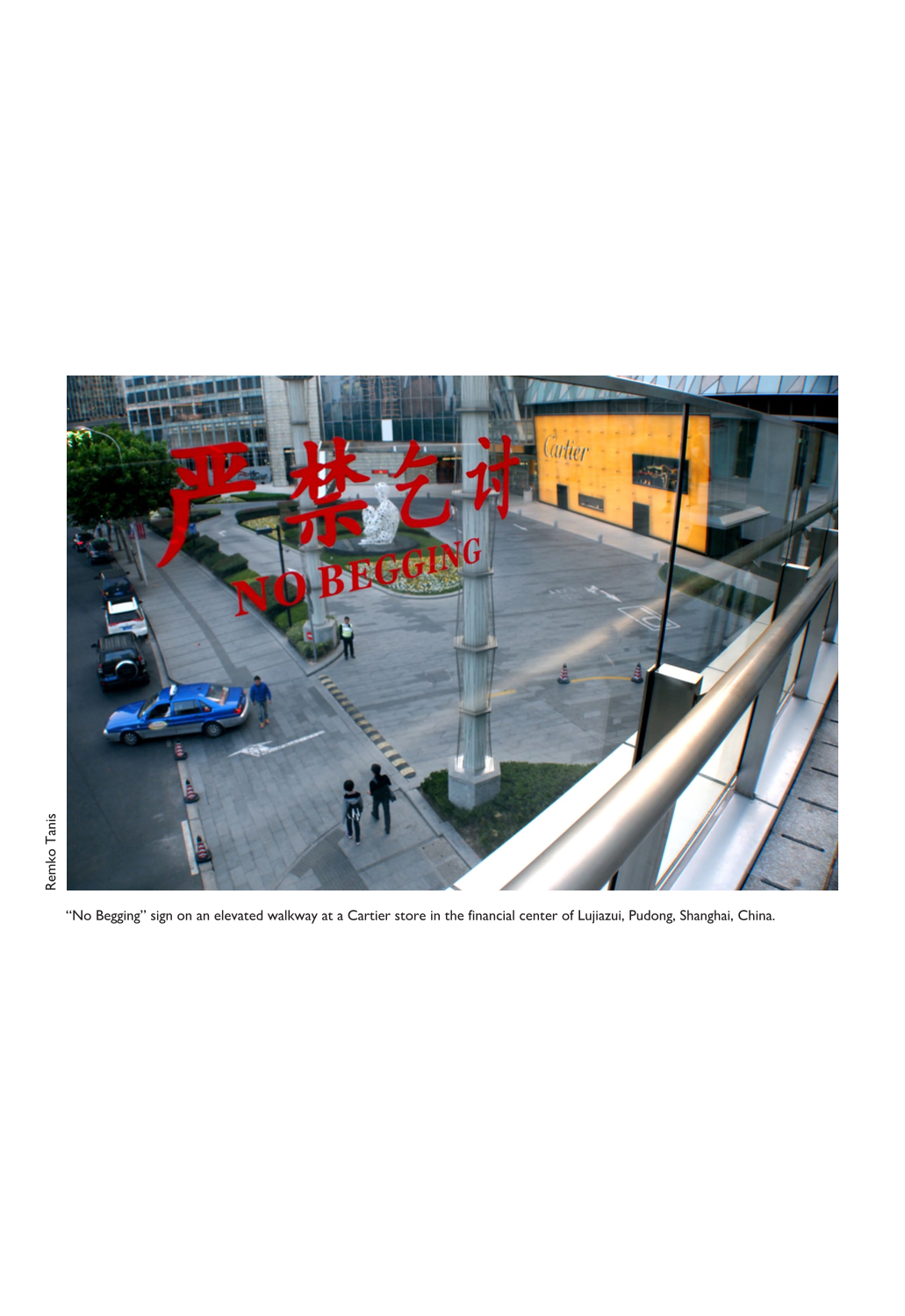
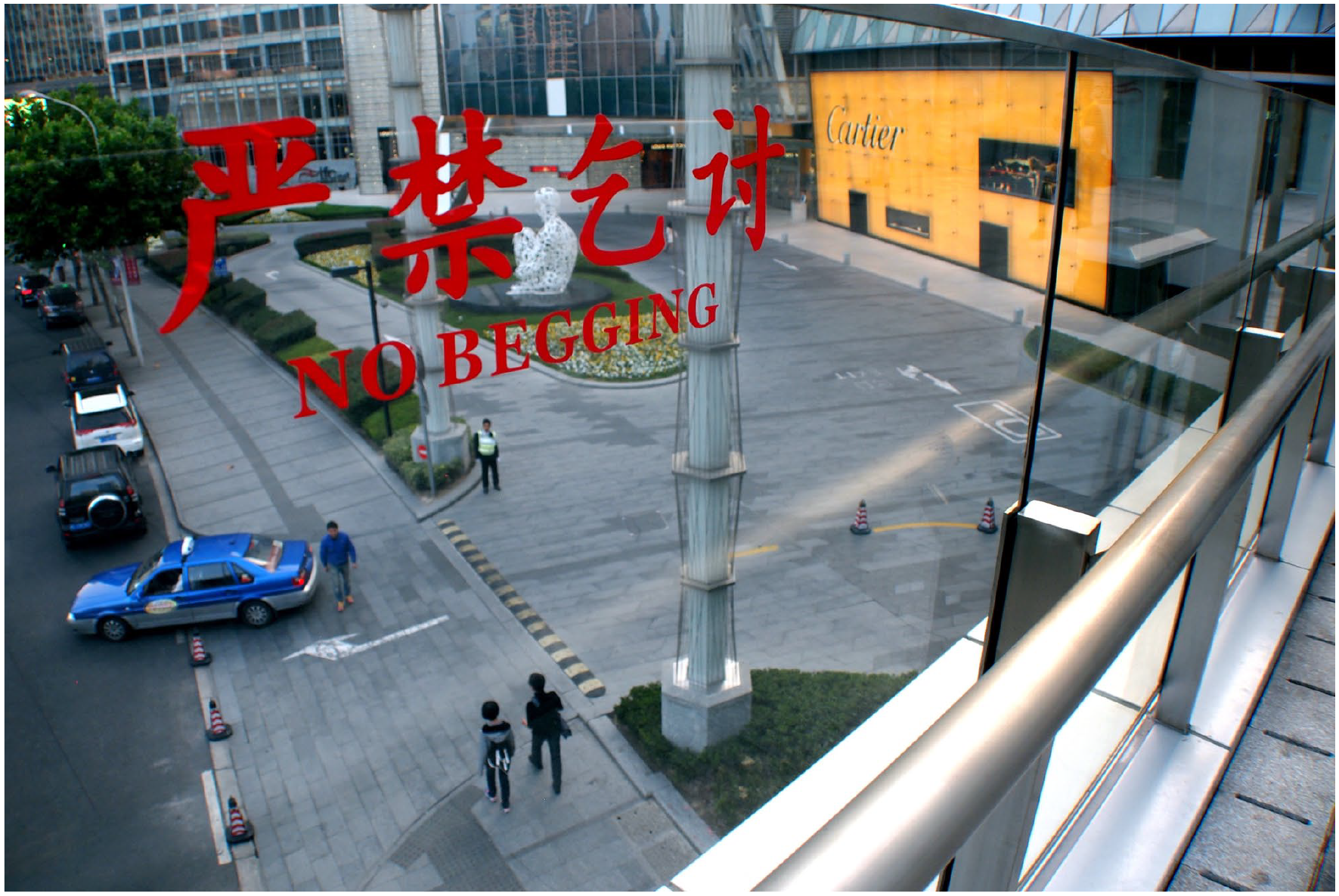
“No Begging” sign on an elevated walkway at a Cartier store in the financial center of Lujiazui, Pudong, Shanghai, China.
Remko Tanis
In the summer of 2021, the Chinese Communist Party (CCP) announced a call for a comprehensive policy program to achieve “common prosperity” (gongtong fuyu), which instantly attracted wide attention from the domestic public as well as China observers overseas. Allegedly aimed to significantly reduce China’s economic inequality, boost mass income levels, and nurture a large and prosperous middle class, this “common prosperity” program has been seen by many as marking a progressive, redistributive, and egalitarian turn in the country’s economic and social policy regime.
Whereas the substance of this program is still in the making, so far it has been most closely associated with a notable strengthening of the state’s disciplinary and punitive hand toward big capital. The announcement of “common prosperity” took place amidst a series of high-profile, dramatic actions targeting some of China’s major tech giants for reasons including financial risk prevention, data security, and anti-monopoly. In November 2020, just days before the Ant Group—a major financial platform and spin-off of the tech conglomerate Alibaba—was about to launch its initial public stock offering (IPO), the Chinese state, citing regulatory concerns, unexpectedly called off what would have been the world’s largest IPO in history. 1 The Ant Group was ordered to go through an organizational overhaul in 2021, which brought it much closer under the regulatory grip of state agencies including the People’s Bank of China. 2 In mid-2021, the ride-hailing giant Didi received a range of regulatory inspections and harsh penalties from cybersecurity, anti-trust, tax, and transport regulators (with its flagship app banned from app stores in China) after it disobeyed the state authority’s subtly communicated order and filed for an IPO in the United States. 3 Also in 2021, the state significantly tightened regulations on entire economic sectors including real estate and private tutoring 4 —almost decimating the latter—which hit their leading companies particularly hard. Indeed, “preventing the disorderly expansion of capital” has been one of the signature slogans of the official “common prosperity” rhetoric. 5 Policy content beyond such head-on disciplining of capital has remained vague so far. For example, although the central government announced its intention to enact a new property tax in October 2021, when, why, how, and to whom this would apply are all unresolved.
The policy . . . could be understood as a necessary technocratic fix for . . . a weak domestic market . . . and a perceived “demographic crisis” caused by low birth rates.
The policy program’s emphasis on economic equality and curbing capital’s power could be understood as a necessary technocratic fix for two fundamental challenges: a weak domestic market that has so far failed to spur economic growth, and a perceived “demographic crisis” caused by low birth rates. But these important structural factors alone cannot explain the political character of the state’s endeavors, particularly why they have prioritized disciplining capital in such a confrontational manner. I will argue that this is because the state has been both strategically responding to a powerful and visibly growing anti-capital sentiment across Chinese society and preemptively dispossessing big capital of any major leverage that could cause the party-state political unease in the future. The fundamental shortcoming of the “common prosperity” program is as well a political one: a paternalistic attitude toward ordinary citizens, including the working class, that sees them as recipients of state goodwill but not agents capable of demanding change through action and organizing.
A Technocratic Fix?
China’s economic inequality has substantially increased since the country embarked on post-Mao reforms. One authoritative study found that by 2007, China’s income GINI index—a conventional measure of a society’s income inequality—had surpassed 0.48, which meant China “had entered the ranks of the world’s most unequal nations in terms of income distribution.” 6 While income inequality slightly decreased between 2008 and 2015, it again fell on a slowly rising trend thereafter. The rise in the wealth GINI index has been even more striking, from 0.49 in 2002, to 0.63 in 2014, to 0.7 in 2018. 7 Social scientists have long argued that the inadequate share by the popular strata of the nation’s wealth has limited their spending power and the growth of the domestic market. 8
This was not a big problem for China’s economy when it could rely on exports and investment in infrastructure and real estate as engines of growth. But as these economic drivers started to lose steam in recent years, the problem of insufficient consumption became more deeply felt. In 2018, “consumption downgrading” (xiaofei jiangji) became one of the biggest trending phrases on social media, referring to a growing phenomenon of belt tightening, curbing unnecessary expenditures and looking for cheaper substitute goods as a result of stagnant or worsening income prospects.
As China came out of the pandemic lockdown in 2020, consumption growth has been much weaker than expected, despite various incentives local governments provided to encourage consumer spending. 9 In the meantime, trade wars in preceding years and new pandemic-related fragilities in the export market convinced China’s policymakers of the necessity to pivot to domestic consumption as the main anchor of the economy, captured by the shift to emphasize a “dual circulation economic strategy” (shuang xunhuan) in 2020. This strategy refers to a growing reliance on the domestic market and indigenous innovation, or “internal circulation,” as the major driver of economic growth, without totally abandoning the export market and cross-border technological exchange, or “external circulation.” 10
The economic challenge coincides with a widespread panic about China’s low birth rates. Analysts have for years warned about China’s unsustainably low birth rates and the pending crisis of population aging, but the results of the seventh national census released in 2021 were even more alarming than expected, leading many to claim that China might enter population decline before the end of this decade. 11 Census results showed the annual population growth rate over the last decade was a mere 0.53 percent, slightly lower than the previous decade. Only 12 million babies were born in 2020, down from almost 18 million in 2016, the year after the partial relaxation of the one-child policy that allowed married couples to have up to two children. China’s total fertility rate—the average number of children a woman is expected to have over her lifetime—stood at 1.3, among the lowest in the world. In 2020, those aged sixty or above comprised 13.5 percent of the population, a dramatic increase from 8 percent a decade ago.
In response to this “demographic crisis,” in 2021, the central state further relaxed the maximum number of children married couples could have to three, and local governments rushed to announce an imaginative range of incentives and benefits, including privileged access to public housing, preferential loans, and generous parental leave. China’s policymakers expressed a determination to tackle the fact that economic hardship and the lack of social support are major reasons why China’s young generation is going on something like a “birth strike.” At least in official rhetoric, this could be partially addressed through measures of the “common prosperity” program such as greater access to affordable childcare, expansion of public housing, and child tax credit provisions. 12
A worrying development, though, is that these policies have been taking place in conjunction with a state-promoted conservative turn—in both rhetoric and policy—that emphasizes heteronormative family values and women’s domestic responsibilities. The state recently instituted a mandatory “cooling off” rule that requires couples who are mutually seeking a divorce to wait for thirty days before finalizing it. The official Women’s Federation has been calling on women to attend to the domestic sphere. 13 Government incentives to have more children so far have failed to address gender inequalities in the workplace and at home, with many feminist advocates worrying that policies like more generous maternity leave risk increasing workplace gender discrimination that the state is willing to ignore to encourage women to stay at home and raise children.
[There is] evidence that more and more youth in China are identifying themselves as “workers” in the classical Marxian sense . . .
While some policymakers were likely swayed by such technocratic rationale supporting a policy shift toward inequality reduction and economic redistribution, these considerations alone cannot explain why the “common prosperity” program has so far been headlined by disciplining and punishing big capital. The answer, as I will show, has to be sought in the realm of political dynamics—in the state’s desire to both consolidate popular support and preempt political threat. At the same time, as I will argue, the state has embarked on an increasingly repressive project that, in both “soft” and “hard” ways, dispossesses ordinary citizens and grassroots movements of the ability to themselves demand change and concession from the state and capital. A “progressive” program developing alongside growing political authoritarianism might appear paradoxical, but it ultimately reflects the party-state’s imperative to guard its own power, invalidating any claim that the “common prosperity” program has a genuinely progressive character.
The Politics of Common Prosperity
Many observers, including those in China who self-identify as leftist, have noted that Chinese society, especially the young generation, is experiencing a leftward turn. Although there is no solid public opinion data demonstrating this, its manifestations seem to be everywhere. 14 Marx’s Capital and The Selected Works of Mao Zedong are becoming popular readings among the young, in a way that has not been the case for the past three decades: according to one statistic, the sales of The Selected Works of Mao Zedong has continuously increased over the past five years and doubled between 2019 and 2020. 15 Multiple friends of mine who teach in China’s universities and interact daily with college students say the main driver of this trend is not state pressure for compulsory reading of “red” classics, but indeed young people’s surge of interest in such texts. In 2020 and 2021, several catchphrases went viral online, especially among the youth: one was “dagongren” (meaning “laborer”), which many young people use to label themselves as part of the laboring masses; another is “tangping” (“lying flat”), referring to their (mostly implicit) resistance to their bosses’ call on them to work hard 16 ; yet another is “gongren yeye” (literally meaning “you should call us workers ‘grandpa’”), used to express frustration with the lack of social status and respect they experience as workers, particularly vis-à-vis their bosses. These discursive phenomena can indeed be taken as evidence that more and more youth in China are identifying themselves as “workers” in the classical Marxian sense—part of a proletariat being exploited and oppressed by capitalists—and suggest some kind of embryonic class consciousness in the making. Correspondingly, young people have been painting “capital” and “capitalists” in a negative light. One example often cited by media analysts is the dramatic turn of public opinion against Jack Ma, founder of Alibaba and one of China’s signature private capitalists. Within a span of three or four years, the sentiment toward him on major social media platforms such as weibo and bilibili has shifted from awe and adoration—with many social media users calling him “papa”—to deeply felt hatred, with many calling him “vampire” and arguing that he should be hanged, following his defense of information technology (IT) companies’ long work hours and condescending comments toward women in the workplace. 17 In another telling example, observers were startled by the number of people online who celebrated the passing of Zuo Hui, founder of Homelink and Beike, two of China’s major real estate brokerage companies, who died of cancer at fifty years of age in May 2021. 18
[The anti-capital turn] is not the work of state indoctrination but is rooted in people’s experiences with the objective reality of Chinese capitalism . . .
I personally have reservations calling this public opinion shift a leftward turn, both because the term “left” (besides conjuring up figures like Marx and Mao and their texts) means very different things to different people in China and because the political content of this turn is ambiguous at best: some people have developed an explicit critique of capitalism as a social system and its political apparatus (i.e., the state), whereas most have not; some hold visions and ideas about an alternative social order they would want to embrace, whereas most do not; some are aware of the importance of workers’ collective struggles as the key mechanism of progressive social change, whereas most are not. What these people are united by, therefore, are not a set of elaborate political views but rather a strong sense of anger, disgust, and frustration with their material suffering at the hands of capitalistic actors. It is therefore more accurate to call this an “anti-capital”— rather than “leftward” or “anti-capitalist”—turn.
It is important to reiterate that this turn is not the work of state indoctrination but is rooted in people’s experiences with the objective reality of Chinese capitalism, which has entered a new stage. As economic growth slows down and room for new profit-making activities shrinks, capitalistic competition increasingly takes the form of cutting labor costs, resulting in stagnant wages and benefits, abrupt layoffs, fewer prospects for upward career mobility, heightened workplace competition, increased workplace surveillance, and worsening labor conditions. Many of these things have been experienced by manufacturing and low-wage service-sector workers for decades, but in recent years they have become much more prevalent in traditionally “middle-class” sectors such as IT, in which workers who used to see themselves as professionals and their jobs as a path toward prosperity now increasingly recognize their workplace experience as one of exploitation. This has led to some high-profile organizing efforts to air grievances, share information, and build solidarity, such as the anti-996 initiative organized by IT workers in 2019 to expose the extent of mandatory overtime requirements and the Worker Lives Matter campaign, launched in 2021 to share information on employers’ behavior and working conditions across companies on an embryonic organizing platform. By loudly demonstrating their discontent through collective organizing, IT workers have made themselves a prime example of middle-class sectors participating in the anti-capital shift.
. . . “middle-class” sectors such as IT . . . increasingly recognize their workplace experience as one of exploitation. This has led to some high-profile organizing efforts . . .
Meanwhile, the Chinese economy is increasingly dominated by private monopoly capital, particularly platform giants (conglomerates whose core business models rely on facilitating transactions on digital platforms), with their influence penetrating almost every walk of life. In 2019, the top three e-commerce platforms—Alibaba, JD, and Pinduoduo—accounted for 80 percent of all online purchases in China. 19 As a result, a growing segment of the population is being squeezed by monopoly capital not only as workers but also (sometimes simultaneously) as tenants, debtors, consumers, small investors, and small business owners who are either driven out of existence by platforms or are dependent on them for survival. As capital reveals its predatory and rentier character in spheres beyond the workplace, it is now much easier for people to connect the dots and trace their everyday hardship to capital. She Zongming, a famous media commentator, noted in July 2021 that the view of capital as having not only “original sin” but also “comprehensive sin” is getting extremely popular among the young. 20 As people’s concrete experiences with a changing Chinese capitalism drive the growth of anti-capital sentiment, the state-mandated pedagogy of Marxist orthodoxy also provides people with a vocabulary to make sense of their experiences, express grievances, and identify “capital” as the culprit.
. . . [R]iding on the wave of anti-capital popular sentiment also helps mitigate the state’s own sense of insecurity vis-à-vis the platform giants . . .
The state’s disciplining of capital could be seen, in part, as a response to this sentiment. I am not arguing that grassroots sentiment pushes the state to act, but that this broad and emotionally energetic sentiment has created a precious political opportunity for the state to consolidate popular support by posing as a benign regulator, preventing the worst excesses of capital. Because of the politically ambiguous nature of the anti-capital shift, many of those angered at capital are intuitively poised to rally around a state that comes across as “fighting hard against capital.” So far, the Chinese government has exploited this opportunity quite artfully, with its slogan of “preventing the disorderly expansion of capital” and disciplinary actions drawing high praise from the public, the effect of which was further amplified by negotiations between China’s healthcare authority and pharmaceutical companies—heavily publicized by state media in December 2021—in which the former aggressively pushed the latter to cut the prices of their drugs to be included in public healthcare insurance coverage. The net result has been a popular perception of the state as standing up for the “people”—a perception that neglects how the state organizes and reproduces the conditions of existence of capitalism as a mode of production.
Of course, riding on the wave of anti-capital popular sentiment also helps mitigate the state’s own sense of insecurity vis-à-vis the platform giants, which hold the power to effect visible changes in the lives of millions of highly dependent customers who also generate a vast amount of valuable data. At least in theory, this, along with the scale of their operations, provides the companies with potential sources of leverage that could be used to demand concessions from the state. And the companies’ interlocking networks and cross-sector expansion multiply such leverage: for example, Alibaba and Tencent, China’s two leading tech companies, hold sizable shares in other major companies in social media, video streaming, ride-hailing, electronics, logistics, retail, and more. 21 Making sure these companies fall further into the orbit of state regulation and dispossessing them of such leverage are thus of paramount importance for the party-state.
The Missing Agents of Change
Meanwhile, the party-state has shown absolutely no interest in empowering grassroots actors to organize and demand progressive change. On the contrary, since Xi Jinping took power in 2012, the state has significantly narrowed the space for self-organizing. The labor movement has been one of its main casualties.
[T]he state has significantly narrowed the space for self-organizing. The labor movement has been one of its main casualties.
Ever since 2013, and particularly since 2018, the state has developed much more sophisticated methods of surveilling and containing workers’ collective actions; devoted much more attention to identifying, prosecuting, and neutralizing leaders who emerged from collective action and self-organizing; left much smaller room for labor non-governmental organizations which in the past had played a role, however small, in facilitating workers’ action and organizing; and harshly repressed left-wing students, activists, and intellectuals. In the second half of 2021, soon after “common prosperity” was announced as a top priority, a left-wing labor researcher was detained on charges of “subverting state power,” 22 and the Worker Lives Matter campaign was shut down two weeks after its launch. Grassroots self-organizing, particularly working-class self-organizing, seems to be seen by the state as a major (potential) threat.
This calls into question the progressive character of the “common prosperity” program. It suggests that the party-state’s fundamental concern is to protect its own power, by consolidating popular support and preemptively disempowering grassroots challenges. The political logic behind it is deeply paternalistic, one that says to citizens, “I will give you good things, but you won’t be able to demand them through action.”
To some extent, this resembles what political scientist Manfred Elfstrom has shown in his recent book Workers and Change in China: Resistance, Repression, Responsiveness: over the past decade or so, the Chinese state has responded to workers’ contentious activity by both granting material concessions and tightening the space for collective organizing. 23 In the “common prosperity” era, the state is going beyond merely granting concessions to actively mobilizing popular support by portraying itself as a protector of citizens’ well-being against capital, while elevating the political tightening to a new level. One may even speculate that the Chinese state was concerned that the burgeoning anti-capital sentiment, if left to its own devices, could develop the kind of clarity, radicalism, and agency that eventually feed into independent grassroots and labor movements. Thus, channeling an “immature” anti-capital sentiment into a pro-state one, while suppressing independent organizing, makes much sense for the state.
The state is certainly able to demand that big capital play by the rules, and treat workers, consumers, debtors, renters, and small investors a bit better, especially if this wins it political credit. It can enact more redistributive taxation and devote a larger share of public spending to certain social provisions—although policymakers have also loudly denounced “welfarism,” by which they mean welfare provisions so generous as to encourage “laziness,” something they ignorantly and condescendingly associate with Latin America. 24 Some segments of Chinese society might indeed benefit materially from such measures. However, without strong popular sectors—especially a strong working class—able to hold the state accountable and act as a counterweight to capital, material gains are highly subject to reversal. On the other hand, it is exactly this public passiveness, which the state endeavors to maintain, that ensures capital’s structural domination over the popular sectors, however much the state disciplines particular capitalistic enterprises.
Footnotes
Declaration of Conflicting Interests
The author(s) declared no potential conflicts of interest with respect to the research, authorship, and/or publication of this article.
Funding
The author(s) received no financial support for the research, authorship, and/or publication of this article.
