




Abstract
We explore the transformative impact of integrating generative artificial intelligence (GenAI) in the form of large language models (LLMs), large behavioral models (LBMs), and agentic AI into physical service robots and how these will transform physical service encounters. This conceptual article first shows that GenAI-powered service robots (also referred to as GenAI robots) will be able to autonomously deliver more complex, customized, and personalized customer service. Second, GenAI’s increasing capacity for no-code programming is expected to democratize robot training, improvement, and fine-tuning by frontline employees, thus improving robot performance. Third, the implications of GenAI robots are outlined for frontline employees (i.e., their work and job scopes, and a new role as citizen developer), customers (i.e., improved customer experiences and service outcomes), and the service firm (i.e., a pathway to cost-effective service excellence, continuous improvement and agility, alleviation of labor shortage, and the introduction of new ethical, fairness, privacy, health, and safety risks into physical service encounters). This article is the first to explore the theoretical and practical implications of GenAI robots in physical service encounters and opens a new stream of service research.
Keywords
Introduction
Robots are increasingly used to transport critical medication to nurses and their patients. However, these robots are mostly deployed for simple and repetitive tasks, and numerous implementations have not provided the anticipated returns (Knof et al. 2024). This is expected to change with the integration of generative artificial intelligence (GenAI) into physical service robots. Imagine the following. In a high-pressure hospital environment, a service robot is tasked with delivering critical medication, supplies, and consumables to nurses. On its first day, the robot takes too long to deliver medication, resulting in a potentially dangerous situation. The nursing staff immediately intervenes and questions the robot. The robot explains that it misunderstood the urgency and failed to correctly interpret the doctor’s instructions due to its limited contextual awareness. By asking the robot what it did and why, and then explaining what should be done in such a situation and why, the head nurse “trains” the robot. This conversation improves the robot’s decision-making by clarifying how to prioritize emergency requests, an improvement that is shared through fleet learning across all robots in the hospital. The following day, a robot on another floor accurately prioritizes the delivery of medication in an emergency. This scenario demonstrates the promise of GenAI-powered service robots that autonomously pursue desired service outcomes.
Industry experts are convinced that GenAI-powered service robots will transform our economies. Huang (2025), CEO of Nvidia Corp, proclaimed, “The next wave of AI is physical AI . . . the era of robotics has arrived.” Narain (2025), Group Chief Executive of Technology and CTO of Accenture, states “Robots will be able to move into customer-heavy environments, work in unpredictable settings, communicate with anyone and take on any number of tasks, without needing to be specifically trained for each” (p. 26). In parallel to these GenAI advances, robot dexterity is also improving with some now being able to even “thread a needle” (Citi Global Perspectives & Solutions 2025, p. 3). These advancements are expected to result in exponential growth in GenAI-powered robot installations. For example, Citigroup projects an installed base of 750 million AI-powered robots by 2030, 1.3 billion by 2035, and 4 billion by 2050 that deliver services and help people in their homes (Citi Global Perspectives & Solutions 2025, p. 7). In this article we explore the integration of GenAI in the form of large language models (LLMs), large behavioral models (LBMs), agentic AI, and the no-code programming these technologies facilitate (Bornet et al. 2025; Economist 2024; Eliot 2024) into physical service robots (Wirtz et al. 2018).
We argue that these advancements and the integration of GenAI offer new opportunities for automating and scaling physical service encounters. This is especially exciting as physical service encounters have hitherto been lagging their digital counterparts in AI-enabled productivity increases (Bornet et al. 2025; Wirtz et al. 2023a).
This conceptual article draws insights from the literature in services marketing, service operations, and service management as related to technology, and the combined decades-long experience the author team has in research, consulting, and executive teaching on these topics. The discussions and reflections in this article are supplemented by insights from 13 industry and academic experts interviewed via email. They were selected based on their prominence and thought leadership in service robots and AI practice and research. The experts interviewed are (in alphabetical order): Pascal Bornet (industry expert and author), Kevin Clark (President, Content Evolution), Kieran Gilmurray (Chief AI Innovator, Technology Transformation Group), Merlind Knof (PhD student in the area of service robots, Technical University of Darmstadt), Tobias Kölsch (industry expert and consultant), Werner Kunz (Professor of Marketing and Director of the Digital Media Lab, University of Massachusetts Boston), Marcello Mariani (Professor of Entrepreneurship and Management, Henley Business School and University of Bologna), Cristina Mele (Professor of Service Innovation, University of Naples Federico II), Mekhail Mustak (Assistant Professor, Hanken School of Economics), Gaby Odekerken-Schröder (Chair in Customer-Centric Service Science, Maastricht University), Valentina Pitardi (Senior Lecturer in Marketing, University of Surrey), Kevin So (Professor, School of Hospitality and Tourism Management, Purdue University), and Jim Spohrer (Member Board of Directors, International Society of Service Innovation Professionals).
The interviews were conducted via email, with the working paper version of this article being presented as a backdrop. Each expert was asked to read the working paper, add comments and edits directly into the paper, and provide suggestions for theoretical and managerial implications and further research directions. That is, an adapted soft positivism approach was used in our interviews and analysis, whereby experts were guided to reflect on the working paper while they were also explicitly prompted to think beyond what was covered so that additional implications and further research ideas could emerge. In cases where expert comments are cited verbatim in this article, the expert’s full name (i.e., including first name) is provided in brackets.
In this article, we make the following contributions. First, we advance that the integration of GenAI (i.e., LLMs, LBMs, and agentic AI) will enable service robots to autonomously deliver more complex, customized, and personalized customer service in physical face-to-face service encounters. That is, GenAI-powered service robots will enable automation and scaling of physical service encounters, a context that has hitherto lagged behind their virtual, information-processing-type service counterparts.
Second, we propose that the introduction of GenAI-facilitated no-code platforms will democratize robot programming, allowing nonexperts such as frontline employees, to become “citizen developers” who train, improve, and fine-tune robot performance. This perspective broadens the framework of human-robot interaction (HRI) by showing how GenAI reduces the dependency on technical skills in frontline service modification.
Third, we develop a set of implications of GenAI-powered service robots for frontline employees (i.e., changes in their work and job scopes, and the introduction of a new role as citizen developers), customers (i.e., improved customer experience and service outcomes), and the service firm (i.e., these robots provide a new pathway to cost-effective service excellence through scalable service excellence and enhanced productivity; they drive continuous improvement and agility; alleviate labor shortage; and introduce new risks that have to be mitigated).
Finally, this article opens a new stream of service research on LLM-, LBM-, and agentic AI-powered service robots in physical service encounters.
Integration of GenAI into Physical Service Robots
Service robots are defined as “system-based autonomous and adaptable interfaces that interact, communicate and deliver service to an organization’s customers” (Wirtz et al. 2018, p. 909). Until today, however, service robots have not lived up to their expectations. Rather, the implementation of service robots has been difficult, and their capabilities in physical service environments in terms of adaptability and autonomy have been limited. At present, service robots are mostly used for basic, predetermined, preprogrammed, and scripted tasks (Knof et al. 2024). For example, robots such as TUG, offered by Aethon, handle supply deliveries in hospitals today, but they follow preprogrammed routes and do not yet have the level of flexibility described in our opening vignette. The integration of GenAI into service robots will change this. GenAI enables physical robots to become more intelligent and adaptive, which allows them to autonomously respond to dynamic environments and deliver the desired outcomes. These capabilities are especially important in customer-facing roles that have to respond to heterogeneous and dynamic interactions with customers. GenAI-powered service robots finally seem able to deliver on their original promise (cf., Wirtz et al. 2018).
LLMs, LBMs, and Agentic AI
The enhanced capabilities of GenAI-powered service robots are enabled by the synergistic integration of LLMs, LBMs, and agentic AI into physical robots (Economist 2024; Eliot 2024; Huang 2025; Narain 2025).
Large Language Models
LLMs, like OpenAI’s GPT-4o with their APIs and interfaces, have rapidly transformed natural-language understanding and generation across various fields (Yang et al. 2024). In HRI, researchers have leveraged these models to enhance conversational abilities in robots (e.g., Billing, Rosén, and Lamb 2023; Cherakara et al. 2023), generate smooth dialogues, and display emotive expressions based on sentiment analysis (Cherakara et al. 2023). For example, Atlas, a robot produced by Boston Dynamics, uses ChatGPT to elaborate on descriptions, answer questions, and explain what actions it plans to take.
The integration of LLMs into physical service robots allows them to engage in more nuanced, contextually relevant, and empathetic conversations, which is a substantial advancement over traditional robots (Mele et al. 2025). For example, in a healthcare context, they can provide dynamic responses, explain complex medical terminology in accessible language, answer frequently asked questions about treatment plans, and provide empathetic dialogue to provide emotional support during stressful moments, alleviate feelings of anxiety, and even offer guided relaxation techniques to reduce preoperative anxiety (Cristina Mele). These capabilities can enhance their effectiveness in many domains beyond healthcare, including education and care provision, where human-like interaction is critical to fostering trust, understanding, and emotional well-being. By adapting dynamically to the needs of individuals, these robots are transforming the scope and depth of human-robot interactions in meaningful and impactful ways (Mele and Russo-Spena 2025).
Large Behavioral Models
LBMs contain large sets of behaviors, just as LLMs contain texts. These sets of behaviors can be built through robots observing human behaviors and asking questions, and through trial and error using their cameras, microphones, and touch sensors (Economist 2024; Eliot 2024; Narain 2025). The training of these robots can be done initially by showing, for example, how to pick up a glass in the real world. Then, the learning can be transferred into a virtual world (e.g., using digital twins) where the model can be given millions of different examples. Robots cannot tell the difference between real and digital worlds, which allows learning to happen in millions of worlds running in parallel. This means millions of permutations of picking up a glass could be learned within a day (Huang 2025). Furthermore, these sets are transferable across tasks (e.g., helping an elderly customer pick groceries in a supermarket can be transferred to a hardware store). As expressed by Gill Pratt, Toyota’s chief scientist and CEO of Toyota Research Institute: “If you give a robot the confidence to work in a kitchen, it will also have the confidence to work in a factory or a person’s home” (Economist 2024, p. 69) and, as we advance in this article, in physical service encounters.
Agentic AI
Agentic AI is viewed by experts as one of the most important AI developments happening today (Bornet et al. 2025; Davenport and Bean 2025). Agentic AI further enhances service robots’ autonomous decision-making abilities and interactions with customers and their environment, allowing them to react more dynamically to situations without needing specific instructions for each task. It enables service robots to autonomously pursue specific goals (e.g., achieving a specific service outcome), make the necessary decisions, and take the required actions to achieve that goal. That is, unlike typical LLMs that provide information or summarize output, agentic AI takes action (Bornet et al. 2025). It enables service robots to autonomously process inputs (including from cameras that allow them to perceive their surroundings, microphones to listen to dialog, and API-linked data sources such as CRM and booking systems), build and evaluate alternative courses of action, select the best option, plan the execution (e.g., sequencing tasks, setting priorities, allocating resources, and managing timelines), and execute the required tasks to achieve preset goals without continuous human guidance (Aggarwal 2024; Narain 2025).
Multimodal Input into GenAI-Powered Service Robots
LLMs, LBMs, and agentic AI operate synergistically with multimodal input that allows robots “to see, to learn, to move, to talk, and take instruction” and translate these inputs into code and then actions (Citi Global Perspectives & Solutions, 2025, p. 3). Understanding language input is required for service robots to communicate with customers and frontline employees. LBMs are needed to execute physical tasks, and agentic AI governs the course of action robots take to achieve the desired customer experiences and service outcomes. (Note, in the remainder of this article, we refer to service robots that use LLMs, LBMs, and agentic AI interchangeably as “GenAI-powered service robots,” “GenAI service robots,” or simply “GenAI robots”).
GenAI robots allow service firms to automate and scale physical service encounters while also personalizing and improving customer satisfaction in ways previously impossible. To illustrate, these technologies can create a seamless fusion between virtual intelligence and real-world presence better than human employees could and thereby enhance their ability to provide human-like interactions at a higher performance level (Cristina Mele). These abilities include contextual adaptability that allows service robots to maintain thematic coherence in dynamic, multi-turn conversations, adjust responses to new and unforeseen contexts, sense nuances in human language such as tone or urgency, remember information from previous conversations, make interactions more natural, personalize interactions, have multilingual capabilities, creative problem-solving, error handling, and service recovery, and customer-centric and goal-oriented task execution and service provision (Cristina Mele; Mekhail Mustak).
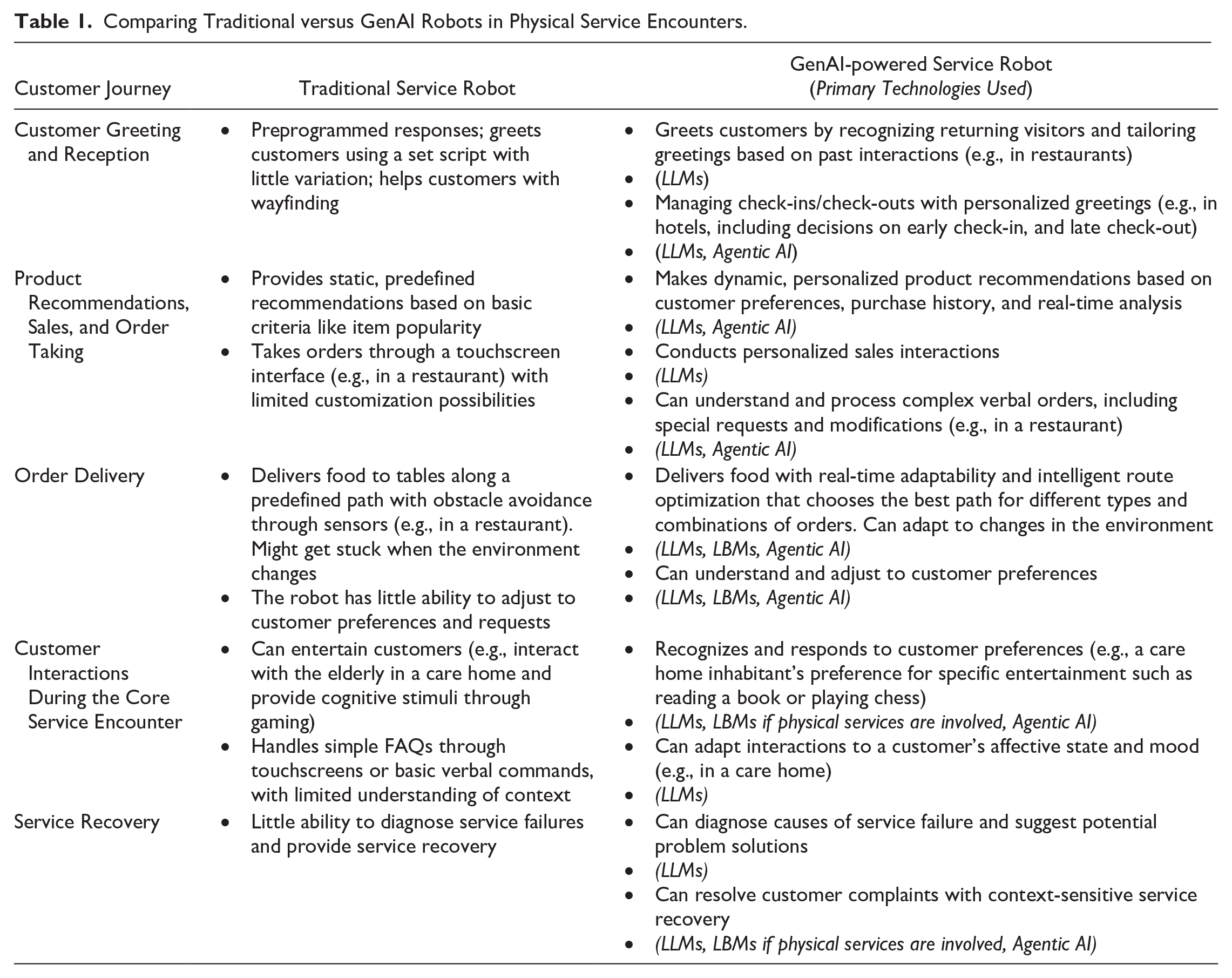
Table 1 illustrates the transformation in service delivery brought about by the integration of GenAI into service robots across a typical customer journey and shows the new roles they can assume with their GenAI capabilities. Traditionally, robots in service environments, such as retail and restaurants, were limited to performing simple, scripted tasks with little to no adaptability (Knof et al. 2024). These tasks included basic customer greetings, order taking, and delivering items along predefined paths. The lack of flexibility and personalization often resulted in static and somewhat impersonal customer experiences. The integration of GenAI into service robots expands the range of tasks that robots can perform, enabling them to take on more complex customer-facing roles.
Comparing Traditional versus GenAI Robots in Physical Service Encounters.
Note that we do not advance that GenAI-powered robots achieve artificial general intelligence (AGI) in the immediate future. Even with the integration of LLMs, LBMs, and agentic AI, these robots are developed for and deployed in specific service contexts for defined tasks. That is, intelligence is currently demonstrated only in specialized domains. To illustrate, Waymo’s autonomous vehicles integrate LLMs (e.g., they take instructions from passengers and can interact with them), LBMs (e.g., they operate the car), and they have agentic AI (e.g., they decide on the best route to take based on traffic conditions and passenger preferences), but they do not show AGI as their intelligence is domain specific. In contrast, AGI is generally defined as a general-purpose intelligence that can adapt to a wide range of situations and domains, very much as humans can (Bergmann and Stryker 2024). Leading robot manufacturers that are working on general-purpose robots include Boston Dynamics (Atlas), Figure AI (Figure 02), and Tesla (Optimus Gen 3) (Diamandis 2025). However, it is not clear yet how fast AGI can be achieved. Nevertheless, the examples provided in the remainder of this article are specific applications that do not require AGI and are already working in laboratory environments and in-field pilots, and many are realistically already implementable now or at least within the next 12 months to 3 years on a large scale (see also the four near-future scenarios developed by Mahr et al. 2025).
No-Code Programming of Service Robots
One important feature of GenAI-powered service robots is that they facilitate no-code programming. The opening scenario showcased no programming in action. That is, frontline employees can “train” service robots simply through a conversation and/or physically showing them how to do something better and thereby improve a robot’s performance.
Benefits of No-Code Programming
For the average user, it can be challenging to personalize or modify a service robot’s actions. Rather, configuring robot behavior usually demands advanced technical skills such as a background in computer science or engineering (Bornet et al. 2025). For example, if a service robot makes a mistake, developers need to manually diagnose the issue, rewrite the code, and update the robot’s software. This involves writing complex code to define every possible action and response a robot might need, followed by multiple iterations of coding and testing in controlled environments before deployment to ensure the robot behaves as expected in real-world scenarios. This process is time-consuming and costly.
In contrast, with GenAI-enabled no-code programming, a robot can learn from real-time interactions and immediately update its algorithms based on feedback. Instead of waiting for a manual software update, the robot adapts instantly, and the improved behavior can be disseminated across all robots in a network (also called “fleet learning”; Economist 2024), subject to human supervision and fine-tuning in sensitive contexts (Mustak Mekhail). While no-code platforms were available for some time (e.g., Plural.io, Zora ZBOS, and Temi Center), they had limited flexibility as they were not linked to GenAI yet (Tobias Kölsch). This shift from a rigid and time-consuming coding process to dynamic, GenAI-driven learning significantly enhances a robot’s ability to respond to new situations, ensuring faster and more accurate service.
Evolution of Programming Approaches
Figure 1 illustrates the evolution of programming approaches for humanoid robots, progressing from code-based programming to no-code programming. It spans different decades, from the 1980s to the 2020s, showcasing the transition in terms of developer expertise required and the tools used for robot programming.
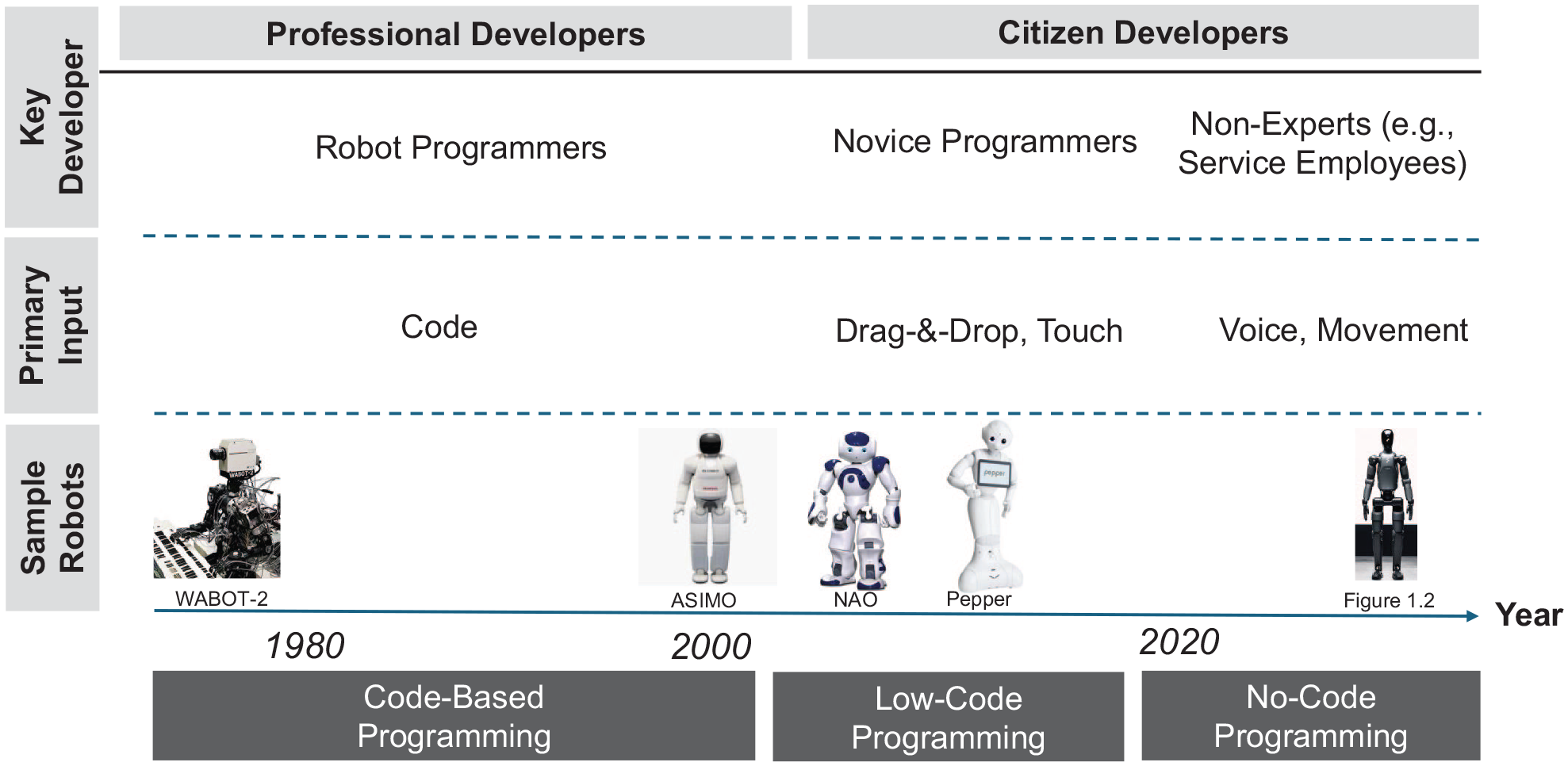
Evolution of programming approaches.
Code-Based Programming (1980s–2000s)
This type of programming requires professional programmers to write complex code. The primary input is manual coding, with developers using languages like C and C++. Early humanoid robots during this era, such as WABOT-2 (1980s) and ASIMO (2000), were programmed using custom code written specifically for their hardware.
Low-Code Programming (2000s–2020)
In the low-code era, programming robots became more accessible, allowing novice programmers to use visual programming tools and drag-and-drop interfaces such as Choregraphe (Bornet et al. 2021). Low-code solutions usually require some initial installation and limited coding skills. Robots such as Nao and Pepper utilize such platforms to simplify tasks, making robot programming easier for nonexpert developers.
No-Code Programming (2020s and Beyond)
The current and future landscape focuses on no-code platforms, which allow even those without programming knowledge to configure robots through simple interfaces using voice commands, gestures, and movement (Edigbe and Drezner 2024). These enable users to customize robots’ functionalities and adapt them to a variety of scenarios (Cristina Mele). Service robots such as those in Figure 02 are programmable through intuitive, natural-language interfaces. Users can simply tell the robot what and how it should execute a task, and the robot itself will translate these instructions into code. That is, the programming is effectively done by the robot.
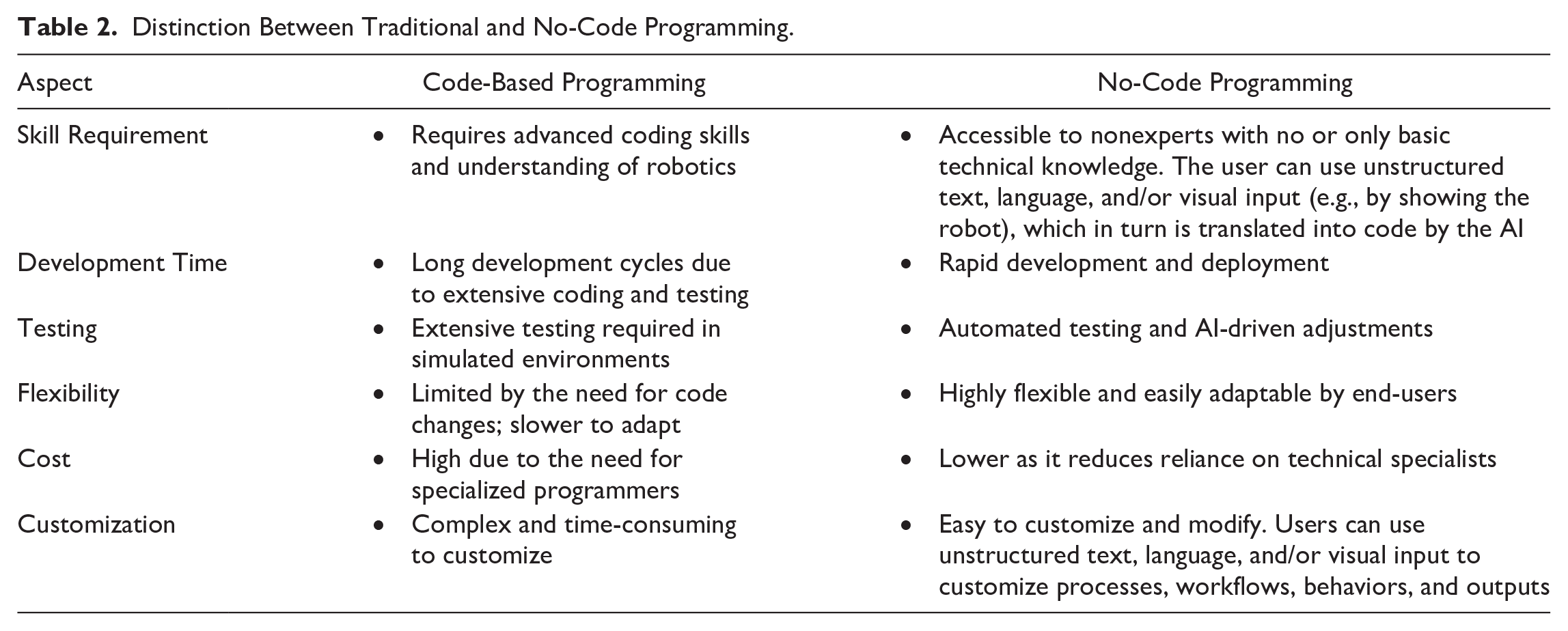
The advent of no-code platforms has revolutionized the way service robots can be programmed and trained, fundamentally altering the process from a highly technical endeavor to one that is accessible to nonexperts. The differences between traditional programming and no-code programming are contrasted in Table 2. In the following sections, we discuss the implications of GenAI-powered service robots and their no-code programming feature in the service context.
Distinction Between Traditional and No-Code Programming.
Implications for Service Firms and Propositions
The integration of GenAI into service robots is expected to change the employee and customer experience and transform service operations. In this section, we examine the implications for service employees, customers, and service firms and their operations. We advance a series of propositions for each group of stakeholders.
Implications for Service Employees
GenAI-powered service robots are expected to change frontline employees’ job scopes and requirements. We discuss first how job scopes change, followed by introducing the concept of citizen developer to the frontline.
Frontline Work and Job Scopes
With robots taking over standard and often unpleasant tasks and roles (also referred to as “dull, dirty, dangerous, and disgusting” tasks; Knof et al. 2024), human employees can focus on higher-level tasks that require emotional intelligence (e.g., empathy and building trust), complex decision-making (e.g., decisions that include moral reasoning), and creative problem-solving (e.g., considerations that involve thinking “outside the box”) that are still beyond the scope of GenAI service robots. That is, human frontline employees will focus on areas where they excel and add the most value over service robots (Huang and Rust 2024). This reallocation of tasks not only improves operational efficiency but can also enhance job satisfaction by allowing human workers to engage in more meaningful and less repetitive work. It also means that frontline roles will be more demanding in terms of required skill levels; there will be fewer jobs that require basic skills (cf., Acemoglu and Restrepo 2022; Graetz and Michaels 2018) as these are taken over by service robots (cf., Bornet et al. 2021; Huang and Rust 2024). As such, we advance the following propositions.
P1: Human service employees will focus on tasks that require higher-level emotional intelligence, complex decision-making, and creative problem-solving. GenAI-powered service robots will execute most routine and unpleasant tasks in customer service (i.e., those that are dull, dirty, dangerous, and disgusting).
P2: There will be few(er) jobs for less skilled frontline employees.
Citizen Developer—A New Role for Service Employees
Citizen developers refer to “technical people with little or no programming skills—who would be using no-code platforms to program various software solutions in specific domains” (Avishahar-Zeira and Lorenz 2023, p. 103). These had their advent with the start of the low-code programming era (Figure 1). Citizen developers can be designers or business professionals and typically emerge from domain experts in specific fields of an organization as they have a deep understanding of the processes to be redesigned and can develop solutions tailored to their specific needs (Thacker et al. 2021). No-code tools enable non-technical individuals to build applications through visual programming and, recently, also natural-language interfaces, reducing or eliminating the need for traditional coding (Bornet et al. 2021, 2025; Economist 2024).
Frontline employees will not do the basic development, integration, configuration, and implementation of service robots. These are likely to be done by robot engineers. However, as shown in the opening vignette, frontline employees can be expected to fine-tune and improve the behavior and responses of service robots once implemented. As such, future frontline employees can be considered citizen developers.
The concept of citizen developers can be concretely applied to service employees in industries such as healthcare, as shown in the opening vignette, and retail and restaurants by empowering employees to manage and customize service robots based on their specific operational needs. For example, in a retail environment, service employees could fine-tune robots for tasks such as assisting customers, stocking shelves, and managing inventory. A sales associate could adjust the robot’s behavior to greet customers, direct them to products, or even assist in restocking based on real-time inventory levels. Suppose a seasonal promotion is running, and a product needs to be highlighted. The staff could “train” the robot to specifically mention promotions, guide customers to these items, and arrange the products in certain aisles, all without needing the help of an IT specialist. This flexibility allows retail employees to react to shifting customer demands and operational needs on the fly. In restaurants, waitstaff could adjust a robot’s interaction based on how busy the restaurant is, directing the robot to either focus on quick order-taking during rush hours or more personalized customer interactions during quieter times. This level of customization enhances customer service and creates a more fluid operational flow (Cristina Mele).
P3: Frontline employees working with GenAI robots will take on the role of citizen developers to “train” service robots to improve operations and deliver better service outcomes.
Finally, GenAI service robots can even play an active role in training citizen developers to use their no-code platforms more effectively by providing personalized and adaptive guidance and real-time feedback (cf., Gong 2025). These robots can simplify complex concepts, offer step-by-step instructions, and simulate practical scenarios to empower citizen developers to confidently customize and optimize service robots. That is, employees will not only train service robots but also will learn from them to become more GenAI literate. This can empower citizen developers to unlock new functional capabilities for service robots, expand their applications, and enhance their performance in various domains (Cristina Mele).
P4: Frontline employees can be guided and trained by service robots in how to best customize and optimize robot performance.
Implications for Customers
GenAI service robots are expected to lead to a richer customer experience where robots are not just executing specific tasks but are also able to engage in meaningful dialogue, answer more difficult queries, anticipate customer needs, and deliver the service (Mele and Russo-Spena 2025). From a customer experience perspective, the integration of GenAI into service robots can enhance the overall customer experience, making interactions more natural and human-like (Cristina Mele). GenAI robots are expected to enhance personalization and responsiveness in service encounters far beyond traditional self-service technologies (SSTs) and current robots. The ability to handle complex interactions smoothly creates a more intuitive and satisfying service experience, more seamlessly connecting customer requests with robot actions.
P5: GenAI service robots’ ability to understand and respond to verbal requests enhances the overall customer experience and makes interactions more natural and human-like compared to traditional SSTs and service robots that are not powered by GenAI.
Being connected to a service firm’s IT systems (e.g., CRM systems, transaction databases, and inventory, order, and POS systems) and having “memory” of past interactions with a customer (Bornet et al. 2025), GenAI robots can analyze customer needs more effectively, offer tailored solutions, anticipate issues before they arise, better address unexpected service issues, and execute customer requests in real time (e.g., by informing the kitchen of changes in a customer’s order in a restaurant). These robots seamlessly fuse the firm’s systems and real-world interactions better and faster than human employees can and thereby enhance their service performance (Cristina Mele). Furthermore, a customer-facing service robot could connect to other robots to execute tasks it is not able to do itself. For example, in a retail context, it can ask another robot or system that “owns” and manages stock to get a pair of shoes from a storeroom (Tobias Kölsch). By enabling robots to remember customer preferences and connect to a firm’s systems, they can adapt their responses, offer more fluid and customized interactions, and provide consistent yet customized service. These robots are likely to enhance customer satisfaction and increase brand loyalty (Gaby Odekerken-Schröder) and may deliver on customer preferences beyond what human employees could.
P6: GenAI service robots’ real-time connection with a service firm’s IT systems and having “memory” of past interactions enables them to remember customer preferences, adapt responses, and offer more fluid and customized interactions that can exceed those offered by human service employees.
Finally, improved customer engagement is also gained by the robots’ enhanced emotional sensing (Huang and Rust 2024). This, combined with their advanced linguistic capabilities, allows them to engage in more nuanced, empathetic, and context-aware interactions to provide personalized support, foster emotional well-being, and improve understanding (Mele and Russo-Spena 2025). Near-future scenarios suggest that “service robots become ubiquitous companions in our daily lives, not only performing tasks efficiently but also forming deep emotional connections with their human users” (Mahr et al. 2025, p. 6). These capabilities allow service robots to also handle more emotionally complex and engaging interactions with customers.
P7: GenAI robots’ ability of emotional sensing combined with advanced linguistic abilities enables them to handle more emotionally complex customer interactions.
Implications for Service Firms and Their Operations
The implications for service firms can be organized into areas related to (1) cost-effective service excellence (i.e., service excellence, scalability, and service productivity), (2) continuous improvement and agility, (3) alleviation of labor shortage in service and IT, and (4) new risks introduced into the service encounter that need to be mitigated.
Pathway to Cost-Effective Service Excellence
GenAI service robots offer an additional pathway toward cost-effective service excellence in physical service encounters by enabling service excellence that is scalable at high levels of productivity (cf., Wirtz and Zeithaml 2018; Wirtz et al. 2023a). First, as discussed in the section on implications for customers, GenAI service robots are expected to far outperform standard SSTs and non-GenAI-powered service robots, plus with their constant connection to a firm’s systems (e.g., CRM and transaction databases) and enhanced emotional sensing and communications ability may in many cases match or exceed human employees in terms of transaction-relevant knowledge, customization, and personalization. Also, service robots ensure consistent, high-quality service, reducing the variability associated with human employees (Wirtz et al. 2018). This consistency is crucial for maintaining brand standards and ensuring every customer receives the same high level of service. As businesses scale, the ability to deploy robots that seamlessly integrate interaction and physical action across multiple locations is valuable and new in the context of physical service encounters.
P8: GenAI-powered service robots offer opportunities for achieving and scaling cost-effective service excellence in physical service encounters.
Digital service encounters (e.g., in fintech and healthtech) can easily be delivered through fully automated end-to-end (E2E) platforms (e.g., via websites, apps, and AI agents; Bornet et al. 2025) that are increasingly supported by a GenAI-enabled digital frontline, also called “digital people” (Wirtz et al. 2023a). In contrast, increasing productivity in physical service encounters is difficult (Chase 1981). Here, customer-induced uncertainty (e.g., heterogeneity in customer wants and behaviors) is at the source of the problem that has made it difficult for firms to use systems and machines to industrialize service (Chase 1981). To still facilitate high operational efficiency, firms have used operations management tools such as modularization, reduction of customer choice, and tight scripts to achieve more homogeneous and high-volume processes (Wirtz and Zeithaml 2018).
With the advent of GenAI robots, there is now the possibility to efficiently manage lower-volume and more heterogeneous processes. Furthermore, because of “fleet learning,” these can include also the “long tail” of service transactions that do not happen a lot in any one outlet or location but have sufficient volume system-wide for a robot fleet having learned that process. That is, GenAI robots may facilitate much-enhanced productivity also in physical service encounters. This shift means that the space where service robots can be effectively deployed has expanded considerably, allowing businesses to scale a broader range of service transactions with greater flexibility.
P9: GenAI service robots offer opportunities for achieving significant productivity gains in physical service encounters, even in lower-volume and more heterogeneous service tasks.
Continuous Improvement and Agility
GenAI robots can be expected to learn and improve quickly for a number of reasons. First, unlike their human counterparts, GenAI robots can record, analyze, and synthesize their interactions with customers and distill these exchanges into concise summaries that can guide their own learning and provide information to frontline employees where performance falls short. This ability to capture data effectively digitizes all robot-provided customer interactions. It is similar to today’s analytics on customer website and app behaviors such as clicks, page views, time spent on a page, scrolling patterns, and abandoned baskets. However, as service robots have cameras and microphones, they can collect even more data than websites or apps, including facial expressions, tone of voice, and posture. As for their digital counterparts, these new summaries on physical service encounters can provide employees with actionable insights into the dynamics of these interactions, enabling them to assess performance trends and pinpoint specific areas where robots may be falling short (Mele et al. 2025).
By highlighting deficiencies in robotic responses, GenAI facilitates targeted improvements, ultimately enhancing the effectiveness of robot-provided services and fostering a more seamless customer experience. For example, in a retail setting, a customer-facing robot deployed by a global electronics retailer might struggle to handle nuanced questions about product compatibility or troubleshooting technical issues. GenAI robots can process many interaction logs, and summarize frequent complaints and unanswered queries, such as confusion about device pairing instructions or dissatisfaction with vague responses about warranty policies. By identifying such recurring issues, employees can update the robot’s programming to include clearer, more specific answers or escalate certain topics to human representatives when necessary. This feedback loop ensures continual refinement of a robot’s performance and enhances customer satisfaction (Cristina Mele).
P10: GenAI service robots’ ability to record and analyze physical service encounters and customer interactions provide data and evidence-supported suggestions for improvements.
Frontline employees can act as citizen developers and fine-tune, address smaller, domain-specific problems quickly and with greater autonomy, and improve robot performance using their no-code feature (c.f., Edigbe and Drezner 2024). This allows the frontline to sidestep IT departments which are notoriously overworked and slow (c.f., Avishahar-Zeira and Lorenz 2023). That is, the self-learning of service robots combined with continuous training by frontline employees can be expected to enhance responsiveness, adaptability, and performance as these robots learn and improve quickly. Frontline employees can easily reprogram these robots to improve performance, meet changing customer needs, and respond to new trends without the delay associated with traditional programming methods. This should lead to faster iterations and improvements in customer service and means that service operations could be more dynamic and responsive, offering customer experiences that are continuously refined and improved based on real-time feedback. These targeted improvements ultimately enhance the effectiveness of GenAI robots and foster a more seamless customer experience.
P11: GenAI service robots’ no-code feature allows frontline employees to easily and quickly reprogram these robots and implement improvement ideas, thereby drive continuous improvement and agility of a service firm’s customer interface.
GenAI service robots have system-wide fleet learning capabilities. With GenAI, service robots can learn from individual interactions and apply this knowledge across multiple locations in a service network. Even at any one outlet or branch, seldomly occurring issues and exceptions can be identified as the learning is system-wide across interactions at all branches and outlets. Furthermore, training frontline employees system-wide takes a lot longer than robot fleet learning. That is, improvements can be implemented almost instantaneously across a network. Combined, these features should lead to service firms being able to drive continuous improvement and become more agile, responsive, and adaptive in their customer service compared to today’s service delivery by SSTs and frontline employees with their slower learning, more rigid service processes, and lagging IT support.
P12: The fleet learning capability of GenAI service robots allows firms to identify issues (including rarely occurring exceptions) and implement improvements fast and system-wide.
Alleviation of Labor Shortage in Customer Service and IT
The integration of GenAI in service robots is not only reshaping customer interactions and service processes but also offers a viable solution to the growing labor shortage in many industries. By robots increasing employee productivity (Acemoglu and Restrepo 2022; Graetz and Michaels 2018), delivering more routine and structured tasks, and taking on some more advanced roles, businesses can better manage their workforce needs. This frees up human employees for roles that demand emotional intelligence and creativity (Gaby Odekerken-Schröder) and concentrate on tasks that leverage their unique skills (Bornet et al. 2025; Huang and Rust 2024), thereby creating a more balanced, collaborative, and efficient service environment. AI-powered service robots can fill gaps left by the shortage of qualified personnel, ensuring that essential services continue to be delivered efficiently. This shift allows businesses to maintain high levels of service even in the face of staffing challenges, alleviating some of the pressure caused by the current workforce crisis (Wirtz et al. 2025).
Furthermore, tasks that are low-level and boring, physically demanding, dirty, dangerous, and disgusting are increasingly delegated to service robots (Knof et al. 2024). Removing such tasks from the job scope of frontline roles can make these jobs more attractive, generate more job applications, and thereby also reduce staff shortage (Tobias Kölsch).
Finally, the demand for software engineers and programmers far exceeds the supply with projections indicating a global shortage. By 2030, there are expected to be 45 million software engineers worldwide, a dramatic shortfall from the projected demand of 85 million positions (Avishahar-Zeira and Lorenz 2023). This shortage of IT talent has been pushing the software industry toward no-code tools (Simon 2022), which are also facilitated by GenAI in service robots.
P13: GenAI service robots will help alleviate the shortage of frontline service employees and IT talent.
Risks Introduced into the Service Encounter
Virtually all the benefits and opportunities of GenAI service robots discussed also have downsides and introduce new risks into the service encounter that firms will have to mitigate. First, these robots are (1) connected to a firm’s IT systems and databases, (2) have system-wide memory of past transactions with customers, (3) are embodied with cameras and microphones and can record, store, and analyze their face-to-face interactions with customers (including customers’ facial expressions, tone of voice, and posture), which effectively enables digitization of all robot-provided customer interactions at great levels of detail, (4) have emotional sensing (Huang and Rust 2024), can simulate human emotions such as empathy (Ciriello, Chen, and Rubinsztein 2025), and advanced linguistic capabilities (Mele and Russo-Spena 2025) that can persuade, nudge, and sell to customers, (5) these robots make decisions, and (6) autonomously executive service transactions.
Naturally, these features raise an uncountable number of issues relating to ethics (e.g., ranging from dehumanization, social deprivation, threat to human dignity, disempowerment to predicting, nudging and manipulating customers in physical service encounters better than any human frontline employee could), fairness (e.g., biases and discrimination in decision-making), and privacy (e.g., ubiquitous surveillance, recording of preferences, transactions, and behaviors) (cf., Ciriello et al. 2025; Kunz and Wirtz 2024; Lobschat et al. 2021; Wirtz et al. 2023b). Furthermore, as GenAI robots move and deliver service in the physical world, additional health (e.g., hygiene in a restaurant) and safety issues (e.g., risk of injury and property damage) are introduced.
P14: GenAI service robots introduce new ethical, fairness, privacy, health, and safety risks into the service encounter.
GenAI robots learn from customer interactions, which introduces new risks. While robots are designed to learn from user interactions to improve their functionality, this also risks undesired behaviors. Real-world examples illustrate this. Guests used inappropriate language when interacting with a robot concierge in a hotel. The robot lacked the ability to discern the appropriateness of such language and inadvertently learned and replicated it in future guest interactions (Cristina Mele). Museum visitors tampered with service robots for fun, causing them to fail (Knof et al. 2024). As such, unfiltered learning without proper guardrails represents a significant risk.
P15: GenAI service robots’ ability to learn from customer interactions introduces new risks to the service encounter.
The no-code capabilities and fleet learning introduce additional risks. No-code tools, while excellent for quick updates, pose security risks, especially in public environments and when customer-facing (Bornet et al. 2021; Davenport and Miller 2022). Like shadow IT issues, collaboration challenges arise in citizen development, and employees could introduce errors and biases (Werner Kunz). Service employees might alter robot behaviors in undesirable ways, and robots may even be open to employee sabotage (cf., Harris and Ogbonna 2002). These challenges are amplified when robot fleets learn system-wide. Guardrails and governance will need to be established.
P16: No-code programming by frontline employees and fleet learning introduce additional risks (e.g., unintended errors and biases introduced by frontline employees and employee sabotage) into the service encounter.
It seems clear that GenAI robots will introduce significant risks, many of which are new because of the robots’ novel capabilities and features, including their connectedness, embodiment in the physical world, and no-code and fleet learning features. Service firms have to address these risks while adhering to current and expected growing and tightening regulations in the future. That is, firms must proactively address ethical, fairness, privacy, health, and safety risks associated with the use of GenAI robots in customer-facing roles. “As GenAI becomes more embedded in our lives, it is crucial to ensure that these technologies are designed with user-centric principles. This includes prioritizing privacy, security, and user autonomy, and ensuring AI systems are transparent and accountable” (Clark and Shannon 2024, p. 46). This requires firms to develop a commitment to “ensuring AI serves humanity’s best interests” (Ciriello et al. 2025, p. 5). To do this, firms should focus on three areas: (1) build a robust corporate digital responsibility (CDR) culture that includes shared values, norms, CDR competency, and ethical KPIs for employees; (2) develop a CDR management structure including IT and technology executive roles; and (3) implement digital governance with formalized processes, safeguard systems, and humans-in-the-loop (Kunz and Wirtz 2024; Lobschat et al. 2021; Wirtz et al. 2023b).
P17: To mitigate the risks posed by GenAI service robots, firms need to build a robust CDR culture, CDR management structure, and digital governance.
Discussion, Implications, and Further Research
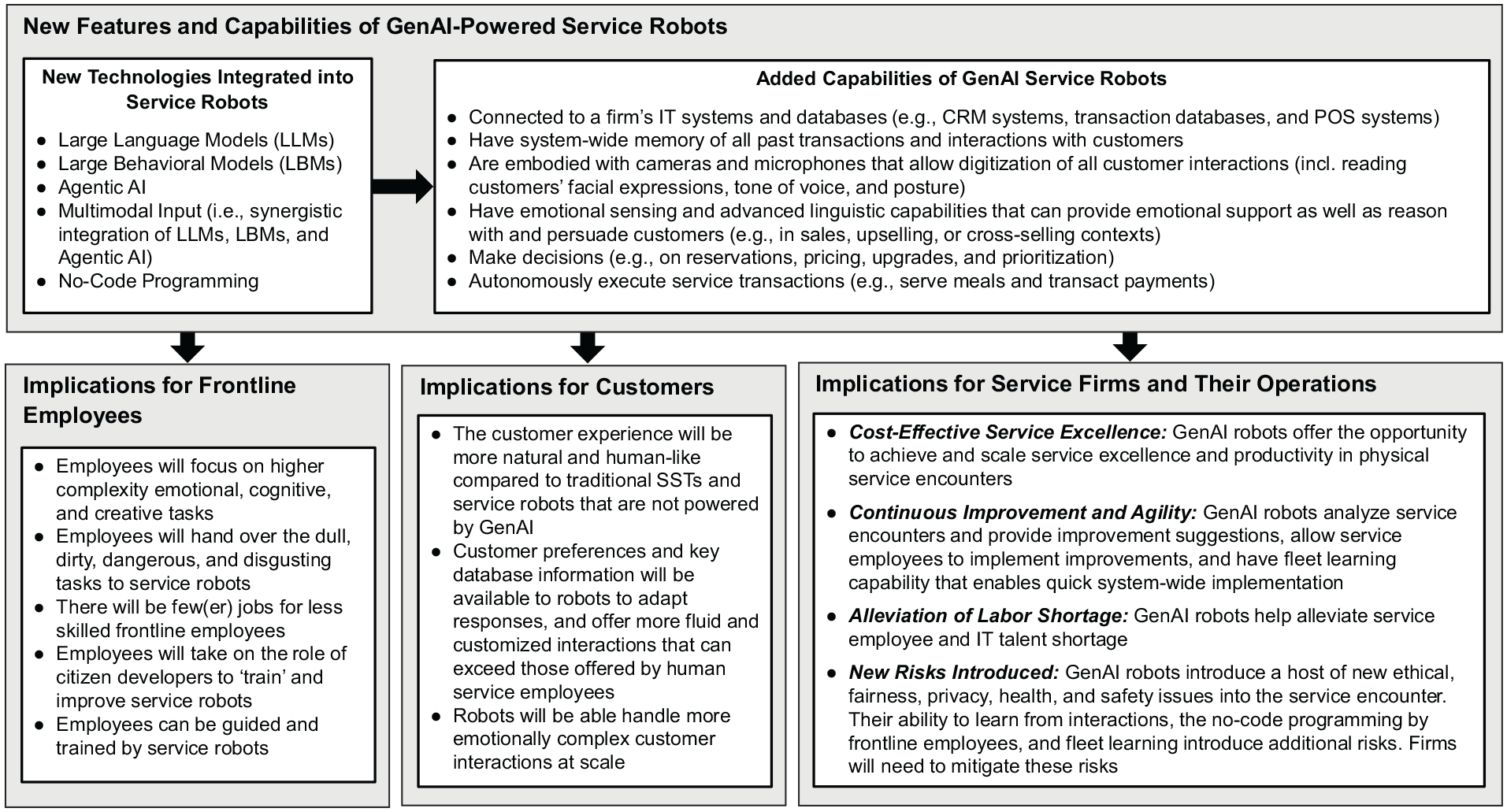
This article is the first to explore the implications of GenAI service robots in physical service encounters through the lens of the service literature. Hitherto, the literature has largely not differentiated between the traditional, non-GenAI-powered service robots and the expected step function in the improvement of service robot performance through the integration of GenAI in the form of LLMs, LBMs, and agentic AI and their no-code feature. As shown in the 17 propositions we advanced, there are likely to be entirely new and GenAI robot-specific implications. Figure 2 provides an overview of the new features and capabilities of GenAI service robots discussed and summarizes their proposed implications for service employees, customers, service firms, and their operations.
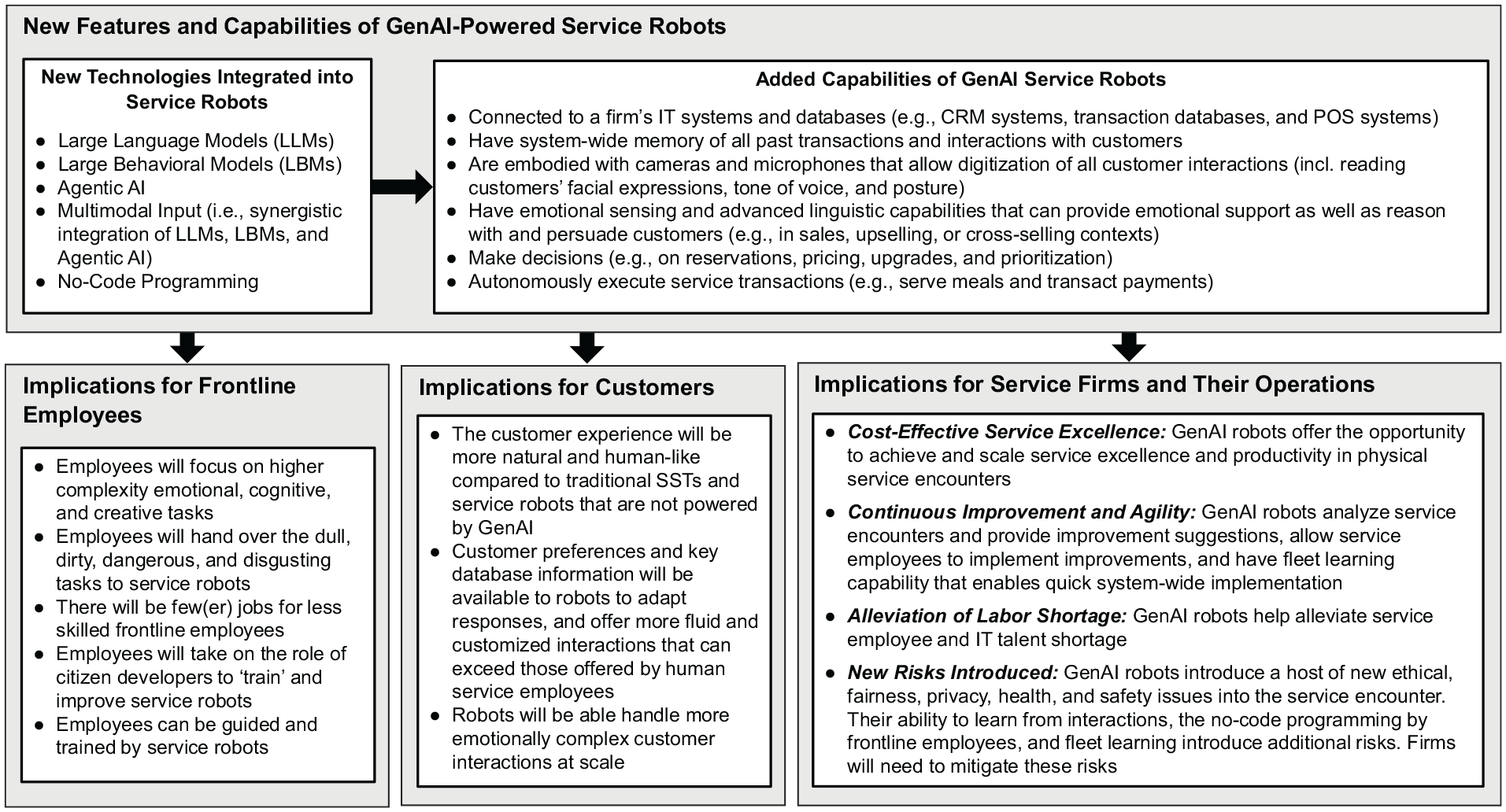
Proposed implications of GenAI robots in physical service encounters.
Implications for Theory
There are a number of important implications for service theory. First, the role of service robots in physical service encounters has to be reconsidered in the service literature. The integration of GenAI (i.e., LLMs, LBMs, and agentic AI) and their emotional and linguistic capabilities (e.g., Billing, Rosén, and Lamb, 2023; Cherakara et al. 2023) and agency (cf., Aggarwal 2024; Bornet et al. 2025; Jurowetzki and Squicciarini 2025) will enable service robots to autonomously deliver more complex, customized, and personalized customer service that will reshape hitherto assumed human-robot interaction (HRI; cf., Wirtz et al. 2018). These robots will be able to engage in nuanced, contextually relevant, and empathetic conversations (Mele et al. 2025), transforming the types of services that can be automated and scaled effectively, and offering a new potential pathway toward achieving cost-effective service excellence in physical service encounters (Wirtz et al. 2023a).
Second, we introduce the no-code feature of GenAI robots to the service literature. This feature allows frontline employees to become “citizen developers” who train, improve, and fine-tune robot performance (cf., Edigbe and Drezner 2024). This perspective again broadens the framework of HRI by showing how GenAI reduces the dependency on technical skills in frontline service modification with exciting implications for employees and the firm.
Relatedly, we develop a set of propositions on the implications of GenAI service robots for frontline employees, customers, and service firms that are new to the service literature. Specifically, we introduce the concept of “citizen developers” to frontline employees (Avishahar-Zeira and Lorenz 2023) with important implications for job scopes and requirements that have not been discussed in the service literature yet.
The service literature’s dominant narrative on customer responses to service robots has to be revised. The extant views on the acceptance and continued use of service robots focus on their lack of “warmth” and emotional capabilities (cf., Wirtz et al. 2018). These new GenAI robots will be able to deliver richer customer experiences, read and respond to emotions (Huang and Rust 2024), engage in more meaningful, nuanced, empathetic, and context-aware dialogue, and even provide personalized support and foster emotional well-being (Mele and Russo-Spena 2025). These will make HRIs more natural and human-like and should shift the current narrative of the service literature on robots.
From a service firm perspective, there are a number of theoretical implications GenAI service robots introduce. First, they offer opportunities for scalable service excellence and enhanced productivity, adding a further strategic pathway for firms to achieve cost-effective service excellence in addition to those identified earlier by Wirtz and Zeithaml (2018). Relatedly, service operations research has long held the view that productivity increases require service industrialization approaches such as modularization, reduction in customer choice, and tight scripts to achieve more homogeneous and high-volume processes (Chase 1981; Wirtz et al. 2023a). With GenAI robots, this view may have to change as they offer the potential to efficiently automate lower-volume and more heterogeneous processes.
Furthermore, the ability of GenAI robots to (1) digitize all robot-provided customer interaction, including customers’ facial expressions, tone of voice, and posture, (2) learn from these interactions, and (3) use fleet learning to disseminate this learning system-wide, brings entirely new topics to the service literature. Relatedly, these features also introduce new ethical, fairness, privacy, health, and safety risks that have not been examined in the service literature yet. They offer new perspectives on the risks of introducing GenAI into physical service encounters (cf., Wirtz et al. 2023b).
Further Research Directions
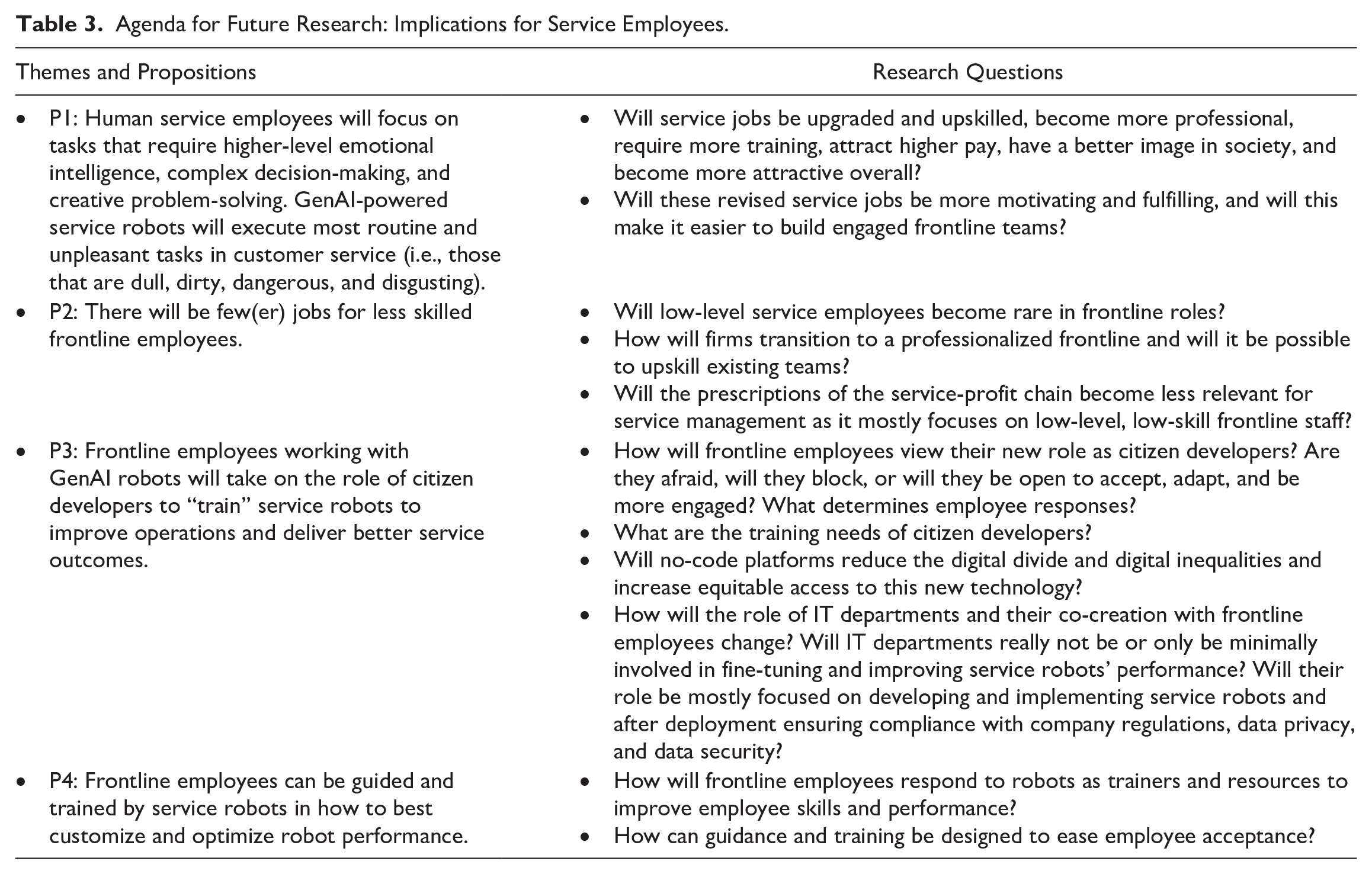
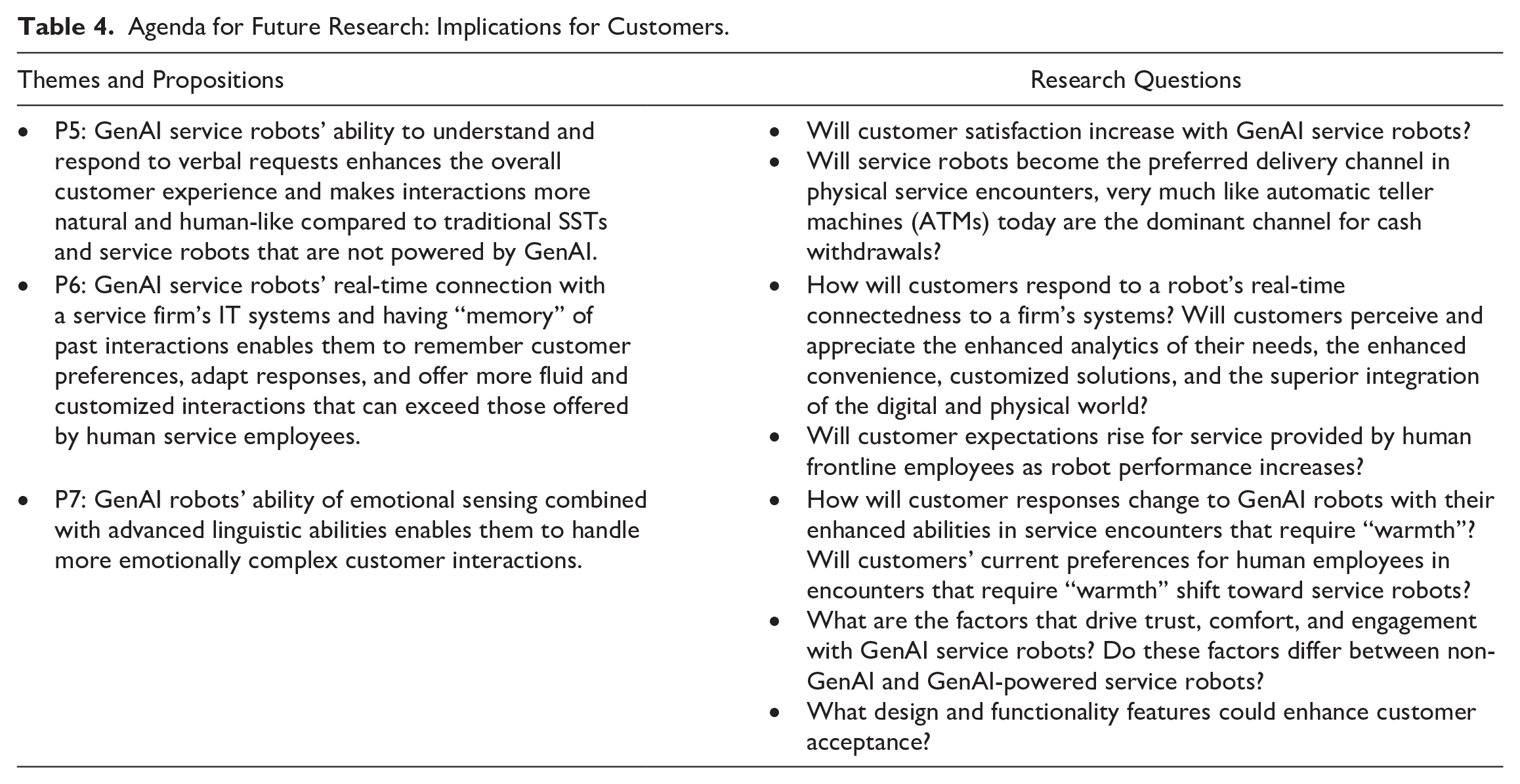
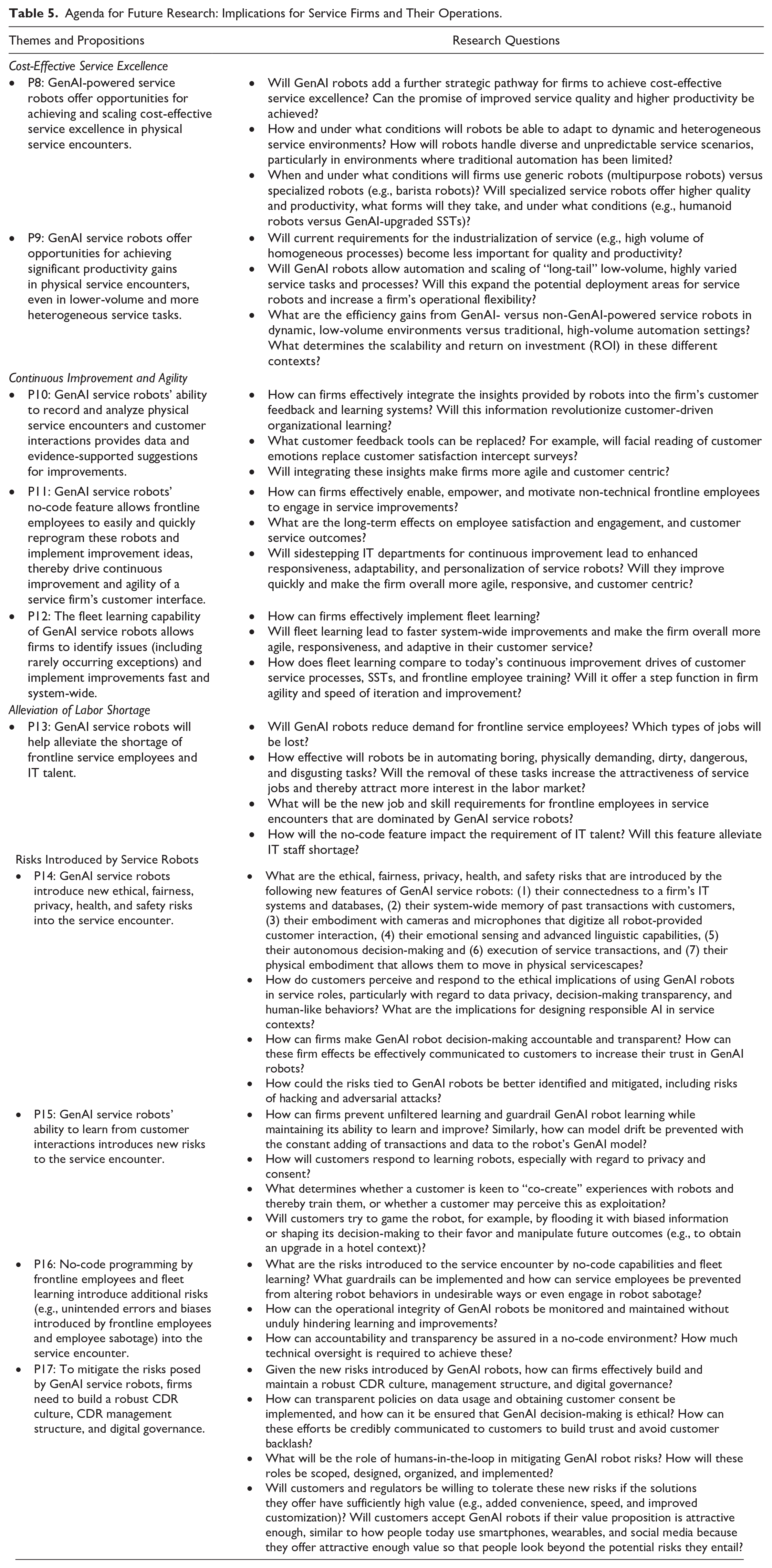
As this is the first article in the service literature on GenAI service robots that integrate LLMs, LBMs, and agentic AI and their no-coding feature into physical service encounters, it opens new streams of research. Given the many new angles discussed that are unique to this next generation of GenAI robots, we hope that this article encourages a step function in service research and brings the service robot literature to the next level. Our key themes and 17 propositions offer an excellent starting point for future investigation. They are listed in Tables 3 to 5 with suggestions for further research directions we find particularly interesting.
Agenda for Future Research: Implications for Service Employees.
Agenda for Future Research: Implications for Customers.
Agenda for Future Research: Implications for Service Firms and Their Operations.
Managerial Implications
The integration of GenAI into service robots represents a significant leap forward in the evolution of service operations. This technology enables robots to move beyond simple, scripted tasks and engage in more complex, adaptive interactions where robots handle an increasing range of tasks, from personalized customer service to dynamic problem-solving. This will lead to more responsive, efficient, and personalized service encounters that enhance the customer experience. No-code platforms further democratize the deployment of these advanced robots, allowing nonexperts to program and train them, thereby accelerating their integration into various service sectors while also making firms more agile as employees can quickly adapt GenAI robots to changing customer needs and operational challenges.
Looking to the future, GenAI-integrated robotics will likely become an indispensable component of service operations, fundamentally transforming how businesses interact with and serve their customers. The collaborative potential between human workers and GenAI robots promises to create more efficient, scalable, and high-quality service environments. As these technologies continue to advance, they will offer opportunities for innovation and growth while addressing critical challenges such as labor shortages and lagging productivity.
Firms need to recognize that, as the saying goes, the future is already here; it is just not widely distributed. The majority of examples in this article are already operational in the laboratories of robot manufacturers and universities (e.g., Cit Global Perspectives & Solutions 2025; Diamandis 2025), and firms are piloting service robots in virtually all service sectors ranging from restaurants and hotels to hospitals and art gallies (Knof et al. 2024). As such, firms cannot stay off the bandwagon if they wish to remain competitive. They will have to experiment with GenAI service robots. As explained by Narain (2025), leaders “need to start imaging what their business could become and achieve in a world where robots are accessible, flexible, and—for all intents and purposes—think for themselves” (p. 37) and “can handle changing environments, complex and unpredictable work, and can learn new capabilities and be redeployed. . .we can see an explosion of use cases and ideas emerge” (p. 38). Our 17 propositions provide food for thought for practitioners, and we will not repeat the key benefits of GenAI robots here. Also, generic change management prescriptions such as Kotter’s eight-step approach to leading organizational change (Kotter 2012), as well as success factors and barriers for successful implementation of service robots (e.g., start with a viable use case, focus on employee acceptance and engage them early, and use a wholistic process redesign approach) have been discussed elsewhere (e.g., Knof et al. 2024). However, we would like to highlight a few additional higher-level managerial implications for service firms as follows.
First, the success of the implementation of GenAI service robots depends not only on the technical capabilities of the robots but also on how well they are positioned to meet customer expectations and enhance overall service quality, and this transition poses challenges in customer acceptance. While some customers may appreciate the efficiency and novelty of interacting with GenAI robots, others may feel uneasy or skeptical about relying on machines for services traditionally provided by humans. For example, robot acceptance has been shown to depend on demographics (e.g., older customers prefer human service providers) and service context (e.g., human service providers tend to be preferred in hedonic and luxury contexts, complex service settings, and service recovery situations) (de Oliveira Santini et al. 2025). To address these, businesses must manage the introduction of service robots carefully, ensuring they complement rather than replace human employees, clearly communicate the benefits of AI-enhanced service encounters to customers, and carefully consider customer demographics and service context (Merlind Knof).
Second, a number of our experts felt that the views presented in this article are too optimistic and that it will take longer for GenAI robots to deliver the outlined benefits. As such, it is important for firms to assess GenAI robot capabilities and carefully quantify efficiency gains. That is, the operational benefits of deploying GenAI robots, including improvements in service speed, accuracy, and cost-effectiveness, should be planned and monitored (Knof et al 2024). By measuring these efficiency gains, practitioners can justify the investment in GenAI robots and strategically allocate resources to ensure a return on these investments (ROI). Demonstrating attractive ROI on use cases is important for building confidence in further investments.
Finally, and related to the skepticism of some of our experts, identifying and mitigating potential risks will be critical and include ethics, fairness (i.e., biases), privacy (Lobschat et al. 2021; Wirtz et al. 2023b), health and safety risks. Firms need to find a balance between automation and human oversight (Werner Kunz). As such, supervision and clear boundaries are essential to ensure that these systems serve their intended purposes (Kunz and Wirtz 2024) while maintaining quality and appropriateness in their interactions (Davenport, Barkin, and Tomak 2023). In fact, many GenAI robot vendors see the need for teleoperations with “humans-in-the-loop” where a single person can oversee multiple service robots (Jim Spohrer). Especially in the early days of implementation, this approach may be necessary for customers, employees, and senior management to build trust before giving these robots more autonomy. As such, to navigate this complex landscape, practitioners must consider a range of factors, from customer acceptance and personalization to operational efficiency and ethical concerns to make their GenAI service robot implementations successful.
In closing, the transformative potential of GenAI service robots seems vast. Service robots will constantly get better, more effective, more productive, more accessible, and cheaper, and as a result, show increasingly attractive ROI (Diamandis 2025). As firms adopt GenAI robots, they will unlock new levels of service excellence and redefine standards of customer experience while achieving service productivity and scalability that were unattainable in the realm of physical service encounters in the past. We believe that service robots will become ubiquitous and widely accepted, very much like today’s customers mostly cash money from ATMs and not human tellers. Finally, we hope this article opens new streams of research on the unique features of GenAI robots and their implications for physical service encounters.
Supplemental Material
sj-docx-1-jsr-10.1177_10946705251340487 – Supplemental material for Generative AI Meets Service Robots
Supplemental material, sj-docx-1-jsr-10.1177_10946705251340487 for Generative AI Meets Service Robots by Jochen Wirtz and Ruth Stock-Homburg in Journal of Service Research
Footnotes
Declaration of Conflicting Interests
The author(s) declared no potential conflicts of interest with respect to the research, authorship, and/or publication of this article.
Funding
The author(s) received no financial support for the research, authorship, and/or publication of this article.

Supplemental Material
Supplemental material for this article is available online.
Author Biographies
References
Supplementary Material
Please find the following supplemental material available below.
For Open Access articles published under a Creative Commons License, all supplemental material carries the same license as the article it is associated with.
For non-Open Access articles published, all supplemental material carries a non-exclusive license, and permission requests for re-use of supplemental material or any part of supplemental material shall be sent directly to the copyright owner as specified in the copyright notice associated with the article.
