




Abstract
Conventional research typically adheres to established disciplinary methodologies, whereas transdisciplinary research demands a more flexible and adaptable approach. This paper presents and discusses a work procedure developed and successfully implemented to support collaboration and progress in a large-scale 4-year research project. The work procedure integrates the overall principles from interactive research with the structure of the design research methodology (DRM) framework. The focus here is on the potential of the developed work procedure to support transdisciplinary engineering research. We specifically investigate to what degree the requirements of relevant transdisciplinary research processes are met, i.e., the ability to a) understand and manage complexity, b) incorporate diverse perspectives, c) link abstract and practice-oriented knowledge for implementation and d) develop descriptive, normative, and practical knowledge. Several principles essential to fulfilling the requirements and succeeding with transdisciplinary research were encouraged and supported. Therefore, integrating knowledge from collaborative research, industry-academia partnerships and engineering design could be a promising strategy to strengthen transdisciplinary engineering research. We propose that the suggested work procedure, together with the identified best practices, could serve as support in this context as a transdisciplinary engineering research framework.
Keywords
Introduction
Current societal challenges increasingly require radical new solutions developed in collaboration between academia and industry. However, due to distinct logic, incentives, and timescales, a divide exists between academia and industry (Coughlan et al., 2016). Efforts are needed to combine practical relevance and academic contributions, a challenge associated with applied fields of research such as engineering and management (Berglund et al., 2020; Van de Ven, 2018). To illustrate the relationship between industry and academia, “the gap” as a metaphor has commonly been used (Van de Ven, 2007). Today, with the progress made in terms of, for example, various collaborative research approaches, “the interface” is suggested as a more appropriate metaphor as a means, or location, of interaction between two systems (industry and academia) (Bartunek & McKenzie, 2017). In European research at large, collaboration between academic and non-academics has been widely promoted (Pohl, 2010). Knowledge across different fields, technologies, contexts, and scientific disciplines needs to be combined across theory and practice, which calls for strengthened co-productive research approaches (Lindhult & Axelsson, 2021).
There is no doubt that research benefit from being carried out in close collaboration between different parties, involving both industry and academia, and transdisciplinary research has been pointed out as supportive when solving complex problems (Lattanzio et al., 2021). There are, however, several critical aspects related to the co-creation of knowledge between industry and academia that need to be considered, including the process of building partnerships between academic researchers and practitioners, the nature of the collaborative research process, and the challenges involved in this way of working from the point of view of the participants involved (Humphries et al., 2024; Jacob et al., 2000; Wlazlak et al., 2024).
At the same time, a plethora of research approaches are suggested, describing or prescribing how this collaboration could or should be performed to reach the required scientific quality targets and, at the same time, support development in, for example, the manufacturing industry. Some examples of collaborative research approaches are collaborative management research, action research, and interactive research (Aagard Nielsen & Svensson, 2006; Ellström et al., 2020; Shani et al., 2012). On the contrary, literature on different disciplinarity concepts focuses on who is to be integrated and what is to be achieved by means of integration, rather than how integration is to be carried out and how the expected results are achieved (Pohl, 2010; Tress et al., 2004). A transdisciplinary research process must meet requirements such as understanding problem complexity, integrating diverse perspectives, linking abstract and case-specific knowledge, and promoting practices that benefit the common good for effective problem-solving (Pohl, 2010). Despite these high expectations on transdisciplinary research projects, approaches or methods to support the implementation of transdisciplinary research are still limited (Gooding et al., 2022). However, design science research has been identified to potentially match the requirements of transdisciplinary projects (Drechsler et al., 2022; Lattanzio et al., 2019). In addition, it has been pointed out that a design science approach provides a common language which supports collaboration between academic and non-academic partners, which is an advantage in transdisciplinary projects (Humphries et al., 2024).
In this paper, focus is on transdisciplinary engineering research, here defined as a collaborative research approach that integrates academic and non-academic knowledge from multiple disciplines, including engineering, to address complex real-world problems and develop comprehensive and practical solutions.
To expand the knowledge of transdisciplinary research approaches, this paper aims at further detailing how established design research approaches may support the ambitions within transdisciplinary engineering research. To address this aim, insights were drawn from a recently concluded research project. The research project focused on integrating product and production platforms to support agile and demand-driven product realisation. To address various aspects, the project was organised into four sub-projects. As part of the research project's design, a work procedure was developed (Säfsten, Elgh et al., 2024). The principles from interactive research (Ellström et al., 2020; Svensson et al., 2015) in combination with the structure of the design research methodology (DRM) (Blessing & Chakrabarti, 2009), served as a foundation. The resulting work procedure included the following five stages:
Current state mapping Analysis of the current state and decision on the desired state Implement development activities Follow-up of the development activities Follow-up of the project goal fulfilment (sub-project and overall project level)
The logic between the different stages and their position at the overall project level and at the sub-project level is visualised in Figure 1.
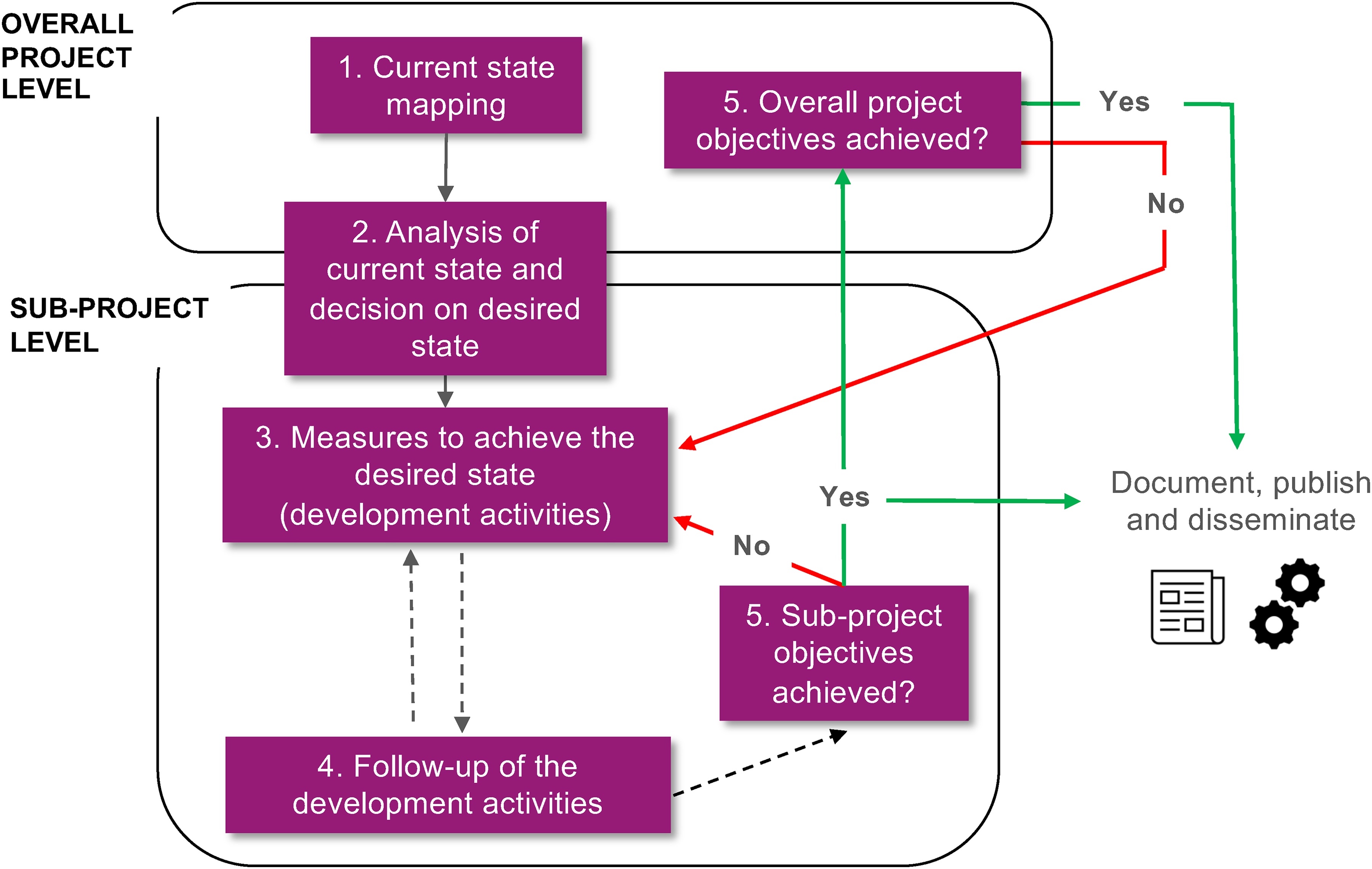
Visualisation of the Work Procedure Implemented in the Research Project IDEAL.
Stages 1–4 resemble the four stages prescribed in DRM: Research clarification (RC), Descriptive study I (DS I), Prescriptive study (PS) and Descriptive study II (DS II) (Blessing & Chakrabarti, 2009). The content of these stages is equivalent to a regular problem-solving cycle and well aligned with the transdisciplinary research process: problem identification and structuring, problem analysis, and implementing the result (Pohl & Hirsch Hadorn, 2007).
In this paper, we investigate to what degree the requirements of transdisciplinary research processes are met by the developed work procedure (Figure 1). For each of the requirements, both strengths and weaknesses of the work procedure are pointed out, and best practices are derived. A combination of knowledge related to collaborative research, industry-academia collaboration and engineering design may be a fruitful avenue to strengthen transdisciplinary research. Based on the analysis, we propose that the work procedure can be described as a framework supporting transdisciplinary research, specifically in the engineering domain, i.e., a “Transdisciplinary Engineering Research Framework”.
The rest of the paper is structured as follows. In Section 2, relevant literature related to collaborative and transdisciplinary research is presented. This is followed by a description of the applied research methods and a more detailed description of the above-mentioned research project in Section 3. As support for investigating the work procedures’ applicability, illustrative case descriptions are provided in Section 4, preceding the analysis in Section 5. Finally, the paper concludes with a discussion and conclusions.
Collaborative and Transdisciplinary Research
This section introduces the frame of reference, including different perspectives on industry-academia collaboration, collaborative research and transdisciplinary research, with a focus on transdisciplinary engineering research.
Collaborative Research Approaches
Collaboration between industry and academia is commonly advocated as the core of applied research, such as engineering and management. Scholars in applied research often face the challenge of balancing practical relevance with academic contribution (Karlsson, 2024) and recent studies emphasises that academic research sometimes lacks connection to real-world context, resulting in impractical or non-scalable outcomes (Figlie et al., 2024; Marijan & Sen, 2022). A frequent mismatch in expectations regarding language, processes, and deliverables arises because academics often approach such research projects as traditional knowledge-seeking endeavours, whereas adopting a solution-seeking research approach would better ensure that the needs of all participants are addressed (Humphries et al., 2024). It is advised that the challenge of addressing practical problems while generating new knowledge is approached as a problem of knowledge creation rather than merely one of knowledge transfer (Van de Ven, 2007, 2018).
Over the years, there has been a noticeable transformation in the dynamics between the academia and industry, moving from a sponsorship model to more collaborative partnership approaches (Figlie et al., 2024; Jacob et al., 2000). The emphasis has shifted from conducting research solely for the purpose of creating practical knowledge handed over to practitioners to a joint and cooperative process where usable knowledge is co-created through collaboration (Van de Ven, 2018). This shift is commonly referred to as moving from “mode 1”, which represents the traditional, linear paradigm of scientific discovery, to “mode 2”, the new paradigm of knowledge production that is application-oriented, transdisciplinary, and accountable to multiple stakeholders (Nowotny et al., 2003). The shift implies that the differences in roles, missions and abilities of academic researchers and industrial practitioners need clarification at the beginning of the research process (Börjesson, 2011; Svensson et al., 2015). The dominating conviction in collaborative research approaches is that the exchange between academic researchers and industrial practitioners is reciprocal; research can contribute to practice, and practice can stimulate research (Anderson et al., 2001). This approach, that genuine and democratic cooperation takes place between academic researchers and industrial practitioners, has been described as co-production of knowledge (Sannö et al., 2019).
Nevertheless, challenges remain. Recent studies continue to underscore that collaboration between industry and academia faces challenges, including goal misalignment, limited transparency, and inadequate communication regarding expectations, timelines, and responsibilities (Cohen et al., 2025; Humphries et al., 2024; Marijan & Sen, 2022). Shneiderman (2018) highlights the need to improve collaboration by encouraging industry partners to communicate their real-world challenges to researchers, who then prioritise delivering practical value in addition to producing academic publications. Similarly, Sjöö and Hellström (2019) and Cohen et al. (2025) note that practitioners may be reluctant to engage if they perceive academic objectives as divergent from industry needs. Wlazlak et al. (2024) further emphasise difficulties in communicating complex theoretical concepts to practitioners, complicating mutual understanding and knowledge creation. In the context of Industry 4.0, particularly within engineering and computer science, Figlie et al. (2024) reveal that small and medium-sized enterprises (SMEs) often struggle to translate cutting-edge scientific advances into practice due to a lack of mutual understanding and limited interaction with academia. The academics’ focus on theory development, coupled with limited industrial experience, could hinder alignment with practical needs (Ahmed et al., 2022). On the industrial side, professionals frequently lack awareness or resources to utilise academic insights effectively (Masood & Sonntag, 2020; Rocha et al., 2023). In addition, professionals do not always recognise their own learning, which is significantly influenced by the presence of supportive project conditions (Zielhuis et al., 2024).
In collaborative approaches, researchers and practitioners interact throughout the entire research process, from formulating the initial problem to disseminating results and joint learning is emphasised (Maurer & Githens, 2010; Shani et al., 2012). Scandinavia has a strong tradition of addressing real industrial problems through close collaboration with practicing managers and company representatives (Ellström et al., 2020) Interactive research, a concept developed and refined primarily in Scandinavia, exemplifies this approach by focusing on joint learning and co-creation between the research system and the practice system (Ellström et al., 2020; Svensson et al., 2015). It bridges the gap between traditional, linear research models and various forms of action research (Aagard Nielsen & Svensson, 2006; Ellström, 2007; Svensson et al., 2007). Although interactive research has historically been used less extensively outside Scandinavia, for example, in the UK and US (Drejer et al., 2000), several studies indicate that different collaborative approaches are increasingly applied beyond Scandinavian contexts (Figlie et al., 2024; Humphries et al., 2024; Rocha et al., 2023; Zielhuis et al., 2024).
The term interactive research was used for the first time in 1990 by Lundin and Wirdenius (1990). At this time, interactive research was described as an approach focused on comprehending the system under study and allowing this understanding to develop through interactions between the researcher and the system's participants (Lundin & Wirdenius, 1990). The interactive research approach emphasises that two organisational systems are involved, the research system and practice system, see Figure 2, thus explicitly addressing both the industrial and academic perspectives (Berglund et al., 2020; Svensson et al., 2015). Activities within the research system are presumed to be guided by scientific theories and concepts, while activities within the practice system, such as organisational problem-solving actions, are expected to be informed by local theories derived from prior research and/or practical experience (Ellström et al., 2020). At the core of interactive research is the joint conceptualisation and interpretation of the research object and the co-creation of new knowledge, which are then integrated as cognitive input into subsequent cycles of problem-solving activities and research.
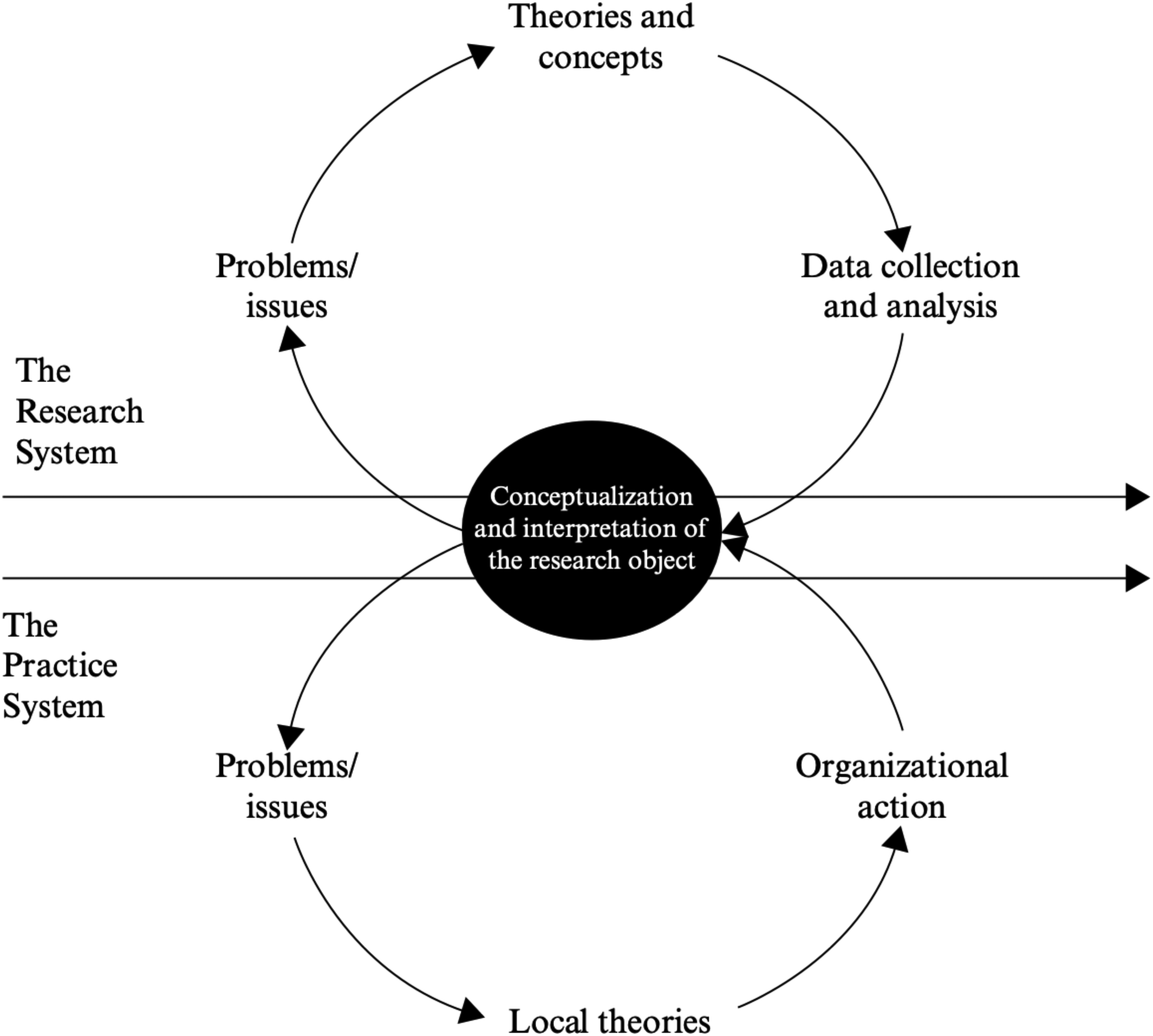
The Interactive Research Approach, with the Interacting Research System and Practice System [Svensson et al., 2015, p. 352].
An essential element in industry-academia collaborations is workshops (Ørngreen & Levinsen, 2017). defined as “…an arrangement whereby a group of people learn, acquire new knowledge, perform creative problem-solving, or innovate in relation to a domain-specific issue…”. Workshops constitute potential arenas for learning and knowledge creation, enabling joint exploration and generation of insights between practitioners and researchers (Bäckstrand et al., 2018; Engström et al., 2023; Säfsten & Bäckstrand, 2016). Workshops take various forms, offering opportunities for researchers to receive feedback on collected data or analyses (Säfsten & Gustavsson, 2020), as well as serving as arenas for generating creative solutions to problems (Börjesson, 2011). They also serve as spaces where researchers and practitioners gather to collectively analyse and discuss research findings, aiming to generate new interpretations and conceptualisations (Engström et al., 2023).
Transdisciplinary Research
There are many terms to describe the interaction between different disciplines, for example, interdisciplinarity, multidisciplinarity and transdisciplinarity. The lack of common terminology does, however, make the landscape a bit vague, which causes confusion in communication and hinders the consistent development of practices (Lattanzio et al., 2021; Tress et al., 2004). As a starting point, disciplinary research can be defined as research carried out within one academic discipline with the goal of creating knowledge relevant to that specific discipline (Tress et al., 2004). The borders of a discipline are, however, not always clear-cut and easy to define; disciplines are dynamic and vary with the field of research, institutions, and types of knowledge. Some borders are harder to cross than others; sometimes, borders between sub-disciplines might even be the most challenging (Tress et al., 2004).
To differentiate different disciplinarity concepts, a distinction related to the participants and the level of integration has been suggested, see Table 1 (Tress et al., 2004). Multidisciplinary research involves multiple academic disciplines, where each discipline formulates goals under a thematic umbrella (Tress et al., 2004). Some cooperation occurs across the involved disciplines, but the knowledge developed is discipline specific. When the level of integration is low, involved disciplines work in parallel.
Participants and Degree of Integration and in Different Disciplinarity Concepts (Tress et al., 2004).
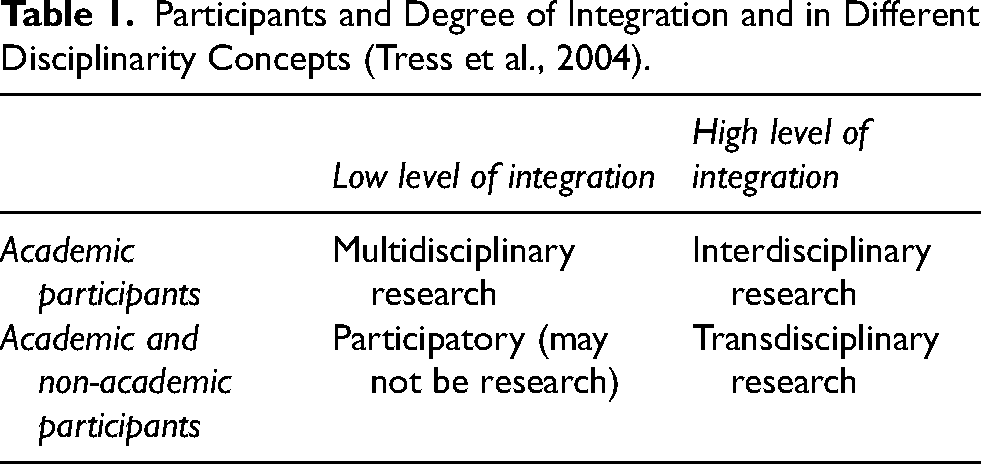
Interdisciplinarity also involves multiple disciplines. The main difference compared to multidisciplinary research is that a joint goal is formulated, and the knowledge developed is integrated, not discipline specific. Lastly, transdisciplinary research implies that both disciplinary borders and academic/non-academic borders are crossed. A joint goal is formulated, and the research is carried out in collaboration between different academic disciplines and non-academic participants (Tress et al., 2004). When collaboration across academic and non-academic participants is discussed, a new mode of knowledge production is required, i.e., creating knowledge with the stakeholders (Pohl, 2010). Similarly, as with interdisciplinary research, integrated knowledge is developed in transdisciplinary research, combining knowledge from different disciplines. In addition, transdisciplinary research is described to be problem-focused, addressing real-world problems (Lattanzio et al., 2021). New knowledge is developed in academia and among the involved non-academic participants (the society) (Tress et al., 2004). Transdisciplinarity is, however, a concept in flux, as Pohl (2010) described, and slightly different interpretations exist, especially within different domains. In the engineering domain, transdisciplinary engineering reflects this ambiguity in definitions. It has been suggested that rather than providing a general definition, transdisciplinary engineering is best defined as a “landscape encompassing multiple conceptualisations” (Lattanzio et al., 2021). It has also been pointed out that a lack of joint definition might hinder the progress (Tress et al., 2004) and attempts have been made to nail down the essence of transdisciplinary research and transdisciplinary engineering research (Gooding et al., 2022; Lattanzio et al., 2021). In this paper, a tentative definition of transdisciplinary engineering research is suggested. Based on Lattanzio et al. (2021) and Gooding et al. (2022), transdisciplinary engineering research is here defined as a collaborative research approach that integrates academic and non-academic knowledge from multiple disciplines, including engineering, to address complex real-world problems and develop comprehensive and practical solutions.
The transdisciplinary research process follows the phases of a traditional problem-solving cycle, including problem identification and structuring, problem analysis, and result implementation, most often iteratively applied (Pohl & Hirsch Hadorn, 2007). To be relevant, transdisciplinary research must meet specific criteria (Pohl, 2011; Pohl & Hirsch Hadorn, 2007). These criteria served as the foundation for examining the capability of the work procedure to support transdisciplinary research processes. The following criteria must be met:
understand and manage the complexity of the issue, incorporate diverse perspectives on the issue, link abstract and case-specific, practice-oriented knowledge for implementation, and develop descriptive, normative, and practical knowledge that promotes what is perceived to be the common good in each specific situation.
To succeed with transdisciplinary research, according to the four requirements above, guiding principles for the design of the research have been proposed (Pohl & Hirsch Hadorn, 2007). These include the following:
reduce complexity by specifying the need for knowledge and identifying those involved, achieve effectiveness through contextualisation, nurture integration through open encounters/interactions, and cultivate reflection by employing iterative processes.
According to the first principle, complexity is reduced through an increased understanding of the actual needs of those involved (Pohl & Hirsch Hadorn, 2007). It is essential to keep in mind that the focus should be on matters relevant to practice-oriented problem-solving. In addition, the focus should be on empirical questions; the target is to provide the basis for better practices, i.e., knowledge relevant to real-world situations and contexts in which people live and make decisions.
The second principle, contextualisation, according to Pohl and Hirsch Hadorn (2007) specifically impact-related contextualisation, implies that research projects should carefully consider and address how their outcomes will affect the specific context in which they are applied. It involves understanding and planning for the social, economic, and practical impacts that the research might have on the community or environment it targets. The results from transdisciplinary research should both be tailored and transformed into practical applications and, at the same time, be integrated within the broader scientific community (Pohl & Hirsch Hadorn, 2007).
The third principle, to nurture integration through open encounters/interactions, is described as the most important principle for successful collaboration between disciplines, i.e., for transdisciplinary research (Pohl & Hirsch Hadorn, 2007). To allow different perspectives to be heard, collaboration can occur in different forms (e.g., group discussions), and be supported with different modes (e.g., boundary objects, models, joint concepts). It is important to reflect on suitable form and mode of integration, since this shapes the relationship between the involved perspectives in a unique manner.
The fourth principle, to cultivate reflection by employing iterative processes, is essential since transdisciplinary research, solving real-life problems, most often requires the different phases of the research process to be repeated one or several times (Pohl & Hirsch Hadorn, 2007). It is advised not to wait until the end of the research project with the implementation of preliminary results but rather consider it as “real-world experiments”, which may support learning (Pohl & Hirsch Hadorn, 2007).
Method and Material
To assess the work procedures applicability in transdisciplinary engineering research, the participants’ perception of the work procedure and the project outcome were in focus during this study. A reflective approach was applied with emphasis on the experiences of the project activities and the participants’ main learnings during the research project IDEAL. The rationale for selecting a reflective approach was the need to look back on our own practices when using the work procedure (Mortari, 2015). In this section, a description of the research project is provided to contextualise the work procedure (presented in the Introduction). This is followed by a detailed account of methods and techniques applied for data collection and analysis for the purpose of this paper.
The Research Project IDEAL
The context for the work procedure was the research project Integrated Product and Production Platforms Supporting Agile and Demand-driven Industrial Product Realisation (IDEAL), which ran between April 2020 and January 2024. The aim of the IDEAL project was to explore how integrated product and production platforms can support agile and demand-driven product realisation in manufacturing companies. Specifically, the project investigated how aligning product and production system development could enhance flexibility, reduce lead times, and improve the ability to respond to changing customer demands, technological advancements, and regulatory requirements. As mentioned in the introduction, the research project was structured into four sub-projects, where most activities took place. Two sub-projects focused on the development of product and production platforms, while the other two explored technical and organisational integration. Together, these sub-projects addressed the overarching research question from complementary perspectives (Säfsten et al., 2022). The sub-projects are denoted Product Platform Development (PPD1), Production Platform Development (PPD2), Technical Integration (I1), and Organisational Integration (I2). As part of the design of the research project, the work procedure presented in the Introduction was developed.
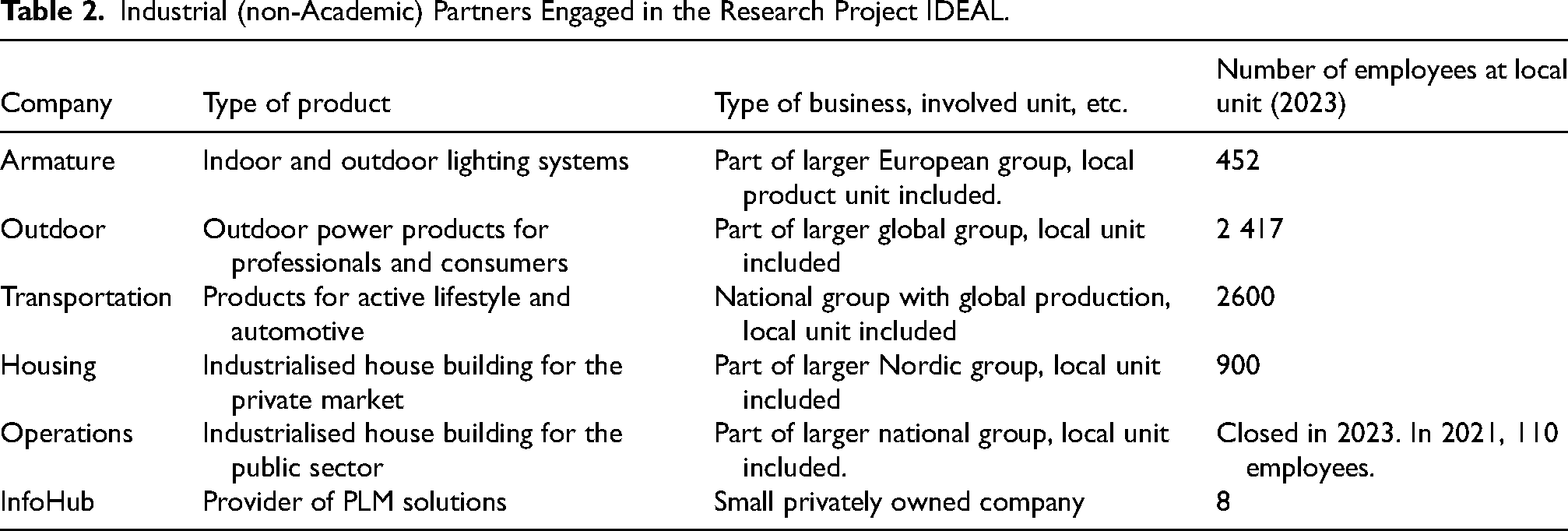
The research project involved six industrial (non-academic) partners. Three of the industrial partners represented the traditional mechanical engineering industry, two the construction industry, and one was a provider of software solutions. They were selected based on their roles within the value chain, as product owners with production sites, and their interests in the problems addressed in the IDEAL project. The industrial partners are denoted Company Armature, Outdoor, Transportation, Housing, Operations and InfoHub. In Table 2, the involved companies’ type of product, business and number of employees are stated, together with a clarification of what part of the company was involved in the IDEAL research project.
Industrial (non-Academic) Partners Engaged in the Research Project IDEAL.
During the research project, one academic institution and a total of 13 academic participants were involved. The research team brought together experts from multiple disciplines. Three researchers focused on production development, production platforms, and changeability. Four had backgrounds in product design, modularisation, and product platforms. Another three specialised in the digitalisation and automation of product development tasks, while the remaining three had expertise in knowledge integration and organisational theory within the context of product realisation. An overall project manager and four sub-project managers were appointed, forming the project management team. To coordinate the project content and implementation with the industrial partners, a steering group with representatives from all companies was formed. Meetings were held at least four times a year, led by the project manager. To foster a common understanding and shared vision among the academic participants, research seminars on different topics such as platform planning and development, integration, boundary objects, and interactive research were held on 15 occasions. Each seminar involved preparatory reading of selected papers and a joint discussion. The seminars were held on Teams, due to the pandemic, and most of the researchers participated at every seminar.
The implementation of the research project IDEAL followed the five main stages of the developed work procedure, see Figure 1. The first stage, the current state mapping, was carried out jointly by all sub-projects. The applied techniques for data collection were interviews, document studies, and workshops. A structured interview guide was created, capturing relevant questions from each of the sub-projects. All interviews were carried out by two researchers, most often representing two of the four sub-projects, via Microsoft Teams. A total of 53 interviews were completed, with 66 respondents across the six companies involved. All respondents were involved in product realisation at the companies, having roles such as product managers, R&D manager, operations managers, engineering designers, production engineers, projects managers, quality engineers, testers, lab technicians, etc. The interviews lasted on average 1 h and 30 min. All interviews were transcribed verbatim, and data analysis was carried out in smaller groups of researchers, where all sub-projects were represented. As a result, the current state of each company was compiled and thereafter validated with the company representative. To develop a desired state for each company and identify development activities, workshops were arranged, one for each company and one with all companies. During the joint workshop, the results from the current state were presented and discussed, and potential development activities were identified for each of the sub-projects. In addition, all companies had internal meetings before and between the workshops. In total more than 70 development activities were suggested, condensed by the researchers into 13 larger initiatives, agreed upon by the industrial partners. Thereafter the implementation of the different development activities commenced, carried out on sub-project level. Depending on the nature of the development activity, different research methods were applied. For some of the development activities, DRM was selected as the most suitable framework, while others required traditional case studies. The implementation of the various development activities created an additional level of the work procedure. Follow-up of the development activities was continuously carried out by each sub-project.
Data Collection and Analysis
The results presented in this paper are based on multiple data collection activities to capture the experiences from using the work procedure developed and used in the research project IDEAL, from hereon only referred to as the work procedure.
One source of information was a reflection on the use of the work procedure based on a study of the completed research project. A case study design was applied, with implemented development activities as the unit of analysis (Yin, 2018). A development activity refers to the initiatives agreed upon by the industrial and academic partners, carried out on a sub-project level. An overview of the sub-projects and the selected development activities (i.e., the cases) is provided in Table 3. Narratives were compiled, capturing the essence of the selected activities.
Sub-Projects and Selected Development Activities.

Additional data for the analysis in this paper was captured both from activities carried out during the project and from post-project evaluations and reflections. During the research project, workshops were performed on two occasions to capture project experiences among all involved partners: in May 2022 (midway through the project) and in December 2023 (during a concluding result conference). Both occasions provided reflections on what the academic and industrial participants experienced about the work procedure. During the midway workshop, the possibility of reaching the goals in the ongoing development activities, in the sub-projects, and in the research project IDEAL was discussed among industrial and academic partners. The questions posed were: What are the obstacles to achieving the goals in the various development activities, sub-projects and the IDEAL project? How can we overcome identified obstacles? The participants were divided into smaller groups, with industrial and academic representatives in separate groups. Among the participants, 26 represented the industrial partners, and 12 the academic institution. During the concluding result conference, in December 2023, industrial and academic partners presented their main takeaways from the research project IDEAL. In addition, a workshop was conducted with a focus on how the co-production in the research project was perceived. During this workshop, the academic and the industrial representatives respectively discussed the co-production in the research project. The main question was: How do you consider co-production has functioned throughout the various phases of the IDEAL project? The participants were divided into smaller groups, with industrial representatives and academic representatives in separate groups. In total, eleven industrial and seven academic representatives participated. The results from the two above-mentioned workshops are presented in Appendix A.
The hosting academic institution assessed the research project on three occasions: during the first year, halfway through, and at the end of the project. The purpose of the assessment was to ensure that the research projects are of high co-production quality and provide valuable results. The assessment is called ECG, to indicate that the pulse or heartbeat of the project is measured. For this paper, the results from the assessment at the end of the project were used. The assessment was conducted through a digital questionnaire sent out to the contact persons at participating industrial companies. The assessment included questions related to the expectations of the project, critical factors to succeed, availability of resources, how the collaboration was working, and if it was something the participants were especially proud of. Four of the five participating industrial partners responded. The data collected were both quantitative and qualitative, for details and a compilation of the results, see Appendix B.
After completion of the project, a post-project follow-up was performed to capture the experiences from using the work procedure. A questionnaire was sent out to the academic researchers participating in the project and 11 respondents completed the questionnaire. The questions included were: What benefits and disadvantages can you see/did you experience from using the IDEAL work procedure? Did you experience any challenges during the project due to the work procedure? Did the work procedure contribute to the results achieved? How important was the interactive element? How important was the iterative structure of DRM with the different phases (Research clarification, Descriptive study I, etc.)? When relevant, the qualitative data were analysed using a thematic analysis procedure (Braun & Clarke, 2016). The questions with more elaborate answers were coded and thereafter grouped together into themes, capturing the essence of the content. The results are presented in Appendix C.
Illustrative Case Descriptions
To allow for analysis of the work procedure, narratives of the selected development activities from the four sub-projects are provided as illustrative case descriptions.
Sub-Project PPD1: Supporting Design for Producibility During Production Preparation
The sub-project focusing on product platforms initially had an open problem definition, including the balancing and the combination of rigid (based on the configuration of predefined components/modules) and flexible (based on the execution of predefined methods and knowledge) product platform definitions, the exploration of asset types, and the integration of production aspects as assets in a platform definition. The development activity selected for this paper aimed at supporting design for producibility during production preparation. The overall idea was to support production engineers with identification, definition, structure, and sharing of production requirements to enable collaborative decision-making during the production preparation process. The resulting method includes three parts: specification of focus areas and requirement categories, a requirement worksheet, and a working procedure guiding the production engineers to review the components that are assembled and list requirements in the areas critical to production. These requirements are then subjects for discussion between the design and production engineers (Areth Koroth, 2023; Areth Koroth et al., 2021; Areth Koroth et al., 2022; Areth Koroth et al., 2023).
The development activity, supported by the work procedure, forms a stream that can be traced back to the initial phases. The complete set of activities in this stream can be divided into four main steps. The first step was partly coordinated with the shared current state mapping and included interviews and document studies supporting the problem scoping and familiarisation with the companies and research team. The joint project activities (individual and joint workshops with all participating companies) were combined with an initial literature review. The result was a problem definition and an understanding of the problem domain ´design for producibilitý from both a scientific and an industrial perspective. The second step included focused interviews (Company Outdoor, Company Transportation, and Company Housing) and document studies combined with a scoping literature review. The main outcome was the identification of a common well-defined problem, production requirements management, a detailed understanding of the current practice and the state-of-the-art, and an overall approach to the specific problem. The third step included a scope setting workshop, observation, method development, evaluation workshop (all activities in collaboration with Company Outdoor) and a first update on the literature review. The main outcome was the first version of a method to support identification, definition, structure, and sharing of production requirements to support design for producibility during production preparation. The final step, done in collaboration with Company Outdoor and Company Transportation, included focused interviews, supporting document studies, evaluation workshops, and a second update on the literature review. The main outcome was an updated method to work with production requirements to support production preparation during product development that considers different product and production maturities (Areth Koroth et al., 2024). In the first step, several disciplines were addressed by combining academia and industry perspectives, including product development, engineering design, project management, procurement, quality management, production development and production. In the subsequent steps, the focus was set on product development, engineering design, production development and production combined with systems engineering and product lifecycle management.
Sub-Project PPD2: Developing Production Platforms from a Practical Stance
In the sub-project targeting production platform development, the overall goal was to create knowledge and support for how to achieve pro-actively coordinated integration between product and production development. Through an initial literature review, the concept of production platforms was examined, revealing a common understanding that production platforms are denoted as “the foundation for the design, development, and reconfiguration of a production system” (Boldt et al., 2021). During the early project phases, the potential for improved platform descriptions and increased integration between product portfolios and ongoing production development were identified among participating companies (Boldt et al., 2022). This groundwork, combined with the joint current state mapping, led to development activities for advancing knowledge in product platforming, particularly in production platform development. The development activity in focus here was aimed at enhanced modularisation in semi-automatic assembly systems to better address market uncertainties and shorter product life cycles. Two of the industrial partners were keen on expanding the flexibility of their investments to better orient in this uncertain landscape (Company Outdoor and Company Transportation), while two were more interested in following this activity (Company Armature and Company Housing). Company Outdoor repeatedly invested in the same production system, repurposing and reconfiguring it to accommodate new product families to adapt to the market demand. Company Transportation was planning to make a large investment in a new production system ahead of knowing the capacity demands and what exactly to produce. This required designing a production system that could handle uncertain volumes and product features, creating a necessity to design a reconfigurable solution. From a research perspective, it was essential to combine the industrial needs with the academic ambition to develop product platform concepts. However, the practical relevance created a high commitment from the start and the academic and the industrial partners learnt from each other in an iterative process.
Through the first phase of 13 months, the collaborative approach created a generic understanding of the complexity of the issue at hand, which resulted in a proposal for a support tool called Production Capability Mapping (PCM) (Boldt et al., 2023). The collaborative development was thereafter expanded by involving Company Housing and Company Armature, which, from the start, decided to follow the activity rather than actively taking part, which allowed for more diverse perspectives to be taken into consideration. Hence, the second phase, consisting of 12 additional months, allowed for further testing of the support tool's capacity to function as a process for describing production platforms. During this phase, the guidance from the researchers was limited. The role of the researchers was to coach the companies’ use of the PCM tool. At Company Housing the purpose was to explore how they could document their production platforms by mapping one of their production lines. Whereas Company Armature used the PCM tool to support the development of a new production line. The tool functioned for both purposes which, to some extent, showcases the generic capacity of the PCM tool (Boldt, 2023). In essence, each company's point of origin and context was used to create meaningful platform descriptions (Linnéusson & Boldt, 2024).
Sub-Project I1: Product Life Cycle Information Management for Product Realization
The purpose of this sub-project was to increase the knowledge related to digitalisation and automation of engineering processes supporting integrated product and production platforms. After the initial joint project stage, the current state mapping, two development activities were implemented within this sub-project, both of which are included here.
The first development activity aimed at securing the manufacturability of sheet metal parts in the development phase (Stolt, 2024). The stakeholders were asked about what they perceived as challenging in sheet metal part design. The design engineers stated that they have difficulty making an early-stage prediction of the sheet behaviour in a press tool. Too large strains may cause the material to thin too much and eventually rupture. It was found that an early-stage prediction tool that did not require a specialist to set up a simulation model was needed. The tool should be operated by the design engineers, and it only needed to provide indicative results leading designers to feasible design suggestions. The tool involved automated finite element models, developed together with participants from Company Transportation. The tool was made available and interpretable for all stakeholders identified in the development activity. It could, for example, aid the purchasing department in understanding the requirements of sheet metal plates, complementing the standard material properties, and direct designers in understanding the manufacturing possibilities and constraints.
The second development activity involved how to handle information in different stages of product development for compiling accurate bills of materials for various parts of the lifecycle (Stolt, 2023). Thereby, information systems such as ERP (Enterprise Resource Planning) and PLM (Product Lifecycle Management) were involved. Interviews were held to understand how the systems worked and how information flowed between them. It was found that the systems in the companies had a complicated structure and suggestions of how to simplify the information flows were put forward. In Company Outdoor the development activity could be concretised.
To progress the development activities, semi-structured interviews were conducted to gain a deeper insight into the state of practice in the companies. The interviews were complemented by the studies of corporate documents. In retrospect, it can be concluded that the interaction with the companies was too sporadic and not on the level that the work procedure prescribed. Rather than following the key idea, to implement the development activities in co-production with the companies, the sub-project lingered too long in the descriptive stage. The proposals were presented, and the companies were asked for their opinions. This was not completely satisfactory in that the work procedure prescribes that the effect of the changes should be measured or at least estimated so that it can be more firmly determined to what extent the sub-project and synergy level objectives have been achieved. Ideally, the degree of objective fulfilment could have been carried out by staff and researchers not involved in the development to get an unbiased opinion.
Sub-Project I2: Development of a Boundary Object Assessment Process
To address the industrial challenge of integration between product and production (platforms) in the context of product realisation, the starting point for the sub-project was an analytical concept, boundary object, defined as objects that exist across multiple social spheres and meet the formal criteria of each of them (Star & Griesemer, 1989). The overall objective for the sub-project was to develop a procedure that supported the selection of appropriate boundary objects in different situations, which is the development activity here selected as an illustrative case. The resulting procedure, denoted boundary object assessment process, includes four steps and was designed for usage in the manufacturing industry by, for example, project managers in product development projects (Wlazlak & Säfsten, 2025).
Since the boundary object concept was perceived as quite theoretical, it was essential to establish joint understanding in the project team. This was achieved through a series of workshops designed to create a joint understanding, so-called knowledge-sharing sessions (Wlazlak et al., 2024). The sessions aimed to enhance the project team's understanding of boundary crossing and boundary objects during product realisation by combining theoretical input with practical reflections. Two types of knowledge-sharing sessions were employed: theory-driven sessions (led by the researchers) and practice-driven sessions (led by practitioners). During the theory-driven sessions, the starting point for the discussions was theoretical concepts, progressing from broad topics on knowledge integration to more specific discussions on boundary objects. During the practice-driven sessions, the focus was on methods and tools employed by the companies to cross boundaries between disciplines in product realisation, such as DfM/A (Design for Manufacturing/Assembly), PLM (Product Lifecycle Management), and 3P (Production, Preparation, Process) methodology (Hussmo, 2023). The sessions involved three researchers and practitioners from five large and medium-sized manufacturing companies in the Swedish industry. Each session lasted a maximum of two hours, mixing practical experiences with theoretical underpinnings.
The development of the boundary object assessment process followed the stages prescribed in Design Research Methodology (Blessing & Chakrabarti, 2009), guided by an interactive approach (Ellström, 2007; Ellström et al., 2020). The initial stage, Research Clarification, involved a literature review of existing frameworks and typologies, emphasising the key factors that enable an object to function as a boundary object. These factors included the type and complexity of the boundary being crossed, the inherent properties of the object, and the contextual factors related to its usage. Additionally, during this stage, criteria were formulated to guide the development of the new assessment process. In the second stage, Descriptive Study I, researchers and practitioners collaborated to jointly identify critical aspects for understanding and addressing situational complexity, the key properties that enable an object to function effectively as a boundary object, and the factors that could potentially influence its use. The outcome of this stage was a jointly compiled list of critical situational aspects, boundary object properties, and factors affecting the object's use. To achieve this, the knowledge-sharing sessions were critical. During the third stage, Prescriptive Study, the boundary object assessment process was developed and refined through iterative testing. Several versions were created and tested in real-life cases. Two case studies were conducted (Yin, 2018). The first case was conducted at Company Armature, focusing on the handover process between the project (development) organisation, a cross-functional team, and the line organisation (e.g., operations). During this case, version #1 of the boundary object assessment process was tested. The second case was conducted at Company Housing, focusing on the product strategy process, which resulted in the development of a product strategy functioning as a boundary object. In this case, version #2 of the assessment process was tested (Hussmo et al., 2022; Wlazlak et al., 2021). Finally, during the closure workshop for the research project IDEAL, version #3 of the boundary object assessment process was presented (Säfsten, Elgh, et al., 2024; Säfsten, Wlazlak, et al., 2024).
Analysis
Drawing on the diverse data provided, this section examines how the various research activities, supported by the work procedure, met the four key requirements of transdisciplinary research. To effectively address real-world problems, a transdisciplinary research process must, as suggested by Pohl (2010):
Understand and manage the complexity of the issue at hand. Incorporate and integrate diverse perspectives. Link abstract and practical knowledge for implementation. Develop descriptive, normative, and practical knowledge that promotes the common good in each specific situation.
When the project was designed, the overall research question (How can integrated product and production platforms support agile and demand-driven product realisation?) was general enough to be of interest to all companies involved but still needed further analysis. The initial stage of the work procedure, current state mapping, allowed all involved partners to understand and manage the complexity, as required (Pohl, 2010). The current state mapping, including an analysis of the current state and the decision on the desired state, provided a foundation for the upcoming development activities. Through this time-consuming activity, including interviews, document studies, analysis, and workshops, complexity was reduced, and the need for knowledge was specified. Through workshops, both individually at each company and jointly with all companies, more than 70 initiatives were suggested. After iterations within each sub-project, considering the purpose and research questions within each project and the state-of-the-art research, the suggestions were condensed into 13 larger development activities. This iterative procedure allowed all participants (academic and non-academic) to be involved when specifying the need for knowledge and contextualising the overall research question, both of which have been pointed out as essential principles of transdisciplinary research (Pohl & Hirsch Hadorn, 2007). During the concluding result conference, the industrial participants emphasised the value of the initial interviews and workshops, and the joint creation of development activities. Although extensive and relatively time-consuming, this stage was perceived to contribute to improved relations between the researchers and the industrial participants. The procedure settled the commitment from the industry and served as a second agreement on the project's intentions.
Through the structured work procedure and the guidance on approaching the research problem step-by-step, it was perceived as possible to get a thorough understanding of the problem at hand before rushing into problem-solving. As one participant noted in the post-project follow-up: “…the procedure emphasises iterative development in collaboration, which guides understanding the problem, connection to theory and practice and joint development of a solution.”
As a practical example, the iterative process deployed in sub-project PPD1, illustrated in Figure 3, is provided. Through the four steps, the problem definition is redefined, the understanding is improved, the knowledge is refined, and the solution completeness is enhanced. Academics and non-academics participated in each step to ensure both practical relevance and scientific contribution. Through the iterative approach, the researchers and the industrial partners gradually understood the problems at hand and were thereby able to reduce complexity and involve relevant stakeholders. In this case, the development activity followed the principles of DRM, with emphasis on the iterative element of generating results (Blessing & Chakrabarti, 2009).
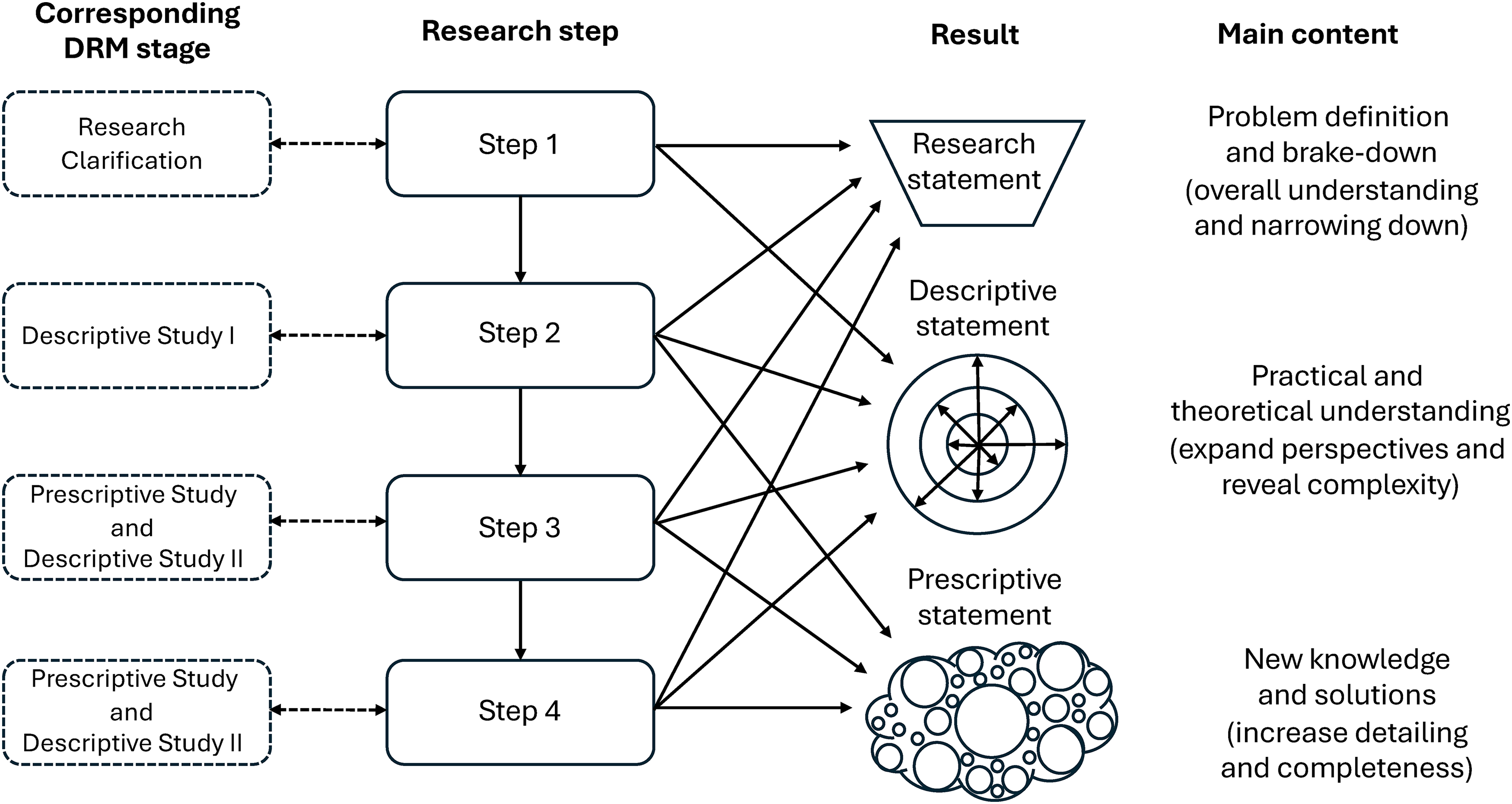
The Iterative Generation of Results During the Development Activity in Sub-project PPD1.
In sub-project PPD2, the adherence to the industrial partners’ request to adopt a practical approach reduced the complexity. By applying a relevant theoretical framework related to production development for changeable production (Boldt et al., 2023), the researchers, together with the practitioners, investigated potential solutions to the practical problem – to design production systems capable of accommodating higher levels of adaptability in response to varying product feature demands. Throughout a collaborative process, the researchers maintained the overarching objective of formulating a generic theory for the development of production platforms, while the industrial partners focused on creating a specific instance of a flexible production system. This way of working clearly reflected the essence of the interactive research approach, as illustrated in Figure 2. In interactive research, the research system and the practice system are interconnected via joint conceptualisation and interpretation, which feeds into the subsequent cycles of problem-solving activities within each system, which gradually frames a problem and reduces complexity (Ellström et al., 2020). Furthermore, this way of approaching problems contributes to a natural integration of diverse perspectives, the second of the four requirements of a transdisciplinary research process (Pohl, 2010).
Summing up the research project, it became apparent that the work procedure supported the integration of diverse perspectives in multiple ways. During the concluding workshop and associated follow-up of the co-production, workshops and study visits were described as very beneficial for integration between the involved participants, see Appendix A and B. One example of a workshop format that was perceived as beneficial for the integration of diverse perspectives was the so-called knowledge-sharing sessions, designed as part of sub-project I2. During the sessions, practitioners were challenged by researchers to understand and reflect on complex concepts. Meanwhile, researchers had to translate intricate ideas, such as boundary objects, into practical terms that practitioners could easily grasp. The sessions were seen as essential for enhancing the understanding of potential boundaries in product realisation and creating a joint understanding of the analytical concept of boundary objects (Wlazlak et al., 2024). In sub-project PPD1, workshops were used for different purposes, including problem analysis, identification of stakeholders’ needs and requirements, solution seeking and ideation, evaluation and suggestions for improvement. Workshops frequently act as spaces for shared learning and knowledge creation, enabling collaborative exploration and the generation of insights between practitioners and researchers (Berglund et al., 2020; Engström et al., 2023). In collaborative research approaches, joint conceptualisation and interpretation are important, and workshops can serve as space for that (Berglund et al., 2020; Ellström et al., 2020).
One of the benefits captured during the post-project follow-up was that the work procedure contributed to communication and collaboration, see Appendix C. According to the respondents, the well-defined procedure ensured effective communication within the research team and with external representatives. The procedure contributed to a common view among those involved, and it provided clarity when implementing a larger project with both common and individual goals and research questions. As stated in the post-project follow-up: “It kept the team of researchers and practitioners united in the initial phases, ensuring that the sub-projects and development activities didn't stray away.” It also contributed to the anchoring process among researchers and practitioners, fostering trust and openness, and enhancing collaboration. During the project, the progress related to the development activities was regularly reported, and thereby, the involved participants were reminded about the overall project purpose and the agreed activities, which also allowed for the integration of diverse perspectives.
The third requirement, to link abstract knowledge with case-specific, practice-oriented knowledge, which is possible to implement, has been supported by the applied work procedure in different ways. The project results included new insights and knowledge as well as methods and demonstrators related to platform development and organisational and technological integration. For example, a framework that supports requirements management in the interface between product development and production, a method to analyse the long-term capabilities of a production system (the PCM tool), a bill of material master and a method for boundary object assessment. To succeed with this, several of the guiding principles advocated for transdisciplinary research were applied and supported by the work procedure: integration between actors was nurtured, the work procedure employed an iterative process, and a thorough contextualisation was established (Pohl & Hirsch Hadorn, 2007).
Maybe most importantly, the work procedure nurtured integration between actors. As indicated by the involved researchers in the post-project follow-up, the interactive element was perceived to be “one of the most important factors for the success of the project”, see Appendix C. One of the key arguments for the importance of the interactive element was that it facilitated an understanding of the practical implications of the theories applied within the project. The work procedure was seen as instrumental in comprehending the current state of practice, which was crucial since the sub-projects were focused on developing support for the companies. There were also examples where closer involvement of the stakeholders would have been advantageous. In sub-project I1, the solutions were mainly conceived by the researchers and then “sold in” at the companies. During the post-project reflection, a higher degree of involvement from the non-academic participants was assumed to have been beneficial for the possibility of creating implementable results.
The work procedure also employed an iterative process, allowing different stages to be repeated, and preliminary results to be tested along the way, as described in several of the sub-projects. In the sub-project PPD1, theoretical concepts of product platforms, production preparation and requirements management were brought together, and a framework combining these was developed. The framework was iteratively developed, including abstract and practice-oriented knowledge to be implemented at the companies. The development was supported by the interactive research approach and thereby related joint activities involving non-academics. Similarly, in the sub-project PPD2, the close collaborative and interactive research approach resulted in the continuous nurturing of open discussions throughout the project. During the first phase of developing the PCM tool, in total, 18 workshops with the participating companies were carried out. The result was a generic approach to generate production platform descriptions that could be tested by other companies. Furthermore, the work procedure was perceived to reinforce the linking of abstract concepts (production platforms) with case-specific and practice-oriented knowledge (based on meaningful ways to describe the various studied production systems based on the specific contexts).
The interactive and practical approach in the work procedure provided a sound contextualisation, which is yet another of the guiding principles of transdisciplinary research (Pohl & Hirsch Hadorn, 2007). To develop practice-oriented knowledge that can be implemented, a thorough understanding of the problem at hand and the situation where the knowledge is to be applied is required. The current state mapping, stage 1 of the work procedure, see Figure 1, provided an overall picture, as described earlier. Another way to contextualise the development of solutions was through case studies. In sub-project I2, the results from several case studies constituted the foundation for the developed boundary object assessment framework (Säfsten, Elgh, et al., 2024; Säfsten, Wlazlak, et al., 2024). Each case study provided pieces of information that together comprised the foundation for the preliminary framework, presented at the end.
Transdisciplinary research is expected to contribute with descriptive, normative, and practical knowledge that promotes what is perceived to be the common good in each specific situation, which is described as the fourth requirement of a transdisciplinary research process (Pohl & Hirsch Hadorn, 2007). What is to be considered a common good is, however, open to different interpretations. In engineering, the approach has been applied to both operational goals and ‘grand challenges.’ Consequently, when evaluating impact, it is important to distinguish between transdisciplinary research aimed at benefiting a specific subset of society and transdisciplinary research intended to benefit society as a whole (Lattanzio et al., 2021). In the research project IDEAL, the core question was how integrated product and production platforms could support agile and demand-driven product realisation. This question was developed jointly by academic and non-academic participants, in line with the principles of interactive research and co-production (Svensson et al., 2007). Therefore, in this study, when knowledge developed contributed to answering the sub-project questions and the research project's core question, it was considered to promote the common good. As we have seen, methods and tools have been developed, contributing to the formulated aims and goals. We have also seen some examples where the intention of the work procedure was not followed, and the results consequently were perceived as less founded.
Discussion and Conclusion
To expand the applicability of the work procedure developed and tested within the research project IDEAL, the potential of the procedure to support transdisciplinary research was elaborated on in this paper. Previous knowledge related to different disciplinarity concepts, combined with knowledge of various collaborative research approaches and industry-academia collaboration, created the foundation for discussing the suggested work procedure. A transdisciplinary research process must fulfil the requirements of understanding the complexity of a problem, considering diverse perspectives, connecting abstract and case-specific knowledge, and fostering knowledge and practices that advance the common good to be effective in problem-solving endeavours (Pohl, 2010). The question raised in this paper was to what degree the developed work procedure can support the requirements for a transdisciplinary research process with a focus on transdisciplinary engineering.
The initial stage of the work procedure, current state mapping, included an analysis of the current state and a decision on the desired state, contributing to both the framing of the problem and the integration between the involved perspectives. Working across disciplinary and cultural borders requires communication of information and knowledge across borders (Carlile, 2002). The capability of different disciplines to interpret the same object, expressed in their domain languages, is required to succeed in transdisciplinary knowledge production (Dodig-Crnkovic et al., 2017). Objects enabling individuals with diverse specialisations to bridge across their specialisations and integrate knowledge can be referred to as boundary objects (Caccamo et al., 2023; Star & Griesemer, 1989). The work procedure combined the different academic disciplines and the academia-industry perspectives and was perceived as a boundary object among those involved, which was indicated in the different follow-up activities (see Appendix A-C).
Moreover, the overall structure, with numerous joint interactions and significant activities for the companies, created conditions for openness. We observed that the content evolved to nurture an engagement, primarily because of the strong focus on addressing the needs of the companies involved, which had previously been pointed out as key in transdisciplinary research. Strong focus on problem-solving and real-world problems has previously been pointed out as one of the hallmarks of transdisciplinary engineering research (Lattanzio et al., 2021). Furthermore, Sjöö and Hellström (2019) and Cohen et al. (2025) found that practitioners were more willing to engage if they perceived that their needs were in focus. However, at times, there were practical circumstances, such as a change of staff, that challenged commitment to some of the development activities. To succeed with interactive research, it is not enough with a good work procedure; you also need the capacity to build trust, foster open communication, and ensure mutual respect among all participants. Trust is the cornerstone of any collaborative effort, as it encourages openness and the sharing of ideas, which are crucial for innovation and problem-solving (Theandersson & Rolandsson, 2013). This is especially important in transdisciplinary research, where the participants are dependent on each other's knowledge. One of the ideas with transdisciplinary research is that the participants are not necessarily knowledgeable in all areas involved, and therefore trust is key (Gooding et al., 2024).
The work procedure also supported result implementation in practice. The jointly executed development activities allowed the industrial partners to be part of the development of methods and tools and thereby monitor their relevance. Workshops, study visits, and other activities within the research project were perceived to inspire and provide learnings valuable for their continued development work. Traditionally, the goal of transdisciplinary research extends beyond merely solving tangible problems; it also aims to enrich the collective knowledge within the community of practice, encompassing the research community and the industrial community (Dodig-Crnkovic et al., 2017).
To sum up, with the illustrative cases and the different follow-up activities as a foundation, we have investigated how the work procedure, developed for the research project IDEAL, was able to fulfil the requirements of a transdisciplinary engineering research process. During this analysis, advantageous merits or effective approaches of the work procedure were identified. These have been documented as best practices and are presented in Table 4.
Advantageous Merits and Best Practice Supporting Transdisciplinary Engineering Research.
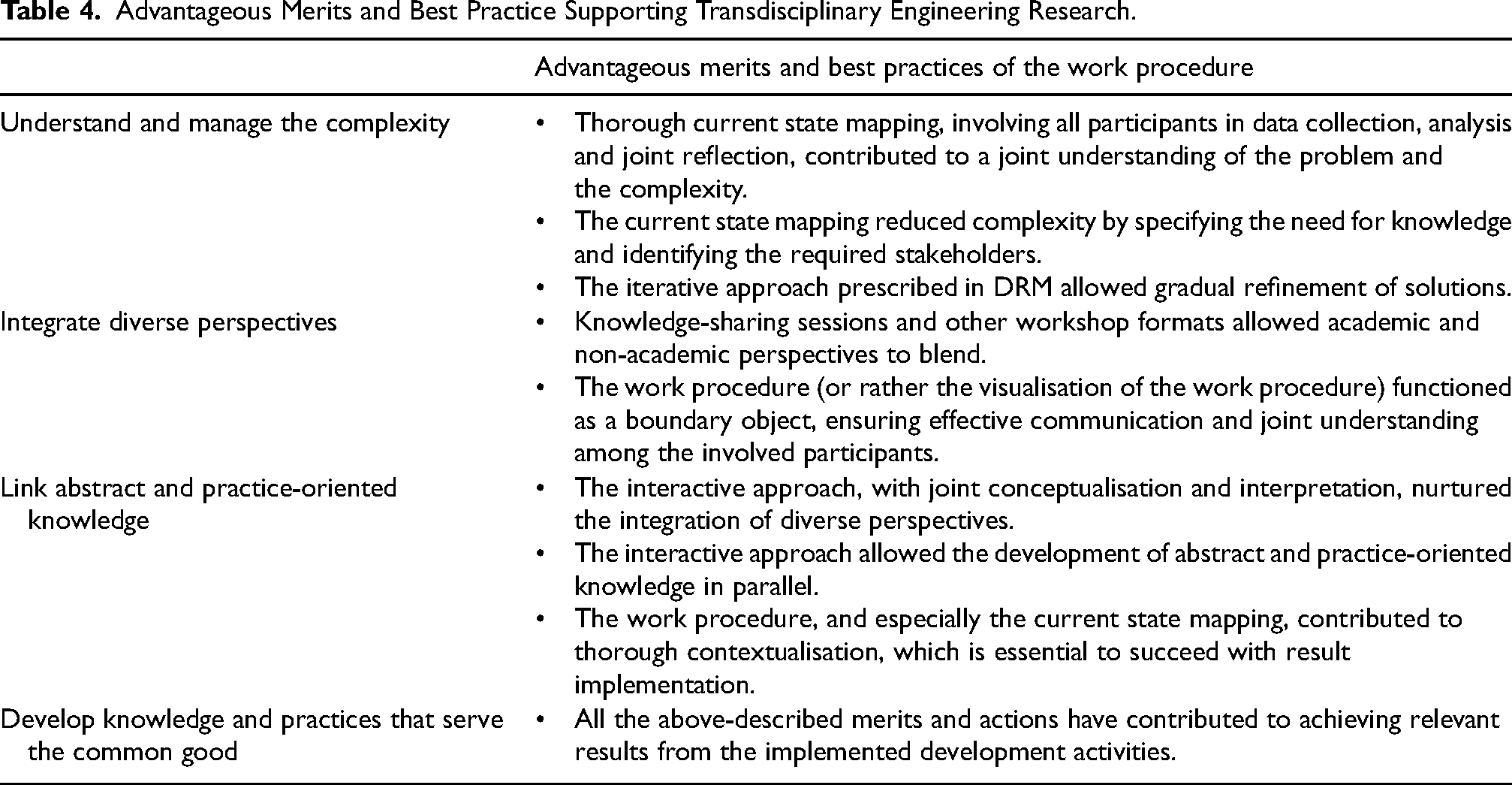
As we can see from the analysis, the guiding principles proposed by Pohl and Hirsch Hadorn (2007) for the design of successful transdisciplinary research were supported by the work procedure originally developed for the research project IDEAL. The current state mapping contributed, amongst other things, to an increased understanding of the actual needs of those involved, which both reduced complexity and provided contextualisation, the first two of the four design principles (Pohl & Hirsch Hadorn, 2007). The interactive element of the work procedure encouraged integration between the involved actors and contributed to a shared understanding of the problem at hand. Workshops, in general, and the specifically designed knowledge-sharing sessions proved to be very important for integrating different perspectives and creating consensus. This is related to the third, and as stated by Pohl and Hirsch Hadorn (2007), maybe the most important design principle – to nurture integration through open interactions (Berglund et al., 2020).
The Design Research Methodology (DRM) provided a planning framework for executing the overall research project. Specifically, the iterative element adapted from DRM supported the fourth design principle of recursiveness, which cultivated reflection but also allowed for refinement of results. Even though DRM was not the driver for achieving transdisciplinary research, it did create a structure and project management tools to facilitate the process, enabling important conditions for conducting transdisciplinary research. In addition, bringing in a framework such as DRM, originally developed to support engineering design research (Blessing & Chakrabarti, 2009), potentially makes the work procedure specifically relevant to transdisciplinary engineering research.
However, during the assessment of the work procedure we also noted some limitations and drawbacks. First and foremost, the current state mapping was perceived as time-consuming, but at the same time, it was also seen as important for the continuation of the project. To optimise the time required, it is instrumental that all questions posed during the interviews are essential for the project. It is also important to plan beforehand for the analysis and the next phases of the work. Here, the work procedure can be supportive, and by adding some guiding principles with more details, and maybe also templates for the different phases (such as interview guides, forms for informed consent, etc.), it could be even more supportive. Another drawback was the perceived imbalance between the activities on the sub-project level and the overall project level. To overcome this, more frequent follow-up activities on an overall level might have been valuable. For future applications of the work procedure, it is preferable to schedule follow-up activities from the start. Lastly, from an academic perspective, in the post-project follow-up, it was noted that “… publishing and dissemination appear at the end; it might be better to integrate these activities throughout the entire procedure.” (Appendix C). This is, unfortunately, a common drawback in collaborative and qualitative research projects; nonetheless, it is key to mitigate (Berglund et al., 2020; Ellström et al., 2020). One way is to plan for conference papers from each study to continuously deliver academic results. Another way is to make sure that time is allocated for writing, and the culture in the research projects allows for prioritisation of writing, not only working together with companies.
To sum up, the work procedure serves as an example to learn from, considering how transdisciplinary research can be supported by methods developed for collaborative research and industry-academia collaboration without explicitly addressing transdisciplinary research. The suggested framework consists of both the overall visualisation of the different stages, Figure 1, and the guidelines presented in Table 4. The next step would be to use the Transdisciplinary Engineering Research Framework in other research projects and further refine its clarity and content.
Footnotes
Acknowledgements
We gratefully acknowledge the support of the Knowledge Foundation and School of Engineering, Jönköping University, which made this research possible. We also extend our thanks to the participating industrial partners and our fellow research colleagues for their invaluable contributions.
Funding
The research was funded by the Knowledge Foundation and the School of Engineering, Jönköping University, Sweden.
Declaration of Conflicting Interests
The authors declared no potential conflicts of interest with respect to the research, authorship, and/or publication of this article.

Appendix A. Workshop Results
Appendix B. ECG Assessment
The ECG assessment measured the perceived co-production quality and the provision of valuable results. The assessment was conducted as part of the standard procedure by the hosting academic institution. At the end of the IDEAL project, a digital questionnaire was sent out to the contact persons at the participating industrial companies. By the time of project closure, one of the companies (Company Operations) had closed its business. Of the remaining five companies, the contact persons at four of the participating industrial partners responded to the questionnaire. Below, answers to the questions are summarised.
Appendix C. The Post-Project Follow-Up
Below, the answers received on the questionnaire are compiled for each of the questions. Citations are included to illustrate the standpoints provided by the research team.