




Abstract
Key Points
Circus and dance students responded positively to the inclusion of strength training in their program and perceived multiple benefits to mental and physical health and a positive impact on performance.
Circus and dance artists both highlighted that strength training is not a predominantly male or female domain and should be available equally to all genders.
This research suggests a shift in perceptions, with a predominantly positive perception of strength training, and a desire to receive guidance on how to carry out strength training effectively.
Introduction
Circus and dance are both forms of physically demanding performance1,2 that cover a range of disciplines. Both also heavily rely on performance esthetics; combining artistic and athletic performance.2,3 Contemporary circus encompasses a variety of disciplines including aerial skills such as static trapeze, flying trapeze, lyra, rope, corde lissé, and silks/tissue; and non-aerial, ground-based disciplines including acrobatics, hand to hand, juggling, and cyr wheel,3,4 with training available via vocational training organizations as well as smaller circus schools. Likewise, vocational dance training may focus on one specific genre or provide a range of pathways including ballet, contemporary, jazz, and musical theater. A requirement to include acrobatic tricks and extreme flexibility in a dancer’s repertoire appears to be more prevalent in recent years. To the authors’ knowledge, there is no existing research that discusses this phenomena, however there is anecdotal evidence from within dance schools and within recent dance magazine publications5 -7 suggesting that there is a growing demand for dancers to increase their versatility by including acrobatics in their repertoire in order to increase their employability. Most circus performers engage in some form of acrobatics accompanied by artistic skill. 3 Circus acrobatics, comprising of aerial acrobatics and ground acrobatics, requires high levels of athleticism 8 and the ability of the performer to hold and manipulate their own body weight on and around their apparatus or other performers. Research into the physical wellbeing of circus artists has currently focused on injury patterns,4,9 -12 with some research beginning to investigate biomechanics and strength characteristics of specific movements such as shoulder range of motion. 8 Within circus research the requirement for strength, power, flexibility, balance, and agility have been briefly mentioned,13,14 however research on the physiological demands of circus disciplines is scarce. 14 We are aware of only one recent paper specifically investigating shoulder range of motion and strength characteristics in circus acrobats 8 and research into physiological profiles of recreational aerialists. 14
It is suggested that dancers often perceive fitness as the absence of injury, 15 rather than a requisite part of dance training and that strength is not necessary for a successful dance career. 16 Investigations into levels of physical fitness in dancers have suggested they have similar levels of strength to the general population and are not as fit as their athletic counterparts.17,18 However, circus artists who participated in both aerial and ground acrobatics have been found to have greater shoulder strength and range of motion than the general population. 8 It could be posed that due to the higher risk factors related to circus disciplines, particularly when working at height, there is a greater emphasis on muscular strength, power and endurance than within dance genres.
Perceptions of Strength Training in the Performing Arts
Recent research into perceptions of strength training in dance16,19 have demonstrated that previously assumed perceptions that dancers were fearful of strength training due to increases in muscle hypertrophy and therefore had a negative impact on esthetics,15,20 are not as prevalent as previously assumed, although larger data sets are required to further substantiate these results. A cultural shift is visible amongst some dance students whereby they perceive the benefits of strength training on their dance performance16,19 as well as a desire for a more toned physique with muscular definition. Results demonstrate an understanding amongst dance students and professional dancers of the need for strength training and an agreement that it is beneficial to their performance as well as how they feel about themselves physically and mentally. 16 Previous literature relating to body composition in dance, described modern dancers as having a more muscular physique 21 and that they had a stronger focus on physiological demands rather than esthetic qualities.16,22 No research has explored similar themes in circus students. Due to the higher requirement for relative strength in modern circus disciplines it could be presumed that circus students may also have a more favorable view of strength training than some dance students.
The aim of this study was therefore to ascertain current perceptions of strength training across different disciplines within vocational circus and dance training. The objectives of the study were to investigate the level to which dance and circus students agree or disagree with a set of statements relating to perceptions of strength training and examine any differences between the 2 groups of students.
H0 = no significant differences between the perceptions of dance and circus students.
Methods
Eighty UK students participated in the study (Mean age = 20.74 ± 2.71), with 39 circus students and 41 dance students. Both gender and sex assigned at birth were recorded with 9 participants identifying as male, 65 as female and 6 as non-binary. A power analysis returned a recommended sample size of 51 per group (α = .05, power = 0.80, d = 0.5), however due to the relatively small number of vocational students within the 2 training institutions in this study and possibility to opt-out of the survey, it was not possible to attain this level of participation. Ethical approval was granted by Middlesex University Arts and Creative Industries Ethics committee. Data collection took place April to July 2021 and June 2022.
A modified version of the Training Information Survey (TIS)16,23 was distributed online via Qualtrics®XM survey software to current students on BA undergraduate programs at London Studio Centre and National Centre for Circus Arts inviting them to participate, with email reminders prior to the survey closing. The Training Information Survey is a tool to ascertain perceptions of strength training via a series of statements answered with a Likert style scale. Originally utilized to in the National Collegiate Athletic Association (NCCA), the statements were modified by Farmer and Brouner 16 to suit a performing arts context by replacing words such as “sport” with “performance,” “dance” or “circus” on a small number of the statements. The TIS has been shown as a valid tool within the field of exercise science with an alpha correlation coefficient of .89. 23 The survey took approximately 4-minute to complete. For this study strength training was defined as “any training that requires the muscles to move against an opposing force (usually some form of equipment). This may include free weights (kettlebells, dumbbells, medicine balls), weight training machines, resistance bands or bodyweight training.” This statement was included at the beginning of the survey. The survey consisted of 5 questions pertaining to participation in strength training followed by 21 statements such as “Strength training has beneficial effects on my dance/circus performance” and “Strength training increases body weight,” with a Likert-style scale response of 1 to 5 (1 = Strongly disagree, 5 = Strongly agree). Each statement is scored individually to ascertain level of agreement with the statement. An optional free-text comments box was included at the end of the survey to provide qualitative data as to participants’ perceptions of strength training. Basic demographic information including age, gender, sex assigned at birth, chosen specialism and year of study was also collated. Pre-analysis tests of normality were conducted using a Shapiro Wilk test which showed evidence of non-normality (P < .001) for all data sets. Between group differences were assessed by Mann-Whitney U (IBM® SPSS® Statistics, V25). Post-hoc analysis via Bonferonni correction was utilized to assess for differences between survey statements (P < .002).
Results
All results pertaining to the initial 5 questions of the survey are presented as percentages, with the remaining 21 statements recorded via Likert scale presented as median and interquartile range (IQR).
Ninety-seven percent of circus students and 69% of dance participants reported that strength training was a required part of their training program, with 62% of circus students and 81% of dance students reporting that they participate in strength training on their own anyway in addition to the requirements of their training program, although not all students responded to this question. Circus students included strength training days 4.24 ± 0.98 per week, with dance students participating in strength training 3.05 ± 1.42 day per week.
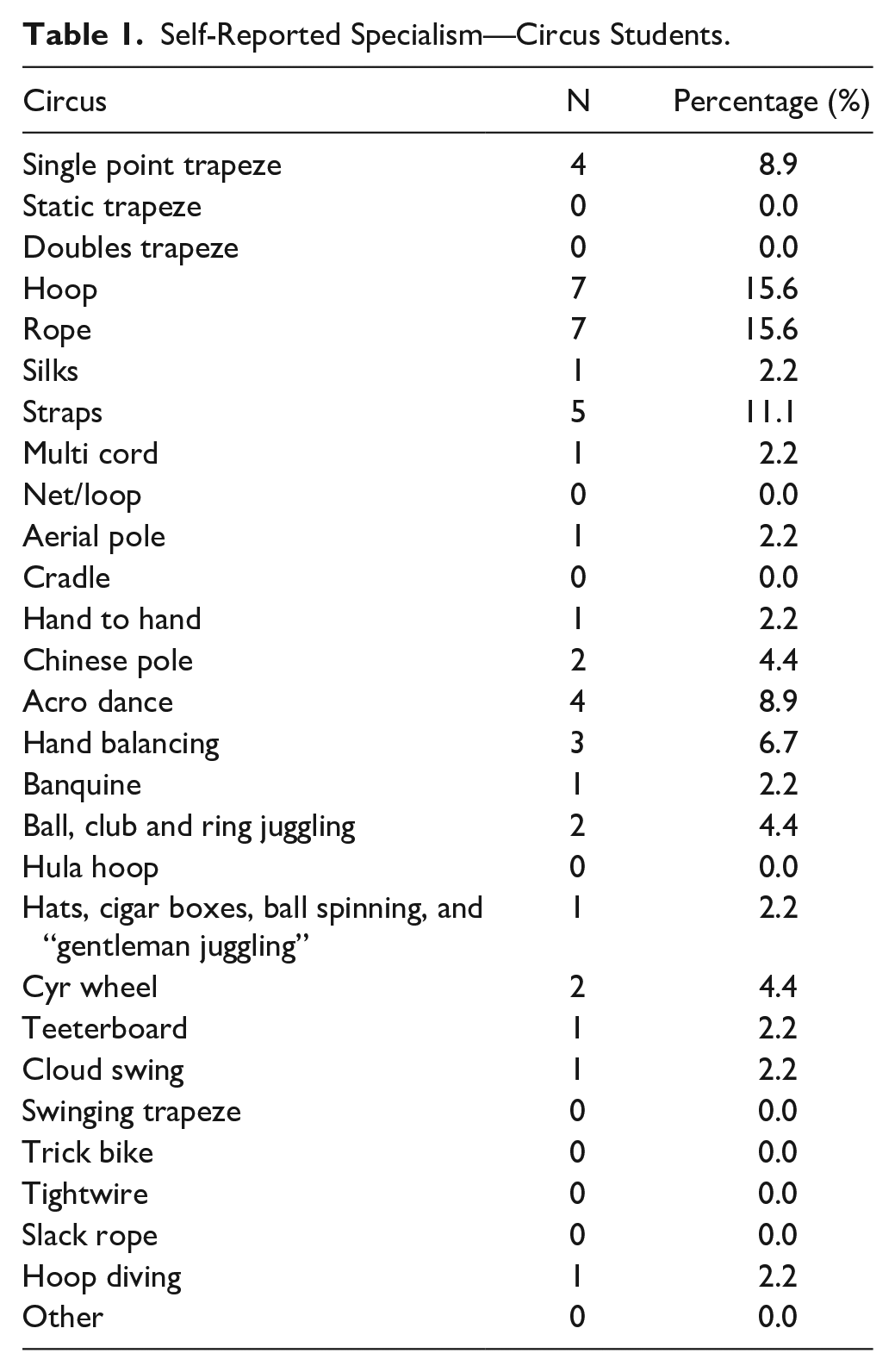
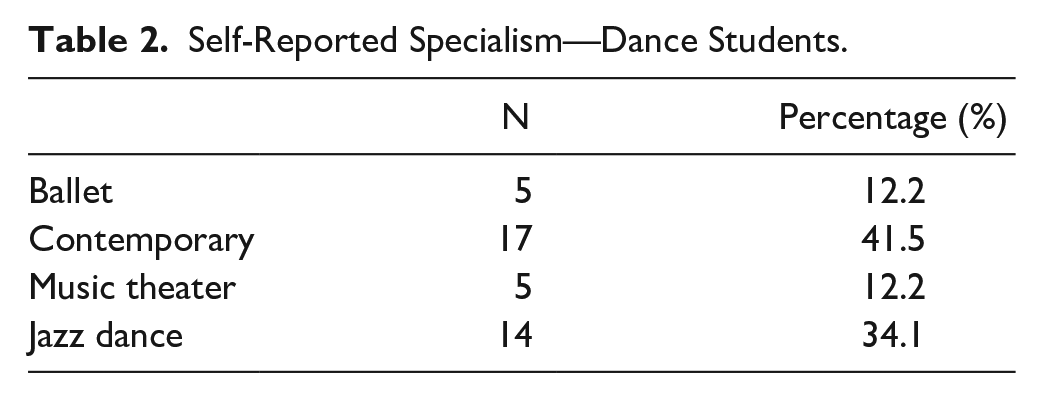
The chosen specialism or favorite discipline for each participant are displayed in Tables 1 and 2. Some circus participants selected 2 or more specialisms.
Self-Reported Specialism—Circus Students.
Self-Reported Specialism—Dance Students.
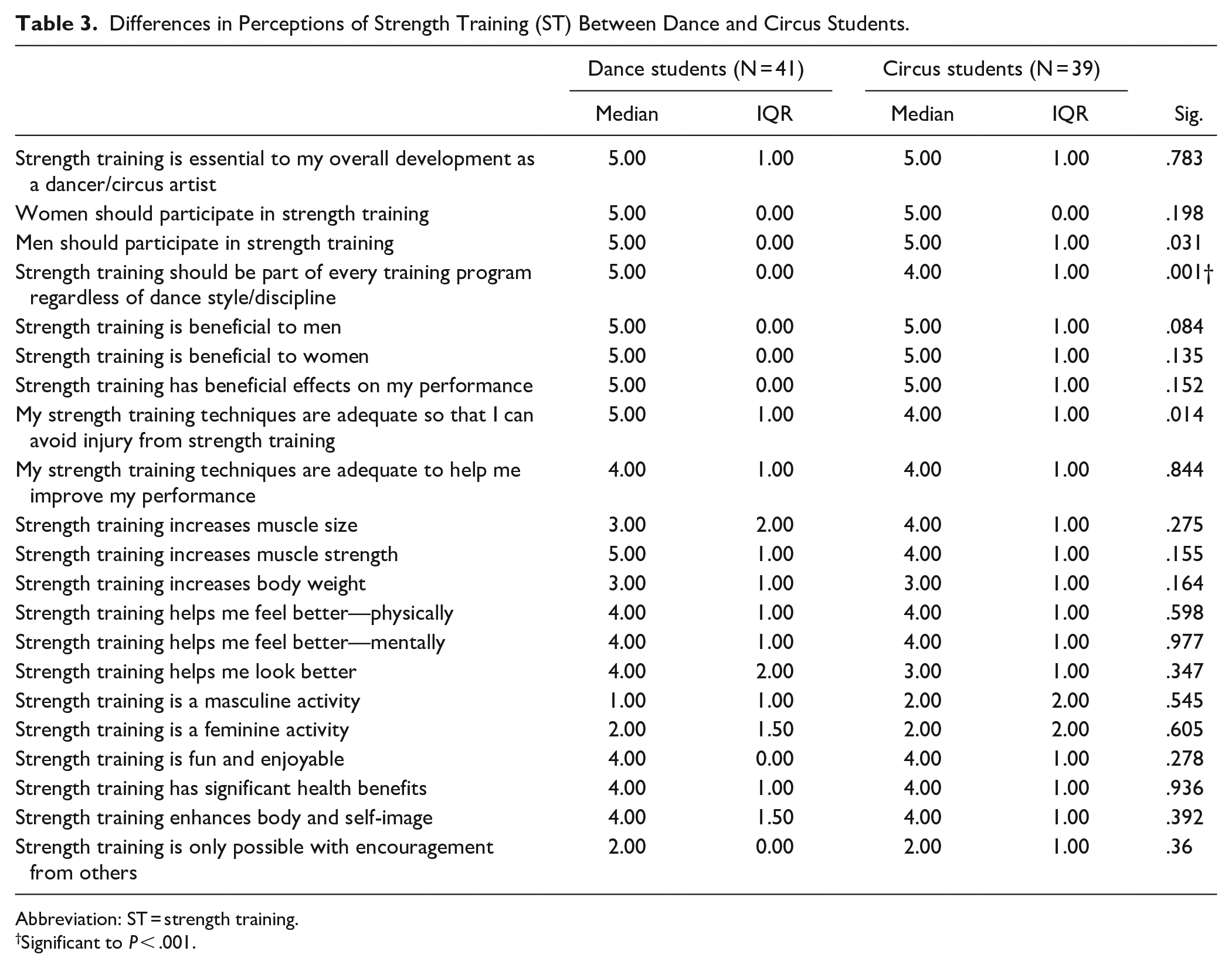
Dance students agreed more strongly than circus students with the “Strength training increases muscle size,” U = 473.00, P = .001. No other statistically significant results were found between the perceptions of dance students in comparison to the circus students (Table 3).
Differences in Perceptions of Strength Training (ST) Between Dance and Circus Students.
Abbreviation: ST = strength training.
Significant to P < .001.
Twelve participants provided comments in the free text box. Five of these comments related to strength training being neither a male or female specific activity, and that it should be available to all, including; “Strength training is not made for man or women, is made for who wants to be physically better.” All other comments focused positively on strength training and the need for it to be included in training; “if one to one sessions with strength coaches were readily available this would improve my desire and determination to strength train more than I currently do now,” “Benefits preventing injuries,” “. . .it’s necessary for everyone- Personally I think we should all have more,” “I think most people are unaware of the benefits, although everyone needs to find their own version that suits them best,” “Provides muscle endurance that technique classes don’t allow you to increase in the same way” and “It is necessary for body and mental health and upkeep.”
Discussion
We hypothesized that there would be differences in perceptions of strength training between circus and dance students due to the greater risk of injury posed by working at height in some circus disciplines, however our results suggest no statistically significant between-group differences. The majority of responses from circus students were from those who specialized in an aerial discipline including aerial hoop, rope and straps. However, participants’ responses suggest that both dance and circus students understand the importance of strength training for their chosen discipline. Perceptions of strength training amongst vocational circus and dance students appear to be favorable, with both sets of students strongly agreeing with the statements “Strength training is essential to my overall development as a dancer/circus artist” (5.00 (IQR 1.00) and 5.00 (IQR 1.00) respectively). This is reflective of previous results within student and professional dancers, who also cited strength training as essential to their overall development 16 and within collegiate dance students who viewed strength training as key to optimizing their performance. 19
Students also agreed that strength training helped them to feel better mentally and physically and is beneficial to both males and females, with the free-text box further emphasizing that strength training was not assigned to a specific sex or gender; “It’s neither inherently masculine or feminine, but it can make you feel either, or both, of those, if you feel so inclined.” These perceptions concur with recent research that demonstrates a sea-change in perceptions, particularly amongst students.16,19
Prior research has stated that there is often misinformation on the importance of strength training to optimize performance in sport and dance,23,24 particularly in relation to female athletes. Interestingly many of the free comments provided by participants stated that strength training was neither predominantly a male or female activity. In response to questions relating to gender disparities in ST, both dance and circus students disagreed with the statements “Strength training is a masculine activity” (1.00 (IQR 1.00) and 2.00 (IQR 2.00)) and “Strength training is a feminine activity” (2.00 (IQR 1.50) and 2.00 (IQR 2.00)) and agreeing with the statements “Strength training is beneficial to men” (5.00 (IQR 0.00) and 5.00 (IQR 1.00)) and “Strength training is beneficial to women” (5.00 (IQR 0.00) and 5.00 (IQR 1.00)), although with slightly greater variation in responses from circus students. This suggests that perceptions of strength training relate more to the demand of the dance genre or circus discipline the performer is training for, rather than any relation to sex or esthetics as previously posed. However, due to the small sample size in this study further research is needed to further investigate perceptions of strength training in relation to sex and gender.
As discussed by Rosenthal et al 19 collegiate dancers demonstrated less integrated or intrinsic motivation when participating in strength training. Only one dancer reported enjoyment as a reason to participate in strength training alongside their dance training. 19 In the current study, both dance and circus students neither agreed nor disagreed with the statement “Strength training is fun and enjoyable,” 4.00 (IQR 0.00) and 4.00 (IQR 1.00) respectively and “Strength training enhances body and self-image,” 4.00 (IQR 1.50) and 4.00 (IQR 1.00). It has been suggested that barriers to participation in strength training may be removed through an increase in education on the benefits and techniques of strength training16,19 and that this may in turn lead to increases in intrinsically motivating factors. 19
Limitations
As with all self-reported surveys there is potential for misinterpretation from the participants when completing the questions. A definition of strength training was included at the beginning of the survey, and responses were assumed to have been considered in relation to this particular definition, however this cannot be certain. Additionally, the free text box garnered very few detailed responses, thus limiting the amount of qualitative data available to the authors. This section of the survey was optional and only requested any further details the student wished to share, rather than asking specifically for commentary relating to their perceptions. Although the survey was shared with all students at both institutions, participants were able to self-select into the survey. It is therefore possible that those who chose to complete the survey either already have a vested interest in strength and conditioning or are opposed to the inclusion of strength and conditioning within dance training.
Practical and Clinical Applications and Implications
Students’ interest in participating in strength training and receiving more coaching and time allowance for these activities should be noted by educational establishments and coaches. Utilizing this appetite for strength training to optimize performance can help to reduce risk of injury as well as prepare students for a range of choreographic demands in their future training and careers. However, careful consideration must be given when planning training schedules in order to not overload students.25,26 Therefore, in order to implement strength training it is likely that educational institutions will need to consider removing something from their existing timetable.
The addition of specialist coaches to enable the safe and effective implementation of strength training is also recommended. Whilst this is the optimal scenario the authors understand that this may not be a feasible first step for some educational establishments and therefore, instead, they should look to support the students with knowledge and resources regarding how to safely embed strength training as a supplementary co-curricular activity.
It is also suggested that a tool such as the Training Information Survey (TIS) be utilized by coaches and teachers in order to understand the perceptions of the performing artists they are working with, and thus design an optimal training program that takes these perceptions into consideration. This in turn may increase adherence in strength training programs amongst performing artists.
Conclusion
This is the first study to investigate perceptions of strength training within a vocational circus and dance training context. Results concur with prior research16,19 in dance that there appears to be a cultural shift amongst dancers, particularly in relation to the preconceived ideas of how a performer should look and the purpose of strength training in their development as a performer. From these preliminary investigations it appears circus and dance students are no longer highly concerned with muscle hypertrophy and a negative impact on performance esthetics, but instead value the positive impact it has on how they feel physically and mentally, as well as optimizing their performance. It is therefore suggested that dance and circus training establishments integrate strength training into students’ programs, offering expert guidance from strength training professionals on how to do so safely and effectively.
Footnotes
Acknowledgements
The authors wish to thank Michaela O’Connor for her assistance in collecting the data for this study.
Declaration of Conflicting Interests
The author(s) declared no potential conflicts of interest with respect to the research, authorship, and/or publication of this article.
Funding
The author(s) received no financial support for the research, authorship, and/or publication of this article.
