




Abstract
Keywords
Key Points
Within a group of highly trained dancers, laterality has the ability to significantly impact the success rate of pirouette performance in the non-preferred turning direction.
Trends of greater COM-COP displacement and peak pelvic rotational velocities in the non-preferred direction indicate dancers may use different technical strategies during the weight transfer phase between pirouette conditions.
To reduce effects of bilateral transfer and asymmetries in muscle activation patterns, dancers should ensure each leg receives equal practice performing as both the gesture leg and supporting leg.
Introduction
Lateralization has the ability to impair technical dance performance, limit choreographic versatility, and increase the risk of overuse injuries. 1 However, the effects of laterality in dance, specifically preferred turning direction, have not been widely researched.2,3 It was reported that previous dance studies most often measure a movement performed with the dominant side only and do not focus on making lateral comparisons. 4 However, while rotational skills along the longitudinal axis are primarily trained unilaterally in sports such as figure skating and gymnastics, traditional dance practice aims to develop functional symmetry.4,5
A pirouette en dehors is a fundamental ballet turn in which the dancer completes multiple revolutions on one foot, rotating away from the supporting leg (SL). Balance, speed of rotation, and aesthetic body posture are three essential characteristics of a successful turn. 6 Since the single leg turning phase (SLTP) of a pirouette requires a dancer to balance on demi pointe (the ball of the foot), the vertical alignment of their center of mass (COM) over the center of pressure (COP) is considered integral to maintaining postural stability. 7 To achieve this balanced position, an appropriate amount of force must be generated by the gesture leg (GL) when pushing off of the floor. This will allow the COM to efficiently shift forwards from double to single leg support. In addition, the turn speed and number of pirouette revolutions are dependent on the coordinated magnitudes of the forces created by the GL and pelvic torque at push-off.6-10 The desired aesthetics for a classical ballet pirouette require a dancer to maintain a retiré passé throughout the SLTP. A traditional retiré position is defined by the attachment of the GL foot to the medial side of the SL knee as well as the external rotation of the hips. 10 Since bilateral proficiency is seen as an asset by both professional dance companies and choreographers alike, dancers are expected to perform turning skills expertly on both supporting legs and in both directions. 4 Therefore, the effects of lateral bias on pirouette performance should be considered when aiming to train a well-balanced dancer.
Laterality: Biological Phenomenon or Learned Behaviour?
Laterality refers to the human preference to perform voluntary motor movements with one side of the body over the other. 11 Biological psychology suggests lateralization is determined by the asymmetric development of the vestibular organ in utero, which later leads to postural imbalances during adulthood. 12 However, another theory suggests that the preferred leg used for balancing tasks is not only dependent on neurodevelopmental origins, but also on the context of the movement itself. 13 Thus, while the origins of laterality can be explained in part by innate biological factors, the influence of external factors cannot be ignored.
Ballet is a codified dance technique designed to develop a well-balanced dancer by training both the right and left sides equally.14,15 However, a previous study observed both beginner and advanced level Cecchetti technique ballet classes and found that exercises using a right GL and left SL were repeated 26% more often. 1 Dancers routinely learn, rehearse, and perform exercises beginning with the right side of the body, before immediately repeating the same movement pattern using a left GL without any additional practice.5,15,16 This training strategy, known as bilateral transfer, is regularly used by dance educators to accommodate for a lack of class time. However, as a result of greater exposure to dextral movements, this pedagogy is likely training dancers to have a rightward bias.4,14,17
A research study found significantly more prepubertal girls with dance training preferred turning toward the right (CW) with a left SL. In contrast, non-dance trained girls of a similar age preferred to rotate towards the left (CCW) regardless of chosen SL. 14 Additionally, it was found that only expert level dancers exhibited lateral bias on pirouette performance, while novice dancers did not. This further supports the notion that increased dance training may result in higher levels of unilateral dominance. 18 Consequently, by undertraining one side of the body, dancers are at risk of developing bilateral inconsistencies in muscle strength, technical performance, and potential injuries.1,4,16,19
Review of Laterality and Dance
Although research regarding pirouette performance and turning preference is limited, bilateral differences in lower limb strength are an important measure of laterality in dance. It has been shown that the vertical height of a maximal 2-footed jump is determined by the combined muscle strength of the lower limbs. 20 Therefore, by using unipedal jumping tasks, such as a single leg countermovement jump (SCMJ), the individual strength profiles of each leg can be effectively assessed and compared. In line with this, a previous study examined the effects of leg muscle mass on SCMJ performance in professional female ballet dancers. While no bilateral differences in muscle mass or jump height were found, higher jumps with the right leg were reported during the initial jump trials. This lateral discrepancy suggests that left-sided movements may experience less efficient muscle activation patterns due to a lack of practice. 20 Additionally, female dancers reported greater power and knee flexion during take-off of a grand jeté split leap when performed with the non-dominant leg compared to the dominant leg, respectively (non-dominant: 3724 ± 1045 W and 99 ± 28.08°; dominant: 3663 ± 1229 W and 115 ± 26.8°). 5 More research is needed to determine if this compensation is due to a muscular imbalance between the lower limbs. However, these findings further demonstrate that dancers may alter their technique and coordination patterns when performing skills with the non-preferred side of the body.
Since pirouettes require different levels of coordination and muscle activation from the GL compared to the SL, 18 ballet dancers typically prefer using the dominant leg as GL when completing turning skills. 7 As such, a similar trend of bilateral asymmetries have been reported in pirouette en dehors performance. Dancers were found to have better balance and a more upright posture when turning on their dominant SL. 18 This finding warrants a greater examination into the impact of laterality on dance technique. Therefore, the aim of this study was to investigate the effects of lateral preference on the bilateral strength and technical performance of highly trained dancers. A biomechanical analysis was conducted to compare the vertical jump height and force production of maximal effort SCMJs, as well as measure the success rate, balance, retiré posture, and push-off force of single pirouette en dehors.
Methods
Participants
Eight highly trained female dancers (Mean ± SD: age 24 ± 2 years, height 166 ± 6 cm, mass 59.4 ± 4.7 kg) volunteered to participate in the study. Inclusion criteria specified dancers must have classical ballet training (Mean ± SD of 17 ± 3 years) and the ability to perform single pirouettes en dehors. At the time of the study, dancers were training 20 hours per week in ballet as well as other modern contemporary dance styles. Potential participants were excluded from the study if they had a history of musculoskeletal injury that could affect their performance. Each individual provided written informed consent, with ethical approval provided by the ethics board.
Equipment
Dancers wore tight-fitting, non-reflective dance attire, and soft ballet shoes. A full body marker set consisting of 38 individual retroreflective markers (Vicon Motion Systems Ltd, Oxford, UK; B&L Engineering, Los Angeles, CA, USA) and 8 custom-made marker clusters were applied to each participant (Figure 1). Ten Vicon infrared cameras (MX T-Series (T40-S) Camera, Vicon Motion Systems Ltd, Oxford, UK), recording at 240 Hz, were used to capture the three-dimensional trajectories of the retroreflective markers. A Vicon Vue Camera (Vicon Motion Systems Ltd, Oxford, UK), recording at 120 Hz, was used to collect 2-dimensional synchronized video footage of the pirouette trials.
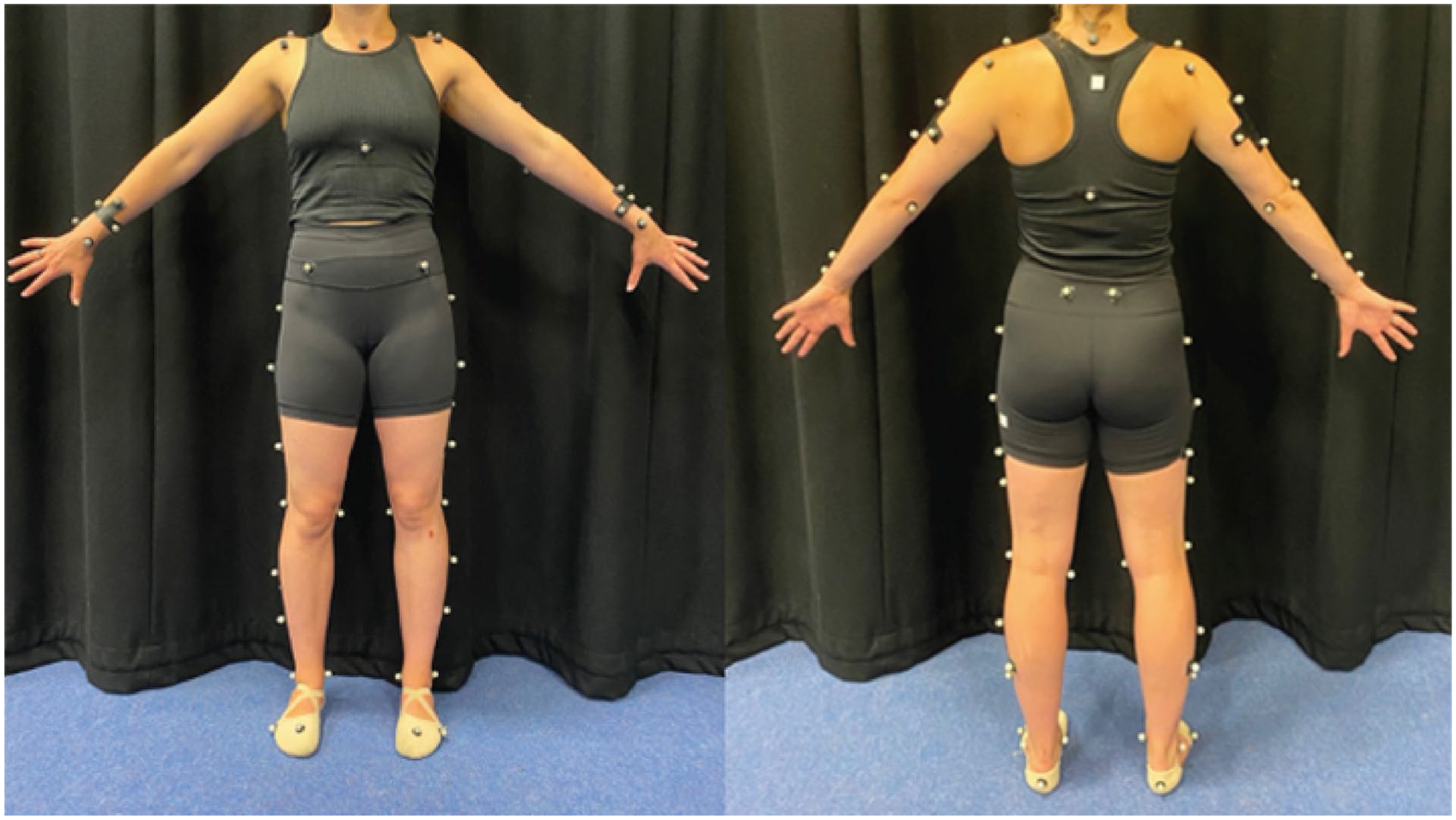
Placement of full body marker set used in this study.
The vertical ground reaction force (vGRF) for the SCMJ trials was measured using a Kistler piezoelectric force plate (Type 9281B, 600 mm × 900 mm × 100 mm, Kistler Instruments, Hampshire, UK). A second Kistler piezoelectric force plate (Type 9287, 400 mm × 600 mm × 100 mm, Kistler Instruments, Hampshire, UK), located posteriorly to the first plate, was utilized for the pirouette en dehors trials (Figure 2). Both force plates recorded at a sampling frequency of 960 Hz.
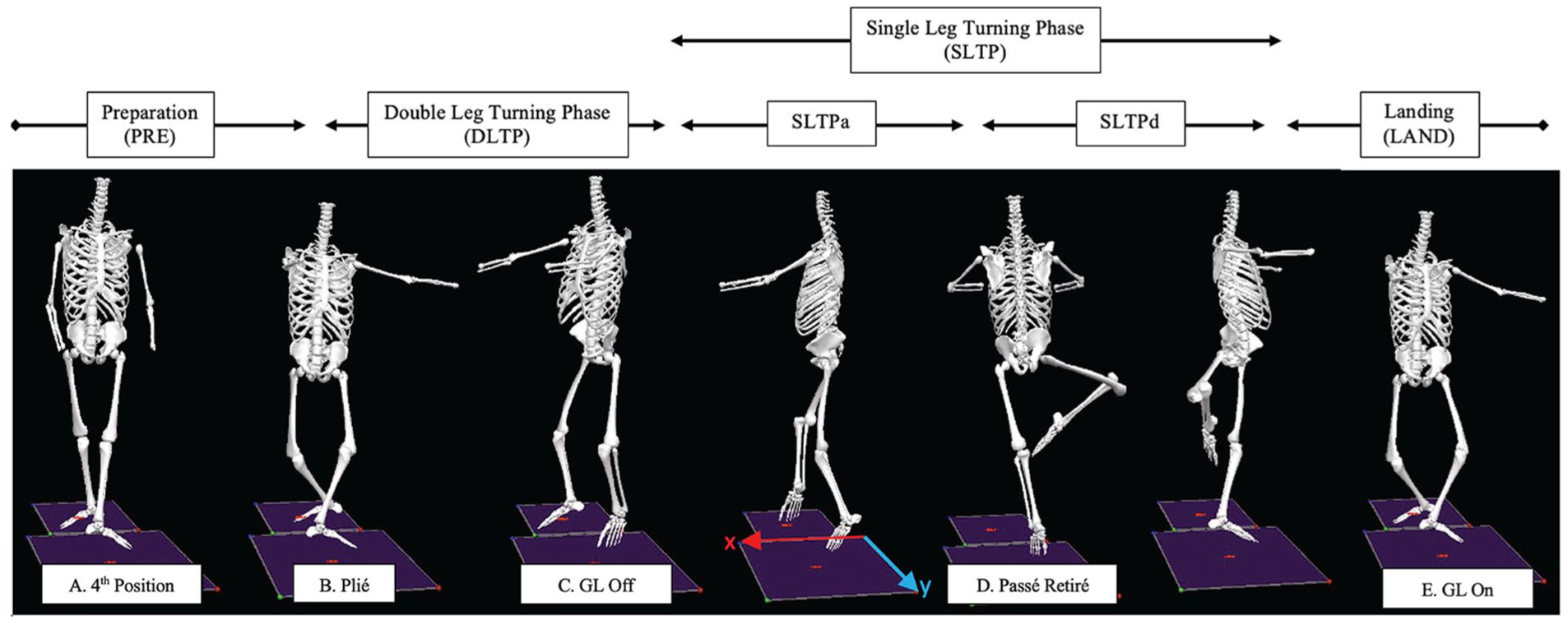
Five movement phases of a pirouette en dehors. Dancers prepared in fourth position (A) facing along the y-axis of the lab coordinate system. After a plié (B), dancers pushed the gesture leg off (C) of the floor to complete the single leg turning phase in a passé retiré (D) before placing the gesture leg back on (E) the floor during the landing phase.
Procedure
During one testing session, participants performed two static standing trials in anatomical position, followed by three maximal effort SCMJs on each leg and ten single revolution pirouettes en dehors in each direction. Prior to data collection, dancers were asked to complete a 10-minute self-directed dance-specific warm up. Practice time was provided for participants to familiarize themselves with the testing area and both movement tasks. Individuals were randomly selected to start on the right or left limb following a crossover design. After the testing session was completed, leg dominance, and preferred direction of rotation were self-reported in a lateral preference questionnaire (Table 1).
Results from the Lateral Preference Questionnaire.
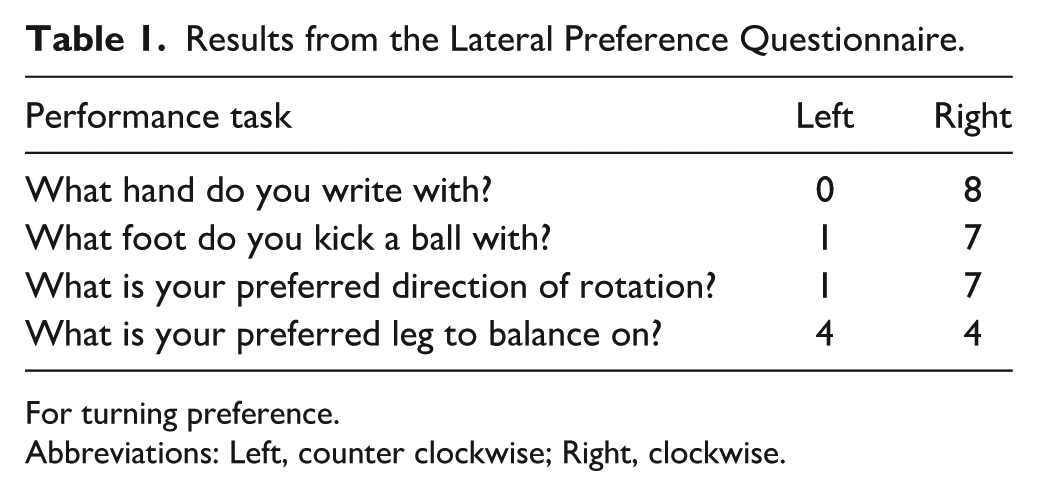
For turning preference.
Abbreviations: Left, counter clockwise; Right, clockwise.
The SCMJs were performed in a parallel cou-de-pied position, in which the GL foot was situated against the lower calf of the jumping leg. The hands were placed on the hips to restrict upper body movement as well as isolate the GRF from the lower extremities. Each trial began with a single leg plié prior to jump take-off and finished by landing on the same leg. Dancers were given 30 seconds of rest between each SCMJ to control for fatigue and encourage maximal effort performance. All pirouette trials began from a ballet fourth position (Figure 2A), in which both legs were externally rotated from the hips and each foot was placed on a separate force plate. Following an auditory cue given by the researcher, dancers prepared for the pirouette with a plié (Figure 2B), then turned 1 revolution on demi-pointe in retiré passé (Figure 2D) before landing with the GL fully extended to the back in a lunge position. To standardize rhythmical tempo, all pirouettes were performed to the same piece of music, Pirouette (Faster)—The Winner Takes All, by E. Geddis in a ¾ time signature with 60 beats per minute. Adequate rest, as determined by the participant, was provided between each trial.
Video recordings of each pirouette were then evaluated by two qualified dance professionals and scored as either successful or unsuccessful. Both evaluators were highly trained in ballet and agreed on the following baseline criteria prior to data collection. Pirouettes were classified as successful if the dancer fully rotated the turn without hopping, achieved the desired retiré position, and landed with the GL on the back force plate. This grading criteria was selected in accordance with previous research. 21 Three successful trials from each direction were selected for analysis for all participants following the order in which the pirouettes were performed.
Data Processing and Analysis
The SCMJ and pirouette trials were labelled using Vicon Nexus. All processed data was then exported to Visual 3D software (C-Motion, Inc., Rockville, MD, USA) for analysis. A 12 Hz low pass filter was used on all video data and therefore a 48 Hz low pass filter was used for all force data. Cut off frequencies were determined through completion of a residual analysis. 22 The dancer’s motion was analyzed using a 12-segment, 6 degrees of freedom model: trunk, pelvis, upper arms, forearms, thighs, shanks, and feet. All variables calculated using COM were relative to this system. 23 All GRF data was normalized to the dancers’ bodyweight (BW).
In accordance with previous studies, leg dominance for the SCMJs was defined as the leg used to kick a football,7,18,19,24 whereas the preferred turning condition for pirouette en dehors performance was determined using the self-reported preferred direction of rotation. Vertical jump height (VJH) was calculated by subtracting the COM at standing height from the COM at jump apex. Peak vGRF was recorded as the highest force output prior to take-off and the average vGRF was measured across the entire concentric phase, defined as the period between maximum knee flexion and take-off.
For the purposes of kinematic and kinetic analysis, the pirouette en dehors was divided into 5 movement phases (Figure 2): 1. preparatory (PRE), 2. double leg turning phase (DLTP), 3. single leg turning phase with GL in ascension (SLTPa), 4. single leg turning phase with GL in descension (SLTPd), and 5. landing (LAND). In analyzing the movement, the DLTP ended and SLTPa began when the GL left the force plate (Figure 2C) and continued until the retiré passé was achieved (Figure 2D). The retiré position was defined by the maximum knee flexion of the GL during SLTP. Once the GL reached retiré passé, the dancer then moved into SLTPd. The end of the SLTPd was determined when the GL returned to the force plate (Figure 2E). The pirouettes were compared across turning conditions using 9 different performance variables, each assigned to one of 4 assessment categories: performance consistency, balance, retiré posture, and force production at push-off.
Performance consistency was determined by the total number of successful turns out of 10 for each direction and reported as a percentage score. Balance was measured by evaluating both the vertical alignment of the model COM over the base of support (BOS), 7 as well as the instantaneous trunk angle during the SLTP.18,24 A resultant 2D vector between the two horizontal axes (x and y; Figure 2) was calculated between the coordinates of the model COM and COP of the SL. A metric value of the displacement between COM and COP at retiré was taken (COM-COP) and the average COM-COP was calculated across the SLTPd. The instantaneous trunk angle was measured at retiré in the y-axis relative to the global vertical of the lab. Retiré posture was evaluated using the maximum knee flexion and external hip rotation of the GL.7,18 External hip rotation was calculated about the z-axis of the thigh segment relative to the pelvis. Force production at push-off was measured by the peak GRF of the GL in the vertical (vGRF) and anterior-posterior directions (APGRF), 24 along with the peak rotational angular velocity of the pelvis when the GL pushed-off of the force plate. 10
Statistical Analysis
The values for each jump and turn variable were calculated by averaging the data from all 3 trials in each lateral condition for every participant. Since this study is a repeated measures research design, a paired-samples t-test was used for all variables. The statistical significance level was set as P ≤ .05. All statistical analysis was completed using R studio Version 2024.09.0+375.
Results
The data was explored to determine if the presence of laterality in elite dancers will impact lower limb strength and technical pirouette performance. The results of the lateral preference questionnaire are shown in Table 1. All participants indicated to be right-side dominant in handedness. Only one dancer demonstrated contralateral tendencies in which the left side was preferred for kicking and turning actions. Therefore, preferred turning direction was correlated to the preferred kicking leg as GL for all participants.
There were no statistical differences between limbs in the SCMJs for VJH, peak vGRF, or average concentric vGRF (Table 2). The results for all pirouette performance variables are presented in Table 3. Pirouettes executed in the preferred turning direction had a significantly greater success rate than those completed in the non-preferred direction. Both COM-COP at retiré and average COM-COP in SLTPd, as well as instantaneous trunk angle showed no significant differences between turning conditions. However, a non-significant trend of increased COM-COP displacement at retiré was observed in the non-preferred direction. Figure 3 demonstrates a representative comparison of the COM-COP displacement of 1 participant throughout the entire pirouette of both conditions. Retiré posture measures indicated no significant differences for either GL max knee flexion or GL external hip rotation at retiré between the preferred and non-preferred sides. There were also no significant differences in turning direction for both peak GL vGRF and peak GL APGRF at push-off. However, pirouettes performed in the non-preferred direction demonstrated a trend of increasing peak pelvic velocities at push-off.
Performance Variable Results for Single Countermovement Jumps.

Abbreviations: vGRF, vertical ground reaction force; BW, bodyweight.
Performance Variable Results for Pirouette en Dehors.
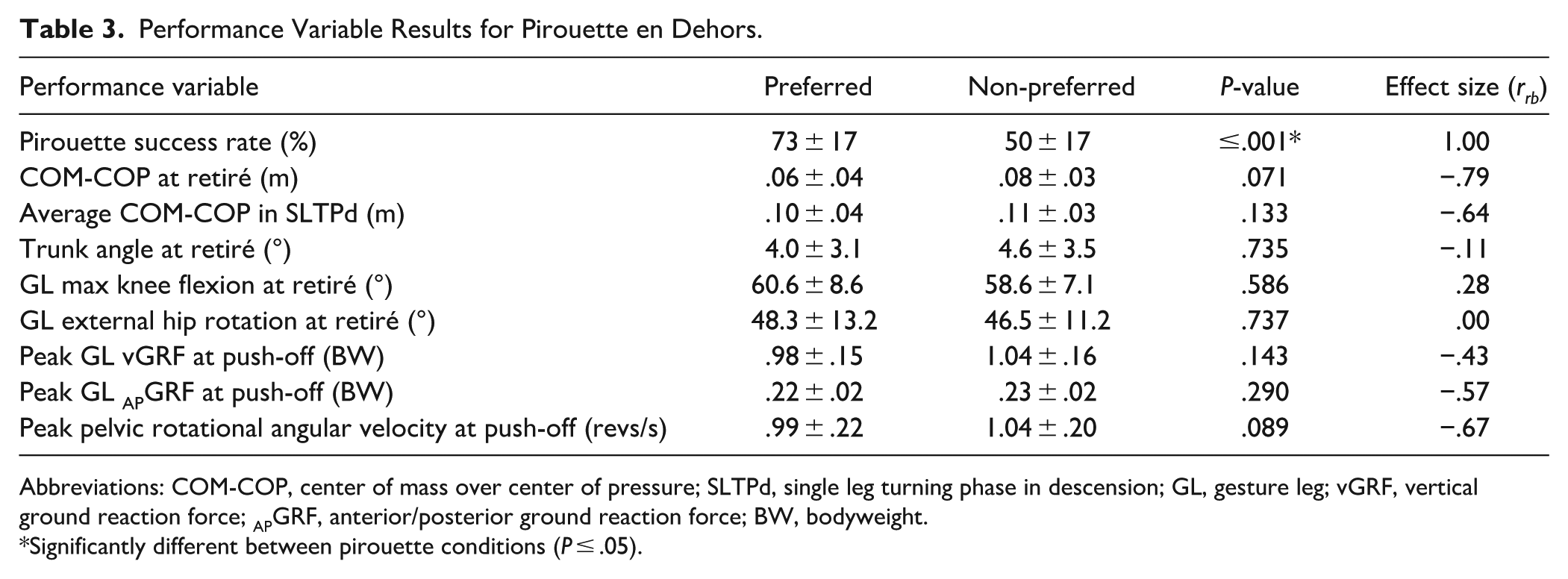
Abbreviations: COM-COP, center of mass over center of pressure; SLTPd, single leg turning phase in descension; GL, gesture leg; vGRF, vertical ground reaction force; APGRF, anterior/posterior ground reaction force; BW, bodyweight.
Significantly different between pirouette conditions (P ≤ .05).
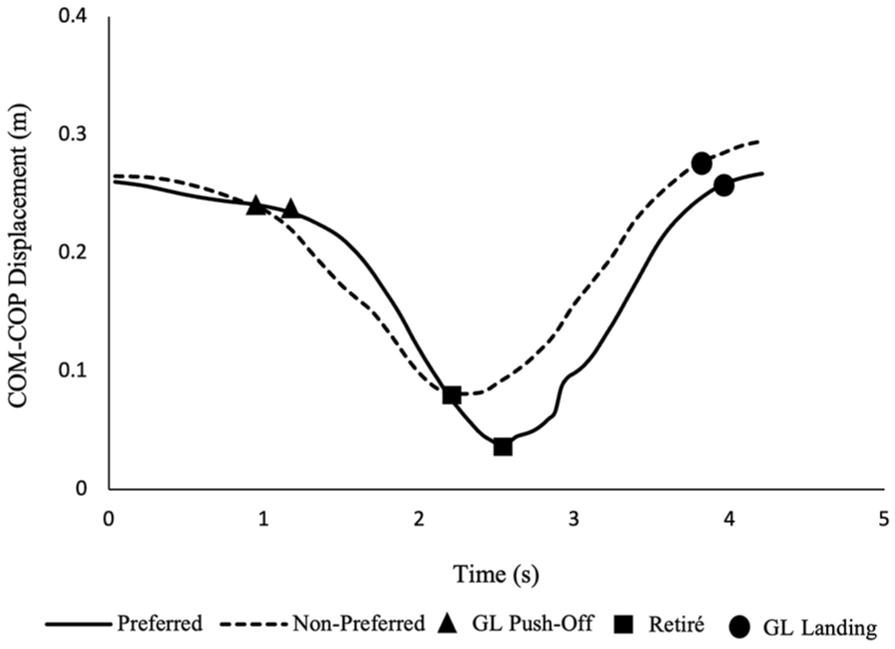
A representative comparison of the COM-COP displacement between the preferred and nonpreferred pirouette conditions for 1 participant.
Discussion
Lateral Preference
This study aimed to examine the effects of laterality on lower limb strength and technical performance of dancers who have received extensive dance training. The lateral preference questionnaire indicated a strong partiality toward the right side for handedness, footedness, and preferred turning direction. All participants preferred to rotate in the direction towards their dominant kicking leg when used as the GL, demonstrating that footedness is a reliable measure of turning bias. 25 However, despite a significantly greater success rate of pirouettes performed in the preferred direction, there were no significant bilateral differences for any of the discrete biomechanical performance variables for both SCMJs and pirouettes. While earlier research has shown that experienced dancers exhibit greater functional symmetry due to their focus on bilateral training,7,15,26,27 laterality maintains the ability to significantly impact the performance consistency of pirouettes in the non-preferred direction.
Single Countermovement Jumps
VJH and vGRF during take-off demonstrated no significant differences between the dominant and non-dominant SCMJs. Therefore, the findings of this study suggest that lateral bias does not contribute to lower limb strength asymmetries within this group of highly trained dancers. This is consistent with previous literature, in which single-leg vertical jumps were also used to measure bilateral strength profiles. Between dominant and non-dominant legs, Newton et al 28 found no significant differences in average concentric force for Division I collegiate female soft-ball players, and McElveen et al 29 reported no discrepancies in VJH and peak vGRF for physically active young adults. However, while SCMJs have been shown to have significant correlations to isokinetic strength testing for measuring bilateral muscle asymmetries,19,28,30,31 this field test only provides data pertaining to the strength of the entire leg and not individual muscles. As such, future research would benefit from comparing the bilateral strength profiles of the lower limb flexors, extensors, and plantar flexors.
Pirouette en Dehors
Preferred pirouette performance demonstrated a significantly greater success rate than pirouettes completed in the non-preferred direction. However, since there were no significant differences in any of the biomechanical variables measured in this study, the lack of consistency found in the non-preferred pirouettes requires further analysis. Balance is perhaps the most important component of a successful pirouette. 32 If the COM deviates from vertical alignment over the COP, dancers will often lose balance and need to hop on the SL to regain control.6,33 As such, the strong trend towards greater COM-COP displacement that was observed at retiré for the non-preferred direction highlights a potential weakness in pirouette technique. While this is not a serious issue for single pirouettes, a high amount of COM fluctuation could become problematic when performing double or triple rotations with increased rotational velocity.7,33 That said, dancers have been shown to accommodate for postural sway during the SLTP of multiple revolution pirouettes by adopting different movement coordination patterns.7,33,34 Consequently, it is suggested that the greater COM-COP displacement demonstrated in the non-preferred pirouettes may be influenced by postural instability elsewhere in the turn.
The weight transfer that occurs between the preparation phase on double leg support and the SLTP is an integral part of the pirouette. The COM-COP trajectory displayed in Figure 3 shows a faster weight transfer strategy between double to single leg support in the non-preferred direction. The dancer reached retiré in a shorter amount of time from GL push-off and then experienced a larger COM-COP displacement at retiré. Previous research has found that novice dancers tend to overshoot this weight transfer phase and therefore exhibit greater medial COM inclination at retiré than experienced dancers. 7 Comparably, inadequate force at push-off also makes it difficult for a dancer to efficiently shift their weight over the BOS. Although participants in the current study generated similar vGRF and APGRF by the GL at push-off for both turning conditions, greater peak pelvic rotational angular velocities at push-off were descriptively observed in the non-preferred pirouettes. In line with previous laterality research conducted on dance jumps and bilateral transfer,5,16,20 it is suggested that lateral preference may influence dancers to use a different push-off strategy when turning on the non-dominant side. As such, GRF produced at push-off should be controlled to decrease the horizontal velocity of the pelvis for non-preferred pirouettes.8,10 This approach will enable an increased accuracy of COM-COP vertical alignment following the preparation to the SLTP transfer phase. Therefore, dancers are encouraged to train this weight transfer strategy in isolation from the rest of the pirouette, with the purpose of developing consistent levels of controlled force production and pelvic velocity at push-off as well as postural stability in retiré. To reduce variations in push-off technique between pirouette conditions, it is important for each leg to receive an equal amount of practice performing as both the GL and SL. 18 In this way, any residual effects of bilateral transfer on pirouette performance can be addressed.
During the SLTP, the GL is required to achieve considerable external hip rotation to meet the aesthetic demands of the retiré position.27,34 Additionally, a lower and less laterally orientated GL requires the dancer to shift their weight further onto the SL to find balance. For this reason, insufficient turnout in retiré could potentially contribute to greater COM-COP displacement. 7 That said, the results of the current study demonstrated that lateral preference did not significantly affect either of the discrete biomechanical variables for retiré position. However, there were subject-specific differences within the GL external hip rotation data. Depending on the participant, greater external hip rotation was either observed in the preferred or non-preferred pirouette direction. This asymmetry in hip rotation suggests that an unequal muscle effort exists between the external rotators of the lower limbs.7,26 Therefore, an inconsistency in muscle activation patterns, along with postural instability and different technical strategies used during the weight transfer phase could help explain the lower success rate of the non-preferred pirouettes demonstrated by this sample of dancers. 20
Future Recommendations
While movement variability has been shown to influence pirouette performance, 32 not much research has been conducted on the relationship between laterality and movement consistency. 2 An earlier study suggested that tasks completed with the non-preferred limb are subject to higher amounts of variability in coordination patterns and are therefore comparable to novice level performance. 19 Accordingly, future research should endeavor to measure movement variability between the preferred and non-preferred turning directions for both successful and non-successful pirouettes. The use of EMG sensors to study possible discrepancies in muscle activation patterns and postural stability is also recommended.
Limitations
Traditional dance flooring could not be sourced for the present study. Consequently, the friction coefficient between the ballet shoe and force plate surface may differ to the flooring conditions typically used for dance purposes. This research did not examine the kinematics of upper limbs during pirouette execution and therefore the effects of arm laterality in dance remains unknown.
Conclusion
Within a group of highly trained dancers, a rightward bias for both footedness and turning preference had a significant negative effect on the success rate of pirouettes performed in the non-preferred direction. However, when using discrete biomechanical performance variables to compare bilateral lower limb strength and pirouette technique, this study found no significant asymmetries between lateral conditions. That said, the trends toward greater COM-COP displacement and peak pelvic rotational velocity that were observed in the non-preferred turning direction highlight potential technical issues that may help explain the less consistent performance rate. Since these discrepancies could have increased effects on the execution of multi-revolution pirouettes, it is suggested that dancers train the weight transfer between the preparation phase and retiré position separately from the rest of the turn. Dancers are also encouraged to control the amount of GRF produced by the GL at push-off. In doing so, the pelvic velocity can be reduced and postural stability during the SLTP can be sustained. To focus on developing symmetrical push-off technique for both pirouette conditions, each lower limb should receive equal practice acting as both the GL and SL. In this way, the effects of laterality on dance performance can be appropriately managed and the development of a well-balanced dancer can be supported.
Footnotes
Acknowledgements
The authors thank Corey Perrett and Kieran Austin for their guidance and technical assistance during data collection, as well as the University of Chichester for the use of their facilities and equipment.
Declaration of Conflicting Interests
The authors declared no potential conflicts of interest with respect to the research, authorship, and/or publication of this article.
Funding
The authors received no financial support for the research, authorship, and/or publication of this article.
Ethical Considerations
Ethical approval for this study was provided by the University of Chichester’s Ethics board.
