




Abstract
Keywords
Key Points
The physiological demands of live dance performance are scarcely reported in previous research.
Heart rate values recorded during live performance noted professional Irish dancers working at hard/very hard intensities for ~3 minutes at a time for 3-9 individual dance numbers across the show.
Overall physiological demand experienced by any one dancer across the entire show duration varied dependent upon their role (dictating the nature and frequency of on-stage moments) and off-stage/recovery practices.
Introduction
Dance is frequently reported as being a high-intensity, intermittent activity.1 -4 This may be an accurate summation, but it is also a broad generalization. Dance styles and contexts vary. Within one dance company’s repertoire there will be variability in discrete skills required for different choreographies, dancer roles within the company, duration and pattern of time spent on and off stage for each dancer, overall performance duration per show, and individual dancer fitness levels.
As the focal output of dance training, it is important to understand performance demands to ensure dancers are physically prepared to cope with these. Both the intermittent nature of dance activity and its aesthetic requirements provide challenges for data collection. Previous studies aiming to document the demands of dance performance have utilized a variety of experimental settings, including during5 -7 or after 8 live, on-stage performance, under simulated conditions,9 -15 in rehearsal,7,16 and utilizing recordings to undertake retrospective video analysis.17,18 Methods of data collection and variables identified as representative of physiological demand have been directed by the nature of the “performance” situation being observed and the associated restrictions of the equipment. For example, simulated or rehearsal conditions allow for respiratory (oxygen uptake) and blood (lactate) measures, whereas retrospective video analyses are restricted to time-related variables only such as work:rest ratio.
Previous research investigating the physiological demands of dance performance has centered on ballet and contemporary genres,6,7,16 -18 and competitions in Dance Sport (Latin and ballroom),9 -15 with singular studies in other genres such as Highland, 5 Jazz, 8 and hip-hop (new style and breaking). 19 Notwithstanding differences in measurement conditions, a high mean intensity has been reported across all genres, documented in multiple studies as exceeding 80% of individual maximum heart rate (HRmax)6,8,9 or oxygen uptake (VO2max).9,10,12 Findings from ballet further identify differences in demand between principal, soloist, and artist roles, with principals spending significantly greater time at moderate intensity than soloists and artists, and soloists spending significantly greater time at rest than principals. 18 Significant differences have also been reported in blood lactate levels between different dance numbers in competitive Highland dance. 5 However, there is limited data available documenting variation in demands between dancers within a specific dance number or across an entire live show. A review by Beck et al. 2 recommends a greater breadth of genre-specific performance data be collected, along with combining time-related work and rest data with real-time measurement of intensity during work and rest to quantify demand.
Live monitoring during real performance conditions is restricted to devices that can fit discretely under costumes (most typically, heart rate [HR] monitoring) and has scarcely been adopted in previous research. Descriptions of heart rate response to short segments of live, on-stage ballet performance are available in two studies published from 1982 to 1984.6,7 Cohen et al. 6 report HR “rapidly increasing to near maximal levels” (peak 94% age predicted [AP] HRmax) during allegro (fast tempo) sections. Schantz and Åstrand 7 describe HR values recorded via electro-cardiography (ECG) as “frequently close to maximum” (80%) and associated blood lactate levels as “similar to” those recorded by these individual dancers following maximal exercise on a treadmill or cycle ergometer (10 mM). This study concluded that despite the short duration of the performed elements, the activity was “very demanding energetically.” 7 An additional, single study in Highland dance reported an overall mean HR of 195.0 ± 6.5 b.min−1 during a scheduled championship competition. 5 These existing data provide only a high-level, vague description of overall demands of live performance, not accounting for factors such as time spent at reported intensities, entire performance time, rest time between on-stage moments, nor variation between individual dancers performing different roles.
The present study examines the Irish dance genre, through a collaboration with a world renowned professional Irish dance company. Irish dance is characterized by its vertical spinal posture, while the lower limbs perform repetitive explosive and high-impact rhythmical actions. Soft shoe Irish dance has similarities to Highland Dance, with elements comparable to some ballet actions, while hard shoe Irish dance has similarities to other percussive styles such as Tap or Flamenco. Irish dance became a global performance phenomenon in the mid 1990’s with the launch of Riverdance and subsequent professional performance companies. 20 Typically, dancers in such companies have previously been elite competitive Irish dancers with some amateur performance experience. Dancers are contracted per tour; therefore, each touring period introduces new cast members within the troupe role, alongside established cast members in troupe and lead roles. Those dancers performing in lead roles are selected/promoted from the troupe. Between contracted touring periods, dancers will typically undertake other employment opportunities within, or outside of, the dance industry. The training and performance practices of professional Irish Dancers therefore differ from those commonly seen in ballet and contemporary dance, as examined in the majority of available studies. Of the limited scientific research on professional Irish dance, the predominant focus has been on injury risk factors,20 -28 with other studies examining fatigue and technique29,30 and nutrition knowledge. 31 To date there is no known published data on heart-rate response to professional live Irish dance performance.
A more comprehensive understanding of the physiological demands of dance performance across a variety of genres and contexts can positively inform training, preparation, and recovery strategies in relation to those demands. Therefore, the aim of this study is to provide a detailed description of the overall physiological demands of live professional Irish dance performance, through HR monitoring, accounting for time- and intensity-related data across work and recovery periods for an entire show. This study is part of a larger project and the design and resultant data described herein provide an initial exploration to build upon the few existing studies examining the physiological demands of dance performance, aiming to overcome limitations as outlined above.
Methods
Participants
The entire Irish Dance Cast of the Liffey Company of the Riverdance 25th Anniversary show participated in the study (n = 24; 10 male troupe, 12 female troupe, 1 male lead, 1 female lead per performance), enabling the maximum possible purposive sample size in the context of the study design. The mean age of participants was 25 ± 4 years.
Ethics
The study was approved by the Institutional Research Ethics Committee and all participants provided informed consent following receipt of a verbal briefing and written participant information sheet.
Study Design
The study employed a descriptive, cross-sectional research design. Two shows (matinee and evening) were monitored on the first show day of a 4-month touring/performance period. No dancer performed the exact same role in both shows due to the company’s system of rotating dancers through roles and dance numbers within each performance. The rotation system allows variation in the demands experienced by each dancer and is designed by the company to allow dancers to have “heavier” and “lighter” performances over an average of seven shows per week (range 2-9). Participant roles and individual dance numbers performed were noted/recorded for both performances observed.
One-to-two hours before each show, dancers walk through each dance number in a rehearsal referred to as “rotations,” with the primary purpose of ensuring each dancer is familiar with their role and placement within the upcoming show. No other company scheduled training (class or rehearsals) is conducted on show days.
Due to the live performance nature of the study design, data collection was limited to HR monitoring, where the chest strap could fit discreetly under costumes. However, this enabled the study design to have a high ecological validity, where the specific context of dance performance is captured in real-time as related to the primary aim of the study. The set nature of the production’s choreography offered relatively consistent parameters for monitoring heart-rate response of both on-stage and off-stage periods for the duration of the production.
Procedures
Individual chest strap HR monitors (Polar Team 2 , Polar Electro, Finland) were worn by each dancer, which recorded data every 5 seconds. Monitors were put on around 1 hour before and taken off around 30-minutes after the show. Monitors fitted discreetly under costumes to allow continuous monitoring during on-stage performance (in front of a live audience) and off-stage periods across the duration of the show. Shows were filmed to allow retrospective categorization of show timings, including full notation of times at which individual dancers were on stage (ie, work) and off stage (ie, rest/recovery).
Data Analysis
Time-related data detailing the structure of the show were synchronized with recorded HR data to create an individual HR response profile for each dancer, corresponding to each individual dance number performed in that show and the duration of the overall show. Data were removed from analysis of both matinee and evening shows for one male (troupe) and one female (troupe matinee, lead evening) dancer, due to incomplete HR data files. Individual AP HRmax (220—age) was used to calculate %HRmax from raw HR data. For 7/24 participants, the highest HR value recorded during the monitoring period was used as HRmax instead, as these values exceeded the AP HRmax calculated value. Time spent working in each exercise intensity zone was calculated for each individual number performed, and for both the whole show duration (140 minutes) and total time spent on stage (work) for each individual dancer. Exercise intensity zones were classified as “Very light” < 50% HRmax, “Light” 50%-63% HRmax, “Moderate” 64%-76% HRmax, “Hard” 77%-93% HRmax, and “Very Hard” > 94% HRmax. 32 All analyses were separated by male/female and troupe/lead role. Descriptive statistics, reporting mean (±standard deviation; SD) data are provided.
Results
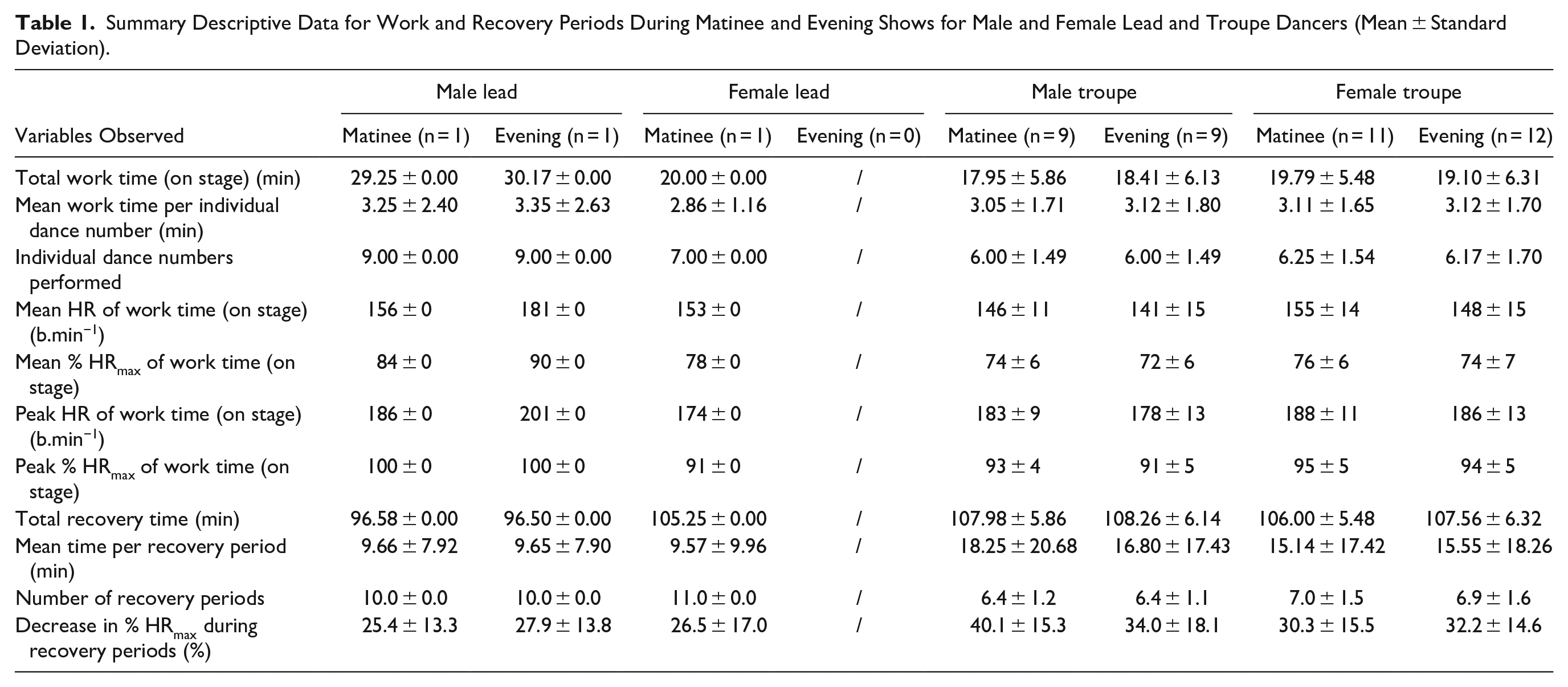
All dancers worked at hard/very hard intensities (mean > 72%, peak > 91% HRmax) for ~3 minutes (mean ± SD available in Table 1) at a time for 3 to 9 individual dance numbers over the duration of the 140 min show (including one 20 minutes interval). Table 1 reports mean ± SD values from the matinee and evening shows of key variables related to both work and rest time, including HR response (ie, intensity experienced) for the male lead and female lead individually, and for the male troupe dancers and female troupe dancers as groups.
Summary Descriptive Data for Work and Recovery Periods During Matinee and Evening Shows for Male and Female Lead and Troupe Dancers (Mean ± Standard Deviation).
Overall, there was a low percentage of total work time across the whole show duration (inclusive of 20-minute interval); 23% for male lead, 15% for female lead, 14 ± 4% for male troupe, and 15 ± 4% for female troupe, with mean work to rest ratio (W:R) in the range of 1.0-1.6 to 5.4-6.0. Figure 1 displays the proportion (%) of total show time (Figure 1A) and total work time (on stage; Figure 1B) spent in each of the exercise intensity zones for male and female lead, and male and female troupe dancers for the matinee show only.
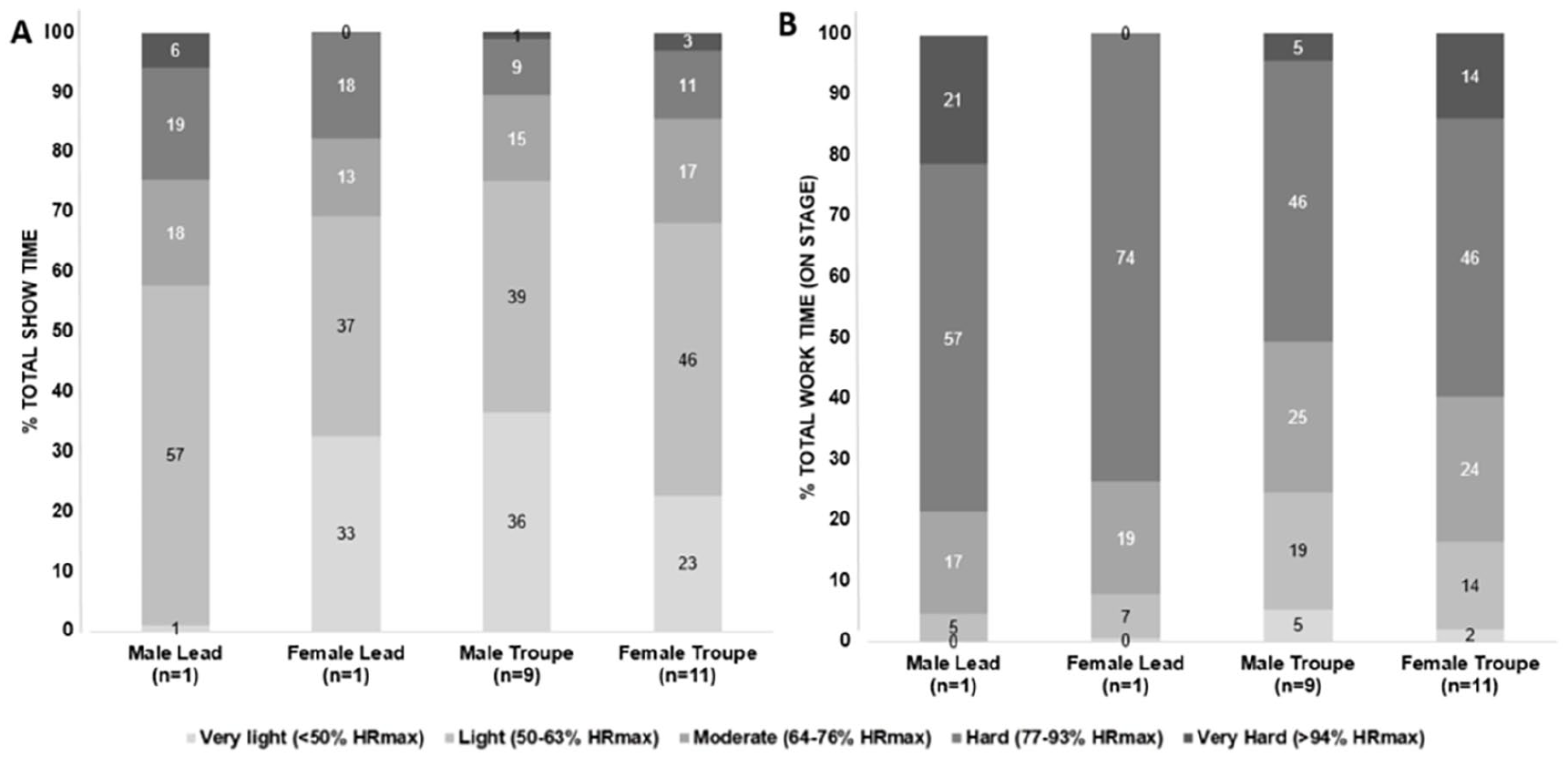
Mean proportion of time spent working in each exercise intensity band during matinee show, expressed as a percentage of (A) total show time, (B) total work time (on stage).
Figure 2 displays example full-show HR traces with matinee (solid line) and evening (dashed line) shows overlaid for one male dancer performing a troupe role for the matinee and the lead role for the evening show (Figure 2A), one female dancer performing the lead role for the matinee and a troupe role for the evening show (Figure 2B), and one male (Figure 2C) and one female (Figure 2D) performing troupe roles in both shows.
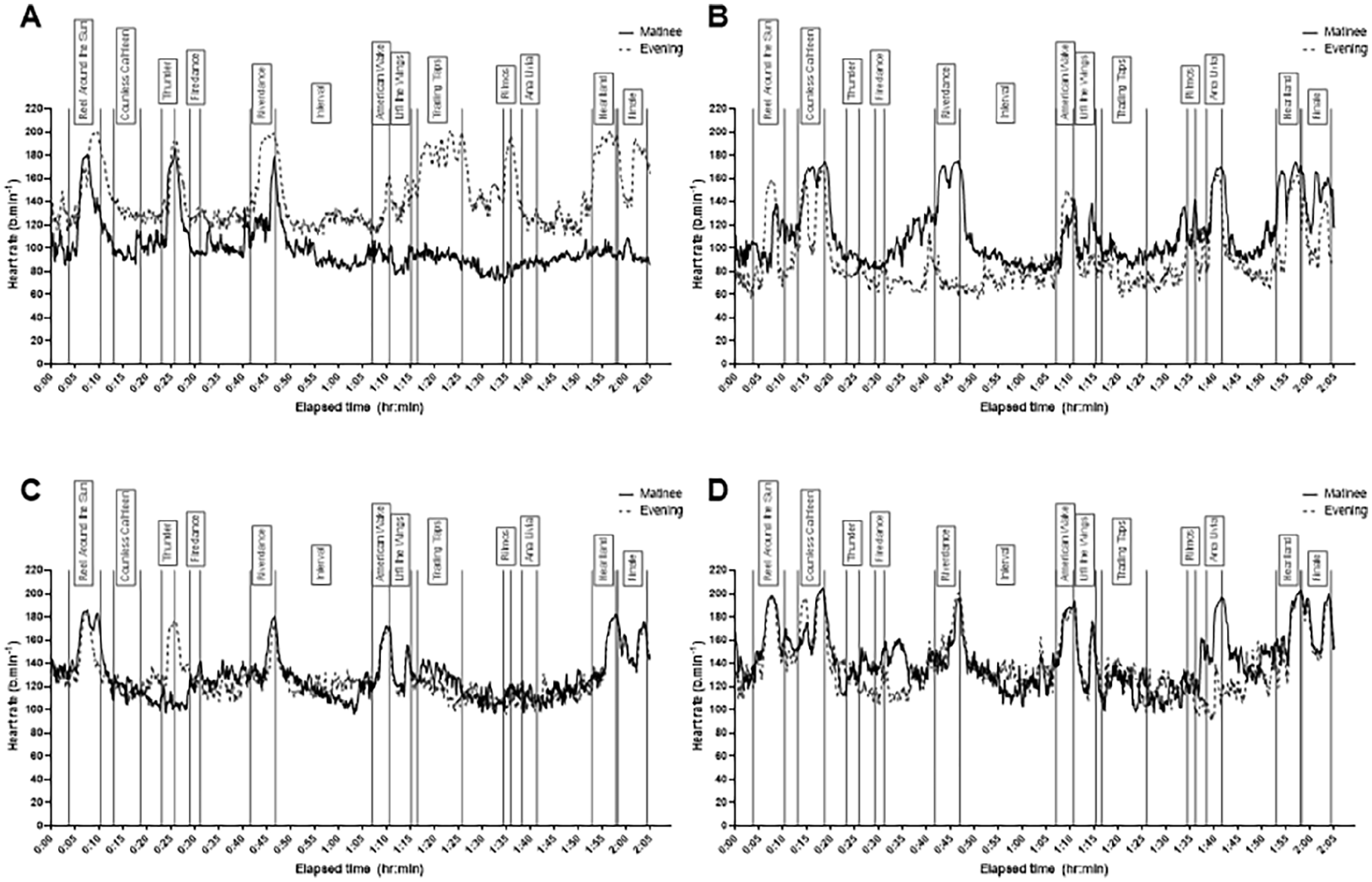
Example full-show heart rate traces with matinee and evening shows overlaid for four individual participants: (A) male troupe role for matinee and male lead role for evening show, (B) female lead role for matinee and female troupe role for evening show, (C) male troupe role (both shows), (D) female troupe role (both shows). Individual dance numbers within the whole show timeline are represented by solid vertical lines.
Discussion
Key findings indicate all dancers worked at hard/very hard intensities (mean > 72%, peak > 91% HRmax) for ~3 minutes at a time for 3 to 9 individual dance numbers over the duration of the 140 minutes show (including one 20 minutes interval). However, suggested variation based upon available data in both time- and intensity-related parameters was reported between individual dancers based on their role. These findings are in keeping with previous literature describing dance performance as intermittent and high intensity in nature, with HR values typically exceeding 80% of individual HRmax6,8,9 and differences found between lead/principal and other dancer roles. 18 However, the present study arguably provides a more detailed picture of the overall demand profile, where few previous studies have provided real-time measures of both time- and intensity-related variables. These data, when presented alongside one-another, provide important detail to the generalized statement of dance performance as a “high intensity, intermittent activity,” whereby the duration and intensity of work and rest periods will vary greatly between dance styles, repertoire, and individual dance roles. For example, both ballet and contemporary dance performance have previously been documented as high intensity, intermittent activity, but with significant differences in the duration spent at different intensities (as estimated by retrospective qualitative observation of movement patterns). 17 Contemporary dance performance was described as being made up of longer duration moderate intensity bouts, interspersed with high intensity bursts, with ballet performance consisting of longer periods at rest and at high to very high intensities compared to those reported in contemporary dance. 17 As reported in the present study, on-stage Irish dance performance consists of high intensity for a mean duration of around 3 minutes, interspersed with off-stage moments of varied durations. The physiological response of the body to these different dance activities will vary based on intensity-duration demands, as will the necessary training and fitness preparation to be able to meet these demands. Therefore, future research in different genres of dance should provide detailed documentation of time spent at given exercise intensities and the patterns of work and rest observed.
Data available suggested differences between individual dancer roles in both work and rest durations and intensities, as noted in both the high variation (standard deviations) reported for troupe dancers, and between troupe and lead dancers. The male leads (matinee and evening, respectively) recorded the longest mean time on stage per number (3.25 and 3.35 minutes) and the most dance numbers performed (9), resulting in the greatest total time spent on stage (29.25 and 30.17 minutes) and the least recovery time (96.58 and 96.50 minutes) compared to the female lead (matinee) and to both male and female troupe roles (matinee and evening) (Table 1). Slight differences in reported time-related variables for the male lead dancers are due to an individually choreographed section in one dance number. Additionally, the male leads (matinee and evening, respectively) reported the highest work time mean (84% and 90%) and peak (both 100%) %HRmax (noting limitations of the use of age-predicted and peak recorded HR values to represent HRmax and to calculate %HRmax data). Male and Female lead roles, on average, had more frequent, shorter recovery periods, while troupe roles had fewer, longer recovery periods, on average. As displayed in Figure 1, across the whole show duration for the matinee (including the 20-minute interval), the greatest proportion of time was spent at very light/light intensities for all dancer roles (58% male lead, 70% female lead, 67.5 ± 28.0% male troupe, 62.4 ± 25.8% female troupe [Figure 1]). When considering the on stage (work) time only, the greatest proportion of time was spent in the hard intensity zone for all roles (Figure 1). However, male and female lead dancers for the matinee performance appeared to spend a greater proportion of both total show time and on-stage time at hard/very hard intensities, compared to troupe roles, as well as spending longer durations on stage and having less rest time. It is important to note that these data represent the response of one male and one female lead dancer only and will not necessarily be representative of mean response of all lead dancers. Nonetheless, in comparison to ballet performance, principals were also found to have significantly less rest time than soloists, but, in contrast, also spent a significantly greater time at moderate intensity than soloists and artists. 18 In the present study, the higher overall demands suggested for the lead dancers (intensity and time), compared to those of the troupe dancers (in particular for the male lead), highlight an important consideration with regard to physical preparation for those selected from the troupe to assume the lead role. Adequate time for, and attention to, physical preparation to undertake this more demanding role, should be considered alongside the technical, choreographic, and artistic elements of performance. It would also be pertinent for more data to be collected in future research studies on more dancers performing the lead role to examine if these observed patterns of greater demand hold true.
Recovery time was highly varied throughout the show duration; largely dependent on the individual dancer’s role for that show and which individual dance numbers they performed, as per the company’s rotation system. Short recovery periods within dance numbers were rare but ranged from 0.50 to 2.08 minutes and were most common for the female lead role. Longer recovery periods were recorded between dance numbers, including during the interval, which provided 20.75 and 23.42 minutes of rest between last appearance in the first act and first appearance in the second act for troupe and lead roles, respectively. Based on anecdotal observation from time spent backstage by the researchers, there was noted variation in activities completed by dancers during off-stage times, both within individual dancers between shows, and between dancers. Activities observed included seated rest, costume changes, marking through dance numbers (whole or sections), completing exercises/warm up activity (eg, abdominal crunches, squats, high knees, jumps), stretching, eating, drinking, and attending massage appointments scheduled by the company. To our knowledge, no previous dance specific research has examined the rest/recovery periods within the intermittent nature of performance (nor class or rehearsal) to allow comparison of common practices and their resultant impact upon overall demand experienced. Future research exploring what could be done between dance numbers, in off-stage moments, to best support recovery and optimize performance both in subsequent dance numbers and subsequent performances across a prolonged tour/run is warranted.
Despite no individual dancer performing the exact same role in both shows (due to the company’s system of rotating dancers through roles within each dance number), data collected do allow for some comparisons to be drawn between the two performances. Firstly, there were similarities between shows for troupe dancers; both visually in HR trace patterns (Figure 2C and D) and numerically in reported HR values. In particular, similar responses were displayed for specific sections of individual dance numbers. For example, in Figure 2D, the HR response pattern for ‘Countess Cathleen’ part 2 (second elevation in trace) visually appears to be almost identical in the matinee and evening traces, despite the participant performing an additional section (part 1) immediately prior to this in the evening show. This apparent consistency is confirmed by a mean HR value 199 ± 7 b.min−1 for this individual dancer for this 1.75 minutes section of on-stage time for both the matinee and evening performances. In contrast, there is visible variance in the recovery time traces for individual troupe dancers between shows (Figure 2C and D), in line with the observed variation in activities undertaken during this time, as discussed previously. When comparing individual dancers’ own HR traces during the lead role compared to performance in a troupe role earlier or later that day (as shown for one male and one female dancer in Figure 2A and B), overall, HR appears higher across the entire duration of the show when performing the lead role. This is also evident during recovery periods between dance numbers and in the initial data at the start of the show before the first number (Figure 2A and B). While only based on visual exploration of patterns, this may corroborate the differences in physiological demands between troupe and lead roles as discussed previously. These apparent patterns of consistency and variability in the demands experienced between performances within individual dancers may be useful in guiding future research seeking to examine response profiles across time.
While this study does provide a detailed description of time- and intensity-related variables across an entire dance show, it is limited by sample size and the number of observations made. Firstly, in relation to data presented for only two male and one female lead role dancers, the individual HR response experienced, and therefore reported, are likely to be influenced by individual dancer characteristics. For example, where an individual dancer performing the lead role who has a relatively high cardiorespiratory fitness level will experience less cardiorespiratory strain to perform the same set dance movement compared to an individual of a lower fitness level. Secondly, as only two shows were measured, in which no one individual dancer performed the exact same role/dance numbers in both shows, direct, individual, within-dancer comparisons of overall demands between the matinee and evening shows were not possible. Future research should seek to compare: (i) different individuals performing the same role, and (ii) the same individual performing the same role on different occasions, to assess similarities/differences in physiological responses documented. Such data would provide a more generalizable picture of the physiological response that each role elicits and allow identification of the level of cardiorespiratory conditioning appropriate to allow dancers to cope with the set role/performance demands. Repeated measures across a prolonged performance period (eg, “run” or tour) would also allow examination of the possible effects of repeated performance exposure on individual fitness levels and relative intensity experienced. Similarly, these may be influenced by prior training and/or performance exposure; details of which were not collected from participants in the present study. Future studies should seek to include such data in order to provide additional context to the participant sample and to potentially allow for a more detailed analysis of factors that may influence individual physiological response to the performance repertoire.
The sole reliance on HR data to accurately represent cardiorespiratory strain may present a further study limitation, where inclusion of additional measures such as oxygen uptake and/or blood lactate may provide a more detailed and accurate description of the demands of activity. In the case of the present study, restriction to HR monitoring equipment only, did enable unobtrusive measurement during live dance performance, thereby increasing ecological validity and ensuring data were captured in the specific context we sought to examine. This trade-off is worth careful consideration in the planning of future studies of this nature. Additionally, the use of age-predicted and peak recorded HR values to represent HRmax and to calculate %HRmax data may not accurately represent actual HRmax for all individuals. In the present study, given its applied and field-based/context specific nature and the busy touring schedule (performance and travel) of the dance company, it was not possible to measure actual HRmax nor undertake specific cardiorespiratory fitness tests with each dancer, although this should ideally be incorporated in future studies.
Practical and Clinical Applications and Implications
As acknowledged across the existing evidence base, a more comprehensive understanding of the physiological demands of dance performance across a variety of genres and contexts can positively inform training, preparation, and recovery strategies in relation to those demands. This study has additionally provided (and highlighted the importance of) data combining time- and intensity related factors, analysis of rest/recovery time (off-stage), and differentiation between dance roles; all within a live performance context, measuring the entire show, rather than just excerpts or individual dance numbers. It is hoped that future research will build upon this, to provide more detailed descriptions of the physiological demands of a wide variety of dance performance repertoire and genres, in order to provide underpinning evidence to support the preparation of dancers to meet these demands.
Conclusion
To our knowledge, this study has provided the first data of live, full show-duration demands of dance performance (including rest periods). Individual dance numbers were high intensity for a short duration when considered in isolation, but overall physiological demand experienced by any one dancer across the entire show duration varied dependent upon their role (dictating the nature and frequency of on-stage moments) and their off-stage/recovery practices. This highlights an important consideration for research aiming to explore the physiological demands of dance performance, where data captured in isolation (an individual dance number, or a single show; as in previous studies) might not offer the full picture in terms of dancer demands. Future research investigating the physiological demands of dance performance should ensure analysis is conducted based on individual dancer role, include the entire show duration (including off-stage/recovery time and practices), and capture repeated exposures.
Footnotes
Acknowledgements
The authors would like to acknowledge the effort and engagement of the entire cast and crew of the Riverdance 25th Anniversary UK tour (Liffey Company) in the research process and, in particular, Padraic Moyles, for making this study possible.
Author’s Note
This work was presented at the International Association for Dance Medicine and Science 31st Annual Conference.
Declaration of Conflicting Interests
The author(s) declared no potential conflicts of interest with respect to the research, authorship, and/or publication of this article.
Funding
The author(s) received no financial support for the research, authorship, and/or publication of this article.
