




Abstract
This article examines the partnership between a teacher and teacher educator disrupting a colonized early childhood curriculum that fosters a dominance of whiteness by replacing it with the beauty and brilliance of Blackness. We explore the following research question: “What are the affordances of teaching from an Afrocentric stance in a first-grade classroom?” We employ Afrocentrism, which includes African cultural principles as the paradigm, and our theoretical lenses are Critical Race Theory and Black Critical Theory. Our Sankofa methodology revealed that African Diaspora literacies fostered (a) positive racial and gender identities, (b) community, and (c) positive linguistic identities in the work to help children to love themselves, their histories, and their peoples. We close with implications.
Keywords
Last summer, I traveled with two other African American women, my sister and a friend, to Egypt, where we were consistently greeted by locals with the question, “Where are you from?” When we answered, “We are from the United States,” many Egyptians would counter, “I thought you were from Africa!” as if Africa was a faraway continent that they did not live on. During a tour in Luxor, one of the women in our group got annoyed with the infamous and oft-repeated question, and retorted, “You are African too!” In response, the tour guide confidently moved his hand in a circular motion in front of his face and said, “Yes. But me, me white face.” Then, pointing at my group, he said with disgust, “You, you Black face!” My sister and I stood there dismayed; at that moment, we realized that even in Africa, we could experience anti-Blackness.
The tour guide’s hegemonic ideologies of whiteness versus Blackness symbolize the way educational institutions treat Blackness in American schools. The devastation, dehumanization, hurt, and anger experienced by the first author and her sister in Egypt are no different from the emotions internalized by Black children when schooling privileges whiteness from curriculum to tracking to discipline to school–family relationships (Baines et al., 2018; G. S. Boutte, 2016). The educational void of Blackness in curriculum is one of the reasons that poet, playwright, author, and activist Useni Eugene Perkins wrote the often-recited poem “Hey Black Child.” Originally written as a song to conclude his play for children titled Black Fairy (1974), Perkins wrote it out of concern for the lack of opportunity for Black children to learn that they come from greatness. This article calls for educators to do just that—to teach so that Black children know who they are, which means teaching rich African and Africa diaspora histories as foundational, not tangential to curriculum, and, in the process, helping all other children to know that their Black peers come from greatness. To support those efforts, we share our work as a university professor and an in-service teacher committed to foregrounding the brilliance and beauty of Blackness across the year in a first-grade classroom. While upholding the expectations of district and state standards and pacing guides, we broke away from white-dominated curriculum to make substantive changes in teaching literacy, language, and content-area subjects, and in approaches to student behavior. We made this commitment recognizing that the whiteness of school curricula, policies, and practices is a form of anti-Blackness, just as dehumanizing as the tour guide’s comments in the opening vignette. Thus, the work presented here represents teaching against anti-Black violence, which must begin in children’s earliest years.
What Is This Violence?
To articulate the types of anti-Black violence experienced by students in school, we draw from the work of Johnson et al. (2018), who categorize five kinds of violence: symbolic, systemic, physical, linguistic, and curricular. In school settings, symbolic violence occurs when the spirits and humanity of Black children are attacked through racial slurs, rejection of Black youths’ experiences, and denial of their voices: the high school student threatened by a teacher who said, “That’s how people like you get shot. I bet by the time you’re 21, someone’s going to put a bullet right through your head, OK? And it might be me—the one that does it” (Phillips, 2017); Black girls pushed out of school due to hairstyles and attire (Morris, 2016); and Black boys are criminalized in preschool for playing whereas when white boys engage in this behavior it is accepted as rough and tumble (Bryan, 2020). Systemic violence against Black children occurs just as regularly, often unacknowledged because of the normalcy of school structures that reflect racist ideologies. This is evidenced in systems of tracking, under-resourced and overcrowded Black schools, zero-tolerance school policies, Black children disproportionately referred to special education classes (Office of Special Education and Rehabilitative Services, 2016) and suspended and expelled in greater numbers than their non-Black peers (Okonofua et al., 2016), and testing systems anchored in an anti-Black past (Kendi, 2016). Physical violence is widely evident as students’ bodies are disrespected and brutalized: a 16-year-old Black girl violently thrown from her desk by the school’s resource officer (Stelloh & Connor, 2015); an 11-year-old girl wrestled to the ground by another school resource officer (Kellogg, 2019); a 7-year-old boy in Flint, Michigan (Carrero, 2015) and a 6-year-old girl in Orlando, Florida (Kesslen, 2020), handcuffed and arrested for temper tantrums. Linguistically, Black students are erroneously stereotyped as unintelligent when teachers have no background to understand the cognitive and linguistic expertise exhibited by speakers of African American Language (AAL; Smitherman, 2009). Finally, curricular violence is inflicted daily as whiteness dominates instructional practices and materials, while the need to decolonize the teaching of African and African American histories is ignored. In this article, we define decolonize as decentering whiteness and centering the voices of Black knowledge, stories, histories, experiences, and joy. Research indicates the need to decolonize schools because from the moment Black children enter the school doors their spirits are murdered daily (Love, 2016) through institutionalized anti-Black dispositions, policies, practices, and curricula (Johnson et al., 2018).
Anti-Blackness violence in schooling impacts not only Black students but also white students who receive messages of Black inferiority, omission, and inaccurate historical representations and thereby develop negative attitudes about Blackness. These same white students grow up to perpetuate anti-Black violence in society. We see this over and over again as white people profile Black people for everything from barbequing to bird-watching to jogging to shopping and on and on. This reaches deadly proportions, even in the lives of Black children: Aiyana Jones, a 7-year-old shot in the head while sleeping on the couch; Tamir Rice, a 12-year-old shot by police while playing in the park; and Jordan Davis, a 17-year old, fatally shot in a car while listening to music was too loud. These are only a few among hundreds of instances of anti-Black violence witnessed since the supposed end of the era of Jim Crow. The prevalence of such violence and, in particular, the acquittal of George Zimmerman in the murder of 17-year-old Trayvon Martin led Alicia Garza to craft A Love Note to Black People, proclaiming that “Black lives matter.” Patricia Cullors’ addition of a hashtag sparked the global #BlackLivesMatter movement (Khan-Cullors & bandele, 2018). Recognizing that schools are spaces where anti-Black violence can either be perpetuated or interrupted, the #BlackLivesMatterAtSchool movement soon followed.
So, What Do We Do?
Given the societal and institutional landscapes outlined above, if change is to occur, teachers must play pivotal roles therein. We are largely responsible for building a more equitable, broadly knowledgeable, and anti-racist education for all children while supporting the brilliance of Black children. For this reason, the authors of this article (a teacher educator and first-grade teacher) made the decision to teach from an Afrocentric perspective for the 2018–2019 school year. This article recounts elements from that experience to highlight the importance of Black peoples’ reconnection to and reclamation of African Indigenous knowledge and ways of being through the teaching of young children. Our yearlong study of the experience asked the following question: “What are the affordances of teaching from an Afrocentric stance in a first-grade classroom?”
In keeping with our devotion to African ancestry, we organize this article by calling on ancestors for guidance. That guidance helps us name each section of this article using African proverbs to guide readers through the piece. Thus, while we attend in many ways to the Eurocractic parameters of American Psychological Association requirements for professional papers, within our text, we mesh words and concepts from our African heritage as subheadings and as analytic guides (see the description of methods). We begin by drawing from elders’ wisdom to subhead our literature review, which focuses on miseducation, AAL as foundational in uplifting Black students’ views of self and history, and African Diaspora literacy as a curricular construct. Then, also guided by our ancestors, we introduce the conceptual and theoretical frameworks that ground our study: Afrocentrism including African cultural principles for our conceptual base—the paradigm or beliefs and convictions that guide us. Within this, we situate Critical Race Theory (CRT) and Black Critical Theory (BlackCrit) as our theoretical frame. Next, we outline our research methodology, situating it within Sankofa approaches, followed by findings illuminated through classroom stories. We close with implications for educators.
“Wisdom is like fire. People take it from others.” ~Hema Proverb (Democratic Republic of Congo)
In this section, we review the literature that informs this study. In doing so, we pay homage to our elders, not necessarily in age but in wisdom. We summarize their contributions as they inform our work to transform the schooling of Black children.
The Miseducation of All Children
Early in the 20th century, Carter G. Woodson (1933) asserted that “there would be no lynching if it did not start in the school room” (p. 3). In other words, African American students were inundated with notions of anti-Blackness through curricula that promoted white supremacy, distorted representations of Blackness, and omitted Black excellence. Unfortunately, such indoctrination persists today in a variety of ways. Some are as overt as requiring Black students to act as enslaved people in a mock auction (Griffith, 2019); participate in Civil War reenactments, one of which encouraged a white student to tell his Black classmate, “You are my slave” (Thompson, 2019); portraying bound Africans aboard a slave ship (Herron, 2019); and Black students asked to enact picking cotton during learning engagements (Jones, 2020).
Less acknowledged by white educators as anti-Black are forms of miseducation such as the white dominance of curriculum, over referral of Black students to special education, and inequitable disciplining of Black children. However, both Black and white children observe these actions, thereby internalizing beliefs about Black inferiority and white superiority, views many of them take with them into adulthood (Baines et al., 2018). According to Derman-Sparks and Ramsey (2006), when white students learn inaccurate, incomplete, and distorted information, they absorb messages about white superiority, whiteness as the norm, and negative messages about people of color, and when they watch Black peers more harshly disciplined for the same behaviors exhibited by white children or leaving the room in higher numbers for special education, those notions are further solidified. Miller’s (2015) study of her three young white children documented these discourses of whiteness as they were received by her children, finding that they learned white supremacy and negative views of Blackness in almost every aspect of their worlds: church, extracurricular activities, play, and school via curriculum that overwhelmingly featured white characters, white-dominated events, and white-centric texts. Asante (1991) referred to this as “white esteem curriculum” (p. 29). Black educator Janice Baines illuminated this miseducation of both white and Black students in describing her own schooling experiences. She wrote, “My family kept up my esteem and heritage pride while schools kept up the self-esteem of white children because everything they learned about was about people who looked like them” (Baines et al., 2018, pp. 1–2).
Language as Foundational
An important element in countering white esteem curriculum is language, a critical element in our identities and connections to history, family, and community. Anti-Blackness can be recognized in linguistic violence against speakers of AAL. Children who speak AAL in schools are constantly under attack as they are linguistically profiled for speaking the language of comfort, home, family, heritage, and friendship (Weldon, 2000). Despite decades of research that documents AAL as historic, literary, and rule-governed (Alim & Smitherman, 2012), teachers commit linguicide, or the killing of a language (G. S. Boutte, 2016), in classroom spaces because they view AAL as slang, incorrect, or broken English and make judgments about children’s intelligence accordingly.
Acknowledging the legitimacy of Black children’s language began long before, in the mid-1990s Oakland, California, Ebonics controversy, but that debate is still the most well-known in terms of raising awareness about AAL as a strength that many students bring to the classroom (Rickford, 1996). The school district resolution includes recognizing the legitimacy of AAL led to instructional practices teaching children to code-switch from AAL to Standardized English (SE; Wheeler & Swords, 2006). This approach was later criticized for promoting views of AAL as a subordinate language and failing to address racist attitudes toward it. Critical scholars described it as “one-way assimilation” (Young et al., 2014, p. 64) requiring no pedagogical investment in AAL’s West African history or “discussions of power, hegemony, and ideological control” (Kirkland & Jackson, 2009, p. 147).
Code meshing has been suggested as an approach that recognizes students’ expertise in utilizing elements of both AAL and SE to communicate across contexts (Young & Martinez, 2011) while understanding racist power structures that demand SE fluency. Baker-Bell (2013) is among contemporary scholars who write about this as critical language pedagogy, which problematizes teachers’ and students’ lack of knowledge about the structures and history of AAL and the sociopolitical issues that suppress it. This work can be traced back to Godley and Minnici (2008), who defined critical language pedagogy as teaching that questions dominant language ideologies, engages students in democratic dialogue, and draws on students’ existing language expertise. Linguist Alim (2007) also argued for critical language pedagogy to encourage students to examine and challenge linguistic inequities. Wynter-Hoyte et al. (2020) recently documented the development and implementation of lessons for young learners, anchoring the study of AAL in an anti-colonial teaching of African histories to facilitate children’s connections among their bi/multilingualism, history, power, and identity.
African Diaspora Literacy
Africa-centered scholars such as Asante (2017) emphasize the psychological, emotional, and academic trauma inflicted when curriculum forces African American children to employ what W. E. B. Du Bois (1903) called a double consciousness: “always looking at one’s self through the eyes of others” (p. 2). In U.S. curriculum, this means learning about history through the eyes of whiteness (European colonizers’ accounts); learning literature through books written from a white gaze; learning about science, mathematics, geography, and so on through a white lens. To counter this, scholars have long called for African-centered curricula that locate African-descendant peoples within the context of decolonized African histories and cultural agency (G. Boutte et al., 2017; Du Bois, 1903; King & Swartz, 2016), reflecting the position that “the education of any people should begin with themselves” (C. G. Woodson, 1933, p. 32). Guiding much of this work in recent years, Dillard (2012) and King and Swartz (2014) emphasized the importance of “re-membering” African heritage knowledge, explaining that teaching a “repository legacy . . . makes a feeling of belonging to one’s people possible” (p. 29).
In 1992, Joyce King introduced the idea of African Diaspora literacy to include the collective history of Africa and the African Diaspora (e.g., countries where Africans and African descendants live). King argued that children’s study of the diaspora and the knowledge it gives the world is critical to the “struggle against miseducation” (p. 317), leading to a “radically more human mode of being” (p. 336). This has been taken up by educators who write about teaching diaspora literacies as essential in challenging and critiquing equity issues while uplifting Black people positioned in the margins of society (Lynn et al., 2013). However, in spite of over a century of calls for this kind of teaching, we rarely see it normalized in early childhood classrooms (Johnson et al., 2018).
“Many hands make light work.” ~Haya Proverb (Tanzania)
The subheading “Many hands make light work” does not mean that this work is light; we know it is full of challenges. However, “many hands” refers to the set of common beliefs among scholars we are uplifted by who do this work. We employ Afrocentrism, which includes African cultural principles as the paradigm—foundational beliefs and sets of convictions—that guides our teaching and our research because we believe in the importance of centering Blackness in both theory and practice. Within that foundation, we draw, theoretically, from CRT and BlackCrit.
Afrocentrism
Afrocentrism is a crucial foundation in our work to counter the Eurocratic education that miseducates all children. Throughout this study, we leaned on the philosophies of Black activists such as Marcus Garvey, who in 1921 encouraged Black people to center African-ness as a way to unify as people of African descent, asking, “How many of us know ourselves? . . . If the Negroes of the world could answer this, we would live, a new life, a risen life, a life of knowing ourselves” (BlackPast, 2011). Likewise, Caribbean-born African liberationist Fanon (1967) asked questions of Africans and African descendants that undergird our work to teach so that Black children can also answer the questions: “Who am I? Am I who I say I am? and Am I all I ought to be?” Thus, Afrocentrism asks educators to understand the divine power in Black children that comes from knowing themselves, their histories, and their heritage, denied as descendants of enslaved Africans who were stripped of their languages, names, birthdates, families, drums, gods—anything that secured their identity, essence, and African being. Today, although some African traditions and language legacies exist in the lives of African descendants around the world, our history is not centered or even correctly articulated in U.S. schools.
African studies scholar Asante (1991) popularized the concepts of Afrocentrism through his work to re-center African perspectives in schooling as a way to speak back to colonized accounts of history that omit or distort Africa and Africans. Asante’s push for Afrocentric curriculum echoes scholars such as Du Bois (1915), who called for teaching that communicated more accurate and comprehensive views of African peoples, and other scholars who emphasized Africa as the cradle of civilization (Diop, 1987; Hilliard, 1998). It is these contributions that guided us to design curriculum as resistance to the existing hegemony (hooks, 1992) for Black students who deserve to know themselves and to be empowered to love Blackness and for white students who cannot continue to be educated in their own superiority.
The wisdom of our ancestors is also reflected in our dedication to African cultural principles handed down through centuries. These principles guide our teaching and our research. Because Africans across the diaspora are not monolithic, these principles vary somewhat across peoples. At the same time, they reflect a collective history (King, 2005), so there is commonality across principles that guide African lives (G. S. Boutte, 2016; King & Swartz, 2016).
Many researchers describe the cultural strengths that guide African thought as including spirituality, harmony, movement, verve, affect, communalism/collectivity, expressive individualism, oral tradition, social time perspective, perseverance, and improvisation (Boykin, 1994; Hale, 2001; Hilliard, 1992; King & Swartz, 2014). For teachers, adoption of these cultural strengths can lead to humanizing schooling for Black children while centering African knowledges. For example, when a Black boy moves his body, beats on his desk with his hands, or freestyles lyrics during instruction, an African-centered teacher would understand that he is using verve, movement, oral tradition, and improvisation, and will harness these principles to teach, not punish him.
These principles align, in many ways, with the Ma’at principles of the Kemet (now called Egypt). Traced back to 2375 BCE, Ma’at principles include truth, balance, order, harmony, law, morality, and justice. Many of these are also reflected in the principles of Kwanzaa, a celebration created in 1966 to honor Africans across the diaspora. Kwanzaa’s guiding principles include umoja (unity), kujichagulia (self-determination), ujima (collective responsibility), ujamaa (cooperative economics), nia (purpose), kuumba (creativity), and imani (faith). King and Swartz (2016) also offer African culturally informed principles to guide teachers: inclusion, representation, accurate scholarship, Indigenous voice, critical thinking, and a collective humanity. Together, these principles inform our work and are foundational to the teaching illuminated in this article.
CRT and BlackCrit
With Afrocentrism at the heart of our conceptual foundation, CRT and BlackCrit provide the concepts that help us focus that lens as teachers and researchers. CRT was developed in critical legal studies (CLS) in the mid-1970s when legal scholars Derrick Bell and Alan Freeman, dissatisfied with the failure of legal studies to uncover racism in judicial systems (Delgado, 1995), called for change. Ladson-Billings and Tate (1995) applied CRT to racial inequities in the field of education. Although scholars have identified several tenets of CRT, the following ideas support the frame for this study: (a) race and racism are endemic, (b) counter-storytelling can challenge dominant ideologies, and (c) effective change is social justice-oriented and action-focused (Lynn & Dixon, 2013). Although CRT investigates white supremacy and the endemic nature of racism, it does not center Blackness, which is essential if we are to build curriculum from an Afrocentric stance. Therefore, we employed BlackCrit, which distinctively analyzes the disdain for Black people reflected in laws, policies, and institutions (Dumas & ross, 2016) and brings an essential dimension to our theoretical lens. BlackCrit theory also helps us expand our CRT-based use of counter-stories by specifically focusing on anti-Black experiences and narratives (Dumas & ross, 2016). Finally, our commitment to BlackCrit aligns with the CRT commitment to action as a necessary function of social justice work (Chapman, 2013), requiring us to examine ways that teaching can be action-oriented in the interest of justice.
BlackCrit and CRT helped us incisively examine the affordances of Afrocentric praxis within the larger systems that marginalize, distort, and criminalize Black bodies and minds. By framing this study in an Afrocentric teaching and research paradigm, we were able to examine our work to foster liberation through pedagogies that dismantled and replaced Eurocentrism with Afrocentrism to restore the souls of Black children (G. Boutte et al., 2017) and support all children in appreciating the humanity of Black people (G. S. Boutte, 2016).
“It is not wrong to go back for that which you have forgotten.” ~Twi Proverb (Ghana)
The research methodology guiding our study addresses a call for approaches that reject colonized depictions of history and the world’s knowledge. We are informed by a spirit of resistance to the legacy of colonialism, which continues to influence practice in schools (Orelus, 2020). This commitment is contextualized within histories of the worst excesses of colonialism conducted at the expense of Black people (Smith, 2013): for example, the eugenicists’ claims of European and white superiority; Sims’s gynecological experiments on enslaved Black women without anesthesia; Henrietta Lacks, whose cancer cells were removed and used without her knowledge, propelling medical research; the Tuskegee study of syphilis conducted under the guise of free health care from the U.S. government; and most recently, the first COVID-19 vaccine trial conducted on Black South Africans. In our work as educational researchers, this kind of unethical, anti-Black research aligns with social science methods that dismiss, devalue, and erase African knowledge as worthy of scholarship (G. Boutte et al., 2019; Chilisa et al., 2015). To counter these attempts at erasure, our methodology utilizes anti-colonial and Afrocentric thought as a form of liberation.
Sankofa Methodology
From an anti-colonial base, the methodology of this study draws specifically from African thought through Sankofa methodology (Dillard & Okpalaoka, 2011). Sankofa is a word from the Akan people of Ghana that translates roughly to “go back and get that which was left behind.” It is represented by the Ashanti Adinkra symbol of a mythic bird with its head looking backward, signifying that we learn from what came before us; the egg in its mouth symbolizes using the past to inform the future. The concept of Sankofa defines decolonization for us as we dismantle the dominance of Eurocentric practices by going back to relearn and reteach histories to counter anti-Blackness through a pro-Black, African-centered stance (Telda, 1995; Watson & Wiggan, 2016).
We draw from the work of Bangura (2011) to describe four concepts that undergird African thought in Sankofa methodology and in our research:
Affirmation of life, which our study does by respecting multiple forms of student expression, including drumming, singing, dancing, chanting, spontaneous talking, rituals, ceremonies, and celebrations;
Community, or the collective “we,” which we honor by embracing each other, children, and families as wise contributors to our knowledge;
Person, which “refers to the individual who must be a part of the community” (p. 180) through which we center our children in every aspect of our classroom; and
Work, a key part of African life that includes instructing, counseling, governance, and healing.
By framing our methodology with these concepts, we were able to investigate how each person (teacher, child, family member) worked within a community to affirm the Black lives of our first graders.
Context
This study took place in a first-grade classroom at Martin Luther King (MLK) Elementary School (all names of people and places are pseudonyms), located in the southeastern United States. The school and community have a rich heritage of civil rights activism during the 1950s and 1960s. The student body is 97% African American, and 88% of all students qualify for free or reduced-price lunch. The student-teaching population is multigenerational, as some teachers have worked there for at least 20 years now, teaching the children of their former students. In fact, three teachers have graduated from MLK and made it a point to return.
Participants
Students
Mukkaramah’s classroom consisted of seven boys and eight girls, all of whom came from families that identified as Black and/or African American.
Families
Most of the families lived in multigenerational homes, and eight of the students’ parents or grandparents attended MLK school. They have fond memories of deeply rooted relationships and recall a sense of belonging. One parent explained, “The teachers made learning fun and I felt like they wanted me here.” Another family member remembered how he loved the different clubs and extracurricular activities, like the Odyssey of the Mind [a creative competition that cultivates problem solving in P–12 schools]. We would compete and win every year. We even won first place in the World’s competition.
A grandparent shared, “MLK supported our learning and development; it is truly a village.” Although some of the families have moved out of the community, they purposely sought MLK for their children and grandchildren.
Researchers
As co-researchers in this study and coauthors of this article, we met through an Urban Education Collective (Wynter-Hoyte et al., 2019) that entails four schools partnering with the Urban Cohort Early Childhood cohort of preservice teachers at a local university. University faculty provided professional development focused on culturally relevant teaching for teachers in Urban Collective schools where preservice teachers engaged in practical and internship experiences. At MLK school, teachers engaged in professional development with Kamania after school and during the summer in full-day professional development courses.
During these professional development sessions, Kamania noticed the critical insights provided by Mukkaramah, such as her commitment to pushing her colleagues to see the value of African Diaspora literacy and supporting students to learn the richness of their diasporic ancestry. This sparked a collaboration between us, and we continued working together through the support of the National Council of Teachers of English’s Professional Dyads and Culturally Relevant Teachers (PDCRT) project, which supports dyads (teacher educator–teacher partners) to work together for 2 years. Through this work, we began by teaching side by side once a week in Mukkaramah’s classroom and co-planned lessons face-to-face or virtually through e-mails, text messages, and a shared Google document.
Researcher positionality. Kamania identifies as a first-generation African American woman born to Jamaican parents. She grew up in a diverse community in Brooklyn, New York. At home, she engaged in oral storytelling that promoted symbolism, synthesizing, and connecting themes across stories and experiences. In her community, she moved easily in and out of different spaces using AAL, Jamaican Patois, Spanish, and SE. Some of her fondest memories include playing double Dutch while singing poetic songs, dance competitions, and hand-clapping games and attending Black churches full of music, oracle teachings, and call-and-response. Although she navigated these spaces successfully, at school she was labeled an at-risk reader and experienced hardships to matriculate from elementary to graduate school due to standardized test scores. She remembers any mention of Black history in her schooling as starting with slavery. She did not learn about Black excellence in school until her senior year in high school through an elective course in African American history. As a doctoral student, she learned how her childhood was actually full of literacy practices, that she was indeed literate as a young child, and that her AAL was not bad English, but a rule-governed language.
Mukkaramah identifies as a Black American woman who was raised in Columbia, South Carolina. Her father was an employed social justice advocate who worked with the Urban League, and she attended many initiatives with him to provide resources and opportunities for marginalized Black families and youth all around the state. She strongly believes that knowledge of self means a deep connection to her ancestors, nature, and the universe. However, her journey of self-discovery followed a treacherous route. When she attended college and studied public speaking, she found herself in an adversarial position because she had to defend her AAL as not broken English but rather as a language of survival and identity, and a language that cannot be labeled as inferior. For her, AAL represents the Black American grit between her ancestral motherland and the American land she currently occupies. Through these experiences, she vowed never to make her students feel inferior due to their home languages. This self-awareness guides her teaching career of 25 years.
Researchers’ purpose. As research partners, our lives are deeply intertwined with our identification as teachers of young children but also with who we are as Black mother scholars (G. Boutte et al., in press). This impacts the purpose behind our research, which focuses on humanizing Blackness in educational spaces for predominantly Black classes of young learners and predominantly white groups of college students (preservice teachers)—to honor Black brilliance, joy, languages, and stories and to teach from the conviction that centering Blackness liberates us all.
This commitment was also impacted by professional reading through our work with the PDCRT project as we read the text The Afrocentric Praxis of Teaching for Freedom (King & Swartz, 2016). The authors’ emphasis on the need for Afrocentric praxis (teaching and reflection) and discussion of African cultural principles helped us set the purposes for our classroom planning and inspired the urgent need for disseminating this work.
Developing curriculum. Together, we developed curriculum to address our focus on countering colonized, anti-Black practices. We did not allow pacing guides to restrict our pedagogical decisions; instead, we committed to building our own knowledge to decolonize our first-grade curriculum. As we planned, Mukkaramah kept Kamania informed of the pacing guide, standards, and essential skills she was expected to teach based on the district’s literacy framework, which purports to support students in becoming fluent, effective, and purposeful readers, writers, and communicators through reader’s workshop, writer’s workshop, and word study. Our commitment to decolonizing practices also required us to counter elements of those standards and guides that perpetuated white dominance; for example, the pacing guides provided a list of books for mentor texts in reader’s and writer’s workshops that overwhelmingly featured white and animal characters. Specifically, for reader’s workshop, 16.5% of the books featured animals, 62.5% white characters, and 21% Black characters, and for writer’s workshop, 64% of the books featured animals and 36% white characters. None of the books featured characters from Latinx, Asian, or Indigenous communities or any language other than English.
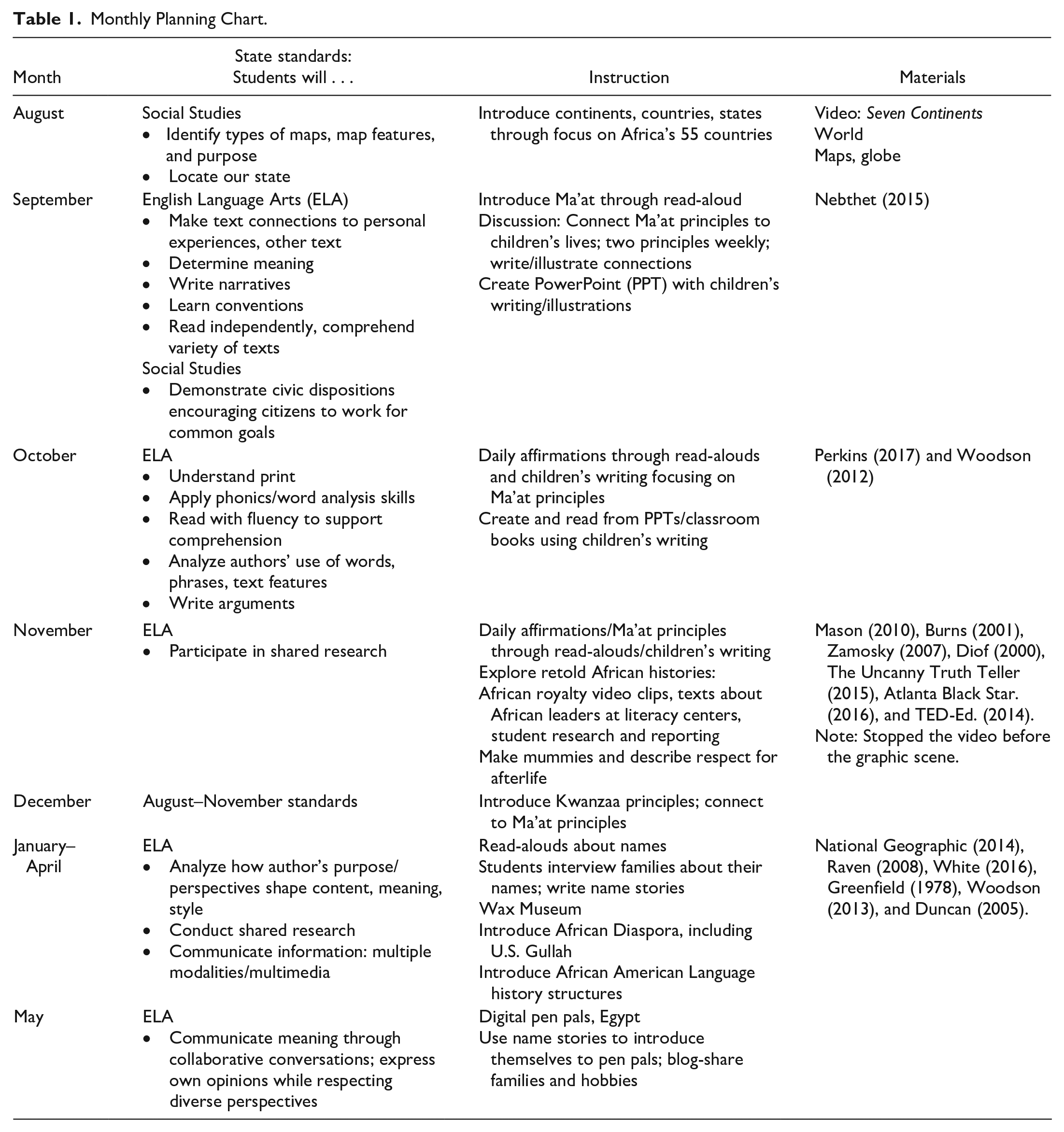
Throughout the entire partnership, we cultivated a bilateral relationship, in which we each contributed to planning and teaching, made revisions, and ensured that the lessons connected to the lives of our students. While all of the elements of this study were shared, we also leaned on each other’s expertise. So, if one researcher had more knowledge about a particular student, topic, or method, the other embraced that knowledge. Table 1 provides an overview of the yearlong planning, including examples of ways that the teaching aligns with district standards.
Monthly Planning Chart.
Data Collection and Analysis
Classroom data were collected daily by Mukkaramah and weekly by Kamania when she co-taught in the classroom and when we met or corresponded with each other and with families. Thus, data sources included student artifacts (their writing and drawings), audio-recorded lessons, interviews with students and family members, district pacing guides, lesson plans, and all written communication between Kamania and Mukkaramah and families.
Data from family members were collected in various ways. Some interactions occurred while family members attended classroom and school events or when they came to drop something off. When that occurred, we documented their comments in text messages between us and also reported family comments in our shared Google document. We conducted the phone interviews together with families that were available to speak with us in greater length to ask specific questions, such as the following: “Describe your own schooling experiences,” “How was this similar to and different from your child’s first-grade year?” “Which learning engagements and assignments did your child complete that stood out to you the most, and why?” “Why are these activities important to you, your child, all children?” and “What do you wish teachers knew about your child?”
Students were interviewed formally and informally. To solicit details from students about their thinking, while teaching we would ask, “What do you mean by that?” and “Can you tell me more?” We conducted formal interviews with students in groups and individually, usually while students were immersed in learning or immediately after the lesson. We asked questions such as the following: “How did it make you feel to learn about this?” “What do you want to learn more about?” “What was your favorite or least favorite part of this lesson?” and “What does this lesson remind you of?”
In every interaction, while talking with an adult or a student, we were attentive to the Sankofa concepts of affirming life, community, and person. This meant that we honored multiple ways of knowing and being by seeking and validating each individual’s views and interacting with them as vital members of the classroom community. Our goal for every interaction was to learn from and with each family member and student, recognizing that they were not “empty vessels or new to the practice of education and socialization that is rooted in deep thought” (King, 2005, p. 20).
All interviews were recorded and transcribed. We stored data in Dedoose, a software data analysis system. We analyzed the data using constant comparison methods (Bhattacharya, 2017), reading and rereading data, and coding segments independently guided by our paradigm (i.e., Afrocentrism utilizing African cultural principles) and theoretical frameworks (i.e., CRT and BlackCrit). In this way, codes were derived directly from African cultural strengths: spirituality, harmony, movement, verve, affect, communalism/collectivity, expressive individualism, oral tradition, social time perspective, perseverance, and last improvisation (Boykin, 1994; Hale, 2001; Hilliard, 1992; King, 2005; King & Swartz, 2014). We also utilized CRT and BlackCrit when coding policies and curricula by focusing on race, specifically Blackness, to pinpoint where and how we disrupted colonized teaching. We later collaborated to compare and contrast codes, synthesized overlapping codes, and categorized codes into themes. Finally, we member-checked with students and family members, asking for their views about our interpretations, which further informed our findings. In the section below, we share findings constructed as we sought to uncover the affordances experienced when teaching first graders from an Afrocentric stance.
“What you help a child to love can be more important than what you help the child to learn.” ~African Proverb
Analyzing data through our BlackCrit and CRT lenses, situated within a commitment to Afrocentrism, led to findings that illuminate ways that African Diaspora literacies afforded opportunities to disrupt anti-Blackness and to teach Black brilliance in a first-grade classroom. We found that teaching through and about African Diaspora literacies allowed us to foster (a) positive racial and gender identities, (b) community, and (c) positive linguistic identities in the work to help children to love themselves, their histories, and their peoples. Informed by CRT, these findings provide curricular counter-stories that challenge the Eurocratic status quo; guided by BlackCrit theory, they showcase pro-Black teaching that challenges white-dominated curriculum and supports the development of children’s positive Black identities.
Positive Racial and Gender Identity
One affordance we uncovered was that, for this group of first graders, African Diaspora literacy instruction fostered strong racial and gender identities. We saw this throughout the curriculum but particularly as we taught African codes of spirituality, expressive individualism, and perseverance. When reading the picture book Hey Black Child (Perkins, 2017), for example, we made sure to discuss what each line meant. When students heard the lines, “Hey Black child, do you know you are strong? I mean really strong,” Kamania asked, “What does the author mean by ‘strong’? Does he mean physically strong? Also, what does the author mean when he writes, ‘If you try to learn, what you can learn’?” In response, students gave examples about not giving up on learning new things. Some described how hard it was learning to ride a bike or play a new video game, but that they never gave up until they mastered the task. The words and images in this read-aloud disrupted anti-Black messages that children were inundated with through district-provided leveled books that prominently featured white protagonists. We chose texts such as Hey Black Child (Perkins, 2017) so the children could see themselves in texts. Eventually, we adapted the picture book into a classroom book illustrated with photographs of our students’ learning. The book we created using PowerPoint, was projected on the Smart Board and also printed, bound, and placed at a reading center. Reading the book as a read-aloud and independently, students had opportunities to build appreciation for Blackness while practicing skills required in first-grade standards: high-frequency words, comprehension, one-to-one correspondence, directionality, and fluency.
Another learning activity that fostered positive racial—and gender—identity was studying African royalty. We read, viewed, and researched historical figures such as Mansa Musa and Abubakari of Mali and Hatshepsut of Egypt. Students were intrigued by Mansa Musa’s wealth and power, particularly in light of the dominant U.S. perception of Africans as uncivilized and poor. When learning about Musa giving away his gold on a voyage, Malik, a student, exclaimed, “He was makin’ it rain!” (the Standardized English translation is “He had so much money that he could throw it in the air!”). When introduced to the pharaoh Hatshepsut, students were surprised to learn that this powerful leader was a woman. When asked, “What do you think when I say the word ‘royalty’?,” 6-year-old Anna responded, “I think of a king and queen.” Mukkaramah replied, “I am happy that you said that, because today we are going to learn about a woman who was a pharaoh and led without a man by her side.” Many of the children gasped. Antoine, a male student, screamed out, “Nah ah, girls can’t be kings!,” which sparked a “Yes, they can” and “No, they can’t” battle among the children.
We kept this debate in the forefront as we made connections between Hatshepsut, Ma’at principles, and gender roles. Later, the children made mummies with papier mâché to symbolize the way Egyptians respected the afterlife. The children showcased their learning by creating a live wax museum that was attended by parents, teachers, administrators, and peers. One first grader was so enthralled by Hatshepsut that she selected her as the subject for a presentation, and often wrote about her during writer’s workshop. Family members noticed and commented on the importance of this teaching: One parent reflected, “It’s important for my baby girl to be educated on all our history because we are so much more than being slaves.”
Cultivating Community
The second affordance of African Diaspora literacy teaching found in our study was that it helped us cultivate a positive, caring classroom community that included families and the diaspora community beyond the United States. One engagement that helped build this community was students interviewing family members to learn more about the history of their names. They video-recorded the interviews, and we watched them while supporting students in writing their family name stories. Some of the names were passed down through generations, had biblical ties, or were traced to African languages and countries. This helped us honor and build our community as African-descendent learners.
Later in the year, our students expanded their community by becoming digital pen pals with children in Cairo, Egypt. We wanted students to gain an understanding of contemporary Egypt and to connect with people in another part of the African Diaspora. They used iPads, connecting through a blog, and shared their name stories, hobbies, and family compositions, rebuilding community across two countries of the diaspora.
Community within families was also built through our African Diaspora teaching. This was felt during another learning engagement focusing on Black genius. We opened the engagement by reading picture books and poetry and viewing artwork and movie clips that highlighted the courage, ingenuity, and resilience of Black excellence across disciplines. Students were then asked to select an African or African American historical or contemporary figure often overlooked in school curricula. Students chose figures such as Thurgood Marshall, Maya Angelou, Jean-Michel Basquiat, Sean Combs, Michelle Obama, and Michael B. Jordan. At home, they conducted deeper research about the person’s life with their families, made a visual representation, and practiced a short monologue. Families commented on how opportunities to support their children around African and African American themes deepened their family community. Together, they researched and practiced so that students could come to school dressed as and enact historical or contemporary figures. As one parent described, this was more than merely dressing up and led to further family engagements and discussions: To me it wasn’t just about dressing up but the courage of that little girl [Ruby Bridges]. I actually ordered the movie for Maya because I wanted her to have a clear understanding of how our ancestors worked so hard for us to have what we have today.
Teaching African Diaspora literacy also supported Mukkaramah’s ability to address behavioral issues by building a respectful community of learners. She was dissatisfied with the behavior chart system incorporated at the school. The chart required her to indicate when children engaged in “undesirable” behaviors by instructing them to post their card on the chart below a color symbolizing the severity of the offense and resulting punishment. However, instead of focusing on deficit responses to behavior, we decided to focus on positive behaviors using ancient African Ma’at principles: truth, justice, balance, order, compassion, harmony, and reciprocity. We introduced these principles through read-alouds such as Light as a Feather: The 42 Laws of Ma’at for Children (Nebthet, 2015), providing students with background knowledge about ancient Kemet as we focused on two principles each day. After classroom talks around each principle, students illustrated ways they exhibited the principles in school, at home, and in communities. Their illustrations were imported into a PowerPoint presentation that we printed or projected as a book, allowing us to talk in more depth about students’ actions upholding Ma’at principles.
We later selected other picture books to further explore each principle. We used Each Kindness (J. Woodson, 2012) to explore righteousness and The Youngest Marcher (Levinson, 2017) to discuss the concept of justice. We created a follow-up activity that required each student to write a letter to the main character in the book Each Kindness (J. Woodson, 2012) because writing real or imaginative narratives was a state standard in the district’s pacing guide.
As we explored literary texts that taught more about Ma’at principles, we replaced the behavior chart with a chart of Ma’at principles and used them as a code of conduct for our classroom.
These engagements and discussions served as helpful pathways for resolving conflicts and encouraging self-expression. They helped us foster a sense of communal responsibility, another African cultural principle. We often observed the children commenting on their own embodiment of Ma’at principles. For example, one day, Tyrone grabbed a pencil from a classmate and said to Mukkaramah, “I’mma tell da truth because you not supposed to not tell the truth.” The teacher complimented him for using the Ma’at principles, by being honest and for self-disciplining himself, even when it could lead to consequences. Another student, Emily, turned to Tyrone and said, “Thank you for telling the truth about what you did.”
Developing Positive Linguistic Identities
The third affordance of African Diaspora teaching was that it fostered the children’s positive linguistic identities as speakers of AAL. Teaching precolonial African contributors to the world’s knowledge, we had laid the groundwork for teaching about the colonization, colonizers’ inaccurate depictions of Africans, how the African Diaspora developed, and the vast knowledge and languages Africans brought with them. We then taught how, as African languages meshed with each other and the languages of their oppressors, new languages developed, such as Patois and Gullah and eventually AAL. We wanted our students to understand that AAL symbolizes “the pain and the glory, the nuances and the delicacies of our existences” (Wagner-Martin, 2015, p. 32). We utilized texts that showcased linguistic, culinary, and cultural connections that our children recognized from their own lives and that are rooted in African traditions. Viewing videos and reading books (Table 1), we built first graders’ historical and cultural knowledge of how AAL came into existence, fostering a sense of pride in their home language.
Laying this groundwork was important to help children appreciate AAL. In addition, we all spoke and wrote in both AAL and SE in the classroom. When a child used AAL, we never responded with, “That’s incorrect.” Instead, we said, “I love the way you are using AAL here,” pointing out how they could use both AAL and SE, making students aware of their linguistic dexterity (Paris & Alim, 2017). During writer’s workshops, we discussed purposes for writing and how to integrate AAL and SE to communicate ideas. Mukkaramah addressed this through mini lessons using mentor texts that featured AAL and then talking about writers’ word choices. For example, when discussing the author’s choice of words in Honey Baby Sugar Child (Duncan, 2005) and Honey, I Love (Greenfield, 1978), Mukkaramah asked the children, “Why do you think the author is using AAL?” Adam raised his hand and responded, “‘Cause deh talkin’ ‘bout family and deh love ‘em.”
To reinforce this, before sending the children to work on their own writing, we focused on four questions: (a) “What messages are you trying to convey?” (b) “Who will read this piece? Who is your audience?” (c) “What language(s) would they understand?” and (d) “If there are characters in your piece, what languages do they speak and how will you represent those languages?” Through this process, we helped children build a positive linguistic identity as bilingual AAL and SE writers, celebrating their use of both.
We continued this during writer conferring. For instance, Mukkaramah gave confidence to Adam as a writer through conferences pointing out his AAL expertise. Adam was described at the beginning of the school year as an introvert (rarely speaking) and a fragile writer. His journal consisted mostly of random words, incomplete thoughts, and detailed drawings of cars. Yet, at conferring time, when he was not degraded for speaking AAL, and interacting with Mukkaramah, who meshed AAL and SE as they conferred, he engaged in detailed conversations. Mukkaramah used those conversations to help Adam recognize his voice and encourage him to use it in his writing, thereby empowering him as a writer. As the school year progressed, he became more verbal, not fearing backlash for using AAL’s habitual be, as evidenced in his writing about what was near and dear to him—his family.
Tyrone and Emily’s truth-telling incident described earlier is another example of how many children began using AAL and SE without fear of reprisal. Similar to Adam, Tyrone started the year rarely speaking, but when AAL was studied as a language and utilized alongside SE, he talked more freely. In the pencil-grabbing example, Tyrone said, “I’mma” instead of “I am going to” and “da” for “the,” linguistically consistent with AAL features. His ease of using AAL reflected his comfort as a language user in this environment. Ultimately, our students understood that they were bilingual speakers of AAL and SE, and that neither language was superior to the other.
Implications
Akua (2020) asserts that by centering African identity and history in classrooms, a foundation can be established for building agency and self-determination. In Mukkaramah’s classroom, pedagogies supported students in developing and demonstrating their abilities, agency, and pride as we foregrounded African histories, Ma’at principles, and AAL while addressing required standards. Creating books, we addressed writing standards. Reading books, we addressed every reading skill required in mandated programs. Social studies standards were addressed as we taught histories using maps and globes and taught about cultural principles, community, and language. Based on these findings, we offer implications to support teachers as they engage in the work to disrupt anti-Blackness.
Commit to African Diaspora Teaching—It Is Not an Add-On
If teachers do not commit to Afrocentric teaching, this can lead to teaching that subverts the decolonization of the Eurocratic norm: “From nine o’clock to ten o’clock I will teach about Africa; then I will teach reading from ten to eleven”—absolutely not. Teaching African Diaspora literacy as an add-on means that students will continue to be overwhelmed by Eurocentrism the rest of the day. Imagine moving from African studies at 9.00 to reading block at 10.00 in which there is no normalized positive image of Blackness. Because anti-Blackness is so deeply embedded in the policies, practices, and curricula, if teachers are committed to countering it, we send conflicting messages if we avoid teaching from an African Diaspora literacy stance throughout the entire school day.
Don’t Let Standards Keep You From Afrocentric Teaching
Our work demonstrated that Afrocentric teaching can easily address required standards. We realize, however, that educators feel constrained by standards-driven programs and do not see possibilities within them (Long et al., 2011). This in itself is a problem because standards-based excuses mean we are complicit in allowing Eurocratic systems to control what is taught. We ask educators to stop defaulting to “I can’t because of standards” excuses. In addition, teachers need to problematize, question, and unpack standards that are steeped in whiteness and begin with the enslavement of Black people.
Afrocentric teaching is teaching to redress the gross imbalance of whiteness in centuries of curricula. This particularly matters for Black students who have been labeled at risk but have actually never been engaged in curricula that respected them or their histories. Many students in our study became engaged, confident, and learned through our teaching as they excelled in using knowledges of Africa and knowledges about achieving state standards. Although how we taught was different from what the district mandated, we still met the state standards regarding required skills and strategies.
Engage in Focused Professional Development
Teachers engaging in ongoing professional development focused on countering anti-Blackness is important to this work, especially when anti-Blackness is the most dominant form of racism in the United States (G. Boutte & Bryan, 2019). Whether this comes in the form of knowledgeable facilitators working with teacher groups or, in our case, teacher–teacher educator teams working in partnership, in-depth and ongoing learning is critical. As we read professional literature and engaged in historical research together, planned, taught, and reflected, we deepened the knowledge necessary to generate our own practices. Likewise, teachers need to commit to professional development to change systems that position Black students as incompetent based on systems that have long denied Black students (Sleeter, 2011).
Examine Your Classroom and Commit to the Work
Mukkaramah recognized before we started our work that curricular changes needed to be made if she were to humanize Blackness for her Black students and support optimum learning. As a result, we foregrounded Afrocentrism in curriculum and in replacing the system of behavior management. We committed to this work every day, every week throughout the year. Children grew. Children and families noticed the difference. We felt better as teachers because we were taking action against unjust systems. Thus, an important implication is that commitment to self-examination, institutional examination (Baines et al., 2018), and change are critical. There is no other choice.
Conclusion
This study addressed the call for change as Eurocratic practices build the esteem of white students while ignoring, marginalizing, and destroying the spirits of Black children (Love, 2016). We believe that a better world can be built for Black children when we teach African Diaspora literacies foundationally to all children. We have a responsibility to halt the cycle of Black students growing up without knowing the richness of their histories, and white students growing up to associate Blackness with inferiority, as did the tour guide who profiled Kamania, her sister, and their friends. As educators and justice advocates, we know that these realities will continue to exist if we do nothing to change them. The responsibility is great, to begin in the earliest years teaching pedagogies that demonstrate love for and humanization of Black lives.
Supplemental Material
967393__Kamania_Wynter-Hoyte – Supplemental material for “Hey, Black Child. Do You Know Who You Are?” Using African Diaspora Literacy to Humanize Blackness in Early Childhood Education
Supplemental material, 967393__Kamania_Wynter-Hoyte for “Hey, Black Child. Do You Know Who You Are?” Using African Diaspora Literacy to Humanize Blackness in Early Childhood Education by Kamania Wynter-Hoyte and Mukkaramah Smith in Journal of Literacy Research
Footnotes
Acknowledgements
This article is dedicated to every Black life that has been treated as disposable; from the very first ship of Africans taken against their will to the continual murders of unarmed Black men, women, and children; from the names we cry out and scream ashe, to the names we will never know; from our African ancestors who rebelled in the slave dungeons to our brothers and sisters who revolted in the streets of America. It is our hope that one day teachers will humanize Blackness in their classrooms because we cannot be human all by ourselves; we are connected, and how we teach impacts us all.
Declaration of Conflicting Interests
The author(s) declared no potential conflicts of interest with respect to the research, authorship, and/or publication of this article.
Funding
The author(s) received no financial support for the research, authorship, and/or publication of this article.

References
Supplementary Material
Please find the following supplemental material available below.
For Open Access articles published under a Creative Commons License, all supplemental material carries the same license as the article it is associated with.
For non-Open Access articles published, all supplemental material carries a non-exclusive license, and permission requests for re-use of supplemental material or any part of supplemental material shall be sent directly to the copyright owner as specified in the copyright notice associated with the article.
