




Abstract
Through a study of digital composing in LGBTQ+ YouTube reaction video channels, I explore the role of emotion in shaping how writers in virtual communities collectively feel about injustice and write for social change. In the reaction videos, vloggers circulate funny, emotional reactions to anti-LGBTQ+ media undergirded by oppressive ideologies and norms. To guide the analysis, I draw on queer and Black feminist theories to conceptualize political feeling as cultural formations of emotions that shape how a community feels toward injustice and open or foreclose possibilities for movement toward social change. By constructing and analyzing composing events situated in a virtual ethnography, I find reaction videos construct and circulate the political feeling of radical joy, or willful and resistant happiness in the face of oppression. Radical joy, then, mediates the satirical critiques of interlocking structures of power and the development of belonging in struggles for liberation in the comment section.
“SAME GURL”: Political Feeling in LGBTQ+ Digital Composing
Literacy studies scholarship has increasingly sought to trace the role of emotions in writing (Leander & Ehret, 2019; Lewis & Tierney, 2011). Affective approaches have tended to consider how writers are moved with and by flows of feeling, following writing that emerges through sparks of curiosity or flashes of wonder (Lenters, 2016; Zapata et al., 2018). Studies of digital composition often explicate possibilities and pressures produced by relations among affect, technologies, and bodies (Ehret et al., 2018; Wargo, 2018). Recently, literacy scholars have also called for more explicit consideration of power in affect (Dernikos et al., 2019). To forward justice-oriented approaches, scholars have drawn on critical affect theories attentive to intersections of power and identity, often following how affect can oppress (Coleman, 2021; Dernikos, 2020; Jocson & Dixon-Román, 2020). I build on critical scholarship to consider how networked online communities structure and circulate cultural formations of feeling needed to contest oppressive forces. These feelings have the potential to move writers and create conditions for collective movements toward liberation.
In this article, I analyze digital composing in LGBTQ+ YouTube reaction video channels to trace the role of emotion in shaping how writers collectively feel about injustice and write for social change. Reaction videos emerged in the early 2000s as a popular form in which vloggers watch and react to media clips, circulating “affectively intense” responses (Warren-Crow, 2016, p. 1113). In LGBTQ+ reaction videos I study, vloggers comically react to anti-LGBTQ+ media undergirded by oppressive ideologies and norms such as cisheteronormativity, white supremacy, and anti-Blackness (Dumas & Ross, 2016). Through viral sharing, these videos can garner millions of views and thousands of comments. Reaction video channels are, therefore, an exemplary context in which to examine feelings in virtual writing and how digital compositions can disrupt structures of power.
To guide the analysis, I draw on queer and Black feminist theories to assemble and employ the conceptual framework of political feeling, with particular attention to radical joy. Political feelings are the cultural formations of emotions such as anger, hope, or despair that shape how a community comes to feel about injustice, thereby opening or foreclosing possibilities for movement toward social change. While queer theories tend to examine feelings such as ambivalence and shame that have historically shaped LGBTQ+ experiences (Cvetkovich, 2003; Love, 2007; Muñoz, 1999), Black feminist thought foregrounds feelings of love and anger needed to nurture political action in the face of domination (Hooks, 1995, 2000; Lorde, 1981; Nash, 2011). Drawing these bodies of work together, I focus on the political feeling of radical joy, namely willful and resistant happiness in the face of oppression.
I explore the pedagogical and political potential of collective digital composing on LGBTQ+ YouTube with attention to affect, asking three research questions:
How do reaction videos structure and circulate political feelings to media underpinned by oppressive ideologies and norms? How does the commentary interactionally take up and construct political feelings toward the media source and oppressive ideologies and norms? How do these political feelings mediate digital composing?
Through these questions, I seek to understand how media can move viewers to feel, and how feelings can nurture subsequent action. To address these questions, I advance a method to construct composing events with YouTube video and comment data to make visible how feelings emerge in digital media, circulate among viewers, and mediate forms of activity in the comments. This method presents a novel way of analyzing digital composition on social media with attention to political contexts of writing.
Affect and Power in Collective Digital Composition
In recent decades, writing studies scholarship has undergone a turn from sociocultural to affective approaches that reconfigure the subject in writing and trace the roles of emotion in mediating composition (Dernikos et al., 2020; Leander & Ehret, 2019). Sociocultural approaches (e.g., Street, 1995) tend to privilege the human subject and theorize literacies as practices through which subjects make meaning and social worlds. Affective approaches are plural and capacious, yet they tend to take up new materialist and posthuman theories centering relationality among humans, sociomaterial others, and more-than-humans with an interest in how subjects act with, and are moved by, the world through flows of feeling (Ehret & Rowsell, 2021; Thiel & Dernikos, 2020). In a foundational piece, Leander and Boldt (2013) followed a 10-year-old boy as he engaged with manga to understand how affective intensities “build relations among previously unconnected elements” (p. 36). Explorations of affect in writing often emphasize the relations youth make through writing and delineate unexpected trajectories of learning (Zapata et al., 2018). By widening units of analysis from youth and text to landscapes of writing relations, these approaches facilitate analysis of literacies in out-of-school contexts and “off-task” activities (Hollett & Ehret, 2015; Lenters, 2016).
Scholarship on digital composition has employed affective approaches to consider how writers move with, and are moved by, media and technologies (Ehret et al., 2018; Wargo, 2018). Digital devices are entangled with broader landscapes of writing relations, amplifying semiotic and sensory modes through which youth may compose. Most scholarship on affect in digital composition attends to how youth narrate and produce felt intensities across technologies, bodies, materials, and place (Abrams, 2016; Hollett & Ehret, 2015; Wargo, 2015). Some scholarship attends to affective forces within digital communities shaping participation online (Ehret et al., 2018; Hagge, 2021). Ehret et al. (2018), for example, traced creative tension between self and community, or “participatory pressures,” by examining vloggers on YouTube channels dedicated to reading (p. 154). Through a focus on feelings that circulate within and mediate digital composition, I build with scholarship that considers how affect can influence writing in virtual communities.
Though affective approaches in writing studies have the potential to unsettle a focus on the individual and uplift possibilities that emerge from relations, literacy scholars more broadly have argued for lenses attentive to questions of power (Beucher et al., 2019). Scholars have challenged some approaches anchored in new materialist and posthumanist theories for silence on colonialism, racism, and intersections of power as they depart from “teaching and research methods that have historically contributed to equitable education” (Nichols & Campano, 2017, p. 249; see also Dernikos et al., 2019; Thiel & Dernikos, 2020). To realize the potential of affective approaches for social justice, literacy scholars have mobilized affect theories from critical traditions of thought (Coleman, 2021; Dernikos, 2020; Dernikos et al., 2020; Dutro, 2019; Jocson & Dixon-Román, 2020; Thiel & Dernikos, 2020). Coleman (2021), for instance, took up critical emotion studies to explore how an English teacher's imagination can structure and propel feelings that perpetuate literacy normativities undergirded by white supremacy, coloniality, and queerphobia. I join this scholarship by mobilizing queer and Black feminist theories to explore cultural formations of emotion needed to contest oppressive forces, considering radical joy as a tool to subvert interlocking oppressions and nurture belonging among participants in an LGBTQ+ virtual community.
In joining critical affect scholars, I turn to digital composition on social media, specifically comment sections that respond to videos on YouTube, because virtual writing nurtures my interest in cultural formations. Virtual writing is distributed across a networked community (Curwood et al., 2013), requiring a shift in conceptual focus from bodily intensities to collective feelings. As Boler and Davis (2018) argued, new materialist affect theory centering embodiment tends to reify a focus on the autonomous subject and fails to account for “collectively shared and expressed emotions” on social media (p. 76). In contrast, Boler and Davis (2018) and Dernikos (2017) forwarded lenses attuned to these complex dimensions of social media. Boler and Davis (2018) traced “affective politics” of social media, arguing that a distinction between affect as embodied and emotion as cultural has limited value for studies of networked virtual contexts. Dernikos (2017) considered how the #BlackLivesMatter movement on social media transmits “political affects” creating senses of intimacy that may simultaneously foster belonging in the movement and violate its Black queer woman founders. I build with this scholarship, responding to the need Boler and Davis (2018) raised for approaches that trace how emotions “shape, and are shaped by, mediated political landscapes” on social media (p. 79). In doing so, I depart from new materialisms to conceptualize political feeling in queer and Black feminist traditions of thought.
Conceptualizing Political Feeling
Political feeling frames emotions as cultural artifacts that mediate political life, attuning scholars and educators to a constellation of political feelings needed for projects of liberation. Building on critical affective approaches, the framework of political feeling explicates the capacity of emotion to be a structuring force in cultural practice and political life. Whereas the term “affect” typically indexes bodily intensities and “emotion” signals cultural systems of meaning, I follow scholars who resist the dichotomy of terms and employ the term “feeling” to convey the inextricability of embodied and political life (Gould, 2009, pp. 19–21; see also Boler & Davis, 2018; Coleman, 2021; Dernikos, 2017). I develop the analytic of political feeling with queer and Black feminist theories of feeling to examine how emotions are cultural formations that mediate political activity, shaping how a community comes to feel about injustice and act toward social change (Cvetkovich, 2003; Muñoz, 1999; Nash, 2011). Political feelings such as anger and radical joy, or ambivalence and shame, afford or foreclose social action. The framework is thereby commensurable with sociocultural theories of literacy by following how cultural formations of emotion mediate activity in sociocultural and political contexts (Lewis & Tierney, 2011).
I draw on queer affect theories to understand feelings as cultural formations, shaped and circulated in communities, with purchase for liberatory political projects (Cvetkovich, 2003; Love, 2007; Muñoz, 1999). Queer studies scholars engaged with activism amid the HIV/AIDs crisis shaped an early interest in feelings within LGBTQ+ communities, often seeking to understand the political potential of mourning that marked queer experiences (Muñoz, 1999). The feminist, queer Public Feelings group begun in 2001 galvanized this interest by convening scholars around the capacity of feelings to produce political life. Cvetkovich (2003) influenced this line of theorizing through the concept of “archives of feeling,” arguing affective experiences of trauma experienced by lesbian communities structure and circulate “new practices and publics” (p. 10). Queer affect theorizing often considers feelings such as shame, depression, and ambivalence that reflect experiences of social disavowal yet have potential to unsettle oppressive ideologies and norms (e.g., Love, 2007). In a departure, Gould's (2009) study of the AIDS Coalition to Unleash Power (ACT UP) movement focuses on how ACT UP moved participants from feelings of shame and ambivalence to feelings of anger and pride to build power in the face of disavowal and inform social action. Gould argued social movements “provide a language for people's affective states as well as a pedagogy of sorts regarding what and how to feel and what to do in light of those feelings” (p. 28).
Black feminist theorizing sharpens my attunement to the need for a constellation of political feelings to spark and sustain participation in social movements that confront interlocking racial, gender, queer, and trans oppressions. Black feminist theories of feelings such as love and anger attend to links between activism and theory with an investment in political transformation (Lindsey, 2015; Lorde, 1981). Though queer affect theories are interested in social action, they may tarry with dangers of political stagnation through a focus on bad feelings that arise in response to oppression (Love, 2007, p. 149). Black feminist thought calls for action, theorizing feelings to mobilize toward political and ethical visions. Black feminist writers argue that emotions of anger (Hooks, 1995; Lorde, 1981) and love (Hooks, 2000; Jordan, 2003; Nash, 2011) meaningfully shape action against oppressions. Building on Lorde (1984), Black feminist theorists have also conceptualized the need to cultivate pleasure and feeling amid domination that seeks to repress feelings as a source of power (Lindsey, 2015; Nash, 2011). Through theorizing the intertwined politics of anger and love, and through attention to feeling good in the face of oppression, Black feminist thought informs my attention to political feelings needed for projects of liberation and shapes my interest in radical joy in LGBTQ+ digital writing.
Gathering together queer and Black feminist theories of emotion, I forward political feeling as an analytic that considers the ways feelings mediate how communities feel about injustice and create conditions for social action. I am particularly interested in how media may structure and circulate feelings in virtual communities that open up possibilities for political transformation. Studying 1980s LGBTQ+ local broadcast television, Herold (2018) argued media offered a “televisual emotional pedagogy” by circulating feelings of anger that helped the LGBTQ+ community make sense of how to feel about the AIDS crisis and “channel these feelings toward collective action” (p. 28). Through pedagogy of political feelings, media move youth toward feelings that build agency amid domination and foster belonging in collective struggles. Though I attend to a political feeling that sparks participation in struggle, digital and social media may also generate affective forces that constrain participation and amplify oppression (Boler & Davis, 2018; Dernikos, 2017; Ehret et al., 2018).
In applying the framework of political feeling to composing events in LGBTQ+ reaction videos, the analysis extends queer and Black feminist theories through attention to radical joy. Happiness has been an oft-maligned feeling in queer theorizing of emotion because it can signal attachments to inclusion within oppressive structures (Ahmed, 2010). Yet, radical joy in the LGBTQ+ composing events I examine subverts oppressive structures and insists on marginalized ways of being. As willful and resistant happiness in the face of oppression, radical joy simultaneously confronts injustice, as anger does, as it builds felt relations in communities, as love accomplishes. The political feeling also draws on humor as a tactic to disrupt oppression and nurture belonging (Gould, 2009; Muñoz, 1999; see also Shrodes, 2021; Shrodes et al., 2021). Though Gould's (2009) study focused on anger, she also found ACT UP spaces were filled with exuberance, humor, and joy—feelings that electrified, enticed, and excited members to participate in direct actions and “try out new ways of being” (p. 212). With humor, radical joy presents a pedagogy to laugh off encounters with injustice to defuse hatred, disrupt oppression, and create felt relations in community. Radical joy indicates another set of political feelings imperative to react to oppression (Coppola et al., 2022; Dunn & Love, 2020). Though I focus on radical joy, political feeling makes room for feelings of anger, sadness, and ambivalence as felt responses to injustice by considering the constellation of feelings youth need in projects for liberation.
Method
To explore how political feelings circulate in an online community and create conditions for social action to emerge, I analyze videos and comments situated in a virtual ethnography of LGBTQ+ YouTube. In this section, I describe the virtual ethnography, strategies I employed to select videos and construct composing events, and my analytical approach to construct findings.
Situating the Analysis in a Virtual Ethnography
This study of radical joy as a political feeling in LGBTQ+ digital composing emerged from a virtual ethnography, a qualitative method to study online communities (Hine, 2000; see also Black, 2009; Kim, 2016), of LGBTQ+ video channels on YouTube conducted from April 2018 through November 2019. Conducting the ethnography for an extended period enabled me to understand how vloggers, topics, genres, and commenters changed over time. For instance, reaction videos became increasingly common on LGBTQ+ video channels. In the virtual ethnography, I employed virtual observations of LGBTQ+ YouTube through “video strolling” (Raun, 2016) and analysis of digital compositions with a focus on reaction videos to examine how humor mediated political possibility and resistance against oppressive ideologies and norms. To “stroll,” I used an initial set of keyword searches (e.g., “LGBT reaction video”) and vloggers to initiate an exploration of suggested and related content on YouTube, watching around 180 h of video footage. For most videos, I also read through the first few hundred comments. The approach follows how YouTube viewers explore videos, as guided by the platform design and algorithms (Raun, 2016; see Shrodes, 2021 for a longer description of video strolling).
I approached the study as a queer white and multiracial femme and ongoing participant viewer in LGBTQ+ YouTube channels that I followed in the ethnography with an interest in forms of critical, playful practices enacted in the virtual community. The ongoing focus on humor led to my engagement with the conceptual ground of queer and Black feminist affect theories to consider political feelings such as radical joy in the videos and comment sections. Reaction video channels on YouTube are an exemplary virtual space to examine political feelings, given that emotions play an important role in video popularity (Warren-Crow, 2016). As a feminist scholar-activist committed to coalitional projects of liberation, I have drawn on both queer and Black feminist theorizing of feeling in this analysis to recognize and cite the bodies of knowledge that have shaped my thinking, feeling, and teaching with emotions (Smith et al., 2021).
Data Sources
For this study, I selected video data and commentary from the virtual ethnography via rigorous selection criteria (see Shrodes, 2021 for a description of the criteria). The criteria focus on selecting active LGBTQ+ vloggers with large audiences who reflect a range of social positions around race, gender, and sexuality. I aimed to select vloggers who hold multiple marginalized identities and videos that respond to a range of content (e.g., advertisements, comments, platforms). Focusing on multiply marginalized vloggers both responds to and is limited by the overrepresentation of vloggers on YouTube who are white and identify as men at the time of data collection (Raun, 2016). I assessed guiding criteria in dialogue, since vloggers who are multiply marginalized, particularly trans women of color, had smaller audiences.
I selected one reaction video each from five vloggers: Kat Blaque (she/her), who self-identities as a Black trans woman; Ash Hardell (they/them or all pronouns), who self-identifies as a white queer and trans nonbinary person; Mac Kahey (he/him), who self-identifies as a Black gay man; Chase Ross (he/him), who self-identifies as a white trans man; and Strange Aeons (she/her), who self-identifies as a white lesbian woman. Videos selected react to a range of content and each has large viewership and commentary relative to the popularity of the vlogger, as specified in my selection criteria. Table 1 documents data sources used to construct composing events.
Video and Commentary Data Sources for Constructing Composing Events.
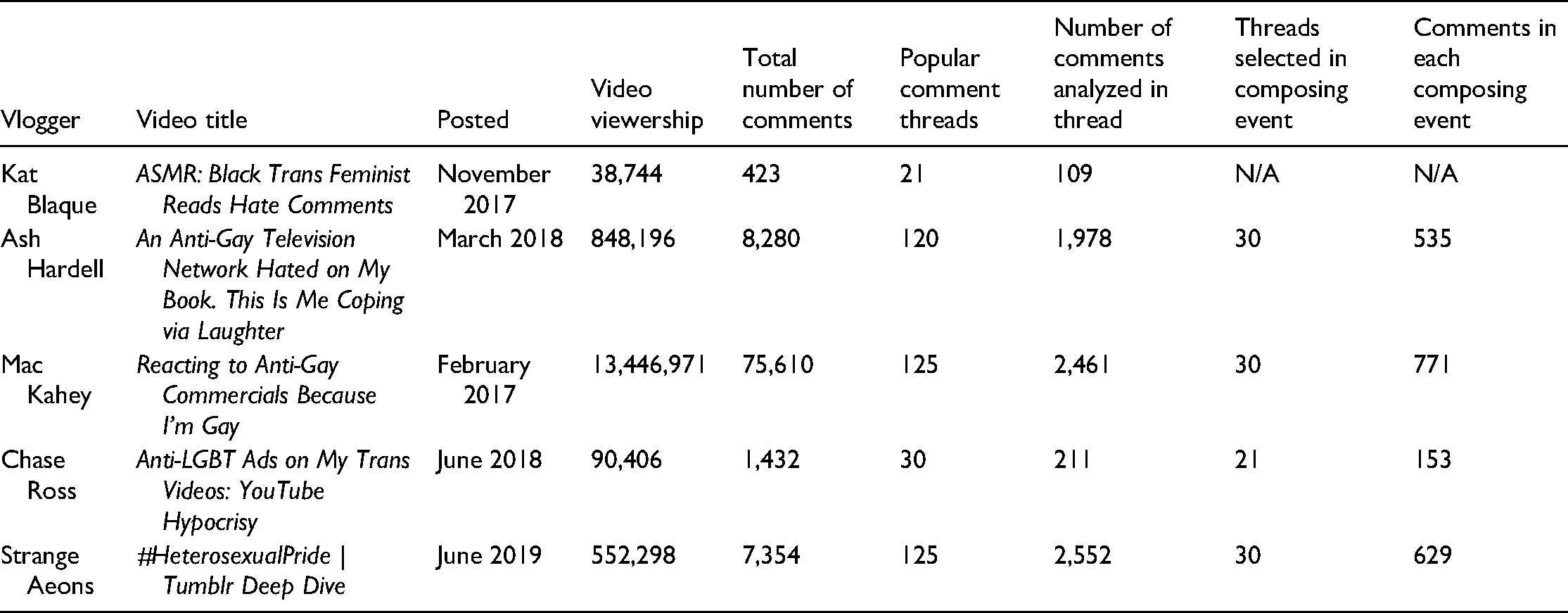
The five videos share a focus on reacting to media, technologies, and digital writing that reproduce oppressive ideologies and norms. In Kat's 25-min video ASMR: Black Trans Feminist Reads Hate Comments (Blaque, 2017), Kat reacts to racist, sexist, and transphobic “hate comments” arising from transmisogynoir that have been posted on her videos. The term “transmisogynoir” extends the term “misogynoir” (Bailey, 2021) to refer to anti-Black sexism and transphobia that Black trans women experience. In Ash's 18-min video An Anti-Gay Television Network Hated on My Book. This Is Me Coping via Laughter (Hardell, 2018), Ash reacts to a clip from the Christian Broadcasting Network (CBN) that covers anti-LGBTQ+ backlash to a sexual orientation and gender identity curriculum implemented in some Canadian school districts. In Mac's 9-min video Reacting to Anti-Gay Commercials Because I’m Gay (Kahey, 2017), Mac reacts to a range of anti-LGBTQ+ advertisements and videos his fans submitted on other social media platforms. In Chase's 9-min video Anti-LGBT Ads on My Trans Videos: YouTube Hypocrisy (Ross, 2018), Chase reacts to the phenomenon of anti-LGBTQ+ advertisements playing before his videos, as well as how YouTube regularly demonetizes and age-restricts trans content. Strange Aeons's 12-min video #HeterosexualPride | Tumblr Deep Dive (Strange Aeons, 2019) reacts to the homophobic phenomenon of “Straight Pride” by doing a Tumbler “deep dive” on the hashtag #HeterosexualPride. These videos are publicly available to view on YouTube (Blaque, 2017; Hardell, 2018; Kahey, 2017; Ross, 2018; Strange Aeons, 2019).
To select comments on the videos, I sampled up to the first 125 popular comment threads on each video, sorted by “most recent,” for a total of 421 threads. I define popular comment threads as comments with more than two replies and a large number of “likes” relative to the number of comments on the video. These threads featured as few as three replies to more than 100 replies. For videos with higher viewership, selecting “popular” comment threads largely excluded racist, homophobic, transphobic, and ableist comments, which typically did not receive a significant number of likes, even though other commenters respond to shut down hate. I did not collect identifying information, meaning I am unable to discuss demographic information beyond identities described in the comments. In analyzing excerpts, I included usernames of commenters when they preserve anonymity. When usernames ostensibly included a full name, I changed the last name to a pseudonym or initial.
Data Analysis
I first analytically logged video and commentary data with an iterative inductive and deductive approach to surface key events and patterns across the data set. Analytic logging of videos involved (a) slowly watching each video multiple times to develop an understanding of videos events and interplay of content and form, and (b) logging videos with events (e.g., Mac analyzes extended simile), time frames (e.g., 02:13–02:54), type of shot (e.g., talking head in response to sampled clip), a description (Mac analyzes the simile in the clip of being gay as baggage to check before getting onto an airplane), and interpretive notes (e.g., satire, connections between cisheteronormativity and racism, analyzing structures of power and privilege). Analytic logging of comment threads involved (a) reviewing threads on each video to construct a holistic sense of the data and potential directions in analysis, and (b) logging events, or what the thread is about, with particular attention to how it responds to events in the video (e.g., extends Mac's satirical play on oppressive simile). Analytic logging informed my turn to queer and Black feminist affect theories.
Based on analytic logging, I aimed to select one key event in each video and up to 30 comment threads that respond to this event, a cluster I call a “composing event,” to analyze further. I chose these clusters based on the frequency of commentary events responding to a video event as well as patterns I began to construct. Drawing on Hymes’s (1974) concept of the communicative event and Shirley Bryce Heath's concept of the literacy event (1983), I approach clusters of video events and comment threads that respond to the video as composing events. Approaching asynchronous video and commentary compositions as composing events in traditions of literacy ethnography and sociolinguistics attunes research on digital composition to the sociocultural and political nature of digital composing. Like other communicative or literacy events, composing events on YouTube are situated in their sociocultural and political context with attendant social rules, norms of interaction and interpretation, purposes, routine practices, and established forms for meaning-making (Heath, 1983; Hymes, 1974).
I found the composing event method effective to construct data and patterns from hugely popular videos, such as videos from Mac Kahey, with important limits for less popular vloggers. In analyzing Kat Blaque's video with a small number of comments, many of which reflect oppressive ideologies, a cluster did not cohere. Several threads respond to the video's autonomous sensory meridian response (ASMR) technique, which employs soft whispers, but a similar number attacked her argument or her personhood. Some are explicitly anti-Black, transphobic, and transmisogynistic. Kat's video is an important reminder that popularity on YouTube is raced, gendered, and classed (Raun, 2016). Though I was not able to create a composing event with Kat Blaque's video, I maintained her video and comments in the data set.
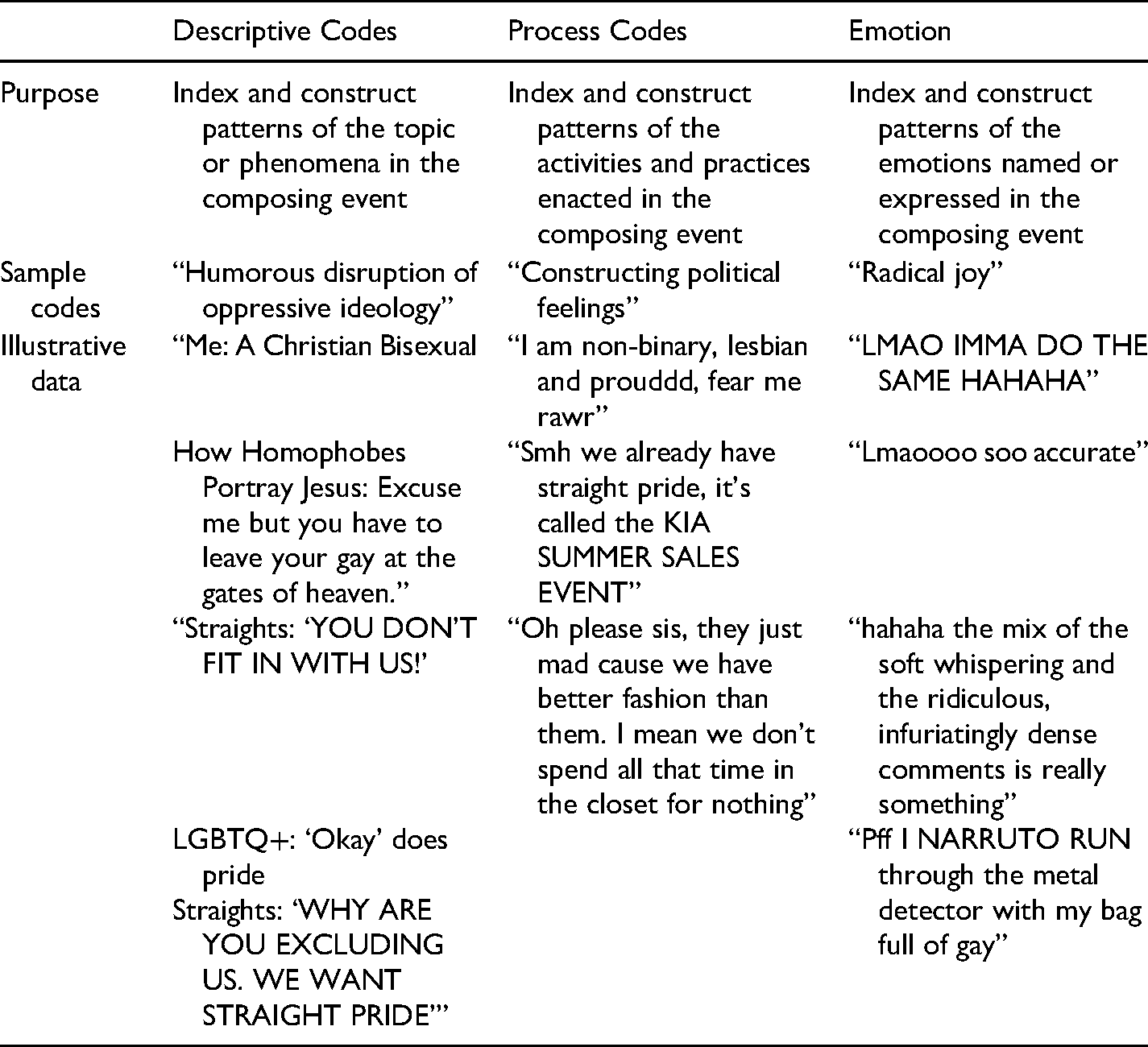
To construct thematic patterns, I then conducted open coding of comments within the four composing events and comments on Kat Blaque's video with descriptive, process, and emotion codes in dialogue with queer and Black feminist theories of emotion (Miles et al., 2019). Table 2 documents the coding process to construct thematic findings across composing events. I developed and refined the concepts of political feeling and radical joy through open coding conducted in dialogue with queer and Black feminist theories. When emotions are not explicitly named in comments (e.g., “AHAHAHA,” “UGH,” “I’m so happy”), I coded emotions with attention to tone, often communicated through capitalization, spelling, and punctuation, as well as use of memespeak, textspeak, and other phrases communicating feelings (e.g., “OMG,” “uwu,” “naruto run”). Memes are humorous multimodal forms that make and transform meaning through configurations of text, images, video, and emojis (digital icons used to express an emotion, object, or concept). Memespeak employs emotive visual language of memes in linguistic form. Textspeak, then, involves linguistic forms often used in digital communication, such as abbreviations.
Coding Process to Construct Thematic Patterns Across Composing Events.
I then selected one exemplar composing event from Mac's video to explicate thematic patterns that emerged across the data set. The composing event comprises a 22-s video clip and 30 comment threads with a total of 771 comments that respond to the clip. The composing event made up around 30% of logged comments. The number of comment replies on each thread ranged from four to 77, with an average of 26 comments per thread. I chose the composing event from Mac's video because Mac has a robust community with more than 1.93 million subscribers and almost 205 million video views at the conclusion of data collection, and because he directly addresses interlocking anti-Black and anti-queer oppression in the video event, which mediates engagement in the comments. Given Mac's enormous popularity, his video also offers the unique opportunity to demonstrate the composing event method with a video that has a large number of comments. Even so, Mac's popularity is shaped by his social position as a cis man, which constrains my ability to address misogynoir and transmisogynoir or consider how Black women resist anti-Black misogyny (Bailey, 2021), though it came up in Kat Blaque's video.
After I developed the conceptual framework of political feeling, I analyzed the exemplar composing event with critical discourse analysis (CDA) guided by the framework to examine how the video and comments discursively manifest, reproduce, and modify social practices in sociocultural and political contexts (van Leeuwen, 2008). CDA enabled me to understand compositions as representations of social practice that can be analyzed “for the way they draw on, and transform, social practices” and larger discourses in which these practices are situated, a process van Leeuwen (2008) described as recontextualization (p. 6). Though affective approaches in writing studies often take nonrepresentational stances and methods anchored in new materialisms, the framework of political feeling aligns with representational methods since it seeks to understand how cultural formations of emotion are structured, circulated, and subsequently mediate practices within dynamic contexts. I attended to comments coded with emotions to further explicate how commentary interactionally constructed political feelings toward the media source and oppressive ideology, as well as how these political feelings mediate digital writing. For instance, I considered how discursive expressions of emotion (e.g., “lol,” “same,” “yeet”) amplify radical joy across the commentary. Collective composition responds to, and alters, the context of writing.
Findings
Through CDA of an exemplar composing event, I find the LGBTQ+ reaction video constructed and circulated the political feeling of radical joy, which meaningfully mediated activity in the comment section. First, I analyze how the video structures and circulates the feeling of radical joy. The commenters interactionally take up and construct radical joy as collectively held, opening up possibilities of “laughing off” harmful oppressive ideologies. Second, I explicate how radical joy mediates the ways the commentary satirically critiques interlocking structures of power. Third, I examine how radical joy, as it becomes collectively held, mediates belonging in struggles for justice.
Circulating Radical Joy: “Throws My Gayness Over the Metal Detector AHAHAHA I BEAT THE SYSTEM!!”
Mac Kahey's video event circulates radical joy, which commenters construct as a collectively held political feeling, opening up possibilities of “laughing off” oppressive ideologies. In the video clip that anchors the composing event, Mac structures and circulates the political feeling of radical joy through a laughter-filled satirical reaction to a clip from a Jehovah's Witness animated children's show underpinned by oppressive ideologies and norms. In the media clip to which Mac reacts, two perceivably white animated characters, a mother and daughter, discuss the belief of marriage between “one man, one woman,” employing a simile to describe being gay as baggage to check before getting on an airplane, or going to heavenly paradise. The clip reifies interlocking cisheteronormativity, white supremacy, and anti-Blackness (Dumas & Ross, 2016), which render Mac's identities as gay and Black deviant. Mac models the practice of laughter in the face of oppression as a tactic to satirically disrupt the clip: Moral of the story: If you gay, leave it behind [starts laughing]. That's really what this video is staying, I swear to god, I swear to god. If you want to go down the road of paradise, just drop your gay right before the metal detector. You know, just put it all in a bag, and then just drop it. Problem solved. Gay free. Can I do the same with my Blackness? Just like put it in a bag, drop it off, give me privilege. (Kahey, 2017, minutes 2:33–2:55 of 9:08-minute video)
Through his satirical reaction punctuated with laughter, Mac structures radical joy as an appropriate and agential feeling to resist the hate. Given how LGBTQ+ experiences have historically been structured by stigmatization and feelings of shame, ambivalence, and invisibility (Gould, 2009), Mac could have responded to this media with responses of chagrin, irritation, or embarrassment. In contrast, he responds with joy in a context of erasure, re-mediating harmful media into an artifact he and his viewers can use to laugh at together, a move that challenges the logics of oppression and insists on other ways of being in community. Mac gives shape to radical joy as a way to feel about injustice and, with those feelings, begin to resist power.
Popular comment threads interactionally take up radical joy, constructing willful and resistant happiness in the face of oppression as a collectively held political feeling. Radical joy appears discursively throughout comments in the composing event. Emotive words that express joy as resistance to power demonstrate commenters’ construction of the feeling as collective. Words such as “yeeeeeesss” or “YAAASS” and variations of the idiom “dying laughing” like “IM DEAD!!!!!” reflect commenters’ use of Mac's humor in the face of hate. Though fraught by mainstream appropriation, the word “yaaass” arises in ballroom culture of Black and Latinx LGBTQ+ communities and can indicate defiant celebration as “an expression of visibility for people who are made invisible” (Moore, 2018, p. 29). Textspeak (e.g., lol) and emojis (e.g.,?) also construct and convey laughing off hate, mirroring Mac's laughter in the video event. Frequent capitalization of words and phrases for humorous emphasis in the comments similarly demonstrates the circulation of radical joy—a happiness that refuses injustice as it cultivates forms of community marginalized by interlocking oppressions.
(606 likes and 16 replies on the thread).
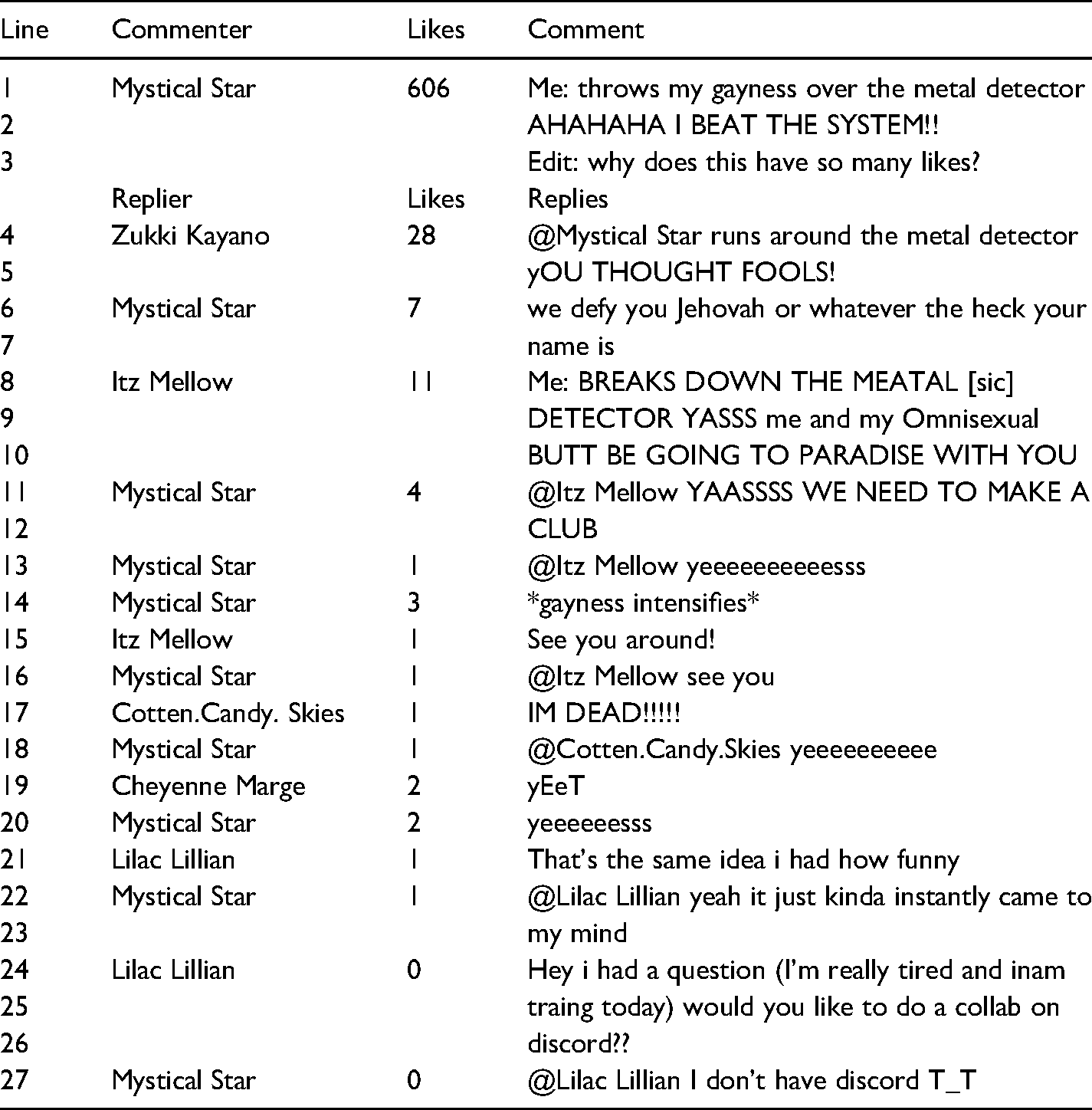
Commenter Mystical Star extends Mac's satirical play on the metal detector metaphor, initiating a set of exchanges that circulate laughter to disrupt oppression (lines 1–2). Zukki Kayano adapts the comment form to join the joke (lines 4–5). Mystical Star plays along with Zukki, constructing a collective “we” as the subject of joyful, defiant action (lines 6–7). As the thread gains popularity and forms a collective subject, Itz Mellow again plays with the form, amplifying willful, resistant happiness by escalating the act from going around the metal detector to breaking it down (lines 8–10). Significantly, Itz Mellow addresses other commenters in the collective “we” through the phrasing “WITH YOU” (line 10). Mystical Star celebrates and expands the construction of radical joy through queer emotive words (e.g., “YAASSSS”), capitalization, and underscoring the intensity of the political feeling (lines 11–14).
After Mystical Star and Itz Mellow share a moment of shared recognition (lines 15–16), other commenters jump into the thread to participate in radical joy (lines 17–20). Lilac Lillian and Mystical Star note the collectivity of the political feeling, commenting on how they both thought of the same joke in response to Mac's video (lines 21–23). The intensity of the shared feeling can be seen in the invitation to continue the collaboration on Discord, a messaging platform (lines 24–27). It appears this cross-platform collaboration did not occur because Mystical Star did not have Discord, but the thread accelerated in popularity. At 606 likes, Mystical Star edited the comment to remark, “why does this have so many likes?” (line 3). The thread crystalizes the viral nature of political feelings and specifically radical joy that can guide writers to laugh off the hate and come together.
Satirical Critiques of Power: “Guess I’ll Just Stuff My Transness in a Duffel Bag”
Radical joy mediates how commenters satirically critique interlocking structures of power manifest in oppressive ideologies and norms through adapting memespeak. Satire is a literary technique and activist tactic that mobilizes irony, sarcasm, and exaggeration for social critique of oppressive ideologies and norms. I consider Mac's video as a form of digital emotional pedagogy of how to feel and begin to act toward injustice, following Herold (2018). Specifically, Mac's video circulates radical joy as a way of feeling about injustice and models practices to disrupt power through humor, which comments take up and extend.
(1,289 likes and 11 replies on the thread).
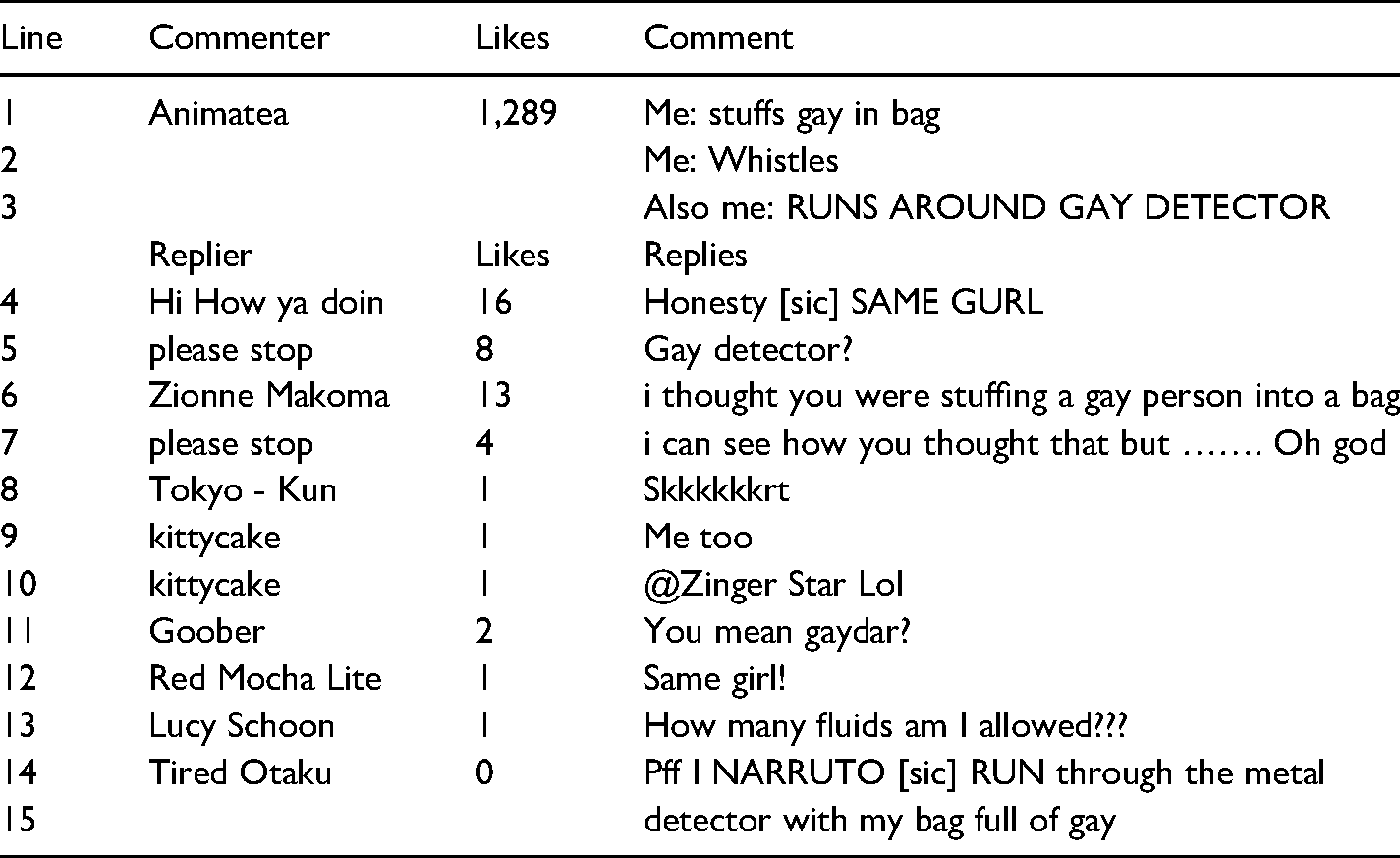
By employing the meme form and capitalization, Animatea plays on the moment Mac's initiated in the video with radical joy, satirizing cisheteronormativity. Emotive replies draw on capitalization and memespeak to interactionally construct this political feeling. Repliers Hi How ya doin and Tired Otaku draw on capitalized text (line 4 and line 14) to communicate a playful, exuberant agreement with the commenter, appropriating radical joy. Tokyo - Kun and Tired Otaku also use memespeak with the phrases “Skkkkkkrt” (line 8) and “NARRUTO [sic] RUN” (line 14) to humorously communicate the feeling and their participation in the satire. “Skkkkkkrt” is a form of memespeak that emerges in hip hop culture, specifically trap and hyphy, in which the sound of a car drift, “Skrrt,” became a word to describe energetic states. The term communicates, in a comedic tone, felt states of this thread. Similarly, “NARRUTO [sic] RUN” is a memespeak form of a visual meme from the anime Naruto, in which lead character Naruto runs quickly with his head forward and arms back. Memespeak here expresses feelings that intensify the satire.
(398 likes and four replies on the thread).
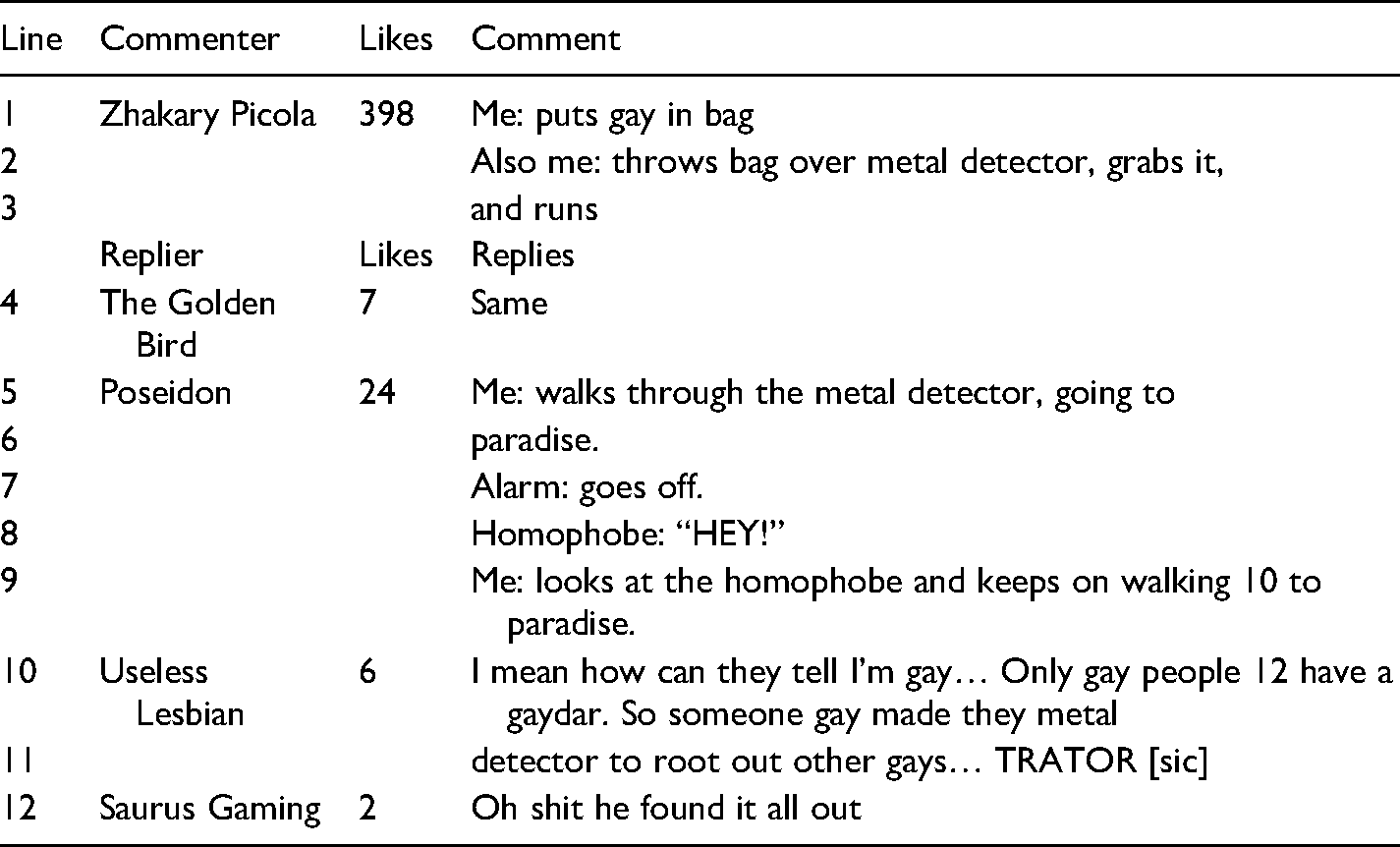
Zhakary Picola employs the meme form and collective play on beating the system to satirize cisheteronormativity with aplomb (lines 1–3). Poseidon takes up the invitation to satire, raising the stakes by demonstrating refusal of oppressive norms (lines 5–9). Poseidon's meme form underlines the humor inherent in the act of defiance, akin to laughing in the face of oppression. Humor here is a tool to resist participation in normativity. The comments by Useless Lesbian and Saurus Gaming elaborate Poseidon's joke (lines 10–12). Collective activity in the satirical play extends beyond commenters since each comment in the thread receives multiple likes.
(74 likes and seven replies on the thread).
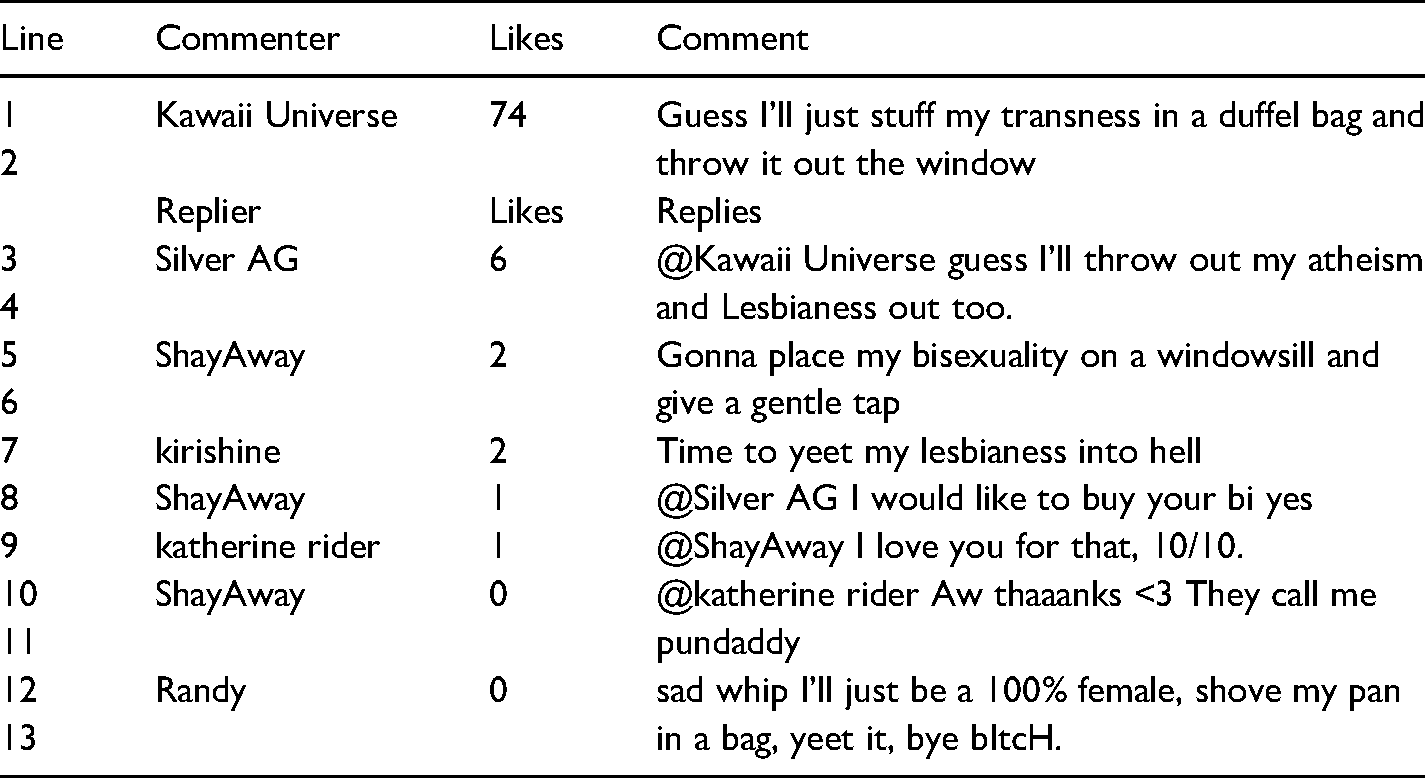
Kawaii Universe manifests radical joy through exaggerated irony, extending Mac's analysis of queer identity to trans identity. Kawaii Universe's playful participation in oppressive norms indexes structures of power that construct the norms. The irony sparks a torrent of jokes that collectively take up radical joy. Silver AG, ShayAway, and kirishine ironically quip about throwing out their sexual identities (lines 3–7), with kirishine drawing on the memespeak “yeet” as a humorous emotive term to express a spontaneous gesture (line 7). The term “yeet” seems to have lost its referent point through internet circulation, but the term first appeared online in 2014 through Black dance culture. As such, terms such as “Skrrt” and “yeet” may engage in “digital blackface,” a term that challenges the “excessive use of reaction GIFs” with images of Black people (Jackson, 2017). Research must contend with problematic ways memes and memespeak circulate Blackness. Holding this tension, the term “yeet” in the comments extends the satire of the composing event through exaggerated expression of emotion. Randy uses it alongside mis-capitalization to compose a satire of cisheteronormativity (lines 12–13). Across the thread, the commenters collectively extend the disruptive jest.
Felt Relations in Collective Struggles: “Same Here Sister Lol”
Lastly, radical joy mediates a form of belonging I describe as “felt relations,” feelings of being in relation with others through collective struggles. Comments are peppered with emotive, relational phrases such as “SAME GURL,” “OOF SAME,” and “Yup, me too,” illustrating how shared political feelings mediate felt relations. Coming into felt relations within LGBTQ+ communities is consequential for young queer and trans composers who seek out belonging on social media. Youth learn emotional configurations that support being in relation with each other and within struggles toward liberation. Political feelings guide LGBTQ+ youth toward belonging in communities, provide an agential way for new members to feel about injustice, and sustain communities in collective fights for a better world.
(191 likes and 11 replies on the thread).
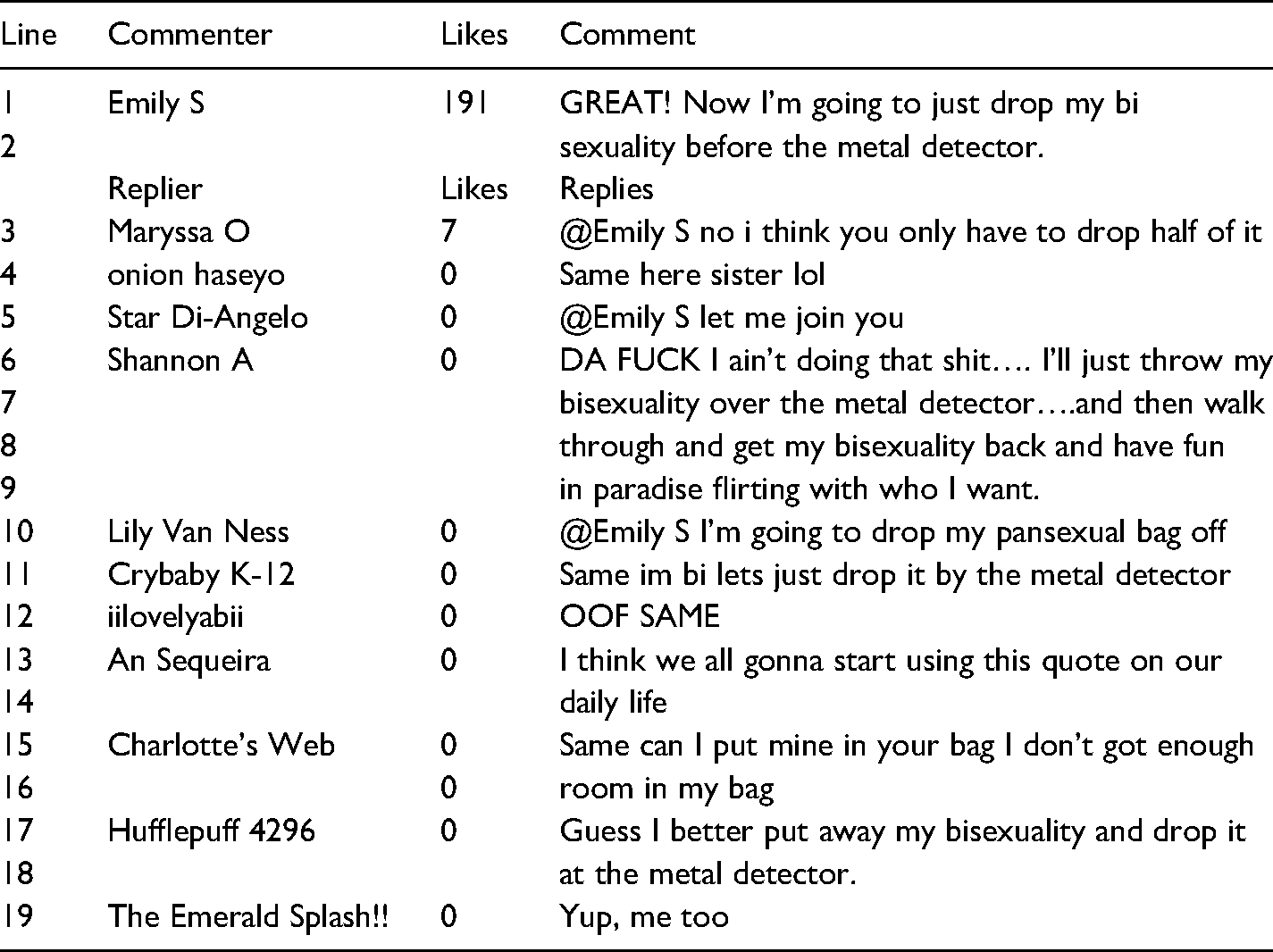
Repliers Maryssa O and Shannon A expand Emily S's statement of radical joy, taken up from the video, by elaborating the satirical play on metaphor that disrupts cisheteronormativity. In so doing, these comments open up possibilities of composing felt relations, as seen in the replies “Same here sister lol,” “let me join you,” “OOF SAME,” and “Yup,me too” (lines 4–5, 12, 19). The comments’ articulation of radical joy mediates the emergence of belonging in shared struggles. Felt relations, in turn, give rise to a collective “we” that gives new meaning to personal experiences of cisheteronormativity. This collective emerges both in iterative play on metaphor and in phrases that implicate a “we” (lines 11, 13–14, 15–16). An Sequeira emphasizes how viewers and commenters come together, forming a “we,” through the video (lines 13–14).
(216 likes and nine replies on the thread).
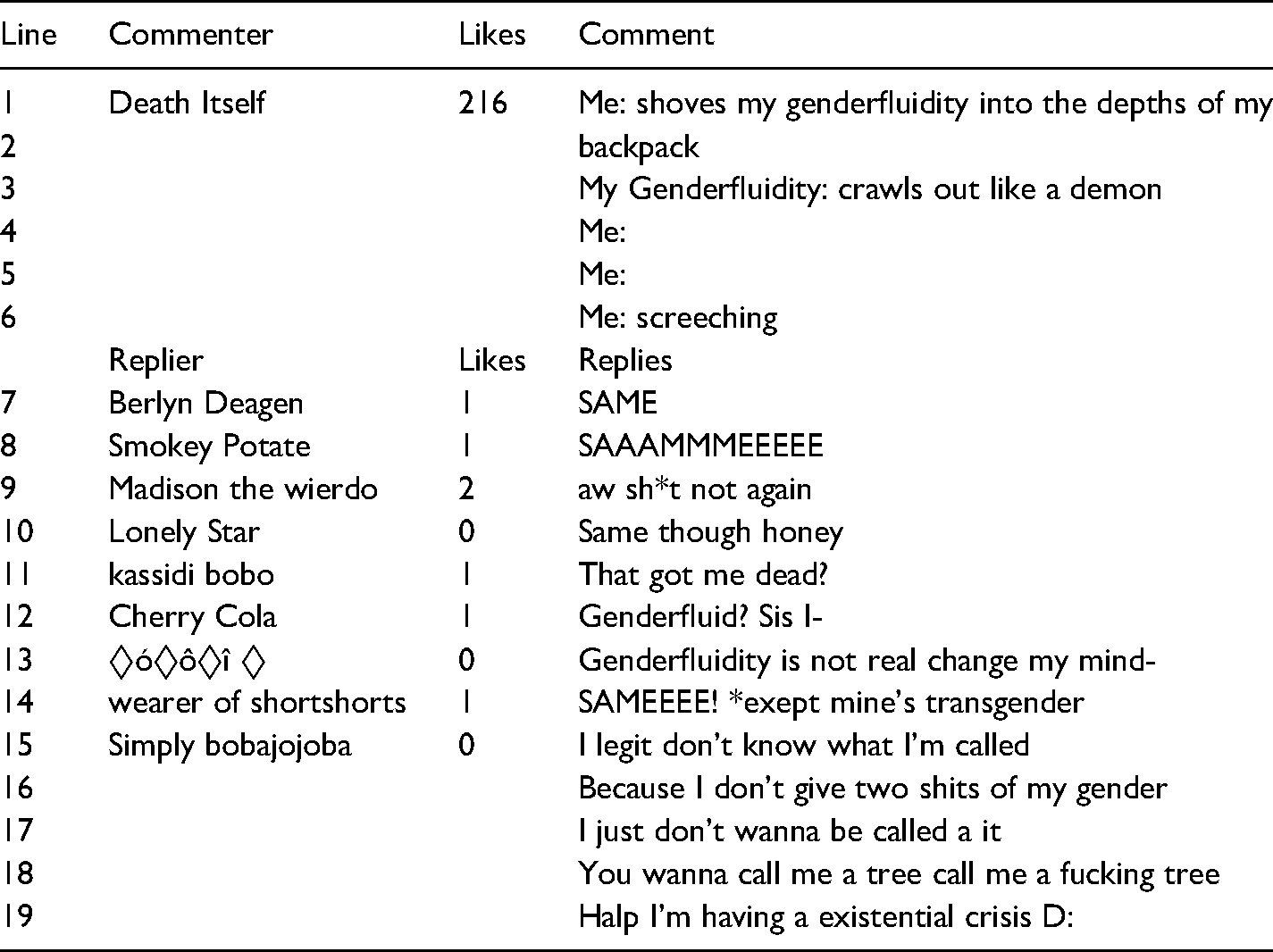
Commenter Death Itself employs a comedic, exaggerated meme form to circulate radical joy, here laughing at the failure of cisheteronormative culture that attempts to erase trans and nonbinary gender identities (lines 1–6). The meme form's circulation of radical joy to laugh at cisheteronormativity gives rise to other commenters composing felt relations (lines 7–11). They join the chorus of mutual recognition through laughter (lines 7–11). The relations that emerge are fraught with potential tension. Commenters question genderfluidity, a denial of experience with potential to participate in cisheteronormativity's violent act of rendering identities illegible (lines 12–13). Yet, other commenters in the thread ignore the skeptics. The commenter wearer of shortshorts defiantly picks up where the celebratory comments left off to compose felt relations around trans experience in cisheteronormative society (line 14). However, the return to composing felt relations halts again in the absence of recognition for Simply bobajojoba's calls for support to navigate social structures that render them illegible (lines 15–19). Though it goes unrealized, the thread highlights possibilities for community support through felt relations.
Conclusion: Toward Research, Teaching, and Learning With Political Feelings
With this study, I forward a critical affect framework to trace how media and other forms of pedagogy may structure and circulate feelings that mediate collective meaning-making of, and action against, oppression. While attending to cultural formations of emotion, political feeling ultimately foregrounds emotion as an interactional accomplishment that is continually negotiated. Scholars may seek to follow how a community achieves and continually renews political feelings such as radical joy through which youth subvert oppression and insist on life otherwise (Gould, 2009; Nash, 2011). Simultaneously, the concept can shed light on how a collective constructs, or breaks from, feelings such as shame or hate that can enclose possibilities for movement or participate in oppression (Coleman, 2021; Dernikos, 2017; Jocson & Dixon-Román, 2020). This framework will be particularly useful for studies of networked digital cultures, which scholars argue require approaches that consider the politicized and collective dimensions of emotion (Boler & Davis, 2018; Dernikos, 2017). Scholars may also follow political feeling across virtual and physical contexts, examining how learning ways to feel about injustice online mediates writing and makes other forms of political participation possible (Thiel & Dernikos, 2020). Scholars who take up affective approaches to writing might consider how feelings that emerge in composition may also be constructed in relation to broader sociopolitical contexts (Ehret et al., 2018; Lenters, 2016). Though political feeling considers myriad felt reactions that may arise in struggles for justice, my attention to radical joy guides scholars to consider feelings that defuse hate, nurture persistence, and build felt relations as they disrupt oppression and imagine worlds anew (Coppola et al., 2022; Dunn & Love, 2020).
Through the study, I also contribute a novel methodology to consider influences of affect in digital composing and situate virtual comment writing in sociopolitical contexts. As reaction media and videos more broadly continue to grow in popularity on social media (Warren-Crow, 2016), the method to construct a composing event with video and comment data guides scholars to consider how virtual writing emerges in relation with other media, and specifically in relation to moments within media (Curwood et al., 2013; Ehret et al., 2018). I am particularly interested in how vloggers, through forms of emotional pedagogy, may structure and circulate feelings that support viewers in making sense of how to feel about injustice and how, with these feelings, to move toward action (Herold, 2018). Composing events enable researchers to trace how writers are moved by media and construct feelings as collectively held. Because only around 10% of viewers on the videos that I examined also comment, connective ethnographic approaches (e.g., Wargo, 2015) may also be needed to understand how feelings mediate broader literate activity of viewers. Further research can trace how youth make meaning of and produce political feelings that they learn online, as well as how these feelings may compel participation in social movements across virtual and physical contexts.
The framework of political feeling explored through radical joy underlines the importance of emotions in critical teaching and learning. In times of social and political upheaval, youth are making sense of how to feel about injustice. Educators might consider how they notice and nurture feelings youth reach for in subverting oppression and creating more just worlds. The analysis also demonstrates that teachers—be they on YouTube or in the classroom—play an important role to construct, circulate, and cultivate political feelings that can bolster agency and guide social action. Studying hateful representations that operate through stigma might prompt feelings of fear, shame, and sadness. In the face of hate, critical approaches to teaching often foreground resistance against injustice, which may manifest in political feelings of anger. Anger and resistance are important tools in dismantling structures of power (Lorde, 1981). Yet, the analysis invites educators to consider what other feelings and practices youth need, and are already mobilizing, in the everyday work of building more just worlds (Dernikos, 2020; Jocson & Dixon-Román, 2020). In order to begin reflecting on feelings needed for liberation struggles, it is important to guide students to consider feelings as resources for inquiry and action. Educators might ask students to reflect on felt responses to materials, artifacts, and events, including those they encounter every day. Making feelings explicit can be a starting point to learn new configurations of feeling that open up possibilities for participation. Educators might invite students into the questions of what a range of feelings accomplish, and why they are valuable or needed for particular goals.
Political feelings matter in writing because they can give rise to new worlds. Scholarship on affect in writing and digital composition explicates the capacity of writing to spark new possibilities for self and society (Lenters, 2016; Wargo, 2015). Radical joy mediates meaningful forms of writing that facilitate critiques of power and belonging in community—conditions that may make other forms of participation in social movements possible. Even so, the conceptual framework of political feeling suggests youth reach for a wide range of feelings within struggles toward liberation. While radical joy may cultivate agency and resilience against oppression, feelings of sadness and anger are important felt reactions to oppression and also have a role in social action. Ultimately, radical joy and other forms of feeling shape the worlds youth refuse and otherwise worlds youth are already building (Dernikos, 2020; Thiel & Dernikos, 2020). Feelings that youth mobilize in struggles for liberation offer foundations for more just and expansive forms of social and political life.
Footnotes
Declaration of Conflicting Interests
The author declared no potential conflicts of interest with respect to the research, authorship, and/or publication of this article.
Funding
The author received no financial support for the research, authorship, and/or publication of this article.
