



Abstract
Today, digital media technologies are ubiquitous and mundane, making the relationship between digital and analog messy and porous. This postdigital condition prompts new analyses of how young children's local encounters with digital media technologies unfold, and how their relationships with digital media technologies carry on after they leave their devices. While sociomaterial approaches to literacy are apt to study how such messy literacies are enacted through singular events, they struggle to account for consistencies that emerge across events. Plugging into the concept of the refrain, we explore how felt consistencies were produced and scored two boys’ friendship through and across events as they watched YouTube, played Minecraft, and played with construction playthings. We find that felt refrains of “dwelling in novelty” were enacted, referring to the set-up of conditions where materialities acted together to produce affectively intense moments of surprise. As moments accumulated, deeply felt friendships were produced over time.
Prologue
The first author, Kenneth, met 5-year-old Yahtzee Champignon (Yahtzee) and Professor Poopy Pants (Professor) 1 during fieldwork in a Norwegian preschool in Spring 2020. Yahtzee and Professor were close friends before the COVID-19 pandemic, playing together at school and at each other's homes whenever they had the chance. As the pandemic spread, classrooms were strictly separated for contagion control, which meant that the two rarely had a chance to play together. By the time pandemic restrictions loosened in Norway, the boys had turned six and found themselves attending different schools. Now able to play safely in each other's homes, they reignited their friendship through frequent playdates after gymnastics practice. When Kenneth restarted his visits to their family homes in Fall 2021, they were playing with each other at least once a week.
These playdates were a highlight of the week for Yahtzee and Professor. While hanging out, they often moved between playing video games, such as Donkey Kong, Super Mario, or Minecraft, and playing with their toy action figures, Legos, or stuff they randomly found around the house. Sometimes they both stretched out on a big couch in front of the living room TV to watch YouTube videos in relative silence. On one such day, Kenneth, carrying video equipment, audio recorders, and notebooks, was met at the door by both boys. They were excited and boisterously talked over each other as they told him what had transpired since their last meeting. “Have you ever watched Lemon?” Yahtzee asked Kenneth, referring to a recent obsession, a Minecraft YouTuber with over two million subscribers, going by the handle of Lemon Craft (n.d.).
Over the next few weeks, Kenneth would observe the boys as they “watched Lemon” on YouTube and “played Lemon” in Minecraft and with construction playthings. As the boys moved across these sites while playing Lemon—on a streaming platform, playing a digital game, and roaming around their homes with analog playthings—Kenneth thought of how the boys themselves made no similar distinctions between “digital” and “analog.” Moreover, just as he had felt the boys’ excitement as they met him at the door, he felt, over time, the ways affect drove their play, leading to the sorts of surprises and novelties that sparked joy for them. These events carried histories of excitement accrued from playing the way they liked to play together: over time through a series of novel, more-than-digital movements that established a felt dimension of their friendship characterized by a love for surprise and novelty.
Introduction
In this article, we consider the contemporary, postdigital conditions through which Yahtzee and Professor used their literacies to produce the surprise and novelty that energized their play as friends. These contemporary conditions—where the digital fails to constitute a discrete space—have spawned a conversation in early childhood research around “undoing the digital” (Burnett & Merchant, 2020b) to generate more nuanced portraits of digital-analog imbrications in young children's literacies (Abrams et al., 2017; Burnett et al., 2014; Marsh, 2019). Originating in art theory (Berry & Dieter, 2015), the term postdigital describes the historical situation in which much of everyday life has become computational and digitally mediated, thereby blurring the distinction between digital and analog in how we come to experience social worlds.
We contribute an empirical analysis of Professor and Yahtzee's postdigital play that illuminates the consistency of literacy events across settings and over time. Our analysis of consistency refer both to the makeup of emerging literacy events, as well as to how certain literacy events evoke a sense of similarity over time—a consistency of feeling or resonance between them. We focus on consistency to address an unresolved theoretical tension in sociomaterial studies of literacy. Although well established in literacy research, sociomaterial theories (Hackett, 2021; Kuby & Rowsell, 2017; Leander & Boldt, 2013), which are often applied to the analysis of social life as constantly unfolding and singular emergence, have struggled to account for what feels like consistencies across emergent, singular events. To address this tension, we use the Deleuzo-Guattarian (Deleuze, 1997; Deleuze & Guattari, 1987) concept of the refrain to illuminate the consistency of the boys’ play, through the case of the “Lemon game,” which is enacted across literacy events involving, among other things, YouTube algorithms, Minecraft on Nintendo Switch, and construction playthings.
Tracing the enactment of the Lemon game across time and settings also allows us to feel the way that playing the game “scores” their friendship. We illustrate how the refrain set the conditions for the boys to dwell in novelty as they used their literacies to arrange the materials and produce the events of surprise and unpredictability animating their play. Professor and Yahtzee's play is therefore particularly apt for dealing with the problem of consistency in sociomaterial theories of literacy as their searching for, and dwelling in, novelty through their play became a consistent affective dimension of their childhood friendship. Our developed sociomaterial analysis provides an empirical account of how young children's contemporary postdigital play can create resonant feelings of connection between children as they use their literacies together over time. We end with implications for literacy education and practice that aims to create conditions for affective resonance in childrens’ postdigital play over time.
Theory
Refrains and Feeling Consistency Through and Across Literacy Events
Literacy cannot be reduced to representation through language and other semiotic modes alone. For example, wide-ranging literacy research has described the role of feeling, vitality, and the nonverbal in living and learning with texts (e.g., Boldt, 2021). Problematizing what counts as literacy is at the core of literacy research today, which for long has accounted for literacies enacted through other modes than the verbal. For example, young children's play is an embodied literacy, a language of movement through which children communicate (Wohlwend, 2018). Nonrepresentational thinking further attunes the researcher to playful literacies not only used to express something. Instead, playful literacies can also be about creating nonsense (Wohlwend et al., 2017), or feeling for unpredictable affects as you move your body with the world by rolling down a hill (Hackett & Rautio, 2019). In this research tradition, affect refers to the products of the murmurations of the world coming together and breaking apart contingently, which registers through human bodies as the indeterminate vital forces and textures of social life (e.g., Gregg & Siegworth, 2010).
The literacy event, in this line of thinking, should be studied as the focal point of analysis, rather than extrapolating it to broader, recurrent practices. Literacy events are not where practices are enacted and actualized. Instead, literacies are enacted through the event (Ehret, 2019) and as the event (Burnett & Merchant, 2020a), bringing to the fore the singular and emergent. Staying in the event means asking what potentials for literacies emerge in how materialities assemble, disassemble, and reassemble in a particular place and at a particular time, to affect each other relationally.
However, it follows that this strain of literacy research typically has struggled to account for apparent consistencies across literacy events over time. Concepts such as practice, identity, and discourse have supported sociocultural theorizing of literacies across contexts and events, especially in the connected ecologies of the digital age (e.g., Lankshear & Knobel, 2011). Yet, concepts that can account for consistencies across literacy events, theorized as singular, remain underdeveloped in sociomaterial accounts of literacy. While extant research on affective dimensions of literacy has attended to felt consistencies as felt atmospheres (Dernikos et al., 2020; Hollett and Ehret, 2015), or how affects are produced through assemblages coming together and falling apart across larger swathes of time and space (Lenters, 2016), a general tendency toward emergence has prevailed. In a recent issue of the Journal of Literacy Research, this tendency was attended to as it presented studies from a range of theoretical traditions going “beyond emergence” to “generate more expansive literacy ecologies” (Bauer et al., 2023, p. 3). Such efforts resonate with our own. There is a need for sociomaterial, nonrepresentationalist theorizing of literacy to develop concepts that account for how events connect, disconnect, and reconnect in postdigital conditions, and that push the field's capacity beyond analyses of the emergence of the singular event.
To address this theoretical tension, we draw on Deleuze and Guattari's (1987) concept of the refrain, which they deployed explicitly to deal with the problem of consistency (see pp. 327–328). For them, the problem of consistency was a question of “the ‘holding together’” of heterogeneous elements and how a constituting element of one “holding together” becomes a constituting element of another (pp. 323–324). Consistency thus expresses a dual sense: the consistency (i.e., makeup) of a singular event and the consistency (i.e., similarities) felt across the makeup of multiple events. Deleuze and Guattari theorized the refrain as a constituting element of the holding together of an event, an organizing force that gives it a felt dimension. Furthermore, the refrain reemerges as an organizing force across multiple related yet singular events, thus generating a feeling of consistency and resonance. It is important to note that consistency does not preexist the events. Rather, consistency is “the becoming–expressive of rhythm” (Deleuze & Guattari, 1987, p. 322), the movement through this time and this space with these bodies and materials coming together and holding together: an organizing force that expresses a sense of familiarity through a larger assemblage of materials.
Refrains of Friendship
Thus, although refrains are enacted through and are immanent to events, they bring with them a sense of familiarity (“we are doing this”) and, as such, represent something new to the problem of consistency. Refrains are what make us experience life not as events that randomly follow each other but often as seemingly congealed—even hardened. Illustrating the contingent temporal consistency of the refrain, Berardi, in a book detailing his friendship with Félix Guattari, theorized that friendship in essence is about shared refrains: Friendship means a provisional community that is not based on any common origin, on any written destiny, on any historical necessity, but instead only on provisionally assembling refrains. It means love for the same situations, pursuing the same provisional objectives, taking pleasure in following the same path together, or failing together, and falling. (Berardi, 2008, p. 87)
Like friendships, events do not hold together forever, and refrains both enable an event's holding together and its inevitable rupture toward difference. For example, Boldt and Leander (2017) analyzed the literacy event of a father and child's play with Legos, describing how the movements of the play refrains produced “breaks.” They used as an example the tendency for Legos to fall apart or not fit together just at the moment we want them to hold or fit together the most. This set of expectations is a refrain that expresses the sense of Lego play through and across events and which, at the same time, creates the affective conditions that enable a break in an event when the Legos do not cooperate. The refrain, as it relates to the break, is thus productive of both consistency and difference through and across events.
The Postdigital Condition
Literacy researchers have recently proposed “postdigital” as a moniker for the contemporary conditions in which digital media technologies are both ubiquitous and mundane, as mobile devices travel with us, and artificial intelligence and algorithms become ever more pervasive and technologically advanced. In this condition, the previously distinct and clear categories of analog and digital become more difficult to justify, and the relationship between the two becomes messier and more porous (Burnett & Merchant, 2020b; Edwards, 2022). As digital media technologies slowly entered early childhoods in the early 2000s, sociocultural studies explored how digital cultures and technologies mediated children's play. Yet, the unprecedented pervasiveness of digital technologies in contemporary social life cannot be reduced to the mediation of digital cultures (Jarvis & Savage, 2021). Contemporary digital technologies actively collect and analyze data to affect human activity, thereby making it difficult, if not sometimes impossible, to disentangle the digital from the analog. For example, in Marsh (2019), a young boy's elder sister disclosed to a researcher that Hot Wheels was not just a traditional toy car activity confined to designated play spaces, as their mother initially had explained. Rather, Hot Wheels emerged via YouTube, apps, and toy cars throughout all rooms of the house. This disclosure prompts questions such as what role the YouTube algorithm played in the children's choice to view Hot Wheels videos, or how their choices in improvising stories about their Hot Wheels toys was co-authored by the YouTube algorithm, which showed them Hot Wheels stories based on their YouTube watch history. An analytical adjustment is needed to attend to the wide range of heterogeneous materialities assembled in young children's contemporary play.
Literacy researchers have found sociomaterial approaches particularly apt to study this messy assembling, disassembling, and reassembling occurring in the postdigital (Edwards, 2022). Concepts such as “sitings” (Leander & McKim, 2003), “playscapes” (Abrams et al., 2017), or “(im)materiality” (Burnett et al., 2014) are all attempts to account for relationality in the postdigital through sociomaterial frameworks. Furthermore, several contributions in the Journal of Literacy Research, informed by sociomaterial theorizing, have explored the digital–analog imbrications of contemporary literacies (e.g., Ehret et al., 2016; Lenters, 2016; Nelson et al., 2020). Yet these studies have often explored the postdigital through the singular event by emphasizing the materiality and embodiment of the digital, and the fluidity of the interfaces between screen, body, and world. They have rarely explicitly explored how young children's relationships with digital media technologies resonate and reverberate across events and over time. In our analysis of Professor and Yahtzee's play, we work to understand resonances across literacy events that illuminate how postdigital conditions affect how children use and experience their literacies in their everyday social worlds.
Method
Analytical Focus and Research Questions
The concept of the refrain sensitized us to how children's contemporary play involves digital–analog assemblages across events. Rather than focusing on one “digital literacy event” understood narrowly through the digital, we focus on refrains enacted through and across literacy events; this sensitivity allows us to consider how consistencies emerge that are immanently material and difficult, if not impossible, to categorize as digital or analog. The felt refrains held together over time, offering insights that moved our analysis beyond emergence. Throughout, we develop an impersonal theory of friendship expressed through Professor and Yahtzee's dwelling together in novelty through their literacies in play. The following research questions, driven by our development of theory to address the dilemma of consistency, guided our analysis:
RQ1: How do refrains emerge and generate felt consistency through the literacy events of two young children's play? RQ2: How do refrains reemerge and generate felt consistency across the literacy events over time? RQ3: How do refrains score the boys’ friendship through and across the literacy events?
Fieldwork
These research questions did not precede our experiences with the boys; instead they derived from our thinking and feeling together with them and, later, from viewing videos of their play. The experiences and videos were collected along with audio recordings, field notes, and digital photographs from broad ethnographic fieldwork in which Kenneth immersed himself in the daily lives of young children in a large Norwegian city in 2020–2021. Beginning this fieldwork at a preschool, Kenneth focused primarily on a group of 4- to 5-year-old children who enacted video game narratives on the preschool playgrounds. As his relationship with the children and their families developed, Kenneth began visiting three of the children's family homes to explore further how the children engaged in gaming-related practices across home and preschool. He made 64 visits altogether to the preschool and family homes, collecting 55 h of video recordings.
Through this fieldwork, Kenneth learned that two children, Yahtzee and Professor, often visited each other's homes and that these visits often centered around video games—mostly Minecraft. He then visited the children over a span of two months as they had each other over for home visits or played with siblings. Some months after these visits, in anticipation of our upcoming research stays at the same university, Kenneth and the second author, Christian, met through Zoom and email. Two days of the fieldwork, in which one of the boys visited the other boy's house to watch Minecraft YouTube, play Minecraft, and play with construction playthings, engaged our thinking about issues of the postdigital and the refrain. The video recordings from these two days amounted to 3 h and 33 s; these were transcribed and translated, with three pages of field notes. As we watched these recordings, consulted theory, and reviewed empirical studies, three events of 38 (event 1), 71 (event 2), and 40 (event 3) seconds were selected for closer analysis as they seemed generative of ideas which, by then, were starting to materialize. The video recordings formed the basis of narratives accompanied by line drawings (see Figures 1–3).
Feeling for Focal Moments
We are not exactly sure how we came to these events. As researchers searching for new perspectives on affect and literacy, experiencing the feeling that something was happening through these events and then focusing on them was a process more apt for “data reduction” than more traditional, rationally oriented qualitative methods. Feeling for feelings in data should not—and cannot—be wholly rational. Focal moments from the data, registered and felt on researcher bodies, were selected because of how they animated new thinking, rather than because they illustrated constructed patterns and themes. This analytical process, informed by postqualitative approaches (Jackson & Mazzei, 2022; MacLure, 2013), is established in literacy research (Burnett & Merchant, 2020a; Ehret et al., 2016), and is represented in recent studies from the learning sciences (Køster & Fernandez, 2023; Leander et al., 2023). Postqualitative research is theoretically informed by post-structuralist and posthumanist thinking, which generally resists the notion that research is a representation of a consistent, external reality. Ethnography, for example, can instead refer to the diverse, lived experiences of engaging materially, affectively, and experimentally with theory and fieldwork.
Through our feeling for focal moments in the data, we noticed how emergent and contingent sparks registered on participants’ bodies as they jumped, slumped, sang, and giggled. For example, within the literacy event of Professor and Yahtzee playing Minecraft, something occured, which was felt by us and, we argue, felt by the two boys. While waiting for a hostile mob 2 —a creeper—to appear from the bushes and kill the player's avatar, Professor tensely got up into a crouch, both feet on the seat of the chair, and jumped rhythmically while shouting, “You have to die!” at the TV and Yahtzee. Through this event, the felt anticipation and excitement of maybe getting attacked at any moment by the hostile mobs were key to the start of new inquiries. Our interest in what happened was piqued, not because it was a repeated practice ripe for categorization or because it was an enactment of a specific social norm, but precisely because it seemed to be not only that but something more. Following the feeling that something more was happening eventually allowed us to recognize that the boys seemed to be “designing” their gameplay to create surprises, novelty, and intensities that were resonant across the literacy events we have analyzed below.
We represent the events discussed in this article through narrativized accounts accompanied by line drawings based on video recordings. The translation of the boys’ talk into American English in the narrativized accounts was a pragmatic choice, given the multilingual audience of the Journal of Literacy Research. However, there are limitations to this approach because it reflects naturalized ideological imbalances between English and non-English speaking countries, and subtleties are lost in translation, reducing transparency (e.g., how the talk of the boys is interspersed with English words and phrases) (Nikander, 2008). To amend these issues, see Appendices 1–3 in the online version of the article for transcriptions in the original Norwegian, bearing in mind that these do not resolve the issue of language primacy.
Further reflecting our theoretical framework, we have highlighted and directed the reader's attention to the embodied, material, affective, and situated dimensions of literacies. This way of expressing our relationship with the data will, we hope, allow the reader to tune in to and feel the events as they are produced anew in this article. We could not represent exactly what happened but only present accounts of it. These narrativized analytic accounts of the boys’ play were inserted into our study, producing something that we felt sparked new thinking of how early childhood literacies are enacted in situ. Furthermore, the drawings outlined from video stills as bottom layers in Adobe Photoshop afforded transparency, adding to the trustworthiness of our interpretations.
Analysis
Professor and Yahtzee Play the Lemon Game
In this section, we consider RQ1: How do refrains emerge and generate felt consistency through the literacy events of two young children's play? In analyzing an event in which the boys played Minecraft after watching YouTube, we illustrate how a felt refrain of dwelling in novelty slowly gains felt consistency through the boys playing the Lemon game. The Lemon game first appeared in their engagement with YouTube before reemerging as the boys attempted to recreate the feeling of the Lemon game on YouTube by playing Minecraft “badly.”
On Lemon Craft, the Minecraft YouTube channel Yahtzee and Professor were eager to show Kenneth (as noted in the prologue), 10 min videos of Minecraft machinima targeted toward children are posted daily to close to three million subscribers. Machinima, a portmanteau of machine and cinema, refers to the practice of making video content by means of computer graphics engines, such as videogames like Minecraft. The Minecraft machinima most popular with the two boys were Lemon Craft's Noob videos. Noob is short for newbie, a gaming culture term that dismissively refers to novices. In the videos, Noob is a comical, slapstick character who often ends up in dangerous situations but also sometimes crazily succeeds despite the odds stacked against him. For example, in one video—“How to USE this HUGE DIAMOND SWORD in Minecraft ? BIGGEST SWORD !” (Lemon Craft, 2021)—Lemon, the protagonist of Lemon Craft's videos, leaves his house to find Noob rambling incoherently outside his own house while putting up a sign that says,“Best sword ever,” with an arrangement displaying Noob's unimpressive sword. Lemon walks angrily back to his house to get a diamond sword; he then kills Noob and replaces Noob's sword with the diamond sword. Lemon turns around to walk back to his house, but Noob, now apparently respawned, 3 appears behind him with two giant diamond swords. Noob runs toward Lemon, shouting incomprehensibly. Lemon quietly exclaims “Uh-oh!” before the video freezes with the text “We’ll be right back” superimposed on the screen.
One day, after the boys watched a handful of related videos on Lemon Craft, Professor's mother—who, along with Professor's father, was in the kitchen sometimes glancing at the boys in the living room, commenting occasionally, but mostly letting the boys play as they liked—urged the boys to “do some gaming” rather than “gawking” at YouTube. Yahtzee suggested playing what he calls a Lemon game in Minecraft. He clarified that suggestion by adding that they would play “so badly, and dumb,” and later that they would “be so crazy,” a statement which echoed the content of the videos they had been watching on Lemon Craft. Professor then added that they would “do Survival all the time,” referring to selecting a mode of Minecraft where hostile mobs are running wild, a more dangerous mode of the game where “crazy” things were more likely to happen.
Playing Minecraft, Yahtzee sat on the couch and Professor sat in a chair. They alternated holding the gaming controller. Because hostile mobs, and more prospects of dying, primarily surface during nighttime, 4 the boys used daytime to prepare for the Lemon game. The preparations significantly involved taking armor off, and leaving their weapons behind. Preparing to roam around during nighttime, surrounded by hostile mobs and with no armor or weapons to protect Noob was, in the boys’ own words, very dumb—a perfect condition for playing the Lemon game!
Ten minutes transpired and the sky was slowly turning darker in Minecraft. The boys had been awaiting this moment, and the hostile mobs were coming out of the woodwork. In the living room, Yahtzee was now holding the gaming controller, remaining on the couch. Professor was remaining in the chair. Soon, however, the two boys’ body postures and movements grew wilder and more erratic while they were laughing and shouting. The intensity was palpable to Kenneth, as he sat four feet away, and for Kenneth and Christian who watched the video recordings together on a shared laptop months after the fact.
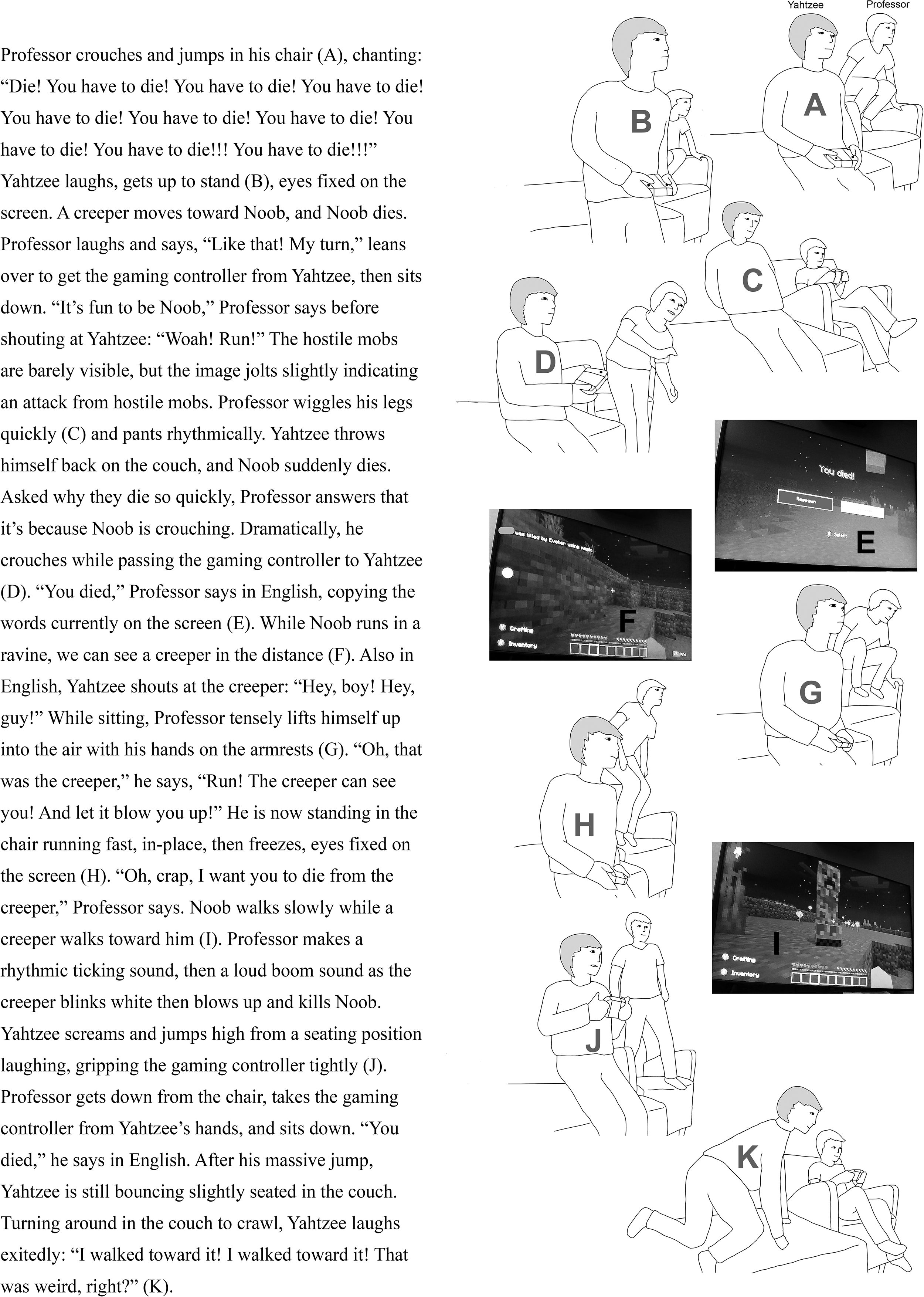
Event 1: Professor and Yahtzee Play The Lemon Game.
First, Professor repeatedly shouted the objective of the game—“You have to die!”—while jumping in the chair. The boys consistently sought out open spaces in Minecraft where they might die, running toward the hostile mobs. It was the middle of the night and hostile mobs seemed to be everywhere, killing Noob within seconds of respawning. The boys’ bodies crawled, jumped, and ran in place, displaying feelings of excitement and anticipation. They laughed and shouted interjections: “Woah!” “Run!” “Crap!” In the end, Yahtzee commented on the counterintuitive practice they were engaging in, saying, “I walked toward it. I walked toward it. That was weird, right?”
Analysis
A refrain emerged as Yahtzee and Professor played the Lemon game in Minecraft. Playing the Lemon game—“dumb,” “badly,” and “so crazy”—constituted expressive content through which the refrain gained a felt sense: the play was going to produce something novel, something surprising. Playing dumb, badly, and so crazy, and seeing what might happen, was the metaphorical playground of the boys—in other words, it was what enacted the boundaries of this felt literacy event and made it feel like the Lemon game at this moment. The boys made specific material and affectively charged moves in the game in relation to this felt sense by, for example, loading Survival mode, taking off their armor, and leaving their weapons behind.
Furthermore, the enactment of the refrain was made possible through the feature of respawning in the game. Inevitably, playing badly leads to dying, and respawning affords life after death. In this process, the boys could easily reenter the material-discursive narrative and immediately start running away from hostile mobs once again, giving their play a “calm and stable pace” (Deleuze & Guattari, 1987, p. 312) of dying, respawning, playing badly, dying, and so on. The Lemon game emerged as a felt refrain of potential surprise through their play. As the game was expressed, it gained consistency through the development of material-discursive boundaries, enabling this potential for surprise that sparks affects. It slowly became recognizable as the Lemon game as the affects generated through watching Noob's dumb adventures on Lemon Craft were allowed to reemerge while the boys played Minecraft.
However, importantly, material breaks were also “grafted onto [the] pace” (Deleuze & Guattari, 1987, p. 312). During Event 1, the emergent agencies of the hostile mobs interfered by breaking through the refrain. While Yahtzee and Professor assuredly envisioned results following their actions, they were not designing something as an internal representation before enacting it on their material surroundings. On the contrary, Yahtzee and Professor allowed the world, in its emergent agentic materiality, to act upon them in ways that felt unpredictable: they dwelled in novelty. 5 The emergent agencies of the hostile mobs attacking Yahtzee during Event 1 could not have been precisely anticipated, and both boys laughed and jumped as they were moved through this break.
Any person, either present at the time, watching the video recordings, or, we hope, reading this article, will feel the zeal and intensity of the boys as the hostile mobs come for them out of nowhere. We argue that this flow was productive and significant for the boys because it allowed for a movement between the break and refrain, which never disintegrated into chaos or stagnated into something too fixed and boring. The boys were dwelling in a rhythm of heterogeneous materialities because they enjoyed the way it felt when something came out of left field to surprise them. This dwelling in novelty was the felt refrain that we saw emerge repeatedly through and across literacy events; it became recognizable through the Lemon game in Minecraft (RQ1, this section), reemerged while the boys played with construction playthings (RQ2, next section), and scored their felt friendship (RQ3, the following section).
Noob Tries All the Stuff
In this section, we consider RQ2: How do refrains reemerge and generate felt consistency across the literacy events over time? We analyze an event in which the boys played the Lemon game with construction playthings. The event made us think anew about—that is, “undo” (Burnett & Merchant, 2020b)—the digital so prevalent in Event 1. Resonating with the boys’ experiences in Event 1, the Lemon game reemerged as the boys played with construction playthings.
One week after Event 1, the boys met again in the same room to “play Minecraft.” This time, they moved a few feet to the left, next to a dinner table (the corners of which are represented as black triangles in Figure 2). They were sitting on the floor with Plus-plusses 6 spread out all over, and the Lemon game once again materialized. The two were close to and turned toward each other. Professor was finished making a Plus-plus ender dragon, 7 which was placed next to him. Yahtzee made a long flat row of Plus-plusses, which were mostly gray, although uniformly placed pieces of other colors made up imagined pools within the long gray row. Furthermore, Yahtzee built a Plus-plus Noob. Noob was jumping into pools made, according to the boys, of varying matter—for example, wool, poop, honey, bedrock, or obsidian. 8 Yahtzee explained Noob's reasoning for jumping: “He…uh…felt like trying all the stuff they had. So he did them all.” Later, Yahtzee said, “A new Noob is born! And he's pretty dumb. He wanted to try all the stuff. Even bedrock.” All the while, Professor and the ender dragon roamed around the living room a few feet from the floor. Next to it, Noob jumped into a pool and died. Then, expectedly, something unexpected happened.
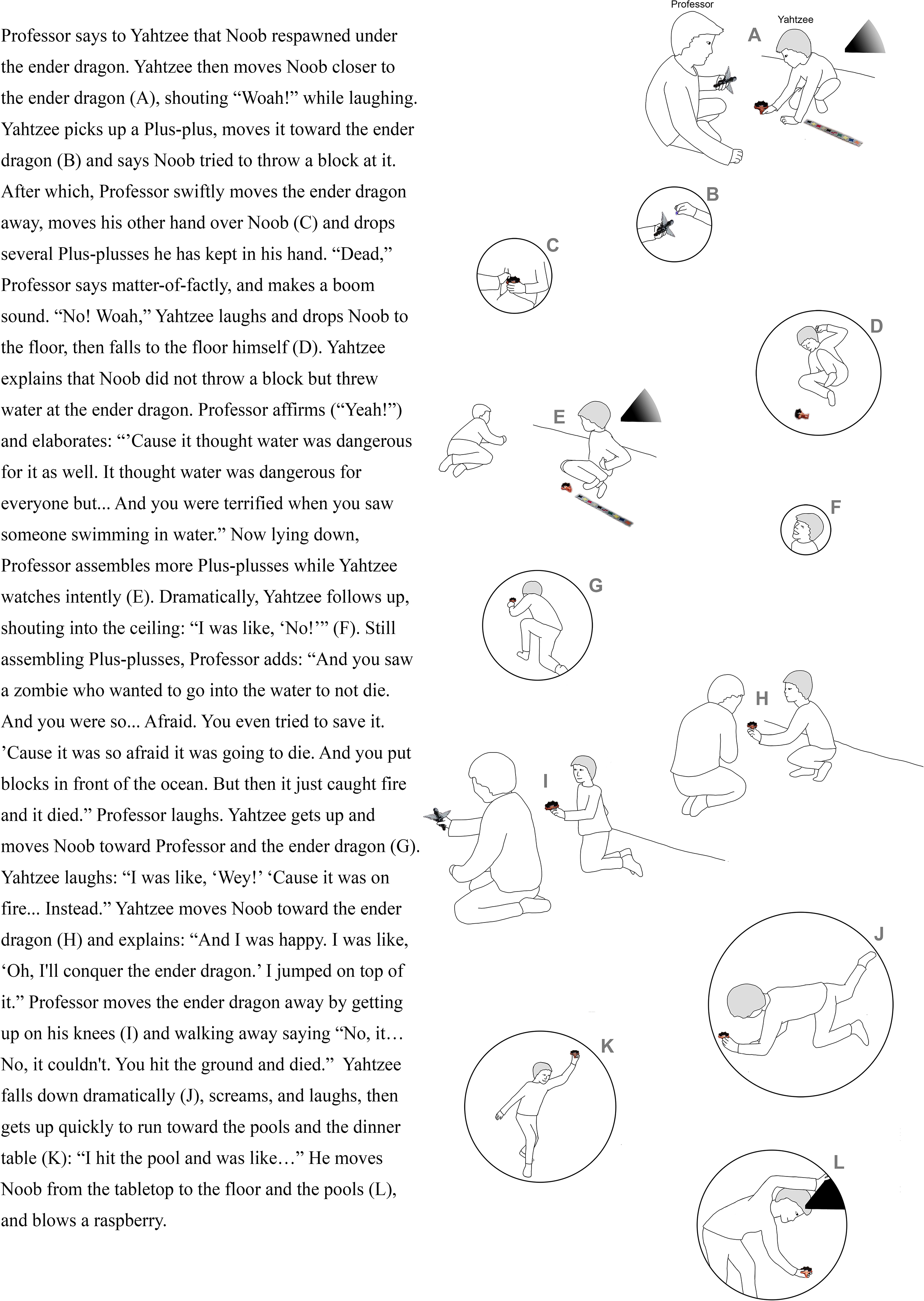
Event 2: Noob Tries All The Stuff.
In this event, Noob first respawned under the ender dragon. In a moment of apparent bewilderment, Noob attempted to throw a block at the dragon, and later some water, which was even more futile. After the ender dragon counterattacked, Noob died and respawned in the presence of a zombie. In Minecraft Survival gameplay, zombies often move toward the ocean during daylight to become underwater zombies. If they do not find shelter or become underwater zombies, they catch fire and die. However, in the boys’ narrative, Noob wanted to save zombies who move toward the water, mistakenly thinking they might die from drowning. He erected a wall between the zombie and the water, and, not surprisingly, the zombie caught fire and died. Happy-go-lucky, Noob then decided to conquer the ender dragon once again and attempted to ride it by jumping on top. However, as the ender dragon flew away, Noob instead plunged into a pool and died once again.
Analysis
Mirroring their play on the Nintendo Switch a week earlier, we once again meet Noob in this new assemblage but in a familiar refrain enacted across literacy events. We once again see Noob playing the Lemon game, finding and placing himself in dangerous situations, such as dying from jumping into a pool, respawning under the ender dragon, and jumping on top of the ender dragon. The boys set the stage through the placing of materials in specific assemblages: a Noob was made of Plus-plusses, and the tabletop served as a cliff. This staging allowed for respawning, zombies, and pools to emerge, enacting a familiar refrain through which the features of Minecraft gameplay—most notably, respawning—were allowed to take place on the floor next to the dinner table. Furthermore, the felt refrains of dwelling in novelty were enacted as the abundant materialities the boys set up—zombies, ender dragons, Noob, pools, cliffs, human bodies—made breaks possible, and openings for novelty and unpredictability entered the mix. For example, when the zombie appeared, assembled on the fly, the boys improvised, and blocks were placed along the water, igniting the zombie, which subsequently died. This event propelled an overly optimistic Noob to attempt to jump on top of the ender dragon—a foray that ended in Noob's death. During the course of action, the boys laughed, blew raspberries, and gestured dramatically in ways that carried felt affective intensities due to the breaks experienced by Yahtzee's Noob as attacks by zombies, jumps into bedrock pools, and escapes of ender dragons obstructed and rerouted Noob's movement. The boys crawled on the floor, laughed, and screamed, dwelling in these events, allowing for novelty, unpredictability, and the affective intensities produced in the encounters to move the play in new, enjoyable directions.
Importantly, the concept of the refrain allowed us to study the felt consistencies across literacy events instead of focusing on singular, emergent literacy events. Furthermore, in postdigital conditions, connections were made across seemingly disparate events. Rather than study them separately—one involving “gaming literacies,” the other “Lego literacies”—the refrain and the resonances across these two, which were thought-felt by the children and the researchers, were studied together. They were studied not as bounded, but as porous and percolating: The Plus-plus Noobs were allowed the potentialities to respawn, adding novelty. Felt refrains of dwelling in novelty, first enacted through Minecraft gameplay on the Nintendo Switch and their gawking at YouTube videos, bled over and reemerged through Plus-plus play under the kitchen table, which reflected but also enacted the postdigital conditions of their everyday. Because these conditions involved the emergent agency of a wide range of (digital-analog) materialities that introduced unpredictability and instability, the play veered off in new directions, enacting similarly felt refrains and breaks.
The Ultra Mutant Zombie Can Drop Dead by Himself
In this section, we consider RQ3: How do refrains score the boys’ friendship through and across the literacy events? We analyze an event in which the boys have a disagreement while roleplaying zombies with Minecraft Legos in Professor's bedroom. We develop two arguments from our analysis of Event 3. First, the event brought to light what is more implicit in the previous events, namely, the work of attunement it requires to dwell in and let oneself be touched by the emergent agentic materialities of the world, including the ones of your friend. Second, we argue that the sensitivity toward the refrains enacted was integral to how Yahtzee and Professor's friendship grew and was nurtured.
In Event 3, Yahtzee and Professor were playing with Minecraft Legos in Professor's bedroom, after having watched YouTube and played Minecraft for around an hour (Event 1). Minecraft Legos were spread out on the floor among Professor's toys and on a chaise lounge on the floor space of his bunk bed. Kenneth arrived in the room with his video camera when the boys had been there for 30 seconds; the play was already taking form as they picked up two assembled Minecraft Lego zombies, one mutant and one normal. Kenneth sat down three feet away from them as they knelt and leaned over the chaise lounge. A shift in perspective had occurred: the zombies were now the protagonists fighting other Minecraft characters. The adversaries were no match for the superior zombies, and the zombies soon ended up attacking each other. Furthermore, to gain power, the zombies, in Professor's words, “make themselves ultra,” which likely referred to a mod 9 that augmented the characters’ features in Minecraft. For example, Professor and Yahtzee attached blaze head Legos to the zombies and made them bigger and less vulnerable to damage. After fighting each other, Yahtzee's mutant zombie with the blaze head (i.e., the ultra mutant zombie) picked up a Batmobile Duplo cannon from the floor and, in what had become a familiar refrain, attempted to die using it. On the same side of the chaise lounge and still on their knees, the boys were positioned to face each other with various Legos and a Lego house between them, each of them handling their own set of Legos.
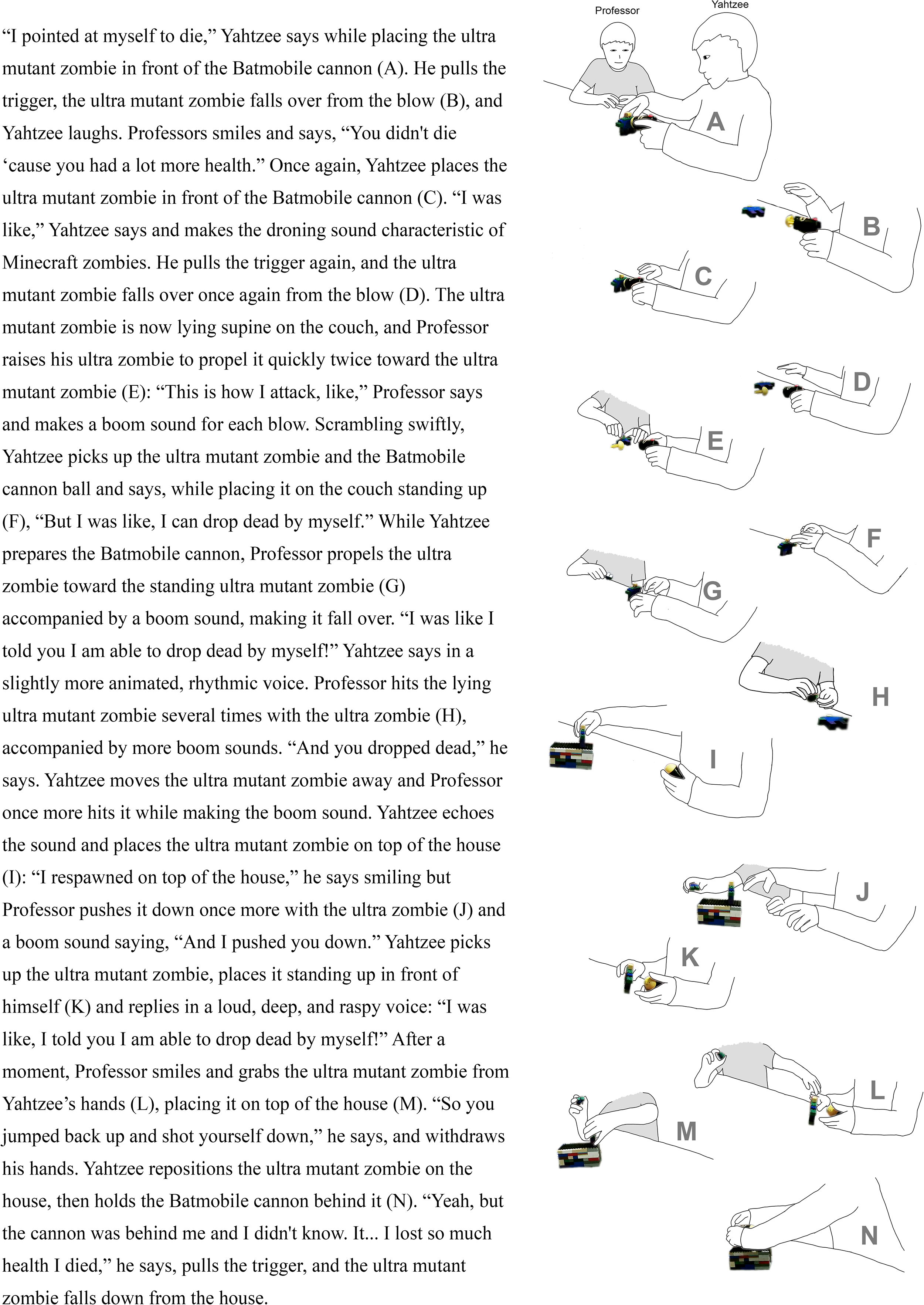
Event 3: The Ultra Mutant Zombie Can Drop Dead by Himself.
In this event, Yahtzee used the Batmobile cannon to make his ultra mutant zombie shoot himself. Professor, on the other hand, attacked Yahtzee's ultra mutant zombie with his ultra zombie, which interfered with Yahtzee's plans. Speaking in the voice of the ultra mutant zombie, Yahtzee got more and more agitated. Finally, after Yahtzee's ultra mutant zombie was punched down for the umpteenth time by Professor's ultra zombie—this time from the roof of the house—Professor grabbed the ultra mutant zombie and placed it back on the roof, following instead the storyline proposed by Yahtzee of the ultra mutant zombie shooting himself. Elaborating, Yahtzee explained that the ultra mutant zombie did not even know the cannon was behind him and was shot down.
Analysis
Echoing Events 1 and 2, the recurring Lemon game refrain of dying senseless and spectacular deaths once again materialized with the ultra mutant zombie pointing the cannon at himself (crazy!) and failing to register that the cannon was behind him (dumb!). As we have shown, these types of refrains, characterized by dwelling in novelty, allowed for breaks because a wide range of agentic materialities were assembled.
Event 3 also illuminated the complex sociomaterial network that is the foundation for certain things to occur by illustrating the “what if…?” Both boys—in concert with the ultra zombie, the ultra mutant zombie, the cannon, the house, the chaise lounge—brought the situation to a halt as their materialized, embodied ideas were not given the chance to resonate through the event. While there was an affective charge, this charge was characterized by an agitated, frustrated tension that did not produce “a difference that makes a difference” (Boldt & Leander, 2017, p. 409). Boringly and stagnantly, the ultra mutant zombie got up, got attacked, got up, and got attacked again. Toward the end of the day, the boys began to tire out, and Yahtzee was visibly annoyed. They had been gaming and watching YouTube for well over an hour, and it was approaching bedtime for both. This event illustrated the intra-actional accomplishment required to enact the dwelling literacies of attuning to—or feeling—the emerging agentic materialities of the world. Finally, the refrain was enacted once again as Yahtzee's ultra mutant zombie was allowed to do what it wanted—to be dumb and crazy—which produced new potentialities for breaks and affective intensities to take place. In fact, after Event 3, Professor turned to look through a box of Legos to make their zombies “even more ultra bultra sultra cultra.” Novelty was able to be introduced again, allowing for new breaks and new affective intensities.
Watching the video, being in the room, and reading our descriptions, we felt Yahtzee and Professor's friendship through their strong and urgent desire toward novelty alongside each other. There was a thickness and dimensionality to their play, thanks to the “provisionally assembling” refrains and breaks. They were attuned to each other and “follow[ed] the same path” (Berardi, 2008, p. 87), as illustrated by our three events, scored by recognizable refrains. During Event 1, they watched the same YouTube video together, gleefully reveling in Noob's unconventional approach to Minecraft gameplay, embracing the respawning feature. Anticipation built as they turned to playing Minecraft on the Nintendo Switch. During the game's daytime period, they set things up to play the Lemon game together. The intensity was high as they jumped on chairs, crawled on couches, and laughed at each other, feeling Noob as he kept dying spectacularly during the nighttime. Moving to the floor in Event 2 to play with Plus-plusses, the two once again played similar refrains and dwelled in similar breaks, producing familiar, intensely felt affects.
The refrains were enacted through different bodies, things, and spaces. For Yahtzee and Professor, the refrains they loved—be they “digital” or “analog”—were the ones that allowed for breaks, and a type of friendship, to emerge, which was about following a felt exigency toward dwelling in novelty. Through and across the events scored by these refrains, a friendship emerged that was impersonal because the dwelling in novelty was enacted affectively and relationally; in other words, they were not friends who happened to play Minecraft. Minecraft texts and the literacies enacted throughout—in concert with the tabletops, Batmobile Duplo cannons, and Plus-plusses—were integral to, and inseparable from, the refrains, breaks, and production of affectively intense events at the center of the two boys’ friendship.
Sociomaterial analyses, developed from a nonrepresentational tradition, not only feel for moments in data to analyze, but also work to express what literacies feel like through moments in research writing (Ehret, 2018; Stewart, 2010). As a reader coming to the end of our analysis of three literacy events, you may have a sense of what it felt like for Professor and Yahtzee to dwell in novelty together. Taking children's contemporary literacies seriously requires that researchers not only engage with them rationally but also push the boundaries of expression and analysis to attune to the feeling of literacy for young children today: gawking at YouTube, playing badly with Plus-plusses, and nurturing friendships.
Concluding Remarks
Through our analysis and our feeling alongside Professor and Yahtzee, we have shown how two children watching Minecraft YouTubers, playing Minecraft on a Nintendo Switch, playing Minecraft with Minecraft Legos, and playing Minecraft with Plus-plusses in their living room and bedroom enacted literacy events, through and across which refrains were enacted, producing and maintaining feelings of friendship over time. Each dimension of our analysis highlighted how Professor and Yahtzee's uses of their literacies in postdigital play were driven by desires for novelty and the production of affect and feelings of friendship. Our analysis addressed the following: How refrains emerge and generate felt consistency through the literacy events of two young children's play; How refrains reemerge and generate felt consistency across the literacy events over time; and How refrains score the boys’ friendship through and across the literacy events.
First, the felt refrain of dwelling in novelty emerged through a literacy event by gaining recognizability as the Lemon game. Through the refrain, discursive boundaries were erected and expressed as the Lemon game, enacting a metaphorical playground through and from which to work. Playing the Lemon game in Minecraft was to dwell in novelty because it involved, in Yahtzee's words, “[trying] all the stuff” and being open to how novelty unfolds, no matter how “dumb” it is. Dwelling in novelty allowed for breaks—for example, the emergent agencies of Plus-plus zombies and Nintendo Switch zombies attacking—to insert themselves abruptly and surprisingly through the refrains of the literacy events, veering off to produce the affectively intense events of jumping around, screaming, and laughing, which in turn prompted new lines of movement. Rather than rejecting or revising novelty, the boys accepted and worked with it, embracing unpredictability as they felt for its affects.
Second, the felt refrain of dwelling in novelty also reemerged and was enacted repeatedly, developing a felt consistency across the literacy events: by the kitchen table, when Plus-plus Noob jumped from a tabletop cliff into Plus-plus bedrock pools; on the Nintendo Switch, when avatar Noob took off all his armor and weapons before nighttime when the hostile mobs appeared; and in Professor's bedroom, when a Minecraft Lego ultra mutant zombie shot himself with a Batmobile Duplo cannon. A wide range of materialities, both digital and analog—for example, Minecraft texts, Plus-plus pieces, the tabletop, the game on the TV, and the two boys’ bodies—assembled, disassembled, and reassembled, enacting emergent agencies through and across literacy events.
Third, the felt refrain of dwelling in novelty scored Yahtzee and Professor's friendship. The affective intensities produced through the refrains of the literacy events were key to understanding the boys’ feelings of friendship. Furthermore, the feelings of friendships were an illuminating case, through which we explored how affective intensities move over time and gain consistency. The refrains scoring the two boys’ play during the two days when they dwelled in novelty through the literacy events produced palpable affective intensities they felt together. Dwelling in novelty also involved the boys’ dwelling in the emergent agency of each other and a sensitivity and care for the contributions of your friend. For example, when the boys played two zombies under attack with Minecraft Legos, Yahtzee became frustrated as Professor attacked his ultra mutant zombie. While it took some work, the boys ultimately sensitively attuned to each other, dwelling in novelty by allowing for the emergent agency of Yahtzee's ultra mutant zombie to play its part. Through these shared refrains, affective intensities emerged, and as literacy events like these accumulate—as old and new refrains, breaks, and affective intensities are enacted repeatedly—deeply felt sensations of being friends were being produced over time.
The contribution of our study is twofold. First, after noting that sociomaterial analyses of literacies tend to emphasize emergent literacies unfolding through the singular event (Burnett & Merchant, 2020a; Ehret, 2019; Leander & Boldt, 2013), we have contributed an empirical analysis of the felt consistencies making up two young boys’ feelings of friendship, illustrating how sociomaterial literacy research can study literacies enacted and felt across events over time. Second, owing to our specific case in which Yahtzee and Professor attuned to, felt, and enacted the postdigital conditions of their everyday, we considered how young children's gaming and YouTube gawking did not spill onto the playground as tools and resources. Rather, taking into account the contemporary larger ecologies of young children's play, we showed, through rich, on-site descriptions, how bodies, blocks, and bytes assembled, disassembled, and reassembled, gaining new forms of agency, across events.
There is an ongoing conversation in literacy research that explores and accounts for the affects, materiality and embodiment of the digital—the porous interface between the screen, the body, and the world—as new digital media technologies are put to use in situ. The concept of the refrain adds to sociomaterial theorizing of literacy in the postdigital by providing a new set of analytical and methodological modes. Attending to the postdigital condition, then, is not only about how bodies and things are mobilized through playing Minecraft but also about recognizing how the vibe of playing Minecraft is enacted and makes itself felt across events—even under a kitchen table, or on a bedroom bunk bed.
Leading scholars in postdigital education have described how the flexibility and ambiguity of the term “postdigital” appeal to some researchers and make others skeptical of their usefulness (Jandrić et al., 2022). We too have been concerned that this concept may further reify the digital after decades of literacy research has worked to undo the digital-analog binary, including our own work (Ehret & Hollett, 2014). In our analysis, we therefore settled on referring to the postdigital as a situation and a condition in which Yahtzee, Professor, and we find ourselves—a condition in which digital technologies increasingly act in new ways through young children's play. Consider, for example, the YouTube algorithm, which seemingly moves play beyond digital mediation. A technology, which is not visible to the children, chose, in part, what Lemon videos were available for the children to watch. Among other things, the algorithm nudged the children into Lemon Craft again and again, with the result that their desire for novelty and surprise was deepened over time, and a felt dimension of their friendship was produced, attuning them to each other as they played and produced new stories and scenarios with their playthings.
When digital platforms come into relation with how children feel their friendships, we see the postdigital condition at work. As Professor and Yahtzee grow up, might they also experience a fracturing of friendship—also influenced by digital platforms and the dis/information they might continue to consume? We view these questions and perspectives as part of what considering the postdigital condition can offer early literacy researchers working to both “undo the digital” (Burnett & Merchant, 2020b) and to explore its increasing pervasiveness through even the most intimate events of children's social worlds.
We are careful not to idealize the refrain. Boldt and Leander (2017) pointed out that refrains tend to territorialize singular events into predefined categories; thus, they “make us dead to the social communication of others and make it seem unnecessary, undesirable or unthought of to embrace the productive powers of difference” (p. 414). We, too, recognize that refrains can harden and stagnate, not only to become “boring,” as discussed above, but also to contribute to unjust power imbalances through territorializing cuts. Minecraft, for example, has been critiqued for how it portrays villagers according to antisemitic stereotypes, such as crooked noses, unibrows, and being expert salespersons. In fact, during our fieldwork, we observed how the two children discussed the “gross” noses of the villagers. Furthermore, the gaming community has been critiqued as gendered, which became evident through the process of Gamergate in 2014, when female gamers who advocated for more progressive and gender-equal designs of video games were targeted and harassed. 10 During the preschool fieldwork, we observed mostly boys either discussing video games or playing them out on the playground, while girls did not, despite some being avid gamers at home. For the age range in question, Minecraft is still mostly played among boys (Mavoa et al., 2018). Accordingly, gendered or racialized refrains from historically unequal practices can manifest through materials and bodies, producing affects that Ahmed (2004) calls “sticky,” causing, for example, racist or sexist feelings of disgust, anger, or schadenfreude to linger. Future studies should investigate these dimensions of the refrain in children's play and literacies.
Furthermore, while we share the enthusiasm regarding Minecraft's apparent ability to move and inspire young children in their playful endeavors, something that has been documented in a range of studies (e.g., Bailey, 2016; Dezuanni & O’Mara, 2017; Hollett & Ehret, 2015), we recognize the potential peril of instrumentalizing Minecraft in ways that may not carry affective resonance for young children. Some of the appeal for Yahtzee and Professor seemed to reside in the liminal space between sense and nonsense, the refrain and the break. Young children should have time and space to play around and be silly, sharing affectively intense encounters afforded by an open-ended experience of playing Minecraft, with bodies, blocks, and bytes—what Boldt (2021) refers to as “vitality rights.” Because parents, teachers, and policymakers tend to serve as gatekeepers of new media for young children (Livingstone & Blum-Ross, 2021), we believe these groups should recognize young children's vitality rights, and not subscribe to territorializing refrains of Minecraft as inherently educational and good, or addictive and bad. Rather, we should sense the vibe of the room, allow ourselves to be affected, and allow children to move through and explore the breaks and refrains of the postdigital together with their friends.
Supplemental Material
sj-docx-1-jlr-10.1177_1086296X241226479 - Supplemental material for Refrains of Friendship in Young Children's Postdigital Play
Supplemental material, sj-docx-1-jlr-10.1177_1086296X241226479 for Refrains of Friendship in Young Children's Postdigital Play by Kenneth Pettersen and Christian Ehret in Journal of Literacy Research
Supplemental Material
sj-docx-2-jlr-10.1177_1086296X241226479 - Supplemental material for Refrains of Friendship in Young Children's Postdigital Play
Supplemental material, sj-docx-2-jlr-10.1177_1086296X241226479 for Refrains of Friendship in Young Children's Postdigital Play by Kenneth Pettersen and Christian Ehret in Journal of Literacy Research
Supplemental Material
sj-docx-3-jlr-10.1177_1086296X241226479 - Supplemental material for Refrains of Friendship in Young Children's Postdigital Play
Supplemental material, sj-docx-3-jlr-10.1177_1086296X241226479 for Refrains of Friendship in Young Children's Postdigital Play by Kenneth Pettersen and Christian Ehret in Journal of Literacy Research
Supplemental Material
sj-docx-4-jlr-10.1177_1086296X241226479 - Supplemental material for Refrains of Friendship in Young Children's Postdigital Play
Supplemental material, sj-docx-4-jlr-10.1177_1086296X241226479 for Refrains of Friendship in Young Children's Postdigital Play by Kenneth Pettersen and Christian Ehret in Journal of Literacy Research
Supplemental Material
sj-docx-5-jlr-10.1177_1086296X241226479 - Supplemental material for Refrains of Friendship in Young Children's Postdigital Play
Supplemental material, sj-docx-5-jlr-10.1177_1086296X241226479 for Refrains of Friendship in Young Children's Postdigital Play by Kenneth Pettersen and Christian Ehret in Journal of Literacy Research
Supplemental Material
sj-docx-6-jlr-10.1177_1086296X241226479 - Supplemental material for Refrains of Friendship in Young Children's Postdigital Play
Supplemental material, sj-docx-6-jlr-10.1177_1086296X241226479 for Refrains of Friendship in Young Children's Postdigital Play by Kenneth Pettersen and Christian Ehret in Journal of Literacy Research
Footnotes
Acknowledgments
Thanks to Professor, Yahtzee, and their families for generously inviting us into their worlds. Thanks also to Kenneth Silseth, Hans Christian Arnseth, and Jennifer Rowsell for encouraging and inspiring conversations about early and late drafts, and to the Institute of Education at Sheffield Hallam University for organizing a supportive and stimulating seminar about our study.
Declaration of Conflicting Interests
The authors declared no potential conflicts of interest with respect to the research, authorship, and/or publication of this article.
Funding
The authors disclosed receipt of the following financial support for the research, authorship, and/or publication of this article: This work was supported by the Department of Education, University of Oslo.

Notes
References
Supplementary Material
Please find the following supplemental material available below.
For Open Access articles published under a Creative Commons License, all supplemental material carries the same license as the article it is associated with.
For non-Open Access articles published, all supplemental material carries a non-exclusive license, and permission requests for re-use of supplemental material or any part of supplemental material shall be sent directly to the copyright owner as specified in the copyright notice associated with the article.
