




Abstract
Drawing upon conceptual approaches in sound studies, posthuman literacies, and new materialisms, this article highlights how writing for young learners is always already an emplaced invention of withness. Zeroing in on a diffractive experiment of young children reauthoring Showers’s picture book, The Listening Walk, this study charts how the withness of writing is a communicative project that is all at once elliptical, relational, and coexistent. Reading the literacy desirings and material←→discursive intra-actions of 12 young children writing with wearables, the article illuminates how more-than-human ecologies of literacy amplify composition not as a practice of being, but of becoming. Thinking with Henriques’s conception of rhythmic elements (periodic pulses, reciprocal resonances, and oscillating overtures), findings are presented as strategic sketches. Attuning to writing as a more-than-human assemblage, this article pedagogically amplifies new be(com)ings of writing and literacy-in-action while theoretically resituating research as a process that thinks with.
“We’re writing with it [GoPro]!” yelled Hannah (all names are pseudonyms). “No,” Solomon argued, “it’s writing with us!” The larger group of 12 multiage (6- to 8-year-olds) writers contracted away from the composition scene. iPads and digital cameras in hand, they oscillated outward, each capturing their own divergent story. Touch. Crunch. Aim.
Through the above scene of “withness” (Micciche, 2014), we are reminded how material technologies do indeed matter in early literacy. Reading the “literacy desirings” (Kuby & Rucker, 2016) and material←→discursive intra-actions of young children writing with wearables, this article illuminates how emergent technologies amplify the relational contours of writing. In other words, it highlights how the nature of materials and discourse are inseparable and that writing is a communicative project of withness that is all at once “elliptical, immersive in diverse environments, dispersed, ordinary (not rarified), mediated, ongoing, and coexistent with other activities” (Micciche, 2014, p. 493). In an outcomes-driven educational context, it is tempting to displace writing as an expression of the human condition, to disavow its “radical withness” (Micciche, 2014, p. 502). Consequently, this article produces new knowledge regarding how wearable technologies—alongside sonic composition—enhance strategies for witnessing writings’ withness-ing, a relational assemblage made possible by the mingling of forces, energies, technologies, and affects. The article demonstrates how writing with wearables is a mode of new materialist production that “sounds out” literacy-in-action.
Despite a growing number of studies examining the intricacies and affordances of developing a “compositional fluency” (Shipka, 2016), the aural and more sonic possibilities of composing are nascent. This article responds to this paucity in scholarship by broadening the literatures on the multimodal and new materialist dimensions of early literacy. Drawing upon conceptual approaches in sound studies (Gershon, 2013; Goodman, 2010; Schafer, 1993), posthuman literacies (Hackett & Somerville, 2017; Kuby, Rucker, & Kirchhofer, 2015; Kuby, Spector, & Thiel, 2018; Thiel, 2015; Zapata & Van Horn, 2017), and new materialisms (Barad, 2003, 2007; Braidotti, 2013; Jackson & Mazzei, 2012; Lenz Taguchi, 2010), this article examines a 97-min collaborative exercise of young children reauthoring Showers’s (1961) picture book The Listening Walk. Thinking with Henriques’s (2010) conception of rhythmic elements (periodic pulses, reciprocal resonances, and oscillating overtures), findings are presented as strategic sketches. In sum, by amplifying composition not as a practice of being, but of becoming, the article highlights how writing for young learners is always already an emplaced invention of withness.
Research Questions
The study draws on data from a project examining 12 young children in a creative writing camp. In this “diffractive experiment” (Merewether, 2018), I think with theory (Jackson & Mazzei, 2012) to explore the intra-active encounters and material←→discursive withness in early writing. In particular, I ask the following research questions: What are the material←→discursive relations of 12 early writers remediating Showers’s The Listening Walk with wearables? Diffracted across multiple contexts of production, what are the rhythmic realities of writerly intra-action? What, if anything, may this diffractive experiment of writing with wearables teach us about early writing as an onto-epistemology, or knowing in be(com)ing?
A Shift Toward “Withness” in Literacy Research: Posthumanism, Sound, and “Wearing” Writing
Recently, educational research has worked to explore the more-than-human in classroom theory and practice (Petitfils, 2014; Snaza & Weaver, 2014). Writing and literacy studies, in particular, has only amplified this call by exploring the material←→discursive relations of textual production (Ehret, Hollett, & Jocius, 2016; Kuby & Rucker, 2015, 2016; Leander & Rowe, 2006; Lenters, 2016; Thiel, 2015; Wargo, 2017, 2018; Zapata & Van Horn, 2017). This shift in thinking, of placing the human and more-than-human on the same plane of immanence, is a radical departure from rational humanism. A Western epistemological approach that is underscored by dualistic thought (i.e., mind/body, subject/object), rational humanism is anthropocentric (human-centered) in nature. It posits an either/or ontology. Literacy, from this humanist perspective, focuses on developing one’s ability to articulate decisions through increasing an individual’s agency (I-subject). Rational humanism sees the world as ordered and unchanging. It relies on the critical separation between thought and action, the knower and the known.
Posthumanism, in contrast to rational humanism, views the world as connected. All bodies—human and the more-than-human—are porous. Posthumanism moves the “I-subject” of radical immanence toward a collective “we-subject.” Agency, as a concept, moves similarly. Whereas rational humanism views agency as residing in the individual, posthumanism understands the concept through a relational model. Agency is an entanglement of knowings/becomings/doings. This shift in thought works not to downplay agency as a political action that has affective capacity and reach, but rather suggests that individual agency is partial. Posthumanism views the human (and concepts such as agency and subjectivity) in philosophically different ways.
Despite the interest in posthumanism and agential realist philosophies, experimentations in early writing theory and practice remain very much a work in progress. Acknowledging that elementary language arts, and childhood writing in particular, often operates from the presupposition that textual products are driven from the teacher acting as a “crafts-person” (Calkins, 1986; Graves, 1983), this article envisions writing through a more-than-human apparatus. Writing, thus, is not an object/practice/process/skill but an ongoing series of relational encounters. It is an enmeshed orchestration of ecological relations and assemblage of relational withness. In the following sections, I explain this theoretical shift in more detail. Taking the diffractive experiment of young children reauthoring The Listening Walk with wearables, I chart how writing, when examined through a more-than-human lens, illustrates its ontological capacity as a relational becoming and literacy desiring. After, I examine sounds’ capacity as a quasi-object. In doing so, I chart the implications for how reframing writing as a posthuman practice affects writing pedagogy and the ethics of doing literacy research.
Writing as a Way of Becoming With the More-Than-Human
Composition from a more-than-human perspective is a writing with. Hawk (2011) contextualizes this movement in writing theory and practice as a postprocess turn. An expression of posthumanism, postprocess composition “includes humans but centers them in relational models of assemblage and expression” (Hawk, 2011, p. 77). This shift in writing has ontological implications for how we imagine the “subject” and/or “author.” As Yagelski (2011) suggests, “writing becomes a practice of the fundamental Cartesian subject-object binary and an expression of autonomous Cartesian self as knower” (p. 24). He goes on to further say that “in school we teach separateness rather than interconnectedness; we see a world defined by duality rather than unity” (p. 17). Yagelski argues that writing is an ontological act. “When we write,” he contends, “we enact a sense of ourselves as beings in the world,” and “when writing is practice as an act of being, it opens up possibilities” (p. 24). Composition, from a posthumanist perspective, takes Yagelski one step further. Rather than seeing writing as a way of being, it is, as Boyle (2016) argues, a “way of becoming” (p. 538), a literacy desiring. Writing is always already a becoming of future relations with.
A more-than-human approach to writing emphasizes the material←→discursive contours of composition through a diffractive lens. Diffraction—a process of methodological provocation that reads for patterns of difference that make a difference—is a conceptual tool of agential realism to explore writings’ “socio-material entanglements” (Barad, 2007, p. 88). As an apparatus and heuristic, diffraction takes Bennett’s (2011) call seriously for new materialists insofar as she invites us
to consider what happens to our writing, our bodies, and our research descriptions, our consumption practices, our sympathies, if this call from things is taken seriously, taken, that is, as more than a figure of speech, more than a projection of voice onto some inanimate stuff, more than an instance of the pathetic fallacy. What if things really can, in some undetermined way, hail us and offer us a glimpse through a window that opens, of lively bodies that are not just parsed into subjects and objects.
This more-than-human approach to examining childhood writing underscores a relational withness in early literacy research. Writing is an incipient activity, a coming-to-expression.
Recognizing how composing is distributed across time/space/materials, withness is a conduit for collective experience, an entanglement of human and more-than-human actors. Although others have talked across “withness” as a means to trace group interactions and social formations (e.g., see Kendon, 1990), I use it to underscore writings’ more-than-human capacity. Thinking of writing as a project of withness “is to imagine a merging of various forms of matter—objects, pets, sounds, tools, books, bodies, spaces, feelings, and so on—in an activity not solely dependent on one’s control but made possible by elements that codetermine writing’s possibility” (Micciche, 2014, p. 498). In this way, writing is an enlivening, a desiring, a vibrant matter, and a being-with-materials (Barad, 2007; Bennett, 2004; Kuby & Rucker, 2015; Lenz Taguchi, 2010). 1 Writings’ withness opens up transitions of experience.
Sounding Out “Withness” in Early Writing With Wearables
As modes of delivery change in early writing, the critical awareness of platforms, practices, and tools children write with has intensified. Interested in exploring the intersection of early literacy and immersive technologies, I was curious how young children wrote with wearables. My focus on wearables—analog or digital technologies whose primary function requires that they are connected to bodies—is intentional. I see them as an emerging technology and early writing tool that can usher in productive discussions in the study of literacy both by identifying novel means for communication and illuminating conceptual approaches (e.g., withness) that are privileged by those technologies and may have previously escaped unnoticed. I also find wearables to be materially performative of the posthuman subject, “an amalgam . . . of heterogeneous components, a material-informational entity whose boundaries undergo continuous construction and reconstruction” (Hayles, 1999, p. 3). For the purposes of this article, the emphasis is on the relationship between the human and technology (i.e., the relational practices and assemblages the child becomes enmeshed in) rather than the notion of a literal cyborg. As Pedersen (2013) amplifies, “to wear a device is to integrate it with one’s physical, political, social, and ontological makeup” (p. 149). Thus, how do we examine the withness of early writing and interrogate how children used wearables to intra-act with text?
With an ear toward withness, I turned to sound studies to explore the role that wearables have in amplifying the relational encounters of childhood writing. From a posthuman perspective, a child’s encounter with sound is an intra-action with energy, force, and exchange. Sound is not solely vibrations passing through matter at particular frequencies, but a tool that depicts more-than-human relations. Sound is a quasi-object, an atmospheric partner. As Voegelin (2010) explains, sound, when “listened to generatively, does not describe a place or object, nor is it a place of an object, it is neither adjective or noun. It is to be in motion, to produce” (p. 14). I would add to Voegelin and argue that it also means to be with. As a vehicle, sound carries with it semiotic and nonsemiotic messages. Sound emits
a vibratory wave of force, and is experienced by and extended through other bodies . . . which is experienced by another body. . . . These material relations can then be transformed into larger relational practices . . . and fold back into the process. (Hawk, 2018, p. 315)
As Gershon (2013) argues, sound has the capacity to “help individuals and groups interpret the nested layers of ecologies, norms, values, and other iterations of the ordinarily sensible that inform our daily lives” (p. 260). Sound tunes into literacy desirings and amplifies the tonalities of emergence and becoming.
Thinking-With: Composing, Teaching, and Researching Inquiry
I met Jane, a 17-year veteran primary grades teacher, through a colleague who spoke highly of her innovative approach to writer’s workshop. As an award-winning English language arts educator, Jane was excited about the opportunity to collaborate with a university partner. Interested in my expertise in digital writing, and multimodal composition more broadly, Jane invited me to coteach a creative writing seminar during a 6-week intensive writing camp for early elementary age children. Prior to the start of camp, Jane and I met regularly to talk about pedagogical entry points. We worked out logistics for the curricular scope and sequence and read shared pieces that guided our own teaching philosophy. Through collaborative teacher inquiry we decided that our focus for the creative writing camp would be on transmediation (Suhor, 1984), the transformation that maps the content of one sign system (e.g., print-based text) onto the expressive plane of another. We were interested in exploring the meaning making that young writers employed when crossing genres, materials, and modes.
The creative writing class was held on a U.S. college campus in a midwestern state. It was composed of 12 multiage students who were economically, racially, ethnically, and linguistically diverse. According to students’ registration cards (filled out by the parent/guardian who dropped the child off on the first day of camp), two students identified as African American, two students identified as Asian American, one student identified as Latino, one student identified as Other (Bengali/Indian), and six students identified as White. With four students speaking languages other than English at home and half of the registrants qualifying for free and reduced-price lunch at school, the demographics mirrored those of the larger school district the camp served. Despite being signed up for a writing-intensive camp, many students signaled discouragement about feeling confident as a writer or being named a “good writer.” For these purposes, Jane and I structured writing as a collaborative endeavor, one that was always already in dialogue with other people/ideas/materials. In other words, our own philosophy of writing was grounded in witnessing “withness” through a more-than-human approach. From free-form sculpture to screenplay, we encouraged a compositional dexterity that amplified the experience of be(com)ing a writer. Although we used a number of texts and media to create, this article zeroes in and focuses on a single episode of children’s making, the (re)composing of Showers’s (1961) picture book The Listening Walk.
(Re)Composing The Listening Walk: Data Sources
The Listening Walk was a text used in the first week of the creative writing seminar. Illustrated by Aliki, Showers’s (1961) picture book details a father and child’s neighborhood walk. The pair observes everyday actions (e.g., hearing a construction worker go dak dak dak with a hammer) and then tunes in to the sometimes-silent aural dimension of observation. The text, popular for its focus on figurative language, imagery, and emphasis on onomatopoeia, was used as a pedagogical tool to highlight the role sound has in our everyday. After reading the text aloud, students were given the task of thinking about how they could reimagine the text. Alongside of Jane, I introduced students to wearables, indicating that our task was to use digital technologies and tools to make the walk more “real.” Through a combination of discussion and play, students highlighted the audio capabilities of the GoPro and expressed interest in eliminating all forms of spoken and print narration from Showers’s original text. Using the sonic affordances of the GoPro wearable, head harness, and boom mic, children worked to amplify the ambient acoustics of the walk itself.
Collaboratively, the group recorded 116 min of GoPro video. This, plus field notes and textual artifacts from the production process, served as primary data sources. During the listening walk, I followed lead authors with a video camera. Through video, I examined how children used their bodies with space to tell particular stories of sound and how I, as a coparticipant, was enmeshed within the relational assemblage of writing. Jane, concurrently, followed the other writers with an iPad mini, capturing photos of what piqued students’ interests at each location. With the aid of GoPro technologies, I captured video and audio of the entire session. Using a “stimulated recall” procedure (Beers, Boshuizen, Kirschner, Gijselaers, & Westendorp, 2006), I interviewed students throughout the process, noting of course that the movement and rhythms of writing with were not always “capturable” in qualitative moments and artifacts (St. Pierre & Jackson, 2014). 2
During the walk, each student took the position as “lead author.” Lead authors, through a variety of stylistic choices, facilitated the group across particular campus landmarks. Some students stuck to the original text, narrating their arrival to a scene or location by announcing it the way Showers did (e.g., “Hear the tower go bing-bang, bong-bong”). Others took the liberty to shift voice or point of view. Although the lead author wore the GoPro wearable, other writers recorded video or took digital pictures using iPad minis. Writers concurrently mapped the traces of their walk using the mobile media application Map My Walk. Map My Walk is a global positioning system that in this case charted where literacy desirings pushed/diverted/transformed from the writers’ “lead author” narrative.
After recording the video, students were ushered into the editor’s studio, a classroom next to the creative writing camp. Together, we observed video and recorded “notes” pertaining to scene-specific revisions. After, using FinalCut Pro, students revised their particular segment with the group’s assistance. During this period, with all children’s consent, the “walk” segments between sites were fast-forwarded 700% and ambient sound was eliminated. Thus, the remediated listening walk was transformed into a more staccato visit of particular campus landmarks. Scenes were detached from one another. This was important for the children, as it signaled the “turning of the page” that Showers included in his text. After small-group revision, the class watched the condensed 8 min and 56 s video together. Students, with the help of Jane, decided on transitions for in-between landmarks and final areas for revision. The children then published the video, allowing other campers and students to witness the withness of writing with wearables.
Feeling Rhythmic Realities Through Intra-Active Analysis
As an entry point into data analysis, I transcribed both the listening walk (product) as well as the larger GoPro video (process) through a multimodal transcription technique (Norris, 2004). This type of analysis was useful insofar as it allowed me to examine children’s broader communicative capacity (i.e., gesture, mode, and proxemics) rather than privileging language as the primary mode of expression. It did not, however, shed light on the unpredictable and improvisational unfolding of withness in children’s (re)authoring (see Figure 1).
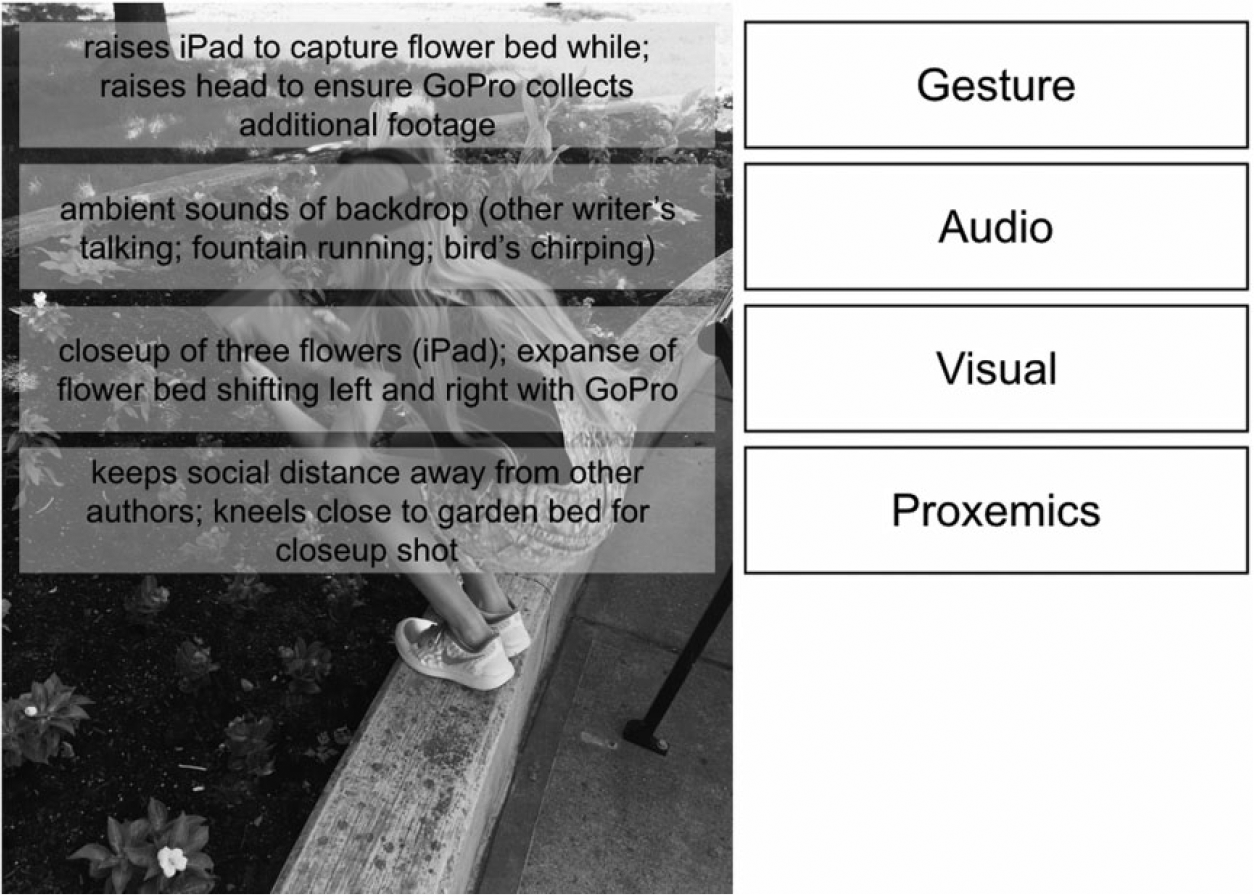
Excerpt from multimodal transcript.
Withness was not thinkable with an analytic technique that saw relationality as an object/subject divide rather than a material←→discursive being/doing. As a concept, it did not work within the confines of conventional humanist qualitative methodology. Given the limitations of this discursive approach, I entered into the data again through a “thinking with theory” (Jackson & Mazzei, 2012) perspective. 3
Thinking with posthumanism
Thinking with theory is less about a particular analytic method and more of a stitching and reconfiguring of analytic heuristics to create new assemblages of creativity and invention. Jackson and Mazzei (2012) detail that the thinking-with-theory process is like entering a threshold. “We are brought into a threshold where we become aware of how theory and data constitute or make one another and how, in the threshold, the divisions among and definitions of data collapse” (p. 137). My personal practice of thinking-with-theory was illustrative of what Springgay and Truman (2018) call a “practice of being inside a research event” (p. 2). I took an “abductive approach” to data where “data” also includes “any material which helps me to think about astonishment, mystery, and breakdowns in one’s understanding” (Brinkmann, 2014, p. 722). Thinking in the event, I tended toward what Merewether (2018) names a “diffractive murmuration” or what MacLure (2013) calls a “glow” in data. These slippages speak to the intensities that cannot be represented or interpreted through conventional qualitative research means. These moments of withness, murmurs that opened up new onto-epistemological spaces of affective encounter, were then selected as boundaries of the larger data assemblage.
Sounds of writing with young children
I reentered the research assemblage attuning toward writing’s withness. I read theory to “plug in” (Jackson & Mazzei, 2013) data and transduce affective sonic moments into melodic movements, rhythms, and harmonies (see, for example, Hollett & Ehret, 2017; Smith, Hall, & Sousanis, 2015). Thinking with posthumanism signaled an intra-action with theory, histories of participation, data, the digital, and the production of new inquiry. Focal moments emerged as rhythmic peaks of intensity where resonances of the material←→discursive echoed. As Henriques, Tiainen, and Väliaho (2014) contend, “there is a rhetoric to rhythm, we feel it, it carries an affective charge, conveying meaning as feeling and tone, rather than logic or information” (p. 4). Thus, the effects resulting in a data assemblage were emergent. Together in their ability, they worked to make something happen that each unit, distinct and alone from the total sum of the assemblage, could not.
Sound, in the diffractive experiment, was a relational conduit. Thus, in analyzing the focal moments, I turned to emergent listening (Davies, 2014). As an early childhood pedagogical approach, emergent listening refutes being bound by what we already know, hear, or recognize and instead attunes us to what may “count” as action. In an educational milieu that often views early writing as that which is made visible by standards-based assessment, rubric scores, process-based clip charts, or “fix-its” (Dyson, 2013), emergent listening foregrounded that writing is an expression, a communicative act of worldly activity. Refracted here through a posthuman lens, emergent listening offered conceptual tools that enabled an examination of early composition as a rich site for not only production but withness. It directed us toward the relational assemblages of people/objects/practices/materials. Emergent listening was an apparatus to hear literacy-in-action (Brandt & Clinton, 2002; Leander & Boldt, 2013).
Emergent listening, as an apparatus, is a transductive method. It frames and forms representation typically associated with the more-than-human subjective experience. Like Henriques’s rhythmic elements, emergent listening uses metaphor to examine the vibrant materialities of early writing with wearables. Thus, my analysis and the strategic sketches that follow aim to understand the withness of writing with wearables as a relational enterprise. I use pulse, oscillation, and resonance to parallel Young, Becker, and Pike’s (1970) borrowed metaphor from physics (i.e., lens, wave, and field). Oscillation, here, entails children’s repeated expansion from and contraction with a unique more-than-human location. Pulse highlights how the affective energies of the lead author signaled a representational reverberation of participation. Resonance enacts a transformative capacity among beings/materials in the world. Withness’s resonance, as the sketches will show, makes human and more-than-human bodies vibrate in sync and links them with others relationally. Taken together, elements illustrate how the rhythmic realities of nonhuman forces were “equally at play and work as constitutive factors in children’s learning and becomings” (Hultman & Lenz Taguchi, 2010, p. 527). Emergent listening inscribes conditions of perception and transforms them into intelligible experience.
Strategic Sketches
Given the tempo of writing with wearables, the scenes that follow are not detailed in chronological order but as “strategic sketches” (Leander & Boldt, 2013), each showcasing alternative realities of experiencing writing with the more-than-human. Serving as an “invitation to an alternate means of experiencing data—to think and feel within the possibilities of the data and not ‘over’ them toward conclusion” (Leander & Boldt, 2013, p. 26), each sketch hones in on one of Henriques’s (2010) rhythmic elements (oscillation, pulsation, and resonance). Focusing on the intra-actions of writing with, the first sketch is inclusive of the larger collaborative composition, whereas the latter two zero in on shifts in lead author and the relational becomings incited by the withness of writing. Sketches are used as provocations. In line with other scholarship playing with (re)presentation in posthuman production (see Davies, 2014; Kuby & Rucker, 2016), liberties are taken in regard to design and format to breathe life into the intra-active encounters of sonic composition. For example, I play with font, size, and type to illustrate the vibrancy and movement of intra-active authoring. In addition, I use the online supplemental archive to share raw video of the walk itself. These shifts in style and form work to reimagine the possibilities of visualizing and listening to withness in early writing and qualitative inquiry while also unflattening the constraints maintained by the genre of the academic essay itself.
Oscillating Overtures: Reading Bodies/Materials/Movements as Relational Writing Assemblage
When children geared up with the wearable GoPro, the larger group would come together. Children detailed how-to’s, don’t forget’s and gave other directions for the new lead author. Starting “lead author” time, however, was different. The larger group would oscillate to individual products, only stemming back to the lead author to check in later. Participants asked rhetorical questions concerning voice, delivery, and point of view. “Where are you looking?” “Are you making sure the mic is where it needs to be?” “How are you sitting?” In the larger analysis, I pinpointed how these actions happened and at what frequency so as to better understand the rhythms of withness in reauthoring The Listening Walk text. Through this more macroanalysis, I visually saw the oscillations of withness that presented themselves as parts of the larger orchestrated composition (see Figure 2).
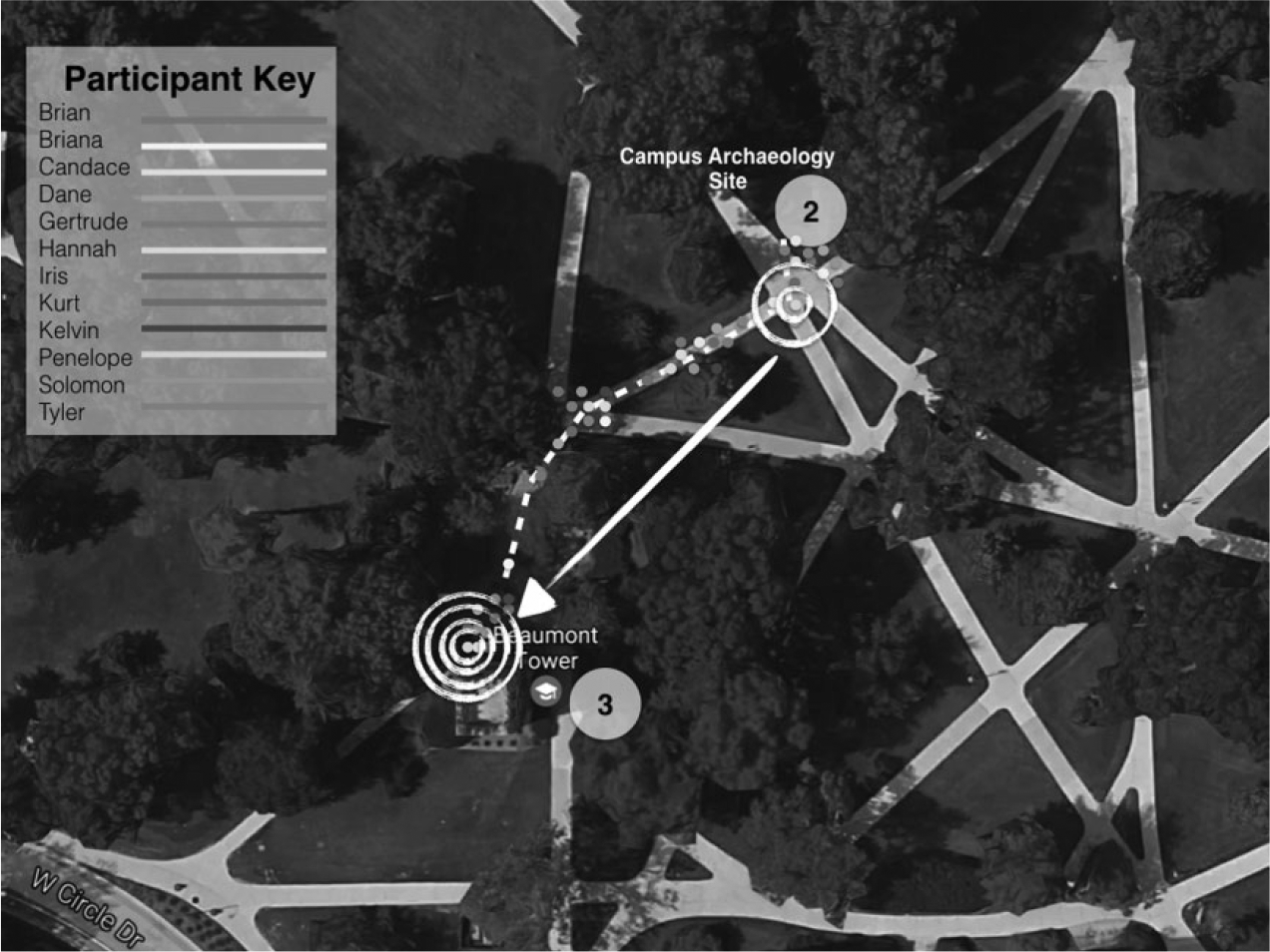
Visualizing children’s oscillating participation.
At the start of the walk, central sonorous landmarks were highlighted as those places where the wearable writing should start. Using the backdrop of the large midwestern campus, places like the bell tower, the children’s garden, and the construction zone of the campus archeology project were selected by the children as they most closely aligned with the cacophony in Showers’s neighborhood setting. One of the first authors, Penelope, strapped the GoPro’s head harness and camera to her forehead. cliCK The campus bell tower was her central landmark. It marked the conclusion of writing with the north side of campus.
[Strapped to her head, the GoPro zooms into view two other authors, Gertrude and Kelvin.]
Outside of the orchestrated oscillation between points of production, the witnessing of withness expanded children’s potential for being and becoming a writer. Indeed, writing with was a literacy desiring. Penelope, an otherwise novice to writing with wearables, was apprenticed into the process. Gertrude, Kelvin, and the more-than-human engaged in a form of joint production. This, however, was not solely heard or felt during the walk itself, but also in the materiality and editing of the larger collaborative piece. For example, when asked to select two peers to help cut and revise her lead author time, Penelope immediately asked Gertrude and Kelvin to join. Together they walked through the almost 13-min sequence and detailed major shifts to be made. Penelope articulated that she wanted to put text over the audio of the bell tower ringing. Gertrude and Kelvin disagreed. According to Gertrude, it would “ruin” the purpose of the walk. Kelvin cosigned, signaling that the “word story” was not needed and would distract the reader from actually hearing the bells. “It’s supposed to be like they’re [the reader] there,” directed Kelvin. I highlight this interjection to underscore another form of withness that peaked in these oscillating projects of joint production. Although students interrogated one another’s writing, asking what was being made to matter with the wearable, I was interested in examining the tensions of writing’s withness and how it came to be a material mattering.
Writing with Showers’s book was important for Penelope. Although not illustrative of the larger group, this material withness with the picture book itself was significant. Penelope wanted to “stay true” (her words, not my own) to the original text. She held the text closely, often referencing it to see how she could orchestrate its likeness. The oscillations of writing with wearables were not only physical, pinpointing the staccato of bodies composing, but at times were quite literary (e.g., using transitions in FinalCut to signal the turn of a page). For Penelope, the withness of writing and remediating Showers’s text was not necessarily about remixing the product into something indiscernible from the original, but amplifying the original textual message and assemblage—in other words, turning up the volume on the text’s sonic possibilities and form.
For Penelope, the withness of writing with wearables oscillated from the singularity of the I-subject (lead author) to a collaborative partnership of authoring a we-subject. This we-subject, inclusive of the more-than-human, is always already an act of material withness. If we take Henriques seriously, lead author time emerged as a metaphorical ostinator, “a short musical pattern that is repeated persistently throughout a performance or composition” (Randel, 1986, p. 600). The we-subject of the assemblage and writerly group saw these moments of ostinato as a focal intensity, highlighting the tempo of collaborative composition. Individual textual production and lead author time became punctuation for the larger collaborative writing. It indicated a shift in style and tone. Read diffractively, there was no “I” that existed outside the “we” pattern.
As illustrated both in the diagrammatic representation and in Penelope’s expansion and compression of affective production, the withness of writing happened across digital and analog technologies. It was multiplied and dispersed. Writing with wearables was a practice of perception. As this sketch helps illuminate, each body was with its transition, and each transition was relationally with the more-than-human. These transitions were accompanied by the variation of oscillation. Affectively moved, the human and more-than-human meshed to reverberate withness. Withness was a perception heard in present projects of writing and in the arc to future projects of becoming writer.
“I’m an Ant!” Periodic Pulses in Collaborative Composition
Outside of the oscillation between projects and participation, the withness of writing with wearables was also spliced by the intra-actions of new interlocutors entering as lead author. Children gravitated toward their focal stop/landmark as concerns over perspective, story, and materials became centered. As children passed the pen—in our case, the GoPro head harness—the possibilities and potentials of wearable writing were marked by the periodic pulses in collaborative and multispecies composition.
Iris’s time as lead author provided a withness of making/being/doing unheard in other children’s wearable writing. She was not as interested in continuing the otherwise linear narrative form from the landmarks that preceded her stop at the children’s garden. Rather, for Iris, lead author time was a rhythmic pulse of multispecies participation. She entered her “stop” and transformed, not into a young writer, but as an ant, an assemblage of space/place/time/nature that affectively pushed her writing with wearables as a felt moment. As noted in the above sketch, Iris transformed from the singular I-subject into a we-subject of withness. It was no longer Iris as author, but
The pulses of more-than-human participation far exceeded the walk itself. Children were as equally moved by sound and the material acts of composing with wearables in the editing room. The tempo of writing with, however, shifted. As Iris made her way into the FinalCut studio, she brought her notebook and her sister Briana to narrate. On her notebook page, long dark slashes cut the paper in thirds. Each scene of the paper was highlighted in a different color: yellow for the garden, green for ground, pink for the tree. The highlighters, quite intentionally, bled into one another. “Why?” I asked, pointing this out to Iris. “It’s like a transition,” she replied, “for when Briana talks what I wrote here.” When I asked Iris about her decision to bring in Briana to perform her voiceover, she noted the withness of writing and the pulses of participation that circulated in her writing process. She was quick to note sound as a co-conspirator and primary voice in her composition.
Why did you have Briana record the audio? Why didn’t you do it?
I was with the GoPro. I was the ant. My sounds were the ant’s sounds. The dirt, the ground . . . I couldn’t be the narrator and the ant.
But you were lead author. You wrote Briana’s script to say “Here’s this cool hollow tree that I found. We’re going to look under some trees and get the perspective of an ant.” You used “I” but it was actually Briana?
I was the ant writing. I couldn’t be the narrator too. That’s different. Briana’s sounds were her voice. My sounds were the ground, the moving. I was still lead author, though.
Iris’s authorial shift, from
In contrast, pulses in composition and action signaled the children’s abilities to sustain desire and energy in the larger assemblage and group project of reauthoring Showers’s text. If we read Iris’s sketch diffractively, for instance, the withness of writing involved building a sonorous multispecies story. It became metaphorically marked by varying pitches and pulses of participation and materially marked with cuts and highlighter and being with nature. Iris enacted a relational writing that was a being/doing/making. This difference was also felt materially, as Iris strived to become one with the ground as a mechanism for be(com)ing one with the ant. Her body transformed with the wearable. Curving her small head inside the knot of a tree to locate the environs, she was steadfast in getting the right perspective. Rhetorically, as a writer, she was also concerned with her ethos as an ant. Whereas traditional classroom settings often value the collective rhythms of student culture and life, Iris and Briana’s periodic pulses of production and individual interests did something different. It created a rhythmic reality of call and response, a withness of writing that gave voice to the not-yet-known and a desiring for literacy-in-action.
“What Would Happen If My Head Was Cut Off?” Reciprocal Resonances in Remixing Participation
Outside of the oscillating rhythms of participation and the spikes and lulls of joint production in collaborative composition, the children were also largely interested in tracing writerly resonance (the harmony with a particular text and place followed by the reverb of the idea or object) through form. At the penultimate stop of the group’s larger listening walk, Solomon and Brian rounded the bend, yearning to take over the GoPro technology. “No, no!” exclaimed Solomon, “I don’t want to put it on my head.” He continued, “Wait—what would happen if my head was cut off? What would happen if I was a zombie walking and writing?” Brian, bright-eyed with Solomon’s interjection, echoed the creative endeavor. “Yeah,” Brian joined in, “we can work together and record like a zombie.” Together, Brian and Solomon transformed into
Retrieving the GoPro,
In the editing room, Solomon’s writerly ethos transformed. The GoPro, originally a tool for reauthoring Showers’s The Listening Walk for Brian and Solomon, lost its undead liveliness. In fact, the zombie perspective was quickly silenced by Solomon. Rather than fleshing out the monstrous narrative, Solomon wrote on his “notes to the editor” that he wanted to include text over his video. “Sorry for the view” was placed over the sideways footage in white alphabetic script. Solomon alerted the audience that they may find their read/view uncomfortable. He also silenced the dialogue between him and Brian. “I want it to sound right for people,” Solomon instructed. “Sound like the others.”
Remixing the original resonances of writerly production was guided by a “sounding right” that Dane and Tyler, two older campers, earmarked earlier. As the trio stood up, ready to exit after their time in the editing studio, Solomon’s arm darted back into the editing classroom. A comic entitled “Geese” emerged (see Figure 3).
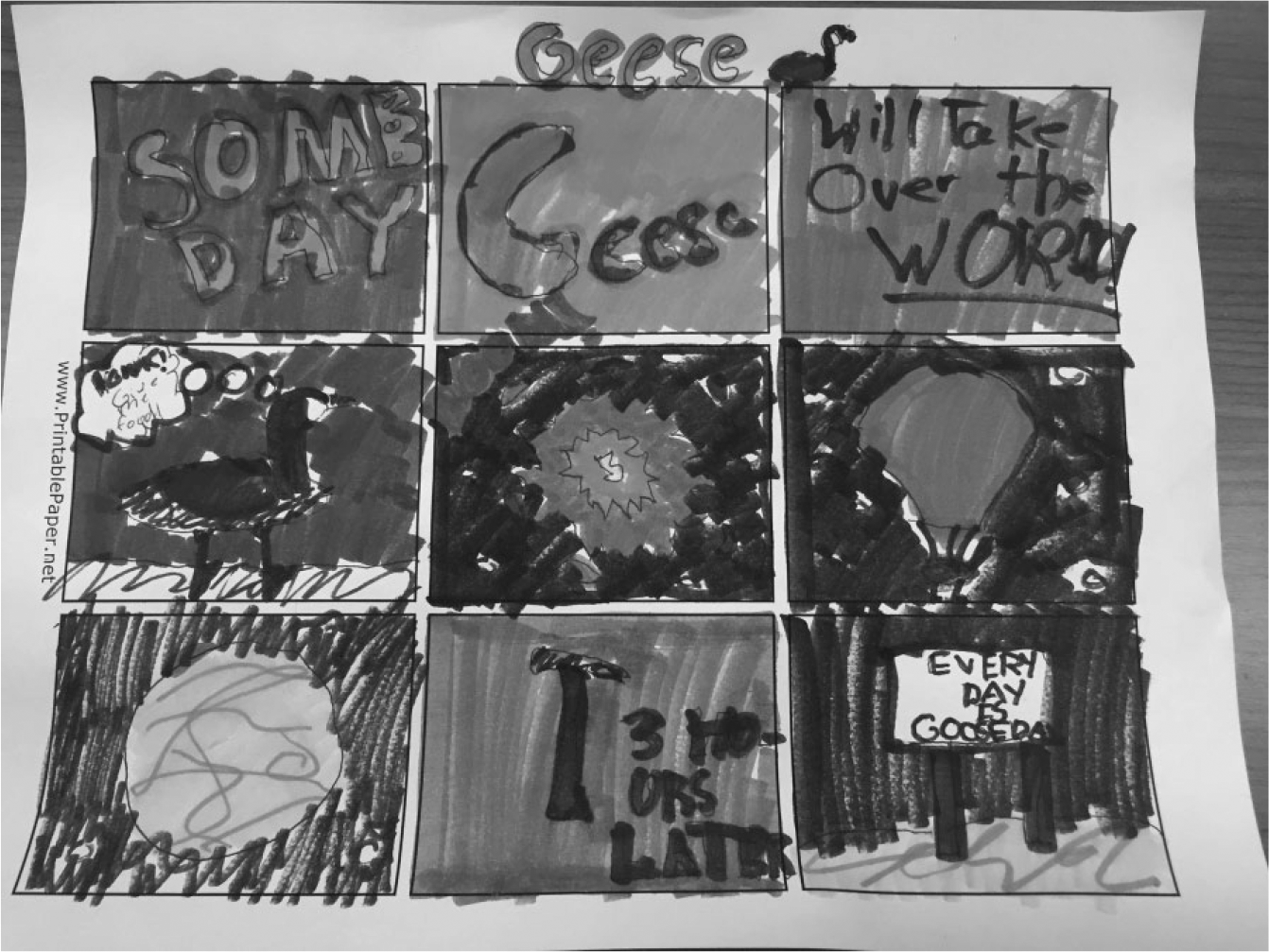
Solomon’s “geese” comic.
“I made it at lunch,” Solomon detailed. “Can you make copies so everyone who watches this movie gets it?” Solomon, looking back to see if Tyler and Dane were out of sight, added one final detail: “I want them to take my story with them.” He quickly added, “See, you can still hear the story here.” Solomon pointed to the “Boom” captioning the fifth frame. “There,” he said, pointing to the seventh frame, “they can feel it. Like feel how the boom made the mess [orange line] That’s why I colored outside the lines.”
As teachers, we too were with the walk. The wonder of withness not only reoriented our perception toward less habituated modes of experience (writing with wearables) but also carved out a cadence for writerly remix and resonance.
Wearables were not a liberatory technology for young writers. Nor was the concept of withness. If, as Solomon showcases, writing and writers are always already enmeshed with things/bodies, then the practices and dispositions of writing face the challenge of becoming bad doings/be(com)ings/knowings. This, for example, may persuade a child writer to separate him- or herself from those things that he or she may be codependent with or on. Although the goose comic resonated with the memories/meanings/materials of previous production, it lacked the vibrational impasse of the in-the-moment sound story initiated with the GoPro. As an audience, we are never able to experience the withness of the editing studio as parallel to the withness of the larger outdoor walk. This reciprocation of composing was mobilized by other students, not emergent technologies or more-than-human concepts. Nonetheless, for Solomon, the lived realities of withness and play became silenced in the digital video.
(In)Conclusion: Embracing the Withness of Writing
By thinking with theory and reentering the data assemblage through diffractive means, I was able to experience the withness of early writing not only as a material perception but as a sophisticated form of production that took seriously the expressive means and rhetorical choices of sentience. Shifts in bodies and materials led to shifts in nonstandardized ways of knowing, of being, and of being heard with writing. The reauthored composition, titled “Our Campus Walk,” became less an accessible (re)writing or version of Showers’s book. It, to borrow from Solomon’s sketch, fell outside the lines. The product was disjointed and the conclusion was never fully realized. Tracing the production of the reauthored The Listening Walk, however, was never my intention. Rather, I read the being/making/doing as a palimpsest, interrogating what, if anything, we can learn from the intra-active authoring and emplaced invention of young children writing with wearables. In this concluding section, I revisit the rhythmic resources of withness to consider the theoretical and pedagogical implications for literacy research and practice.
Examining writing with wearables highlighted expressive forms of literacy desirings. Using concept as method, withness opened up registers of more-than-human recognition. It shed light on the ambience, tone, and vibration of posthuman practice and helped frame what matter matters in the space of children’s collaborative composition. As literacy teachers and researchers, we should work to reimagine and transform the withness of writing across platforms, habits, tools, and ecologies. Future research should examine how witnessing writing through a posthuman lens underscores a compositional fluency not heard or felt in schools. To see writing as a becoming, a vitality that senses, feels, desires, and responds to the energies of the more-than-human, we should attune to writing as an act of material←→discursive withness.
Emergent listening, theoretically, amplified the sonic intra-actions of withness. Writing with wearables provided what Boldt (2009) calls a “space for young children to use materials, social relations, and time . . . for anything other than predetermined academic outcomes—in other words, the time to play—with ideas, materials, and one another” (p. 12). As a pedagogical tool for documentation, emergent listening underscored a new onto-epistemology for examining how researchers and teachers, alongside of their students and participants, are always already emergent with theoretical←→pedagogical assemblages.
Although limited in its scope, this diffractive experiment amplified new capacities for children writing with technology. As I suggest here, it was a movement beyond form. Seeing early composing through a posthuman perspective drives a writing pedagogy that is ethically charged by its habits, orientations, perceptions, relations, and desirings. Emergent listening, as a theoretical apparatus, attunes us to the virtual projections of a child’s imagination as well as their relations with the more-than-human. Writing practice, then, needs new concepts for engaging withness that cannot be reduced to humanist orientations of composing. To echo Boyle (2016), “we do not yet know what a (writing) body can do” (p. 532). Examining withness as a relational concept in writing lays out planes for new inquiry that result in newness and difference each time.
Withness, however, as a concept and method has its own timbre and cadence. As literacy research takes up the new materialist turn and educators ponder more-than-human perspectives to their pedagogy, it is important to consider how these theories and modes of inquiry “sound out” the social. In other words, we must examine the rhythms of writing with time/space/materials. Sound, as this article demonstrates, shows its relationships with action, with technologies, and with technique. Struggling to find a place to articulate itself, sound slides into the shape of the conjunction and lives in the with, near, and toward of emplaced invention. Although joining a larger body of scholarship interested in the material←→discursive contours of literacy-in-action, this article’s promise comes in its capacity to think with sound as an intersubjective state. Hearing human and more-than-human bodies as instruments that extend and transform the polyphony of perception, sound amplifies the withness of writing.
In closing, I want to suggest that thinking with posthumanism in literacy studies is not a passing fad, but a political and ethical endeavor. Posthumanism resituates research as a practice that thinks with and invites us to examine the very question of what is at stake in our pedagogy. In line with recent special issues examining the more-than-human in early childhood education (e.g., see Kuby & Rowsell, 2017) and calls for posthuman literacy research to “help us see students . . . not as isolated data points . . . but as learners who live interdependently with one another and with our environments” (Nichols & Campano, 2017, p. 250), the potential in thinking with posthumanism is to encourage an ethico-onto-epistemology. As Barad (2010) explains,
Only in this ongoing responsibility of the entangled other, without dismissal (without “enough already!”), is there the possibility of justice-to-come. Entanglements are not intertwinings of separate entities, but rather irreducible relations of responsibility. There is no fixed dividing line of “self” and “other,” “past” and “present” and “future,” “here” and “now,” “cause” and “effect.” Quantum discontinuity is no ordinary disjunction. Cartesian cuts are undone. (pp. 264-265)
This is not to suggest that posthumanism’s attention to agential forces of nonhuman matter is an antidote for human exploitation or oppression. Rather, it may engender the entangled nature of all matter—to witness the relational withness of all existence.
Supplemental Material
Supplemental_MAterial_802880 – Supplemental material for Writing With Wearables? Young Children’s Intra-Active Authoring and the Sounds of Emplaced Invention
Supplemental material, Supplemental_MAterial_802880 for Writing With Wearables? Young Children’s Intra-Active Authoring and the Sounds of Emplaced Invention by Jon M. Wargo in Journal of Literacy Research
Footnotes
Acknowledgements
Many thanks to anonymous reviewers for providing pedagogical commentary and helping push my work forward, to coleaders of the 2017 LRA (Literacy Research Association) Literacy and Posthumanism Study Group (Candace Kuby, Karen Spector, Jaye Thiel, Angie Zapata) for helping me think with withness, and to Cassie Brownell, Andres Castro-Samayoa, Gabrielle Oliveira, and Jasmine Ulmer for reading various versions of this manuscript.
Declaration of Conflicting Interests
The author(s) declared no potential conflicts of interest with respect to the research, authorship, and/or publication of this article.
Funding
The author(s) received no financial support for the research, authorship, and/or publication of this article.
Supplemental Material

Notes
References
Supplementary Material
Please find the following supplemental material available below.
For Open Access articles published under a Creative Commons License, all supplemental material carries the same license as the article it is associated with.
For non-Open Access articles published, all supplemental material carries a non-exclusive license, and permission requests for re-use of supplemental material or any part of supplemental material shall be sent directly to the copyright owner as specified in the copyright notice associated with the article.
