




Abstract
Recent scholarship has identified how the reading assessment process can be improved by adapting to and accounting for emergent bilinguals’ multilingual resources. While this work provides guidance about how teachers can take this approach within their assessment practices, this article strengthens and builds on this scholarship by combining translanguaging and raciolinguistic lenses to examine the ideologies that circulate through assessment. By comparing interview data from English as a new language and dual-language bilingual teachers, we found that while reading assessments fail to capture the complexity of all emergent bilinguals’ reading abilities, they particularly marginalize emergent bilinguals of color. Thus, we expose the myths of neutrality and validity around reading assessment and demonstrate how they are linked to ideologies about race and language. We offer a critical translingual approach to professional learning that encourages teachers to grapple with these ideologies and shift toward a more critical implementation of reading assessments.
Keywords
Flora is a fifth grader in a small suburban school who recently arrived from Guatemala. Her story is a complex one: she has gaps in her educational trajectory and she lives with her older sister. We think we know Flora; her profile fits the image of an emergent bilingual student who struggles. We anticipate that gaps in her home literacy will make teaching her to read in English an almost insurmountable challenge. These thoughts are confirmed by what some educators say about teaching readers like Flora: “They have nothing.” “Always at the bottom.” “Not quite there.” The administration of a formative reading assessment will only corroborate these assertions; Flora will have numerous miscues, or errors, as she reads and will not be able to craft nuanced responses to the text in English, which will conceal the entirety of her reading abilities from teachers.
This snapshot exemplifies what has also been demonstrated in research: that emergent bilinguals are cast as struggling readers, particularly within the context of assessment (Ascenzi-Moreno, 2018; MacSwan & Rolstad, 2006; Schissel, 2020; Valdés & Figueroa, 1994). While research has addressed how literacy assessments are skewed toward monolingualism and thereby negatively portray what emergent bilinguals know and can do (Ascenzi-Moreno, 2018; Noguerón-Liu, 2020), less is known about how the often-obscured language ideologies embedded within assessments differentially shape the literacy assessment of emergent bilinguals. In this article, we draw on the discussion by Irvine and Gal (2000) of language ideologies, which they defined as “the ideas with which participants and observers frame their understandings of linguistic varieties and map those understandings onto people, events, and activities that are significant to them” (p. 35). When teachers assess emergent bilingual readers, the process is entangled with an array of assumptions about reading, the function of reading assessments, the teacher's role in assessment, how students’ literacy practices connect to reading, and emergent bilinguals’ identities as students and readers.
Because formative reading assessments exist both as practical tools used in the classroom and as instruments through which deficit ideologies circulate, we assert that equity in assessment for emergent bilinguals cannot be achieved solely by tweaking assessment tools but also requires interrogating the ideologies that shape and are shaped by them. To that end, we focus on what teachers’ discourses about reading, assessment, and emergent bilinguals reveal about the ideologies embedded in assessment practices. As Solano-Flores (2011) underscored, assessment is a “product of human activity” (p. 3), and as such, teachers’ interactions, responses, and interpretations of the assessment of emergent bilinguals are crucial to understanding the role of ideologies in shaping assessments and to shifting how assessments are conceived and implemented for emergent bilinguals.
To uncover how ideologies shape the assessment process, we offer a deliberate and essential contrast. We draw upon interviews with a small, purposeful sample of teachers who work with two different populations of emergent bilinguals—one Latinx and low-income and the other White and middle class—and analyze their talk about the assessment of emergent bilinguals. Using theories of translanguaging and raciolinguistic ideologies as lenses, we aim to identify the locus of ideological structures that codify the assessment of emergent bilinguals and examine how these ideologies impact emergent bilingual readers, particularly those of color. We listen for the presence of monoglossic, raciolinguistic ideologies in teachers’ discourse to communicate that teacher education and professional development (PD) must attend not only to their assessment practices and tools but to the ideologies that inform and shape those practices. To work toward a more equitable assessment process for all emergent bilinguals—particularly those of color—teacher education and PD programs must work with teachers to interrogate their own ideologies and how they shape the assessment process and their roles in it.
We focus on teachers’ discourse about emergent bilinguals with respect to widely used, formative reading assessments, which are employed to assess students’ decoding, reading strategies, and comprehension and to learn about students as readers and frame possibilities for reading instruction. Through these assessments, teachers meet individually with students to listen to how they read a text, document the strategies they use, and assess their comprehension. Unlike large-scale literacy assessments, formative reading assessments provide teachers with a unique opportunity to interact holistically with students, potentially unlocking multifaceted understandings of them as readers. However, formative reading assessments are too often used to evaluate emergent bilingual students along monoglossic standards that ignore how their multilingualism factors into their reading development (Ascenzi-Moreno, 2016; Schissel, 2020).
Recent scholarship has identified how formative reading assessments can be improved by adapting to and accounting for emergent bilinguals’ multilingual resources (Ascenzi-Moreno, 2018; Briceño & Klein, 2018; Kabuto, 2017). While this work provides guidance about how assessment practices can incorporate students’ multilingual reading performances and knowledge, in this research we analyzed the ideologies present in teachers’ discourse about the assessment process and their framings of emergent bilingual readers, particularly emergent bilinguals of color. In line with the work of researchers who view shifts in teachers’ ideologies and subjectivities as integral to their practices with language-minoritized students of color (Ball, 2009; Daniels & Varghese, 2020; McBee Orzulak, 2015), we argue for a critical translingual approach to language and literacy teacher education and PD that can make space for educators to develop both a critical stance and equitable assessment practices. We demonstrate the potential of a critical translingual approach to shift formative reading assessment and hone teachers’ criticality so that they may disrupt those ideologies that pervade such assessment practices and maintain deficit perspectives of emergent bilingual readers.
Theoretical Framework
We bring together theories of translanguaging and raciolinguistic ideologies (Flores & Rosa, 2015) to contribute a layered view of reading and formative reading assessment and to clarify how both are currently imagined as monolingual endeavors with specific conceptualizations of what reading is and who readers are. We begin by describing recent shifts in how literacy educators and scholars understand reading in general and build on this scholarship to introduce a view of reading through translanguaging theory that lays out a transformative, asset-based view of emergent bilingual readers. We then discuss the importance of layering the lens of raciolinguistic ideologies to point out how the language and literacy practices of emergent bilinguals of color are particularly stigmatized and misperceived. The combination of these theoretical lenses has pushed us and, we hope, can push the field to examine how teachers’ perceptions and uses of formative reading assessments are shaped by and maintain ideologies about racialized emergent bilingual readers.
Taking Up a Translanguaging Lens to Develop a Layered View of Reading and Readers
Through a monolingual view of reading, it is assumed that students develop reading skills in one named language and then “transfer” those reading competencies to another named language. When reading development is conceptualized in this way, teachers and researchers may prioritize how reading in one named language is affected by knowledge of reading in another named language, such as how reading proficiency in English is predicted by knowledge of reading in Spanish (Proctor et al., 2010), an idea that could be seen as assigning more value to English than Spanish. This framing has paved the way for monolingual reading pedagogies to have an uncontested stronghold in literacy instruction. Thus, in classrooms where emergent bilinguals are developing as readers, it is widely accepted that (a) reading in English is taught separately from reading in other languages, and (b) biliteracy development occurs through the natural transfer between languages and thus relies on what is deemed “native” language proficiency.
Recent scholarship has reconceptualized this view of reading, emphasizing that it is a “complex and multidimensional” process that includes language, social participation, cultural membership, and identity negotiation (Compton-Lilly et al., 2020; Kabuto, 2017). We build on this view of reading by layering it with an expanded notion of translanguaging theory that rests upon a “dynamic, distributed view of language, seeing language as embodied, emplaced, and ensembled in its physical and social environments” (Lin, 2019, p. 8). This view of translanguaging incorporates social and semiotic components of languaging and highlights that reading exists as a process that goes beyond the boundaries of named languages and modalities (Ascenzi-Moreno, 2018; García, 2020; Kabuto, 2017, 2018; Lin, 2019). With students’ multilingual and semiotic resources at its core, reading can be viewed as an active meaning-making process that is centered on the person as they interact with beings and things in the world (Ascenzi-Moreno, 2018; Espinosa & Lehner-Quam, 2019; García, 2020; Kabuto, 2017, 2018; Lin, 2019). Therefore, bilingual readers draw not only upon their multilingual linguistic repertoires while they read, but also upon their embodied and emplaced experiences (Lin, 2019). For example, even if a text is in only one named language or mode, students draw upon the entirety of their socially embedded experiences—including multilingual and multimodal resources—as they construct meaning.
Applying a Translanguaging Lens to Formative Literacy Assessment
While translanguaging has taken root in literacy classrooms by supporting students’ access to curriculum (Fu, 2009; Machado et al., 2019; Velasco & García, 2014), engagement in classroom learning (Ascenzi-Moreno & Espinosa, 2018), and identities as learners (Ascenzi-Moreno & Quiñones, 2020; Kabuto, 2018), its impact on formative reading assessment has only recently been explored. This research confirms that because the assessment of emergent bilinguals has been developed within monolingual frameworks, these assessments provide an inadequate and incomplete evaluation of their abilities (Abedi, 2011; Ascenzi-Moreno, 2018; Bauer et al., 2020; Escamilla et al., 2017; Sánchez et al., 2018; Schissel, 2020; Shohamy, 2011).
It has been widely noted that assessments are created with the “native” speaker of a language as the norm, rather than through a lens that recognizes that bilinguals organically mesh linguistic and social resources as they read (Escamilla et al., 2017; García, 2009; Mahoney, 2017; Valdés & Figueroa, 1994). Thus, reading assessments of emergent bilinguals are almost exclusively used to gauge reading development monolingually (Ascenzi-Moreno, 2016; Kabuto, 2017). Because of this monolingual focus, Yoon (2019) asserted that literacy assessments function as “regulatory tools” (p. 552) for emergent bilinguals and highlighted the need to flesh out and move toward a multilingual assessment framework. Schissel (2020), too, argued that equitable approaches to assessment are impossible if they continue to reside within monolingual frameworks, because they “are incongruent with the semiotic and linguistic practices of language-minoritized bilinguals” (p. 93).
As attention has been drawn to the problematic nature of assessments, researchers have identified promising ways to account for students’ multilingualism in the assessment process. Research by Briceño and Klein (2018) offers a departure from the standard monolingual approach that teachers typically employ and recommends that teachers analyze students’ miscues to determine if they are “language-related.” Bauer et al. (2018) demonstrated that African American and Latinx kindergarten students in a dual-language bilingual program translanguaged when narrating their understandings of a wordless picture book, thus highlighting students’ complex, fluid use of both linguistic and semiotic features as valid and essential during reading assessment. And, drawing specifically on translanguaging theory, Ascenzi-Moreno (2018) pointed to the potential of responsive adaptations, which are attuned to the diverse linguistic and semiotic resources that students possess, in the assessment of emergent bilinguals’ reading. Responsive adaptations are flexible actions that can be taken by teachers to support students’ multilingual meaning-making during assessment events. The aim of these adaptations is to shift current assessment practices to be more multilingual. Altogether, this research demonstrates that assessments can be adapted to be dynamic and responsive to students’ multilingualism, leading to more holistic understandings of how emergent bilinguals make meaning in reading. However, tweaking formative reading assessments alone will have limited impact in changing how assessments are used and what role they play in positioning emergent bilingual readers. We turn to a raciolinguistic perspective to more fully explain and disrupt the ways that assessments construct and maintain perceptions of emergent bilinguals as struggling readers.
Broadening the View: Raciolinguistic Ideologies in the Assessment of Emergent Bilinguals
Flores and Rosa (2015) argued that understandings of the language practices and educational experiences of Latinx and other racialized bilingual speakers are shaped by those ideologies that “produce racialized speaking subjects who are constructed as linguistically deviant even when engaging in linguistic practices positioned as normative or innovative when produced by privileged white subjects” (p. 150). In this way, even if a racialized speaker were to become “proficient” in “academic English,” they would still be heard as deficient. Thus, for many racialized emergent bilinguals, their educational experiences have been defined by low expectations and ignorance of their linguistic gifts and intellectual potential. This explicit attention to racialization provides a lens for understanding why those students who are rendered “languageless” (Rosa, 2016) when they fail to conform to monoglossic norms imposed by formative reading assessments tend to be students of color. By drawing attention to and naming the ideologies that create and reify such “problems” in these students’ language and literacy practices, a theory of raciolinguistic ideologies provides a lens for the development of pedagogy that draws on students’ translanguaging and puts forth an anti-racist agenda (Flores & Chaparro, 2018).
Integrating a translanguaging lens and an understanding of raciolinguistic ideologies highlights that when reading assessment is considered from a monoglossic perspective, students whose literacy practices do not align with the expectations of White, monolingual listening subjects (Flores & Rosa, 2015) are deemed struggling readers from the start. As racialized bilingual subjects, students’ unique experiences and connections to reading are deemed inferior, inadequate, or even deterrents to their development as readers. For instance, when racialized emergent bilinguals are held to monoglossic standards, their reading abilities in their named “native language” are perceived as lacking, and teachers presume that students are less able to engage successfully in literacy.
A raciolinguistic view cautions that these perceptions of racialized emergent bilinguals’ language and literacies abilities are simply that—perceptions—and may be skewed to devalue or obscure the resources students bring to the reading process. A raciolinguistic view on literacy can thus “disrupt politically and ideologically neutral conceptualizations of literacy learning” (Compton-Lilly et al., 2020, p. S189) and highlight that who is considered a reader is, in part, shaped by White supremacist conceptualizations of reading and readers over what racialized emergent bilinguals already can or have the potential to do. An expansion of what counts as reading and who counts as a reader is crucial because it underlies how teachers view their students and what they think is possible for their literacy instruction and for their futures as readers (Noguerón-Liu, 2020). To understand these conceptualizations further, and to connect them directly with the assessment process, we frame this study through these questions:
How do teachers describe the process of implementing and interpreting results from the formative reading assessments they administer to emergent bilinguals? In comparing teachers’ descriptions, what can we learn about underlying ideologies about language and race that shape the formative reading assessment process for these students?
Context and Methods
This article draws on data collected from a multisite case study of teachers’ adaptations of formative reading assessments with emergent bilinguals in elementary schools in the metro area of a large Northeastern city in the United States. Over the course of 2016 and 2017, a variety of data were collected, including observations of teachers conducting reading assessments, teachers’ analytic memos, and teacher interviews. In this article, we focus primarily on teacher interviews from two schools involved in the larger study. As we describe below, the selection of these two schools, which differ in terms of socioeconomic status and the ethnic and racial makeup in the student populations, is both purposeful and essential to our analysis.
Schools and Participants
For the larger study, recruitment letters were sent to five different schools with large populations of emergent bilingual students. Laura contacted principals at each school, and after an initial meeting, they consented for the study to take place at their schools. Next, Laura invited teachers who worked with emergent bilinguals at each school to participate in the study; the four teachers featured in this article were those who consented to be part of the study at the featured schools.
The first school, Plainview Elementary (all names are pseudonyms), is located in a suburb of a large Northeastern city. In the past decade, the student population has changed from being majority English-speaking to experiencing an influx of Spanish-speaking immigrants from Central America, as seen in the 2016–2017 demographics, which identify 51.6% of students as Hispanic, 36.7% as White, 5.2% as Black, and 3.5% as Asian. Although a bilingual program was not offered at the time of the study, there were three full-time English as a new language (ENL) teachers at the school.
Plainview was part of a cohort of schools that received professional development through the City University of New York—New York State Initiative on Emergent Bilinguals, or CUNY-NYSIEB, project (see CUNY-NYSIEB, 2020, for more details). As a result of this partnership, the school developed a committee that planned PD for teachers about emergent bilinguals and translanguaging. Vanessa and Julie, two ENL teachers at the school, opted to be part of the research. At the time of the study, both teachers had about 15 years of experience teaching ENL. Although Vanessa is of Latinx heritage and Julie identifies as a White woman, both use Spanish with their emergent bilingual students.
The second school, Metropolitan Elementary, is located within an upper-middle-class neighborhood of a large Northeastern city. The demographics of the school differ from those at Plainview, with 73.4% of students identified as White, 10.4% as Hispanic, 9.2% as multiracial, and 4.1% as Black. Metropolitan houses a dual-language bilingual program in French. While this school did not engage in long-term PD on translanguaging, Audrey and Maureen, two teachers who consented to participate in the study, were familiar with the concept. Both teachers learned French as a new language in early adulthood and had lived in French-speaking countries. At the time of the study, Audrey had 7 years’ experience as a dual-language teacher and Maureen was a career-changer who had been teaching for 4 years.
At Planview and Metropolitan, teachers regularly administered formative reading assessments in English and at Metropolitan also in French. As previously described, these assessments involve teachers listening to and documenting how a child reads a text individually. Teachers also ask the child comprehension questions to assess their understanding. As a result of the assessment, teachers can assess the child's miscues (or deviations as they read the text) and analyze their responses to ascertain their comprehension. Teachers at Plainview used the Developmental Reading Assessment (DRA) in English and also conducted running records using ENL-designated guided reading books; the teachers at the Metropolitan School used the Teachers’ College Reading and Writing Project Running Records in English and used Trousse de’evaluation en lecture GB+ in French (a French–Canadian reading assessment tool).
In Laura's early readings of data from the larger sample, participating teachers from these two schools expressed their perceptions of assessments differently. Hearing these different articulations of the assessment process made it clear to Laura that it would be important to delve into teachers’ descriptions of assessments to better understand why they differed and how such differences might shape the experiences of emergent bilinguals in these two schools. While the small sample size is limited and impacts this study's generalizability, the findings presented offer an important storyline to researchers, teacher educators, administrators, and teachers about how ideologies circulate through formative reading assessments and ways that educators can disrupt their negative effects by reflecting on the presence of such ideologies in the assessment process.
Positionality of the Researchers
Laura is a Latinx bilingual teacher educator and researcher who began teaching over 20 years ago as a Spanish–English dual-language bilingual teacher and literacy coach. In these roles, there was an emphasis on implementing formative assessments in a timely manner and reporting them to the administration, but there were few opportunities for PD on how the data would be used to support students’ biliteracy. These experiences spurred Laura to inquire about the role of assessment in the reading development of emergent bilinguals. Kate is a White teacher educator and researcher as well as a former high-school ELA (English Language Arts) teacher. Similar to Laura, though she was critical of the preparation she was asked to do to help emergent bilinguals pass high-stakes exams, there was little space for her to raise questions and a sense of “helplessness” among her fellow teachers regarding what could be done for emergent bilinguals in the face of these exams. Because of these experiences, we are interested in understanding both how teachers see themselves in their role of assessors and how they position emergent bilinguals vis-à-vis reading and formative assessment. As teacher educators and researchers, we constantly listen for how teachers talk about formative reading assessment in general, but then also process how they implement and interpret results from the assessment they administer to emergent bilinguals.
Data Collection and Analysis
At Metropolitan, each teacher was interviewed formally once for about 45 minutes. At Plainview, the two teachers were interviewed in a dyad for 45 minutes. Julie, one of the teachers at Plainview, was subsequently interviewed two more times and maintained an email correspondence with Laura throughout the study and beyond. Interview questions—such as “What is the purpose of running records with your program?” and “When you assess your students, do you make any accommodations or adaptations?”—were designed to gather general information about how assessment policies were tied to program goals and how teachers viewed these policies. All interviews were transcribed verbatim. All four teachers were also observed as they implemented reading assessments with students. Each teacher was observed from three to six times, with each observation lasting 45 minutes. Brief five- to 10-minute check-ins followed each observation.
Our data analysis included both open coding and critical discourse analysis (CDA). These approaches allowed us to identify themes across the data as well as listen for the presence of monoglossic, raciolinguistic ideologies present within teachers’ talk about assessment. We used a grounded theory approach to analyze interview data (Saldaña & Omasta, 2018). Overall, the process of analysis went as follows: Our own individual readings of the data led us to concepts, which, after comparing our readings, led us to generate codes, which we then used again to reread all the data. When comparing our coding, themes emerged that related to and helped us address our research questions. Below, we explain this process further.
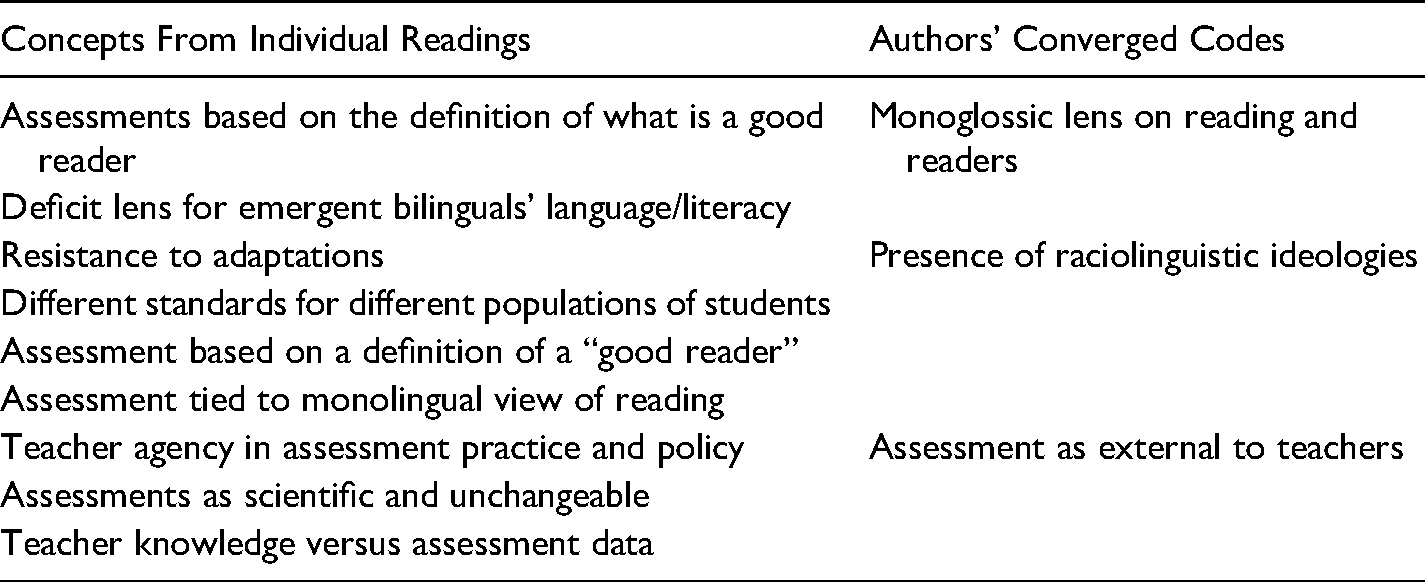
We first individually identified concepts through multiple, independent readings of the interview transcripts by each researcher. We then compared the list of concepts that each researcher compiled. Because we used translanguaging and raciolinguistic ideologies as lenses in the data analysis, our identification of concepts was shaped by understanding language and language ideologies as they exist in diverse contexts and among diverse users and as they intersect with processes of racialization. These concepts were then converged into codes such as “presence of raciolinguistic ideologies,” “assessment as external to teachers,” and “monoglossic lens on reading and readers,” which we used to code our data. One example of how we developed one of these codes—“monoglossic lens on reading and readers”—was by merging a concept Laura identified, “assessments based on the definition of what is a good reader,” with a concept that Kate identified, “deficit lens for emergent bilinguals’ language/literacy.” See Table 1 for details on how concepts converged into codes.
Sample of Open Coding.
CDA is a method of analyzing meaning transmitted in the discourses of participants, as it is based on the recognition that “because systems of meaning are caught up in political, social, racial, economic, religious, and cultural formations which are linked to socially defined practices that carry more or less privilege and value in society, they cannot be considered neutral” (Rogers, 2011, p. 1). After coding the data, each researcher identified key pieces of the coded data that were appropriate for CDA and then annotated each of these pieces of text. Our approach to CDA is rooted in our theoretical framework and positioning, and therefore our process of employing CDA had theories of translanguaging and raciolinguistic ideologies at its center. As we layered CDA upon coding, we analyzed how teachers’ talk, particularly around their own agency as teachers and their students’ status as readers, reflected their deficit ideologies around emergent bilinguals, language, and reading. Lastly, we reviewed each piece of text, the codes assigned to each, and our annotations and notes based on CDA and integrated them into a cohesive analysis that related back to our research questions.
Findings
This section lays out two important findings that emerged from our analysis of teachers’ descriptions of the assessment process. The first was the four teachers’ descriptions of assessments themselves as inherently more valid and meaningful than their own on-the-ground observations and knowledge about their students. Teachers discussed how notions surrounding assessment shaped their implementation of them; how the school culture emphasized that they “report” the data, rather than engage in meaningful analysis of them; and how top-down policies ignored the multilingualism of the students. In these ways, the assessment process, as articulated by these teachers, constructs and maintains deficit ideologies rather than uncovering what students know and assisting educators toward ways of supporting emergent bilingual readers.
A second finding that emerged was how assessment practices further marginalize emergent bilinguals of color because they relate to teachers’ existing raciolinguistic ideologies about what reading is and the overall capabilities of racialized emergent bilingual readers. Teachers expressed their views of emergent bilinguals of color as “struggling” readers and cited their bilingualism as inherently tied to—and even the cause of—their low performance on reading assessments. In addition to these two findings, there is an additional narrative revealed through the data. As a counterexample and possible way forward, we describe our finding that the PD that Laura took up with one of the teachers, Julie, disrupted the very deficit ideologies revealed in the four teachers’ discourse around assessment.
“It's an Assessment”: The Subordination of Teacher Agency and Knowledge About Emergent Bilinguals
Assessments regulate teacher behavior and minimize teacher knowledge
The four teachers in the study spoke about assessments as being external to them and expressed that they had little agency or authority to make any changes to meet the needs of emergent bilinguals. Consider the short exchange between Vanessa and Julie, two ENL teachers at Plainview Elementary School: I think we can’t do accommodations. We are not really allowed to make them, although I have. It's an assessment. [emphasis added]
Since this interview was conducted in a dyad, conversation ensued. Immediately after Vanessa stated, “It's an assessment,” Julie explained why and how she made adjustments to the assessment of emergent bilinguals. She explained, “Where I felt that their accuracy was a little bit cuspy or their comprehension was a little bit cuspy because they didn’t have the skill of expressive retelling, but I felt that they really did understand it, I’ve attempted the next level to see how they did.” In response, Vanessa remained firm to assessment procedures teachers were provided with and expected to follow. She explained, “You have to follow whatever the guidelines are of that level. Certain levels do a picture walk, certain levels you can’t. It depends on what level they are in. In higher levels, they don’t do picture walks.”
In contrast to Julie's description of basing her assessment decisions on her understanding of students, Vanessa's response demonstrates her adherence to external procedures that center the assessment regulations as the guiding force in implementing assessment. Framed in this way, Julie's criticality or questioning about whether reading assessments are appropriately assessing emergent bilingual readers is viewed as suspect and a threat to obtaining valid results. Making adjustments to reading assessments shifts “validity” toward teachers’ knowledge of emergent bilinguals and language and literacy development. Because Julie's adaptations to assessment are not sanctioned, her actions and the knowledge that guided those actions remain behind the scenes and do not affect the way that the school community identifies and addresses the equitable assessment of emergent bilingual readers. In this way, “official” assessments are pitted against teacher knowledge—in this case, specific knowledge about emergent bilinguals as readers—thus limiting what teachers can do, what they can learn, and ultimately how they view and instruct emergent bilingual readers (Ascenzi-Moreno, 2016).
For example, at Julie's school there were specific guidelines that instructed teachers about how to assess emergent bilinguals based on their expression of their comprehension. Julie described a formula that was created for teachers that set the parameters of how they should assess emergent bilinguals: There was a guideline that [emergent bilinguals] had to be within a certain percentage for their accuracy and they had to score this many out of this many for their comprehension score within the DRA [Developmental Reading Assessment] rubric to be able to assess them at the next level. Otherwise, they have to stay [at a particular reading level].
Julie's description of the parameters of when teachers could assess emergent bilinguals at higher text levels reveals that this policy limits how much teachers can learn about emergent bilinguals’ reading abilities. This policy operates as another mechanism in which teachers’ knowledge and agency are subordinated in favor of following procedures. We also see that the policy has the potential to keep emergent bilinguals at lower reading levels than where they actually are, shaping (and upholding) teachers’ perceptions of emergent bilinguals as struggling and possibly impacting the types of instructional responses they craft.
School culture emphasizes reporting over analyzing assessment data
The four teachers across the two schools reported that while a dominant message they receive is that assessment should drive instruction, what is valued at the school level is merely reporting these data to administration. The following two quotes describe how established assessment routines favor “reporting” rather than analyzing emergent bilinguals’ reading skills and abilities. Vanessa described: “You hand [the administration] the piece of paper. And we have to report the scores on a Google sheet.” Audrey, a second-grade dual-language bilingual teacher at Metropolitan School, said: “This year our administration wanted to have a more basic [form of reporting], which is to make it easier for us, because in the end, it's are they on reading level or not?”
Teachers expressed that school administration requested and valued the reporting of reading data in the forms of “levels,” but did not provide time or training for teachers to analyze individual students’ reading behaviors (see Ascenzi-Moreno, 2016, for similar findings). Data demonstrated that at both schools, teachers were required to hand in students’ reading levels. Maureen, a fifth-grade dual-language bilingual teacher at Metropolitan School, related that in the dual-language bilingual program, only the English reading formative assessment was used by the school. When asked if she used formative reading assessments to shape instruction, Maureen stated, “A little bit. They give me a chance to check in with each kid. Using techniques that we use in a whole group and read aloud, a little bit.”
Additionally, at Julie's school, while she implemented the formative reading assessments with emergent bilinguals, she simply passed on the assessment to the mainstream teacher of the emergent bilingual student. Therefore, while she gained knowledge of the emergent bilingual student she implemented the assessment with, she was not the one who planned and implemented reading instruction for the child—the mainstream teacher did.
This practice of prioritizing the reporting of reading levels negatively affects emergent bilinguals in particular. Since school administration and teachers use students’ reading levels to sort students into instructional groups, and because formative assessment guidelines may cause emergent bilinguals’ reading levels to skew lower than they actually are, there is the potential to limit emergent bilinguals to “low level” reading groups, label them as struggling readers, and render their reading instruction remedial rather than enriching.
Top-down assessment policies ignore the multilingualism of students
How teachers view and use assessments in classrooms reflects policies that originate at higher levels of the educational system. Maureen described how district-level reading assessment policies equate students’ reading achievement with English by favoring the reporting of reading levels in English over French. Maureen described how English reading levels are the only ones documented on the report card, though students are in a dual-language bilingual program: “The English [reading levels] are used. [Students] are held to standards-based report cards, so their reading level [in English] makes or breaks part of their [reading] grade.”
The reliance on an English reading level is illustrative of how monolingual views of reading impact students’ overall grade for reading and is reflective of the foothold that these ideologies have on policies that frame emergent bilinguals’ performance, regardless of whether students come from English- or French-speaking homes. When reading is conceived as specific to named language competencies, as evidenced through the practice of reporting reading levels in English only, literacy competencies in languages other than English are altogether ignored. As a result of this practice, many French-speaking emergent bilinguals are deemed not to be reading at grade level overall because of the sole reliance on English reading levels.
The data here demonstrate that when teachers’ reporting of data is valued at the school level, students’ reading performance in English is prioritized, even if teachers’ knowledge of reading and of emergent bilingual readers is at odds with such data. These examples are a testament to the distance between teachers and reading assessments of emergent bilinguals and the deleterious effects on this student population as a whole. Because of the emphasis on reporting reading levels in English, even within dual-language bilingual programs, emergent bilinguals are viewed through the lens of deficit. The emphasis on reporting assessment data, present in all four teachers’ talk, contributes to negative perceptions of emergent bilinguals, as they equate “reading well” with “reading in English.”
In our next finding, we delve into the raciolinguistic ideologies that teachers communicated in their talk about the assessment of two different groups of emergent bilingual students: the working-class Latinx students at Plainview and the more affluent White students at Metropolitan. We juxtapose commentary from teachers at both schools to demonstrate that while assessments negatively shape teachers’ perceptions of all emergent bilinguals as readers, they further marginalized emergent bilinguals of color.
Emergent Bilinguals Assessed Differently: Raciolinguistic Ideologies and Perceptions of “Readers” in Two Contexts
In her discussion of one of her students, Plainview ENL teacher Vanessa described that after the student read in English, he could not speak about the book in English and therefore, to her, exhibited no comprehension: If he were able to give you some of [the retell] in English and just a couple of things in Spanish, I think he would have been OK. But he couldn’t say anything in English at that point. He was a newcomer. He said it all in Spanish.
Vanessa lamented that her student, a recently arrived immigrant to the United States, did his retell of what he had read “all in Spanish.” Although this might seem obvious—a student who is a “newcomer” would of course retell in his home language—the assessment portrays this student as below grade level as a reader. This conflation of a formative assessment in reading with English proficiency erases the student's use of translanguaging to make meaning (i.e., his ability to comprehend what he read in English and to retell it in Spanish) and renders him “struggling.” Vanessa's discourse about the student focuses on what he lacks rather than on what he can do.
A similar assessment, when administered to White, English-speaking students learning French at Metropolitan School, was interpreted differently by Audrey: When they get to fifth grade and they are reading [French] at a really high reading level, and the teacher says “retell,” and the kids [retell] in English, to me it's a bad habit that I want to break. I say, read the book a couple of times to get one new word that you think that you can use in your retell. I don’t want them to get to a really high reading level and not [be able to] retell in French. If you are not a good reader, you are going to struggle with everything else. So, we concentrate on reading, because if they learn to love to read, they will become good writers. I think that it's something that they lack, because when they go home, they don’t have that. So, I always feel that my biggest goal every year is to make sure that they become good readers.
When teachers at Plainview were given a presentation about responsive adaptations, they voiced discomfort in making these adaptations for emergent bilinguals because, as Vanessa stated in the first section, they would undermine the integrity of the assessment. Vanessa's ENL colleague, Julie, added more context to this discomfort when she reported on another colleague's comments about these multilingual adaptations: “One teacher said that it would make emergent bilinguals look stronger than they would expect monolingual kids to read at a given level.”
Julie's comment highlights that teachers look to assessments not only to accurately report what students know, but to support their existing ideologies. The ideology that lies beneath this teacher's comment is that emergent bilinguals are worse readers than monolingual students, and if the assessments do not prove that, then the assessments must be invalid. Julie's colleague's comment reveals the belief that if emergent bilingual students, when given appropriate accommodations, score higher (and thus “look stronger”) than monolingual students, something must be amiss.
We contrast this with another comment from Audrey, who discussed her approach to reporting her students’ reading levels to their parents: We try to tell [the French-speaking parents] that [having a lower reading level in English] is a normal part of their development, but we have to write 2's and 1's on the report card sometimes. And yes, some parents are a little bit upset, because it's unfair—why are Francophones held to the same standard [as English-speaking students]? And we just explain that it's a public school, we don’t control that. But the Anglophones, the levels are way lower, so sometimes I don’t even say that to them because we’ve definitely had disagreements about that too.
Her French-speaking emergent bilinguals have a lower reading level in their new language as a “normal part of their development,” and the resulting “2's and 1's” (2 = Below Standards; 1 = Well Below Standards) they receive on their report cards are just part of the city's accountability measures, not necessarily a realistic portrayal of their reading abilities. Audrey related that part of her job is to explain away these “2's and 1's” to the (middle-class, White) parents of her French-speaking students, for whom such low scores are perceived as unfair. While the teachers at Plainview see assessments as confirmations of their existing deficit ideologies regarding the languagelessness (Rosa, 2016) of Latinx emergent bilinguals, Audrey saw them as inconvenient, unfair, and unrelated to her middle-class White students’ “normal development” as bilingual readers. Thus, both the teachers at Plainview and Audrey used assessments to uphold and reify raciolinguistic ideologies that assume higher levels of literacy competence in White readers.
Although teachers at Plainview and Metropolitan communicated that they could do little to change how emergent bilinguals were assessed or their own roles in the process, their comments reveal something different. Teachers do, in fact, make changes to and interpret the results of these assessments differently depending on who is being assessed. Assessments were seen as valid and more important than teachers’ professional judgments when their results upheld raciolinguistic ideologies that rendered low-income Latinx emergent bilinguals “struggling.” They were downplayed, recast, and “spun” into different narratives when their results revealed “deficiencies” in the language and literacy practices of middle-class White emergent bilinguals.
A Counterexample: Interrogating Monoglossic, Raciolinguistic Ideologies Through a Critical Translingual Approach to PD
We assert that criticality around assessment is essential in striving toward equity for emergent bilinguals in literacy. However, criticality around assessment is only possible when teachers uncover and unpack the ideologies that circulate through assessment and lead to misperceptions of what emergent bilinguals know and can do. To explore this possibility, we describe Laura's work with Plainview teacher Julie, which aligns with what Seltzer (Ascenzi-Moreno, 2018; Seltzer, 2019; Seltzer & de los Rios, 2018) has called a critical translingual approach. We provide a description of this work as an example of how teacher education or sustained PD can both address the need to adapt classroom practices and disrupt those ideologies that shape teachers’ perceptions of literacy assessment in schools. A critical translingual lens in teacher education and PD can attend to adapting classroom practices, including assessment, and also foster teachers’ criticality so that they can interrogate how monoglossic, raciolinguistic ideologies pervade assessment practices and (mis)shape their perceptions of emergent bilinguals’ language and literacy practices.
As described by Seltzer, a critical translingual approach is rooted in theories of translanguaging, critical language awareness, and critical literacy and, when taken up in teacher education and PD, tasks teachers with reorienting their listening and reading practices to better understand and teach language-minoritized students of color. In other words, this approach encourages teachers to hone their raciolinguistic literacies (Seltzer & de los Rios, 2018), which, especially for White monolingual educators, are typically underdeveloped. In Seltzer's work with a high-school ELA teacher, they engaged with critical research and texts that challenged the teacher to unpack the ideologies that were present in her classroom and that often serve as the foundation of language and literacy classrooms overall. As she engaged in this learning, the ELA teacher in Seltzer's study made shifts to her practice that brought students’ translanguaging and their own understanding of language ideologies to the surface and leveraged them into rich, meaningful classroom learning.
The PD work that Laura did with Julie aligned with Seltzer's critical translingual approach and focused explicitly on assessment. Because Julie's school had participated in the CUNY-NYSIEB project, and she had been a member of the Emergent Bilingual Leadership Team, she was already familiar with the importance of infusing translanguaging pedagogy into her instruction. However, questions remained about how specifically a translanguaging framework could impact her reading assessment practices with emergent bilinguals. Julie made the study a central aspect of her yearly professional development goals.
To address these questions, Laura and Julie layered this kind of critical translingual approach with inquiry as they co-constructed understandings by taking up a translanguaging lens vis-à-vis the reading assessments she conducted with emergent bilinguals. The work began with a discussion of the affordances a translanguaging approach would offer emergent bilingual readers, delineating possible adaptations, and then inserting them into the reading assessment process. These discussions were based on the translanguaging principles Julie was introduced to through the CUNY-NYSIEB project and were deepened through journal articles about formative reading assessments that Laura identified and read with Julie. Laura and Julie then analyzed observational notes and student work to learn about emergent bilinguals as readers when given the chance to translanguage during assessments.
Through the exploration of responsive adaptations, Julie incorporated new ways of implementing reading assessments for her emergent bilinguals and evolved her understanding that making the assessment process more accurate and accessible was part of a larger goal of “valuing” students’ bilingualism and disrupting the ideologies that portray her students as deficient. In the following memo Julie wrote to her principal, to share the results of her yearly professional development goal, she noted that she learned not only about her students’ competencies through making adaptations but also about the skewed nature of the reading assessment process for emergent bilinguals: By [making adaptations to the reading assessments], we focused on students’ reading comprehension, not their developing language abilities in English. By combining [new adaptations] with some practices I already use when administering the DRA2 [a reading assessment kit]…I believe we can assess students from a strengths-based perspective, valuing their emerging bilingualism, instead of using a deficit perspective where we only consider what they don’t know and can’t yet do. Some teachers were vocally opposed to making adaptations because they thought these made the assessment invalid and meaningless. I explained that it is a test designed for monolingual students and if we don’t make some of these adaptations and be flexible in our thinking, we are penalizing these students and not recognizing the skills they do have. (personal communication, May 2017)
Discussion and Implications
In this article, we have applied a translanguaging lens to the process of formative reading assessments with emergent bilingual students. This lens highlights the monoglossic nature of such assessments and points to the inequities that can be maintained when there is an emphasis on teachers’ procedural fidelity when implementing assessments and when reporting emergent bilinguals’ reading skills favors their performances in English. We have also incorporated into our analysis an emphasis on the presence of raciolinguistic ideologies in teachers’ descriptions of formative reading assessment. In this way, we have demonstrated that while monoglossic assessments frame all emergent bilinguals through a deficit lens, they particularly marginalize emergent bilinguals of color by projecting their “struggles” with language and reading into overall academic struggles in the future. By taking up these two theoretical lenses, we have attempted to chip away at the myths of neutrality and validity around literacy assessments and demonstrate, instead, how they are informed by and maintain ideologies about race and language that shape racialized emergent bilinguals’ educational experiences more broadly.
In this section, we argue that a critical translingual approach to teacher preparation and PD is critical to shifting educators’ understandings of assessment and assessment practices with emergent bilingual readers, and ultimately to improving the actual literacy assessments and policies that are regularly implemented with emergent bilinguals. In adopting a critical translingual approach, we align our recommendations with beliefs and practices that are rooted in translanguaging theory and take up an understanding of raciolinguistic ideologies. We assert that such an approach aligns with call for literacy educators by Frankel and Brooks (2018) to examine “the power dynamics and structural inequities that contribute to standardized definitions of readers and reading, thus locating difficulties within the reader without accounting for the broader social, cultural and historical contexts of literacy policies, testing and instruction” (p. 111). Only through a focus on the ideologies present in assessment and the practices that attend to and, ideally, destabilize those ideologies can teachers engage in assessment practices that are untethered from deficit-oriented notions of emergent bilinguals, and particularly racialized emergent bilinguals, as struggling readers who will continue to struggle in the future.
A critical translingual approach to teacher education and PD could hone and support teachers’ criticality toward assessment by familiarizing them with both translanguaging theory and raciolinguistic ideologies. Because assessments are positioned outside of the orbit of the teacher and deemphasize teacher knowledge, they become a vehicle to maintain systems of power, obscuring exactly what educators intend to uncover—students’ reading abilities. As Yoon (2019) posited, literacy assessments can function as regulatory tools for emergent bilingual students; our research extends that finding and highlights their potential to serve as regulatory tools for educators as well.
Yet another story to be told by the data featured in this article is that, in fact, teachers do have agency in the assessment process. Julie made modifications based on her knowledge of her students. Audrey made subtle shifts in her reporting of assessment data to the parents of her students, downplaying their low scores. Julie's colleagues, including Vanessa, chose not to make modifications for emergent bilinguals. What we see in these choices is how action (and inaction) in the reading assessment process is a choice that tacitly upholds existing monoglossic, raciolinguistic ideologies, which contribute to the framing of emergent bilinguals of color, in particular, as struggling readers and struggling students overall.
We also demonstrate how these tacit reifications of harmful ideologies can be interrogated through an approach to teacher education and PD that is aligned with a critical translingual approach. In her work with Julie, Laura encouraged Julie to integrate her knowledge of emergent bilinguals, translanguaging, language ideologies, a layered and multilingual perspective on reading, and the overall purpose of reading assessment, which helped her uncover the ideologies that circulate throughout every aspect of the assessment process. When reading was framed as a complex, multidimensional, translingual process in which students’ identities play a critical role (Compton-Lilly et al., 2020; Noguerón-Liu, 2020), as we described earlier in the article, Julie's situated knowledge of emergent bilingual readers became the center of both her decision making and her analysis of how formative reading assessments impact emergent bilinguals. She was then able to consider how this knowledge positioned her as an advocate on behalf of emergent bilinguals in her school. In short, by bringing attention to the ways that teachers make choices about when, how, why, and if they make shifts in their reading assessment practices, a critical translingual approach also raises teachers’ awareness about how their actions (or inactions) can inadvertently maintain deficit ideologies and perceptions of racialized emergent bilinguals as readers.
A critical translingual approach cultivates an understanding of assessment as a curricular space, raising teachers’ awareness of the ideologies that shape it and developing approaches that meet the diverse needs of emergent bilinguals. Within curricular spaces, teachers are required to use their combined knowledge of content, students, and pedagogy to craft lessons attuned to their particular students. Assessment can also exist in such a space, where teachers shape their practices based on their deep understandings of their students, their translanguaging practices, and their awareness of the ideologies that exist in such assessments and negatively shape perceptions of their students. Knowledge of the pros and cons of assessment tools and of the potential ways in which they highlight or obscure students’ abilities is necessary to positively affect school literacy assessment policies for emergent bilinguals (Bauer et al., 2018; Schissel, 2020).
Assessment tools, policies, and practices should all be within the realm of teacher discussion and reflection and not portrayed as the “lay of the land,” as they are often construed. A critical translingual approach in teacher education and PD can sanction and foster a multipronged approach to assessment that starts with thinking about how to modify literacy assessment to better capture the contextualized, embodied, and dynamic nature of emergent bilinguals’ literacy practices. We also see the promise that this work has to lead literacy educators to think beyond the instruments and processes as they currently exist to imagine literacy assessment practices that take into account the changing nature of how reading is conceptualized, texts, and readers in dynamic ways, much as literacy assessment was originally intended to be: an authentic observation of readers.
While we see the potential of a critical translingual approach to support teachers in taking up a layered approach to reading and reading assessment, we acknowledge that it requires sustained, long-term engagement. Pre- and in-service teachers in teacher preparatory programs have a unique opportunity to develop knowledge and skills while becoming familiar with theoretical frameworks, such as translanguaging and raciolinguistic ideologies, that are not connected to individual school and district policies but rather reflect current trends in educational scholarship committed to equity. Teachers who, through such preparation, have a critical translingual view of assessment are equipped to bring both knowledge and practices to school communities and into direct use with students.
While the seeds of teachers’ critical stance toward reading and reading assessment can begin in preparation programs, they must be continued through professional development opportunities such as research practice partnerships between schools and universities and teacher inquiry groups such as professional learning communities that are attuned to local contexts. The key to these venues for professional development is that they provide educators with sustained time and space to understand how literacy instruction is intertwined with and maintains those ideologies—about readers and reading, about named languages, about students of color—that ultimately affect how we assess readers. Actively countering monoglossic, raciolinguistic orientations about emergent bilinguals as readers that are promoted and buttressed not only through assessment tools but also through the policies and practices that surround them is essential in ensuring that formative reading assessments are powerful tools that uncover the abilities of emergent bilingual readers.
Footnotes
Declaration of Conflicting Interests
The authors declared no potential conflicts of interest with respect to the research, authorship, and/or publication of this article.
Funding
The authors disclosed receipt of the following financial support for the research, authorship, and/or publication of this article: This work was supported by The Professional Staff Congress and the City University of New York Research Award Program (Grant no. 69126-00 47).

References
Supplementary Material
Please find the following supplemental material available below.
For Open Access articles published under a Creative Commons License, all supplemental material carries the same license as the article it is associated with.
For non-Open Access articles published, all supplemental material carries a non-exclusive license, and permission requests for re-use of supplemental material or any part of supplemental material shall be sent directly to the copyright owner as specified in the copyright notice associated with the article.
