




Abstract
A critical function of schooling is to provide young writers with opportunities to explore real-life, out-of-school experiences through writing. However, literacy instruction in U.S. schools primarily (and sometimes almost exclusively) focuses on the tested skills, with little recognition of children’s diverse backgrounds and experiences. The predominance of English-only instruction further limits the potential for many children who speak languages other than English at home to develop a sense of agency that is fundamental to academic development. Although bilingual and bidialectal children bring rich linguistic and cultural repertoires that could serve as resources for the development of school-based reading and writing, curriculum is seldom structured to take advantage of these resources. This study reports on two minoritized kindergarten students in a dual language (DL) classroom. The study documents how the teacher’s use of “buddy pairs” created a classroom environment where students could take risks and participate in translanguaging. Results show that both emergent bilingual students benefited from a classroom environment in which their home language was valued and translanguaging was encouraged.
The writing of emergent bilingual children, as with all writers, reflects their individual selves, their language, and their world (Dworin & Moll, 2006). Emergent bilinguals are children who are in the process of developing language skills in their respective languages simultaneously (García, Kleifgen, & Falchi, 2008). A critical function of schooling is to provide young writers with opportunities to explore real-life, out-of-school experiences through writing. Dyson (2006) argues that children are more likely to develop a genuine repertoire of symbolic possibilities when teachers create opportunities for students to explore their emerging vocabulary without limiting the author’s message. As many researchers have shown, literacy instruction focuses primarily (and sometimes almost exclusively) on the tested skills, with little recognition of children’s diverse backgrounds and experiences (Luke, 2008; Zoch, 2013). Previous terms used to discuss these simultaneous language learners, such as English language learners (ELLs), English learners (ELs), and English for Speakers of Other Languages (ESOL), emphasized only one of their languages. The marginalization of the cultures of emergent bilinguals and the subsequent “silencing” of their home languages can be overt or covert. For emergent bilinguals in U.S. schools, the predominance of English-only instruction further limits the potential for many children who speak languages other than English at home to develop a sense of agency that is fundamental to academic development. Although bilingual and bidialectal children bring rich linguistic and cultural repertoires that could serve as resources for the development of school-based reading and writing (Gregory, 2008), curriculum is seldom structured to take advantage of these resources.
A context that has the potential to push against the pattern of “silencing” bilingual writers through English-only literacy instruction can be found in dual language (DL) immersion bilingual programs. Because all students in DL classrooms are language learners, these classrooms present unique opportunities for biliteracy development, as well as challenges for teaching writing (Soltero, 2004; Spence, DeFord, & Reardon, 2012). Cervantes-Soon (2014) warns that although DL classrooms have great potential for both groups of students, if critical attention is not given on the implementation of DL classrooms, those classrooms can provide “an overemphasis on appealing to the dominant group [white English speakers], and the reinscription of the unequal power relations between majority and minority groups deeply rooted in U.S. society” (p. 65). This study seeks to understand the DL classroom context where students who are minoritized —Latinas/os and African Americans—compose the majority of students. In this study, we present examples of biliteracy development in a DL kindergarten classroom composed of emergent bilinguals who are learning either Spanish or English as a second language. Understanding the ways in which students become biliterate and how their languages are used to attain their goals is very important if we are to support students and the educators working with them, and advance the bilingual and literacy fields’ understanding of the way students do languaging (García, 2009; Pennycook, 2010). To explore these ideas, we examine translanguaging, which includes languaging, as a theoretical framework that is critical to ideas about language, knowledge, and young children. Building on this framework, we used a qualitative methodology that allowed us to uncover insights about writing among emergent bilinguals. The schooling community in which this study takes place, consisting primarily of working-class African American and Latina/o students (immigrants and first generation), represents national demographic shifts, thereby making this study a timely contribution to the understanding of translanguaging in multilingual and multicultural educational spaces.
Theoretical Framework
A translanguaging framework sets the foundation for this study, as it provides a lens to explore students’ use of language. The two views that have dominated the discussion on bilingualism are additive or subtractive models for instruction (Baker, 2011). Although additive models of instruction are generally viewed in a positive light, they are insufficient in that they reify the view of languages as separate entities that are added to students’ existing language(s). García (2009), however, argues that the focus should be on how students are “doing” languaging, and offers the potential for richer understandings of the cognitive, social, and linguistic processes that shape the writing of emergent bilinguals.
The term languaging refers to how individuals engage in the process of making meaning in the world through language (García & Wei, 2014). This dynamic process of languaging can take place across languages, and according to García (2009), it “goes beyond the notion of two autonomous languages of a first language (L1) and a second language (L2)” (pp. 13-14). Orellana, Martínez and Martínez,(2014) concur and remark that translanguaging (the systematic use of two languages) reflects “the broader set of practices that bilinguals engage in as they leverage the tools in their toolkits to do things in the world” (p. 311). This broader set of translingual practices that are part of translanguaging includes language brokering (the use of knowledge of more than one language to do things for others), code-switching (the practice of alternating between two or more languages or varieties of language in conversation), and metalinguistic awareness (the ability to objectify language as a process as well as an artifact). García (as cited in Lewis, Jones, & Baker, 2012) argues that translanguaging explains the potential for cross-language transfer, flexibility in language and pedagogic classroom approaches, and the permeability of learning across languages.
García, Flores, and Chu (2011) regard translanguaging as an “approach to bilingualism that is centered not on languages, but on the observable communicative practices of bilinguals” (p. 5 emphasis in original) (i.e., brokering). The growing body of work on translanguaging in K-12 classrooms indicates that “emergent bilinguals expand their translanguaging repertoires as they develop stocks of practical experiences from which to strategically respond to schoolwork and academic uses of language” (Alvarez, 2014, p. 327). In fact, even when students are asked to function in one language, “emergent bilingual students strategize from their stocks of translanguaging practices to make meaning” (Alvarez, 2014, p. 327). Translanguaging, then, affords students the opportunity to strengthen their multilingual identities through flexible pedagogical practices that champion the use of multiple languages to make sense of their experiences (Creese & Blackledge, 2010).
Literature Review
A key challenge for researchers interested in young children’s biliteracy development is that biliterates “are simultaneously developing oral and written proficiency in both their languages . . . with various levels of competence in the two modalities as well as the two languages” (I. Reyes, 2012, p. 312). Understanding the complexity of biliteracy development in young children is emphasized by Moll, Sáez, and Dworin (2001), who note that “bilingual children, unlike their monolingual counterparts, may become literate in a language they do not speak fluently, [and] their literate ability may exceed their oral fluency in one language but not the other” (p. 447).
According to Bauer and Gort (2012), students who are emergent biliterates are qualitatively different from monolinguals in that they approach literacy activities in bilingually defined ways. Studies of bilingual children’s writing support this view and suggest that biliterates employ knowledge of their two languages in strategic ways at various levels of the writing process (Pérez, 2004; Velasco & García, 2014). In doing so, students embody what Guitiérrez, Baquedano-López, and Tejeda (1999) label “hybridization,” meaning that they make use of “multiple linguistics codes, semiotic modalities, [and] participation structures during literacy events” (Gort, 2012, p. 92).
With regard to writing development, the promise of what DL students can do was shown in a study conducted by Gort (2008). She examined peer interactions during writer’s workshops and found that students strategically used their languages “for explanation/clarification, discussing the language structures of English and Spanish, attending to written language patterns of each language in systematic and purposeful ways” (Gort, 2012, p. 92).
Similarly, Dworin (1996, 2003) has pointed out that young children who are taught in both Spanish and English often use their literate knowledge in one language to represent meaning in the other. Early studies of bilingual education and literacy development within bilingual schooling had pointed to the one-way “transfer” of literate knowledge (i.e., from the student’s home or dominant language to the additional language being learned in school). In contrast, Dworin’s work has been influential in demonstrating that, given supportive classroom conditions in which both languages are treated as legitimate languages of instruction and learning by the teacher and within the curriculum, biliterate children leverage what they know about both their written languages to create meaning in print. Dworin (2003) refers to this process as “bidirectionality of emergent biliteracy development” (p. 179), which is an integral aspect of this study. That is, children’s knowledge about writing in one language shapes their writing in both languages.
In studies that have underscored the importance of peer relationships in biliteracy development, Spanish speakers often functioned as brokers for their English-speaking peers (Gort, 2008). Peer interactions were typically documented during writing (Gort, 2008) and read-aloud discussions (Worthy, Durán, Hikida, Pruitt, & Peterson, 2013), and they frequently involved repetition, translation, code-switching, and nonverbal communication—actions that reflect translanguaging (Angelova, Gunawardena, & Volk, 2006). Within a reading context, peer interactions were found to have provided a context for students to socially engage with text to help one another construct meaning through comprehension processes (Christ, Chiu, & Wang, 2013; Christ, Wang, & Chiu, 2014).
The above studies represent the beginning of a body of work; yet, despite these findings, few studies focus on different pair combinations (e.g., Latina/o and African American students) working together in DL classrooms (Henderson & Palmer, 2015). Orellana (2010) reminds us it is important to understand brokering (and by extension translanguaging) practices across diverse contexts to broaden the field’s grasp of what bilinguals do. In this study, we look at African Americans and Latinas/os working together to become bilingual, biliterate, and bicultural. African Americans are often discussed in terms of their academic achievement when compared with Whites and Asians (National Assessment of Educational Progress, 2012). Because African American students are often absent in DL programs, the perception is created that their instruction should continue to primarily focus on the basics (Edwards, McMillon, & Turner, 2010; Hammond, Hoover, & McPhail, 2005; Milner, 2012). Inherent in that thinking is the belief that they are incapable of learning another language in school. Looking closely at a pair of students allows us to explore how an African American and a Latino student helped each other as they wrote during an academic year.
Bilingual students use both of their languages when given the opportunity (Alvarez, 2014; García, 2009); however, how certain learning environments promote translanguaging remains underexplored. From the limited studies with African American students, we learned that even when schools are well intentioned in trying to bridge students’ cultural and linguistic differences, the schools might still unwittingly create unequal access for students (Palmer, 2010). In particular, teachers struggle with African American students who enter kindergarten with low literacy levels; moreover, some teachers do not believe these students can be both bilingual and biliterate in English and Spanish (Weise, 2004). The very presence of African American students in DL programs typically raises issues for the staff related to students’ competence and linguistic readiness (Valdés, 2002; Weise, 2004). Few studies look closely at the biliteracy development of emergent bilinguals in DL classrooms where students are African American and Latina/o, and fewer studies research the nature of the interactions among these students around their writing. Studies that have examined students’ interactions in DL programs tend to have White students representing the English-dominant speakers (e.g., Gort, 2008) or tend to focus on schools where most of the students are Latina/o (e.g., Henderson & Palmer, 2015; Worthy et al., 2013). Guided by the above theoretical framework and review of the literature, we posed the following research question:
Method
To better understand two students’ writing development and their interactions related to their writing, a qualitative case study design was used. According to Stake (1994), if we want to understand the unique elements of a given context, it is important to understand the larger context—thus, the need for a case study. The case study design allowed for an in-depth investigation of how students approach their writing and raised new questions for advancing the discussion on emergent bilinguals’ writing development.
School Context
Emergent bilingual students, regardless of the teaching context in which they are placed, approach their learning bilingually (García, 2009; Velasco & García, 2014). However, some settings make it difficult for students to capitalize on their bilingual skills. To explore certain nuances related to students’ interactions and their writing, it may be advantageous to look at settings that openly acknowledge students’ flexible use of language.
Potter Elementary School (all names and locations are pseudonyms) is a K-5 elementary school located in a midsized district in the Midwest. The school is a low-income school with a racially and linguistically diverse student population. In the 2013-2014 school year, the student demographics were as follows: 58% African American/Black, 21% White, 10.5% Hispanic/Latino, 8.5% multiracial, and 2% American Indian (self-identified as indigenous peoples of North, Central, and/or South America). Nearly 90% of the students qualified for free or reduced-price lunch based on family income. Most Spanish-speaking students began their enrollment in the school when the DL program was introduced.
Research has revealed that DL programs are often viewed as a type of enrichment program for the English-speaking students (Thomas & Collier, 2012), and as such, these programs are often placed in middle-class communities. However, Potter Elementary was selected by the district with the explicit goal of providing low-income students access to DL instruction. Although it has been documented that well-designed Spanish–English DL programs are beneficial to Latina/o students and White English speakers (Lindholm-Leary, 2003), less is understood about how African American English-speaking students function in these settings.
During the 2013-2014 academic year, Potter’s DL program had two kindergarten classrooms, two first-grade classrooms, and one second-grade classroom. District administrators developed a plan to grow the program by adding a new grade level each year (personal conversation with district personnel). Language allocation at the kindergarten level was based on a 90–10 model (90% of the day students were exposed to instruction in Spanish and 10% of the time in English), with language allocation for first grade at 80–20 (80% of the day students were taught in Spanish and 20% of the time in English). Instruction in Spanish decreased 10% each subsequent grade until instruction reached 50–50.
As in most elementary programs, kindergarten in this DL program is intended to establish a learning foundation for children’s academic success. For that reason, we selected one of the kindergarten classrooms for closer examination. Although the instructional day in the kindergarten classroom was designated as Spanish time (90% of the day), English was still present. In addition to the classroom use of English, 10% of students’ day was designated as opportunities for English interactions (e.g., library time, lunchroom). Students who had developed receptive competence in Spanish, but whose productive skills were not yet very strong in Spanish, used all their linguistic skills (including English) to communicate with the teacher and with their classmates. Similarly, Spanish speakers who had some working knowledge of English used their language and literacy knowledge in both languages.
Classroom Context
By focusing on one kindergarten classroom, we were able to limit the issue of variability across teachers such as teaching style, education, and experience (Allington, 2002). We adhered to the following selection criteria to determine which teacher’s classroom we would observe: (a) The teacher needed to be an endorsed bilingual teacher, (b) she or he had to have more than 5 years of experience, and (c) she or he needed to have an interest in working with researchers. Only one kindergarten teacher met these criteria. To explore our question of interest, we took a close look at her classroom context where students’ collaborations took place as well as the nature of the collaborations. The focus classroom consisted of 18 kindergartners, with nine students identified by their parents as native Spanish speakers and nine students as native English speakers. There were 10 girls and eight boys. The Spanish-speaking students represented different countries of origin (Mexico, six; Guatemala, two; Honduras, one). The English speakers were predominantly African American (six), with two biracial children (African American/White) and one White student.
Focus Students
Purposeful sampling was used to select the target students (Patton, 2005). In qualitative research, purposeful sampling is used for the identification and selection of information-rich cases related to a phenomenon of interest, in this case, the role two students’ collaborations in a DL classroom had in shaping their emergent writing skills in Spanish. Students were selected based on the following sampling criteria: observed frequency of turn taking, use of translanguaging, and positioning of each other as experts. Neither of the target students was shy, and, thus, they engaged in frequent interactions together, which made it possible for us to capture their talk.
The two target students for this study worked as buddy pairs throughout the year in the DL kindergarten classroom. Students had daily opportunities to talk as pairs during morning message, read-aloud, and writing activities. Both were 5 years old at the start of the school year. Although all the student pairs supported each other, based on our observation, these two students evinced a greater amount of willingness to interact with each other across the year as part of buddy pairs.
Manuel is Latino and was born in the United States. His parents are Mexican immigrants and his home language is Spanish. He has an older and a younger brother. During the academic year, his mom worked at home. Manuel attended an English-speaking preschool. At the start of the year, Manuel knew 20 of the 58 combined upper and lowercase letters in Spanish and 12 of the 29 sounds in Spanish.
Manuel’s writing across the academic year showed growth in various areas (e.g., variety in topics, more details, writing length). His first writing piece in August, which was in response to the teacher prompt, “En mi primer día de la escuela . . .” (On my first day at school . . .), showed that he was able to copy some of the teacher’s writing and to form some letters conventionally (see Figure 1).
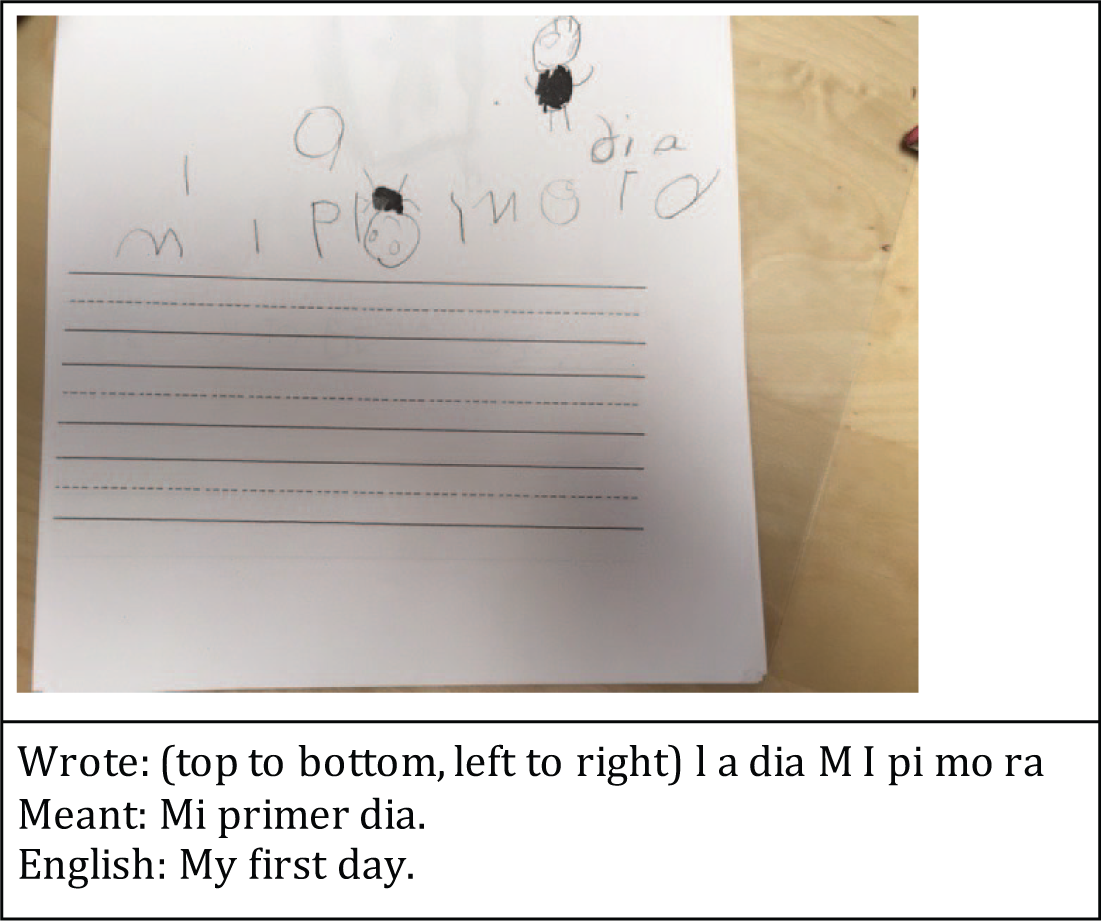
Manuel’s first attempt to write.
He was able to tell the teacher what he had written about. For example, when asked about his illustration, Manuel stated he drew a picture of himself writing on his first day at school. Although he could write the words the teacher had written on the board and illustrate what it meant to him, when he ran out of space on the first line, he began writing above the words on that line, indicating he was still working on directionality of print. This type of early writing effort emphasized writing as a form of communication of ideas and set the stage for writing in this kindergarten classroom.
Although a number of Manuel’s writing samples focused on the video game he liked to play, he also wrote about other topics. In October, he wrote, “a vija una ves qe un vampire qe la modei pesona” (Había una vez que un vampire que la morder persona/Once upon a time that a vampire that bite the person). His writing focused on what came to him during that writing time. In a number of Manuel’s writing samples, his family was a focal point. In his daily journal, for example, he wrote about different activities he did alone and with his family, such as watching TV and playing video games. He wrote, “yo y mi mama y mi papa ve mos tele” (Yo y mi mama y mi papa vemos tele/I and my mom and my dad watch TV).
Manuel’s strengths came through in his writing as evidenced in the writing sample collected monthly by the teacher and in his daily writing journal, which was later collected. Although Manuel’s spoken Spanish helped him when encoding what he wanted to write, he sometimes had difficulty reading his own encoded writing. This created an opportunity for his buddy to assist him in the process. More of this will be addressed later in the article.
Elizabeth is an only child and is African American. She lives with both of her parents, who are college educated. She did not attend a preschool program. At the time of the study, Elizabeth’s mother worked in the home and did a variety of small jobs on the side. She was a frequent volunteer in the classroom and in the school. She had taken Spanish classes in college and was supportive of the DL program, but she reported to the teacher that she felt uncomfortable about her Spanish and did not speak it at home with Elizabeth. At the start of the year, Elizabeth knew 46 of the 58 combined upper and lowercase letters in English and 18 of the 29 sounds in English.
Elizabeth began the year as a “silent” learner and would typically nod or shake her head in response to other students’ questions or prompts. Eventually, she began to supply short comments or responses in English. Based on our observations and video recordings, Elizabeth’s English did not show any evidence of African American Vernacular English (AAVE). However, we recognize that knowledge of AAVE represents a broad spectrum and that Elizabeth would have been exposed to AAVE spoken by some of the students in the school and possibly in the community. Unfortunately, we did not pursue this line of question with the parents or with Elizabeth. However, we did notice that as Elizabeth’s confidence grew in the classroom, she began to take more risks in speaking Spanish.
Our field notes show the first attempts by Elizabeth to write in Spanish in September. Her written words reflected some of the utterances she was starting to produce during that time. She wrote, “Oso, bebé” (Bear, baby) when she responded to the prompt about her favorite part of “Goldilocks and the Three Bears.” We noticed that she wrote from left to right, formed some of the letters correctly, and was able to locate some of the high-frequency words displayed around the room and to copy them. We also noticed that she was starting to use the words that she found fun or interesting to say in Spanish in her writing. For example, in October she learned how to say, “¡Qué chistoso!” (How funny!), and thought it was a great phrase, as evidenced by her frequent use of it in her speech (field notes, October 2013). Also in October, as part of her reading response to the teacher-read book Los Tres Cerditos (The Three Little Pigs), she wrote “cochintos y lobo chistosos” (cochinitos y lobos chistosos/pigs and funny wolves).
Elizabeth’s writing improved every month. The teacher often overheard Elizabeth asking other students how to say various words and phrases in Spanish: “¿Cómo se dice, um, butterflies?” (How do you say, um, butterflies?). Although she relied on the formulaic sentences her teacher provided as scaffolding, Elizabeth’s writing evolved. At first, she wrote only about topics covered in class: “mi parter favorite es curadotienene Evos co lores blanco. Son bonitos huevos y los huevos color es blanco” (Mi parte favorita es cuando tiene huevos colores blanco. Son bonitos hueveos y los huevos color es blanco/My favorite part is when she has white eggs. They are pretty eggs and white eggs). Then, she began writing about her family: “Mes mi en petate tu abla espenño con mima. Hablar en fiach con mi papa lerr con mi mama” (Mi es importante tu habla español con mi mamá. Hablar inglés con mi papá leer con mi mamá/It is important that you speak Spanish. I speak English with my dad I read with my mom). It is important to note that Elizabeth’s writing suggests that the language interaction in her home changed to a bilingual structure, even though her mother reported at the beginning of the year that she spoke only in English with Elizabeth (teacher conversation with the parent).
The secondary participant is the classroom teacher. The teacher is Latina and her parents are immigrants from Mexico. She grew up on the north side of Chicago in a working-class neighborhood that was predominantly African American, but with a growing number of Latinos. The teacher is a certified elementary teacher and was in her ninth year of teaching at the start of the 2013-2014 school year. She also has a master’s degree and an endorsement in bilingual education. Her professional experience includes teaching language learners in preschool and in early elementary grades. Her first 3 years of teaching were in the same elementary school she attended as a child. At the time, the school served low socioeconomic status (SES) students, but the students were mostly African immigrants. Although she had previously worked with students for whom English was not their first or only language, the year our study took place was her second year teaching in a Spanish/English DL classroom. After revealing her interest to better understand how her classroom was meeting her students’ needs, she became a participant–researcher and began collecting information on her teaching and her students’ writing.
Researchers’ Roles
Bauer has been an academic resource for the DL program since its inception. As such, she visits the school on a regular basis, consults with district personnel as needed, and provides professional development (PD) for the DL teachers. She also has university institutional review board (IRB) and district support to document the program’s development. In the fall of 2013, Bauer visited the kindergarten classroom monthly and took field notes. Presiado, the teacher, started her discussion and early exploration of writing with her students in the fall. Other DL teachers asked Presiado how she established writing so early in her classroom. Based on the teachers’ interests in implementing a writer’s workshop, Bauer conducted five PD sessions ranging from 1 to 2.5 hr with all the DL teachers during the spring semester. The PD sessions focused on establishing writer’s workshops in each DL classroom. Although the PD sessions were primarily conducted by Bauer, Presiado played an important role in providing examples from her classroom and discussing her pedagogy with the other teachers. The focus of the PD sessions was elements of a writer’ workshop (one session), supporting emergent writers (two sessions), and conferencing with students (two sessions). Although the teachers took part in the PD and the school supported these professional dialogues, the teachers had autonomy in regard to what they took away from the PD and how they applied new concepts and techniques in their classrooms. Throughout each of the PD sessions, the group discussed the importance of thinking about the DL students and their particular needs. Teachers at the PD regularly took turns bringing in their students’ work and worked together to reflect on how they could set the stage for writing, how the students generated writing, how the students approached writing, and how they could modify their practices as a result of the PD. This sort of discussion and reflection on the part of the teachers made it possible to not fall into the pitfall of some writer’s workshops (Genesee & Riches, 2006). That is to say, students were not simply given opportunities to participate in extended free writing and left to themselves. Instead, teachers were engaged in thinking about how to excite and invite students into writing while being attentive to the skills they needed to learn (M. Reyes & Laliberty, 1992). Colomer is a consultant on the larger project at Potter Elementary and participated in the writing of this article.
Data Collection
This study is situated within a larger effort to document the teachers’ and the students’ experiences in the DL program at Potter Elementary. This article focuses on one of those classrooms. For the purpose of this study, the classroom was observed and videotaped and field notes were taken. The two students in this article represent the type of collaboration structure the teacher used, “buddy pairs,” in her classroom. The pair, Manuel and Elizabeth, was specifically chosen because they represented the demographics of this DL classroom (Latinas/os and African Americans) and had different academic experiences and strengths. We also focused on this buddy pair because their experiences revealed the degree to which patterns of interactions could change over the course of a school year. By highlighting how this bilingual student pair operated in the classroom, we were able to document how two emergent bilinguals developed into writers. Furthermore, these students highlight what is possible when African Americans and Latinas/os are given an opportunity to learn about writing together. And, this gave us an opportunity to question the myth that African Americans are not good language learners, especially in a low-income school (Weise, 2004). Manuel and Elizabeth’s partnership composes approximately 11% of all the data collected across the three settings (i.e., morning message, read alouds, and writing activities).
Close examination of students’ Spanish writing development over the school year was important for understanding this classroom because programs using a DL model of bilingual education have sometimes struggled to meet the needs of students (Valdés, 2002). To better ascertain how well this newly established DL program was helping Latina/o and African American emergent bilingual students develop their writing skills, samples of children’s written work were collected in the classroom at eight different points during the year between August and March. For comparison purposes, the teacher (Presiado) had students write once a month on a prompt, which she then collected. For example, one prompt read, “Escribe acerca de tu familia” (Write about your family). To support students’ writing about their family, they each brought three pictures from home. For the prompt about a toy—“Escribe acera de tu juguete favorito” (Write about your favorite toy)—students brought in their favorite toy from home. Moreover, throughout the school year, all students were encouraged to write daily in their two-way journal (a journal where the teacher and the students communicated in writing; Atwell, 1987) about anything that had happened during the past 24 hr or as part of a response to a book read aloud by the teacher. In addition, Bauer video-recorded the classroom during writer’s workshop four different times between January and May, focusing on the students’ interactions. These videos were used to analyze the teacher’s instruction and the impact it was having on her students.
Data collected for analysis included eight writing samples from each student, students’ journals, the teacher’s reflections on students’ interactions during “buddy pair” time in her notes, videos of writer’s workshop, and Bauer’s classroom observation field notes.
Analysis
Analysis of the data was conducted at three levels. During the first phase, we read and reread the data using a constant comparative method (Glaser, 1965) to capture the broad pattern that emerged from students’ writing collaborations (length, words used), the content (topics) of their journal entries, and how the comprehensibility of their writing improved during the year (Echevarría & McDonough, 1995; Graves, Valles, & Rueda, 2000). Throughout the analysis, we start with students’ own written approximations, then provide Spanish and English glossing. In the second phase of the analysis, we focused on the videos and field notes and coded for themes such as type of talk with which students engaged (e.g., Did they direct and redirect each other’s attention?), comments they made about Spanish or English (meta-awareness of language), the pair’s use of both languages (translanguaging), the role students played in supporting each other’s writing (peer interaction), whether the roles were consistent throughout (peer interaction), how students provided feedback and assisted each other (peer interaction and brokering), and the general focus during these interactions. Understanding how Latinas/os and African Americans take part in translanguaging is important to understanding a broader range of students who participate in DL classrooms.
Third, given the school’s goal to improve the amount and cohesiveness of students’ writing, we analyzed students’ individual writing samples for clarity in communicating their message to the reader in Spanish. To capture the comprehensibility of students’ writing, a three-point scale was created by Bauer and verified by Colomer and used to judge the acceptability of the texts that were written. Each sentence was analyzed and given a score of 1, if it was not comprehensible; 2, if it could be understood but the syntax, word choice, or verb form made it more difficult to understand; and 3, if it was easily understood. Although the numbering system provided only a broad holistic snapshot in understanding students’ writing, we did so in part because we recognized that these students were in the early stages of developing their communicative writing skills in Spanish, which meant it was important to maintain a focus on their general ability to communicate via print. Through these analytic methods, we identified how students’ interactions during buddy pairs shaped their writing.
Findings
As in many DL classrooms, the students were purposefully paired to support each other’s language development. Buddy pairs were created at the beginning of the school year and played an important role in supporting students’ writing throughout the year. In fact, buddy pairs became a vehicle for supporting translanguaging. Consistent with Dworin’s (2003) notion of bidirectionality, the roles of “learner” and “teacher” taken by each partner switched, depending on the language in use at a given time. We also observed that “buddy” relationships changed with regard to who led and the manner in which sharing was accomplished between partners. Although writing workshop was formally introduced in January, students began to participate in writing at the beginning of the year. Over the course of the year, students moved from a sole reliance on verbal sharing to sharing ideas with a partner through writing. In this section of the article, we focus on the exchanges between Manuel and Elizabeth as they interacted around writing. We start by presenting a general sense of the classroom within which these interactions took place. We then provide a description of the formal instruction of writing, how students participated in writing through dialogue, and how they took part in becoming writers.
A Glimpse Into the Classroom
The 90 min of literacy block began with a morning message. At the beginning of the year, this was the responsibility of the teacher. It was written on the board each morning before the students entered the classroom. The teacher had several goals for this component of her literacy block. She wanted students to learn that writing could be used to communicate a range of ideas, from writing about playing outside to writing about respecting one another. She underscored that writing was in part a combination of the ideas students wanted to communicate and their knowledge of how words were put together to capture those ideas (learning about spaces, learning that they can stretch words out to hear the sounds better). The teacher explicitly informed students that their languages shared certain linkages and it was the group’s job to learn what those were over the course of the year (e.g., the students knew the letters “b” and “v,” but thinking about them in Spanish meant something else—the/b/sound in Spanish could be written as “b” or “v” but only as “b” in English). They were to take on roles of language detectives and employ a variety of writing styles to convey their ideas (e.g., pictures, the letters they knew, combination of the two). The teacher’s goals were routinely reinforced throughout the year, during the morning message portion of the day.
With the teacher’s help, students read aloud the morning message, followed by the students helping the teacher look for words (usually high-frequency words or target words). The structure of the daily morning message was predictable and featured formulaic phrases such as “Buenos días. Hoy es ____.” (Good morning. Today is ____.). This predictable structure helped students develop a better understanding of print that would later assist them in writing and reading. It was not long before students began helping the teacher to find and point out individual letters, and eventually, students transitioned into helping the teacher write a missing word.
By January, students began to take charge of composing the morning message. As a group, the class helped the chosen message writer to “stretch” words by “breaking” the words into syllables. As the message writer wrote on the board, he or she could ask for assistance from the class when needed. The message usually began with the same formulaic phrase to provide a scaffold for all students. Specifically, students helped the daily appointed message writer to write the sounds they collectively heard (the corresponding letter). Analysis of field note data revealed it was during this time that children were directed to focus on how to draw from the linguistic features available to them from their peers’ collective linguistic repertoires. For example, during a morning activity, a student began the morning message by writing the following phrase on the board: “Me gusta escibir” (I like to write). Her classmates then helped her expand her statement by asking, “¿Sobre qué te gusta escribir?” (What do you like to write about?). She responded, “Juguetes” (Toys). Her classmates then helped her by stretching the sounds for her to encode the word.
It was during these types of group sessions that students were given the opportunity to reflect on their language, which supported their emerging understanding of how their languages work. An example of this took place when the students began to sound out the/j/sound in Spanish for another student to write on the board. The sound prompted a metalinguistic discussion. As the students watched their classmate write the letter “j” on the board, one student pointed out that the letter “h” should be used instead of a “j.” This discussion led to another student stating that “h” is silent in Spanish. These types of metalinguistic interactions highlight the fact that emergent bilinguals always have access to their rich linguistic repertoire. The purpose of this activity was not explicit phonics instruction, but rather, the development of an appreciation for the way certain sounds were created as they spoke them and how they sounded to their ears. From a translanguaging framework, these types of early interactions and verbalization of connections across the languages document the metalinguistics awareness that these students were developing as a group, which could affect individual development in turn. Documenting this type of language development across the years will be important to better understand the role this knowledge plays in how students translanguage.
Formal Instruction of Writing
Although students were encouraged to write at the beginning of the year in their daily journals about their experiences (e.g., about something that happened last night), formal writing instruction in the form of writer’s workshop began in January and took place three times a week. Writer’s workshop focused on two key elements: (a) an understanding of the author’s craft through “author studies” (investigation into a particular children’s author) and (b) the physical act of writing itself. To address the first element, the teacher focused on using individual illustrations as a way to think about writing. Wordless picture books were first used to show how illustrations tell a story and how stories have a beginning, middle, and end. As the year progressed, author studies were used as exemplars of writing by particular authors. As part of this activity, the teacher selected an author, read multiple books by that author, and engaged students during the read alouds of each book. During the read alouds, students were often asked to participate in “turn and talk” by sharing their ideas with the person directly next to them. Turn and talk positioned students to consider their ideas before engaging in the physical act of writing. After engaging in the turn-and-talk activity with the class, students found their buddy pair to partake in the act of writing. During instruction, sometimes a student would ask whether he or she could write in English, and the teacher would allow it as long as the student was producing some writing in Spanish (supporting translanguaging). In one of the teacher’s reflections on students’ interactions, she emphasized the interplay of the two languages during the Spanish instructional time for writing. She noted,
It is important to make Spanish the dominant language, so they can learn various aspects of the language. However, this does not mean that the students’ language choices were not respected. If students wrote in English it was accepted. . . . I also created an environment where the students really wanted to write in Spanish because they would receive public praise from me when they did. Yet, the children were encouraged to use all of their linguistic repertoires to expand their knowledge of . . . language. Experience has taught me that the students have to “buy into” the urgency of speaking/reading/writing in Spanish as quickly as possible in order for Spanish to be one of the languages they regularly use.
Writing Through Dialogue
Analysis of the field notes revealed that Manuel and Elizabeth were asked to brainstorm favorite things they liked to do in preparation for writing a short story. The goal was to actively move students from the formulaic phrases that scaffolded their writing at the beginning of the year to something that was less structured in form. The teacher wanted more from the students than simply a listing of sentences starting with “Me gusta . . .” (I like . . .). With their partners, they were to engage in discussions about their likes and dislikes, activities they enjoyed, with whom they enjoyed these activities, and why they enjoyed these activities. All this was part of the students’ prewriting activities. If they spoke about an activity they enjoyed, they were to discuss the way that activity made them feel and the reasons they participated in that activity.
As part of the prewriting routine established by the teacher, where buddy pairs were central, they were to fill out their graphic organizer as they discussed their experiences with one another (see Figure 2). This type of prewriting activity was typical for most of their writing activities in the classroom.
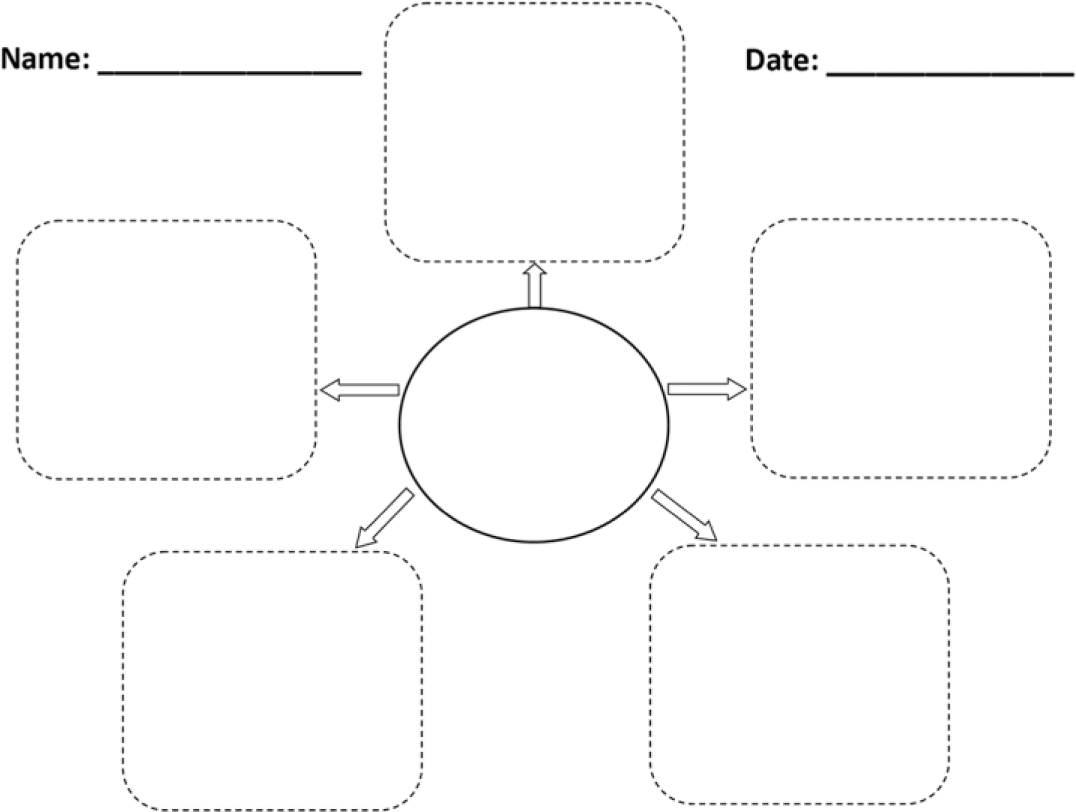
A sample of graphic organizers used.
The teacher hoped students would be able to access and represent this information as they wrote their stories about a character similar to themselves. The following transcription comes from the researchers’ video analysis collected in March during writer’s workshop as the students were discussing and completing their graphic organizer as part of their prewriting activity. Manuel started.
A mí me gusta jugar videojuegos. (I like to play video games.) As Manuel is writing his sentence, Elizabeth continues to write. Each student was entranced in his or her writing as the teacher approached their desks.
Amigos, me encanta que están tan motivados a escribir pero el propósito de la actividad es pensar por qué les gustan estas cosas. Por ejemplo, ¿Manuel, por qué te gustan los juegos? (Friends, I love that that you are motivated in your writing, but the purpose of this activity is to think about why you like these things. For example, Manuel, why do you like games?) Reading his graphic organizer.
Son videojuegos. Vez. (They are video games. See.) Pointing to his picture.
Okay, ¿pero por qué te gustan? (Okay, but why do you like them?)
A mí me gusta Mario porque tiene carritos y yo soy Mario y mi hermano es Luigi. (I like Mario because it has little cars and I am Mario and my brother is Luigi.) Colors in his drawing.
Bien. Y Elizabeth, ¿por qué te gusta la princesa? Reading Elizabeth’s writing.
Me gusta princesas porque bonitas. (I like princesses because pretty.)
Elizabeth colors.
Excelente. Ahora, escríbanlo. Para la última caja hagan lo mismo. Primero lo dicen y luego lo escriben. (Excellent. Now, write it. For the last box [square on the graphic organizer] do the same. First say it, then write it.) The teacher left them so that they could continue working, yet eavesdropped when they were about to commence talking again about their writing.
Looks at Manuel, who is starting to fill in his last box. ¡No Manuel! We gotta talk. Spots the teacher looking at them. Manuel follows her gaze. Habla. (Talk).
Oh, me gusta renos. (I like reindeer.) Starts to draw.
¿Por qué? (Why?) Proudly looks in the teacher’s direction.
Porque ayudan a Santa. (Because they help Santa.) All this time working on his paper.
Bien. Me gusta Tinkerbell. (Good. I like Tinkerbell.) She can . . . how do you say fly?
Volar. (To fly.) Stretches out arms like wings. ¿Es un pájaro? (Is it a bird?)
She is a fairy, not a bird! Looks in the teacher’s direction. ¡No pájaro! But she can volar (fly).
They continue working.
In the above example, we see both students eagerly wanting to write. Although the teacher directed both students to elaborate on their ideas, Elizabeth felt empowered to continue the role of the teacher after the teacher left. Manuel is also empowered, but he is focused on completing the chart the teacher gave them. By having his partner push the point of a discussion, he was able to satisfy the intent of the activity. Manuel is available to support Elizabeth’s vocabulary as he translates English words (fly) to Spanish (volar). Working together, both students operated in a zone that allowed them to be more productive and meet the teacher’s goals. By analyzing what each student said to the other, we were able to see that Manuel was not familiar with Tinkerbell, and although Elizabeth grasped the concept of flying, she did not have the Spanish code on to which she could map what she wanted to communicate. Through their interactions, Manuel and Elizabeth engaged in translanguaging when they both drew from each other’s knowledge and language to create a broader repertoire.
Becoming Writers
Manuel and Elizabeth both took turns leading in their buddy pair relationship; the topic of discussion typically determined who guided the conversation as they wrote. Examination of the video data showed that the more Manuel and Elizabeth spoke in Spanish using the prewriting graphic organizers, the more they wrote in Spanish (see Figure 3).
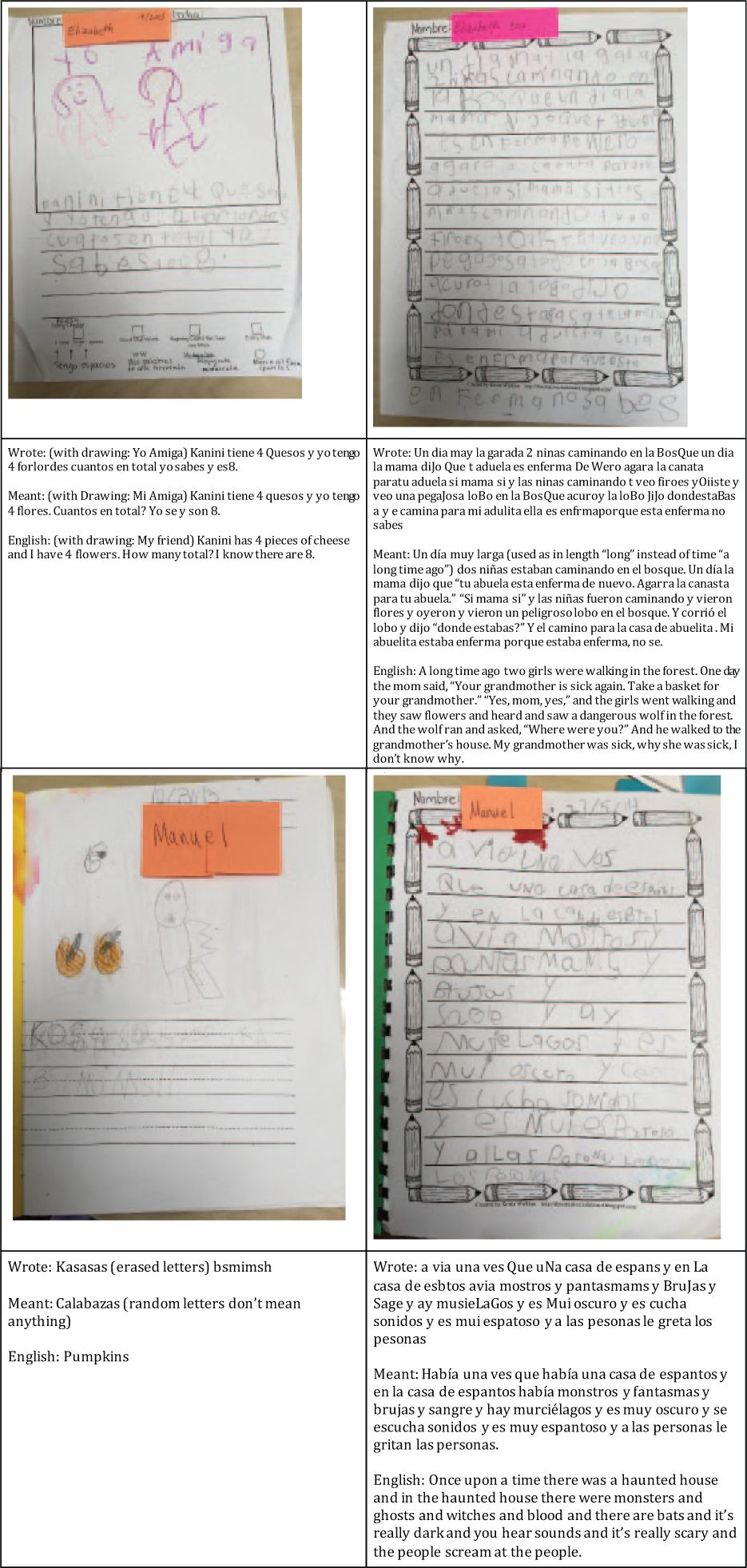
Sample of student work from fall and spring.
In doing so, both students worked to stretch the sounds in words and their writing skills, as they worked together to “leverage the tools in their toolkits to do” writing (Orellana et al., 2014, p. 311).
Manuel
Manuel’s strengths came through in his writing. Field notes and video recordings showed that although Manuel’s spoken Spanish helped him when encoding what he wanted to write, he sometimes had difficulty reading his own writing aloud. He would get frustrated with himself when reading his work to the teacher. Elizabeth played an important role for Manuel in this regard. She often could be heard asking him to read his writing to her—“Leer, por vavor (favor)” (Read, please)—which gave him an opportunity to practice the decoding of his own writing. As he struggled to remember something he had written, Elizabeth would remind him of what he had shared as they talked prior to the writing.
Brokering is often associated with Spanish-speaking students translating English into Spanish for an adult (Orellana et al., 2014) and/or for other students (Chao, 2006). What differentiates this buddy pair collaboration is that Elizabeth had to recall what was said to her in Spanish, a language she was in the process of learning, to help Manuel decode what he had previously encoded. Manuel translanguaged as he moved between spoken and written forms of Spanish and when he interacted orally with Elizabeth, who used both her linguistic resources to communicate. Because translanguaging involves all modes of communication, this type of interaction between Manuel and Elizabeth supports translingual practices on the part of both students.
By March of the school year, Manuel’s writing had expanded. Below is an example of an entry that Manuel wrote in his daily writing journal as he reflected on the book that the teacher read to them as part of read aloud “The Great Kapok Tree.” He wrote,
avia una ves Q uN ON Bre jue al BosQue y a y en contra nu jaguar le diJo NO corTes el alBol y La Bua Le diJo NO corTes el aL Bol (Había una vez que un hombre fue al bosque y él encontró un jaguar y una búa y el jaguar le dijo no cortes el árbol y la búja de dijo no cortes el árbol/Once upon a time that a sorcerer to the woods and there he finds a jaguar and he told him, “Don’t cut down the tree.” And the owl told him, “Don’t cut down the tree”).
Manuel used what he knew about the Spanish language and its sounds to sound out words to write inventively, thereby revealing his Spanish sound repertoire.
During the school’s spring break (March 2014), Manuel and his family visited Wisconsin, which became the subject of one of his entries. In this writing, we see his attempts to be very detailed about what he experienced. Although he is writing about this event in one language, his experience took place in an environment that was dominated by another language (English). Manuel wrote,
en Las vacasiones jui a wiscosi deols y a y y se Nade y JuGe coN La BoMBde agua y luego yo jui a un TovoGaNde agua y Luego Juy a TorNadode un TovoGaN be ogua y Luego Fui a un TovoGan be agua Que y vamuy rapido (En las vacaciones fui a Wisconsin Dells y allí se nadé y jugué con la bomba de agua, y luego yo fui a un tobogán agua, y luego fui a tornado—un tobogán de agua—y luego fui a un tobogán de agua que y va muy rápido/During vacation, I went to Wisconsin Dells and there I swam and played with the water pump, and then I went to the water slide, and then I went to tornado—a water slide—and then I went on a water slide that goes very fast).
Manuel clearly viewed writing as a means for communication. Although he is still developing his writing skills, we can hear his excitement about his trip. In this writing, his use of “and” may show his emerging understanding of conjunctions and limited knowledge of more sophisticated dependent clauses, but it can also serve as a means to build excitement in his writing, as if he were writing it the way he had spoken it.
Elizabeth
By midyear, analysis of Elizabeth’s writing revealed that she began to write in ways that were less formulaic, which resulted in her use of her full linguistic repertoire. Students were free to write what they wanted in response to the teacher’s text for “read aloud” in their journal. After the teacher read a text, she might ask students a question such as, “Who was your favorite character in the story of the three little pigs and why?” Our field notes show that students were also allowed to use what they knew about both English and Spanish to capture their thoughts. This created a context where some students started to write about things that interested them in general. This kind of inviting climate created by the teacher around writing (M. Reyes, 1992) created an environment where students were more likely to take part in translanguaging (e.g., students had access to each other’s feedback, vocabulary words in English and Spanish on the walls of the classrooms, and opportunities to talk across languages to rehearse their ideas). For example, when Elizabeth decided to write about the Disney character Snow White (Blanca Nieves), a non-assigned writing topic, she wrote, “A my me gusta prsesa nieve blanca por que bonido (bonito) tirire (tiene) animeles” (A mí me gusta princesa nieve blanca porque bonito, tiene animales/I like princess Snow White because she is pretty. She has animals). It is important to note that she drew on prior knowledge of the fairy tale character, Snow White, which she learned in English, and that she wrote this name in Spanish using English word order. This type of translanguaging was a recurring strategy for Elizabeth. That is, she translated literally the names of characters or sentences from English to Spanish. She was becoming comfortable with her knowledge of Spanish and felt she could translate without assistance. During this phase of her writing, she seemed to be more concerned with communication and was unconsciously using an English syntactic pattern to write in Spanish. Like Manuel, Elizabeth was able to add more details into her writing as the year progressed. Ongoing writing collaborations resulted in students expanding each other’s linguistic repertoire; students supported each other beyond their writing, through their metalinguistic dialogues.
As part of an end-of-year writing activity, the teacher gave a mini lesson where she highlighted how much she loved being with the students and described the three major events that stood out for her when she thought about their year together: the first day of school, having their families help them present their family heritage project, and reading their stories. She explained why these three memories were important to her. She then instructed each buddy pair to talk with each other about three of their favorite memories and why. Following this, they used a generic graphic organizer to capture some of the activities they engaged in over the year. To guide their discussion around the graphic organizer, the teacher asked each buddy pair to think about what they would share with the future kindergartners to get them excited about their year. Before engaging in writing, buddy pairs revisited their cocreated graphic organizer and then chose what was important to them to write about. The prewriting activity and first draft took 2 days. Following the first draft, the teacher met with each student, read the draft, and asked, “Why was that event your favorite?” Students used those discussions to further elaborate on their writing. In all, it took a full week of writing instruction for Elizabeth to generate the example below. At the end of the week, students shared their writing with the class as part of “author’s chair.”
In the following example, Elizabeth wrote a page in Spanish on her favorite activities in kindergarten. Perhaps, what is most striking is that the content of her writing gave her teacher a glimpse into her as a confident African American student who embraces writing in Spanish. Her willingness and ability to write in Spanish is related, in our view, to her experience in a yearlong partnership where students had daily opportunities for translanguaging. In the example below from her journal, Elizabeth shared with her imagined reader what she was able to change over the course of the year.
Mi año en Kinder por Elizabeth Yo te guta cuando fuimos a la garaja y vireo dos tipos de pajaros. En kinder va a muchos sambelleas como de la africano. Hice los planetas y esta coloreando los palaneneta y pegar en negro papel. Hice muchas Historiiias y escribir y Ataras y esta muy intilijete. Y cuando Jugar donde donde es divertido y yo ciero acer la ma estra. Y cuando la Maestra en cerado las orugas era divertido! Aora va a ir a rrimer garado. (A mí me gustó cuando fuimos a la granja y vimos dos tipos de pájaros. En kínder fui a muchas asambleas como el de los africanos. Hice los planetas y estoy coloreando los planetas y pegando en papel negro. Hice muchas historias y escribí hasta atrás y soy muy inteligente. Y cuando juego “Donde Donde” es divertido y quiero ser la maestra. Y cuando la maestra atrapó las orugas fue divertido! Ahora voy a ir a primer grado.) I liked it when we went to the farm and we saw two types of birds. In kinder, I went to many assemblies, like the one about the Africans. I made the planets and I’m coloring the planets and gluing them on black paper. I made many stories and wrote way back and I am very intelligent. And when I play “Where Where” it’s fun and I want to be the teacher. And when the teacher trapped the caterpillars it was funny! Now I’m going to go to first grade.
As we look at Elizabeth’s writing, she reveals an important part of translanguaging: Although emerging bilinguals’ thinking about writing is a bilingual act (which we have shown throughout this article), it does not mean that students are always engaged in bringing the languages together in obvious ways. García (Orellana & García, 2014) acknowledges this point when she remarks,
We as bilinguals don’t translanguage all the time. I’m not doing it now because I have to communicate and I understand who my audience is. And that’s what we have to teach children to do—to help them understand how to use language to their advantage cognitively, but also to adjust to some social norms. (p. 389)
Here, Elizabeth shows that she is becoming comfortable writing in Spanish and adjusting to the social norms of the classroom. Her ability to do this may be in part tied to her interaction with Manuel, but it may also reflect her teacher’s support to guide students to use all their linguistic resources, while sending the message that the goal, at this point in their educational learning, is to learn to write in Spanish, reflecting a new normal for Elizabeth. We suspect that this ongoing opportunity to translanguage may also provide opportunities for Elizabeth (as well as the other students in the class) to learn how to self-regulate her complex linguistic repertoire, which may lead to achieving higher standards of writing (Velasco & García, 2014).
Discussion
Often the perceptions of schools that cater to predominantly low-income students highlight what they cannot do. This is reflected in the achievement data that are prevalent nationally (National Assessment of Educational Progress, 2012) and in the attitude associated with these students in the media (Muwakkil, 2015). What is missing from the national dialogue is a discussion on the limited access these students have to reach their true potential. The Latina/o population may be outpacing the African American population; however, combined, they will constitute 44% of the student population by 2025 (National Center for Educational Statistics, 2016). Therefore, it is imperative that researchers document how DL classrooms can work for both of these communities. Cervantes-Soon (2014) warns that minoritized students can be further disadvantaged in DL classrooms. Researchers must better understand both what limits and what aids progress in DL classrooms for these students. Due to ongoing shifts in our K-12 schools, we must broaden our understanding of what it means to be bilingual and who is entitled to become bilingual. Internationally, bilingualism is the norm, thereby fostering linguistic flexibility within and across diverse communities. However, this attitude has not always been accepted in U.S. public schools. Manuel and Elizabeth show us what is possible when both Latinas/os and African Americans are the focus of DL instruction.
Although recent studies have looked at peer interactions within DL programs (Durán & Palmer, 2014; Gort, 2008; Palmer, Martínez, Mateus, & Henderson, 2014), the interactions tend to take place in programs where Latina/o and White students make up the student body or in programs where the school is predominantly composed of Latinas/os. This line of work is very important to understanding Latina/o and White students’ progress in DL programs; yet, we have little information on how Latinas/os and African Americans navigate the bilingual biliteracy highway (Fránquiz, 2012) together. Moreover, Orellana (2010) reminds us that more attention is needed to document the developmental trajectories of brokering as well as the variations across diverse contexts. The lack of research on this topic perpetuates beliefs that African Americans are incapable of learning another language in school. This study provides a glimpse into the types of interactions and instruction that may be necessary if the dialogue about African Americans in DL is to move beyond the current debate of serving or not serving African Americans and Latinas/os. We have to take a closer look at the teachers who are serving these students and their experiences with them, the instructional program, and the systematic evaluation on the part of schools and districts to examine their instructional efforts with these students and their ability to adjust accordingly. The teacher in this study had lived experiences with different language speakers, degrees and endorsements in teaching bilinguals, and a strong commitment to developing all students into bilinguals—all important points to consider when trying to understand how to make DL classrooms better for these students.
The research on child brokers has grown; however, most of the research focuses on students 10 years of age or older (Perry, 2014). This study contributes to the existing body of work by researching 5-year-old DL students who were in the process of developing their literacy skills while being called upon to broker for a classmate. Through this study, we see how Manuel entered the DL program with the language of instruction, which, given the language policy and structure of the classroom, established him as an expert. This kind of student positioning runs counter to the deficit views that are often associated with Latinas/os in schools. Elizabeth was also positioned as an expert because she could offset the obstacles that made it difficult for Manuel to write (e.g., decoding what he had encoded). These two students provide only a glimpse into how Latina/o and African American emergent bilinguals benefit from each other when trying to learn two languages (Spanish and English). What their development will look like across the grades as they matriculate through the program and what will be the impact of those interactions on their academic progress are yet to be understood.
Both Manuel and Elizabeth grew in ways that may not have occurred without their ongoing interactions (e.g., they received opportunities to expand their linguistic repertoire across both languages, metalinguistic awareness of their languages, and appreciation for Spanish). A translanguaging framework allowed us to see the role of interactive communication in Elizabeth’s development of writing skills as she drew from both a Spanish-speaking peer and a bilingual teacher to successfully navigate learning to write in Spanish. Conversely, Manuel drew on his interactions with Elizabeth and his interactions with the bilingual teacher to broaden his linguistic repertoire (e.g., fairy). Furthermore, the classroom’s acceptance of translanguaging encouraged students to support each other and to negotiate their writing during their multilingual discussions. Manuel and Elizabeth were able to interact in the above ways because the power relations were disrupted from the typical structure where English speakers are viewed as holding the linguistic power. Although we cannot state that Manuel and Elizabeth’s interactions were influenced by race per se, we can say that their pairing offered both students ongoing opportunities to see each other in positive ways, and that in and of itself is important given the fact that the media often highlights tensions between these minority groups (Muwakkil, 2015).
The focus of this article centers on the instructional approach of buddy pairs, whereby Manuel and Elizabeth interacted with each other to further their writing. Genesee and Riches (2006) cautioned that the research findings on writer’s workshops for emergent bilinguals are mixed at best and troublesome at worst. Part of the issue involves whether or not students are given explicit instruction as needed. As described in this article, the teacher did not leave her instruction to chance. That is to say, her whole-group instruction ensured students worked on a range of metalinguistic skills, such as phonological awareness (e.g., “b”/“v” in Spanish), text decoding, and sound encoding, among others. Students’ interactions in pairs built on the larger group interactions that were created by the teacher and students. Because the teacher welcomed what students already knew about languaging and positioned them as competent emerging bilinguals, students could draw on these skills when they worked in pairs with each other. That is to say, the classroom climate surrounding writing instruction went beyond what is often critiqued in the literature (Genesee & Riches, 2006), simply letting students write with limited guidance from the teacher. Our findings, as well as those of others (Gort, 2008, 2012), call into question whether or not the findings presented in Genesee and Riches (2006) are linked to writer’s workshop as a pedagogical format or if they are tied to how teachers implement that pedagogy with emergent bilinguals (M. Reyes, 1992). To our knowledge, early critiques of writers’ workshop have not accounted for a translingual perspective on literacy. In addition, the framework of translanguaging is continuing to emerge in the field. Documenting when students translanguage, when they do not, and what that tells us about the development and relationship between their languages is part of our emerging understanding of what translanguaging is and is not. Therefore, it is important to examine instruction, interactions, and students’ writing during writer’s workshop from a translanguaging perspective as we further build this theoretical framework.
Orellana and García (2014) remind us of the urgency to develop models of translanguaging that start from preschool and extend throughout the educational system if we are to understand students’ literacy development. In fact, García (Orellana & García, 2014) calls for critical language awareness in the classroom that “has to be for everybody. It cannot just be for children who are early language learners” (p. 390). We agree with Orellana and García that the bilingual field must research models of learning using a translanguaging framework; however, to do so, we would argue that we need to widen the scope of our current discussion on who bilinguals are and the classroom spaces that give rise to them.
This study calls into question the concerns that Latinas/os and African Americans are not well served in DL classrooms (Cervantes-Soon, 2014; Palmer, 2010; Valdés, 2002; Weise, 2004). Given the size of our sample, we recognize that our study cannot be applied to all learning spaces. More studies are needed with Latinas/os and African Americans of different ages in DL classrooms across a variety of contexts. Although it was not relevant for the African American student in this case study, there is also a need for future studies in similar educational contexts to address the role of AAVE in the translanguaging that takes place in DL classrooms.
Footnotes
Declaration of Conflicting Interests
The author(s) declared no potential conflicts of interest with respect to the research, authorship, and/or publication of this article.
Funding
The author(s) received financial support for the research, authorship, and/or publication of this article: This project is funded by the University of Illinois Research Grant.

Author Biographies
References
Supplementary Material
Please find the following supplemental material available below.
For Open Access articles published under a Creative Commons License, all supplemental material carries the same license as the article it is associated with.
For non-Open Access articles published, all supplemental material carries a non-exclusive license, and permission requests for re-use of supplemental material or any part of supplemental material shall be sent directly to the copyright owner as specified in the copyright notice associated with the article.
