




Abstract
This study explores disciplinary literacy instruction integrated within an elementary engineering unit in an urban classroom. A multidisciplinary team of university literacy and engineering educators and classroom teachers served as the research team for this case study. A social semiotic language theory (systemic functional linguistics) and a framework of mechanistic reasoning informed the instruction and analysis of classroom discourse and student writing. The study illustrates how a flexible set of disciplinary language choices functioned to support students’ evolving reasoning as part of the engineering design process. These findings provide insights into synergy between language and reasoning as a habit of design. These findings also inform calls to align science, technology, engineering, and mathematics (STEM) literacy and core disciplinary practices within both Common Core State Standards for (English language arts) ELA and Next Generation Science Standards.
Arguments for the integration of language and science, technology, engineering, and mathematics (STEM) instruction posit that “learning science is in essence learning the language of science because the two cannot be separated” (Avalos et al., 2017, p. 152). Recent U.S. education standards such as the Next Generation Science Standards (NGSS Lead States, 2013) and the Common Core State Standards for English language arts and literacy (National Governors’ Association Center for Best Practices & Council of Chief State School Officers, 2010) promote instruction that positions literacy as integral to disciplinary learning in STEM. These standards emphasize apprenticing students into the language and literacies of STEM from the earliest years of schooling. However, efforts to integrate STEM literacy into elementary-level classrooms face multiple challenges. First, in their current form, the standards behind these efforts leave many educators confused about what exactly students need to learn and do (Brisk, 2015; Lee, 2017; Lee et al., 2013; Wright & Domke, 2019). In addition, institutional barriers such as siloed curricula focused on test preparation for math and reading limit the teaching of science (Berliner, 2011; McLaughlin, 2014; Wright & Domke, 2019). Finally, concerns in the science education community that literacy as a text-centric focus will supplant the inquiry practices essential for STEM learning create resistance to these efforts (Hinchman & O’Brien, 2019; Pearson et al., 2010).
Using practitioner-focused research methodologies that invite the school-based insights of the classroom teachers who are ultimately responsible for such integrated curricula (Hinchman & O’Brien, 2019), literacy researchers can both investigate and address the challenges of positioning the ideologies and epistemologies of STEM disciplines alongside the theories and belief systems that guide literacy education (Hinchman & O’Brien, 2019). For example, Settlage et al. (2005) studied an inductively taught science unit on air and weather in an elementary classroom. In this study, the authors—a science teacher educator and two urban elementary teachers with backgrounds as English as a second language (ESL) educators—co-planned, taught, and engaged in practitioner-focused research. The fact that the researchers were positioned inside the instructional context allowed them to construct dialogic and inductive classroom instruction informed by their ongoing research. Their findings demonstrated powerful student learning and also “personified the tension between theory and practice . . . as [researchers] shared the goal of improving their own understanding about teaching science to all students” (p. 44).
The practitioner-focused study described here shares a similar goal of exploring and addressing tensions between the ideologies and epistemologies of literacy and engineering education. It centers inquiry inside the classroom context with a specific focus on disciplinary literacy in relation to the reasoning demanded by engineering design. Intentionally tapping the expertise of an engineering educator, a literacy educator, and three urban classroom teachers to collaboratively plan, teach, and analyze student learning during an elementary engineering unit on rocket design, this study seeks to identify disciplinary language that supports the higher levels of student reasoning necessary for successful engagement in an engineering challenge. This research draws on a social semiotic language theory, systemic functional linguistics (SFL; Halliday, 1975), for instruction and for analysis of oral and written language. The study connects language with reasoning pertinent to the disciplinary demands of the engineering challenge.
SFL as a Framework for Disciplinary Engineering Practices
Focusing on the role of language in science education, Yore (2012) argues that “the choice of language can shape what we know” (p. 16). Thus, disciplinary literacy relates to specific sets of practices that support domain-specific ways of knowing. It evolves within hybrid spaces where insights and experiences pertinent to the local participants shape the learning context (Hinchman & O’Brien, 2019). In tandem with the recent standards movement, instruction through a disciplinary literacy perspective demands fuller attention to “simultaneous engagement with disciplinary content (e.g., core concepts, big ideas, key relationships) and disciplinary habits of mind (e.g., reading-writing, viewing-representing, listening-speaking, thinking-reasoning, and problem-solving practices consistent with those of content experts)” (Fang, 2012, p. 20). A social semiotic theory of language known as SFL (Halliday, 1975) provides a framework for connecting language, context, and conceptual development.
According to SFL theorists, meaning is derived from the set of relations among grammar, discourse, and social activity—what is known as realization. That is, discourse is only meaningful within a social context. Within discourse, there are consistent patterns of language that are present within spoken, written, or signed texts that realize meanings for specific purposes. SFL uses the term “genre” to identify “staged, goal-oriented social processes” for these distinct patterns (Martin & Rose, 2007, p. 8).
In addition to genres, SFL also recognizes “registers” that provide flexible systems through which language users construct specific meanings. SFL theorizes that a register consists of three related, simultaneous linguistic metafunctions (Martin & Rose, 2007). First is the ideational metafunction—language that communicates ideas. These are the participants, processes, and circumstances (represented by nouns, noun groups, verbs, prepositional phrases, etc.) found at the level of the clause. Another is the interpersonal metafunction—language establishing how information, goods, or services are exchanged. Important here are the adverbial, adjectival, and mood choices that set up the relationships between interlocutors or between composer and audience. The third is the textual metafunction—language related to the flow of ideas as the text builds meaning across clauses. Important here are lexical chains through which ideas shared are then referenced or extended throughout a spoken or written text. Pronoun references and processes that become nominalized as nouns are examples of choices useful for building scientific ideas. Following Seah (2016b), we use “LG” to denote both genres (e.g., description or explanation) and register features (lexico-grammar).
SFL offers a repertoire of choices to educators and students as they build ideas and concepts through a flexible and creative process of transforming experience into knowledge (Fang, 2012). Research from a group of SFL scholars collectively known as the Sydney School connects SFL theory to disciplinary literacy in K-12 STEM pedagogy. Much of this scholarship investigates the disciplinary language awareness of students traditionally marginalized from STEM fields, such as students in under-resourced urban schools, students of color, and English learners (Lee et al., 2013). SFL theory offers a key to the technical, abstract, and dense language essential for developing scientific thought (Schleppegrell, 2016). Importantly, SFL can inform pedagogy within a culturally sustaining classroom that introduces disciplinary language as an addition to, not a replacement for, everyday cultural ways of knowing (Haneda, 2014).
In many classrooms, the integration of literacy and science is limited to the introduction of technical vocabulary. An SFL perspective argues that in addition to technical vocabulary, effective engagement with STEM discourses involves expanding awareness of how language functions for conceptual development (Schleppegrell, 2016). This study adds to a collection of recent research connecting SFL to science learning in elementary grades. These studies all use an SFL framework and focus on three areas: students’ use of LG features for representing effective concept development (Avalos et al., 2017; Fang, 2014; Fitts et al., 2020), teachers’ learning about the functions of language in scientific concept development (Hodgson-Drysdale, 2014; Paugh & Moran, 2103; Seah, 2016a), and connections between pedagogy and the effectiveness of students’ written language choices (Brisk et al., 2011; de Oliveira & Lan, 2014; Hodgson-Drysdale & Rosa, 2015; Seah, 2016b).
The elementary studies cited above investigated LG features of scientific discourse in middle-elementary classrooms (Grades 3–5). Genres examined included procedures, procedural recounts, reports, explanations, and arguments. A detailed review of the connections between these genres and the range of common elementary science practices is limited here by space considerations. However, these studies shared a common focus on examining the development of disciplinary language leading to greater precision and expression of the complex ideas necessary for scientific thought. Some common purposes and corresponding LG features that these studies found necessary but challenging for elementary students are highlighted below.
First, scientific discourses require a shift in focus from concrete experience in a specific time and place toward conceptual categories (e.g., simple present tense and generic or nonparticularized participants). This is language that is less personal and more factual; it also adds authority and objectivity. Second, scientific discourses challenge users to develop facility with language that is dense and abstract, and that draws on specialized verb types, complex noun groups, and nominalized verbs (verbal processes that become packed into nouns such as “evaporation”). Third, scientific ideas are built across the clauses of a text in specific ways depending on the conceptual goal. In many cases, the use of pronouns that clearly reference previous ideas or the appropriate use of connectives in linking clauses is key to creating relationships such as sequences or cause and effect. Elaboration of ideas using embedded clauses or phrases is also used to achieve additional precision.
SFL theorists understand that language features may overlap across disciplines. In this case, within STEM disciplines, there are many genres and register features that are similar. On the other hand, achieving goals of the discipline and the learning context demand specific configurations of language choices. For example, in its Science and Engineering Practices, NGSS recognizes “designing solutions through a process that is iterative and systematic” as a practice unique to engineering (NGSS Lead States, 2013). Presently, there are no studies that specifically investigate how language functions to support the development of engineering discourse in elementary classrooms. Therefore, we began with some of the common genres and register features (LG) connected to concept development in elementary science practices. We drew on these as sources for integrating instruction, and then to investigate the specific configuration of LG choices that supported students’ reasoning for designing solutions to an elementary engineering challenge.
The Study
In this case study, we explore instruction where teachers and students engage in engineering discourse to support students’ reasoning. We also explore students’ use of that discourse to represent their learning through written explanations at the end of the engineering cycle. Our purpose is to better inform educators who seek to adopt language and literacy practices that will support students’ reasoning across the engineering process. Our research questions are as follows:
Project Overview
This bounded case study (Merriam, 1998) uses data from a larger 5-year design-based research project exploring language and literacy supports for students’ learning of engineering. Over 5 years, we—the authors, one literacy educator and one engineering educator (along with an engineering graduate student)—partnered with teachers in two or three midlevel urban elementary classrooms each year to adapt elementary engineering units to include literacy-related supports. The focus was on understanding how such supports could be integrated while maintaining the integrity of the units’ engineering goals. We chose design-based research because it offers analytic methods to systematically operationalize the development of instructional theories over time and within the context of classroom practice (Anderson & Shattuck, 2012; DiSessa & Cobb, 2004; Moore et al., 2018). Our research and instructional team members’ multiple perspectives stemming from expertise in literacy, engineering, and classroom teaching were integral to the research process. For example, early in the project, instructional modules were created to support explanation writing. The engineering educator participated in analyzing writing samples and concluded that while the modules (which included language frames) were helpful to some students for organizing the structure of an explanation, they interfered with the innovative thinking and reasoning necessary for solving engineering problems. Based on this type of feedback over the first 3 years of research, we formulated a theory of change to inform and investigate supports. Design principles emerging from this process guided the investigation of the interdependence of language and engineering reasoning during the final 2 years of the study. We also investigated three related design-based principles:
Integrating focused instruction during the engineering design cycle affords a learning context where students learn language and use language in conjunction with their evolving reasoning.
Teaching specific language features related to the engineering design challenge enables students to develop habits of mind that develop their reasoning as engineering learners.
Creating written texts utilizing specific genre features related to engineering design supports students’ development of engineering design ideas.
Context of the Focus Unit
This case study draws on data collected from one engineering unit on rocket design taught within a three-unit sequence (spring 2017 through spring 2018) to combined teams of students from one fourth-grade and one fifth-grade classroom in a K–8 elementary school in a large urban district in the Northeast United States. The demographic makeup of the students in both classrooms reflected that listed on the school’s district profile (22% first language not English; 23% students with disabilities; 43% economically disadvantaged; 17% African American, 3% Asian, 17% Hispanic, 59% White, 4% multirace not Hispanic). The research team that developed and co-taught the units included two university researchers (one with expertise in literacy education and one who is an engineering educator) and three classroom teachers (the fourth-grade teacher, the fifth-grade teacher, and the math specialist). A graduate engineering student also supported the project. The team collaborated to integrate language and literacy supports into preexisting units of study. For the first round (spring 2017), one integrated unit on stomp rocket design was taught. Next (fall 2017), the team taught a second integrated unit on stomp rocket design. The final unit (spring 2018) was on plant package design. The rocket units were loosely based on lessons from “Liftoff! Engineering Rockets and Rovers” from the Engineering Adventures series (Engineering Is Elementary, 2014).
For this case study, we analyzed data collected from the second (fall 2017) rocket design unit. For this unit, students were assigned to eight mixed-grade teams of four students each (n = 32). This was an urban district where the classroom teachers were under pressure for students to perform well on high-stakes testing. As a result, the literacy curriculum offered few opportunities for learning language in project- or problem-focused experiences. Science was offered as a “special” subject, but due to district constraints on personnel and materials, it was not integrated with classroom instruction.
The teachers and school principal were committed to STEM and interested in making room for the engineering project as it offered disciplinary literacy within a student-driven rather than test-driven curriculum. The mixed-grade groupings also offered a rare opportunity for asset-focused, student-driven learning where students were not leveled or otherwise constructed as specific types of learners by the system. The literacy researcher and the three teachers (who had some exposure to SFL through a professional development experience) co-taught the unit. While there was attention to disciplinary language during the first rocket unit, it was during the second unit that the literacy expertise of the university and classroom educators was foregrounded. The engineering educators who were the primary instructors during the first rocket unit had scaffolded students’ engineering reasoning (see Wendell et al., 2019). The second rocket unit provided further opportunity to connect disciplinary language to that reasoning. Author 2, the engineer, continued to participate in the project in a consulting role: attending teacher meetings, visiting, and being available for advice throughout.
Table 1 presents the 14-day unit in which the design challenge for students was to create a stomp rocket that could carry a specific number of metal washers (its “payload”) a specific distance (its “destination”) from the launcher, generating a burst of air pressure when stomped. Student teams were challenged to plan, build, test, redesign, and rebuild the air-powered rockets constructed from paper, lightweight cardboard, or plastic. Throughout the unit, they engaged in “design talks” (Wendell et al., 2019) during which teams analyzed progress across each attempt at building and testing their rockets. The instructors intentionally considered how LG resources could help students clarify their reasoning during the engineering design cycle and introduced such language as part of the instructional process. Classroom dialogue during this process illuminated instructional ideas on the spot; these ideas were then incorporated into future class sessions. Students were also guided to represent their thinking by documenting their work regularly using a digital notebook (Wendell et al., 2019), a series of written reflections, and the preparation of a team poster for a culminating design conference. At the conference, teams presented their posters, sharing their learning with other K–8 students and families.
Unit Plan.
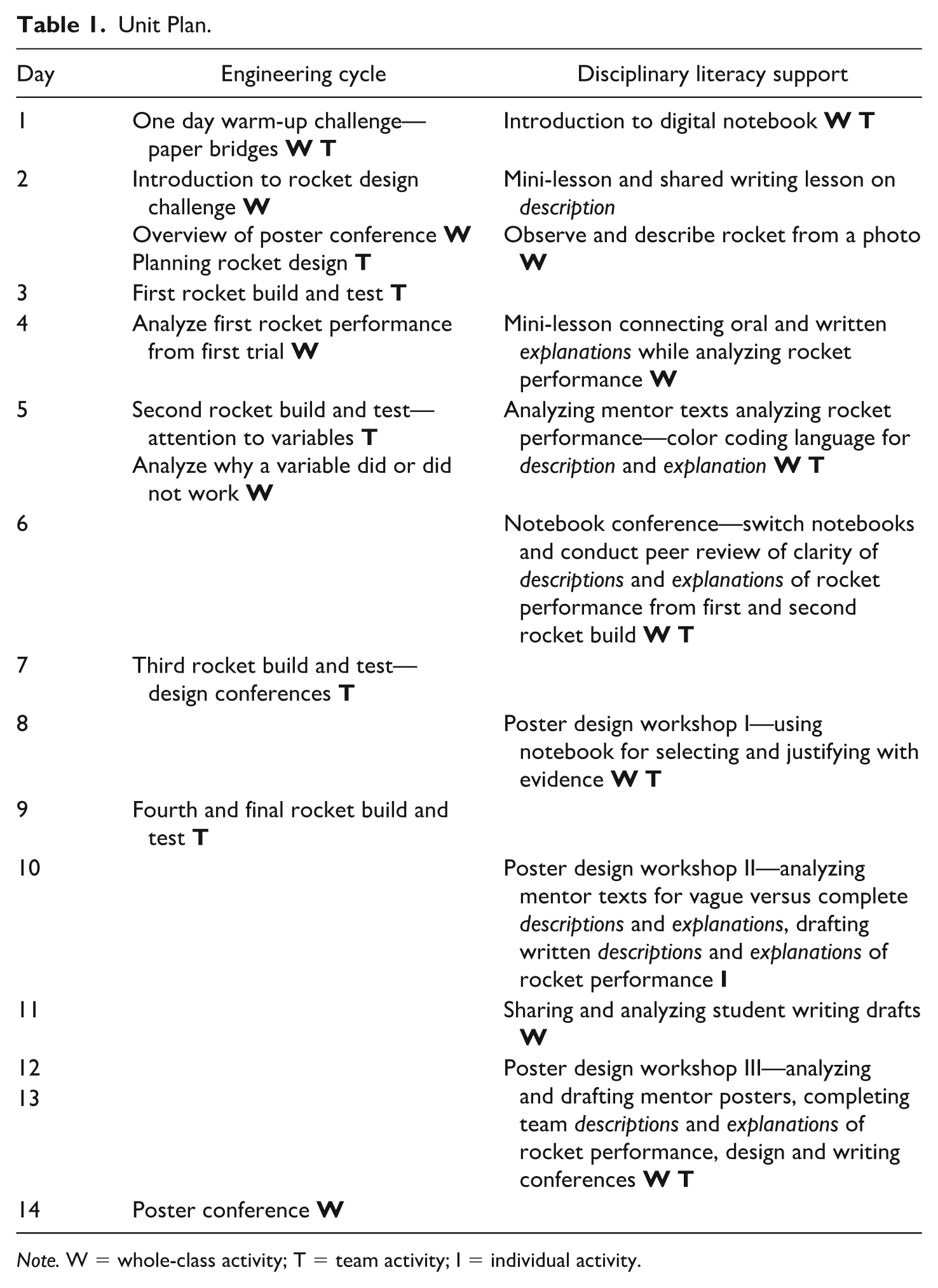
Note. W = whole-class activity; T = team activity; I = individual activity.
Data Collection
The second rocket unit chosen for this case represents a moment in the design-based research where our research and instructional team members consolidated and operationalized ongoing findings into the instructional framework in ways that highlighted the integration of disciplinary literacy to support students’ reasoning. The case is particularistic as it focuses on a particular phenomenon (disciplinary literacy integrated into the engineering design cycle); descriptive as it analyzes a thick, rich description of the phenomenon; and heuristic, as it illuminates the researchers’ understanding of the phenomenon under study (Merriam, 1998).
When planning and enacting instruction, we used tools from participatory action research that included systematic and iterative data collection and analysis to inform instruction (Kemmis et al., 2014). We video- or audio-recorded all whole- and small-group design talks. These discussions provided space for students to share rocket test results, critique representations of rocket designs, and participate in the co-creation of design texts, including written descriptions and explanations of rockets. In addition to video recordings, we collected (a) artifacts such as anchor charts and handouts, (b) students’ digital notebooks, individual writing, team writing, and photos of poster drafts, and (c) field notes from teacher meetings and classroom observations. Data were organized after each day of teaching.
Data Analysis
Before instruction began, our research team met to create a unit plan based on prior findings and to outline a plan for analyzing data over two phases, during and after teaching. During teaching, we used tools from participatory action research described above to inform instruction. After teaching, we reviewed data to identify and analyze relevant episodes (Moore et al., 2018) in the classroom talk where language support and engineering reasoning were simultaneously visible. We conducted discourse analysis of these episodes, followed by analysis of students’ written explanations using rubrics informed by SFL (Brisk, 2015; Hodgson-Drysdale, 2014) and mechanistic reasoning (Russ et al., 2008). We triangulated findings through check-ins with the teacher team members.
Phase I: Data analysis during teaching
We analyzed data iteratively during the unit to both raise and inform problems of practice related to RQ1: What LG resources does a research team of university-based engineering and literacy educators, and elementary classroom teachers need to support students’ reasoning during an engineering unit on rocket design? The research team met daily to share field notes and to evaluate student progress using artifacts such as digital notebook cards and paper-and-pencil responses. Author 1 consolidated feedback from these sources each evening and adjusted the subsequent day’s lessons and teaching materials using Google Docs. Situated and ongoing reflection allowed for immediate instructional improvements. As an example, on the evening of Day 10, Author 1 identified a design talk focused on a fifth grader’s writing from that day as containing exemplary language for explaining a successful rocket design. On Day 11, teachers asked the student to read and share his text with peers. Other students were also invited to share similar text from their own writing. As the teachers scaffolded the conversation, one teacher (MS) noticed a process of naming, describing, and then explaining each feature of the rocket. Another teacher (TD) immediately created a writing organizer on Google Docs for student teams to access for the next drafting session. This organizer eventually became a scaffold for teams to share ideas while preparing the written portion of the culminating poster.
The excerpt below was recorded at the end of this whole-class discussion:
[looking at the student writer] Look how it is organized. You named feature.
And we explained how and why. Then we named another feature and then explained how and why.
Yes.
Remember, name your feature and then explain why it worked.
. . .
Ms. TD, I think this is a great (inaudible). Name your feature, and then tell how and why it worked. And then think . . . what’s another feature?
I think this would be a good graphic organizer we can make to add to our folder.
(inaudible/affirming idea)
You know what? I’m going to make that graphic organizer.
(inaudible)
You know, I think this will be a good graphic organizer that we can offer as a piece of their poster.
That would actually be a good diagram or a table on their poster.
This type of interactive instructional decision-making adds validity to the design-based analysis because it reflects the learning of students, teachers, and researchers within a systematic investigation.
Phase II: Data analysis post-teaching
At the end of the unit, we reviewed and transcribed eight whole-class design-talk sessions (4 hr 30 min) and approximately eight excerpts from informal design conferences (lasting 2–5 min each, 30 min total). We then read the transcripts multiple times and identified episodes of talk focused on explicit language awareness or reasoning about rocket design. When questions arose, we checked with each other about theories of learning in our respective fields. We cross-checked the final unit lessons, photos, instructional materials, field notes, and teacher meeting notes to reconstruct how language and reasoning were integrated in each episode. Literature on language theory and engineering thinking informed our analysis of LG resources used by instructors and students to build the classroom discourse.
Following the instructional analysis, we conducted a line-by-line coding and analysis of each student team’s final writing sample. Author 2 suggested mechanistic reasoning as a fit for assessing content learning for this type of design challenge because a stomp rocket could be considered a “system” requiring students to envision its whole picture while also identifying the relationships among its parts (Cunningham & Kelly, 2017). A mechanism is an assembly of interacting parts that performs a cause-and-effect chain, like a transfer of force, energy, or information. Mechanistic or causal reasoning provides one type of explanation useful for developing more abstract understandings about the performance of a phenomenon or designed system such as the stomp rocket. Analyzing a mechanism involves identifying agents, structures, and processes. Russ et al. (2008) use these elements to create a rubric to nominate actions of mechanistic reasoning. We used five of the elements to code student writing. An example of this reasoning and our coding based on Russ et al.’s rubric can be found in the following sentence, in which the NASA (National Aeronautics and Space Administration) team explains the role of the “payload” as a system component: The washers (IE) were taped evenly (IOE) so it could travel farther (IA, C) and it [washer distribution] made it [rocket] balance mid-air (IA) so it [rocket] could go straight (IA, C).
Our coding rubric investigated four elements: identifying entities (IE), the components of the mechanism that contribute to the outcome of the phenomenon; identifying activities (IA), the things that entities “do” that cause changes in surrounding entities; identifying properties of entities (IPE), the characteristics that are necessary for the particular mechanism to run; and identifying organization of entities (IOE), the spatial location of entities and their structure. In addition, Russ et al. (2008) outline chains (C) of backward and forward reasoning that involve causal knowledge. Chains are used to make claims about what happened previously or to project what entities or activities present might lead to future performance. We then organized writing samples across a continuum related to quality of the description and explanation (Fitts et al., 2020).
Each section of writing was then divided into clauses and analyzed for LG features that identify participants, processes, and circumstances indicative of the SFL “ideational metafunction” (Martin & Rose, 2007). These included developing precise specifications for a design using complex noun groups; using third-person pronouns to explain an entity or part of a mechanism; packing verbal processes more abstractly into complex nouns or noun phrases known as nominalizations; or learning to relate, or chain, ideas by connecting and extending information throughout a text. Table 2 represents both sets of coding criteria.
Coding Criteria.
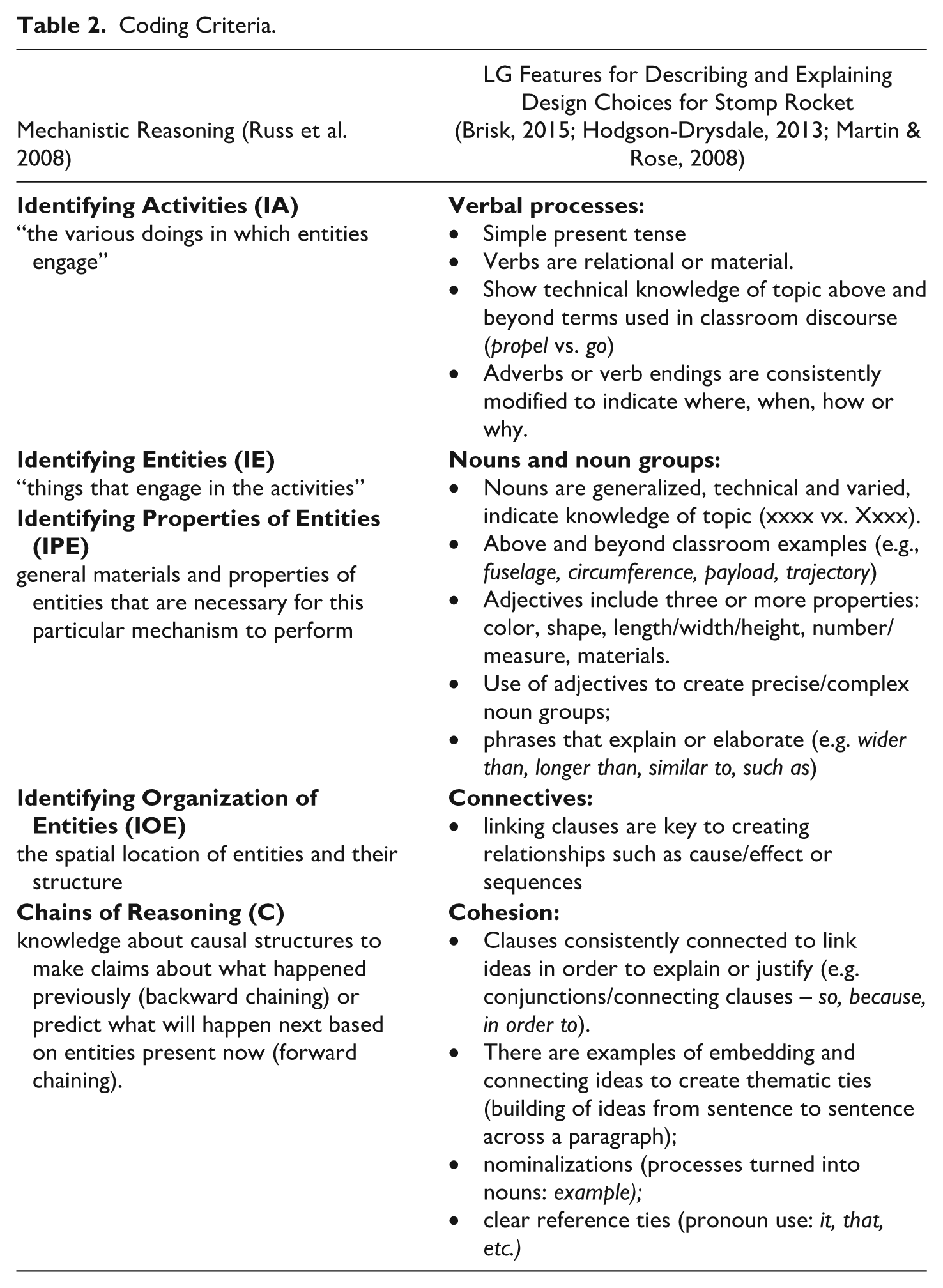
Following the coding, we identified patterns of reasoning about the mechanism in conjunction with students’ use of LG for representing their reasoning about the function of their rocket design.
Findings and Discussion
Disciplinary Literacy to Support Students’ Reasoning During the Engineering Cycle
This section addresses RQ1: What LG resources does a research team of university-based engineering and literacy educators, and elementary classroom teachers need to support students’ reasoning during an engineering unit on rocket design? Disciplinary literacy is a specific set of practices that support ways of knowing in a domain and evolve within hybrid spaces where insights and experiences pertinent to the local participants shape the learning context. The research team integrated disciplinary literacy into the cycle of planning, design, testing, and redesign known as the engineering design process (EDP; Rogers & Portsmore, 2004). As students sought to make sense of their rockets’ performance during iterations of testing and redesign, the literacy goals were to increase student capacity for “epistemic practices” of engineering design, specifically “envisioning multiple solutions, considering materials and their properties, using systems thinking, and building and learning from prototypes” (Cunningham & Kelly, 2017, p. 496).
The rocket challenge provided a context for scaffolding the type of systems thinking used by engineers because an air-powered rocket has “multiple and interacting parts that contribute to the functioning of a whole system” (Cunningham & Kelly, 2017, p. 496). For example, the weight of the rocket body influences the extent to which rocket fins can help the rocket reach a specific target. This interaction between variables required student engineers to understand part–whole relationships and the interconnections between system parts.
The research team had noted a problem in prior units that interfered with this type of complex thinking: Students often automatically defaulted to personal language when asked to explain the performance of a phenomenon. This is a common default for elementary students (Brisk, 2015) and can be explained by the preponderance of personal and fictional texts in early literacy curricula. Seah (2016a) noted that students primarily used to fictional description used what they anecdotally termed “flowery” language to create narrative imagery (p. 1067). In addition, the team had observed that in prior writing samples, the students regularly used first-person or personal pronouns, producing recounts of their own experiences rather than explanations. Therefore, the team focused on language instruction that introduced and supported the factual description and explanation necessary for the systems thinking that was the instructional focus of the unit. To integrate this awareness, familiar literacy routines were included during the EDP: shared writing lessons, analysis of mentor texts, sharing and critiquing students’ written drafts, and the ongoing creation of anchor charts.
One example of instructors using LG resources to introduce factual description occurred on Day 2 when the research team explicitly connected a lesson on writing factual descriptions with demands that engineers provide “precise specifications” for communicating about the qualities of a technology (Pleasants & Olsen, 2019, p. 155). Observing a projected photo of an actual rocket, students were encouraged to observe its parts and to use explicit language to describe their observations. Teachers scaffolded talk about “describing” to include the reasons why engineers need to be explicit and precise. They also prompted students to notice variables such as materials, location, size, and shape of the rocket parts. In the excerpt below, TD responds to a student who has just used the word “parallel” to describe the location of two cylindrical boosters on each side of the rocket. All four instructors (MM, MS, TD, and A1) interact with the children, providing the rationale for and scaffolding the use of precise and explicit descriptions, some based on concurrent language development from their mathematics lessons:
I like that word parallel. [both MM and TD pointing to the photo]
(inaudible) high and they are located under the smaller cylinder. These are the terms . . . see. [pointing] I see another shape in there. You haven’t mentioned it. shape. Who said it? [points back to photo] See here? They’re not triangles they’re three dimensions so they’re=
=cones
Ice cream cones.
=looks like an ice cream cone but are we going to use “ice cream cone” when we are talking science?
No.
Be careful about our language. When you’re writing these descriptions you are writing these descriptions to an audience of scientists so they have to be very very . . .?
precise.
=and very detailed in what you say. And we are used to writing very fluffy stuff [move hand in circular motion] right?
You want to be explicit.
Explicit.
Two of the teachers, TD and MM, then co-constructed a shared writing paragraph on the whiteboard with the students. As TD scribed the paragraph, MM took visible notes. These notes evolved into a permanent anchor chart for future student consultation. Along with a reminder that “precise description is factual language,” the chart included bullet points translating ideas from the shared writing to a list of “features” found in precise descriptions. Bullet points included “formal not personal language (e.g., not flowery language, no me, we, us),” “factual and precise adjectives (e.g., seven inches long, rectangular),” “technical or mathematical vocabulary (e.g., cone, cylinder, body),” and “signal words for comparing or classifying (e.g., wider than, are called).” As a note, we recognize that it can be productive for engineers to use metaphors and references to cultural artifacts—such as ice cream cones—to help explain their thinking to each other. An alternative way to respond during this classroom episode might have been to celebrate the detail that the ice cream cone image provides while then encouraging students to consider how that might be restated in technical language, such as in the discussion about three-dimensional objects.
A second example of language and engineering integration occurred on Day 4, after students had built a prototype based on their first design. Instructors taught a mini-lesson about language choices that help explain the “how and why” of an aspect of a rocket’s performance. As noted earlier, explanations and reasoned argument require a shift from the language of concrete experiences to language that condenses texts and links to more abstract ideas about broader phenomena (Brisk, 2015; Fang, 2012). When student Jared (all student names are pseudonyms) offered to tell “about a rocket that did not work,” A1 scaffolded his reasoning and used it as an example to define the concept of an “explanation”:
Yes, we built a rocket that didn’t work because it was like tall because the cylinder (inaudible).
So you made a cylinder, and the cylinder was wider than that piece of the launcher [demonstrating with her hands]. Why so, when your team noticed that it didn’t work, did you think about why it didn’t work? Because if it’s too big, why would it go off if it’s too big?
‘Cause at the top of the rocket it had some open spaces.
Did anyone else have open spaces in their rockets? And it didn’t really fly. You might wanna think about why if there’s too much open space your rocket it might not fly? [Pointing at the student] Jared?
When the air is pushing out of the launcher, the air is the one that’s pushing it, but if there’s an open space, the air will get out, and (it won’t go in the top) the rocket won’t fly. The air won’t launch it.
Jared just told us about reasons why the rocket doesn’t work when the air gets out.
What he just told us is called an explanation. That’s what we are going to work on today.
He was explaining why. It was a great explanation . . . explaining why a rocket might work and a rocket might not work.
Not only did the instructors emphasize that an explanation built on and extended description, they focused on using the discussion of explanations to help students realize and connect ideas (e.g., physical and scientific concepts) to the success or failure of their test. These ideas included the role of the force of the air within the rocket, as well as other concepts such as even distribution of weight for balance and drag in achieving distance and trajectory.
As mentioned earlier, moving students’ reasoning from recounting “what happened” to explaining “how or why” requires increasingly abstract reasoning. Discussion, such as the dialogue about explanation shared above, that explicitly linked LG resources to engineering discourse provided literacy support for such reasoning throughout the unit. As in the shared writing lesson on Day 2, MM recorded examples from the discussion about the success or failure of the rockets’ designs on the whiteboard and eventually added them to the anchor chart. The chart also evolved to list additional examples of adjectives and prepositional phrases for precise description (e.g., “on the top of the rocket, heavy cardboard”), clause connectors (e.g., “linking words to indicate time—first, following, then”; “linking words to indicate cause/effect—if/then, because, so, as a result”), and “action verbs” (e.g., “increased, changed”). Following this whole-group discussion, students were asked to consult their digital notebook records and write individual explanations concerning the performance of their prototype. In later sessions, design talks included analysis of their writing drafts.
Emerging Habits of Using Language for Reasoning
The research team designed instruction to be both explicit and responsive, a dialogue, connecting LG features with support for students’ reasoning. As the unit progressed, discussions focused on written description and explanation of rocket designs as a required component of the multimodal posters. While evaluating their first rocket test, students coded mentor texts to identify descriptive and explanatory language. Built into the design cycle were peer review and discussion of digital notebooks and invitations to share drafts of written explanations. As part of this process, students’ developing reasoning about both their rocket designs and the use of language in that reasoning became visible.
Students’ learning visible in instructional dialogue
An example of student learning emerged after students were asked to work in pairs to code instructor-designed mentor texts for language features using different colored markers. Afterward, volunteers shared their coding using a larger chart copy of the texts. Student Ina’s observation illustrates a growing awareness of language in relation to reasoning. As her peer, Warren, was underlining descriptive writing on the master chart, Ina interjected, noting that in her opinion the sentence could both “describe and explain”:
Now Ina, I was so impressed you said, “I’m going to change the color on the rest of the sentence.” What’s the rest of the sentence say?
The rest of the sentence says “so no air can escape from the rocket.”
And why’d you change the color?
Because it’s explaining how air escaped.
Ina noticed that the sentence on the chart, “The cone top was crumpled and taped securely so no air could escape from there either,” accomplished more than a description of the rocket. The latter phrase added a reason for the tape, to trap air. Her words implied that she understood that escaping air would prevent the rocket moving forward. A1 scaffolded this thinking as the discussion continued:
And that can tell how the rocket moved . . . does everyone agree with Ina? And the word so can help. “So no air can escape” because if the air doesn’t escape what does the air do?
It pushes the rocket.
It pushes the rocket so we want to make sure the air stays in there.
Later, after further discussion,
So what do you think? Is that a describing sentence or an explaining sentence?
What do you think?
I’m not actually sure but I think it might be an explaining sentence.
And what would be your reasons for that?
Because the air was trapped inside of the rocket (inaudible) rocket forward.
Do you want to come up and underline that? Have we seen a certain word a lot?
So.
So. So is probably a good word to explain things.
I just wanted to say it reminded me of the word because. When we write our (inaudible/technical) responses we say because . . . and because is kind of like why and then it seems that so is a good word to transition from what’s happening to why it is happening.
Yeah.
We now have two explaining words that we can add . . . because and so to help us explain.
How about therefore?
I was thinking the same thing.
Reasons why.
Oh reasons why.
Maybe we need to start a list.
This means.
This means . . . because we had the word “distributed” and this told us more about that=
(inaudible) this means=
=when you use a word that’s really complex they explain it with this means.
I like that. Ina’s seeing a pattern. She’s seeing something descriptive and then she’s seeing what happens because of that description. She’s seeing that because they are taped around evenly (inaudible) you’re getting that pattern of a description and then how and why that happens.
Ina’s participation in the discussion was more than simply responding to a teacher’s prompt with the correct answer. Her interjection indicated independent thinking and growing language awareness. It created a space for teachers to further emphasize the role of explanation to link and extend ideas (Brisk, 2015) and to point out how specific language features function to achieve this goal. Rather than preteaching language or hoping students absorb and use language, this interactive instruction provided space for teachers to be explicit about disciplinary language “in use,” building awareness with independence in mind.
Students’ learning visible in their writing
Part of the EDP was a culminating conference where teams were asked to create a poster to share the challenges, trials, and lessons from the rocket challenge. Early in the unit, the adult engineers provided authentic posters from college engineering conferences as mentor texts. These model posters included multiple modes (writing, photos, graphs, prototypes) through which engineers shared a design idea. One required element for the student team’s posters was writing that described the important components of their rocket design and explained how these contributed to its performance. Informed by notes from individual drafts and digital notebooks, each team completed the graphic organizer developed earlier in class using a Google Docs platform.
Holistic sorting of patterns in the writing that used mechanistic reasoning connected content learning with LG use at a “granular level” (Fitts et al., 2020, p. 6). After coding for language, we placed written sections of the organizers on a continuum from basic to complex and checked for accuracy in terms of the demands of the engineering task. We considered connections between language use and the strength of the reasoning visible in the samples. Different relationships between reasoning and language use sometimes appeared within one team’s sample. Rather than creating a developmental trajectory by placing each team’s organizer on a continuum, we instead coded excerpts in the organizer using these categories: (a) emerging disciplinary language/inaccurate reasoning, (b) emerging disciplinary language/accurate with partial reasoning, and (c) emerging academic language/stronger reasoning. Excerpts below contain examples.
Some disciplinary language but inaccurate reasoning
In this example, the Super Novas team describes and explains a component they identified as “thrusters” attached to either side of their rocket’s body: The thrusters (IE) were distributed at the bottom sides of the rocket (IOE). The thrusters are 5 and a half centimeters (IPE). The thrusters were dixie cup [sic] (IPE). The thrusters (IE) helped the rocket get to Jupiter because they helped capture (IA) air to push it forward (C).
In terms of reasoning, the material (Dixie Cups) and a property of that material (length) are described. There is reasoning that identifies the target phenomenon (forward movement). However, the explanation is inaccurate. It connects the role of the Dixie Cups attached to the body of the rocket based upon previously known information about fuel-propelled rockets rather than observed performance of the air-propelled prototype. Despite this inaccuracy, there is evidence of disciplinary language use. The register is formal, not personal. The clauses are complete, with the entity (thrusters) positioned as the subject or theme of each sentence. Embedded clauses utilize adverbials (e.g., “distributed at the bottom sides,” “push it forward”), an adjectival for length (e.g., “5 and a half centimeters”), technical material, and relational verbs (e.g., “were distributed,” “helped capture”). A connector (“because”) is used for a cause–effect explanation.
Despite indications of disciplinary language, the reasoning here indicates that the students were relying upon preconceived notions about fuel-propelled rockets rather than direct observation. Earlier, during the shared writing lesson, teachers noted similar disconnections between assuming and observing. For example, as TD scaffolded descriptive writing, she guided a student who suggested that the rocket in the photo had “oxygen inside”:
. . . Only (describe) exactly what you see, don’t assume you know.
Assumptions and predictions are part of engineering design; however, teachers realized that students needed to focus on the evidence at hand, a necessary habit for informed redesign and explaining design decisions. In this instance, TD might also have contrasted the role of directly observed description with assumptions and predictions about what students might know from past experience. Such a discussion would have directed the students to consider the role of air power, oxygen, and fuel in the different types of rockets.
As noted earlier, when teaching language modules outside of the engineering cycle, we noticed that when language became the primary instructional goal, it shifted students’ focus away from the engineering challenge and toward completing the writing assignment. The default is leaving disciplinary language development to chance during the EDP and hoping students will absorb language through the activity. In contrast, an SFL perspective as part of integrated instruction can bridge awareness of how language works to support deeper reasoning (Fitts et al., 2020).
Some disciplinary language, accurate reasoning but partially expressed
In this example, the Milky Way team describes and attempts to explain why the “rocket cylinder” or body component of their design worked: The rocket cylinder (IE) is made of green construction paper (IPE) with 15 washer [sic] taped (IE) on the outside (IOE) with clear tape (IPE). It is 29 centimeter [sic] tall (IPE). It (IE) worked because we changed the cylinder (IE) and made it thinner (IPE).
Here, materials (“construction paper,” “clear tape”), properties of color (“green”), height (“29 centimeter”), and quantity (“15 washer”) are all included. The location of the washers (“taped on the outside”) is also mentioned. However, the reasoning is not explicit about how the washers were distributed or how the thinner cylinder added to the performance. Evidence of disciplinary language is present, including complete clauses and even some prepositional phrases indicating location or type of materials. There are small noun groups for basic materials (“clear tape,” “green construction paper”) and two adverbials (“taped on the outside,” “made it thinner”). The excerpt states the height of the rocket and improvements made by the team; however, the reasoning can only be considered partial as these imply but do not directly connect to how or why the rocket performed successfully.
This excerpt is indicative of challenges faced by elementary writers when moving from concrete experiences to more abstract “how and why” explanations (Brisk, 2015). In this case, teachers might further support students’ reasoning by distinguishing which descriptive language supports reasons for performance and which does not. For example, the color of the paper has no bearing on performance, whereas the weight of the paper could be a factor. Extending or elaborating through the use of connectives and embedded clauses might also provide more complete explanations. These writers might benefit from further intentional analysis such as the mentor text deconstruction mentioned earlier (where Ina argued that a sentence could both describe and explain a phenomenon, with the teacher prompting students to notice the role of the connective “so” in creating this more complex clause).
Emerging disciplinary language, stronger reasoning
In this example, the Voyagers team added a summary section to their graphic organizer entitled “Mix of It All.” This team coordinated the components into a culminating explanation of how all entities worked together in their mechanism, the rocket. Their explanation shows indications of independence in using language for making sense during engineering: Rocket 3 (IE) has a white paper cylinder body (IE) (IPE). The washers (IE) are evenly distributed (IOE)—2 on top and 2 on the bottom. The same distribution of washers is on the other side of the rocket (IOE). In total there are 8 washers (IPE). The wings are red (IPE) and shaped as a triangle (IPE). The rocket (IE) reached Titan because the wings (IE) helped it glide (IA) because when the rocket was launched the air kept it up (IA) (C). The washers (payload) (IE) were distributed evenly (IOE) so it was stable and it kept (IA) the rocket straight. If there weren’t any washers (IE) the rocket would just go in any direction (C). If there wasn’t any tape (IE) at the top of the cylinder (IOE) the air from the launch wouldn’t be kept in (IA) (C) and it would push out off the launcher (C). The circumference of the rocket (IE) fit perfectly on the launcher (IOE) so no air could get out (C) and the rocket could project towards its target (C).
This excerpt is stronger; not only did the team independently assemble a summary explanation but also they incorporated materials and properties (shape, quantity, weight) that contributed to the performance of the rocket. Their explanation was the most complex, including four chains of reasoning. The first explains how the wings worked to glide across the air to achieve distance. The second explains how the distribution of the weight enabled the rocket to remain stable and straight and adds an additional cause–effect rationale to counter why a lack of weight would cause a failure. The third addresses the need to prevent air escape to propel the rocket forward. Causal reasoning is added to explain an alternative result if air did escape. Finally, a fourth chain of reasoning, also related to preventing air escape, concerns the fit of the circumference of the body onto the rocket launcher.
This excerpt shows a facility with language for abstraction and cohesion. For example, in the initial description, a sentence utilizes an adverbial (“evenly distributed”) and then two adjectival phrases to clarify and elaborate. This information is subsequently brought forward in a nominalized phrase as the theme (subject) of the following sentence (“the same distribution of washers”). Later on, the “evenly distributed” washers are referenced to provide reasoning for the rocket’s success (stability and straight trajectory). This emerging ability to pack information into sentences indicates more facility with abstract reasoning. It is key to understanding and creating informational texts and critical to disciplinary learning in STEM, where ideas are increasingly abstract (Christie & Derewianka, 2008).
In earlier units, student writing tended to focus on the actions of the designers; feedback related to the use of the third person supported a shift toward a focus on the performance of the mechanism instead. In addition, extending reasoning through clause connectors and embedded clauses provided language for writers to link ideas for more complete explanations. Not specifically addressed in these design talks, but visible in this excerpt, are some further opportunities to support students in creating denser, more abstract meanings. In this sample, the writers began to connect ideas throughout a text by condensing and moving previously stated information forward through the use of nominalizations (verbal processes condensed into nouns or noun groups). One example is the transition in the first section from “the washers are evenly distributed” to the subject of the following sentence, “the even distribution of the washers.” This language supported more abstract reasoning about distribution and weight and their role in stability later on.
Conclusion
This case study explores the development of elementary students’ reasoning when disciplinary literacy was integrated into an engineering unit. In an effort to bridge barriers that currently interfere with the instructional integration of STEM and literacy, we intentionally created a research team including members with expertise in engineering, literacy, and classroom teaching. Drawing on SFL allowed this team to recognize and scaffold LG (genre and register) resources to support students’ mechanistic reasoning as they planned, tested, and redesigned an air-powered rocket. SFL offered language choices related to systems of meanings necessary for achieving discipline-focused goals.
Findings related to our RQ1 add to emerging knowledge about language resources to support STEM habits of mind in elementary grades (e.g., specific noun groups leading to precision or connectives that link ideas to explain how or why). More importantly, these findings highlight the potential of SFL theory as a flexible system of choices for classroom teachers seeking to adapt disciplinary literacy. In this engineering unit, providing language as a system of choices supported instruction in ways that are not possible with traditional paced and prescribed curriculum. Member checks with teacher MS confirmed that the LG resources visible in this unit would inform her teaching during future units. MS also recognized the value of flexibility, noting that different configurations of LG may be needed for different STEM goals.
The findings also provide insights into expanding the extant literacy curriculum. Familiar routines in place for ELA, such as workshopping student writing, were easily adapted for STEM disciplines. Such curricular integration of disciplinary literacy practices and STEM practices may address one barrier to realizing NGSS practices—providing time in elementary classrooms not currently available to schedule STEM subjects. Although it was not a direct focus of our research questions, literacy integrated into project-based curricula such as this engineering unit provides contexts where students have room for productive struggle in using disciplinary language to develop ideas rather than respond to set expectations. Teacher MM noted that while students were “not used to this much freedom,” the school principal noticed more focused, yet independent discipline-specific attention not seen in other outside-of-class STEM activities. Access to curricula that demand open-ended intellectual work is a social justice issue for many classrooms in high-stakes testing environments.
Our RQ2 considered what LG resources emphasized during instruction were used by students to represent their learning about the function of their rockets. This question evaluated the relationship between students’ language choices and the quality of their written explanations. We noted shifts in student writing from recounting immediate personal experiences toward focusing on the rocket mechanism, an important movement toward the more conceptual thinking necessary for explaining a rocket’s performance. It is important to note that student responses were variable, even within each sample. This aligns with the findings of related studies that demonstrate that evolving complexity in STEM writing is not necessarily developmental across Grades 3 to 5 (Fang, 2012).
Still, the continuum from partial to fuller use of LG resources visible here provides specific discursive supports for teachers who wish to include disciplinary literacy to strengthen student reasoning—in this case, during the EDP and when representing their learning at final stages. In keeping with the ideological framework for disciplinary literacy and utilizing a functional approach to language, we conclude with the caveat that the goal for such instruction is not simply for students to develop a precise mechanistic explanation of a design artifact but for them to deepen their reasoning and to utilize the language of the discipline toward that end.
Supplemental Material
sj-zip-1-jlr-10.1177_1086296X20986905 – Supplemental material for Disciplinary Literacy in STEM: A Functional Approach
Supplemental material, sj-zip-1-jlr-10.1177_1086296X20986905 for Disciplinary Literacy in STEM: A Functional Approach by Patricia Paugh and Kristen Wendell in Journal of Literacy Research
Footnotes
Acknowledgements
The authors acknowledge contributions to this work from Chelsea Andrews, Tufts University, and Tracy Doyle, Mary Moran, and Michele Sirois, Boston Public Schools.
Declaration of Conflicting Interests
The author(s) declared no potential conflicts of interest with respect to the research, authorship, and/or publication of this article.
Funding
The author(s) disclosed receipt of the following financial support for the research, authorship, and/or publication of this article: This material is based upon work supported by the National Science Foundation under Award DRL-1316762.

References
Supplementary Material
Please find the following supplemental material available below.
For Open Access articles published under a Creative Commons License, all supplemental material carries the same license as the article it is associated with.
For non-Open Access articles published, all supplemental material carries a non-exclusive license, and permission requests for re-use of supplemental material or any part of supplemental material shall be sent directly to the copyright owner as specified in the copyright notice associated with the article.
