




Abstract
This study explores one teacher's instructional method for teaching life sciences using argumentation and argumentative writing rather than simple templates for writing claims and evidence. The microethnographic discourse analytic case study reported here included the teacher and 26 “advanced” eighth-grade students in a suburban middle school. Nine consecutive video-recorded lessons and related data were analyzed, focusing on how the teacher and students constructed the theory of evolution during instructional conversations about evidence and reasoning and about the content of students’ written arguments on the theory. The teacher created a context in which students developed arguments with teacher support to ensure that they were learning to use argumentation as a heuristic to understand concepts and to engage in argumentative practice central to doing science. The modes of participation of two case study students are contrasted to explore two different trajectories and to examine particular cases of writing a lab report.
Approaches emphasizing the teaching and learning of disciplinary ways of reading and writing at the secondary school level are most apparent within the aptly named “disciplinary literacy” research movement (cf. Moje, 2007). Perhaps one of the more explicit and extensive arguments for this movement is the framework and research methodology proffered by Project READI (Goldman et al., 2016). A key contribution of this project is an instructional design, including learning goals targeted at what secondary students need to know and be able to do in order to attain high levels of literacy (broadly defined as reading) and achievement in three disciplinary areas: literature, science, and history. Project READI's exploration of disciplinary core knowledge such as reading processes, as well as knowledge about the academic disciplines, including the sciences, that define and give purpose to reading, reasoning, and critical inquiry in a discipline has contributed a robust and renewed intellectual vigor to teaching and learning the disciplines in school settings.
Despite these and other efforts such as the National Commission on Writing in America's Schools and Colleges report titled The Neglected “R” (2003) and the Common Core State Standards (Council of Chief State School Officers & National Governors Association, 2010) that argued not only for more instructional time for writing but also for an ambitious agenda for the teaching of discipline-specific writing, there is reason to believe that the role of writing in disciplinary literacy remains conceptually vague and practically neglected. What, then, are the obstacles, especially in content areas such as the sciences? We believe that a key issue is that currently, disciplinary literacy research has proffered only limited exemplars and incomplete concomitant theorizing to demonstrate how learning to write effectively within a discipline is part of that discipline's knowledge base and not simply another way to develop a skill to support the work of English language arts teachers or a tool for assessment purposes.
But how might teachers provide their students with opportunities to learn how to argue and argue to learn (Newell et al., 2015) within the science classroom? Rather than the use of simple templates of claims and evidence, Applebee and Langer (2013) turned to “Toulmin’s (1961) point that the ability to participate effectively in scientific discourse (e.g., argumentation) develops through a process of enculturation” (p. 182) that requires, in our judgment, a “practice” perspective (Newell et al., 2015). However, when Applebee and Langer (2013) reported on science writing in middle and high school classrooms, they found “that the dominant trend in writing in science is to recite information” (p. 108) and using the form of short responses that limit students’ efforts to argue to learn or to think deeply about scientific concepts.
Argumentative Writing as an Epistemic Practice for Teaching and Learning Science
In a recent meta-analysis of the effects of writing on learning in science, social studies, and math, Graham et al. (2020) found that “the impact of argumentative writing was more than double at least one of the other types of writing (e.g., expressive, free writing, journaling)” (p. 215). Graham et al. (2020) also found that, in general, “writing-to-learn effects were not moderated by the features of writing activities, instruction, or assessment” (p. 179; emphasis added). Accordingly, they called for more studies of writing-to-learn (hereafter, WTL) in a range of contexts that include consideration of “the instructional environment in which it is implemented, as a complex set of values, social interactions, and typified instructional practices [that] moderate its impact” (p. 184). Our study of teaching and learning argumentative writing in an eighth-grade life sciences classroom is one small contribution to the kind of research suggested by this call.
In their synthesis and review of Writing and Learning in the Science Classroom, Wallace et al. (2007) claimed that “writing is an essential activity that all students of science need to engage in to completely focus their scientific understandings” (p. 2). WTL is a use of writing that has had the attention of science education researchers for several decades (Wallace et al., 2007); however, the field's concerns have focused largely on the question, “Does writing improve science learning?” Although there is a range of ways to conceptualize WTL (Klein et al., 2016; Newell, 2006; Wallace et al., 2007), we assume that writing represents one way for students to enter and perhaps contribute to academic traditions of knowing and doing, including learning rules of evidence that govern effective arguments within the disciplines (Applebee, 1996).
Following Applebee (1996) and Kelly (2018), we argue for understanding writing not just as a tool for acquiring new concepts but as a way of learning how to engage in an epistemic practice in science. Epistemic practices are the socially organized and interactionally accomplished ways that members of a group propose, communicate, evaluate, and legitimize knowledge claims. Through application of epistemic practices, communities justify knowledge claims. This means that rather than assuming a narrow conception of writing as, say, a structure or a skill to be taught or as a way to assess expected, correct answers, WTL research grounded in practice theory ought to be motivated by broad and complex questions such as how, when, and why different kinds of writing—including argumentative writing—within curricular conversations in particular social contexts shape student learning of key concepts such as evolution and epistemic practices such as using and warranting evidence to support claims.
Theoretical Framework
Although “dialogic argumentation” has become an important construct in science education (cf. Jiménez-Aleixandre & Erduran, 2008), our underlying warrant for the pedagogical significance of dialogic scientific argumentation builds on the idea of arguing to learn through talk and writing (Newell et al., 2015) to engage students in using scientific concepts and to explore what it means to do science at a particular time and place. How teachers structure classroom discourse, then, can provide opportunities for students to participate through language (VanDerHeide, 2018). Students need “involvement in thoughtful and reasoned dialogue, in which their teachers ‘model’ useful language strategies and in which they can practice using language to reason, to reflect, to enquire, and to explain their reasoning to others” (Mercer & Littleton, 2007, p. 56).
Across an instructional unit, a teacher may indicate and then reinforce what matters and what learning might look like: how to listen to and communicate concepts and perspectives, and ways to talk and interact (Boyd & Veenis, 2021; Weyand et al., 2018). Specifically, we theorize the affordances of dialogic scientific argumentation with an ethnographic stance (Heath & Street, 2008) and use of microethnographic discourse analysis (Bloome et al., 2005) to examine the social practices and processes in the teaching and learning of evolution that occurred in an eighth-grade life sciences classroom. As such, this research aligns with scholarship in New Literacies Studies (Street, 2005) and its extension “academic literacies” (Lea & Street, 1998, 2006). Such a perspective seeks to uncover how students are being socialized into not only academic ways of reading and writing, as is the case with disciplinary literacy, but also science learning as arguing to learn, not merely as autonomous skills or strategies for students to acquire for doing schoolwork, but rather as ways of being in, acting upon, and understanding the natural world in specific times and spaces. This includes the construction of a social identity that is shaped by participation in classroom discourse and literacy events, with these processes affecting “who you are” and “how you are” (Bloome et al., 2005, p. 101). Put another way, our use of social identity refers to a role or position that a student might assume, or that a teacher might assign, within a social group such as an eighth-grade life sciences classroom. To build upon the richness and complexity of learners’ prior knowledge, an academic literacies perspective assumes students’ “home background” not as a deficit but as affecting deep levels of identity and epistemology. Yet the fact remains that this consideration of student identity represents a significant instructional challenge.
Empirical Studies of Dialogic Argumentation in Science Classrooms
Argumentation in the science classroom requires students to draw on their ideas of and about science and to reason between evidence and theory, but dialogic argumentation goes further. Dialogic argumentation, framed for tentative consensus, can motivate students to collaborate productively with others, and to engage with scientific concepts and issues relevant to their personal and social lives. The dialogue requires interlocutors to reason, to critique the reasoning of others, and to engage with feedback to their own reasoning.
For the purposes of this article, we limit our review of research on dialogic scientific argumentation to the contributions of Sampson and his colleagues, whose studies are particularly relevant to our own project. They have proposed the Argument-Driven Inquiry (ADI) instructional model (Sampson et al., 2009, 2011) as one strategy designed to support teachers to promote students’ development toward science proficiency. The ADI instructional model has been implemented and researched in a variety of contexts from secondary school to postsecondary science classrooms (Enderle et al., 2012; Sampson et al., 2013; Walker & Sampson, 2013), and the model can serve as a “template for teachers to restructure laboratory investigations to allow for a more authentic and educative experience for students” (Grooms et al., 2015, p. 47). The value of the ADI enterprise is how dialogic argumentation serves the purpose of developing persuasive explanations for natural phenomena. Moreover, ADI's empirical base is compelling, especially as a way to restructure laboratory activities. Our own project proposes and examines the value of dialogic argumentation in science labs as well as in the daily life of science classrooms.
Modes of Student Participation in Epistemic Practices: An Academic Literacies Approach
From the perspective of academic literacies (Lea & Street, 1998, 2006), teaching students to write an argument is not a technical matter, but a matter of socializing students to act, think, value, feel, and use language in particular ways that are shared with others. The phrase “becoming socialized to” may seem to imply students learning what is being offered. And while that may be so, for us “becoming socialized to” includes going beyond the academic social practices being offered. Given the great variations in everyday and academic ways of knowing natural phenomenon students appropriate, how then might we examine and account for how individual students become socialized in a particular context?
Grounded in Lave and Wegner’s (1991) view of learning as participation, Prior (1998) has described three modes of participation (in a graduate school context) as “passing,” “procedural display,” and “deep participation.” These modes “involve ascending levels of access to and engagement in disciplinary activity” (Prior, 1998, p. 100), such as learning how to make a scientific argument about evolution in a middle school life sciences classroom. He applied these modes judiciously and cautioned against “proposing these methods as a general stage model, or…even a comprehensive classification” (p. 100). An important implication for understanding “learning to write and writing to learn” within an academic literacies frame is to avoid relying on single idealized pathways or trajectories of expertise. Instead, we embrace what Prior (1998) has pointed out (from Lave & Wenger, 1991), that “forms of participation in communities of practice are diverse, multiple, [and] always peripheral, and that there is no core to such communities” (p. 102). Accordingly, we applied two of Prior's modes (procedural display and deep participation), not as a simple classification of behavior but as a heuristic to understand how each case study student participated in developing an argument, took up the content of the unit on evolution, and positioned himself or herself to take advantage of a range of opportunities to learn.
Two questions give focus to our study:
How does the teacher, through classroom talk, support students engaging in the practice of written scientific argumentation?
How were the students’ modes of participation shaped by this support when making written scientific arguments as revealed through intertextual tracings and epistemic complexity?
The Context for the Study
The microethnographic discourse analytic case study reported here was part of a larger research project on the teaching and learning of scientific argumentation and argumentative writing in middle school and high school science classrooms (Misar & Newell, 2019; Newell & Misar, 2020). For this study, we examine one of our collaborating teachers, Mr. Delucca, who had begun to use argumentative writing in teaching middle school science 2 years prior to the study. During the 2018–2019 academic year, Mr. Delucca also joined a “scientific argumentation” study group that included the coauthors, science education professors, and middle school and high school science teachers. This informal professional experience allowed Mr. Delucca to share his ideas and concerns about the role of argumentation and argumentative writing in the teaching and learning of school science.
Research Site and Participants
The middle school
The site of the research study was an eighth-grade “advanced” (school district designation) life sciences classroom in a middle school (grades 6–8) located in a suburban school district with a population of 874 students. Student demographics for the academic year 2018–2019 indicate that 69% White, 16% Black, 5% Latinx, and 4% Asian students attended the middle school. The middle school has a reputation for academic excellence and consistently receives positive reviews from parents for its academic programs. In 2018, the middle school reported that 78% of its students were “proficient” based on statewide science test scores, 10 points higher than the state average (68%).
Participants
Our findings are based on our field research with Mr. Delucca (White, male), a science teacher with a master's degree in education and the “2019 middle school teacher of the year,” who had worked as a chemical engineer for 15 years before entering teaching. He had taught eighth-grade science for 11 years at the time of the study. We selected Mr. Delucca based on his principal's high regard for his science teaching, his developing knowledge of argumentation, his participation in a summer workshop and the study group, and his reflective-analytic approach to his teaching and his students’ learning.
Students
Mr. Delucca's 26 eighth graders met the three criteria in order to enroll in an advanced section of life sciences: (a) consistently high grades in all courses, (b) successful completion of an honors class, and (c) a recommendation from a previous teacher. The eighth-grade students included 13 females and 13 males; 20 were White, five were Asian American, and one was Black. Out of the students who agreed to be interviewed, Mr. Delucca chose four focal students he believed represented different kinds of experience with and knowledge of science and writing. For the purposes of this study, we selected two students: William (White, male), who was an “average” reader and writer but a frequent contributor to whole-class discussions, and Brianna (Black, female), who was a “quiet student” but, according to the teacher, one of the stronger writers. She revealed to us that since she was new to the school and unsure of her academic abilities, she felt “a bit nervous” in the middle school science classroom. However, she said she wanted to do well in Mr. Delucca's classroom, and she liked “to express my ideas in writing.”
The eighth-grade life sciences curriculum that Mr. Delucca taught during the school year 2018–2019 included three instructional units: objects in motion, earth science, and evolution. Although he assigned brief WTL tasks that asked students “to make an argument” during all three units, he focused on argumentation and argumentative writing in the evolution unit, “because I know it [evolution] can be controversial for some students and by now I want them to argue for their ideas.” In general, Mr. Delucca's instruction included teacher presentation of new information using both lecture and brief videos; posing of a scientific problem to solve (e.g., explaining changes in finch beak strength); brief WTL tasks; small group work (to share writing, to conduct a lab experiment, to respond to study questions, etc.); and a culminating argumentative essay.
Methods
Data Sources
The broader corpus of data used in this study consisted of classroom instruction (video recordings, audio recordings, student written work, instructional materials, and field notes) collected throughout the unit. Additionally, we conducted teacher interviews and collaborative data analysis (with video clips), student interviews about instruction and their writing, samples of student writing, and related documents.
Observational data
We used case study methods to collect data in the classroom in three interrelated stages. During Stage 1, we observed and video recorded an instructional unit that culminated in a laboratory group project that included experimental work and each student writing a lab report conceptualized by the teacher based on what was appropriate for his students. In Stage 2, we collected documents: instructional materials, student writing samples, and so on. Finally, in Stage 3, we conducted semi-structured interviews with Mr. Delucca and four case study students. The field researcher composed field notes on instructional activities and classroom discussions in the classroom and made video and audio recordings. The lab group discussion (including two of the case study students) was also audio and video recorded. Class sessions were 50 minutes in duration. In addition to semi-structured interviews, brief post-observation debriefings with the teacher allowed us to cross-check the content of field notes and to get the teacher's impressions of what he regarded as key events that occurred during class sessions. (See Figure 1 for key episodes across the evolution unit.)
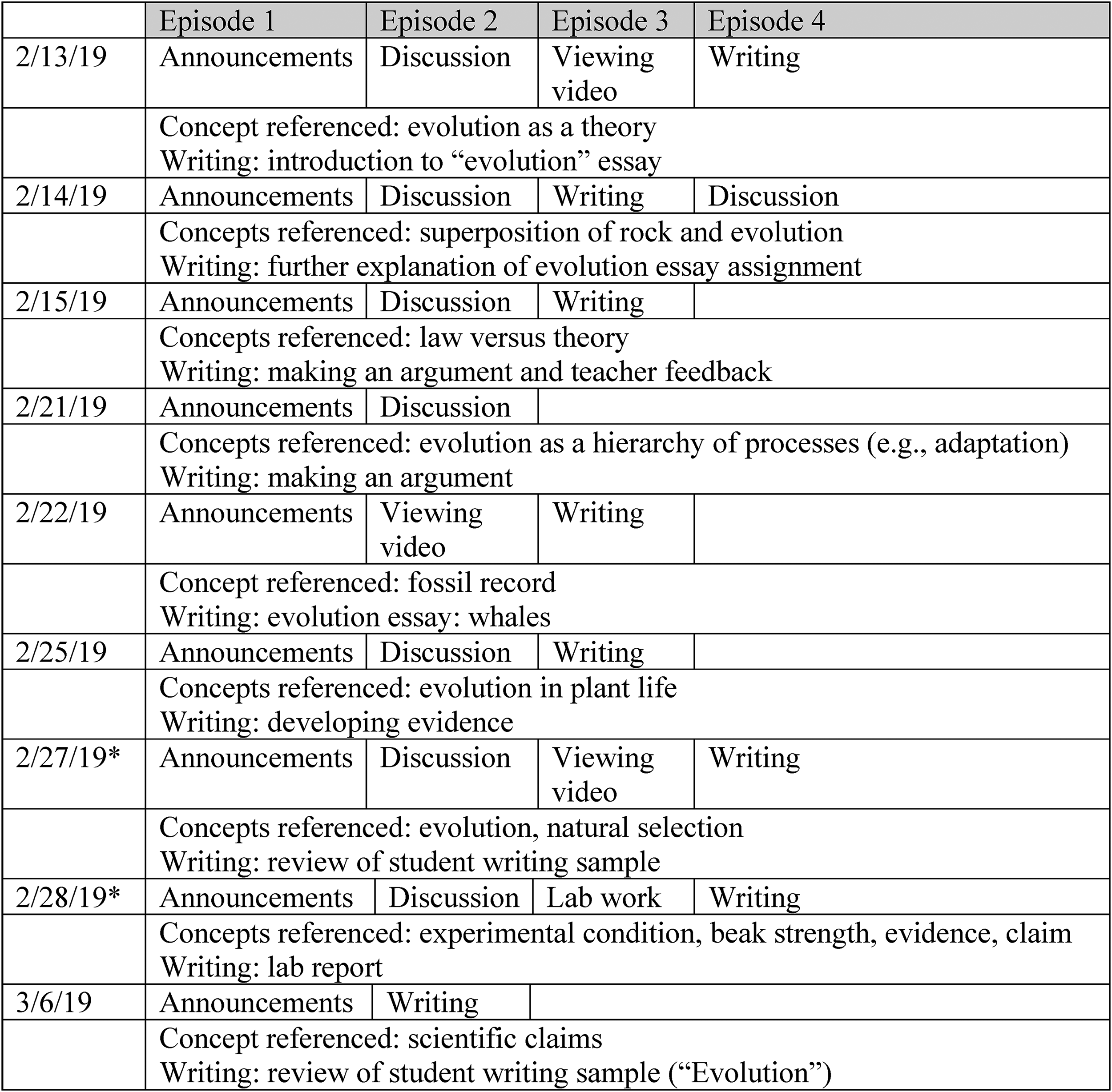
Episodes within the lessons during the evolution unit.
Teacher and student interviews
We interviewed Mr. Delucca several times regarding his professional background, his teaching at the middle school level, his planning of the instructional unit, and his approach to using WTL assignments. We also asked Mr. Delucca to name significant instructional events during our post-observation debriefings and used his recommendations to create instructional chains (VanDerHeide & Newell, 2013) to represent the most critical events in helping students be successful on their respective teacher-sponsored lab reports. We interviewed four case study students with particular attention to how they composed their “evolution essays,” including a lab report and a brief summative essay on “What is your opinion of evolution?” Our goals in these interviews were (a) to understand how each student conceived of the writing task, (b) to trace features of previous instructional conversations, and (c) to find connections to their (primary and secondary) sources.
Data Analysis
To respond to our first research question, regarding how the teacher supported students’ writing to learn about evolution through classroom talk, the theoretical framework for the procedures used in data collection and data analysis derive from Bloome et al. (2005) and are labeled microethnographic discourse analysis, that is, “micro”-level approaches to discourse analysis emphasizing face-to-face interactions, the immediate situation, and local events. This approach provides a way to constantly move back and forth between data and theorizing, theoretical constructs, and assumptions. More than a methodology, microethnographic discourse analysis provides a way for “seeing” language and literacy events in classrooms.
Throughout data collection, researchers in collaboration with the teacher asked, What are the “key events” in the classroom that need to be explored in depth to better understand how the teacher used argumentation and argumentative writing to support learning about evolution (Mitchell, 1984)? A key event, as defined in the context of the study, is a classroom event that is viewed by participants as crucial for students’ acquisition of those epistemic practices that define them as engaging in writing a “scientific argument,” that is, as designated by the teacher as including a claim, evidence, and reasoning. We, as participant observers, selected two events based on specific concerns for teaching and learning argumentative moves as well as on the teacher's suggestion that the events included significant relevance for the goals of the instructional unit.
After identifying key events in the classroom, video recordings of those key events were analyzed using procedures described in Bloome et al. (2005). In brief, the event was transcribed and an utterance-by-utterance analysis conducted of how the teacher and students acted and reacted to each other and constructed meaning and conceptions of evolution and scientific argumentation. In order to capture how a key event was situated within the flow of classroom activity and learning, classroom lessons both before and after a key event were also analyzed. We also looked for analogous classroom events before and after the targeted key event to understand how an epistemic practice (such as using argumentative moves to teach argument) evolved over time. As part of the analysis of key events, the teacher and students were interviewed about the event, how it fit into the broader context of classroom activity, and how they interpreted the meaningfulness of what occurred in the key event.
To make the corpus of data manageable and to consider the content and structure of the curricular domain, we sorted the instructional conversations in three ways: (a) around instructional chains (VanDerHeide & Newell, 2013) that capture key episodes linked by a sequence of classroom activities (e.g., lab work in small groups) that corresponded to supporting students in writing a series of brief essays on evolution (“What is your current understanding of evolution?”) and a lab report on finch beak strength; (b) around selected episodes of instructional conversations that were representative of key events (Mitchell, 1984) within instructional chains representing instruction on writing the essay and lab report; and (c) around movement between intertextual connections across these events. Once each key event was mapped and transcribed, events were then studied and compared for how the students and teacher negotiated evidence construction about the theory of evolution, with particular attention to a lab experiment on the effects of the size and strength of the finch's beak.
Discourse analysis of classroom events
After reviewing the data collected from the classroom and in collaboration with the teacher, we identified two key classroom events to analyze based on the extent to which the instructional conversation within the event was related to a series of WTL assignments and the lab group work that was the culmination of the instructional unit. To determine how the teacher, over time, prompted students to make these same moves during instructional conversations, we conducted a discourse analysis (Bloome et al., 2005) of typical cases (Mitchell, 1984) of classroom literacy events (Heath, 1983). The data were collected in Mr. Delucca's classroom from February 2019 through March 2019. Two key events were the focus of our analyses. We identified Event 1 as the teacher's efforts to use a student writing sample to demonstrate the argumentative writing moves a student (successfully) used to distinguish evolution and adaptation. Event 2 occurred during a class session when students worked in small groups to replicate an experiment on the finch's beak strength.
These two representative events of about 10 minutes each were selected and the instructional conversation within each event was transcribed and analyzed according to the methods of microethnographic discourse analysis. These analyses were triangulated with data from interviews and student work. First, we analyzed and discussed the transcribed events and possible emergent codes that became visible across each chain. We continuously asked, “What is happening here?” with regard to the creation of learning opportunities. We focused on the contextualization cues the teacher and students used (cf. Gumperz, 1986) and how they acted and reacted to each other. Second, to describe what occurred in the instructional conversations within the events, we worked on a message-unit-by-message-unit basis, using procedures from Green and Wallat (1981) and Bloome et al. (2005) to code for “making a claim,” “providing evidence,” and “explaining results” that we also used to code students’ essays and lab reports. Third, we wrote initial memos to capture our unfolding interpretations of the analysis, and then memos to integrate other bits of data such as interviews and student work and thus identify emerging themes (Emerson et al., 1995). Toulmin’s (1958) terminology and Newell et al.’s (2015) studies of teaching and learning argumentative writing helped us describe the construction processes in each instructional conversation.
Modes of participation in scientific argumentation
To respond to our second research question, regarding students’ modes of participation, two case study students’ written products were examined for evidence of the influence of key events through intertextual tracings (Newell et al., 2021; Wynhoff Olsen et al., 2018). In addition, epistemic complexity of the written products (Wilcox et al., 2015) provided a way to characterize how the writing functioned as an instrument for knowledge representation. This analysis was based on a scale from simple descriptions of scientific phenomena to increasingly more complex explanations of relationships of phenomena and analyses of phenomena that include arguments. We also interviewed students about their writing, with particular interest in how they composed it. Our goals in these interviews were (a) to understand how each student conceived of the writing task, (b) to trace features of previous instructional conversations with particular attention to argumentative moves, and (c) to find connections to the primary and secondary sources.
In order to trace how students enacted modes of participation through changing participation in writing practices and shifting writer identities, we began our analysis with the students’ final essays. We conducted a multiphased and multilayered analysis using procedures based on previous intertextual analysis scholarship and backward mapping processes (Green & Wallat, 1981; Prior, 1998; Wynhoff Olsen et al., 2018). First, we constructed a data set of transcribed classroom interactions, curricular materials, and writing from within the instructional unit. Second, we analyzed the essays for connections to the texts and talk over time from classroom discussions, marking the traced connections with particular attention to “making a claim,” “providing evidence,” and “explaining results.” Third, we used “text-based” interviews in which the students described their writing process; we analyzed these interviews for connections between the content of the essays and classroom events focused on argumentation as well as for students’ personal backgrounds that were not accessible from the essay (the product) itself (Prior, 1998). The intertextual tracings (Newell et al., 2021) among the essays and other texts illustrate the actions the students took to participate in the epistemic (writing) practices of the classroom community.
Findings
Instructional Context and Epistemic Practices for Teaching and Learning Evolution
During spring semester 2019, as part of the instructional unit on evolution over 15 contiguous class sessions, nine of which we observed, Mr. Delucca spent some portion of instructional time teaching his students how to participate in constructing evidence for arguments about the theory of evolution and using a lab experience on finches’ beak strength to teach students how to generate empirical evidence for scientific claims (see Figure 1 for key episodes). Figure 1 indicates that Mr. Delucca worked alongside his students to co-construct an understanding of key concepts, written arguments (about evolution) with a range of evidence, and the genre of a lab report using written samples. He questioned students about their observations, provided opportunities to engage in experiments that simulated the process of evidence construction, and assigned (and offered feedback on) writing tasks asking students to argue how a range of evidence supported their claims.
Argumentative writing tasks about evolution
In an interview, Mr. Delucca reported that he used these writing assignments to introduce his students to reasoning about complex topics as well as the need to cover specific information about evolution. He noted, “I expect them [the students] to do more than list facts—I want them to reason through their response. I used the questions [on the assignment sheet] to guide their reasoning.” Mr. Delucca also indicated that he ordered the writing tasks to prompt students to write their own “story of evolution” beginning with what they believed about evolution, exploring what evidence is available from science and from conducting a finch lab experiment, and then considering if they changed their understandings of evolution.
Mr. Delucca used these writing assignments to support his eighth graders’ attempts at written scientific argumentation that he then reviewed and responded to and, on occasion, used as samples of argumentative writing to share with the whole class. For example, he described the series of brief writing assignments for the instructional unit as “a discussion of evolution in a persuasive [argumentative] essay format to think about various ideas and controversies about the theory and about evidence” with a series of prompts to guide students’ essay development:
What is your current opinion of the theory of evolution?
Describe your current position heading into this project.
Specifying Argumentative Moves to Prompt Exploration of Evolution and Adaptation
On more than one occasion, Mr. Delucca and his eighth graders extended their writing as a way to present what had been learned about evolution to using writing in order to learn. This epistemic practice was manifested in different ways at different times. For instance, in our interviews with case study students, they reported that when they responded to Mr. Delucca's writing prompts, they always had another opportunity “to think about the ideas again rather than just writing them down and forgetting.” Several times during the evolution unit, the teacher reminded the students to “make an argument” rather than just summarize facts.
In Table 1, we examine an instructional event that captures how a review of a writing sample provided an opportunity to consider a range of argumentative moves (VanDerHeide, 2018) and triggered scientific reasoning as learning rather than a simple reiteration of information from a previous lesson. In the far-right column, we describe the nature of the discourse moves and how Mr. Delucca explained their uses in making a scientific argument.
Using a Student Writing Sample to Explain Discourse Moves.
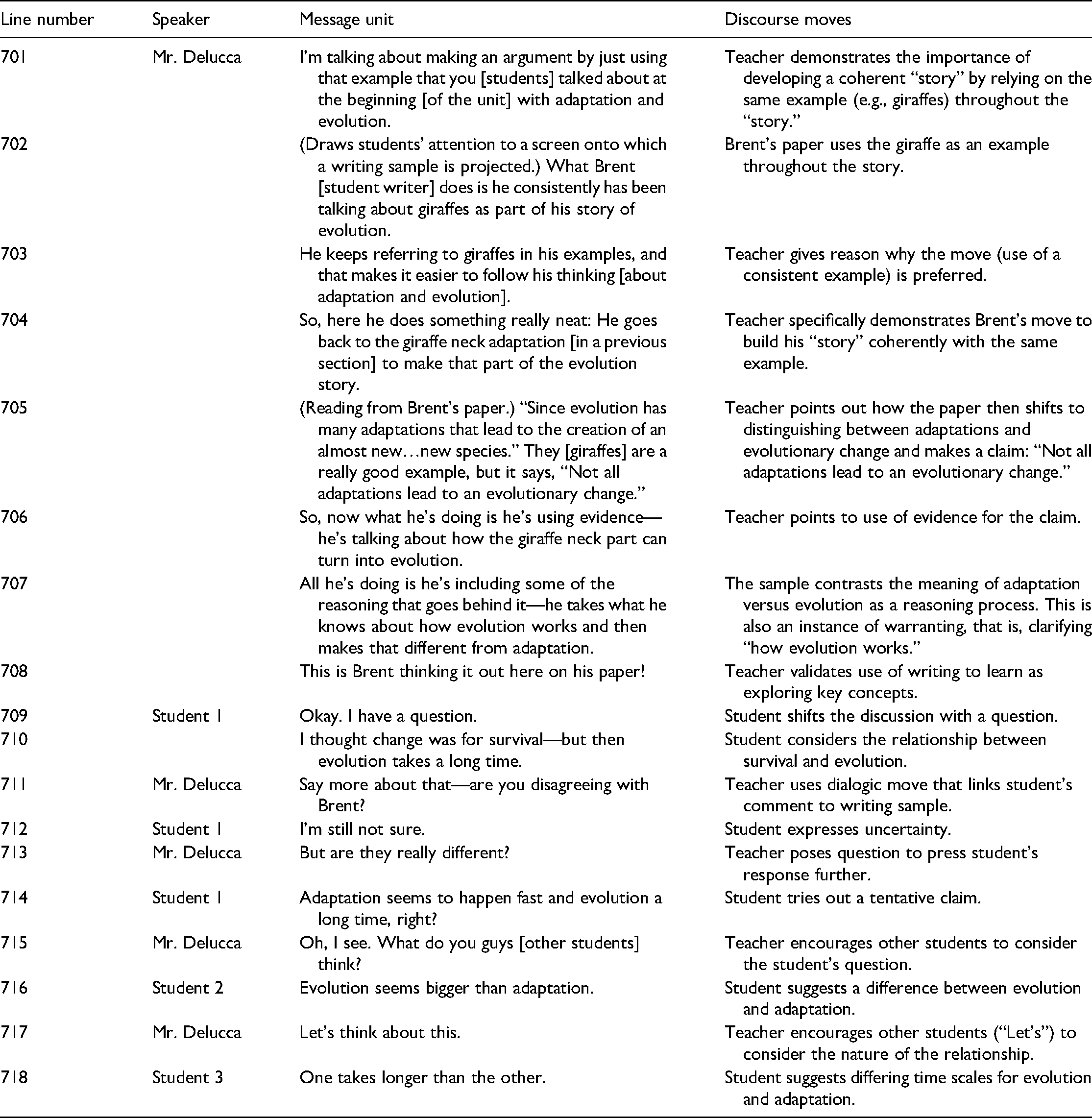
At message units 701–708, Mr. Delucca discusses Brent's writing for two purposes: as a sample of how to build a more coherent story (of evolution) by relying on the same animal as an example when explaining the differences between adaptation and evolution. He also demonstrates what he calls “reasoning” by pointing out how Brent's writing shifts from offering evidence for adaptation and evolution to warranting his claim by explaining how evolution works. That is, within this event Mr. Delucca demonstrates argumentative moves that echo Toulmin’s (1958) model, and in doing so engages his students in an epistemic practice. This event also reveals how the teacher used student writing as a prop (Newell et al., 2018) to foster connections between the content of a student's written text and an instructional conversation. With a student's question at message unit 710, the discussion shifts: “I thought change was for survival—but then evolution takes a long time.” Rather than offering a quick response to the student's question and claim, Mr. Delucca poses another question: “What do you guys [other students] think?” Although this question is dialogic (Scott et al., 2006), it is quite general—the teacher uses it to simply collect ideas. At message units 716–718, the teacher takes up Student 2's comment that “evolution seems bigger than adaptation,” but he asks the other students to “think about this.” Student 3 responds, “One takes longer than the other.” Compared to the broad question, “What do you guys think?,” the request to think about another student's idea is not only more specific but elicits a response that constitutes the beginning of a dialogic interanimation of ideas (Scott et al., 2006).
Exploring Finch Beak Strength During a Small Group Discussion
During the eighth session of the instructional unit on evolution, Mr. Delucca shifted his students away from talking and writing about abstractions such as evolution and adaptation to what he described as “a hands-on experience that allows students to ‘see’ adaptation and evolution.” In addition, he believed a lab experience to be a more “student-centered process” that would “provide an opportunity to create something, share what was revealed, and then write about it to make sense of evolution.” A key dimension of the lab was the replication of Grant and Grant’s (2014) study of the relationship between finches’ beak strength and their survivability.
During session 7, prior to the lab, Mr. Delucca assigned the students to work in small groups to “take notes” guided by short-answer questions while viewing a 16-minute video titled The Origin of Species: The Beak of the Finch (HHMI BioInteractive, 2014). The video “explores four decades of research on the evolution of Galápagos finches, which has illuminated how species form and diversify.” During the next session (8), the students worked in small lab groups to test finch beak strength under certain conditions, to discuss their observations, and to report their findings. Mr. Delucca distributed a worksheet with a series of questions about “Finch Evolution Analysis.” As an example, the first two questions are listed below.
Which beak collected the largest number of seeds? Identify one for each food condition:
Land of plenty: ______ (all seeds available) Drought: ______ (only hard seeds available) Drought recovery (rainy season): ______ (small seeds and insects more available)
Which beak collected the smallest number of seeds? Identify one for each food condition.
Along with tweezers and pliers (representing differing beak strength and size), he then distributed two worksheets. The first worksheet was titled “Beaks as Tools” and included directions for the lab (e.g., “In your teams, two members will act as finches, each equipped with a different tool [tweezers or pliers], while the others will be observers [timer and recorder] to find out how many seeds can be accessed in 30 seconds.”). Also included was a section for making “Predictions” regarding possible results and a section titled “Foraging Experiment” that described the three conditions: Land of Plenty (large and small seeds available), Drought (only large seeds available), and Drought Recovery (only small seeds available). The second worksheet, titled “Finch Evolution Analysis,” served as template for a lab report and contained a series of questions for students to answer.
For our purposes, we are interested in the interaction during the small group work between two students, William and Brianna—two of the four case study students whose lab reports we also consider later in this article. We selected this segment of the event (Table 2) because it includes the development of a claim (what can be concluded) supported by evidence (results under the three conditions) and warranted by evolutionary theory. That is, the talk would seem to support the development of the kind of lab report the teacher assigned as well as participation in epistemic practices such as argumentation and evidence construction as students communicated their emerging understandings.
Discussion of Conclusions Based on Lab Results.
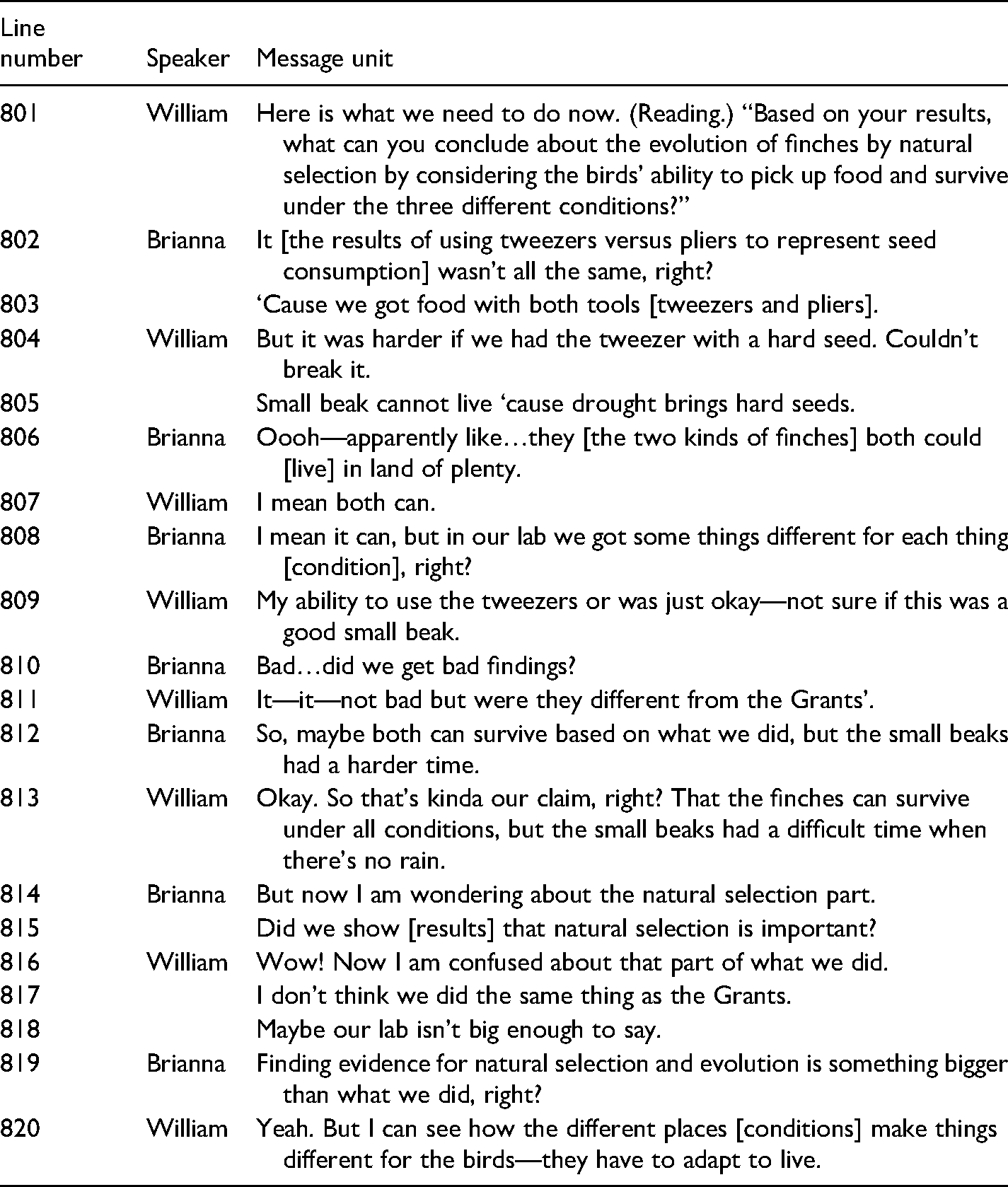
If understanding is fundamentally dialogic as students construct, critique, and explore the meaning of what happened, we find Brianna and William's exchange productive in that they experienced uncertainty in replicating the findings of Grant and Grant (2014) and in co-constructing an argument based on evidence and warranted by theory. At message units 801–809, they sort out the results of their experiment: At message unit 808, Brianna reports that “we got some things different for each thing [conditions].” At message units 809, 810, and 811, they compare their results with the findings of Grant and Grant’s (2014) research as documented in the video and then they express concern that their tools may not have yielded similar results. At message units 812 and 813, after they consider their results, they develop a claim: “that the finches can survive under all conditions, but the small beaks had a difficult time when there's no rain.” Both Brianna and William suggest claims with qualifiers such as “Maybe both can survive” and “So, that's kinda our claim, right?” When Brianna reminds the group that they were to consider their results based on adaptation versus evolution, they seem even less confident. At message unit 819, Brianna struggles to distinguish between adaptation and evolution, and at message unit 820, William seems to grasp the notion of adaptation, but he does not explain the concept and does not connect it to evolution. In order to examine the social processes and complex set of practices through which Brianna and William accomplished the goals of their report writing, in the next section we consider what they wrote in their respective lab reports, with particular attention paid to how their writing was shaped by their peers, teacher, and instructional conversations and activities.
Students’ Modes of Participation Revealed: Tracing Students’ Intertextual Moves
A key finding from our discourse analysis of a key event (Event 1) is that Mr. Delucca attempted to make explicit the moves necessary for analysis and argument to his eighth graders. In this event, he led the students through an analysis of a sample of student writing to explicitly demonstrate how argumentative writing can become a way of presenting and clarifying complex concepts. But to what extent did his students take up argumentative moves in their own writing? As it turns out, this is a complex question to answer given students’ different modes of participation.
Our selection of William and Brianna as case study students was purposeful in that we were especially interested in developing “telling cases” of procedural display and deep participation (Prior, 1998), respectively. To be clear, we are not proposing these two modes as a classification of “good” or “poor” writers. We think the two modes, although a limited heuristic, capture important patterns of school-based disciplinary socialization that Prior (1998) treated as necessary but not sufficient. We characterized William's participation as “procedural” and Brianna's participation as “deep” based on not only the qualities of their lab reports but our interviews with their science teacher about them, and our own interviews with them.
When Mr. Delucca assigned the writing of a lab report based on an experiment on the relationship among changes in finch beak strength for eating food supplies in three weather conditions, this was the first time he deliberately taught a particular type of science writing genre by signaling this intention and using instructional time for this purpose. (This mirrors what occurs in many science classrooms in that only 20% of science teachers report that they provide their students with the opportunity to practice a specific type of writing, with the lab report a consistent feature of such a practice [Applebee & Langer, 2013].) Mr. Delucca's instruction consisted of a four-step process, with students (a) viewing (in small groups) a video of scientists studying finch beak strength and survival, (b) taking notes while conducting the lab, (c) discussing a series of questions on a worksheet in a small group (e.g., “Which beak collected the largest number of seeds? Identify one for each food condition”), and (d) completing the lab report individually by responding to a series of questions “to argue how your findings are consistent with your predictions about each beak's ability to pick up enough food in each environment.” In our judgment, a successful feature of this approach was Mr. Delucca's efforts to use a format that reflects the process of inquiry appropriate to evolutionary biology rather than the simple fill-in-the-blank exercises that currently dominate science lab reports in school settings (Applebee & Langer, 2013).
William's procedural display
After William drafted his report, we were able to interview him about his work. Mr. Delucca had suggested him as a focal student who “is typical of many students who do about average work—not great but he does his work and takes it seriously.” William's approach to this assignment was to “stay pretty close to what [Mr. Delucca] asked us to write based on the questions he gave us.” We used two different approaches to interpret the report: (a) intertextual connections (Bazerman, 2004) to consider the multiple sources drawn upon during the unit, and (b) epistemic complexity (Wilcox et al., 2015) to study the extent to which the lab reports included arguments to explain phenomena and postulate causes, reasons, and other relations or theories related to scientific phenomena. Below is William's lab report with each message unit numbered for our reference purposes: (1) The finch lab that we did can support how food supply can impact finch survival. (2) We had scenarios that were made to simulate what the Grants experienced when watching the birds during the drought, the hurricanes, and the times of plenty of food. (3) In this lab we saw that if the bird had a smaller beak it was made to pick up smaller seeds, and if the bird had a larger beak it was made to break larger seeds. (4) Another relationship that contributed to finch survival was body size. (5) The bird could not be too big for the kind of food it ate. (6) If it was too big then it would die of starvation. (7) In the finch lab we can see that the appearance and beak type of finches has diversified based on location on the island since Darwin first saw them which supports evolution. (8) These changes are evolutions and not adaptations because the original finches have split into many different species, since an adaptation is one small change that is most of the time not very noticeable. (9) The finches separating into 20 different species that all look different easily falls into the category of evolution because it is by no means a small change to one part of the species.
Each of William's nine message units reflect his step-by-step responses to the questions Mr. Delucca asked the students to consider; that is, William's responses are intertextually linked to the worksheet titled “Finch Lab.” For example, message units 1 and 2 are a response to the question: “You collected data on how food supply can impact which finches survived. How did this lab correlate to what the Grants experienced on Daphne Major?” Put simply, William's report was developed as he responded to the list of questions as if he was responding to study questions rather than writing a lab report. Note too that during the small group lab discussion he was concerned with answering a question: “Here is what we need to do now [reading].” When we asked about this approach, he commented, “That's the way I think Mr. Delucca wanted us to write it [the report]. Anyway, that's the way you write in science classes to be objective.” We also noted that William's report does not index any of the uncertainty (“Wow! Now I am confused about that part of what we did”) evident in his contributions to the small group lab discussion.
William's brief report is well organized, is factually descriptive, and explicitly states an argument shaped by a set of questions provided by the teacher. It is also meaningfully organized and has the potential of facilitating understanding of the differences between evolution and adaptation. In terms of epistemic complexity, we coded William's report at level 3: “Well-organized facts. A statement consisting of rather well-organized factual or descriptive information.” This piece of writing was indexed at level 3, relatively high, which would not have been the case if the writing prompt itself did not call for identifying connections to Grant and Grant’s (2014) research and Darwin's findings. William's mode of participation can be characterized as “Here is what I learned,” especially in his efforts to respond mechanically and specifically to each of the teacher's questions used to prompt the development of the lab report.
Brianna's deep participation
Recall that earlier in this article we introduced Brianna as a “quiet student” who was adapting to a new school, new classmates, and new academic challenges. In an interview, she reported that her previous school “was not very academic” compared to her current middle school. She was also the only Black student in Mr. Delucca's life sciences class. Though she described herself as “quiet” and said she wanted to be academically successful, Brianna was quite willing to take risks in her writing: “[Mr. Delucca's] writing assignments are difficult but he lets us write ideas that we want. And he doesn't grade like language arts teachers. I can write what I’m thinking about as long as I try to make sense.” Brianna also took seriously Mr. Delucca's efforts to distinguish “just listing facts” from “reasoning about evolution” (see the discussion of Event 1 above) when he reviewed and discussed writing samples that he believed captured “thinking it out here on…paper.” Her contributions to the small group lab discussion demonstrated her efforts to move beyond responding to a set of teacher-sponsored questions to making an argument about experimental results: “So, maybe both can survive based on what we did, but the small beaks had a harder time.” Accordingly, Brianna's disposition toward talking and writing to learn brings us to characterize Brianna's participation as relatively “deep” compared to William's participation and based on not only the qualities of her lab report but our interviews with her science teacher about her, and our own interviews with her.
Brianna positioned herself as both a committed insider and a critical outsider in her writing. For example, when we asked her to describe how she approached writing for Mr. Delucca, she surprised us by pointing out, “He reads my writing carefully and talks to me with his [written] comments.” She described her writing process as “going beyond what he [the teacher] says in class to going into ideas by googling them at night [for homework] when I am writing.” However, due to her family's religious practices and beliefs, Brianna was skeptical about, if not in opposition to, evolution “as a way to see the world that differs from my way.” This skepticism, however, may have fostered a deep engagement as she sought to understand the differences between a scientific and a religious worldview.
Rather than reviewing all of the details of Brianna's lab report, which we rated at epistemic level 5—“Well organized explanation. A statement containing postulations of common causes, reasons and other explanatory relations, or theoretical entities”—we provide a brief description of its content and then turn our attention to a bit of writing she did as she reflected on what she had learned from the lab work. Her lab report included 37 message units when compared to William's nine message units. Her use of intertextual connections was largely grounded in very specific lab procedures: We simulated this [Grant and Grant’s (2014) studies] in a lab where there were grains of rice to represent small seeds for the medium ground finch, and there were pinto beans to represent big seeds for the larger beaked birds. We used pliers and tweezers to act as birds: Pliers are longer and open wider, representing large beaks of larger birds. Tweezers were smaller and opened just barley, representing the small beaks [of] the Medium Ground finch.
Brianna also makes a very clear claim near the end of her report: “The finches [lab] can support evolution because when the finches made adaptations to survive due to things like droughts and monsoons, or other changes to their environments that separated them for a long time, scientist would say they’d evolved into new species. A long separation is important to have evolution.” At message unit 37 Brianna writes, “Altogether, it said the changes in finches [as observed in the lab] are evolutionary and not just adaptation because the different species of finches had become completely opposed to each other.” According to Mr. Delucca, Brianna's grasp of “how adaptation and evolution differ and how they are related is a complex idea that my eighth graders often fail to understand.” That is, she grounds her hypothesis regarding the differences between evolution and adaptation based on the results of the lab and in theoretical framing presented by Mr. Delucca during the instructional unit.
In the “Evolution” worksheet, there was a final section titled “Your Final Opinion/Conclusion” about evolution. Brianna's final section prompted by the question “What is your opinion on evolution?” includes a personal essay of over 2,000 words in which she engages in a dialogic argument with Mr. Delucca regarding the validity of Darwin's theory of evolution. Even though most of the research [reviewed in class discussions] was still backing up evolution as just happening naturally, and, at times, I thought I was changing my mind, I’ve discovered some holes [in the data] along the way to back up what I believe, and picked up some data to support the conclusion I’ve drawn. Scientists are pretty convincing but they will have to do some work to fully convince me.
This is a bold statement in light of the fact that she is writing to her science teacher as the primary audience. So, how is it possible to argue that Brianna's participation in the study of evolution was “deep” or perhaps deeper relative to William's mode of participation? We think the comment “At times I thought I was changing my mind” is telling in that she has grappled with conflicts between scientific knowledge and what she revealed to be religious belief. Following Wertsch’s (1991) notion of privileging, in this section of her essay, Brianna has privileged the social language (Bakhtin, 1981) of religious belief over scientific understanding. We think Brianna's participation in this segment of her essay exemplifies her resistance to socialization that Mr. Delucca embraced as a way “to begin with the student's beliefs from home.” Efforts to allow for exploration through talk and writing became, for Brianna, a specific opportunity to perceive and act to make sense and to develop new understandings.
Although we assume some readers will disagree with us, we think that if students are permitted to challenge scientific rationality, teachers may have the opportunity to elevate the ways in which students from a range of cultures and discourses read, think, write, and argue by suspending judgment and superficial understanding and moving toward appreciating and seeking diverse viewpoints—scientific, religious, humanities—with a range of rationalities about what makes sense and how to take reasonable action (cf. Brown, 2019). As we understand it, this means that science might be taught as one way of understanding our experience of the natural world—that is, one of the most valuable ways.
Discussion and Implications
The purpose of this study is to explore one teacher's instructional method for teaching scientific argumentative writing, a method that did not specify a particular form students needed to use. We explore what an alternative method may be, particularly what the students are learning to do in and through writing and how the teacher scaffolds this learning. In so doing, we hope to add to the ongoing conversation on how to teach scientific practices that allows for students’ personal constructions in what they talk about and how they write it. A key finding is that classroom talk and learning to write are intertwined in many ways. When students talk together as a whole class or small group about the content they are writing on, they develop and borrow ideas that can become sedimented in the writing (VanDerHeide, 2018).
We also contrasted the modes of participation of William and Brianna to explore two different trajectories and to examine particular cases of writing a lab report. We recognize that this comparative analysis is limited to bits of a single assignment composed by just two students. In future studies, we will collect drafts and responses to drafts for not only the lab report but other writing assignments and will conduct interviews with the teacher to explore how the texts were read and responded to, and the kinds of text-based interviewing that might provide more evidence and specificity.
Beyond Disciplinary Literacy to Academic Literacies
As we articulated in the introduction, in recent decades a “disciplinary literacy” approach has dominated the study of teaching and learning in the content areas in the U.S. schools. Since we are particularly interested in understanding the nature and relationship of discourse processes and social practices in instructional settings, an approach grounded in text-oriented practices and decontextualized cognitive processes is rather restrictive (cf. Hinchman & O’Brien, 2019), especially considering the changing demographics of the country and our schools. Accordingly, we have adapted Lea and Street’s (1998, 2006) “academic literacies” to account for the cultural and contextual factors of WTL in content areas such as science as well as for the linguistic, social, and cultural practices of students. For example, our study of Brianna's participation in a predominantly White classroom with students the middle school had designated as “advanced” life sciences students raises questions regarding student access to scientific knowledge, given the differences in register between scientific discourse and everyday ways of speaking, knowing, and being, such as religious discourse and practices (Cope, 2020). Taking on a scientific discourse includes building an identity with the discipline and members of the local discourse community, which can be alienating for some students (Brown, 2019), as their everyday way of speaking and interacting is often not valued in educational settings. To address the variation in discourse practices across communities, studies of academic literacies need to account for language variation, specific forms of scientific discourse that pose problems for learners, potential contributions from students’ cultural knowledge, and ways that affiliation and identity are constructed through language use.
Implications for Further Research
One of the reviewers reminded us that our study focuses on “high achieving” students (though it is also a much-needed one focusing on writing in science). Studies of WTL in the content areas, including the sciences, are needed for students who find themselves in “lower tracked” contexts that position students in deficit positions and in classrooms where instruction tends to be skills-based and divorced from knowledge-building. Exacerbating this problem are the pressures that come with the need for students to pass high-stakes tests and the tendency for test-preparation instruction to focus on learning content rather than on activities that would help them better understand disciplinary content and develop academic literacies.
Literacy researchers have provided plenty of evidence that all students can learn when expectations are high (Langer, 2004) and with writing activities that are related to the central issues and problems of the discipline (Wallace et al., 2007). This work may be especially needed in science education, where, if students are given directions to use writing as a way of knowing, we may have more students who not only understand concepts but have a deeper understanding of epistemic practices and scientific processes.
Footnotes
Declaration of Conflicting Interests
The author(s) declared no potential conflicts of interest with respect to the research, authorship, and/or publication of this article.
Funding
The author(s) received no financial support for the research, authorship, and/or publication of this article.

References
Supplementary Material
Please find the following supplemental material available below.
For Open Access articles published under a Creative Commons License, all supplemental material carries the same license as the article it is associated with.
For non-Open Access articles published, all supplemental material carries a non-exclusive license, and permission requests for re-use of supplemental material or any part of supplemental material shall be sent directly to the copyright owner as specified in the copyright notice associated with the article.
