




Abstract
Research on how peer feedback affects second language (L2) writing in higher education has been limited. This study examines the impact of peer feedback on revision and literature review writing in learners of Chinese as an L2 at a university in mainland China. The study analyzed feedback, revisions, and writing performance of 30 students. The quantitative analysis revealed that revision-oriented feedback had significantly positive effects on revision. Adopted-feedback-revision explained the gain score in the writing performance. The qualitative text analysis demonstrated that students paid unbalanced attention to the genre-specific characteristics of the literature review and the concreteness varied accordingly. Students valued peer feedback for improving comprehension, thinking skills, and audience awareness, especially when it identified issues with specific revision suggestions. This study contributes to the field by addressing how Chinese language learners benefited from peer feedback when writing literature review in higher education, which also has practical implications.
Plain Language Summary
Highlights: • Revision-oriented feedback positively affects the revision in literature review writing by undergraduate students of Chinese as a second language. • Adopted-feedback-revision explains the gain score between the first and the final drafts. • Students provided unbalanced feedback to genre-specific characteristics of a literature review and the concreteness of feedback varied accordingly. • Students regarded the most useful feedback as those that could point out problems and provide specific suggestions for revision.
Keywords
Introduction
This study aims to investigate the effects of peer feedback on literature review writing among learners of Chinese as a second language (CSL). Peer feedback refers to learners’ practice of providing and receiving oral and/or written feedback to or from their counterparts (Yu & Lee, 2016). Supported by several theories (J. Liu & Hansen, 2002), including process writing theory (Flower & Hayes, 1980), collaborative learning theory, and socio-cultural theory (Vygotsky, 1978), peer feedback is believed to help L2 learners improve their writing performance and thus, it has been widely employed in second language (L2) writing instruction. Benefits of peer feedback in cultivating audience awareness (Cao et al., 2019; C. Y. Chang, 2015), enriching students’ knowledge of rating rubrics (Wang, 2014), and enhancing L2 writing performance (J. Liu & Sadler, 2003; Min, 2005; Min, 2006; Pham et al., 2020) have been reported in the literature.
Many of the studies have examined how peer feedback fosters argumentative writing (Zhao, 2014), narrative writing (Tajabadi et al., 2023; Wu, 2019), and expository writing (Wang, 2014). However, there is a dearth of research that explores the role of peer feedback in thesis writing (Cho & MacArthur, 2010; Gielen & Wever, 2015; Huisman et al., 2018; Yu & Hu, 2017; Yu, 2019), particularly with regards to literature reviews (Cao et al., 2019; Chen, 2010; Gao et al., 2019; Huisman et al., 2018). Literature review is a crucial part of a thesis, normally a mandatory requirement for degree studies in higher education. It has specific requirements of discourse structure, style, and content that are set by the academic community. Writing a literature review is more demanding than many other writing tasks because it requires learners to examine, summarize, organize, and use existing studies on a specific subject to build a line of arguments for one’s own research (Boote & Beile, 2005). Studies on English language learners indicate that students encounter great difficulties and challenges in giving feedback to their peers’ theses, including a literature review, due to a lack of genre-specific knowledge and skills to provide feedback (Yu, 2019, 2020; Gao et al., 2019). Therefore, the effects of peer feedback on literature review writing need further examination.
Despite these challenges, numerous learners have enrolled in Chinese courses at higher institutions in mainland China. According to a survey in 2018, before COVID-19, there were 492,185 international students coming from 196 countries and regions pursuing their studies in mainland China (Ministry of Education of the People’s Republic of China, 2019). Many of them face the challenge of writing a thesis as a graduation requisite. Peer feedback plays a significant role in students’ thesis writing. Yet, the majority of relevant studies explored how peer feedback (Cao et al., 2019; Gao et al., 2019; Pham et al., 2020; Yu, 2020) influenced writing in English as a first language and as an L2. Consequently, we have limited knowledge about how CSL learners can benefit from peer feedback in Chinese thesis writing. The study focuses on the writing of a literature review because it lays the foundation for thesis writing and is cognitively demanding. Thus, the study aims to explore how peer feedback affects revision and L2 literature review writing among CSL learners. An investigation on this issue could provide insights into peer feedback mechanisms in CSL academic writing and shed light on pedagogical practice in higher education.
Literature Review
The Impact of Peer Feedback on L2 Writing
As reported in the literature (Mendonca & Johnson, 1994; Paulus, 1999), peer feedback does not always substantially improve writing performance. The question of what characteristics of peer feedback facilitate L2 writing has been extensively discussed. With attention to its focus, feedback has been classified into language, content, and organization (J. Liu & Sadler, 2003; Min, 2005). Feedback on language, also labeled as local issues, mainly covers spelling, usage of lexical items, syntactic errors, and format, if applicable. Feedback on content and organization, also referred to as global issues, are concerned with elaborations of ideas, structure, and logic of paragraphs. Some studies have indicated that students’ comments tend to focus more on local issues than on global issues (Leki, 1990; Paulus, 1999), which fail to provide relevant information for text-level revision. According to Lockhart and Ng’s survey on 56 ESL college learners in Hong Kong (1993), students perceived feedback on content and organization as more useful than those on language. However, in the study of Huisman et al. (2018), undergraduate students in the Netherlands perceived feedback on content, language style, and structure as equally adequate. The authors explained that the language style weighted 50% of the final score, which drove the students to value feedback on this aspect as much as the other two.
Studies on learning processes have examined cognitive functions of peer feedback in increasing students’ willingness to make revisions (Cheng et al., 2015; Cho et al., 2006; Huisman et al., 2018; Min, 2005; Min, 2006). Min (2005, 2006) analyzed functions of peer feedback in terms of clarifying authors’ intention, identifying the problem, explaining, and making suggestions. Her study (2006) found that the number of peer comments including multiple functions increased after training. The enhanced quality of feedback induced 90% peer-triggered revisions out of the total revisions. Consequently, the students’ L2 writing performance improved. Cheng et al. (2015) examined the feedback types from an affective dimension (supporting, praise, and opposing), a cognitive dimension (direct correction, personal opinion, and guidance), and a metacognitive dimension (evaluating and reflecting). Their findings indicated that direct corrections were more helpful for improving undergraduate students’ writing than reflecting comments and praise. Huisman et al. (2018) examined 89 undergraduate students’ perceptions toward peer feedback. The functions of feedback were operationalized into analysis (clarifying the problems), evaluation (commenting on advantages and disadvantages), explanation (giving justifications), and revision (making direct suggestions). The results showed that the explanation feedback, which provided justifications to evaluative comments and suggestions, significantly predicted students’ perceived adequacy and willingness to improve. The researchers explained that explanation would induce cognitive processing in students, which motivated them to revise.
Some other studies have highlighted the effects of concrete feedback on writing improvement. These studies categorized peer feedback into revision oriented and non-revision oriented (C. Chang, 2012; Liou & Peng, 2009). Revision oriented comments are those that provide specific advice addressing the problems in written compositions, such as direct corrections. Non-revision-oriented comments, on the contrary, are comments such as praise or summary which do not indicate suggestions for revision. Some studies suggest that revision-oriented feedback enhances writers’ incorporation of feedback into text revision and, consequently, improves writing performance (Cho et al., 2006; Cho & MacArthur, 2010; Gielen & Wever, 2015; Nelson & Schunn, 2009). For instance, Cho et al. (2006) found that undergraduate students perceived direct comments, suggesting a specific change to the paper, as the most helpful and direct comments positively associated with simple revisions (Cho & MacArthur, 2010). However, contradictory results were also reported in Strijbos et al.’s study (2010). They assigned university students to concise general feedback and elaborated specific feedback groups, and found students in the general feedback group outperformed those in the specific feedback group in the post-test. The authors explained that students who received specific feedback might passively rely on the feedback while making very few active changes to the problematic texts.
The Impact of Peer Feedback on L2 Thesis Writing
Research on peer feedback in the context of L2 thesis writing has received increasing attention in the field given its essential yet challenging nature for college students. Studies on this issue suggest that students often have great difficulties in giving feedback, given its intricate demands. This complexity amplifies our understanding on the impact of peer feedback on thesis improvement. Yu (2020) examined the written feedback from seven English language learners to their peers’ Master’s theses. Drawing on interviews and stimulated recalls, he found that students lacked knowledge about functions of distinct parts of a thesis, as well as lacked skills to provide genre-based feedback, due to insufficient training. However, despite limited training, the findings showed that peer feedback increased some students’ knowledge of the literature review genre, especially in terms of using resources to support one’s argument and employing appropriate citation styles. The author emphasized that when exploring peer feedback in thesis writing, special attention should be paid to genre-specific characteristics which pertain to the purposes of different components of a thesis, such as abstract, introduction, and literature review.
In another qualitative study, Yu (2019) identified the benefits of peer feedback in enhancing students’ theses writing. The researcher found that peer feedback raised students’ awareness of the genre, motivated learners to seek scholarly resources, and improved thesis writing skills. Several students repeatedly mentioned in their interviews that peer feedback helped them to write a comprehensible and logical literature review. While Yu’s studies took a comprehensive look at thesis writing, Gao et al. (2019) narrowed their focus on literature review writing. They analyzed 21 university students’ feedback on their partners’ literature review compositions. They found that students primarily focused their comments on explaining their own research while paying less attention to the effectiveness of arguments. Besides, students did not tend to use comments for revisions unless the problems in the written text were addressed by different reviewers.
Peer Feedback for Chinese Language Writing
While much of the existing research has focused on English language learners, there is a notable gap in research that investigates Chinese language writing among CSL and CFL learners. Studies on this topic have primarily examined linguistic features of Chinese writing performance (Lu & Wu, 2022) and rhetoric preferences (Y. Liu & Du, 2018). There is a dearth of research that has investigated the role of peer feedback in enhancing Chinese language writing. Ji (2019) explored the perspectives of 10 Chinese heritage learners on peer feedback for rewriting textbook chapters practice. The participants showed a positive attitude toward peer feedback. The students reported that peer comments provided diverse perspectives, increased their awareness of the audience, and motivated them to improve their writing quality. The author emphasized that the shared cultural background of these students fostered a collaborative environment for peer feedback practice.
Another recent study by Zhu and Qin (2022) examined how peer feedback facilitated descriptive essay writing among Chinese-as-a-foreign-language learners. They found that 86.5% of comments generated from four students were language-related. In contrast, only 13.5% of the feedback centered on content, organization, and mechanics. 74% of the feedback was incorporated in revised drafts. The participants valued the peer feedback and perceived most of them as accurate and beneficial for improving writing performance. Factors that influenced peer feedback included interpersonal relationships, time limitations, lack of vocabulary knowledge, and disagreement. Both studies adopted a case study design, and there is a lack of quantitative evidence supporting the effects of peer feedback on Chinese language writing. Beyond these two, scant research has investigated the impact of peer feedback on CSL thesis writing in higher education.
In summary, while studies have investigated peer feedback from different perspectives, they have yielded mixed results regarding its influence on revision and writing performance across different genres (Cheng et al., 2015; Huisman et al., 2018; Lockhart & Ng, 1993; Strijbos et al., 2010). Previous studies have primarily focused on English language learners and the impact of peer feedback on descriptive writing, narrative writing, and argumentative writing, often overlooking learners of other languages and the realm of academic writing. Given its importance in higher education, it is urgent to explore how peer feedback affects thesis writing, both broadly and in its specific components, among non-English language learners.
The Study
The study aims to explore the characteristics of peer feedback and its influence on literature review writing among CSL learners. Thus, the study has the following four questions.
(1) What are the characteristics of the feedback that CSL provided on their peers’ literature review writing?
(2) What is the relationship between types of feedback, adopted-feedback-revision, and literature review writing improvement?
(3) How do students use peer feedback to improve literature review writing?
(4) What are CSL students’ perceived benefits of peer feedback?
By employing a mixed-methods approach, the study collected quantitative data (writing performance, frequencies of different types of feedback, frequency of adopted-feedback-revision, and gain score) as well as qualitative ones (written texts, content of feedback and revision, and interviews) to gain an in-depth understanding of the impact of peer feedback on students’ L2 literature review writing.
Participants
The participants were 30 international students who enrolled in a Chinese academic writing class at a renowned university in Mainland China. At the time of data collection, they were all in the first semester of the fourth-year study of the B.A. degree program of Chinese language. The participants come from 14 countries, mainly Indonesia, Thailand, and South Korea. There were 16 males and 14 females. Their Chinese proficiency is at Hanyu Shuiping Kaoshi (HSK) Level 5 with scores ranging from 186 to 279 out of a full score of 300. The HSK is the most popular international Chinese language proficiency test. In 2022, more than 500,000 examinees took the HSK held in 162 countries. HSK level 5 is roughly equivalent to C1 in the Common European Framework of Reference for Languages (CEFR). International students at this level of proficiency are expected to be able to communicate in academic Chinese for their undergraduate studies. Due to the diverse range of students’ L1s and varying levels of English proficiency, we used Chinese as the language for peer feedback practice and interviews. A set of five research articles on a common topic, that is, the impact of the COVID-19 pandemic on university students’ well-being, was provided to the students. The specific writing prompt asks the students in the academic writing class to write a literature review for the above-mentioned articles with no less than 500 Chinese characters within 1 week. The consent forms were sent to students after the grades of the course were released to avoid conflict.
Procedure
Due to the influence of the COVID-19 pandemic, the class hours were conducted via Zoom by the second author. Prior studies on computer-mediated peer feedback have suggested the functions of online tools in facilitating peer feedback practice (Gielen & Wever, 2015; Liou & Peng, 2009). The current study used WeDocument, an online platform that allows members of a group to synchronically co-edit and comment on each other’s written compositions. The instructor spent the first two classes teaching the genre-specific characteristics of a literature review with written samples. Based on the previous studies (Boote & Beile, 2005; Gao et al., 2019; Yu, 2020), a literature review has specific requirements on language, content, and organization. Language includes accuracy, cohesion, academic language style, and academic citation format. Content entails synthesis of previous research, critical evaluation of the previous research, and explanation of the significance of one’s own research. Organization refers to essential components of a literature review, categorization of previous research by themes and sub-themes, and coherence of arguments. This framework (see Table 1), serving as rating rubrics, was offered to students as a formative tool. In another two classes, the instructor explained feedback focuses and demonstrated steps of providing peer feedback. First, the instructor presented a written sample with attached comments and compared the content of the comments. Second, the instructor demonstrated the steps of identifying problematic areas in the written sample, explained the problems, and made suggestions in the comment. Then, the instructor asked the participants to pair up with someone they were familiar with and then to give feedback to their peers’ writing compositions on WeDocument.
Rubrics for Literature Review.

The training procedure is illustrated in? Figure 1. The first-round practice lasted for 3 weeks for the pilot purpose. The participants familiarized themselves with the steps of searching for literature in China National Knowledge Infrastructure (CNKI), writing the first draft of the literature review, reviewing their peers’ writing, commenting on their peers’ literature review in Chinese via WeDocument, reading peers’ feedback, revising the draft, and submitting to the instructor. The main data for the current study came from the second round, which repeated the procedure of the first round. The students were given 1 week to write a literature review on another topic: the impact of the COVID-19 pandemic on university students’ well-being. This topic is highly relevant to the students’ lives and the current situation. The data comprises the participants’ first and final drafts, peer feedback, and text revisions, all of which are archived in WeDocument.

The training procedure.
Thereafter, ten students with high, intermediate, and low HSK scores were invited to participate in the interview. The purpose is to elicit opinions from beneficiaries of the activity on their perceptions of peer feedback.
Data Analysis
The content of peer feedback received by the students was first segmented into idea units because reviewers sometimes discussed multiple issues regarding different dimensions of writing in one comment. An idea unit includes a few words or multiple sentences commenting on a single topic (Nelson & Schunn, 2009). Then, the idea units were categorized on the basis of their focuses of the literature review: language, content, or organization. Cognitive functions of feedback were analyzed with reference to previous studies (Cho et al., 2006; Huisman et al., 2018; Min, 2005) as clarification (i.e., asking for explanation), problem description (i.e., pointing out problems), suggestion (i.e., providing directions for changes), and praise (i.e., comments on good features of writing). As for concreteness, feedback was coded into revision oriented (i.e., concrete solutions to improve the problems) and non-revision oriented (i.e., praises and general feedback that does not provide concrete solutions) (C. Y. Chang, 2015). The examples for coding different types of feedback are presented in Table 2.
Types of Feedback, Dimensions, Definition, and Example.

Moreover, the first and final drafts were exported from WeDocument and then compared by Microsoft to further identify revisions. The revisions were then cross-referenced with the feedback received. Revisions that can be attributed to the feedback was labeled as adopted-feedback-revision (Excerpt 1 shows an example). A sample of 5% comments was coded independently by two coders, and then the results were compared to identify disagreements. All the discrepancies were resolved through discussion. Therefore, the inter-coder reliability reached 100%. The first and final drafts of the second round were independently rated against the criteria as shown in Table 1. The inter-rater reliability (Intraclass Correlation Coefficient) for the first and final drafts is 0.941, with a 95% confidence interval of (0.888, 0.968), and 0.958, with a 95% confidence interval of (0.924, 0.977), respectively. The gain score in this study was defined as the difference between the writing scores of the first and final drafts.
To explore the impact of peer feedback on revision and writing performance, structural equation modelling (SEM) analyses were performed to explore the pathway from feedback types to final gain score, mediated by revision action. Qualitative text analysis on original writing, feedback, and revision was also conducted to cross-validate the quantitative analysis. The excerpts in the following session were originally written in Chinese. The first author translated them into English and then, the second author checked the accuracy of the translation.
Students’ perceptions were collected via interviews. which were audio-recorded and transcribed verbatim. Themes that were widely discussed in the literature (e.g., “raising audience awareness”) were applied for content analysis.
Findings
The Characteristics of the Feedback
Feedback was analyzed independently in each of the following three types: focuses, cognitive functions, and concreteness. The Pearson’s bivariate correlation coefficients between sub-dimensions in each of the four categories were not significant. To save space, the results were not presented in this manuscript, whereas the descriptive statistics are reported in Table 3.
Descriptive Statistics for Different Types of the Received Feedback (n = 30).
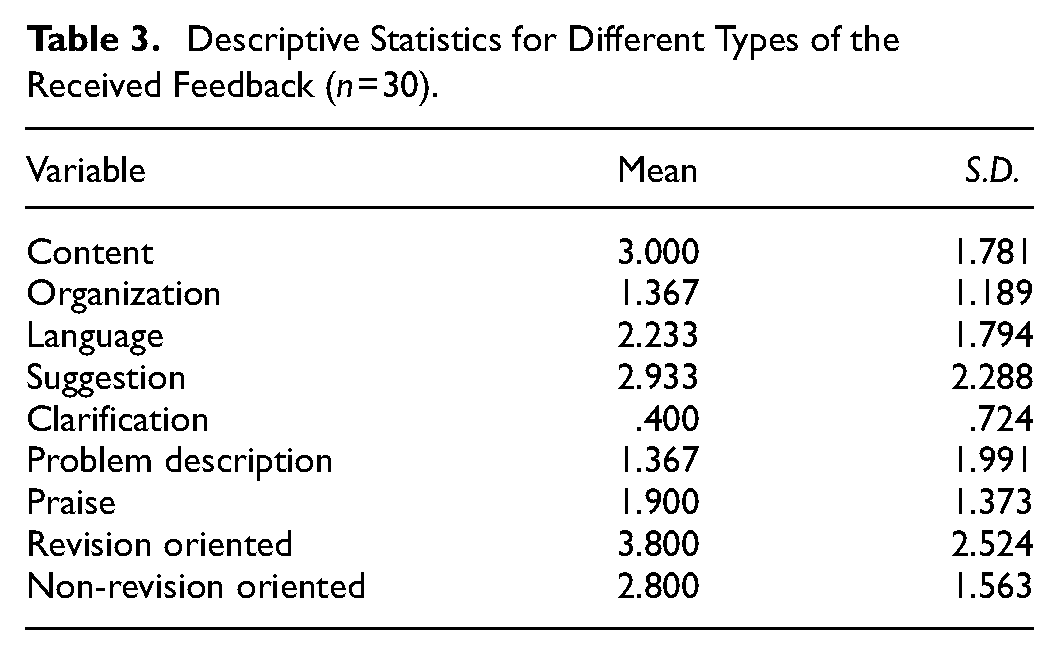
The following box-plots (i.e., Figures 2 –4) show the distribution of feedback in each of the above-mentioned categories of this study. The box-plots indicate that students received content feedback most frequently and organization feedback most infrequently. Peer feedback was more revision oriented than non-revision oriented, and their sequence of frequencies in terms of cognitive functions were as follows: suggestion, praise, problem description, and clarification.
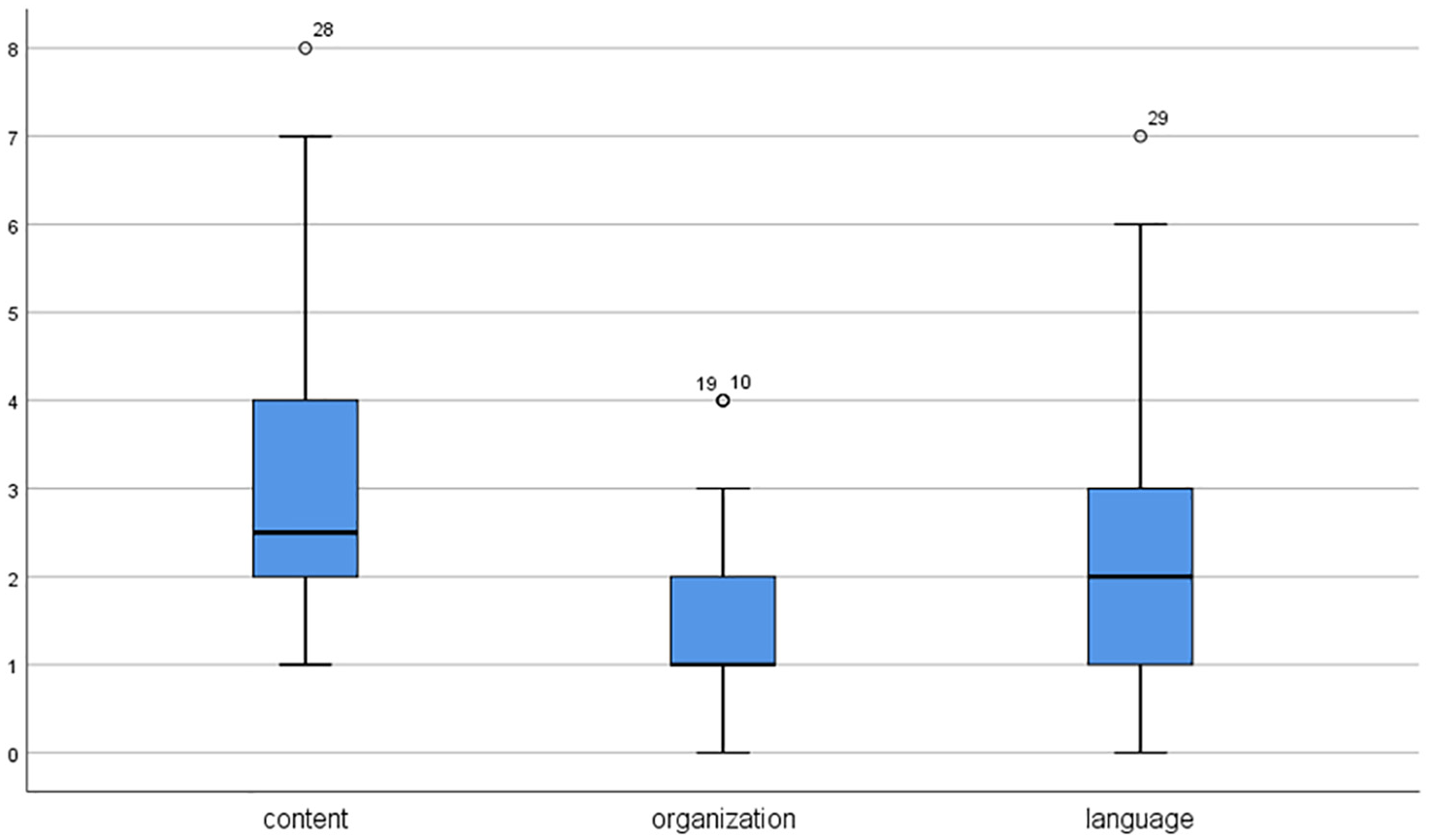
Distribution of focuses of the feedback.
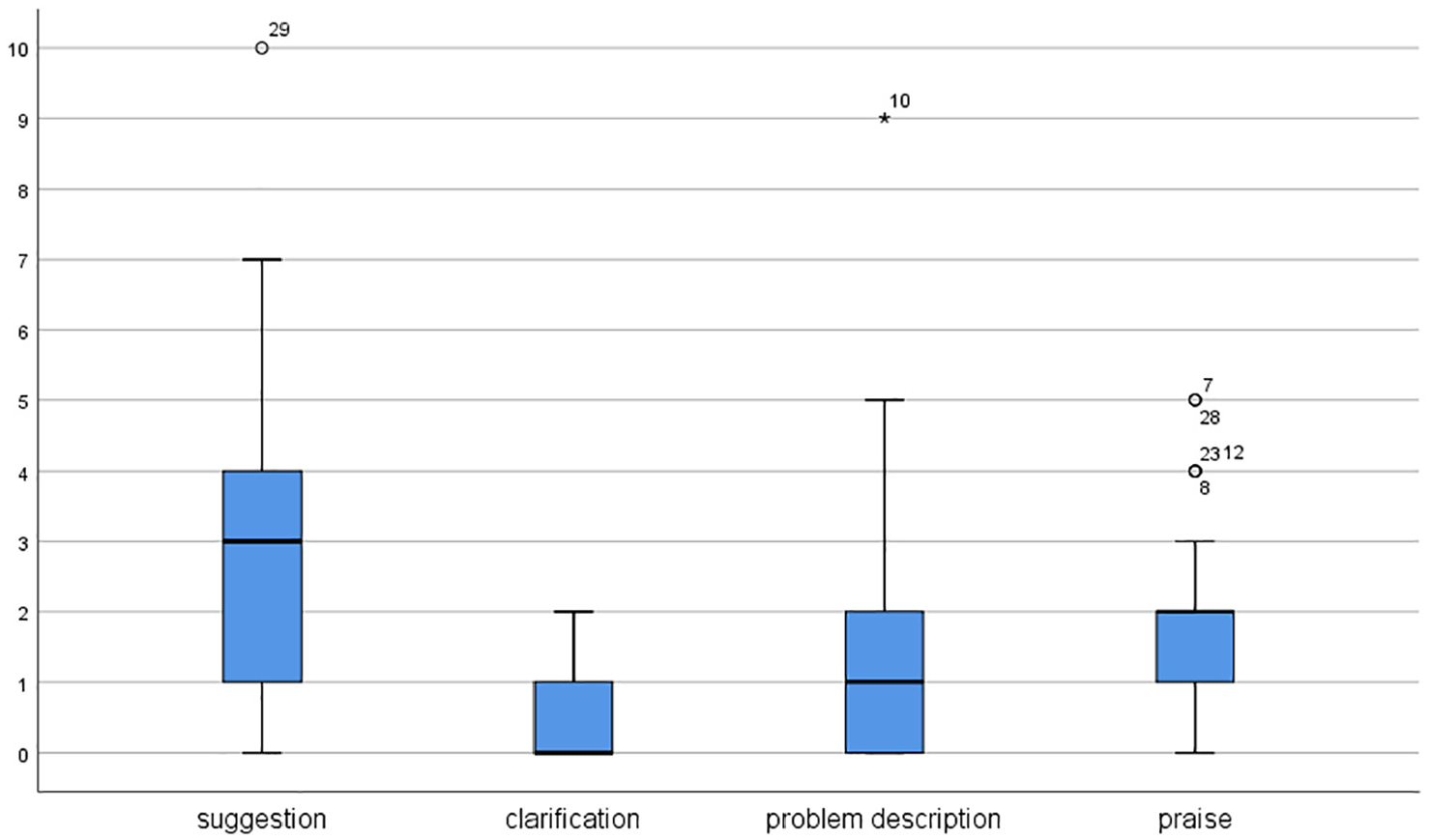
Distribution of discourse functions of the feedback.
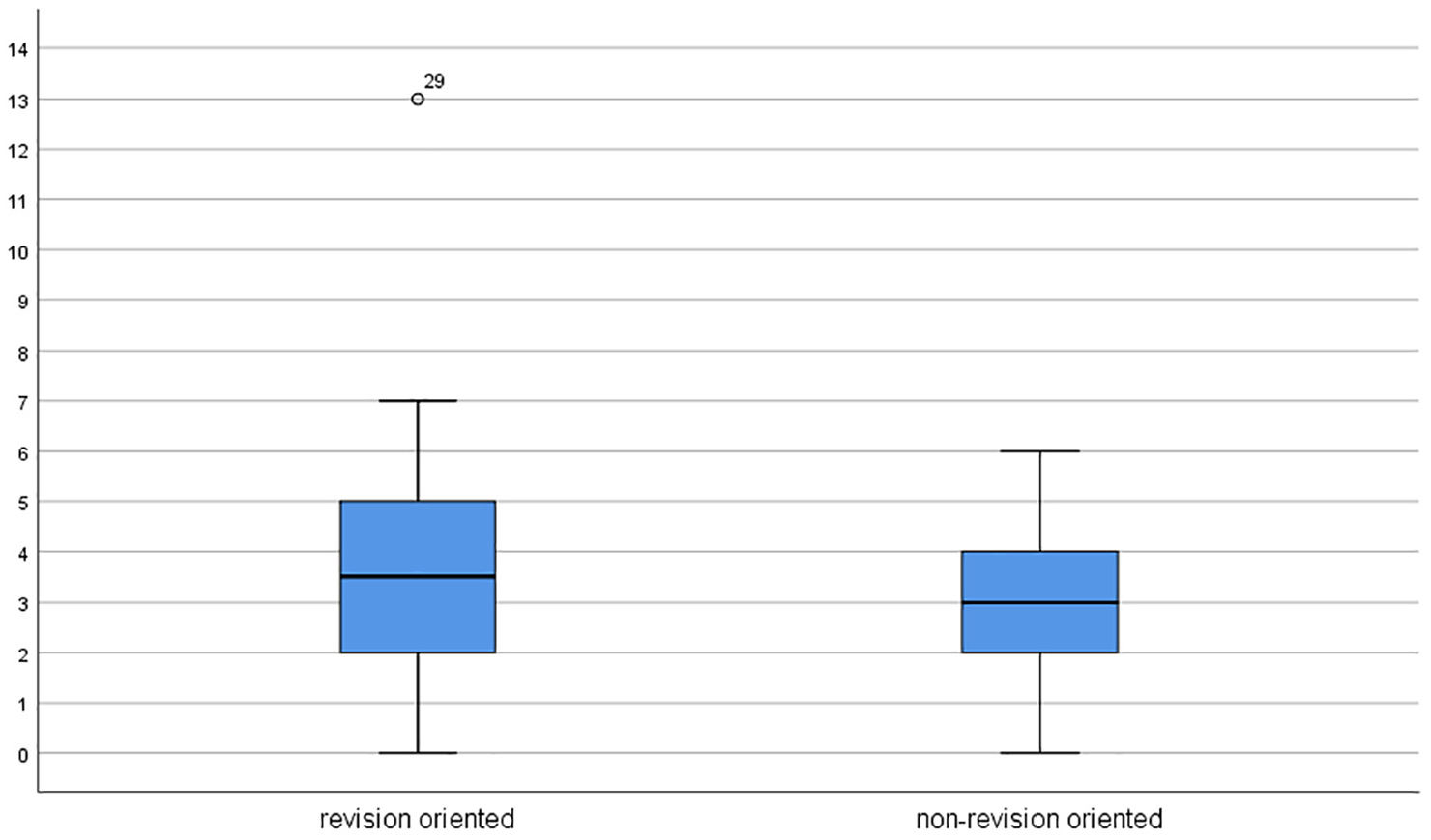
Distribution of concreteness of the feedback.
Relationship between Feedback Types, Adopted-Feedback-Revision, and Gain Score
SEM was performed to investigate how each category of feedback (i.e., focuses, cognitive functions, and concreteness) may affect gain scores, mediated by the adoption of feedback. The model that fits our data is one including concreteness of feedback, adoption of peer feedback, and the gain score (χ2 = 0.836, d.f. = 2, p = .658). Each of the model fit indicators in Table 4 suggests that the model, as in Figure 5, fits at a satisfactory level with the data of our study.
Model Fit Statistics of the Structural Equation Model.

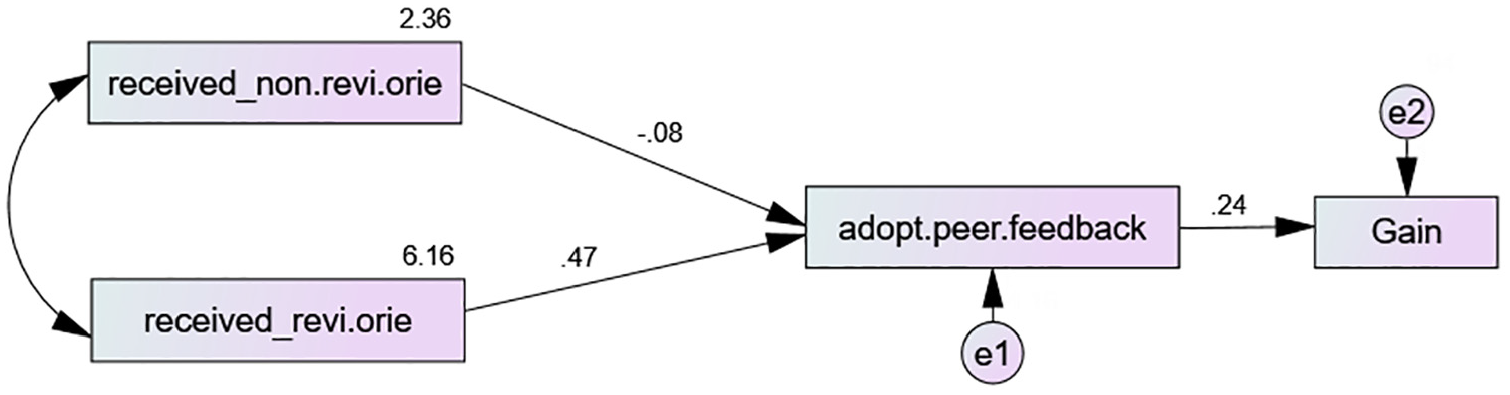
Structural equation model of feedback, revision, and gain.
Table 5 reveals that revision-oriented feedback had intermediate level effects on adopted peer feedback and that adopted peer feedback had intermediate level effects on the gain score. Revision-oriented feedback had an indirect and weaker effect on the gain score.
Standardized Total Effects Matrix of Feedback, Revision and Gain Score.

As shown in Figure 5, revision-oriented feedback positively affects the number of revisions that incorporate the feedback, and this type of revision positively affects gain scores between the first and final drafts. These two effects were all statistically significant at the 0.01 level. Meanwhile, none-revision-oriented feedback has no effects (α = −.082, p = .742) on peer feedback that were adopted. Table 5 summarizes the standardized total effects across the variables in the model.
How do Students Use Peer Feedback to Improve Literature Review Writing?
The quantitative analysis indicates that revision-oriented feedback facilitates writers’ incorporation of feedback for revision, which explains the improvement in students’ writing performance. That is to say, feedback on language, content, and organization need to be concrete to facilitate revision and writing improvement. Given that language, content, and organization each entails several sub-dimensions, the text analysis of students’ received feedback, drafts, and revision illustrated a nuanced picture of how students used peer feedback to improve literature review writing.
Language
Text analysis revealed that students’ feedback on language encompassed general lexical and grammatical errors, academic language style, and citation format. The latter two dimensions were emphasized in class, given that these represent genre-specific characteristics. The concrete language feedback was likely to be taken by students for revision, which helped to improve their academic writing style. For example, in Excerpt 1 (the screenshots of the original texts were presented in Appendix 1), the reviewer highlighted the format of the in-text citation in the original draft and commented that it was inappropriate to include the title of the reference in the in-text citation. The reviewer then suggested keeping only the name of the authors and the year of publication. The writer later revised the phrase into “Wu et al. (2020) pointed out…” which fits the format in citing previous studies in a literature review.
Wu Pei-pei, Tao Zhi, and Han Xiao-Long ‘An investigation and analysis of the psychological health issue of college students during the Covid-19 pandemic: A case study of Shanghai Electric Power University’ (2020) …. You simply need to write down the authors’ names and the year, no need to write the title (of the reference). Wu et al. (2020) pointed out…
Content
Students’ feedback on content entailed coverage, elaboration on ideas, synthesis, and criticality. Most of the content feedback was on elaboration on ideas and synthesis, and the concrete ones helped students to develop the ideas and enrich the details when reporting the literature. As exemplified in Excerpt 2 (the screenshots of the original texts were presented in Appendix 1), the original draft only briefly described the similarities and the differences between the two studies regarding responses to the pandemic. The reviewer (S37) pointed out that the writer (S2) did not report the findings, asking for elaborations on the research results and then requesting a summary on the differences and similarities. S2 acknowledged the comments and revised accordingly by adding much more details about the protection strategies discussed in the prior research.
These two studies provided a lot of strategies. The difference lies in that the first study focuses on psychological adaptation and the second one provides specific strategies. You can provide findings of these two studies, and then summarize the similarities and differences.
The difference lies in that the first study provides methods to ease negative emotions, such as increasing sleeping time, reducing the time of watching phones, doing something you like, and more exercises. The second study provides specific strategies to higher institutions, such as requiring mask-wearing for workers at restaurants on campus and requiring doctors and nurses at school hospitals to wear masks, hats, and uniforms. The same opinion of Gao and Zhang is that university students should release news via official channels, learn scientific knowledge and protection measures, hold a positive attitude toward pandemics, and increase confidence in self-protection.
Although a few comments were found on criticality, they were overly general and thus none-revision oriented, such as “there is a lack of your own evaluation.” This may indicate that the students developed an awareness of the importance of critical evaluation in writing a literature review. However, identifying the limitations of academic journal articles is challenging, especially for L2 student learners.
Organization
Most of the students’ organization feedback was on categorization. These comments were generally ambiguous or positive, which caused difficulties for writers to incorporate them for revision. A typical such comments is shown in Excerpt 3 (the screenshot of the original text was presented in Appendix 1), where S36 pointed out that “there was a lack of categorization.” This feedback failed to explain the problem source or suggest how to improve. In general, students’ feedback contained few comments on the coherence of arguments, and these were mostly positive. For instance, in Excerpt 4, S26 praised her partner’s categorization, especially regarding the connection between studies in the literature. In Excerpt 5, S9 stated that the categorization of the literature and the logic of arguments were clear in her partner’s writing. This may imply that critically analyzing the logic of a literature review written by others can be challenging.
In general, it looks like there is a categorization but not clear, I have some sense of ‘expressing feelings about reading’. Please work hard when categorizing and summarizing the literature ヾ(
I think your categorization section is much better than mine. The teacher mentioned that we should find connections in each piece of literature, so we should check if each article is related (this is my personal understanding; if I misunderstood, please forgive me, thank you).
In terms of structure, I personally think there’s nothing that needs to be changed. He has presented the classification of the literature, the arguments of the literature, and the logical relationships. Especially in the classification part, it’s written very well. Great job!  )ノ゙”)ノ゙
 (S9)
(S9)
The above analysis demonstrates that the concrete language feedback helps students to improve overall presentation of academic writing, such as reporting prior studies in an objective tone and citing references in an appropriate style. Concrete content feedback assists the students in enriching the content, such as elaborating details of the literature and summarizing the similarities and differences across prior studies. However, comments on organization tend to be ambiguous or positive, which constrains its role in improving the critical evaluation of the existing studies and the coherence of arguments.
CSL Students’ Perceived Benefits of Peer Feedback
The benefits of peer feedback practice in improving language, content, and organization were reported by all the students in the interview. When asked about “what is useful feedback,” students’ responses aligned with the quantitative results. Eight participants thought that the most useful feedback was those that could point out problems or disadvantages and provide specific suggestions for revision. As S2 explained, what was needed for a writer is to understand where the problem was and thus, she thought praise was the least useful one. S4 further pointed out that general feedback, such as “the logic is not clear,” was not helpful because it did not assist the writer in identifying the problems.
The participants also reported other benefits of peer feedback in the writing process, including enhancing reflective thinking skills, fostering reading comprehension, and increasing audience awareness. S7 explained that analysis of peers’ writing enabled her to recognize how to improve her own writing. A similar view was also expressed by S5, who reminded herself not to make similar mistakes as her partner did.
S7: analysis on the partner’s merits and shortcomings allow me to realize which parts can be improved when writing my own paper. S5: because when providing feedback to my partner, I reminded myself not to make the same mistakes as my partner did, such as being careful when typing, writing a good summary.
S6 explained that he had to understand the writing of their peers in order to provide feedback, which facilitated reading comprehension. S10 realized that audience’s perspective differed from the writer’s perspective. She stated that what the writer thought may not be the same to the audience. She believed that peer feedback illuminated the parts she ignored as a writer.
S6: because, first of all, if I need to revise the thesis outline of my partner, I have to understand the topic of my partner [thesis]. Then revise, otherwise, it won’t work. S10: because what I felt right and clear parts, to a reader may not be right or clear. I felt the most helpful part [of peer feedback] is to discover the things that I haven’t noticed, such as a word was not appropriate in this sentence, or which part was not clear.
Discussion
The results showed that students’ comments primarily focused on content feedback, with organization feedback being the least frequent. Their comments were more revision-oriented than non-revision-oriented. In terms of cognitive functions, suggestions were the primary category. In addition, the study found that revision-oriented feedback positively affects the feedback-adopted-revision, and this type of revision positively affects the gain scores. The qualitative text analysis demonstrates how students used concrete peer feedback to improve language and content. Feedback on criticality, categorization, and coherence of arguments, which requires reasoning and critical thinking skills, tend to be ambiguous. Students perceived the effects of peer feedback on improving writing performance, enhancing reading comprehension, thinking skills, and audience awareness. They thought the most useful feedback was those that could identify problems and provide specific suggestions for revision.
This study examined the feedback characteristics from different perspectives. Some researchers argue that feedback on content and organization is more beneficial than that of language in enhancing writing performance substantially (Leki, 1990; Lockhart & Ng, 1993; Paulus, 1999). The quantitative results showed that feedback focuses did not predict revision that explained the writing improvement. This observation implies that feedback on these aspects are not essential for students to make revisions. Some studies (Cheng et al., 2015; Cho et al., 2006; Cho & MacArthur, 2010; Huisman et al., 2018) also suggested that cognitive functions, such as direct corrections, explanation, and praise, had better effects on writing improvement than other types. Again, findings of this study did not reveal a significant relationship between functions, revision, and writing improvement. The study found that revision-oriented feedback positively affected revision behavior, which explained improvement in literature writing, supporting previous findings that direct corrections had an impact on writing performance (Cheng et al., 2015; Cho et al., 2006). The results suggest that feedback need to be concrete to be taken by students for revision. Although there is some evidence showing that praises could motivate students to revise (Cheng et al., 2015), this type of feedback was not found to be helpful in this study. This finding is consistent with students’ perceptions, which regarded the feedback providing specific suggestions as the most useful one, whereas praise was the least helpful type. Although the present study, limited by research scale, does not find effects of feedback category as focuses or functions significant as that of concreteness, they certainly have essential roles in peer feedback practice. Feedback focuses provide relevant information to different aspects of the written compositions, and functions could trigger writers’ critical thinking and reflection. However, despite various functions of feedback, it needs to be concrete to maximize its impact on improving writing quality. The authors therefore recommend a comprehensive perspective to conceptualize peer feedback and set up the criteria of high-quality feedback which can be integrated into future peer feedback training.
The qualitative analysis showed that students’ feedback on language was centered more around lexical or grammatical errors, academic language style, and citation format. These comments assisted them in learning how to formally report previous studies, employ an appropriate citation style, and maintain an objective tone. While content feedback focused more on elaboration on ideas and synthesis, it lacked a focus on criticality. Such feedback helped students to elaborate the details of the previous studies, identifying the similarities and differences across studies, and summarizing their findings. However, it did not effectively foster students’ critical evaluation of the existing research. Organization feedback primarily touched upon categorization, but there was scant emphasis on the coherence of arguments. Besides, these limited comments tend to be positive or ambiguous, which constrains its effects on improving the quality of a literature review. The unbalanced attention and differing concreteness could be explained by the variations in cognitive loadings and language skills required for providing feedback on genre-specific characteristics. For example, to evaluate the coherence of arguments, a reviewer needs to comprehend the meaning of each part in the literature review and try to understand how these parts are logically connected. Second, the reviewer should articulate the problem in the written language and then make suggestions for improvement. This task demands a high level of reading comprehension, inferencing, critical thinking, and writing skills from a reviewer. This aligns with the argument that providing feedback to a thesis is cognitively challenging to L2 learners (Gao et al., 2019; Yu, 2020; Yu & Liu, 2021). The concreteness of feedback decreases as the difficulty of providing feedback to certain aspects rises. Thus, this paper suggests peer feedback training in L2 academic writing need to be systematically designed to provide scaffolding on genre-specific characteristics of language (e.g., reporting previous studies, citation format), content (e.g., functions of different components, critical evaluation), and organization (e.g., structure of different components, coherence of arguments) through explicit instructions over a period of time.
Although giving peer feedback is challenging, it positively affected literature review writing in this study, confirming its impact on the complex L2 writing task. The students produced more comments on the global issue than on the local issue and more revision-oriented comments than non-revision-oriented comments (see Table 4). The results imply that feedback training, with an emphasis on the explanation of genre-specific characteristics and the demonstration of steps for providing feedback, is essential to optimize the effects of peer feedback on L2 academic writing. This echoes previous intervention studies in the literature (Liou & Peng, 2009; J. Liu & Sadler, 2003; Min, 2005; Min, 2006). Moreover, additional training should be provided on how to analyze and offer feedback on critically and coherence of arguments, as there is a scarcity of such comments, and the ones that exist tend to be ambiguous.
Conclusion and Limitation
This study employed a mixed-methods approach to explore the impact of CSL students’ feedback on their revision and L2 literature review writing. Revision-oriented comments significantly predict adopted-feedback-revision that explained the gain score in the literature review writing, indicating that peer feedback positively affected L2 academic writing. The benefits of peer feedback were perceived by students as well. Moreover, we identified students’ unbalanced attention to the dimensions of language, content, and organization of a literature review, indicating the variations in cognitive loadings and language skills required by providing feedback to genre-specific characteristics. Although this study contributes to our knowledge of how students benefited from peer feedback in regard to L2 literature writing in academic context, it is not without limitations. Due to a lack of face-to-face teaching and time differences, generally, we noticed that students’ motivation in learning was not as strong as that in the traditional face-to-face teaching mode. Thus, we only focus on analyzing data from 30 students who participated in online peer feedback practice. Given that this is currently unavoidable, future research could further examine peer feedback practice facilitated by technological tools in L2 academic writing and identify factors influencing the process.
Footnotes
Appendix 1
Screenshots of the original text, feedback, and the revision of Excerpt 1.
Original Text and Feedback
Revision
Screenshots of the original text, feedback, and the revision of Excerpt 2
Original Text
Feedback
Revision
Screenshot of Excerpt 3
Feedback on Categorization
Declaration of Conflicting Interests
The author(s) declared no potential conflicts of interest with respect to the research, authorship, and/or publication of this article.
Funding
The author(s) disclosed receipt of the following financial support for the research, authorship, and/or publication of this article: This study was funded by the Humanities and Social Sciences Research Project of Chinese Ministry of Education (Title: A corpus-based study of language variations in Chinese theses by international students in China. No.: 21YJA740058.)
Ethical Approval
Ethical approval has been given by the Human Research Ethics Committee of The Education University of Hong Kong (Ref. no. 2020-2021-0422) for this study.

Data Availability Statement
Data sharing not applicable to this article as no datasets were generated or analyzed during the current study.