




Abstract
This article argues that for disciplinary literacy to be addressed successfully by subject-area teachers and students, it needs to choose a different path than the one it has been on. It explains how the road disciplinary literacy has traveled to date has been marked by justifiable subject-area teacher resistance to requirements to infuse literacy teaching and learning strategies into their teaching without regard for disciplinary epistemologies or local perspectives. It argues for an alternative approach that immerses literacy experts in the hybridity of classroom disciplinary learning spaces with respect for literacy and disciplinary discourses as well as school and community subcultural beliefs, practices, and resources. It examines the ways such hybridity has been addressed by disciplinary literacy researchers in the Journal of Literacy Research to date, and it offers recommendations for advancing research, practice, and policy.
Keywords
Disciplinary literacy stands at a crucial crossroad. The road it has traveled has been marked by decades of failed efforts of literacy experts who used an infusion approach. This approach required subject-area teachers to infuse various teaching and learning strategies to support students’ literacy into their teaching, often with little regard for subject-area epistemologies and practices (O’Brien, Stewart, & Moje, 1995). Yet at the crossroad is another route. This alternate road involves literacy experts immersing themselves in classrooms, a hybridity approach that builds from the variety of discourses in all learning spaces—including literacy and disciplinary discourses as well as school and community cultural beliefs, practices, and resources (Easthope, 1998; Gutiérrez, Baquedano-López, & Tejeda, 1999).
In this article, we—the authors of this essay and longtime academic literacy researchers—argue that literacy experts, including researchers, teacher educators, and school-based practitioners who work with respect for hybridity, are more likely to foster disciplinary literacy in equitable and lasting ways. The following sections review the history that brought the infusion approach to disciplinary literacy, introduce hybridity as an alternative approach, consider how hybridity has been addressed by disciplinary literacy researchers, and offer recommendations for advancing research, practice, and policy along this more promising route.
Infusion Approaches
In the early part of the last century, literacy scholars addressed concerns for supporting students’ reading of newly available subject-area textbooks with what are now called study skills (Moore, Readence, & Rickelman, 1983). This attention evolved into approaches for helping subject-area teachers support students’ use of a limited number of functional reading skills and strategies needed to study texts (Herber, 1970). Researchers then developed sophisticated models of cognitive processes used in reading-to-learn, which begat experimental testing of myriad new teaching and learning strategies (Anderson, Spiro, & Montague, 1977). These strategies were promoted for use in subject-area classes where they typically had not been tested, though subject-area teachers resisted these efforts (Hinchman, 1987; O’Brien & Stewart, 1989) and scholars critiqued them for lacking ecological validity (Alvermann & Moore, 1991). The focus on decontextualized cognitive approaches dissipated with the realization that reading (and writing) are socially and culturally situated, requiring digital, multimodal, and print-based literacies (e.g., Cope & Kalantzis, 2000).
Literacy researchers have explored social aspects of academic literacy in many ways. This has included research to describe new literacies, multiliteracies, and multimodal aspects of disciplinary inquiry (Coiro, Knobel, Lankshear, & Leu, 2008). Other researchers exploring functional aspects of academic literacy delineated the workings of academic language in disciplinary texts and discourses (Fang & Schleppegrell, 2010). Still other scholars studied how school literacy instruction aligned with youth’s ways of knowing (Gutiérrez, Morales, & Martinez, 2009). Because of its popularization among equity-oriented literacy researchers (Dyches, 2018a; Moje, 2002; Moje, Ciechanowski, et al., 2004; Moje, Peek-Brown, et al., 2004), more recent theoretical articulations among literacy education scholars (Moje, 2007, 2008; T. Shanahan & Shanahan, 2008, 2012); and the proliferation of research catalyzed by the U.S. Common Core State Standards (Goldman et al., 2016), disciplinary literacy also became an important focus of much academic literacy research.
The preceding history means that literacy experts have worked for almost half a century in preservice and in-service university coursework and school-based professional development to help subject-area teachers support students’ reading, then writing, and, more recently, academic language and multiple literacies (e.g., Alvermann, Gillis, & Phelps, 2013; Bean & O’Brien, 2012; Zwiers, 2014). However, many of the disciplinary literacy pedagogical recommendations that followed Common Core mandates ignored disciplinary ideologies and epistemologies and school-based insights (Geisler, 1994). Instead, these recommendations resulted in a new round of infusion efforts that appear to be topically appropriate to disciplinary outsiders but that, once again, have resulted in subject-area teachers’ resistance (Colwell & Reinking, 2016; Fisher & Frey, 2009; Mitton-Kükner & Orr, 2018). Such moves reflect literacy-oriented regimes of truth (Dunkerly-Bean & Bean, 2016) and academic and pedagogical hubris, when literacy experts, including researchers, teacher educators, and school literacy specialists, act with the conviction that their pedagogical acumen and literacy mission position them as best suited to determine instructional focus (O’Brien et al., 1995).
Infusion approaches have yielded other unintended consequences. In our view, focus on literacy instead of subject-area goals undermines the intended purposes for subject-area study in schools, and, thus, subject-area teachers’ maintenance of expertise, student interest, and engagement. In elementary schools, prioritizing literacy can result in limited mathematics and tokenistic science and social studies instruction (Marco-Bujosa & Levy, 2016). In secondary schools, students may find subject-area classes replaced with leveled, digitized topical readings and study guides completed in assembly lines of uninteresting, ineffective literacy test preparation (Roberts-Mahoney, Means, & Garrison, 2016).
Toward Hybridity
As academic literacy researchers were exploring varied social aspects of literacy, disciplinary scholars were describing disciplinary subcultures’ richness, depth of knowledge, logic, ways of thinking, and epistemological and pedagogical practices. K-12 disciplinary education scholars realized that students needed support to address the unique literacy demands of their respective disciplines, as illustrated in work by Wineburg (1991) in history, Pimm (1987) in mathematics, and Hyland (2004) in composition. Shulman (2005) asserted that teaching in the professions needed to develop students’ “habits of the mind, habits of the heart, and habits of the hand” (p. 59). He explained that within-discipline signature pedagogies should foster students’ understanding of knowns within disciplines as well as the tensions, perspectives, and parameters associated with these knowns. As an example of this, Calder (2006) contended that signature pedagogies for college history survey courses should involve student inquiry using multimodal information sources, including print text.
Literacy researchers (Shanahan & Shanahan, 2008) drew on scholarship from linguistics and cognitive psychology to show how discipline-specific literacy practices are central to disciplinary study. They explained that although the disciplines share certain commonalities in their use of academic language. . . they also engage in unique practices. That is, there are differences in how the disciplines create, disseminate, and evaluate knowledge, and these differences are instantiated in their use of language. (p. 48)
Wineburg (1991) maintained that even well-prepared subject-area teachers forced to use reductive school curricula over time could lose touch with the essence of learning in their respective disciplines . Draper (2008) noted that literacy experts could be more effective at supporting students’ literacy in collaboration with disciplinary experts to ground efforts in content to be learned. These ideas suggest that those charged with generating new knowledge in disciplines, including academics, practitioners, and researchers, may better represent Shulman’s disciplinary habits of mind, heart, and hand in plans for compelling classroom inquiry.
One approach to planning inquiry involves the use of third-space pedagogy. This pedagogy invites students and teachers to engage in inquiry together, merging perspectives into hybrid new viewpoints as they work (Gutiérrez et al., 1999; Moje, Ciechanowski, et al., 2004). We think such hybridity is especially powerful in subject-area study when inquiry focuses on current, compelling questions of the disciplines, the kinds of questions that are most likely to be identified by disciplinary experts. We have experienced firsthand how much easier it is for these colleagues to develop inquiry questions that are true to disciplines, including their tensions. The teachers we have worked with resonate during collaborations with our non-K-12 disciplinary colleagues’ assertions about essential disciplinary questions. Subject-area teachers also contribute what they know about students and communities to shape questions that are intriguing and accessible. Literacy experts help when they collaborate with teachers and disciplinary experts to identify multimodal information sources offering multiple affordances to students and ways to support students’ use of these sources. Students who engage in such inquiry begin to understand how they, too, can contribute to disciplinary knowledge with new insights that emerge from their wide-ranging viewpoints.
Building on several years of disciplinary literacy scholarship, Moje (2015) posited disciplinary literacy as a construct with domain-specific social and cultural practices. This construct includes approaches to inquiry that are unique to disciplines. This disciplinary-driven definition of disciplinary literacy finds value in and draws on difference. Literacy, with its own disciplinary subcultural identities, works in iteration with various disciplines as subcultural groups and not as a primary focus. Through intensive collaboration over time, individuals working from within their respective disciplinary subcultures work the tensions and differences to translate and value each other’s identities and practices, leading to enriching, engaging forms of research and practice that yield hybrid new insights.
Disciplinary Literacy Hybridity in the Journal of Literacy Research (JLR)
Wondering whether and how hybridity approaches have been playing out in disciplinary literacy research, we examined 17 disciplinary literacy studies we found in an online search of JLR. We considered how much they allowed researchers to understand how disciplinary literacy practices were embedded in classroom cultures, who were positioned as disciplinary experts, and what counted as data and effective teaching (see Table 1).
Disciplinary Literacy Articles in Journal of Literacy Research.
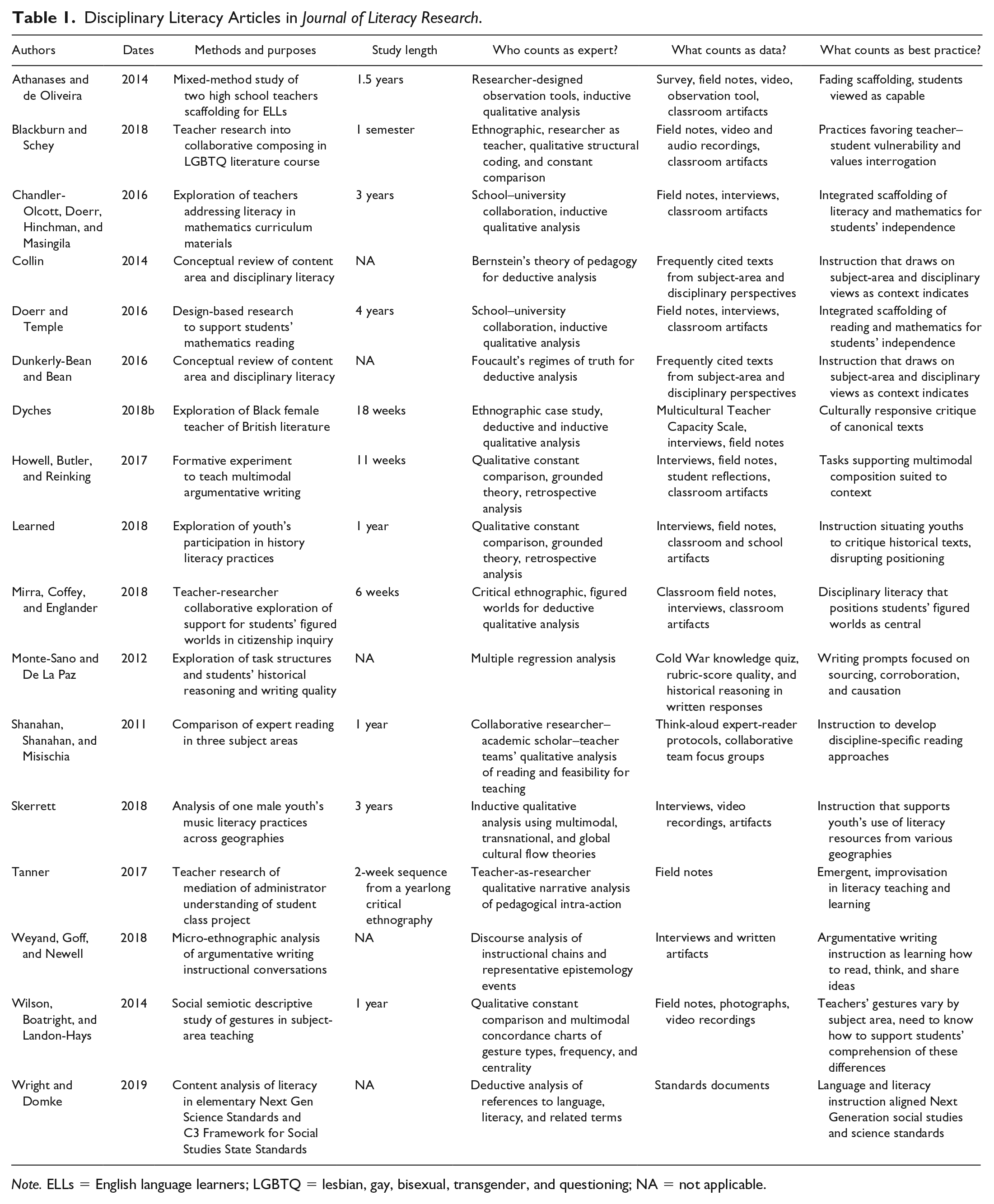
Note. ELLs = English language learners; LGBTQ = lesbian, gay, bisexual, transgender, and questioning; NA = not applicable.
Almost all the classroom-based studies in the collection involved researchers in long-term immersion in school and subject-area communities. Most were at least a semester in length and many were longer. These time frames suggested that the researchers’ practices were in keeping with understanding the hybridity of school communities’ ways of seeing disciplinary learning and literacy. One classroom study (Mirra, Coffey, & Englander, 2018) followed a shorter time frame than others, though it was an explicit teacher–researcher partnership in terms of study design, analysis, and authoring, which also reflected respect for local viewpoints. A cursory Internet search hinted that most, perhaps all, researchers were current or former teachers, which may help to explain why research designs showed such appreciation for context-specific perspectives.
In all cases, literacy researchers were first authors, and they determined the general focus and designs of the studies. This, of course, gave them interpretive power. These researchers addressed disciplinary expertise and students’ interests in various ways. Two studies were designed in collaboration with local school leaders (Blackburn & Schey, 2018; Chandler-Olcott, Doerr, Hinchman, & Masingila, 2016), the latter of which also involved collaboration of literacy and disciplinary researchers and teachers. Two additional studies also involved explicit collaborations of literacy and disciplinary scholars, along with classroom teachers, to represent disciplinary and school-based ways of knowing (Doerr & Temple, 2016; Shanahan, Shanahan, & Misischia, 2011). One study drew on collaborations with disciplinary teachers as co-researchers (Mirra et al., 2018), another on a disciplinary teacher as intervention co-designer (Howell, Butler, & Reinking, 2017), and five others on disciplinary teachers as study participants who invited researchers to explore their disciplinary literacy practices (Athanases & de Oliveira, 2014; Dyches, 2018b; Learned, 2018; Monte-Sano & De La Paz, 2012; Weyand, Goff, & Newell, 2018; Wilson, Boatright, & Landon-Hays, 2014).
Researchers were the disciplinary teachers in two studies, drawing on long-standing recommendations for teacher research to develop context-specific teaching ideas (Blackburn & Schey, 2018; Tanner, 2017). Two studies privileged students’ perspectives (Learned, 2018; Skerrett, 2018). Two conceptual analyses critiqued overly simple notions of content area and disciplinary literacy, suggesting that context-specific support for disciplinary literacy would require learners to deploy a variety of literacy practices (Collin, 2014; Dunkerly-Bean & Bean, 2016). One study was a content analysis of how elementary school disciplinary learning standards suggested a need for language and literacy support (Wright & Domke, 2019).
JLR’s classroom-based disciplinary literacy studies were almost all qualitative and exploratory, which is not surprising given quickly evolving ideas about disciplinary literacy research. These studies both explored multiple perspectives and honored the realities of local contexts without unduly valuing versions of best practice conceived in more controlled settings. The deductive and quantitative studies in the collection also attended to how settings, pedagogical features, or pedagogical tools worked for teachers and students in classrooms.
All the studies we found seemed grounded in concern for hybridity. They valued teachers’ perspectives, compelling inquiry, authentic disciplinary texts, supportive practices, gradually withdrawn scaffolds, and expectations that students were capable of using available resources to construct new learning—varied, context-driven approaches drawing on generic and discipline-specific literacy practices. Students appeared to be engaged, motivated, and willing to learn during inquiry that welcomed their insights and critique (Blackburn & Schey, 2018; Learned, 2018; Skerrett, 2018).
What Does Hybridity Mean for Disciplinary Literacy Research and Practice?
Recent JLR disciplinary literacy research gives us reason for optimism that the field is heading down a disciplinary literacy road that values hybridity. However, as disciplinary literacy scholars and teachers, we spend a lot of time in schools, attend conferences, and review articles for possible publication in literacy journals, including JLR. What we sometimes see worries us about how ideas connected to disciplinary literacy are being applied in schools, in the formulation of policy, and in some literacy research efforts that continue to promote infusion with artificially mapped skills, strategies, and texts onto disciplines. Experience has taught us that the inauthenticity of these approaches could well give disciplinary literacy a bad name among subject-area teachers.
More research is needed to identify features of the disciplinary pedagogical approaches outlined above, including efficient and effective ways to work with disciplinary and local experts to define essential questions for inquiry, locate suitable multimodal texts, recognize local resources, and identify literacy practices and needed scaffolds. Qualitative research remains a way to represent these varied points of view, though quantitative approaches that respect local points of view could also be helpful for validating tools and aggregating observations of planning, practice, and outcomes. If researchers do not ground their work in the hybridity of disciplinary literacy, they run the risk of producing results that are replicated by few and forgotten by most.
Literacy scholars, practitioners, and policy makers should avoid the hubris of thinking they have expertise to demand literacy instructional practices without the collaboration of disciplinary experts, subject-area teachers, and students. We are not sure how much disciplinary and local expertise is “enough.” How much and what kind of disciplinary expertise are needed depend, in part, on collaborators’ disciplinary currency, confidence, and knowledge of the kinds of questions students find compelling. Addressing disciplinary habits of mind, heart, and hand takes time—to understand disciplines, develop good questions, locate texts, and design, teach, or observe sufficient amounts of instruction.
If the field continues to choose the road to hybridity in disciplinary literacy—the road that shows respect for students’, subject-area teachers’, and disciplinary ways of knowing—the long-term prospect for disciplinary literacy research, practice, and policy is promising. Choosing this road will generate teachers’ and students’ interest in disciplinary study and, thus, their engagement in disciplinary literacy in new, equitable, hybrid ways.
Footnotes
Acknowledgements
The authors wish to thank Patricia Anders, Roni Jo Draper, and Cynthia Shanahan for helpful reviews of an earlier draft of this commentary.
Declaration of Conflicting Interests
The author(s) declared no potential conflicts of interest with respect to the research, authorship, and/or publication of this article.
Funding
The author(s) received no financial support for the research, authorship, and/or publication of this article.
