




Abstract
Secondary literacy instruction often happens to adolescents rather than with them. To disrupt this trend, we collaborated with 12th-grade “literacy mentors” to reimagine literacy teaching and learning with 10th-grade mentees in a public high school classroom. We used positioning theory as an analytic tool to (a) understand how mentors positioned themselves and how we positioned them and (b) examine the literacy practices that enabled and constrained the mentor position. We found that our positioning of mentors as collaborators was taken up in different and sometimes unexpected ways as a result of the multiple positions available to them and institutional-level factors that shaped what literacy practices were and were not negotiable. We argue that future collaborations with youth must account for the rights and duties of all members of a classroom community, including how those rights and duties intersect, merge, or come into conflict within and across practices.
Twelfth-grade literacy mentors and their 10th-grade mentees sit together in small groups. Class begins with a question: What’s one thing you noticed about how your book started? Mentors and mentees consider the question by writing in their reading journals and by talking in their small groups. Next, everyone independently reads a self-selected book. During and after reading, students write in their reading journals about how they read. Finally, mentors continue earlier discussions or pose additional questions to consider and discuss with their mentees.
Questions about how to support adolescents’ literacy learning have received much attention in recent decades (e.g., International Reading Association, 2012). However, adolescents themselves are rarely included as participants in conversations about school-based literacy research or instruction. One explanation for the lack of youth involvement in these conversations is that typical approaches to literacy instruction take a deficit view of adolescents and their literacies (Gutiérrez, Morales, & Martinez, 2009). Literacy instruction is something that happens to adolescents rather than with them.
We argue that youth can and should be involved in efforts to disrupt traditional literacy instruction because they bring perspectives that are grounded in their own experiences as readers, writers, and learners. The vignette above is a window into one such effort that emerged through a collaboration with 12th-grade literacy mentors to co-design and co-teach a new course called the Literacy Mentorship Class (LMC), centered around interest-driven literacy engagement. The purpose of the present study was to understand the complexities of engaging youth as collaborators in this attempt to transform classroom literacy practices.
We ground this study in scholarship that foregrounds the importance of humanizing pedagogies and research in education (e.g., Paris & Winn, 2014). We also build from related work that highlights the complexities of such endeavors—specifically the warning that, left unexamined, efforts to disrupt traditional practices can have the unintended consequence of reinforcing the status quo (e.g., Lodge, 2005; Nyachae, 2016; Tuck & Yang, 2014). Using positioning theory as an analytic tool, we addressed the following two research questions: How were 12th-grade literacy mentors positioned by themselves and others (e.g., the teacher, university researchers, other mentors) within the classroom? What were the literacy practices that enabled or constrained that positioning?
Theoretical Framework
An understanding of literacy as an ideological social practice and a social psychological theory of positioning framed this study.
Literacy as Ideological Social Practice
From a social practice perspective, literacy is not a neutral endeavor: It is at once situated in localized contexts (Heath, 1983; Street, 1984) and sustained across broader contexts and social structures (Brandt & Clinton, 2002). In each case, what and whose literacies count are key considerations. These considerations are especially important in educational contexts, where the literacies that matter to youth can be overlooked or undervalued by educators in the pursuit of “academic” literacies that are normalized and reified through structures within and beyond classrooms (e.g., district mandates, state/federal education policies; Street, 2005).
Following Street (2005) and others, for analytic purposes we distinguished between literacy events and literacy practices. A literacy event is an instance where a piece of written text is central to the interaction. A literacy practice encompasses both events and “the social models of literacy . . . that give meaning to them” (p. 419). We also considered the literacy materials that played a role in shaping literacy practices and the sponsors of those materials (Brandt & Clinton, 2002).
Positioning and Identity
We used positioning theory—the study of how individuals use language/discourse to situate themselves in relation to others—as a complementary lens through which to identify and understand the rights (i.e., that to which one is entitled) and duties (i.e., that to which one is obligated) of individuals in the context of particular literacy practices (Davies & Harré, 1990). As Harré (2012) explained, Positioning Theory is based on the principle that not everyone involved in a social episode has equal access to rights and duties to perform particular kinds of meaningful actions at that moment and with those people . . . A cluster of short-term disputable rights, obligations, and duties is called a “position.” (p. 193)
In this analysis, we sought to understand the explicit (intentional) and tacit rights and duties of 12th-grade literacy mentors and how those rights and duties were reinforced or undermined by classroom literacy practices.
Positioning is inextricably linked to identity (Harré & Van Langenhove, 1999; Holland & Leader, 2004; McVee, Brock, & Glazier, 2011). According to Moje and Luke (2009), identity-as-position is one of five ways scholars have conceptualized identity in literacy research. It is unique from other identity metaphors because it (a) situates identities in activities and relationships with others and (b) considers how individuals navigate positions. Central to the connection between positioning and identity is power and the role it plays in shaping how individuals negotiate positions in interaction with others (Lewis, Enciso, & Moje, 2007). Here, we focused on the “official” literacy practices of one classroom—those practices that were sanctioned by us and therefore imbued with power (Bloome, 2008)—and how they enabled or constrained the positions and associated identities of 12th-grade literacy mentors. In examining these practices, we also traced the materials that influenced them and the sponsors of those materials.
Positioning Practices
In this article, we conceptualized classroom literacy practices as positioning practices that themselves impose particular rights and duties onto participants (Frankel, 2017). The concept of a positioning practice brings together the term practice, as we defined it from a sociocultural perspective, and the term episode, as it is used in positioning theory. Harré and Secord (1972) define an episode as “any sequence of happenings in which human beings engage which has some principle of unity” (p. 10). But, “episodes are more than just visible behavior, they also include the thoughts, feelings, intentions, plans and so on of all those who participate” (Harré & Van Langenhove, 1999, p. 5). Similarly, a practice encompasses literacy events as well as the social models of literacy that give those events meaning. For example, a book discussion that occurs in a classroom and involves students with different thoughts about and plans for the activity is an episode. Because a book discussion presumably involves one or more books that are integral to the discussion, it is also a literacy event. Book discussions that occur over time, as well as the ideological understandings about literacy that underlie those discussions, constitute a positioning practice.
By conceptualizing classroom literacy practices as positioning practices, our objective was twofold. First, we wanted to see how mentors positioned themselves and how we positioned mentors through classroom literacy practices. Second, we wanted to understand how those classroom literacy practices, as positioning practices, shaped the positions that were available to the mentors, and how other literacy materials that were present (if not always central to these practices) also contributed to mentor positioning.
Literacy and Positioning in Educational Contexts
There is a substantial body of work that draws on positioning theory in literacy research (McVee, Silvestri, Barrett, & Haq, 2019). For example, researchers have used positioning theory as an analytic lens to understand school-based literacy practices in the areas of coaching and teaching, teaching and learning, and collaborating in literacy communities.
The first area focuses on the positioning of literacy coaches and teachers within and beyond classrooms (e.g., Brock, Nikoli, & Wallace, 2011; Glazier, 2011; Hall, Johnson, Juzwik, Wortham, & Mosley, 2010; Keegan, Abdallah, & McVee, 2011; McVee, 2014; McVee, Baldassarre, & Bailey, 2004). For example, Hunt and Handsfield (2013) analyzed the “small stories” of three first-year literacy coaches to understand how the coaches navigated power, positioning, and identity during a district–university professional development partnership designed to support them in their first year. Building from foundational work in positioning theory (e.g., Davies & Harré, 1990; Harré & Van Langenhove, 1999; McVee et al., 2011), the authors highlighted the affordances of positioning theory as a way to move beyond the concept of role to a more robust conceptualization of the multiple, complex, fluid, and power-laden ways that individuals navigate positions through interactions with others.
In another study focused on literacy teachers, Kim and Viesca (2016) found that middle school reading intervention teachers’ positioning of their emergent bilingual students (e.g., as individuals vs. monolithic learners) was related to the practices those teachers used to motivate and engage students (e.g., hybrid vs. monolithic). Although not specific to literacy, Reeves (2009) and Yoon (2008) similarly found that the ways teachers positioned themselves in relation to their students influenced their own identity positions and classroom teaching practices. Furthermore, Yoon (2008) showed that those teaching practices in turn influenced how students positioned themselves.
The second area focuses on the positioning that happens during classroom interactions from the perspectives of both teachers and students (e.g., Brock & Raphael, 2011). Four of these studies used positioning theory to understand the impact of literacy intervention contexts on students’ identities as readers. While Skerrett (2012) found that one student’s reading identity was positively reshaped as a result of how she was positioned in her reading classroom (e.g., as a member of a community of agentive learners), other studies found that positioning acts had negative consequences for students’ identities as readers (Frankel, 2016, 2017). For some students, placement in such classes was incongruous with their identities as readers; for others, the literacy practices of the classes served to position them in particular ways regardless of their actual reading abilities (e.g., oral reading practices positioned some students as better readers depending on the ease with which they read aloud).
Learned (2016) extended the scope of inquiry to investigate how students enrolled in intervention classes were positioned across space and time in school. She found that the conflation of reading ability with behavior problems positioned youth as deficient readers regardless of actual reading skill, and despite the youths’ efforts to reposition themselves. In related work, Enciso (2001) used positioning theory to problematize the questions and tasks assigned to middle-grade readers through standardized assessments, the very assessments that identify youth for placement in reading intervention classes (Frankel, 2016; Learned, 2016).
The third area examines how youth and others are positioned in literacy communities with attention to gendered and racialized positioning (e.g., Clarke, 2006; Evans, 2011; Thompson, 2011). For example, Rogers, Winters, LaMonde, and Perry (2010) found that youth took up dynamic subject positions as they engaged in video production in a secondary literacy program where discourses about youth culture, race, and gender intersected in sometimes contradictory ways. More recently, Ridgeway and Yerrick (2016) used critical race theory combined with positioning theory to examine the racialized positioning of youth by an “expert” artist in an after-school science community, documenting how youth ultimately rejected this positioning by foregrounding their own subject positions as artists and activists.
Contributions of the Present Study
To our knowledge, positioning theory has not been used to interrogate interactions in classroom contexts explicitly designed to disrupt typical student–teacher positioning. This study extends the existing literature by examining how 12th-grade literacy mentors were positioned in such a context. Building particularly from prior research that has complicated and problematized the concept of “role,” and research that has found a relationship between teaching practices and student positioning, our study contributes new knowledge about the complex relationship between literacy practices and the positions that are available to youth in classrooms.
Method
This qualitative study was the first year of an ongoing collaboration between a university researcher (Kate), a teacher (Caitlin), and high school students. The collaboration was inspired by social design methodologies (Gutiérrez, 2016). A social design approach is aligned with positioning theory because it affords opportunities for various stakeholders to “design for educational possibilities” (p. 187) by creating and studying change in partnership with each other. Social design methodologies foreground questions of equity, historicity, and agency in the service of ecological resilience, transformation, and sustainability for individuals and communities.
Setting and Participants
The school
The site of this study was a public high school serving over 500 students (54% Hispanic/Latinx, 42% Black/African American, 2% White, 2% Asian; ~70% identified by the state as economically disadvantaged). At the time of the study, the school was labeled a “turnaround” school, meaning it was subject to increased state oversight.
The class
The LMC arose in response to the turnaround mandate to accelerate achievement, including 10th graders’ performance on the state’s standardized assessment administered every spring. It also arose from a desire on the part of school teachers and leaders to design more youth-centered and engagement-oriented literacy instruction. The goal of the LMC was to engage students in activities that reflected their own interests and desires and that leveraged their agency as readers, writers, and learners. While institutional support for the LMC (e.g., teacher time, scheduling) was couched in its potential to improve student performance on the state assessment, the actual design of the course was left up to Caitlin, Kate, and the 12th-grade literacy mentors to co-construct and adapt throughout the school year.
The design of the LMC was informed by previous research that demonstrated the positive impact of text-based peer collaboration and social interaction (e.g., Applebee, Langer, Nystrand, & Gamoran, 2003) and metacognitive conversations (e.g., Greenleaf, Schoenbach, Cziko, & Mueller, 2001) on literacy learning, particularly in the context of cross-age tutoring or mentoring relationships (e.g., Juel, 1996). The design also was informed by prior research that documented the positive impacts on both classroom learning ecologies and individual learning trajectories that resulted from membership in authentic classroom literacy communities that promoted extensive, engaged reading (e.g., Ivey & Johnston, 2013, 2015).
School-based participants
From September to November, the class included Caitlin, a White woman in her 10th year of teaching, and 13 mentors. Nine of the 13 mentors agreed to participate in the study (see Table 1), but all mentors contributed to the course design. In spring 2016, Caitlin solicited teachers’ recommendations for students who demonstrated an interest in or potential for taking on a leadership role. Caitlin invited the nominated students to participate in the inaugural year of the course, the goal of which was to engage them both as literacy mentors to 10th graders at the school and as co-designers and co-teachers of the LMC. As preparation for mentoring, the mentors spent the first few months of the school year exploring their histories and identities as readers; interrogating definitions of literacy as they are constructed by schools, communities, and the media; learning about recent developments in reading theory and research (e.g., comprehension); and co-designing classroom activities that prioritized extensive reading, writing, and discussion of self-selected texts.
Participants’ Demographic Information.
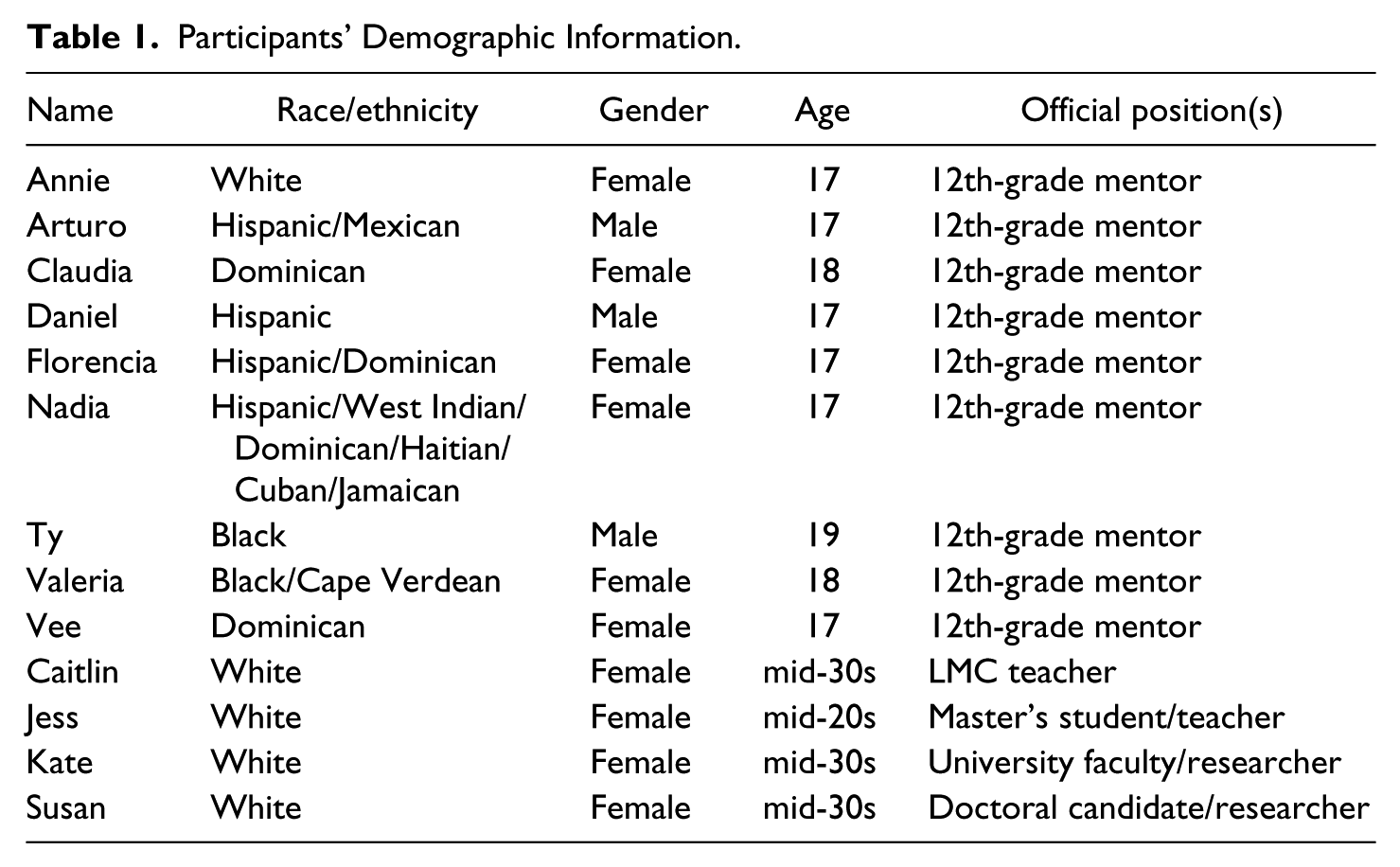
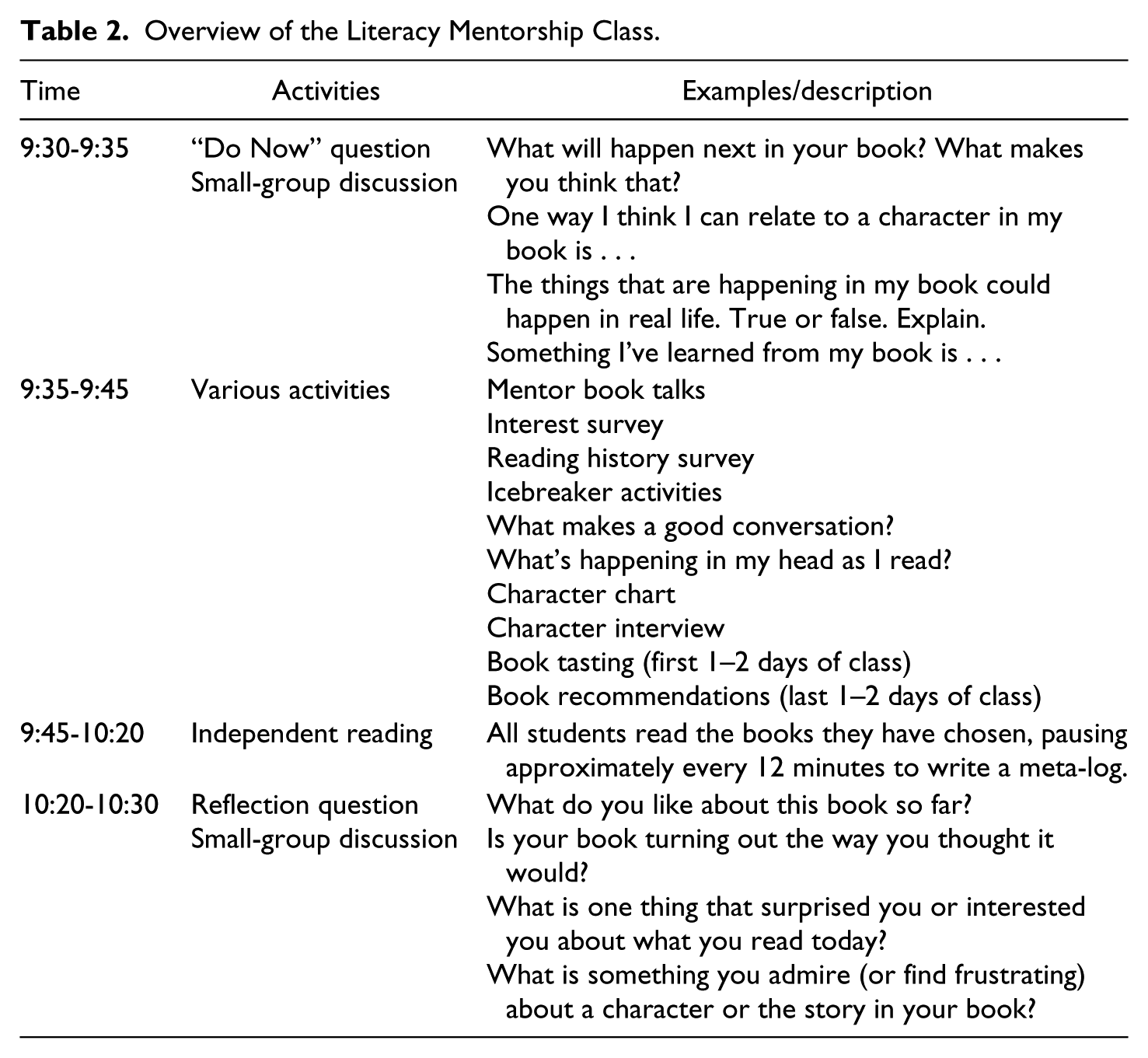
From November to March, the class also included a total of 60 tenth-grade mentees in three 6-week cycles (20 mentees/cycle). All 10th graders whose schedules allowed for them to be in the class participated in one of the cycles. The LMC changed over the three cycles as the mentors reflected on each iteration through formal and informal debriefs and made changes to the course and their rights and duties therein (see Table 2).
Overview of the Literacy Mentorship Class.
University-based participants
Kate and Susan—both White women, university researchers, and former teachers—regularly participated in classroom activities. Jess, a literacy master’s student, visited the class occasionally but primarily assisted with transcription and data analysis. As regular participants in the classroom, we (Kate and Susan) were explicit with students about our positioning, indicating frequently through words and actions that we were there to read and learn alongside them. We assumed hybrid positions in the classroom, at times participating in small-group book discussions and other activities as mentees and at other times, such as when a mentor was absent, participating as substitute mentors. We used books as a tool to facilitate interactions with students (e.g., asking students about books they were reading to initiate or extend conversations).
As White women collaborating predominantly with youth of color, we were reminded frequently about the reflexivity that must accompany our work (Glazier, 2011; McVee, 2014). We each wrote reflective memos as part of our regular field note routine and used these memos to record questions and concerns that we wanted to address in subsequent conversations with Caitlin and the mentors. For example, in a memo in March, Kate wrote: I’m struck by Ty’s observation that all anyone reads are books about drugs and dying. I wonder if we are not doing a good enough job of ensuring that students have a wide range of books to read. Certainly there aren’t enough graphic novels, but are we also limiting the content of the books that are available [e.g., by making assumptions about the kinds of books that students want to read based on their age, race, and/or gender]? (Memo March 2, 2017)
We further used memos to document our own positions and to begin to make sense of emerging patterns that arose as we interacted in the classroom across multiple positions. During data analysis, we included the reflections as data sources alongside our field notes to partially account for our various (powerful) positions and how those positions shaped and were shaped by our interactions in the classroom.
Data Sources
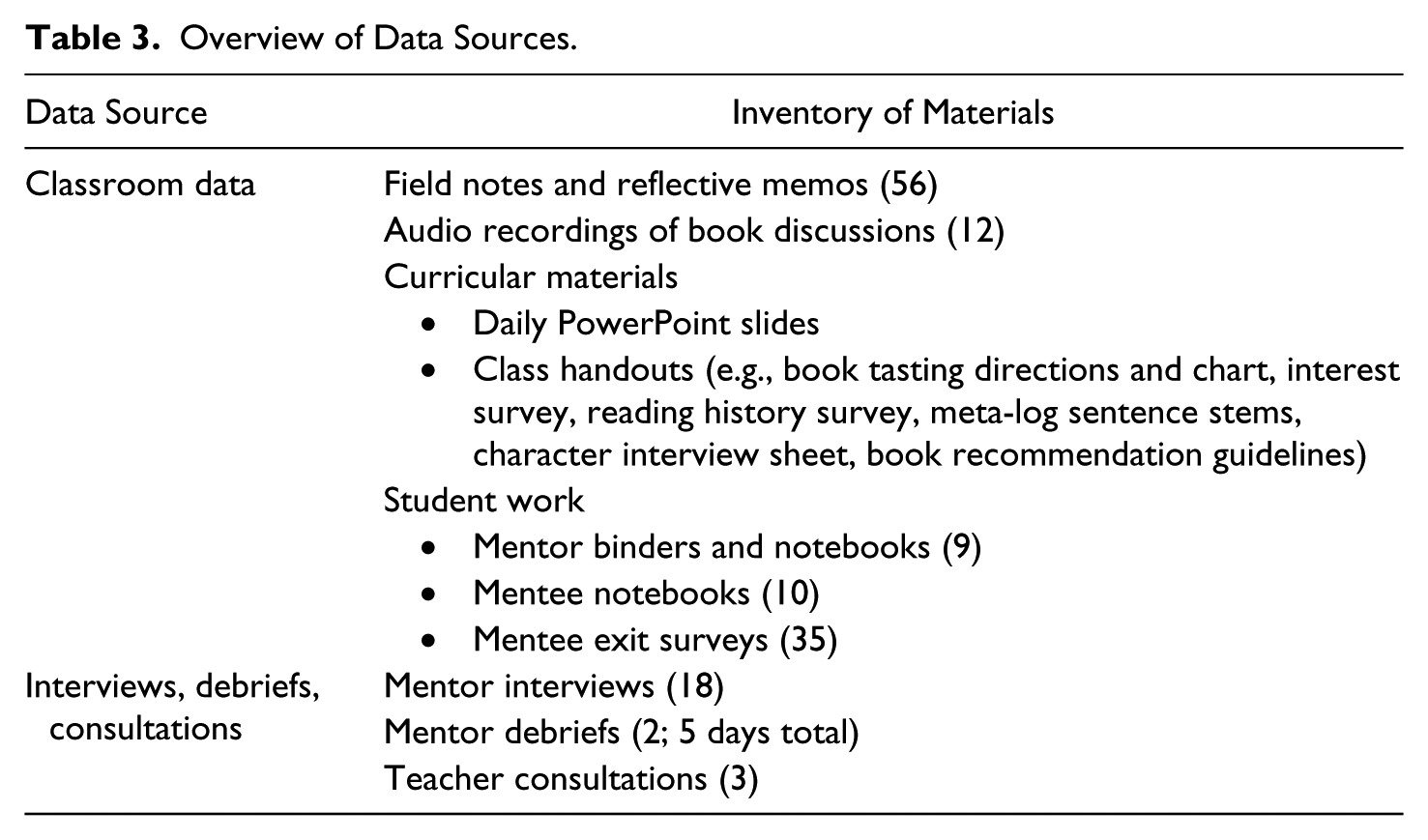
For this analysis, we drew from data collected during classroom observations and formal and informal conversations with the mentors (see Table 3).
Overview of Data Sources.
Classroom data
The purpose of collecting classroom data was to capture all participants’ interactions in the classroom over time. We drew on these data in collaboration with the mentors during debriefs (e.g., by together analyzing mentee notebooks and exit surveys to inform next steps). We also used classroom data to understand mentor positioning, as described in the analysis section. While Caitlin taught the class alongside the mentors, Kate and Susan contributed as participant-observers, visiting the classroom twice each week, taking field notes, and writing reflective memos. For continuity, each field note and memo followed a structured format (see Figure 1 in the online supplemental archive).
Mentor interviews
The purpose of the mentor interviews was to (a) learn about each mentor as an individual, including their identities and storylines about what it means to be a mentor, and (b) solicit their feedback on how to change or improve the course. Kate conducted audio-recorded interviews with the mentors in the fall and spring. The interviews occurred before the first mentoring cycle began and after the third cycle concluded. Kate asked mentors about their experiences with reading and writing, their perspectives on the LMC, and their understandings about what it means to be a mentor (see Appendix A in the online supplemental archive). After the first interview, Kate and several mentors noted that it was more productive to talk about changes to the course in consultation with Caitlin and the other mentors. Therefore, we began mentor debriefs after the first mentoring cycle to facilitate a more equitable exchange of ideas.
Mentor debriefs
The purpose of the mentor debriefs was to collaboratively analyze data from the LMC to date and discuss how to improve it moving forward. In January and March, Caitlin and Kate engaged mentors in audio-recorded debrief sessions. In January, the 3-day debrief was led by Caitlin with Kate’s and Susan’s support. In March, the 2-day debrief was led by Kate. At the debriefs, we collaboratively analyzed artifacts from the class (e.g., mentee notebooks, exit surveys) and discussed what went well, what did not go well, and what needed to change (see Figure 2 in the online supplemental archive). Between formal debriefs, Caitlin, Kate, and Susan regularly discussed the class with mentors and mentees during class time; these discussions were embedded into field notes as part of routine data collection procedures.
Teacher consultations
Initially, the purpose of the consultations was to brainstorm and co-plan ideas for the course. In September, November, and January, we audio-recorded consultations in which we jointly reviewed classroom practices, reflected on the class to date, and discussed next steps. In addition, we engaged in regular, informal check-ins before and after the classes that Kate and Susan attended. All informal consultations and check-ins were recorded as field notes. As with the individual mentor interviews, over time we came to see these consultations as less enabling of the mentor position (i.e., because they did not include the mentors) and therefore less useful in the context of a social design approach. We thus shifted to an emphasis on mentor debriefs as a means through which to facilitate a more equitable exchange of ideas.
Data Analysis
The purpose of data analysis was to document mentor positioning, including the rights and duties of the mentor position, and identify the literacy practices that enabled or constrained that positioning. Although we focused on the positioning of mentors in this analysis, we drew from mentee data collected through observations and field notes, as well as the written work and audio-recorded book discussions of a subset of mentees, to provide a more robust accounting of mentor positioning.
We uploaded all data sources to the qualitative data analysis software NVivo. Kate, Susan, and Jess engaged in an iterative, multiphase coding process following recommendations outlined by Smagorinsky (2008), including individual coding, co-coding and discussion at three phases of analysis, ongoing analytic check-ins, and matrix building and discussion. Kate discussed emerging findings with Caitlin throughout data analysis and consulted with three of the mentors—Nadia, Valeria, and Vee (all student names are pseudonyms)—about the findings as part of follow-up interviews the following school year.
First-phase coding
We (Kate, Susan, and Jess) individually read through a subset of the field notes from the beginning, middle, and end of data collection (including reflective memos and artifacts relevant to those field notes). During this initial review, we read or reread key works in positioning theory and coded for and memoed about preliminary themes related to how mentors were positioned in the context of the day-to-day happenings of the LMC.
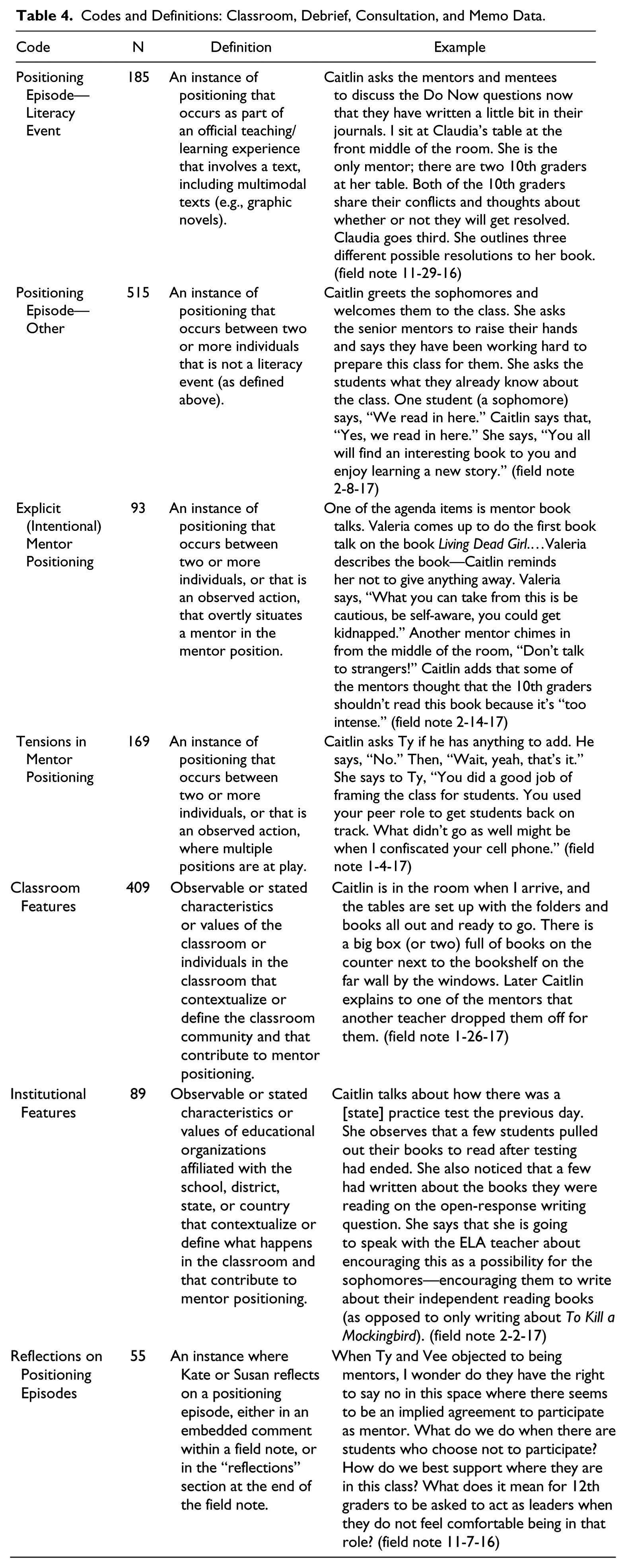
Next, we met to discuss emerging themes and to co-create a code list (see Table 4). At this time, the team distinguished between positioning episodes that were and were not literacy events. We further distinguished between classroom-level and institutional-level features that helped us to understand the context in which positioning episodes occurred—what Van Langenhove (2017) refers to as the “field of moral orders,” which “limit and influence what people can do at a given time and in certain places” (p. 7). We selected one field note to jointly code and together discussed and refined all codes, definitions, and examples. Finally, we each coded one-third of the field notes from the beginning, middle, and end of the school year. Instances of uncertainty or disagreement were resolved through synchronous analytic group check-ins via text message (e.g., when Kate had a question about a code, she texted Susan and Jess for clarification or discussion in real time).
Codes and Definitions: Classroom, Debrief, Consultation, and Memo Data.
Second-phase coding
We revisited the data for each Phase 1 code and conducted a second round of analysis for each code. For example, Susan returned to the coded data for positioning episodes that were also literacy events and further coded for event structures (e.g., independent reading) and event topics (e.g., literary response, metacognition). At this time, we also added codes for the kinds of positioning happening within the coded episodes by identifying positioning episodes where the mentor position was explicit and episodes that indicated tensions due to the co-occurrence of multiple positions.
Third-phase coding
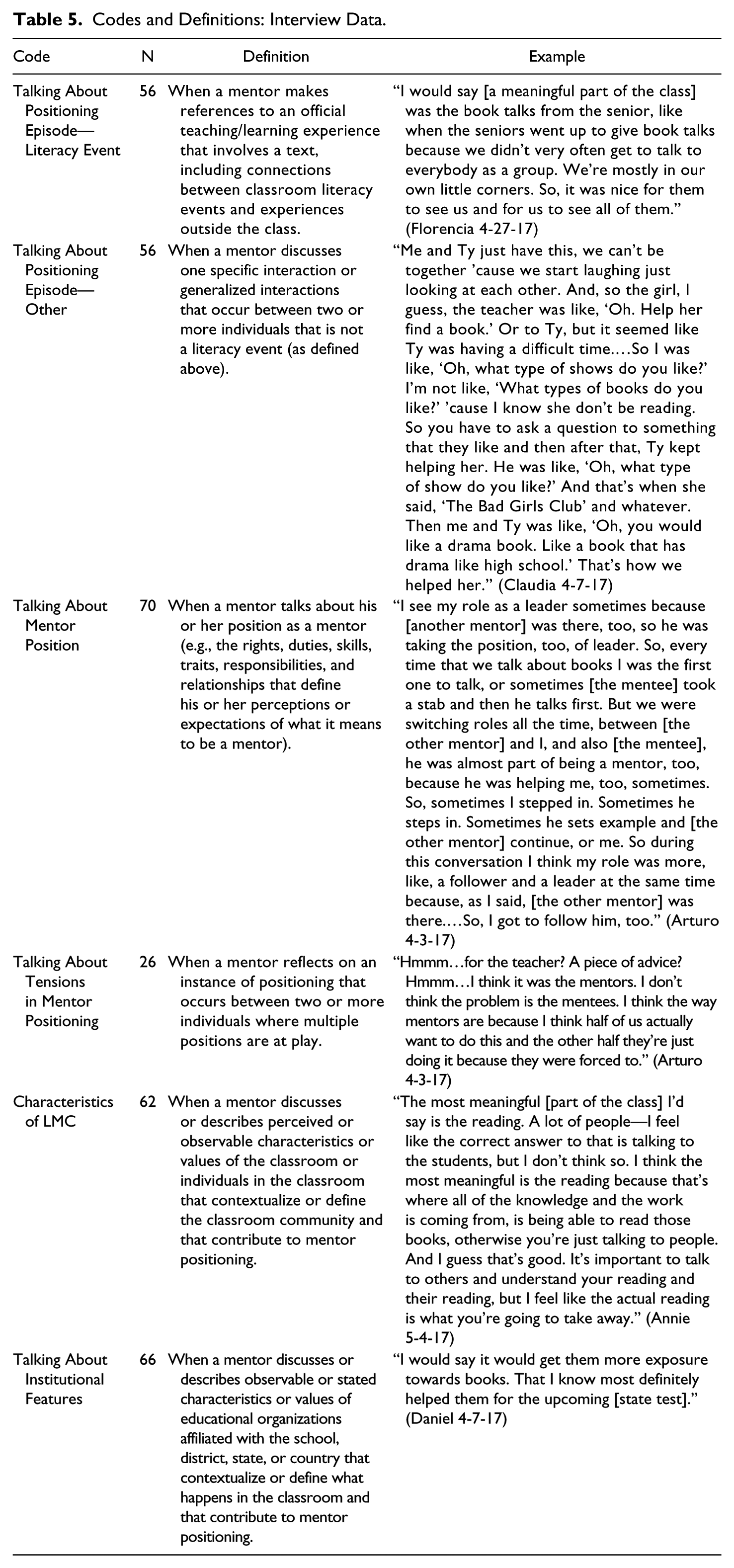
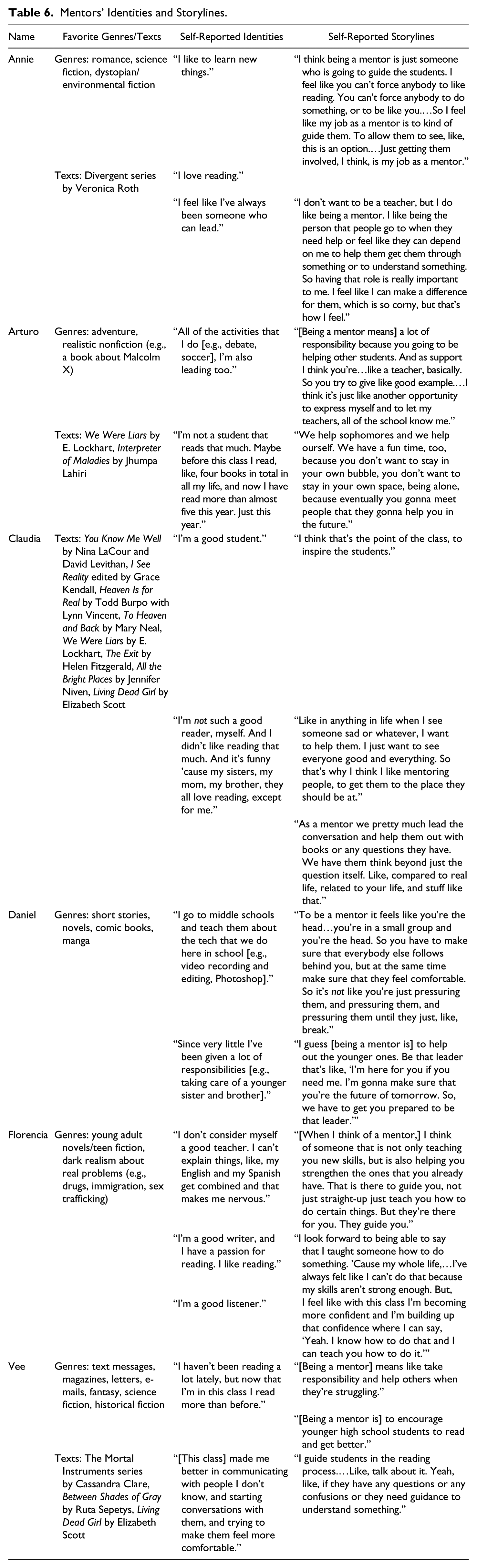
We followed a similar analytic procedure for the interview data. Some of our interview codes were created to complement the codes that we established during our analysis of the classroom data (see Table 5). in the online supplemental archive). Specifically, we analyzed the interviews to understand how mentors thought about positioning episodes and features, including their rights and duties as mentors and what tensions arose for them. We also coded interviews for mentors’ self-reported identities and storylines (see Table 6).
Codes and Definitions: Interview Data.
Mentors’ Identities and Storylines.
Identifying positioning practices
We met again to focus on understanding the conditions under which the mentor position was enabled or constrained during the class. We first ran a series of queries within NVivo to identify positioning episodes where the mentor position was explicit, as well as episodes where we identified tensions. As we looked across positioning episodes that were also literacy events, how mentors talked about those events in debriefs and interviews, and how we reflected on those events in memos, we identified literacy practices that enabled and constrained the mentor position. More precisely, the interviews and memos provided insights into the meanings ascribed to particular literacy events such that we could begin to understand the literacy practices of the classroom. Within these literacy practices, we identified the rights and duties that characterized the mentor position (and other positions).
These enabling and constraining literacy practices, while representing general trends as positioning practices, were not always clear-cut. For example, while independent reading as a practice was generally enabling of mentor positioning, it was not enabling in the same ways or to the same extent for all mentors. We discuss these findings, including their nuances, below. Finally, at this stage of analysis, we documented the literacy materials that played a role in shaping literacy practices, both materials that were central to the practices and those that were peripheral but nonetheless influential (Brandt & Clinton, 2002), as evidenced by the degree to which they appeared across data sources.
Findings
Below, we describe how 12th-grade mentors were positioned in the LMC and then discuss the literacy practices that enabled and constrained that positioning.
Mentor Positioning
We identified two primary categories of mentor positioning in the LMC: explicit positioning and tensions in positioning (see Figure 3 in the online supplemental archive).
Explicit mentor positioning
Before the mentees joined the class (September-November), we positioned the mentors as co-designers and co-teachers. Explicit positioning occurred during discussions about literacy and its place in the lives of students, and during planning discussions about the mentors’ future work with mentees. For example, during a discussion about how literacy is assessed in the United States (i.e., through standardized tests), Caitlin explained that teachers and administrators at the school often have conversations about testing and that she was inviting the mentors to be a part of that conversation. She added that understanding and critiquing how the tests work is important to the mentors’ ability to teach the mentees (field note September 22, 2016). The mentors similarly positioned themselves as co-designers and co-teachers during classroom interactions, for example by collectively rejecting an idea put forward by Caitlin and Kate to compile text sets for the mentees. The mentors argued that the class would be successful only if the mentees had full autonomy to choose their own books; we changed the plan accordingly.
Once mentees joined the class in November, explicit positioning occurred formally in the framing of classroom literacy events (e.g., the mentors gave book talks, helped mentees find books, and talked to them about how they were liking their books) and informally during classroom interactions (e.g., Caitlin directed mentees’ questions to the mentors). Other examples of explicit positioning occurred during mentor debriefs, where Caitlin, Kate, and the mentors negotiated the “mentor role,” analyzed classroom data, and made changes to classroom activities. During debriefs, the mentors regularly enacted the rights and duties of co-designers and co-teachers (e.g., critiquing previous activities, offering ideas for alternative activities).
Tensions in mentor positioning
Tensions usually occurred when the explicit rights and duties of the mentor position were juxtaposed with the mentors’ tacit rights and duties as students at the school. Before the mentees arrived, instances of tension stemmed from institutional-level norms that affected the classroom and positioned the mentors as students (e.g., school-wide rules about phone and bathroom privileges). For example, in October the mentors performed skits that addressed some of their concerns about the kinds of difficulties they might encounter as mentors. Before the skits began, Caitlin talked with the mentors about their cell phones, explaining that she had to enforce the school policy of no phones during class and asking them to “please step it up with the phones . . . don’t be a hypocrite” (field note October 20, 2016).
When mentees joined the class, tensions in mentor positioning occurred as the 12th graders negotiated their rights and duties as mentors with their position as students within the broader school community. For example, while the mentors reviewed their mentees’ notebooks after Cycle 1, Susan recorded the following: For “what could have been improved,” Valeria and Daniel comment on the mentees’ behavior. Valeria says that the mentees “did not work to capacity” and in the same breath says, “Uh, I hate judging people.” After Valeria and Daniel share their observations with the rest of the mentors (e.g., their own tendency to get “distracted”; their concerns about the mentees “teasing,” “talking back,” and participating unequally), another mentor calls them out for “snitching on the whole thing.” Valeria replies, “I know, I feel horrible!” Caitlin clarifies that they are not snitching, but instead doing what they were supposed to do by talking about what worked and what didn’t work, and providing honest feedback to make Cycle 2 better. There is some laughter from the mentors in response. (Field note January 4, 2017)
In her reflection, Susan highlighted this tension in positions, noting that the mentors seemed to be “walking this line between allying themselves with mentees . . . and allying themselves with Caitlin.” She wondered, “To whom do they feel more allegiance? How does this impact the nature of the groups?” (memo January 4, 2017). In this instance, the questions—to consider what went well and what did not go well in that cycle—implied duties that came into conflict with the mentors’ simultaneous position as students. As we show below, tensions in mentor positioning occurred in the context of classroom literacy practices that both enabled and constrained the mentor position.
Literacy Practices That Enabled and Constrained the Mentor Position
We identified both practices that were enabling and practices that were constraining of the mentor position. Below, we examine these practices and show how they shaped mentors’ opportunities to flexibly and authentically negotiate their rights and duties. We also demonstrate how tensions in the rights and duties of the mentor position opened up unique positioning opportunities within these practices.
Enabling practices: Independent reading and book discussions
Independently reading self-selected books and participating in book discussions led by the mentors were defining practices in the LMC. As previously noted, the mentors felt strongly that the mentees needed to be able to choose their own books. With just one exception, in exit surveys the mentees highlighted independent reading and book discussions as the most enjoyable parts of the class.
These practices were enabling of the mentor position for a number of reasons. First, they leveraged mentors’ knowledge of books (e.g., by giving book talks, assisting mentees with book selection, recommending new books for the class library). Second, they afforded opportunities for mentors to shape interactions and determine next steps (e.g., by building personal relationships with mentees, generating questions for discussion, determining how and when to ask follow-up questions). Third, they helped to establish an authentic community of readers within the classroom that supported the mentors’ own understandings of their position.
In interviews, mentors described successful book discussions as authentic conversations about topics of interest where all participants had the right to contribute as equals (see Figure 4 in the online supplemental archive). Florencia described discussions with her mentee, Alice, in this way: She was reading this book [All the Bright Places] that I recommended and she loved it. The way she spoke about the book, it was just amazing . . . She would tell me details without me asking. She would tell me about the characters without me even asking because she was so excited about the book . . . So I felt like I didn’t have as big of a role because she took the lead. (Interview April 27, 2017)
Likewise, Valeria described successful book discussions as ones where mentees were “just explaining what they liked about the book or how they can relate to the book” (interview April 10, 2017). Vee had a similar perspective: [One of my mentees] started talking about her book [Tyrell] and how all these crazy things happened. And, her friend, the other mentee, was really engaged in it, and me too because we were wondering what was going to happen next. So, I wanted to read the book after she talked about it. (Interview March 31, 2017)
Valeria’s and Vee’s mentee, Ron, seemed to agree with his mentors’ understandings, writing in his exit survey that “reading is a great experience” and that he most enjoyed “reading books I liked, meeting new people, and stepping out of my comfort zone” (exit survey February 7, 2017).
Other mentors had similar perspectives on book discussions. Nadia’s explanation of her position during this practice reflects broader trends in the data about how mentors viewed their rights and duties: I made them feel like I was just like them, even though I really, I literally am, but in terms of this class it’s supposed to be, you know, you’re the mentor, but no I made them feel like, you know, we’re just a bunch of kids interested in a book and answering questions. But in the back of my mind, I am doing what I’m supposed to do and collecting all this data, but I’m asking questions just like them, having reactions, like “Oh, that’s cool.” I don’t ever like to make people feel, especially in cases like this, make them feel like, if there was a teacher at the table. You know? No, like, “We’re chilling, just talking about this book,” and be comfortable. You know? “If anyone were to understand you, it’d be me.” (Interview April 10, 2017)
One of Nadia’s mentees noticed and appreciated her approach, observing that “she was really into it, she was asking questions . . . she always was working on us” (exit survey March 16, 2017). Notably, as Nadia alluded to in her description, some mentors contrasted these book discussions with their own experiences in school, where teachers sometimes did not understand them or treat them as equals.
Tensions during independent reading and book discussions
Although independent reading and book discussions generally were enabling practices, there were tensions within these practices for mentors when their position as mentors was juxtaposed with their position as students at the school. These tensions were particularly salient for one mentor, Ty. Ty regularly articulated a nonreader identity in formal and informal conversations with Caitlin, other mentors, and mentees (e.g., introducing himself to mentees as someone who is “not much of a reader”). He also routinely circumvented the classroom cell phone policy during independent reading, which followed the school-level policy of no phones during class. At one point, this led to the confiscation of his phone. In October, Ty discussed his concerns about being a mentor, and particularly his fear that the duties of the mentor position might make him a hypocrite: I like to help people when I can, but I don’t like to, if it comes down to it, tell them what to do or make them do something because I’m a student myself now. So, I don’t like to put anybody in a position that is not even . . . I don’t know, I just, I don’t want to be a hypocrite. (Interview October 27, 2016)
At the same time that Ty articulated a nonreader identity and expressed concerns about the implied duties of the mentor position, he was an avid reader of comic books and graphic novels, a self-proclaimed visual artist with his “own style of drawing that nobody even knows about,” and a relentless advocate for more visually engaging texts in the classroom. Ty used his interests and expertise as a way to connect with his mentees. He explained, I had two mentees that I had to help read a book. It was at the beginning because they didn’t really want to read, so I was like, “Hey, graphic novels, you really don’t have to read. It’s mainly about the pictures.” And he was like, “Oh, all right.” I gave it to him and he was like, “Oh, that’s nice. This book is nice. The illustrations is nice . . .” And they would be like, “Yeah, I’m into action or I’m into graphic novels or comic books.” And I’m like, “Yeah. I’m the guy to come to for that, so you just let me know.” (Interview March 28, 2017)
At the end of three cycles, Ty articulated an approach to mentorship (and a definition of what it means to be a reader) that leveraged the tensions arising from the sometimes competing rights and duties of being a mentor versus being a student: The students still see you as an equal because you’re still a student, but they respect their mentors . . . It’s not complicated. It’s just a slow process . . . You get to grow a relationship with your mentees as a mentor. So, I think that’s what I did with every single mentee I have. It went slow, but towards the middle and the end, it was there. We connected . . . I mean because if your teacher don’t have a relationship with you while they’re teaching you, they’re just gonna be another person that’s standing in front of you teaching you something. (Interview March 28, 2017)
For Ty, independent reading and book discussions brought to the fore some of the tensions that he experienced as a mentor. Ty leveraged these tensions to negotiate his rights and duties as a mentor in light of his other positions and identities. Other mentors also worked to negotiate their rights and duties in ways that aligned with their own distinct positions and identities. For example, as an aspiring lawyer who had experience working in courts, Nadia made connections between her position as mentor and her commitment to advocating for others. Opportunities for mentors to engage in revisions of the rights and duties of the mentor position were more constrained in the context of other practices, which we discuss in the next section.
Constraining practices: Metacognitive activities
Other defining practices in the LMC included metacognitive activities. Specifically, Caitlin introduced meta-logs during Cycle 1 as a way for students to think about the how as well as the what of reading. During and after reading (i.e., every 12 min or so), mentors and mentees wrote in their journals about how they read during that period of time. Caitlin provided sentence stems to support their writing (see Figures 5 and 6 in the online supplemental archive) and a list of follow-up questions that mentors could use during discussions (e.g., Did anyone get confused while reading? What did you do?).
Metacognitive activities represented key practices that aligned with school, district, and state priorities (i.e., preparing students for the state test) and with research on best practices in adolescent reading instruction (e.g., Greenleaf et al., 2001). Metacognitive activities also addressed the perceived need to make the class about more than “just reading,” a concern that was a frequent topic of conversation between Caitlin and Kate throughout the school year, particularly in relation to school-level expectations for the course. In November, for example, Kate wrote, Caitlin and I discuss her concerns about the role of strategy instruction in the class—she doesn’t want it to detract from the reading students are doing. Rather, she wonders how it might be a way to enhance that reading . . . We discuss the tension between wanting students to be immersed in their books and the [perceived] need for explicit strategy instruction. We talk through this tension and what it might look like moving forward—perhaps having mentors talk about their reading processes (what they do when they get stuck, etc.). (Field note November 29, 2016)
Although only two mentees mentioned meta-logs specifically in exit surveys as something that should change about the class, most of the mentors perceived meta-logs as inauthentic, tedious, and an obstacle to reading. They expressed concerns about meta-logs in debriefs and offered ideas for how to adapt the practice to make it less onerous. During the March debrief, for example, the mentors discussed in small groups the parts of the class that did and did not work well. All three groups noted meta-logs as something that did not work well. In a subsequent whole-group discussion, Kate asked the mentors to say more about meta-logs:
What are you guys thinking about the meta-logs at this point, because I know when we had our debrief in January—
They’re boring.
What’s the point?
They’re pointless.
Doing a meta-log like every time we finish reading? It’s like, one time, or do it at the end of reading, okay, but like every 12 minutes—
Yeees! No kidding! [Laughs.]
That’s so annoying. (Audio recording March 20, 2017)
Subsequent interviews with mentors reiterated a general frustration with meta-logs. For example, in response to a question about activities that were the least useful, Florencia said, I feel like everybody’s going to say meta-logs, but they were really tedious, especially because we kept doing them on and on . . . It gets boring for [mentees]. It gets boring for us, even though we try to look enthusiastic about them . . . One of my mentees even said, “Isn’t this supposed to be a fun class? What are we doing? Why isn’t this fun?” And I didn’t know what to say. (Interview April 27, 2017)
Concerns about meta-logs were a common topic of conversation. As such, the meta-logs indexed some of the tensions in the mentor position, specifically the implication that one of the nonnegotiable duties of the mentor position was to facilitate metacognitive activities.
Tensions during discussions about meta-logs
The intention of mentor debriefs was to provide a forum for the negotiation of rights and duties through the solicitation of critical and collaborative analysis and discussion about how to improve the LMC. The topic of meta-logs surfaced tensions because it called attention to certain duties (i.e., engaging mentees in thinking about how they read) that the mentors ultimately did not have the right to negotiate. For example, during the debrief in January, Arturo and his small group identified meta-logs as an activity that did not go well because “[the mentees] didn’t talk that much” although “they did explain it in their notebooks.” Several other mentors, including Claudia and Daniel, supported this observation and suggested getting rid of the meta-logs, noting that they were “frustrating” and that the sentence starters were difficult to use and restricted their own writing. Here, mentors argued against the meta-logs from their positions as readers and students, but they simultaneously claimed the right of the mentor position to critique the practice. Caitlin, appealing to the mentors in terms of their duties, sought to reposition them as expert readers: [The meta-logs] may feel more cumbersome to you guys because you’re more experienced readers, so the purpose of the meta-logs, when we do the meta-logs, it’s not supposed to be a time to just write about whatever you want, it’s meant to be a time to think about your thinking as you’re reading . . . A lot of you guys do this automatically, but not everybody does that when they’re reading. (Audio recording January 4, 2017)
The next day, Caitlin began by discussing “the things that we are tasked with doing when we put that mentor hat on,” including the following:
Getting the 10th graders engaged in reading
Getting the 10th graders thinking about HOW they read
Helping them improve their reading through problem solving and modeling fix-up strategies. (PowerPoint January 5, 2017)
She explicitly acknowledged the concerns about meta-logs that arose the previous day, and then revisited the purpose for and rationale behind them, specifically the following:
The purpose [of meta-logs] is to address #2—get them thinking about what is happening in their heads as they read
Research shows doing this helps to improve overall comprehension of texts
Experienced readers do this automatically. (PowerPoint January 5, 2017)
Points two and three connected back to previous conversations with the mentors in the fall, when Kate introduced them to reading comprehension theory and research. Here, Caitlin again emphasized the mentors’ position as experienced readers, suggesting they found the meta-logs tedious because strategic reading was something that was automatic for them, before proposing a compromise: to keep the first part of the meta-log (i.e., “I started on page __ and ended on page __. I was actively engaged __/__ minutes”) the same, but leave the second part (i.e., “what did you read, the juicy content, the questions about the characters”) up to the mentors (field note January 5, 2017). She also clarified that some of the duties of the mentor position were nonnegotiable: One caveat is, there are questions for debriefing the meta-logs that are going to help you reach that goal of number three, which is helping them to have the strategies that they need to have in order to be better readers when they leave here. So, if the kid has lost interest during the session and that’s what they write in their meta-log, then it’s important for you to have a conversation with them about what happened. (Audio recording January 5, 2017)
In a memo, Kate reflected on this conversation: Today during class, I thought a lot about how we navigate mentors’ questions, concerns, and suggestions in light of the teaching agenda. The mentors tend to have ideas that focus on the affective components of reading, while Caitlin and I tend to push back to also be able to preserve certain learning opportunities. The meta-logs are a clear instance of this back-and-forth tension, with multiple mentors indicating that they don’t like them and think they should be abandoned. Today, and on other days, too, one of Caitlin’s strategies for negotiating this tension was to explain to the mentors in quite explicit terms how she thinks about things as a teacher (e.g., “When teachers plan, we . . .”). This seems like an effective way of acknowledging the mentors’ perspectives and then providing an explanation for why some things can’t/won’t change. At times today, however, I did wonder about whether the mentors felt fully heard/validated. What it seems to come down to is the discomfort of, on one hand, genuinely wanting students to have a voice, and, on the other, genuinely feeling like there are certain things that need to happen, from a teaching perspective. (Memo January 6, 2017)
In debriefs, tensions arose when the rights of the mentor position to shape and critique the class came into conflict with the duties of the mentor position to engage the mentees in particular practices (i.e., meta-logs). These practices were important to Caitlin and Kate in light of a variety of institutional pressures ranging from looming state testing to extant research establishing the importance of metacognition to reading. In addition, it was in these conversations that the mentors’ multiple positions became entwined as they claimed the rights of the mentor position while simultaneously arguing against meta-logs from their positions as readers and students.
Discussion and Implications
We first discuss what we learned about mentor positioning and the literacy practices that contributed to that positioning. Next we consider the implications of our findings for our ongoing work, and for the work of others who seek to engage youth as collaborators.
Rights and Duties at the Intersection of Multiple Positions
Our analyses indicate that our explicit efforts to position mentors as collaborators were taken up in different and sometimes unexpected ways. This was a result of the multiple positions of student, reader, and mentor that were available to the mentors and that were enabled and constrained through the official literacy practices of the classroom. It also related to institutional-level factors, or moral orders, that shaped what was and was not negotiable.
Enabling practices
Independent reading and book discussions were enabling of the mentor position because they were opportunities to negotiate the rights and duties of that position through authentic interactions and conversations with mentees about books chosen by the students. Ty’s concern about being a hypocrite was one example of how tensions arose for mentors through these practices. In his and other cases, this concern led to adaptations of the rights and duties of the mentor position. Specifically, Ty leveraged his articulated nonreader identity to position himself as the mentor others went to if they wanted to find different kinds of texts. He recast the mentor position as an opportunity to “grow a relationship” with his mentees—the kind of relationship he believed all teachers should have with their students.
Constraining practices
Metacognitive activities were constraining of the mentor position because they implied nonnegotiable duties that positioned mentors as complicit in classroom practices that did not resonate with their own understandings of their rights and duties as mentors (and readers). Discussions about meta-logs highlighted the mentors’ multiple positions in the classroom and school. They also indexed broader tensions at the intersection of classroom-level norms and school-level constraints and expectations. While the mentors viewed the classroom as a place to build relationships, savor books, and relax, we also envisioned it as a space to encourage mentors and mentees alike to think metacognitively about how they were reading in addition to what they were reading.
Other factors
The literacy practices that defined the LMC—specifically, independent reading and book discussions, which prioritized choice and student-centered learning in a small-group structure—deviated from typical practices at the school. These defining features were heavily influenced by the mentors’ perspectives on the design of the class. However, alongside these opportunities for mentors to shape classroom practices, there were also nonnegotiable duties that characterized the mentor position—specifically, the expectation that mentors would talk with mentees about how they were reading. Tracing the literacy materials implicated in these constraining practices provides further insight into the nonnegotiable duties to engage mentees in metacognitive activities. State testing, on one hand, and scholarship on reading instruction, on the other, were two sets of materials that shaped the practices of this classroom. As de facto sponsors of those materials, we at times invoked our authority as adults affiliated with powerful educational institutions (e.g., the school, the district, the university, the research community) to rationalize and justify practices that constrained the mentor position. The implications of our respective sponsorships of these materials were frequent topics in conversations and memos. The fact that these concerns were never fully resolved in consultation with the mentors leaves us with lingering questions, which we discuss below.
Lingering Questions
As we engage in ongoing collaborations with youth in the pursuit of humanizing pedagogies and research in education (Paris & Winn, 2014), we return to positioning theory to explore some of the limitations of the LMC as a means of disrupting traditional literacy instruction. In light of these limitations, we also propose ways that we may have increased the reflexivity of our work and more meaningfully and equitably engaged our youth partners.
Designing for equity
The intention of the LMC was to disrupt traditional literacy instruction in consultation with youth. However, the nature of the collaboration—that is, the decision to partner with 12th-grade mentors but not 10th-grade mentees—may have served to reproduce traditional norms by maintaining hierarchical structures. Considering this limitation from a social design perspective—which prioritizes equity, historicity, and agency (Gutiérrez, 2016)—we must question the equitableness of a collaboration where older students made instructional decisions that affected their younger peers without sufficient opportunities to incorporate 10th graders’ perspectives into the design process. We wonder how the LMC might have evolved differently if the rights and duties of mentors and mentees as collaborators had been a central component of the design.
Questioning rights and duties
Throughout this project, we explicitly discussed—and at times negotiated with mentors about—the mentoring “role.” Previous theory and research (e.g., Davies & Harré, 1990; Hunt & Handsfield, 2013; McVee et al., 2011) have documented that how roles are understood, taken up, and negotiated in social interaction is a complex, nuanced, and power-laden process. However, we did not always sufficiently take into account our own rights and duties as members of the classroom community, or how those rights and duties were linked to moral orders characterized by broader educational and societal power structures and relationships (Van Langenhove, 2017).
In the case of the meta-logs, for example, we did not engage directly in an interrogation of the moral orders and associated power dynamics that made this component of the class a nonnegotiable duty of the mentor position (i.e., that we perceived metacognitive activities as a way to support students to read more and better beyond the class, thereby positioning them to perform better on the state test and ultimately positioning the school for liberation from state oversight). Opportunities to question these and other structural conditions might have led to different outcomes (e.g., a renegotiation of our own rights and duties around meta-logs or a rethinking of the practice altogether). In light of research that has called attention to the gendered and racialized nature of youth positioning (e.g., Ridgeway & Yerrick, 2016; Rogers et al., 2010), this shortcoming seems particularly salient for us as White women collaborating predominantly with youth of color. Specifically, it calls attention to some of our assumptions about what we believed students required to be academically successful, and how those assumptions may have inhibited us from thinking more critically and expansively.
Interrogating positioning practices
In the LMC, certain literacy practices were more enabling of the mentor position than others. Previous research (e.g., Kim & Viesca, 2016; Yoon, 2008) has established a connection between teachers’ positioning of students (e.g., as monolithic learners) and teachers’ instructional practices (e.g., using practices calibrated to a single understanding of learners’ needs). We extend this line of work to argue that the literacy practices of the LMC were positioning practices that themselves enabled and constrained certain positions.
In light of this finding, we acknowledge that we did not adequately incorporate opportunities for the generation of practices that might have built from youths’ diverse experiences across multiple social, cultural, and historical contexts (Gutiérrez, 2016). Although the rights and duties of the mentor position included critical reflection and feedback during interviews and debriefs, this feedback was realized within the confines of existing practices. We wonder how a more equitable distribution of rights and duties across partners to design expansive practices (e.g., explicitly inviting “new” and multimodal literacies like fan fiction or social-media-based literacies into the classroom) might have altered some of the design decisions. Relatedly, we wonder how more inclusive methodological practices (e.g., writing field notes and memos with youth rather than about them) might have led to different findings.
Conclusion
At the outset of this collaboration with 12th-grade literacy mentors to co-design and co-teach the LMC, our goal was to disrupt traditional literacy instruction alongside our youth partners. The analysis of mentor positioning presented here reveals areas of promise as well as areas of challenge in achieving this goal. A key challenge is that the positions afforded youth in collaborative partnerships like this one are imbued with hierarchical power relationships that characterize educational and societal contexts more broadly. Therefore, future endeavors to disrupt traditional literacy instruction in collaboration with youth must engage these relationships by accounting for the rights and duties of all members of a classroom community, including how those rights and duties intersect, merge, or come into conflict within and across practices. Future endeavors also must attend to classroom literacy practices as positioning practices that themselves impose particular rights and duties onto participants. At the time of this writing, we have shared the findings and implications discussed here with a new cohort of literacy mentors (some of whom were mentees during the inaugural year of the LMC described in this article), using them as an opportunity to facilitate ongoing and critical conversations related to the aforementioned lingering questions about designing for equity, questioning rights and duties, and interrogating positioning practices. We invite all teachers, university researchers, and youth partners who work from within schools in the pursuit of ever more humanizing pedagogies and methodologies to keep these questions about positioning at the forefront as a central—and ongoing—design concern.
Supplemental Material
Appendix – Supplemental material for Positioning Adolescents in Literacy Teaching and Learning
Supplemental material, Appendix for Positioning Adolescents in Literacy Teaching and Learning by Katherine K. Frankel, Susan S. Fields, Jessica Kimball-Veeder and Caitlin R. Murphy in Journal of Literacy Research
Supplemental Material
Supplemental_figures – Supplemental material for Positioning Adolescents in Literacy Teaching and Learning
Supplemental material, Supplemental_figures for Positioning Adolescents in Literacy Teaching and Learning by Katherine K. Frankel, Susan S. Fields, Jessica Kimball-Veeder and Caitlin R. Murphy in Journal of Literacy Research
Supplemental Material
Supplemental_Material_802441 – Supplemental material for Positioning Adolescents in Literacy Teaching and Learning
Supplemental material, Supplemental_Material_802441 for Positioning Adolescents in Literacy Teaching and Learning by Katherine K. Frankel, Susan S. Fields, Jessica Kimball-Veeder and Caitlin R. Murphy in Journal of Literacy Research
Supplemental Material
supplemental_tables – Supplemental material for Positioning Adolescents in Literacy Teaching and Learning
Supplemental material, supplemental_tables for Positioning Adolescents in Literacy Teaching and Learning by Katherine K. Frankel, Susan S. Fields, Jessica Kimball-Veeder and Caitlin R. Murphy in Journal of Literacy Research
Footnotes
Acknowledgements
Thank you to our youth partners for collaborating with us on this project—the LMC quite literally would not exist without their invaluable insights and critiques. Thank you as well to Sarah Thomas, whose commitment to this project in its earliest stages helped to lay the groundwork for all that followed. Finally, thank you to the JLR editors and four anonymous reviewers for their feedback on earlier drafts of this manuscript.
Declaration of Conflicting Interests
The author(s) declared no potential conflicts of interest with respect to the research, authorship, and/or publication of this article.
Funding
The author(s) disclosed receipt of the following financial support for the research, authorship, and/or publication of this article: This research was supported by a Faculty Research Award from the School of Education at Boston University.
Supplemental Material
The appendix, online supplemental figures and abstracts in languages other than English are available online.
References
Supplementary Material
Please find the following supplemental material available below.
For Open Access articles published under a Creative Commons License, all supplemental material carries the same license as the article it is associated with.
For non-Open Access articles published, all supplemental material carries a non-exclusive license, and permission requests for re-use of supplemental material or any part of supplemental material shall be sent directly to the copyright owner as specified in the copyright notice associated with the article.
