




Abstract
Scholars contend that disciplinary literacy is a productive route for all secondary learners, including those identified as struggling readers, to build knowledge. Relatedly, scholars point to disciplinary literacy as a socially just alternative to decontextualized skill instruction and deficit positioning. Yet, little research has examined how instructional contexts facilitate these youths’ participation in disciplinary literacy practices. I present the case of one ninth-grade history classroom. Participants were three students and one teacher. Data sources included 48 hr of observations, 11 semistructured interviews, ongoing ethnographic open-ended interviews, and classroom artifacts. By closely examining the enactment of one lesson and situating the analysis in the class’s yearlong academic and social trajectories, I show how disciplinary literacy provided avenues for youths to wrestle with and critique historical texts, compare perspectives across sociohistorical periods, see themselves in history, and disrupt deficit positioning in school. I discuss implications for secondary literacy and social studies education.
How to effectively support young people’s school-based literacy has long been deliberated in research and policy. A current argument is for teaching disciplinary literacy (Hynd-Shanahan, 2013; Moje, 2015; C. Shanahan, Shanahan, & Misischia, 2011; Wineburg & Reisman, 2015), which apprentices youths into the unique and overlapping practices of the various disciplines through text-based inquiry. Although some contest its usefulness (Heller, 2010), others argue that by foregrounding the discursive practices of particular disciplines, young people learn to read, produce, and critique disciplinary texts (Bain, 2006; Hand, Wallace, & Yang, 2004; Wineburg, 2001). Moreover, scholars contend it is a productive route for all readers, not only those who are high-achieving, to build knowledge and skills in meaning-focused ways and to develop tools to transform the disciplines themselves (Lee & Spratley, 2010). Given that decontextualized skill instruction and deficit positioning still occur among some secondary classrooms labeled as lower track or intervention (Learned, 2016), disciplinary literacy is regarded as not just an alternative but a form of socially just teaching (Moje, 2007) and a civil right (Lee, 2004).
Questions persist, however, about how to effectively engage youths in disciplinary literacy, particularly those identified as struggling readers. In the complex and tracked arena of high school learning (Callahan, 2005; Gamoran, Nystrand, Berends, & LePore, 1995; Oakes, 1985), as teachers and students navigate demanding schedules, increasingly standardized learning objectives, and ever-shifting social and instructional arrangements, how and when is disciplinary literacy a boon for all readers? This article draws on data from an extensive school-yearlong study to present the case of a ninth-grade lower track U.S. history class in which youths identified as struggling readers were clustered. I use the terms lower track and struggling readers because they were used in the school and because this article problematizes their deficit, static connotations (see Franzak, 2006; Gutiérrez, Morales, & Martinez, 2009).
By closely examining one history lesson and situating the analysis in the class’s yearlong academic and social trajectories, I show how the teacher, together with students labeled as struggling readers, constructed literacy contexts and how those contexts mediated students’ learning, identities, and engagement. On balance, across classes youths experienced and were positioned to experience difficulty as instruction focused on decontextualized skills and behavior compliance (see Learned, 2016). However, in this history classroom, the teacher and students disrupted school-wide trends. In this article, I show how disciplinary literacy appeared to support youths as readers and learners by providing avenues for youths to wrestle with and critique historical texts, compare perspectives across sociohistorical periods, and see themselves in history.
Theoretical and Empirical Perspectives
Assuming that literacy is a social practice (Scribner & Cole, 1981), and as such is mediated in and constituted by cultures and ideologies (Street, 1984), adolescent reading involves the enactment of identities and skills mediated by the literacy practices in which youths engage for specific purposes and through particular contexts. Correspondingly, reading “struggle” is not a static or stable trait, but rather difficulty that manifests among the interactions a reader has with particular texts and activities (Lipson & Wixson, 1986) and across contexts (Stone & Learned, 2013). From this perspective, a youth’s demonstrations of reading struggle—and proficiency, for that matter—vary in dynamic interaction with the purposes, texts, and people she or he encounters (Learned & Moje, 2015).
School Contexts as Fluid yet Consequential
Central to this analysis of readers labeled as struggling are questions about instructional, social, and sociohistorical contexts. Contexts are always under construction, power-laden, and multifaceted. On a moment-to-moment basis, people constitute contexts through their social interactions (Erickson & Schultz, 1997) and with the tools actors use to make meaning throughout and beyond their networks (Latour, 1987). Even while actors construct contexts, contexts also mediate individuals’ actions (Blumer, 1969). Thus, individuals and contexts are separate but related entities that exist in dynamic relationship with one another (Sawyer, 2002).
As individuals bring to bear their histories of participation across space and time, contexts overlap. Despite the dynamic and fluid nature of contexts, however, they are not so ephemeral that they have no consequence in social life. Indeed, in secondary schools, a multiplicity of contexts, including cultural, linguistic, and instructional contexts, play important roles in mediating youths’ literacy (Moje, Dillon, & O’Brien, 2000).
Moreover, school contexts are imbued with power dynamics, which help shape the literacy-learning opportunities of young people (Gutiérrez et al., 2009). To account for the role of power, I drew on a notion that power flows unpredictably through social interactions, but that the mechanisms of power are colonized by forms of authority (Foucault, 1972). Differentiating power from authority afforded an analysis of how teachers and administrators can support or compromise students’ opportunities to learn without casting youth as powerless.
As youth readers navigate institutional authority, they are called into social positions. In taking up and resisting positions, they enact identities and discursively construct themselves in relationship to others (Davies, 2008; Davies & Harré, 1990). Because being positioned as a struggling reader (Alvermann, 2001) has consequences for literacy learning (see Franzak, 2006) and because youths actively negotiate these identities (Hall, 2007), attending to positioning in contexts is critical. Taken together, these theories of context, power, and positioning supported an analysis of how a teacher and students’ interactions shaped and were shaped by the contexts of one history class and how those contexts mediated literacy.
Disciplinary Literacy as a Context for the Learning and Teaching of History
Coining the phrase content area reading, Herber (1978) argued that educators need to teach not only the content knowledge of a particular subject but also the processes by which content is produced and learned. To understand these processes, researchers pursued a line of inquiry related to metacognitive reading strategies. Although strategy instruction was found to be effective (Palincsar & Brown, 1984), researchers have more recently argued it is less productive when it happens as a means unto itself (McKeown, Beck, & Blake, 2009) or absent attention to other aspects of literacy learning, such as building knowledge (see Learned, Stockdill, & Moje, 2011; Palincsar & Schutz, 2011) and enacting productive literacy identities (see McCarthey & Moje, 2002).
Disciplinary literacy is one means by which to integrate knowledge building, inquiry, and learning identities. Scholars define disciplinary literacy and its relationship to content area literacy in various ways. I draw on Moje (2007, 2015) to understand disciplinary literacy as inquiry-based, purpose-driven, and situated in disciplinary discourses and communities of practices. As individuals participate in these communities, they use and develop skills and strategies, enact identities, and assume membership. From this perspective, skills and strategies are not discreet or decontextualized but imbued with disciplinary purpose. Moje also notes that disciplines are human constructions with cultural and social dimensions, and therefore they are dynamic and require ongoing critique about their usefulness and trustworthiness. In sum, then, teaching disciplinary literacy involves not only apprenticing youths into particular reading, writing, and thinking practices but also supporting youths to participate in disciplinary discourses, enact identities, and question the disciplines themselves.
Opposing this perspective, some scholars argue that because most young people will not become disciplinary experts (e.g., biologists, literary critics), it is important to keep central, if not foreground, general literacy practices (Dunkerly-Bean, & Bean, 2016; Heller, 2010), particularly for youths identified as struggling readers who may have difficulty with sophisticated disciplinary practices (Brozo, Moorman, Meyer, & Stewart, 2013). Others argue the converse that disciplinary literacy is an ideal route for struggling readers to engage in meaning-focused, purposeful, empowering learning (Lee, 2004; Moje, 2015), thereby disrupting the effects of deficit labeling (Gutiérrez et al., 2009; Learned, 2016). These scholars tend not to eschew general literacy strategies but to regard them as useful when they work in service of disciplinary learning. Therein lies one facet of the current and complex debate about when content area literacy or disciplinary literacy benefits adolescent learners, and this study provides empirical evidence for the latter argument.
A detailed review of disciplinary literacy theory and research is beyond the scope of this article (for a variety of perspectives, see Brozo et al., 2013; Dunkerly-Bean, & Bean, 2016; Gillis, 2014; Lee & Spratley, 2010 Moje, 2007, 2015; T. Shanahan & Shanahan, 2014). Pertinent to this study is research that has documented how historians use specialized literacy practices, including ways of thinking, inquiring, and warranting, and how teaching those practices to secondary students deepened historical learning (Bain, 2006; Hynd-Shanahan, Holschuh, & Hubbard, 2004; Monte-Sano, De La Paz, & Felton, 2014; Reisman, 2012).
In a landmark study, Wineburg (1991) used reading think-aloud interviews to compare how eight historians and eight high-achieving secondary students read historical texts about the American Revolution. This expert–novice study showed that historians maintained inquiry at the fore of their reading. Through sourcing, or attending to where a historical document comes from, they sought to understand authors’ biases and the sociohistorical contexts in which texts were written, and they looked across documents to corroborate interpretations. In contrast, the students read less critically and sought to make meaning of texts in isolation. Although the students comprehended generally, without historical literacy practices, they demonstrated a limited awareness of the complexity or significance of historical texts and, relatedly, what the perspectives represented in those texts meant for interpreting history. T. Shanahan and Shanahan (2008, 2014) have also researched the literacy practices of historians. They found evidence of similar reading practices, including sourcing (i.e., attending to where information comes from), contextualizing (i.e., considering the sociohistorical context in which a document was written), and corroborating (i.e., reading across multiple historical documents to look for similar and dissimilar perspectives or accounts).
These studies pointed to the promise of teaching historical literacy practices to novices in school settings, which classroom-based reading research has subsequently supported (e.g., C. Shanahan et al., 2011; Shreiner, 2014). In a study of three history classes in a suburban high school, Bain (2006) documented how students learned to critically read historical texts by considering authors’ biases and by comparing perspectives across documents. Students ultimately used these practices to question the authority of their history textbooks. Bain concluded that making history textbooks and teachers the object of students’ historical inquiry was a productive route to not only historical learning but also disturbing traditional pedagogical approaches that position texts and teachers as authoritative and omniscient.
Studies of writing in history classrooms have also suggested that disciplinary literacy has purchase (e.g., De La Paz et al., 2014). Monte-Sano (2008) studied the teaching practices of two teachers in an urban high school over 7 months and documented the qualities of writing instruction that supported students’ ability to write evidence-based historical essays. These qualities included disciplinary practices such as approaching history as evidence-based interpretation, reading historical texts as interpretations, and asking students to develop interpretations and support them with evidence. Other research (Wilcox, 2015) has shown that students in higher and lower tracks had differential access to disciplinary writing instruction, which affected their ability to engage in disciplinary discourse throughout secondary school.
In summary, instructional contexts that make visible the shared and specialized practices of the various disciplines help youth develop the tools and identities necessary to navigate content area classrooms with shifting literacy demands (Lee & Spratley, 2010). In the case of history, disciplinary literacy “restores agency to the reader” by positioning him or her as a critic of authors’ credentials and agendas (Wineburg & Reisman, 2015, p. 636). Amid this body of work that suggests such promise, however, there has been little attention to how disciplinary literacy might engage, support, or empower readers labeled as struggling. Studies have predominantly focused on higher achieving youths and heterogeneous classrooms. In the present study, I extend research by examining how youths identified as struggling readers participated in disciplinary literacy in a lower track history classroom and the extent to which youths’ experiences with and contributions to the classroom’s contexts disrupted the deficit positioning associated with secondary reading labels. Moreover, because secondary instructional contexts are necessarily embedded in myriad school contexts, another contribution of this study is to consider disciplinary literacy as multifaceted, with social, cultural, instructional, and institutional dimensions.
Drawing on a dynamic theory of context that accounts for the role of power and positioning and considering disciplinary literacy as one aspect of multidimensional classroom contexts, I pursued this overarching question: How does one history classroom appear to successfully support youths identified as struggling readers to engage in historical learning? Specific research questions were a) What instructional contexts appear to support youths identified as struggling readers to participate in historical literacy practices, construct historical knowledge, and enact sociohistorical identities? b) How do the identified instructional contexts appear to support youths’ literacy practices, knowledge, and identities?
Method
Overview of Design
The theoretical frame for this study assumes that literacy is socially situated (Street, 1984), and therefore the design reflects a sociocultural orientation. Specifically, I used an embedded case study design (Yin, 2003) to examine the instructional and social contexts of one ninth-grade history classroom. Embedded units of analysis included literacy-related instruction, youths’ interactions with historical texts, classroom relationships, teachers’ goals and perceptions, and youths’ perceptions and identities. This case is a secondary analysis from a broader study in which I shadowed youths identified as struggling readers across history, mathematics, and reading classes for a school year (Learned, 2016). In that study, I found that focal students tended to be positioned as deficient readers and “deviant” young people through institutional school contexts that conflated reading difficulty and behavior problems despite, sometimes, youths’ demonstration of literacy knowledge, interests, and skills (Learned, 2016). In one history classroom, however, focal participants appeared to thrive and grow as readers, thinkers, and class members, thereby countering school trends. For this analysis, I engaged in a closer analysis of the history classroom (as a case) to better understand how the teacher and the three focal participants in her classroom productively disrupted school patterns.
Research Context
Data from the previously mentioned study (Learned, 2016) were collected during the 2012-2013 school year at Moore High School, located in a medium-sized Midwestern city (all names and places are pseudonyms). Moore High was the most culturally and linguistically diverse school in the district. It enrolled 1,584 students: 0.7% American Indian or Alaska Native, 10.7% Asian or Pacific Islander, 13.4% Latino, 30.9% African American, and 44.2% White. The state’s Department of Public Instruction ranked Moore High at the second lowest accountability rating, “meets few expectations,” and the school had the lowest achievement scores in the district and county. According to district reporting, 57% of Moore’s students were economically disadvantaged, 19.8% were identified as having disabilities, and 15.3% were limited in English proficiency.
Participants
I used a purposive approach (Patton, 1990) to select three focal participants, who were all identified as struggling readers by the school based on below-proficient scores on standardized reading assessments. None were identified as having learning disabilities. They were all in ninth grade in one history classroom. One youth identified as African and African American, one as Hmong, and one as White. All were young women (see Appendix A for additional background and achievement information). I also selected the history classroom teacher, Ms. Talbot, who was White and had 6 years of teaching experience.
Data Sources
For this analysis, I drew primarily on observations, interviews, and artifacts, and used literacy assessments, school achievement data, and behavior reports as secondary sources. I also used data from focal participants’ math and reading classes as secondary sources to contextualize the analysis of their literacy experiences in history class.
Observations
Observations afforded an ongoing analysis of how social interactions resulted in meaning-making (Blumer, 1969), and constituted networks (Erickson & Schultz, 1997) across space and time (Latour, 1987). Over the year, I conducted 48 hr of observations in Ms. Talbot’s history classroom, which contributed to over 425 hr of observations shadowing youths across history, reading, and math classes. From September to December, I conducted open-ended observations to identify which classroom and institutional contexts appeared important in mediating focal participants’ reading. From January to June, I used protocols to confirm and disconfirm my hypotheses (see Appendices B and C for protocols, which show refinement over time). Protocols served as guides as I examined how dimensions of school contexts (e.g., disciplinary literacy instruction) mediated youths’ reading-related practices, skills, and identities. I also recorded open-ended field notes to capture unanticipated interactions.
Interviews
In accordance with my theoretical frame that foregrounded the constitutive role of social interaction in contexts (Erickson & Schultz, 1997), interviews permitted me to analyze how youths and the teacher understood their roles in literacy-related interactions and how those interactions contributed to the construction of history-learning contexts. I conducted three kinds of interviews. First, I conducted ongoing open-ended ethnographic interviews in which I asked youths and the teacher about classroom instructional and social experiences. Second, I conducted eight semistructured interviews: six with focal participants (two per student) and two with the teacher. In student interviews, I asked youths to reflect on their literacy-related experiences in history, their perceptions of history instruction and texts, and their literacy practices, skills, and identities across classrooms. For example, I asked, “What have you been reading in history class? Do you find it interesting? How easy or difficult is it to understand? What are you supposed to do with the information you learn from [insert name of text]?” In teacher interviews, I asked about Ms. Talbot’s instructional goals and decisions, approaches to literacy teaching and classroom management, and perceptions of students’ strengths and challenges. For example, I asked, “What is the role of reading and writing in your history class? From your perspective, are there ways of reading, writing, or thinking about history that are unique? Are there ways of reading, writing, or thinking in your history class that are different from what students are asked to do in other classes? If so, what are they?” Third, I conducted reading think-aloud interviews (adapted from Moje, Overby, Tysvaer, & Morris, 2008) during which focal participants read historical, math, and choice texts silently and aloud, and responded to questions about how they made sense of the texts. All semistructured and reading think-aloud interviews were recorded and transcribed. For this analysis, I used reading think-aloud interviews and the data they generated about youths’ interactions with historical texts as a secondary source to contextualize the overarching analysis.
Classroom artifacts
Throughout the study, I collected classroom artifacts such as history lesson plans, instructional texts (e.g., reading guides), and student work. I analyzed student work diagnostically to better understand youths as history students and literacy learners.
Analysis
My theoretical frame suggests that rather than impose order or theory on data, the task is to follow the actors to see how they make sense of the social collective and the controversies embedded therein, specifically “which accounts could best define the new associations that they have been forced to establish” (Latour, 2005, p. 16). To understand how participants navigated these forces, including power and authority (Foucault, 1972) in literacy-learning contexts, I used constant comparative analysis (Glaser & Strauss, 1967). This method, rather than a priori codes or preconceived categories, allowed me to follow the actors and examine how they made sense of the literacy-related contexts of their history classes.
Coding across interview transcripts, observation field notes, and classroom artifacts, I began with open coding to identify emerging themes and patterns related to how school contexts mediated focal participants’ reading, as well as how young people helped construct school literacy contexts. Initial codes included, for example, discussion of texts, student–teacher interactions, and behavior problem positioning. These initial codes generated questions that I then pursued in subsequent rounds of data collection. Because I interviewed, observed, and collected artifacts throughout the school year, I was able to investigate questions recursively across time and space.
In axial coding, I identified commonly occurring codes across data sources and grouped them into categories. For example, I grouped several literacy-related codes (e.g., discussion, texts, oral language, vocabulary, explicit literacy instruction) into a category called disciplinary literacy instruction because they appeared to be dimensions of an overarching literacy-teaching approach in Ms. Talbot’s class. Over time I collapsed or eliminated categories if, for example, I found that two categories were repeatedly warranted by the same data exemplars or if I found insufficient evidence for a category (see Appendices B and C for protocols, which show refinement over time). Finally, during selective coding, I linked data within and among categories. To do this, I created data charts for each category and recorded evidence from multiple data sources along with an interpretative comment. Throughout analysis, I wrote theoretical memos to connect data to theory and research, and created key linkage charts to identify connections among the central constructs understudy (see Appendix D). During the overall study, I discussed coding and memos with another literacy researcher on a monthly basis. At the end of data collection, I discussed initial findings with students and teachers. I considered their questions and reactions to reduce researcher bias and support the study’s reliability and validity.
Role of the Researcher
Throughout the study, I acted as a participant observer and became involved in classroom interactions to collect data or when youths and teachers invited me to participate. In the fall, I was new to the school, city, and state, which was a resource in that I had authentic questions for participants about their community and school. These questions appeared to help me build relationships and gather data. My newness was also a limitation in that I lacked background knowledge about the contexts at play in the school. As a White, middle-class woman in my 30s, I was similar demographically to many teachers, and students appeared to regard me in a teacher-like role. Over the year, I became a familiar entity circulating among ninth-grade classrooms. In addition to my race, class, and gender, my past experiences as a public high school teacher informed my interactions and interpretations during the study.
Limitations
This was a small-scale study, and variability in the students’ racial and ethnic identifications limited a systematic examination of the role of race and ethnicity in youths’ literacy experiences. In addition, focal participants were all young women. These limitations can be addressed in future work through revised participant selection procedures.
Findings and Discussion
My analysis showed that disciplinary literacy teaching and learning supported focal participants’ reading skills and identities. During difficult ninth-grade years in which young people tended to be positioned as deficient readers and deviant young people and experience skills-based instruction across their classes (Learned, 2016), these productive instructional contexts were both rare and powerful. Understanding why youths labeled as struggling readers thrived as readers, thinkers, and young people through these contexts requires close examination. Thus, I turn to the case of a ninth-grade history classroom.
Introduction: A Case of Doing History in Ninth Grade
Ms. Talbot taught U.S. history to focal participants Aziza, Janice, and Mai See. On the surface, the classroom shared several key characteristics with the school’s other ninth-grade classes in which readers labeled as struggling were clustered, which might have suggested that focal participants would experience similar deficit positioning (Learned, 2016). Like many teachers in the school, Ms. Talbot was mid-career and White. She planned instruction with her colleagues in the history department, and in the multiday lesson under analysis, she taught from a shared unit plan using the same primary sources that other teachers used. Yet despite these similarities, Ms. Talbot’s class appeared particularly effective at countering deficit-framed identities and making learner positions available to youths. Disciplinary literacy instruction, in tandem with other teaching strategies, facilitated students’ engagement and meaning-making with historical texts, students’ connections across sociohistorical themes and times, and the teacher’s and students’ sense of well-being and classroom community.
The purpose of presenting this case is not to showcase fully realized disciplinary literacy teaching, but to document how one teacher and students complexly built literacy and social contexts over time and how aspects of disciplinary literacy were productively enacted with readers identified as struggling. This analysis affords the consideration of complex issues in need of attention in disciplinary literacy research: How can teachers and young people, particularly those positioned as struggling readers in lower track classes, effectively engage in disciplinary literacy in the midst of complex secondary school schedules, district and school curricular oversight, and increasingly standardized learning objectives? Put simply, how and when does disciplinary literacy work with readers identified as struggling?
In what follows, I first document Ms. Talbot’s perspectives on teaching history and her instructional goals. Then I examine the enactment of a text-based lesson on the U.S. annexation of Hawai’i. To conclude, I examine focal participants’ perceptions of history instruction and texts, as well as students’ class outcomes. Finally, I highlight dominant themes from the case and discuss them in relationship to patterns I noted in the other content area classrooms in which I collected data.
Ms. Talbot’s Perspectives and Instructional Goals: Disciplinary Literacy and Community
Before teaching at Moore High, Ms. Talbot taught at an alternative school where she had autonomy to design history curriculum to align with students’ interests and learning needs. At Moore High, however, she reported co-planning curriculum with the history department and feeling hemmed in: There is a ton of pressure, especially in history, which I personally disagree with, about content coverage and not depth. I really, really struggle with it . . . You need to get through X number of years instead of taking the time to engage the kids when they’re interested.
As Ms. Talbot co-planned, she worked to influence the history team, and at times she veered away from shared lesson plans when she thought different instruction would benefit students: During Westward Expansion, I was like . . . I don’t care if we’ve never taught it before, I’m teaching the Mexican-American War. I believe it’s foundational for understanding the concept of Manifest Destiny and I have tons of Latino kids in my class, most of them Mexican American. We’re taking the time to do this.
In addition, Ms. Talbot sought to connect sociohistorical discussions to students’ lived experiences. She explained that young people made connections between history and their lives: I had a kid tell me that our discussion about oppression . . . made him think—rethink—and he’s now out of his gang activity . . . He kind of started connecting . . . “Well, I’ve been oppressed too and like, now I’m using violence to hurt other people and that’s the kind of stuff I don’t want to do anymore.” I try to build it in, but there is just such this pressure, content coverage, content coverage.
As Ms. Talbot negotiated pressure to cover content while trying to connect learning to students’ interests, she explained her goals for the ninth-grade U.S. history: “The biggest goal for me, especially with the ninth graders, would be that they improve their reading and their ability to critically think. . . just because it’s very hard to do history if you struggle with reading comprehension.” Ms. Talbot’s aim was for students to “do history,” and later I show how her instruction positioned students to take active roles learning and critiquing history. She reported that rather than learning a “specific date,” she wanted young people to learn “big ideas, big themes . . . what our country has been through.”
Reading to learn and question history
When asked what helps students’ reading in history, Ms. Talbot responded, “Starting off the first day, saying reading is important and it’s going to happen.” She communicated the value and centrality of reading in learning history. To facilitate disciplinary literacy, she integrated texts into instruction that was organized around historical questions, modeled how to consider authors’ biases and relatedly how to question the credibility and motivation of historical actors, and gave youths opportunities to read across documents to compare perspectives, as I show in the lesson analysis. In addition, Ms. Talbot also described using general literacy-teaching tools such as ability grouping, reading circles with assigned roles, and marking text. Rather than a means unto themselves, however, these strategies were incorporated into meaning-focused history learning. Ms. Talbot reported, Marking the text has been amazing . . . because I’ve been able to really figure out what areas are they struggling with . . . so, if a bunch of kids all ask the same question, that will then come in the next day or the next two days.
Neither was reading a means unto itself. Ms. Talbot reported using reading to deepen learning: “I always try to really make sure that if we do a reading, I follow up the next day either with notes or a thinking question . . . I hardly ever just give them a reading and that’s it.”
Building community through which to learn
Intertwined with instruction were Ms. Talbot’s efforts to build community and students’ academic identities. She explained, One of the things that I’ve always thought was super important is community building so that people feel okay to take risks. In fact, I’m very diligent about protecting students . . . no answer is ever stupid . . . building up their identity as freshman and as the class of 2016 and really wearing that as pride.
From her perspective, learning required risk-taking through open discussion of ideas. Establishing a respectful community and attending to students’ identities was therefore central. As shown here, Ms. Talbot recognized students’ identities as multifaceted, involving, for example, race and ethnicity, year in school, and out-of-school experiences. Moreover, she viewed students’ identities and interests as resources, and later I show how this helped create contexts through which youths expressed power and positioned themselves as credible contributors to history class discussions.
Lesson Enactment: Historical Inquiry
In March and April 2013, all of the ninth-grade history teachers taught a unit on imperialism. For the multiday lesson under analysis, Ms. Talbot began with the guiding question, “Why and how did the United States annex Hawai’i?” On the first day, she began with a 10-min lecture on imperialism to build background knowledge. During the lecture, Aziza, a focal participant, did not take notes. She was coughing and appeared tired. Instead of her usual brightly colored, coordinated outfits, she was wearing gray sweatpants and a sweatshirt. Aziza was not engaged, but Ms. Talbot took steps to involve her in the subsequent reading activity.
After the lecture, Ms. Talbot introduced document analysis by drawing students’ attention to the overarching question on the board, “Why and how did the United States annex Hawai’i?” She then displayed the text “Petition Against Annexation,” from 1897, on the document camera and led students in whole-group analysis. In the petition, the Hawaiian Patriotic League protested President McKinley and the Senate’s decision to assume control of Hawai’i. During analysis, Ms. Talbot supported students’ historical inquiry by posing questions such as “What is it? . . . Okay, what is a petition?”; “Who is it to?”; “Who is writing it?”; “What do they want?”; and “Is this a primary or secondary source? Why does it matter?” These questions encouraged students to consider the authors’ perspectives, the historical context in which the petition was written, and the implications of the text’s genre.
Ms. Talbot’s questions appeared to help students engage with the text and the discussion. Aziza commented, “But what do the Hawaiians want?” Ms. Talbot praised Aziza’s contribution: “Beautiful, Aziza! These are the questions we want to ask ourselves. We know they want something, but what is it?” Aziza appeared buoyed by the positive and public interaction with Ms. Talbot, and Aziza smiled and began annotating her text. As the class analyzed the petition, Ms. Talbot encouraged them and their disciplinary literacy practices by saying, “This is hard critical thinking, but you can do it and ask questions. This is what historians do.”
Participating in disciplinary literacy practices
Next, Ms. Talbot organized students into groups to analyze five other primary sources, and she provided a reading guide with the following categories: question you are trying to answer, document information, inferences and conclusions/your understanding, evidence, predict, and reflections/opinion (see Figure 1).
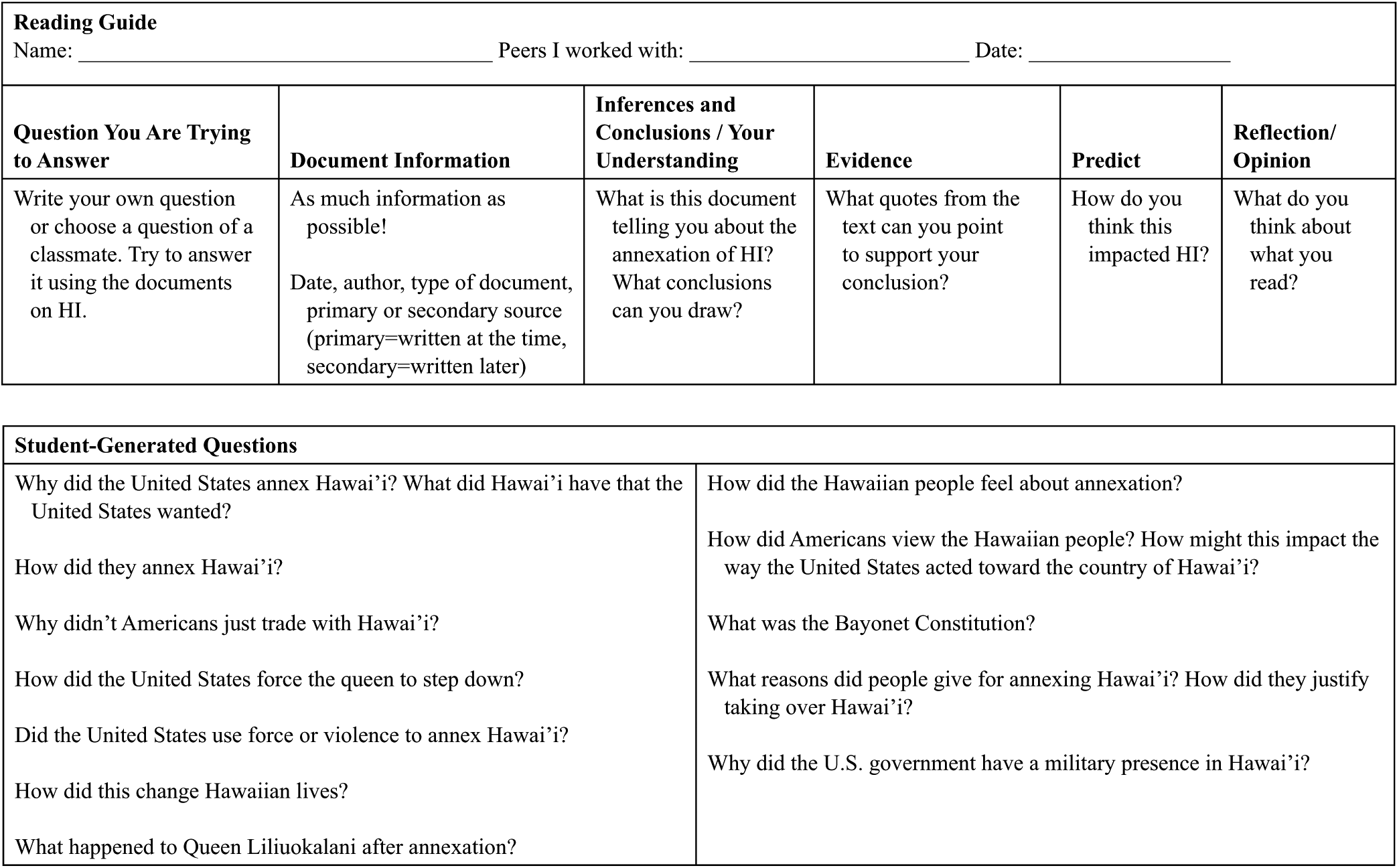
Instructional materials: Reading guide and student-generated questions compiled by Ms. Talbot.
As Aziza’s small group read two texts, Aziza referenced the reading guide, asked questions, and recorded group ideas. At times Aziza and her classmates started off-topic conversations or checked their phones, and Ms. Talbot redirected them with questions such as, “So what does it seem like the Hawaiians want?” and “What are they saying there?” As the bell rang to end class, students were still reading and discussing. Ms. Talbot collected their reading guides and compiled students’ questions, which she shared the following day (see Figure 1).
Beginning the next day with students’ questions foregrounded their voices in historical inquiry. Students then returned to groups to finish analyzing the documents. When they reconvened as a class, Ms. Talbot introduced the final document, “Joint Resolution to Provide for Annexing the Hawaiian Islands to the United States, 1898.” Written by U.S. officials, the document outlined Hawai’i’s loss of sovereignty and called the annexation a “joint resolution” between Hawai’i and the United States. Ms. Talbot posed the question, “What did the United States gain and Hawai’i lose?”
After students read the document individually, Ms. Talbot facilitated a discussion posing questions such as “What did the U.S. want?”; “But what did Hawai’i want?”; and “How do you know?” which encouraged students to consider perspectives across documents and make text-based claims. She also prompted students to build knowledge collaboratively: “It’s always good to bounce ideas off other people during document analysis.” Throughout the discussion, students synthesized information across the documents. As one student realized the United States had annexed Hawai’i despite Hawaiian residents’ protests, she said, “How can you just go in and take over?!” Another student responded, “Just what happened to the American Indians,” which was a connection to other sociohistorical events the students had studied earlier in the year.
Using general literacy strategies in the service of disciplinary learning
In this and other lessons, analyzing primary source documents engaged students in disciplinary literacy practices that generated knowledge. The goal was not simply to understand or summarize texts but to read across sources to answer historical questions. Ms. Talbot used general literacy and teaching strategies including teaching background knowledge, guiding whole-group reading, providing a reading guide, marking text, and assigning group roles, but these strategies were not a means unto themselves. They were imbued with disciplinary purpose and served to deepen historical learning. Aziza and other focal participants, Mai See and Janice, appeared engaged with texts and made contributions to discussions.
Students’ Perceptions of History Texts and Instruction: Voices, Identities, and Knowledge
Overall, focal participants Aziza, Mai See, and Janice reported positive perceptions of learning and reading in history, and as they discussed texts and instruction, they focused on historical events and interpretations.
Learning history through voices, identities, and relationships
Ms. Talbot’s efforts to connect historical learning to students’ lived experiences and identities were evident in Aziza’s comments: “It’s U.S. history, [and it] is basically talking about how our voices matter. And, I think that now, like in 2013, it matters most. I mean, in this class and outside the class too.” Aziza understood the study of history as being about “our voices.” As such, instead of conceiving of history as distant or confined to a textbook, Aziza saw it as spanning to the current day (“2013”) and across multiple contexts (“in this class and outside the class too”). When asked if there were aspects of class that helped Aziza know her voice mattered, she responded, When we get on certain topics that would relate to me . . . that’s when it matters most. There are stereotypes that [students] could bring up and I’m going to have to, like, get rid of those. Like, African stereotypes . . . like, all Muslims are terrorists. I’m not a terrorist.
Aziza not only understood aspects of her religious and cultural identities as having bearing on discussions about history but also expressed power and demonstrated agency to disrupt negative stereotypes related to her lived experiences. When asked what she thought of history class, another focal participant, Janice, responded,
I love her.
You love her—why do you love her?
Because like, some teachers . . . give you most of the stuff but not everything, and Ms. Talbot makes sure that you . . . have everything you need . . . and she’s really nice too.
That Janice responded to a question about history class by describing how she felt about the teacher suggests the pivotal role that positive social interactions played in constructing learning experiences. Moreover, that Janice attributed her positive feelings to good instruction suggests that focal participants wanted to learn and engage in history class and that Ms. Talbot effectively built on their intentions, which is notable because focal participants tended to be regarded as work avoidant and uninterested in classes (see Learned, 2016).
Focusing on content of texts and making critiques
When focal participants discussed history, they mentioned ideas gleaned from readings and discussions. For example, when I asked, “What kinds of things have you been reading in history class?” Mai See responded, “We used to read about Native Americans and then we’d read about African Americans. And now we’re reading about Hawaiians.” Similarly, Janice said, “We’re learning about history . . . and that’s interesting because the Europe people are taking away their culture and . . . they’re turning the Indian people into American people and changing their looks and their culture and threatening their heritage.”
Students also critiqued texts. For instance, during discussion of the document “Joint Resolution to Provide for Annexing the Hawaiian Islands to the United States, 1898,” students drew on other sources to argue that there had not been an agreement between nations and that the authors had used the term “joint resolution” in a deliberately misleading way. These comments suggest that instruction supported students to express power by questioning the authority of texts, and thus students learned with and from texts not as consumers but as critical readers.
Students’ Class Outcomes
Janice, Mai See, and Aziza’s positive social and academic experiences are notable because focal participants tended to experience strained teacher–student interactions, disproportionately high suspension rates, and difficulty passing classes; at the end of the year, only four of the eight focal participants were still attending school (see Learned, 2016). In this class, however, focal participants grappled with historical texts, persisted when texts were difficult, and participated not as struggling readers but as credible evaluators of historical accounts. In June, Aziza and Mai See had passing grades. Janice was expelled shortly after this unit, but she earned credit earlier in the year.
Overall Themes and a Brief Look at the Case in Relationship to Ninth-Grade Patterns
Consideration of this case by itself, as well as in relationship to ninth-grade patterns previously reported (Learned, 2014, 2016), sheds light on when and how literacy instruction appeared to facilitate focal youths’ participation in historical literacy practices. Next I discuss dominant themes within this case and how the teacher and young people disrupted school-wide patterns evident across focal participants’ content area classes.
Agency and Disciplinary Knowledge Building
When Ms. Talbot described her instructional goals, she discussed the reading and writing that historians do, the importance of teaching historical themes instead of facts, and literacy as a means to historical learning. She said, “The biggest goal for me . . . [is] that they improve their reading and their ability to critically think and . . . write with logical arguments . . . just because it’s very hard to do history if you struggle with reading comprehension.” Ms. Talbot discussed and taught history as something students “do,” and her instruction appeared rooted in this stance as contexts supported students to construct and critique historical knowledge (see Wineburg & Reisman, 2015).
In contrast, the predominant instructional focus among other teachers in school (Learned, 2016) was skills and information students should adopt or know, and correspondingly teaching tended to involve telling. Young people identified and critiqued the passive positions they were assigned across content classes. For example, regarding a different history class, a student said, Try to keep [the texts] in our mid-range of reading instead of how [the teacher] thinks that we’ll be able to read . . . try to let us do the work instead of sitting and watching him do it for us . . . because that’s mostly what the problem is . . . .He’s doing the work for us and he could teach us how to do it and then we could get like in groups . . . and we’ll do the work. (Learned, 2016, p. 1288)
Indeed, guiding reading or modeling thinking are ways to help students build knowledge. Moreover, knowledge building is central to both disciplinary literacy (Lee & Spratley, 2010; Moje, 2015) and adolescent literacy (Learned et al., 2011), but how teachers regard knowledge informs instruction. A conception that knowledge is preestablished rather than dynamically constructed can position students as consumers rather than creators or critics of disciplinary knowledge. Being a consumer affords limited agency to students, and this may help explain why students appeared frustrated as they reported teachers “did the work” for them. Conversely, Ms. Talbot’s instruction afforded agentive positions to youths through which they read and interpreted historical perspectives and described their “voices” as being important in discussions of history.
Community, Risk-Taking, and Disciplinary Learning
In Ms. Talbot’s classroom, students veered off topic and checked phones during discussions. She sought to refocus attention by asking, “So what does it seem like the Hawaiians want?” and “What are they saying there?” In addition, throughout the lesson and year, Ms. Talbot attended to community building by involving students’ perspectives and identities in historical learning and fostering a respectful, open environment in which ideas were debated. From her perspective, “community building” was important “so that people feel okay to take risks.” She described being “very diligent about protecting students . . . no answer is ever stupid . . . [and] building up their identity as freshman.” Central to disciplinary learning, then, was creating a safe place to take intellectual risks and experiment with ideas through discussions.
In contrast, across classrooms identified as lower track there was a focus on behavior, which was supported by school-level institutional contexts; a culture of compliance shifted attention away from disciplinary and literacy learning (Learned, 2016). For instance, when asked what would help students learn, one teacher responded in the following way, which is representative of the sample: “behavior expectations of, you know, you need to be in your seat, you need to not be engaged in a side conversations” (Learned, 2016, p. 1288). If youths identified as struggling readers were positioned across classes, and possibly across school years, as noncompliant, then effectively teaching disciplinary literacy required attention to students’ identities and to community building, both of which appeared to support focal youths in this case.
Literacy and Historical Inquiry
In Ms. Talbot’s class, rather than be “protected” from complex primary sources, students had opportunities to read independently and together. She taught general literacy strategies including, for example, activating prior knowledge before reading, using reading guides, and responding to writing prompts. Ms. Talbot’s focus on historical inquiry, however, appeared to provide a disciplinary purpose that helped students use strategies in the service of historical learning. For example, when studying the United States’s annexation of Hawai’i, Ms. Talbot repeatedly grounded the lesson in questions such as “What did the U.S. want?”; “But what did Hawai’i want?”; and “How do you know?” In addition, she taught specialized literacy practices that historians use, including sourcing, contextualizing, and corroborating (see T. Shanahan & Shanahan, 2014). The instructional contexts that Ms. Talbot and students built afforded opportunities for all readers to employ historical literacy practices and build knowledge.
Across focal participants’ classes, content area teachers tended to have literacy-related goals and, to varying degrees, teach literacy strategies, but the strategies tended to be taught in isolation or as a means unto themselves (Learned, 2014, 2016). Absent the purposes a more robust disciplinary literacy approach may have afforded, these strategies appeared to distract youths from disciplinary learning and instead focus their attention on reading tasks (Learned, 2014, 2016). For example, when I asked youths what they were reading across classes (i.e., history, math, and reading), they tended to respond by describing the kinds of texts (e.g., “packets,” “articles,” “PowerPoint”) and the processes they used for trying to understand them: “What is hard is figuring out if the question is about the whole passage or just one piece” (Learned, 2014, p. 167). However, when discussing Ms. Talbot’s class, students tended to focus on what they were reading about (“We used to read about Native Americans and then we’d read about African Americans”). Research suggests that helping students attend to the content of their reading, rather than only the strategies they use to make sense of the text, results in deeper comprehension (McKeown et al., 2009). Not that attending to text features or thinking processes is unhelpful, but building knowledge and metacognition can work in service of each other (Learned et al., 2011).
In Ms. Talbot’s class, students not only focused on “content” but also grappled with how historical “content” is constituted by multiple, often conflicting, accounts or perspectives. Instruction afforded opportunities to discern and compare these perspectives. Moreover, students asserted their perspectives and saw themselves in history. As Aziza explained, “U.S. history is basically talking about how our voices matter.” Powerful, then, in this analysis was the extent to which Ms. Talbot’s class disrupted patterns across ninth-grade contexts that tended to make particular positions and interactions available to teachers and youths (Learned, 2014, 2016). Focal participants tended to be positioned as low skilled and unmotivated through skills-based instruction, which was divorced from the interesting problems of the disciplines and absent the social contexts that inquiry into such problems requires. In Ms. Talbot’s class, which focused on disciplinary literacy and community, youths participated in historical literacy practices, made historical interpretations, expressed agency, and positioned themselves as readers and learners.
Conclusions and Implications
Analysis of one history class showed how a teacher, together with students, constructed learning contexts and how those contexts mediated focal participants’ learning, identities, and engagement. Disciplinary literacy provided avenues for youths to make meaning with historical texts, compare historical perspectives, see themselves in sociohistorical terms, and earn passing grades. These findings suggest that disciplinary literacy can help disrupt the diminished opportunities and outcomes associated with deficit reading labels (Gutiérrez et al., 2009; Learned, 2016) and school tracking (Callahan, 2005; Gamoran et al., 1995; Oakes, 1985).
Doing Disciplinary Literacy in History and Disrupting Struggling Reader Labels
These findings corroborate previous research by showing that disciplinary literacy provided a route to historical learning (Bain, 2006; Wineburg, 2001). The contribution of the present study is that it closely examines youths labeled as struggling readers and their experiences with historical disciplinary literacy in the context of their overall school experiences, and findings demonstrate that youths were neither uniformly low skilled nor tending toward disengagement, as their deficit label may imply. Indeed, disciplinary literacy appeared to contribute to several positive outcomes, including not only passing history class and earning credit toward graduation but also opportunities for youths to transform the landscape of historical learning and classroom social dynamics. Evidence that disciplinary literacy restores agency (Wineburg & Reisman, 2015) was apparent as young people critiqued historical perspectives and asserted themselves as consequential players during otherwise marginalizing ninth-grade school experiences.
In the tracked contexts of traditional secondary schools (Callahan, 2005; Gamoran et al., 1995; Oakes, 1985), both teachers and students can be positioned to participate in hectic, strained environments. Through school-wide processes for reading intervention, tracking, and school discipline, youths identified as struggling readers can be constructed as deficient and deviant (Learned, 2016). Disciplinary literacy as it is currently being advanced in education research and policy is not conceived as a reading intervention, so it does not cast students as lacking or educators as fixers. Rather, it encourages youths to question the authority of teachers, texts, and accounts (Bain, 2006). The present study suggests that youths’ and teachers’ participation in disciplinary literacy can help productively restructure classroom contexts.
Future research can investigate how youths identified as struggling readers participate in the practices of other disciplinary domains, how disciplinary literacy instruction mediates their learning in the contexts of nontracked or heterogeneous classes, and how teachers can be supported to enact disciplinary literacy instruction that builds on all students’ identities.
With regard to students’ identities, this study also suggests the need for continued research into the role of race and ethnicity in school processes for labeling youths as struggling readers. Youths of color were overrepresented and White students were underrepresented among youths identified as struggling readers in the school population, which the large study’s focal and comparative peer samples reflect (Learned, 2016). Variability among participants prevented a close analysis of racial and ethnic identities in youths’ literacy experiences, but these findings in concert with previous research (Gutiérrez et al., 2009; McDermott, Goldman, & Varenne, 2006) call for further examination of the roles of cultural identities in how youths express power, experience positioning, and position themselves as readers and learners across the contexts of secondary school.
Teaching Disciplinary Literacy in History: Implications for Instruction and Policy
Teaching disciplinary literacy in secondary history classes is complicated and requires attention to numerous factors, including teachers’ knowledge of history and their ability to meld disciplinary literacy teaching with their current practices (Monte-Sano et al., 2014). In this study, the teacher articulated a disciplinary literacy instructional approach when she, for example, pointed to historians’ reading and writing practices as ones in which youths could participate and described inquiry goals as forefront in her instruction. At the same time, she drew on other teaching practices, such as actively building community and teaching reading strategies (e.g., questioning), but these were integrated with disciplinary literacy teaching. The purpose of this analysis is not to label everything Ms. Talbot did as disciplinary literacy but to show that disciplinary literacy provided deep and interesting purposes for youths’ learning—purpose that was largely absent across skills-oriented classes. Together with other teaching strategies, disciplinary literacy appeared to support focal participants to learn history, make meaning with complex texts, and feel valued in class. This study, then, provides evidence that disciplinary literacy is indeed a complex social and cultural enterprise (see Moje, 2015). It involves interaction among the various cultures associated with a discipline, a teacher, youths, and a school—and the shared and divergent reading, writing, arguing, and thinking practices across these cultures.
This study also suggests that a disciplinary literacy approach is particularly salient for high school history classes that have as their aim the interpretation of historical, social, and cultural events. As social studies educators negotiate standards (National Council for the Social Studies, 2013) and pressure to privilege content coverage over deep learning (Parker et al., 2013), these findings lend further evidence that a “skill” or “content” approach does not suffice. Doing history, as facilitated by Ms. Talbot, involved engaging youths in active, social, academic, and cultural learning. Educators and policymakers can support this kind of teaching and learning by foregrounding the role of disciplinary literacy in history education. In summary, these findings suggest that learning history in high school classrooms is complex, and for those identified as struggling readers, these complexities may be exacerbated by school experiences through which youths are positioned as deficient and distanced from historical texts and inquiry. Disciplinary literacy teaching can not only leverage youths’ interests and identities in the service of historical learning but also create opportunities for young people to socially construct and shape historical interpretations.
Supplemental Material
SMART_APP_Learned – Supplemental material for Doing History: A Study of Disciplinary Literacy and Readers Labeled as Struggling
Supplemental material, SMART_APP_Learned for Doing History: A Study of Disciplinary Literacy and Readers Labeled as Struggling by Julie E. Learned in Journal of Literacy Research
Supplemental Material
Translated_Abstract_Learned – Supplemental material for Doing History: A Study of Disciplinary Literacy and Readers Labeled as Struggling
Supplemental material, Translated_Abstract_Learned for Doing History: A Study of Disciplinary Literacy and Readers Labeled as Struggling by Julie E. Learned in Journal of Literacy Research
Footnotes
Appendix A
Demographic Information for Ninth-Grade Focal Participants in Case Study and Large Study (adapted from Learned, 2016).
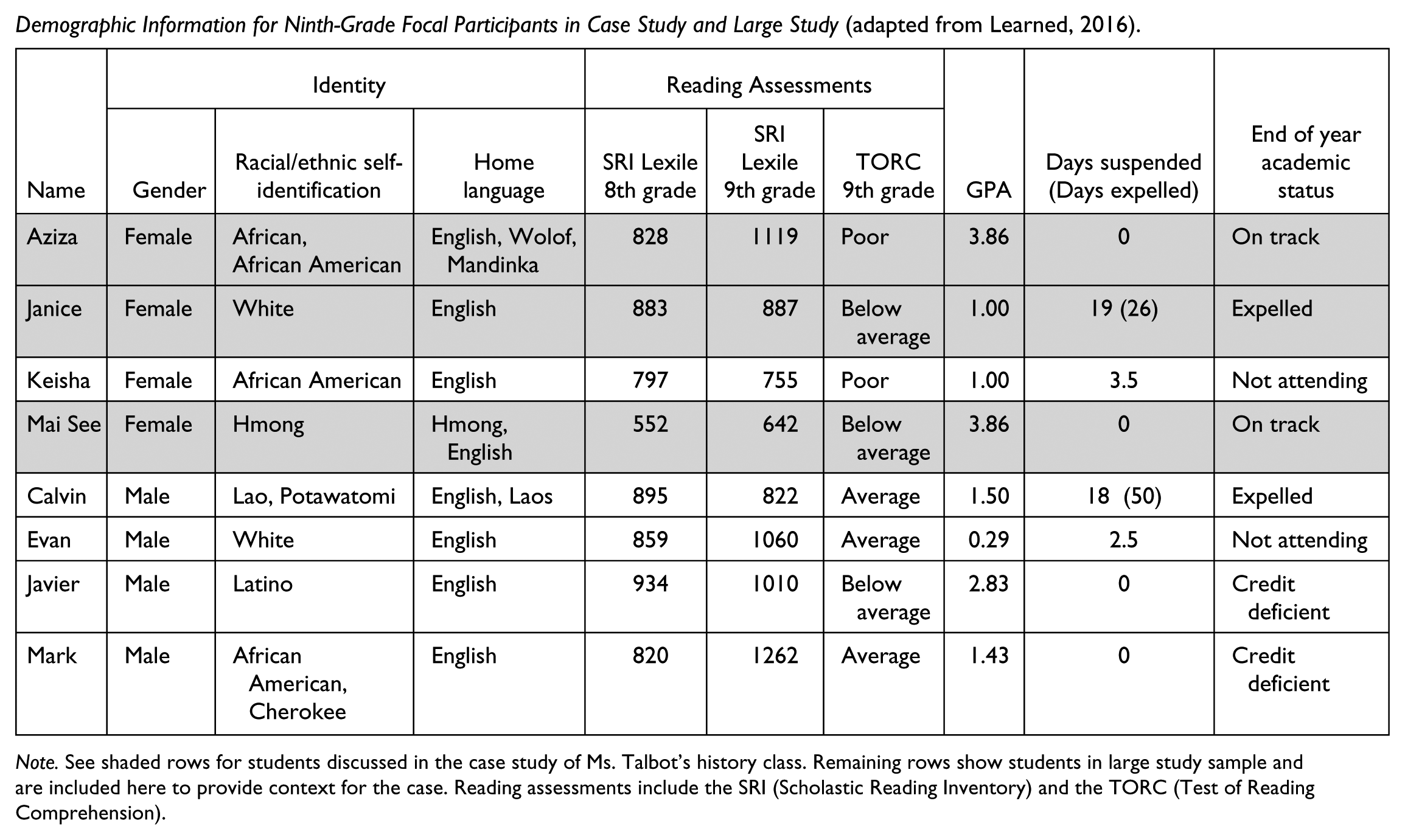
| Name | Identity | Reading Assessments | GPA | Days suspended (Days expelled) | End of year academic status | ||||
|---|---|---|---|---|---|---|---|---|---|
| Gender | Racial/ethnic self-identification | Home language | SRI Lexile |
SRI |
TORC |
||||
| Aziza | Female | African, African American |
English, Wolof, Mandinka | 828 | 1119 | Poor | 3.86 | 0 | On track |
| Janice | Female | White | English | 883 | 887 | Below average | 1.00 | 19 (26) |
Expelled |
| Keisha | Female | African American | English | 797 | 755 | Poor | 1.00 | 3.5 | Not attending |
| Mai See | Female | Hmong | Hmong, English | 552 | 642 | Below average | 3.86 | 0 | On track |
| Calvin | Male | Lao, Potawatomi | English, Laos | 895 | 822 | Average | 1.50 | 18 (50) |
Expelled |
| Evan | Male | White | English | 859 | 1060 | Average | 0.29 | 2.5 | Not attending |
| Javier | Male | Latino | English | 934 | 1010 | Below average | 2.83 | 0 | Credit deficient |
| Mark | Male | African American, Cherokee | English | 820 | 1262 | Average | 1.43 | 0 | Credit deficient |
Note. See shaded rows for students discussed in the case study of Ms. Talbot’s history class. Remaining rows show students in large study sample and are included here to provide context for the case. Reading assessments include the SRI (Scholastic Reading Inventory) and the TORC (Test of Reading Comprehension).
Appendix B
Observation Protocol for Large Study from January 2013 (adapted from Learned, 2016)
Date: ____________Class period/content area/teacher: __________________
Shadow of focal participant: _____________________________________________
Other focal participants/comparative peers: _________________________________
Appendix C
Observation Protocol for Large Study from May 2013 (adapted from Learned, 2016)
Date: ____________Class period/content area/teacher: __________________
Shadow of focal participant: _____________________________________________
Other focal participants/comparative peers: ________________________________
Appendix D
Key Linkage Chart for Overall Study
Declaration of Conflicting Interests
The author(s) declared no potential conflicts of interest with respect to the research, authorship, and/or publication of this article.
Funding
The author(s) received no financial support for the research, authorship, and/or publication of this article.
References
Supplementary Material
Please find the following supplemental material available below.
For Open Access articles published under a Creative Commons License, all supplemental material carries the same license as the article it is associated with.
For non-Open Access articles published, all supplemental material carries a non-exclusive license, and permission requests for re-use of supplemental material or any part of supplemental material shall be sent directly to the copyright owner as specified in the copyright notice associated with the article.
