




Abstract
This conceptual review addresses the bifurcation of content area and disciplinary literacy by examining each as regimes of truth. We look specifically at the ways in which both approaches comprise, in Foucault’s terms, “regimes of truth” within their respective epistemological domains. Following a brief history of adolescent literacy, extant research is considered. By employing a theoretical framework based on Foucault’s notions of “connaissance” referring to a particular corpus of knowledge, and “savoir” or knowledge in general, research and discourse surrounding the current debate over content area literacy and disciplinary literacy are taken up to deconstruct stances within these domains with the aim of a reconstruction that captures the affordances of both. Suggestions for moving the field out of this binary through a collaborative focus on interdisciplinary approaches are discussed.
Keywords
Our purpose in this conceptual review is to address the bifurcation of content area and disciplinary literacy by examining each as regimes of truth (Foucault, 1978; Gore, 1993). To date, much of the discourse surrounding the contributions of content area and disciplinary literacy have conceptualized the domains as at odds with each other. While the notion of debating curriculum is not particular to these approaches, neither is it particularly helpful. As Allan Luke (2013) noted,
Debates over curriculum have durable histories and tend to work in binary arguments that caricature and distort complex educational positions . . . with little sense of the conceptual ironies, practical contradictions and empirical anomalies that the resultant settlements may generate. (p. 1)
Foucault’s (1978) notions of regimes of truth, along with the related constructs of will to knowledge and will to truth, are taken up to deconstruct the binary stances and contradictions within these domains with the aim of a reconstruction that captures the affordances of both. The binary of content versus disciplinary practices locates knowledge in multiple silos with little to no interaction or value of the other. This disunity has the consequence of creating “battle lines” to the detriment of both the field and the learners (students, teachers, and researchers) within it.
This conceptual review is informed by our own work with in-service and pre-service content area teachers from multiple disciplines, and is philosophically situated in the critical literacy practice of regarding no text, practice, or construct as “neutral” (Dunkerly-Bean, Bean, & Alnajjar, 2014). We looked to Hillary Janks (2010) practice of both engagement and estrangement with text or discourse, both reading with and against the discourses of content area literacy and disciplinary literacy. To do one without the other, as Janks points out is a “form of entrapment” (p. 96):
Engagement without estrangement is a form of submission to the power of the text regardless of the reader’s own positions. Estrangement without engagement is a refusal to leave the confines of one’s own subjectivity, a refusal to allow otherness to enter. Without the entry of the other, can we be said to have read the text at all? What then might we be resisting? (p. 96)
As we take up this engagement/estrangement, we examine competing regimes of truth surrounding both content area and disciplinary literacy positions. It may be possible to seek space for commonalities and connections that offer a solution to bifurcation and inaccurate assertions (e.g., “content area reading is dead”).
We begin by introducing our theoretical perspective for this conceptual review, followed by explicating both content area literacy and disciplinary literacy as regimes of truth. Both related constructs have specific and discernable discursive networks constituting regimes of truth (e.g., agencies, technical reports, organizations, legal policies, curriculum materials, and published research). These structured systems promote varying will to truth dimensions and contribute to the bipartite condition in which we are currently situated.
Theoretical Perspective
We draw from Foucault’s (1980) concepts of regimes of truth and related notions of will to truth and will to knowledge, to examine the phenomenon of the shift in attention and research from content area reading to disciplinary literacy. It is helpful to consider that the translation of the English word “knowledge” translates to two different words in French: connaissance or a particular body of knowledge, and savoir or knowledge in general. In effect, savoir is the sum of all connaissances.
With the concept of what constitutes knowledge as a “whole” defined this way, we can then look at the notion of will to knowledge and the will to truth. Foucault saw the will to knowledge as a general desire to know, and the will to truth as the desire to determine the difference between truth and falsehood in a particular discipline (Gore, 1993). However, as Gore elaborates, “The ‘will to truth’ which characterizes much intellectual work is such that the need, desire, or willingness to question one’s own work is often lost in the desire to believe that one has found the ‘truth,’ that one is ‘right’” (p. 11). Although the term “one” can refer to individualistic or idiosyncratic belief, Foucault perceived it as the many struggling within a politic of truth, which is how we will utilize it here. It is in the seeking, debating, and codifying of “truth” that in turn creates the regimes of truth that characterize sites of power.
Although Foucault did not examine pedagogy or schools as he did prisons and other systems, it is apparent that he saw them as sites of disciplinary power (Gore, 1993). Before explaining the manner in which we utilize the concept of regime of truth, it is useful to explore Foucault’s original use:
Each society has its regime of truth, its general politics of truth: that is, the types of discourse which it accepts and makes function as true; the mechanism and instances which enable one to distinguish true and false statements, the means by which each is sanctioned; the techniques and procedures accorded value in the acquisition of truth; the status of those who are charged with saying what is true. (Foucault, 1980, p. 131)
Although Foucault conceived of “society” in larger temporal and geographic terms, we concur with Gore (1993) that it can be applied “to discourses and practices that reveal sufficient regularity to enable their immanent naming” (p. 56). In examining the interplay between truth, power, and knowledge in any discourse, an examination of the ways in which power, knowledge, and truth are named and enacted is also possible.
For Foucault, “power and knowledge do not operate in isolation of, or in opposition to the other” (Gore, 1993, p. 54). Rather, the two are interconnected. As Foucault explains,
There is an administration of knowledge, a politics of knowledge, relations of power which pass via knowledge, and which, if one tries to transcribe them, lead one to consider forms of domination designated by such notions as field, region or territory. (p. 9)
Given that pedagogy embodies power relations between researchers, practitioners, and students and what is counted as knowledge, “pedagogy is a regime of truth” (Gore, 1993, p. 60). Janks (2010) noted that Foucault (1980) viewed societal discourse as a structured system for the production, regulation, distribution, and circulation of statements that are sustained by power relations. In this sense, “truth” is generated by this system and sustains itself via “a circular system of power” (p. 133). Yet, it is important to note that for Foucault, there are no inherently liberating practices (or discourse). Rather, it is “in discourse that power and knowledge are joined together” (Foucault, 1978):
We must not imagine a world of discourse divided between the accepted discourse and excluded discourse, or between the dominant discourse and the dominated one; but as a multiplicity of discursive elements that can come into play in various strategies . . . Discourses are not once and for all subservient to power or raised up against it, any more than silences are. We must make allowances for the complex and unstable process whereby discourse can be both an instrument and an effect of power, but also a hindrance, a stumbling block, a point of resistance and a starting point for an opposition strategy. (p. 100)
Thus, in using regimes of truth as an analytic framework to examine the discourses of content area literacy and disciplinary literacy and the practices within both, it is our intent to problematize them through this lens, in the hope of revealing the complexity inherent in these discourses while resisting a simple dichotomy or to engage in the “politics of pointing the finger” (Morris, 1988, p. 23). Rather we examine these discourses as a complex and unstable process with points of obvious resistance, but with points of possibility as well. However, we do remain cognizant of the risk of debating a fragmented pedagogy. As Bourdieu (1986) lamented,
It is well known that no group likes an informer, especially when the transgressor or traitor can claim to share in their own highest values. The same people who would not hesitate to acclaim the work as “courageous” or “lucid” if it is applied to alien, hostile groups will be likely to question the credentials of the special lucidity claimed by anyone who seeks to analyze their own group. (p. 5)
While we are skeptical of some of the current shifts and claims, we find Foucault helpful in both deconstructing and reconstructing the current differentiation and fragmentation of the field in this conceptual review, and ask, “Where does regime of truth leave us in understanding and implementing content-disciplinary literacy for adolescent learners?
Content Area Reading/Literacy as a Regime of Truth
Foucault (1983) argues that we constitute ourselves through real practices—“historically analyzable practices” (p. 250). Given the relatively long history of content area reading, we are able to view it as a regime of truth as its practices are consistent and reliable enough to permit its naming and examination. Central to that naming are identifying the discursive networks that support this perspective. Figure 1 depicts the discursive networks that inform and have been informed by content area literacy. While the limitations of portraying complex networks are somewhat limited in the two dimensional world of print, the figure below is meant to depict recursive influences rather than a particular hierarchical framework.
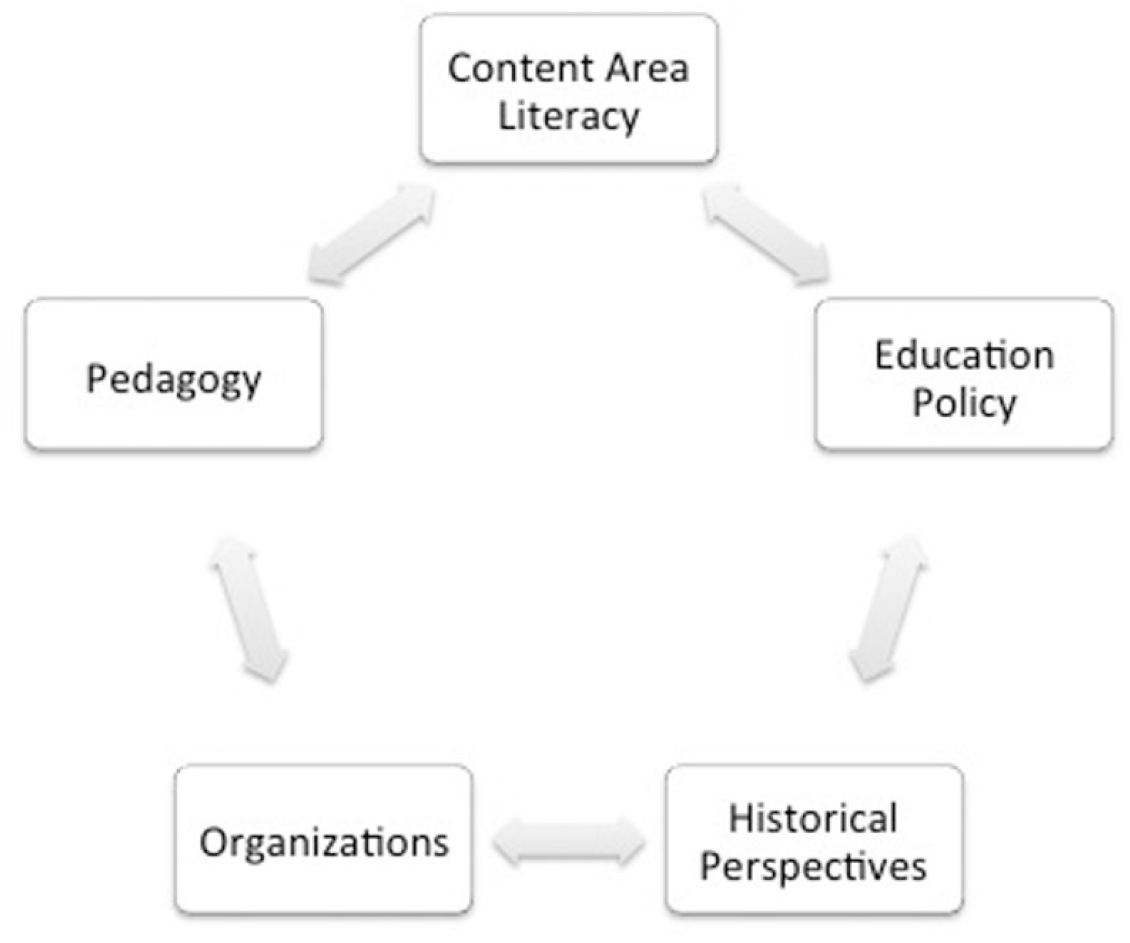
Content area literacy discursive networks.
In the following section, we discuss the discursive networks and how they contribute to a regime of truth.
Historical Perspectives
Current discussions and debates about the value of content area literacy strategies versus discipline-specific approaches bifurcate two constructs in working with adolescent learners across various content areas. These discussions and debates were foreshadowed by some of the early literacy scholars. The genesis of content area literacy has its roots in the early 1900s efforts to address the demands of reading and studying across the disciplines (Moore, Readence, & Rickelman, 1983).
In a detailed history of the evolution of content area literacy from early verbatim recitation of texts to a developing concern for reading and studying across the disciplines by 1925, Moore et al. (1983) traced the influence of key figures including William S. Gray, Arthur Gates, and others. Even as early as 1919, some scholars favored teaching reading skills in isolation from the subject areas, fearing that subject area specialists would have little interest in teaching reading within their disciplines. From 1924, through the 1940s and 1960s, researchers were concerned that the basic reading skills acquired in primary schooling would be unlikely to address the demands of specific disciplines.
Nila Banton Smith (1965) and others argued that different disciplines featured distinct rhetorical patterns and different perspectives on constructing knowledge (Moore et al., 1983). Interestingly, this work preceded more recent efforts to explore the particularities of content area literacy in the disciplines including science, mathematics, chemistry, English, and history (Alvermann & Moje, 2013; Lesley, 2014; Moje, 2008; Shanahan & Shanahan, 2008).
More progressive educators in this era sought to merge content with reading instruction. For example, in a social studies passage containing a blend of fact and opinion, a strategy lesson aimed at guiding students efforts to discern fact and opinion statements could be offered (Moore et al., 1983). This integrated approach to content and process undoubtedly influenced much of the subsequent thinking about content area reading that followed.
The term “content reading” became widespread in the 1970s with the publication of Herber’s (1970) book, Teaching Reading in the Content Areas. In this text, Herber distinguished between literacy development as reading instruction, which primarily took place in the early grades, and literacy development to support subject matter learning in later grades (Alvermann, Gillis, & Phelps, 2013; Ruddell, 2001). Herber advanced the idea of merging content and process in reading subject area texts and foreshadowed the current discussions of how best to approach guiding students’ reading of disciplinary texts. Grounded largely in cognitive psychology and particularly schema theory, which in part holds that meaningful learning occurs when new information can be linked to existing knowledge (Anderson, 1984), content area reading researchers created instructional strategies that teachers could utilize to increase student comprehension of the given content (Grady, 2002). For example, anticipation guides might be used to activate prior knowledge, while various vocabulary development strategies were developed to help students utilize existing schema or develop new schemata for new concepts. We turn now to an overview of the pedagogical approaches and research of content area literacy.
Pedagogy
By the 1980s, over 20 content area reading methods textbooks for pre-service and in-service teachers were available ranging from those that featured individual chapters by subject area to those integrating strategies for the various content areas (Jacobs, 2008). Currently, a cursory search on a major Internet bookseller shows that over 100 content area reading or content area textbooks are available. Most states in the United States currently require secondary teacher licensure candidates to take a content area literacy course in their program of study (Fang, Sun, Chiu, & Trutschel, 2014; Lesley, 2014) and this requirement has been in place for some time (Romine, McKenna, & Robinson, 1996).
Fang (2012) traced four major approaches to content area literacy that included the cognitive approach, the sociocultural approach, the linguistic approach, and the critical approach. The cognitive approach argues for systematic and explicit teaching of metacognitive generic strategies for studying discipline-based texts including mapping, summarizing, and note-taking. Fang (p. 104) noted that this approach assumes that cognitive requirements for reading/writing are essentially the same regardless of content areas. However, these are really independent study strategies that students would adopt after teacher scaffolding and guidance. In essence, they would evolve as independent strategies from the guided practice portion of a content area lesson on a particular topic.
The sociocultural approach considers how in- and out-of-school literacies may be incorporated in lessons to include students’ everyday funds of knowledge and cultural practices. The linguistic approach places emphasis on explicit vocabulary instruction aimed at helping students grasp academic vocabulary critical to a content area (e.g., photosynthesis in biology). Finally, Fang touched on the critical approach aimed at helping students explore multiple texts and contrasting viewpoints.
Despite the advantages of utilizing content area reading strategies, some research in content area literacy pointed to teachers’ resistance to integrating strategies in to their instruction (O’Brien & Stewart, 1990). However, more recent research provides evidence that teacher candidates would adopt a content literacy perspective at the pre-service level, depending upon the support offered by their practicum cooperating teachers.
In a 2-year professional development study with ongoing observation, Adams and Pegg (2012) explored teachers’ implementation of content area literacy strategies in secondary science and mathematics classes. The 26 teachers in their study did, indeed, implement content area literacy strategies (e.g., Anticipation-Reaction Guides and the Verbal-Visual Vocabulary strategy) after tailoring them to their respective disciplines. For example, the mathematics teachers used the Verbal-Visual Vocabulary strategy to teach their students about absolute value. Thus, the implementation of content area literacy practices remains widespread with ample evidence that these practices impact students’ achievement (Lai, Wilson, McNaughton, & Hsiao, 2014; Love, 2010).
While we do note that as far back as 1936, James M. McCallister created a textbook that included separate chapters devoted to history, mathematics, and science (Moore et al., 1983), it is only more recently that the privileging of particular nuances in the disciplines have called into question the precepts of content area reading strategies while also ignoring its historical attention to the specifics of each content area. For example, although the fishbone cause–effect diagram was originally used in business (Ishikawa, 1971), it has been adapted for use in various content areas including science (Tan, Dawson, & Venville, 2008), English, (Bennett & Rolheiser, 2001), and other content disciplines. Using the elegantly simple fishbone diagram with a cause and effect template placed the effect of proposed actions at the head of the skeletal fish and the other ideas (or causes) on the spines.
Following the early use of fishbone diagrams to assist workers in problem solving at a shipyard, they have now been adopted for science to help students consider causes and effects related to climate change and earthquakes in science (Clary & Wandersee, 2010), as well as applications to history, English, and other content areas (Bennett & Rolheiser, 2001). Thus, this versatile strategy developed in Japan in the 1940s is not tied to any one connaissance (content area or discipline), but rather illuminates the complexities of the savoir or overall knowledge. Similarly, other graphic organizers (termed structured overviews in their original form), in Harold Herber’s research, ultimately evolved into more interactive, independent learning tools across content areas (Barron, 1969; Herber & Sanders, 1969). Barron’s original adaptation of Ausubel’s (1960) advance organizer pre-reading passages resulted in an academic vocabulary diagram that depicted relationships between words organized around text structure key concepts and supporting details. Studies in this early stage of advance organizer and graphic organizer development centered on STEM (science, technology, engineering, and mathematics) areas including metallurgical properties of steel and cell chemistry. Teachers were advised to use the structured overview as a prelude to reading content.
As this approach evolved into more refined use of graphic organizers in content areas, some evidence from a synthesis of studies suggested that graphic organizers were more helpful at the post-reading stage than the pre-reading stage (Moore & Readence, 1984). Indeed, in a review of integrated strategy instruction in the content areas, Learned, Stockdill, and Moje (2011, p. 171) concluded, “Conceiving of strategy use in the service of knowledge development is a productive instructional stance that greatly benefits secondary readers.” That productive stance then makes it possible for content area teachers to make accessible the nuance of the reading and writing required in their field. While the catch phrase “every teacher is a teacher of reading” (in relation to foundational reading skills) is antithetical to a disciplinary view of learning in science, history, mathematics, and other subject area fields (Alvermann & Moje, 2013; Gillis, 2014), it is true that content area teachers have been called on for at least the past decade to teach the reading and writing practices specific to the discipline (Heller & Greenleaf, 2007).
Thus, in recent research, Donna Alvermann and Elizabeth Moje (2013) situate reading “inside particular disciplinary discourses, practices, knowledge domains, texts, and tools” (p. 1098). Alvermann and Moje note,
The act of teaching literate practices to adolescents at the secondary level, then, is as much about teaching youths to navigate the texts, discourses, identities and knowledge of different subject areas, classrooms, and relationships, as it is about teaching word-level skills, discipline-specific vocabulary, or even disciplinary habits of mind. (pp. 1098/1099)
Their model embraces a more complex notion than much of the discussion aimed at determining the specifics of various disciplines. Indeed, in this approach we see that teaching students to navigate texts and discourse is positioned as just as essential as their disciplinary knowledge.
Professional Organizations
In the network of professional organizations, content area literacy has been linked with adolescent literacy. The term adolescent literacy has been somewhat amorphous and in some ways defies a simplistic description. Older definitions of adolescent literacy used a chronological metric (e.g., age 12 and up), and needs based accounts that acknowledged increasingly demanding texts across the disciplines or content (Moore, Bean, Birdyshaw, & Rycik, 1999). While Guthrie and Metsala (1999) defined proficient youth readers as those who
at grade four, eight, or twelve, must not only comprehend passages of text but must also (1) integrate information across multiple texts, (2) critically relate paragraph meanings to personal experience, (3) employ knowledge from texts to evaluate science observations or historical documents, and (4) compose complete messages in the form of stories and reports for actual audiences. (p. 382)
In an effort to contribute to the understanding of adolescent literacy and the role of in-school and out-of-school literacies, professional organizations created position statements and other documents to guide the field and to inform policymakers. The International Reading Association Commission on Adolescent Literacy developed a position statement aimed at driving curriculum policy and funding initiatives (Moore et al., 1999). Other prominent professional organizations created policy documents in support of adolescent literacy, which in turn inform and influence content area literacy pedagogy. For example, the National Council of Teachers of English (NCTE) created an action-oriented policy research brief for teachers, school programs, and policymakers with particular attention to multicultural dimensions and the affirmation of multiple literacies (Gere, 2007). This brief provided six elements for promoting adolescent literacy including demystifying content literacy practices, engaging students in real-world applications of literacy, and fostering social responsibility through multicultural literacy. Additionally, the brief warned against the “proliferation of high-stakes tests (that) can complicate the literacy learning of adolescents, particularly if test preparation takes priority over content-specific literacy instruction across the disciplines” (p. 4)
Similarly, The National Association of Secondary School Principals (NASSP) created similar policy and practitioner publications in 2006 to support adolescent literacy, and the National Middle School Association (NMSA) provides educators with electronic resources devoted to adolescents. More recently however, the current Adolescent Literacy Task Force of the International Literacy Association (formerly International Reading Association) included the Organization for Economic Co-Operation and Development’s (OECD) definition of adolescent literacy stating that a contemporary literacy education should develop
students’ capacity to apply knowledge and skills in key subject areas and their ability to analyze, reason, and communicate effectively as they pose, interpret and solve problems in a variety of situations. (OECD, 2010, p. 3)
In this definition, we see the role that content area reading plays in the development needed by 21st century adolescents (Adolescent Literacy, 2012). However, despite varying definitions, support, and position papers created by professional organizations over the past decade, the language of adolescent literacy has largely been one of crisis, positioning some adolescents as struggling readers (Jacobs, 2008). In the next section, this language of crisis arising mainly due to standardized test data has also discursively influenced content area literacy as a pedagogical approach on the national and international stage.
Content Area Literacy in Education Policy
Despite research exploring the fairly robust reading and writing habits of adolescents out-of-school (see Elizabeth Moje, Overby, Tysvaer, & Morris, 2008), their in-school academic literacies have been a cause for alarm over the past decade or more. This tone was largely set by concern over performance trends on the National Assessment of Education Progress (NAEP) otherwise known as the nation’s report card in 2003. Data from the 2003 NAEP revealed that while over 70% of students ages 10 to 18 were able to read and write at basic levels, only 23% to 30% were able to read and write at proficient levels, while those performing at advanced proficiency numbered only 3% to 6% (Donahue, Daane, & Grigg, 2003).
Likewise, student performance on international measures such as the Programme for International Assessment (PISA) sponsored by the OECD in the same year ranked the United States as 18th in reading, 22nd in science, 28th in math, and 29th in problem solving among participating countries (OECD, 2005). The alarm had been sounded: American adolescents were not prepared for college, the workplace, or global participation. Results such as these led to reports such as Heller and Greenleaf’s (2007) Literacy Instruction in the Content Areas: Getting to the Core of Middle and High School Improvement, which called for members of each discipline to define the reading and writing skills specific to their discipline and receive professional development in the same.
In the same year, the National Institute of Child Health and Development (NICHD) released a revision of a 2006 publication outlining what content area teachers should know about adolescent literacy. Drawing from research done for the National Reading Panel Report (2000), the following key literacy components were addressed: decoding/phonemic awareness and phonics, morphology, vocabulary, fluency, and text comprehension. While the applicability of teaching phonemic awareness to adolescents could be hotly contested, publications such as this set up a deficit view of adolescent’s engagement with academic texts.
In addition, two other key reports based on analysis of empirical studies added to the momentum supporting national policy interest in adolescent literacy and content area reading. The report, Reading Next: A Vision for Action & Research in Middle & High School Literacy—A Report From the Carnegie Corporation of New York (Biancarosa & Snow, 2006), recommended greater attention to adolescent and struggling readers with a focus on explicit instruction aimed at increasing students’ reading comprehension. This report was closely followed by an empirical analysis of studies guiding approaches to improving middle and secondary school students’ writing. Funded by the Carnegie Corporation of New York, Writing Next (Graham & Perin, 2007) highlighted promising strategies for summarization and other forms of writing with particular attention to effect sizes found in each study reviewed. While these reports have informed the field, they have been challenged in the research literature. One of the challenges centers on the marginalization of struggling readers because of difficulty with academic reading that does little to acknowledge their individuality and specific competencies, nor does it acknowledge their proficiencies in out-of-school literacies (Franzak, 2006).
Although it is beyond the scope of this conceptual review to discuss trends in academic performance for adolescents, it is perhaps an understatement to say that these concerns have continued since the early years of the 21st century to our present day. While it appears that, at least in some instances, there is a sea change in our previously narrow curriculum, high-stakes testing, and diminishing application to real-life problems with a move away from frequent testing in the post-No Child Left Behind era and The Every Student Succeeds Act of 2015, the discursive influence of national policy on content area literacy and vice-versa will no doubt continue.
The regime of truth constructed in content area reading/literacy lies in its history, influences on pedagogy and policy, and continuing presence in college and middle/high school classrooms. As we examine next, the regime of truth of disciplinary literacy is based in a conception of the superiority of disciplinary knowledge over pedagogical approach and in some sense has been furthered by shifts in national educational policy. Yet, in essence, the “what” of a discipline has been privileged over strategies that show “how” to understand it. This can be problematic as Shulman’s (1986) research illustrated. Shulman defined pedagogical content knowledge as the ways that teachers interpreted and transformed their subject knowledge to facilitate student learning. We add to the equation of content knowledge and pedagogical approach an understanding of diverse learners and their cultural and linguistic contributions.
We turn now to an examination of disciplinary literacy and the networks supporting and supported by it. However, we are cognizant that where conflicting will to truth(s) and resulting binaries occur, there may also be a negative impact on the savoir of content-disciplinary literacy as meaningful to the development of knowledge for adolescents.
Disciplinary Literacy as Regime of Truth
The ongoing discourse and body of research exploring disciplinary literacy take on the power of a regime of truth by privileging disciplinary knowledge over pedagogical approach. Additionally, by positioning content area reading approaches as “passé” and removed from the needs of 21st century learners, proponents of disciplinary literacy somewhat conveniently dismiss the integrated approach to discipline and strategies that is a hallmark of content area literacy instruction. Instead, they position content area reading and the students that benefit from it in a deficit perspective: “We recognize that content area reading instruction tends to help the bottom kids only” (Shanahan, 2012b). Such a position homogenizes adolescent readers who may be quite proficient in out-of-school literacies, but may temporarily struggle with the demands of academic content. Rather than acknowledge that the “new” strategies of disciplinary literacy have their foundations in content area literacy, and in fact utilize many similar approaches, disciplinary literacy is positioned as a better “choice” for content area teachers to adopt (Shanahan, 2012c).
Janks (2010) noted that Foucault (1980) viewed societal discourse as a structured system for the production, regulation, distribution, and circulation of statements that are sustained by power relations. In this sense, “truth” is generated by this system and sustains itself via “a circular system of power” (p. 133). As in our examination of content area literacy as a regime of truth, we will examine disciplinary literacy and its discursive networks here, with as much consistency as possible. The caveat to this approach, however, is that historical perspectives on what is now termed disciplinary literacy are derived from the history of content area literacy. For example, Harry Singer and Dan Donlan’s 1980 book, Reading and Learning From Texts devoted individual chapters to reading in English, mathematics, and social studies. Interestingly and especially salient to our argument here, by in effect co-opting elements of content area literacy history, disciplinary literacy creates a discursive argument that on one hand requires a comparison to content area literacy, but would not exist without it on the other. Therefore, we will limit a historical perspective on disciplinary literacy to research and pedagogical approaches in recent literature. Figure 2 illustrates the discursive networks that inform the regime of truth inherent in disciplinary literacy.
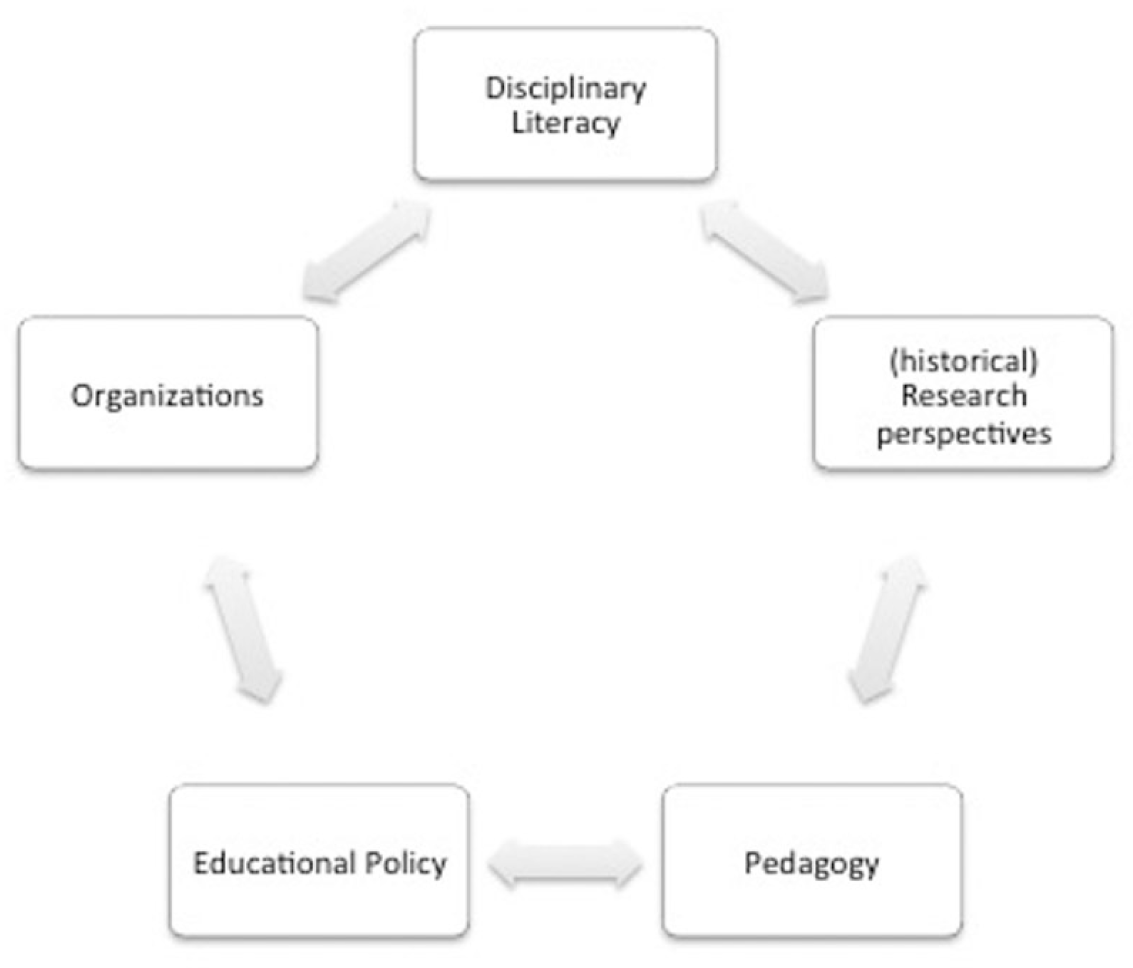
Disciplinary literacy discursive networks.
Research Perspectives and Pedagogy
Disciplinary literacy generally refers to ongoing efforts to determine the particularities of subject areas (or connaissance) including mathematics, science, social studies, English, and so on. The unique aspects of discourse in these areas are teased out by attempting to determine how experts read and think within these domains (Draper, Broomhead, Jensen, Nokes, & Siebert, 2010; Hillman, 2013; Shanahan & Shanahan, 2008,2014). This work has produced an ongoing map of the particularities of discourse across the disciplines aimed at guiding instruction. For example, music classes focus heavily on performance dimensions, biology pays close attention to structure and function relationships, while history requires readers to judge the authenticity of historical accounts, and mathematics encompasses precise algorithms and problem solving. Although the ongoing discussion and debate arguing that broad-based content area literacy strategies ignore discipline-specific approaches is erroneous as we have shown in the above section, an increasing number of adolescent literacy researchers have taken up this position, and in doing so have constructed a regime of truth surrounding the shift.
For example, Shanahan and Shanahan (2008) conducted a 2-year Carnegie-funded research project to explore elements of disciplinary literacy in mathematics, chemistry, and history. The first year of the project involved consulting with disciplinary experts and conducting think-alouds to determine the unique elements of reading in each subject area. They found that the mathematicians valued close reading of proofs and rereading as each word in a mathematical proof was crucial. Chemists valued particular structures, as well as jotting down formulas and using graphs and charts to gain meaning. Historians paid close attention to the author or source with a particular interest in detecting author bias in historical accounts. In essence, texts were to be interpreted and judged based on credibility.
During the second year of this study, the researchers sought to implement discipline-based literacy approaches with secondary teachers. They found that the chemistry teachers resonated with a T-chart type structured note-taking strategy where each section of the chart contained information about substances, properties, processes, and interactions. Mathematics teachers preferred a structured note-taking strategy to use with students that had four columns containing the concept being studied, an explanation of the concept, an example, and a formula, graph, or diagram. History teachers used an events chart with questions for who, what, where, when, how, and why as empty slots to be completed by their students. They completed the chart as they were reading text material and used it as study guide prior to a unit test.
The researchers noted,
Instead of trying to convince disciplinary teachers of the value of general reading strategies developed by reading experts, we set out to see if we could formulate new strategies or jury-rig existing ones so that they would more directly and explicitly address the specific and highly specialized disciplinary reading demands of chemistry, history, and mathematics. (Shanahan & Shanahan, 2008, p. 57)
Although this was a detailed 2-year effort to chart new terrain in disciplinary literacy, the actual reading strategies developed by these subject area experts, and the research team, replicate well-established content area note-taking strategies (e.g., T-charts and Cornell notes). Similarly, the language in position papers of professional organizations also seems to blend a content and disciplinary literacy emphasis. In the next section, we look to the ways in which professional organizations have informed and been informed by the content-disciplinary literacy binary.
Professional Organizations
In the International Literacy Association’s (ILA) recent position statement, Collaborating for Success: The Vital Role of Content Teachers in Developing Disciplinary Literacy for Students in Grades 6-12 (2015), the authors state, “There is definitely a place for both disciplinary and content area literacy approaches in schools” (p. 4). However, they note recent demands of the Common Core State Standards (CCSS) as well as concerns about the college and career readiness of high school students has shifted attention to disciplinary literacies. However, while ILA recognizes that “content area teachers are masters of the literacy demands of their disciplines and have a responsibility to share with students how to read, write, speak, listen, research, and think like experts in subject areas” (p. 5) the paper speaks to the importance of English Language Arts (ELA) teachers and reading coaches collaborating with content teachers to make the material accessible to students.
The NCTE position paper for disciplinary literacy takes a similar tack in its policy brief on the Literacies of the Disciplines (2011). This document looks at the complexities of both of the terms “literacies” and “disciplines.” It notes that the word discipline means something entirely different in secondary and post-secondary settings:
Discipline is likewise a complicated term. One complication arises from the fact that disciplines, as they are conceived in higher education, do not exist in secondary schools. Content areas or school subjects in secondary schools are organized differently—social studies, for example, does not exist as a discipline although it is a high school subject—and school subjects often operate to constrain or control how knowledge is presented, while disciplines emphasize the creation of knowledge. Furthermore, while it is possible to identify general qualities— problem solving, empirical inquiry, research from sources, and performance—that distinguish academic areas from one another, the boundaries of disciplines are increasingly flexible and porous. No single discipline can function as a rigidly fixed container of knowledge. (p. 1)
The brief goes on to discuss the need for students to engage in a plurality of literacies and advocates for a cross-disciplinary approach for teacher professional development. This more nuanced position takes a more integrated stance, while still maintaining that the teacher of that discipline, but with interdisciplinary collaboration, develops the literacies needed in each subject area.
While position statements and briefs prepared by professional literacy organizations such as ILA and NCTE inform the field and thus the current debate, it is still the case that the language of content area literacy and disciplinary literacy talk through and by each other, but not directly to each other. This overshadowing of content area literacy strategies and disciplinary approaches is perhaps best illustrated in looking at the current influence of educational policy, specifically the widespread adoption of the CCSS.
Disciplinary Literacy and Educational Policy
One of the most prevalent examples of the integration of a disciplinary literacy approach in educational policy can be located in the creation of The CCSS (National Governors Association Center for Best Practices & Council of Chief State School Officers [NGAPBP], 2010). The CCSS call for literacy within each discipline, for critical thinking of complex texts, for complex knowledge development, and for evidence-based reading, writing, and speaking. Moreover, the standards were designed to increase students’ readiness to enter college and/or the workplace:
The standards for literacy in history/social studies, science, and technical subjects ensure that students can independently build knowledge in these disciplines through reading and writing. Reading, writing, speaking, and listening should span the school day from K-12 as integral parts of every subject. (http://www.corestandards.org/other-resources/key-shifts-in-english-language-arts/)
Moreover, the CCSS require that instruction in reading, writing, speaking, language, and listening be a shared responsibility across the school with each teacher required to determine how best to approach literacy in their area. Additionally, the CCSS require that educators across disciplines make a shift to text-dependent questions that require close reading on the part of the student. Similarly, the CCSS makes a distinction between academic or Tier II vocabulary (i.e., analyze, calibrate, formulate, etc.) and Tier III or domain specific vocabulary (i.e., circumference, aorta, autocratic, etc). In addition to the CCSS, other standards and frameworks, such as the Next Generation Science Standards (NGSS Lead States, 2013), the College, Career, and Civic Life (C3) Framework for Social Studies State Standards (National Council for Social Studies, 2013), and the Common Career Technical Core (National Association of State Directors of Career Technical Education Consortium, 2012) were created because of the emphasis on the literacy demands in the discipline areas because of CCSS.
While the CCSS did not specifically call for a shift away from content area literacy strategies, it did provide a rationale for researchers and educators to address discipline-specific literacies, furthering the binary between content area literacy and disciplinary literacy. For example, in a recent extension of Carnegie-funded research described above, Shanahan and Shanahan (2014) described how historians conceptualize reading in their field. In addition to historians interest in three central reading processes (sourcing or where the information in a historical account came from; contextualizing or considering when the writing was produced and its particular historical context; and corroborating with attention to agreements and disagreements across multiple texts), historians edged into literacy terrain typical of a critical literacy stance. That is, as expert historians reflected on their approach to evaluating multiple texts on a topic (e.g., the Civil War), they reported considering the political stance of authors and naming these as conservative or liberal. They also critiqued their own potential biases in evaluating historical documents and arguments. These experts recommended teaching high school students, who often think of history as a list of factoids to be memorized, how to critically consider whose voices are not represented in historical accounts (e.g., women, Native Americans, and so on).
According to the researchers, “Historians see everything in history as argument—with a series of claims about the past and evidence for these claims” (Shanahan & Shanahan, 2014, pp. 236/237). If students are taught to read more like historians across contradictory multiple texts, there is some preliminary evidence they will be more engaged and display higher levels of reading comprehension (Shanahan & Shanahan, 2014).
The strategies recommended for increasing adolescents’ comprehension of history texts (e.g., Shanahan & Shanahan 2014, Episode Pattern Organizer, p. 244; History Events Chart, p. 246) are based on a well-researched body of work supporting the use of various forms of graphic organizers applied to reading history texts. Indeed, when viewed side-by-side (see Figure 3), the History Event Chart (Shanahan & Shanahan, 2014) is similar to the Inquiry Chart or I-Chart (Hoffman, 1992; Tierney & Readence, 2005). The I-Chart is described in content area literacy texts as a means to “nurture critical reading in content classrooms by having students examine multiple sources of information for points of consistency and inconsistency and . . . organize it for summarization, comparison and evaluation” (Bean, Readence, & Baldwin, 2011, p. 224). In essence, this parallels the purpose of the History Event Chart, which is to “summarize each of the historical events in the narrative and explain the connections between events” (Shanahan & Shanahan, 2014, p. 245).
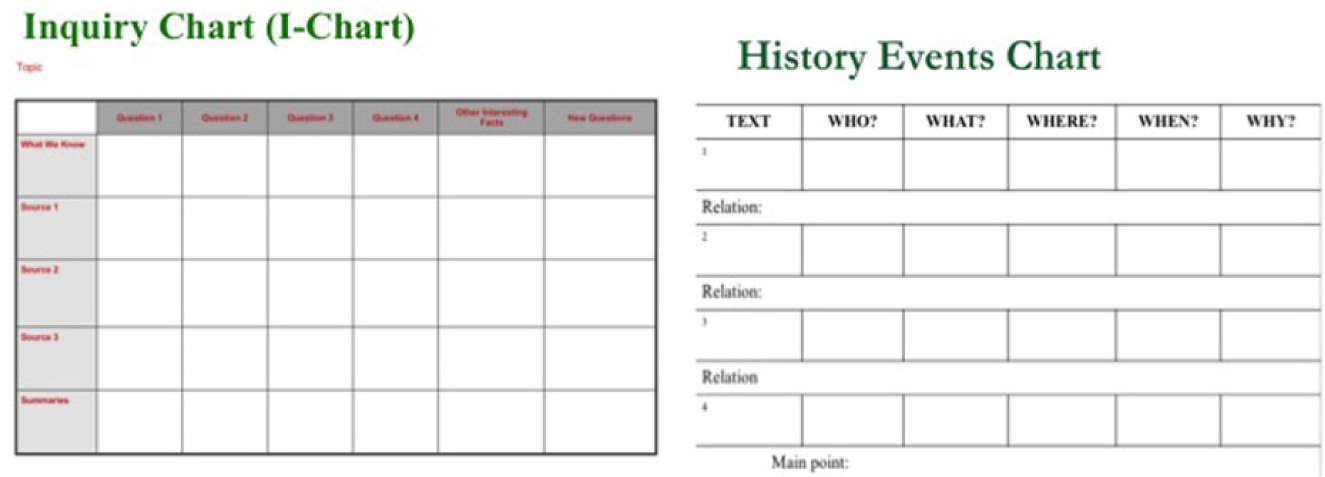
Inquiry and analysis charts.
Thus, in meeting the demands of national educational policy such as the CCSS, disciplinary literacy draws heavily from previously existing content area reading strategies. Indeed, there would appear to be scant evidence to warrant the claim that “content area reading is dead” (Shanahan, 2012a). Rather, at this stage of research in disciplinary literacy, the existing strategies of content area literacy have been slightly modified to align with a particular interpretation of the learning needs of various disciplines with attention to the particularities of core subjects in the sciences, social sciences, English, and other content areas. That is, the nuances and particularities or connaissance of these bodies of knowledge are in some ways being privileged over the totality or savoir of content area knowledge. It may well be that the desire and “will to truth” that embraces a disciplinary literacy focus is premature based on the scant research base for this movement and the fact that such strategies are derived from existing content area approaches possessing a lengthy and substantial research history (Lesley, 2014).
Reconstructing the Savoir: Resisting the Regime(s)
Support for a more balanced view of content area and disciplinary literacy have been advanced by recent scholarship (Brozo, Moorman, Meyer, & Stewart, 2013) that may better represent the savoir of the field. These researchers espouse that both content area literacy and disciplinary literacy are important but emanate from different processes. Brozo et al. argue,
Disciplinary literacy approaches are based on fundamentally different assumptions. Unlike the outside-in approach of content area reading, disciplinary literacy evolves from the inside out because the text itself and the goals for reading the text dictate the reading processes. (p. 354)
To mediate this dichotomy of approach, an integration of strategies may be useful. For example, Gillis (2014) argued for increased instructional scaffolding to integrate subject area teachers’ desire to impart concepts in their disciplines while ensuring student comprehension of key concepts. In history, this might involve helping students use Inquiry Charts to compare and contrast historical arguments and evaluate sources for credibility. In science, students have to become skilled at reading multimodal texts including diagrams, graphs, experimental results, flow charts, and so on. Various graphic organizers that include observation notes, inferences, and conclusions parallel scientific inquiry (Gillis, 2014). In essence, Gillis advocates using strategies such as these as a tool for learning so that students improve their disciplinary knowledge and overall literacy as well. This argument is well supported by earlier research including Hal Herber’s (1970) notion that content goals should lead to appropriate reading processes determined by the nature of the content.
Recent studies suggest that integrating disciplinary content knowledge and language knowledge, particularly academic vocabulary, helps scaffold students’ comprehension of texts across various disciplines (Love, 2010). These researchers noted the increasing diversity of students enrolled in high school. They worked with 300 teacher candidates in Australia to integrate content and language strategies to support students’ learning. The researchers concluded that the vast majority of these teacher candidates demonstrated content area language and vocabulary strategies to mediate students’ content learning across the disciplines.
Similarly, a large-scale New Zealand study (Lai et al., 2014) used what these researchers termed a “blended” approach that included generic strategies and discipline-specific elements with content area teachers in a learning community professional development noting,
We adopted a blended view of literacy in secondary schools, where both generic and content area literacy are important. By generic literacy, we mean that which is more or less applicable to all content areas and includes the decoding of multisyllabic words, knowledge of a large corpus of words, and control of generally applicable comprehension strategies, such as comprehension monitoring and repairing. (p. 308)
The researchers, working with mathematics, English, and science teachers in New Zealand to collaborate in a blended approach to professional development, found that this 3-year project was associated with increases in reading comprehension for students in their first 2 years of secondary school. The teachers worked together across interdisciplinary boundaries to develop curriculum that acknowledged both the particularities of their respective disciplines (Moje, 2008) and the contribution of generic strategies (e.g., graphic organizers). The researchers concluded that this longitudinal study challenged the belief that discipline-specific professional development is most effective in improving teacher learning and student achievement (Lai et al., 2014). Rather, teachers from different content areas were able to collaborate and focus on blended, interdisciplinary approaches to advancing student achievement.
The crux of the issue for researchers trying to reconceptualize content area literacy rests on the differences between “infusion models” that instruct content area teachers about the advantages of literacy strategies (e.g., graphic organizers), and more discipline-specific models that pay close attention to how “insiders” do authentic work in biology, English, history, and mathematics (Bean & Dunkerly-Bean, 2015).
Even with scaffolding and disciplinary literacy practices in support of struggling readers, it can take years to become knowledgeable in a discipline (Sawyer, 2006; Weisberg, 2006). Much of the current discussion of disciplinary literacy occurs without referencing the body of work on what it means to be an “expert” in a content area. For example, studies of master poets, painters, and musicians find that there is broad support for the 10-year rule (Sawyer, 2006; Weisberg, 2006). Similarly, philosopher and antique European motorcycle mechanic Matthew Crawford (2009) asserts, “Creativity is a by-product of mastery of the sort that is cultivated through long practice” (p. 51). In essence, masterwork in a field of endeavor yielded the most powerful contributions after spending at least 10-years in the field. Experts were characterized as able to persevere in arduous time-consuming tasks. This depiction of expertise may not mesh well with the more scattered nature of secondary schooling with bell schedules, multiple disciplines, athletics, clubs, and social relationships.
In another effort to resolve the disjuncture between content area and disciplinary literacy, Collin (2014) employed Bernstein’s work in the sociology of school epistemology to examine how discourses are transformed as they move from one field (e.g., the university setting) to another. Collin argued that neither the generic strategies approach nor the disciplinary approach are adequate because the strategies approach fails to account for the ways literacies in different content areas are represented by different discourses while the disciplinary approach “conflates content area discourses with university and professional discourses” (p. 306).
For example, disciplinary literacy in biology might involve high school students observing natural phenomena (e.g., box turtles laying eggs in the spring), and developing written reports on their observations in the manner of professional wildlife biologists. The problem in this instance is that secondary schools are simply not equivalent to universities or professional work sites in wildlife biology. Furthermore, Collin notes that high-stakes tests further emphasize a narrowing of the curriculum supported politically by the ideologies of those in power.
As a way to address the disjuncture between the strategies approach to content area learning that underplays differences across content areas and the disciplinary approach that underplays distinctions between secondary schools and university curriculum, Collin proposes the following solution. He argues for a process that exposes students to multiple genres that may be examined critically with an eye toward underlying ideologies. In this model, students would collect samples of a genre, identify how it operates, and compose texts within that genre that represent how this content might be recontextualized based on power issues. Students could then write counterpoint texts. Collin’s example of this process in action proposes that an English Language Arts class would study the genre of the high school newspaper op-ed discourse. Taking a critical stance, students could examine whose voices are represented in the newspaper and which voices are silenced. Moving one step further, they might then rewrite these texts with a social justice stance that offers a more authentic portrayal of a social issue.
At this stage of conceptualizing the disjuncture between generic strategy approaches and disciplinary approaches, additional research is needed to examine the potential of genre study as a means to bridge the limits of either approach. For example, Heller (2010) captured the unique purposes of secondary schools versus disciplines that have their roots in the modern university. Heller advances a kind of Renaissance goal of educating youth through opportunities to discuss issues and ideas in non-technical language. The goal then would be for secondary schools to develop well-informed amateurs who can fine-tune their disciplinary literacy prowess at the college level.
In summary, efforts to examine the affordances and constraints of content area and disciplinary literacy suggest that both, as regimes of truth, have the potential to mire the field in either/or positions that are antithetical to informing our practice through research. Infusion models, where content area teachers explore literacy strategies (e.g., graphic organizers), and more discipline-specific models aimed at understanding how discourse and truth values function in history, science, and mathematics both have limitations (Collin, 2014; Gillis, 2014; Heller, 2010; Lesley, 2014). In the section that follows, we address some of the ideas from emerging interdisciplinary approaches that may help ameliorate the current debate and move the field forward.
Discussion
Mansfield (2000) writes, “We are unsettled by things that cross lines, especially those that seem to belong to both sides, that blur and question the whole process of demarcation” (p. 83). As we have attempted to illustrate in this conceptual review, the opposing binary of content versus disciplinary connaissance locates knowledge in multiple silos where the specialization of discourse constitute regimes of truth (Kenway, 1990). It is an unintended though obvious consequence then, that the savoir becomes the unwitting victim of this bifurcation to the detriment of both the field and the learners (students, teachers, and researchers) within it.
In the text, Education and Democracy in the 21st Century (2013), Nel Noddings notes that disciplinary specialists as teachers must be able to navigate the inter-textual terrain in their field of study to help their students move from the general to the specific. In thinking about related topics, Noddings raises issues around hierarchical power assigned to the disciplines and wonders, “Why is a course in academic chemistry more important than one on nutrition?” (p. 43). This echoes Foucault’s (1980) position that the emergence of disciplinary experts in the form of what he termed the “specific intellectual” occurred in the aftermath of World War II and accelerated in importance throughout the 1960s. He noted that in particular, biologists and physicists became privileged experts: “It is rather he who, along with a handful of others, has at his disposal, whether in the service to the State or against it, powers which can either benefit or irrevocably destroy life” (p. 129).
While we in no way suggest disciplinary literacy holds the melodramatic potential to destroy, we do agree with Noddings, who challenges the isolation of the disciplines and argues for collaboration over competition. She takes to task the organization of curriculum “into specialized subjects that rarely make connections across the disciplines and almost totally ignore the great existential questions” (p. 57) such as the power of the sciences to create as well as destroy. In contrast, Noddings proposes an interdisciplinary curriculum that aligns closely with the natural world and sustainable practices in agriculture, and water pollution, biology, and health. She argues that we should be introducing big questions aimed at addressing the long-term health of our planet along with local ecological projects students can undertake (e.g., water quality studies). “An effective 21st century curriculum emphasizes connections, connections among the subjects taught and connections between school subjects and real life” (p. 91). For Noddings, this is not an abstract notion but one that arises from years of teaching high school algebra and trying to avoid an often isolated, “for its own sake” approach to mathematics that disenfranchises too many students.
Where might the ongoing debate over content area literacy and disciplinary literacy fall in this deconstruction of arguments favoring one regime of truth over another if we take up Nodding’s call to pay attention to connections across the disciplines? A noticeable omission in the content area literacy and disciplinary literacy discussions is the increasing need for curricula that crosses over disciplinary boundaries to address societal issues and problems that require an interdisciplinary perspective (Baildon & Damico, 2011; Williamson, 2013). Indeed, universities, including our own, have created departments and concentrations that acknowledge the need to collaborate on pressing problems in the STEM arena, and other fields including gaming, cultural studies, gender studies, and media studies among others.
Writing within the context of over 10 years of research in interdisciplinary learning as part of Project Zero at Harvard University, Mansilla (2014) argues,
Pressing social issues from poverty to climate change and global health challenge scientists, historians, psychologists, and artists to converge on solutions that transcend single-disciplinary perspectives. Interdisciplinary understanding (i.e., the ability to integrate knowledge from two or more disciplines to create products, solve problems, or produce explanations) is a hallmark of contemporary problem-solving and discovery—and a primary requirement for relevant education today. (p. 1)
One of the most recent and prominent examples of interdisciplinary teaching is the ongoing work of the Science Education for Public Understanding (SEPUP) curriculum design project at the University of California, Berkeley Lawrence Hall of Science (Nagle, 2013). The project develops modules and professional development courses that combine inquiry approaches integrating science, health, and environmental concepts and issues of interest to high school teachers and students. Contemporary world problems (e.g., climate change) call for interdisciplinary learning and delving deeply into a problem rather than trying to survey and cover a vast array of content. For example, overarching themes like climate change can be approached from an interdisciplinary perspective, drawing from earth science (atmosphere, weather, and climate), physics (heat and temperature), and life science (the impact of climate change on ecosystems). Larger concepts like stability and change can integrate thematic units across the disciplines.
While this is a powerful and promising model, Nagle (2013) cautions that there are a number of challenges to engaging students in deep understanding of fewer rather than more topics in science. Namely, standardized tests remain discipline specific with an emphasis on recall of declarative knowledge and definitions. If an interdisciplinary model is going to become a reality, a great deal of teacher preparation and professional development will be needed. For example, in an earlier study of the degree to which teachers adopted inquiry-based practices in science teaching, the researchers noted that at least 80 hours of professional development was needed to sustain this approach (Yore & Treagust, 2006).
Nevertheless, a growing number of contemporary high schools have been reorganized into magnet schools that emphasize particular disciplines (e.g., health science), and in some cases, interdisciplinary teaching (Hulette, 2014). In 2014, a high school in Virginia moved from a 1962 vintage building to a brand new facility designed to be a model of both energy conservation and interdisciplinary learning. The school is organized around six learning communities where teachers can collaborate across content areas. For example, an earth science teacher and an English teacher are collaborating in a study of weather and authentic writing (Hulette, 2014).
The Interdisciplinary and Global Studies Project in the Harvard University Graduate School of Education aims to develop high school students’ global competence through interdisciplinary education based on expert to novice mentoring (Mansilla, 2014). For example, a high school history and English teacher collaborated with science faculty in a project where their students tracked the production of everyday objects including cell phones, sneakers, and guitars (Mansilla & Jackson, 2011). One group of students represented a corporation interested in building a new shoe factory in a rural China province. They researched the economic and social impacts that would be seen as an economic engine for this area of the world. The other group of students represented NGO interests, initially opposed to the factory development. This group eventually approved the factory plan but with a proviso to carefully monitor labor practices in light of human rights issues. Global competence requires students to merge disciplinary knowledge and understanding with a capacity and disposition to act on issues of global significance, in this case, outsourcing manufacturing. It is in these types of approaches that we may see what Andrew Nelson terms the “commonalities among, spaces between and connections across disciplines.” In a TED talk given at University of Oregon titled Radical Interdisciplinarity and Other Ingredients for Innovation, Nelson argues that the root of innovation lies in the combination of radically different disciplines (https://www.youtube.com/watch?v=4cXRrNXK4zE).
At this early stage of understanding the impact of both disciplinary literacy and interdisciplinary teaching and learning, research is needed to gauge the challenges and benefits of moving in this direction (Lesley, 2014). In support of an integrated, interdisciplinary curriculum, researchers Baildon and Damico (2011) noted,
Problems such as climate change, pollution, disease, war, terrorism, financial crisis, public health, poverty, increasing inequality, and injustice affect all corners of the world and, thus, necessitate groups of people working across geographical boundaries and professional contexts and within, across, and outside of academic disciplines to address and solve those problems. (p. 38)
Clearly, as various interdisciplinary approaches to curriculum continue to evolve, we need additional, on-the-ground studies of how these efforts play out. As researchers move past the current contentious claims that proclaim “content area literacy is dead” and disciplinary literacy the successor, we suggest that taking up calls for innovative interdisciplinary work may provide those commonalities and connections to be recognized and utilized across approaches to their fullest potential. Perhaps what is most important and most beneficial is that the field becomes something it was not in the beginning. In an interview titled “Truth, Power, Self,” Foucault (1982/1988) said,
The main interest in life and work is to become someone else that you were not in the beginning. If you knew when you began a book what you would say in the end, do you think that you would have the courage to write it? What is true for writing and for a love relationship is true also for life. The game is worthwhile insofar as we don’t know what will be the end (p. 9).
The field of content-disciplinary literacy has brave and compelling work to do. The story is not yet complete, and we can offer neither epitaph nor encomium. Rather, we reflect on the words of Meredith Cherland and Helen Harper who urge us to “find new ways to work in the classrooms and new forms of research to inform our best efforts” (Cherland & Harper, 2007, p. 128). Rather than engage in competing regimes for whom there is no benefit, we may do well to recognize that our savoir responds to a shifting and amorphous educational, societal, and global context that is never stagnant or fixed.
Footnotes
Declaration of Conflicting Interests
The author(s) declared no potential conflicts of interest with respect to the research, authorship, and/or publication of this article.
Funding
The author(s) received no financial support for the research, authorship, and/or publication of this article.